Original Research Article
Occupational stress among female police officers in an urban setting in
South Kerala
Vivek S., Rosin George Varghese, Neethumol K. S., Sameena S. S., Reju R. S., Priya James,
Rashik Rasheed, Shereena V. H., Vijaysankar S.,
INTRODUCTION
Police force in any civil society is concerned with enforcement of the law so as to protect its people and property, and to prevent crime and civil disorder. A well-functioning police machinery ensures peaceful life for the inhabitants. But the police personnel‟s who carries out these tasks are often exposed to physical , mental and social stressors as a part of their job, like long and unpredictable working hours- round the clock duty, constant pressure to perform, accountability, work
overload and noxious physical environment.1 However this often goes underreported, under diagnosed and undertreated thus affecting the quality of workforce. Occupational stress among police personal is associated with a number of adverse organizational outcomes including poorer levels of commitment, depression, inability to concentrate and impulsive behaviour and an increased likelihood of resigning from the work.2 Police department which historically has been a male-dominated profession is now widely taken up by females also as a profession. Researchers have found female police officers
ABSTRACT
Background: Occupational stress is regarded as one of the major health hazards of modern workplace, with policing (law enforcement) being no exception. Women police officers are gradually increasing in numbers in the country and they are believed to experience more stress than their male counterpart. Hence this study was conducted with the objectives of estimating prevalence of occupational stress among female police personals in terms of operational and organizational stress and to identify the causes for these stress as perceived by them.
Methods: A cross sectional study was conducted among 50 female police officers working in various police stations of Thiruvananthapuram city, selected by simple random sampling, during the period May 2018 to July 2018,using a pre tested semi structured questionnaire based on operational police stress questionnaire (PSQ-OP) and organizational police stress questionnaire (PSQ-ORG). The data was properly coded and entered in Microsoft excel and analyzed using SPSS version 16.0.
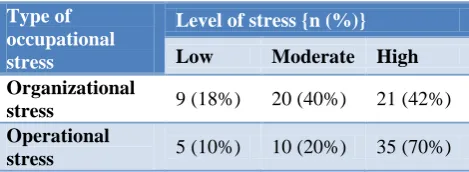
Results: Mean age of the study population was 38.07 years (SD=5.714 years) and majority (64%) belonged to middle socioeconomic class. Perceived organizational and operational stress prevalence among the study population was as high as 80% (40 % experienced moderate stress and 40% experienced high stress) and 90% (high stress reported by 70 % and moderate stress by 20%) respectively. The most common stressor reported for organizational stress was staff shortage (74%) and that for operational stress was finding time to stay in good physical condition (76%).
Conclusions: High prevalence of occupational stress calls for immediate attention from the officials.
Keywords: Women police, Operational stress, Organizational stress
Department ofCommunity Medicine, Al Azhar Medical College, Thodupuzha, Kerala, India
Received: 13 November 2018
Revised: 14 December 2018
Accepted: 18 December 2018
*Correspondence:
Dr. Rosin George Varghese, E-mail: [email protected]
Copyright: © the author(s), publisher and licensee Medip Academy. This is an open-access article distributed under the terms of the Creative Commons Attribution Non-Commercial License, which permits unrestricted non-commercial use, distribution, and reproduction in any medium, provided the original work is properly cited.
to be exposed to more stress which may be due to the multiple roles that are expected by the society and performed by females without adequate support in Indian context. Stress among police personnel, especially female police personnel, is now being acknowledged as an international phenomenon of serious concern.3 Understanding the importance, much work has gone into the field around the globe but unfortunately very few in our country. Hence this study was conducted with the objectives of estimating prevalence of occupational stress among female police personals in terms of operational and organizational stress and to identify the causes for these stress as perceived by them.
METHODS
After getting permission from the Commissioner of police Thiruvananthapuram city, this cross sectional study was conducted among the female police officers, working in various police stations of Thiruvananthapuram city, during the period May 2018 to July 2018.
Sample size
In a study conducted by Ragesh et al assessing the occupational stress among police personnel in India, it was found that 68% of the police personal experienced moderate organizational stress.4 Using this data minimum sample required for the current study was calculated using the formula
n= Zα2PQ/d2 taking „d‟ as 13% which is less than 20% of P, n=50. Hence this study was conducted among 50 female police officers.
Sampling technique
50 female police officers were selected from the list obtained from the office of the commissioner of police Trivandrum by simple random sampling method, using a random number table.
Study procedure
After getting permission from the commissioner of police Trivandrum city, list of female police officers working in the city was obtained and 50 officers were selected by simple random sampling method. An internal memo was sent to all selected female police officers informing them of the study. Informed consent was taken from each of the selected female police officer. Each study participant was then asked to fill a pretested semi structured questionnaire. Initial part of the questionnaire retrieved personal and socio demographic details of the study participants and the later part assessed the occupational stress. Occupational stress was measured by using operational police stress questionnaire (PSQ-OP) and organizational police stress questionnaire (PSQ-ORG), each having 20 items.5,6 Each subject was asked to rate
how stressful each item has been for him or her recently, on a seven-point Likert scale ranging from “not at all stressful” (Score: 1-3), “moderately stressful” (Score: 4-6), and “very stressful” (Score: 7). The mean total cut off scores for low, moderate and high stress for Operational police stress was at below 2.0, 2.1-3.4, and above 3.5, respectively. On the other hand, the mean total cut off scores for low, moderate and high stress levels for organizational police stress was at: below 2.6, 2.7-3.9, and above 4.0, respectively.7The questionnaire was translated to local language– Malayalam and translated back into English to ensure reliability and validity.
Statistical analysis
The data was properly coded and entered in Microsoft Excel. Further analysis was done using the software SPSS version 16.0. Qualitative variables were expressed as percentages and quantitative as mean with standard deviation. For testing associations chi square test was used for qualitative variables and t test / ANOVA for quantitative variables. Level of statistical significance was fixed at p<0.05.
RESULTS
The study sample consisted of 50 female police officers – 49 (98%) civil police officer and 1(2%) sub inspector. mean age of the study population was 38.07 years (SD=5.714 years) and majority (64%) belonged to middle socioeconomic class. All the participants were having an education of degree or above. 94% (n=47) of the participants were presently married and the remaining were unmarried (2%), divorced (2%) and widowed (2%). Mean years of work experience of the participants was found to be 10.42 years (SD=5.28). 88% were not having any co morbidities, while 8% (n=4) reported bronchial asthma , 4% reported diabetes mellitus as well as thyroid disorder. Majority (76%) were getting daily sleep less than 6 hours and only 34% reported to get a continuous sleep.
Table 1: Distribution of study population based on level of occupational stress.
Type of occupational stress
Level of stress {n (%)}
Low Moderate High
Organizational
stress 9 (18%) 20 (40%) 21 (42%)
Operational
stress 5 (10%) 10 (20%) 35 (70%)
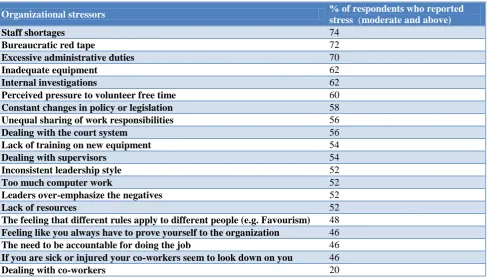
Bureaucratic red tape issues (72%) and the least stressor reported was dealing with coworkers (20%) (Table 2). On the other hand in case of operational stress, the most common stressor reported was finding time to stay in good physical condition (76%) followed by occupation related health issue issues (72%) and the least stressor
reported was shift in work time (48%) (Table 3). The study could not find any association between occupational stress (organizational as well as operational stress), and age of the subject, duration of service, socioeconomic class, duration of sleep and physical illness (Table 4).
Table 2: Causes of organizational stressors with percentage of subjects reporting them.
Organizational stressors % of respondents who reported
stress (moderate and above)
Staff shortages 74
Bureaucratic red tape 72
Excessive administrative duties 70
Inadequate equipment 62
Internal investigations 62
Perceived pressure to volunteer free time 60
Constant changes in policy or legislation 58
Unequal sharing of work responsibilities 56
Dealing with the court system 56
Lack of training on new equipment 54
Dealing with supervisors 54
Inconsistent leadership style 52
Too much computer work 52
Leaders over-emphasize the negatives 52
Lack of resources 52
The feeling that different rules apply to different people (e.g. Favourism) 48
Feeling like you always have to prove yourself to the organization 46
The need to be accountable for doing the job 46
If you are sick or injured your co-workers seem to look down on you 46
Dealing with co-workers 20
Table 3: Causes of operational stressors with percentage of subjects reporting them.
Operational stressors % of respondents who reported
stress(moderate and above)
Finding time to stay in good physical condition 76
Occupation related health issues 72
Fatigue 68
Eating healthy at work 68
Lack of understanding from family and friends about work 66
Working alone at night 48
Feeling like always on the job 66
Managing social life outside of work 66
Paperwork 64
Negative comments from the public 62
Overtime demands 62
Not enough time available to spend with friends and family 60
Friends or family feel the effects of the stigma associated with job 60
The risk of being injured on the job 60
Work related activities on off days 58
Upholding a “higher image” in public 56
Making friends outside the job 54
Traumatic events 52
Limitations to social life 50
Table 4: Statistical summary.
Variables Test of significance P value
Organizational stress Operational stress
Age (>35 years) Chi square test 0.715 0.355
Socio economic class Chi square test 0.501 0.500
Duration of service t test 0.666 0.718
Duration of sleep t test 0.890 0.582
Physical illness Chi square test 0.063 0.103
DISCUSSION
Policing, due to the unique stressors, has been widely regarded as a stressful profession, which in turn results in disruption of the psychological as well as physiological homeostasis of the individual, leading to deviant functioning in the working environment. The current study also demonstrated a very high prevalence of occupational stress– 90 % reported operational stress (high stress by 70 % and moderate stress by 20%) and 80% reported organizational stress (both high stress and moderate stress by 40% each).This prevalence was higher when compared to that reported by Ragesh et al who demonstrated organizational stress to be 72% (moderate stress in 68% and high stress in 14%) prevalence of operational stress to be 83% (moderate stress in 67% and high stress in 16.5%).4 This difference might be due to the fact that current study recruited only female police officers. Berg et al, Maran et al as well as Ragesh et al found that policewomen reported higher stress levels than their male colleagues.4,8,9 As shown above, the current study showed perceived operational stress to be higher than organizational stress. This is contrary to the findings of Gershon et al as well as Brooks and Piquero who claimed administrative or organizational stress to be more than operational stress.10,11
The current study didn‟t find any statistically significant association between years of experience and stress. But many previous studies reported workers with more years of service to have lower stress levels than colleagues with less experience. Reporting of shortage of staff and the resultant excessive administrative duties as the leading cause of organizational stress should be an eye opener. Negative comments from the public as well stigma about police job held by the family and friends resulting in operational stress is really a matter of concern.
Study couldn‟t demonstrate any significant association between occupational stress and life style disorders like Type 2 diabetes mellitus and hypertension. Tharkar et al demonstrated the prevalence of metabolic syndrome to be significantly higher among police compared to general population and attributed stress as one of the contributing factors to this condition.12 Similar views were expressed by Kumar et al as well as Saha et al.13,14
CONCLUSION
This study conducted among the female police officers further strengthen the view that policing is associated with high stress. Perceived organizational and operational stress prevalence was as high as 80% and 90% respectively. This calls for immediate attention from the officials as occupational stress can have an extremely negative impact on the physical, mental and social health as well as professional life of the police officers.
Limitations
This study was conducted using a pretested semistructured questionnaire, in which majority of the questions assessing dietary habits are answered on a Likert scale. Hence subjective bias could have occurred.
Recommendations
1. All those who were found to be having occupational stress as per this study needs to be followed up, given expert medical care.
2. Police personals must be made aware about consequences of occupational stress.
3. Understanding the gravity of situation, authorities must take efforts to identify and occupational stress among female police personals in hopes of improving their overall health and thus contributing to healthy work force.
ACKNOWLEDGEMENTS
The authors acknowledge the support received from The Principal Al Azhar medical college and officials of Kerala Police, in the completion of the study. The hospitable nature and cooperation of the study participants are also acknowledged at this moment.
Funding: No funding sources Conflict of interest: None declared
Ethical approval: The study was approved by the Institutional Ethics Committee
REFERENCES
2. Brown J, Cooper C, Kirkcaldy B. Occupational stress among senior police officers. Br J Psychol Lond Engl. 1996;87(1):31–41.
3. Kirkcaldy BD, Furnham A. Coping, seeking social support and stress among German police officers. Eur Rev Appl Psychol. 1995;45:237–46.
4. Ragesh G, Tharayil HM, TP Meharoof Raj, Philip M, Hamza A. Occupational stress among police personnel in India. Open J Psychiatry Allied Sci. 2017;8:148-52 .
5. McCreary DR, Thompson MM. Operational Police Stress Questionnaire (PSQ-Op). Available at: https://www.statisticssolutions.com/operational-police-stress-questionnaire-psq-op/. Accessed on 2 May 2018.
6. McCreary DR, Thompson MM. Organizational Police Stress Questionnaire (PSQ-Org). Available at: www.midss.ie. Accessed on 2 May 2018. 7. McCreary DR, Fong I, Groll DL. Measuring
policing stress meaningfully: establishing norms and cut-off values for the Operational and Organizational Police Stress Questionnaires. Police Pract Res. 2017;18(6):612–23.
8. Berg AM, Hem E, Lau B, Ekeberg Ø. An exploration of job stress and health in the Norwegian police service: a cross sectional study. J Occup Med Toxicol. 2006;1(1):26.
9. Acquadro Maran D, Varetto A, Zedda M, Ieraci V. Occupational stress, anxiety and coping strategies in police officers. Occup Med. 2015;65(6):466–73.
10. Gershon RRM, Lin S, Li X. Work stress in aging police officers. J Occup Environ Med. 2002;44(2):160–7.
11. Brooks LW, Piquero A, Cronin J. Police Officer Attitudes Concerning Their Communities and Their Roles: A Comparison of Two Suburban Police Departments. Am J Police. 1993;12(3):115–39. 12. Tharkar S, Kumpatla S, Muthukumaran P,
Viswanathan V. High prevalence of metabolic syndrome and cardiovascular risk among police personnel compared to general population in India. J Assoc Physicians India. 2008;56:845-9.
13. Kumar P, Mallik D, Mukhopadhyay DK, Sinhababu A, Mahapatra BS, Chakrabarti P. Prevalence of diabetes mellitus, impaired fasting glucose, impaired glucose tolerance, and its correlates among police personnel in Bankura District of West Bengal. Indian J Public Health. 2013;57:24-8. 14. Saha A, Sahu S, Paul G. Evaluation of
cardio-vascular risk factor in police officers. Int J Pharma Bio Sci. 2010;1(4):263-71.
Cite this article as: Vivek S, Varghese RG,