VOLUME 14 | ISSUE 1 | 2019 | 47
Improvement of knowledge and postural habits
after an educational intervention program in
school students
VICENTE MIÑANA-SIGNES 1 , MANUEL MONFORT-PAÑEGO, SAMUEL ROSALENY-MAIQUES
Body Languages Didactics Department, Academic Unit of Physical Education, University of Valencia, Spain
ABSTRACT
To study the effect of an educational intervention programme concerning knowledge and postural habits for back health on a group of 10 to 11-year-old students. Two groups of 5th grade primary school students were selected. A control group (CG) (n=16), and an experimental group (EG) (n=16) who developed a back-health educational programme. A follow-up was carried out one month after the end of the intervention. The proposed educational intervention improved the results of both the knowledge and postural habits of the participants. The increase in the level of knowledge concerning health and back care in the daily lives of the EG (x̅=6.32) was significantly greater than that observed in the CG (x̅=3.86), with a high effect size (U = 29.500; Z = -3.717; p <0.001, r = 0.66). In daily postural habits, the EG (x̅= 88.38) also increased their score significantly (U= 7.50; Z = -4.55; p <0.001, r = 0.80) compared to the CG (x̅= 74.88).In both knowledge and postural habits, the scores increased in the intervention. The educational intervention programme studied improves both knowledge and postural habits for back health of the 5th grade students participating in the study. The Physical Education class seems to be an ideal environment to develop back health educational programmes. Keywords: Physical education, Educational intervention, Knowledge, Postural habits, Primary education.
1Corresponding author. University of Valencia, Spain.
E-mail: [email protected] Submitted for publication April 2018 Accepted for publication July 2018 Published in press July 2018
JOURNAL OF HUMAN SPORT & EXERCISE ISSN 1988-5202 © Faculty of Education. University of Alicante
doi:10.14198/jhse.2019.141.04
Cite this article as:
48 | 2019 | ISSUE 1 | VOLUME 14 © 2019 University of Alicante
INTRODUCTION
It is currently estimated that low back pain prevalence in children and adolescents is high during the course of their lives, ranging from 7% to 72% (Jeffries et al., 2007), the average being 39.9% (Calvo-Muñoz et al., 2013). In Spain, the study by Kovacs et al. (2003), conducted with school children aged between 13 and 15 from the island of Mallorca, found a prevalence of back pain of 50.9% for boys and 69.3% for girls. A more recent study on a sample of 1,500 adolescents aged between 12 and 18 from the Valencian Community detected a 44.5% prevalence of low back pain, this being higher in girls (50.3%) than in boys (38.9%) (Miñana-Signes & Monfort-Pañego, 2015a).
According to several authors (Fairbank et al., 1984; Korovessis et al., 2004; Leboeuf-Yde & Kyvik, 1998), there is a noticeable increase in DLI between 10 and 14 years of age. For these reasons, it seems recommendable to start the back-care education and training of the scholastics in this age group or before.
For these reasons, numerous authors (Balague et al., 1996; Cardon et al., 2000; Cardon et al., 2002; Dolphens et al., 2011; Foltran et al., 2012; Geldhof et al., 2007; Habybabady et al., 2012; Hill & Keating, 2015; Leboeuf-Yde & Kyvik, 1998; Olsen, 1990; Spence et al., 1984; Vidal et al., 2013; Viry et al., 1999) advocate for a better understanding of the current situation in school-age youths, and for developing educational intervention programmes on back care education of children in the school context.
According to Johnson and Deshpande (2000), schools have enormous potential to help students develop the knowledge and skills they need to be healthy. School is the main social institution with the responsibility to promote health. One of the most important tools for the prevention of back problems, or to minimize their frequency and severity, is to develop educational intervention programmes to acquire health knowledge and habits for the lower back (Mendez & Gomez-Conesa, 2001).
Some intervention studies have concluded that the development of educational programmes for back care can improve back health in schoolchildren (Geldhof et al., 2007; Jones et al., 2007). However, the review studies indicate that these improvements are still inconclusive (Calvo-Muñoz et al., 2012; Heymans et al., 2005; Michaleff et al., 2014; Steele et al., 2006). In them, the main problem is that the works are of low quality due to the lack of agreement concerning the use of evaluation tools for health promotion research. For these reasons, the purpose of this research was to study, with validated instruments, the effect of an educational intervention programme for improving knowledge and postural habits in a group of elementary school students aged between 10 and 11. As a research hypothesis, the authors considered that after the application of the intervention program the levels of knowledge and postural habits would improve in the students.
METHODOLOGY
A quasi-experimental study was designed with an intervention and data collection at three different times. The first time was before the intervention or pre-intervention. The second time was at the end of the intervention or post-intervention and for the third time, or to follow-up, four weeks after the end of the intervention.
Participants
VOLUME 14 | ISSUE 1 | 2019 | 49
(SD = 0.34), and the experimental group consisted of 16 students with an average age of 11.19 (SD = 0.4). Both groups were made up of 8 girls and 8 boys.
Selection criteria
The inclusion criteria that were followed were that the students must be between 10 and 12 years of age and be attending the 5th year of primary education.
The exclusion criteria were: not having returned the informed consent signed by the parents; having missed the intervention programme more than twice or not participated due to illness or disability, and not having completed all the questionnaires in the three registration times.
Evaluation instruments
Nordic questionnaire
The Nordic questionnaire on back health (Kuorinka et al., 1987) includes questions related to the duration of back pain symptoms over time, such as the pain suffered over the last 12 months, and during the last week, as well as in different situations. This questionnaire has been validated in several languages, including Spanish (de Barros & Alexandre, 2003).
Health questionnaire on back care knowledge concerning practice physical activity and exercise for adolescents (HEBACAKNOW-PAE)
The HEBACAKNOW-PAE is a validated questionnaire (Miñana-Signes & Monfort-Pañego, 2015b) that aims to measure the degree of knowledge that young people have about health and back care related to activity and physical exercise. This questionnaire is composed of 13 multiple-choice questions with three possible options, only one of them being correct. The score scale is between -5 and 10 points. The items refer to knowledge about physical conditioning, about muscle strengthening and about stretching and joint mobility.
Health questionnaire on back care knowledge concerning physical activities in daily life for adolescents (HEBACAKNOW-DL)
The HEBACAKNOW-DL is a validated questionnaire (Monfort-Pañego et al., 2016) with a single construct that aims to discover the level of knowledge students have about health and back care in daily activities. It is composed of 24 multiple-choice questions with four possible options, only one of being correct. The score scale is between -3 and 10 points. The questions are related to categories of knowledge termed: anatomical-topographical, anatomical-functional, posture habits when standing, seated and lying down, how to carry weights using backpacks and on how to lift heavy loads.
Health questionnaire on back care postural habits concerning physical activities in daily life for adolescents (HEBACAPOHA-DL).
HEBACAPOHA-DL is a validated questionnaire (Monfort-Pañego, Molina-García, Calabuig-Moreno, & Bosch-Biviá, 2010) whose scores report on the level of health of postural habits in daily life. It is made up of 30 questions, the scores of which function as a single construct. The score scale is between 0 and 120 points. It asks about posture habits when standing and wearing shoes, sitting posture when studying and using a computer, the handling of heavy objects and the use of backpacks, and posture habits when lying down.
Process
50 | 2019 | ISSUE 1 | VOLUME 14 © 2019 University of Alicante
complete the collection of information. An experienced researcher presented the questionnaires to the students, explained the procedure and rules for their completion and personally answered all the questions that the participants might have. The data collection occurred at the same time intervals for both groups.
All the students voluntarily participated in the study. The management of the centres, the class tutors, and the parents were informed about the study in writing and expressed their consent.
Intervention
The intervention with the experimental group took place over a two-week period. There were seven sessions, each one lasting 45 minutes, which occurred during the real school context and in the physical education classes. The control group followed the normal programme of physical education classes.
The intervention was based on the guidelines of the Valencian Community Primary Education curriculum , as well as previous scientific studies on the subject (Cardon et al., 2000; Geldhof et al., 2007; Gómez-Conesa et al., 2001; Lorenzo González & García Soidán, 2009; Martínez García, 2014; Martínez-González et al., 2008). Specifically, the programme was made up of a theoretical session and 6 practice sessions.
The sessions and contents of the back-health education programme were as follows:
1st session: Presentation and justification of the intervention. Explanation of basic knowledge
The power point program was used to make a theoretical presentation of 40 min. on back health. During the explanation, the teacher used a teaching style based on problem solving and guided discovery in which the students had to answer questions about the subject. The slides talked about the anatomy and functions of the back; most common pathologies of the spine, correct and incorrect postural habits, physical exercise for the back health, and the principles of a healthy back.
2nd session: Practice of daily postural habits through circuits
The teacher placed different tasks along the gym, and while one partner practiced the postural habit, the other observed and evaluated the action by means of a rubric. The habits worked were: sitting, lifting objects, transporting objects, sleeping, writing, sweeping, brushing teeth, using a mobile phone, carrying a backpack, carrying a backpack, etc. In the final part, the students practiced the initiation to the progressive relaxation of Jacobson.
3rd session: Practical continuation of everyday postural habits through motor games
This session consisted of doing racing games with CORE exercises by teams in the warm-up, relay races with cards about postural habits to classify in groups, and more practice of progressive relaxation of Jacobson.
4th session: Development of the flexibility of the hamstring musculature
During this session, the teacher took the opportunity to teach how to stretch while maintaining a proper body posture for the spine, and also to show how to stretch the muscles directly involved with back health such as the lumbar quadrate, paravertebral, latissimus dorsi, psocas ilicao, hamstrings, etc.
5th and 6th sessions: Strengthening the trunk musculature
VOLUME 14 | ISSUE 1 | 2019 | 51
forward. Sports initiation games were also practiced with exercises to work the CORE muscles. 3x3 matches of football and floorball were played in which a teammate had to act as a goalkeeper for a while, adopting the position of front plank bridge, side bridge, or pelvis lift. In the mini-tennis matches the network was formed by two players in the position of bridges, etc. Softballs were used and the partners changed roles within the team and sports.
7th session: Synthesis session and final reinforcement
In the last session, the students held a relay race to collect and classify cards with postural habits. And they ended the session playing a trivial about the concepts and habits learned during the didactic unit.
This intervention was carried out by a specially trained physical education teacher. For its development, following the instructional models for physical education (Metzler, 2005), an intervention was prepared based on the use of direct instruction, pair-work teaching, cooperative learning and research and problem solving. The use of these methods was intended to make the students active participants in the learning process, inviting them to search for information, setting activities that pose problems in real-life situations which imply the need to apply the theory learned in practice and creating self-evaluation and peer evaluation situations, always under teacher supervision.
Statistical analysis
The data analysis was carried out using SPSS® IBM® software, r. 24. Firstly, a univariate descriptive analysis was carried out for each group. The Mann-Whitney test was applied for two independent samples. The chi-square test was applied to analyse the relationship of the group with the qualitative variables. The Friedman test was used to study the evolution of the groups over time. The Wilcoxon test was applied to compare the differences between pairs of values obtained at different times. The level of significance for all comparisons was set at 5%.
RESULTS
Analysis of the study simple
Table 1 shows and compares, the age, weight, height and BMI values of the study groups. The data show that there are no differences in the results obtained between the two study groups.
The study of the contrast of the results obtained from the Nordic questionnaire between groups indicated that there are no significant differences in the prevalence of clinical symptoms in the neck, arms, spine, shoulders, legs and other parts of the body, as well as in the characteristics related to low back pain.
Table 1. Descriptive statistics of age and anthropometric data according to the group and its contrast with the Mann-Whitney test
Experimental (n = 16) Control (n = 16) Mann-Whitney test
x̅ SD Md x̅ SD Md U Z p r
Age (years) 11.19 0.40 11.00 11.13 0.34 11.00 120.00 -0.48 0.63 0.08 Weight (Kg) 40.14 6.11 39.00 39.94 7.97 40.50 126.50 -0.06 0.95 0.01 Height (m) 1.45 0.10 1.43 1.49 0.07 1.48 90.00 -1.43 0.15 0.25 BMI (Kg/m2) 19.16 3.22 19.09 17.97 2.89 18.74 105.50 -0.85 0.40 0.15
52 | 2019 | ISSUE 1 | VOLUME 14 © 2019 University of Alicante
Effects of the educational intervention on the HEBACAKNOW-PAE
The first test of Mann-Whitney (table 2) shows that both groups had similar scores in the HEBACAKNOW-PAE before the intervention. After the application of the intervention, the experimental group had a significantly higher score both in the post-intervention and the follow-up.
Friedman's test for the study of the variation of the scores over time in each of the groups indicated that in both groups there has been a significant change (table 2).
The analysis of the differences between time pairs, according the second Mann-Whitney test (table 2), indicated that the increase in the score between pre-intervention and post-intervention was significantly higher in the experimental group. The difference between the score in the follow-up and pre-intervention stages was also significantly higher in the experimental group. However, the decrease in the post-intervention score at follow-up was similar for both groups.
Table 2. Descriptive statistics of the scores in the HEBACAKNOW-PAE according to the group in the pre-intervention, post-intervention and follow-up. Mann-Whitney test on the differences between groups. Friedman's test to study the evolution over time in each group. Wilcoxon test to study the comparisons by pairs of times in each group
Experimental (n = 16) Control (n = 16) Mann-Whitney Test
HEBACAKNOW-PAE x̅ SD Md x̅ SD Md U Z p r
Pre-intervention 2.36 0.72 2.31 2.04 0.90 1.92 92.00 -1.37 0.170 0.24 Post-intervention 6.56 1.28 6.54 3.99 0.98 3.85 14.50 -4.29 <0.001 0.76 Follow-up 5.03 1.75 4.43 3.03 1.38 2.89 48.00 -3.03 0.002 0.54
Friedman test χ2 df p 27.226 2 <0.001 20.590 2 <0.001 Mann-Whitney Test
Post-Pre 4.21 1.18 4.04 1.95 0.84 1.93 13.50 -4.33 <0.001 0.77 Follow-Pre 2.67 1.71 2.12 0.99 1.35 1.15 58.00 -2.65 0.008 0.47 Follow-Post -1.54 1.74 -1.54 -0.96 1.11 -1.35 100.00 -1.06 0.290 0.19
Wilcoxon test Z p r Z p r
Post-Pre -3.519 <0.001 0.88 -3.421 0.001 0.86 Follow-Pre -3.467 0.001 0.87 -2.452 0.014 0.61 Follow-Post -2.609 0.009 0.65 -2.626 0.009 0.66
x̅: mean; SD: Standard deviation; Md: median; U: Statistic of Mann-Whitney; Z: statistical standard; p: level of critical significance; r: statistical effect size; df: degrees of freedom.
Pair comparison (Wilcoxon test, table 2) between the different times in each group showed that, in both groups, there were significant changes in the HEBACAKNOW-PAE scores for all the contrasted items. The scores increased significantly after the intervention and decreased significantly in the follow-up with respect to the post-intervention. However, despite this observed reduction, the significant increase in scores between the pre-intervention and follow-up was maintained in both groups. This showed that the significant improvement in scores was maintained over time.
Effects of the intervention on the HEBACAKNOW-DL
VOLUME 14 | ISSUE 1 | 2019 | 53
Table 3. Descriptive statistics of the HEBACAKNOW-DL based on the group. Mann-Whitney test to study the differences between groups. Wilcoxon test to study the differences between pre-intervention and post-intervention in each group
Experimental (n = 16) Control (n = 16) Mann-Whitney test
HEBACAKNOW-DL x̅ SD Md x̅ SD Md U Z p r
Pre-intervention 3.32 1.24 3.69 2.43 1.18 2.44 75.00 -2.00 0.045 0.35 Post-intervention 6.32 1.57 6.55 3.86 1.18 3.63 31.00 -3.67 <0.001 0.65
Wilcoxon test Z p r Z p r
Pre-Post -3.518 <0.001 0.88 -3.413 0.001 0.85
x̅: mean; SD: Standard deviation; Md: median; U: Statistic of Mann-Whitney; Z: statistical standard; p: level of critical significance; r: statistical effect size.
The difference between the scores obtained in the different recording times was significantly different for both groups (Wilcoxon Test, Table 3).
Effects of the intervention on the HEBACAPOHA-DL
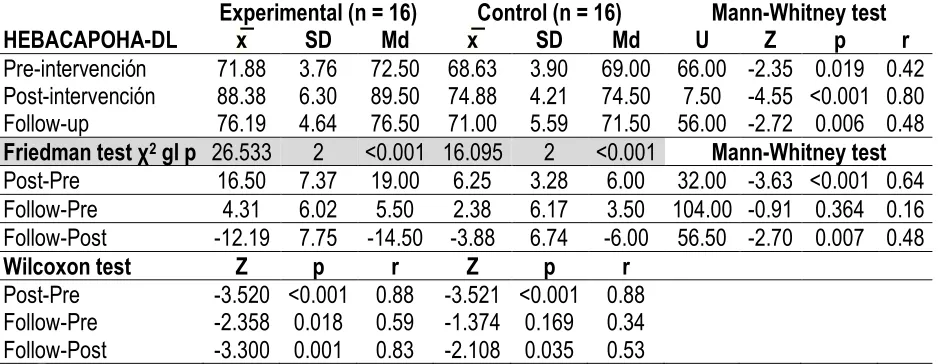
The analysis of the effect of the intervention on the score recorded in postural habits showed that both groups were not equivalent before the intervention; the score of the experimental group being higher (Table 4), although its effect size was small (r = 0.42). The experimental group also obtained a significantly higher score than the control both in the post-intervention and the follow-up.
The analysis of the change over time yielded significant results in the two groups according to the Friedman tests (Table 4).
Table 4. Descriptive statistics of the HEBACAPOHA-DL scores based on the group in the pre-intervention, post-intervention and follow-up. Mann-Whitney test to study the differences between groups. Friedman's test to study the evolution over time in each group. Wilcoxon test to perform the pairwise comparisons in each group
Experimental (n = 16) Control (n = 16) Mann-Whitney test
HEBACAPOHA-DL x̅ SD Md x̅ SD Md U Z p r
Pre-intervención 71.88 3.76 72.50 68.63 3.90 69.00 66.00 -2.35 0.019 0.42 Post-intervención 88.38 6.30 89.50 74.88 4.21 74.50 7.50 -4.55 <0.001 0.80 Follow-up 76.19 4.64 76.50 71.00 5.59 71.50 56.00 -2.72 0.006 0.48
Friedman test χ2 gl p 26.533 2 <0.001 16.095 2 <0.001 Mann-Whitney test
Post-Pre 16.50 7.37 19.00 6.25 3.28 6.00 32.00 -3.63 <0.001 0.64 Follow-Pre 4.31 6.02 5.50 2.38 6.17 3.50 104.00 -0.91 0.364 0.16 Follow-Post -12.19 7.75 -14.50 -3.88 6.74 -6.00 56.50 -2.70 0.007 0.48
Wilcoxon test Z p r Z p r
Post-Pre -3.520 <0.001 0.88 -3.521 <0.001 0.88 Follow-Pre -2.358 0.018 0.59 -1.374 0.169 0.34 Follow-Post -3.300 0.001 0.83 -2.108 0.035 0.53
x̅: mean; SD: Standard deviation; Md: median; U: Statistic of Mann-Whitney; Z: statistical standard; p: level of critical significance; r: statistical effect size; df: degrees of freedom.
pre-54 | 2019 | ISSUE 1 | VOLUME 14 © 2019 University of Alicante
intervention were similar for both groups. However, after the intervention there was a decrease in both groups, which was significantly higher in the experimental group (Table 4 although with a small effect size (r = 0.48).
From the analysis of the pairwise comparisons of the different recording times (Wilcoxon test, Table 4), it was observed that in both groups there was a significant increase in scores after the intervention. The effect of the significant improvement in the scores in the follow-up compared to the pre-intervention was only maintained in the experimental group, although the decrease observed in the contrast of the post-intervention until the follow-up was significant for both groups.
DISCUSSION
The objective of this study was to study the effect of an educational intervention program related to knowledge and postural habits for back health in a group of students from 10 to 11 years of age.
The results of our study show a significant improvement in the students. The Mann-Whitney test on the contrast of the scores obtained for both groups, and the contrast of the differences of the different times between the groups, indicated that the experimental group was the one that obtained significantly greater scores and improvements similar to previous studies (Geldhof et al., 2007; Jones et al., 2007).
Another important aspect that this work includes is the analysis of the effect of the passage of time on the knowledge and habits acquired after the intervention. As in previous studies (Geldhof et al., 2007; Vidal et al., 2013), the results of our study confirm the maintenance of the improvement of knowledge and habits in relation to the pre-test. Although in our study the follow-up took place one month after the intervention, studies with longer follow-up periods, three months (Habybabady et al., 2012; Kovacs et al., 2011; Vidal et al., 2013), one year (Mendez & Gomez-Conesa, 2001), two years (Geldhof et al., 2007) and 8 years (Dolphens et al., 2011), also found similar results. This improvement over time indicates the existence of a positive long-term effect of interventions on knowledge and habits.
Therefore, we can say that our results suggest that the most important cause of the improvements in scores in both knowledge and habits for back care was the analysed educational intervention. Related to this, previous studies point to healthy lifestyle habits, and active lifestyles, as prevention factors that would guarantee health and the greatest quality of life (Steptoe & Butler, 1996).
On the other hand, although improvements in the scores occurred for all the variables studied, we must carefully analyse whether or not this is due to the intervention. Both the Friedman Test and the Wilcoxon Test indicate that the control group obtained improvements in their scores provided by the different instruments used, which suggests that there has been some interference.
We believe that the test effect may have influenced learning and retention of knowledge (Adesope, Trevisan, & Sundararajan, 2017). Besides, we consider another cause of the interference in the variables measured could be the fact that the control group was part of a group of students belonging to the same educational centre as the experimental group, and that both groups were in regular contact.
VOLUME 14 | ISSUE 1 | 2019 | 55
Cardon et al. (2001) comment that teachers can play an important role in the effectiveness of education about back care. Likewise, Sallis and Nader (1988, cited by Cardon et al., 2002) point out that parents also play a vital role as early influences on health and that schools can take advantage of this fact. Similarly, it is argued (Cardon et al., 2001) that the Physical Education teacher is best positioned and prepared to observe the students' posture, and to elaborate a back-care educational programme and preventative action in collaboration with school health services. Moreover, it is possible to offer prolonged, continuous feedback, and reach a large percentage of young people.
Despite the limited number of hours that Physical Education (PE) has in the centres, the role of the PE teacher can be important, mainly for the application of the principles of back care (Balague et al., 1996). Hence It is important that primary and secondary school teachers receive adequate training related to the principles of back health to help reduce back problems (Balague et al., 1996; Cardon et al., 2007).
At this point, it is important to remember that knowledge per se is probably not enough to change people’s
habits or healthy behaviour (Ennis, 2007; Keating et al., 2009; Placek et al., 2001). But, for habits to become the fundamental element to improve health, and specifically back care, access to knowledge and information must be the starting point of the teaching-learning process along with establishing said healthy physical activity habits (Keating, 2003; Nahas, 1992). It is widely accepted that voluntary behaviour is influenced by the corresponding knowledge (Brynteson & Adams, 1993), and that one of the most important tools to prevent back problems, or to minimize their frequency and severity once produced, involves the acquisition of knowledge about lower back health (Gómez-Conesa et al., 2001).
As observed in the results of this study, the level of knowledge concerning health and back care was very low in adolescents, coinciding with other studies (Miñana-Signes, 2017; Minana-Signes & Monfort-Panego, 2015). Hence, educational interventions are relevant and necessary for students to improve knowledge that will allow them to produce changes in relevant habits.
This relationship between knowledge and habits must be transferred over into daily life. As Schwartz and Jacobs (1992) explain, in order to achieve safe lifting habits it is not enough just to train people in the biomechanical principles: people must also be willing to apply this knowledge in their daily tasks, arguing that effective and safe programmes are those that help to modify cognitive structures and allow people to make appropriate decisions whenever necessary.
The joint improvement of knowledge and habits opens up a course for future work, namely the study of
people’s relationship with health and quality of life. In order to discover if the relationship between knowledge and know-how, between knowledge and healthy habits, has a real effect on back health, future longitudinal studies, which include objective measures of back health are necessary. In this respect, in the current literature we find instruments that allow us to discover the general level of health and well-being of young people (Vilagut et al., 2005).
56 | 2019 | ISSUE 1 | VOLUME 14 © 2019 University of Alicante
current literature answers the question: ¨What is a bad back? ¨ However, it is necessary to also work to find answers to the question: ¨What is a healthy back? Therefore, future research needs to be directed to the development of easy-to-use instruments that provide us with this information.
CONCLUSSION
The educational intervention programme studied improves 5th grade primary education students’ knowledge and habits concerning health and back care. However, the learning achieved decreases over the passage of time once the educational programme finishes. Physical Education classes seem to be the ideal environment to develop educational programmes on back-health. In order to continue improving intervention programmes, and their effects, more intervention studies using validated instruments are required.
ACKNOWLEDGEMENTS
The primary school and physical education teachers who accepted to participate in this study.
CONFLICT OF INTEREST STATEMENT
Non-declared
FUNDING
Non-declared
REFERENCES
Adesope, O. O., Trevisan, D. A., & Sundararajan, N. (2017). Rethinking the use of tests: A meta-analysis of practice testing. Review of Educational Research, 87(3), 659-701. https://doi.org/10.3102/0034654316689306
Balague, F., Nordin, M., Dutoit, G., & Waldburger, M. (1996). Primary prevention, education, and low back pain among school children. Bulletin (Hospital for Joint Diseases (New York, N.Y.)), 55(3), 130-134.
Biering-Sorensen, F. (1984). Physical measurements as risk indicators for low-back trouble over a one-year period. Spine, 9(2), 106-119. https://doi.org/10.1097/00007632-198403000-00002
Brynteson, P., & Adams, T. M. (1993). The effects of conceptually based physical education programs on attitudes and exercise habits of college alumni after 2 to 11 years of follow-up. Research Quarterly for Exercise and Sport, 64(2), 208-212. 10.1080/02701367.1993.10608798 Retrieved from http://dx.doi.org/10.1080/02701367.1993.10608798
Calvo-Muñoz, I., Gómez-Conesa, A., & Sánchez-Meca, J. (2012). Prevalencia del dolor lumbar durante la infancia y la adolescencia: Una revisión sistemática. Revista Española De Salud Pública, 86(4), 331-356.
VOLUME 14 | ISSUE 1 | 2019 | 57
Cardon, G., De Clercq, D., & De Bourdeaudhuij, I. (2000). Effects of back care education in elementary schoolchildren. Acta Paediatrica (Oslo, Norway: 1992), 89(8), 1010-1017. https://doi.org/10.1111/j.1651-2227.2000.tb00426.x
Cardon, G. M., De Clercq, D. L., & De Bourdeaudhuij, I. M. (2002). Back education efficacy in elementary schoolchildren: A 1-year follow-up study. Spine: 27(3), 299-305. https://doi.org/10.1097/00007632-200202010-00020
Cardon, G., De Bourdeaudhuij, I., & De Clercq, D. (2002). Knowledge and perceptions about back education among elementary school students, teachers, and parents in belgium. Journal of School Health, 72(3), 100-106. https://doi.org/10.1111/j.1746-1561.2002.tb06524.x
Cardon, G., de Clercq, D., Geldhof, E., De Clercq, D., & de Bourdeaudhuij, I. (2007). Back education in elementary schoolchildren: The effects of adding a physical activity promotion program to a back care program. European Spine Journal: Official Publication of the European Spine Society, the European Spinal Deformity Society, and the European Section of the Cervical Spine Research Society, 16(1), 125-133. https://doi.org/10.1007/s00586-006-0095-y
de Barros, E. N., & Alexandre, N. M. (2003). Cross-cultural adaptation of the nordic musculoskeletal questionnaire. International Nursing Review, 50(2), 101-108. https://doi.org/10.1046/j.1466-7657.2003.00188.x
Dolphens, M., Cagnie, B., Danneels, L., De Clercq, D., De Bourdeaudhuij, I., & Cardon, G. (2011). Long-term effectiveness of a back education programme in elementary schoolchildren: An 8-year follow-up study. European Spine Journal: Official Publication of the European Spine Society, the European Spinal Deformity Society, and the European Section of the Cervical Spine Research Society, 20(12), 2134-2142. https://doi.org/10.1007/s00586-011-1856-9
Ennis, C. D. (2007). 2006 CH McCloy research lecture: Defining learning as conceptual change in physical education and physical activity settings. Research Quarterly for Exercise and Sport, 78(3), 138-150.
Feldman, D. E., Shrier, I., Rossignol, M., & Abenhaim, L. (2001). Risk factors for the development of low back pain in adolescence. American Journal of Epidemiology, 154(1), 30-36. https://doi.org/10.1093/aje/154.1.30
Foltran, F. A., Moreira, R. F., Komatsu, M. O., Falconi, M. F., & Sato, T. O. (2012). Effects of an educational back care program on brazilian schoolchildren's knowledge regarding back pain prevention. Revista Brasileira De Fisioterapia (Sao Carlos (Sao Paulo, Brazil)), 16(2), 128-133. https://doi.org/10.1590/S1413-35552012005000023
Geldhof, E., Cardon, G., De Bourdeaudhuij, I., Danneels, L., Coorevits, P., Vanderstraeten, G., & De Clercq, D. (2007). Effects of back posture education on elementary schoolchildren's back function. European Spine Journal: Official Publication of the European Spine Society, the European Spinal Deformity Society, and the European Section of the Cervical Spine Research Society, 16(6), 829-839. https://doi.org/10.1007/s00586-006-0199-4
Geldhof, E., Cardon, G., De Bourdeaudhuij, I., & De Clercq, D. (2007). Back posture education in elementary schoolchildren: A 2-year follow-up study. European Spine Journal: Official Publication of the European Spine Society, the European Spinal Deformity Society, and the European Section of the Cervical Spine Research Society, 16(6), 841-850. https://doi.org/10.1007/s00586-006-0227-4 Gómez-Conesa, A., Méndez, F., & Hidalgo, M. (2001). Cuestionario de información sobre salud lumbar
para niños: Estudio con una muestra de alumnos de educación primaria. Revista Internacional De Psicología Clínica Y De La Salud/International Journal of Clinical and Health Psychology, 1, 495-508.
58 | 2019 | ISSUE 1 | VOLUME 14 © 2019 University of Alicante
Spine Society, the European Spinal Deformity Society, and the European Section of the Cervical Spine Research Society, 8(6), 439-443. https://doi.org/10.1007/s005860050202
Habybabady, R. H., Ansari-Moghaddam, A., Mirzaei, R., Mohammadi, M., Rakhshani, M., & Khammar, A. (2012). Efficacy and impact of back care education on knowledge and behaviour of elementary schoolchildren. JPMA.the Journal of the Pakistan Medical Association, 62(6), 580-584.
Heymans, M. W., van Tulder, M. W., Esmail, R., Bombardier, C., & Koes, B. W. (2005). Back schools for nonspecific low back pain: A systematic review within the framework of the cochrane collaboration back review group. Spine, 30(19), 2153-2163. https://doi.org/10.1097/01.brs.0000182227.33627.15 Hill, J. J., & Keating, J. L. (2015). Encouraging healthy spine habits to prevent low back pain in children:
An observational study of adherence to exercise. Physiotherapy, S0031-9406(15)03807-9 [pii]. Jeffries, L. J., Milanese, S. F., & Grimmer-Somers, K. A. (2007). Epidemiology of adolescent spinal pain:
A systematic overview of the research literature. Spine, 32(23), 2630-2637. https://doi.org/10.1097/BRS.0b013e318158d70b
Johnson, J., & Deshpande, C. (2000). Health education and physical education: Disciplines preparing students as productive, healthy citizens for the challenges of the 21st century. Journal of School Health, 70(2), 66-68. https://doi.org/10.1111/j.1746-1561.2000.tb07246.x
Jones, M., Stratton, G., Reilly, T., & Unnithan, V. (2007). The efficacy of exercise as an intervention to treat recurrent nonspecific low back pain in adolescents. Pediatric Exercise Science, 19(3), 349-359. https://doi.org/10.1123/pes.19.3.349
Jones, M. A., Stratton, G., Reilly, T., & Unnithan, V. B. (2005). Biological risk indicators for recurrent non-specific low back pain in adolescents. British Journal of Sports Medicine, 39(3), 137-140. https://doi.org/10.1136/bjsm.2003.009951
Keating, X. D., Harrison, L., Chen, L., Xiang, P., Lambdin, D. D., Dauenhauer, B., . . . Pinero, J. C. (2009). An analysis of research on student health-related fitness knowledge in K-16 physical education programs. Journal of Teaching in Physical Education, 28(3), 333-349. https://doi.org/10.1123/jtpe.28.3.333
Keating, X. D. (2003). The current often implemented fitness tests in physical education programs: Problems and future directions. Quest, 55(2), 141-160. 10.1080/00336297.2003.10491796 Retrieved from http://dx.doi.org/10.1080/00336297.2003.10491796
Kovacs, F., Gestoso, M., Gil del Real, M. T., Lopez, J., Mufraggi, N., & Mendez, J. I. (2003). Risk factors for non-specific low back pain in schoolchildren and their parents: A population based study. Pain, 103(3), 259-268. https://doi.org/10.1016/S0304-3959(02)00454-2
Kovacs, F., Oliver-Frontera, M., Plana, M. N., Royuela, A., Muriel, A., Gestoso, M., & and the Spanish Back Pain Research Network. (2011). Improving schoolchildren's knowledge of methods for the prevention and management of low back pain: A cluster randomized controlled trial. Spine, 36(8), E505-12. https://doi.org/10.1097/BRS.0b013e3181dccebc
Kuorinka, I., Jonsson, B., Kilbom, A., Vinterberg, H., Biering-Sørensen, F., Andersson, G., & Jørgensen, K. (1987). Standardised nordic questionnaires for the analysis of musculoskeletal symptoms. Applied Ergonomics, 18(3), 233-237. https://doi.org/10.1016/0003-6870(87)90010-X
Leboeuf-Yde, C., & Kyvik, K. O. (1998). At what age does low back pain become a common problem? A study of 29,424 individuals aged 12-41 years. Spine, 23(2), 228-234. https://doi.org/10.1097/00007632-199801150-00015
Lee, J. H., Hoshino, Y., Nakamura, K., Kariya, Y., Saita, K., & Ito, K. (1999). Trunk muscle weakness as a risk factor for low back pain. A 5-year prospective study. Spine, 24(1), 54-57. https://doi.org/10.1097/00007632-199901010-00013
VOLUME 14 | ISSUE 1 | 2019 | 59
Martínez García, A. (2014). Efectos de un programa de educación postural sobre el morfotipo sagital del raquis, la extensibilidad de la musculatura isquiosural y psoas iliaco y la resistencia muscular abdominal y lumbar en escolares de educación secundaria Retrieved from http://hdl.handle.net/10201/37826
Martínez-González, M., Gómez-Conesa, A., & Hidalgo Montesinos, M. (2008). Programas de higiene postural desarrollados con escolares. Fisioterapia, 30(5), 223-230. https://doi.org/10.1016/j.ft.2008.09.003
Mendez, F. J., & Gomez-Conesa, A. (2001). Postural hygiene program to prevent low back pain. Spine, 26(11), 1280-1286. https://doi.org/10.1097/00007632-200106010-00022
Metzler, M. (2005). Instructional models in physical education Taylor & Francis.
Michaleff, Z. A., Kamper, S. J., Maher, C. G., Evans, R., Broderick, C., & Henschke, N. (2014). Low back pain in children and adolescents: A systematic review and meta-analysis evaluating the effectiveness of conservative interventions. European Spine Journal: Official Publication of the European Spine Society, the European Spinal Deformity Society, and the European Section of the Cervical Spine Research Society, 23(10), 2046-2058. https://doi.org/10.1007/s00586-014-3461-1
Mierau, D., Cassidy, J. D., & Yong-Hing, K. (1989). Low-back pain and straight leg raising in children and adolescents. Spine, 14(5), 526-528. https://doi.org/10.1097/00007632-198905000-00010
Miñana-Signes, V., & Monfort-Pañego, M. (2015a). Back health in adolescents between 12-18 years of the valencian community, spain: Prevalence and consequences. J Spine, 4(237), 2.
Miñana-Signes, V., & Monfort-Pañego, M. (2015b). Design and validation of a health questionnaire about knowledge for health and back care related to the practice of physical activity and exercise for adolescents: COSACUES-AEF. Journal of Spine, 2015.
Miñana-Signes, V. (2017). La salud de la espalda en la educación. estudio y validación de un cuestionario de conocimientos sobre la práctica de actividad y ejercicio físico para la salud y el cuidado de la espalda en jóvenes de la comunidad valenciana. Available from RODERIC. Retrieved from http://roderic.uv.es/handle/10550/58032
Minana-Signes, V., & Monfort-Panego, M. (2015). Knowledge on health and back care education related to physical activity and exercise in adolescents. European Spine Journal: Official Publication of the European Spine Society, the European Spinal Deformity Society, and the European Section of the Cervical Spine Research Society. https://doi.org/10.1007/s00586-015-3953-7
Monfort-Pañego, M., Molina-García, J., Calabuig-Moreno, F., & Bosch-Biviá, A. H. (2010). (2010). Validación de un cuestionario sobre hábitos para el cuidado de la espalda. Paper presented at the Ii Congreso Internacional De Ciencias Del Deporte De La Ucam. área De Actividad Física Y Salud, UCAM Murcia., 5(CCD 13 - suplemento, año 6) S37.
Monfort-Pañego, M., Molina-García, J., Miñana-Signes, V., Bosch-Biviá, A., Gómez-López, A., & Munguía-Izquierdo, D. (2016). Development and psychometric evaluation of a health questionnaire on back care knowledge in daily life physical activities for adolescent students. European Spine Journal, 1-6.
Nahas, M. V. (1992). Knowledge and attitudes changes of low-fit college students following a short-term fitness education program. Physical Educator, 49(3), 152-159.
Olsen, P. (1990). (1990). Body mechanics education: A legacy for our children. Paper presented at the Phys Ther Forum, 9 1-5.
60 | 2019 | ISSUE 1 | VOLUME 14 © 2019 University of Alicante
Salminen, J. J., Erkintalo, M., Laine, M., & Pentti, J. (1995). Low back pain in the young. A prospective three-year follow-up study of subjects with and without low back pain. Spine, 20(19), 2101-7; discussion 2108. https://doi.org/10.1097/00007632-199510000-00006
Schwartz, R. K., & Jacobs, K. (1992). Body basics, a cognitive approach to body mechanics training in elementary school back pain prevention programs. Work, 7, 173-177.
Sjolie, A. N. (2004). Low-back pain in adolescents is associated with poor hip mobility and high body mass index. Scandinavian Journal of Medicine & Science in Sports, 14(3), 168-175. https://doi.org/10.1111/j.1600-0838.2003.00334.x
Sjolie, A. N., & Ljunggren, A. E. (2001). The significance of high lumbar mobility and low lumbar strength for current and future low back pain in adolescents. Spine, 26(23), 2629-2636. https://doi.org/10.1097/00007632-200112010-00019
Spence, S. M., Jensen, G. M., & Shepard, K. F. (1984). Comparison of methods of teaching children proper lifting techniques. Physical Therapy, 64(7), 1055-1061. https://doi.org/10.1093/ptj/64.7.1055 Steele, E. J., Dawson, A. P., & Hiller, J. E. (2006). School-based interventions for spinal pain: A
systematic review. Spine, 31(2), 226-233. https://doi.org/10.1097/01.brs.0000195158.00680.0d Steptoe, A., & Butler, N. (1996). Sports participation and emotional wellbeing in adolescents. Lancet,
347(9018), 1789-1792. https://doi.org/10.1016/S0140-6736(96)91616-5
Vidal, J., Borras, P. A., Ponseti, F. J., Cantallops, J., Ortega, F. B., & Palou, P. (2013). Effects of a postural education program on school backpack habits related to low back pain in children. European Spine Journal: Official Publication of the European Spine Society, the European Spinal Deformity Society, and the European Section of the Cervical Spine Research Society, 22(4), 782-787. https://doi.org/10.1007/s00586-012-2558-7
Vilagut, G., Ferrer, M., Rajmil, L., Rebollo, P., Permanyer-Miralda, G., Quintana, J. M., . . . Domingo-Salvany, A. (2005). El cuestionario de salud SF-36 español: Una década de experiencia y nuevos desarrollos. Gaceta Sanitaria, 19(2), 135-150. https://doi.org/10.1157/13074369
Viry, P., Creveuil, C., & Marcelli, C. (1999). Nonspecific back pain in children. A search for associated factors in 14-year-old schoolchildren. Revue Du Rhumatisme (English Ed.), 66(7-9), 381-388. Zhu, Q., Gu, R., Yang, X., Lin, Y., Gao, Z., & Tanaka, Y. (2006). Adolescent lumbar disc herniation and
hamstring tightness: Review of 16 cases. Spine, 31(16), 1810-1814. https://doi.org/10.1097/01.brs.0000226047.83475.e4