Original Research Article
Knowledge, attitude and practices of secondary school teachers
regarding school health services in children
Girish Manohar Chavan, Vishwajeet Manohar Chavan*
INTRODUCTION
Good health and good education provide individuals to lead productive and satisfying lives. Physical activity, quality education with good health and nutrition are responsible for development of child’s ability to attain her or his full potential. Children and youth are recognized as prime population. Academic success, optimal health and well-being of its children and youth predict national development. Schools are important settings for comprehensive health promotion. Schools exert maximum influence on the lives of children and youth; and can play a key role in supporting students’
health and, by extension, the health of their families and communities.1
Children spend most of their time with their teachers during school years. It is recommended to have the knowledge and skills to reach their future goals and nurture hidden potentials during this period. Shaping ways of life and personality development of school children during elementary education is the key responsibility of school teachers and parents. Students follow what teachers do and say. Teachers are considered as role models to transmit values of life. School teachers by virtue of their training can influence a large number of children, thereby play major role in planning and
ABSTRACT
Background: Being an essential member of school, it is the responsibility of teachers to inculcate healthy habits amongst children which thereby makes the future generation of a country healthy. Objective of the study was to assess knowledge, attitude and practices of school teachers and compare them between urban and rural school teachers with special reference to school health services.
Methods: The present cross-sectional study was carried out in 520 rural teachers and 185 urban teachers with an aim of assessing teacher’s health related knowledge and skills.
Results: Of the rural school teachers, 10.38% received school health training as compared to only 7.57% urban teachers. First aid training was received by 84 rural in contrast to only 24 urban school teachers. Mean percent knowledge score was similar for rural and urban school teachers. Mean percent attitude score amongst all schools, irrespective of their location, was 90%. Mean percent practice score among rural school teachers was 86.67% as compared to 76.67% among urban school teachers. Teacher performance score (sum of knowledge, attitude, and practices towards school health) in rural teachers was 79.64%, while that in urban school teachers was 72.21%.
Conclusions: School teachers should be periodically assessed at various levels to get status of their knowledge and understanding regarding health education. It should be ensured that teachers should receive continued education and trainings related to health, especially importance of first aid and hygiene.
Keywords: School teachers, Knowledge, Practice, Training
Assistant Professor, Department of Community Medicine, Mahavir Institute of Medical Sciences, Vikarabad, Telangana, India
Received: 26 January 2018
Accepted: 06 March 2018
*Correspondence:
Dr. Vishwajeet Manohar Chavan, E-mail: [email protected]
Copyright: © the author(s), publisher and licensee Medip Academy. This is an open-access article distributed under the terms of the Creative Commons Attribution Non-Commercial License, which permits unrestricted non-commercial use, distribution, and reproduction in any medium, provided the original work is properly cited.
implementation of health preventive programs. It is important for teachers to be health educated.2
Cognitive, creative and social development of children would not be possible without schools. Being an essential member of school, it is the responsibility of teachers to inculcate healthy habits amongst children which thereby makes the future generation of a country healthy. Several guidelines are suggested by WHO, UNESCO and respective health authorities that encourage children to develop healthy habits from school. So it is essential for the health authorities to vigilante the seriousness of schools in implantation of school health policies.3
Being an essential member of school, it is the responsibility of teachers to inculcate healthy habits amongst children which thereby makes the future generation of a country healthy. Several guidelines are suggested by WHO, UNESCO and respective health authorities that encourage children to develop healthy habits from school. So it is essential for the health authorities to vigilante the seriousness of schools in implantation of school health policies.3
Present study was carried out to determine level of Knowledge, Attitude and Practice regarding school health services among school teachers, to compare the knowledge, practices and approach between urban and rural teachers regarding school health service, to suggest steps to improve the present status of knowledge, attitude and practice regarding various school health services among school teachers, to detect the areas where training is needed.
METHODS
Study design:Cross sectional study.
Study period: Approximately one year from December 2014 to November 2015.
Study area: Secondary school from Sangli district of western Maharashtra.
Study population:Secondary school teachers. Permission and consent
The study proposal was scrutinized and approved by IEC, as stated in a letter from The chairman, IEC, dated 11/12/2014 with reference no. BVDUMC&H/ Sangli/IEC/Dissertation 2014-15/95. All the guidelines and instructions of the IEC were meticulously followed while conducting the study.
Permission from respective principal of schools was taken accordingly. Informed written consent was acquired from every participant of the study.
Sample size
10% of secondary school teachers from Sangli district were taken. Total secondary school teachers from Sangli district = 7298.
Urdu, Kannada secondary school teachers, and administrative working teachers (1000) were not considered; hence the sample size became 630. (Rural=474 + Urban=156).
Sampling method
Sampling was done by using two stage stratified random sampling. First stage was of Urban and Rural setting and second stage was of different zones from urban and rural area. Teachers were selected by simple random sampling methods from each zone.
Inclusion criteria
Inclusion criteria were all willing and consenting teachers; all the teachers who were appointed on permanent basis.
Exclusion criteria
Exclusion criteria were unwilling; working on temporary basis; those who were engaged in full time administrative working; teachers from Kannada and Urdu schools because of language constraints.
Study tool
A self-administered, pre-tested questionnaire based on published literature was developed with the help of specialists from the field and experienced faculty. Study procedure
Permission was obtained from the respective principal of the schools; similarly they were requested to allocate time for data collection. Then teachers from schools were briefed about the research and its importance. The anonymity of participants was stressed. Similarly they were also informed that, voluntary nature of the participation. Thereafter all the teachers distributed questionnaire. Complete privacy and requisite time was ensured for those completing the questionnaire. They were requested to place completed questionnaires in the drop box.
Statistical analysis
Statistical analysis was done appropriately by using Microsoft Excel, SPSS-22.
difference between Rural and Urban parameters, Mann-Whitney test was used wherever ordinal data were to be analyzed, other tests like Fisher’s exact test, Spearman’s correlation coefficient method were also used.
RESULTS
Among the 520 teachers in rural areas included in the study, only 54 teachers received school health training while 466 teachers did not receive any training. And among the 185 teachers in urban areas included in the
study, only 14 teachers received school health training as compared to 171 teachers who did not receive any training. This was not statistically significant (Table 1). Mean duration of school health training received was 4.97±5.95 days while that in urban schools was 3.67±2.89 days. The median duration for the same was 1.5 days in rural schools (range: 1-22 days) as compared to 4 days in urban schools (range: 1-9 days). No significant difference in the two groups was observed (Table 2).
Table 1: School health training received by teachers.
School health training Rural school teachers Urban school teachers
Number Percentage (%) Number Percentage (%)
Received 54 10.4 14 7.6
Not received 466 89.6 171 92.4
Total 520 100 185 100
P=0.3112, using Fisher’s exact test.
Table 2: Duration of school health training received by teachers.
Duration (days) Rural schools (n=34) Urban schools (n=15)
Mean ± SD 4.97±5.95 3.67±2.89
Median (Range) 1.5 (1-22) 4 (1-9)
P=0.9739, using Mann-Whitney test.
Table 3: First aid training received by the teachers.
First aid training Rural schools Urban schools
Received 084 024
Not received 436 161
Total 520 185
P=0.3425, using Fisher’s exact test.
Table 4: Knowledge regarding school health amongst the teachers.
Knowledge regarding school health Rural schools (n=520) Urban schools (n=185)
Knowledge score I, median (range) 8 (1-12) 8 (0-11)
Knowledge score II, median (range) 6 (1-11) 6 (1-9)
Knowledge score (I + II), median (range) 14 (5-20) 14 (5-19)
Mean percent knowledge score 60.87% 60.86%
P=0.0100, using Mann-Whitney test.
Only 84 teachers received training for first aid in rural schools compared to 24 teachers from urban schools. But there was no statistically significant difference between the groups (Table 3).
The median knowledge score I in the 520 rural school teachers was 8 (range: 1-12) and that among the 185 urban school teachers was also 8 (range: 0-11). The median knowledge score II in the 520 rural school teachers was 6 (range: 1-11) and that among the 185 urban school teachers was also 6 (range: 1-9). The median combined knowledge score (I+II) among the 520 rural school teachers was 14 (range: 5-20) and that among the 185 urban school teachers was also 14 (range:
5-19). There was a significant difference in the median knowledge score of the two groups (Table 4).
Median score of attitude towards school health amongst rural school teachers was 9 with range from 1-19 whereas that of the urban school teachers was also 9 but with a range between 5 and 10. Median score of attitude towards school health was significantly less in urban school teachers as compared to the rural school teachers (Table 5).
range between 1 and 30. The mean percent practice score among rural school teachers was 86.67% as compared to 76.67% among urban school teachers. Median score of practice regarding school health was significantly less in urban school teachers as compared to the rural school teachers (Table 6).
Among the 520 teachers in rural schools, the teacher performance score which includes the sum of knowledge, attitude, and practices towards school health is 79.64%. The Teacher performance score (sum of knowledge, attitude, and practices towards school health) in urban school teachers is 72.21%. Mean teacher performance
score was significantly less in urban school teachers as compared to the rural school teachers and difference was statistically significant at p<0.0001 (Table 7).
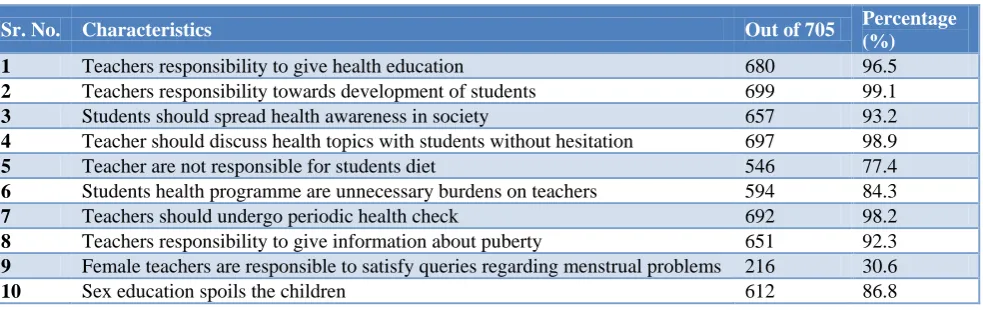
From the total 705 teachers in both rural and urban schools, 680 teachers (96.5%) had the perception that it is their responsibility to give health education. 699 teachers (99.1%) had the perception that they have responsibility towards student development, 657 teachers (93.2%) think that students should spread health awareness in the society, 697 teachers (98.9%) think that they should discuss health topics with students without hesitation (Table 8).
Table 5: Attitude towards school health amongst the teachers.
Characteristics Rural schools (n=520) Urban schools (n=185)
Attitude towards school health, median (range) 9 (1-19) 9 (5-10)
Mean percent attitude score 90% 90%
P=0.0006, using Mann-Whitney test.
Table 6: Practice regarding school health amongst the teachers
Characteristics Rural schools (n=520) Urban schools (n=185)
Practice regarding school health, median (range) 26 (0-30) 23 (1-30)
Mean percent practices score 86.67% 76.67%
P<0.0001, using Mann-Whitney test
Table 7: Teacher performance score (sum of knowledge, attitude, and practices towards school health)
Teacher performance Rural schools (n=520) Urban schools (n=185)
Mean score (%) 79.64% 72.21%
P<0.0001, using unpaired t-test.
Table 8: Perception about health education.
Sr. No. Characteristics Out of 705 Percentage
(%) 1 Teachers responsibility to give health education 680 96.5
2 Teachers responsibility towards development of students 699 99.1
3 Students should spread health awareness in society 657 93.2
4 Teacher should discuss health topics with students without hesitation 697 98.9
5 Teacher are not responsible for students diet 546 77.4
6 Students health programme are unnecessary burdens on teachers 594 84.3
7 Teachers should undergo periodic health check 692 98.2
8 Teachers responsibility to give information about puberty 651 92.3
9 Female teachers are responsible to satisfy queries regarding menstrual problems 216 30.6
10 Sex education spoils the children 612 86.8
Table 9: Correlation between teacher experience and KAP.
Character Knowledge Attitude Practices
Correlation coefficient (r) 0.0159 -0.0642 0.0151
P value 0.6728 0.0885 0.6877
The correlation is calculated using Spearman’s correlation coefficient method. P value<0.05 is considered significant.
546 teachers (77.4%) have the perception that they are not responsible for student diet, 594 teachers (84.3%) think that student health programs are an unnecessary
give information about puberty, 216 teachers (30.6%) think that female teachers are responsible to satisfy queries regarding menstrual problems and 612 teachers (86.8%) think that sex education spoils children (Table 8).
The correlation between experience of teachers and scores of knowledge, attitude and practices was calculated. Since p value was >0.05 none of the parameters showed significant correlation with teacher’s experience.
DISCUSSION
The mean age of the school teachers in rural areas was 40.77±8.88 years, while that of the teachers in urban areas was 41.37±7.60 years, this was not significant. The mean age of teachers reported by El-Gamelen Ebrahim Essa et al was 40.31±7.58 years in rural area and 38.71±7.71 years in urban area and there was a significant difference.4 This may be due to the ethnic difference in the study population. Out of the 520 teachers included in the study; in rural schools, 330 (63.46%) were males and 190 (36.54%) were females; while out of the 185 teachers in urban schools, 90 (48.65%) were males as compared to 95 (51.35%) females. Chi-square test indicated that there were more male teachers in rural schools. El-Gamelen Ebrahim Essa et al also reported the percentage of male and female teachers in rural and urban schools with 56.1% and 43.9% respectively in rural schools while 49.1% male and 50.9% female teachers were reported to teach in urban schools.4 There was no significant difference in the number of male and female teachers teaching in either rural or urban schools.
In our study, out of the 520 teachers in rural schools 508 belonged to Hinduism and 12 were Muslims. Whereas out of the 185 teachers in urban schools, 184 were Hindus and 1 was a Muslim. There are no studies that report the religion of the teachers.
In rural areas, maximum (58.27%) were graduates followed by (32.5%) were postgraduates. In rural areas, maximum (46.49%) were graduates followed by (41.62%) were postgraduates. In a study by Kaushal et al 30.32% teachers were graduate, 60.64% were post graduate and only 1 (0.64%) teacher was a PhD holder, this included both the rural and urban population of teachers.5 These reports were more or less similar to our study.
In rural areas, majority i.e. 442 were Assistant teachers. In urban areas also majority i.e. 174 were assistant teachers and 11 were teachers. In rural areas, majority i.e. 194 (37.31%) teachers have 10-20 years, followed by 135 (25.96%) have the experience of 20-30 years. In urban areas also majority i.e. 73 (39.46%) teachers had 10-20 years experience, followed by 42 (22.7%) had 20-30 years experience. Htun et al reported that there were
46.4% teachers with an experience of >14 years, 9.3% teachers with experience of 15-9 years, 15.5% teachers with experience of 20-24 years and 28.9% teachers with >25 years experience.1 These study reports although; they do not correlate with our study, were reported for teachers of Myanmar.
In rural areas, only 54 (10.38%) teachers received school health training. In urban areas included in the study, only 14 (7.57%) teachers received school health training. In a study by Bhesania et alreported that 15.5% of teachers had received training related to epilepsy.6 These results were more or less similar to our study.
In rural schools, the mean duration of receiving school health training was 4.97±5.95 days while that in urban schools was 3.67±2.89 days. The median duration for the same was 1.5 days in rural schools (range: 1-22 days) as compared to 4 days in urban schools (range: 1-9 days). Out of the 520 teachers in rural schools, only 84 teachers received training for first aid while 436 teachers did not receive any such training. Out of the 185 teachers in urban schools, only 24 teachers received first aid training in comparison to 161 teachers who did not receive any such training.
The median knowledge score I in rural school teachers was 8 (range: 1-12) and that among urban school teachers was also 8 (range: 0-11). The median knowledge score II in rural school teachers was 6 (range: 1-11) and that among urban school teachers was also 6 (range: 1-9). The median combined knowledge score (I + II) among rural school teachers was 14 (range: 5-20) and that among urban school teachers was also 14 (range: 5-19). The mean percent knowledge score of rural school teachers was 60.87% which was similar to that of the urban school teachers (60.86%). Median score of attitude towards school health amongst rural school teachers was 9 with range from 1-19 whereas that of urban school teachers was also 9 but with a range between 5 and 10. The mean percent attitude score among all the schools, irrespective of their location, was 90%. There were no studies to our knowledge that reported the knowledge and attitude scores of teachers.
performance score published for teachers in rural and urban schools.
From the total 705 teachers in both rural and urban schools, 680 teachers (96.5%) had the perception that it is their responsibility to give health education. 699 teachers (99.1%) had the perception that they have responsibility towards student development, 657 teachers (93.2%) think that students should spread health awareness in the society, 697 teachers(98.9%) think that they should discuss health topics with students without hesitation. 546 teachers (77.4%) have the perception that they are not responsible for student diet, 594 teachers (84.3%) think that student health programs are an unnecessary burden on teachers, 692 teachers (98.2%) think that they should undergo periodic health check, 651 teachers (92.3%) had the perception that it is their responsibility to give information about puberty, 216 teachers (30.6%) think that female teachers are responsible to satisfy queries regarding menstrual problems and 612 teachers (86.8%) think that sex education spoils children. There are no studies that report the perception of responsibility of health education among teachers of rural and urban school.
Kumar et al studied the perception and practices of first aid in school teachers in Mysore and found that overall perception and practices of school teachers on first aid was found to be poor.8 Wound was the most common event requiring first aid followed by fainting attack. There was a significant difference among the teachers with qualification of degree or less, working experience of more than ten years, residing in urban areas and trained in first aid compared to their counterparts. The study brings out important information about lack of awareness regarding first aid among school teachers even though there is more number of events requiring first aid occurred frequently in the school campus. This gives a way for designing future programmes to train the school teachers on first aid and incorporate the same in regular school health appraisal.
Concerted effort to involve students will create an empowered young population and a demand for sustainable health and education interventions, particularly for those from historically vulnerable groups such as girl children, scheduled castes and tribes, and children with disabilities. Finally, investment in improving the evidence base and using evidence for action could be prioritised.9
CONCLUSION
School teachers should be periodically assessed at various levels to get status of their knowledge and understanding regarding health education. It should be ensured that teachers should receive continued education and trainings related to health, especially importance of first aid and hygiene. This can help them to spread the
importance of and need for better health in the community.
Funding: No funding sources Conflict of interest: None declared
Ethical approval: The study was approved by the Institutional Ethics Committee
REFERENCES
1. Htun YM, Lwin KT, Oo NN, Soe K, Sein TT. Knowledge, attitude and reported practice of primary school teachers on specified school health activities in Danuphyu Township, Ayeyarwaddy Region, Myanmar. South East Asia J Public Health. 2013;3(1):24-9.
2. Sekhar V, Sivsankar P, Easwaran MA, Subitha L, Bharath N, Rajeswary K, et al. Knowledge, Attitude and Practice of School Teachers Towards Oral Health in Pondicherry. J Clin Diagn Res. 2014;8(8):12-5.
3. UNESCO: Creating School Health Programme. 2000. Available at: http://www.unesco.org/ education/educprog/ste/projects/health/creating.htm. Accessed on 2 September 2016.
4. El-Gamelen Ebrahim Essa HA, Ahmed El-Zeftawy MA. Teachers’ Knowledge, Attitudes and Reported Strategies to Assess and Support the Students with Learning Difficulties. ISOR-JHNS. 2015;4(2):79-92.
5. Kaushal P, Singh T, Padda AS, Deepti SS, Bansal P, Satija M, et al. Impact of Health Education on The Knowledge, Attitude and Practices of Teachers Regarding Reproductive Health of Adolescents of Amritsar, Punjab. J Clin Diagn Res. 2015;9(5):18-21.
6. Bhesania NH, Rehman A, Savul IS, Zehra N. Knowledge, attitude and practices of school teachers towards epileptic school children in Karachi, Pakistan. Pak J Med Sci. 2014;30(1):220-4.
7. Kakkar R, Kandpal SD, Aggarwal P. Health status of children under school health services in Doiwala Block, Dehradun. Indian J Community Health. 2012:24(1);45-8.
8. Kumar SD, Kulkarni P, Srinivas N, Prakash B, Hugara S, Ashok NC. Perception and Practices Regarding First-Aid Among School Teachers In Mysore. Natl J Community Med. 2013;4(2):349-52. 9. Situation analysis a summary of school health in
India and in four states: Andhra Pradesh, Delhi, Gujarat and Tamilnadu. Available at: www.schoolsandhealth.org/.../Situation%20
Analysis%20A%20Summary%20of%20Sc. Accessed on 9th Aug 2016.