Provision of library services to people with disabilities
in Malawi
Aubrey Harvey Chaputula
1and Patrick Makono Mapulanga
2[email protected] ORCID: orcid.org/0000-0003-3753-9934
[email protected] ORCID: orcid.org/0000-0002-0305-3736
Received: 26 August 2016 Accepted: 16 January 2017
The purpose of this paper was to investigate the provision of library services to people with disabilities in Malawi. A mixed methodology was used as the research design. All participating libraries (fifty-six) were sampled to participate in the survey while fourteen students with disabilities (one from each institution, where possible) were purposively chosen to be interviewed. Quantitative data were collected through questionnaires whilst qualitative data were collected through interview guides. Quantitative data was analysed using Microsoft Excel while qualitative data was analysed thematically. The paper highlights the lack of library and information services to disabled people and acknowledges possible barriers. The study has revealed lack of equipment to support disabled access to library and information resources. Similarly, despite an increase in the number of people with disabilities, the majority of the libraries do not offer specialised training such as induction sessions or market services that cater for those with disabilities. The study, among other suggestions, recommends that equipment deemed necessary for people with disabilities (such as Braille books) be procured. Libraries should also take necessary steps to address accessibility challenges faced by people with disabilities when using their libraries. Libraries should take further steps to either introduce or enhance services that cater for people with disabilities.
Keywords: People with disabilities, accessibility of library buildings, library resources and services, libraries, Malawi.
1 Introduction
Discrimination against any person in Malawi on the basis of disability is prohibited; all persons are guaranteed equal and effective protection from discrimination (Chilemba 2012, Republic of Malawi 1994). Discrimination prevents people who are discriminated against from exercising their rights, including the right to access information resources in libraries and information centres. The right to access facilities, sources and services without any limitations is one of the fundamental rights of any society (Bodaghi & Zainab 2013). However, it is evident that people with disabilities face challenges when it comes to accessing libraries and using their resources.
Disability can be defined as a physical or mental condition that in some way prohibits an individual from performing daily tasks (Todaro 2005). Examples of disabilities include autism, hearing difficulties and deafness, speech and language disorders, limited vision and blindness. Disability is a worldwide concern: 10% of the world’s population lives with a disability of some kind (United Nations Secretariat for the Convention on the Rights of Persons with Disabilities 2013).
A 2003 study conducted by the Federation of Disability Organisations in Malawi and the University of Malawi’s Centre for Social Research indicated that 4.18% of the Malawian population was made up of persons with disabilities, 51% males and 49% females. However, a recent study conducted by Chapambali and Chinthuli (2011) estimated that there are 1.9 million people living with disabilities in Malawi, 12.2% of the population. This figure implies that the number of people with disabilities in Malawi is increasing. The World Bank believes that 20% of the world’s poorest people have some kind of disability and that the majority of these are in Africa. Despite making up a large percentage of the world’s population, the majority of people with disabilities experience challenges in accessing information centres and resources. These challenges tend to affect their daily lives.
Although Malawi achieved independence in 1964, it was only in 1971 that the Handicapped Persons Act was passed (Chilemba 2012). The Handicapped Act viewed disability as a clinical condition, as opposed to a human rights issue (Chilemba 2012); the law did not provide any additional rights to people with disabilities. On 24 May 2012, the Malawi National Assembly passed the Disability Act (2012), eight years after it was drafted. The Disability Act (2012) was drafted based on the disability social model, which perceives disability as a human rights issue and associates the challenges of disability with those of the environment, including individual prejudices and discrimination at institutional level (Chilemba 2012). The Disability Act (2012) includes clauses that ensure that people with disabilities are not discriminated against in the fields of health, education and training, social life, culture, sports, recreation, employment, public and political affairs, housing, and many others. The Act also seeks to ensure that people with disabilities have unimpeded access to various places, including buildings. The Act further grants people who suffer from discrimination based on their disability rights
enforceable by law. Moreover, the Act requires that a national sign language be introduced to facilitate communication with people with hearing loss or deafness.
2 Theoretical framework: the social model of disability
This study was based on the social model of disability. This model views disability as a consequence of the environmental, social and attitudinal barriers that hamper people from maximising their potential (Naami 2014). The model stems from a socio-political viewpoint that disability is a result of the failure of society to adjust and meet the needs and aspirations of a disabled minority (Lang 2007). It implies that the removal of attitudinal, physical and institutional barriers will likely improve the lives of people with disabilities, giving them equal opportunities to others (Naami 2014).
The strength of this model lies in its emphasis on the high expectations and obligations impressed on the societies in which people with disabilities live, instead of on these people themselves (Naami 2014). However, the model faces two challenges. The first one is the inability of the so-called society to adjust to the needs of people with disabilities (Lang 2007). Secondly, concepts such as ‘attitude’ are difficult to understand: what constitutes a good or a bad attitude towards people with disabilities is subjective.
People with disabilities face numerous challenges when it comes to using different types of libraries. These challenges include access to the physical library buildings, access to information resources, and lack of services that are tailor-made for them. Issues pertaining to accessibility emanate from architectural designs that do not take people with disabilities into consideration. Challenges related to access to information resources, on the other hand, result from the lack of appropriate information resources and assistive devices. Sometimes, libraries do not anticipate that people with disabilities may want to access their services; in other cases, libraries are ill-prepared to serve people with disabilities because suitable equipment for their needs is simply not there.
3 Statement of the problem
People with disabilities are of the most vulnerable, disadvantaged and marginalised people in Malawi (Chilemba 2012). Despite the constitution guaranteeing human rights to all people without discrimination, people with disabilities are excluded from the enjoyment of many of these rights (Chilemba 2012). Chilemba (2012) noted that for a long time people with hearing disabilities in Malawi lamented the failure of the Malawi Broadcasting Corporation to include the use of sign language in state-owned television broadcasts. In 2012 it was indicated that people with visual impairments had lodged a complaint that they were not able to identify the different denominations of the new bank notes as the notes did not have distinguishing features (Chilemba 2012).
Studies in other parts of the world have shown that issues to do with accessibility of library buildings, access to information resources, and services tailor-made for people with disabilities are some of the major challenges faced by those with disabilities (Alqaryouti 2010, Das, Kuvini & Desai 2013, Ekwelem 2013). This study sought to investigate the provision of library services to people with disabilities at academic, special/research and school libraries across Malawi. The study specifically aimed to uncover the availability of the requisite infrastructure to accommodate people with disabilities, the extent of service provision (including equipment for people with disabilities), and related challenges.
4 The status of libraries in Malawi
Salanje (2012) noted that there are many types of libraries in Malawi ranging from academic, school and public, to special libraries existing as supporting entities of institutions such as universities, research stations, government departments, statutory organisations, non-government organisations and public and private schools. The budget of many of these libraries was reported to be around 3% of the budget of the institution to which they belonged. For instance, academic libraries in public universities received three to six percent of the total institutional budgets (Mapulanga 2012, Chaputula 2011). The state of funding was far worse in private university libraries: Chaputula (2014) noted that these libraries were receiving between one and three percent of the total institutional budget; less than the six percent recommended by Goudy (1993). The consequences of inadequate funding are that it impacts negatively on collection development activities of the libraries, with some libraries spending less than 1% of their budgets on library materials. As a result, most of the university libraries (private and public) rely on donations to grow their collections (Chaputula 2014). In terms of staff development, Mapulanga (2014) noted that most of the public libraries in Malawi were headed by professional librarians with at least an undergraduate degree, while the majority of the support staff in public university libraries had a certificate in Library and Information Studies. Inadequacy of funding to support both collection development and training has the potential to impact negatively on service provision for people with disabilities.
5 Best practices in service provision to people with disabilities
6 Literature review
According to the United Nations Secretariat for the Convention on the Rights of Persons with Disabilities (2013), 10% of the world’s population, or 650 million people, live with a disability of one form or another. Some common disabilities are deformity, loss of limbs, blindness, deafness and mental retardation. These forms of disability affect the degree to which one can move, hear, see, or speak.
Realising the challenges that people with disabilities face, various governments have enacted laws that guarantee equal opportunities for people with disabilities. The Government of the United Kingdom (UK), for instance, passed the Special Educational Needs and Disability Act in 2001. Harris and Oppenheim (2003) and Hill (2013) noted that the Act requires that students with disabilities in institutions of higher learning have the same access to educational facilities and resources provided as do all other students. The Disability Act (2012), among other things, guarantees
access to the physical environment, transportation, information and communications, including information and communication technologies and systems, and other facilities and services available or provided to the public ….
Libraries are facilities provided to the public; for this reason, libraries find themselves bound by this legislation. In Malawi, the Disability Act (2012) states that “no education or training institution shall deny any benefits or services to any person, on the basis of disability”. Many educational institutions in Malawi are hesitant to admit students with disabilities because these institutions lack specialised teaching and learning resources. The task of providing for teaching and learning resources in many educational institutions falls within the realm of the library. The Act, therefore, has implications for libraries: they are required to make modifications to their designs to ensure that they are physically accessible to people with disabilities; acquire appropriate materials and assistive devices to ensure that people with disabilities can access their collections; and introduce services that cater for their special needs (Ahmad 2015).
Apart from its services, the quality of a library is measured by its collection and the equipment that allows patrons access to the collection. Socially inclusive libraries need to have collections and equipment that can be used by all, including those with disabilities. Visually-impaired people, for example, face problems using libraries because, besides mobility challenges, they face the challenge of accessing the library collection. There are several contributing factors to these problems, including that only 5% of the world’s published output in English is made accessible in alternate formats for people who cannot use traditional print resources (Epp 2006). This statistic implies that there is little reading material available to people with visual impairment.
Concerted efforts should be made to ensure that those living with disabilities are able to access the information resources that others are able to access. Access to information resources for all can be made possible through use of assistive tools and technologies. Commonly-used technological devices include Braille books, talking books, playback machines, audiotapes and screen readers (Epp 2006). A recent study by Adetoro (2012) of alternate format preferences among secondary school visually-impaired students in Nigeria found that talking books and/or audio recordings were the most preferred format for blind students (51%) as well as partially-sighted students (55%). These formats were preferred over others because of their playback facility and because they were easy to understand. Other technological devices for people with disabilities, and particularly the visually impaired, include talking computers and Braille embossers. The second challenge which visually impaired people face is that most of these technological devices are expensive, making them difficult for many poor libraries to acquire. However, this challenge can be overcome through institutional resource-sharing initiatives in which libraries pool resources to acquire the equipment they need. A study by Epp (2006) showed that libraries in the United States of America (USA) and Canada were successfully collaborating in this area.
Both visually-impaired people and those with mobility challenges experience problems in accessing most library buildings. To ease these challenges, experts have made recommendations on the appropriate design of library buildings and the type of equipment that should be provided in them. Harris and Oppenheim (2003) advised that walkways should be clearly defined and free of obstacles; signs in the building should be clear and well lit; and service points should have low desks and hearing loops for hearing-impaired users. Furthermore, the doors to the library should be wide enough to ensure that clients using wheelchairs and walkers are able to access the library. More recently, electric doors are being recommended to achieve this objective. It is also suggested that electronic lifts be provided for high-rise buildings to ensure that people with disabilities can easily access the upper floors of the library.
Findings from a number of studies show that libraries have made progress towards complying with laws and have set standards of varying degrees. Results of a study conducted by Harris and Oppenheim (2003) in the UK showed that only 45.8% of the libraries in their study had specific features to assist visually-impaired students physically to access the library and its collections. Nevertheless, more recent studies in the USA and the UK have shown that great strides have been made to facilitate the accessibility of libraries to people with disabilities (Samson 2011, Bishop & Rhind 2011, Beaton 2005). The study by Samson (2011) found that, besides providing for most of the equipment required to facilitate accessibility to the library, authorities in 50% of the institutions provided disability parking near the library. Studies by Bishop and Rhind (2011) and Beaton (2005), both conducted in the UK, also showed that significant strides in facilitating access to people with disabilities had been made. Progress is indeed being made in developed countries towards making libraries accessible to people with disabilities.
and Koulikourdi (2008) in Greece have likewise shown that much more needs to be done if libraries in their countries are to be described as truly accessible to people with disabilities. The former found that most of the libraries in Argentina do not provide the desired physical space to people with disabilities. The latter found that only academic libraries have attempted to create an environment conducive to studying in Greece by providing for the required facilities and equipment. Such facilities and equipment are largely unavailable in special, national, school and public libraries. In the case of Malawi, Chilemba (2012) observed that most library spaces in Malawi are not accessible to people with disabilities.
7 Research objectives
The objectives of the study were:
to investigate how accessible library buildings are to people with disabilities in selected libraries in Malawi; to find out if libraries in Malawi provide services that are tailor-made for people with disabilities;
to explore information resources and equipment in the libraries that cater for people with disabilities; and to examine challenges that people with disabilities face in using libraries in Malawi.
8 Research methodology
The study investigated the provision of library services to people with disabilities. It employed a convergent mixed method design that integrated both qualitative and quantitative data collection and analysis techniques. The study covered academic, special/research and school libraries across the country. Malawi has four public universities; nine private universities; four agricultural research stations; ten government, private and grant-aided teacher training colleges; and three high schools. The total number of libraries covered by this study was fifty-six.
The study used a census for the study because the number of libraries surveyed was deemed to be small. This means that all fifty-six institutional libraries targeted participated in the study. In institutions with one or more persons with a disability, the study purposively sampled one person with a disability to participate in the interviews. In total, fourteen people, mainly those with visual impairment or mobility challenges, were sampled. The number was smaller than the number of participating institutions because most of the institutions covered by the study did not enrol students with disabilities.
Questionnaires and interview guides were used as data collection instruments. Both instruments were pretested at Mzuzu University, Malawi, to determine their effectiveness before they were used for the study. The researchers administered the questionnaires and conducted interviews with students in libraries and institutions within their locality. Quantitative data was collected through questionnaires sent to the heads of the libraries targeted for the study. Qualitative data was obtained through interviews. Overall, forty of the fifty-six questionnaires administered were returned, representing a 71.4% response rate, while fourteen interviews were conducted with people with disabilities. Data were collected between August 2013 and July 2014. Quantitative data collected from the research was analysed using Microsoft Excel while qualitative data was analysed thematically.
9 Data presentation, analysis and discussion
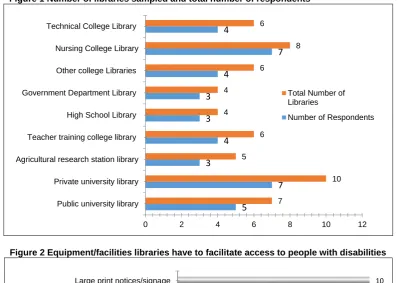
Figure 1 shows the scope of the study. The figure shows that forty out of the fifty-six questionnaires administered were returned which represents a 71.4% response rate. Nursing college libraries and private university libraries each accounted for 17.5%, public university libraries accounted for 12.5% of responses while technical college libraries, teacher training college libraries and other college libraries each had a 10% representation. Government department libraries, high school libraries and agricultural research station libraries respectively had 7.5% representation.
9.1 Accessibility of library buildings to people with disabilities
The right to access facilities, information sources and services without any hindrance is one of the fundamental rights a society should protect, especially for people with disabilities (Bodaghi & Zainab 2013). In light of this statement, the present study explored accessibility of library buildings to people with disabilities.
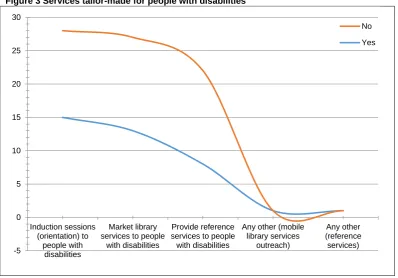
The study discovered that libraries in this study are largely not accessible to people with disabilities. Reasons are mostly that the libraries in question do not have the necessary architectural structures and equipment to give access to people with disabilities. An analysis of librarians’ responses on the questionnaires indicated that the libraries lack automatic doors that would facilitate easy entry for people with disabilities. Libraries housed in multi-storied buildings have lifts capable of allowing people with disabilities to access the various floors. However, the lifts no longer work and efforts to repair them have yielded unsatisfactory results. The findings also showed that libraries in this study have no Braille buttons in the lifts. Challenges people with disabilities face in accessing libraries are compounded by the fact that the number of libraries that have equipment to assist them in accessing library resources is also small. An analysis of the responses from the librarians revealed that libraries in this study owned few pieces of equipment suitable to this task. Results in Figure 2 show that only ten (19.6%) of the libraries in this study indicated that they had fitted large-print, clear and well-lit signage or could boast paved walkways that were free of obstacles. Nine (17.6%) of the libraries offered service points with low desks while only two (3.9%) ensured Braille signing on their shelves. These findings signify that many libraries are ill-prepared to accommodate people with disabilities.
library were described as narrow, making them difficult for those on wheelchairs to use. All of the above compound the accessibility challenges people with disabilities face.
Figure 1 Number of libraries sampled and total number of respondents
Figure 2Equipment/facilities libraries have to facilitate access to people with disabilities
Findings of this study reflect those made by Chilemba (2012) who indicated that, besides libraries, most of the public buildings and recreational spaces in Malawi are not accessible to people with disabilities. Chilenga also noted that people with disabilities in Malawi are disadvantaged and marginalised on the basis that schools and colleges enrol people with disabilities only to realise later that they need Braille materials or to employ a sign language specialist.
Findings in the present study correlate with those made in other countries, but not entirely so. A study conducted by Koulikourdi (2008) in Greece showed that, while efforts had been made to provide for equipment to help with accessibility to libraries for people with disabilities, most efforts related to academic libraries and few to special and public libraries, while national and school libraries mostly lacked this equipment. Similarly, studies done by Todaro (2005) in Argentina and Bodaghi and Zainab (2012) in Iran indicated that library accessibility to people with disabilities remains a problem. However, the situation is slightly different in other countries where research findings have shown that equipment to aid library access to people with disabilities is largely available. Studies done by Samson (2011) in the USA and Beaton (2005) in Scotland indicated that libraries were indeed providing the equipment needed to facilitate access for those with disabilities. What is apparent from these studies is that libraries in the developed world face fewer challenges in this regard than those in Malawi, perhaps because these countries passed legislation to protect people with disabilities much earlier than did Malawi. A second reason could be that they have more financial resources to implement their programmes than do libraries in Malawi.
5
7 3
4 3 3
4
7 4
7
10 5
6 4
4
6
8 6
0 2 4 6 8 10 12
Public university library Private university library Agricultural research station library Teacher training college library
High School Library Government Department Library Other college Libraries Nursing College Library Technical College Library
Total Number of Libraries
Number of Respondents
0 1 2 3 4 5 6 7 8 9 10
Paved walkways for people with disabilities Lifts for multi-storied buildings Are signs in the building clear and well lit Walkways free of obstacles Service points have low desks Automatic doors Braille buttons in lift Braille signing on all shelves Large print notices/signage
10 0
10 10 9 0
0
2
9.2 Services tailor-made for people with disabilities
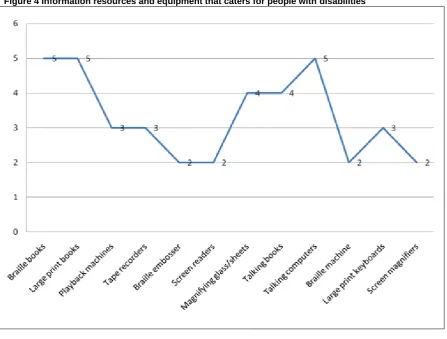
Librarians were asked to indicate whether or not they provided services that were tailor-made for people with disabilities. The term ‘tailor-made’ was understood to mean a deliberate effort made to orient students on how to use the services offered, to market library services to people with disabilities, and to provide special reference and related services for this segment of the population. An analysis of responses, as shown in Figure 3, reflects that only fifteen (37.5%) of the libraries arranged induction sessions for people with disabilities. Similarly, only thirteen (23%) of the libraries marketed their services. With regards to reference services, only eight (14%) offered the service to people with disabilities. The same trend applied to the other services libraries offered to people with disabilities as only one out of fifty-six libraries indicated that it organised mobile library outreach services.
The researchers also engaged with people with disabilities to find out whether libraries offered services that were tailor-made for them, and if not, why this was the case. An analysis of responses indicated that ten interviewees (71.4%) were not orientated on how to access the library. Only three (21.4%) indicated that they were orientated together with the other students; no special orientation was done. Asked to say why they think this was not done, nine (64.3%) stated that some library staff do not recognise the need for special orientation; four (28.6%) thought it was due to negligence or lack of interest of library staff; two (14.3%) stated that they were not able to go up the stairs where the orientation was taking place; two (14.3%) said that it is because people with disabilities themselves did not demand the services.
Figure 3Services tailor-made for people with disabilities
Responses from librarians and people with disabilities showed that most libraries in Malawi are not offering library services that are tailor-made for people with disabilities. Harris and Oppenheim (2003) and Hopkins (2000) observed that people with disabilities may have problems in accessing library services, and, therefore, need specialised training. Training includes induction sessions, marketing, and reference services that ensure that they know the outline of the collection, where to find assistive devices, and where to ask for assistance or conduct searches themselves. Failure by libraries in Malawi to provide these types of services implies that people with disabilities face challenges in accessing their services.
9.3 Information resources and equipment that cater for people with disabilities
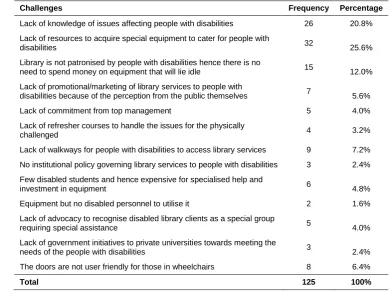
The researchers wanted to find out if information resources and equipment that cater for people with disabilities were available in libraries in Malawi. Figure 4 shows information resources and equipment that libraries indicated they provided which cater for people with disabilities.
Only five (12.5%) libraries indicated that they had Braille books, talking computers and large print books. Talking books and magnifying glass/sheets, each one with four responses (10%), were the other main information resources and equipment that the libraries indicated they had in stock.
9.4 Reasons for failure to provide resources and equipment that cater for people with disabilities
The research indicated that the majority of the libraries fail to provide information resources and equipment to people with disabilities. Figure 5 shows some of the reasons behind libraries’ failure to offer information resources and equipment required by people with disabilities.
-5 0 5 10 15 20 25 30
Induction sessions (orientation) to
people with disabilities
Market library services to people
with disabilities
Provide reference services to people with disabilities
Any other (mobile library services
outreach)
Any other (reference
services) No
Figure 4Information resources and equipment that caters for people with disabilities
Figure 5Reasons for failure to provide information resources and equipment to people with disabilities
Eight (23.5%) libraries indicated that they did not have students with any disability, while six (17.6%) indicated that their colleges or schools as a whole did not have many students with disabilities. Nursing college libraries had few students with disabilities as their institutions do not enrol students with physical disabilities. Furthermore, four (11.8%) indicated that no
6
4
8
2
1
0 1 2 3 4 5 6 7 8 9
Their colleges/schools do not have many
students with disabilities
No one with a disability has ever come to seek
assistance
Do not have students with any disabilities
Libraries not built with people with disabilities
in mind
one with a disability had ever sought assistance, two (5.9%) blamed government for lack of commitment towards people with disabilities as libraries are not built with people with disabilities in mind, while one respondent stated that the specialised equipment is expensive to procure.
Educational institutions in Malawi experience challenges related to admitting students with disabilities as the institutions lack specialised teaching and learning resources. As the study has shown, the majority of the libraries in Malawi do not have the requisite information resources and equipment that cater for people with disabilities. Chilemba (2012) noted that people with disabilities are enrolled in most institutions in Malawi without the knowledge of management. Only after enrolment, do schools or colleges begin to consider the need for Braille materials or a sign language expert to assist the students concerned. The Disability Act of 2012 was, among other things, enacted with the aim of making educational institutions more readily accept people with disabilities.
9.5 Challenges people with disabilities face in using libraries
The study further explored the challenges people with disabilities face in accessing library services in Malawi. Table 1 shows an analysis of librarians’ responses to questions about these challenges. Respondents indicated that lack of special equipment to cater for people with disabilities (thirty-two; 25.6%) and the lack of knowledge on issues affecting people with disabilities (26; 20.8%) were the major challenges. A significant number of respondents (fifteen; 12%) indicated that their libraries were not patronised by people with disabilities, hence they saw no need to spend money on equipment that would be unused.
Table 1 Challenges faced in providing services to people with disabilities
Challenges Frequency Percentage
Lack of knowledge of issues affecting people with disabilities 26 20.8%
Lack of resources to acquire special equipment to cater for people with
disabilities 32 25.6%
Library is not patronised by people with disabilities hence there is no
need to spend money on equipment that will lie idle 15 12.0%
Lack of promotional/marketing of library services to people with
disabilities because of the perception from the public themselves 7 5.6%
Lack of commitment from top management 5 4.0%
Lack of refresher courses to handle the issues for the physically
challenged 4 3.2%
Lack of walkways for people with disabilities to access library services 9 7.2%
No institutional policy governing library services to people with disabilities 3 2.4%
Few disabled students and hence expensive for specialised help and
investment in equipment 6 4.8%
Equipment but no disabled personnel to utilise it 2 1.6%
Lack of advocacy to recognise disabled library clients as a special group
requiring special assistance 5 4.0%
Lack of government initiatives to private universities towards meeting the
needs of the people with disabilities 3 2.4%
The doors are not user friendly for those in wheelchairs 8 6.4%
Total 125 100%
The issue of failure to provide for equipment and information resources for people with disabilities is a result of several contributing factors. As has already been indicated, the challenges mainly stem from the marginalisation of people with disabilities, as some institutions do not even enrol such students in their institutions. For institutions which may have made efforts to enrol students with disabilities, the cost of procuring requisite resources seems prohibitive. This view is supported by research studies conducted elsewhere, one of which was conducted by Epp (2006) who noted that equipment for people with disabilities is expensive. Nevertheless, cooperation between libraries – for example, in the form of interlibrary loans – has shown to be an effective way of tackling such challenges. The problem can also be attributed to libraries’ failure to procure materials, not only for people with disabilities, but also in formats other than the norm. A study conducted by Chaputula (2011) showed that many libraries in Malawi, especially those in the academic sector, experience challenges growing their collections because of financial resource constraints. Consequently, many libraries rely on donations to make up the shortfall.
10 Thematic areas derived from interviews with people with disabilities
Key thematic areas identified through interviews with people with disabilities have been discussed in sections 10.1 to 10.4.
10.1 Access to appropriate resources and services
In the interviews, the researchers asked people with disabilities to indicate the information resources and equipment that libraries would need to offer in order to cater for them. Thirteen (92.8%) people with disabilities stated that they needed resources like Braille books, talking computers and electronic books. Eleven (78.6%) indicated that most of these resources were largely not available in their libraries. One of the persons with disabilities stated that “some books are available at primary and secondary school but [the situation is] worse at tertiary level”.
These findings are similar to those made by Epp (2006), and more recently by Adetero (2012). The former observed that libraries that offer services to people with disabilities have some resources and equipment that are common. Some of these commonly-used devices include Braille texts, talking books, playback machines, audiotapes, screen readers and other adaptive devices. The latter found that talking books were the most-preferred format in 53% of the libraries in Nigeria. Talking books were preferred because they were easy to follow and had playback facilities which proved to be time-saving.
10.2 Access to infrastructure
Those with disabilities who were surveyed indicated that they experienced difficulties in accessing library buildings as some buildings had too many steps leading to the top floors and no lifts. Although ramps are provided in some libraries, some users complained that these were very steep, hence making it problematic for those in wheelchairs to access the library on their own.
A female respondent in a wheelchair complained that, although her library had a special door for access for people in wheelchairs, the door was kept locked most of the time and was only opened when she wanted access to the library. She complained that sometimes the keys were missing and/or the door could not be opened at the time when she specifically wanted to use the library. Sometimes these delays resulted in her being late for class. Another respondent commented:
The toilets are not wheelchair accessible. I remember getting stuck in there, and I had to wait for someone to help me. There is a small bump at the entrance which did not allow me to get out.
10.3 The right to individualised treatment
Library rules and the attitudes of other library users contributed to accessibility challenges of some users with visual impairment. One respondent indicated that she was able to move on her own with a cane but that a cane makes a noise, something libraries do not condone. To this end, she indicated that, while she was able to use a cane at her previous institution, some library patrons disapproved of the noise: “people were murmuring whenever I used it [the cane]”. She has opted not to use her cane at her current institution.
10.4 Protection of human dignity
During interviews conducted with people with disabilities, it was noted that parent institutions of libraries deliberately side-lined the admission of people with disabilities for fear of taking on the burden of providing for their educational needs. Examples of such institutions included nursing colleges which do not enrol students with visual impairment. In some cases, it was noted that learning institutions in Malawi enrol students with disabilities only to realise later that they need materials, such as Braille texts. In some cases, institutions are requested to employ a sign language expert for students with visual and hearing impairments. Similarly, most libraries are inaccessible to people with disabilities, especially those in wheelchairs. Failure to provide for the educational needs of students with disabilities means that these students are not able to attend classes, thus being indirectly discriminated against.
11 Conclusion and recommendations
People with disabilities are not able to access library services in the same way as others. This research has revealed that people with disabilities face numerous challenges when using libraries in Malawi. Challenges occur because of the lack of equipment to support their accessibility to library and information resources. Similarly, despite an increase in demand, the majority of the libraries do not offer specialised services such as training sessions on equipment use or market their services to the benefit of people with disabilities. This lack impacts negatively on the utilisation of the services by people with disabilities.
The study recommends that the Ministry of Gender, Children, Disability and Social Welfare in Malawi makes deliberate efforts to emphasise the need for recognition of people with disabilities. The ministry should also make deliberate efforts to ensure that learning institutions have assistive technologies or equipment for people with disabilities before they may be recognised as institutions of learning. These changes would help ease the challenges that people with disabilities face. To mitigate the shortage of resources and equipment, libraries in Malawi should consider assigning a small percentage of their funding towards procuring assistive equipment and information resources that meet the needs of people with disabilities.
References
Ahmad, F.K. 2015. Use of assistive technology in inclusive education: making room for diverse learning needs.
Transcience, 6(2): 62-77.
Alqaryouti, I.A. 2010. Inclusion the disabled students in higher education in Oman. International Journal for Cross-Disciplinary Subjects in Education, 1(4): 216-222.
Beaton, M. 2005. Glasgow City Council: library, information and learning services for disabled people in Glasgow. Library Review,54(8): 472-478.
Bishop, D. and Rhind, D.J.A. 2011. Barriers and enablers for visually impaired students at a UK Higher Education Institution. The British Journal of Visual Impairment, 29(3): 177-195.
Bodaghi, N.B. and Zainab, N.A. 2013. Examining the accessibility and facility for the disabled in public and university library buildings in Iran. Information Development, 29(1): 1-10.
Chapambali, M. and Chinthuli, D. 2011. Being disabled in Malawi. The Weekend Express: an official publication of the Malawi Institute of Journalism. 8 December. [Online]. http://mijweekendexpress.wordpress.com/2011/12/08/being-disabled-in-malawi/ (18 December 2012).
Chaputula, A.H. 2011. Impact of the global economic crisis on academic libraries in Malawi: a case study of University of Malawi and Mzuzu University Libraries. Library Management, 32(8/9): 565-578.
Chaputula, A.H. 2014. Collection development practices in private university libraries in Malawi. Library Management,
35(3): 150-163.
Chilemba, E. 2012. Promoting disability rights in Malawi. OSISA: Open Society Initiative for Southern Africa. 23 July. [Online]. http://www.osisa.org/law/blog/promoting-disability-rights-malawi (12 June 2013).
Das, A.K., Kuvini, A. B. and Desai. I.P. 2013. Inclusive education in India: are the teachers prepared? International Journal of Special Education, 28(1): 27-36.
Ekwelem, V. O. 2013. Library services to disabled students in the digital era: challenges for outcome assessment. Library Philosophy and Practice, Paper 970 [Online]. http://digitalcommons.unl.edu/libphilprac/970 (10 January 2017). Epp, M.A. 2006. Closing the 95 percent gap: library resource sharing for people with print disabilities. Library Trends,
54(3): 411-429.
Goudy, F.W. 1993. Academic libraries and the six percent solution: a twenty-year financial overview. The Journal of Academic Librarianship, 19(4): 212-215.
Harris, C. and Oppenheim, C. 2003. The provision of library services for visually impaired students in UK further
education libraries in response to the Special Educational Needs and Disability Act (SENDA). Journal of Librarianship and Information Science, 35(4): 243-257.
Hill, H. 2013. Disability and accessibility in the library and information science literature: a content analysis. Library & Information Science Research, 35(2): 137-142.
Hopkins, L. Ed. 2000 Library services for visually impaired people: a manual of best practice. London: Resource. Koulikourdi, A. 2008. Library services for people with disabilities in Greece. Library Review, 57(2): 138-148.
Lang, R. 2007. The development and critique of the social model of disability. London: Leonard Cheshire Disability and Inclusive Development Centre.
Malawi Government. Disability Act No. 10 of 2012. Zomba: Government Printing Press.
Majinge, R.M and Stilwell, C. 2013. Library services provision for people with virtual impairments and in wheelchairs in academic libraries in Tanzania. South African Journal of Libraries and Information Science, 79(2): 39-50.
Mapulanga, P. 2012. Adequacy or inadequacy of budgets for University of Malawi Libraries. The Bottom Line: Managing Library Finances, 25(3): 115-122.
Mapulanga P. 2014. Prospects and constraints of staff development in the University of Malawi Libraries. The Bottom Line: Managing Library Finances, 27(1): 29-41.
Naami, A. 2014. Breaking the barriers: Ghanaians’ perspectives about the social model. Disability, CBR & Inclusive Development, 25(1): 21-39.
Nassimbeni, M. and De Jager, K. 2014.Even we can read: evaluating the impact of a project to expand library services to visually impaired users in rural South Africa. Libri: International Journal of Libraries& Information Services, 64(3): 247-253.
Republic of Malawi. 1994 The Constitution of the Republic of Malawi. 1994. Zomba: Government Printing Press. Salanje, G. 2012. Creating digital library collections: prospects and challenges for libraries in Malawi.[Paper]. Second
African Digital Libraries and Archives, Johannesburg, 14-18 November 2012.
Samson, S. 2011. Best practices for serving students with disabilities. Reference Services Review, 39(2): 260-277. Todaro, A.J. 2005. Library services for people with disabilities in Argentina. New Library World, 106(5/6): 253-268. United Nations. 1948. The Universal Declaration of Human Rights. [Online].http://www.un.org/en/documents/udhr/#atop
(8 June 2013).