A Image Segmentation Algorithm Based on Differential
Evolution Particle Swarm Optimization Fuzzy C-Means
Clustering
Jiansheng Liu1, Shangping Qiao2
1
College of Science, Jiangxi University of Science and Technology, 341000 Ganzhou, P. R. China
Graduate School, Jiangxi University of Science and Technology, 341000 Ganzhou, P. R. China
Abstract. This paper presents a hybrid differential evolution, particle swarm optimization and fuzzy c-means clustering algorithm called DEPSO-FCM for image segmentation. By the use of the differential evolution (DE) algorithm and particle swarm optimization to solve the FCM image segmentation influenced by the initial cluster centers and easily into a local optimum. Empirical results show that the proposed DEPSO-FCM has strong anti-noise ability; it can improve FCM and get better image segmentation results. In particular, for the HSI color image segmentation, the DEPSO-FCM can effectively solve the instability of FCM and the error split because of the singularity of the H component.
Keywords: differential evolution particle swarm optimization, fuzzy c-means clustering, image segmentation, HSI color space.
1.
Introduction
has become an important visual perception tools for psychology, physiology, computer science and many other areas.
Image segmentation is an important part of image processing, it is the basis of image analysis and pattern recognition to simplify or change the representation of the image, making the image easier to understand and analyze, typically used to locate images of objects and boundary. The classical image segmentation method [1]:
a) The boundary detection, including edge detection, boundary tracing, etc. These methods make use at the edge of the image pixel gray value discontinuity is detected by the derivative; for the step-like edge, its position corresponding to the extreme points of the first order derivative, and the second derivative is zero; the differential operator is also a common method of edge detection.
b) The region segmentation, including threshold segmentation, region growing, classification merger, etc. In these methods, the whole area is constituted by the combine to have the same or similar data, the key to these methods is to determine the threshold value, and if we can determine the appropriate threshold value can be accurately image segmentation.
Because the influence of light and noise, there is ambiguity between the target and gray background of pictures, the classical segmentation algorithm is difficult to split it and the result is not satisfactory. The fuzzy clustering method can effectively deal with the fuzziness of the image; the image segmentation method based on fuzzy clustering has been extensively studied.
The Fuzzy C-means clustering (FCM) is one of the most common algorithms of fuzzy clustering algorithm; it is an unsupervised algorithm with self-adaptive and fast convergence. When use FCM to split the image, the uncertain information in the image can be split and get better segmentation. The introduction of fuzzy clustering method can effectively deal with the fuzziness of the image, and therefore subject to a wide range of applied research ([2], [3] and [31]). Compared to the traditional image segmentation algorithm, the FCM image segmentation algorithm can solve the problems of traditional segmentation algorithm cannot split the image fuzzy or uncertain area; FCM image segmentation algorithm using unsupervised automatic segmentation can automatically adjust the threshold to avoid split due to threshold selection improper impact; the FCM image segmentation algorithm do not need to know that the image grayscale data of first and second order derivative information to avoid complex mathematical seeking.
However, this algorithm is influenced by the initial cluster centers and can fall into local optimal value easily. In order to change the disadvantages of the FCM, the major improvement strategies have: the introduction of adaptive threshold method ([4], [5]); the construction of the new membership function [6]; the introduction of new weight calculation method ([7], [8]); the introduction of other distance calculation methods [9]; the introduction of intelligent compute methods ([10], [11], [12]), and the others [34].
2.
Brief introduction of FCM
The Fuzzy C-means clustering (FCM) is an unsupervised learning based on fuzzy math theory, proposed by Bezdek [13].
Let vectors
x
i(
i
1
,
2
,...,
n
)
intoc
fuzzy groups, seeking cluster center of each packet to find the function of the value of the similarity index is the minimum, the value function of the FCM is defined as:
c i n j ij m ij c ii u d
J c U J 1 2 1 ) ,
( (1)
where
m
[
1
,
)
is weighting exponent;d
ij is the distance between thei
th
centeri
c
and thej
th
datax
j, andd
ij
||
x
j
c
i||
;u
ij
[
0
,
1
]
represents the fuzzymembership from the
i
th
center to thej
th
data, to determine the degree ofmembership of each packet, and
c
i
ij
j
n
u
1
,...,
1
,
1
. For the value of the equation(1) is the minimum, the cluster center and the degree of membership must meet the equation (2) (3):
n j m ij n j j m iji
u
x
u
c
1 1
/
(2)1 1 ) 1 /( 2
ck m kj ij ij
d
d
u
(3)The FCM clustering steps are as follows:
Step 1: Initialize the membership matrix
U
, generate randomly from 0~1, to satisfy the degree of membership constraints.Step 2: calculate
c
i with equation (2),i
1
,...,
c
.Step 3: According to equation (1) to compute the objective function value. If it is less than the
, where
is the threshold value, or relative to the last objective function value, the change of itis less than the threshold value, the algorithm will stop.Step 4: Calculate the new matrix
U
using equation (3) and return to Step 2.This algorithm is particularly strong dependence of the initial cluster centers; the initial cluster centers improper selection will cause a clustering search into local extreme, when the number of clusters of samples, the drawback is more significant.
c i L k ik m ikd
h
k
u
c
U
J
1 0 2)
(
)
,
(
(4)where
h
(
k
)
is the image histogram,k
is a gray level,u
ik represents the fuzzy membership from thei
th
cluster center to the grayscale valuek
,d
ik is the Euclidean distance between the gray value of thei
th
cluster centerc
i and the grayscale valuek
,d
ik
||
k
c
i||
. By using
||
||
c
(t 1)c
(t) to determinewhether the algorithm converges,
c
(t) is the center of the clustering of the t-th iteration andc
(t1) is the next iteration.The FCM image segmentation based on gray histogram can split the image quickly, but it still has the problems in the FCM algorithm inevitably. So we propose DEPSO-FCM. Use the PSO to reduce the impact of the initial value set for the FCM, and consider the particle swarm optimization precocious ([15], [32]), we use the differential evolution algorithm to avoid it. Meanwhile, the DE algorithm lacks the local search ability [16] and the algorithm late convergence rate is slow, the PSO can control it effectively.
3.
DEPSO-FCM algorithm for image segmentation
3.1. Differential Evolution
The differential evolution (DE) is first proposed to solve optimization problems of the real number by Storn and Price [17], is an adaptive global optimization algorithm, which is similar to the genetic algorithm. It belongs to the evolutionary algorithm is currently the most efficient optimization algorithm; it has simple structure, fast convergence and robustness. In DE, the differential mutation operator is used mainly by using the differences in different particles mutation, and using the hybridization process to select better-population particle, thus achieving the goal of global optimum.In this paper we use the
DE
/
rand
/
1
/
bin
mutation operator.A brief working may be described as: For population
X
{
x
i|
i
1
,
2
,...,
NP
}
, use three different particles, through the equation (5) to produce a new particlez
.)
(
*
2 31 r r
r
i
x
F
x
x
z
(5)
others
x
j
d
or
CR
rand
if
z
u
d i
rand i
d i d i
,
)
(
,
(6)
where
x
id ,z
id andu
id are thed
th
dimensional components of the particlex
i,i
z
andu
i ,CR
is the crossover probability and the value belongs to[
0
,
1
]
,)
,...
2
,
1
(
D
j
rand
is a randomly generated positive integer. Finally, similar to the laws of natural selection of the fittest,u
i will be compared withx
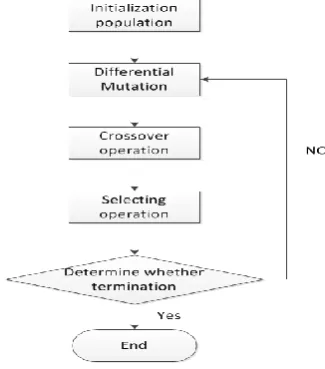
i, and the better one will be saved as a member of the DE population for the next generation.The differential evolution is a one-to-one selection operator algorithm and belongs to the steady-state evolutionary algorithm. The differential evolution algorithm flowchart is shown in Figure 1.
Fig. 1. Differential evolution algorithm flowchart
Compared to other evolutionary algorithms, the differential evolution has the following advantages ([16], [17]): In solving non-convex, multimodal, nonlinear function optimization problem, it has a very strong soundness; fast convergence algorithm under the same accuracy requirements; especially good at solving the multivariate function optimization problem; operation simple and easy programming.
3.2. Particle swarm optimization
The particle swarm optimization (PSO) is proposed by Eberhart and Kennedy [20] in 1995, it is an optimization algorithm based on swarm intelligence theory, through inter-group cooperation and competition between individuals optimize. It retains the populations of the global search ability of the algorithm, by using the velocity - displacement model to avoid the operation of complex genetic algorithm. In addition, its unique memory function can be dynamically tracking current search, then adjust the local and global search capability.
In the PSO, each optimization problem can be regarded as a bird of the search space. For randomly generated initial population
Z
{
Z
i|
i
1
,
2
,...,
NP
}
, each population particle locationZ
i
{
Z
i1,
Z
i2,...,
Z
in}
, and the velocity of the particles}
,...,
2
,
1
|
{
V
i
NP
V
i
in feasible solution space. According to the objectivefunction to calculate the fitness of each particle in the population, and find the optimal solution of the particle itself and global optimal solution in the population, denoted as
ibest
p
andp
gbest. Then update current velocity and location of the particles according to the equation (7) and (8). Use the new velocity and position to looking for the better results, until converges.)
(
)
(
221
1 ibest id gbest id
id
id
v
c
r
p
z
c
r
p
z
v
(7)id id
id
z
v
z
(8)where
c
1,
c
2 are the acceleration factors,r
1,
r
2
(
0
,
1
)
are randomly generated constants,
[
0
,
1
]
is the inertia weight to keep the particles moving, the large
is suitable for a large range and the small one is suitable for a small range, if
0
the particles will lose their memory capacity, the population will shrink to the current optimal position, thus losing the ability of global search. In this article, use the current number of iterationsiter
, the maximum number of iterationsiter
max, we define
asmax min
max
max
iter
(
)
/
iter
,
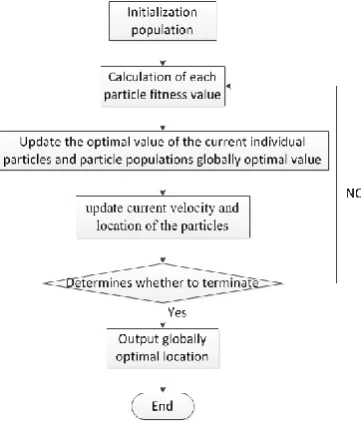
will decrease with the increase of the number of searches. The PSO algorithm flow chart is shown in Figure 2.Fig. 2. Particle Swarm Optimization flowchart
The PSO has been widely used in function optimization, neural network training, fuzzy system control, multi-objective optimization, and other genetic algorithm ([21], [22], [23]).
3.3. The DEPSO-FCM image segmentation design
The characteristics of the PSO are the ability of local search, fast convergence, but premature, the DE is characterized by global search ability, but poor convergence and the lack of local search ability. In order to achieve better optimization results, in recent years, more and more experts tried to mix these two algorithms with other algorithms [24-29]. We propose the use of the respective merits of these two algorithms and learn from each other, and use it in the FCM. On the one hand, the DEPSO-FCM can avoid the local extremum of the FCM; on the other hand, can make use of the PSO to solve the DE’s poor convergence.
The PSO and the DE are required to evaluate the individual particles, when the initial cluster centers close to the target cluster centers, indicating that the convergence of the algorithm, in this article we define the fitness function as:
)
,
(
U
c
J
k
diff
(9)The image as the search space, in the course of the campaign, the particles cannot exceed the range of the image, during the search, according to the fitness function, the particle search global optimal solution as image segmentation threshold based on the fitness function. The DEPSO-FCM image segmentation as follows:
Step 1: Read the image gray histogram and set parameters: the number of clusters
c
, the population numbersN
, fuzzy indexm
, scaling factorF
, the cross rateCR
, accelerating factorsc
1andc
2, the maximum and minimum inertia weights
max andin m
, the maximum number of iterationsiter
max, the maximum velocityV
max.Step 2: Initialize population. Randomly generate the initial population and its flight velocity, use equation (2) and (3) to calculate the degree of membership and the cluster centers of all the particles in the population, compute the fitness of all the particles in the population according to equation (9), record all current particle individual extremum
ibest
p
and groups extremump
gbest, set the initial mutation particle valueZ
.Step 3: According to equation (6) to judge whether the crossover operation. If the crossover operation is not satisfied, the process proceeds to the step 4, otherwise to generate a variation of the particle in accordance with equation (5).
Step 4: According to equation (9) to calculate the current degree of adaptation of the variation particle, and compared with the current population extremum. If this particle is better than the current population optimal, update the initial individual extreme
p
ibest, record the current population extreme valuep
gbest and go to the step 6, otherwise go to the step 5.Step 5: According to the formula (7) (8) to update the particle velocity and position, control the velocity and position of the new particles to movement within the space. Calculate the degree of membership, the cluster centers, and the fitness. Update the
p
ibest, if it’s better than the initial individual extremum, Update thep
gbest, if it’s better than the group extremum.Step 6: Judge whether the algorithm has reached the maximum number of iterations. If it has been reached, output the global optimal solution; Otherwise, skip to the step 3 for the next iteration.
The pseudo code of the DEPSO-FCM Algorithm is:
Parameter setting:
C
is the classification number,N
isthe population size,
X
is gray image numerical at 0-255,M
is the fuzzy index,F
is the scaling factor,CR
is thecross rate,
is the inertia weights;Initialize a population
X
that containsN
particles withrandom positions and each particle is clamped within
]
,
[
X
minX
max ;Initialize the particles’ velocities
V
speed and eachparticle’s velocity is clamped within [-1, 1];
Evaluate
U
anddiff
for all particles according to (2), (3)value
diff
(
p
ibest)
and the current global optimal value)
(
p
gbestdiff
;p
ibest is he particle's current individual extremelocation and
p
gbest is the global optimal location.while (cnt < iter)
// cnt is the current iteration times, iter is the maximum
number of iterations.
For i=1: N // Do DE. Select
x
r1,
x
r2,
x
r3
N
randomly;If ((rand()<CR) || i==jrand)
Change ui according to (5) and (6);
// Adjust the value of ui to prevent cross the border;
If
u
i
X
maxthenu
i
X
max; EndIf
u
i
X
minthenu
i
X
min; EndEvaluate
U
(
u
i)
anddiff
(
u
i)
foru
i according to theequation (2), (3) and (9);
If
diff
(
u
i)
is better thandiff
(
current
gbest)
Update
current
gbest with ui; EndElse //Do PSO
iter
cnt
(
max min)
/
max
;Evaluate the current velocity
v
i according to theequation (7) ;
// adjust the value of vi to prevent cross the border.
If
v
i
1
thenv
i
1
; EndIf
v
i
1
thenz
i
1
; EndEvaluate the current location
z
i according to theequation (8) ;
// adjust the value of zi to prevent cross the border.
If
z
i
X
max thenz
i
X
max; EndIf
v
i
X
min thenv
i
X
min; EndEvaluate
U
(
z
i)
anddiff
(
z
i)
according to the equation(2), (3) and (9);
If
diff
(
z
i)
is better thandiff
(
p
ibest)
Update
p
ibest withz
i; EndIf
diff
(
z
i)
is better thandiff
(
p
gbest)
Update
p
gbest withz
i;EndEnd for
X
gbest
p
gbest;// Xgbest as the best segmentation threshold value.
cnt = cnt+1; End
Do segmentation by using
X
gbest.3.4. Simulation and Analysis
All the test were implemented using MATLAB 7.8 on a PC compatible with Core i5, a 2.5GHz processor and 4 GB of RAM. The parameters were set as: the initialization population size
N
30
, the inertia weight
max
0
.
9
and
min
0
.
4
, the fuzzy indexm
2
, the acceleration factorsc
1
c
2
2
, the scaling factorF
0
.
5
, the cross rateCR
0
.
3
, the velocityV
speed
[
1
,
1
]
and the range of motion]
255
,
0
[
x
.The gray image segmentation based on DEPSO. In gray image, we add noise in the original image and get a new image, then blur it. In order to judge the superiority of the algorithm, we introduce the peak signal to noise ratio (PSNR). Set the image contains
n
m
pixels:n m j i I j i I MSE MSE PSNR m i n j split original
1 1
2 2 )] , ( ) , ( [ 255 log 10
(10)
where
I
original(
i
,
j
)
is the original image pixel value without noise and blur, and)
,
(
i
j
I
split is the pixel value of the image segmentation. The biggerPSNR
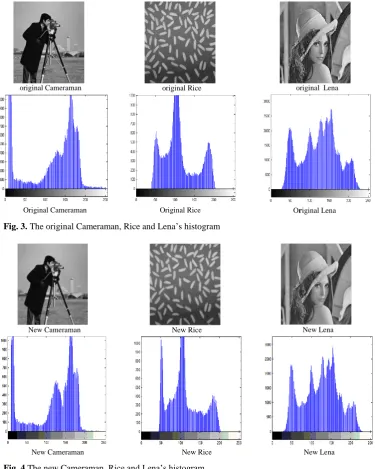
means the divided image closer to the original image, and the better ability of anti-noise.We split the image Cameraman, Rice, Lena with the DEPSO-FCM, and compared with the FCM and PSO-FCM. The histograms of the original image were show as Figure 3. We add salt and pepper noise to the image and blur it, and get the new image histograms as Figure 4.
original Cameraman original Rice original Lena
Original Cameraman Original Rice Original Lena
Fig. 3. The original Cameraman, Rice and Lena’s histogram
New Cameraman New Rice New Lena
New Cameraman New Rice New Lena
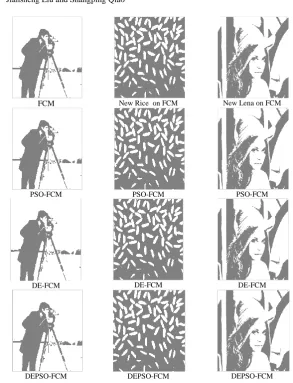
FCM New Rice on FCM New Lena on FCM
PSO-FCM PSO-FCM PSO-FCM
DE-FCM DE-FCM DE-FCM
DEPSO-FCM DEPSO-FCM DEPSO-FCM
Fig. 5. The results of image segmentation based on different algorithms with C=2
Table 1. The comparison of the optimal cluster center of the different algorithms with C=2
Image Cameraman Rice Lena
FCM (26.5811,154.4875) (90.7999,168.2538) (77.4335,160.1558)
PSO-FCM (26.1471,154.4076) (90.1918,167.9582) (77.3923,160.1371) DE-FCM (26.3111,154.3134) (90.7696,168.1519) (77.8900,160.3529)
DEPSO-FCM
FCM FCM FCM
PSO-FCM PSO-FCM PSO-FCM
DE-FCM DE-FCM DE-FCM
DEPSO-FCM DEPSO-FCM DEPSO-FCM
Fig. 6. The results of image segmentation based on different algorithms with C=5
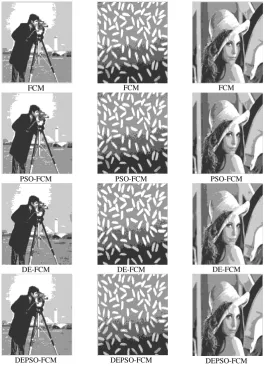
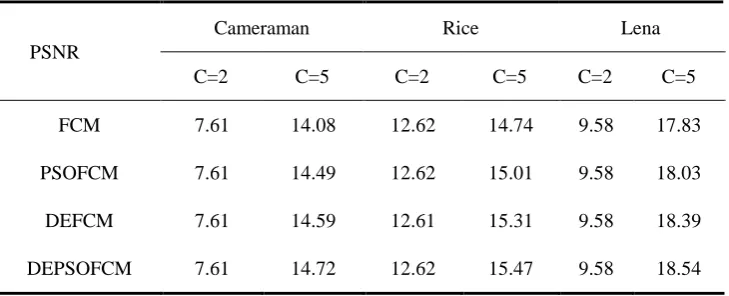
Above the figures and tables, we find that all kinds of segmentation methods have the same effect when c=2. When c=5, we can see the DEPSO-FCM has the best ability of anti-noise and can get best results in the four algorithms.
Table 2. The comparison of the optimal cluster center of the different algorithms with C=5
Image Camera--man Rice Lena
FCM
(15.8154,66.9201, 122.8481,158.363, 179.0340)
(55.9146,85.4695, 107.8236,145.5002, 183.9177)
(54.0167,97.2855, 130.5054, 159.2682, 201.6038)
PSO-FCM
(17.1111,74.3400, 124.5780,159.9312, 180.9697)
(56.4884,88.6676, 108.4027,147.3045, 184.8857)
(55.7062,99.4954, 132.0255,159.6482, 201.7871)
DE-FCM
(15.8291,66.9386, 122.8169,158.3525, 179.0773)
(59.3405,89.0625, 106.2658,146.3129, 183.4174)
(55.5577,98.3903, 128.6414, 159.4831, 202.5555)
DEPSO-FCM
(15.9971,83.1323, 125.3749,161.4510, 181.1450)
(54.9073,88.5200, 108.8697,156.5483, 187.5816)
(52.7146,97.3412, 135.1057,161.4538, 203.5498)
Table 3. The comparison of the psnr of the different algorithms with C=2 and C=5
PSNR
Cameraman Rice Lena
C=2 C=5 C=2 C=5 C=2 C=5
FCM 7.61 14.08 12.62 14.74 9.58 17.83
PSOFCM 7.61 14.49 12.62 15.01 9.58 18.03
DEFCM 7.61 14.59 12.61 15.31 9.58 18.39
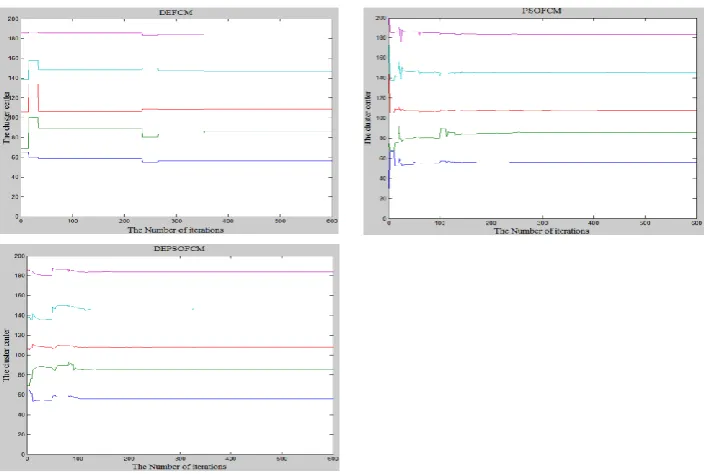
Fig. 7. The cluster center changes in DEFCM, PSOFCM and DEPSOFCM for Cameraman
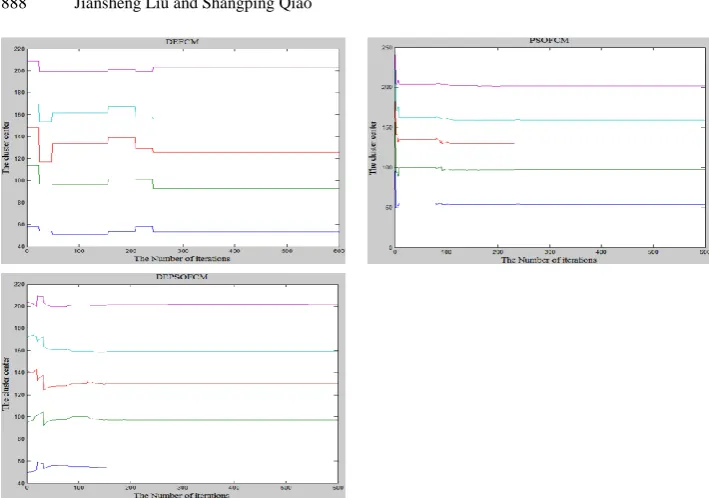
Fig. 9. The cluster center changes in DEFCM, PSOFCM and DEPSOFCM for Lena
Color image segmentation based on DEPSO in HSI space. Color image is more complicated than grayscale image, in general, we put it to a specific color space to process. HSI (Hue, Saturation, Intensity) is a color space that can be separated luminance information and color information of the image, it is an ideal space for color image rendering and processing. However, in the HSI space, some images contain a number of meaningless points that will affect the segmentation, espacailly in the H component.
House Peppers
Original House J(u, c)=257.4 in H (a) J(u, c)=545.6 in H (b)
Fig. 11. The FCM segmentation results with C=3 for House
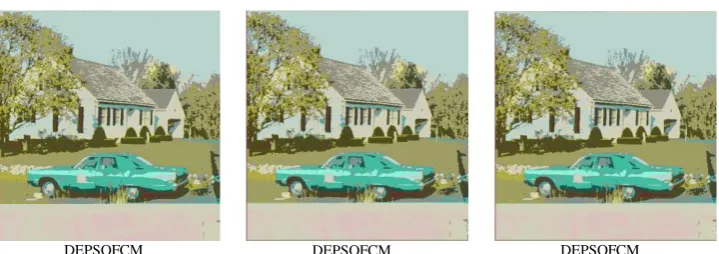
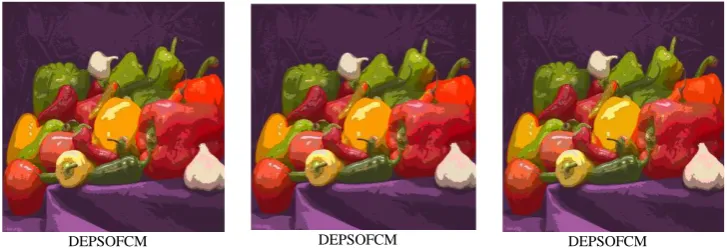
The initial clustering center of FCM, the DE-FCM, PSO-FCM and the DEPSO-FCM is randomly generated; the maximum number of iterations iter=200 and the center numbers C=3 in House, and iter=500 with C=5 in Peppers. And the initial clustering centers of DE-FCM, PSO-FCM and DEPSO-FCM are the same.
Original peppers J(u, c)=29.5 in H (a) J(u, c)=32.1 in H (b)
Fig. 12. The FCM segmentation results with C=5 for peppers
DEPSOFCM DEPSOFCM DEPSOFCM
Figure 11 and Figure 12 show the effect of the color image segmentation by FCM. There are two different effects with different initial values. The figure 10(b) and figure 11(b) are caught in local minima.
DEPSOFCM DEPSOFCM DEPSOFCM
Fig. 14. The results of different algorithms with C=5 and iter=500 in peppers
Table 4. The comparison of the different algorithms in House in the H component with C=3 iter=200
J(u,c) in H Mean Max Min Errors Error rate
FCM 305.4975 546.0756 257.3819 7 35%
PSO-FCM 258.0987 261.2646 257.3826 1 5%
DE-FCM 257.8241 258.8733 257.3962 0 0
DEPSO-FCM 257.5019 259.5329 257.2075 0 0
Table 5. The comparison of the different algorithms in peppers in the H component with C=5 iter=500
J(u,c) in H Mean Max min Error Error rate
FCM 30.7452 32.0031 29.4874 10 50%
PSO-FCM 30.4316 53.8285 29.5291 5 25%
DE-FCM 30.1653 32.6461 29.4875 4 20%
Figure 13 and Figure 14 show the effects of the color image segmentation by DEPSO-FCM, DEF-CM and PSO-FCM. Table 4 and Table 5 show the objective function
J
(
U
,
c
)
of H component of House and Peppers in different algorithms. The results in the table are obtained by running twenty times, and we consider the data that seriously deviate from the optimum is error.Analyzing the above table 4 and table 5, DEPSO-FCM is the best in the optimization. In House and Peppers, the DEPSO-FCM can get the smallest mean and the smallest minimum. From the number of successful search, the algorithm of this paper close to DE, can effectively improve the number of failures.
4.
Conclusion
In this paper, we analyze the characteristics of the FCM image segmentation, the advantages and disadvantages of the PSO and the DE. Then an image segmentation method named DEPSO-FCM is introduced, which improves the effect of image segmentation by introducing differential evolution and particle swarm optimization. From the results we can see that the DEPSO-FCM has strong robustness and practicality; the DEPSO-FCM can help FCM to improve the dependence of the initial cluster centers to improve easy to fall into the local extremum. In the same initial population, the same parameters and the sufficient number of iterations, the convergence of DEPSO-FCM is the best in all and in the multi-peak gray level histogram the advantage of DEPSO-FCM is more obvious. In HSI color space segmentation, the algorithm in this paper can effectively find the global optimum, and avoid error split, and get more stable and better segmentation results.
However, this algorithm is more complex than the other two and the setting of each parameter needs for further research.
References
1. He-Yue.: Research on Image Segmentation Algorithms Based on Fuzzy Clustering. Jilin University, China. (2012)
2. Chuang, K. S., Tzeng, H. L., Chen, S., et al.: Fuzzy c-means clustering with spatial information for image segmentation. Computerized Medical Imaging and Graphics, 30: 9- 16. (2006)
3. Jiansheng, L., Hui, L., Shangping, Q., and Guangxue, Y.: “An Automatic Image Inpainting Algorithm Based on FCM,” The Scientific World Journal, vol. 2014, Article ID 201704, 10 pages. doi:10.1155/2014/201704. (2014)
4. Jihong, P., Weixing, X.: Adaptive Multi-Thresholds Image Segmentation Based on Fuzzy Restrainted Histogram FCM Clustering. ACTA ELECTRONICA SINICA, 27(10): 38-42. (1999)
5. Oh, J. T., Kwak, H. W., Sohn, Y. H., et al.: Mult-ilevel thresholding using entropy-based weighted FCM algorithm in Color Image. MLNCS, Springer, 437-444. (2005)
7. Mingxia, X., Chen-Ke, Jianzhong, G.: Research of FCM for image segmentation based on graph theory. Computer Applications, 28(11): 2912-2914. (2008)
8. Hongying, Y., Xiangyang, W., Chunhua, W.: Improved Adaptive FCM Color Image Segmentation Algorithm. Computer Science, 36(8): 281-284. (2009)
9. Songcan, C., Daoqiang, Z.: Robust image segmentation using FCM with spatial constraints based on new kerne-linduced distance measure. IEEE Trans. on System, Man, and Cybernetics, 34(4): 1907-1916. (2004)
10. Li-li, L., Li-Ming, Xiyu, L:. Image segmentation algorithm based on Particle Swarm Optimization fuzzy C-means clustering. Computer Engineering and Applications, 45(31): 158-160. (2009)
11. Chen-Xi, Chun-yue, L., Feng, L., et al.: Image segmentation based on PSO and Fuzzy C-Means clustering algorithm. Computer Engineering and Applications, 44(18): 181-182. (2008)
12. Xiaolong, L., You-sheng, Z., Ying, X.: Image Segmentation Algorithm Based on Simulated Annealing an Fuzzy C-Means Clustering. Journal of Engineering Graphics, 1: 89-93. (2007) 13. Bezdek, J. C. Pattern recognition with fuzzy objective function algorithms. New York:
Plenum Press, 95- 107. (1981)
14. Ding-Zhen, Zhongshan, H., Jingyu, Y., et al.: FCM Algorithm for the Research of Intensity Image Segmentation. ACTA ELECTRONICA SINICA, 25(5): 39-43. (1997)
15. Xie, X. F., Zhang, W. J., Yang, Z. L.: A dissipative particle swarm optimization. Congress on Evolutionary Computation, 1456-1461. (2002)
16. Wenyin G.,: Differential Evolution Algorithm and Its Application in Clustering Analysis. China University of Geosciences, China. (2010)
17. Storn, R., Price, K.: Differential Evolution-a simple and efficient Heuristic for global optimization over continuous spaces. Journal Global Optimization, pp.341- 359. (1997) 18. Qinghua, S., Zhongbo, H.: Cluster Analysis Based on Differential Evolution Algorithm.
Journal of Wuhan University of Technology, 32(1): 187-191. (2010)
19. Yuling, C., Binghan, L.; Image segmentation method based on differential evolution and weighted fuzzy C-means algorithm. Journal of Fuzhou University (Natural Science), 38(1): 36-40. (2010)
20. Eberhart, R. C., Kennedy, J.: A new optimizer using particles swarm theory //Proc of the 6th International Symposium on Micro Machine and Human Science, Piscataway, NJ: IEEE Service Center, 39-43. (1995)
21. Benxian-Yue.: Extension of Particle Swarm Algorithm for Constrained Layout Optimization. Dalian University of Technology, China. (2012)
22. Yingying, L.: Research of Logistics Distribution Routing Problem based on PSO. Beijing Jiaotong University, China. (2012)
23. Wenbin, Z., Xiaofei, X.: Safeguard resource optimization based on hybrid PSO. Computer Engineering and Applications, 48(29): 210-213. (2012)
24. Pant, M., Thangaraj, R.: Hybrid Differential Evolution-Particle Swarm Optimization Algorithm for Solving Global Optimization Problems. Third International Conference on Digital Information Management, 18–24. (2008)
25. Hui-Liu, Zixing, C., Yong, W.: Hybridizing particle swarm optimization with differential evolution for constrained numerical and engineering optimization. Applied Soft Computing 10: 629–640. (2010)
26. Xin-Bin, Chen-Jie, ZhiHong, P., Pan-Feng.: An adaptive hybrid optimizer based on particle swarm and differential evolution for global optimization. SCIENCE CHINA, 53(5): 980– 989. (2010)
27. Xiao-hong, Z., Hong-mei, N.: Fuzzy clustering image segmentation algorithm based on CPSO. Application Research of Computers, 28(12): 4786–4789. (2011)
29. Wen-Jun, Z., Xiao-Feng, X.: DEPSO: Hybrid Particle Swarm with Differential Evolution Operator, IEEE International Conference on Systems. Man & Cybernetics (SMCC), Washington D C, USA, 3816-3821. (2003)
30. Lin-Chuan.: Study and Application of Particle Swarm Optimization and Differential Evolution. Southwest Jiaotong University, China. (2009)
31. Chen-Kun, Ma-Yan, Shunbao, L.: Color image segmentation algorithm based on histogram and fuzzy c-means algorithm. Computer Applications and Software, 29(4): 256-259. (2012) 32. Li-Guang, Zhao-ying, W., Zhi-qiang, H.: Color image segmentation algorithm based on
K-means clustering and region merging. Journal of Computer Application, 30(2): 354-358. (2010)
33. van den Bergh, F.: An Analysis of Particle Swarm Optimizers. Department of Computer Science, University of Pretoria, South Africa. (2002)
34. Kaiyan, L., Lihong, X., Junhui, W.: A Fast Fuzzy C-Means Clustering for Color Image Segmentation. Journal of Image and Graphics, 9(2): 159-163. (2004)
35. Yingqian, W., Pengfei, S.: A Genetic Algorithm Based Approach for Image FCM Segmentation. Measurement & Control Technology, 21(5): 16-18. (2002)
Jiansheng Liu, corresponding author, was born Jiangxi of China in 1959.He is an Associate Professor in Jiangxi University of Science and Technology, China. His interests include Information Security, Artificial Intelligence and Numerical Analysis.
Shangping Qiao, postgraduate student of college of science in Jiangxi University of Science and Technology, the research direction is Intelligence computation and Intelligent recognition.