18
Personal Construct Theory & Practice, 12, 2015
REFLECTING ON A VOCATIONAL EDUCATOR’S THEORY
OF PRACTICE: A CO-CONSTRUCTED ACCOUNT
Willfred Greyling, Owen Lingard
Waikato Institute of Technology, Hamilton, New Zealand
In this article, we report on how we used personal construct theory (PCT) methods in reflecting on the second author’s (SA’s) practices in vocational training for at-risk pre-apprenticeship youth in the electrical engineer-ing and supply field. Our main aim is to describe the reflective process, especially how we raised SA’s awareness of his pedagogical constructs and some of the implicative dilemmas in his pedagogical meaning-making. We provide a brief outline of a constructs-based approach, and what we mean by implicative dilem-mas. Our method involves a case study to show how we used two PCT methods, constructs elicitation and repertory grids, in SA’s reflective work. We found that SA was able to make explicit both his constructs and the conflicts in his meaning-making. His experiment with small-group learning and role definitions assisted him in resolving these dilemmas and diversifying his constructs. We concluded that PCT methods were useful in providing very specific prompts for reflective practice in this educational context. First author’s (FA’s) broader interest was to develop a constructs-based reflective approach for educators at a tertiary institute of technology.
Keywords: Implicative dilemma, repertory grid, vocational training, education, tacit knowledge
INTRODUCTION
Context
Brophy, Fransella and Reed (2003) observe that personal construct mentoring typically involves associates who engage in co-operative, devel-opmental activity aimed at awareness-raising and solution-seeking change. We report on such a constructs- and evidence-based reflective proc-ess between an academic support staff member (FA) and a vocational trainer in electrical engi-neering (SA) in a tertiary institute in New Zea-land. We reasoned that reflective practice would allow us to make explicit educators’ tacit knowl-edge (Gascoigne & Thornton, 2013; Nonaka & Takeuchi, 1995; Senge, 2006), or in PCT terms, develop accounts of vocational trainers’ (non-symbolised) non-verbal know-how (Kelly, 1955).
FA’s broader concern was to illustrate the usefulness of PCT methods in drawing up indi-vidualised agendas for reflective practice in
ter-tiary vocational training, and how ‘workplace research’ could be used to improve educator practices and lift outcomes for learners. In this article, our purpose is to report on how con-structs elicitation and repertory grid analysis were used in reflective practice in vocational training. This article follows on Greyling, Belcher and McKnight (2013) who explored the usefulness of the repertory grid in triangulating an educator’s and her learners’ meaning-making on a pre-apprenticeship hairdressing programme.
A constructs approach
Kelly (1955; 1966/2003) contends that, on the basis of experience, each person develops a net-work of bipolar constructs (such as like vs dis-like; autonomous vs dependent learning; experi-ential vs instructional approaches to learning,
simi-19
Personal Construct Theory & Practice, 12, 2015
larity. For example, the construct experiential vs instructional approaches to learning identifies ‘experiential’ and ‘instructional’ as the aspect of difference, while ‘approaches to learning’ is the aspect of similarity.
Subsequent experiences allow the person to either validate or disconfirm the predictions. If predictions are validated, the person is able to assign meanings to the experience that she would deem useful and adequate in the context. The person may, but does not have to, improve her constructs and predictions. However, if her predictions are invalidated, she would be prompted to make one of three moves: use the same constructs to make new predictions, use different constructs to find more useful predic-tions, or create new constructs to make new pre-dictions (Kelly, 1955).
Kelly (1955; 1966/2003) also refers to frag-mentation, pointing out that inconsistencies often exist in a person’s network of constructs. For example, a vocational trainer may firmly believe in active learner participation, prompted by his
active vs passive learner roles construct. How-ever, in practice, he may not allow learners enough time to respond to his tasks or elicita-tions, mediating their ‘non-responses’ too soon and depriving them of the opportunity to engage. Thus, his notion that learner responses have to be efficient and immediate turns learners into passive recipients of information – they are not given enough time to respond. Thus, his efficient vs inefficient lag in learner response-time in training construct is out of kilter with his notion of active learner participation and how such learning is accomplished.
Implicative dilemmas
We were interested not only in SA’s network of constructs, but also in a specific form of incon-sistency in his network, namely implicative di-lemmas. A significant literature exists on the topic and how to identify conflicts, inconsisten-cies and implicative dilemmas in repertory grids (Badzinsky & Anderson, 2012; Bell, 2004; Feixas, Saúl & Ávila-Espada, 2009; Feixas &
Saúl, 2004; Feixas, Saúl & Sanchez, 2000; and others).
Feixas and associates (2000; 2004; 2009) link implicative dilemmas to discrepant and congru-ent constructs. A discrepant construct, they point out, refers to an area where a person experiences a level of dissatisfaction which results in her viewing change as highly desirable, while a con-gruent construct denotes an area where the per-son would see no reaper-son to want to change (Feixas & Saúl, 2004). Hence, we refer to an implicative dilemma as more than an inconsis-tency or ambiguity in a person’s thinking; rather, it denotes an inconsistency or ambiguity that evokes a level of discomfort in a person which will prompt her to want to resolve the tension and ambivalence of not knowing how to act.
For example, a vocational trainer, using the
20
Personal Construct Theory & Practice, 12, 2015
2012). To extend the example, a host of otherconstructs may come into play at this point, not least of these cost vs benefit of change (Badzin-ski & Anderson, 2012), overt vs covert resis-tance to change (Marshak, 2006), imposed top-down vs negotiated bottom-up buy-in to change
(Hardy, Palmer & Phillips, 2000), and high vs low urgency change (Kotter, 2008), to name a few.
AIMS AND OBJECTIVES
Our main aim was to show that constructs elici-tation and repertory grids were useful methods in setting agendas for academic support staff and vocational trainers to reflect on the latter’s prac-tices in vocational training. Specifically, we set out to describe and reflect on SA’s teaching con-structs that related to a pre-apprenticeship elec-trical engineering programme for at-risk youth.
We defined several objectives which emerged from our reflective conversations about SA’s teaching. These were: to describe the process of embedding the two PCT methods in our reflec-tive practice; illustrate how we arrived at an ac-count of the elements and constructs in SA’s meaning-making; design a grid; use the findings for reflective conversations between FA and SA to raise our awareness of his pedagogical mean-ing-making, including implicative dilemmas, if any; and collaborate in interpreting the findings.
We also provide a brief account of SA’s self-initiated experiment with his learners to explore his view of the relationship between scaffolding, educator control and learner autonomy.
RESEARCH METHODOLOGY AND METHODS
We provide a brief account of our methodology and methods. PCT methods became relevant in our reflective conversations in the workplace, when at the appropriate time, FA suggested to SA that constructs elicitation and a repertory grid could assist us in going beyond discrete themes in his meaning-making to reveal the re-latedness of clusters of meanings in his thinking.
We outline our methodology to assist anyone wanting to replicate our process which lasted approximately for 15 hours of conversation from October 2013 to June 2014. We use the word ‘replicate’ in the knowledge that no two events are ever the same, and even if we were to ‘repli-cate’ the study, we would face newness and dif-ference in our experience (Drummond & Themessl-Huber, 2007).
Preliminaries: Shared knowledge and experi-ences
We agreed that we had a well-established and ongoing positive, high-trust relationship (Dutton & Ragins, 2007) and that such a relationship was a key factor. We also had at our disposal an in-formal record of past conversations, two graphic outlines of key words and symbols (i.e. mind-maps) of SA’s preferred teaching principles and practices, and a classroom observation. FA, who has an interest in PCT methods, had used con-structs elicitation in these conversations. As prompts for reflection, FA and SA had discussed current and future practices; trainers deemed to be, or not to be, role models; traditional and more innovative approaches; and industry expec-tations. These became the elements in our small-scale project.
Step 1: From informal talk to constructs and a repertory grid
21
Personal Construct Theory & Practice, 12, 2015
Step 2: Imposing order on our input data
Using the input available to us, FA identified the elements, and tentatively, abstracted constructs on the basis of our conversations, especially SA’s responses to conversational cues, consis-tent with dyadic elicitation (Fransella, Bell, & Bannister, 2004), such as: If you think about your current practices and industry expectations, are they consistent? How are they the same? How are they different? If you compare training that will produce innovative, problem-solving learners and your future practices, how would those be similar? How would they be different?
Step 3: SA validating the formulations
In this step, FA presented his tentative summary of seven elements and twelve constructs. FA revisited the input data, explaining the link be-tween dyads of elements and constructs. SA ac-cepted the elements. Although he agreed with the constructs, he contested the wording of some. We worked on the wording until SA was satisfied that the verbal labels came as close as they could to his view. Following Bell (2010), SA identified the emergent of each construct before FA designed the grid.
Step 4: Designing the grid
Next, FA developed a grid consisting of twelve constructs and seven elements, with the focus of convenience, as specified earlier. In the design, FA reversed the poles of six constructs. The grid consisted of 7 pages, one per element. Each page consisted of an element (see Table 2) and the twelve constructs (see Table 1), each of which requiring a rating on a seven-point Likert scale (Feixas & Cornejo, 2002; Fransella, et al., 2004).
Step 5: Eliciting and processing SA’s ratings
SA completed the grid, page by page, without referring back, in approximately an hour. FA then applied grid-focusing, reversing half the
poles of the constructs in the completed grid to align the emergent poles on the left side of the grid (Feixas & Cornejo, 2002). FA also con-verted the seven-point scale to a zero-point scale where 4 = 0, a rating of 1 = 3 and a rating of 7 = -3. He then processed the ratings in IBM SPSS (2013, Version 22), computing means, standard deviations, correlations for constructs and ele-ments; as well as two cluster analyses, producing dendrograms which showed how ratings were configured for constructs and elements (Fransella, et al., 2004).
Step 6: Identifying implicative dilemmas
We used Feixas, Saúl and Sanchez (2000) as a rough guide to identify discrepant and congruent constructs. Discrepant constructs showed nega-tive means located on the opposite poles (means < 0), while congruent poles would yield positive means located on the emergent poles (means >0). Means >-1 and <+1, we argued, signalled either conflict or confusion, revealing that SA was undecided on whether the emergent or op-posite pole should apply. In addition, as speci-fied by Feixas et al. (2000), the opposite pole of a discrepant construct would be associated with the emergent pole of a congruent construct, yielding a negative correlation, while the emer-gent poles of congruent constructs would show positive correlations. We noted Feixas and Saúl’s (2004) salience point of 0.35, but then, following Cohen (1988), we opted for correla-tions of 0.6 or higher, and probability levels of 0.05 or less. These, we reasoned, were stringent requirements for identifying meaningful associa-tions among constructs and among elements.
Step 7: FA’s tentative interpretations and SA’s response
22
Personal Construct Theory & Practice, 12, 2015
the other for elements. For this article, we madea selection to illustrate our process.
Step 8 Resolving the implicative dilemmas
Although SA initially labelled his implicative dilemmas as unresolvable for at-risk pre-apprenticeship students, he nonetheless em-barked upon an experiment. He opted for small-group tasks, carefully crafting step-by-step voca-tion-specific problem-solving tasks for active learner engagement. He also redefined his role as a “questioner and guide” rather than the
tradi-tional provider of information. FA was then in-vited to conduct a classroom observation to ex-plore how SA was redefining his view of his
scaffolding construct.
Step 9: Preparing a joint report
Our final step was to prepare a joint report (Greyling & Lingard, 2014) which was lodged in the institute’s research archive as evidence of our reflective conversations.
Table 1: Constructs for the repertory grid
Construct: Emergent Poles Construct: Opposite Poles
C1: Develop multiple role relationships and practices through modelling [Congruent]
C1: Develop authority-based educator role rela-tionships and practices
C2: Use scaffolds initially, and then eliminate them
[Discrepant]
C2: Use scaffolding consistently throughout the course
C3: Explicitly stated sequential and step-by-step ex-perimentation in learning [Congruent]
C3: Implicit and unstated sequence of actions in experimentation in learning
C4: Socialised into the community of electrical practi-tioners’ socio-cultural practices [Congruent]
C4: Focusing on the individual in relation to the community of electrical practitioners’ socio-cultural practices
C5: Intentionally create socially meaningful learning spaces for students to learn (from others) [Dis-crepant]
C5: Remaining within trainer-dominated learning spaces for students to learn
C6: Shape vocation-specific literate reasoning in a vo-cational context and authentic tasks [Congruent]
C6: Shape general literate reasoning in general contexts (regardless of context)
C7: Seek attention-grabbing instructional strategies
[Congruent]
C7: Seek information-driven instructional strate-gies
C8: Extrinsic personal gain as a lever to motivate learners [Congruent]
C8: De-emphasising personal gain as a lever to motivate learners
C9: Audience-directed relationship-driven approach
[Congruent]
C9: Specialist subject-orientated approach
C10: Experiential cycle of learning [Congruent] C10: Instructional cycle of learning C11: Holistic learning experiences [Mastery as
voca-tion-specific reasoning, problem-solving, atti-tudes, values and practices] [Discrepant]
C11: Subject-focused learning experiences (se-lected theoretical electrical knowledge, rea-soning and knowledge are key)
C12: Intentionally seeking and using associations and analogies to promote learner understanding and complexity of thinking [Congruent]
23
Personal Construct Theory & Practice, 12, 2015
FINDINGS
We report on the following aspects: first, the selected constructs, elements and focus of con-venience for the grid; second, the means, stan-dard deviations and correlations for both con-structs and elements; third, the dendrograms for constructs and elements (as part of a cluster analysis), a brief outline of some of the implica-tive dilemmas, followed by FA’s tentaimplica-tive inter-pretations and SA’s comments.
SA’s constructs
Table 1 lists emergent poles on the left, with congruent or discrepant constructs indicated.
Elements and the focus of convenience
We identified elements from earlier conversa-tions (See Table 2). The focus of convenience of the grid was ‘teaching at-risk pre-apprenticeship students in electrical engineering’. Kelly’s (1955) guidelines specify that role titles should be used; however, others have shown that typical practices or scenarios can also be used profitably as elements (Wright, 2008).
Table 2: Elements
Role 1: ‘How you anticipate industry would want you to train your students’ Role 2: ‘A tutor-trainer in your field who is currently a role model to you’ Role 3: ‘How you view your current practices as a tutor-trainer’
Role 4: ‘How you would want to teach in future’
Role 5: ‘A tutor-trainer in your field whose training practices you reject’
Scenario 1: ‘Imagine training in which the tutor-trainer’s ultimate aim is to develop learners’ roles and prac-tices of independent, innovative, reasoning and responsive electrical engineering practitioners’. Scenario 2: ‘Imagine training in which the tutor-trainer controls all information and activity, and focuses on a
limited range of topics to achieve limited, yet complete mastery of the so-identified content in teacher-controlled exchanges’.
Legend:Roles 1 to 4 & Scenario 1 = Positive and emergent elements. Role 5 & Scenario 2 = Contrastive, dispreferred roles and scenario
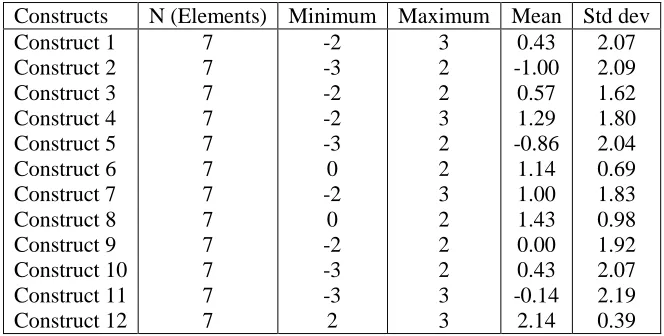
Table 3: Means and standard deviations for SA’s constructs-based ratings of elements
Constructs N (Elements) Minimum Maximum Mean Std dev Construct 1
Construct 2 Construct 3 Construct 4 Construct 5 Construct 6 Construct 7 Construct 8 Construct 9 Construct 10 Construct 11 Construct 12
7 7 7 7 7 7 7 7 7 7 7 7
-2 -3 -2 -2 -3 0 -2
0 -2 -3 -3 2
3 2 2 3 2 2 3 2 2 2 3 3
0.43 -1.00
0.57 1.29 -0.86
1.14 1.00 1.43 0.00 0.43 -0.14
2.14
24
Personal Construct Theory & Practice, 12, 2015
Means and standard deviationsWe report the means and standard deviations for both constructs and elements. Positive means indicate ratings congruent with emergent poles,
while negative means signal meanings located on the opposite poles. The standard deviations signal variability on SA’s ratings. However, we realise that these means mask significant mean-ings captured in individual ratmean-ings.
Table 4: Means and standard deviations for SA’s elements-related ratings
Elements N (Constructs) Minimum Maximum Mean Std dev Role 1 Role 2 Role 3 Role 4 Role 5 Scenario 1 Scenario 2 12 12 12 12 12 12 12 -2 -2 -2 -3 -3 -2 -2 2 2 2 3 3 3 2 0.17 0.50 1.08 1.75 -0.75 1.67 -0.67 1.80 1.24 1.51 1.60 2.01 1.23 1.97
The means for elements (based on 12 ratings on each) signal that negative means are associated with the negative and rejected role definitions of a teacher-centred approach and the undesirable scenario.
Correlations among constructs and among elements
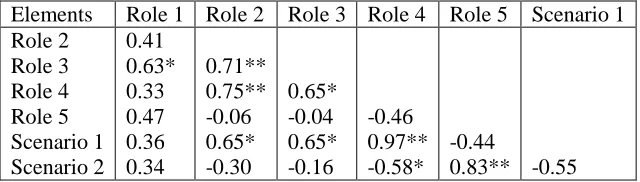
We computed two correlation matrices, one for constructs and the other for elements. We report
the matrix of Pearson correlations for the 12 constructs in Table 5, and for elements in Table 6.
Table 5: Pearson Correlations for Selected Constructs
Constructs C1 C2 C3 C4 C5 C6 C7 C8 C9 C10 C11
C2 C3 C4 C5 C6 C7 C8 C9 C10 C11 C12 -.85** .76* .77* .81* -.63 .93** .14 .97** .84** .90** -.53 -.89** -.89** -.63 .35 -.97** -.33 -.75* -.97** -.77* .64 .97** -.63 -.26 .90** .45 .75* .91** .83* -.43 .67 -.31 .91** .30 .73* .87* .73* -.36 -.25 .67* .38 .81* .66 .75* -.46 -.53 .64 -.63 -.28 -.43 -.09 .19 .86** .93** .83* -.48 .18 .47 .42 -.65 .80* .95** -.46 .86** -.73* -.57
25
Personal Construct Theory & Practice, 12, 2015
Table 6: Pearson correlation matrix for elements
Elements Role 1 Role 2 Role 3 Role 4 Role 5 Scenario 1 Role 2
Role 3 Role 4 Role 5 Scenario 1 Scenario 2
0.41 0.63* 0.33 0.47 0.36 0.34
0.71** 0.75** -0.06 0.65* -0.30
0.65* -0.04 0.65* -0.16
-0.46 0.97** -0.58*
-0.44
0.83** -0.55
*. Correlation is significant at the 0.05 level (1-tailed). **. Correlation is significant at the 0.01 level (1-tailed).
Tentative interpretations and collaborative discussion
As noted, we had reflective conversations about 6 pairs of constructs and 6 pairs of elements, which were summarised in the institutional
re-port, lodged in the institute’s research archive and SA’s personal portfolio of reflections. The correlations below include a congruent pair (Ta-ble 7) and a discrepant/congruent pair (Ta(Ta-ble 8), selected to illustrate the process.
Table 7: Correlation of constructs 3 and 4
Emergent x Opposite poles: Correlation: 0.97** [Congruent constructs] C3: Explicitly stated sequential, step-by-step
experimentation in learning
C3: Implicit and unstated sequence of actions in experi-mentation in learning
C4: Socialised into the community of elec-trical practitioners’ socio-cultural prac-tices
C4: Focusing on the individual as a future member of the community of electrical practitioners’ socio-cultural practices
FA asked SA whether he could validate and clar-ify the level of association between the emergent poles on the left. SA confirmed that explicit communication was key in learning in the elec-trical engineering field. This included explicit-ness about learner roles, practices and rules of engagement. Often, he stated, vocational
practi-tioners would have to apply step-by-step routines involving thinking and doing. Such mastery was required to be deemed socialised into the prac-tices of the community of electrical practitioners. Thus, he agreed that the emergent poles of C3 and C4 were associated.
Table 8: Correlation of constructs 2 and 7
Constructs 2 and 7: Pole A x Pole B Correlation: -0.97** [A discrepant x A congruent construct] C2: Use scaffolds initially, and then eliminate them
[Emergent, yet aspirational pole]
C2: Use scaffolding consistently throughout the course [Opposite pole, discrepant]
C7: Seek attention-grabbing instructional strategies [Emergent pole][Congruent]
26
Personal Construct Theory & Practice, 12, 2015
We agreed that initially we had worked on theassumption that C2 Pole A would be associated with C7 Pole A 9 (both on the left). FA’s ques-tion was whether there was a reason for the change from the emergent to the opposite pole of the construct (Opposite C2 Pole B) and C7 (Emergent Pole A). SA confirmed that his rat-ings changed when we narrowed the focus of convenience of the grid from mainstream to at-risk students. These students, he said, had major backlogs in their skills and knowledge. Often, they had misperceptions, acting in ways that posed significant health and safety risks. He would rather scaffold their learning, ensuring he offered them systematic learning of the basics required at that level, while at the same time he could assist them in clarifying their roles. SA associated pervasive scaffolding with very tight teacher control over classroom exchanges which typically exhibited tutor-dominated statement-question-answer-evaluation sequences (Bax, 2011; Greyling, 1995; Sinclair & Coulthard, 1992). It was this restrictive account of scaffold-ing for at-risk learners SA had to re-define.
Once he was certain that they had mastered the basics, he could give them more autonomy.
In his view, this would most probably occur at higher levels once they had mastered the basics and had been socialised to act responsibly within their roles. Thus, the idea to eliminate scaffolded learning at all during the pre-apprenticeship phase of the training was aspirational. Scaf-folded practice, SA argued, had to be supple-mented by memorable, attention-grabbing in-structional methods to ensure the at-risk cohort engaged in learning.
Correlations of elements
In this section, we report on three relatively high correlations among the elements in the grid (cor-relations>0.6). We selected the correlations be-low to illustrate the reflective process. We se-lected these correlations to show how SA viewed his tutor role in terms of ‘his current versus fu-ture practices’, ‘current vs innovative practices’ (scenario 1), and ‘his anticipated future practices vs innovative practices’ (scenario 1) elements.
Table 9: Elements - Correlation of role titles 3 and 4
Role title 3: ‘How you view your current practices as a tutor-trainer’ Correlation: 0.65* Role title 4: ‘How you would want to teach in future’
FA asked SA to agree or disagree with the claim that his current practices were associated with what he wanted them to be. SA responded that he felt himself firmly on the path, albeit that he
sometimes experienced doubts, especially when he realised some students could not be rescued from failure.
Table 10: Correlations of role title 3 and scenario 1
Role title 3: ‘How you view your current practices as a tutor-trainer’ Correlation: 0.65*
27
Personal Construct Theory & Practice, 12, 2015
FA’s question was whether SA agreed or dis-agreed with FA’s claim that his current training practices came relatively close to those in a training context that replicated scenario 1. SA agreed, stating that he judged the direction of his practices to be consistent with this scenario.
An-other iteration of his teaching would be closer still to these practices. SA viewed his role as motion, movement on a path, an evolving proc-ess and a journey.
Table 11: Correlation between role title 4 and scenario 1
Role title 4: ‘How you would want to teach in future’ Correlation: 0.97**
Scenario 1: ‘Imagine training in which the tutor-trainer’s ultimate aim is to develop learners’ roles and practices of independent, innovative, reasoning and responsive electrical engineering practi-tioners’.
FA’s question was whether SA agreed or dis-agreed with the following claim: If SA had to imagine a future scenario (such as scenario 1), he would want his future practices to achieve those outcomes (i.e. the role definition and prac-tices described in scenario 1. SA agreed, con-firming the desired direction of his practices. It was clear that he viewed industry-ready learners to exhibit the skills, knowledge and attitudes referred to in scenario 1.
Cluster analyses of constructs and elements
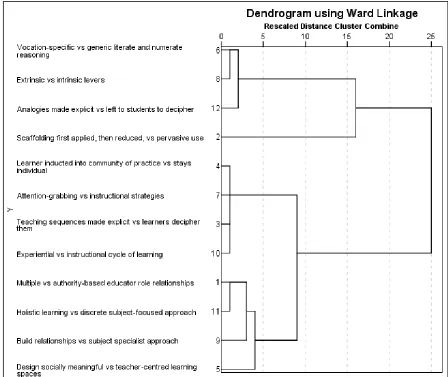
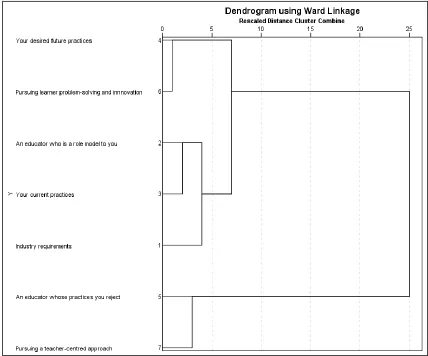
We triangulated our interpretations of the corre-lated pairs, analysing dendrograms for the clus-ters of constructs and elements. The closer the distance between variables on the horizontal axis, the closer they are associated (i.e. Euclid-ean distances).
Dendrogram for constructs
The dendrogram indicates that the following re-lationships exist within the data set, and the dis-cussion of the clusters appear after the dendro-gram in Figure 1 below.
Constructs 1, 5, 9 and 11as implicative dilem-mas
We noted that SA felt torn between the emergent and opposite poles of these constructs. This is
reflected in the means for C1 (0.43), C5 (-0.86), C9 (0) and C11 (-0.14) signalling either confu-sion or tenconfu-sion in his construing. These are grouped in the range >-1 and <+1, hence the high correlations among these constructs. Using means and correlations, as well as SA’s judge-ment of feeling torn between the poles of these constructs, he interpreted the cluster as follows:
SA felt that the challenges posed by at-risk pre-apprenticeship students forced him to revert to an undesirable tutor-centred role instead of collaboratively enacting multiple mentoring-type roles (C1); re-establish teacher-dominated learn-ing spaces instead of intentionally creatlearn-ing so-cially meaningful spaces for students to learn (among themselves and with him as the trainer) (C5); and retreat into his expert specialist sub-ject-matter role (C9 and C11).
In contrast, the emergent poles related to SA creating socially meaningful learning spaces and relationships in which learners could take initia-tive in their learning. The implicainitia-tive dilemma was that group characteristics associated with at-risk students prompted SA to act in terms of the implications of opposite poles (bound together by the notion of teacher control) which con-flicted with his emergent poles (of wanting to assign them tasks requiring initiative and respon-sibility).
Constructs 3, 4, 7 and 10
28
Personal Construct Theory & Practice, 12, 2015
learning processes (C3). This cluster wasassoci-ated with the notion that if learners had to be socialised into the community of electrical prac-titioners (C4), they systematically had to master vocation-specific reasoning. This objective, SA reasoned, could be achieved by employing atten-tion-grabbing instructional strategies (C7), and adopting hands-on experiential cycles of learn-ing (C10).
Constructs 6, 8 and 12
This cluster shows the anticipated association between shape vocation-specific literate
reason-ing and actions in a vocational context and au-thentic tasks (C6) and the view that learners re-sponded to extrinsic personal gain as a lever to motivate them (C8). SA viewed learners as moti-vated by tangible positive results and personal gain. A tangible and immediate benefit had to be clear for learners to engage. One of his strategies was to assist learners in developing their compe-tence deliberately to seek and use associations and analogies that supported learner understand-ing (C12).
29
Personal Construct Theory & Practice, 12, 2015
Construct 2
As seen in Table 8, SA insisted that for the target group scaffolding had to be pervasive in the course (C2). SA viewed such scaffolded support and control as key in dealing with the target group who, in his view, lacked the maturity to be assigned any autonomy. Construct 2 is isolated from the rest of the constructs in the grid, con-firming that this is a focal point in SA’s experi-ence of an implicative dilemma. The negative implication of pervasive scaffolding was that his learners might not meet the industry’s and insti-tute’s work-readiness requirement. Instead, his pervasive scaffolding would lead to dependency, unemployability, and learned helplessness (Seligman, 2012).
SA associated the pole pervasive scaffolding
with tutor-directedness, manifested as tightly controlled initiation-response-feedback (IRF) exchanges in tutor-student interactions (Bax, 2011; Greyling, 1995; Sinclair & Coulthard, 1992). Relevant information would be trans-ferred to the group in a brief lecture followed by students completing relevant workbook activi-ties, and then proceeding to practical application. His emergent pole, scaffold at first, then gradu-ally reduce support, implied that students would receive progressively less support so that by the end of the module, they worked on their own, as he generally experienced with mainstream stu-dents.
30
Personal Construct Theory & Practice, 12, 2015
Alongside our reflections, SA experimented withtutor and learner role definitions, task require-ments, and different interactional configurations in his classes. These experiments assisted him in changing his views of his delivery practices. We refer to the outcomes of his experiment in the discussion section.
We included the dendrogram for elements to show that in SA’s meaning-making, captured in his ratings, the elements were associated as fol-lows:
Role 4 (Element 4) and scenario 1 (element 6)
SA’s ratings showed a positive correlation (cor-relation = 0.97**) which means that ‘how SA would want to teach in future’ is strongly associ-ated with the positive scenario described in sce-nario 1.
Role 2 (Element 2) and Role 3 (Element)
In SA’s ratings, there was a high level of asso-ciation between how he perceived ‘a tutor-trainer in his field who currently serves as a role model to him’ and ‘how he views his current practices as a tutor-trainer’ (correlation = 0.71*).
Role 1 (Element 1) was moderately associated with Elements 2 and 3
SA’s ratings suggest that his perceptions of ‘how he anticipated industry would want him to train his students’ were related to the ‘tutor role as a role model’ and his ‘current practices’ (elements 2 and 3). Although role 1 was associated with elements 2 and 3, we noted in Table 6 that the correlations between role 1 and these two ele-ments were relatively low (with element 2, cor-relation = 0.41) and the only significant result the correlation with element 3 (correlation = 0.63*). SA’s interpretation was that he perceived industry expectations as somewhat inconsistent
with his perception of his and his colleagues’ roles and practices.
Role 5 (Element 5) and Scenario 2 (Element 7)
For purposes of contrast, we included a negative role (‘A tutor-trainer in your field you reject’) and a negative scenario (‘Imagine a training con-text in which the tutor-trainer controlled all in-formation and activity, and focused on a limited range of topics to achieve limited, yet complete mastery of the so-identified content in teacher-controlled exchanges’). As expected, these two elements were highly correlated (correlation 0.83**); however, they contrasted with the other elements in the grid, as can be seen by the dis-tance (25) between the negative pair and the rest of the elements, as well as negative correlations with other elements (See Table 6).
DISCUSSION
Eliciting an agenda for reflective practice
The findings of our small-scale intervention showed that constructs elicitation and repertory grid analysis were useful in identifying an agenda for reflective practice in a vocational context. These methods were valuable because they allowed us not only to elicit SA’s constructs and implicative dilemmas (Table 1) in relation to various elements (Table 2), but also to explore how various poles of SA’s constructs interacted. See, for example, the discussion of constructs 1, 5, 9 and 11 in Figure 1, and several pairs of in-teracting meanings in Tables 7-11.
Constructs are part of networks of meaning
31
Personal Construct Theory & Practice, 12, 2015
“non-symbolised constructs” (Kelly, 1955: 198). We realised that recordings and transcriptions of conversational data, when analysed, could serve as a valuable source of evidence of implicitly held constructs that evaded our attention in the immediacy of the
From implicative dilemmas to experimenting with new approaches
SA’s construing of scaffolding was a very re-strictive view of teacher-directed support. Such support was manifested mainly as tutor-dominated initiation-response-feedback (IRF) cycles of interaction, controlling content and learner actions, which is typical of such class-room discourse (Bax, 2011; Greyling, 1995; Sin-clair & Coulthard, 1992). His experiment al-lowed him to begin to explore other options: he became a questioner, using extended sequences of IRF exchanges (White & Lightbown, 1984), guiding learners to use vocational reasoning in problem-solving tasks. He outlined the tasks, listing achievable steps for completing them, and the resources (capacitors, circuit components, and technology-enhanced course materials) needed. SA also used small groups of mixed ability, one per task, and imposed time limits for completion. SA worked the room, going from group to group, asking questions to check on learner reasoning. He responded to learner-initiated questions.
What SA discovered was that as the tutor, he was able to scaffold learning, provide firm task-related supports, and re-define his role as a ques-tioner and guide. Tutor control and autonomous learner participation are not mutually exclusive: a tutor can control the design of activities and interactional spaces, yet secure a significant level of learner participation far beyond restric-tive traditional IRF exchanges.
CONCLUSION
We concluded that our joint effort had shown that PCT methods were useful in supporting re-flective processes. Vocational trainers’ mean-ing-making systems, we contend, impact on
their instructional choices. These methods are appealing because they honour the meaning-making of the individual, yielding opportunities for academic advisors and educators to create, abandon, reject or embrace meaning. We viewed the dendrograms from the cluster analy-ses as a valuable source of conversational prompts to explore the relatedness of multiple constructs and elements in SA’s meaning-making.
We also noted four orders of reflective prac-tice: first, eliciting SA’s pedagogical constructs; second, co-designing, administering and process-ing the repertory grid; next, collaboratively in-terpreting means, correlations and dendrograms for constructs and elements; and finally, experi-menting with new tasks and roles for both him-self and his learners while co-writing this article. In hindsight, FA believes that constructs should be defined in relation to observed class-room practices and activities. This would tie the reflective component directly to teaching acts. These, in turn, could be linked to meanings tu-tors deem to be critical in lifting outcomes for learners. This could be supported by laddering up, asking successive why questions, and ladder-ing down, explorladder-ing the how of constructs (Fransella, et al., 2004) Second, the process was time-consuming. Although we agreed that our process offered valuable reflective opportunities, we concluded that applying repertory grids insti-tution-wide had to be considered with care. The challenge would be how to extend the use of the repertory grid and other PCT methods across the organisation in ways that were meaningful, sus-tainable, effective and efficient.
REFERENCES
Badzinski, S.I. & Anderson, J.A. (2012). An explora-tion of the identificaexplora-tion of implicative dilemmas and their relationship to personal construct theory-congruent measures of psychological well-being in nonclinical samples. Journal of Constructivist Psychology, 25, 1-33.
Bax, S. (2011). Discourse and genre: Analysing lan-guage in context. London: Palgrave Macmillan. Bell, R.C. (2004). A new approach to measuring
Con-32
Personal Construct Theory & Practice, 12, 2015
struct Theory & Practice, 1, 53-59. Retrieved from
http://www.pcp-net.org/journal/pctp04/bell042.pdf.
Bell, R.C. (2010). A note on aligning constructs. Per-sonal Construct Theory & Practice, 7, 42-48. Re-trieved from
http://www.pcp-net.org/journal/ptcp10/bell10.pdf. Brophy, S., Fransella, F & Reed, N. (2003). The power of a good theory. In F. Fransella (2003) (Ed.) International handbook of personal con-struct psychology (pp. 329-338). Chichester, UK: John Wiley & Sons.
Cohen, J. (1988). Statistical power analysis for the behavioural sciences (Second edition). Hillsdale, New Jersey:Lawrence Erlbaum Associates. Drummond, J.S. & Themessl-Huber, M. (2007). The
cyclical process of action research: The contribu-tion of Gilles Deleuze. Action Research, 5, 430-448.
Dutton, J.E. & Ragins, B.R. (2007). Exploring posi-tive relationships at work. Mahwah, New York: Lawrence Erlbaum Associates.
Feixas, G. & Cornejo, J.M. (2002). A manual for the repertory grid. Using the GRIDCOR programme
(Version 4.0). Retrieved on July, 23, 2012 from http://www.terapiacognitiva.net/record/pag/conten ts.htm\
Feixas, G., Saúl, L.Á. & Ávila-Espada, A. (2009). Viewing cognitive conflicts as dilemmas: Implica-tions for Mental Health. Journal of Constructivist Psychology, 22, 141-169.
Feixas, G. & Saúl, L.Á. (2004). The Multi-Center Dilemma Project: An investigation on the role of cognitive conflicts in Health. The Spanish Journal of Psychology, 7(1), 69-78.
Feixas, G., Saūl, L.A. & Sanchez, V. (2000). Detec-tion and analysis of cognitive conflicts: Implica-tions for case formulaImplica-tions and the therapy proc-ess. In J.W. Scheer (Ed.) The person in society: Challenges to a constructivist theory (pp. 391-399). Giessen, Germany: Psychosozial-Verlag. Retrieved on 19 January 2015 from http://www.ub.edu/personal/protocolo%20Ingl%e
9s/Protocolo-INGL%c9S-corregido1.htm.
Fransella, F., Bell, R. & Bannister, D. (2004). A man-ual for repertory grid technique (2nd ed.). Chich-ester: John Wiley & Sons.
Gascoigne, N. & Thornton, T. (2013). Tacit knowl-edge. Durham, UK: Acumen.
Greyling, W.J. (1995). Sinclair & Coulthard revisited: Global- and local-allocational turn-taking mecha-nisms in the language classroom. In Pragmatics and Language Learning. Monograph Series
Vol-ume 6 (pp. 19-46). Urbana-Champaign: Univer-sity of Illinois.
Greyling, W., Belcher, C., McKnight, E. (2013). Tri-angulating a vocational tutor’s and her learners’ meaning-making on a pre-apprenticeship hair-dressing programme in the tertiary sector
Personal Construct Theory & Practice, 10, 1-14, 2013. Retrieved from http://www.pcp-net.org/journal/pctp13/greyling13.html
Greyling, W.J. & Lingard, O. (2014). Describing a vocational educator’s pedagogical constructs: A co-constructed account (24 pages). Confidential institutional report. Lodged in July 2014. Waikato Institute of Technology, New Zealand.
Hardy, C. Palmer, I. & Phillips, N. (2000). Discourse as a strategic resource. Human Relations, 53/9, 1227-1248. Sage: London.
IBM Corp. (2013). IBM SPSS Statistics for Win-dows. Version 22.0. Armonk, NY: IBM Corp. Kelly, G.A. (1955). A theory of personality. The
psy-chology of personal constructs. New York: W.W. Norton & Company.
Kelly, G.A. (1966/2003). A brief introduction to per-sonal construct theory. In F. Fransella (Ed.) (2003). International Handbook of personal con-struct psychology (pp. 3-20). Chichester: Wiley. Kotter, J. (2008). A sense of urgency. Boston:
Har-vard Business Press.
Marshak, R. (2006). Covert processes at work. Man-aging the five hidden dimensions of organiza-tional change. San Francisco: Berrett-Koehler Publishers.
Nonaka, I. & Takeuchi, H. (1995). The knowledge-creating company, New York, Oxford: Oxford University Press.
Senge, P. (2006). The fifth discipline: The art and practice of the learning organization. London: Random House.
Seligman, M. (2012). Flourish [eBook]. Sydney: Wil-liam Heinemann.
Sinclair, J. & Coulthard, M. (1992). Towards an analysis of discourse. In M. Coulthard (ed.) (1992). Advances in spoken discourse analysis
(pp. 1-34). London: Routledge.
White, J., & Lightbown, P. M. (1984). Asking and answering in ESLclasses. The Canadian Modern Language Review, 40,228-244.
33
Personal Construct Theory & Practice, 12, 2015
AUTORS’ NOTE
We would like to thank the two anonymous re-viewers for their detailed comments and guid-ance. This version of the paper is substantially different from the version submitted for review. FA would also like to acknowledge Owen Lin-gard, who left the organisation recently for greener pastures, for his commitment and contri-bution. FA takes full responsibility for the final version of the article.
ABOUT THE AUTHORS
Willfred Greyling has worked as a literacy-embedding manager at Waikato Institute of Technology, Hamilton, New Zealand, from 2009 when he emigrated from South Africa. He con-tinues to work as a research associate in the De-partment of English, University of the Free State, Bloemfontein, South Africa.
Owen Lingard worked as a contract project manager on Waikato Institute of Technology’s
Trades & Engineering Modernisation project. He procured and integrated teaching equipment and technology into teaching delivery to support a shift towards inquiry-based and student-centric delivery methodologies.
Contact: [email protected]
REFERENCE
Greyling, W., Lingard, O. (2015). Reflecting on a vocational educator’s theory of practice: a co-constructed account
Personal Construct Theory & Practice, 12, 18-33, 2015
(Retrieved from http://www.pcp-net.org/journal/pctp15/greyling15.pdf)