Corresponding Author E-mail: [email protected]
1645 | Page International journal of Advanced Biological and Biomedical Research
Volume 1, Issue 12, 2013: 1645-1651
The effect of ginger powder on performance, carcass characteristics and blood
parameters of broilers
Habibollah Barazesh1*, Mohammad Boujar Pour2, Somaye Salari2, Tahereh Mohammad Abadi2
1
Graduate student of Animal Nutrition, Ramin University of Agriculture and Natural Resources, Ahwaz, Iran
2
Faculty members, Ramin University of Agriculture and Natural Resources, Ahwaz, Iran
ABSTRACT
To study the effect of herb ginger powder on performance, carcass characteristics and blood parameters of broilers used from 192 broiler chicks (Ross ) in a completely randomized design with 4 treatments and 4 replicates ( each replicate of 12 chicks ). All treatments, including different levels of ginger powder ratios of 0, 0.5, 1, 1.5 percent respectively called T1, 2T, T3 and T4 that were added to the basal diet for 42 days. The results showed that increasing levels of dietary herb ginger powder caused a significant reduction in food intake and weight gain in broilers. So that the entire period, birds fed diets containing 1% lower feed intake and diet ginger powder 0.5% of total period of greatest weight gain were regarded ginger powder. Best and worst feed conversion was significantly related to treatment with 1% ginger and control group. Rise to the level of the herb ginger powder 1.5 percent, decrease abdominal fat in broiler chickens will increase the percentage of ham and stock, while on other carcass parameters were not significantly affected. The results showed that the blood parameters of glucose, HDL and LDL levels treated 1.5 percent ginger powder showed no significant difference compared to control. And other parameters such as cholesterol and triglycerides in number (in treatments 1 and 1.5 percent) powdered ginger to the control group showed a tangible decrease was not significant. From this experiment we can conclude that treatment with 1% (T3) and 1.5 percent (T4) ginger powder showed better performance and carcass characteristics and blood parameters in broilers.
Keywords: Ginger, chicken, performance, blood parameters
Introduction
1646 | Page gingerdiol and ginerdione the ability to stimulate the digestive enzymes, the impact on microbial activity (Dieumou et al, 2009) in broiler. Reported that various medical properties of ginger (such as showing pain) analgesic, antiemetic, antiulcer (febrifuge) antipyretic and Cardiac relaxing. (Mascolo et al, 1989; Philips et al, 1993; Jana et al, 1999) and reduced anti oxidation free harm, increased reuse and improve the health and production of animals (Bosisio et al, 1992).
Materials and Methods
192 broiler chicks (Ross) were trained for six weeks. The 4 treatments and 4 replicates (12 chicks per replicate) were drivers. The experiments were studied in a period of 42 days to evaluate the performance and carcass characteristics, and blood parameters. This scheme is based on corn and soybean meal, and minerals and vitamins for 2 periods with the period 0 to 21 days 21 to 42 days. Ginger powder was purchased from the local market and was used for treatment. Treatment 1 : control ( no additives) , Treatment 2 with 0.5% Of ginger and treatments 3: 1 percent of ginger and treatment 4 : 1.5 percent ginger powder was added to the experimental diets . At the end of the experiment , one bird from each replicate were randomly removed for slaughter , blood samples were collected and centrifuged for 10 min in the machine , to separate the serum separation . Serum samples for analysis of glucose in minus twenty degrees Celsius (Coles, 1986), cholesterol, triglycerides and HDL, LDL (Franey et al, 1986) were housed. All data were used from the CRD (completely randomized design) (1992, SAS) to analyze multiple range and Duncan's tests to compare treatment means (Duncan, 1955).
Results and discussion
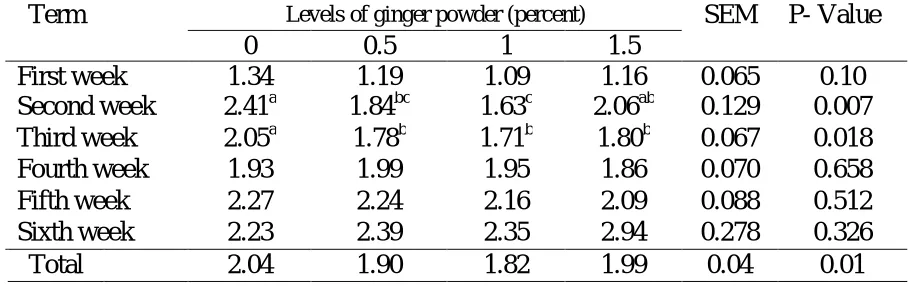
All chickens were apparently healthy and mortality was not significant in the whole course of the experiment. According to Table 1, the effect of treatment with 1% ginger powder on broiler feed intake during the second week showed significant difference compared to control. And sixth week of treatment, 0.5% highest intake of ginger powder and ginger powder 1% treatments showed the lowest intake. But the whole period of treatment with 1% ginger powder showed the lowest feed intake was not significant. The effect of ginger powder (Table 2), the weight gains per week in the third and fifth, respectively, in treatments 1% and 1.5% showed no significant difference with the control diet. And the total duration of weight gains, but did not show significant differences but in numerical treated with 0.5 % of ginger powder showed the best weight gain. The effect of treatment with 1% ginger powder (Table 3) on feed conversion in the, second and third week period showed a significant difference compared to control. Ginger powder 1 % of total treatment period showed the best feed conversion ratio and the lowest. According to (Table 4), the effect of treatment 1.5% of powdered ginger on the percentage of abdominal fat and thigh meat stock showed a significant difference compared to control .
1647 | Page Table 1 - Effect of different levels of ginger powder on feed intake of broiler chickens at different weeks of reared (g)
Table 2 - Effect of different levels of ginger on weight gain of broiler chickens at different weeks of reared (g)
The standard error of the mean SEM and P-Value is the level of significance. Dissimilar letters in each row is indicated significant (P<0.05).
Table 3 - Effect of different levels of ginger powder on a FCR of broiler chickens at different weeks of reared
P- Value
SEM
Levels of ginger powder (percent)
Term
1.5
1
0.5
0
0.28
4.86
92.85
82.50
94.64
94.64
First week
0.02
14.37
353.16
a299.64
b325.00
ab370.00
aSecond week
0.97
28.19
526.70
519.77
537.14
533.61
Third week
0.93
32.62
752.26
737.23
753.9
727.64
Fourth week
0.23
37.62
964.17
929.81
927.14
850.36
Fifth week
0.11
41.51
817.08
732.11
891.36
819.43
Sixth week
0.54
122.82
3506.22
3301.05
3529.18
3395.68
Total
P- Value
SEM
Levels of ginger powder (percent)
Term
1.5
1
0.5
0
0.39
4.35
80.71
76.79
79.82
70.71
First week
0.38
14.91
171.55
192.61
178.57
155
Second week
0.13
12.48
291.55
303.79
301.07
262.32
Third week
0.82
23.18
405.78
380.33
381.43
378.75
Fourth week
0.05
13.28
459.96
a431.63
ab414.82
bc357.00
cFifth week
0.13
53.22
280.53
321.25
376.25
411.78
Sixth week
0.88
62.16
1690.07
1706.45
1731.96
1663.75
Total
P- Value
SEM
1648 | Page The standard error of the mean SEM and P-Value is the level of significance. Dissimilar letters in each row is indicated significant (P<0.05).
Table 4 - Effect of different levels of ginger powder on carcass characteristics of broiler chickens at 42 days of age (% of live weight)
The standard error of the mean SEM and P-Value is the level of significance. Dissimilar letters in each row is indicated significant (P<0.05).
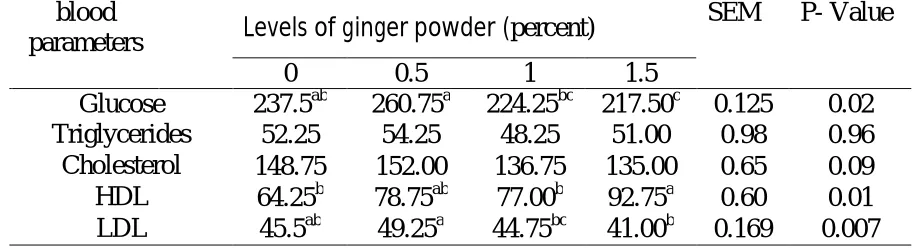
Table 5 - Effect of different levels of ginger on blood parameters of broilers at 42 days (measured in milligrams per deciliter)
The standard error of the mean SEM and P-Value is the level of significance. Dissimilar letters in each row is indicated significant (P<0.05).
Conclusion
The effect of treatment with 1% ginger powder on broiler feed intake during the second week showed significant difference compared to control. And week sixth of treatment, 0.5% highest intake of ginger powder and ginger powder 1% treatments showed the lowest intake. But the whole, period of treatment with 1% ginger powder showed the lowest feed intake and was not significant. The results obtained in this study corresponded with the results of Zhang et al (2009) using ginger (0.5%) and Dieumou et al (2009) using essential oils of ginger (10,20 and 40 mg per day) on broilers.
P- Value
SEM
Levels of ginger powder (percent)
Carcass
components
1.5
1
0.5
0
0.032
0.862
23.49
a19.59
b20.67
b20.07
bThigh
0.335
1.452
31.43
32.87
32.55
29.28
Breast
0.565
0.333
3.12
3.02
3.45
3.62
Liver
0.533
0.395
3.59
2.84
3.17
3.52
Gizzard
0.032
0.348
1.38
b2.25
ab3.06
a2.54
aAbdominal Fat
0.426
0.018
0.21
0.17
0.17
0.18
Spleen
P- Value
SEM
1649 | Page In the other study, Cabuk et al (2006) reported that adding a mixture of medicinal plant extracts on broiler feed intake was reduced significantly compared to the control group. The effect of ginger powder on weight gain in the fifth weeks, , in treatments 1.5% showed significant difference with the control diet. Corresponded with the Arkan et al (2012) reported that the levels of ginger diet improve performance, weight gain and reduce cholesterol, triglyceride (TG) and glucose. Herawati (2009) reported that chickens fed red ginger to which was added 2%, more body weight was observed than chicks that had a diet uncontrolled. Dieumou et al (2009) reported that the amount of dried ginger powder (8.4, 37, 74, 149, 300) mg cause increase weight gain, increased activity of superoxide, Glutathione peroxides and protein and reduced Molondyaldy concentration and cholesterol. In experiment (Mehala, 2008), reported that adding aloe vera and turmeric in broiler feed had no significant effect on weight gain. The effect of treatment on feed conversion ginger powder 1% per week of the second and third period showed a significant difference compared to control. Ginger powder 1% of total treatment period showed the best feed conversion ratio so was the lowest. In study, Durrani et al, (2006) with turmeric and Aloro among treatments reported significant conversion factor. Kamel (2001), reported that the conversion ratio improved by adding plant extracts. In study Mehala et al (2008), reported that adding turmeric and Aloro saw significant effect on FCR.The effect of treatment, 1.5% of powdered ginger on the percentage of abdominal fat and thigh meat stock showed a significant difference compared to control. In stock and percentage ham-treated 1.5 percent ginger powder has the most and the least amount of control treatment, but the treatment of abdominal fat 1.5% of powdered ginger has been minimal. Also treated 1.5 percent ginger powder weight control treatment for breast, gizzard and liver more than control group, the herb ginger powder, but did not show significant differences. In study, Emadi et al (2006), reported that adding 0.5 percentage of turmeric root powder to the diet caused a significant decrease in the relative weight of abdominal fat.We disagree with the trial and the trial Mehala et al(2008), adding aloe Vera to the feed of broilers reported that treatments did not affect the composition of the carcass components including abdominal fat. The results showed that glucose, HDL and LDL levels treated 1.5 percent ginger powder showed significant difference compared to control. In other blood parameters differed the control group. But cholesterol and triglyceride levels in treatments 1% and 1.5% of powdered ginger in number compared to the control group demonstrated a tangible so, decrease were not significant. In the study Craigc et al (2001), the role of herbs and oils extracted from them in reducing cholesterol and protect against cancers reported. There is also evidence that the volatile oils extracted serum cholesterol in broilers fed diets was reduced (Case et al, 1995). In a study Emadi and Kermanshahi (2006) Effect of turmeric rhizome powder (0.05, 0.1, 0.15 and 0.2%) on some blood parameters of laying hens a diet based on wheat and soybean were investigated. According to the results of tests of different levels of turmeric rhizome powder caused a significant decrease in blood LDL and cholesterol. It also increases HDL levels that are consistent with the results of the present study. Zhang et al (2009) in a study showed that using the 0.5% powdered ginger rhizome significantly decreased total cholesterol in broilers that are not consistent with these results. Omage et al (2007) in a study the effect of scrap substitute powdered ginger as an energy source in the diet of a rabbit. Treatments consisted of four levels of 8-week experimental period of 10, 20, 30, and 40 percent ginger and a control group without ginger. The use of ginger significantly decreased total cholesterol and total lipid levels in all treatments compared with the control group, which does not correspond with the results obtained in this study.
REFERENCES
1650 | Page Bosisio, E., C. Benelli and O. Pirola, (1992) Effect of the flavanolignans of Silybum marianum L. on lipid peroxidation in rat liver microsomes and freshly isolated hepatocytes. Pharmacol. Res., 25: 147-154.
Brugalli, I., (2003) Alimentacao alternativa: An utilizacao de fitoterapicos ou nutraceuticos como moduladores da imunidade e desempenho animal. Anais do Simposio sobre Manejo e Nutricao de Aves e Suínos; Campinas, Sao Paulo. Brasil. Campinas: CBNA, pp: 167-182.
Cabuk, M.,Bozkurt, M., Alcicek, A., Akbas, Y. and Kuucukyilmaz, K . (2006) Effect of a herbal essential oil mixture on growth and internal organ weight of broilers from young and old breeder flocks . South African J. Anim . Sci . 36:35-41 .
Case, G. L., He, L., Mo, H. and Elson, C. E. (1995) Induction of geranyl pyrophosphate pyrophosphatase activity by cholesterol-suppressive isoprenoids . Lipids. 30:357-359.
Chrubasik, S., M.H. Pittler and B.D. Roufogalis, (2005) Zingiberis rhizoma: A comprehensive review on the ginger effect and efficacy profiles. Phytomedicine,12: 684 701.
Coles, E.H., (1986) Veterinary clinical pathology. 4th, Edn., W.B. Saunders. Pheladelphia, London, Hong Kong.
Craig W . J . (2001) Herbal remedies that promote health and prevent disease . In : Vegetables , fruits , and herbs in health promotion . Watson , R.R. (ed.) .Florida, CRC press, Boca Raton : 179-204.
Dieumou, F.E., A. Teguia, J.R. Kuiate, J.D. Tamokou, N.B. Fonge and M.C. Dongmo, (2009) Effects of ginger (Zingiber officinale) and garlic (Allium sativum) essential oils on growth performance and gut microbial population of broiler chickens. Livest. Res. for Rural Dev., 21: 25-34.
Dorman, H.J.D. and S.G. (Deans, 2000) Antimicrobial Martins, A.P., L. Salgueiro, M.J. Goncalves, A.P. da agents from plants: Antibacterial activity of plant volatile oils. J. Appl. Microbiol., 88: 308-316. Duncan, D.B., 1955. Multiple range and F-test. Biometrics, 11: 1-42.
Duncan, B.D., (1955) Multiple range and multiple F-test.Biometrics, 11: 1-42.
Durrani,F.R.,Ismail, M. Sultan, A., Suhail, S. M., Chand, N. and Durrani, Z. (2006) Effect of different levels of feed added turmeric (Curcuma longa) on the performance of broiler chicks. J. Agric. Bio. Sci. 1:9-11.
Emadi, M., H. Kermanshahi and E. Maroufyan. (2006) Effect of Varying Levels of Turmeric Rhizome Powder on Some Blood Parameters of Broiler Chickens Fed Corn-Soybean Meal Based Diets. International Journal of Poultry Science. 6 (5): 345-348.
Franey, R.J. and A. Elias, (1986) Measurment based on ethanol extraction and ferric chloride-sulfuric acid. Clin. Chim. Acta., 21: 225-263.
1651 | Page Hui, Y.H., (1996) Oleoresins and essential oils. In: Hui YH, editor. Bailey's industrial oil and fat products. New York: Wiley-Interscience Publication, cap. 6, pp:145-153.
Jana, U., R.N. Chattopadhyay and B.P. Shaw, (1999) Preliminary studies on anti-inflammatory activity of Zingiber officinale Rosc., Vitex negundo Linn and Tinospora cordifolia (Willied) Miers in albino rats. In. J. Pharmacol., 31: 232-233.
Kamel, C. (2001) Tracing modes of action and the roles of plant extracts in non-ruminants . Pages 135-150 In: Recent advances in animal nutrition . Garnsowothy, P.C., Wiseman , J. eds, Nottingham University Press, Nottingham.
Mascolo, N., R. Jain, S.C. Jain and F. Capasso, (1989) Ethno pharmacologic investigation of ginger (Zingiber officinale). J. Ethnopharmacol., 27: 129-140.
Mehala, C, and M. Moorthy. (2008) Effect of Aloe vera and Curcuma longa (Turmeric) on carcass characteristics and Biochemical parameters of broilers. International Journal of Poultry Science. 7(9):857-861.
NRC, (1994) National research Council, Nutrient Requirements of poultry. 9th Rev. Edn., National Academy Press, Washington, DC. Onimisi, P.A., I.I. Dafwang and J.J. Omaga, 2005. Growth performance and water consumption pattern of broiler chicks fed graded levels of ginger waste meal. J. Agric. For. Soc. Sci., 3: 113-119.
Omage, J.J., P.A. Onimisi, E.K Adegbite and M.O. Agunbiade. (2007) The Effect of Ginger (Zingiber officinale Roscoe) Waste Meal on Growth Performance, Carcass Characteristics, Serum Lipid and Serum Cholesterol Profiles of Rabbit . Pakistan Journal of Nutrition 6 (4): 359-362.
Philips, S., R. Ruggier and S.E. Hutchinson, (1993) Zingiber officinale (ginger) an antiemetic for day case surgery. Anaes, 48: 715-717.
SAS Institute, (1992) SAS User’s Guide: Statistics. SAS Institute. Inc., Cary, NC. Tollba, A.A., 2003. Using some natural additives to improve physiological and productive performance of broiler chicks under high temperature conditions. 1--Thyme (Thymus vulgaris L.) or fennel (Foeniculum vulgare L.). Egypt. Poult. Sci. J., 23: 313-326.