Analytic Representation for Parallel Flow of Hot Ions Produced by
Tangential Neutral Beam Injection
Junya SHIRAISHI, Takahiro SUZUKI, Naoaki MIYATO
1)and Go MATSUNAGA
National Institutes for Quantum and Radiological Science and Technology, Naka 311-0193, Japan
1)National Institutes for Quantum and Radiological Science and Technology, Rokkasho 039-3212, Japan (Received 7 June 2018/Accepted 12 September 2018)
Tangential neutral beam injection deposits momentum in a fusion plasma, which produces macroscopic flow of bulk particles. Concurrently, equilibrium distribution of hot ions produced by the injection is determined by collisions with the bulk particles. Through these processes, macroscopic flow of hot ions can be produced. Effects of the flow of hot ions have not been focused on since their inertial force is thought to be much smaller than the bulk one due to smallness of density of hot ions. In this study, we derive an analytic representation for parallel flow of hot ions. From the analytic representation, we find that amplitude of the parallel flow is determined by three parameters, injection speed, injection pitch angle, and electron temperature. Also we find that the inertial force of hot ions is not negligible even if the density of hot ions is much smaller than that of bulk ions.
c
2018 The Japan Society of Plasma Science and Nuclear Fusion Research
Keywords: hot ion, flow, neutral beam injection, slowing-down distribution, inertial force of hot ions DOI: 10.1585/pfr.13.1403119
1. Introduction
A neutral beam injection (NBI) system is key equip-ment for a fusion device. One of the most important roles for the system is to heat plasma to a high temperature enough for fusion. Another important role is to deposit momentum in the plasma, which produces macroscopic plasma flow. The resultant plasma flow improves plasma performance. The flow can stabilize some magnetohy-drodynamic (MHD) modes, such as resistive wall mode (RWM) that limits the achievableβvalue. Also, sheared flow can suppress microscopic turbulence through sheared radial electric field, which reduces anomalous transport. Therefore, control of the plasma flow is essential to realize confinement of a stable high-βplasma. For the control of flow profile, the NBI system can be an “actuator.”
In this paper, we consider a situation such that the NB is injected in a plasma steadily. The NB injection produces hot ions through collisions with bulk particles. This gives the source term for dynamics of hot ions. These hot ions achieve the steady state through collisions with the bulk particles. Through these processes, the bulk plasma flow is produced, and we assume that it is prescribed in this paper. The distribution function of hot ions for the steady state has been discussed in [1], which solves the steady state Fokker-Planck equation with the source term. The source term is given by delta functions of injection speed (or en-ergy) and injection pitch angle. The solution represents the slowing-down distribution in the energy (speed) and scat-tering in the pitch angle. In this paper, we investigate the macroscopic flow of “hot” ions (not “bulk” ions). The flow author’s e-mail: [email protected]
of hot ions has not been focused on because it is not ex-pected to affect the overall plasma dynamics. The inertial force of hot ions is thought to be small due to the small-ness of the number density. Based on this assumption, the hybrid kinetic-MHD model, which can analyze the in-teraction between MHD modes and hot particles, neglects the inertial force of hot ions [2–4]. However, recently, we show that the flow of hot ions can affect the MHD stabil-ity (such as RWM) through energy exchange term between bulk plasma and hot ions [5]. In this paper, we derive an analytic representation for parallel flow of hot ions. The present representation can be applied to the situation that the NB is tangentially injected in a tokamak.
The remainder of this paper is organized as follows. In Sec. 2, we derive an analytic solution of the equilibrium distribution function for hot ions which collide with bulk particles with flow. In Sec. 3, based on the analytic so-lution of the distribution function described in Sec. 2, we derive an analytic representation for parallel flow of hot ions. In Sec. 4, we investigate the parallel flow based on the analytic solution derived in Sec. 3. Also we study the importance of the inertial force of hot ions. Section 5 sum-marizes the results.
2. Analytic Solution of Equilibrium
Distribution Function for Hot Ions
Interacting
with
Flowing
Bulk
Plasma
In this section, we derive an analytic solution of an equilibrium distribution function for hot ions which collide
c
2018 The Japan Society of Plasma
with bulk particles with flow. We start from the steady-state Fokker-Planck equation that governs the dynamics of hot ions,
vh· ∇fh+
Qh
Mh
E+vh×B
· ∇vhfh
=
j=i,e
F(fh,fj), (1)
where f is the equilibrium distribution function (the sub-scriptsh,i, anderepresent for hot ions, bulk ions, and bulk electrons, respectively),Qis the charge,M is the mass,E
is the equilibrium electric field,Bis the equilibrium mag-netic field, andF is the collision operator. We note thatv is the particle velocity in the laboratory frame. We assume that collisions between hot ions can be neglected. The col-lision operator of the Landau form reads
F(fh,fj)=
Q2hQ2j
8πε2 0Mh
lnΛ ×∂v∂
h
·
dv3jωh j·
1 Mh ∂ ∂vh − 1 Mj ∂ ∂vj
fhfj, (2)
whereε0 is the vacuum permittivity, lnΛis the Coulomb cut-offfactor, and ∂/∂vh and∂/∂vj operate on fh and fj,
respectively. We note that the tensor
ωh j=
∂2g
h j
∂vh∂vh =
1
g3
h j
g2
h jI −gh jgh j
, (3)
depends on the relative velocitygh j =vh−vj, where I
is a unit tensor. In what follows, we assume that equilib-rium flow of bulk ions is prescribed byVi. In addition, we
assume that the equilibrium electric field is determined by the ideal Ohm’s law asE+Vi×B=0. After variable
trans-formationuh =vh−Vi anduj =vj−Vi, we observegh j
is invariant, which indicates that Eqs. (2) and (3) are also invariant for puttingvh→uhandvj→uj. This fact is due
to the Galilei invariance of the collision operator [6]. Then, assuming fhis spatially uniform, Eq. (1) reduces to
Qh
Mh
uh×B
· ∇uhfh=
j=i,e
F(fh,fj), (4)
which is formally equivalent to the equation in [1]. Then following the derivation in [1] with assuming that the equi-librium distribution function is axisymmetric about the magnetic field, we can obtain the analytic form of equi-librium distribution function for hot ions as
fh(uh, ξ)=
S0τ
s
u3h+u3c
∞
l=0 2l+1
2 Pl(ξ0)Pl(ξ) ×
⎛ ⎜⎜⎜⎜⎝u3
h
u3 0
u3 0+u
3
c
u3
h+u3c
⎞ ⎟⎟⎟⎟⎠16l(l+1)Z2
U(u0−u), (5)
whereξ=(uh/uh)·bˆ =cosθis the pitch (ˆb=B/Bis the
unit vector along the equilibrium magnetic field andθis the pitch angle),ξ0is the injection pitch of the hot ions, and
S0is the source term defined byN0h=(2πS0τs/3) ln[(u30+
u3c)/u3c]. Here N0h is the uniform number density of hot
ions,τs = u3c/(2ΓheZ1) is the Spitzer slowing down time,
u0is the injection speed of hot ions by neutral beam injec-tion, anducis the crossover speed. The crossover speed is
expressed asuc=[3
√π
MeZ1/(4Mh)]1/3vthe, where
Z1=
i
N0iZi2Mh
N0eMi
, (6)
is a parameter depending on the mass ratio [N0i(e) is the number density of ions (electrons) andZis the charge num-ber] andvthe=
√
2Te/Meis the electron thermal speed (Te
is the electron temperature). The coefficientΓheis defined
byΓhe =Zh2e4N0elnΛ/(8πε20Mh2), whereeis the
elemen-tary charge. In Eq. (5),Plis the Legendre polynomials,
Z2=
iZ2iN0i
N0e
1
Z1
, (7)
is a parameter depending on the mass ratio, andUis the step function.
3. Analytic Representation for
Paral-lel Flow of Hot Ions Produced by
Tangential Neutral Beam Injection
Using the analytic solution of the distribution func-tion for hot ions interacting with bulk particles with flow [Eq. (5)], we compute the parallel flow of hot ions. Let us start from the definition of the macroscopic flow of hot ions,
N0hVh=
vhfhdv3h =
uhfhdu3h+N0hVi. (8)
When we substitute Eq. (5) into Eq. (8), it is difficult to compute a general form of flow. Hence in this study, we focus on the “parallel” flow, which would be observed when neutral beam is injected tangentially into a tokamak plasma. From Eq. (8), we obtain
N0hVh=
uhξfhdu3h+N0hVi. (9)
The second term in the right hand side of Eq. (9) represents the flow of bulk ions and is assumed to be prescribed. Sub-stituting Eq. (5) into the first term of the right hand side of Eq. (9), we obtain
uhξfhdu3h
=2πS0τs
∞
l=0 2l+1
2 Pl(ξ0) ⎛ ⎜⎜⎜⎜⎝u3
0+u3c
u3 0
⎞ ⎟⎟⎟⎟⎠16l(l+1)Z2
(10)
× 1
−1
dξ ξPl(ξ)
u0
0
duh
⎛ ⎜⎜⎜⎜⎝ u3
h
u3h+u3c
⎞
⎟⎟⎟⎟⎠16l(l+1)Z2+1 .
In Eq. (10), we observe that the integration byξbecomes rather simple because−1
1
−1ξP0(ξ)dξ=0 forl=0, onlyl=1 component survives, i.e.,−11ξP1(ξ)dξ=2/3. Then Eq. (10) reduces to
uhξfhdu3h=2πS0τsξ0 ⎛ ⎜⎜⎜⎜⎝u3
0+u3c
u3 0
⎞ ⎟⎟⎟⎟⎠13Z2
× u0
0
duh
⎛ ⎜⎜⎜⎜⎝ u3
h
u3h+u3c
⎞ ⎟⎟⎟⎟⎠13Z2+1
.
The last term, which represents the integration byuh, can
be solved analytically as [8] u0
0
duh
⎛ ⎜⎜⎜⎜⎝ u3
h
u3h+u3c
⎞ ⎟⎟⎟⎟⎠13Z2+1
= uc
3
vμ
μ2F1(μ−1/3, μ; 1+μ;−v), (11) whereμ=(Z2+4)/3,v=u30/u3c, and2F1is the Gauss’s hy-pergeometric function. Using these expressions, we obtain an analytic form of the parallel flow of hot ions as
N0hVh
= 2π
3 S 0τ
sucξ0 v
+1
v
1 3Z2 vμ
μ2F1+N0hVi, (12)
where the arguments of2F1are same with ones in Eq. (11). Equation (12) is the analytic representation for the parallel flow of hot ions. Here, we compare the present analysis with the previous ones on NB current drive [9,10]. The pre-vious studies tried to obtain the current density of hot ions with tangential neutral beam injection by assuming that the distribution function is characterized by onlyl=1 Legen-dre polynomial. In these literatures, the current density (or flow multiplied by the density) is expressed in an in-tegral form. Therefore, the difference between the present and previous analyses is only the use of the hypergeometric function instead of integral in Eq. (11). The present anal-ysis clearly shows the validity of the assumption and that the expression has an analytic solution.
In what follows, we make some assumptions to reduce Eq. (12). We consider a single bulk ion specie, and the bulk and hot ions have the same charge numberZi=Zh=1. In
addition, we assume that the bulk ions and electrons have the same densityN0i = N0e. Then from Eqs. (6) and (7),
Eq. (12) reduces to
Vh =
ucξ0 ln (1+ν)
ν
+1
ν
μ−4 3 νμ
μ2F1+Vi. (13)
From Eq. (13), we observe that the parallel flow of hot ions is characterized by the crossover velocityuc, injection
pitchξ0, mass ratioμ =(Mi/Mh+4)/3, and a parameter
ν=u3 0/u
3
cthat depends on injection speed, mass ratio, and
electron temperature.
4. Analysis of Inertial Force of Hot
Ions
In the previous section, we have succeeded to ob-tain an analytic representation for the the parallel flow of
hot ions produced by tangential neutral beam injection as shown in Eq. (13). First we observe that the first term in the right hand side of Eq. (13) is spatially uniform, hence the spatial profile is characterized by the parallel flow of bulk ions. This is because we assume that fhis uniform. Since
the profile ofVhis totally determined by the bulk ion flow
profile, in this paper we assume a uniform bulk ion flow to exclude the complexity arising from non-uniformity. Equation (13) indicates that the amplitude of parallel flow of hot ions is characterized by the injection parameters (speedv = u3
0/u3c and pitchξ0), the electron temperature
(through the crossover speeduc), and the mass ratioμ. In
what follows, we investigate how these parameters affect the amplitude of parallel flow of hot ions,Vh.
4.1
Dependence of parallel flow of hot ions
on injection parameters
We first investigate how the amplitude of parallel flow of hot ions,Vh, depends on the injection parameters
(in-jection speed u0 and pitch ξ0). To this end, we fix the following parameters asMh/Mi = 1, Nh/N0i = 2×10⁻²,
N0i =N0e = 0.5×10²⁰m−3,T0e =3keV, and lnΛ = 17.
These are JT-60SA-like parameters. When these param-eters are fixed, the first term of Eq. (13) reads Vh =
(3ucξ0/5)(1 +1/v)1/3v5/3/ln(1 +v)2F1(4/3,5/3; 8/3;−v) wherev =u3
0/u 3
c. This shows that|Vh|is large when|ξ0|
is large and thatVhis symmetric with respect toξ0. Nat-urally, large injection pitch, which is almost tangential to the magnetic field, can drive large parallel flow and the di-rection depends on its sign. These properties are clearly shown in the analytic representation. The factor related to
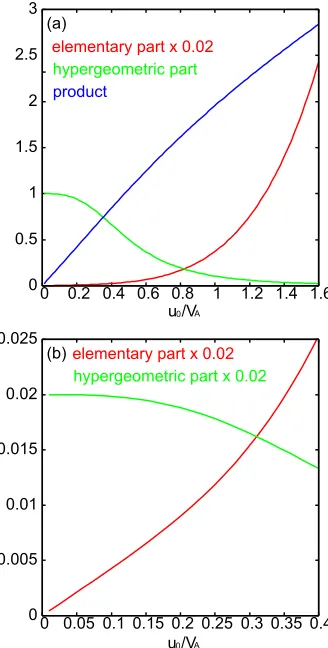
vcan be divided in two parts, an elementary function part (1+1/v)1/3v5/3/ln(1+v) and a hypergeometric function part2F1(4/3,5/3; 8/3;−v). Figure 1 shows the behavior of two parts when we varied the injection speed from 0 to 1.6VA (VA is the Alfvén speed), whereu0 = 1.6VA
cor-responds to the energy E0 = Mhu20/2 ∼ 500keV similar
to the JT-60SA N-NB injection. Clearly shown in Fig. 1 (a) , for fixed electron temperature and mass ratio, the de-pendence ofVh on u0 is almost linear. The near-linear dependence for small u0 can be shown as follows. For smallν = u3
0/u3c, the elementary part is approximated as
(1+1/ν)1/3ν5/3/ln(1+ν)=ν1/3[1+O(ν)], while the hyper-geometric part is approximated as2F1(4/3,5/3; 8/3;−ν)= 1+O(ν). These are clearly shown in Fig. 1 (b). Therefore, the “product” in Fig. 1 (a) in smallu0/VA becomes linear.
From Fig. 1, we obtainVh ∼1.2(uc/VA)ξ0u0 ∼0.57ξ0u0 for the present parameters. Therefore, whenu0 = 1.6VA
andξ0 =1, we obtainVh/VA ∼ 0.9 =O(1), which
indi-cates the flow can be Alfvénic.
4.2
Dependence of
V
hon electron
tempera-ture
elec-Fig. 1 (a) Plots of the elementary part (1+1/v)1/3v5/3/ln(1+v), the hypergeometric part2F1(4/3,5/3; 8/3;−v), and their product as functions ofu0/VA. The first one is multiplied
by 0.02. (b) Plots of elementary and hypergeometric parts multiplied by 0.02 in the range 0<u0/VA≤0.4.
tron thermal speed. The electron thermal speed affects the crossover speeduc, which affects the amplitude ofVh. We
fix the injection parametersξ0 = 0.8 and u0/VA = 1.6,
which corresponds to the tangential neutral beam injec-tion in JT-60SA. Other parameters are fixed as same with the previous subsection except for the electron tempera-ture. In this case, the analytic representation (13) reads
Vh=0.8uc(1+1/v)1/3v5/3/ln(1+v)2F1(4/3,5/3; 8/3;−v)
wherev=u3
0u−c3. The factor related tovcan be divided into
two parts as in the previous subsection. Figure 2 (a) shows the behavior of elementary and hypergeometric parts when we varied the electron temperature, and Fig. 2 (b) indicates their product. Figure 2 (b) indicates that the product is ap-proximately scales by Te1/6 ∝ u1c/3. Therefore, the flow
amplitude depends on the crossover speed asVh ∝u4c/3in
total.
4.3
Dependence of
V
hon mass ratio
The last parameter to determine the amplitude ofVh
is the mass ratio. Here we define the mass ratio parameter
Mh/Miand study the mass ratio effect onVh. To this end,
we fix the following parameters as follows,Nh/N0i =2×
Fig. 2 (a) Plots of the elementary part (1+1/v)1/3v5/3/ln(1+v), the hypergeometric part 2F1(4/3,5/3; 8/3;−v) as func-tions ofTe. The first and second lines multiplied by 10−8
and 102respectively. (b) Plot of the product as a function ofTe.
10−2,N0i =N0e =0.5×10²⁰m−3,T0e =3keV,ξ0 =0.8, andu0/VA = 1.6. We consider a situation such that the
bulk and hot ions can be hydrogen or deuterium. These can be realized in the “initial research phase” in JT-60SA. In this case, the mass ratio can be 0.5, 1, and 2. When the mass ratio is changed, we obtainVh/VA = 0.614, 0.646,
and 0.664 for Mh/Mi = 0.5, 1, and 2, respectively. The
dependence ofVh on the mass ratio is weak. Since u0 is fixed, increasing Mh/Mi means the injection energy is
increased.
4.4
Estimate of inertial force of hot ions
In the previous subsections, we observe that the am-plitude of parallel flow of hot ions is determined mainly by the injection parameters, and that the electron temperature can affect the amplitude while the mass ratio has little ef-fects. The inertial force of hot ions can be approximated byIh = MhNhVh2/LVh where LVh is the scale length for
Vh. Here, we assume LVh ∼ LVi ∼ R where R is the
major radius. The ratio of inertial force of hot and bulk ions readsIh/Ii =(Mh/Mi)(Nh/Ni)(Vh/Vi)2. In previous
previous subsection,Vh/VA ∼1. Hence, even for fast bulk
plasma rotationVi/VA =10−2, the term (Vh/Vi)2can be
large. Then even if the density of hot ions is small, e.g.,
Nh/Ni=10−3, the inertial force of hot ions can be
compat-ible with that of bulk ions.
Next we consider the inertial force of hot ions in the momentum equation of the hybrid kinetic-MHD model [2],
MhNhVh· ∇Vh =J×B− ∇p− ∇ ·Ph, whereJ,p, andPh
are equilibrium current density, bulk pressure, and pressure tensor of hot ions. The right hand side can be approximated asL =|J×B| ∼ |∇p| ∼[B2
0/(μ0a)]β, wherea is the mi-nor radius andβis the total pressure normalized byB2
0/μ0. Then we observe
Ih
L = a LVh
Mh
Mi
Nh
Ni
Vh
VA
2
β−1.
When we approximatea/LVh ∼0.3,Mh/Mi ∼1,Nh/Ni =
10−2,Vh/VA = 1, and β = 10−2, we obtain Ih/L ∼ 0.3.
Therefore, the inertial force of hot ions can be prominent in the momentum equation. This tendency is enhanced when we increase the parametersu0,ξ0, and Te sinceVh gets
large.
5. Summary
In this paper, we focus on the inertial force of hot ions produced by the neutral beam injection. We point out that hot ions interacting with bulk ions and electrons with flow can be described by the Fokker-Planck equation that is for-mally same with the static case. Hence, if we assume uni-form equilibrium distribution function, we can obtain an analytic form of slowing-down distribution function. From this analytic distribution function, we have succeeded to compute the parallel flow of hot ions analytically. This representation is derived for the first time. From this rep-resentation, we observe that the parallel flow of hot ions is characterized by the injection parameters, electron temper-ature and mass ratio. Further analysis shows that injection
parameters determine the parallel flow, and that electron temperature can affect the amplitude while the mass ratio has a minor effect on the parallel flow. Finally, we discuss the inertial force of hot ions in the framework of hybrid kinetic-MHD theory. The order estimate indicates that the inertial force of hot ions can be compatible with the pres-sure gradient term, hence in these cases, the framework of hybrid kinetic-MHD theory should be extended. This ex-tension will be studied in future.
Acknowledgments
The authors are grateful to Dr. S. Ide and Dr. S. Higashijima for their support. JS is indebted to an anony-mous referee for providing insightful comments to signifi-cantly improve the manuscript.
[1] J.D. Gaffey, Jr., J. Plasma Phys.16, 149 (1976).
[2] L. Chen, R.B. White and M.N. Rosenbluth, Phys. Rev. Lett.
52, 1122 (1984).
[3] F. Porcelli, R. Stankiewicz, W. Kerner and H.L. Berk, Phys. Plasmas1, 470 (1994).
[4] G.Z. Hao, A.K. Wang, Y.Q. Liu and X.M. Qiu, Phys. Rev. Lett.107, 015001 (2011).
[5] J. Shiraishi, N. Miyato, G. Matsunaga, M. Toma, M. Honda, T. Suzuki, M. Yoshida, N. Hayashi and S. Ide, Nucl. Fusion57, 126051 (2017).
[6] P. Helander and D.J. Sigmar,Collisional Transport in Mag-netized Plasmas(Cambridge University Press, Cambridge, 2002) Chap. 3.
[7] I.S. Gradshteyn and I.M. Ryzhik,Tables of Integrals, Se-ries, and Products, Edited by A. Jeffrey and D. Zwillinger (Academic Press, New York, 2007), p. 790.
[8] I.S. Gradshteyn and I.M. Ryzhik,Tables of Integrals, Se-ries, and Products, Edited by A. Jeffrey and D. Zwillinger (Academic Press, New York, 2007), p. 315.
[9] ITER Physics Expert Group on Energetic Particles, Heating and Current Drive and ITER Physics Editors, Nucl. Fusion
39, 2495 (1999).