University of Pennsylvania
ScholarlyCommons
Publicly Accessible Penn Dissertations
1-1-2016
Statistical Methods for Time-Conditional Survival
Probability and Equally Spaced Count Data
Victoria Alexandria Gamerman
University of Pennsylvania, [email protected]
Follow this and additional works at:
http://repository.upenn.edu/edissertations
Part of the
Biostatistics Commons
This paper is posted at ScholarlyCommons.http://repository.upenn.edu/edissertations/1729
For more information, please [email protected].
Recommended Citation
Gamerman, Victoria Alexandria, "Statistical Methods for Time-Conditional Survival Probability and Equally Spaced Count Data" (2016).Publicly Accessible Penn Dissertations. 1729.
Statistical Methods for Time-Conditional Survival Probability and Equally
Spaced Count Data
Abstract
This dissertation develops statistical methods for time-conditional survival probability and for equally spaced
count data. Time-conditional survival probabilities are an alternative measure of future survival by accounting
for time elapsed from diagnosis and are estimated as a ratio of survival probabilities. In Chapter 2, we derive
the asymptotic distribution of a vector of nonparametric estimators and use weighted least squares
methodology for the analysis of time-conditional survival probabilities. We show that the proposed test
statistics for evaluating the relationship between time-conditional survival probabilities and additional time
survived have central Chi-Square distributions under the null hypotheses. Further, we conducted simulation
studies to assess the empirical probability of making a type I error for one of the hypotheses tests developed
and to assess the power of the various models and statistics proposed. Additionally, we used weighted least
squares techniques to fit regression models for the log time-conditional survival probabilities as a function of
time survived after diagnosis to address clinically relevant questions. In Chapter 3, we derive the asymptotic
distribution of time-conditional survival probability estimators from a Weibull parametric regression model
and from a Logistic-Weibull cure model, adjusting for continuous covariates. We implement the weighted
least squares methodology to assess relevant hypotheses. We create a statistical framework for investigating
time-conditional survival probability by developing additional methodological approaches to address the
relationship between estimated time-conditional survival probabilities, time survived, and patient prognostic
factors. Over-dispersed count data are often encountered in longitudinal studies. In Chapter 4, we implement
a maximum-likelihood based method for the analysis of equally spaced longitudinal count data with
over-dispersion. The key features of this approach are first-order antedependence and linearity of the conditional
expectations. We also assume a Markovian model of first order, implying that the value of an outcome on a
subject at a specific measurement occasion only depends on the value at the previous measurement occasion.
Our maximum likelihood approach using the Poisson model for count data benefits from a simple
interpretation of regression parameters, like that in GEE analysis of count data.
Degree Type
Dissertation
Degree Name
Doctor of Philosophy (PhD)
Graduate Group
Epidemiology & Biostatistics
First Advisor
Phyllis A. Gimotty
STATISTICAL METHODS FOR TIME-CONDITIONAL SURVIVAL PROBABILITY AND EQUALLY SPACED COUNT DATA
Victoria A. Gamerman
A DISSERTATION
in
Epidemiology and Biostatistics
Presented to the Faculties of the University of Pennsylvania
in
Partial Fulfillment of the Requirements for the
Degree of Doctor of Philosophy
2016
Supervisor of Dissertation Co-Supervisor of Dissertation
Phyllis A. Gimotty Justine Shults
Professor of Biostatistics Professor of Biostatistics
Graduate Group Chairperson
John H. Holmes, Professor of Medical Informatics in Epidemiology
Dissertation Committee
Susan Ellenberg, Professor of Biostatistics
STATISTICAL METHODS FOR TIME-CONDITIONAL SURVIVAL PROBABILITY AND EQUALLY
SPACED COUNT DATA
c
COPYRIGHT
2016
Victoria A. Gamerman
This work is licensed under the
Creative Commons Attribution
NonCommercial-ShareAlike 3.0
License
To view a copy of this license, visit
ACKNOWLEDGEMENT
I would like to acknowledge the support of my committee and thank the Biostatistics faculty and my
ABSTRACT
STATISTICAL METHODS FOR TIME-CONDITIONAL SURVIVAL PROBABILITY AND EQUALLY
SPACED COUNT DATA
Victoria A. Gamerman
Phyllis A. Gimotty
Justine Shults
This dissertation develops statistical methods for time-conditional survival probability and for equally
spaced count data. Time-conditional survival probabilities are an alternative measure of future
sur-vival by accounting for time elapsed from diagnosis and are estimated as a ratio of sursur-vival
probabil-ities. In Chapter 2, we derive the asymptotic distribution of a vector of nonparametric estimators and
use weighted least squares methodology for the analysis of time-conditional survival probabilities.
We show that the proposed test statistics for evaluating the relationship between time-conditional
survival probabilities and additional time survived have centralχ2-distributions under the null hy-potheses. Further, we conducted simulation studies to assess the empirical probability of making
a type I error for one of the hypotheses tests developed and to assess the power of the various
models and statistics proposed. Additionally, we used weighted least squares techniques to fit
re-gression models for the log time-conditional survival probabilities as a function of time survived after
diagnosis to address clinically relevant questions. In Chapter 3, we derive the asymptotic
distribu-tion of time-condidistribu-tional survival probability estimators from a Weibull parametric regression model
and from a Logistic-Weibull cure model, adjusting for continuous covariates. We implement the
weighted least squares methodology to assess relevant hypotheses. We create a statistical
frame-work for investigating time-conditional survival probability by developing additional methodological
approaches to address the relationship between estimated time-conditional survival probabilities,
time survived, and patient prognostic factors. Over-dispersed count data are often encountered
in longitudinal studies. In Chapter 4, we implement a maximum-likelihood based method for the
analysis of equally spaced longitudinal count data with over-dispersion. The key features of this
approach are first-order antedependence and linearity of the conditional expectations. We also
specific measurement occasion only depends on the value at the previous measurement occasion.
Our maximum likelihood approach using the Poisson model for count data benefits from a simple
TABLE OF CONTENTS
ACKNOWLEDGEMENT . . . iii
ABSTRACT . . . iv
LIST OF TABLES . . . viii
LIST OF ILLUSTRATIONS . . . ix
CHAPTER 1 : INTRODUCTION . . . 1
1.1 Time-Conditional Survival Probability Methods . . . 1
1.2 Longitudinal Count Data Methods . . . 7
1.3 Dissertation Structure . . . 9
CHAPTER 2 : NONPARAMETRICTIME-CONDITIONALSURVIVALPROBABILITY . . . 10
2.1 Introduction . . . 10
2.2 Estimation of Time-Conditional Survival Probabilities . . . 12
2.3 Distribution Theory . . . 13
2.4 Hypothesis Testing Using Weighted Least Squares . . . 17
2.5 Simulation Studies . . . 28
2.6 Application: Staging Procedure and Time-Conditional Survival Probability for Stage II Melanoma Patients . . . 34
2.7 Discussion . . . 48
CHAPTER 3 : PARAMETRIC TIME-CONDITIONALSURVIVALPROBABILITY . . . 55
3.1 Introduction . . . 55
3.2 Parametric Time-Conditional Survival . . . 55
3.3 An Example: The Weibull Distribution . . . 65
3.4 Application to Real-World Data . . . 69
CHAPTER 4 : ANALYSIS OF LONGITUDINAL COUNT DATA WITH SPECIFIED MARGINAL
MEANS AND FIRST-ORDERANTEDEPENDENCE. . . 93
4.1 Introduction . . . 93
4.2 Methods . . . 95
4.3 Application . . . 99
4.4 Simulation Studies . . . 103
4.5 Discussion . . . 105
CHAPTER 5 : DISCUSSION. . . 114
APPENDICES . . . 118
LIST OF TABLES
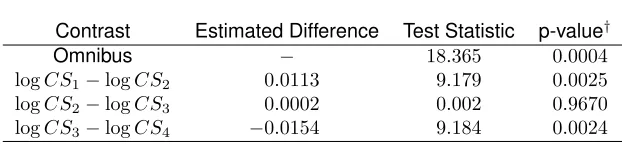
TABLE 2.1 : SEER melanoma contrasts of profile-based differences . . . 51
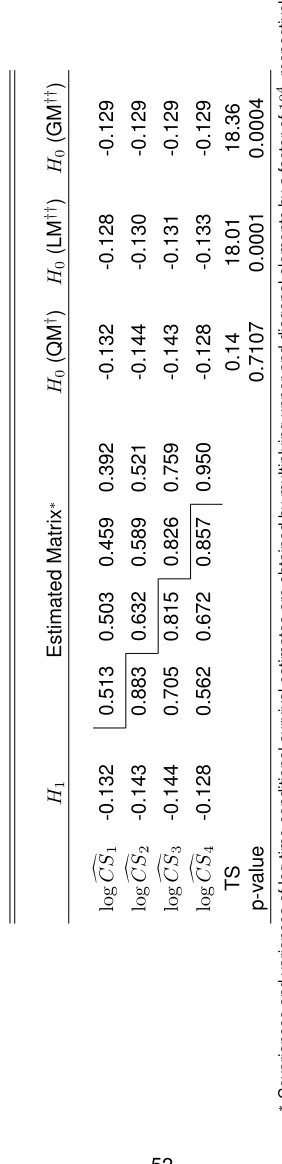
TABLE 2.2 : Estimates of log time-conditional melanoma-specific survival probabilities,
their variance-covariance matrix, and estimates from the saturated (H1),
QM, LM, and GM models . . . 52
TABLE 2.3 : Parameter estimates for the multivariable analysis . . . 53
TABLE 2.4 : Estimates of time-conditional melanoma-specific survival probabilities from the multivariable analysis . . . 54
TABLE 3.1 : Maximum likelihood estimates of the Weibull survival distribution for
disease-specific survival of esophageal cancer patients adjusting for tumor length. . 88
TABLE 3.2 : Maximum likelihood estimates of the Weibull mixture cure model for disease-specific survival. . . 89
TABLE 3.3 : Estimated covariance matrix∗ for the time-conditional survival probability
from the Weibull mixture cure model for disease-specific survival. . . 90
TABLE 3.4 : Estimates of 5-year time-conditional survival probability from the Weibull mixture cure model for disease-specific survival adjusting for fixed gender (male), fixed age at diagnosis (60 years), fixed tumor thickness (3.58 mm) and varying staging type (clinical versus pathological), number of nodes ex-amined, and ulceration status along with the estimated covariance and cor-relation matrices for the alternative hypothesis. . . 91 TABLE 3.5 : Change in 5-year time-conditional survival probability given 1 and given
10 years after diagnosis from the Weibull mixture cure model for disease-specific survival with Bonferroni adjustment. . . 92
TABLE 4.1 : Estimated parameters from the ML, GEE, and Poisson models in the analy-sis of the doctor visits data. . . 107 TABLE 4.2 : Mean and variance for the placebo and treatment groups. . . 108 TABLE 4.3 : Estimated parameters from the GEE and ML approaches for analysis of the
epilepsy data when Period is included in the models. . . 109 TABLE 4.4 : Estimated parameters from the GEE and ML approaches for analysis of the
epilepsy data when Period is not included in the models. . . 110 TABLE 4.5 : Small sample efficiencies for evaluating the AR(1) correlation structure for
varying values ofαand sample size per group. . . 111 TABLE 4.6 : Percent bias for evaluating the AR(1) correlation structure for varying values
ofαand sample size per group. . . 112 TABLE 4.7 : Coverage probabilities for the ML and GEE approaches with the AR(1)
cor-relation structure for varying values ofαand sample size per group. . . 113
TABLE B.1 : Maximum likelihood estimates from four Weibull mixture cure models for disease-specific survival. . . 136 TABLE B.2 : Results from the likelihood ratio test for nested models. . . 137 TABLE B.3 : Estimates of 5-year time-conditional survival probability from four Weibull
mixture cure models for disease-specific survival adjusting for fixed tumor thickness (3.58mm) and varying ulceration status. . . 138
LIST OF ILLUSTRATIONS
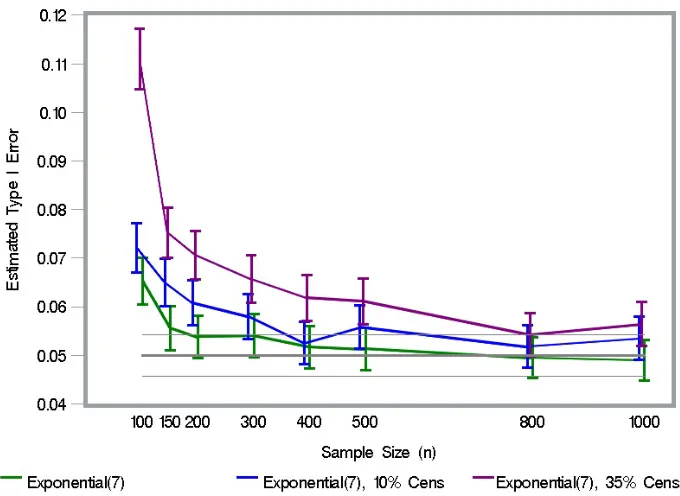
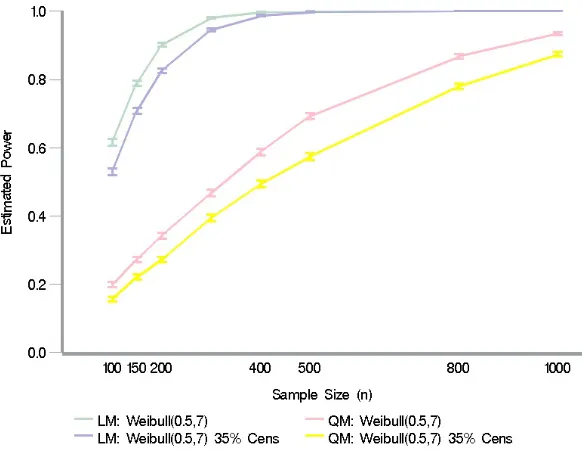
FIGURE 2.1 : Expected type I error of 5% with the 95% confidence interval for 10,000 datasets and estimated type I error for the GM model test statistic (and 95% confidence intervals) for no censoring, 10%, and 35% uniform random censoring. . . 31 FIGURE 2.2 : Estimated power for the LM and QM test statistics with and without censoring. 32
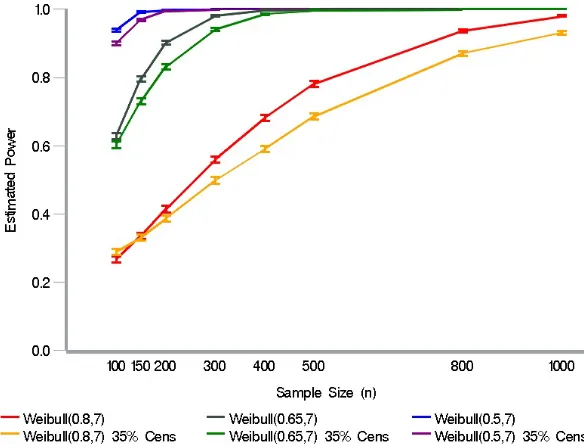
FIGURE 2.3 : Estimated power for the GM model test statistic. . . 33
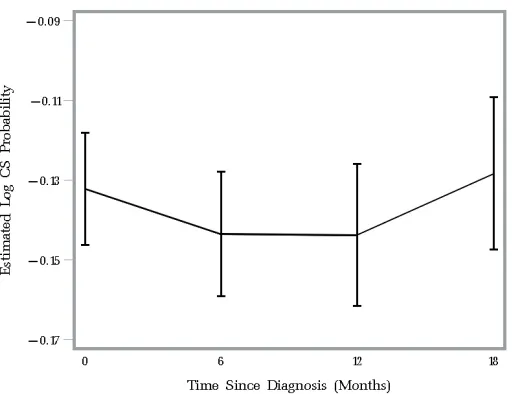
FIGURE 2.4 : Nonparametric Kaplan-Meier estimated 3-year log time-conditional survival probabilities given 0, 6, 12, and 18 months after diagnosis for Stage II patients. . . 37 FIGURE 2.5 : Nonparametric Kaplan-Meier estimated 3-year log time-conditional survival
probabilities given 0, 6, 12, and 18 months after diagnosis for patients by procedure: (1) Pathologically staged (some nodal procedure) and (2) Clin-ically staged (no nodal procedure). . . 39 FIGURE 2.6 : Nonparametric Kaplan-Meier estimated 3-year log time-conditional survival
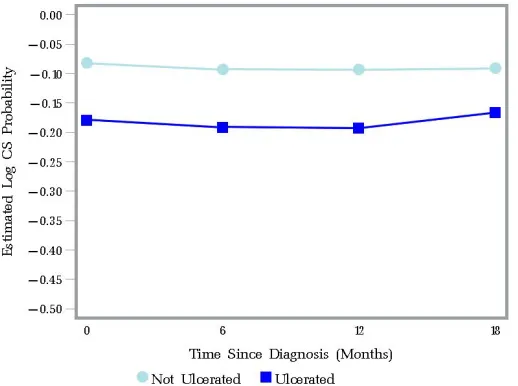
probabilities given 0, 6, 12, and 18 months after diagnosis for patients by ulceration status: (1) Not ulcerated and (2) Ulcerated. . . 39 FIGURE 2.7 : Nonparametric Kaplan-Meier estimated 3-year log time-conditional survival
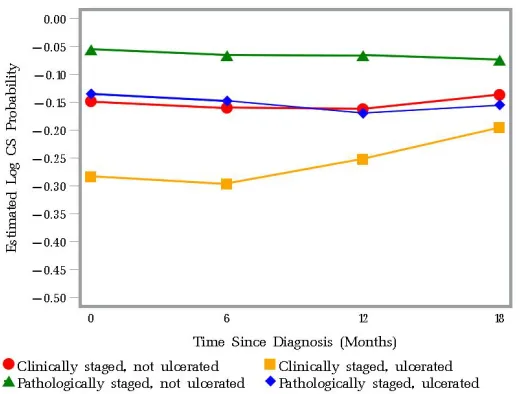
probabilities given 0, 6, 12, and 18 months after diagnosis for patients in one of four groups: (1) Pathologically staged (some procedure) and not ulcerated, (2) Pathologically staged (some procedure) and ulcerated, (3) Clinically staged (no nodal procedure) and not ulcerated, and (4) Clinically
staged (no nodal procedure) and ulcerated. . . 43
FIGURE 3.1 : The unadjusted survival estimate from the parametric Weibull distribution and the empirical Kaplan-Meier survival function for the SEER esophageal sample. . . 70 FIGURE 3.2 : Estimated 5-year time-conditional survival probability given increasing time
survived for mean tumor length from the Weibull distribution based on the
SEER esophageal sample. . . 71
FIGURE 3.3 : Estimated 5-year time-conditional survival probability, given that survival is greater than 1, 2, and 3 years after diagnosis, for increasing tumor length
from the Weibull distribution based on the SEER esophageal sample. . . 72
FIGURE 3.4 : Estimated 5-year time-conditional survival probability given increasing time survived for tumor length at 2, 5, 10, and 15 cm from the Weibull distribution
based on the SEER esophageal sample. . . 73
FIGURE 3.5 : Estimated time-conditional survival probability, given that survival is greater
than 2 years after diagnosis, as a function of∆evaluated at mean tumor
length from the Weibull distribution based on the SEER esophageal sam-ple. . . 74 FIGURE 3.6 : Estimated 2-, 3-, 4-, and 5-year time-conditional survival probability, given
that survival is greater than 2 years after diagnosis, for increasing tumor length from the Weibull distribution based on the SEER esophageal sam-ple. . . 75
FIGURE 3.7 : Empirical survivor function for the SEER melanoma sample. . . 77
FIGURE 3.8 : Estimated 5-year time-conditional survival for the SEER melanoma sample
CHAPTER 1
I
NTRODUCTIONThis dissertation develops statistical methods for time-conditional survival probability and for equally
spaced count data. In Chapter 2, we derive the asymptotic distribution of a vector of nonparametric
estimators and use weighted least squares methodology for the analysis of time-conditional
sur-vival probabilities. In Chapter 3, we derive the asymptotic distribution of time-conditional sursur-vival
probability estimators from a Weibull parametric regression model and from a Logistic-Weibull cure
model, adjusting for continuous covariates. We implement the weighted least squares methodology
to assess relevant hypotheses. In Chapter 4, we implement a maximum-likelihood based method
for the analysis of equally spaced longitudinal count data with over-dispersion.
1.1. Time-Conditional Survival Probability Methods
This work was motivated by increased attention in the medical literature on conditional survival. We
distinguish between two types of conditional survival probabilities. The first refers to those
proba-bilities that condition on fixed covariates at time of diagnosis (e.g., Xu and O’Quigley, 2000). The
second, which we refer to as time-conditional survival probabilities, condition on time survived and
will be the focus of the work here. With earlier detection, better therapies for diseases, and more
systematic tracking, patients in recent years have been surviving longer and information on their
long-term follow-up is more readily available. With patients living longer, there is interest in
estimat-ing the probability of survival not from a patient’s time of diagnosis, but rather from her/his present
state sometime after diagnosis. Time-conditional survival probability is defined as the probability
of surviving at least an additional ∆ years given that a patient has already surviveda years. As
described in further detail in Chapter 2, this probability can be estimated by the ratio of thea- and (∆ +a)-year estimated survival probabilities from a single Kaplan-Meier survivor function (Kaplan and Meier, 1958).
We create a statistical framework for investigating time-conditional survival probability by
devel-oping additional methodological approaches to address the relationship between estimated
time-conditional survival probabilities, time survived, and patient prognostic factors. While the work
disciplines.
1.1.1. Nonparametric Methods
Time-to-event data generally contain observations that are censored. Censoring occurs in
situa-tions when a patient has not yet experienced an event and is known to be alive up to a particular
time. When all that is known is that a patient is alive at a given point in time, that patient’s survival
data is right censored. In this work, we use the survival function, defined as the probability of
surviv-ing beyond a specified time, to estimate time-conditional survival probability. For the nonparametric
approach, the Kaplan-Meier Product-Limit methodology is used to estimate the survivor function,
which is then used to estimate survival probabilities (Kaplan and Meier, 1958).
Time-conditional survival probabilities are an alternative measure of future survival by accounting
for time elapsed from diagnosis and are estimated as a ratio of survival probabilities. Relative
survival is also defined as a ratio of probabilities in a target population relative to the expected
survival probability in a comparable general population over a given follow-up period (Dickman and
Adami, 2006). The estimate of five-year relative survival is the ratio of the estimated five-year
sur-vival probability for the target population divided by the expected five-year sursur-vival probability in the
general population that is assumed to be fixed (e.g., Ederer, Axtell, and Cutler, 1961; Hakulinen,
1982). Dickman et al., 2004 describe four approaches to estimate a regression model for relative
survival using maximum likelihood methodology. In our work, we use the weighted least squares
methodology to analyze nonparametric and parametric based estimators of time-conditional
sur-vival probabilities.
Over the last two decades, clinical investigators have presented point estimates and
correspond-ing 95% confidence limits for time-conditional survival probabilities. Clinical investigators report
that patients who have survived for some time beyond diagnosis are more interested in estimates
of time-conditional survival probabilities because these estimates offer more relevant prognostic
information than estimates from traditional survival probabilities computed using time from initial
diagnosis (e.g., Xing et al., 2010). Clinical research publications increasingly present estimates
of time-conditional survival probabilities. A topic search for “conditional survival” on Web of
Sci-ence conducted in early 2015 revealed approximately 150 articles published in the past five years
ar-ticles published in 2000–2004. The interest in these estimates demonstrates its strong relevance
to many clinical settings and highlights the importance of developing modeling methodology for
time-conditional survival probabilities.
In Chapter 2, we develop the asymptotic distribution for estimates of log time-conditional survival
probabilities. The asymptotic distribution facilitates the extension of statistical tools from estimation
to the statistical testing of different hypotheses of interest. We base our methods for hypothesis
testing and model fitting on the work of Grizzle, Starmer, and Koch, 1969, who used weighted least
squares as part of a regression modeling strategy for proportions and proposed test statistics for
evaluating simplified models. Koch, Johnson, and Tolley, 1972 applied this approach to survival
probabilities. With modifications, we apply their approach to time-conditional survival probabilities.
We use weighted least squares to develop a test statistics for relevant hypotheses, e.g. a
multivari-ate omnibus test of pairwise differences. We show that the proposed test statistics for evaluating
the relationship between time-conditional survival probabilities and additional time survived have
centralχ2-distributions under the null hypotheses. Further, we conducted simulation studies to
as-sess the empirical probability of making a type I error for one of the hypotheses tests developed
and to assess the power of the various models and statistics proposed.
Additionally, we used weighted least squares techniques to fit regression models for the log
time-conditional survival probabilities as a function of time survived after diagnosis to address clinically
relevant questions. Quadratic, linear, and global mean models are used to explore the relationship
between log time-conditional survival probabilities and time survived. To include discrete,
categori-cal covariates, we develop a parametric framework for multivariable models. To avoid the problem
of multiple testing due to comparisons among covariate patterns resulting from either categorical
variables or categorization of continuous variables (Bennette and Vickers, 2012), we propose an
overall test of significance in addition to pairwise comparisons. Population based survival data from
patients with melanoma are used to illustrate the proposed methodology by evaluating survival in
patients who underwent clinical staging versus pathological staging (Balch et al., 2001).
In contrast, consider an alternative approach for nonparametric inference using median residual
lifetimes with censoring proposed by Jeong, Jung, and Costantino, 2008. As with time-conditional
survival probabilities, they draw the comparison between information at diagnosis and at a time
and the impact of first-line treatment on life expectancy fromdiagnosisin contrast with a patient’s
interest in their estimate of residual life expectancy sometime after diagnosis and the impact of
additional, second-line treatment.
To obtain an estimate of median residual lifetime for censored survival data, the authors’ first model
the survivor function. Then their approach infers the median of remaining lifetimes among survivors
beyond time t at a fixed time point, t0, to obtain an estimate of the median residual life function
evaluated att0. To compute the median residual lifetime, the authors compute the residual lifetime
for a patient who has survived beyondt0asS(t|t0) =S(t+t0)/S(t0)fort0 ≥0. As given in their
manuscript by Equation 2, they then obtain the estimated median of the residual lifetime distribution
att0by solving the equationuˆ(θt0) = 0forθt0 where
ˆ
u(θt0) = ˆS(t0−θt0)−0.5 ˆS(t0),
and whereSˆ(t)is the Kaplan-Meier estimator ofS(t)(Jeong, Jung, and Costantino, 2008).
The resulting estimate provided to patients and physicians is the median residual life in years, which
is more intuitive for patients to understand than a survival probability. However, a limitation of this
approach is the influence of the proportion of censored observations as the median failure time
cannot be theoretically defined until the minimum of the survival curve reaches 0.5 (Jeong, Jung,
and Costantino, 2008). This issue is addressed in the later work by Park, Jeong, and Lee, 2012.
As will be demonstrated in the application of Chapter 2, time-conditional survival probability under
the nonparametric Kaplan-Meier framework is advantageous as it can be estimated irrespective of
the minimum of the survival curve.
Further, in their paper, Jeong, Jung, and Costantino, 2008 note that the methods of comparing
median residual life functions over the entire follow-up period that they developed did not address
issues of multiple comparisons. In our work, we developed an omnibus test of contrasts and other
hypotheses tests along with providing estimators of the covariance matrix to allow researchers to
address issues of multiple comparisons. Lastly, the authors note the need for future research to
develop a regression model that would take into account continuous prognostic factors and develop
such an approach using regression on quantile residual life (Jung, Jeong, and Bandos, 2009). This
Kaplan-Meier framework in Chapter 2 and extended the approach to allow for continuous covariates
in the parametric framework in Chapter 3.
1.1.2. Parametric Survival Methods
Parametric models are used by researchers for time-to-event data in the estimation of model
param-eters and related functions such as the parametric hazard function. Modeling survival time without
the inclusion of covariates provides an estimate of the survival experience on the assumption that
the underlying population is homogeneous. Incorporating covariates allows for the study of
het-erogeneous populations that may characterize observational studies based in disease registries,
rather than populations from clinical trials with strict inclusion and exclusion criteria. Covariates
can be incorporated by modeling the natural logarithm of survival time (e.g., Weibull or log logistic
regression models) or using an accelerated failure-time model. In both cases, when the parametric
model provides a good fit for the data, the estimates from the model are often more precise than
those from the nonparametric setting because they are based on fewer parameters (e.g., Lambert
and Royston, 2009).
In Chapter 2, we develop the large sample distribution for log time-conditional survival and pairwise
tests for differences among a set of estimates. We also use weighted least squares to model a
profile of estimates as a function of time survived and compare time-conditional survival estimates
across groups of patients. Stratifying patients into groups based on covariate patterns requires
using categorical variables or categorizing continuous variables. For example, Barchielli et al.,
1994 categorized age at time of diagnosis into 5-year groups to evaluate the prognostic effect of
this variable as opposed to evaluating it as a continuous covariate. Stratification assumes that
patients falling into one stratum are homogeneous and, therefore, have a homogeneous risk for the
outcome (Bennette and Vickers, 2012). However, ignoring variability within the stratum leads to a
loss of information and reduces the power of a test of association (Greenland, 1995). Therefore,
we extend the work in Chapter 2 by developing methods under parametric assumptions.
Chapter 3 develops methods for parametric time-conditional survival probability. It extends the
methodology of Chapter 2 by allowing for the inclusion of multiple covariates, including continuous
variables, in a single regression model for time-conditional survival probability. Two regression
is based on the log-linear model for the relationship between time survived from diagnosis and
covariates of interest. It is important to note that a survival model that tends to zero with increasing
time after diagnosis will be appropriate for a disease with a generally poor prognosis. If, on the
other hand, long-term survival is of interest due to patients surviving longer and having improved
prognoses, a model that allows for a non-zero probability of indefinite survival or cure will better
fit the data. The second regression is a parametric cure model where the underlying population
is a mixture of patients who experience the event of interest and those who do not. The Weibull
distribution is used to illustrate the methods which are applied to esophageal cancer data (Weibull
regression model with covariates) and to melanoma data (Logistic-Weibull cure model).
A recent paper by Hieke et al., 2015 emphasized the usefulness of the conditional survival concept
to provide information on the evolution of prognosis over time. In their application, these authors
used Kaplan-Meier survival estimation to analyze data from multiple myeloma patients stratified by
age groups and disease stage. Further, while they stated that methods to estimate conditional
sur-vival exist using Kaplan-Meier and Cox regression, they did not note uses of parametric regression
models in the estimation of conditional survival. This indicates that a methodological gap remains
in nonparametric estimation adjusting for continuous covariates which can be addressed using a
parametric statistical approach.
When assessing hypothesis testing based on conditional survival methods, Hieke et al., 2015 show
estimates in Figure 2B with a 5-year conditional survival profile plotted for each age strata and
95% confidence intervals around each point estimate of time since diagnosis in years. In our
work, we develop nonparametric and parametric methods that account for the correlation among
time-conditional survival probabilities through the hypothesis testing framework by incorporating the
covariance matrix into the test statistic.
Parast, Cheng, and Cai, 2011, 2012 have developed methodology for incorporating short-term
out-come information to predict long-term disease outout-comes where the long-term event of interest is
time to a terminal event such as death and the short-term event is time to a non-terminal event.
These authors propose methods for incorporating censored short-term event information to
pre-dict long-term survival beyond the parametric models in a multi-state survival setting, which may
lead to invalid prediction if the model assumptions do not hold. In their earlier work (2011) they
and information on a discrete marker. However, similar to the limitation in the time-conditional
sur-vival methods developed in Chapter 2, these methods cannot account for information from one or
more continuous covariates. The authors then extended work by others and proposed a flexible
ap-proach that allows for the inclusion of longitudinal predictor information collected such as repeated
biomarker measurements (2012). As the authors note, including information about a short-term
outcome in addition to genetic or biomarker measurements may lead to an improved ability to
pre-dict long-term survival. Accordingly, future research on implementing competing risks models in
the estimation of time-conditional survival needs to be explored.
1.2. Longitudinal Count Data Methods
Longitudinal count data are often encountered in scientific studies. Common features of longitudinal
count data include intra-subject correlation and over-dispersion. Intra-subject correlation is due to
similarities between the repeated measurements on each participant. When the variance is larger
than expected for the assumed distribution of the outcome variable then over-dispersion is observed
(Efron, 1992).
As noted by Farewell and Farewell, 2012, one approach to modeling longitudinal Poisson count
data is using a generalized linear mixed model with Poisson distributions conditional on random
effects. They note that a marginal modeling approach may be preferred for cases where the effect of
explanatory variables at the population-averaged level (marginal effects) is of interest as opposed to
subject-specific effects. Heagerty and Kurland, 2001 showed that marginal modeling is more robust
for the estimation of regression parameters as compared to subject-specific covariate effects when
there is a departure from the underlying random effects structure.
Marginal modeling can be implemented using generalized estimating equation (GEE) methods
(Solis-Trapala and Farewell, 2005). Two considerations when using the GEE approach are that
GEE methods do not give the researcher an understanding of the sources of variation and,
un-like parametric maximum un-likelihood estimation, there is reduced efficiency (Farewell and Farewell,
2012). Given these limitations, Farewell and Farewell, 2012 developed methods to analyze such
data using the Dirichlet negative multinomial distribution. From their simulation study to evaluate the
model robustness and finite-sample behavior, the authors found that the Dirichlet negative
data, Farewell and Farewell, 2012 also fit a Poisson generalized linear mixed model and found that
the estimated coefficients and standard errors were similar to their Dirichlet negative multinomial
model. Our approach offers an alternative to their methods and to the GEE approach.
Over-dispersed count data are often encountered in longitudinal studies. This may be present in
the context of the number of patients with epileptic seizures (Farewell and Farewell, 2012; Thall
and Vail, 1990) or the number of patients who had transplants performed. Over-dispersion occurs
when the variability is larger than the standard Poisson variability that is expected. However, few
likelihoods are available for the simulation and analysis of such data (Efron, 1992). Therefore, we
provide a maximum likelihood approach to model longitudinal Poisson count outcomes.
In Chapter 4, we develop an approach for maximum likelihood analysis of longitudinal discrete data
with over-dispersion. We implement a likelihood proposed for simulation of over-dispersed random
variables with specified marginal means and product correlations by Guerra and Shults, 2014.
The key features of this approach are first-order antedependence and linearity of the conditional
expectations. We also assume a Markovian model of first order, implying that the value of an
outcome on a subject at a specific measurement occasion only depends on the value at the previous
measurement occasion. Our maximum likelihood approach using the Poisson model for count data
benefits from a simple interpretation of regression parameters, like that in GEE analysis of count
data.
As described elsewhere (e.g., Shults et al., 2006 Appendix A), the maximum likelihood approach
for count data requires information on the correlation between adjacent measurements on each
subject. While Guerra and Shults, 2014 developed general simulation methods allowing for different
patterns of correlation, we focus our maximum likelihood approach to Poisson count data with a
first-order autoregressive (AR(1)) correlation structure. Given the specified marginal means and
adjacent correlations, the AR(1) correlation structure is induced and the marginal distributions are
over-dispersed relative to the Poisson distributions. Under the AR(1) structure, it is assumed that
the adjacent intra-subject correlations are constant. This assumption is appropriate when it is
reasonable to assume that two count outcomes that are measured closer in time will be more
highly correlated, because they are assumed to be more similar, rather than if they are farther apart
We obtain likelihood-based estimating equations for the regression and correlation parameters.
Simulations are conducted to demonstrate that the approach has good statistical properties. This
approach is applied to the analysis of health policy data on doctor visits (StataCorp LP, 2013;
Winkelmann, 2004) and to seizure data (Farewell and Farewell, 2012; Thall and Vail, 1990).
1.3. Dissertation Structure
This dissertation is structured as follows. Chapter 2 defines the framework for nonparametric
meth-ods to assess time-conditional survival probability. This includes the development of the
asymp-totic distribution for a vector or profile of time-conditional survival probabilities, a flexible
frame-work for hypothesis testing using point estimates, and regression modeling to address clinically
relevant questions. Chapter 3 builds a parametric framework for time-conditional probability and
incorporates multiple discrete and continuous covariates in modeling time-conditional survival
pro-files. These methods are applied using a Weibull regression model for data where survival tends
to zero with increasing time after diagnosis and a Logistic-Weibull cure model for data where there
is evidence of cure in a fraction of patients. Chapter 4 discusses a new approach for maximum
likelihood-based analysis of correlated count data with over-dispersion. This maximum likelihood
approach assesses the problem of over-dispersion in Poisson data with an AR(1) structure. Such
longitudinal outcomes can be found in medical research in situations where measurements on a
subject are captured at pre-specified occasions over time. Poisson regression is often used for
analysis of count data, but would not be appropriate in an analysis of data characterized by
over-dispersion. Key assumptions of the maximum likelihood approach include the first-order Markov
property and the linearity of the conditional expectations for the conditional distributions. The
pro-posed approach is applied in analysis of data on doctor visits and epilepsy seizure data (R code is
CHAPTER 2
N
ONPARAMETRICT
IME-C
ONDITIONALS
URVIVALP
ROBABILITY2.1. Introduction
Commonly reported statistics for cancer patients include estimates of survival and conditional
sur-vival probabilities. Over the past two decades, clinical investigators have also reported estimated
time-conditional survival probabilities for patients who have already survived for a specified amount
of time after the diagnosis or therapy of their disease. While conditional survival probabilities
condi-tion on covariates that were measured at the time of diagnosis (e.g., Xu and O’Quigley, 2000),
time-conditional survival probabilities condition on the time already survived after diagnosis. Specifically,
time-conditional survival probability is defined as the probability of surviving at least an additionalx
years given survivalayears after diagnosis.
Typically, what is reported in the medical literature are the point estimates of the time-conditional
survival probabilities and their associated 95% confidence limits that are based on the estimated
Kaplan-Meier survival function (e.g., Choi et al., 2008; Merrill, Henson, and Ries, 1998; Xing et al.,
2010). These estimates can be used to answer questions such as “What is the expected probability
that a patient will survive an additional 5 years, given that she has already survived 5 years since
diagnosis”? However, additional methods are needed to answer other clinically relevant questions
of interest, such as “Does the expected probability that a patient will survive an additional 5 years
significantlyincrease with increasing time post-diagnosis”? For example, is the expected probability
of an additional 5 years survival significantly greater if the patient has survived 5 years than if she
has only survived 1 year after diagnosis?
This type of question is of clinical interest because it has been observed (Ries et al., 2003) that
for some cancers, the estimated time-conditional survival probabilities increase with an increasing
number of years survived. More recently, Miller, Lynch, and Buckwalter, 2013 investigated 5-year
conditional survival for a cohort of patients from the Surveillance, Epidemiology, and End Results
(SEER) registry with osteosarcoma and Ewings sarcoma. They found that 5-year conditional
sur-vival was 74.8% at diagnosis and 91.4% given sursur-vival beyond 5 years after diagnosis. Wang et al.,
from the SEER registry. For Stage I patients, the 5-year survival at diagnosis was 71% and 5-year
conditional survival given survival beyond 5 years increased to 74%.
New methods are also needed to address questions about trends in the time-conditional survival
probabilities over the course of a study. For patients who have survived some time after diagnosis,
the probability of surviving an additional number of years may be different from an initial overall
survival probability at diagnosis because the probability is not necessarily static (Choi et al., 2008).
For example, is the change in probabilities linear, or quadratic? If we have different sub-groups
of patients, does the change over time differ between the groups? Does the strength of this
rela-tionship differ for males versus females? In this chapter we develop methodology to answer such
questions.
In Section 2, we define point estimates of time-conditional survival probabilities and their 95%
confidence intervals, methods which have been published in the medical literature. In Section 3, we
develop the asymptotic distribution of a vector of estimators of time-conditional survival probabilities
using large sample distribution theory. We derive the estimate for the natural logarithm (log) of
time-conditional survival probability and its estimated variance as a function of the number of years
survived.
Grizzle, Starmer, and Koch, 1969 presented a general approach for the analysis of categorical
data using linear models with weighted regression. This approach allowed for simplification in
model formulation and hypothesis testing within the linear models framework. Koch, Johnson,
and Tolley, 1972 applied linear regression models and weighted least squares methodology to the
analysis of survival rates. In Section 4, we use Koch’s regression modeling strategy using weighted
least squares to analyze time-conditional survival probabilities. In particular, we develop Wald test
statistics (Wald, 1943) to evaluate trends in time-conditional survival estimators that are relevant to
patients, clinicians, and researchers.
In Section 5, we present results from simulations that assess power and the empirical probability of
making a type I error for particular tests. We then apply the proposed methodology to a cancer study
in Section 6, where we estimate time-conditional probabilities for melanoma patients as a function
of time survived. Additionally, we evaluate the differences in time-conditional survival between
2.2. Estimation of Time-Conditional Survival Probabilities
2.2.1. Notation
Letnbe the fixed number of individuals in a study. DefineTi = min(Xi, Ci), whereXi andCiare
the event and censoring times for theith subject, respectively. We assume the censoring time,Ci,
is independent of the event time,Xi. We observe the pair(ti, δi), i= 1, . . . , n, wheretiis the time
on study andδi=I(Xi≤Ci)is the indicator variable for whethertiis an event or a censoring time.
DefineJ distinct event times to bet(1) <· · ·< t(J)allowing for possible ties in the data. For each
observed event timet(j) in the set of ordered event times, definenj to be the number of subjects
at risk at timet(j)and letdj be the number of events observed at timet(j)among thenj subjects
at risk. To incorporate information on censoring, letwjdenote the number of observations that are
(right) censored at times after thejth event time, but prior to the(j+ 1)th time.
2.2.2. Current approach
Assume we have non-informative censoring, where knowledge of an individual’s censoring time
provides no further information about the patient’s likelihood of survival at a future time had they
continued on the study. Under this assumption of non-informative censoring, the likelihood is given
by
L(π1, . . . , πN)∝ J Y
j=1 πdj
j S(t(j−1))djS(t(j))wj,
whereπj = lim
∆t↓0P(t
−
(j) < T ≤t
−
(j)+ ∆t|T > t
−
(j))is the conditional probability of an event att(j), j = 1, . . . , J, and where the survival function is given by S(t) = P(T ≥t)such thatt(0) = 0and S(t(0)) = 1(Lachin, 2000).
Survival beyond timet(j) requires a subject to be event-free beyond timet(j−1) and all previous
times. If the survivor function is rewritten in terms of πj, the likelihood can be simplified in the
following product binomial form
L(π1, . . . , πJ)∝ J Y
j=1 πdj
j (1−πj)nj−dj.
The maximum likelihood estimator (MLE) of πj is given by ˆπj =
dj
estimators from the same sample, πˆj andπˆk, where 1 ≤ j < k ≤ J, are uncorrelated (Lachin,
2000).
Define thexgivenatime-conditional survival probability as the probability of surviving at least an additionalxyears given survivalayears after diagnosis as
P(T > a+x|T > a) =P(T > a+x)
P(T > a) =
S(a+x)
S(a) , (2.1)
wherea≥0andx >0. To provide shorthand notation for the time-conditional survival probability, let
CS(a+x|a) =P(T > a+x|T > a).
The timesaandb=a+xare not necessarily observed event times, however, bothaandbshould
be chosen so that0 ≤a, b≤t(J) anda < b. The time-conditional survival probability is estimated
using the maximum likelihood estimators of the conditional probabilities,ˆπj = dj
nj,j= 1, . . . , J, by
d
CS(b|a) = Sˆ(b) ˆ
S(a) =
Q j:t(j)≤b
1−ˆπj
Q j:t(j)≤a
1−πˆj
=
Y
j:a<t(j)≤b
1−πˆj
= Y
j:a<t(j)≤b
1−dj nj
. (2.2)
To derive the variance of the time-conditional survival probability, we use computations similar to
those used to obtain Greenwood’s formula (Greenwood, 1926) from the estimated Kaplan-Meier
survivor function. The estimated variance is given by
d
V ardCS(b|a)
=V ard
ˆ
S(b) ˆ
S(a)
!
=dCS(b|a)
2 X
j:a<t(j)≤b
dj nj(nj−dj)
. (2.3)
See Appendix Section A.1 for the derivation.
2.3. Distribution Theory
Clinical studies of time-conditional survival have used a profile of estimated time-conditional survival
probabilities (shown here as ap×1vector) given by
c
CS=dCS1(b1|a1),dCS2(b2|a2), . . . ,CSdp(bp|ap) T
Whenbj=aj+xforj= 1, . . . , p, these estimators represent consecutively estimatedx-year
time-conditional survival probabilities. For example, 5-year time-time-conditional survival probabilities given
survival beyond 1, 2, and 3 years after diagnosis are consecutive estimators that can be expressed
as
c CS3×1=
d
CS1(6|1),dCS2(7|2),dCS3(8|3) T
.
2.3.1. The choice ofp
The choice ofpis limited by the amount of follow-up data available, the timing of events, and the researcher’s choice ofxanda(refer to Equation 2.1). Consider a data set where 10 years of annual follow-up data is available. When researchers are interested in 5-year time-conditional survival
probabilities, at most five distinct time-conditional survival estimates can be computed using a one
year increment post baseline (time=0). Specifically, we assume that distinct estimates of survival
are available forS(1), . . . , S(10),which allows for subsequent estimation of 5-year time-conditional survival probabilities given survival from 0 through 5 years after diagnosis.
For this example, the profile of distinct time-conditional survival estimates is given by
c CS6×1=
d
CS1(5|0),dCS2(6|1),dCS3(7|2),dCS4(8|3),dCS5(9|4),dCS6(10|5) T
.
This profile represents estimates of 5-year time-conditional survival probabilities given survival at
diagnosis (year 0) and beyond 1, 2, 3, 4, and 5 years after diagnosis. Note thatdCS(5|0) = ˆS(5) =
ˆ
P(T ≥5). Therefore, the elements of the profile, and the covariance matrix that correspond to this term, will reflect thatdCS(5|0)is a survival probability.
2.3.2. Asymptotic distributions
In this section we derive the asymptotic distribution of the natural logarithm (log) of the profile of
estimators. Assume thatnj/nconverges in probability toωj,nj/n p
−→ωj. For fixedaandb, where a < b, the asymptotic distribution of the log of the estimated time-conditional survival probability, logdCS(b|a), is given by
√ n
P
j:a<t(j)≤blog(1−πˆj)−
P
j:a<t(j)≤blog(1−πj)
q
P ˆπj
d
wherenj/n p
−→ωj asn → ∞. This result follows from the consistency, asymptotic normality, and
invariance properties of the maximum likelihood estimator of πj. See Appendix Section A.3 for
details.
Using the δ-method, the large sample expectation of the individual log time-conditional survival
estimator is given by
ElogdCS(b|a)
∼
= X
j:a<t(j)≤b
log (1−πj),
and the large sample variance is given by
V arlogdCS(b|a)
∼
= X
j:a<t(j)≤b
πj nj(1−πj)
.
Substituting the maximum likelihood estimator, πˆj, for πj, the estimated mean and variance are
then given by
ˆ
ElogdCS(b|a)
= X
j:a<t(j)≤b log
1−dj nj
, (2.5)
and
d
V arlogdCS(b|a)
= X
j:a<t(j)≤b
dj nj(nj−dj)
, (2.6)
respectively.
Define the generalp-vector profile of log time-conditional survival probability estimators as
logCSc =
logdCS1(b1|a1),logdCS2(b2|a2), . . . ,logCSdp(bp|ap) T
. (2.7)
This profile is defined by a fixed difference between times bi and ai, such that bi −ai = c for i= 1, . . . , p. The asymptotic distribution of the estimator of thep-vector profile is then given by
logCSc d
−→NE(logCSc), V ar(logCSc)
such that
ElogCSc
∼
= logCS,
V arlogCSc
∼
The formula for the estimate of each log time-conditional survival probability is given in Equation
2.5. See Appendix Section A.3 for more details regarding the derivation. Note that the inclusion of
the survival probability at diagnosis, such aslogdCS1(5| 0), will need to be reflected as a survival
probability in the estimatedp-vector profile and in the estimation of the variance and covariance terms described below.
To describe the terms of the covariance matrix, Σ, and the estimated covariance matrix,Σ, weˆ
define any two estimators of log time-conditional survival probabilities. These are given by
logdCSl(bl|al) = log
ˆ
S(bl)
ˆ
S(al) !
, (2.8)
and
logdCSm(bm|am) = log
ˆ
S(bm)
ˆ
S(am) !
, (2.9)
where1≤l, m≤Jand whereal, bl, am, bmare fixed times such that0≤al≤am≤bl≤bm≤t(J).
As shown in Appendix Section A.3, the elements of the covariance matrix,Σ, forl =m, are given
by
Σll=V ar
logCSdl(bl|al)
= X
j:al<t(j)≤bl πj nj(1−πj)
and forl6=mare given by
Σlm =Cov
logCSdl(bl|al),logdCSm(bm|am)
= X
j:am<t(j)≤bl πj nj(1−πj)
.
The covariance matrix,Σ, is estimated byΣˆ where the elements ofΣˆ forl=mare given by
ˆ
Σll=V ard
logdCSl(bl|al)
= X
j:al<t(j)≤bl dj nj(nj−dj)
(2.10)
and forl6=mare given by
ˆ
Σlm=Covd
logdCSl(bl|al),logdCSm(bm|am)
= X
j:am<t(j)≤bl dj nj(nj−dj)
. (2.11)
See Appendix Section A.2 for a detailed derivation. The covariance is 0 ifal, bl, am, bm are
more details on the large sample distribution.
2.4. Hypothesis Testing Using Weighted Least Squares
We use the weighted least squares methodology of Grizzle, Starmer, and Koch, 1969 and Koch,
Johnson, and Tolley, 1972 to evaluate the relationship between time-conditional survival
probabil-ities and additional time survived. We propose test statistics to assess these relationships that
have centralχ2-distributions under the null hypotheses. For example, is there a linear relationship
between the probabilities and additional time survived post-baseline?
We focus on four clinically relevant research questions using hypothesis testing. The first question
when considering a single time-conditional survival probability profile is whether the profile is
con-stant. The null hypothesis that the time-conditional survival probabilities in the profile are the same
indicating that increasing survival time after diagnosis (a) does not result in either an increased (or decreased) likelihood of surviving an additional number of years. We first propose an omnibus test
of contrasts for adjacent time-conditional survival probabilities.
When the null hypothesis is rejected, there could be a linear or quadratic relationship between the
time conditional survival probabilities and additional time survived. The second objective is to
fur-ther consider the shape of the time-conditional survival probability profile. We propose a series of
hypothesis tests to identify the most parsimonious regression model to describe the relationship
between the log time-conditional survival probabilities and time survived after diagnosis.
Specifi-cally, we develop three regression models to evaluate the relationship between log time-conditional
survival probabilities and time survived: the quadratic model (QM), the linear model (LM), and the
global mean (GM) model. A quadratic relationship would suggest that there is a greater benefit with
increasing time survived post diagnosis than if the relationship were linear. Note that the GM model
is equivalent to the constant profile described for the first hypothesis test.
The third objective is to assess whether time-conditional survival profiles for independent strata
are the same and are constant. To do so, we estimate multiple time-conditional survival probability
profiles, one for each strata defined by categorical covariates. Under the null hypothesis, the profiles
are the same for all strata and are constant. This would indicate that there is no change in the
The fourth and final objective is to apply a modeling strategy to evaluate differences in
time-conditional survival probabilities based on the covariates used to create the strata. For example,
to determine if observed linear relationships differ significantly between males and females, we
de-velop a set of hypothesis tests based a multivariable model framework allowing for the inclusion of
interaction terms. Under the null hypothesis of no interaction, if we have two independent binary
covariates used to create four strata, for example, then the model is adequately represented by an
additive model without the interaction term.
2.4.1. General Framework
In the case where there is a single population, the log time-conditional survival proportions are
defined by a p×1 vector of estimated probabilities, logdCS, which was defined in Equation 2.7.
Assume a regression model under the null hypothesis,
E(logCSc) =Xβ,
whereX(p×d) is a design matrix of rankd≤pandβis the corresponding vector of parameters.
This model can be fit using weighted least squares where the estimates of β are obtained by
weighting the estimating equations forβby the inverse of the estimatedp×pcovariance matrix,Σ,ˆ defined in Section 2.3.2, so that
ˆ
β=hX0Σˆ−1Xi −1
X0Σˆ−1logdCS.
To test for overall regression, the null hypothesis is given by
H0: logCS=Xβ,
and the test statistic is given by
T S(logCS=Xβ) =logdCS−Xβˆ 0
ˆ
Σ−1logdCS−Xβˆ
.
For largen, the test statistic is approximately distributed as a centralχ2with degrees of freedom
non-centralχ2.
2.4.2. Contrasts of profile-based differences
A common objective in the medical literature is to evaluate differences among estimated
time-conditional survival probabilities. We define the log time-time-conditional survival probability as
logCSi= logCSi(bi|ai) =log S(b
i) S(ai)
, i= 1, . . . , p,
such that a1 < a2 < . . . < ap < b1 < b2 < . . . < bp. Then, define the null hypothesis where,
with increasing time after diagnosis, the log time-conditional survival probabilities are all equal.
Under this null hypothesis, we expect the vector of pairwise differences between adjacent log
time-conditional survival probabilities to be zero. The null and alternative hypotheses are given by
H0:
1 −1 0 · · · 0 0
0 1 −1 · · · 0 0
..
. ... ... ... ...
0 0 0 · · · 1 −1
logCS1
logCS2
.. .
logCSp
=XClogCS= 0 0 .. . 0 , (2.12) and
H1:
logCS1−logCS2
.. .
logCSp−1−logCSp = ∆1 .. .
∆p−1 =∆.
The(p−1)×1vector of estimated pairwise differences is then given by
ˆ
∆=logdCS1−logdCS2,logdCS2−logCSd3, . . . ,logdCSp−1−logdCSp 0
,
where each of the differences in log time-conditional survival probabilities is estimated using the
Kaplan-Meier survivor function estimator,Sˆ(t)(see Equation 2.2).
From the distribution oflogdCS, it follows that the asymptotic distribution of the vector of pairwise
differences is given by
XClogdCS d
The weighted test statistic for the test of this null hypothesis is given by
T S(C) = ˆ∆0XCΣXˆ 0C −1
ˆ ∆,
whereXC is the(p−1)×pmatrix given in Equation 2.12. For largen, T S(C)is approximately
distributed as a centralχ2(p−1)under the null hypothesis and is distributed as a non-centralχ2
under the alternative hypothesis.
When we reject the above null hypothesis that all adjacent pairwise differences are zero, we can
further evaluate each pairwise difference. Each null hypothesis is that there is no difference in the
adjacent pairwise difference of time-conditional survival probability estimators given by
∆h= logCSh−logCSh+1= 0, h= 1, . . . , p−1.
The univariateχ2test statistic is given by
T S(Ch) =
logdCSh−logdCSh+1 2
d
V arlogdCSh
+V ard
logdCSh+1 ,
and under the null hypothesis, the test statistic is approximately distributed as a centralχ2(1). When multiple such independent pairwise tests are computed, we adjust the significance level using the
Bonferroni correction to achieve a total Type I error probability no greater than 5%.
2.4.3. Regression models for time-conditional survival probabilities
To assess whether there is evidence of a relationship between log time-conditional survival
proba-bilities and time survived after diagnosis, we develop three hypothesis tests. These models and
hy-pothesis tests allow researchers to investigate whether the profile of probabilities follows a quadratic
model (QM), a linear model (LM), or a global mean (GM) model. When performing these
goodness-of-fit tests, we begin with fitting the QM. This approach is appropriate when there are at least four
time-conditional survival probabilities (p≥4) ensuring adequate degrees of freedom to test the QM hypothesis.The goal is to find the most parsimonious model to fit the profile by subsequently testing
the remaining models. Without loss of generality, we assume that time consistently increases by 1
Quadratic Model. The estimated log time-conditional survival probabilities are first compared to
QM where the null and alternative hypotheses are given by
H0: logCS=XQβQ and H1: logCS=θ.
The parameter vector isβQ = (β0, β1, β2)0 representing the intercept, linear, and quadratic
param-eters and thep×3design matrix is given by
XQ =
1 0 0
1 1 1
..
. ... ...
1 p−1 (p−1)2
.
Under the alternative hypothesis, the vector,θ= (θ1, . . . , θp)0, of log time-conditional survival
prob-abilities is estimated from the Kaplan-Meier survivor function estimator,Sˆ(t)(see Equation 2.2).
The weighted least squares estimate ofβQis given by
ˆ
βQ=
h
X0QΣˆ−1XQ i−1
X0QΣˆ−1logdCS,
whereΣˆ is the estimated covariance matrix oflogCSdunder the alternative hypothesis (Koch,
John-son, and Tolley, 1972). The test statistic is given by
T S(Q) =logdCS−XQβˆQ 0
ˆ
Σ−1logdCS−XQβˆQ
,
where the design matrix, XQ, is p×3. For large samples, T S(Q) is approximately distributed
as a central χ2(p−3) under the null hypothesis. Under the alternative, T S(Q)is distributed as
a non-central χ2. When the null hypothesis is not rejected, we conclude that the profile of log
time-conditional survival probabilities does not significantly differ from the quadratic model.
Linear Model.To assess whether the log time-conditional survival probabilities are a linear function
of the number of years survived, the null and alternative hypotheses as given by
Similar to the QM, the weighted least squares estimate ofβL = (β0, β1)0, the intercept and linear
parameters, is given by
ˆ
βL=
h
X0LΣˆ−1XL i−1
X0LΣˆ−1logdCS,
whereΣˆ is the estimated covariance matrix oflogdCSand thep×2design matrix is given by
XL=
1 0
1 1
.. . ...
1 p−1
.
For this hypothesis test,
T S(L) =logdCS−XLβˆL 0
ˆ
Σ−1logdCS−XLβˆL
is the test statistic where the design matrix is p×2. The test statistic, T S(L), is approximately distributed as a central χ2(p−2)under the null hypothesis. If T S(Q)does not lead to rejection
of the QM hypothesis but T S(L)does lead to rejection of the LM hypothesis, then the quadratic
model is the more parsimonious model to fit the data. Alternatively, when the null hypothesis is not
rejected usingT S(L), we conclude that the profile of log time-conditional survival probabilities does not significantly differ from the linear model.
Global Mean. Under the GM hypothesis, all time-conditional survival probabilities are equal to
the same parameter. Further, the profile is adequately represented by a line with slope 0. The
hypotheses are given by
H0: logCS=XGβG and H1: logCS=θ,
and the parameterβGis estimated byβˆGwhere
ˆ
βG= h
X0GΣˆ−1XG i−1
and thep×1design matrix,XG, is a vector of ones. Then,
T S(G) =logdCS−XGβˆG 0
ˆ
Σ−1logdCS−XGβˆG
,
is the weighted multiple regression test statistic whereXGis ap×1vector under the GM model. For
large samples,T S(G)is approximately distributed as a centralχ2(p−1)under the null hypothesis
and is distributed as a non-centralχ2 under the alternative hypothesis. IfT S(L)does not lead to
rejection of the LM hypothesis but T S(G)does lead to rejection of the GM hypothesis, then the
linear model is the more parsimonious model to fit the data. Alternatively, when the T S(G) null hypothesis is not rejected, the GM model is the most parsimonious model for the data and the
profile is best described by a line with slope 0.
2.4.4. Stratified time-conditional survival probabilities
Consider the initial null hypothesis that the K samples have the same profile and that this same
profile shows no change in time-conditional survival probabilities with additional time survived.
Un-der this hypothesis, we expect no differences in adjacent log time-conditional survival estimates
and no differences among the strata.
ForK-strata, define theplog time-conditional survival probabilities for each of theK populations as
θki= logCSki= log S(b
ki) S(aki)
, i= 1, . . . , p, k= 1, . . . , K.
The null and alternative hypotheses are given by
H0: logCS=Xβ and H1: logCS=θ,
where
θ= θ11, θ12, . . . , θk(p−1), θkp
0
,
is the Kp×1 vector of all plog time-conditional survival probabilities across K populations. As
previously,βis estimated by
ˆ
β=hX0Σˆ−1Xi −1
with theKp×1design matrix of ones. ThenXβˆrepresents the single estimated horizontal profile showing no change in time-conditional survival probabilities with additional time survived which is
the same across theKsamples. The weighted multiple regression test statistic is given by
T S=logdCS−Xβˆ 0
ˆ
Σ−1logdCS−Xβˆ
,
whereXis thep×1vector under the null hypothesis. For large samples,T Sis approximately dis-tributed as a centralχ2with degrees of freedomKp−1under the null hypothesis and is distributed
as a non-centralχ2under the alternative hypothesis.
When the null hypothesis is rejected, we evaluate the hypothesis that there is an unspecified
re-lationship between additional time survived and time-conditional survival probabilities, but no
dif-ference among the profiles in theK strata. That is, the profiles among theK populations are the
same, but that common single profile shows some change in log time-conditional survival
probabil-ities with increasing time after diagnosis. For example, with two strata, this null hypothesis implies
that the two log time-conditional survival profiles have the same relationship between additional
time survived and time-conditional survival probabilities. The null hypothesis is given by
H0:XlogCS=
logCS11−logCS21
.. .
logCS1p−logCS2p = 0 .. . 0 ,
ap-length vector, and the alternative hypothesis is given by
H1:XlogCS=θ,
where
θ= θ11, θ12, . . . , θk(p−1), θkp 0
,
is theKp×1vector of allplog time-conditional survival probabilities acrossKpopulations. Then, the test statistic is given by
T S=Xθˆ
0h
XΣXˆ 0i −1
Xθˆ,
log time-conditional survival probabilities for theKstrata using the Kaplan-Meier survivor function estimator,Sˆ(t)(see Equation 2.2). Under the null hypothesis, this test statistic is distributed asχ2
withp(K−1)degrees of freedom. As an example whereK = 2andp= 3, the design matrix is
given by
X=
1 0 0 −1 0 0
0 1 0 0 −1 0
0 0 1 0 0 −1
,
and the parameter vector is given by
logCS= (logCS11,logCS12,logCS13,logCS21,logCS22,logCS23)0.
Using a similar approach, we can consider a constant and fixed strata effect with additional time
survived. That is, whatever the relationship is between additional time survived and time-conditional
survival probabilities for the one stratum, the others will have a constant increase (or constant
decrease) with additional time survived. This results in profiles with the same profile pattern and
a fixed difference in magnitude with each additional unit of time survived. Statistically, this implies
that the vector of differences of time-conditional survival probabilities will be constant.
2.4.5. Multivariable models for time-conditional survival probabilities
Consider the scenario of two binary variables defined asX1 = 0,1 and X2 = 0,1. We are
in-terested in whether independent variableX1 has a different effect on log time-conditional survival
probabilities depending on values ofX2. That is, we are interested in assessing whether there is
an interaction effect. Define k = 4strata by{X1, X2} ∈ {(0,0),(0,1),(1,0),(1,1)}and letp = 3,
indicating that for each strata there are three log time-conditional survival probability estimators.
Under this scenario, theKp-length vector of log time-conditional survival probabilities is given by
logCS= (logCS11,logCS12,logCS13, . . . ,logCS41,logCS42,logCS43)0.
We begin by defining the full saturated model given by
whereXf is a 12×12 design matrix andβf is a vector of length12×1. For the full model, the
design matrixXf is given by
Xf =
I3×3 03×3 03×3 03×3
I3×3 I3×3 03×3 03×3
I3×3 03×3 I3×3 03×3
I3×3 I3×3 I3×3 I3×3
, (2.13)
andβf is given by
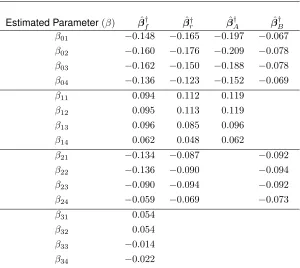
βf = (β01, β02, β03, β11, β12, β13, β21, β22, β23, β31, β32, β33)0.
Then the expectation for a single log time-conditional survival probability is given by
E(logCSkp) =β0p+β1pI(X1= 1) +β2pI(X2= 1) +β3pI(X1= 1)I(X2= 1),
whereI(·)is the indicator function defining the value ofk= 1,2,3,4. At time pointp= 1,2,3for this example, the log time-conditional survival probability for each of the four strata as a function ofpis given by
E[logCS1p] = β0p E[logCS2p] = β0p +β1p E[logCS3p] = β0p +β2p E[logCS4p] = β0p +β1p +β2p +β3p
. (2.14)
Similarly, for the reduced main effects model, the12×9design matrixXris given by
Xr=
I3×3 03×3 03×3
I3×3 I3×3 03×3
I3×3 03×3 I3×3
I3×3 I3×3 I3×3
, (2.15)
and the9×1vector,βr, is given by