
Student Research Projects Student Scholarship
5-12-2018
Review of solid polarized targets
Leiqaa KurbanyUniversity of New Hampshire, Durham
Follow this and additional works at:https://scholars.unh.edu/student_research
Part of theNuclear Commons
This Graduate Research Project is brought to you for free and open access by the Student Scholarship at University of New Hampshire Scholars' Repository. It has been accepted for inclusion in Student Research Projects by an authorized administrator of University of New Hampshire Scholars' Repository. For more information, please [email protected].
Recommended Citation
Review of Solid Polarized Targets
By Leiqaa Kurbany
MAY 2018
Director, Karl Slifer Associate Professor of Phyiscs
ABSTRUCT ... 2
1.Introduction:... 2
2. Dynamic Nuclear Polarization ... 4
2.1 Definition Of DNP ... 4
2.2 The DNP methods: ... 5
2.3 The Solid Effect ... 7
2.3.1 The Varieties of The Solid Effect. ... 8
2.4 Nuclear Spin- Lattice Relaxation... 9
2.5 Thermal Mixing...10
3. Polarized target systems...13
4. POLARIZED TARGET EXPERIMENTS ...15
5. Some Important Definiens ...17
5.1 Deep Inelastic Lepton Scattering ...17
5.2 The Cross Section for Polarized Scattering: -...18
5.3 Structure Functions in Quark-Parton Model. ...20
5.4 The Bjorken Sum Rule ...20
5.5 Tensor Structure Functions ...21
ABSTRUCT
In the following pages I review polarized solid-state target briefly. What I discovered through my reading and writing about this technology, that is amazing tool to study the nucleon structure. I started with what is polarized solid-state target, went through Dynamic Nuclear Polarization (DNP) to understanding how it works, then its setup, in what experiments they used polarized solid-state target and some results of these experiments and finally I wrote a brief definition to many of terms, they are important to know to understand what is polarized solid state target.
1.Introduction:
scattering made use of polarized nuclei and polarized electron beams. This was due to both the limitations in target technology, and the difficulties of producing polarized electron beams. The production of polarized electron beams recently has made great progress, with the use of stressed GaAs photocathodes, which have made possible the production of beams of polarization exceeding 80% with high intensities and good reliability. In addition, significant progress has been made in measuring accurately the polarization of the high-energy electrons. With these developments some of the necessary preconditions for the measurement of precise polarization observables are fullfed.
The second reason is the developments of the past few years which, today, allow the operation of electron accelerators with polarized continuous beams. With the increase in duty cycle by a factor 100-10000, coincidence experiments have become much more practical. Coincidence experiments provide much more detailed information than the inclusive (e,e`) experiments that up till now were the standard[3].
and quark-parton model (QPM) sum rules. The first experiments in polarized electron–polarized proton scattering, performed in the 1970s, helped establish the parton structure of the proton. In the late 1980s, a polarized muon–polarized proton experiment found that a QPM sum rule was violated, which seemed to indicate that the quarks do not account for the spin of the proton. This “proton-spin crisis” gave birth to a new generation of experiments at several high-energy physics laboratories around the world. The new and extensive data sample collected from these fixed- target experiments has enabled a careful characterization of the spin-dependent parton substructure of the nucleon [1]. To address a special problem by scattering experiments, first of all the given (polarized) beam characteristics e.g. stored beam, external beam, beam intensity etc. are decisive for the choice of the target type. Triggered by the many technical developments in different fields over more than four decades a variety of highly functional polarized target systems has been developed. Solid H and D targets, internal gaseous H, D and 3He targets, gaseous 3He are common polarized targets are used. Each of these target types has its own combination of highly sophisticated techniques, which result in specific advantages for the polarization experiments such as high nuclear polarization, high density, high purity of polarizable target material and reasonable polarization resistance during the experiments. All the manifold developments have made it possible to access progressively lower cross section interactions with better precision [4].
2.Dynamic Nuclear Polarization
Dynamic Nuclear Polarization (DNP) is a phenomenon by which high spin polarization, typically derived from a bath of free radical electrons, is transferred to a nuclear spin bath, enhancing the difference between the nuclear energy levels and thereby producing dramatically enhanced NMR signals for detection. The phenomenon was first predicted by Overhauser, but was not observed experimentally until the work of Slichter in metals in 1953.It was soon understood that the same technique could be used to develop high polarizations of 1H, 2H, and 13C in non-conducting solids. This advance became foundational for production of solid targets for high energy physics research.
2.1Definition Of DNP
S. Spin polarization PI,s =< I z , S z > /(I , S ) is defined as a fraction of spins (nuclear or electronic)
directed along the external magnetic field H|| for spins 1⁄ 2, the polarization values at the equilibrium temperature T0 are
𝑃",$% = tanh(ℏ𝛾",$𝐻
2𝐾1𝑇%) (1)
where γI,S are the nuclear and electronic magnetogram ratios, respectively, One can see that, even at high magnetic field of 5 T and very low temperature T0 = 0.5 K, the equilibrium polarization of protons is merely about 0.01, whereas PS0 ≈ -1[5].
2.2 The DNP methods:
Since 1962 a variety of polarized target systems have been developed to reach high values of nuclear polarization by various methods. However, there are two major steps, which are common to all of them. The first step always consists of producing an atomic polarization in the sample. Because the electron magnetic moment exceeds that of the nucleus by a huge factor the polarization of an electron system is much easier to achieve than polarizing the nuclear spin system directly. In the second step the hyperfine interaction between the atomic spin J and the nuclear spin I is exploited to transfer the atomic polarization to the nucleus [4].
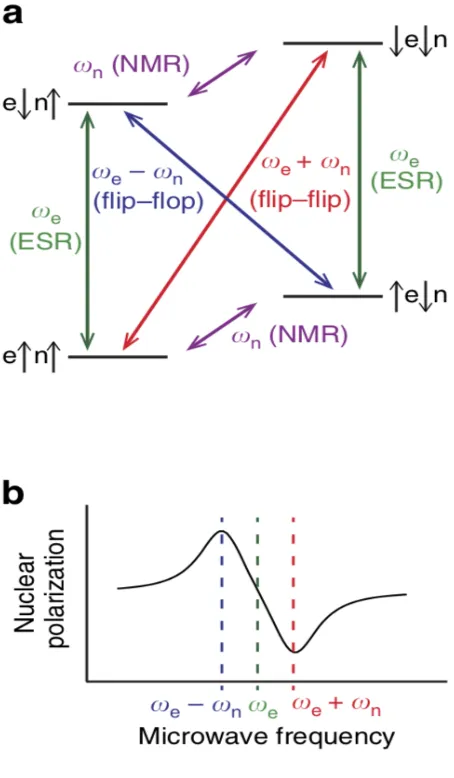
The mechanisms for DNP can be subdivided into two families. In one family, known as the solid effect, the polarization transfer is achieved in a single step. The microwave field combines with the super-hyperfine interaction to induce so-called forbidden transitions, simultaneous flip- flop or flip-flip transitions of an electron spin and a nuclear spin [6],
|𝑚8, 𝑚"⟩ = :+1 2, −
1
2= ↔ :− 1 2, +
1
2= (2)
|𝑚8, 𝑚"⟩ = :+1 2, +
1
2= ↔ :− 1 2, −
1
Figure 1: Energy level diagram for a dipolar-coupled electron spin-1/2 (e) and a nuclear spin-1/2 (n) system in a magnetic field. The ESR at frequency𝜔A(green), NMR at frequency 𝜔B(purple), flip–flop at frequency 𝜔A− 𝜔B (blue), and flip–flip at frequency 𝜔A+ 𝜔B(red) transitions are shown. Driven flip–flop transitions involve a mutual electron flip and a nuclear flop resulting in a positive nuclear polarization. Driven flip–flip transitions result in a negative nuclear polarization. (b) Schematic showing positive and negative nuclear polarization when driving flip–flop and flip– flip transitions, respectively[7].
|𝑚8, 𝑚8C, 𝑚
"⟩ = :+
1 2, −
1 2, −
1
2= ↔ :− 1 2, +
1 2, +
1
2= (4)
|𝑚8, 𝑚8C, 𝑚
"⟩ = :+
1 2, −
1 2, +
1
2= ↔ :− 1 2, +
1 2, −
1
2= (5)
Also, these triple spin flips transfer the polarization from one of the two electron spins to the nuclear spins.
2.3 The Solid Effect
A very simplified description of the solid-state effect can be given as follows: A suitable solid target material with a high concentration of polarizable nucleons is doped with paramagnetic radicals which provide unpaired electron spins [2].
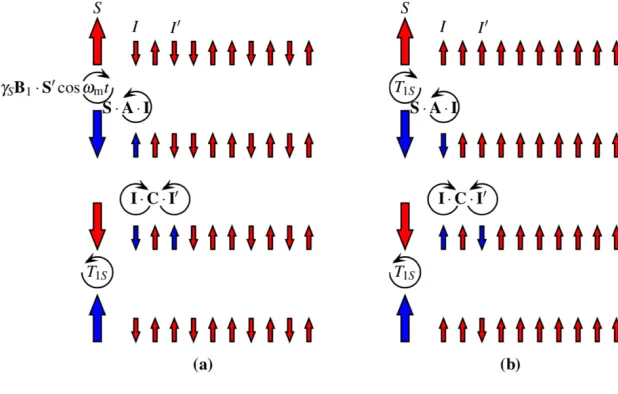
Figure 2:(a) Cartoon depicting the fundamental processes involved in DNP via the solid effect.
(b)Cartoon depicting the fundamental processes involved in direct nuclear spin-lattice relaxation ([6]).
arrow points up, while the nuclear spin polarization PI is still low, so the small arrows are oriented
randomly.
The aim of DNP is to polarize all nuclear spins, i.e., to point all small arrows in the same direction. To point them all up, the microwave frequency ωm is tuned to the difference ωS−ωI of the resonance frequencies of the electron spin S and a nearby nuclear spin I. Then the super-hyperfine interaction S · A · I and the microwave field cooperate to flip these two spins simultaneously. Such combined spin flips are known in the literature as forbidden transitions, though it would be more appropriate to denote them as second order transitions. As seen in the second row, the polarization of the electron spin is transferred to the nearby nuclear spin. Subsequently the resulting nuclear spin polarization needs to be transported to the nuclear spins further away. The third-row shows, how flip-flop transitions
|𝑚8, 𝑚"⟩ = :+
1 2, −
1
2= ↔ :− 1 2, +
1
2= (2)
Induced by the mutual interaction I · C · I′ between the nuclear spins take care of this transport. This process is known as nuclear spin diffusion. Finally, the electron spin S flips back via electron spin-lattice relaxation, so the whole process can start all over again and more nuclear spins can be polarized.
The fundamental process of the solid effect is the simultaneous transition of an electron spin and a nuclear spin leading from the first to the second row. This transition needs to conserve energy. So, the matching condition 𝜔8 = 𝜔F± 𝜔" must hold in order to transfer polarization
from the electron spins to the nuclear spins [6].
2.3.1 The Varieties of The Solid Effect.
2- The differential solid effect. This variety of the solid effect occurs when the ESR spectrum is broad, and their width is of the same order of magnitude as ω0I. Then, for some
microwave frequencies there may be electron spins obeying the matching condition with the + sign, as well as electron spins obeying the matching condition with the − sign. As a result, positive and negative polarizations are transferred simultaneously, and the net transfer is the difference between the two. Moreover, the microwave field also saturates electron spins with a resonance frequency ωS≈ωm. If spectral diffusion is slow, the microwave field only burns a hole in the ESR
signal and the electron spins obeying the matching condition ωS= ωm± ωIare not affected [6],[7].
2.4 Nuclear Spin- Lattice Relaxation
It would be great, if after DNP all nuclear spins were to stay polarized forever, so we could use these polarized spins all the time required by our applications. But the very electron spins, that we need to polarize the nuclear spins with DNP, also destroy the nuclear spin polarizations by means of nuclear spin-lattice relaxation. There are two channels through which this nuclear spin- lattice relaxation can take place:
1- Direct nuclear spin-lattice relaxation: - itis related to the solid effect and the electron spin-lattice interaction flips the big arrow between up and down with the electron spin-spin-lattice relaxation rate 𝑇H$IH. Every once in a while, the electron spin-lattice interaction
combines with the super-hyperfine interaction S · A · I and flips both an electron spin and a nearby nuclear spin. Transfers the polarizations from this nearby nuclear spin back to the
electron spin. Subsequently the mutual interaction I · C · I′ between the nuclear spins induces flip-flop transitions, spreading this loss of polarizations to the nuclear spins further away. As the electron spin continues flipping up and down through electron spin-lattice relaxation, the process is repeated again and again, until all the nuclear spin polarizations are lost.
2- Indirect nuclear spin-lattice relaxation: - it occurs via mechanism of thermal mixing of Nuclear Polarization.
2.5Thermal Mixing
system are furthermore coupled to the lattice and experience relaxation. The heat capacity of the nuclear Zeeman term being much larger than that of the electronic non-Zeeman term, because of the high dilution of electronic spins, the relaxation time of the combined electronic non-Zeeman plus nuclear Zeeman reservoir is much longer than that of the electronic Zeeman reservoir, T1e. The balance between the different mechanisms determines both the rate and the steady state of the dynamic nuclear polarization. This is schematically depicted in Fig. 4[9].
Figure 4: Block diagram of thermal couplings between four thermal reservoirs: electronic Zeeman,
electronic non-Zeeman, nuclear Zeeman and lattice, in the course of DNP under microwave irradiation [9].
A simple picture of the processes playing a role in DNP via thermal mixing is presented in
Figure 5a. The large arrows represent the polarization of several electron spins S, S′, etc., and the
small arrows the polarization of some nuclear spins I, I′, etc., surrounding S. The top row shows the initial conditions. As in our description of the solid effect we start with a high electron spin polarization, and a low nuclear spin polarization. So, as in Figure 5a all large arrows are up, and the orientation of the small arrows is random. Again, our aim is to render all small arrows up. But to achieve this aim, we now tune the microwave frequency to the resonance frequency ωsof the electron spin S′′. As a result, this electron spin flips and we arrive at the situation depicted in the second row. The mutual interaction between the electron spins induces flip-flop transitions and the
reversal of the polarization of S′′ is rapidly transferred to another spin, e.g., S′. But once in a while,
interaction S · A · I and induces a triple spin flip of the two electron spins and a nearby nuclear spin I. The rate of such triple spin flips is much smaller than the rate of simple flip-flop transitions.
Figure 5: (a) Cartoon depicting the fundamental processes involved in DNP via thermal mixing. (b) Cartoon depicting the fundamental processes involved in nuclear spin-lattice relaxation via thermal mixing.
Simple flip-flop transitions may occur before a triple spin flip takes place. The third row shows
how triple spin flips transfer the polarization of S to a nearby nuclear spin, while S′ recovers its original orientation.
Subsequently, just as in the solid effect the resulting nuclear spin polarization is transported
3. Polarized target systems
Dynamic nuclear polarization (DNP) is a standard technique for producing polarized solid targets for nuclear and particle experiments. To realize DNP, a paramagnetic species in the form of a free or unpaired electron is introduced into the target material, either by dissolving a stable radical into the material (if the latter is liquid at room temperature), or by producing radicals directly within the material using ionizing radiation. The electrons are highly polarized by cooling the sample to a low temperature and exposing it to a high magnetic field. For example, at the 1 K and 5 T operating conditions of this target, the electron polarization is 99.8%. Off-center microwave saturation of the radicals' Electron Spin Resonance (ESR) frequency is then used to transfer their polarization to nearby nuclei, with one or more mechanisms, such as the solid effect, thermal mixing, being responsible for the polarization transfer .The polarization of nuclei near the paramagnetic radicals is transported throughout the bulk of the sample via spin diffusion, and may be positive or negative, depending upon whether the microwave frequency is below or above the ESR frequency. In well-designed systems, proton polarizations exceeding 95% have been achieved [10].
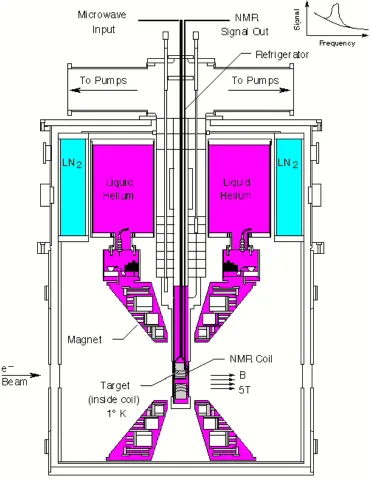
The general setup of the target system is shown in Fig. 6. The main component are; • The superconducting split coil system because the nuclear spins in the solid targets
are polarized with dynamic nuclear polarization method typically in 2.5 or 5 T
magnetic field.
• The evaporation refrigerator which cools the target.
• The microwaves which induce spin flip transitions in the target because during the
polarization build up a microwave generator pumps the paramagnetic centers in the
target material close to the electron spin resonance frequency (about 70 GHz in 2.5
T field).
• The NMR system needed to measure accurately the target polarization.
4. POLARIZED TARGET EXPERIMENTS: -
Many modern experiments in nuclear and particle physics benefit from the exploitation of polarized targets and polarized beams these experiments include: -
• The spin structure of the nucleon: The internal structure of the nucleon in terms of the elementary constituents, the quarks and gluons, depends on the spins and angular momenta of these constituents. These contributions can be measured in deep inelastic scattering (DIS) of polarized leptons from polarized protons and neutrons[3].
One of the review papers to study the spin structure of the nucleon conducted by S.E. Kuhn, J.-P. Chen, E. Leader and others, they focused in particular on the spin structure functions g1 and g2 of the nucleon and their moments. Their data, in combination with the
earlier ones, allow them to study in detail the polarized parton densities, the Q2 dependence of various moments of spin structure functions, the duality between deep inelastic and resonance data, and the nucleon structure in the valence quark region. In their published in 2009, they put limits on the flavor decomposition and the gluon contribution to the nucleon spin [12].
• The electromagnetic structure of the nucleon in its ground state: The magnetic and electric form factors of the nucleon give detailed information on the distribution of the constituents in coordinate space, and a separation of the electric and magnetic form factors, which contribute incoherently to the unpolarized cross section, is possible when using polarized nucleons. Without polarized targets and/or beams, only the dominating form factor at larger momentum transfers this is the magnetic one can be measured with satisfactory accuracy[3].
Ryan Zielinski with the E08-027 collaboration (2017), measured the spin structure functions of the proton at Jefferson Laboratory in Newport News, Va. Longitudinally polarized electrons were scattered from a transversely and longitudinally polarized solid ammonia target in Jefferson Lab’s Hall A, with the polarized NH3 acting as an effective
proton target. Focusing on small scattering angle events at the electron energies available at Jefferson Lab, his experiment covered a kinematic phase space of 0.02 GeV2 < Q2 < 0.20
GeV2 in the proton’s resonance region. The spin structure functions, 𝑔
H K(x, Q2) and
𝑔N K(x, Q2) are extracted from an inclusive polarized cross section measurement of the
electron-proton interaction [14].
• The structure of the nucleon excited states: At excitation energies of 1 GeV, the nucleon exhibits a number of broad, but identifiable excited states. The separation of these overlapping resonances from each other, and the measurement of the electric and magnetic transition form factors, is greatly facilitated by the use of polarized targets[3].
• The structure of light nuclei: As a consequence of the complicated dependence of the nucleon -nucleon force on spin and angular momentum, the wave functions of light nuclei (deuteron, He, He2) display a rich structure. Much of the interest today is centered on the
5. Some Important Definitions
5.1 Deep Inelastic Lepton Scattering
The lowest order diagram for deep inelastic lepton scattering, 𝑙 + 𝑁 → 𝑙C+ 𝑋.
Figure 7: Schematic diagram of the Deep Inelastic Scattering (DIS) process.
Deep inelastic scattering (DIS) is the archetype for hard processes in QCD: a lepton — in practice an electron, muon or neutrino — with high energy scatters off a target hadron — in practice a nucleon or nucleus, transferring large quantities of both energy and invariant squared-four-momentum. For charged leptons the dominant reaction mechanism is electromagnetism and one photon exchange are a good approximation. For neutrinos either W±(charged current) or Z0
(neutral current) exchange may occur. Neutrino scattering experiments require far too massive targets for polarization to be a practical option, so we will ignore them, although W -exchange has been observed in e−p → ν
e + X and could be extended to a polarized target, at least in principle.
Thus, we are mainly limited to charged lepton scattering by one photon exchange. The kinematics is shown in fig. (7). The initial lepton with momentum kand energy E exchanges a photon of momentum qwith the target with momentum P. Only the outgoing electron with momentum k′ and
energy E′is detected. One can define the two invariants
𝒍
Cq2 ≡(k−k′)2 =q
02 −⃗q2 =−4EE′sin2(θ/2) = −Q2 < 0 (6)
ν≡ P · q = M (E − E′) (7)
where; θis scattering angle and q0 ≡ E −E′ refers to the target rest frame.
The deep inelastic, or Bjorken limit is where Q2 and ν both go to infinity with the ratio, x ≡ Q2/2νfixed. x is known as the Bjorken (scaling) variable. Since the invariant mass of the
hadronic final state is larger than or equal to the mass of the target, (P + q)2 ≥ M2, one has 0 < x ≤
1. It is convenient also to measure the energy loss using a dimensionless variable,
0 ≤ 𝑦 ≡ [\Z ≤ 1 (8)
We will find E, Q2, x, and yto be a useful set of variables. Note that it is overcomplete since
x y = Q2/2ME, and note also that what we define as ν differs from common usage by a factor of
M. The behavior of cross sections at large Q2is much more transparent using these variables than
using the set (E, E′, θ) favored by experimenters for the reason that θ → 0 as Q2 →∞at fixed xand y [16].
5.2 The Cross Section for Polarized Scattering:
The differential cross section for unpolarized deep inelastic charged lepton scattering can be written, in the Born approximation,
(9)
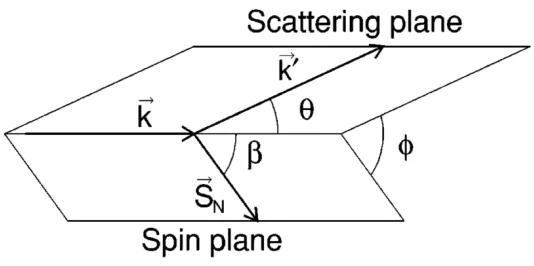
where α is the electromagnetic coupling constant and F (x, Q2) and F (x, Q2) are the unpolarized structure functions of the nucleon. In the laboratory system, the polarized scattering process is conveniently visualized in the two planes depicted in Fig. 8. The scattering plane is
defined by the momentum three-vectors k⃗ and k⃗′ of the incoming and scattered lepton,
respectively. The spin plane is defined by k⃗and by the spin vector S⃗N of the nucleon; β is the
The cross section for polarized scattering depends, in addition, on the relative orientation φof the scattering and spin planes.
This cross section can be decomposed into an unpolarized piece σ0 and a polarized piece σ
(10)
where d3σ /dx dy dφ is the unpolarized cross section of Equation (9).
(11)
where 𝛾 =N[^
5.3 Structure Functions in Quark-Parton Model.
The spin-independent structure functions F1and F2have a straightforward interpretation in the QPM:
(12)
(13)
(14)
In these expressions, qi(x) and q ̄i(x) are the densities of quarks and antiquarks, respectively; iis the quark flavor and eithe quark electric charges.
The interpretation of the spin-dependent structure function g1is equally simple, and where
(qi+(x) (q
i−(x)) is the density of quarks of flavor iwith helicity parallel (antiparallel) to the nucleon spin. This interpretation of g1(x) can be understood from the fact that a virtual photon with spin projection +1 can only be absorbed by a quark with spin projection −1/2, and vice versa.
The interpretation of the “transverse” spin structure function g2in the QPM is less obvious and has been the subject of much theoretical debate [1].
5.4 The Bjorken Sum Rule
It constitutes a very fundamental test of the structure or QCD, the polarized Bjorken sum rule refers to the integral over all x at fixed Q2of the difference between polarized structure
functions of the proton 𝑔HKand the neutron𝑔HB,
ΓKIB(𝑄N) = d 𝑔H K(𝑥, 𝑄N) − 𝑔B(𝑥, 𝑄N) %
𝑑𝑥 (15)
The Bjorken integral can be written in terms of the QCD correction ∆Bj
ΓHKIB(𝑄N) =1
6h 𝑔i
The value of the nucleon beta decay constant is taken to be |gA/gV | = 1.2601 ± 0.0025 [17].
5.5 Tensor Structure Functions
The deuteron, a spin-1 target, has energy levels which split three ways in a magnetic field,
m = −1,0, +1. The target spin orientation can be described using the vector and tensor polarization. The tensor polarization, Pzz, can be expressed in terms of the vector polarization 𝑃oo = 2 −
√4 − 3𝑃N [18].
The definition of vector polarization for spin-1 is
𝑃 = 𝑛r− 𝑛I
𝑛r+ 𝑛I+ 𝑛% =
𝑟N− 1
𝑟N+ 𝑟 + 1 (17)
with the tensor polarization defined as
𝑃uu =𝑛r − 2𝑛%+ 𝑛I 𝑛r+ 𝑛I+ 𝑛% =
𝑟N− 2𝑟 + 1
𝑟N+ 𝑟 + 1 (18)
𝑤ℎ𝑒𝑟𝑒; 𝑟 𝑑𝑒𝑓𝑖𝑛𝑒𝑑 𝑎𝑠 𝑟 = 𝐼 r/𝐼I
For a spin-one hadron such as the deuteron, there exist new polarized structure functions,
b1, b2, b3, and b4, which could probe dynamical aspects including orbital motion within the hadron.
The new structure is associated with tensor structure, so that the tensor-polarized structure functions vanish if constituents are in the S state. It is also important to investigate completely different spin quantities from the nucleon for establishing high-energy spin physics.
Figure 9. Tensor structure of the deuteron[18].
𝑑N𝜎
𝑑Ω𝑑𝐸C= 𝜎[ƒ„„…
1
𝑣𝐹N(𝑥, 𝑄N) +
2
𝑀𝐹H(𝑥, 𝑄N)𝑡𝑎𝑛N𝜃/2‹ + 𝛾𝑔H(𝑥, 𝑄N)+𝛿𝑔N(𝑥, 𝑄N) + 𝜍𝑏H(𝑥, 𝑄N) + 𝜀𝑏N(𝑥, 𝑄N)
6. Summery
For the last four decades scientists and researchers have worked to improve solid polarized targets because they achieved a good explanation and results about the nucleons structure by using them in their experiments. These targets are on the steep rise, and new successes are expected in the near future. They are used to study the configuration of the spin on the nucleon and its structure for spin -1/2 nucleons by analysis spin structure functions and for spin-1 nucleons by analysis tensor structure functions.
Finally, a few words about the future. It seems that the steep rising of solid polarized targets development is far from its finish and the studies of spin and tensor-polarized structure functions could open a new era of high-energy spin physics.
7. Referances
[1] E. W. HUGHES and R. VOSS, “Spin structure functions,” Annu. Rev. Nucl. Part. Sci., vol. 49, no. 1, pp. 303–339, Dec. 1999.
[2] D. G. Crabb and W. Meyer, “Solid polarized targets for nuclear and particle physics experiments,” Annu. Rev. Nucl. Part. Sci., vol. 47, no. 1, pp. 67–109, Dec. 1997.
[3] T. D. Averett et al., “A solid polarized target for high-luminosity experiments,” Nucl. Instruments Methods Phys. Res. Sect. A Accel. Spectrometers, Detect. Assoc. Equip., vol. 427, no. 3, pp. 440–454, 1999.
[4] S. Goertz, W. Meyer, and G. Reicherz, “Polarized H, D and 3He targets for particle physics experiments,” Prog. Part. Nucl. Phys., vol. 49, no. 2, pp. 403–489, Jan. 2002.
[5] V. A. Atsarkin, “Dynamic nuclear polarization: Yesterday, today, and tomorrow,” J. Phys. Conf. Ser., vol. 324, no. 1, p. 012003, Oct. 2011.
[6] A. Abragam and M. Goldman, “Principles of dynamic nuclear polarisation,” Reports Prog. Phys., vol. 41, no. 3, pp. 395–467, Mar. 1978.
[8] W. T. Wenckebach, “Dynamic nuclear polarization via thermal mixing: Beyond the high temperature approximation,” J. Magn. Reson., vol. 277, pp. 68–78, Apr. 2017.
[9] M. Goldman, “Overview of Spin Temperature, Thermal Mixing and Dynamic Nuclear Polarization,” Appl. Magn. Reson., vol. 34, no. 3–4, pp. 219–226, Aug. 2008.
[10] J. Pierce et al., “Dynamically polarized target for the and experiments at Jefferson Lab,” Nucl. Instruments Methods Phys. Res. Sect. A Accel. Spectrometers, Detect. Assoc. Equip., vol. 738, pp. 54–60, Feb. 2014.
[11] D. Keller, “Uncertainty minimization in NMR measurements of dynamic nuclear polarization of a proton target for nuclear physics experiments,” Nucl. Instruments Methods Phys. Res. Sect. A Accel. Spectrometers, Detect. Assoc. Equip., vol. 728, pp. 133–144, Nov. 2013.
[12] S. E. Kuhn, J.-P. Chen, and E. Leader, “Spin Structure of the Nucleon -Status and Recent Results,” 2009.
[13] J. Arrington, K. de Jager, and C. F. Perdrisat, “Nucleon Form Factors - A Jefferson Lab Perspective,” Feb. 2011.
[14] R. Zielinski, “The g2p Experiment: A Measurement of the Proton’s Spin Structure Functions,” Aug. 2017.
[15] N. Guler et al., “SPIN STRUCTURE OF THE DEUTERON,” 2009.
[16] R. L. Jaffe, “Spin, Twist and Hadron Structure in Deep Inelastic Processes,” Feb. 1996.
[17] K. A. Milton, I. L. Solovtsov, and O. P. Solovtsova, “The Bjorken Sum Rule in the Analytic Approach to Perturbative QCD,” Sep. 1998.
![Figure 3: Schematic demonstration of the resolved solid-state effect [2].](https://thumb-us.123doks.com/thumbv2/123dok_us/9656780.1493490/11.612.137.498.315.588/figure-schematic-demonstration-resolved-solid-state-effect.webp)


![Figure 9. Tensor structure of the deuteron[18].](https://thumb-us.123doks.com/thumbv2/123dok_us/9656780.1493490/24.612.148.472.191.373/figure-tensor-structure-of-the-deuteron.webp)
