Licensed under Creative Common Page 1
http://ijecm.co.uk/
ISSN 2348 0386
INFLUENCE OF GREEN SUPPLY CHAIN MANAGEMENT
STRATEGY ON PROCUREMENT PERFORMANCE
OF SUGAR INDUSTRY IN KENYA
Malaba, Petwa Nawire
Jomo Kenyatta University of Agriculture and Technology, Kenya
Ogolla, Kennedy
Jomo Kenyatta University of Agriculture and Technology, Kenya
Mburu, David Kiarie
Jomo Kenyatta University of Agriculture and Technology, Kenya [email protected]
Abstract
In its attempt to establish the influence of Green supply chain management strategy on
procurement performance in the Sugar Industry in Kenya, the study aimed at ascertaining the
influence of green purchasing on procurement performance, exploring the influence of green
manufacturing on procurement performance. Using a cross sectional survey research design on
11 sugar factories in Kenya consisting of 4 Parastatal Companies and 7 Private Companies, the
study sampled stores department, purchasing department and finance department of the
selected sugar factories through a sample of 132 respondents for representativeness. The
gathered data was analyzed using Statistical Package for Social Sciences (SPSS) both
descriptively and inferentially using regression and factor analyses. The study findings showed
that Green purchasing and Green manufacturing, all had direct as shown by the R Square value
of .627 implying that the independent variables account for 62.7% of procurement performance.
The findings also showed that professional experience, supply knowledge training, green
purchasing, technical knowledge, quality and reliability, innovation, delivery, morale, customer
Licensed under Creative Common Page 2
aspects to price and performance criteria in companies within the sugar industry as attested to
by the factor analysis results. The findings formed the basis for the recommendations. This
study concludes that GSCS have a strong positive effect on procurement performance within
the sugar industry.
Keywords: Green supply chain Management, Green Purchasing, Green Manufacturing,
Procurement Performance
INTRODUCTION
Globally, Wang (2009) posits that as the effects of environmental problems on the living conditions of the world’s population become more apparent, an emphasis on environmental
awareness has become more prominent. The general public has started to pay more attention to the potential consequences of this global environmental problem. Some of the most pressing environmental issues include ozone layer depletion, global warming, and hazardous wastes. In an effort to mitigate the negative impacts of such environmental problems, many nations have passed laws and regulations and have set environmental standards aimed at reducing industry carbon and greenhouse gas emissions to the atmosphere. Some of these standards include End of-Life Vehicle (ELV); Restriction of Hazardous Substances (RoHS); Waste electrical and Electronic Equipment (WEEE); eco-design of Energy-Using Products (EuP); and Registration, Evaluation, Authorization, and Restriction of Chemicals (REACH) (Wang, 2009).
Licensed under Creative Common Page 3
Sugar Industry in Kenya
Kenya has a large manufacturing sector serving both the local market and exports to the East African region. Kenya’s manufacturing sector is among the key productive sectors identified for
economic growth and development because of its immense potential for wealth, employment creation and poverty alleviation. The sector is dominated by subsidiaries of multi-national corporations, contributing to the Gross Domestic Product (GDP) (PWC, 2006). The sector is also characterized by improved power supply, increased supply of agricultural products for agro processing, favorable tax reforms and tax incentives, more vigorous export promotion and liberal trade incentives to take advantage of the expanded market outlets through AGOA, COMESA and East African Community (EAC) arrangements resulting to expansion in the sector (PWC, 2006).
The sugar industry is a major contributor to the agricultural sector which is the mainstay of the economy and supports livelihoods of at least 25% of the Kenyan population. The subsector accounts for about 15% of the agricultural GDP, is the dominant employer and source of livelihoods for most households in Western Kenya comprising Nyanza, Rift Valley and Western Provinces. In 2008/2009, the industry produced close to 520,000 tons of sugar operating at 56 percent of the installed capacity. In such environment, the industry will have to enhance its competitiveness along the entire value chain and reduce production costs by at least 39% to be in line with EAC partner states and COMESA sugar producing countries (Kenya Sugar Industry Strategic Plan, 2010-2014).Before independence, the sugar industry in Kenya was dominated by the private sector.
Large-scale production and processing started with the establishment of Miwani Sugar Company in 1922, and expanded with the addition of Ramisi Sugar Company in 1927. After independence, the Kenya Government started playing a central role in the ownership and management of the sugar industry. Five more factories were established, namely Muhoroni (in 1966), Chemelil (1968), Mumias (1973), Nzoia (1978) and South Nyanza (1979).
Statement of the problem
Licensed under Creative Common Page 4
greenhouse gases by countries with consequent climatic degradation. This may require going beyond mere corporate responsibility to take care of the environment (Clarkson Consulting, 2009).The sugar industry in Kenya is facing two major weaknesses. Firstly, the productivity of both the country’s cane from farms and the milled sugar from factories is low. The national
average yields are lower than those in other sugar producing countries in the region. Secondly, Kenya has the highest sugar production cost in the Eastern and Southern Africa (COMESA) region. It’s estimated that it costs up to US$600 to produce a tone of Kenyan sugar, which is
approximately twice what it costs in many of the neighboring countries.
These companies have done little to take advantage of GSCMS. Even with the high cost of inputs as a result of poor infrastructure has led to high prices of locally manufactured products thereby limiting their competitiveness in the regional markets and hampering the sector's capacity utilization, the sugar-sector stakeholders (sugar mills, farmers, researchers) are paying insufficient attention to adaptation to climate change and climate variability which should be key in cost reduction. With the focus on installing irrigation systems to help increase yields and productivity, but also to mitigate climate change and climate variability, its increasingly important to climate-proof the sugar- sub sector (The Scoping Report, 2012). Despite the fact that a tradeoff between social benefits (increase of welfare by reduction of environmental problems) and private costs (of the company) is observed, there is an increasing number of companies that reduce their environmental impact even more than is required. This phenomenon of “over-compliance” or “corporate environmentalism” helps companies to reduce
the sources of possible conflicts between them and society (pollution of the environment). The study therefore aims to explore the influence of green supply chain strategy on procurement performance in the sugar industry where their inbound and outbound logistics activities are potential polluters to the environment. Increasing pressures from a variety of directions have caused the supply chain members to consider the green supply chain management (GSCM) practices to improve both their economic, competitive and environmental performance.
General objective
Licensed under Creative Common Page 5
THEORETICAL REVIEW OF LITERATURE
A theory includes a set of basic assumptions and axioms as the foundation and the body of the theory is composed of logically interrelated, empirically verifiable prepositions. Theoretical frameworks are explanations about the phenomena (Camp, 2001). Theoretical framework provides the research the lens to view the world clearly (Marriam, 2001). Even though this study is based on sustainability theory, it integrates information from Resource based theory and Ethics theory discussed below.
Resource Dependency Theory
According to resource dependence theory (RDT), firms seek to reduce uncertainty and manage dependence by purposely structuring their exchange relationships, establishing formal and semiformal linkages with other firms. Through interdependence, firms can synergistically combine their own resource sets with the complementary resources of their partners and thus develop a resource bundle that is unique and hard to imitate (Harrison et al., 2001). By cultivating such relationship-specific capabilities that become superior to what the organizations may possess on their own firms can obtain sustainable competitive advantage and improved procurement performance (Sambharya & Banerji, 2006; Paulraj & Chen, 2007). In this aspect, RDT is a relevant theory to SCM because it can help elaborate organization-environment boundary spanning activities, implying that a single firm can hardly achieve sustainable growth. Therefore, firms need to depend on the buyer-supplier relationship which helps improve cooperation and coordination among supply chain members (Dyer, 2000).
For SCM to be strategic in nature, it is imperative that buyer firms adopt strategic initiatives, that is, implementation of GSCM practices that foster an effective relationship to provide mutual benefits (Paulraj & Chen, 2007).In the context of GSCM, inter-organizational collaboration is even more important for managing the internal and external coordination and cooperation to have the system successfully implemented throughout the whole supply chains (Zhu et al., 2010). Handfieldet al. (2002) developed a decision model to measure environmental practice of suppliers using a multi-attribute utility theory approach. Kainuma and Tawara (2006) proposed the multiple attribute utility theory method for assessing a supply chain including re-use and recycling throughout the life cycle of products and services.
Sustainability Theory
Licensed under Creative Common Page 6
works to understand the connections between environment, economy and the society. In 2000, the World Bank published The Quality of Growth, advocating a broadening of the growth framework to a complementary agenda involves key quality aspects in the structural, human, social, and environmental dimensions of sustained growth, emphasizing a more equitable investment in people, and the need to sustain natural capital, dealing with global financial risks, improving governance and controlling corruption. The World Business Council for Sustainable Development Report, WBCSD, (2005), Creating Business Value and Accountability, restates the need to increase accountability and change the business approach to sustainable development. Accountability and value creation must be made mutually reinforcing throughout any enterprise, integrating sustainable development amongst all areas of business practice, rather than creating a 'specialist silo.' Although not specific policy responses, the two reports suggest a change in the policy outlook of international institutions (WBCSD, 2005).
According to a research report from the Economist Intelligence Unit by ExxonMobil (2011), there is growing importance of corporate sustainability in enabling companies to compete and to attract customers. Business both impacts and relies on the availability and health of our natural resources. In recognizing this connection and protecting wildlife habitat and biodiversity in and around their operations the survey claims that the adoption of sustainable practices does not cause companies’ share prices to rise. It could be that companies with a
strong financial performance simply have more resources to devote to sustainability. What the findings do show, however, is that it is possible to take a proactive position on social and environmental issues while still delivering robust financial growth. Understanding the full life cycle of their operations is important to operating in an environmentally sustainable manner and involves four key steps: Assessing the surroundings; Designing the facilities and operations; Operating with integrity and Restoring the environment.
Ethics Theory
Ethics is a branch of philosophy that seeks to define what is right and what is wrong. It helps us understand what actions are wrong and why they are wrong. Across the world, not all cultures share the same ethical commitments, and cultural relativism acknowledges that (Desjardin, 2008).
Licensed under Creative Common Page 7
various philosophical approaches to environmental ethics, but only three will be discussed here; anthropocentrism, biocentrism and egocentrism. Anthropocentrism or human centered ethics is the view that all environmental responsibility is derived from human interests alone. It assumes that only human beings are morally significant and have direct moral standing. Since the environment is crucial to human well-being and survival, there is a duty towards the environment; a duty derived from human interest (Desjardin, 2008). Biocentrism is a life centered moral responsibility. According to the broadest version of biocentrism theory, all forms of life have an inherent right to exist (Desjardin, 2008). Egocentrism maintains that the environment deserves direct moral consideration and not consideration that is merely derived from human or animal interests. It suggests that the environment has a moral worth (Desjardin, 2008). According to Kaplan (2009), there are three main sources of rules that regulate behavior of individuals and businesses; the law, non – legal rules and regulations and ethics. If a business is breaking the law, by not complying with one of the many environmental laws requirements. The business would want to move from that point of counter compliance.
Procurement Performance
Procurement performance is the quantitative assessment of the degree to which the procurement function and those employed therein achieve the general or the specific objectives assigned to them (Lyson, 2000). Procurement performance is the extent to which the procurement process is achieving its objectives. Process performance measurement focuses on the concept of process capability and maturity. Organizations have used capability maturity models to assess measure and improve their organizational critical core process such as software development and project management (Garret & Rendon, 2005). Process capability in these models is defined as inherent ability of a process to produce planned results (Ahern et al.,
2001). Procurement performance is also indicated by how well a system supports procurement needs of the organization .Quality of the procurement process can be one of the key performance indicators which can be measured by the proportion of business orders ejected or returned by the user (Subramaniam & Shaw, 2002).Similarly, the quality of systems is measured by looking at system availability or responsiveness and resolution of the technical issues.
Green Purchasing
Licensed under Creative Common Page 8
acquisition of products and services that most effectively minimize negative environmental impacts over their life cycle of manufacturing, transportation, use and recycling or disposal. Green purchasing is adding environmental aspects to price and performance criteria when making purchasing decisions. Ultimate goal is to reduce environmental impacts of sourcing and to increase resource efficiency (Shah, 1998).
Green purchasing is the practice of applying environmental criteria to the selection of products or services. It takes a number of forms, from relatively simple to relatively complex. Despite the fact that green purchasing is an established concept within the purchasing field, common definitions do not exist. One common definition referred to is the practice of companies taking supplier environmental product and process performance into account when purchasing products and service. Zhu Qinghua et al. (2002) considered green purchasing as: every department in the enterprise consults decision-making to improve business performance by decreasing the using materials cost and end treatment cost, protecting resources and enhancing the enterprise reputation. Martha and Houston (2010) pointed out the potential aim of green procurement is to eliminate waste, and purchasing department will focus on value by comprehensive considering the total cost in the process of eliminating waste ,which should focus on the business of waste disposal activities.
Usually, it can save more cost in the source of supply chain to prevent waste than at the end of supply chain. Purchasing activity is the key starting point of eliminating waste, so a key factor of the successful green purchasing is the condition of company recycling and reusing waste. Green purchasing practice is comprised of environment-based initiatives, such as supplier environmental audit and assessments and supplier’s environmental certification (Hsu &
Licensed under Creative Common Page 9
(2001) find that the two most highly rated obstacles to effective implementing green purchasing was cost and revenue. In the process of implementing green procurement, the enterprise is bound to increase investment, training staff costs and the communication costs with suppliers, which hence causes the loss of other investment opportunities (Liu & Zhu, 2009).
Green Manufacturing
Green manufacturing is defined as production processes which use inputs with relatively low environmental impacts, which are highly efficient, and which generate little or no waste or pollution. Green manufacturing can lead to lower raw material costs, production efficiency gains, reduced environmental and occupational safety expenses, and improved corporate image (Ninlawanet al., 2010). To adopt more proactive strategic SCM, it is essential for manufacturers make collaborative efforts with both the first- and the second-tier suppliers to establish green systems and comply with environmental regulations in producing parts and components.
Also a vast majority of business community recognizes that climate change is the reality with potential risk and opportunities. A most recent report of the carbon disclosure project revealed that 79 percent of the responding companies consider climate change to present a commercial risk while 82 percent regard it is a commercial opportunity for both existing and future products (MOEF, 2010). It shows that green manufacturing is becoming increasingly more important for an enterprise to be able to manage its operations in a way that minimizes the negative environmental impact they might result in, directly or indirectly. At the same time, it is a fact that you cannot manage what you cannot measure. Thus, performance measurement is a key element in enabling performance management, performance improvement, and performance documentation (Adams &Neely, 2000; Digalwar & Sangwan, 2011a; Taticchi et al.,
2012).When combining the pivotal importance of environmental friendliness with the need for performance measurement, it is evident that this can be done, first, by understanding thoroughly the green manufacturing systems and their critical success factors or performance measures. The traditional performance measures are invalid for the measurement of green manufacturing practices as they are based on outdated traditional cost management systems.
Licensed under Creative Common Page 10
derived from corporate strategies and capabilities, are a prerequisite for the implementation of green manufacturing systems to survive in today’s competitive environment.
EMPIRICAL REVIEW OF LITERATURE
Gunasekaran et al. (2004) provide insights into current practice and future requirements in supply chain performance measurement including issues relevant to green supply chain management. Included among these issues are: successful implementation requires organization-wide coordination; to monitor performance each metric must take a supply chain perspective; each entity in the supply chain should be measured and improved with common goals; non-financial metrics are gaining more attention than financial ones; and additional and creative efforts are needed to design new measures. Previous research has made predictions for supply, but not specifically for sustainable SCM. For example, a five-year forecast for supply shows academics have been making some effort to try to look ahead (Carter & Smeltzer, 2003).Previous research has explored the relationships between GSCM practices and performance including environmental, economic and operational performance. Literature has offered insight on potential patterns of supply-chain relations for improving environmental performance (Handfield et al.,2002). The literature for supporting such positive relationships is relatively strong. For example, Frosch (1994) argued that an inter-firm linkage facilitated by proximity could lead to improvement in environmental performance. Dodgson (2000), Dyer and others argued that inter-firm relations provide formal and informal mechanisms that promote trust, reduce risk and in turn increase innovation and profitability.
Licensed under Creative Common Page 11
Florida and Davison (2001) surveyed 580 manufacturing plants in the US adopting cleaner production techniques. Their research reveals that green corporations are innovative in their environmental practices, and these strategies emerge from a real commitment towards reducing waste and pollution. Lean production/manufacturing is also an important consideration in reducing the environmental impact of the production phase. Sanches and Ferez (2001) also investigated the link between lean production practices in manufacturing organizations and resultant enhanced competitiveness. Lean production is also expected to improve environmental performance of the firms through good housekeeping practices, such as general waste reduction and minimizing hazardous wastes. King and Lenox (2001) conclude that lean production is complementary to improvements in environmental performance and it often lowers the marginal cost of pollution reduction thus enhancing competitiveness.
Critique of Existing Literature
Organizations face barriers and enablers to GSCM and these can be either internal or external to the organization. What is less clear from previous research is whether certain types of organizations are more internally or externally motivated to engage in GSCM. Many organizations are struggling with implementation of the green supply chain management objectives due to unfamiliarity, uncertainty and inexperience. Examples of the dilemmas include is green supply chain management part of corporate strategy? What are the measurable selection criteria for the procurement performance? Consumers express increasing confusion about the veracity of green terminologies and the large number of symbols currently used, new descriptive terms such as sustainable and low-carbon footprint and the questionable validity of some green claims can only add to consumer skepticism.
Many stakeholders are involved in the GSCM hence a precise framework of policies, common constraints and preconditions governing the area has to be developed to ensure performance measurement in the procurement sector. Majority of existing literature shows how GSCM has been implemented in developed countries but not in developing countries in Africa hence this study aims to find out the relationship between GSCM and procurement performance in the sugar industry in Kenya.
Research Gaps
Licensed under Creative Common Page 12
emerging in procurement, and developing green supply chain policies as well as communicating them to the stakeholders along the supply chain. Environmentally preferable products are sometimes more expensive to purchase than alternative products. This circumstance can discourage green purchasing by consumers seeking lower costing products without significant environmental benefits. Nevertheless, buying greener products doesn't necessarily mean paying more, especially when other cost factors are considered. Firms collaborate with their suppliers and customers to function properly in their business environment. There is need to understand and define the essence of GSCM issues in a much wider context and should conceptualize how GSCM systems interact with the nature in the short as well as the long term since GSC can save resources, eliminate or reduce waste and improve efficiency and effectiveness and eventually attain competitive advantage.
RESEARCH METHODOLOGY
The study adopted descriptive survey research design to explore the influence of GSCM strategy on procurement performance in the sugar industry in Kenya. A survey is an attempt to collect data from members of a population in order to determine the current status of that population with respect to one or more variables (Mugenda et al., 2003). Creswell (2003) observes that a descriptive research design is used when data is collected to describe persons, organizations, settings or phenomena. This is because the method was useful in describing and interpreting wider analysis of data which employs various survey instruments for data collection such as interviews and questionnaires. The design also has enough provision for protection of bias and maximized reliability (Kothari, 2008).
Target Population
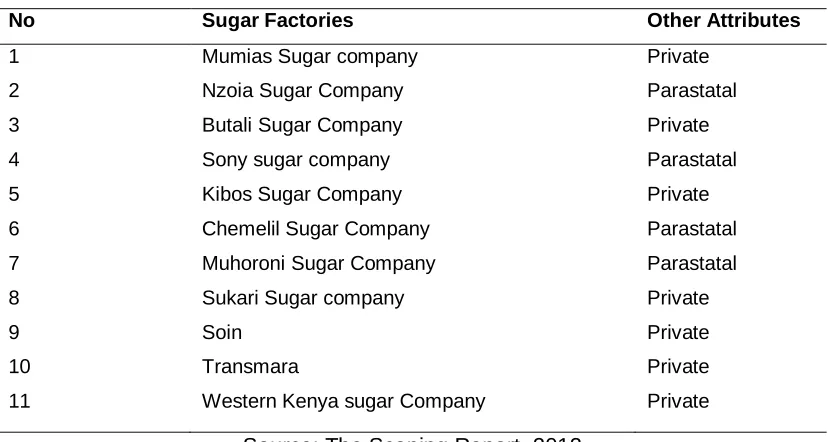
The target population of this study included all the 11 sugar companies licensed by the KSB as at March 2012. The sugar factories in Kenya are composed of 4 Parastatal Companies and 7 Private Companies.
Licensed under Creative Common Page 13
Table 1. Target Population for the Study
No Sugar Factories Other Attributes
1 Mumias Sugar company Private
2 Nzoia Sugar Company Parastatal
3 Butali Sugar Company Private
4 Sony sugar company Parastatal
5 Kibos Sugar Company Private
6 Chemelil Sugar Company Parastatal
7 Muhoroni Sugar Company Parastatal
8 Sukari Sugar company Private
9 Soin Private
10 Transmara Private
11 Western Kenya sugar Company Private
Source: The Scoping Report, 2012
Sample and Sampling Techniques
The procedure involved the identification of the population, establishing the sample frame, determining the sample size and the sample method which was specified (Quee, 2001). According to Kenya Sugar Industry Strategic Plan (2010-2014) the total employment in the factories amounts to around 40,000 workers with an estimated number of 3,000 permanent employees. Stratified random sampling and Purposive sampling was used to select the sample because the population is heterogeneous. This ensured expert judgment to select cases that would best enable to answer the research question and meet the research objective.
The study involved the stores department, purchasing department and finance department of the selected sugar factories. According to Kenya sugar board, the selected departments have approximately 500 employees in all the sugar factories. Therefore 10% of the target population was large enough so long as it allows for reliable data analysis and allows testing for significance of differences between estimates. The number of respondents was twelve; 4 in stores department, 4 in purchasing and 4 in the finance department of each sugar factory. Therefore the study constituted 132 respondents.
Research Instruments
Licensed under Creative Common Page 14
According to Kothari (2006), the information obtained from questionnaires is free from bias and researchers influence and thus accurate and valid data was gathered. Secondary data was collected through e-resources, published scholarly articles, journals, newspapers, magazines, books and other relevant literature.
Data Collection Procedure
Data collection involved a self-administered questionnaire. A self-administered questionnaire was desirable because of low cost, adequacy of time for respondents to give responses, it was free of interviewer’s biases and was capable of reaching a large number of respondents in line with Kothari (2004). The questionnaires were delivered to the respondents’ place of work and
picked later at an agreed day after they had been filled.
Pilot Study
Pilot Study refers to feasibility studies which are small scale versions or trial runs done in preparation for the major study. A pretest prior to the actual study was carried out to enable the researcher to access the clarity of the instrument and its ease of use. According to Mugenda and Mugenda (2003), pre-testing allows errors to be discovered before the actual collection of data begins and 10% of the sample size was considered adequate pilot study. The researcher selected a pilot group of 12 individuals from the target population to test the reliability of the research instrument. The pilot data was not included in the actual study. The pilot study allowed for pre-testing of the research instrument.
Validity is the accuracy and meaningfulness of inferences, which are based on the research results (Mugenda & Mugenda, 2008).A questionnaire is said to be valid when it actually measures what it claims to measure. Reliability is the extent to which any measuring procedure yields the same results on repeated trials (Neuman, 2000; Mugenda,2008). A test is reliable to the extent that it measures what it is measuring consistently (Patton, 2002). According to Mugenda and Mugenda (2008), the number of cases in the pre-test should be 10% for small samples and 1% for large samples. 30 questionnaires were administered to the respondents for the pre-test. The study found that the instrument had an overall Crouchbach alpha score of 0.831 with various scores for the individual variables in the study.
Data Processing and Analysis
Licensed under Creative Common Page 15
statistical tools as they showed the distribution against each of the variable under investigation. Inferential statistics using correlation analysis was also carried out to establish the nature of the relationship that existed between variables. Multiple regression was used to obtain an equation which describes the dependent variable in terms of the independent variables based on the regression model; regression is used to determine the type of relationship (Patton, 2002). The regression had a correlation coefficient (R) of about 0.69 and an adjusted R2 of 0.62. This means that the independent variables in this study, that is, green purchasing, green manufacturing, account for 62.7 percent of the variations in procurement performance. The F statistic test value of 13.174 and a small significance value of 0.000 that is P = 0.000 > α = 0.05,
indicates that there is a regression relationship between the dependent variable (procurement performance) and the predictor variables (green purchasing, green manufacturing).
ANALYSIS AND FINDINGS
Out of the 132 questionnaires that were issued to the sampled employees of the Kenya Sugar Companies in this study that included all the 11 sugar companies licensed by the KSB as at March 2012, only 105 were returned in time for analysis thereby constituting a questionnaire return rate of 74.5%.The respondents’ gender distribution male 38 (36%), female 67 (64%). The respondents’ age distribution, the study found that respondents aged 23-32 years were 7
(6.7%), 33-37 years were 76 (72.4%), 38-42 years were 17 (16.2%), and those aged over 42 years were 5 (4.7%). The sample was all-inclusive. The respondents had varying years of working experience such as 1-2 years 33 (31.8%), 3-7 years 60 (56.8%), Over 8 years 12 (11.4%). The study found that 38 respondents were working under purchasing department (36.4%), 26 were working under finance department (25%), and 41 stores department (38.6%). The study indicated the outcome of the level of education of respondents. KCSE 5 (4.5%), diploma 26 (25%), degree 64 (61.4%) and masters 9 (9.1%). This means that many of the respondents were well educated to fully comprehend the sugar company procurement performance. The respondent’s areas of specialization included finance, procurement and
accounting. These areas of specialization were represented by 22 (20.5%) in finance, 76 (72.7%) in procurement and 7 (6.8%) in accounting.
Green Purchasing
Licensed under Creative Common Page 16
the respondents indicated that level of education influences performance of procurement. A majority 91 (86%) of the respondents indicated that procurement and supply knowledge training influences procurement performance. A majority 88 (84%) of the respondents indicated that technical knowledge influences the performance of procurement.
In the process of implementing green procurement, the enterprise is bound to increase investment, training staff costs and the communication costs with suppliers, which hence causes the loss of other investment opportunities (Liu & Zhu, 2009).Respondents’ answers to deciding on the choice of suppliers were almost equal; yes 50(52.3%), No 55(47.7%). Procurement, a key boundary-spanning function, and the upstream supply partners together influence the environmental impact of the focal firm in several ways: inbound logistics’ environmental pollution, environmental impact of supplied material, energy consumption and emissions in the production process and eco-efficiency of the product through its life cycle (Lee & Klassen, 2008; Ross & Jayaraman, 2009).
Green Manufacturing
This study investigated the influence of green manufacturing by finding out if the green/environmentally conscious strategy, the certification system employed in the organizations, Waste regulation in the organizations and competitive priorities. The respondents’ response to whether their companies follow an environmentally conscious strategy
indicated that 88 respondents constituting 84.1% admitted that their companies were following environmentally conscious strategies leaving only 17 respondents (15.9%) denying the involvement of their companies in such strategies. It was observed that all conceptual frameworks have their relative benefits and limitations, with the most common limitation being that little guidance is given for the actual selection and implementation of the performance measures (Adams & Neely, 2000; Neely et al., 2001; Kennerley et al., 2003; Digalwar & Sangwan, 2011a, Taticchi et al. 2012). Performance measures, derived from corporate strategies and capabilities, are a prerequisite for the implementation of green manufacturing systems to survive in today’s competitive environment. The respondent companies’ certification
Licensed under Creative Common Page 17
environmental consciousness is a competitive priority for their firms. Quality and reliability was indicated by 91 (86%) respondents to be a competitive priority done by their organization.
Majority of respondents also indicated innovation, delivery, morale, customer relations and productivity as competitive priorities done by their firms. Green manufacturing can lead to lower raw material costs, production efficiency gains, reduced environmental and occupational safety expenses, and improved corporate image (Ninlawan et al., 2010). To adopt more proactive strategic SCM, it is essential for manufacturers make collaborative efforts with both the first- and the second-tier suppliers to establish green systems and comply with environmental regulations in producing parts and components.
Procurement Performance
The system of procurement in use in respondents’ companies was as in the graph below and as
follows; manual (paper based) 17(15.9%), computer based, 19 (18.2%), combination of both 69 (65.9%) as can be confirmed from figure 4.12 below. The procurement systems in place in the organizations as enlisted above rightly fit into the understanding of procurement performance as the quantitative assessment of the degree to which the procurement function and those employed therein achieve the general or the specific objectives assigned to them (Lyson, 2000). It also concurs with the views of Garret and Rendon (2005) that procurement performance is the extent to which the procurement process is achieving its objectives. Process performance measurement focuses on the concept of process capability and maturity. Organizations have used capability maturity models to assess measure and improve their organizational critical core process such as software development and project management. The mixed approach could be attributed to the fluctuating power supply in Kenya which could highly tamper with the procurement systems if they were to be wholly electronic/computerized, thus the need for some paper based system. The use of manual process by some organizations called for urgent measures towards automation. 65.9% of the respondents’ accepted that the supply chain
Licensed under Creative Common Page 18
ejected or returned by the user (Subramaniam & Shaw, 2002). The fact that the respondents perceived the supply chain strategies as adequate to a high extent shows that the systems in place within the various organizations supported the needs of their organizations. Innovation and proactive approaches are highly on demand within the Green Supply Chain Management as a way of enhancing high performance in an environmentally friendly setting. The respondents choice of new strategies was as in the figure4.13 below and as follows; procurement 28 (27%), policy 60 (57%), training 17 (16%). Policy as entailing choice of new strategies was the most preferred hence lending credence to the notion of poor policy making. There was a positive significant relationship between reduced costs which was indicated by a majority 91 (86%) of the respondents. A majority 91 (86%) of the respondents indicated that they improve brand image, 93 (84%) of the respondents indicated that they help in staff recruitment. Majority of the respondents also indicated the effect of sustainable supply chains on procurement performance also included retention and morale, maintain supplier loyalty, enhance due diligence, help manage risks, satisfy end user requirements and drive product innovation as pertains their extent of effect on procurement performance. In this aspect, RDT is a relevant theory to SCM because it can help elaborate organization-environment boundary spanning activities, implying that a single firm can hardly achieve sustainable growth. Therefore, firms need to depend on the buyer-supplier relationship which helps improve cooperation and coordination among supply chain members (Dyer, 2000). This implies that sustainable supply chains variable correlates with procurement performance of the sugar industry in Kenya.
SUMMARY OF FINDINGS
Green Purchasing
In line with the first objective, the study found that green purchasing contributes 0.521 of procurement performance in the sugar industry showing how critical this factor is in influencing the dependent variable procurement performance. Other findings showed that most of the respondents (98%) indicated that professional experience is relevant in procurement performance in firms, Green purchasing is adding environmental aspects to price and performance criteria when making purchasing decisions, 86%, 86%, 84% and 52.3% indicated that level of education, supply knowledge training, technical knowledge influences and choice of suppliers influences the performance of procurement respectively.
Green Manufacturing
Licensed under Creative Common Page 19
respondents’ acceptance that their companies had certification systems and follow
environmentally conscious strategies such as ISO (34.1%), KEBS (20.5%), NEMA (18.2%), and auditing (27.3%). Their systems in place for tracking reporting and reducing waste and emission were as follows; technology (34.1%), recycle (13.6%), policy (52.3%), Quality and reliability (86%), through innovation, delivery, morale, customer relations and productivity as competitive priorities done by their firms and taking of appropriate strategies such as cost, flexibility, competitive priority and environmentally conscious competitive priority
CONCLUSION
From the findings of this study, the study concludes that there is a direct strong positive relationship between Green Supply Chain Management and procurement performance within the sugar industry in Kenya as measured by the various items under each of the independent variables in this study. There are a myriad of benefits associated with Green Supply Chain Management and the knowledge of these benefits seems to have penetrated the sugar industry stakeholders. This was the basis of embracing various GSCM strategies such as green purchasing, green manufacturing, green marketing and reverse logistics. The embracing of GSCM by the companies sampled in this study is a step in the right direction as a way of moving in line with the green revolution. This is an achievement that is critical in retarding and controlling the persistent global warming with its consequent diverse effects such as earthquakes, lowering sea levels among others.
RECOMMENDATIONS
Based on the findings, the study made the following recommendations:
(i) The study recommends that the staff of the companies within the sugar industry should undergo professional experience to increase their technical knowledge since it’s relevant
in Green Supply Chain Management and procurement performance in firms.
(ii) The study recommends that there should be awareness creation on how to engage in GSCM, its effects on procurement and create legally binding policies and framework within the sugar industry and even outside (in other industries) as a way of embracing environmentally friendly measures as a mitigation to climate change and improved health.
Licensed under Creative Common Page 20
challenging to measure the levels of utilization of GSCM in the companies within the industry.
(iv) Majority of the companies subscribe to certified bodies hence they were a good target-audience. Systems in place for tracking reporting and reducing waste and emission were as follows; technology, recycle and policy. Quality and reliability was indicated to be a competitive priority done by their organization. The organizations should enhance flexibility since it was found to be a competitive priority while environmental consciousness was found to be a competitive priority for firms.
IMPLICATIONS FOR FURTHER STUDY
There is need for further research to be undertaken to determine the other factors that influence procurement performance GSCM is not the only factor affecting procurement performance within the sugar industry. The study recommends that this study be replicated in other industries that engage in procurement especially the manufacturing industries as a way of strategic positioning against the menace of climatic change
REFERENCES
Aberdeen Group. (2010). Best practices in E -Procurement: Abridged report. New York: American Association for Public Opinion and Research.
Adams, C. & Neely, A. (2000).The performance prism to boost M&A success, Measuring Business Excellence, Vol. 4.( 3), pp. 19-23.
Ahern, D. M., Clouse, A., & Turner, R. (2001).CMMI Distilled. Bouston: MA Addison-Wesley.
Ali, A., Khan, A. A., Ahmed, I., & Shahzad, W. (2011). Determinants of Pakistani Consumers’ Green Purchase Behavior: Some Insights. International Journal of Business and Social Science, 2(3), 217-226. Baenasa, J.M.H., de Castro, R., Battistellea, R.A.G. & Junior, J.A.G. (2010).A study of reverse logistics flow management in vehicle battery industries in the midwest of the state of Sa˜o Paulo (Brazil). Journal of Cleaner Production, Vol.19 (2/3), 168-72.
Blackburn, William R. (2007). The Sustainability Handbook. Earthscan: Trowbridge.
Bowen, F.E., Cousins, P.D., Lamming, R.C., & Faruk, A.C. (2001). The role of supply management capabilities in green supply. Production and Management Journal, Vol.10(2), 174-189.
Camp, W. (2001). Formulating and evaluating theoretical frameworks for the career and technical education research. Journal of Vocational Educational Research, 26-30.
Carter, J. & Smeltzer, L. (2003).Critical strategy areas for purchasing and supply management. Business Briefing: Global Purchasing and Supply Chain Strategies: At Kearney, London.
Chan, R. Y. K., and Lau, L. B. Y. (2002), “Explaining Green Purchasing Behavior'”, Journal of International Consumer Marketing, Vol, 14 No. 2, pp. 9- 40.
Licensed under Creative Common Page 21 Chouinard, M., D’Amours, S. & Ait-Kadi, D. (2005).Integration of reverse logistics activities within a supply chain information system. Computers in Industry, 56, 105–124.
Dekker, R., Fleischmann, M., Inderfurth, K. & Van Wassenhove, L.N. (Eds).(2004). Reverse Logistics: Quantitative Models for Closed-Loop Supply Chains. Berlin: Springer.
Desjardin Joseph R, (2008). Business Ethics: McGraw Hill Publishing.
Digalwar, A.K. &Sangwan, K.S. (2011). An overview of existing performance measurement frameworks in the context of world class manufacturing performance measurement , International Journal of Services and Operations Management, Vol. (9)1, 60-82.
Dodgson, M. (2000).Management of Technology.London:Routedge.
Dyer, J.H., (2000). Collaborative advantage: Winning through extended enterprise supplier networks.
New York:Oxford University Press.
Fleischmann, M., Beullens, P., Bloemhof-Ruwaard, J.M. & Van Wassenhove, L.N. (2001).The impact of product recovery on logistics network design. Production & Operations Management, 10, 156–173.
Faruk, A.C., R.C. Lamming, P.D. Cousins and F.E. Bowen (2002). Analyzing, mapping, and managing environmental impacts along the supply chain, Journal of Industrial Ecology 5(2), 13-36.
Florida, R. and Davison, D. (2001)."Gaining from green management: environmental management systems inside and outside the factory", California Management Review, Vol. 43 No. 3, pp. 64-84.
Frosch, R. (1994). "Industrial ecology: minimizing the impact of industrial waste", Physics Today, Vol. 47 No. 11, pp. 63-8.
Garrett, G.& Rendon, R., (2005). Contract Management: Organisational assessment tools. Ashburn, VA: National Contract Management Association.
Global Environmental Management Initiative (2001).New Paths to Business Value.Washington, DC: GEMI.
Gonzalez-Torre, P.L., Adenso-Diaz, B. &Artiba, H. (2004).Environmental and reverse logistics policies in European bottling and packaging firms,International Journal of Production Economics, Vol. (88) 1, 95-104.
Gunasekaran, A., Patel, C. and McGaughey, R.E. (2004).A framework for supply chain performance measurement ,International Journal of Production Economics, Vol. (87) 3, 333-47.
Handfield, R., S. Walton and R. Sroufe (2002). Applying environmental criteria to supplier assessment: A study of the application of the analytical hierarchy process, European Journal of Operational Research
141, 70-87.
Harrison, J., Hitt, M., Hoskisson, R. and Ireland, R. (2001).Resource complementarity in business combinations: extending the logic to organizational alliances, Journal of Management, Vol. (27) 6, 679-90. Hsu, C. &Hu, A. (2008).Green supply chain management in the electronic industry, International Journal of Environmental Science & Technology, Vol. (5) 2, 205-16.
http://www.clarkstonconsulting.com/viewpoint/sustainability.html
Janse, B., Schuur, P. & de Brito, M.P. (2009).A reverse logistics diagnostic tool: the case of the consumer electronics industry, The International Journal of Advanced Manufacturing Technology, Vol. (47) 5-8, 495-513.
Kainuma, Y. &Tawara, N. (2006). A multiple attribute utility theory approach to lean and green supply chain management, International Journal of Production Economics, 101, 99–108.
Kaplan Publishers, (2009).Accountant in business F1.
Katuse, P. (2011). The challenges of going green to the small and medium sized enterprises in Kenya. Chandaria School of Business: United States International University.
Licensed under Creative Common Page 22 Kenya Sugar Industry Strategic Plan, (2010–2014). Enhancing Industry competitiveness.
Ketokivi, M. (2006). Elaborating the contingency theory of organisations: the case of manufacturing flexibility strategies, Production and Operations Management, Vol. (15) 2, 215-28.
King, A.A. and Lenox, M. J. (2001)."Lean and green? an empirical examination of the relationship between lean production and environmental performance", Production and Operations Management, Vol. 10 No. 3, pp. 244-56.
Kogg, B. (2003). Power and incentives in environmental supply chain management.
Lau, K.H. & Wang, Y. (2009).Reverse logistics in the electronic industry of China: a case study, Supply Chain Management: An International Journal, Vol. (14) 6, 447-65.
Lee, S. and Klassen, R. (2008). Drivers and enablers that foster environmental management capabilities in small- and medium-sized suppliers in supply chains, Production and Operations Management, Vol. (17) 6, 573-86.
Marriam, S. (2001).Qualitative research and case study applications in education. San Francisco: Josset-Bass Publishers.
Martha Turner,&Pat Houston (2010). Purchasing: The key to successful green strategy, China Logistics & Purchasing, 7:20-22.
Meehan, J. & D. Bryde., (2011). Sustainable Procurement Practice. Business Strategy & the Environment 20 (2): 94–106.
Mollenkopf, D.A. &Closs, D.J. (2005).The hidden value in reverse logistics. SupplyChainManagement Review, 9, 34–43.
Moozakis, C. (2007). No Slack supply chain. Internet week No. 846.
Mugenda, A. & Mugenda, O. (2003). Research methods; quantitative and qualitative approaches. Nairobi: Africa Centre for Technology (ACTS).
Nidhi, S. (1998).The issue of responsible supply chain management for improving the environmental performance.
Ninlawan, C., Seksan, P., Tossapol, K. &Pilada, W. (2010).The Implementation of Green Supply Chain.Management Practices in Electronics Industry.
Niven, P.R. (2003). Balanced scorecard: step-by-step for governance and non-profit agencies.Hoboken, NJ:John Wiley & Sons.
Paulraj, A. & Chen, I.J. (2005). Supply management and supply chain quality performance. Journal of Supply Chain Management, 41(3), 4-18.
Poist, R.F. (2000).Development and implementation of reverse logistics programs.TransportationJournal,39, 54.
Poister, T.H., (2003).Measuring performance in the public and nonprofit organizations. San Francisco, CA:Jossey-Bass.
Rao, P. (2002). Greening of the supply chain: a new initiative in South East Asia, International Journal of Operations & Production Management, Vol. (22) 6, 632-55.
Rao, P. (2003).Greening the Supply Chain - A Guide for Managers in South East Asia.Makati: Asian Institute of Management, Makati.
Reuter, C., K. Foerstl, E. Hartmann, & C. Blome., (2010). Sustainable Global Supplier Management: The Role of Dynamic Capabilities in Achieving Competitive Advantage. Journal of Supply Chain Management
46 (2): 45–63.
Rex, E. & Baumann, H. (2007). Beyond ecolabels: what green marketing can learn from conventional marketing. Journal of Cleaner Production, 15(6), 567-576.
Licensed under Creative Common Page 23 Rothenberg, S., PiI, F.K. &Maxwell, J. (2001)."Lean green and the quest for superior environmental performance", Production and Operations Management, Vol. 10 No. 3, pp. 228-43.
Sambharya, R. &Banerji, K. (2006).The effect of keiretsu affiliation and resourcedependencies on supplier firm performance in the Japanese automobile industry, Management International Review, Vol. (46) 1, 7-37.
Sanches, A.M. and Ferez, M.P. (2001)."Lean indicators and manufacturing strategies", International Journal of Operations & Production Management, Vol. 21 No. 11, pp. 1433-52.
Sarkis J. (2003). A strategic decision making framework for green supply chain management, Journal of Cleaner Production 11(4), 397-409.
Sekaran, U. (2010). Research Methods for business: A skill building approach. 5th Edition: John Wiley & Sons .
Seuring, S., Muller, M., Goldbach, M. &Schneidewind, U. (Eds) (2011).Strategy and Organisation in Supply Chains.London: Springer.
Sheu, J.-B., Y.H. Chou &J.J Hu (2005).An integrated logistics operational model for green supply chain management, Transportation Research Part E 41(4), 287-313.
Srivastava, S.K. &Srivastava, R.K. (2005).Profit driven reverse logistics.International Journal of Business Research, 4, 53–61.
Srivastava, S.K. &Srivastava, R.K. (2006).Managing product returns for reverse logistics, International Journal of Physical Distribution & Logistics Management, Vol. (36) 7, 524-46.
Stock, J.R. & Lambert, D.M. (2001).Strategic Logistics Management,New York: McGraw-Hill.
Stock, J., Speh, T. & Shear, H. (2002).Many happy (product) returns.Harvard BusinessReview, 80, 16–
18.
Subramahiam, C. & Shaw, M., (2002).The case of web-based procurement.International journal of electronic commerce, 6, 4, 12-22.
Taticchi, P., Balachandran, K. &Tonelli, F. (2012).Performance measurement and management system: state of the art, guidelines for design and challenges, Measuring Business Excellence, Vol.( 16) 2, 41-54. The brief overview of the industrial manufacturing sector in Kenya (2006). Retrieved 21 October, 2013 fromhttp://www.pwc.com/ke/en/industries/industrial-manufacturing.jhtml
The Manufacturing and Industry plan. (2011).Retrieved 21 October, 2013, from Mars group.Retrieved from http://marsgroupkenya.org/pdfs.
The Manufacturing and Industry sector Report. (2013).Retrieved 21 October, 2013, from http://www.thepeople.co.ke/14003/a-benevolent-hand-needed-to-salvage-dying-sugar-sector/
The Scoping Report (2012).Strategic environmental assessment. SEA of the national sugar adaptation : Strategy for Kenya.
The World Business Council for Sustainable Development report (2005).Creating Business Value and Accountability.
Tibben-Lembke, R.S. (2002). Life after death: reverse logistics and the product life cycle.International Journal of Physical Distribution & Logistics Management, 32, 223–244.
Van, H., & Erasmus, (2000).From Reversed Logistics to Green Supply Chains, Logistics Solutions, 2, 2000, 28-33.
Welford, R. (2000). Hijacking Environmentalism. London: Earthscan.
Zelbst, P.J., Green, K.W. Jr, Sower, V.C. &Rekes, P. (2009).Impact of supply chain linkages on supply chain performance, Industrial Management & Data Systems, Vol. (109) 5, 665-82.
Licensed under Creative Common Page 24 Zhu, Q., &Sarkis, J., (2005). Green Supply Chain Management in China: Pressures, Practices and Performance,International Journal of Operations and Production Management, Vol. (25) 5, 449-468. Zhu, G., Geng, Y. & Lai, K., (2010).Circular economy practices among Chinese manufacturers varying in environmental-oriented supply chain cooperation and the performance implications, Journal of Environmental Management, Vol. (91) 6, 1324-31.