Supervisory System Functioning in Memory Tasks and
Interference from Secondary tasks
by
Sevtap Cinan
Thesis submitted for the Degree o f Doctor o f Philosophy University College London
ProQuest Number: U642227
All rights reserved
INFORMATION TO ALL USERS
The quality of this reproduction is dependent upon the quality of the copy submitted.
In the unlikely event that the author did not send a complete manuscript and there are missing pages, these will be noted. Also, if material had to be removed,
a note will indicate the deletion.
uest.
ProQuest U642227
Published by ProQuest LLC(2015). Copyright of the Dissertation is held by the Author.
All rights reserved.
This work is protected against unauthorized copying under Title 17, United States Code. Microform Edition © ProQuest LLC.
ProQuest LLC
789 East Eisenhower Parkway P.O. Box 1346
Acknowledgements
I acknowledge my special indebtedness to Prof. Tim Shall ice under whose supervision
and invaluable guidance this thesis has been prepared. I am particularly grateful for his
constructive comments and criticisms on the thesis. Special thanks are also due to Kate
Bradford, John Draper, Dr. Heyes, R. Bunce, J.W. Chambers, P. Gaunt, G. Joseph, N.
Preston and S. Zielinski for providing the help that I needed on several occasions. I am
greatful to many people in Istanbul Technical University where I carried out two
experiments. Finally, I would like to thank to Turkish Government for their financial
support.
This thesis is dedicated to my mum, dad, my sister (Arife) and my brothers (Halim,
Abstract
In the recent decades, within the multiple memory systems framework the notion of
memory processing systems which have a strategic control over memory processes
both at encoding and at retrieval has been raised, but few studies have been done to
reveal the system functioning in a memory task. Although several different terms are
being used to refer to these memory systems, the preference of this thesis will be the
term "supervisory systems", proposed by Norman and Shallice (1980) for such narrow
purpose of attentional control of action but later on generalized to memory systems
(Baddeley, 1986).
This thesis examined the kind of strategic processes associated with supervisory
functioning at encoding and retrieval phases of different memory tasks by using dual
task methods. Experiments one to three studied supervisory system functioning in the
free recall of categorized lists. The results showed a secondary task effect on encoding
but an effect on retrieval was observed only when the experimental lists contained
items from four or six different categories. There was no secondary task effect on recall
of lists with two categories. This finding indicated that the role of supervisory systems
in the retrieval of categorized lists is associated with the search for different categories
and that, once a category name is found, the recall of items from a particular category
is relatively automatic. Experiments four to eight examined supervisory processing in an
A-B A-C paradigm. The results of experiments four and five showed that the secondary
task interference with retrieval led to an increase in intrusion errors. This was
interpreted as an indication of the working of supervisory verification processes in recall
of A-B A-C lists. In addition, the results of experiments five to eight supported the
strategic encoding processes suggested in Mediational theory (Arkes and Lyons, 1979).
An important finding of A-B A-C experiments was that, in A-B A-C learning, a secondary
task interference with learning of one of the two lists harms learning of the other list
learned and recalled in the absence of the secondary task. Experiments nine to eleven
examined event confusion in the recall of lists containing event elements. The results
showed that performance of a secondary task led a clear event element confusion
when subjects were asked to recall related event element lists. This effect was
Conclusions are as follows: first, the present thesis produced a detailed account of the
cognitive processes that operate at encoding and retrieval of three different memory
tasks, namely free-recall of categorized lists, cued-recall of A-B A-C lists, and free-recall of event element lists. Second, in line with some of the recent views (e.g. Hayes et al,
1996), it is accepted that the concept of supervisory system suffers from a certain
a vistpüN VVvtore-h’^d)
vagueness in its definition, but it does have a recognizable outlinee. Third, it is believed
that the suggestions concerning the supervisory functioning provided plausible and
good explanations for the complex patterns of the results obtained in the present
Contents Page
Acknowledgements I
Abstract II
List of Tables VIII
List of Figures X
CHAPTER ONE
1 Supervisory Systems 1
1.1 Introduction 2
1.2 Memory and its Control 2
1.3 Baddeley & Hitch's Model; Central Executive System 4
1.4 Fedor's Model: Central Systems 5
1.5 Norman & Shallice's Model: Supervisory Systems 7
1.6 Recent Views, Models of Supervisory Systems and Critical
Aspects of the Psychological Construct 10
1.7 Neuropsychology of Supervisory Systems 13
1.7.1 Anatomy of Supervisory Systems 14
1.7.2 Norman & Shallice's (1980) Five-supervisory-system-sensitive
Situations and Neuropsychological Findings 15
1.7.3 Frontal Syndromes 17
1.7.4 Confabulation 21
1.8 Two processing stages of memory: Encoding and Retrieval 24
1.8.1 Supervisory Systems at Encoding 24
1.8.2 Supervisory Systems at Retrieval 25
1.9 Dual Task Paradigm and Studies 29
1.9.1 Capacity Sharing, Bottleneck, and task interference 30
1.9.2 The Critical Aspects of Dual Task Paradigm 33
1.9.3 Interference to Supervisory Functioning: Dual task
studies 37
CHAPTER TWO
2 The Paradigms of the Memory Tasks used in the Thesis and the Outline of
the Experiments 49
2.1 Introduction 50
2.2 Free recall of Categorized lists: Clustering Processes 50
2.3 Differentiation of Common-category-item Lists: A-B A-C
Paradigm 54
2.4 Event Knowledge and incorrect remembering of events 64
2.4.1 Event knowledge structure and a comparison with the other types of
conceptual knowledge 64
2.4.2 Incorrect recall of events 66
2.5 Outline of the experiments 68
CHAPTER THREE
3 Experiment 1 and Experiment 2: Supervisory Functioning in Free-recall of
Categorized Lists 74
3.1 Introduction 75
3.2 Experiment 1 77
3.2.1 Method 79
3.2.2 Results 81
3.2.3 Discussion 85
3.3 Experiment 2 85
3.3.1 Method 86
3.3.2 Results 88
3.3.3 Discussion 92
3.4 General Discussion 92
CHAPTER FOUR
4 Experiment 3: Supervisory functioning in the Retrieval of Categorized Lists
Revisited 97
4.1 Introduction 98
4.2 Method 105
4.4 Discussion 113
CHAPTER FIVE
5 Experinnent 4: Supervisory Systenn Functioning at the Retrieval
of an A-B,A-C List Differentiation Task 118
5.1 Introduction 119
5.2 Method 123
5.3 Results 125
5.4 Discussion 129
CHAPTER SIX
6 Experiment 5: Supervisory System Functioning at the A-B, A-C List
Differentiation Task Revisited: Encoding Processes & Retrieval Processes 135
6.1 Introduction 136
6.2 Method 143
6.3 Results 144
6.4 Discussion 149
CHAPTER SEVEN
7 Evidence for Mediational Theory 156
7.1 Introduction 157
7.2 Experiment 6 159
7.2.1 Method 159
7.2.2 Results 161
7.2.3 Discussion 164
7.3 Experiment 7 166
7.3.1 Method 167
7.3.2 Results 168
7.3.3 Discussion 171
7.4 Experiment 8 173
7.4.1 Method 174
7.4.2 Results 175
7.4.3 Discussion 178
CHAPTER EIGHT
8 Secondary Task interference with Free-recall of Event Elements: Related and
Unrelated Event Element Lists 183
8.1 Introduction 184
8.2 Experiment 9 192
8.2.1 Method 192
8.2.2 Results 194
8.2.3 Discussion 195
8.3 Experiment 10 196
8.3.1 Method 199
8.3.2 Results 201
8.3.3 Discussion 204
8.4 Experiment 11 205
8.4.1 Method 206
8.4.2 Results 208
8.4.3 Discussion 212
CHAPTER NINE
9 General Discussion 223
9.1 Introduction 224
9.2 Summary of the experiments 225
9.2.1 Experiment 1 and Experiment 2 225
9.2.2 Experiment 3 227
9.2.3 Experiment 4 228
9.2.4 Experiment 5 229
9.2.5 Experiments 6, 7 and 8 231
9.2.6 Experiments 9, 10, and 11 232
9.3 Supervisory Systems: Norman & Shallice's (1980) Model 234
9.4 Dual Task Deficit 238
9.5 Encoding versus Retrieval 242
9.6 Retrieval of events and Confabulation 244
9.7 Concluding remarks and future directions 245
References 248
List o f Tables Page
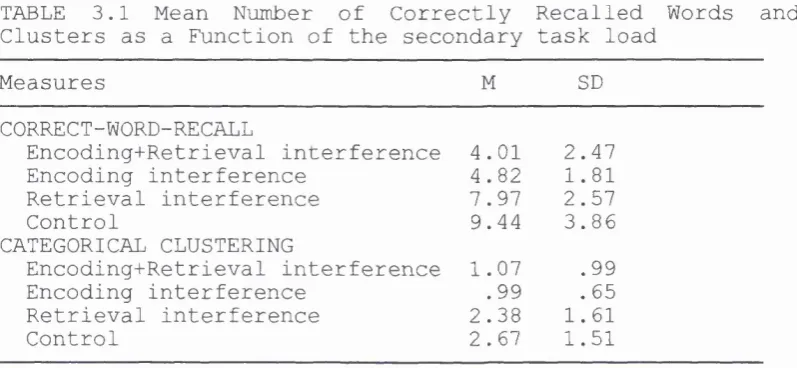
3.1 Mean Number of Correctly Recalled Words and Clusters as a Function of the
secondary task load 83
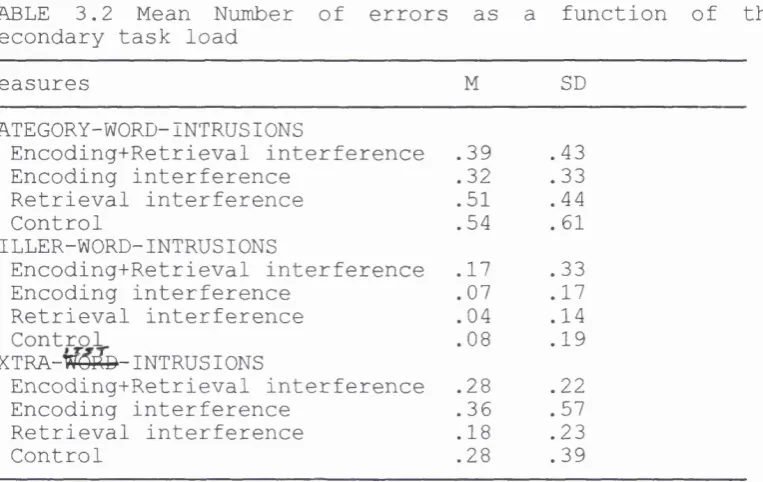
3.2 Mean Number of errors as a function of the secondary task load 84
3.3 Mean number of words correctly recalled, clusters and the corresponding standard
deviations as a function of the secondary task load 90
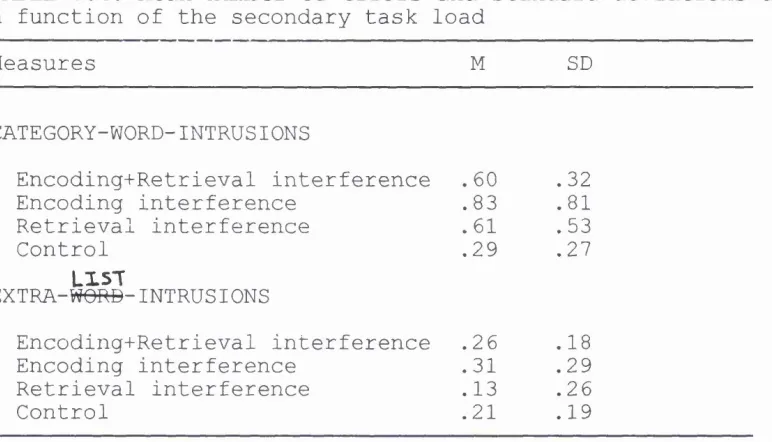
3.4. Mean number of errors and standard deviations as a function of the secondary task
load 91
4.1 Mean number of words recalled and corresponding standard deviations as a
function of the secondary task load 110
4.2 MRR scores representing clustering and corresponding standard deviations as a
Function of the secondary task load 111
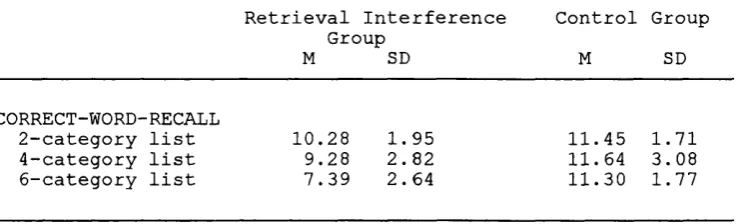
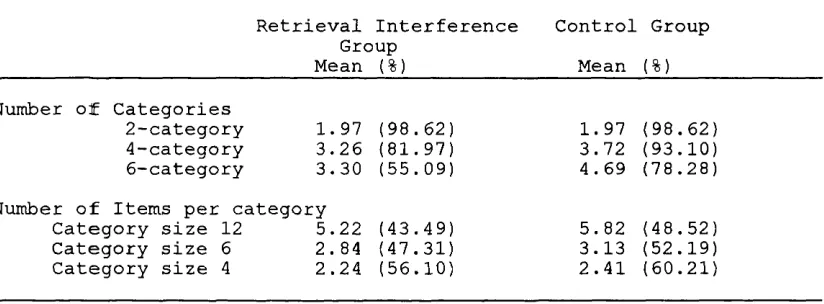
4.3 The mean number (%) of categories recalled and the number of items recalled per
category by the groups as a function of the three list type conditions 112
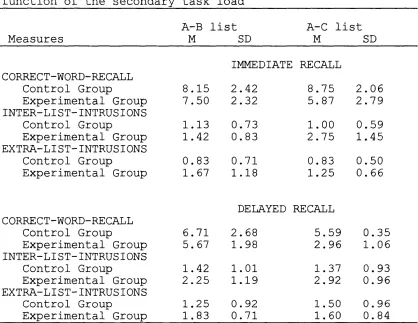
5.1. Mean Performance on the A-B and A-C lists as a function of the secondary task
load 127
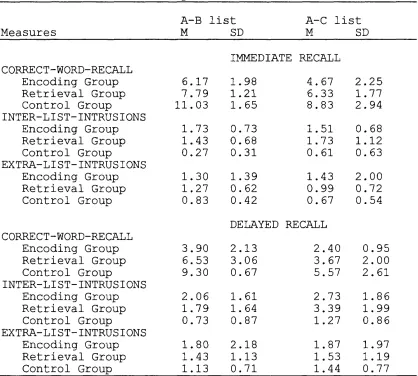
6.1 Mean Performance on the A-B and the A-C lists as a function of the secondary task
load 146
7.1 Mean performance on the B and the C items and the standard deviations as a
function of the secondary task load 162
7.2 Mean performance on the B and the C items and the standard deviations as a
7.3 Mean performance on the B and the C items and the standard deviations as a
function of the secondary task load 176
8.1. Extracts from the retrieval statements of the subjects 187
8.2. An example for momentary confusion 189
8.3. An Example from the event categories 191
8.4 The mean number of elements correctly identified per event category and that
classified as the elements of an incorrect event category and the results of t tests
(CCEE: correctly-classified-event-elements, ICEE: incorrectly-classified-event-elements) 195
8.5. Mean performance on List 1, List 2 and the corresponding standard deviations as a
function of the secondary task load 202
8.6. Mean Performance on the first and the second lists as a function of the secondary
List o f Figures Page
3.1 The structure of the word lists 78
CHAPTER ONE
1.1 Introduction
The present chapter will present views, models and criticisms concerning the
psychological construct to which will be referred as supervisory systems. It will
draw attention to the similarities of some ideas proposed by different models.
Then, a selective overview of some neuropsychological research and theoretical
concerns in relation to the supervisory systems will be highlighted. After that
some suggestions about the variety of strategic processes that are viewed as
functions of the supervisory systems at encoding and at retrieval will be
presented. This is because the experiments conducted in this thesis involve the
manipulation of some memory tasks at these tw o stages. Finally, the dual task
paradigm which is a method used in manipulating the functions of the
supervisory systems will be considered and the relevant dual task studies will be
reviewed.
1.2 Memory and its Control
A fundamental division between the structural features of memory and the
control features of memory has been suggested (Atkinson and Shiffrin, 1968).
Atkinson and Shiffrin (1968) defined the structural components of memory as
permanent systems "with built-in processes that are unvarying and fixed from
one situation to another" (p.90). Three structural components of memory were
identified by them: (1) sensory registers, each of which is responsible for initial
registration of incoming information within an appropriate modality, (2) a short
term store (STS) which holds temporary, active information and (3) a long-term
store (LTS) which holds passive, inactive, permanent information (see also
memory will not be provided here, as it is not in the primary topic of the thesis.
The control processes of memory are defined as not permanent but "transient
phenomena" (Atkinson and Shiffrin, 1968, p.106) selected, constructed, and used
at the option of the subject. The use of control processes had been identified as
one processing mode of memory (Atkinson and Shiffrin, 1968) but later on two
processing modes of memory were recognized: the use of (1) automatic
processes and (2) controlled processes (Shiffrin and Schneider, 1977). Shiffrin
and Schneider (1977) presented comparable features of the two processing
modes, which can be summarized as follow: (a) the automatic processing is the
activation of a learned sequence of elements in long-term memory that is
initiated by appropriate inputs and then proceeds automatically, whereas the
controlled processing is the activation of a temporary sequence of elements
under the control of the subject; (b) the controlled processes are capacity-limited,
whereas the automatic processes can operate without stressing the capacity
limitation of the system and; (c) the controlled processes are attention
demanding (requires active attention by subjects), whereas the automatic
processes can operate without the necessity of active control or attention by
subjects.
Although the above statements may seem to suggest that one can divide
cognitive tasks into two according to which processing mode (automatic or
controlled) is in operation, Shiffrin & Schneider (1977), in fact, argued that
controlled processes are often used to initiate automatic processes and they,
further, stated that automatic and controlled processes can proceed in parallel
with one another in performing a task. This parallel functioning was held to allow
(Shiffrin & Schneider, 1977). This was pointed out as one of the several
advantages of a system which has not one but two processing modes.
As Shallice (1994) reported, the concepts of controlled processes have been
developed since the early 1970s. In fact this development was slow and
produced more questions than answers. Apart from the term controlled
processes, there are variety of terms which were used to refer to the
psychological construct associated with higher level mental control. Some of
these terms are as follow: conscious strategies (Posner & Snyder, 1975),
effortful processes (Hasher & Zacks, 1979), strategic processes, prefrental
strategic processes (Moscovitch, 1994a), executive systems/functions
(Baddeley, 1986; Lyon and Krasnegor, 1996), supervisory systems (Burgess &
Shallice, 1996). Although these terms are all associated with higher level
functioning, the concepts underlying the terms are not exactly the same. Some
such as effortful processes are used to refer to higher level processes in a much
broader sense than some others and some such as supervisory systems are
introduced as a specific model with some certain features and functions.
1.3 Baddeley & Hitch's Model: Central Executive System
Baddeley and Hitch (1974) replaced the term short-term memory (STS) used by
Atkinson & Shiffrin with "working memory". They did not just rename the STS
but, instead of an unitary short-term store responsible for a range of memory
phenomena, they proposed a 3-component-system for the temporary
maintenance and manipulation of information during the performance of a range
of cognitive tasks (Baddeley, 1986). The three components are the central
which holds speech-based information and (2) visuo-spatial scratchpad or
sketchpad which holds visuo-spatial information.
Baddeley (1986) described his early views of the central executive as some type
of supervisor or scheduler, capable of selecting strategies and integrating
information from several different sources. In contrast to the two slave systems,
the concept of central executive was somewhat vague but Baddeley assumed
that central executive functioning was related to two phenomena, namely
attention and consciousness. Baddeley foresaw that, in order to understand and
attempt to characterize the functions of central executive system, he needed the
literature on memory control which did not exist at the time he and Hitch (1974)
proposed the idea of executive system. But in 1980 Norman and Shallice
proposed a model for control of action which supplied the necessary framework
for Baddeley's attempts to characterize the functions of the central executive.
Baddeley's views concerning the functions of executive system will be
discussed with Norman and Shallice's (1980) model later. However, it should be
noted that Baddeley (1986, 1994) saw the central executive system as the
coordinator of memory processes, a memory control system which is capable of
selecting strategies.
1.4 Fodor's Model: Central Systems
While Baddeley (1986) proposed to use Norman & Shallice's (1980) model as a
working hypothesis for the central executive, another memory theorist,
Moscovitch (1992a, 1992b, 1994b) adapted Fodor's model for his theorizing on
the higher order memory systems. For this reason Fodor's model will be
one, not intended to explain nnerely the organization of memory systems.
Fodor (1983) hypothesized that mind is made up of input systems and central
systems. He proposed three main properties for the Input modules: (1) they are
domain specific, that is they analyze incoming information from only one domain
e.g. hearing, sight or touch; (2) they are encapsulated, that is once sensory
information is picked up by an input system, the system processing cannot be
interfered with higher order systems; and (3) they generate shallow outputs
which are automatic and not available to consciousness. This automaticity and
"unconsciousness" of the modules come from the fact that the modules can
process only a single input at a time.
Fodor (1983) arrived at his suggestions for the characteristics of central systems
by arguing that there are some cognitive activities of mind that would not be
explained as functions of modules. Fodor considered that some other systems
must behave in just tbe opposite way to that of the input systems. Therefore,
the first characteristic of central systems is, that they are domain-neutral. That is
they get information from various sources/domains; not just from one domain as
the input systems do. Next, Fodor suggested that the typical function of the
central systems is fixation of a belief which involves processes of rational non
demonstrative inference, and that these processes are non-encapsulated. Fodor
belieps
suggested that the fixation of boliovos is the process of arriving at "best
hypotheses about what the world is like" (p. 104) by using all the information an
organism has access to (the information brought by input systems and the
information in memory).
about central systems, nor did he propose any method for studying central
systems empirically. Fodor argued that the properties of central systems are too
global, so that how these global properties function cannot be understood. Thus,
Fodor did not have much hope for any experimental studies of central systems.
However some authors disagreed with Fodor's first law and argued that there
are some aspects of central systems which can be studied (e.g. Marshall, 1984).
When Moscovitch (1994b) applied Fodor's model to memory processing
systems, he retained, as he put it, the "core" assumptions of the model and
argued that "memory consists of the operations of modules and central systems"
(p.271) which are, in Fodor's model, constituents of mind (brain). Moscovitch's
aim was to show how Fodor's idea of modules and central systems accounts for
performance of normal subjects and memory-impaired patients on different
types of memory tests. Moscovitch's views and studies concerning memory
tests will be discussed later on in this chapter.
1.5 Norman & Shallice's Model: Supervisory Systems
Norman & Shallice (1980) proposed a model for "control of actions by attentional
mechanisms", which later on was generalized to "control of thought
selection/process" (Shallice & Burgess, 1993). Baddeley (1986) took the Norman
& Shallice model, in his terms, "off the shelf" (p.226) and virtually said here is
how central executive systems work in general as memory processing systems.
In this section, first the Norman & Shallice model will be reviewed, then two
applications of the model to "slips of actions" and to a cognitive task - the random
The Norman & Shallice model (1980) had three components: ‘Trigger data base"
is the first psychological component of the model which has a potential to
"recognize" sensory inputs as "psychological inputs" and triggers schemas and
provides input to the system (Shallice, 1994). The second component is the
"source schema" of the system called "contention scheduling mechanisms".
Contention scheduling is a network of schemas which has a complex but
automatic way of functioning. The schemas are connected to each other with
activation or inhibition values which are established through past experience
(Norman & Shallice, 1986). Thus, each schema has an ability to activate or inhibit
other schemas. In different situations, more than one schema will usually be
activated at the same time, which may create a conflicting situation. So, for
example, two schemas can get activated by an input but one can act as an
inhibitor and neutralize the effect of the other active schema and thereby
dominate the situation. This computation of activation/inhibition values is
automatically done within contention scheduling. Thus, in terms of the controlled
process and automatic process distinction made in the memory and its control
section before, the idea of contention scheduling offers mediator processes
which can be called "automatic controlled processes".
Finally, the third component of the Norman & Shallice (1986) model, which,
according to Baddeley (1986), corresponds to the central executive, is called the
supervisory system which modulates the above mentioned automatically
controlled processes. The supervisory systems modulate the selection of
schemas by applying extra activation and inhibition to schemas, in order to bias
their selection within contention scheduling (Norman & Shallice, 1986). In sum,
Norman & Shallice's model offers two levels of controlled processes, one is at
second at the higher level of supervisory systems (Shallice, 1994) which can be
called "supervisory controlled processes".
The Norman & Shallice model has been applied to a number of phenomena
(Norman & Shallice, 1980, 1986). Here the phenomenon of "slips of actions",
described as the performance of an action that was not intended (Reason, 1984),
will be discussed because it demonstrates well the failure of the control
9cf«c/
processes of supervisory systems is a # upon the contention scheduling. Slips of
action phenomenon occur in highly practised activities (action sequences that are
performed automatically) which, as suggested by Norman & Shallice, would be
executed by the contention scheduling mechanisms. But, this does not mean
that supervisory systems are not involved at all in any stages of the highly
practised activities. Reason (1984) proposed that during the early stages of
motor learning, the central processor (supervisory systems) has a moment-to-
moment control but, as a result of extensive practice, this moment-to-moment
control is replaced with control at "critical decision points" (p.521). Thus, at such
critical decision points, supervisory systems are required and if supervisory
systems fail to switch back attention/control on to the task at hand, slips of
actions occur.
Finally, the Norman & Shallice (1986) model is also used to explain the
performance of some cognitive tasks, an example of which will be given here. In
a study where a random letter generation task has been used, subjects have
been asked to produce a stream of letters at rates ranging from two letters per
second to one every four seconds (Baddeley,1986). The results of this study has
shown that the subjects produced more and more pairs of letters and common
Baddeley (1986) explained these findings with the Norman & Shallice model in
the following way: Production of stereotyped letters is a relatively automatic
process operating at the level of contention scheduling and supervisory systems
are needed to modulate this stereotyped output in order to comply with the
instructions of the random generation task. What the study results imply is that
when enough time is given for random generation, the supervisory system can
effectively control and break up stereotyped output, which leads to relatively
random responses. However, the supervisory systems' limited control over
stereotyped letters diminishes with the limited time.
1.6 Recent Views, Models o f Supervisory Systems and Critical Aspects o f
the Psychological Construct
Borkowski and Burke (1996) declared that the concept of supervisory systems,
to which they refer as executive systems, is useful in explaining higher order
behaviour and transfer of higher order strategies in variety of cognitive tasks.
This is why, the authors thought, investigators find the executive functioning as
one of the most appealing subject in cognition. Borkowski and Burke argued that
executive functioning has got three essential components: (1) task analysis, (2)
strategy control/selection, and (3) strategy monitoring. Task analysis involves
understanding the information presented in a cognitive task and what this
information means in terms of how to perform the task. This is important
because how well someone performs the task depends a lot on this critical
stage of task analysis. According to Borkowski and Burke, people have a
representation of strategy knowledge/strategy models in mind which they
developed through experience from childhood. So, in performing a task people
performance and if necessary select another strategy.
Borkowski and Burke (1996) emphasized controlling and monitoring functions of
executive systems in problem solving tasks. However, they have also pointed
out the difficulty in obtaining direct measure of executive functioning and stated
that "since executive functioning can only be observed in terms of changes or
alterations in lower-level behaviours, it likely will always be inferred as a remote,
mediational process" (p.244). Perhaps, the lack of progress in research on
executive systems is because the executive functioning cannot be observed
directly and inferences drawn from performance on a cognitive task in
comparable experimental conditions will tend to evoke objections.
The conceptual overlap between the supervisory/executive systems and other,
possibly related, psychological constructs is another point of discussion among
the theorists interested in the systems. A psychological construct which seems
to overlap with executive functioning is attention. Like executive systems, the
concept of attention escapes a general definition at the moment (Lyon &
Krasnegor, 1996). It has been pointed out that there is variety of usages of the
term attention (Sergeant, 1996). Attention is sometimes viewed as one special
function of cognitive systems that is synonymous with selective concentration or
focalisation which enables organisms to attend to certain visual or auditory
stimuli rather than others (Eysenck & Keane, 1996). Posner and Peterson (1990)
suggested that there are at least three separate cognitive functions or abilities of
human beings that are involved in attention: (1) the ability to engage attention on
a new stimulus, (2) the ability to ignore a certain stimulus or disengage attention
from a stimulus and (3) the ability to shift attention from one stimulus to another.
cognitive processing system or an attentional system which has a number of
distinct functions including focus/execute, sustain, stabilize, shift, and encode.
Initiation and inhibition functions are also associated with attention (Barkley,
1996). However, some of these functions (e.g. shift) are also closely associated
with executive systems (Halperin, 1996).
There is no theoretical agreement among theorists on the relation between
attention and executive function. For example, it has been suggested that
executive systems can be seen as higher level systems which coordinate lower
attentional systems and memory systems (Morris, 1996). According to this view,
attention plays an important role in the development of executive systems.
Another theorist, Taylor (1996), declared that "attention might be best regarded
as a subset of the more wide-ranging executive function domain" (p.403).
Despite the differences in the views of theorists, Taylor pointed out that there is
increasing number of investigators who argue that the concepts of executive
systems, attention and memory can be viewed as separable components of
mental functioning. The theorists also acknowledge that the functions of these
psychological constructs overlap with each other. However the nature of this
overlap is not clear yet. Taylor suggested that more specified theoretical
formulations and analysis of functions of each of the psychological constructs
are needed.
Some theorists (e.g. Pennington et al, 1996) questioned the existence of a
separate construct of executive systems and asked whether or not we needed
this construct. It has been argued that the abandonment of executive systems is
a semantic issue (Denckla, 1996). Indeed, as was pointed out before in this
associated with executive/supervisory systems. Some researchers used broad
terms such as effortful processes or attentional demanding processes (e.g. Craik
et al, 1996) and avoided to propose a model or support or discuss any of the
available models of executive/supervisory functioning. Perhaps, this neglect is
because there are several unsolved issues concerning the models; even the
concept of executive systems is not well-defined. Nevertheless, to use a general
term (attention demanding processes) to refer to what increasing number of
researchers come to see as separable mental control systems and not elaborate
on that general term is not a helpful approach for cognitive psychologists who
want to understand cognitive architecture of memory and human ability to
perform complex cognitive tasks.
7.7 Neuropsychology o f the Supervisory systems
Neuropsychological research on the patterns of cognitive performances in brain
damaged patients is one area of studies in which researchers have been trying
to find some evidence for the existence of higher order control systems -
supervisory systems - modulating lower level systems. Neuropsychological
concerns can be discussed in four parts: (1) the anatomy of the psychological
components of the Norman & Shallice model (1980), (2) Norman & Shallice's
(1980) five-supervisory- system-sensitive situations and neuropsychological
findings, (3) some applications of the model to the psychological symptoms
observed in brain damage patients - frontal lobe syndromes -, (4) confabulation -
1.7.1 Anatomy o f Supervisory Systems
There is a general agreement that supervisory systems are seated roughly in
frontal lobes which cover a large area with several distinctive regions in the brain
(Shallice, 1988). In fact, like the frontal lobe area of brain, supervisory systems
themselves are also considered to be fractionable, thus it is assumed that
perhaps different functions of supervisory systems may be located in different
regions of frontal lobes (Shallice & Burgess, 1993). Shallice (1994) identified the
prefrontal regions as the likely location of supervisory systems and the medial
frontal regions as the probable location of the lower level control of routines -the
contention scheduling. Moscovitch (1994b) agreed with Shallice on the former
location, but, on the latter issue, Moscovitch argued that automatic processing
systems can be located in the medial temporal lobes/hippocampus (MTL/H).
However, Moscovitch was concerned with automatic processes in memory
tasks, whereas Shallice was concerned with automatic processing of actions.
Although Norman and Shallice's (1980) model has been extended to memory
(Burgess & Shallice, 1996), the anatomical location of semi-automatic memory
processes analogous to contention scheduling of action have not been
addressed. In addition, as Moscovitch adopted Fodor's (1983) idea of modules,
his concept of the automatic component of memory situated in MTL7H was
simpler than contention scheduling.
Recent views (e.g. Goldman-Rakic, 1995) generally continue to agree that
prefrontal cortex can be linked to supervisory/executive function. As several
authors (e.g. Shallice, 1988; Denckla, 1996) pointed out, prefrontal lobes are
large structures and they have other functions than those that are viewed as
localization of the supervisory systems and controversy surrounding the
neuropsychological data will be discussed below in the context of frontal lobe
syndromes.
1.7.2 Norman & Shallice's (1980) Five-supervisory-system-sensitive
Situations and Neuropsychological Findings
Norman and Shallice (1980, 1986) proposed five situations or tasks that would
require supervisory systems: (1) situations that involve planning or decision
making, (2) situations that require error corrections or some form of trouble
shooting, (3) situations which involve novel or poorly learned sequences of
actions, (4) dangerous or technically difficult situations, and (5) situations that
require overcoming of a strong response-tendency or temptation. As supervisory
systems are linked to frontal lobe, patients with frontal deficit are expected to
have difficulties in the five types of situations proposed by Norman and Shallice.
It was noted that an impairment in frontal patients in the fourth type of situation
has not been reported yet (Shallice and Burgess, 1993). The neuropsychological
data consistent with the remaining four types of situations will be addressed in
this section.
A planning test. Tower of London test, was given to frontal patients and non-
frontal patients (Shallice, 1982, see also Owen et al, 1990). The test involves
moving three different colour beads on three sticks of unequal length from an
initial position to a target position. This is required to be done with a minimum
number of moves, so that the player needs to plan ahead. Shallice (1982)
showed that left anterior frontal patients exhibited significantly poor performance
frontal patients have difficulties in error correction (Norman and Shallice, 1986). A
typical example of this is the frontal patients' inability to correct errors that they
often make in performing the Wisconsin Card Sorting test even when they are
told that they were wrong (Norman and Shallice, 1986). The Wisconsin Card
Sorting test will be explored further in the next section. In addition, Norman and
Shallice (1986) emphasized that trouble shooting or error correction can be
necessary in the application of planning or decision making (Situation 1). Also,
errors are most likely to occur in learning novel sequences of actions (Situation
3).
In a study, the ability of frontal patients to cope with novelty was also tested
(Shallice & Evans, 1978). The novelty test involved questions which required
estimates rather than straightforward answers (e.g. "how long is an average
man's spine?"). The answers of the frontal patients and of a control group
(posterior patients) were categorized into two types using the distribution of
answers given by a set of normal subjects: sensible answers and bizarre
answers. The results showed that the frontal patients produced bizarre answers
significantly more often than the neurological control group (Shallice & Evans,
1978). The results of this study support the suggestion that the frontal patients
have difficulty with coping with novelty. Finally, the Stroop test is given as an
example of overcoming a strong habitual response (Situation 5), and Shallice and
Burgess (1993) reported that there are studies (e.g. Perret, 1974) which showed
1.7.3 Frontal Syndromes
In the literature at least three substantially different frontal symptoms have been
explained with the Norman & Shallice model: perseveration, distractibility, and
utilization behaviour (Shallice, 1988). On the first symptom, perseveration, it has
been widely documented that frontal lobe patients have a tendency to
perseverate, they tend to produce habitual/stereotyped behaviour and they can
not stop/discontinue or modify an ongoing activity that they are doing. This is
well demonstrated on the Wisconsin Card Sorting test (WCST), in which patients
are asked to switch from one sorting strategy to another. Wisconsin cards have
three dimensions: colour, form, and number and the basic principle of the sorting
task is to instruct subjects to sort the cards first by colour and then shift the
strategy to one of the other two dimensions (number or form). In a study which
included dorsolateral frontal patients and, as control, temporal patients and some
parietal patients and orbital-temporal damaged patients, Milner (1963) showed
that the dorsolateral frontal patients made significantly more perseverative
errors, that is inability to shift sorting strategy, say, from colour to form-sorting,
than any of the other patient groups. This perservation of first sorting strategy by
the frontal patients was explained on the Norman & Shallice model (Shallice,
1988). Shallice (1988) argued that, with the execution of the first sorting
strategy, the patients get "stuck" in one schema because of the damaged
schema control systems -supervisory systems- which would, otherwise, impose
a shift to another schema ("top-down", by processing of the instruction requiring
a shift to a new dimension). Shallice (1994) pointed out that the Milner (1963)
study offers a good evidence for the assumption that the frontal lobes are the
In a more recent study, Blanchi et al (1993) compared performance of frontal
patients with that of non-frontal patients on a task which also requires strategic
shifts as in the Wisconsin sorting task. Bianchi et al's task involved a selective
response (pressing a button) to an appearance of a white square on four
different locations of a computer screen: top-left, top-right, bottom-left, and
bottom-right. The strategic shifts required by the task are, first, switch from
responding to the visual stimuli appearing on the two bottom quadrants of the
screen regardless of side, to only left-bottom and then shift to only right-bottom.
This study also showed that frontal lobe patients found it difficult to shift from
one responding type to another and, consequently, made more errors than the
control group. Bianchi et al concluded that the frontal patients are "incapable of
inhibiting the automatic cued response (practised initial set of responses) in
favour of voluntary response corresponding to the verbal instruction" (p.358)
which, if intact, would have been imposed top-down fashion by supervisory
systems.
An interesting feature of the frontal lobe syndrome is that the patients are, on
one hand, inclined to perseverate; and on the other hand, they are highly
distractible. Shallice (1982) described how these contradictory behaviours of
perseveration and distractibility all in one syndrome can be produced by an
impaired system relying on only contention scheduling mechanisms and trigger
data base, which was summarized by Baddeley (1986) rather nicely in this
paragraph: "Since the supervisory system is not functioning properly, the patient
is at the mercy of the currently active schemata. If a situation exists in which one
schema is clearly dominant, then it will continue to dominate, leading to
perseveration. If on the other hand there are a number of competing schemata
systems, there will be a tendency for control to switch from one schema to
another on the basis of relatively minimal changes in the environmental context"
(p.242), which would be observed as distractibility.
However, the findings of neuropsychological studies have not been always
consistent. Dunbar and Sussman (1995) pointed out that there are some studies
which showed no difference between frontal patients and non-frontal patients in
performing Wisconsin Card Sorting Test (WCST) and that non-frontal patients
can exhibit perseveration on the WCST. Dunbar and Sussman themselves
conducted experiments to investigate this issue. In an experiment the authors
used dual task methodology to induce perseveration in normal subjects and had
the normal subjects perform the WCST under different secondary task
conditions (a phonological task, a central executive task and no-secondary
task/control conditions). They predicted that the subjects who performed the
central executive task would show performance similar to the performance of
frontal patients, that is they would exhibit more perseverative errors on the
WCST than the other subjects (the control or the phonological task groups).
However, the results of this study showed that the phonological task group
produced more perseverative errors than the executive group. The errors were
very low in the control group. On the basis of these results, the authors thought
that perhaps their phonological task which was a digit recall task was sensitive to
central executive and they employed an articulatory suppression task (repeat
"the-the-the") instead of the phonological task and repeated the study. The
results of this study were similar to their previous experiment. Consequently,
Dunbar and Sussman asked the following question: would patients with
phonological memory deficit show perseveration?. The authors pointed out that
and they studied performance of one such patient called RoL on WCST. This
study showed that the performance of the patient RoL was typical of that
reported for frontal patients. The findings of Dunbar and Sussman study
indicated that deficits in phonological memory lead to perseveration which
challenges the validity of the WCST in detecting the executive function deficit.
The last frontal symptom to be discussed in this section is utilization behaviour
(UB) which appears to be providing evidence for the existence of the lower level
of control processes -contention scheduling. It has been observed that some
frontal patients automatically utilize an object placed within their reach
(Lhermitte, 1983). An example of UB is impulsive water drinking action triggered
by a jug of water and a glass placed on a desk by an experimenter. Lhermitte
(1983) argued that the patients cannot be thinking that the experimenter expects
the objects to be used, because UB was executed despite the fact that the
patients were told not to touch the objects. This argument was supported by
Shallice et al (1989) in a study where a patient, L.E., was tested for UB in
"incidental" situations in which the attention of the patient was never drawn to
the objects by the investigators; 22 objects were placed at either ends of the
testing desk. The incidental situations include a general conversation with the
investigator, verbal and non-verbal neuropsychological tests, visuo-verbal and
visuo-manual tests during which objects were available for UB. The results of
this study showed that UB also occurs when objects were presented indirectly
in the incidental situations, in contrast with the Lhermitte's procedure where
objects were presented directly to the patients. A theoretically interesting
explanation of UB, put forward by Shallice et al (1989), is that a system relying on
trigger data base and contention scheduling in the absence of supervisory
not impaired they would have activated the relevant schemata and inhibited
irrelevant behaviours such as responding to the objects presented while carrying
out a task in an incidental situation. A last point is that the anatomical
assessments of this kind of patients suggest that not just medial but also orbital
frontal lobe may have a role in lower level of control processes (Shallice, 1994).
In summary, as the findings of the Wisconsin Card Sorting test (WCST) studies
discussed above indicate that the neuropsychological data do not appear to give
unquestionable support for the neuroanatomical localization of
executive/supervisory systems in prefrontal cortex. Nevertheless, the construct
of a supervisory/executive control system has the potential to explain the
problems of prefrontal patients and the current views (Goldman-Rakic, 1995)
continue to associate executive functioning with the prefrontal cortex.
1.7.4 Confabulation
Another frontal symptom, a complex one in comparison to the above because it
involves event memory, is "confabulation". Confabulations are observed in
autobiographical memory studies carried out on some frontal patients and
described as a term used for the autobiographical memories which have no
basis in "actual" events or occurrences in the patients history (McCarthy &
Warrington, 1990). The important characteristic of this symptom is that the
patients remain unaware of producing these un-true autobiographical memories
and, for this reason, the patients are even called "honest liars" by some authors
(Moscovitch, 1989). A further feature of confabulation is that the "ingredients" of
the untrue-memories indicate that these memories are formed either from the
knowledge about events (semantic) (Burgess & Shallice, 1996). (For more
information about the characteristics of confabulation see Talland, 1965;
Moscovitch, 1989, 1992ab; Burgess & Shallice, 1996).
For this thesis the important aspect of confabulation, lies in the way which
confabulations are produced. Some authors (e.g. Moscovitch, 1989; McCarthy &
Warrington, 1990) argued that confabulations are not self-initiated
remembrances, but that they are "associative recalls" provoked by the questions
of experimenters. This nature of confabulation resembles the other frontal lobe
symptoms, discussed above, in that it is data-driven, triggered to a considerable
extent by environmental cues; in essence, it again concerns the lower level of
control processes operated by only two intact components of the Norman and
Shallice model - the trigger data base and contention scheduling.
A confabulator case was described by Baddeley (1986). The patient, R.J., was
given the same cue words at different times and asked to remember an incident
that he experienced related to the cue. The interesting observation was that the
same cue led the patient to produce completely different stories or different
versions of the same story, which his wife confirmed had not occurred.
Baddeley (1986) explained the confabulation shown by his patient, R.J., from the
perspective of the Norman & Shallice model and stated that in the absence of
the supervisory system "R.J. is distracted by associations generated by the story
he is telling and allows the story to 'tell itself' with no overall constraint by the
teller" (p.242). Thus Baddeley implies that confabulation is a complex form of the
"distractibility" symptom, discussed in the previous section. The inconsistent
versions of stories are produced by the patient because each time different
In another study, Dalla Barba (1993) tested two confabulating patients on two
different retrieval conditions, free recall and cued-recall, after they had learned
categorical word lists. The performance measure taken was intrusion errors,
described by Dalla Barba as "a tendency to unintentionally provide an
inappropriate item" and considered to be "a confabulatory-like behaviour" (p.579).
The study results showed that in the free-recall condition the amount of intrusion
errors made by the patients was very low and at the level of a normal control
group. Moreover, the number of items recalled, correct or not correct, was also
very low. On the other hand, the patients made significantly more intrusion
errors than the controls in the cued-recall condition. These findings support the
assumption that confabulations are determined by environmental triggers and
also, the rate of intrusion errors seems to be determined by the two retrieval
conditions. The results support the view put forward by several authors (e.g.
Shallice, 1988), that confabulation is a retrieval problem rather than one of
encoding or memory storage. The specific retrieval processes that may be
impaired in the confabulating patients have been identified in some retrieval
models (e.g. Norman & Bobrow's model, 1979). The retrieval models will be
discussed later in this chapter, but for the sake of completeness, it should be
stated that the target description and the verification components of the Norman
& Bobrow model have been suggested to be damaged in the confabulating
patients (Shallice, 1988, Burgess & Shallice, 1996).
A last point concerns the anatomical assessments of confabulations; several
authors agreed that confabulating patients have damaged frontal lobes (e.g.
Moscovitch, 1989). However, not all frontal patients exhibit confabulations and
1.8 Two processing stages o f memory: Encoding and Retrieval
Although several authors (e.g. Tulving 1983; Anderson, 1995) pointed out that
there are important interactions between encoding and retrieval, the distinction
between the two as two different stages of memory is useful for researchers.
There are a lot of issues concerning the two memory stages discussed in the
literature. The issues and theories (e.g. categorical clustering, response
competition, interference theory, mediational theory) relevant to the encoding
and the retrieval processes that operate in performing the particular tasks
employed by the present research will be discussed in Chapter 2. In the next
two sections general views about the supervisory/strategic functioning at
encoding and at retrieval will be addressed.
1.8.1 Supervisory Systems at Encoding
The functions of supervisory systems at the retrieval stage of memory have
been discussed more extensively than that at encoding. Some researchers
compared the processes at encoding with that at retrieval (e.g. Baddeley et al.,
1984) and argued that contrary to retrieval processes, encoding is effortful in that
it involves higher order (supervisory) processes and not automatic ones.
However, it should be noted that there are some encoding conditions which are
likely to require automatic processes such as incidental learning and implicit
tasks. Spatial location, time, frequency of occurrence, and word meaning have all
been suggested to be encoded automatically (Hasher & Zacks, 1979). Moreover,
Moscovitch (1992ab) pointed out that, in automatic encoding processes, central
systems (similar in concept to supervisory systems) do not operate or operate
In general terms, the functions of supervisory systems at the encoding stage of
memory concern organizational processes and the control of encoding
operations. Three main functions of central systems/supervisory systems at
encoding have been raised (Moscovitch, 1992ab): (1) control of attention: central
systems direct attention to target items (to-be-learned) so that they can be
picked up by modules, (2) selecting and implementing encoding strategies, (3)
organizing the "raw material" (e.g. visual word forms) that is made available by
modules (e.g. perceptual input modules) and/or by other central systems.
Furthermore, the following is among the encoding processes that are suggested
to require effortful/supervisory processes: strategic use of imagery,
rehearsal/elaboration, categorical clustering and mnemonic techniques (Hasher &
Zacks, 1979).
1.8.2 Supervisory Systems at Retrieval
There are several retrieval models in the literature but, two retrieval models,
Norman & Bobrow's (1979) retrieval model and Tulving's (1984) retrieval model,
are selected for this section because as far as the research undertaken is
concerned the two retrieval models have been discussed in connection with
retrieval control models. Some authors (e.g. Shallice, 1988; Burgess & Shallice,
1996) discussed the role of the supervisory systems at retrieval from the view
point of Norman & Bobrow's (1979) retrieval model. On the other hand,
Moscovitch (1989, 1992b) discussed the central systems role (similar in concept
to supervisory systems) from the viewpoint of the Tulving's (1984) retrieval
model. The following section will offer a summary of each of the two retrieval
to some authors, are most likely to involve supervisory systems/central systems
will be discussed.
Norman and Bobrow's (1979) retrieval model consists of 3 stages: (1) retrieval
specification, (2) matching and (3) evaluation. In the retrieval specification stage,
two types of information are gathered: (a) target descriptions and (b) verification
criteria. A target description is required when one does not have a direct access
to a "target" memory (the memory/item to-be-remembered). The target
description is obtained by searching for the target-related information which can
be of various types (e.g. general knowledge about the target-type of events,
personal knowledge). For instance, assume that the target memory in question
was the activities that you had carried out on the previous Saturday. In order to
answer such a question, you would probably think what you usually do on a
Saturday (using personal knowledge); and from that you would try to figure out
whether you did anything different than usual. This kind of thought-process
(identifying known information about the target) generates verification criteria,
that can be described as a "rough" idea about what-is-likely-what-is-unlikely to be
the correct answer. In the second stage of matching, the information gathered
about the target in the retrieval specification stage (target description) is used to
narrow down the possibilities and typically to activate more than one candidate
memory. Norman and Bobrow stated that the matching process is not simple
access to candidate memories and that it is also a selection process. When a
target memory or candidate memories are selected, they are evaluated and
verified by the retriever (the third stage of the retrieval model), these verification
processes operate according to the verification criteria established in the retrieval
In an attempt to explain confabulation phenomena, discussed before in this
chapter, Shallice (1988) proposed that the verification processes are operated by
supervisory systems and argued that it is this stage of the Norman & Bobrow's
(1979) retrieval model that is damaged in confabulating patients. In addition, in an
autobiographical study, also intended to explain confabulation phenomenon,
Burgess & Shallice (1996) investigated the processing stages of normal retrieval
with a "thinking aloud" paradigm. The study , first, supported the suggested
retrieval stages of the Norman & Bobrow model and, second, the authors
suggested that higher order control processing systems/supervisory systems
operate at two of the retrieval stages of Norman & Bobrow's model, namely
target description and verification processes (the authors also suggest a third
processing stage, mediator retrieval control processes which will be omitted
here). Thus, the above views imply that the matching stage of the retrieval
model is the automatic processing component.
As far as the second retrieval model, that of Tulving (1984), is concerned, Tulving
proposed that there are two retrieval processing components, namely ecphoric
processes and conversion processes, along with two observable entities -
retrieval cues and memory performance- and a few other components
concerning internal states of knowledge during retrieval, among which ecphoric
information and stored experiences will be relevant ones for the present
discussion. The first retrieval processing component, ecphory, is described as a
process by which retrieval cues/information come to interact with stored
experiences/the information in the memory store, as a result of which ecphoric
information is formed. The second processing component, conversion, is
required to utilize the ecphoric information according to retrieval demands, which
Before discussing the application of the Tulving's (1984) model, it must be
restated that Moscovitch (1992a, 1992b), did not only choose a different retrieval
model from Shallice and his colleagues' preference of the Norman & Bobrow
(1979) retrieval model but also he chose Fodor's (1983) model to characterize the
memory systems operating at retrieval. So, Moscovitch (1989) considered that
automatic processes/modules and central system, components of Fodor's
model, to underlie the retrieval operations of Tulving's model. Fie argued that of
all the components of the retrieval model, "only ecphoric processes and the
availability of ecphoric information is presumed to be automatic" (p. 151), that is
the first retrieval processing stage of the Tulving model. In addition, Moscovitch
suggested that central systems, to a greater or lesser extent, are involved in only
the second retrieval processing stage, conversion processes. Moreover,
Moscovitch (1989, 1992b) suggested that ecphoric processes can also be
strategic rather than automatic depending on retrieval cues and demands. If
retrieval cues are insufficient, then strategic ecphoric processes are required
which would involve central systems in evaluating the retrieval cues and
ecphoric information. However, Moscovitch argued that the retrieval difficulties
of frontal patients lies most often in the conversion stage, since it involves more
central system processing.
In summary, although the authors chose different retrieval models to explain the
role of supervisory systems/central systems at retrieval, their views converge in
that in both of the retrieval models the authors identified two types of retrieval
processes: automatic processes and supervisory/strategic processes, and then
associated the latter type of processes with higher order systems (supervisory
1.9 Dual task paradigm and studies
Besides the neuropsychological studies, discussed in the previous sections,
another area of study which brings insight in understanding of supervisory
functioning is that of dual task studies. It has been pointed out that there are
some shortcomings of dual task technique (Shallice et al, 1985), critically dual
task deficit can be attributed to a number of different factors which will be
discussed later in the next sections. However, it is suggested that if it is used in
an appropriate way, dual task technique can be a useful tool to investigate
whether or not a task utilises a particular functional system or structure (Shallice
et al, 1985).
Also, it has been argued that the constraints and the mechanisms of a system
cannot be understood if little is demanded of it, so that overloading the system
with dual task requirements is a good way to understand the functional
architecture of the system (Pashler, 1993, 1994a). Moreover, it has even been
suggested that dual task studies may provide "the only avenue of study" that can
answer "whether human cognitive architecture includes a central processor"
(supervisory systems) (Pashler, 1994a, p.220). However, dual task methods are
not the only way, as pointed out at the outset of this section, the
neuropsychological researches are another base for inferring the need for the
psychological construct of supervisory systems.
In this section, first, some basic concepts related to dual task paradigms will be