559
Volume 63 66 Number 2, 2015
http://dx.doi.org/10.11118/actaun201563020559
DEVELOPMENT OF CREATIVE THINKING IN
CONNECTION WITH COMPENSATION TRADES
Jiří Koleňák
1, František Milichovský
21 Newton College, Rašínova 2, 602 00 Brno, Czech Republic
2 Department of Management, Faculty of Business and Management, Brno University of Technology, Kolejní 4,
612 00 Brno, Czech Republic
Abstract
KOLEŇÁK JIŘÍ, MILICHOVSKÝ FRANTIŠEK. 2015. Development of Creative Thinking in Connection with Compensation Trades. Acta Universitatis Agriculturae et Silviculturae Mendelianae Brunensis, 63(2): 559–566.
Current business environment in world perspective brings diff erent impact on possible development. During economic crisis in last couple of years world economic growth has getting slower, market shares are rapidly falling down. That situation could create new dimension of competition because of large competitors’ intensity on the market due to developed logistics and information technologies. Based on the theoretical data there are applied statistical methods, which should be achieved of main aim of the paper. The main aim of the article is defi ning possible trend of using business tools as a way, how is practicable get out of economic crisis. For this reason there was used questionnaire survey, focused on small and medium companies during economic crisis (between 2009 and 2013). Observed business tools have quite excellent usage not only in the time of crisis, but also in prosperity times, when the companies provide unique competitive advantages. During tracked periods there were advance of gained knowledge about compensation tools by various learning methods.
Keywords: trading tools, crisis management, creative thinking, so skills
INTRODUCTION
The world economic growth got slower in last couple of years, and the share markets are strongly falling down and former confi rmed global players are crushing. This fact has hard impact on nearly all companies and as consequence is descent the business volume, payment morale is worsening; the access to operating and investment capital is more diffi cult, etc. Due the global fi nancial and economic crisis, there are created new dimensions of competition because the above mentioned hyper-competition on the markets, which is due to developed logistics and information technologies causing lower barriers for entry into these fi elds, is now still more intensive as the total volume of businesses is smaller.
Each economic crisis, which has aff ected European region, gives important questions about necessity of innovation to exceed the situation arises. That way creates possibilities to be eff ective in monitoring own activities in production and processes (Klímková, Hornungová, 2012).
Nowadays, the eff ects of the crisis are alarming. All business cases where cash is fl owing have been hit – especially fi nancial institutions, media organisations, energy and oil companies, or food and consumer industry. The immediate fall of demand is felt everywhere. Central banks are lowering the interest rate, the prices of cars are falling, there are clearances of consumables but there are not any radical adjustments to these changes – nobody wants to become bankrupt and he prays for the others to become bankrupt.
During the state’s provisions against the crisis the small and middle companies are o en on the edge of interest even if they represent more than 99% of all companies and they make more than two thirds working places in the EU. They are the engine of innovations in lower orders and a platform for development of entrepreneurial spirit. Theirs presented fl exibility is maybe the reason for the expectation that they will help themselves. Then the management has the priority task to fi nd and realise provisions for their stabilization and in the better case usage of the situation in favour of the company. The tools available to the managers in these conditions could be generally classifi ed as tools for the crisis management, eventually tools for the turn-around management.
This article’s target is to present the research of the recognition level and especially the application of the methods and tools in the fi eld of commercial activities of the company during economic crisis. There are also partially incorporated the activities concerning management of the company fi nances as due to their close cohesion with the business they can’t be displaced from the fi eld of the turnaround management. Other partial target was monitoring the impact of the economic crisis upon the economical results of the companies (lower turnover, worse payment morale, aggravated access to fi nancial resources, etc.).
In crisis time, creative and innovative thinking become more important, especially in crisis time. According to Čichovský et al. (2012) and Vlček (2011) is innovative thinking created by individual experiences and ambitions to improve own abilities, skills or knowledge. For this creation there are important three factors: 1) acceptance (usage of new and innovative fi ndings in human thinking); 2) application (adoption or imitation of new and innovative fi ndings); 3) adaptation (activity to transform fi ndings into new original areas to expand knowledge). Therefore, there exist requirements to change entrepreneurs’ approach and thinking to be eff ective and innovative.
Eff ective implementation of innovation helps to increase competitiveness. It involves using intervention programs compared to the free development and innovation under the pressure. In each organisation is implementation of innovation accompanied by a lack of connectivity of individual areas and non-linearity. That is usually caused by shortage of needful skills, scarce resources, low fl exibility or bad education level (McAdam, 2005).
Acceptable solution could be using so-called innovative thinking. To be successful in implementation process with innovative thinking, it has to require appropriate supportive organizational structure (Humpreys, McAdam, Leckey, 2005; Paul, Elder, 2002).
For many companies the hard times are the constant of the present period. Diffi cult situation on the market has indisputably strong infl uence upon the companies. But it doesn’t have to bring
them at the brink of living conditions. There are many tools for identifi cation of the coming troubles and if the possible problems will be discovered in time there can be used another tools for mastering the situation.
There are many indicators which allow recognizing the coming diffi culties. Relevance of the indicators will diff er between various fi elds and also between various companies. The basis should be the tools for strategic analysis of the company surroundings – PEST analysis of environmental infl uences, Five forces analysis, The life cycle model (Johnson, Scholes, Whittington, 2008) and also of the internal forces and environment Value Chain, Value system, Competitive advantages (Porter, 2008). Many suitable indicators could be also selected from the models of the company processes and from strategic and operative controlling (Steinstöcker, 1998).
In addition to listing of the single indicators it is also necessary to consider theirs quantifi ability (some indicators are so called so indicators) and also with “decontamination” from relations to others, unrelated trends, cyclic and seasonal deviations, etc.
For the purpose of this article were selected indicators for the economic crisis status mainly from the business fi eld, monitoring the changes of the demand volume and structure, availability of resources at the input (materials and raw material) and basic associated services. In the fi nancial fi eld were investigated data about availability of external fi nancial resources, payment discipline of the customers and the faculty to cover the obligations.
For the need of the executed research were selected tools helping to get control over cash-fl ow (Castor and Newcomb, 2006), for example provisions for quicker recovery of debts, postponement of the obligations maturity, use of compensation businesses and also many exclusively business tools from the fi eld of marketing, promotion, relationships with customers or development of the businesses channels (MacPherson, Miller, 2010).
Many of the described tools can act in contrary and it depends only on the given situation and management attitude if the way out of the crisis will be for example limitation of the loyalty actions for constant customers or their development. From the point of view of crisis management it is essential to take this situation into consideration and evaluate the pro and con for both attitudes.
applied in various countries (Oliver, Mpinganjira, 2011b).
The clean barter is a direct exchange of goods for goods, where signed one contract for the supply and counter-supply. There is no invoicing in the supplier’s nor customer’s currency, no movement of money. Multilateral barter is a modern form of a barter trade with many parties. The principle of the multilateral barter is that a client buys from other client goods or services he just needs and pays by supplying his products to other clients. Single businesses are not bound by a time frame, it is possible to purchase and sell continuously according to needs. Each transaction is made by means and with support from some of the barter centre. These subjects – trade companies with various legal form and size, number of clients, turnover and fi eld of activity – are registering and booking in the accountancy single transactions and they are supporting the mutual business of its clients, participants in the corresponding barter chain with various means (Guriev, Ickes, 1999; Oliver, Mpinganjira, 2011a; Kaikati, Kaikati, 2013).
Main reason to use counter trade tools is in those cases, where companies try to off er goods for unstable local currency. In that way counter trades become kind of safety of the goods’ value (Hatten, 2012; Marin, Schnitzer, 2002).
In crisis time there exist strong correlation between barter trades and business cycles, what has been caused by amount of barter transactions. Marvasti and Smyth (2011) and Cresti (2003) realised studies in U.S. region, where they have focused on behaviour in barter exchanges between commercial barter and corporate barter. Both of these barter types are positively correlated with business inventories. That means companies usually use barter trades almost in 30% of all world trade cases (Oliver, Mpinganjira, 2011a).
In Czech Republic are active more than ten barter companies. The participation in the barter system can be for many entrepreneurs very interesting way how to fi nance the overheads connected with operation or extension of the company – especially, in today’s diffi cult time when nearly each company fi ght with unbalanced cash fl ow. It is a fact that in Czech Republic is actively organized in the multilateral barter systems less than 2 000 companies.
In spite of all arguments supporting the usage of barter there are many opponents declaring that there are not many business cases, when the barter couldn’t be substituted by classical payment with money. But the problem is in the fact that most of the businesses made with barter trade wouldn’t be done otherwise or only in incomparably small volume or with other limitations.
One of the biggest problems what entrepreneurs have to solve today is the redundant capacity in the form of unused production facilities or gathering of the goods in stores (Uijttenbroek, 2004). These surplus products mean dead money, which has been
missed in the cash-fl ow. And just that money could be used by barter trade for further development of the company. Herewith the barter trade helps to recreate the actual state of the assets to desired state.
MATERIALS AND METHODS
The objective of this article is fi nd trend of improvement by using business tools in course of economic crisis. For this reason there was used questionnaire survey, focused on small and medium companies during economic crisis (between 2009 and 2013). Respondents have been mainly owners and managers.
Own research problem was the confi rmation or refutation of this hypothesis:
Hypothesis 1: the managers of small and middle companies in Czech Republic are not well prepared for management of the companies in crisis times.
Hypothesis 2: due bad preparation do not react suffi ciently to arising situation.
Hypothesis 3: low knowledge and practical experiences with usage of the tools for crisis and turnaround management. For confi rmation or refutation of the hypothesis were used more research methods. From point of view of secondary research were used sources of actual information, published in the specialised literature, which were focused on tools from the business fi eld usage In primary research we asked the managers of Czech small and middle companies in questionnaire survey and in some cases with controlled interviews.
The questionnaire used for primary investigation was divided in three categories:
1. Identifi cation of the company.
2. Impacts of the crisis times in the business fi eld. 3. Impacts of the crisis times in the fi nancial fi eld. 4. Knowledge and usage of the tools for company
management in crisis times with stress upon ensuring the business activities (more details are in the part theoretical outcomes).
In this section it was investigated independently, if the managers of small and middle companies have enough information and knowledge in this fi eld and how they are acquiring them. According defi ned hypothesis 3, part of primary research was focused on fi ndings development of knowledge in fi eld of compensation trade tools.
RESULTS
all) included owners or executive heads. Almost 25% of the rest respondents were located in lower management levels. The questions were focused on basic risks as result of economic crisis, followed by currency crisis in Europe monetary union.
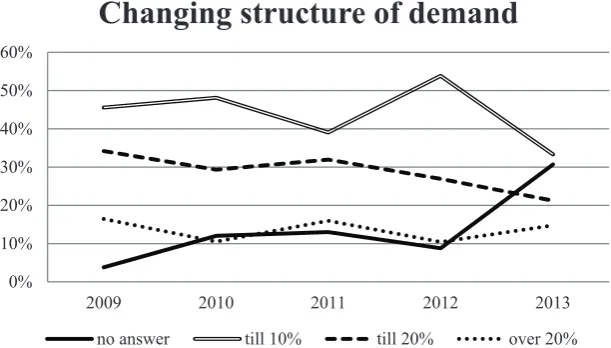
In the period were diff erent infl uences on individual activities in sales, fi nancial and marketing fi elds. Sales fi eld includes only six types of impacts – Reducing the volume of new orders, Cancellation contracted orders, Changing structure of demand, Diffi culty obtaining of sources, Change term performance, The need for restrictions accompanying services. From point of view of sales fi eld was outstanding change in Changing structure of demand, where was growth from 45.57% to 53.85% in level of changes till 10% of total volume. In 2013 was rapidly decreased in structure of demand to 33.33%. In the levels of changes till 20% and over 20% there were decline about almost 13% and 2%. That indicates greater propensity for purchasing relatively cheaper variants of common goods (see Fig. 1).
Financial fi eld includes only three types of impacts: 1) Limited availability of external funding sources; 2) Impaired payment customers’ discipline; 3) Poor ability to repay liabilities. The most important change was found by Limited availability of external funding sources, which noted decline almost about 15%. That improves possibilities of using diverse foreign sources with standard barter’s trades (see Fig. 2).
There are necessary to use manager’s measures to minimalize all impacts. Common measures include sharing of trade channels or eff ort of increase the value added which customers perceive as strong brand. These measures have increased by 6%.
During fi nancial crisis there were reduced marketing activities and customer’s benefi t programs. In 2009 were reduced almost 40% of all marketing activities and 34% of customer’s benefi t programs. In comparison with 2012 were changed these groups only by 28% and 23%.
In 2013 were small increase in reduction of marketing activities to 31% and decrease of
0% 10% 20% 30% 40% 50% 60%
2009 2010 2011 2012 2013
Changing structure of demand
no answer till 10% till 20% over 20%
1: Trend of changing structure of demand in 2009–2013 Source: own research
0% 10% 20% 30% 40% 50% 60%
2009 2010 2011 2012 2013
Limited availability of external
funding sources
Yes Threatens No No answer
reduction of customer’s benefi t programs to 22.73%. These changes have been changed by amount of barter trades (see Fig. 3, Fig. 4).
There has been rapid increase in using barter trades as key tool. It was used in 31.65% companies in 2009 and in 2012 it was more than 65% and in 2013 almost 43% (see Fig. 5). According the trend there is obvious that managers in 2009 were badly prepared for hard times’ management. That is results of economic crisis followed by crisis of European monetary union. During crises using of barter trade tools have grown as results of fi ndings key roles of trading tools – barter, counter purchase, multilateral barter. Important is, if this growth has become only by single trades or by total transformation of whole trading approach.
There are necessary to execute further research to exploit fi ndings with minimal loses in both of domestic and foreign environment. Important premise is verifi cation infl uence of compensation
deals on companies and the choice of using individual business and marketing activities.
In case of distressed sale there exists only opportunity, how sell quickly with minimal loss. Sellers usually lose only few per cent by this kind of sell in comparison with cash sale. Main condition is possibility to exchange own products for another to get required eff ect. For this is necessary to have a broad information base or to be a member of some barter centres.
In questionnaire survey there were respondents asked if companies improves corporate hard skills. According to Senge (2007) hard skills as group of managerial abilities includes 1) alignments in law; 2) economics; 3) taxes; 4) human resources; 5) policy; 6) market and 7) language. From Fig. 6 is obvious, that since 2009 there has been slow growth of hard skills’ curve. This progress is made by changing managers’ thinking in innovative and creative fi elds. To be competitive, managers need to develop knowledge about innovation. Since 2010 knowledge has been
39.24% 42.11% 41.42%
28.02% 31.06% 60.76% 57.89% 56.80%
70.33% 68.56% 0.00% 0.00% 1.78% 1.65% 0.38%
0% 20% 40% 60% 80% 100%
2009 2010 2011 2012 2013
Reduction of marketing and
promotion activities
Yes No No answer
3: Trend of reduction of marketing and promotion activities in 2009–2013 Source: own research
34.18%
21.05% 27.22% 23.08% 22.73% 65.82%
78.95% 71.01% 73.08% 76.89%
0.00% 1.78% 3.85% 0.38%
0% 20% 40% 60% 80% 100%
2009 2010 2011 2012 2013
Reduction of benefit programmes
for custommers
Yes No No answer
increased especially by self-study, courses and workshops or from books. These tools are too old for development of innovation thinking.
Unfortunately, there is necessary to improve knowledge forcefully, included in hard skills. As quite new approach, there is possible to develop “gi ” of subtle skills. Mentioned hard skills are part of subtle skills, which support creative potential of individual persons. According Hroník (2008) subtle skills could be partly genetically encrypted. Accurate perception of feelings and senses should be base for managerial success in high competitive environments. Main fi elds of subtle skills are: 1) mental fi tness; 2) psychophysical condition; 3) critical thinking – wisdom; 4) discipline and stability; 5) distance, concentration; 6) respect; 7) change, chance and stress.
These fi elds describe process of requirements which should be expected in decision-making level in foreign trades and used trades tools.
DISCUSSION
The article proposed the evaluation of three hypotheses formulated on the basis of the secondary research, the monitoring of the trends described in the specialized literature and presented on the specialized meetings of managers and entrepreneurs: 1) managers of small and medium-sized companies in the Czech Republic are not ready well for the management of their companies in the “hard times”; 2) they do not respond adequately to the occurred situation as the consequence of their poor readiness; 3) the cause of the poor readiness is the low level of knowledge and practical experience with the utilization of the tools of the crisis and turnaround management.
The questionnaire survey was applied for the verifi cation or disapproving of the hypotheses, with the aim to verify the situation in the Czech small and medium-sized companies.
0% 10% 20% 30% 40% 50% 60% 70% 80%
2009 2010 2011 2012 2013
Use of compensation trades
Yes No No answer
5: Trend of using of compensation trades in 2009–2013 Source: own research
0% 10% 20% 30% 40% 50% 60% 70% 80%
2009 2010 2011 2012 2013
Use of compensation trades in
connection to hard skills
Yes No No answer Hard skills
On the basis of the identifi ed facts all three hypotheses can be declared as partially verifi ed. Their validity is highly probable; nevertheless, at least one research in the fi eld of the adequacy of the individual implemented provisions will have to be carried-out with a certain time distance.
So as to further verify the validity of the hypothe-ses, a separate monitoring of the industry focus
of the investigated companies will be necessary on the grounds of the diff ering diffi cultness of the implementation of the crisis activities. The paper mentions the barter central offi ces as one of the examples of the strategic partnerships; however, this fi eld off ers a space for the future profound research.
CONCLUSION
Most of respondents fi nd information in internet sources. Except internet there are used books and courses which become basis of countertrade knowledge. Unfortunately, there exists negative response to the question if there are have enough information for possible execution of the compensation trade. Corporate practices show way how is possible create maximal using of compensation trades. Usually, companies are joined up to local barter centres. They have available trained specialists (brokers) who are working for a provision of a few percent and they are actively looking for trade opportunities and solve the problems with single client. Consciousness of barter trade’s knowledge provides possibility to reach eff ective innovation thinking (Oliver, Mpinganjira, 2011b).
Economic crisis support in companies approaches to improve innovative thinking and creativity to stabilize own market positions. Important is to focus on alternative methods of knowledge improving of managers, which strengthen their subtle skills. Mentioned alternative methods could be couching, self-refl ection or counselling. As support for the improvement of “crisis trades” knowledge there are possible to applied brainstorming, simulation, case studies or outdoor training. Own evaluation of the relationship between the development and management decisions would be possible to identify key factors, which would infl uence the eff ectiveness of decision-making and recommend methods for further development of the company.
REFERENCES
CASTOR, R., NEWCOMB, T. 2006. From RED to BLACK: rebuilding wounded companies. Financial Executives International, 22(1): 1–26.
CRESTI, B. 2003. U.S. domestic barter: An empirical investigation. Applied Economics, 37(17): 1953–1966. ČICHOVSKÝ, L., BOHÁČEK, J., URBAN, J. 2012.
The modern concept of innovation and its typology for practice. Praha: VŠEM.
GURIEV, S., ICKES, B. 1999. Barter in Russian enterprises: Myths vs. Empirical Evidence. Russian Economic Trends, 8(2): 6–13. DOI: 10.1111/1467-9426.00046.
HATTEN, T. S. 2012. Small Business Management: Entrepreneurship and beyond. 5th ed. Mason:
South-West Cengage Learning.
HRONÍK, F. 2008. Manažerská integrita. Brno: Motiv Press.
HUMPREYS, P., McADAM, R., LECKEY, J. 2005. Longitudinal evaluation of innovation implementation in SMEs. European Journal of Innovation Management, 8(3): 283–304. DOI: 10.1108/14601060510610162.
JOHNSON, G., SCHOLES, K., WHITTINGTON, R. 2008. Exploring Corporate Strategy: Text & Cases. Lombarda: Pearson Education.
KAIKATI, A. M., KAIKATI, J. G. 2013. Doing business without exchanging money: The scale and creativity of modern barter. California Management Review, 55(22): 46–71.
KLÍMKOVÁ, M., HORNUNGOVÁ, J. 2012. Performance of Enterprises from Information and
Communication Activities in Economic and Social Area. Trends Economics and Management, 6(12): 128– 136.
KOLEŇÁK, J. 2008. Business alliances in economical crisis. Periodica Academica, 3(2): 35–40.
MacPHERSON, D., MILLER, D. 2010. Break through Business Development: A 90-Day Plan to Build Your Client Base and Take Your Business to the Next Level. Mississauga: John Wiley and sons.
MARDAK, D. 2008. Barter your way to better meetings. Successful meetings. 26–27. Retrieved from: http://www.nxtbook.com/nxtbooks/nielsen/ sm0608/index.php?startid=26.
MARIN, D., SCHNITZER, M. 2002. Contracts in trade and transition: The resurgence of barter. Massachusetts Institute of Technology.
MARVASTI, A., SMYTH, D. J. 2011. Barter and business cycles: Further empirical evidence. The American Economist, 56(2): 85–97.
McADAM, R. 2005. A multi-level Theory of innovation implementation: Normative evaluation, legitimisation and confl ict. European Journal of Innovation Management, 8(3): 373–388. DOI: 10.1108/14601060510610216.
OLIVER, P., MPINGANJIRA, M. 2011a. An empirical investigation into diffi culties associated with barter trading: A practioners’ perspective. African Journal of Business Management, 5(4): 1085– 1092. DOI: 10.5897/AJBM10.086.
PAUL, R., ELDER, L. 2002. Critical Thinking. New Jersey: Upper Saddle River.
PORTER, M. E. 2008. Competitive Advantage: Creating and Sustaining Superior Performance. Simon and Schuster.
SENGE, P. M. 2007. Pátá disciplína: teorie a praxe učící se organizace. Praha: Management Press.
SOMNATH, D., PRADYOT, K. S., SANJIT, S. 2003. Strategic alliances: a valuable way to manage intellectual capital? Journal of Intellectual Capital, 4(1): 10–19. DOI: 10.1108/14691930310455351. STEINÖCKER, R. 1998. Strategický controlling. Praha:
Profess Consulting.
UIJTTENBROEK, A. 2004. BDM Business Development Methodology: Core Processes. Lansa Publication. VLČEK, R. 2011. Strategie hodnotových inovací – tvorba,
rozvoj a měřitelnost inovací. Praha: Professional Publishing.
ZICH, R. 2009. Application and Development of Success-Ability Concept in Research of Company Competitive Advantage. In: KOCOUREK, A. (ed.), Proceedings of 9th International Conference Liberec
Economic Forum 2009. 432–443.
Contact information Jiří Koleňák: [email protected]