Licensed under Creative Common Page 802
http://ijecm.co.uk/
ISSN 2348 0386
INFORMATION TECHNOLOGY (IT) INTEGRATION
AND FIRM PERFORMANCE
Leonard T Mwithiga
School of Business, University of Nairobi, Kenya [email protected]
James M Njihia
School of Business, University of Nairobi, Kenya
X. N. Iraki
School of Business, University of Nairobi, Kenya
Abstract
A review of industry practices and literature reveals that studies examining the association
between IT and firm performance are divergent in how they conceptualize key constructs and
their interrelationships. Using a pragmatist philosophical approach coupled with triangulation, it
is evident that comparative and empirical research on IT and Strategy relationship, inaccurately
frames Information Technology (IT) Integration as only a functional-level imperative. This
under-appreciation of the business-level role of IT Integration is the driving need for the substantial
re-theorizing of its role in strategy and its complex and interdependent relationship with the
mechanisms through which firms generate superior firm performance. It is therefore important to
examine the direct and indirect effects of IT Integration on firm performance and understand
how IT Integration influences firm performance through a finite and simple chain of practical
industry based variables. This paper proposes and establishes a conceptual model based on
micro constructs of the following key constructs; IT Integration, Firm characteristics, Business
Operations strategy and Firm performance. This model affirms and calibrates industry and field
observations. It provides researchers and practitioners with pragmatic toolsets to operationalize
financial technology strategies within their organizations.
Licensed under Creative Common Page 803 INTRODUCTION
Although literature sources on Information technology and firm performance are rich with insights and macro-theoretical developments, empirical studies find that the firm micro-dynamics on how Information technology integrates with strategy and firm performance is lacking at micro-level. From this it is evident that a clear understanding of the internal dynamics of organizations is required so as to explain the productivity paradox associated with IT Integration and how financial services firms shall be or are able to navigate the dynamism and environmental turbulence that characterize their industry. Organizations that are able to manage this turbulence are expected to have superior firm performance. Arising from the above therefore this study sought to investigate the relationship between IT integration, Business Operations Strategy, Firm Characteristics and Firm Performance of Commercial Banks and Micro Financial Institutions (MFI). The specific objectives were; examine the relationship between IT Integration, Business Operation Strategy, effect of Business Operations Strategy, influence of Firm Characteristics on IT Integration, Business Operations Strategy and Firm Performance and lastly to investigate and establish the joint effect of IT Integration, Firm Characteristics, Business Operations strategy is greater than the effect each individual variable on the Firm’s Performance. Dynamic capabilities theory is used as the foundational theory,
supplemented by strategic alignment theory and the resources based theory. The research design was cross sectional descriptive survey. The results findings show a statistically significant direct relationship between IT integration and business operations strategy on firm performance. The results also show that relationship between IT integration, business operations strategy and firm performance is moderated by firm characteristics. This study contributes to understanding of the link between IT integration, business operations strategy and firm performance, while at the same time confirms the findings of previous studies that have found a significant positive link between IT integration and firm performance, and thus help in unravelling the related productivity paradox that has been associated with IT. The conclusions from this study demonstrates the substantive re-theorizing of IT Integration from a functional imperative to a business strategy level. In conclusion a well-organized IT integration strategy for financial institutions is indeed its business strategy to counter external financial technology companies, and therein orchestrate its own internal financial technology strategy.
Information Technology Integration
Licensed under Creative Common Page 804 (2011) recognized IT administration abilities, IT work force skill and IT Infrastructure adaptabilities as the essential measurements of IT Integration, in parallel with the scientific classifications of physical, human, organizational perspectives, created by Barney (1991). They additionally asserted that these measurements are interrelated and the cooperative energy that impacts the fast changes in company's business processes and which in turn prompt prevalent firm strategy. This perspective seems to stand out from a portion of the earlier research, where some research work characterized each of the measurements as IT assets; some grouped IT framework as IT assets, with IT staff thought to be of a higher order; and others recognized IT foundation and IT work force skills as capacities, (Ravichandran and Lertwongsatien, 2005; Fink and Neumann, 2007).
Business Operations Strategy
Mintzberg (1978) drew out the significance of the relationship between business operations and operations strategy as the path through which organizations execute strategy, however operations strategy is the functional approach to reach and keep up the organization focused day to day needs, while aligned to the overall strategy. According to Porter (1985), firms with a clear strategy outpace firms without a strategy. Hossain S, Sohrab K, Jamshid N & Mahmood A (2012), through an empirical study of Iranian firms, proposed a model that presented an arrangement in the organization's strategy window, by making the centralization of business system and operations strategy framework, as a proxy for business operations strategy. Thompson & Strickland (1990), refer the same concept as functional strategy, and which is adding details to business strategy with its main role being to support the overall competitive strategy. A business operations strategy in this manner depicts how an organization creates competitive advantage in an industry with respect to its adversaries (Acquaah, 2011). The most common business operations strategies employed by organizations center on cost leadership and differentiation
Firm Performance
Firm performance includes the yield or after effects of a firm as measured against its expected yields, objectives and targets (Banker, Chang, Pizzini, 2004). This has necessitated the need of adjusting the precision and respectability of monetary measures with the drivers of future firm strategy of the organization (Banker et al, 2000).
Licensed under Creative Common Page 805 organization over time (Rahut, Castallanos & Sahoo, 2010). Operational efficiency, profitability, proficiency in asset utilization and liquidity, capital adequacy, product development were utilized by Rahut et al. (2010) to represent traditional measures of performance of financial institutions. Ngumi et al. (2013) analyzed the effect of financial innovations on the performance of commercial banks in Kenya. The study used profitability, total income, total assets and customer deposits as proxies of performance of commercial banks.
The Strategic Balanced score card provides a system in which both financial and nonfinancial achievement measures are connected by the firm’s strategy (Banker, Chang,
Pizzini, 2004). It takes a view of strategy from four points of perspective: financial, customer, internal processes and learning and development. Robert Kaplan and David Norton, built up this approach in three articles distributed in the Harvard Business Review (1992, 1993 and 1996a). Their thought was that conventional financial related measures (like the ROI, for instance) ought to be supplemented with operational measures concerning consumer loyalty, inside procedures and the capacity to advance.
THEORETICAL FRAMEWORK
Several foundational theories can be used to explain the relationship between IT Integration and Firm Performance. Strategic alignment theory, the Resource Based Theory, Dynamic Capabilities theory and Systems Theory have been used by several strategic information system (SIS) scholars to show the relationship and possible perspectives of theoretically connecting business strategy, operations strategy, operations management, sustainable competitive advantage, firm performance with Information technology. In this paper the Dynamic Capability framework is selected, as the theoretical foundation for a conceptual model, to explain Information Technology Integration and Firm Performance, intervened and moderated by business operations strategy and firm characteristics, respectively.
Dynamic Capabilities Theory
Licensed under Creative Common Page 806 that eludes RBV (Crook et al, 2008). The dynamic capability theory has extended RBV to the realm of evolving capabilities (Okoth, 2013). Dynamic Capacities aims to provide a consistent framework for the understanding of competitive advantage driven by sustainable good firm performance. Teece et al. (1997) adopted the efficiency approach from the earlier works of Klevoricket al., (1995); these original works addressed the roles of routines, and their influences on sharing and constraining the ways firms grow and adapt to changing environments. Firm performances are evaluated on efficiency aspects rather than market positions.
Teece et al (2001) wrote on the dynamic capability theory and defined dynamic capability as "the firm’s ability to integrate, build, and reconfigure internal and external competences to address rapidly changing environments.” He introduced the need to develop
the capability to respond quickly to the changes in both the internal and external environment and recognized the multiplicity of variables that come together to influence superior performance. The theory gives a systematically structured view and specifies that successful players cannot restrict the variables they consider to perform well and have to continuously seek which other variables come to play jointly with others for the best results and within their current and future business strategies (McMillan, 2002).
Empirical Studies and Variable Relationships
Licensed under Creative Common Page 807 treating IT capability as an organization-wide dynamic capability, and presented a better understanding of the influences of intangible IT resources within the IT capability construct.
Bharadwaj (2000) directly linked IT to firm performance. Employing Grant (1997) classification model, she categorized the IT Integration as: IT infrastructure (tangible resources), human IT resources, and intangible IT resources (e.g. knowledge assets, customer orientation and synergy). IT Integration was found to be directly associated with firm performance. Firms with effective IT Integration were able to obtain superior financial performance. She argued that firm performance is achieved through the complementary effects of complex interactions between tangible, human and intangible IT resources.
Santhanam and Hartono (2003) extended and confirmed Bharadwaj's (2000) findings, establishing that firms with strong IT Integration had superior current and sustained performance when compared to average industry performance. IT Integration had a sustained impact on firm performance, which was a phenomenon that had not been examined in prior research.
Bhatt and Grover (2005) identified the factors leading to IT Integration, such as IT infrastructure, IT business experience, relationship infrastructure and intensity of organizational learning. They identified that IT infrastructure was not a significant constituent for attaining competitive advantage. The authors argued against the conventional view that IT infrastructure, IT business experience and relationship infrastructure were essential components for competitive advantage. Rather, they claimed that IT infrastructure and IT capabilities across organizations were largely similar. This may be due to the open standards, modular development approaches and openly available software and hardware. In contrast, they emphasized the importance of IT personnel expertise as an inimitable and valuable asset for firms. Organizations with highly competent IT personnel are able to create greater sustainable competitive advantage.
In an ongoing scholarly discourse about the true classification of IT assets and resources, Bharadwaj (2000) recognizes capacities from assets and clarifies; "IT abilities are capacities that prepare and generate IT assets into a portfolio abilities that drive specific business objectives and strategies". She embraces Grant's order (1991) that IT assets are in three classes: IT infrastructure, human IT assets; and thirdly IT relationships. In her examination, she found that the mix and collaboration of IT assets and different assets empowers the making of sustainable competitive advantage.
Licensed under Creative Common Page 808 it is the possession of uncommon and difficult to imitate assets that permits a firm to beat its rivals, while Fahy (2000) showed unrivaled strategy as driven by market leadership and superior financial acumen not expressly identified with contenders. Bharadwaj (2000) further found that organizations which have unrivaled IT abilities have an essentially superior strategy over firms that do not exploit the full potential of IT innovation. She contended that IT must be a source of comparative advantage if firms comprehend and create IT as IT capabilities. To accomplish this, she enumerated three imperatives: IT learning, IT operations, and thirdly IT infrastructure. IT work force skills are also an important part of IT capabilities and critical in defining a competitive advantage position. These three imperatives speak to co-specific assets within the IT and business alignment framework. An examination of its outcomes demonstrate that they indirectly and directly affect firm strategy. In particular, they demonstrate that organizational synergy towards better firm performance is moderated between IT capability and firm strategy.
Drnevich and Croson (2013) examined the relationship between IT and business strategy. According to the study, IT plays an integral role in ensuring the success of the competitive strategy of the organization. They contended that IT influences industry structure and the arrangement of business-level key options and value creation openings that a firm may seek after. Naming IT as integral with organizational changes, they expressed that IT improves the company's present (normal) abilities and empowers new (element) capacities, including the adaptability to concentrate on quickly changing opportunities or to surrender losing activities while rescuing significant resource esteem. The review inferred that IT decides the amount of significant worth, once made, can be secured by the firm and how much will be dispersed through rivalry or through the energy of significant worth chain accomplices, the administration of which itself relies on upon IT.
Research Hypothesis
Based on the above below are the research hypotheses-
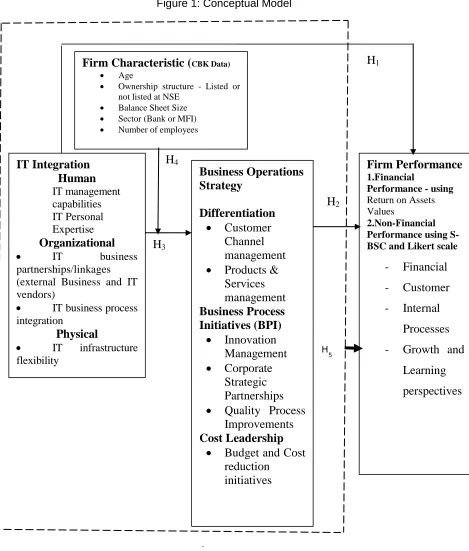
H1: There is a relationship between IT integration and firm performance
H2: There is relationship between business operations strategy and firm performance
H3 Business operation strategy has a significant effect on the relationship between IT integration and firm performance
H4 The strength of relationship between IT integration, business operations strategy and firm performance is influenced by the firm characteristics.
Licensed under Creative Common Page 809 Conceptual Framework
The inter-relationships which form the basis upon which the paper is based is captured in the conceptual framework model as provided in Figure 1 below.
Figure 1: Conceptual Model
Firm Performance
1.Financial
Performance - using
Return on Assets Values
2.Non-Financial Performance using S-BSC and Likert scale
-
Financial
-
Customer
-
Internal
Processes
-
Growth and
Learning
perspectives
Business Operations
Strategy
Differentiation
Customer
Channel
management
Products &
Services
management
Business Process
Initiatives (BPI)
Innovation
Management
Corporate
Strategic
Partnerships
Quality Process
Improvements
Cost Leadership
Budget and Cost
reduction
initiatives
H
1H
3IT Integration
Human
IT management capabilities IT Personal ExpertiseOrganizational
IT business
partnerships/linkages (external Business and IT vendors)
IT business process
integration
Physical
IT infrastructure
flexibility
H
2H
4Firm Characteristic (
CBK Data) Age
Ownership structure - Listed or not listed at NSE
Balance Sheet Size Sector (Bank or MFI) Number of employees
Licensed under Creative Common Page 810 RESEARCH METHODOLOGY
This study adopted a pragmatist philosophical approach. Pragmatism is based on the premise that theories and models are judged primarily by their practical results (McDermid, 2006). Pragmatism underpins mixed research methodology; essentially the combination of qualitative and quantitative approaches. It blends the philosophical assumptions and approaches from both qualitative and quantitative research methods (Creswell, 2009).
Triangulation is used to explicitly account for qualitative aspects of research and how they relate to each other. These two approaches can be: (a) used sequentially, one after the other and (b) used in parallel (Neuman, 2006). The researcher started from hypothesis statements, backed by facts obtained in data sourced from respondents and secondary data obtained from company’s annual reports and Central Bank of Kenya reports. The research
design was cross sectional descriptive survey.
Research Design
This study adopted a cross-sectional survey design deemed appropriate because it accorded the researcher an opportunity to capture data from the respondents at the same time and provide data that objectively shows whether significant associations among variables exist (Cooper & Schindler, 2008). Other scholars among them Lindell and Whitney (2001), Irungu (2007) and Ongore (2008) used this research design successfully to test hypotheses. Further cross sectional surveys have been ascertained to be robust in relationships studies given their ability to capture the population characteristics in their free and natural occurrence (O’Sullivan & Abel, 2007). The cross sectional survey design also helps to collect uniform and comparable data that captures respondents’ similarities and differences across the sampled organizations to enrich the study findings. This design is therefore in tandem with the philosophical orientation, purpose and scope of the research work and facilitates an in depth understanding of the complexities underpinning IT Integration, Business Operations Strategy, Firm Characteristics and their relationships to Firm Performance through a pragmatist philosophical approach.
Population and Sampling
Licensed under Creative Common Page 811 Table 1: Population Categories
Category Population
Commercial banks 43
Micro Finance Institutions 12
Total 55
Data Collection
Data collection refers to the process of gathering raw and unprocessed information that can be processed into meaningful information, following the scientific process of data analysis (Gall, Gall and Borg, 2007). Both primary and secondary data was collected for this study to avoid mono-method bias. Primary data was collected or obtained from the original sources. It is first-hand information collected by an individual group or organization. Semi structured questionnaire was used to collect primary data. The questionnaire was structured into personal profile of the respondents, organizational profile and information addressing research questions. The questionnaire was administered to one Senior IT Executives of the selected institutions. It was dropped and picked later by trained research assistants. A five point type likert scale ranging from 5 - denoting to a greater extent to 1 - denoting to a less extent was used.
Polit and Beck (2003) explain that secondary research involves the use of data gathered in a previous study to test new hypotheses or explore new relationships. They also indicate that analysis of existing data is efficient and economical because data collection is typically the most time-consuming and expensive part of a research project. Secondary data for this research was used to validate the findings from analysis of primary data. The secondary data was extracted from the annual reports and financial statements of the companies as the most recent reports (2015) from the Central Bank of Kenya, supervisory department. These were collected and presented using the secondary data collection sheet. The strategy of using both primary and secondary data to address the same study objectives is meant to improve the interpretive coherence and improve both communicative and pragmatic validity of the study results.
Operationalization of Variables
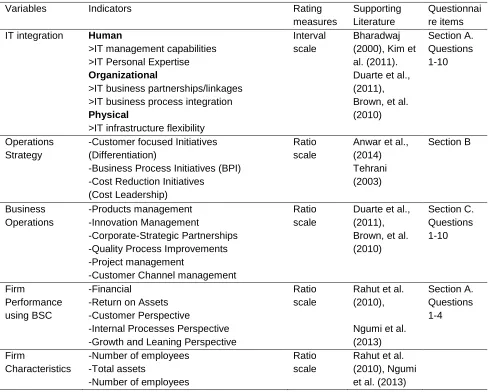
The study’s independent variable was IT integration. The dependent variable was firm
Licensed under Creative Common Page 812 Table 2: Operationalization of the Study Variables
Variables Indicators Rating
measures
Supporting Literature
Questionnai re items IT integration Human
>IT management capabilities >IT Personal Expertise
Organizational
>IT business partnerships/linkages >IT business process integration
Physical
>IT infrastructure flexibility
Interval scale
Bharadwaj (2000), Kim et al. (2011). Duarte et al., (2011), Brown, et al. (2010) Section A. Questions 1-10 Operations Strategy
-Customer focused Initiatives (Differentiation)
-Business Process Initiatives (BPI) -Cost Reduction Initiatives
(Cost Leadership)
Ratio scale
Anwar et al., (2014) Tehrani (2003) Section B Business Operations -Products management -Innovation Management -Corporate-Strategic Partnerships -Quality Process Improvements -Project management
-Customer Channel management
Ratio scale
Duarte et al., (2011), Brown, et al. (2010) Section C. Questions 1-10 Firm Performance using BSC -Financial
-Return on Assets -Customer Perspective
-Internal Processes Perspective -Growth and Leaning Perspective
Ratio scale
Rahut et al. (2010),
Ngumi et al. (2013) Section A. Questions 1-4 Firm Characteristics
-Number of employees -Total assets
-Number of employees
Ratio scale
Rahut et al. (2010), Ngumi et al. (2013)
Research Instrument
Structured questionnaire was used for data collection (See Appendix).
ANALYSIS AND FINDINGS
Licensed under Creative Common Page 813 Table 3. Summary of Hypotheses Testing
Objective Hypotheses Results Remarks on
hypotheses
1.To establish the relationship between IT Integration and firm performance
H1:There is a
relationship between IT integration and firm performance
Adjusted
R2=0.149;R2=0.167, p<0.01;
F=9.606;
β=0.402;t=3.99,p<0.01.
Supported
2.To assess the effect of business operations strategies on firm performance.
H2:There is
relationship between business operations strategy and firm performance
Adjusted
R2=0.259;R2=0.274, p<0.01;
F=18.092;
β=0.312;t=4.253,p<0.01.
Supported
3.To determine effect of Business Operations Strategy on the
relationship between IT Integration and Firm Performance
H3:Business operation
strategy has a significant effect on the relationship between IT integration and firm performance
IT integration*BOS: Adjusted R=.438, R2=.461; F=20.129, p<0.01; IT integration β=.427, t= 4.046, p<0.01;BOS β=.324, t=5.07, p<0.01
Not supported
4.To evaluate the influence of Firm Characteristics on the relationship between IT Integration, Business Operations Strategy and Firm Performance.
H4:The strength of
relationship between IT integration, business operations strategy and firm performance is influenced by the firm characteristics.
IT integration, business operations strategy*Firm characteristics: adjusted R=.680, R2=.707, F=26.494, p< .001; β=.019, t=3.819, p<0.01
Supported
5.To investigate and establish the joint effect of IT Integration, Firm Characteristics, Business Operations strategy is greater than the effect each individual variable on the Firm’s
Performance.
H5:The joint effect of
IT Integration, Firm characteristics and Business Operations strategy on Firm Performance is significantly greater than the individual predictor variables on the firm performance.
Combined effects: adjusted R=.583, R2=.609, F=23.401, p<0.01; β=.381, t=
3.068, p<0.01 Supported
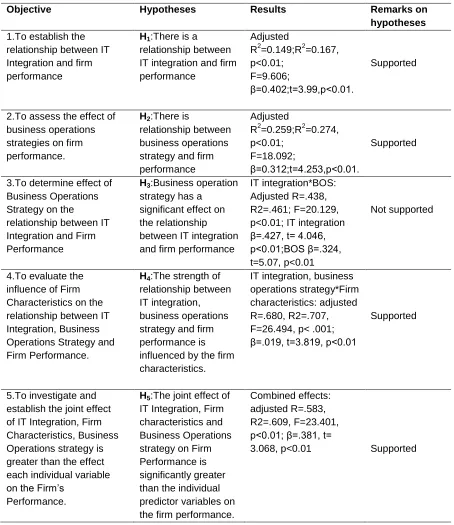
Licensed under Creative Common Page 814 are significant findings with great industry implication to strategy and the affirmation that the IT Integration construct indeed is a business level strategic imperative. Business operations strategies explained 27.4% of the change in firm performance while Firm characteristics explained 34% of the change in firm performance. The joint predictor variables: IT Integration, Firm Characteristics and Business Operations strategy explain 60.9% of the change in firm performance, which was significant. The results of the current study indicate that the joint effect of IT Integration, Firm Characteristics and Business Operations strategy on firm performance is greater than the individual effects of IT Integration, Firm Characteristics, and Business Operations strategy on firm performance.
CONCLUSION
The attendant findings and conclusions from this research work contribute towards addressing the productivity paradox and the related theoretical and methodological flaws, in business and IT research field. From a managerial perspective, the findings provide valuable insights for managing investments in IT. For practitioners whose financial firms are besieged by an ecological ferment of changing technologies, fickle markets, and competitor mergers for global scale, understanding the internal dynamics of how IT Integration can influence firm performance is crucial for their business’ survival. Similarly for managers faced with the dilemma of deciding on 'the next technological investments for their firms', the findings from this research provide valuation criteria for redefining operations strategy through investments in IT Integration.
In conclusion a well-organized IT integration strategy for financial institutions is indeed its business strategy to counter external financial technology (Finitech) companies, and therein orchestrate its own internal Fintech strategy. A bank’s or microfinance’s Fintech strategy would
include the following key imperatives: integrated customer technologies, payment infrastructures and ecosystems, digital financial services products, a digital operations strategy, data analytics framework, an innovations culture and a differentiated organization and governance standard. These imperatives are consistent with this study’s micro constructs, namely Human IT integration, Physical IT integration, organizational integration and governance, cost leadership, innovations management, customer channel management, product differentiation, focus on niche market and development of customer and supplier intimacy. Firm performance micro constructs in the study are defined by return on assets (ROA) and within the strategic balance score card’s, four perspectives of financial, customer, internal processes, learning and growth
Licensed under Creative Common Page 815 REFERENCES
Acquaah, M. (2011). Business strategy and competitive advantage in family businesses in Ghana: The role of social networking relationships. Journal of Developmental Entrepreneurship, 16(01), 103-126. Agan, Y. (2011). Impact of operations, marketing, and information technology capabilities on supply chain integration. Journal of Economic and social research, 13(1), 27.
Amoako-Gyampah, K., &Acquaah, M. (2008). Manufacturing strategy, competitive strategy and firm performance: An empirical study in a developing economy environment. International Journal of Production Economics, 111(2), 575-592.
Amollo, F. O. (2013). Operations strategy decisions and financial inclusion by commercial banks in Kenya (Doctoral dissertation, University of Nairobi).
Approaches, SAGE Publications.
Aral, S., & Weill, P. (2007). IT assets, organizational capabilities and firm performance: Do resource allocations and organizational differences explain performance variation?” Organization Science, 18(5), 763-780.
Barney, J. B. (1991). Firm resources and sustained competitive advantage. Journal of Management, 17 (1), 99-120.
Barua A., Kriebel, C. H. &Mukhopadhyay T. (1995). Information Technology and Business Value: An Analytic and Empirical Investigation. Information Systems Research, 6, 3-23.
Bharadwaj, A. S. (2000). A Resource-Based Perspective on Information Technology Bharadwaj, A. S., Sambamurthy, V. &Zmud, R. W. (1999). IT capabilities:
Bharadwaj, A. S.., Saxena, K. B. C. &Halemane, M. D. (2010). Building a
Bhatt, G. D. & Grover, V. (2005). Types of information technology capabilities and their
Bhatt, G. D. (2000). An empirical examination of the effects of information systems integration on business process improvement. International Journal of Operations & Production Management, 20(11), 1331-1359.
Brynjolfsson, E. &Hitt, L. M (1996). Paradox Lost? Firm-Level Evidence on the Returns to Information Systems Spending. Management Science, 42, 541-558.
Brynjolfsson, E. &Hitt, L. M. (2000). Beyond Computation: Information Technology, Brynjolfsson, E. & Yang, S. (1996). Information technology and productivity: a review Byrd, T. A. & Turner, D. E. (2001). An exploratory analysis of the value of the skills of Byrd, T. A., Pitts, J. P., Adrian, A. M. & Davidson, N. W. (2008). Examination of a
Capability and Firm Performance: An Empirical Investigation. MIS Quarterly, 24, 169-196. Capability to Firm Performance.MIS Quarterly, 27, 125-153.
Clemons, E. K., Reddi, S. P., & Row, M. C. (1993). The impact of information technology on the organization of economic activity: The “move to the middle” hypothesis. Journal of management information systems, 10(2), 9-35.
Consumer Surplus: Three Different Measures of Information Technology Value. MIS Quarterly, 20, 121-142.
Licensed under Creative Common Page 816 Devaraj, S., Krajewski, L., & Wei, J. C. (2007). Impact of eBusiness technologies on operational performance: the role of production information integration in the supply chain. Journal of Operations Management, 25(6), 1199-1216.
Drnevich, P. L., &Croson, D. C. (2013). Information Technology and Business-Level Strategy: Toward an Integrated Theoretical Perspective. Mis Quarterly, 37(2), 483-509.
Duarte, A. L. D. C. M., Brito, L. A. L., Di Serio, L. C., & Martins, G. S. (2011). Operational practices and financial performance: an empirical analysis of Brazilian manufacturing companies. BAR-Brazilian Administration Review, 8(4), 395-411.
Duncan, N. B. (1995). Capturing flexibility of information technology infrastructure: A
Eisenhardt, K. M. & Martin, J. A. (2000). Dynamic capabilities: what are they? Strategic Management Journal, 21, 1105-1121.
Farhanghi, A. A., Abbaspour, A., &Ghassemi, R. A. (2013). The effect of information technology on organizational structure and firm performance: An analysis of consultant engineers firms (CEF) in Iran. Procedia-Social and Behavioral Sciences, 81, 644-649.
Feeny, D. F. &Willcoks, L. P. (1998). Core IS capabilities for exploiting information
Fink, L. & Neumann, S. (2007). Gaining Agility through IT Personnel Capabilities: The Mediating Role of IT Infrastructure Capabilities. Journal of the Association for Information Systems, 8, 440-462.
framework for assessing the business value of information technology. SIGMIS Database, 27, 68-81. Grant, R. M. (1991). The Resource-based Theory of Competitive Advantage: Implications for Strategy Formulation, California Management Review, University of California.
Gunday, G., Ulusoy, G., Kilic, K., &Alpkan, L. (2011). Effects of innovation types on firm performance. International Journal of production economics, 133(2), 662-676.
Ha, B. M., &Jeong, S. R. (2010) Analysis of the relationship between corporate IT capability and corporate performance through Korea IT success cases: An empirical approach,” Asia Pacific Journal of Information Systems, 20(3), 91-114.
Hagedoorn, J., &Schakenraad, J. (1994). The effect of strategic technology alliances on company performance. Strategic management journal, 15(4), 291-309.
Helfat, C. E., Finkelstein, S., Mitchell, W., Peteraf, M. A., Singh, H., Teece, D. J. &Winter, S. G. (2007). Dynamic capabilities: Understanding Strategic Change in Organizations, Blackwell Publishing.
Henderson, J. C., &Venkatraman, N. (1993). Strategic alignment: Leveraging information technology for transforming organizations. IBM systems journal, 32(1), 4-16.
Hitt, L. M. &Brynjolfsson, E. 1996. Productivity, Business Profitability, and Information & Management, 42, 789-798.
Investments: Research Issues and Guidelines,". Communications of the Association for Information Systems, 9, 241-268.
IT Assets. Sloan Management Review, 38, 31-42.
IT personnel: Their relationship to IS infrastructure and competitive advantage. Decision Sciences, 32, 21-54.
Jain, M., &Popli, G. S. (2012). Role of Information Technology in the development of Banking Sector in India. Available at SSRN 2151162.
Kalkan, A., Erdil, O., &Çetinkaya, Ö. (2011). The relationships between firm size, prospector strategy, architecture of information technology and firm performance. Procedia-Social and Behavioral Sciences, 24, 854-869.
Licensed under Creative Common Page 817 Keramati, A. (2007). Assessing the Effects of Information Technology on Firm Performance Using Canonical Correlation Analysis: A Survey in Iran Car Part Suppliers Sector.
Kim, G., Shin, B., Kim, K. K., & Lee, H. G. (2011). IT capabilities, process-oriented dynamic capabilities, and firm financial performance. Journal of the Association for Information Systems, 12(7), 487-517. Kohli, R. &Hoadley, E. (2006). Towards developing a framework for measuring
Kohli, R. &Sherer, S. (2002). "Measuring Payoff of Information Technology
Kozak, S.J. (2005). The Role of Information Technology in the Profit and Cost Efficiency Improvements of banking sector, Journal of academy of Business and Economics, February
Lee, J. (2009). Does Size matter in Firm Performance? Evidence from U.S Public Firms. International Journal of the Economics of Business, 16(2), 189–203.
Macharia Ngombo Wilson, D., Iravo, M. A., Tirimba, O. I., & Ombui, K. Effects of Information Technology on Performance of Logistics Firms in Nairobi County.
Man, M. M. K. (2009). The relationship between distinctive capabilities, innovativeness, strategy types and the performance of small and medium-size enterprises (SMEs) of Malaysian manufacturing sector. The International Business & Economics Research Journal, 8(11), 21.
management. Strategic Management Journal, 18, 509-533.
McAfee, A. &Brynjolfsson, E. (2008) Investing in the IT that makes a competitive difference. Harvard Business Review, 86(7/8), 98-107.
Melville, N., Kraemer, K. &Gurbaxani, V. (2004). Review: Information
Mithas, S., Ramasubbu, N, and Sambamurthy, V. (2011). “How Information Management Capability Influences Firm Performance,” MIS Quarterly (35:1), pp. 237-256.
Mooney, J. G., Gurbaxani, V. & Kraemer, K. L. (1996). A process oriented
Niresh, A., &Thirunavukkarasu, V. (2014). Firm Size and Profitability: A Study of Listed Manufacturing Firms in Sri Lanka. International Journal of Business and Management, 9(4).
Nyangosi, R., & Arora, J. S. (2009). Emergence of Information Technology in the Kenyan banking Sector: An empirical study. International Journal of Electronic Finance, 3(2), 6-12.
of the literature. Advances in computers, 43, 179-214.
Olugbode, M., Elbeltagi, I., Simmons, M., &Biss, T. (2008). The effect of Information Systems on firm performance and profitability using a case-study approach. The Electronic Journal Information Systems Evaluation, 11(1), 35-40.
Oluwatolani, O., Joshua, A., & Philip, A. (2011). The Impact of Information Technology in Nigeria's Banking Industry. arXiv preprint arXiv:1108.1153.
organizational impact of IT- enabled BPR: case studies of three firms. SIGMIS Database, 37, 40-58. Organizational Transformation and Business Performance. The Journal of Economic Perspectives, 14, 23-48.
Osei and Harvey (2011). Investments in Information Technology (IT) and Bank Business International Journal of the Economics and Finance, vol 3, No. 2 May 2011.
OZ, E. (2005). Information technology productivity: in search of a definite observation.
Parast, M. M. (2011). The effect of Six Sigma projects on innovation and firm performance. International Journal of Project Management, 29(1), 45-55.
path model relating information technology infrastructure with firm performance. Journal of Business Logistics, 29, 161-187.
Licensed under Creative Common Page 818 Peppard, J. (2007). The conundrum of IT management. European Journal of Information
Pertusa-Ortega, E. M., Molina-Azorín, J. F., &Claver-Cortés, E. (2010). Competitive strategy, structure and firm performance: A comparison of the resource-based view and the contingency approach. Management Decision, 48(8), 1282-1303.
Pervan, M. &Visic, J. (2012). Influence of firm size on its business success: Croatian Operational Research Review (CRORR), 3, 213-216.
Porter, M. E. (1981). The contributions of industrial organization to strategic management. Academy of Management Review, 609-620.
Porter, M. E., & Millar, V. E. (1985). How information gives you competitive advantage. Harvard Business Review, 63(4), 149-152.
Ravichandran, T. &Lertwongsatien, C. 2005. Effect of information systems resources and capabilities on firm performance: A resource-based perspective. Journal of Management Information Systems, 21, 237-276.
Rivard, S., Raymond, L., &Verreault, D. (2006). Resource-based view and competitive strategy: An integrated model of the contribution of information technology to firm performance. The Journal of Strategic Information Systems, 15(1), 29-50.
role in competitive advantage: An empirical study. Journal of Management Information Systems, 22, 253-277.
Ross, J., Beath, C. & Goodhue, D. (1996). Develop Long-term Competitiveness through Santhanam, R. & Hartono, E. (2003). Issues in Linking Information Technology
Siami, Z.A., (2006). “Role of electronic banking services on the profits of Jordanian Banks” American Journal of Applied Sciences, 3 (9), pp.1999-2006.
study of resource characteristics and their measure. Journal of Management Information Systems, 37-57. successful relationship in business process outsourcing: an exploratory study. European Journal of Information Systems, 19, 168-180.
Systems, 16, 336-345.
Tallon, P. P., Kraemer, K. L. &Gurbaxani, V. (2000). Executives' perceptions of
Tarafdar, M. & Gordon, S. (2007) Understanding the influence of information systems competencies on process innovation: A resource-based view, Journal of Strategic Information Systems, 16, 353.-392. technology and organizational performance: An integrative model of IT business value. MIS Quarterly, 28, 283-322.
Technology. Harvard Business School Press. technology. Sloan Management Review, 39, 9-21.
Teece, D. J. (2008). Dosi's technological paradigms and trajectories: insights for economics and management. Industrial and corporate change, 17(3), 507-512.
Teece, D. J., Pisano, G. &Shuen, A. (1997). Dynamic capabilities and strategic
Tehrani, M. (2003). Competitive strategies, strategic alliances, and performance in international high-tech industries: a cross-cultural study. Journal of American Academy of Business, 2(2), 610-617.
the business value of information technology: a process-oriented approach. Journal of Management Information Systems, 16, 145-173.
theoretical perspectives and empirical operationalization. Proceedings of the 20th international conference on Information Systems. Charlotte, North Carolina, United States: Association for Information Systems.
Licensed under Creative Common Page 819 Waiganjo, E. W., Mukulu, E., &Kahiri, J. (2012). Relationship between strategic human resource management and firm performance of Kenya’s corporate Organizations. International Journal of Humanities and Social Science, 2(10), 62-70.
Ward, P., & Zhou, H. (2006). Impact of information technology integration and lean/just‐in‐time practices on lead‐time performance. Decision Sciences, 37(2), 177-203.
Weill, P., Subramani, M. & Broadbent, M. (2002). Building IT infrastructure for strategic agility. Sloan Management Review, 44, 57-65.
Zahra, Covin, (2015). Business strategy, technology policy and firm performance. Strategic management journal, 14(6), 451-478.
Zehir, C., Muceldili, B., Akyuz, B., & Celep, A. (2010). The Impact of Information Technology Investments on Firm Performance in National and Multinational Company.
APPENDIX 1: RESEARCH INSTRUMENT / QUESTIONNAIRE
PART ONE: GENERAL INFORMATION 1.1 Organizational Information
1. Type of the institution (Tick) Commercial bank
Microfinance bank
4.8 Respondent (Senior IT Executive) particulars
1. Title/designation ………
2. Highest level of education
3. How many years have you worked with this bank? ……….
4. How many years have you worked in the banking industry? ……..
5. Does the most senior executive in Information Technology, directly report to the Chief Executive Officer?
a. 1. Yes [ ]
b. 2. No [ ]
6. Does the company have an Information Technology Board committee? a. 1. Yes [ ]
b. 2. No [ ]
7. Are enterprise projects and programmes managed by InformationTechnology? a. 1. Yes [ ]
b. 2. No [ ]
PART TWO: IT INTEGRATION
2.1 Indicate the level of proficiency of your Chief IT officer in the following areas (Human IT integration)
Use the scale where 1= Not at all 2= to less extent 3=moderately 4= to high extent 5= to a
great extent (Tick)
Indicator Statement(s) 1 2 3 4 5
Licensed under Creative Common Page 820 c ICT security management
d Digital Internet and Mobile
2.2To what extent does the bank use the following vendor supplies (Organizational intergration)?
Use the scale where 1= Not at all 2= to less extent 3=moderately 4= to high extent 5= to a great extent
Indicator Statement(s) 1 2 3 4 5
a ICT hardware vendors/suppliers b ICT software vendors/suppliers c ICT security vendors/suppliers d Networking hardware
e Digital Channels – Internet and Mobile
What was the approximate percentage of IT budget allocated to the following against the total company budget?
Indicator Statement(s) approximate percentage of IT
budget allocated
a ICT strategy plan
b ICT disaster recovery plan c ICT security plan
d Networking hardware
e Digital Channels – Internet and Mobile
Rate the degree of IT usage in the following areas
Use the scale where 1= Not at all 2= to less extent 3=moderately 4= to high extent 5= to a great extent
Indicator Statement(s) 1 2 3 4 5
A Customer relationship management B Marketing processes
C Human resource management D Customer credit procedures E Product development and research F Risk management
2.3Rate the flexibility of the following ICT elements in allowing new modules (Physicalintegration)?
Use the scale where 1= Not at all 2= to less extent 3=moderately 4= to high extent 5= to a great extent
Indicator Statement(s) 1 2 3 4 5
A ICT hardware B ICT software C ICT network
D Digital internet and Mobile
Does IT Flexibility lead to business growth ?
1. Yes [ ]
2. No [ ]
Does IT influence operational performance, please indicate in the space provided below
……… ………
Licensed under Creative Common Page 821 ……… ………
Does IT Integration offer business agility, flexibility and better quality, please elaborate……
……… ……….
PART THREE: BUSINESS OPERATIONS STRATEGY
3.1 Indicate to what extent your company has differentiated in the following (Differentiation strategy)
Use the scale where 1= Not at all 2= to less extent 3=moderately 4= to high extent 5= to a great extent
Indicator Statement(s) 1 2 3 4 5
a Customer management b Channels management c Product management d Services management
e
Innovation strategy
f Industry practice benchmarking
g
Representation of senior executive in Information Technology in Top management structure
3.2 Indicate to what extent your company has implemented the following business process initiatives (BPI)
Use the scale where 1= Not at all 2= to less extent 3=moderately 4= to high extent 5= to a great extent
Indicator Statement(s) 1 2 3 4 5
A Innovation Management
B Corporate Strategic Partnerships
C QualityProcess Improvements
3.How much has been spent in automating the following processes against the total budget?-Budget and Cost reduction initiatives (cost leadership strategy)
Use the scale where 1= Not at all 2= to less extent 3=moderately 4= to high extent 5= to a great extent
Indicator Statement(s) 1 2 3 4 5
A Customer relationship management B Marketing processes
C Human resource
D Customer credit procedures E Product development and research F Risk management
PART FOUR: FIRM PERFORMANCE USING BALANCE SCORE CARD
Licensed under Creative Common Page 822 Use the scale where 1= Not at all, 2= Smallextent 3=moderately extent 4= Large extent 5=Very large extent
Financial Perspective (Contains financial performance indicators which measure financial outputs of the business).
Financial - Criteria Domain
1 2 3 4 5
a) Gross revenue generated by the company increased
b) Net profit of the company increased
c) Cost base of the company decreased
2 Customer Perspective ( Contains measures that identify the customer and market segment in which the business unit competes and the measures of the business unit’s performance in these targeted segments)
a)
Attracted many customers. b) Had satisfied customers.
c) Retained customers.
d) Resolved customer complaints.
e) Market share has expanded.
3 Internal Business Processes (Measures the critical internal processes in which the organization must excel)
a)
Offered products /services of high quality. b)
Increased operational efficiency. c)
Offered after sales service to our customers. d) Company introduced new products.
4 Learning and Growth Perspective ( Measures the infrastructure that the organization must build to create long term growth and improvement)
a) Developed new products.
b) Entered new markets.
c) Developed management competency.
Licensed under Creative Common Page 823 If you may have any other comments, feedback, contribution or suggestions to this topic, kindly elaborate ……… ……… ……… ……… ………...
APPENDIX II: SECONDARY DATA COLLECTION SHEETS
PART ONE: FIRM CHARACTERISTICS
Kindly indicate the firm characteristics in respect to the following Firm characteristics
Age
Total Assets
Type of ownership structure – Local Vs Foreign
Number of employees
PART TWO: FIRM PERFORMANCE
5.1Indicate the financial performance of your of your organization from 2012-2015 using the following indicators
Year
Measure Indicator 2015
Gross profit RE1 Operating income GR1
Net profit GR2
ROA RE2
ROE RE3
RE: Revenue; GR: Growth