
918
An Optimal Solution For Time Minimizing
Transportation Problems By Using Maximum
Range Method
N.Anandhi T.Geetha
Abstract: This article presents a new method named Maximum Range Method (MRM) for finding an optimal solution for Time Minimizing Transportation Problems (TMTP).The main purpose of this method is to Minimize the maximum time of transportation for all availability to req uirement, rather than minimizing transportation cost. The procedure of MRM is developed by Transportation Problem with equality constraints. The proposed method is determine an optimum solution for TMTP and compare with the obtained results of other conventional methods, and found that the proposed method gives the better results from other traditional method. In this dissertation one more method of achieving a minimum time of transportation has been developed which is very different from obtainable method. Finally, a numerical illustration has been presented for better understanding of the algorithm
Index Terms: Transportation problem, Transportation Time, Optimal Solution, Range and MRM
—————————— ——————————
1.INTRODUCTION
The transportation problem for time minimization is one of the special subclass of a transportation problem and it is defined as a Transportation Problem(TP) where instead cost , time is need to be minimized. The objective is to diminish the time while transporting all available thinks to the destinations. In this TP, the value of [t ] is given where
t is representing transporting time from i origins to
j destinations.For any feasible solution[x
] need to satisfy
the capacity and demand condition , time of transportation
is { Max(i. j) t ∶ x > 0}. The aim is to minimize the time take
to bring the goods from source to destination. It is assumed that the goods can be carried from source to target place in single trip. The TMTP is extensively useful in many practical situations such as military transportation for the time of emergency, transport of all the fresh food items, fire service and hospital services …etc. In this paper a simple algorithm for solving a TMTP has been developed. The method presented and discussed above gives us the optimal solution where minimum numbers of iterations are required. The proposed algorithm is easy one to apply which is used to derive the solution to a variety of distribution problems with equality constraints. Hammer[1], Garfinkel and Rao[2] have first analyzed the time minimizing transportation problem. The better solution and procedures are reached by Szware[3] and Puri[4],. Some novel procedures are find by Swarup[5], and Seshan[6] to minimize the time taken for transportation. Recently, Khan et al. [7] defined and used pointer cost to assign the cells for IBFS of the problem. In this paper, the method of finding optimum solution of TMTP is developed, with the same fundamental assumptions made by Gupta.P.K, and Hira D.S.
The method revolves around the allocation of least time cells which are determined by exploring the row/column consisting maximum range time of given transportation problem. This text aims to present the method of determining the Optimum solution of TMTP. The proposed algorithm has very simple steps to reach solution and hence implementation will be easier. It provides the best solution for distribution problems which will be help full for managing persons. The numerical illustration for the proposed algorithms is shown to prove its efficiency to get the optimal solution for TMTP. The paper is arranged as follows: Section 2 .explain the mathematical model of the problem. In section 3, the algorithm of the proposed method is given .In section 4, a example problem is demonstrated In section 5 Results has been Discussed. Section 6 is conclusion of this Paper.
1.1MATHEMATICAL FORMULATION OF THE TMTP
Let us consider the stranded balanced transportation problem, with originO (with availability a) i = 1,2, … m, and destinations, D (with requirement b), j = 1,2, … n. If x is the number of load (amount) units shifting from OtoD,the feasible solution *x + and set of feasible solution*x +
X = {x ∑ x = a , i = 1,2, … … m
⁄ ; ∑ x = b , j
= 1,2, … … n; x ≥ 0 ; ∑ a = ∑ b
}
Let t be the time taken to transfer all x items using
corresponding route (i, j) for all i = 1,2, … … m and = 1,2, … … n .
The problem is mathematically expressed as follow:
Minimize (Total Time) Z =Max
(i. j){ t ∶ x > 0} − −(1)
Subject to the constrains
∑ x = a , i = 1,2, … … m (supply contrains) − − − (2)
∑ x = b , j = 1,2, … … n (Demand contrains) − − − (3)
________________________________________ • N.Anandhi is currently working as Assistant Professor of
Mathematics, Anjalai Ammal- Mahalingam Engineering College, Kovilvenni – 614 403,Thiruvarur Dist., Tamil Nadu, India. • Dr. T.Geetha is currently working as Assistant Professor of
919
and
x ≥ 0; a > 0 ; b > 0 for all i and j −
− − −(4)
Where a is the quantity of load capacity at i origin; b is
the quantity of load demand at j destination; x
is the
amount of commodity transporting from i origin to
j destination.
1.2BALANCED AND UNBALANCED TRANSPORTATION TABLE(TT)
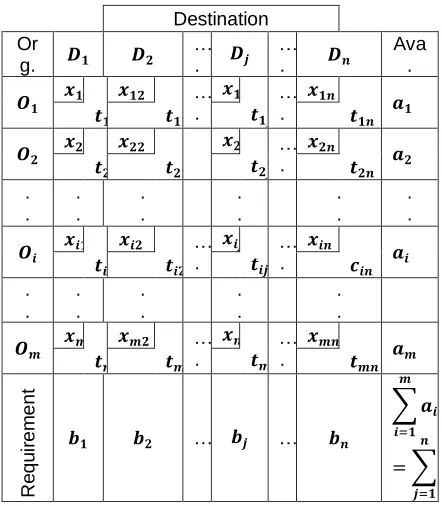
Transportation problem is explicitly represented by the following transportation table
Destination Or g. … . … . Ava . … . … . … . . . . . . . . . . . . . … . … . . . . . . . . . . . … . … . R e q u ir e m e n t … … ∑ = ∑
Figure 1.Transpotation table of transportation problem
The m × n squares are called cells. The transportation time
t from the i origin to the j the (i, j) cell. The solution
x is displayed in the upper left corner of the cell .The
variousa‘s and b‘s are called rim requirements. The feasibility of a solution can be verified by summing the values of x along the rows and down the columns (ie, x
satisfying the rim conditions).
The TP feasible solution will have (m + n − 1) positive allocations.
Unbalanced transportation Table: (Excess availability ie ∑ > ∑ )
Destination Or g. … . …
. Ava.
… . … . … . . . . . . . . . . . … . … . . . . . . . . . …. …. R e q u ir e m e n t … … ∑ > ∑
Figure 2.Transpotation table of unbalanced transportation problem
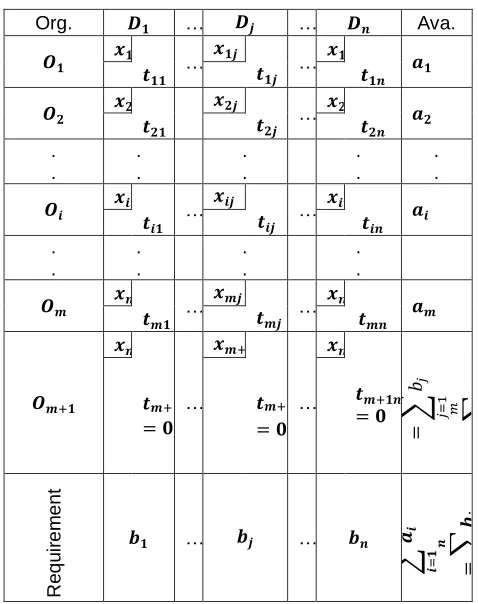
Modified Balanced transportation Table: ∑ a = ∑ b
Destination Or g. … . … . Ava . …. … . … . = . . . . . . . . . . . . …. … . = . . . . . . . . . . …. … . = R e q u ir e m e n t … … = ∑ − ∑ ∑ = ∑
Figure 3.Transpotation table of Modified balanced transportation problem
Unbalanced transportation Table: (shortage in availability ie.
∑ a < ∑ b)
920
. .
. .
. .
. .
…
.
…
.
R
e
q
u
ir
e
m
e
n
t
… …
∑
<
∑
Figure 4.Transpotation table of unbalanced transportation problem
Modified Balanced transportation Table: ∑ a
= ∑ b
Org. … … Ava.
…
…
…
. .
. .
. .
. .
. .
…
…
. .
. .
. .
. .
…
…
…
…
=
∑
−
∑
=
=
=
R
e
q
u
ir
e
m
e
n
t
… …
∑ =
∑
Figure 5.Transpotation table of Modified balanced transportation problem
2.SOLUTION METHOD
Consider a balanced TMTP with m origin and n destination The hauler can able to transport the goods from the starting point to end place in a single time. The transportation time
t is not depend upon the goods carried. There are two type of solution in the TMTP first one is IBFS and second one upgrading of the IBFS.
The solution of IBFS is denoted by Optimum (Minimum)
time of Transportation Z( )(x) = { Max
(i, j) t ∶ x > 0} =
t ( ), where n (n=1,2,3,4…..) is number of iteration. Note
that (r, s) cell may or may not be unique.
And also calculate Total transportation time T(x) = ∑ ∑ t u where the auxiliary function u =
{1 ; x > 0
0 ; x = 0 . Efficiency of Transportation E(x) =
∑ ∑ t x .
Here the better IBFS is obtained by leaving basic cell which have maximum time. If the basic cell transportation time is greater than non basic cell transportation time then leave the basic cell and enter the non basic cell into the basis which rearrange the current allocation. Crossed out the cells which have larger time than the (r, s) cellThe better solution gives the allocated value {x } either partially or fully converted into other allocated cell or non allocated cell with minimum time. The balanced TP form a closed loop , this loop provide the suitable non basic cell enter into the basis. The closed loop always having even number of cells. Let the amount φ is to be shifted and it is less than are equal to basic variable x ,.choose the φ value only for the basic allocation x such that x ± φ ≥ 0. Add the φ to the ‗+‘ sign and subtract the φ to the ‗-‗sign of the closed loop. Iteratively all the non basic cell would be crossed out.
3. A
INNOVATIVE
APPROACH
FOR
SOLVING
TRANSPORTATION PROBLEM
The process of proposed method is carried out in stepwise.
Step 1: To check the given time transportation table is balanced. Suppose the given time transportation table is unbalanced convert into balanced.
Step 2: Calculate the range in each row and each column it is display in the outside of the table. choose any one row or column with highest range value. Assign a feasible value with negligible unit time in the selected row or column. Eliminate the satisfied row (or) column and modify the TT . Suppose row and column both are fulfilled concurrently, eliminate any one and the remaining one has zero availability( or) zero requirement . If tie occur then choose the cells with minimum time and utmost allocation can be made. Suppose the least time and highest allocation also tie chose any one arbitrarily.
Step 3:
(i) Any one of the row (column) with zero (or) nonzero capacity (requirement) calculate the basic variable by using Matrix minima method then stop.
(ii)Otherwise go to step 2 and again the same process until the requirement and capacity are drained.
Step 4:
Display all the basic variable x to the corresponding cells in the given transportation table.
Test for Optimality:
(i) If all the basic cells transportation time is less than or equal to the non basic cells transportation time in its row(column) then cross out all the non allocated cells and also the non - degenerate basic cells are not form a loop then the present BFS is optimum.
921
solution is optimum. To find optimum
valueZ(x), T(x) and E(x).Otherwise go to the improved optimum solution
Step 5: Improved optimum solution
Selected non basic cell with generate a closed loop time transportation table, put a ‗+‘ sign and ‗-‗ sign to the closed loop. Calculate following values
Entering value
∅ = {x /x lies in ′−sign of cells in closed loop}
Add the ∅ to ‗+‘ sign of closed loop ie, x + ∅ > 0 and subtract the ∅ to the ‗-‗ sign of the closed loop ie, x − ∅ ≥ 0
, the cell with x − ∅ = 0 , is leaving the basis and cross out
the cell.
Value of loop V = t − t + t + t … …. Where t is entering non -basic cell transportation time and
t , t , t , t ….etc are basic cell transportation time in the closed loop.
Weightage of the loop W = t − t Where t is entering non -basic cell transportation time and t leaving basic cell
transportation time.
By examine the value of V and W and it is conclude that
(i) If all V > 0 𝑛𝑑 W > 0 ,then the loop is rejected and current solution is optimum and unique.
(ii)If all V ≥ 0 and W ≥ 0 ,then the loop is rejected and current solution is optimum and alternate optimum exists. (iii)If V > 0 or V < 0 and at least one W < 0, then loop is accepted .suppose more than one loop is accepted then select loop with most negative value of W .Therefore the current solution is not optimum .Rearrange the allocation and go to the step 6.
Step 6: Do again the steps 4 and 5 awaiting all non basic cell crossed out and the optimum solution is reached calculate optimum value of Z(x), T(x) and E(x).
4.NUMERICAL ILLUSTRATION
Example-6.1
A air force tools is to be transported from three origins to four destinations the availability of the origins, the requirement of the destination and time of shipment is shown in the table below and find the total time required for shipment is minimum Z(x), Total time of transportation T(x)
and Transportation efficiency E(x) by using maximum range method.
Transportation table 6.1.1
O
ri
g
in D D D D
A
va
ila
b
ili
ty
O 10 0 20 11 15
O 1 7 9 20 25
O 12 14 16 18 5
R
e
q
u
ir
e
m
e
n
t
12 8 15 10 45
Solution of Example 6.1
Iteration :I
From the Transportation Table 6.1.1, Sum of availability and Sum of requirement are equal. Therefore ,the above time TT is a balanced. To find optimum solution by applying MRM allocations are obtained as follows
Destination
O ri g i nD D DA v a il a b il it y
O 10 8 20 7 15
0 11
O 12 13 25
1 7 9 20
O 12 8 2 3 5
16 18
R e q u ir e m 12 e n t 8 15 10 45 Transportation table 6.1.2
Hence, Initial basic feasible solution Z( )(x) = 18, T(x) =
55 minitues and E(x) = 292
Iteration :II
Improved Optimality
O
ri
g
in
D D D D
A
va
ila
b
il
it
y
O 10 5 20 10 15
0 11
O 12 3 10 20 25
1 7 9
O 12 8 5 18 5
16
R
e
q
u
ir
e
me
n
t
12 8 15 10 45
Transportation table 6.1.3
Hence, Improved basic feasible solution Z( )(x) =
16, T(x) = 44 minitues and E(x) = 313
Iteration :III
Destination
O
rig
in D D D D
A
va
ila
b
i
lity
O 10 5 20 10 15
0 11
O 7 3 15 20 25
1 7 9
O 5 8 16 18 5
12
R
e
q
u
ir
e
m
e
n
t
12 8 15 10 45
Transportation table 6.1.4 Hence, Optimum solution
922
7.RESULTS
AND
DISCUSSION
Finally an optimum solution reached by the ―Maximum Range Method (MRM) ‖, the result is compare with the results obtained by NWCM, VAM and LCM are explained in the following result analysis table in Table 7.1As observed from Table 7.1, the MRM present comparatively a best Optimum solution than the results acquire by the established algorithm NWCM, VAM and LCM. Efficiency of MRM has also been tested by solving numerous balanced and unbalanced TP and it is establish that the MRM yield relatively a best outcome with minimum number of iteration.
8.
CONCLUSION
In this article to develop a new algorithm for TMTP provide the optimum solution for cost, time and efficiency of
Transportation even in the least iteration and also in minimum computation time. In a real life situation, such that the varying financial and ecological conditions, the time is vital role for transportation. Therefore TMTP is one of the best method in the time minimize transportation system. It can be serve in the emergency period of organization, military and fire service, and in transportation of fresh food and vegetables etc. Finally this method is very useful to manager to make a good decision in a grave situation.
9 REFERENCES
[1] Hammer, P.L., "Time minimizing transportation problem‖, Naval Research Logistics Quarterly, 16, 1969, pp. 345-357.
[2] R. Garfinkel and M. Rao, The bottleneck
transportation problem. Naval Research Logistics Quarterly, 18, 1971, 72–465
[3] W. Szware, Some remarks om the transportation problem, Naval Research Logistics, 18, 1971, 473-85.
[4] H. Bhatia, K. Saroop, and M. Puri, A procedure for time minimization transportation problem, Indian Journal of Pure and Applied Mathematics, 8, 1977, 29–920.
[5] Sharma, J.K., and Swarup, K., "Time minimizing transportation problems", in Proceedings of Indian Academy of Sciences- Mathematical Sciences, 86, 1977, pp. 513-518.
[6] C.R. Seshan, C.R and Tikekar, V.G. On
Sharma-Swarup algorithm for time minimizing
transportation problems, Proc. Indian Acad. Sci., 89 (2), 1980 101−102.
[7] Khan, A.R., Vilcu, A., Uddin, M.S. and Istrate, C. 2016. An efficient procedure to determine the initial basic feasible solution new method for solving bottleneck-cost transportation problems. In Proceedings of International Conference on Exploring Services Science, Springer. 201-212 [8] Agarwal, S. and Sharma, S. 2014. An open loop
method for time minimizing transportation problem with mixed constraints. In Proceedings of International Conference on Innovative Approach in Applied Physical, Mathematical/Statistical,
Chemical Sciences and Emerging Energy
Technology for Sustainable Development. 83-89.
[9] Nikolic, I. 2007. Total time minimizing
transportation problem. Yugoslav Journal of Operations Research. 17. 125- 133.
[10]Ahmed, M. M. and Islam, M. A., Katun, M., Yesmin, S. and Uddin M. S. 2015. New Procedure of Finding an Initial Basic Feasible Solution of the Time Minimizing Transportation Problems. Open Journal of Applied Sciences. 5. 634-640.
Name of the methods
N
o
.
It
r. Basic solution
Transportation Time
Is
i
t
O
p
t.
Opt. Tota
l Eff.
Z(x) T(x) E(x)
NWCM I
x = 12; x = 3; x = 5; x =
15; x = 5; x = 5 20 64 480 No
Improved Optimum
II
x = 12; x = 3; x = 8; x = 15; x = 2 ; x = 5
20 62 474 No
III
x = 10; x = 5; x = 2; x = 8; x = 15;
x = 5
18 56 438 No
IV
x = 5; x = 10; x = 7; x = 3; x = 15;
x = 5
12 50 413 No
V
x = 5; x = 10; x = 7; x = 3; x = 15;
x = 5
12 40 333 Yes
LCM I
x = 8 ; x = 7; x = 12 ; x = 13; x = 2; x = 3
18 55 292 No
Improved
Optimum II
x = 8 ; x = 7; x = 10 ; x = 15; x = 2; x = 3
18 51 300 No
III
x = 5 ; x = 10; x = 10 ; x = 15; x = 2; x = 3
14 47 321 No
IV
x = 5 ; x = 10; x = 7 ; x = 3; x = 15; x = 5
12 40 333 Yes
VAM I
x = 8; x = 7; x = 12 ; x = 13; x = 2; x = 3
18 55 292 No
Improved
Optimum II
x = 8 ; x = 7; x = 10 ; x = 15; x = 2; x = 3
18 51 300 No
III
x = 5 ; x = 10; x = 10 ; x = 15; x = 2; x = 3
14 47 321 No
IV
x = 5 ; x = 10; x = 7 ; x = 3; x = 15; x = 5
12 40 333 Yes
MRM I
x = 8; x = 7; x = 12 ; x = 13; x = 2; x = 3
18 55 292 No
Improved
Optimum II
x = 5 ; x = 10; x = 12 ; x = 3; x = 10; x = 5
16 44 313 No
III
x = 5 ; x = 10; x = 7; x = 3; x = 15; x = 5
![Avaliando a similaridade semântica entre frases curtas através de uma abordagem híbrida (A hybrid approach to measure Semantic Textual Similarity between short sentences in Brazilian Portuguese)[In Portuguese]](data:image/gif;base64,R0lGODlhAQABAIAAAP///wAAACH5BAEAAAAALAAAAAABAAEAAAICRAEAOw==)