Local Binary Pattern For Medical Video Analysis
And Retrieval With Canberra Distance Vector
P.Gowthami, Dr.J.Chockalingam
Abstract: The computer aided image vision system plays dominant role in disease diagnosis. The medical image, video contents vary in different texture, orientation, colour and shape. The video retrieval system has gained interest due to growing volume of visual and multimedia data. Conventionally, video retrieve from database based on specific patterns, shape and structure. However, the complex organ structure in brain and abdomen, cause inaccurate video retrieval. In this paper, we propose Local Binary Pattern (LBP) for effective medical video retrieval from video database. Initially, the input video file converts to video frames. The LBP via circular symmetric neighbourhood selects sampling point and neighbouring pixels for video retrieval from database. The effectiveness of video retrieval system validate by physician. The LBP based video retrieval system performs better compared to Uniform-LBP (ULBP) and Local colour vector binary pattern (LCVBP) algorithms.
Index Terms: MR, CT, Local binary patter, pixel classification, pattern recognition, video retrieval. ULBP and LCVBP. —————————— ——————————
1. INTRODUCTION
ideo retrieval is a process of retrieving video from a database repository based on the query from a user. Upon receiving query from user, video retrieval can provide relevant and accurate videos in several applications. Video retrieval has many applications such as medical diagnosis, healthcare services, digital libraries, publications, education, broadcasting, and entertainment. Video retrieval classify as Content Based Video Retrieval (CBVR) and Text Based Video Retrieval (TBVR). CBVR is the process of retrieving video sequences based on the features like texture, shape and color of the video frame. TBVR is the process of retrieving videos based on the information tagged with the videos. The user queries the database in different ways such as text, image and image features.
Video retrieval is essential in medical diagnosis because, the shape, texture and color of video frame provide meaningful biomarkers for disease diagnosis. Medical video provides visualization of internal organs, which aid in physicians to diagnosis disease and monitor treatment‘s effect. In video retrieval for medical diagnosis, the content-based video retrieval approach retrieves the most visually similar video frames when a query video frame from the database repository is provided. Another technique to retrieve medical videos is to extract a key feature in object form to reduce storage space. In addition, Content Based Image Retrieval (CBIR) is an essential approach in medical diagnosis. However, this approach yields visual results only, because two images with similar appearance may have conflicting semantic annotations. So CBIR would lead the physician towards a false diagnosis. The video content from the database is classified into low level or spatial features and high level or temporal features. Low-level features are texture, shape, and color of object. High-level features are semantic features.
Features like
timbre, rhythm and events have different semantics. The similarity of features in vector based video frames measure with Euclidean distance. The Euclidean distance utilizes to define similarity when fine geometric differences among video frames are important. Graph matching enables comparison of video frames based on combination of features in video frames and arrangement of objects in video frames. One of the most important problem in video retrieval process is identifying similarity between query submitted by physician and video stored on database through which the physician can perform medical diagnosis. Conventionally, video retrieval techniques such as the indexing, clustering and feature extraction introduce to solve similarity matching. However, the techniques fail to provide accurate retrieval. The inaccurate retrieval causes loss of medical diagnostic information while representing a video frame in terms of its features. In this paper, a Local Binary Pattern (LBP) based video retrieval technique is presented to overcome the problems in similarity identification. Local Binary Pattern (LBP) is an effective texture operator that labels an image‘s pixels by thresholding each pixel‘s neighborhood and yields the result as a binary number. After performing LBP on two video frames, Histogram comparison is performed and the equivalent video frame is provided.
2
LITERATURE
SURVEY
The pilot surveillance scheme along with speech-based interface applies for content-based video data retrieval. The pilot surveillance system comprises of ontology-based data sharing architecture. The system components communicate between each other through Transmission Control Protocol / Internet Protocol (TCP/IP) communication channels. The pilot surveillance system searches dependencies among event detection, video annotation, image analysis, and speech-based video content retrieval in the broader spoken dialogue scheme context [1]. In news video databases, the Content-based video retrieves by relevance feedback approach. The approach extracts several features at several spatial locations in an image. The Spatial content of image model by partitioning images via non-overlapping grid cells and assigning weights to features in grid cell. The weights update either positively or negatively as determined by user. [2] Selection of appropriate features in video provides accurate content-based video retrieval. The features classify as high level and low-level features. The low-level feature extract V
————————————————
P.Gowthami is pursuing her part time Ph.D from PG & Research Department of Computer Science, Khadir Mohideen College, Adirampattinam, Affiliated to Bharathidasan University, Tamil Nadu, India., PH-+917397086972. E-mail: [email protected]
based on the shape, spatial relationship, color and texture. The content-based video retrieval retrieves video based on text query and image query. In image query retrieves image using CBIR algorithm. The text query, retrieves image using the ABIR algorithm. [3] The video compression produces bursty and variable bit rate video. The bursty nature of video degrades the accuracy of video retrieval. Hence, Video-Server Retrieval scheduling employ for effective burst video retrieval from disk system to the digital video server memory. The video Server retrieval scheduling system reduces buffer requirement and allocate fixed disk bandwidth for continuous image retrieval. [4] The object-based video content retrieves video automatically from low-level characteristics of randomly shaped video with domain independent descriptor. The method retrieves shapes from arbitrary video objects by evaluating shape features and shape deformations in video. The video objects shape similarity calculates by temporal instances. [5] The video segment retrieve from database by correlating relationship between emotional audio events (EAEs) and motion. The EAEs identify by utilizing low-level audio features and Generalized State-Space Model (GSSM) in video. The video retrieval system retrieves affective video segments such as sadness, excitement and joy with respect to EAEs and emotions. The EAEs and emotions analyze by subjective evaluation and rank based on emotion levels. [6] The content-based video retrieval technique retrieves video from videos sharing websites. The retrieval system evaluates Earth Mover‘s Distance (EMD) between videos. The EMD calculates with features such as motion, color, and position. The EMD identifies dissimilarities between videos with different time length and number of shots for content based video retrieval. [7] The objects in surveillance video search and classify with dynamic vision system. The dynamic vision system combines CCTV video and infrared thermal video information. The background modelling and thresholding in foresaid videos projects objects. The combined video via temporal linking of objects and foreground pixels aid in object tracking and video retrieval. [8] The Multilevel Thepade's Sorted Ternary BTC (MTSTBTC) extract features for video retrieval. The MTSTBTC divides video frame into three parts. The average color component of pixel intensity values computes for each part. The feature vector of each frame compute with color components. The video retrieve from database with combined feature vector and absolute difference measurement. [9] A flexible video coding technique applies for content-based video storage and retrieval. The flexible video coding technique employs shot clustering on video and encodes video content with multi-clusters. The compressed video, decode with respect to video summary, video indexing and video structure. [10] The video compression degrades video retrieval performance. Hence, the video compress with samples provided by affinity propagation (clustering algorithm). The clustering algorithm improves video recall. The video retrieve from database and classify with nearest neighbor technique and video labelling. [11] The content-based video retrieve from database based on motion information in video. The motion information from video extract by multiple interactive motion trajectory. The motion trajectories index by tensor decomposition. The multiple motion object activity classifies with hidden Markov model for video retrieval. [12]
3
METHODOLOGY
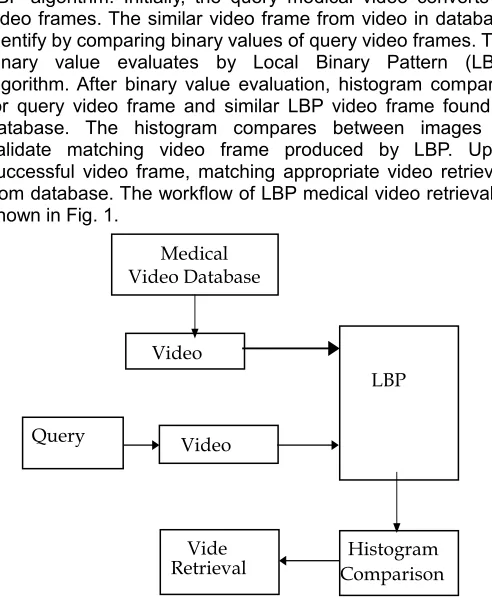
The query video retrieves from medical video repository with LBP algorithm. Initially, the query medical video converts to video frames. The similar video frame from video in database identify by comparing binary values of query video frames. The binary value evaluates by Local Binary Pattern (LBP) algorithm. After binary value evaluation, histogram compares for query video frame and similar LBP video frame found in database. The histogram compares between images to validate matching video frame produced by LBP. Upon successful video frame, matching appropriate video retrieves from database. The workflow of LBP medical video retrieval is shown in Fig. 1.
Fig. 1. Workflow of LBP Medical video retrieval. 3.1 Local Binary Pattern (LBP)
Local Binary Pattern (LBP) is an effective texture operator, which yields binary value of pixels by thresholding each pixel‘s neighborhood. Due to its low computational complexity and discriminative power, LBP texture operator has become an essential technique in several applications. The LBP can be viewed as a unique approach to the conventionally divergent structural and statistical texture analysis models. The LBP operator is adaptive while making monotonic gray scale changes to video frames. The low computational complexity of LBP operator makes it suitable to analyze video frames from videos in real time environments. The LBP implement in four ways such as simple LBP operator, circular neighborhood, and uniform patterns.
3.2 Simple LBP Operator
The input video frame converts to respective grey-scale video frame. This process is performed before implementing any other technique. LBP operator is often utilized in the greyscale video frame, where a code is written for every pixel. For example, when taking a cell of 3x3 pixels, the central pixel value is compared with every surrounding pixels. Any order of pixels is admitted, but here the starting of the pixel is the top left pixel, when using clock-wise direction. When the central pixel‘s value is smaller than or equal to the neighbor pixel‘s value then l is considered, otherwise a 0 is considered. The resulting value is a binary number that is related to a pattern. A weight is assigned to obtain binary number‘s for every digit and a corresponding item can be calculated as shown in Fig. 2
Query Video
Medical Video Database
Video Frame
Video Frame
LBP
Histogram Comparison Vide
Fig. 2. LBP Operation 3.3 Circular neighborhood
LBP operator using 8 pixels in a 3 x 3 pixel block do not restrict the neighborhood‘s size. Later, the LBP operator extends to the use of pixel‘s neighborhoods of various sizes. As a consequence, from the pixel located at the center, the pixel neighborhood with radius R is considered. Consequently, P sampling points on this circle‘s edge are chosen and compared with the center pixel‘s value. In order to attain all sampling points‘ values in the neighborhood any number of pixels and for any radius, bilinear interpolation is important. The three neighbor sets for various values of P and R are shown in Fig. 3.
Fig. 3. Circular Neighborhood 3.4 Uniform Patterns
Uniform patterns represent patterns in image where only two transactions from 0" to,1", or vice versa, are present. For example, the binary code 0011110 contains 3 transactions; the code 00001000 includes 2 transactions, and the code 10000000 has only one transaction. When considering the uniform LBP mapping, a separate output label for each uniform pattern is included, while all the non-uniform patterns are assigned to a single label. As a consequence, the number of different output labels for patterns mapping of P bits is P (P - 1) + 3. The uniform mapping produces 59 output labels for neighborhoods of 8 sampling points. In Fig. 4 some texture primitives detected by uniform LBP pattern are illustrated.
Fig. 4. Different texture primitives of LBP
4
RESULTS
AND
DISCUSSION
The LBP retrieves video frame from video in database by pattern matching. The LBP use parameters such as reference to the point, circularly symmetric neighborhood window and normal to the plane, for video frame matching. In reference point parameter, a pixel in video frame select based on average pixel values in a window. If the average pixel value of local window does not provide accurate video frame matching then global average pixel value is taken. The LBP video frame retrieval performance further improves by taking mean value and neutral color of video frame. In circularly symmetric neighborhood window, the ‗P‘ sampling point is selected with radius ‗R‘ to define local neighborhood for video frame matching has shown in Fig. 5. In normal to the plane, the gray pixels, white pixel and black pixels combine to form normal plane. In normal plane, thresholding applies to differentiate pixel intensity differences.
Fig. 5: Neighbors of pixel, where p is member of circle and R is radius
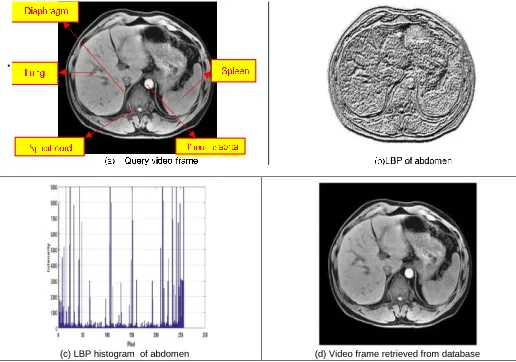
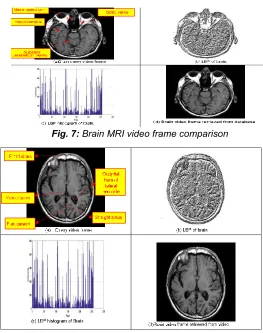
The LBP operator determines similarity index between video frames of query video and video in database for video retrieval has shown in figure 6. The similarity index determines by comparing binary patterns in range of 0 to 2P-1. The similarity index is also referred to as distance vectors. The distance vectors compute with methods such as chi-square, extended Canberra, Canberra, square chord, Jeffery distance, and histogram intersection. Here, the Canberra distance vector computes with respect to particular pixel in video frame. The Canberra distance produce LBP patterns for pixels in video frame and features represent as LBP pattern histogram. The LBP pattern histogram compare for query video frame and video frame in database for retrieval. The video retrieval performs for different query video such as abdominal MRI, Brain MRI as shown in Fig. 6, 7 & 8 respectively. The abdomen (axial view) CT video comprises of organs such as liver lobe both left and right, thoracic aorta, spinal cord, diaphragm, lung and spleen as in Fig. 6
.
Fig. 6: Abdominal CT video frame comparison.
(c) LBP histogram of abdomen
Fig. 7: Brain MRI video frame comparison
Figure 8: Brain MRI video frame comparison
4.1 Validation
The database applied for video retrieval system comprises videos of different organ parts such as abdomen and brain. The MR videos have different intensity level and contrast. The features of abdomen anatomy such as thoracic aorta, lung, spleen, diaphragm and brain anatomy such as Nasal spectrum, olfactory nerve, hippocampus, optic nerve, frontal sinus, occipital horn lateral ventricle, straight sinus flax cerebi and vein of galen, improve video frame retrieval. The orientation of MR video frame, intensity and contrast are major factors, which are major challenges in video frame retrieval process. The 852 video frames from video were selected for video retrieval. An expert physician semantically labelled the MR video frames to evaluate video retrieval accuracy has shown in table 1. The ‗f‘ measure of video frame represents test accuracy and defines harmonic mean of recall and precision of video frame. The ‗f‘-measure of a video frame is given by (1), precision and recall are given in (2 ) and (3).
(1)
Where, p‘ is precision and r‘ is recall and ‗a‘ is assigned weight 0.25.
The precision of a video frame is given by
(2)
Where,
|E| is correct number of estimates,
m (re, T) represents match between two features and, the recall of video frame is given by
(3)
The mean average precision of video frame is given by (4).
(4)
TABLE 1
COMPARISON OF MR VIDEO FRAME RETRIEVAL
From table 1, the video frame retrieval performs better for body parts such as neck, chest, spine and abdomen due to distinct features in MR video frames. However, the video frame retrieval performs less for brain MR video frames with 92 to 95% accuracy due to similar features of query input video frame compared to video frame in database. The table 2 shows comparison of different methods with LBP algorithm for image retrieval. From table 2 the LBP perform better in video retrieval with minimum time compared to ULBP and LCVBP.
4.2 Uniform Local Binary Pattern (ULBP)
The uniform LBP make with patterns of circular transitions from 0-1 and 1-0. For given patterns of 11111111, 11011111, 00111000, and 00000000 the patterns 01001110, 01010000 and 10101100 are non-uniform. The uniform pattern selection in image frame produce minimal feature vector. The uniform LBP also provides rotation invariance for texture classification in video frames.
Organ Orientation Texture (%)
Non- Texture
(%) Mean average precision
(mAP) Precision
Recall f - score
Retrieval time (sec)
Physician Remark
(%)
Brain Axial 91.25 87.54 0.72 0.45 0.75 0.46 2.3 95
Neck Axial 82.52 84.23 0.81 0.42 0.72 0.48 2.9 98
Chest Axial 87.35 83.51 0.69 0.39 0.71 0.42 1.9 96
Spine Axial 83.25 89.56 0.87 0.48 0.75 0.54 2.5 98
Abdomen Axial 89.53 81.25 0.75 0.52 0.79 0.49 3.2 97
Hip Axial 84.18 88.25 0.79 0.61 0.82 0.43 1.9 97
Brain Coronal 89.25 85.35 0.75 0.49 0.69 0.48 2.87 92
Neck Coronal 83.05 82.45 0.86 0.38 0.73 0.42 3.2 97
Chest Coronal 85.25 86.25 0.73 0.43 0.85 0.43 2.5 95
Spine Coronal 81.55 87.28 0.82 0.45 0.69 0.52 3.4 98
Abdomen Coronal 88.26 79.25 0.78 0.54 0.73 0.52 3.9 96
4.3 Local colour vector binary pattern (LCVBP)
The LCVBP extracts feature from video frames by combining features from color angular pattern and color norm pattern in video frame. The color norm pattern computes from center pixel, color vector. The color vector represents particular point ‗n‘ spaced at equal distance from pixel locations. The color norm value is determined by (5)
(5) Where,
‗r‘ is radius
‗c‘ represents component vector in video frame.
‗
‘ represents color values The table 2 shows the performance comparison with other related algorithmsTABLE 2
PERFORMANCE COMPARISON WITH OTHER ALGORITHM
5
CONCLUSION
The query medical video retrieves from video database with LBP algorithm. The LBP algorithm applies for different medical videos such as brain, hip, abdomen, chest and spine. The LBP algorithm retrieves video efficiently for abdomen, chest, hip and spine due to distinct features of organ borders and structures. However, the video retrieved for brain (axial view) were with minimal variations due to similar structure and texture features in MR video as validated by physician. The performance of LBP algorithm compares with ULBP and LCVBP algorithm for MR video dataset. Comparative analysis shows LBP performs well compared to ULBP and LCVBP in terms of precision, recall and retrieval time.
REFERENCES
[1] B. QasemiZadeh et al., ―A speech based approach to surveillance video retrieval,‖ 6th IEEE Int. Conf. Adv. Video Signal Based Surveillance, AVSS 2009‖, vol. 3, no. 4, pp. 336–339, 2009.
[2] N. Videos, ―A Relevance Feedback Technique for Multimodal Retrieval of News Videos,‖ Selim Aksoyy, Member, IEEE Ozge Qavus, vol. 2, no. 3, pp. 22–24, 2005.
[3] V. A. Wankhede and P. S. Mohod, ―Content-based image retrieval from videos using CBIR and ABIR algorithm,‖ Glob. Conf. Commun. Technol. GCCT 2015, vol. 2, no. 3, pp. 1–5, 2015.
[4] [4] Seungyup Paek and Shih-Fu Chang, ―Video-Server Retrieval Scheduling and Resource Reservation for Variable Bit Rate Scalable Video,‖ IEEE Trans. CIRCUITS Syst. VIDEO Technol., vol. 10, no. 3, pp. 1–15, 2002
[5] B. Erol and F. Kossentini, ―Shape-based retrieval of video objects,‖ IEEE Trans. Multimed., vol. 7, no. 1,
pp. 1–4, 2005.
[6] Z. Pantic, ―Affective video segment retrieval for consumer Generated videos based on correlation between emotions and emotional audio events,‖ Emotion, vol. 2, no. 3, pp. 0–3, 2009.
[7] K. Takada and K. Yanai, ―Web video retrieval based on the earth mover ‘ s distance by integrating color , motion and sound,‖ Icip 2008, vol. 3, no. 2, pp. 89–92, 2008.
[8] C. Ó. Conaire, N. E. O‘Connor, E. Cooke, and A. F. Smeaton, ―Multispectral object segmentation and retrieval in surveillance video,‖ Proc. - Int. Conf. Image Process. ICIP, vol. 3, no. 4, pp. 2381–2384, 2006.
[9] S. D. Thepade, K. S. Subhedarpage, and A. A. Mali, ―Performance Rise in Content Based Video Retrieval using Multi-level Thepade‘s sorted ternary Block Truncation Coding with intermediate block videos and even-odd videos,‖ Proc. 2013 Int. Conf. Adv. Comput. Commun. Informatics, ICACCI 2013, vol. 3, no. 2, pp. 962–966, 2013.
[10]J. Zhang, L. Sun, S. Yang, and Y. Zhong, ―Flexible Video Coding Scheme for Contentbased Video Storage and Retrieval,‖ vol. 3, no. 4, pp. 66–71, 2006. [11]A. Karpenko and P. Aarabi, ―Tiny videos: A large data set for nonparametric video retrieval and frame classification,‖ IEEE Trans. Pattern Anal. Mach. Intell., vol. 33, no. 3, pp. 618– 630, 2011.
[12]D. Schonfeld, ―MotionSearch: Context-Based Video Retrieval and Activity Recognition in Video Surveillance,‖ Adv. Video Signal Based Surveill. Plenary, vol. 3, no. 2, pp. 194–194, 2009.