Talking Helps: Evolving Communicating
Agents for the Predator-Prey Pursuit Problem
Kam-Chuen Jim
C. Lee Giles
[email protected] [email protected]
NEC Research Institute, Inc. 4 Independence Way
Princeton, NJ 08540
School of Information Sciences & Technology and Computer Science and Engineering
The Pennsylvania State University University Park, PA, 16801
Physiome Sciences, Inc. 307 College Road East
Princeton, NJ 08540
Abstract
We analyze a general model of multi-agent communication in which all agents communicate simultaneously to a message board. A ge-netic algorithm is used to evolve multi-agent languages for the preda-tor agents in a version of the predapreda-tor-prey pursuit problem. We show that the resulting behavior of the communicating multi-agent system is equivalent to that of a Mealy finite state machine whose states are determined by the agents’ usage of the evolved language. Simula-tions show that the evolution of a communication language improves the performance of the predators. Increasing the language size (and thus increasing the number of possible states in the Mealy machine) improves the performance even further. Furthermore, the evolved communicating predators perform significantly better than all previous work on similar preys. We introduce a method for incrementally in-creasing the language size which results in an effective coarse-to-fine search that significantly reduces the evolution time required to find a solution. We present some observations on the effects of language size, experimental setup, and prey difficulty on the evolved Mealy ma-chines. In particular, we observe that the start state is often revis-ited, and incrementally increasing the language size results in smaller Mealy machines. Finally, a simple rule is derived that provides a pes-simistic estimate on the minimum language size that should be used for any multi-agent problem.
1
Introduction
An important decision that needs to be made when designing a learning multi-agent system is choosing the sensory information to the system. Pro-viding too little information will result in faster learning but will not allow the system to find an optimal solution. On the other hand, providing too much information can significantly increase the learning time because of the larger search space, though the optimal solution becomes possible. Allowing agents to communicate and to learn what to communicate can significantly ease the burden on the designer. This paper studies an ideal case where each agent has access to a small set of local information and through experience learns to communicate only the additional information that is important.
at the relationship between the communication behavior of a multi-agent system and the finite state machine that completely describes this behav-ior. With this knowledge we can better understand how communication increases the representational power of a multi-agent system.
1.1 Previous Work
The role of communication in multi-agent systems remains one of the most important open issues in multi-agent system design [4]. There have been several efforts to standardize communication protocols and languages to facilitate coordination between agents, although these efforts are still rela-tively immature. The Knowledge Query and Manipulation Language (KQML) is a communication protocol for exchanging knowledge and information. A description of KQML can be found in Labrou and Finin [13], but KQML is still a work in progress and its semantics have not been completely defined. The Knowledge Interchange Format (KIF) is a formal syntax for represent-ing knowledge. The KIF language is a prefix version of first order predicate calculus, and has been proposed as a standard for describing knowledge in expert systems and intelligent agents. Speech act theory [19] views human natural language as actions, such as requests, replies, and commitments. Speech act theory standardizes the types of communication acts available to agents. To a receiver agent understanding speech act protocols, the message contained within the communication act may be non-standard, but there is no ambiguity as to the type of message sent.
on a channel reflects the summation of all the other agents’ signals along that channel. Saunders and Pollack assigned these agents to a task in which they need to follow a broken trail of food and show it was possible to evolve agents that communicate the presence of food. Balch and Arkin [2] assigned robot agents to 3 tasks (foraging, consuming, and grazing) and showed that communication significantly improves performance on tasks with little environmental communication, and that more complex communi-cation strategies provide little or no benefit over low-level communicommuni-cation.
While many researchers have shown the emergence of beneficial com-munication, very few have analyzed the nature of the communication and how communication effects the behavior or representational power of the multi-agent system. Gmytrasiewicz and Durfee developed a “Recursive Modeling Method” to represent an agent’s state of knowledge about the world and the other agents in the world [6]. Furthermore, Gmytrasiewicz, Durfee, and Rosenchein used this framework to compute the expected util-ity of various speech acts by looking at the transformation the speech act induces on the agents’ state of knowledge[7]. Hasida et. al. [9] show that with certain assumptions, communication can be treated as an n-person game, and the optimal encoding of content by messages is obtained as an equilibrium maximizing the sum of the receiver’s and speaker’s expected utilities.
Finally, a description of some previous work on the predator prey pursuit problem is provided in the next section.
2
The Predator Prey Problem
ver-sion of the predator prey problem in which the predators were allowed to move diagonally as well as orthogonally and the prey moved randomly. Tan [22] used reinforcement learning and showed that cooperating agents that share sensations and learned policies amongst each other significantly out-performs non-cooperating agents in a version of the predator-prey problem. Nishimura and Ikegami [15] observe random swarming and other collective predator motions in a predator prey game. Stephens and Merx [21] study a simple non-communicating predator strategy in which predators move to the closest capture position, and show that this strategy is not very suc-cessful because predators can block each other by trying to move to the same capture position. Stephens and Merx also present another strategy in which 3 predators transmit all their sensory information to one central predator agent who decides where all predators should move. This central single-agent strategy succeeds for 30 test cases, but perhaps the success rate would be much lower if the agents were to move simultaneously in-stead of taking turns.
This paper uses an implementation which is probably more difficult for the predators than in all previous work:
1. In our configuration, all agents are allowed to move in only four or-thogonal directions. The predators cannot take shortcuts by moving diagonally to the prey, as they do in [12].
2. All agents have the same speed. The predators do not move faster than the prey, nor do they move more often than the prey, as they do in [10].
3. All agents move simultaneously. Because the agents do not take turns moving (e.g. [21]) there is some uncertainty in anticipating the result of each move. In addition, moving the agents concurrently in-troduces many potential conflicts, e.g. two or more agents may try to move to the same square.
4. The predators cannot see each other and do not know each other’s location. If this type of information is essential to getting successful captures then the predators will have to evolve a language that can represent such information.
observed vertically. No two agents are allowed to occupy the same cell at the same time. Agents cannot move through each other. If two or more agents try to move to the same square they are all blocked and remain in their current positions. At the beginning of each scenario the predators and prey are randomly placed on different squares. Each scenario continues until either the prey is captured, or until
time steps have occurred without a capture.
Two prey strategies are used in the simulations. The Random Prey chooses it’s next action at each time step from the set N, S, E, W using a uniform random distribution. The Linear Prey picks a random direction at the beginning of a trial and continues in that direction for the duration of the scenario. It has been shown that the Linear Prey can be a difficult prey to capture [20], [10] because it does not stay localized in an area. In our simulations this is an even more difficult prey to capture because the prey and predators move at the same speed.
3
Communication
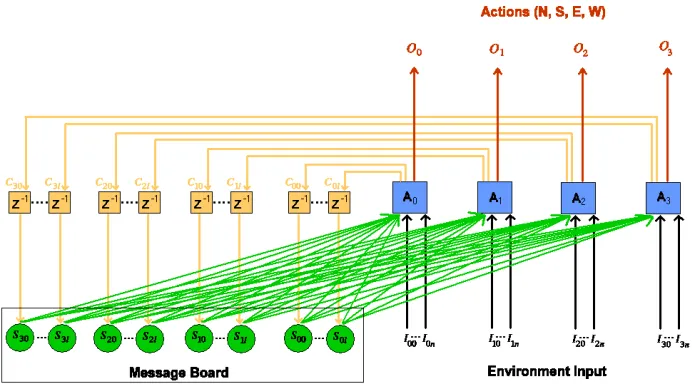
This paper studies a simple framework in which all predator agents com-municate simultaneously to a message board. See Figure 1. At every iter-ation, each predator agent speaks a string of symbols from a binary alpha-bet . The communicated symbols are placed on the message board.
Each agent then reads all the strings communicated by all the predator agents and determines the next move and what to say next. The strings are restricted to have equal length. We vary the length of the strings and
study the effect on performance.
3.1 Equivalence to a Finite State Machine (FSM)
This type of communication may be represented as shown in Figure 1, where is the set of homogenous predator agents, are the
ac-tions of the predators, and is the set of environmental inputs, where
is the number of inputs and is the number of communicating agents.
The message board can be interpreted as a set of state nodes.
The entire set of agents can be viewed as one finite state machine with the set of possible states specified by the state nodes . The whole
Figure 1: Multi-Agent Communication as a single Finite State Machine. is
the length of the communication strings.
state of the machine and its inputs. A Mealy machine can be characterized by a quintuple
, where
is a finite non-empty set of input symbols,
is a finite non-empty set of states, is a finite non-empty set of output symbols,
is a “next-state” function which maps
, and
is an output function which maps
.
It is easy to show that the multi-agent system is a Mealy machine by describing the multi-agent system in terms of the quintuple . The input set
is obtained from the set
of all possible
con-catenated sensor readings for the predator agents (for all possible values of
). A description of the sensor readings is provided later in this paper. The
states
are represented by concatenation of all symbols in the message board. Since the communication strings comprise binary symbols ,
the maximum number of states !" in the Mealy machine is therefore
determined by the number of communicating agents and by the length
of the communication strings: !" $#
. The output set is obtained from the set %&
&('
)' of all possible concatenated
ac-tions for all the communicating agents, where* is the number of bits
re-quired to encode the possible actions for each agent (for all possible values of ). In the general case where the actions do not have to be encoded as
binary bits, the output set is simply the set+
of all possible
and output function
are determined by the agents’ action and commu-nication policies. The policies themselves may be FSMs or something with even more representational power, in such a case the multi-agent FSM is a hierarchical FSM.
3.2 Communication Can Help in Partially Observable
Environ-ments
From Figure 1 it is clear that communication allows the agents to use state information. This state information is contributed by all communicating agents and represents the state of the entire multi-agent system.
Although each individual agent may maintain its own state information, such information will be limited by the available sensors of the agent. When an agent’s next optimal action depends on information that is hidden from an agent’s sensors we say that the agent suffers from the hidden state
problem. Figure 2 shows an example of a typical hidden state problem that
is very common in the predator-prey simulations reported in this paper. In this figure, predator
sees the same sensory information for two different scenarios due to the fact that predators cannot sense each other directly. In scenario , predator
attempts to move South but is blocked by predator
in its path, while in scenario
predator
is attempting to move South and is not blocked.
Communication allows agents to “tell” each other environmental infor-mation that may have been observable only to a subset of the agents. Ob-viously, communication will be of little use in this respect in the limit when the same set of information is observable to all agents. The message board can be viewed as part of the environment. With this equivalent interpreta-tion, the message board disambiguates the environmental states observed by each agent by providing information that may have been hidden other-wise - assuming the agents are able to communicate effectively.
Figure 2: An example hidden state problem. Predator
sees the same sensory information for both scenarios and
, but in fact scenario
is very different from : in scenario predator
is blocked, while in scenario
4
Experimental Setup
A genetic algorithm is used to evolve predators that communicate. A set of experiments is performed with communication strings of varying length
. As the length increases, the number of strings that are available for
communicative acts increases exponentially.
In the sections that follow, GA predators are labeled as GaPredator(),
where is the length of the communication strings. A communication string
of length zero means the predators are not communicating.
The performance of grown predators (see Section 4.2 below) is also compared. These predators are labelled as GaPredator(
, where
is the string length before the agent is grown, and
is the length it was grown to.
Separate populations of GaPredator(
), GaPredator(
), GaPredator(#
), GaPredator(
), and GaPredator( #
) predators are matched against the Random and Linear preys. The initial GaPredator(
) population is grown from the GaPredator(
) population with the best average fitness, and similarly the initial GaPredator( #
) population is grown from the GaPredator(
) population with the best average fitness.
4.1 Encoding Predator Strategies
The behavior of each evolved predator is represented by a binary chromo-some string. The length of the chromosome string is a function of the number of possible states !" observable by the predator based on its
sensory information, and the number of actions
( .
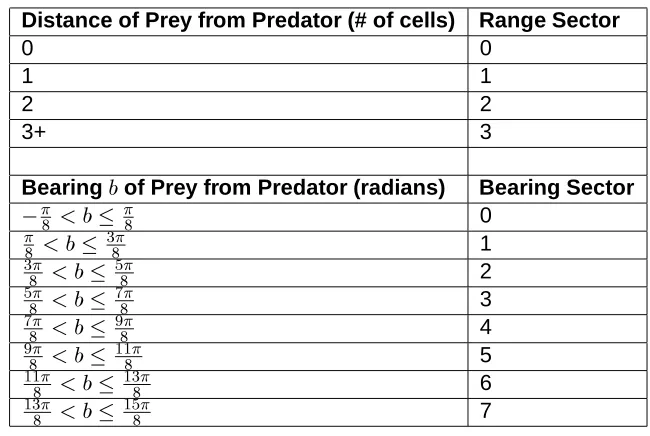
The sensory information available to the predators comprise the range and bearing of the prey, and the contents of the message board. The range (measured in terms of Manhattan distance) and bearing are discretized into !
and !
sectors, as detailed in Table 1. The number of symbols on the message board is , where is the number of
predator agents. The message board can have !" !" #
possible messages. The total number of states that can be sensed by a predator is therefore !"
!! !" !" . The actions comprise the
moves
, and speaking a string of length at each iteration..
The number of binary bits required to represent the
moves are !"
#
. Thus, the total number of action bits is
(
!" . We arrive at
Distance of Prey from Predator (# of cells) Range Sector 0 0 1 1 2 2 3+ 3 Bearing
of Prey from Predator (radians) Bearing Sector
0 1 2 3 4 5 6 7
Table 1: Discretization of predator-prey range and bearing. Range is mea-sured in Manhattan distance.
communicates with strings of length in a team of predators:
( !"
!" !! # (1)
so the chromosome length increases exponentially with communication string length and number of agents .
4.2 Growing GA Predators - Coarse to fine search
To improve efficiency, it would be useful to grow the predators. Growing means taking a population of predators that have already evolved a lan-guage from a set of possible strings, and evolving them further after in-creasing the set of possible strings they are allowed to communicate. This re-uses the knowledge acquired by predators that were limited to a smaller language. This is effectively a coarse-to-fine search; as we increase the search space by increasing the number of possible strings, the agents can refine the language and communicate other useful, but possibly less criti-cal, information.
changes in order to cope with new meanings that have to be expressed.” When a population of GA predators with chromosome length is
grown to a length of
, each new chromosome is encoded such that
the behavior of the new predator is initially identical to that of the chromo-some it was grown from. The portions of the larger chromochromo-some that are new are not visited initially because the predator is making exactly the same decisions as before and will therefore see the same set of sensory states. During the evolutionary process new sensory states will be visited and the agent will evolve accordingly.
In addition, the population size of the grown
predators is always
twice the population size of the predators they were grown from. Half
of the population of
predators are grown from the
predators,
the other half are generated randomly. In this manner the grown predators don’t rely solely on mutation for introducing new genetic material to the genes that were copied from the predators with chromosome length .
They can obtain new genetic material through crossover with the randomly generated individuals.
4.3 Evaluating the Fitness of Evolved Predators
The fitness of each evolved strategy is determined by testing it on
ran-domly generated scenarios with different starting locations for the predator and prey agents. The maximum number of cycles per scenario is
, after which the predators are considered to have failed. Since the initial popula-tion is randomly generated, it is very unlikely that the first few generapopula-tions will be able to capture the prey. We attempt to speed up the evolution of fit strategies by rewarding those strategies that at least stay near the prey and are able to block the prey’s path. The fitness of individual is computed at
the end of each generation as follows, where
is the maximum number of cycles per scenario,
is the total number of scenarios for each individual, and
is the number of captures:
If , !
where " is the average distance of
the all
predators from the prey during the scenarios, and
is the
cumulative number of cycles that the prey’s movement was blocked by an adjacent predator during scenarios. The fitness of non-capture
strategies can never be greater than
Predator Population Size Mutation Rate
GaPredator(
)
GaPredator( #
GaPredator( #
GaPredator( #
GaPredator(#
Table 2: Population Size and Mutation Rate GA parameters used in the simulations. If , !
, where is the number of cycles required
to capture the prey at scenario .
4.4 GA Setup
The following GA parameters were found experimentally to be most effec-tive. We use#
-point crossover with a crossover probability of
. The idea behind multi-point crossover is that parts of the chromosome that contribute to the fit behavior of an individual may not be in adjacent substrings. Also, the disruptive nature of multi-point crossover may result in a more robust search by encouraging exploration of the search space rather than early convergence to highly fit individuals. For a discussion of#
-point crossover and generalized multi-point crossover schemes see [11]. A Tournament selection scheme [8] with a tournament size of 5 is used to select
the parents at each generation. In Tournament selection, individuals
are chosen randomly from the population and the best individual from this group is selected as a parent. This is repeated until enough parents have been chosen to produce the required number of offsprings for the next gen-eration. The larger the tournament size, the greater the selection pressure, which is the probability of the best individual being selected compared to the average probability of selection of all individuals. The population size*
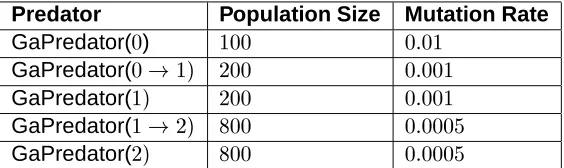
and mutation rate depends on the length of the communication string be-cause the search space increases exponentially with the communication string length. The larger search space translates into longer chromosome lengths. As a general rule, longer chromosome lengths warrant a larger population size and smaller mutation rate. The population sizes and muta-tion rates used in the experiments are listed in Table 2.
beginning of each trial. The following is a brief description of the algorithm:
1. Repeat the following for
trials on selected prey:
(a) Randomly generate a population of* individuals.
(b) Repeat until there is no improvement after#
generations:
i. Simulate each predator strategy on
scenarios and evalu-ate its fitness based on the performance on those scenarios. ii. Select* individuals from the current population using
Tour-nament selection, pair them up, and create a new population by using#
-point crossover with mutation.
(c) The best strategy found over all generations is used as the solu-tion of this trial. The fitness of this strategy is then recomputed by testing on
new randomly generated scenarios.
2. The strategy that performed best over all
trials is used as the solu-tion.
5
Results
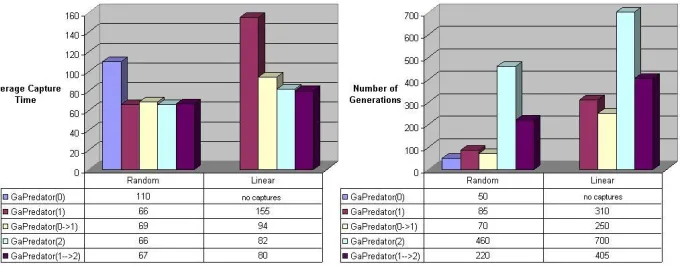
Figure 3 shows the best average capture times (over 1000 randomly gen-erated scenarios) and the cumulative number of evolutionary generations that were needed to achieve such capture times. If
is the number of generations that a GaPredator() population was evolved, and
is the number of generations that a GaPredator(
) population was further evolved after it was grown from( to
, then the cumulative
gener-ations for the best GaPredator(
) and GaPredator( #
) populations are computed as follows:
! ! # ! #
Below is a summary of the performance and convergence results:
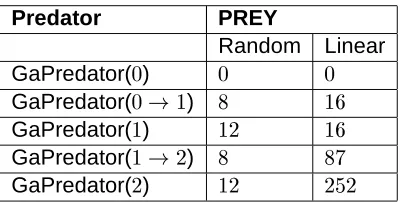
As the length of the communication string increases, the capture time decreases. However, the best capture performance of GaPredator(1) against the Random prey is comparable to the best performance of GaPredator(2) and GaPredator( #
Figure 3: Best capture times and the corresponding number of evolutionary generations required to evolve the communicating predators against Ran-dom and Linear preys, at communication string lengths 0, 1, and 2.
The evolutionary generations required increases with the length of the communication string.
The capture performance of grown predators is comparable to the performance of the equivalent non-grown predators, but requires sig-nificantly less evolution time. Thus, incrementally increasing the lan-guage size is an effective coarse-to-fine method which reduces the search time.
The evolved communicating predators perform better than all pre-viously published work to our knowledge. A previous work whose experimental setup is most similar to our work is perhaps Haynes and Sen [10], although their setup makes the predators’ job easier because they are allowed to move more frequently than the prey. Haynes and Sen and other previous work [12] on similar preys re-port results as a percentage of trials that lead to capture, whereas the results reported here show
% capture rate when the predators are allowed to communicate.
5.1 Analysis of Evolved FSMs and Communication
The Mealy machines were obtained by “listening” to the predators talk-ing durtalk-ing actual trials, as opposed to analyztalk-ing the predators’ GA strtalk-ing to determine what they would say for each possible sensory permutation. This way we only account for states and links on the multi-agent Mealy machine that are ever visited, and ignore states and links that do not contribute to the behavior of the predators because they are never visited anyway.
After obtaining the communication activity of the predators, the states of the Mealy machine are constructed by concatenating the words spoken by all predators on the message board. A different multi-agent state is as-sociated with each unique concatenation. The links represent transitions between multi-agent states (i.e. transitions in the content of the message board) at each time step as a result of the inputs sensed from the environ-ment.
Figures 4, 5, 6, and 7 show the best evolved Mealy machines for non-communicating and non-communicating predators that were evolved against the Linear prey. The Mealy machines are depicted using what we call Scaled Finite State Diagrams (SFSD). SFSDs provide more information than stan-dard finite state diagrams by representing the relative importance of links and nodes in a visual manner. A Scaled Finite State Diagram is described as follows:
Links are combined to meta-links. A meta-link is an aggregate of all links that connect the same two nodes together, irrespective of their input/output pairs. This simplifies the figures because otherwise the individual links are so numerous that they would completely fill all the space. Also, note that the links are directional, and the end with the arrow points to the next state.
The thickness of a meta-link indicates the number of individual links that were combined to form the meta-link. A thick meta-link means that many individual links with different input/output pairs were com-bined to form that meta-link.
The size of a node indicates its attractiveness and significance. This is measured by the number of incoming links that are connected to that node. A large state node indicates that many environmental input combinations from various states would move the multi-agent system to this state.
Figure 4: Finite State Machine of non-communicating GA predators. All the links have been combined into one meta-link for simplicity. In other words, when the predators are not communicating they act like a FSM with one state and many links, one link for each possible input combination.
size as the base power. The start node is labeled “
” because at the start of each scenario the message board is initialized to all zeroes.
Observation of the evolved Mealy machines indicate the following:
The start state is always very significant in the evolved Mealy ma-chines.
Growing a language results in a Mealy machine with fewer states than an evolved language that was not grown. Compare Figures 6 and 7, and see Table 3, which shows the average number of states in the best Mealy machines over ten trials as a function of com-munication size. For example, the average number of states in the evolved GaPredator(2) machines was 252, while for the grown preda-tors GaPredator(
#
) the average was only 87. Intuitively this makes sense: the grown FSMs were forced to initially make do with fewer possible states, and as new states became available they were added only when doing so improved performance, or at least did not detract from the performance.
The size of the Mealy machine appears to increase with the difficulty of the problem. See Table 3. For example, the Mealy machines evolved against the Random prey are smaller than the Mealy ma-chines evolved against the more difficult Linear prey. Also, note that the Mealy machine for GaPredator( #
Figure 5: Finite State Machine of best communicating GAPredator(1) evolved against the Linear prey. All 16 possible states are used. The FSM on the right is the same machine on the left, except the machine on the right is represented as a Scaled Finite State Diagram (SFSD). States 0, 2, 4, 5, 6, and 8 are more significant than the other states.
Figure 7: Finite State Machine of best communicating GAPredator( #
) evolved against the Linear prey. Only 87 out of 256 possible states are used, but the start state (state 0) is much more significant than all other states.
Predator PREY
Random Linear GaPredator(
)
GaPredator(
)
GaPredator(
) #
GaPredator( #
)
GaPredator(#
) # # #
5.2 Evolved Languages
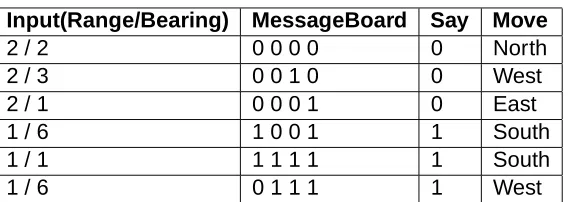
Table 4 shows an excerpt of the language evolved by the best GaPredator(
) agents. This excerpt was obtained by clustering the observed commu-nication activity using the Minimal Spanning Tree algorithm and displaying some of the larger clusters. As an example, the first line is interpreted as follows: “If the prey is to the far north of me (range of 2, bearing 2) and the message board consists of the symbols (0,0,0,0), speak the symbol “0” and move North.”
The Minimal Spanning Tree (MST) algorithm is a hierarchical cluster-ing method. Initially, each distinct communication instance is assigned a separate cluster. A communication instance consists of the following in-formation: the agent’s sensory information, the contents of the message board, what the agent decides to say, and how the agent decides to move. The MST algorithm proceeds iteratively, at each stage joining the two most similar clusters until a stopping criteria (usually until there is only one clus-ter left). The similarity between clusclus-ters was measured using a distance metric that weighted the agents’ move and sensor information more than it weighted the contents of the message board.
An important observation from the evolved languages is that it is very difficult, if not impossible, to explain the evolved languages. Looking at Ta-ble 4, one would be hard-pressed to say, for example, what the symbol “0” means to the predators since there does not appear to be a pattern to its us-age. However, the evolved languages are obviously very suitable because it allows the predators to outperform all previous work on similar preys. We thus conclude that allowing the agents to evolve their own communication language is very useful, since it would have been very difficult for a human designer to construct a similar language that can perform as well.
Also, the evolved languages are tightly coupled with the learning prob-lem and cannot be re-used on a different probprob-lem. The languages are integrated with the strategies and available actions of the agents in their environment. Therefore, the portability of the evolved languages is depen-dent on the portability of the evolved multi-agent strategies.
5.2.1 Semantic Density
Let us define the semantic density of a language as the average number of meanings assigned to each word of the language. The semantic density
Input(Range/Bearing) MessageBoard Say Move
2 / 2 0 0 0 0 0 North
2 / 3 0 0 1 0 0 West
2 / 1 0 0 0 1 0 East
1 / 6 1 0 0 1 1 South
1 / 1 1 1 1 1 1 South
1 / 6 0 1 1 1 1 West
Table 4: Excerpt of the language evolved by best GaPredator(
) agents
where is the total number of meanings represented by the language, and
is the number of words in the language. We can compute an upper bound
on the number of possible useful meanings that the predator agents can communicate. We make the fol-lowing simplifying assumption: the space of useful meanings that a preda-tor can possibly communicate includes only the agent’s sensory informa-tion and its next move. This assumpinforma-tion is justified in our simulainforma-tions be-cause the agents do not have any internal state information that need to be communicated (our predators do not maintain any internal state), and the agents’ plan of action applies only to the current time step. Account-ing for the environmental information observable for each agent and the 4 actions (N,S,E,W) that an agent can take, we get the following equation for the upper bound on the number of useful meanings:
! !
#
where !
is the number of discrete ranges from the prey, and
!
is the number of discrete bearings to the prey.
represents the maximum number of unique meanings that a predator agent can possi-bly communicate regarding its sensory information and its next action.
Assuming that the agents use all the words available to them, an upper bound on the semantic density of the evolved languages in our simulations is simply
#
#
#
where is the length of the binary communication string. Effectively,
is the maximum average number of meanings that need to be assigned to each word to allow for an optimal multi-agent strategy that has access to all available local information.
However, a tighter bound can be obtained by observing traces of the sensory input and movements of all the predators during actual runs. Ba-sically, we observe that in all runs the number of words used is still
#
, however the number of possible meanings
is less than the limit
! ! because not all combinations of sensory input and actions
are experienced by the agents. In other words, the observed upper bound on the density
appears to be much less than the theoretical upper bound
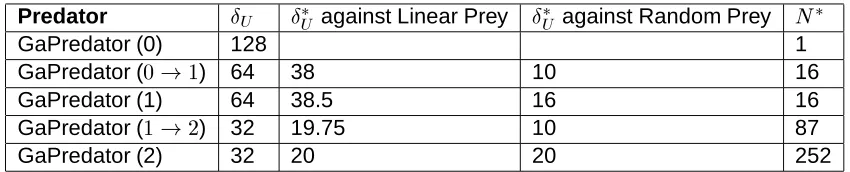
. This is illustrated in Table 5, which shows the theoretical upper bound density
and the average observed
for the best predators at each
com-munication string length. The interpretation of
is slightly different from the interpretation of
: whereas
is an upper bound that allows for an optimal strategy using all available local information,
is an upper bound
that allows for the best evolved strategy observed, which may or may not be the optimal strategy.
Table 5 indicates that the theoretical upper bound on semantic density is rather large, and it is perhaps unrealistic to expect that a word can have so many meanings in an evolved language. Determining the actual semantic density is a difficult data-mining problem and will not be presented in this paper. One would need to first mine for semantics from the data consisting of the sensory logs of each agent and their actions recorded during all runs. Instead, we make the following observations in support of the notion that a relatively high semantic density may in fact be realistic:
First, it should be noted that the observed upper bounds on semantic density are much less than the theoretical upper bounds, as shown in Table 5.
There does appear to be heavy re-use of symbols (or words) in the evolved languages. A symbol is used differently depending on the state of the message board. For example, the symbol “1” is used differently when the state of the message board is 1001 versus 0111 in Table 4. Thus the evolved languages are compact and are able to represent more concepts than the#
possible symbols available to each agent.
“drive” can mean a compulsion to do something, or it can mean a device for storing information, or it can mean to guide or control (e.g. “drive a vehicle”), depending on the context. In fact, the word “drive” can be a noun or a verb, and according to an on-line dictionary [5] the verb form can have at least #
meanings.
In the communication framework studied in this paper, the content of the message board, or equivalently the state of the Mealy machine, determines the context for the spoken symbols. Therefore, the max-imum number of contexts per word is equivalent to the number of states in the evolved Mealy machine, and this places a structural up-per bound on the semantic density that can be represented by the multi-agent system. Table 5 shows that for most cases the evolved Mealy machines can more than accommodate the upper bounds on semantic density because the average number of states in the Mealy machines are greater than the semantic density upper bounds. In fact, the cases where the observed upper bound on semantic density
is greater than the number of states are exactly the cases where a
larger language improved performance in our simulations. For exam-ple,
against the Linear prey with communication strings of length
is greater than the number of possible states, and in our simulations increasing the communication length to #
improved capture perfor-mance.
Thus, one pessimistic estimate for the minimum communication string length is the following rule:
Increase until !"
,
where !" $#
is the number of possible states (semantic con-texts) in the Mealy machine that represents the multi-agent strategy, and is the number of communicating agents. The value of
will be different for each problem, and indeed it may be difficult to estimate in problems where one does not know the space of local information available to each participating agent or when the agents maintain in-ternal state information. The number !" can easily be rewritten as
a function of the number of words
in the language. For example, in our experiments #
, and can be expressed as !"
Predator
against Linear Prey
against Random Prey
GaPredator (0) 128 1
GaPredator (
) 64 38 10 16
GaPredator (1) 64 38.5 16 16
GaPredator ( #
) 32 19.75 10 87
GaPredator (2) 32 20 20 252
Table 5: The theoretical upper bound
on the meaning density and the average observed upper bound
for the best predators. is the average
number of states in the evolved multi-agent Mealy machines, shown here again for convenience.
Increase the number of words in the language until
.
6
Conclusions
A multi-agent system in which all the agents communicate simultaneously is equivalent to a Mealy machine whose states are determined by the con-catenation of the strings in the agents’ communication language. Thus, evolving a language for this type of communicating multi-agent system is equivalent to evolving a finite state machine to solve the problem tackled by the multi-agent system. The simulations show that a genetic algorithm can evolve communicating predators that outperform the best evolved non-communicating predators, and that increasing the language size improves performance. A method is introduced for incrementally increasing the lan-guage size that results in a coarse-to-fine search that significantly reduces the time required to find a solution. Furthermore, a simple rule is derived for estimating the minimum language size that should be used for any multi-agent problem.
References
[1] David H. Ackley and Michael L. Littman. Altruism in the evolution of communication. In Rodney A. Brooks and Pattie Maes, editors,
Artifi-cial Life IV: Proceedings of the International Workshop on the Synthe-sis and Simulation of Living Systems. MIT Press, November 1994.
[2] Tucker Balch and Ronald C. Arkin. Communication in reactive multia-gent robotic systems. Autonomous Robots, 1(1):27–52, 1994.
[3] M. Benda, V. Jagannathan, and R. Dodhiawalla. On optimal coopera-tion of knowledge sources. Technical Report BCS-G2010-28, Boeing AI Center, Boeing Computer Services, Bellevue, WA, August 1985.
[4] R.A. Brooks. Challenges for complete creature architectures. In J.A. Meyer and S.W. Wilson, editors, From Animals to Animats:
Proceed-ings of the First International Conference on Simulation of Adaptive Behavior, pages 434–443. MIT Press, 1991.
[5] www.dictionary.com.
[6] Piotr J. Gmytrasiewicz and Edmund H. Durfee. A rigorous, operational formalization of recursive modeling. In Victor Lesser, editor,
Proceed-ings of the First International Conference on Multi–Agent Systems (IC-MAS), pages 125–132, San Francisco, CA, 1995. MIT Press.
[7] Piotr J. Gmytrasiewicz, Edmund H. Durfee, and Jeffrey Rosenschein. Toward rational communicative behavior. In AAAI Fall Symposium on
Embodied Language. AAAI Press, November 1995.
[8] D.E. Goldberg and K. Deb. A comparative analysis of selection schemes used in genetic algorithms. In Foundations of Genetic
Al-gorithms, pages 69–93. 1991.
[9] K ˆoiti Hasida, Katashi Nagao, and Takashi Miyata. A game-theoretic account of collaboration in communication. In Victor Lesser, editor,
Proceedings of the First International Conference on Multi–Agent Sys-tems (ICMAS), pages 140–147, San Francisco, CA, 1995. MIT Press.
[10] Thomas Haynes and Sandip Sen. Evolving behavioral strategies in predator and prey. IJCAI-95 Workshop on Adaptation and Learning in
[11] Kenneth A. De Jong and William M. Spears. A formal analysis of the role of multi-point crossover in genetic algorithms. Annals of
Mathe-matics and Artificial Intelligence Journal, 5(1):1–26, 1992.
[12] Richard E. Korf. A simple solution to pursuit games. In Working Papers
of the 11th International Workshop on Distributed Artificial Intelligence,
pages 183–194, February 1992.
[13] Yannis Labrou and Tim Finin. A semantics approach for kqml - a gen-eral purpose communication language for software agents. In Proc.
Int. Conf on Information and Knowledge Management, 1994.
[14] Bruce J. MacLennan and Gordon M. Burghardt. Synthetic ethology and the evolution of cooperative communication. Adaptive Behavior, 2(2):161–188, 1993.
[15] Shin I. Nishimura and Takashi Ikegami. Emergence of collective strate-gies in a prey-predator game model. Artificial Life, 3(4):243–260,
1997.
[16] Stefano Nolfi and Dario Floreano. Coevolving predator and prey robots: Do ”arms races” arise in artificial evolution? Artificial Life,
4(4):337–357, 1998.
[17] Gregory M. Saunders and Jordan B. Pollack. The evolution of commu-nication schemes over continuous channels. In P. Maes, M. Mataric, J.A. Meyer, and J.B. Pollack, editors, From Animals to Animats 4:
Pro-ceedings of the 4th International Conference on Simulation of Adaptive Behavior. MIT Press, 1996.
[18] Nicholas J. Savill and Paulien Hogeweg. Evolutionary stagnation due to pattern-pattern interactions in a coevolutionary predator-prey model. Artificial Life, 3(2):81–100, 1997.
[19] John R. Searle. Speech Acts: An Essay in the Philosophy of
Lan-guage. Cambridge U. Press, 1970.
[20] Luc Steels. Self-organizing vocabularies. In Proceedings of Alife V, 1996.
[21] Larry M. Stephens and Matthias B. Merx. The effect of agent control strategy on the performance of a dai pursuit problem. In Proceedings
[22] Ming Tan. Multi-agent reinforcement learning: Independent vs. coop-erative agents. In Proc. of 10th ICML, pages 330–337, 1993.
[23] Adam Walker and Michael Wooldridge. Understanding the emergence of conventions in multi-agent systems. In Proceedings of the First
International Conference on Multi-Agent Systems, San Francisco, CA,