Tuning Of Conventional Pid And Fuzzy Logic
Controller Using Different Defuzzification
Techniques
Afshan Ilyas, Shagufta Jahan, Mohammad Ayyub
Abstract:- This paper presents a method for tuning of conventional PID controller. Simplicity, robustness, wide range of applicability and near-optimal performance are some of the reasons that have made PID control so popular in the academic and industry sectors. Recently, it has been noticed that PID controllers are often poorly tuned and some efforts have been made to systematically resolve this matter. Thus Fuzzy logi c can be used in context to vary the parameters values during the transient response, in order to improve the step response performances. Simulation analysis has been carried out for the different processes by conventional and different defuzzification techniques and the results indicate that the values of percentage overshoot are reduced by using fuzzy logic mechanism.
————————————————————
1. INTRODUCTION
PID controllers are the most widely used type of controller for industrial applications. They are structurally simple and exhibit robust performance over a wide range of operating conditions. In the absence of the complete knowledge of the process these types of controllers are the most efficient of choices. However, because of their simple structure, PID controllers are particularly suited for pure first or second order processes, while industrial plants often present characteristics such as high order time delays, nonlinearities and so on [4]. Many tuning formulae that have been devised such as the Ziegler-Nichols one, assures a good load-disturbance attenuation, but often fail to achieve satisfactory performances, and therefore the operator has to use their experience and might fail to attain the best performances [4]. In this context, the use of fuzzy logic seems to be particularly appropriate, since it allows us to make use of the operator's experience and therefore to add some sort of intelligence to the automatic control. This paper has two main contributions. Firstly, a PID controller has been designed by using Ziegler-Nichols frequency response method and its performance has been observed. The Ziegler Nichols tuned controller parameters are fine tuned to get satisfactory closed loop performance. Secondly, for the same systems a fuzzy logic controller has been proposed. Performance comparison between Ziegler Nichols tuned PID controller, and the proposed fuzzy logic controller is presented for different defuzzification methods. This paper is organized as follows. Section 2 reviews the ZN tuning formula in the context of tuning of PID controller. Section 3 presents the tuning procedure, based on fuzzy logic controller. Simulation results are shown in section 4. Finally the conclusion follows in section 5.
2.
TUNING
OF
CONVENTIONAL
PID
CONTROLLER
Proportional-Integral-Derivative (PID) controllers have been in existence for nearly two-thirds of a century. They remain a key component in industrial process control as over 90% of today’s industrial processes are controlled by PID controllers. The PID controller is probably the most used feedback control design. PID controller has the general form
where e(t) = ysp(t) - y(t) is the system error (difference
between the reference input and the system output), u(t) the control variable, Kp the proportional gain, Td the
derivative time constant and Ti the integral time constant.
The value of controller parameters like KP, Kd and Ki are
reached by mainly trial and error method. But this method is very time consuming. Therefore we switch over to different tuning techniques which give more accurate results with less time. Ziegler-Nichols method is generally used for the purpose in which the parameters like ultimate gain Ku and
ultimate period Tu is first calculated by Routh array criteria
[10], and then Kp, Ki and Kd are calculated as shown below.
Table 1: Ziegler - Nichols tuning formulas based on ultimate gain (Ku) and ultimate period (Tu)
Controller Gain (KP)
Integral time(Ti)
Derivative time(Td)
P 0.5Ku - -
PI 0.45Ku 0.8Tu -
PID 0.6Ku 0.5Tu 0.125Tu
3. FUZZY LOGIC CONTROLLER
The ideas of fuzzy set and fuzzy control are introduced by Zadeh in an attempt to control systems that are structurally difficult to model. Since Mamdani did the first fuzzy control application fuzzy control has been one of the most active and fruitful research areas in fuzzy set theory, and many industrial applications are reported. Fuzzy logic controllers (FLCs) are increasingly applied to many systems with nonlinearity and uncertainty and it is based on experience ______________________________
Afshan Ilyas, Shagufta Jahan, Mohammad Ayyub Department of Electrical Engineering, Zakir Hussain College of Engineering & Technology
Aligarh – Uttar Pradesh, India
139
of a human operator [7]. The structure of fuzzy system can be classified according to the different applications. One of the most popular type is the error feedback fuzzy controller, which is called conventional fuzzy logic controller (FLC). In linear control, there are proportional- derivative (PD), proportional Integral (PI) and proportional-Integral-derivative (PID) control. In conventional FLC, there are also PD type FLC (FZ-PD), PI type FLC (FZ-PI) and PID type FLC (FZ-PID) [7].
3.1 Principle of FLC
The FLC implementations incorporate the following stages: (1) Fuzzification: Fuzzification implies the process of
transforming the crisp values of the inputs of a controller to the fuzzy domain.
(2) Knowledge Base: The knowledge base of FLC consists of database and the rule base.
a. Data base: It is used to provide necessary information for functioning of fuzzification module, rule base and defuzzification module.
b. Rule base: The function of rule base is to represent in a structured way the control policy of an experienced control engineer. This is generally taken the expert in the field otherwise, the knowledge is acquired by having practical experience.
(3) Fuzzy inference engine (system): A fuzzy inference engine has a simple input-output relationship. Input data from the external world is processed by the fuzzy inference engine to produce the data to be used back in the external world. The events taking place in this process are referred as the basic fuzzy inference algorithm [8]. Mamdani and Takagi-Sugeno fuzzy systems are the examples of fuzzy inference systems.
(4) Defuzzification: is a process of transforming the fuzzy sets assigned to a control output variable into a crisp value. There are various method of defuzzification.
Centre of Area Method (COA) Mean of Maximum Method (MOM) Bisector Method
Largest of Maximum (LOM) Smallest of Maximum (SOM)
3.2 Advantages of Using Fuzzy Logic Controller
Computing with words also allow us to develop mathematical models of events articulated in language only.
By fuzzifying crisp data obtained from measurements, fuzzy logic enhances the robustness of a system without fuzzification systems designed to act at certain input data points would not know what to do when data is some-what corrupted.
Representing a solution with fuzzy sets reduces computational burden. In some cases fuzzy technology makes a solution possible that would
be otherwise unthinkable due to cost of computing every single crisp data point.
3.3 Design and Tuning of Fuzzy Logic Controller
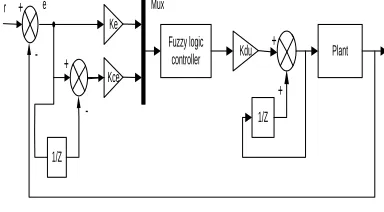
Fuzzy logic controllers (FLCs) are increasingly applied to many systems with nonlinearity and uncertainty and it is based on experience of a human operator. While controlling a plant a skilled human operator manipulates the output of the controller based on error and change in error with an aim to reduce the error with a shortest possible time. The two types of structure of FLC have been studied so far: one is position-type fuzzy controller which generates control input (u) from error (e) and change in error, and the other is velocity-type fuzzy controller which generates incremental control input (∆u) from error and change in error. The former is called PD type FLC and the latter is called PI type FLC. PI type FLC is known to be more practical than PD type FLC [9].
r
Ke
Kce
Plant
1/Z
1/Z
Fuzzy logic controller Kdu Mux
e
-+
+
+ +
-Fig 1: PI type Fuzzy Logic Controller
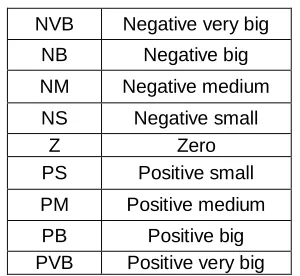
Table 2: Basic rules table for fuzzy inference system ce
e NB NS Z PS PB
NB NVB NB NM NS Z
NS NB NM NS Z PS
Z NM NS Z PS PM
PS NS Z PS PM PB
PB Z PS PM PB PVB
Table 3: Meaning of the linguistic variables in the fuzzy inference system
4. SIMULATION RESULT
The performances of the different controllers have been evaluated on different plants. Here, the following transfer functions, with different values of the parameters, are considered:
G1(s) = ωn 2
/s2+2ωξs+ωn 2
; ωn = 1, ξ = 0.8.
G2(s) = e -sL
/(1+sT)2 ; T = 1, L = 0.1
G3(s) = 1/ (1+s) 3
;
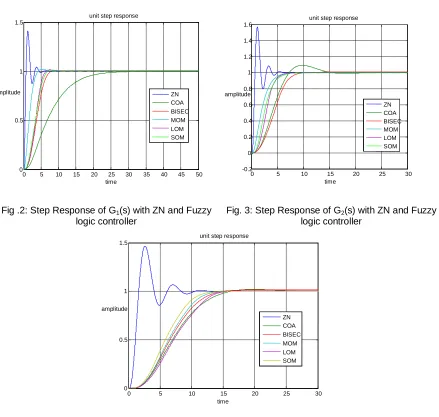
After the tuning phase, accomplished the unit step responses have been simulated for both conventional and fuzzy logic controller with Matlab and Simuink. The Model used in Simulink/Matlab to analyze the effect of fuzzy logic controller, consists of fuzzy logic block and scaling factors. The unit step response is simulated by using MATLAB. A two-input and one output fuzzy controller is created and the membership functions and fuzzy rules are determined. Fuzzy logic block is prepared using FIS file in MATLAB. The resulting values of IAE, rise time, settling time and percentage overshoot are reported in Tables given below. The step responses of different system with the different controllers are plotted in Figs. 2, 3 and 4.
NVB Negative very big
NB Negative big
NM Negative medium
NS Negative small
Z Zero
PS Positive small
PM Positive medium
141
Fig .2: Step Response of G1(s) with ZN and Fuzzy
logic controller
Fig. 3: Step Response of G2(s) with ZN and Fuzzy
logic controller
Fig .4: Step Response of G3(s) with ZN and Fuzzy logic
Controller
Table 4: Value of IAE achieved by the examined controllers tuned by Ziegler-Nichols and Fuzzy Logic controller by using different Defuzzification Methods
Table 5: Value of Percentage Overshoot OS (%) achieved by the examined controllers tuned by Ziegler-Nichols and Fuzzy Logic controller by using different Defuzzification Method
Process
ZN
FLC (DIFFERENT DEFUZZIFICATION METHODS)
COA BISECECTOR MOM LOM SOM
G1(s) 0.8098 6.5485 3.7321 1.6857 3.3756 3.3802
G2(s) 1.0009 4.1061 4.3341 2.1027 2.8704 2.6864 G3(s) 1.9767 6.7508 6.4970 6.3366 6.9123 5.9122
Process ZN
FLC (DIFFERENT DEFUZZIFICATION METHODS)
COA BISECECTOR MOM LOM SOM
G1(s) 40. 9896 0 0.0629 1.5347 0.9437 0.4498
G2(s) 56.8315 0.0284 0 0 0 0
G3(s) 48.8019 0 0 0 0 0
0 5 10 15 20 25 30
0 0.5 1 1.5
time amplitude
unit step response
ZN COA BISEC MOM LOM SOM
0 5 10 15 20 25 30
-0.2 0 0.2 0.4 0.6 0.8 1 1.2 1.4 1.6
unit step response
amplitude
time
ZN COA BISEC MOM LOM SOM
0 5 10 15 20 25 30 35 40 45 50
0 0.5 1 1.5
time amplitude
unit step response
Table 6: Value of Rise-time (tr) achieved by the examined controllers tuned by Ziegler-Nichols and Fuzzy Logic controller by using different Defuzzification Methods
Table 7: Value of Settling-time (ts) achieved by the examined controllers tuned by Ziegler-Nichols and Fuzzy Logic controller by using different Defuzzification Methods
5. Conclusion
In this paper, different methods regarding the tuning of conventional PID and fuzzy logic controller has been presented. Simulation was carried out using MATLAB version 2010a to get the output response of the system. Zeigler Nichols method is used for tuning of conventional PID controller. But this method is not satisfactory for many systems, as it gives high overshoot. In this context, the use of fuzzy logic seems to be particularly appropriate, since it allows us to make use of the operator's experience. According to the profiling results, the use of soft-computing technique resulted in a better outputs. The amount of overshoot for the output response was successfully decreased using the fuzzy logic controller. Certainly, the improved performance is at the cost of increased rise-time and settling-time. The performances of different processes using different defuzzification methods are also present in this paper. From the above results we can easily observe that except the value of the percentage overshoot Mean of Maximum defuzzification method gives better results as compared to other defuzzification techniques.
References
[1] I.J. Nagrath and Gopal M., ―Control System Engineering‖, 3rd
Edition, New age International Publication, 2000.
[2] Ogata K., ―Modern Control Engineering‖, 3rd Edition, Prentice Hall India Publication, 1997.
[3] Johnson C.D. ―Process Control instrumentation Technology‖, John Wiley 1977.
[4] Visioli A., ―Tuning of PID controllers with fuzzy logic‖, IEE proc.-Control Theory Appl. Vol.148, No. 1, January 2001.
[5] Cominos P. and Munro N., ―PID controllers: recent tuning methods and design to specification,‖ IEE Proceedings, 7th January 2002.
[6] McMahon David, ―MATLAB DeMYSTiFieD‖, Tata McGraw Hill, 2007.
[7] Hua Xiongli,―A comparative Design and tuning for conventional fuzzy control‖, IEEE Transaction on system, man and cybernetics-part B cybernetics, Vol.24 No.5, October 1995.
[8] Drainkov D. Hellendoorn H, Reinfran M.,―An Introduction to Fuzzy Control‖, Narosa Publication House, 2001.
[9] Chopra Seema, Mitra R. and Kumar Vijay, ―Auto tuning of Fuzzy PI type Controller using Fuzzy logic‖, International journal of computational cognition (http://www.ijcc.us), vol. 6, no. 1, march 2008.
[10]Gopal M., ―Control Systems Principle and design‖, Tata McGraw Hill, 2001.
Process ZN
FLC (DIFFERENT DEFUZZIFICATION METHODS)
COA BISECECTOR MOM LOM SOM
G1(s) 0.4527 6.5979 4.3923 2.4665 3.5112 4.0325 G2(s) 0.3530 5.1739 4.9400 3.3514 3.1624 3.4605 G3(s) 0.9534 6.1040 6.0768 6.0769 6.0353 5.9891
Process ZN
FLC (DIFFERENT DEFUZZIFICATION METHODS)
COA BISECECTOR MOM LOM SOM
G1(s) 4.1847 9.7298 7.4717 3.8511 6.0894 6.6099