The Effect Of Problem Based
Learning On Undergraduate Oral
Communication Competency
David S. Mandeville, Merrimack College, USATiffanie K. Ho, California State University, Sacramento, USA Lindy A. Valdez, California State University, Sacramento, USA
ABSTRACT
Purpose: The aim of this study was to ascertain the effect of Problem Based Learning (PBL) on student oral communication competency gains.
Methods: Eighty students from two consecutive undergraduate Kinesiology courses (Spring semesters, 2014-15) formed into 29 small groups and were studied. Oral communication competency was assessed using a customized rubric and digital recordings of student presentations. Changes to oral communication competency across time were tested using a dependent t-test; a < .05.
Results: Significant inter-rater agreement was found at both time points for oral communication rating, and student groups demonstrated significant oral communication gains across time.
Conclusions: Collaborative learning was shown to improve students’ oral communication competency. Future study is required to determine the influence of student motivation and goal orientation on oral communication competency, in relation to the various phases of knowledge creation occurring within student groups.
Keywords: Collaborative Learning; Problem Based Learning; Oral Communication Competency; Kinesiology Education
INTRODUCTION
Oral Communication Competency
ecently, competency-based educational models have found favor in professional education programs including chemistry, teacher education and medicine due to their emphasis on ability outcomes (Williams & Handa, 2016; Frank et al., 2010; Albanese et al.,, 2008). The competency-based curricula model shifts the focus from the amount of time a student is immersed in the content area to the development of their ability in the competencies present in their future practice. The concept of competency is seen as an observable ability which changes across time, is embedded into the environment of practice, and spans a spectrum of ability from novice to mastery (Frank et al., 2010). Competence in the allied health care professions has been further described as the relationship between an ability in a person, a task in the clinical world, and the ecology of the health care context (Epstein & Hundert, 2002).
Oral communication is a necessary ability for allied health care providers as the quality of the patient-clinician relationship affects both the health and recovery of patients. Expert oral communication may improve a patient’s understanding of their illness, thereby reducing their anxiety during the shared clinical decision making (Epstein & Hundert, 2002). In this manner, effective oral communication is thought to positively influence the costs and outcomes of chronic disease management. Therefore, developing oral communication competency in undergraduate Exercise Science education may be a necessary goal as this competency plays an important role in the future clinical settings that students hope to enter.
Problem Based Learning Theory
Collaborative learning techniques have been shown to promote professional competencies including: oral communication, abstract problem solving, self-directed learning, managing uncertainty, and teamwork (Epstein & Hundert, 2002). These dimensions of professional competency are considered integral to a 21st century clinical career where ambiguous problems are solved collaboratively using remote communication. Thus, collaborative learning educational goals are thought to be critical to the effort of preparing aspiring undergraduate clinicians for their future health care careers.
Little research exists to support the use of traditional lecture for the achievement of professional competency. However, the literature supporting the development of professional competency for collaborative learning methods is conclusive (Felder & Brent, 2004; Prince & Felder, 2006). Problem Based Learning (PBL) is a collaborative learning method which was designed to develop clinical reasoning (Epstein & Hundert, 2002) and promote deep learning (Dods, 1997). Students engaged in the PBL method are iteratively brought to a more advanced state of intellectual development while taking agency for their education and learning to question expert opinion (Biggs, 1999; Blumenfeld et al., 2006; Felder & Brent, 2005; Norman & Schmidt, 1992; Prince & Felder, 2006). The value added of PBL is the development of transferable and enduring professional competencies. The professional competencies chosen for development in the current PBL setting included: problem solving, critical thinking, evidence-based practice, and oral communication (Mandeville & Stoner, 2015).
The development of professional competency for the PBL student is likely the result of the iterative, peer reviewed formative assessments upon which PBL is based (Albanese & Mitchell, 1993; Gijbels, et al., 2005; Mandeville & Stoner, 2015; Vernon & Blake, 1993). Prince and Felder (2006) define learning as occurring when new information has been integrated into one’s existing cognitive and personal belief structures. Vygotsky’s (1962) social constructivism theory suggests that personal meaning is co-constructed from an experiential event involving dialog and interaction with others (Vygotsky, 1962). Nanoka & Takeuchi (1996) posited that knowledge creation occurs when tacit knowledge is converted to explicit knowledge, using both written and oral communication. To facilitate this conversion process, the context for interaction among individuals across time is required. The theoretical framework of social constructivism suggests that to have an effective learning experience, peer collaboration must be optimized in the classroom. The collaborative learning environment of PBL is theorized to promote knowledge creation by inducing students to co-construct knowledge within the dialog of small groups in which prior beliefs and misconceptions are modified in light of new information (Prince & Felder, 2006). In addition, the availability of peer-review within the collaborative PBL model serves as a formative assessment that fosters growth in professional competence by providing low risk feedback to iteratively expand a student’s zone of proximal development (Epstein & Hundert, 2002; Powell & Kalina, 2009).
Problem
Although PBL is theorized to promote transferable professional competency gains, there exists limited work that objectively describes the effect of PBL on the development of undergraduate student oral communication competency. Therefore, the purpose of this study was to describe the effect of PBL on oral communication competency gains for undergraduate Exercise Science students. Evidence of oral communication gains by undergraduate students may improve the professional preparation of future allied health care providers.
METHODS
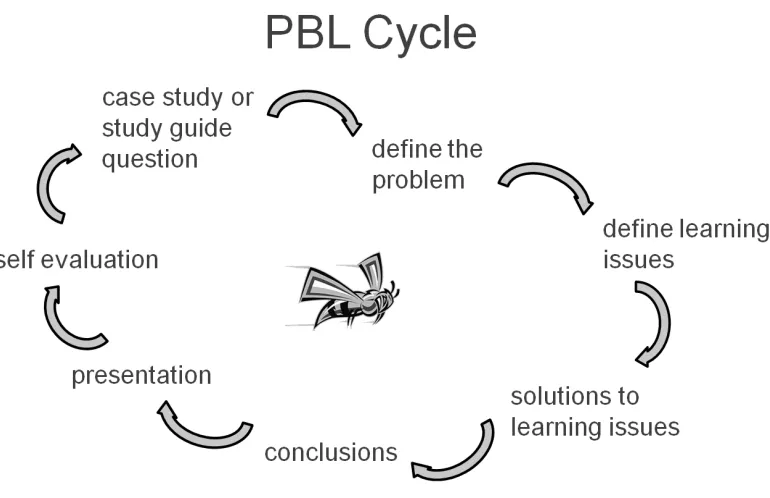
select into small groups (3-5 students per group) based on shared career goals. In weekly laboratory meetings, each group completed a problem solving sequence (evaluated using a rubric) in order to develop a case report addressing an open-ended, real world human movement problem (Figure 1). During the first 60 minutes of laboratory, the groups’ findings were orally presented (12-minute maximum time limit) as PowerPoint presentations in which the group determined the content with minimal professor supervision.
Figure 1. The problem solving cycle iteratively employed by students for their laboratory group presentation.
Table 1. Customized oral communication rubric used to evaluate four criteria elements of this competency.
Score Comments Element Criteria (4 points) Perfect Above average (3 points) (2 points) Average Inadequate (0 points)
/4 Student group
demonstrates presentation delivery techniques (e.g., posture, hand gesture, eye contact, and vocal expressiveness).
All group members demonstrate professional delivery techniques that enhance the cohesion of the presentation including: confident tone voice and projection, purposeful pace and enthusiasm.
All group members demonstrate professional delivery techniques, yet delivery techniques may be ridged or unnatural which compromised the cohesion of the presentation.
A majority of group members demonstrate some professional delivery techniques yet inconsistencies compromise the cohesion of the presentation.
Delivery techniques of all group members detract from the cohesion of the presentation.
/4 Student group
demonstrates use of language by using clinical terminology which avoids slang and layman’s terms.
All group members demonstrate authentic use clinical term authentic use term without slang and layman’s terms.
All group members demonstrate authentic use clinical
terminology
throughout most of the presentation, with minimal slang and layman’s terms.
A majority of group members attempt fluency of terminology, yet elements of layman terminology exist throughout the presentation.
Most group members do not use clinical instead use slang and layman’s terms.
/4 Student group
demonstrates interaction with supporting material by using demonstrations, illustrations, and models.
All group members demonstrate Interaction with supporting materials by using a variety of demonstrations, illustrations, models which enhances the credibility of the presentation.
All group members demonstrate Interaction with supporting materials by using limited variety of demonstrations, illustrations and models which enhances the credibility of the presentation.
A majority of group members attempt interaction with supporting materials to enhance the credibility of the presentation by using one of the following types: demonstrations, illustrations or models.
All group members do not use
supporting materials which diminishes the credibility of the presentation.
/4 All group members
consistently demonstrate techniques to engage the audience and enhance the quality of the presentation: provocative questions using humor and other means to elicit a response from the audience.
All group members consistently demonstrate techniques to engage the audience and enhance the quality of the presentation: provocative questions using humor and other means to elicit a response from the audience.
All group members demonstrate techniques to engage the audience by using a limited variety of the following that may not necessarily enhance the quality of the presentation: posing provocative questions, using humor, and using other means to elicit a response from the audience.
A majority of the group members use either some or only one of the following audience engagement techniques, but they may be used inappropriately or ineffectively: posing provocative questions, using humor, and/or using other means to elicit a response from the audience.
Most or all group members do not use audience
engagement techniques.
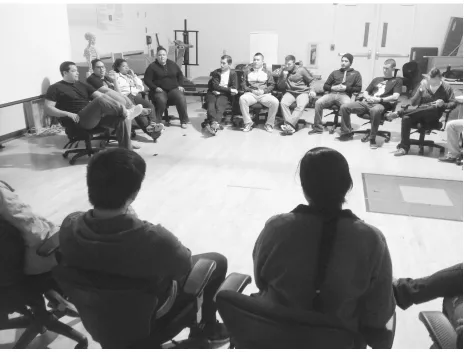
Figure 2. Students engaged in peer-review formative assessment of oral communication following group presentations during laboratory session. Each student group was responsible to assess another group based on the customized oral communication rubric (Table 1).
RESULTS
Thirty-two groups totaling one hundred percent of the students began the study as part of their course work. However, three groups did not complete the semester together and their data were removed from future analysis. These groups disbanded via a mechanism by which groups were able to anonymously rate their colleagues’ weekly contribution. These ratings were used to remove malingering students who did not respond to feedback. Malingering students then completed the weekly laboratory case reports as individuals.
Figure 3. Mean oral communication rating across a 15-week semester, scored at two time points: P1 (week 3) and P2 (week 12).
DISCUSSION
Within the context described by the competency-based curricula and the collaborative learning models, we believe that optimal undergraduate education is more than the acquisition of content knowledge and G.P.A., but also prepares students to manage ambiguous real world problems via a developing set of professional competencies. Therefore, the purpose of this study was to quantify undergraduate student gains in the professional competency of oral communication for a Problem Based Learning (PBL) Kinesiology course. Our results indicate that students engaged in a PBL Kinesiology course demonstrated significant gains in oral communication competency across a 15-week semester.
The students’ oral communication competency gains were likely the result of weekly exposure to the PBL operations of oral presentations and peer-review formative assessments. However, previous studies report equivocal results for the effect of PBL on oral communication competency gains. When studying the effect of PBL on oral communication for Geography undergraduates, students self-reported no gain for their perceived oral communication competency, as students relied on group members with already-established oral communication skills during group presentations (Spronken-Smith, 2005). Differences between this report and our findings may be the result of methodological differences.
Polanco et al., (2004) reported the effect of PBL on oral communication for undergraduate Engineering students. Students displayed significantly greater oral communication compared to their peers in traditional lecture. The author proposed the idea that undergraduate students graduate from their programs with professional competencies that are transferrable across various domains of their career. This notion is consistent with our goal to add an enduring value to the undergraduate education by developing the professional competencies of: problem solving,
management and working in a team (Williams & Handa, 2016). Not only is oral communication a difficult skill to acquire, but students’ also self-report challenges during their initial experience of PBL including: concern about uncertainty and confusion; as well as frustration related to lack of guidance (Yuan et al., 2011; Al-Kloub et al., 2014). Thus, oral communication appears to be a difficult skill to acquire across a semester of collaborative learning which may offer socio-emotional experiences that challenge a student’s motivation.
Understanding the underpinning motivational orientation which leads to competency development in collaborative learning may increase the magnitude of these gains. Student goal profiles have a complex multiplicity of direction and orientation. In the Wosnitza and Volet (2012) study, performance goals did not discriminate as well as learning and well-being goals. This finding supports the idea that a student’s perception of a positive classroom climate is conducive to effective learning and competency development. The authors suggested that the small groups of collaborative learners be constructed with the students’ goal orientations in mind in order to optimize the motivational benefits previously described for collaborative learning (Blumenfeld et al., 2006).
The need to describe the individual and social aspects of motivation for collaborative learning is based on the challenges which PBL students will encounter in their group work including: differences in their goal orientations, cultural backgrounds, and level of content mastery. The extent to which groups can be formed a priori, with heterogeneous pairings of students with respect to these considerations, the greater the peer-to-peer motivation can be optimized for PBL (Wosnitza & Volet, 2012) and thus greater competency gains may be achieved across the semester.
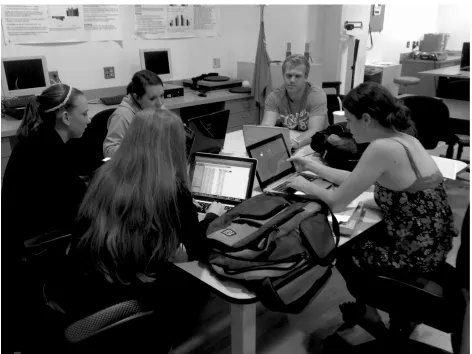
Figure 4. Students engaged in the socialization phase of knowledge creation during face-to-face exchange of ideas during laboratory session. Students chose an open ended clinical problem from a menu of options and then developed division of labor and an initial strategy to accomplish the problem solving technique described in Figure 1.
Although PBL students showed significant gains in oral communication competency, the need to engage students in a progression of competence development across a collaborative learning curriculum becomes important to avoid a receding of the ability prior to graduation. Thus, the onus lies on the educator to design learning environments which progressively incorporate prior learning and competency development via curricula which emphasize peer-review formative assessments rather than summative assessments (Frank, 2010). This becomes especially important as the understanding of health care competency is redefined from content knowledge mastery to the ability to collaboratively manage ambiguous real world problems while communicating remotely (Epstein & Hundert, 2002). Thus, while we have made a commitment to developing problem based learning environments as well as a novel assessment tool of oral communication competency; without a continuum of competency development across a curriculum, it is unknown if these gains will persist following graduation.
AUTHOR BIOGRAPHIES
David S. Mandeville, received the Ph.D. in Biomechanics from University of Oregon. Recently, he as explored collaborative teaching methods for both Kinesiology and Biomechanics curriculum.
Tiffanie K. Ho, M.A., MBA, is an institutional researcher at a private institution. She has a strong interest in student learning outcomes' assessment research.
Lindy A. Valdez, Ed. D.,is a professor in the Department of Kinesiology and Health Science at California State University, Sacramento. He is an international scholar in pedagogy and attitudes in Physical Activity.
ACKNOWLEDGEMENTS
The authors wish to thank: Caroline A. Gibbs for her contribution to the development of the oral communication rubric; the Academic Technology and Creative Services Unit at CSUS for their contribution to the recording of student presentations; Mark Stoner, Ph.D. and Kimo Ah Yun, Ph.D. for their inspiration and guidance provided through the Center for Teaching and Learning, CSUS.
REFERENCES
Albanese MA, Mejicano G, Mullan P, Kokotailo P, Gruppen L. (2008). Defining characteristics of educational ceompetencies. Med Educ, 42(3), 248-255.
Albanese, M. A., & Mitchell, S. (1993). Problem-based learning: A review of literature on its outcomes and implementation issues." Academic Medicine, 68(1), 52-81.
Al-Kloub, M. I., Salameh, T. N., & Froelicher, E. S. (2014). Nursing students evaluation of problem based learning and the impact of culture on the learning process and outcomes: A pilot project. Nurse education in practice, 14(2), 142-147. Biggs, J. (1999). What the student does: Teaching for enhanced learning. Higher Education Research & Development, 18(1),
57-75.
Blumenfeld, P. C., Kempler, T. M., & Krajcik, J. S. (2006). Motivation and cognitive engagement in learning environments. Cambridge University Press.
Dods, R. F. (1997). An action research study of the effectiveness of problem-based learning in promoting the acquisition and retention of knowledge. Journal for the Education of the Gifted, 20(4), 423-37.
Epstein, R. M., & Hundert, E. M. (2002). Defining and assessing professional competence. Jama, 287(2), 226-235.
Felder, R. M., & Brent, R. (2004). The intellectual development of science and engineering students. Part 2: Teaching to promote growth. Journal of Engineering Education, (93)4, 279-291.
Felder, R. M., & Brent, R. (2005). Understanding student differences. Journal of Engineering Education, 94(1), 57-72.
Frank, J. R., Snell, L. S., Cate, O. T., Holmboe, E. S., Carraccio, C., Swing, S. R., ... & Harden, R. M. (2010). Competency-based medical education: theory to practice. Medical teacher, 32(8), 638-645.
Gijbels, D., Dochy, F., Van den Bossche, P., & Segers, M. (2005). Effects of problem-based learning: A meta-analysis from the angle of assessment. Review of Educational Research, 75(1), 27-61.
Mandeville, D. S., & Stoner, M. R. (2015). Assessing the effect of problem-based learning on undergraduate student learning in biomechanics. Journal of College Science Teaching, 45, 66-75.
Nonaka, L., Takeuchi, H., & Umemoto, K. (1996). A theory of organizational knowledge creation. International Journal of Technology Management, 11(7-8), 833-845.
Nonaka, I., Konno, N., & Toyama, R. (2001). Emergence of “ba”: A conceptual framework for the continuous and self-transcending process of knowledge creation. In I. Nonaka & T. Nishiguchi (Eds.), Knowledge emergence: Social, technical, and evolutionary dimensions of knowledge creation (pp. 13-29). Oxford University Press.
Norman, G. R., & Schmidt, H. G. (1992). The psychological basis of problem-based learning: A review of the evidence. Academic Medicine, 67(9), 557-65.
Polanco, B., Rodrigo, P. C., & Delgado, F. (2004). Effects of a problem-based learning program on engineering students’ academic achievements in a Mexican university 1. Innovations in Education and Teaching International, 41(2), 145-155.
Powell, K. C., & Kalina, C. J. (2009). Cognitive and social constructivism: Developing tools for an effective classroom. Education, 130(2), 241.
Prince, M. J., & Felder, R. M. (2006). Inductive teaching and learning methods: Definitions, comparisons, and research bases. Journal of Engineering Education, 95(2), 123-138.
Vernon, D. T., & Blake, R. L. (1993). Does problem-based learning work? A meta-analysis of evaluative research. Academic Medicine, 68(7), 550-63.
Vygotsky, L. S. (1962). Thought and language. Cambridge, Massachusetts: MIT press. (Original work published 1934) Williams, D. P., & Handa, S. (2016). Chemistry Student Perceptions of Transferable & Workplace Skills Development. New
Directions in the Teaching of Physical Sciences, (11).
Wosnitza, M., & Volet, S. (2012). Group heterogeneity and homogeneity in personal content goals for a group learning activity: Impact on individual appraisals. Applied Psychology, 61(4), 585-604.