
HPLC Method Development, Validation And Its Application To Stability Studies Of Chlorpromazine Hydrochloride Tablets
8
0
0
Full text
(2) Venkatesh S et al. IRJP 1 (1) 2010 225-232 modifiers, such as short-chained amines, decylamine, triethylamine and ion-pair reagents have been used to obtain acceptable chromatograms13-15. The formulation got degraded with storage into some degradants and other components. Methylparaben and propylparaben have been used as preservatives in CPZ.HCl in a liquid oral pharmaceutical formulation. Although ion-pair agents were added to mobile phase to improve the peak shape of CPZ during assay of the active component and preservatives in CPZ.HCl oral solution using HPLC, retention time of CPZ was increased substantially15. Alkaline solutions would cause the drug to oxidize. Keeping in mind all theses difficulties the following objectives were taken to fulfill the goal of the present study. The objectives of the present study were i) to develop a new simple, specific, precise and accurate HPLC method, ii) to validation of the developed method as per ICH guidelines, iii) to carry degradation studies of CPZ.HCl, iv) to study the effects of oxidative degradation processes of excipients (used here as super disintegrants) on CPZ.HCl and v) to assess its suitability for formulation. MATERIALS AND METHODS Chemicals USP reference standards acdisol (FMC polymer), polyplasdone XL (ISP), chlorpromazine HCl (Emco laboratory) were used for validation. HPLC grade (Qualigens) mobile phases, Milli-Q water and all other reagents of analytical grade were used. The buffer was prepared by dissolving 2.72g of potassium dihydrogenorthophosphate and 5ml triethylamine (TEA) in 1 liter and pH was adjusted to 3.1 with ortho phosphoric acid. The mobile phase consisted of buffer and acetonitrile in the ratio of 65:35. Amber glassware was used for all samples and standard preparations. Instrumentations A HPLC system (Model 2695, WATERS, Milliford - USA) consisting of a pneumatic pump, a degasser, column heater, an auto injector and a photo diode array detector 2996 was controlled by computer and empower software. The column Zorbax extended C18 column (250 x 4.6 mm, 5µm, 10 Aº (Agilents, Santa Clara, USA) was used. The stability study of chlorpromazine hydrochloride was undertaken to test its stability with super disintegrants under three different conditions 25°C/60% RH, 30°C/65% RH and 40°C/75% RH stability chamber. Hardness, thickness, diameter were checked by using Inkarp Pharma tester. Disintegration and friability were tested by using Erweka manufacturer apparatus. Analytical methods HPLC Method validation was carried out as per ICH protocol16. The terms selectivity and specificity are often used interchangeably. The selectivity of an analytical method was tested by comparing results of samples containing impurities with the results of samples without impurities. Precision of the developed method was the degree of agreement among individual test results when the procedure was applied repeatedly to multiple samplings. It was measured by injecting a series of standards. Accuracy is the measure of how close the experimental value is to the true value. The accuracy of the present method was the degree of agreement of test results generated by the method to the true value. A linear regression equation applied to the results should have an intercept not significantly different from zero17. The range was expressed in the same units as test results (for example percent, parts per million) obtained by the analytical method. The limit of detection is the point at which measured value is larger than the uncertainty associated with it is the lowest concentration of the analyte in a sample that can be detected, but not necessarily quantified. In chromatography the detection limit was the injected amount which resulted in a peak with a height at least twice as high as the baseline noise. The limit of quantification was the injected amount which resulted in a reproducible measurement of peak areas (equivalent to amounts). Peak heights were typically required to be at least 10 times higher than baseline noise. A ruggedness test was examined to assess the affect operational and environmental conditions on the analysis results. It was the degree of variance in test results obtained by the analysis of the same samples under a variety of different test conditions. As per ICH definition16-17 robustness being a measure of the method’s capability was unaffected by small, but deliberate variations in method parameters. Robustness could be partly assured by good system suitability specifications. Thus, it was important to set tight, but realistic, system suitability specifications. Testing variation in some or all. IRJP 1 (1) Dec 2010. Page 225-232.
(3) Venkatesh S et al. IRJP 1 (1) 2010 225-232 conditions, e.g., age of columns, column type, column temperature, and pH of buffer in mobile phase, reagents were performed to validate the method16. Theoretical plate number (N) was calculated for the method as discussed elsewhere18. Oxidative degradation study of CPZ.HCl The ingredients (CPZ.HCl, lactose monohydrate, microcryslalline cellulose, polyplasdone XL or Acdisol, aerosol, Mg-srearate) of CPZ.HCl tablets were mixed in dry condition and compressed in such a manner to get a tolling size of 7mm. The study of CPZ.HCl was undertaken to test its stability with super disintegrants under three different conditions [Ambient, 30°C-65% and 40°C-75% Relative Humidity (RH)]. As super disintegrants contained peroxide, the present study was also undertaken to ensure whether the peroxide had any effect on the stability of CPZ.HCl or not. Analysis of these tablets was performed for duration of 1 to 180 days using HPLC method developed in the present study. Physical parameters such as color (visual/hunter), weight (wt. gain/wt. uniformity), friability test, hardness test, disintegration test, diameter/thickness and chemical parameters such as assay (Impurity/content uniformity), moisture content and dissolution of tablets were carried out repeatedly on days 0, 30, 60, 90, and 180 respectively. Statistical analysis All the statistical parameters present in the results were calculated as per Microsoft ExcelWindows 2003. RESULTS Method development All parameters mentioned in Table 1 were optimized to get good resolution of the separated compounds in the present study. Method validation Diameter, thickness and hardness of the tablets were checked by using Inkarp Pharma Tester and all agreed the pre-specifications. Hardness was also verified through friability test using ERWEKA Friabilator (Ahemadabad, India) and was within control limit. Time of disintegration was checked to be 61-103 sec for innovator sample and 61-89 sec for ISP sample which were mostly identical (data not shown). The above results of stability study indicated that oxidative degradation of CPZ.HCl in the tablet formulations did not occur under the following test conditions i.e., ambient condition, 30оC and 65 % RH, and with 40оC and 75 % RH up to three months. Method validation is generally a one-time process performed after the method development to demonstrate that the method was scientifically sound and that it served the intended analytical purpose18. The test method was validated for specificity, linearity, precision, accuracy, range, ruggedness and robustness. The specificity is the ability to assess unequivocally the analyte of interest in the presence of component that may be expected to be present, such as impurities, degradation products, and matrix components stored under relevant stress conditions (e.g., light, heat, acid hydrolysis, alkali hydrolysis, and H2O2 oxidation). The recovery ranges of CPZ were 104.2-106.9% under acid hydrolysis, 23.3-96.4% under 1-10% H2O2 oxidation, 2.02-98.1% during photolysis for a period of 1 min to 3 hr, 99.4-23.3% under heating for 1-2hr and 75.2-111.6% under alkali hydrolysis for a period of 15 min to 1 hr respectively. As per ICH acceptance criteria RSD (%) of precision study should not be more than 2.0 %. For precision study all solutions were prepared in triplicate at levels 80%, 100% and 120% of test concentrations using CPZ.HCl working standard as per the test method. In the present study RSD% was found to be 0.21%, whereas method precision and sample precision were 1.7% and 0.2% (n=6) using both chlorpromazine ISP and chlorpromazine innovator. As per ICH acceptance criteria recovery should be within 95 to 105%. In the present study the observed acceptable level of accuracy was 98.7 to 101.5% of test concentration for the assay of CPZ.HCl (Table 2). For linearity study a series of solutions were prepared using CPZ.HCl working standard at concentration levels from 1ppm to 200 ppm. The value of R2 was 0.99 and RSD% was 0.10-1.11%. The range should be reported in % with respect to test concentration from the linearity, precision and accuracy. IRJP 1 (1) Dec 2010. Page 225-232.
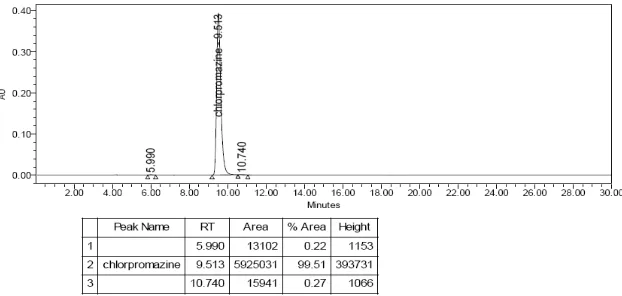
(4) Venkatesh S et al. IRJP 1 (1) 2010 225-232 data. The range of the analytical method for the assay of CPZ.HCl was 92% to 107% of test concentration. For ruggedness study six samples individually were prepared using single batch of CPZ.HCl and each solution was injected in triplicate using different column, system, analyst on different days. RSD% was found to be 1.5%. Robustness was calculated using the developed HPLC method for the effect of temperature, buffer concentration i.e., pH and time on recovery and it was found to be 90.3-101.2%. In addition, limit of detection (LOD) was calculated based upon a signal-to-noise ratio of 3 (as calculated in the external standard calibration solution and adjusting for the dilution factor of sample preparation). Samples were injected 6 times and then LOD was calculated. The limit of quantification (LOQ) was the injected amount which resulted in a reproducible measurement of peak areas (equivalent to amounts) or peak heights typically required to be at least 10 times higher than baseline noise. System suitability study showed that for the developed HPLC method RSD (%), USP tailing and USP plate count were 0.39%, 1.22 and 5310 respectively which were within USP acceptance limit for CPZ.HCl. The results supported the predetermined acceptance criteria. The validated method was found to be specific, linear, precise, accurate, robust and rugged for the assay of CPZ.HCL tablets in the present study (Table 2). Dissolution study There were many literatures available on the method development for CPZ using different columns and mobile phases1,12. In the present study the column used was C18 column (Waters, Milliford, USA) and the mobile phase taken for the first trial was methanol and water system. The peak was asymmetric but tailing was high (Fig. 2) in methanol, because CPZ.HCl being highly soluble in methanol was eluted at RT of 8 min and degraded quickly in slightly alkaline pH. Methanol-buffer system was also tried, but it was not satisfactory (Fig. 3). Later on methanol was replaced with acetonitrile and the phosphate buffer pH was adjusted to acidic at pH 3.1. The proportion of acetonitrile to buffer and pH were optimized and the symmetric peak with minimal retention time of 2.35 min was obtained (Fig. 4). Finally, the method was optimized as per ICH guidelines17 and validated (Table 2). Finally, the present method was applied to check impurity profile and degradation products of CPZ.HCl under different conditions for various lots at different time intervals. Results on stability study Reference Std. compound of CPZ.HCl (100 mg/L) was used to create an external standard calibration for the assay of CPZ.HCl stability study. The retention time of CPZ.HCl was 2.35 minutes (Fig. 4) using buffer-acetonitrile system. Stability study was carried out under normal condition, 25°C/60%RH, 30°C/65%RH and 40°C/75%RH for a period of three months. It was found that tablets made with polyplasdone XL (ISP excipient) had recovery ranges of 98.5-104.1% while tablets made with acdisol (Innovator excipient) had recovery ranges of 97.2-103.9% (Table 2). Similar type of results was obtained from content uniformity study using 10 tablets. Dissolution study was carried out in 0.1N HCl using paddle apparatus at 50 rpm. Results were within USP specifications and same as that of stability study. DISCUSSION The aim of the present study was to develop a method for identification and quantification of CPZ.HCl and its validation as well as application to stability study. The present HPLC method was developed with the trials of different mobile phases such as methanol and water system, methanol and phosphate buffer system or acetonitrile and phosphate buffer system respectively. The acetonitrile buffer system produced the optimized separation capacity (Fig. 4) using Zorbax C18 column. The developed method was validated as per ICH guidelines17-18 (Table 2). The validation parameters such as specificity, precision (% RSD), linearity (R2 as 0.9998), accuracy (%RSD), ruggedness and robustness, system suitability results met the requirements (Table 2) and fulfilled the ICH guidelines for CPZ. HCl16-17,19. The optimized developed HPLC method was fast, accurate, precise and reproducible. The validation parameters tallied nicely with ICH guidelines. The linearity study showed a R2 of 0.9998 and. IRJP 1 (1) Dec 2010. Page 225-232.
(5) Venkatesh S et al. IRJP 1 (1) 2010 225-232 system suitability results (in % RSD) were less than 2. The specificity, ruggedness and robustness were comparable to ICH guidelines. Although Kollmorgen et al.13 used mobile phase methanol-acetate buffer system for the separation of CPZ.HCl and methyl paraben, this mobile system did not work in the present study. Also, the HPLC method described by Boehme and Strobel1 was tried, but it was not suitable for the present study. The developed and validated method was applied for the stability study of CPZ.HCl with super disintegrants. According to ICH guidelines for stability study19 the optimized method was performed and results were strictly within the pre-specified limits. The stability results of physical and chemical parameters such as assay, content uniformity, dissolution, friability, disintegration time, diameter, thickness and hardness were within the intended limits. The results of comparative study between innovative and ISP products showed that the drug formulated in ISP was stable and they did not degrade with super disintegrants. The assay test of tablets showed comparable values with ICH within the range of 90 to105% for all the tablet formulations. In addition, there was no peak appeared in the samples collected from the oxidative degradation study of the tablets (Fig. 5). So, the tablets were free from oxidative degradation during the period of observation time. CONCLUSIONS The HPLC method developed in the present study is simple, reliable, sensitive, reproducible, less time consuming and is applicable to test CPZ.HCl in bulk drug, raw materials and tablet doses. The advantage of the present test procedures is that it is a simple isocratic method without using any complicated mobile phase. The present work gets validated, highly sensitive and selective method for determination of CPZ.HCl in pharmaceutical dosage forms. Also, it would be applied to the oxidative degradation studies of CPZ.HCl for monitoring the quality of CPZ.HCl during storage. The oxidative degradation study of CPZ.HCl confirms no oxidative degradation of CPZ.HCl in tablet formulations under ambient conditions as well as under accelerated stability conditions. The method could be applicable for chlorpromazine derivatives and their metabolites. This technique would be applicable to other formulations with different new excipients. ACKNOWLEDGEMENTS Mr. S. Venkatesh acknowledges the help of VIT University, Vellore - 632014, India for the platform given to do this research. Also, SV acknowledges the help of International Speciality Products (P) Ltd, Hyderabad - 500082, India for the uses of their all facilities to carry out this project research work. REFERENCES 1. Boehme CL, Strobel HW. High performance liquid chromatographic methods for the analysis of haloperidol and chlorpromazine metabolism in vitro by purified cytochrome P450 isoforms. J Chromatogr B 1998; 718:259-266. 2. Indian pharmacopoeia 1996, 1:178. 3. USP XXIII, The United States Pharmacopeia, Rand McNally, Taunton, MA, 1995; 353–356. 4. Tamai G, Yoshida H, Imai H. High-performance liquid chromatographic drug analysis by direct injection of whole blood samples. I. Determination of moderately hydrophobic drugs incorporated into blood corpuscles. J Chromatogr 1987; 423:163-168. 5. Kiel JS, Morgan SL, Abramson RK. Computer-assisted optimization of a high-performance liquid chromatographic separation for chlorpromazine and thirteen metabolites. J Chromatogr 1989; 485:589-596. 6. Ohkubo Z, Shimoyama R, Sugawa K. Determination of chlorpromazine in human breast milk and serum by high-performance liquid chromatography. J Chromatogr 1993; 614:328-332. 7. Kountourellis JE, Makoupoulou CK. A simultaneous analysis by high performance liquid chromatography of bamipine combined with tricyclic antidepressants and/or antipsychotics in dosage forms. J Liquid Chromatogr 1991; 14:2969-2977.. IRJP 1 (1) Dec 2010. Page 225-232.
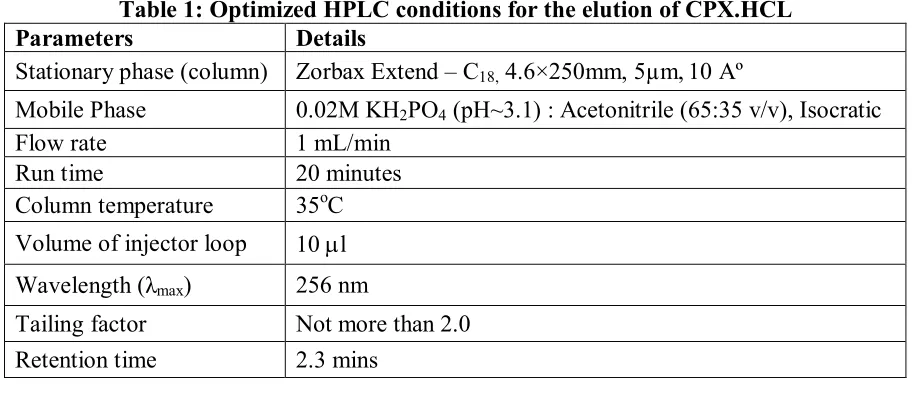
(6) Venkatesh S et al. IRJP 1 (1) 2010 225-232 8. 9. 10. 11. 12. 13. 14. 15. 16. 17. 18. 19.. Fekete J, Del Castilho P, Kraak JC. Reversed-phase liquid chromatography for the separation of chlorpromazine, imipramine and some of their metabolites. J Chromatogr A 1981; 204:319-327. Cooper JK, McKay G, Midha KK. Subnanogram quantitation of chlorpromazine in plasma by HPLC with electrochemical detection. J Pharm Sci 2006; 72: 1259-1262. Pistos C, Stewart JT. Direct injection HPLC method for the determination of selected phenothiazines in plasma using a Hisep column. Analyst 1985; 110:1117-1124. Mahadik KR, Aggarval H, Kaul N. Development and validation of HPLC method for simultaneous estimation of trihexyphenidyl hydrochloride and chlorpromazine hydrochloride from tablet dosage form. Indian Drugs, 39, 441-445, 2002. Kircherer H, Khun-Veltan WN. Quantitative determination of forty- eight antidepressants and antipsychotics in human serum by hplc tandem mass spectrometry A multi level single – sample approach. J Chromatogr B 2006; 843:100-113. Kollmorgen D, Kraut B. Determination of methylparaben, propylparaben and chlorpromazine in chlorpromazine hydrochloride oral solution by high-performance liquid chromatography. J Chromatogr B 1998; 707:181-187. Snyder LR, Glajch JL, Kirkland JJ. Practical HPLC Method Development, Wiley, New York, 232, 1988. Method # 0742.06, Alpharma Inc., USPD, (1994). ICH Topic Q2B, “Validation of Analytical procedures”: Methodology, 6th Nov 1996. ICH Topic Q2A, “Validation of Analytical Procedures”: Text, 6th Nov 1996. USP 26, General Information, Validation of compendial methods 2003; 2440-2442. ICH Stability Testing: Photostability Testing of New Drug Substances and Products, ICH, Geneva, Switzerland, November 1996. Table 1: Optimized HPLC conditions for the elution of CPX.HCL Parameters Details Stationary phase (column) Zorbax Extend – C18, 4.6×250mm, 5µm, 10 Aº Mobile Phase Flow rate Run time Column temperature. 0.02M KH2PO4 (pH~3.1) : Acetonitrile (65:35 v/v), Isocratic 1 mL/min 20 minutes 35оC. Volume of injector loop. 10 ml. Wavelength (λmax). 256 nm. Tailing factor Retention time. Not more than 2.0 2.3 mins. Table 2: Comparison between observed results obtained by validated method and ICH guidelines S.No Validation parameters ICH guidelines Observed results 1 Method precision % RSD not more than 2.0% 1.7% 2 System precision % RSD not more than 2.0% 0.21% 3 Accuracy Recovery should be within 95% to 105% 98.7% - 101.5% 4 Linearity R2 (correlation coefficient) > 0.999 0.9998 5 Range It should be within 80% to 120% Complies 6 Ruggedness % RSD not more than 2.0% 1.5% 7 System suitability % RSD not more than 2.0% 0.39% 8 LOD & LOQ Signal to noise ratio (s/n): 3:1 & 10:1 Complies. IRJP 1 (1) Dec 2010. Page 225-232.
(7) Venkatesh S et al. IRJP 1 (1) 2010 225-232 S. +. HCl N. +. Cl. N. CH3. CH3. Figure 1: Structure of Chlorpromazine Hydrochloride. Figure 2: HPLC chromatogram of Chlorpromazine HCl. The concentration of the sample was 100mg/L. The mobile phase of methanol:water (85:15 v/v) was used at a flow rate of 1ml/minute for elution. The injection volume was 10µL and the column temp was 35ºC.. Figure 3: HPLC chromatogram of chlorpromazine HCl. The concentration of the sample was 100mg/L. The mobile phase of 0.02 M KH2PO4 and methanol containing 0.5% TEA (buffer:acetonitrile :: 20:80, v/v, pH 7.6) was used at a flow rate of 1ml/minute. The runtime was 15 min and the injection volume was 10µL and the column temp was 35ºC.. IRJP 1 (1) Dec 2010. Page 225-232.
(8) Venkatesh S et al. IRJP 1 (1) 2010 225-232. Figure 4: HPLC chromatogram of chlorpromazine HCl. The concentration of the sample was 100mg/L. The mobile phase of 0.02 M KH2PO4 and acetonitrile containing 0.5% TEA (buffer:acetonitrile :: 35:65, v/v, pH 3.1) was used at a flow rate of 1ml/minute. The runtime was 15 min and the injection volume was 10µL and the column temp was 35ºC.. Figure 5: HPLC chromatogram of CPZ.HCl with placebo polyplasdone after oxidation degradation. The concentration of the sample was 100mg/L. The mobile phase of 0.02 M KH2PO4 and acetonitrile containing 0.5% TEA (buffer:acetonitrile :: 35:65, v/v, pH 3.1) was used at a flow rate of 1ml/minute. The runtime was 20 min and the injection volume was 10µL and the column temp was 35ºC.. Source of support: Nil, Conflict of interest: None Declared. IRJP 1 (1) Dec 2010. Page 225-232.
(9)
Figure

Related documents
study, extracted chitosan was characterized by FTIR, SEM and EDS, the same was successfully applied for the treatment of industrial waste water of ghee industry located in SITE area
Single Crystal to Single Crystal Polymerization of a Columnar Assembled Diacetylene Macrocycle..
28 Natasha Korda, Labor’s Lost: Women’s Work and the Early Modern English Stage (Philadelphia: University of Pennsylvania Press, 2011) 1.. 29 In Staging Domesticity:
Hitch Hiker classifies LooCI bindings as high-priority and low-priority, and this classifica- tion allows Hitch Hiker to support data aggregation by appending low-priority data in
Non-participation (i.e., inactivity while in the UI system) In accordance with the empirical evidence presented in section 2.2, we allow the unemployed to choose inactivity
In this article, we propose a fast and robust framework (RSNMF) based on symmetric nonnegative matrix factorization (SNMF) and similarity network fusion (SNF) for clustering
Automated epileptic seizures detection using multi-features and multilayer perceptron neural network
This study provides a multi-channel EEG analysis for the detection of epileptic seizures using PSD, entropy, Teager energy, and MLPNN classifier.. Initially, EEG signals
The current endeavors for the sustainable development of metal free processes employing visible light has evoked considerable interest in organic synthesis [9-12],
