8.1 Project Management Costs
The LCN+ project operates on an annual budget from TfL. This budget includes individual borough allocations, Sector Leader costs and Project Management costs.
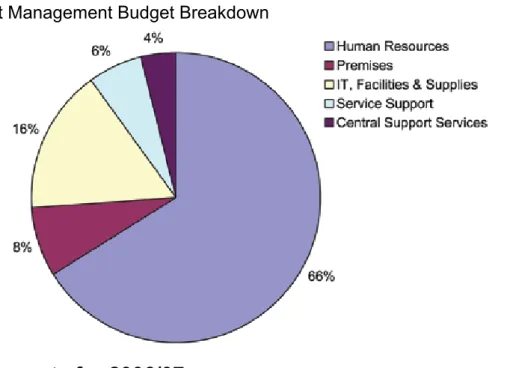
Below is a breakdown of the percentage of the budget towards the various Project Manage-ment costs. The budget allocation for project manageManage-ment in 2006/07 was £800k in the original allocation, which was later revised to £850k.
Fig 3: Project Management Budget Breakdown
8.0 Project Management
8.2 Achievements for 2006/07
Key Achievements
Investigation of high risk infrastructure barriers, preparation and release of the report to
•
highway authorities and the instigation of a barrier resolution strategy Launch of the Scheme Information Management System (SIMS)
•
Responded to the £1.5M budget increase with a risk management plan to help achieve
•
full spend of the borough programme
Provided best value by managing a 50% project budget increase (based on 2005/06
•
budget figures) without increasing human resources
Production of the Funding Proposal and Annual Report Documents
•
Participation in the CRISP process as primary stakeholder
•
Voted Transport Consultancy of the Year by the Transport Times for our
•
LCN+ Annual Report 2006/07
Other Activities
Digitised 60% of final CRISP studies for use in the Network Completion System •
Issued Link map version 6
•
Rationalisation of website material and improved synergy of the website with other
•
LCN+ partnership websites
Participation in national conferences such as the Annual Bus Priority Conference
•
Advice and support for boroughs restructuring and expanding their LCN+ delivery
•
teams
Expanded the scope and distribution of the newsletter to include TfL Area teams and
•
senior borough executives
Maintained exemplar standard of project management in terms of methodology,
innova-•
tion and support
Active participation in TfL SRO meetings in relation to the TLRN/LCN+ cycling
pro-•
gramme
Provision of information for TfL Cycling Programme Team (CPT) mid year report
•
Liaison and refinement of bi-monthly monitoring forms with Borough Partnerships •
8.3 Quality and Standards
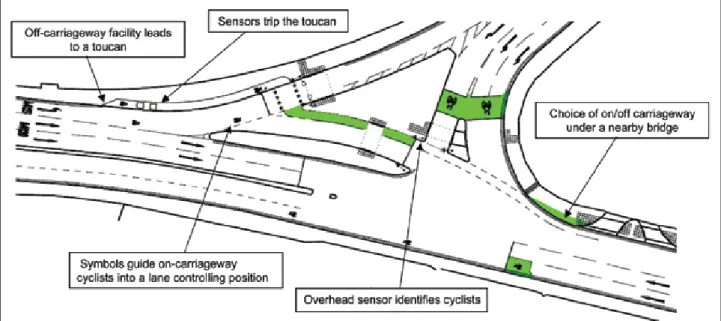
All of the boroughs currently engaged in the LCN+ project have now adopted the design check procedure. This is the key method of ensuring all schemes are implemented to the requirements set out in the London Cycling Design Standards.
Fig 4: Key design features highlighted during the design check procedure for a combined bus and cycle scheme.
In 2006/07 110 design checks were completed by the LCN+ Project Management team. A Design Overview Pro-forma (DOP) is completed by the scheme designer and contains key route objectives and base information. The DOP is submitted to the LCN+ Project Manage-ment team with the relevant scheme drawings prior to the impleManage-mentation of the scheme.
The designer should state any significant departures from the guidance in the LCDS. The
LCN+ Project Management team then uses the information received to assess the suitability of the scheme for cyclists and adherence to the LCDS. Comments/queries are returned to the scheme designer. The aim of the overall process is to assist designers with the develop-ment of schemes that follow LCDS and reduce the queries and concerns raised at both the safety audit and consultation stages.
8.4 Programme Methodology
A monthly Project Managers report is produced by the LCN+ Project Management team for TfL containing a summary of spend and project performance. Borough progress is sum-marised and issues or obstacles hindering their progress are highlighted in this report. This is presented to TfL two weeks into each month and covers the preceding month.
The LCN+ Project Management team submits a yearly Partnership Funding Proposal on behalf of all the boroughs. This document lays out a forward programme for all the LCN+ schemes over the next three years.
Bi-monthly reports are also prepared by the LCN+ Project Management team on behalf of the boroughs and presented to TfL.
Scheme progress within each borough is monitored by the use of Monthly Monitoring (MM)
Forms, which collate financial information. Monthly progress meetings and quarterly sector
meetings also offer a chance to review designs and examine implementation strategies and snagging points. Each individual borough is responsible for the implementation of schemes. LCN+ Steering Group Meetings are held quarterly to discuss network progress and
ob-stacles/barriers to scheme delivery, whether physical or political. Borough Cycling Officer
Group (BCOG) meetings are also held quarterly to discuss LCN+ and general cycling is-sues. The LCN+ Project Management team administer both of these forums.
8.5 Team activities
Fig 5 shows some of the processes involved in the delivery of the LCN+ project and how the partners interact with them.
LCN+ Annual Report 2006/07 LCN+ Annual Report 2006/07
In 2006/07 110 design checks were completed by the LCN+ Project Management team. A Design Overview Pro-forma (DOP) is completed by the scheme designer and contains key route objectives and base information. The DOP is submitted to the LCN+ Project Manage-ment team with the relevant scheme drawings prior to the impleManage-mentation of the scheme.
The designer should state any significant departures from the guidance in the LCDS. The
LCN+ Project Management team then uses the information received to assess the suitability
of the scheme for cyclists and adherence to the LCDS. Comments/queries are returned to
the scheme designer. The aim of the overall process is to assist designers with the
develop-ment of schemes that follow LCDS and reduce the queries and concerns raised at both the
safety audit and consultation stages.
8.4 Programme Methodology
A monthly Project Managers report is produced by the LCN+ Project Management team for TfL containing a summary of spend and project performance. Borough progress is sum-marised and issues or obstacles hindering their progress are highlighted in this report. This is presented to TfL two weeks into each month and covers the preceding month.
The LCN+ Project Management team submits a yearly Partnership Funding Proposal on behalf of all the boroughs. This document lays out a forward programme for all the LCN+ schemes over the next three years.
Bi-monthly reports are also prepared by the LCN+ Project Management team on behalf of the boroughs and presented to TfL.
Scheme progress within each borough is monitored by the use of Monthly Monitoring (MM) Forms, which collate financial information. Monthly progress meetings and quarterly sector
meetings also offer a chance to review designs and examine implementation strategies and snagging points. Each individual borough is responsible for the implementation of schemes.
LCN+ Steering Group Meetings are held quarterly to discuss network progress and ob
-stacles/barriers to scheme delivery, whether physical or political. Borough Cycling Officer Group (BCOG) meetings are also held quarterly to discuss LCN+ and general cycling is -sues. The LCN+ Project Management team administer both of these forums.
8.5 Team activities
Fig 5 shows some of the processes involved in the delivery of the LCN+ project and how the partners interact with them.
8.6 Working with TfL Area Teams
Approximately 200km of the LCN+ network lies on the Transport for London Road Network (TLRN).
In 2006/07 the LCN+ Project Management team continued to attend the quarterly Senior
Responsible Officer (SRO) meetings with the TfL cycle programme manager and the TfL principal engineers. Asset and financial information was collated in these meetings and is
presented in both the TfL Road Network Development (RND) and Road Network Manage-ment (RNM) sections of this report.
The LCN+ Project Management team has played an active role as primary stakeholder in all TfL CRISPs including those only partially on the network.
8.7 Workshops
In July 2006 a workshop was held for the Borough Cycling Officers. The workshop was
divided into three sections for the day. 1) A project review presented by the LCN+ Project Management team, 2) an update presented by members from TfL (CCE) and 3) workshops which were conducted by the LCN+ Project Management sector teams.
The project review focussed on financial monitoring, the CRISP process, Barriers to com
-pletion and the traffic signals programme.
Key points:
New look MM forms
•
Datasheet accuracy
•
Signals process guide
•
Barrier prioritisation
•
The TfL update focussed on project progress and London Cycling Design Standards (LCDS) updates.
Key points:
Toucan blackout timings
•
Tiger crossings
•
Minimum cycle lane widths
•
Delivery by end 2010
LCN+ Annual Report 2006/07
The workshops split the group by their sectors and focussed on the design check procedure, partnership interaction and design solutions to infrastructure barriers to the completion of the LCN+ by end 2010. Following these discussions a detailed list of recommendations was compiled and fed into the LCN+ Project Management team service review. These recom-mendations were also passed on to TfL for strategic review.
8.8 Geographic Information Systems
Mapping of the LCN+ is managed using Geographical Information System (GIS) technology.
The latest techniques and technologies are utilised in order to geo-code on-site photos,
fine-tune the network via variations and update the Link map. During 2006/07 the LCN+ Project Management team launched and maintained the Scheme Information Management System (SIMS), a vital element of which is the geo-coded schedule of works.
Photo 1: Borough Officer
Workshop in process
Photo 2: A GIS Officer performing an
on-site analysis using GIS information technology
8.9 Scheme Information Management System
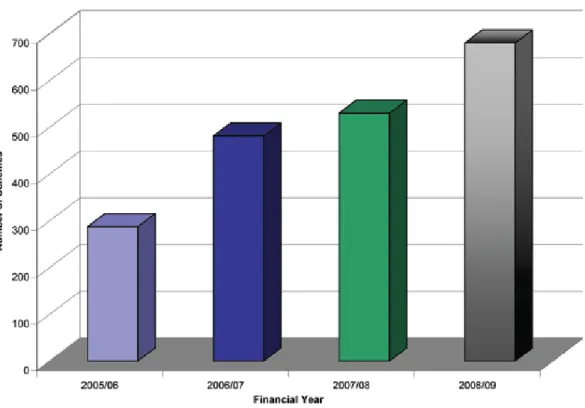
2006/07 saw 483 schemes completed on the LCN+ network compared to 287 in 2005/06. With the project and programme expanding so rapidly and each scheme phase requir-ing constant monitorrequir-ing, evaluation and reportrequir-ing a Scheme Information Management
System (SIMS) was introduced to help with the efficient and effective management of this
workload.
Figure 6: Schemes delivered and projected scheme delivery
In 2005 the LCN+ Project Management team identified constraints within the existing infor -mation management system and undertook an investigation into these data management
and information systems. The findings of this investigation showed that a number of data
management and maintenance systems operated in parallel with each other, resulting in numerous instances of data replication. This typically involved various stand-alone
spread-sheets tracking finances, scheme details, scheme progress and assets implemented, to -gether with GIS and spatial information related to each scheme.
The long-term objective of the SIMS is to provide a background of solid reliable data that
can be utilised to develop an infrastructure network that is efficiently built to a high standard
and is effectively monitored. The processes behind the SIMS will ensure the delivery of
the LCN+ project can be effectively managed to maximise the benefit it will provide to the
LCN+ Annual Report 2006/07
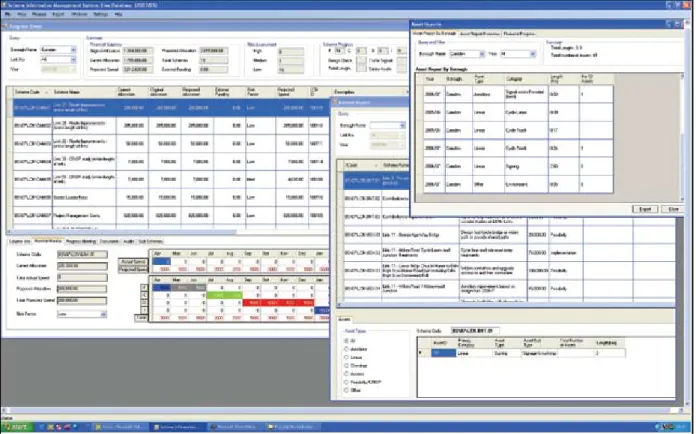
Figure 7: Main process area of the Scheme Information Management System
Figure 7 (above) shows the main process area of the system where detailed financial figures
can be viewed and updated alongside scheme descriptions and design check/audit informa-tion. From this one page it is possible to navigate via the various tabs and boxes through all the key project management functions provided by the project management team in relation to the borough programme.
8.10 Website
www.londoncyclenetwork.org.uk
2006/07 saw the LCN+ Project Management team review the LCN+ project website in con-sultation with TfL. The core requirements for the review were to keep the website focussed
on the project in order to inform the project supply chain, remove the public specific section
and therefore create no delineation between public and partner sections whilst making the
public aware that the website is primarily for project management purposes and finally to link
to borough and TfL websites for topics out of the project range
The website continued to attract large numbers of visitors (4.96M in 2006/07) and has
prov-en to be a key information and resource tool for Borough Cycling Officers and consultants.
8.11 Newsletter
During 2006/07 the newsletter expanded its distribution to include TfL principal engineers and senior executives at the London boroughs. The aim of the newsletter is to engage stakeholders & practitioners in project communication, best practice, development and de-livery through targeted content. The newsletter is also dedicated to the promotion of fast, safe and comfortable conditions for cycling. All LCN+ newsletters are available to download from the LCN+ project website.
LCN+ Annual Report 2006/07
8.12 LCN+ Project Management team service review
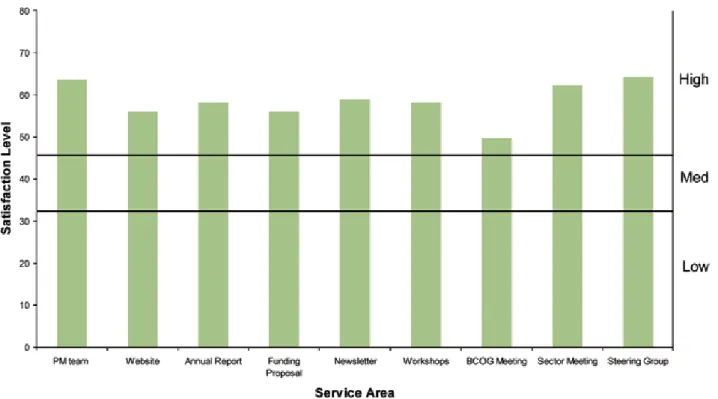
In quarter four of 2006/07 the LCN+ Project Management team undertook a survey of the
services they provide with the Borough Cycling Officers. This survey was intended to help review the project management services provided and highlight deficiencies that could delay
project delivery. 16 of the 33 London boroughs responded.
Fig 9: Service area satisfaction analysis
The project management team scored strongly in terms of their overall performance and the delivery of the annual and summary report. Room for improvement was noticeable in terms of the organisation and running of project forums. The summer workshops were used to ad-dress this issue with recommendations based on feedback from the workshops presented to TfL in September 2006.
The marketing elements of the project management teams service delivery i.e. Newsletter and Website, also scored very highly in terms of quality and presentation. It is hoped that the high standards illustrated by this exercise can be maintained for the duration of the project.
8.13 About the LCN+ Project Management team
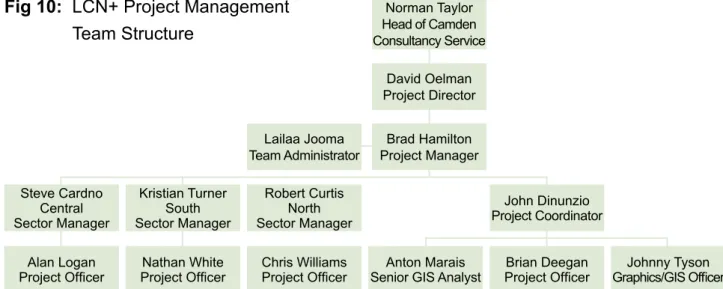
The LCN+ Project Management team comprises of a project director, project manager, project
co-ordinator, three sector managers, four project officers, one senior GIS analyst, one graph
-ics/GIS officer, and one administration officer. The team is employed by Camden Consultancy
Service within the Culture & Environment Directorate of the London Borough of Camden.
Fig 10: LCN+ Project Management Team Structure Norman Taylor Head of Camden Consultancy Service Brad Hamilton Project Manager David Oelman Project Director Lailaa Jooma Team Administrator Alan Logan
Project Officer Project OfficerNathan White Chris Williams Project Officer Senior GIS AnalystAnton Marais Project OfficerBrian Deegan Graphics/GIS OfficerJohnny Tyson
Steve Cardno Central Sector Manager Kristian Turner South Sector Manager Robert Curtis North Sector Manager John Dinunzio Project Coordinator
Below: LCN+ Project Management team (from left to right): Anton Marais, Johnny Tyson, Alan Logan, Lailaa Jooma, Brian Deegan, Chris Williams, David Oelman, Kristian Turner, Nathan White, Brad Hamilton, Rob Curtis, John Dinunzio, Steve Cardno.