
Risk management in the tendering process
A survey of risk management practices within
infrastructural construction
Master of Science Thesis in the Master’s Programme Design and Construction Project Management
JOHN-NICLAS AGERBERG
JOHAN
ÅGREN
Department of Technology Management and Economics
Division of Service Management
MASTER’S THESIS 2012:16
Risk management in the tendering process
A survey of risk management practices within
infrastructural
construction
Master of Science Thesis in the Master’s Programme Design and Construction Project Management
JOHN-NICLAS AGERBERG
JOHAN ÅGREN
Department of Technology Management and Economics
Division of Service Management
CHALMERS UNIVERSITY OF TECHNOLOGY Göteborg, Sweden 2012
Risk management in the tendering process
A survey of risk management practices within infrastructural construction
Master of Science Thesis in the Master’s Programme Design and Construction Project Management
JOHN-NICLAS AGERBERG
JOHAN ÅGREN
© JOHN-NICLAS AGERBERG AND JOHAN ÅGREN, 2012
Examensarbete / Institutionen för teknikens ekonomi och organisation Chalmers tekniska högskola 2012:16
Department of Technology Management and Economics
Division of Service Management
Chalmers University of Technology SE-412 96 Göteborg
Sweden
Telephone: + 46 (0)31-772 1000
Chalmers Reproservice Göteborg, Sweden 2012
Risk management in the tendering process
A survey of risk management practices within infrastructural construction
Master of Science Thesis in the Master’s Programme Design and Construction Project Management
JOHN-NICLAS AGERBERG
JOHAN ÅGREN
Department of Technology Management and Economics
Division of Service Management
Chalmers University of Technology
ABSTRACT
The construction and infrastructure sector is associated with complex projects with high risk exposure. The project related risks compel companies to a structured risk management process to enable successful projects. The project complexity generates a high amount of information which creates a demand for computer based tools. However, there is currently a lack of adequate risk management support tools. Previous studies show that the risk exposure is at its highest level during the tendering process and it is therefore vital to examine how risk management tasks are performed during this process.
The purpose of this thesis is to examine and evaluate how contractor experts manage risks during the tendering process for large scale infrastructural projects. The aim is to provide knowledge that will contribute to improvements of a risk management support tool in the studied company. The improvements should be based on an analysis of behavioural practices and attitudes in a project tendering team.
To enable a detailed risk management study, one major infrastructural contractor has been examined. The methodology is based on a broad literature review of risk management in construction and the company’s internal documents and policies. Additionally, 11 semi structured qualitative interviews with key persons in the tendering process and one observation of a risk meeting have been carried out. Finally, the Monte Carlo simulation technique has been used to simulate risks in two completed infrastructural projects.
Findings indicate that the present risk management process is acceptable but can be improved by a better structure. Furthermore, result shows that the respondents have different risk definitions and that the risk management process will be enhanced if threats were separated from opportunities, both in the identification phase and in the analysis phase. Other findings reveal that there is a suitable risk management support tool within the company but it is not used in the tendering process. Findings indicate that the tool will contribute to a better structured risk management process. To enable a successful implementation, the software has to increase its usability. To improve the risk analysis, a function to perform Monte Carlo simulations and a possibility to create a suitable risk structure for tendering has to be integrated in the software. Key words: risk management, tendering, construction, support tool, risk simulation
Riskhantering i anbudsprocessen
En studie av praktisk riskhantering för infrastrukturprojekt
Examensarbete inom Design and Construction Project Management
JOHN-NICLAS AGERBERG JOHAN ÅGREN
Institutionen för teknikens ekonomi och organisation Avdelningen för Service Management
Chalmers tekniska högskola
SAMMANFATTNING
Många större anläggningsprojekt är komplexa och ger upphov till en hög riskexponering som tvingar företag att strukturera sin riskhantering. Komplexiteten medför ett större behov av informationshantering, vilket ökar kraven på datorbaserade hjälpmedel. Enligt studier är det idag dock en brist på tillgängliga adekvata riskhanteringsprogram. Då studier visar att riskexponeringen är som störst under anbudsfasen blir det under denna process viktigt att undersöka hur väl riskhanteringen fungerar.
Syftet med studien är att undersöka och utvärdera hur professionella entreprenörer hanterar risker under anbudsskedet i större infrastrukturprojekt. Målet är att ta fram ett kunskapsunderlag för att möjliggöra en vidareutveckling och förbättring av ett riskhanteringsverktyg för det studerade företaget. Förbättringarna ska vara baserade på uppfattningar och beteenden hos ett anbudsteam.
För att uppnå en detaljerad beskrivning av riskhanteringsprocessen studerades endast en utvald entreprenör. Den metod som använts i studien, är förutom en bred litteraturstudie inom framförallt riskhantering, även genomförandet av 11 semistrukturerade kvalitativa intervjuer, en observation av ett riskmöte och granskning av interna dokument. För att utföra en risksimulering användes en Monte Carlo-simulering på två av företagets redan genomförda projekt.
Studiens resultat visar att dagens riskhantering fungerar tillfredsställande men kan förbättras genom en tydligare struktur. Studien visar att respondenterna har olika definition av risk och att riskhanteringen skulle förbättras genom en tydligare distinktion när negativa och positiva risker ska identifieras och värderas. Andra resultat visar att företaget har tillgång till ett adekvat riskhanteringsprogram som inte används i anbudsskedet utan endast i utförandeskedet. Genom att implementera programmet i anbudsskedet skulle det bidra till en bättre struktur i det studerade företagets riskarbete. Resultat visar dock att programmet fordrar en vidareutveckling för att få det mer effektivt och användarvänligt innan det implementeras. Ytterligare förslag till förbättringar är en inbyggd Monte Carlo-simulering och en anpassad riskstruktur för anbudsarbete.
Contents
1 INTRODUCTION 1 1.1 Background 1 1.2 Purpose 2 1.3 Delimitations 2 1.4 Report outline 2 2 METHODOLOGY 32.1 Terms describing research quality 3
2.2 Literature review 3
2.3 Documents and policies 3
2.4 Observation 4
2.5 Interviews 4
2.6 Case study - Monte Carlo simulation 5
3 TENDERING PROCESSES WITHIN CONSTRUCTION 6
3.1 Procurement strategies 6 3.2 Contractor’s tendering 7 3.3 Public procurement 9 4 RISK MANAGEMENT 10 4.1 Definitions 10 4.2 Risk classification 12 4.3 Risk perception 12
4.4 The risk management process 14
4.5 The risk management standard 24
4.6 Risk management in the oil and gas sector 25
4.7 Risk management support tools 25
5 FINDINGS 27
5.1 The tendering process 27
5.2 Risk attitude 30
5.3 Risk management during tendering 31
6 CASE STUDY – MONTE CARLO SIMULATIONS 39
6.1 Risk simulation 39
6.2 Case study results 41
7 ANALYSIS AND DISCUSSION 44
7.1 Tendering process compliance with company routines 44
7.2 Risk attitude 44
7.3 Risk management practices in accordance to ISO 31000 45
7.4 Implementation of Software Y 50
7.5 An analysis of the Monte Carlo simulations 51
8 CONCLUSIONS 53
REFERENCES 55
Preface
This master thesis was written during the spring of 2012 and it concludes five years in total and the last two years at the master program Design and Construction Project Management at Chalmers University of Technology.
We would like to thank our supervisor at Chalmers, Jan Bröchner. Your great experience is remarkable and we are thankful for your support throughout the process, with wise assistance and interesting thoughts.
Secondly, we would like to thank the people at Skanska, especially everyone working at the department where the study was carried out. Great thanks to Claes Svanström and Robert Sturk who have supported us with crucial information for the study. Also, we would like to show our appreciation and gratitude to Anders Ericsson and Per-Ola Svahn, not only for guiding us into an interesting subject, but also for taking the time to discuss and advise us with important and intellectual thoughts.
Finally, we would like to thank every person participating in interviews, observation and other wise being involved. Without you, this master thesis would not have been possible.
Göteborg, June 2012
1
Introduction
The construction industry is associated with a high risk exposure and is therefore a field where risk management is crucial (Baker et al., 1998; Hastak and Shaked, 2000). During the last decade, the demand for risk management in civil engineering and construction has increased as a consequence of more complex projects. The development within the construction sector will continue and consequently, the complexity of projects will increase. Hence, the demand for increasingly sophisticated risk management will presumably also increase (Faber and Stewart, 2003).
1.1
Background
According to Smith et al. (2008), the level of risk increases in the beginning of a project and reaches its highest level during the tendering process where the project uncertainty is at its peak.When the production starts, risks are either actualised or expired and the level of risk will decrease as the project progresses. As a result, risk management becomes most vital in the tendering process. To confirm this statement, Elkington and Smallman (2002) claim that there is a strong relation between an early risk management and the success of a project. The volume of resources spent in risk management activities is a fundamental factor to project success. An early involvement of risk management will create better conditions for the contractor, in both the tendering process and in the execution phase. Also, Bajaj et al. (1997) state a relevant conclusion relating to the importance of identifying risks at an early stage in a project: if a risk cannot be identified it cannot be analysed or in any other way be managed.
Cost estimation is the phase of the tendering process where the contractor specifies a price on their commitment to the client. Kim et al. (2008) say that the cost estimate has to be low enough to win a project but high enough to get the required rate of return. Therefore the estimate is a consideration of the two extremes and it will become crucial to the existence of the company. A major part of the cost estimation is performed in the tendering process where risks are assessed and added to the tender price.
There are several studies (Kim et al., 2008; Potts, 2008) showing that risks have historically either not been managed at all or assessed as a stipulated percentage of the contract sum. However, this view has changed during the years and Fayek et al. (1998) show that more than 50% of the contractors still do not use any formal techniques to assess risks in the tendering process. Because of the importance of risk management in the tendering, contractors should use structured techniques to compile more correct estimations. While the construction industry is becoming more complex, structured risk management systems can be the difference between failure and success.
With more complex projects and an increased level of information structured and formal techniques have to be used in order to store and process the available data effectively. In order to manage these techniques, computer software tools should be used. The tools should encourage and assist the contractors to use structured risk management techniques and generate more knowledge about their estimations. However, Dikmen et al. (2004) show that there is a lack of available risk management support tools and the existing tools have several disadvantages. Therefore a possible solution is to customise a support tool perfectly suited for the organisation’s demands regarding risk management in the tendering process.
The fact that risk management is important not only for a single project’s success but for the entire company, makes it vital to investigate further. Surveys have previously
been performed on risk management in construction, but few of them have investigated how risk management in tendering is practically used in projects (Lyons and Skitmore, 2004; Osipova and Eriksson, 2011). This study will both investigate how contractors practise risk management during tendering, and examine what the requirements are for an effective risk management support tool in the tendering process.
1.2
Purpose
The purpose of this thesis is to examine and evaluate how contractor experts manage risks during the tendering process for large scale infrastructural projects. The aim is to provide knowledge that will contribute to improvements of a risk management support tool in the studied company. The improvements should be based on an analysis of behavioural practices and attitudes in a project tendering team.
1.3
Delimitations
The study will focus on risk management in the tendering process from a contractor’s perspective and will not cover the execution phase. Subjects outside the field will be discussed, due to the importance of the subject’s connection to risk management in the tendering phase, but will not be covered completely. These delimitations have been set because the extent of this study does not allow examination of risk management over the entire construction process. To gain more knowledge on the subjects not covered here it is recommended to do further research. The study will focus on infrastructural construction projects. Examples from other sectors and other processes within the construction industry are used to highlight differences or similarities in the examined subject.
1.4
Report outline
The report consists of eight chapters plus references. The report starts with an introduction to present the background of the performed study, the purpose and a delimitation description is presented. Chapter 2 covers how the study was executed and which methods that were chosen. The main methods involved literature studies, interviews, examining internal documents, plus one observation. Except from the methods mentioned, two Monte Carlo simulations were performed. Chapter 3 contains the literatures view on the tendering process. Chapter 4 presents the theoretical view on risk definitions, risk attitudes and the risk management process. The chapter is concluded with information about a risk management standard and information about risk management support tools. In Chapter 5, the results from interviews, internal documents and observations are presented. There will be a presentation of how procedures are executed in practice and how it should be performed according to the internal documents. Moreover, investigation result regarding an in-house developed risk management support tool will be presented. Chapter 6 gives a theoretical view about simulations and presents results from the performed case study. In Chapter 7, an analysis and a discussion of the most essential results from chapter five and six are discussed. The results are connected to the theoretical views of the subjects. The last chapter presents the most important conclusions of the study and gives a proposal to further work.
2
Methodology
To investigate how risk management in the tendering is conducted, a method is required which in detail investigates the issues. Therefore one company has been studied and a qualitative method has been used which covers risk management in the tendering process. The research method covers three major parts. At first a literature review of the subjects has been conducted. The second phase involved data collecting from three sources: studied the company’s internal documents and policies, conducted 11 semi structured interviews, and observed a tender risk meeting. The third part is a case study where two Monte Carlo simulations of the company’s past projects were performed.
2.1
Terms describing research quality
There are some important terms which can be related to the quality of a study’s result. These terms must be investigated to understand what the advantages and disadvantages are in relation to the study. Bryman (2008) mentions two important parameters;
reliability and validity. Reliability refers to whether the results from a study would be
the same if the study was performed again. Therefore reliability measures how big the influence from non-consistent factors has been and how they have affected the results of the study. Validity explains how well the method measures what it claims to measure. When internal documents are evaluated other parameters should be discussed to evaluate the choice of method. Bryman (2008) lists four important components. The first is authenticity; to what extent the document is genuine. The second component, credibility; how reliable the documents are. The third category describes if the
document can be represented in the situation; representativeness. The last component, meaning; how clear and how easy to understand the documents are.
2.2
Literature review
The literature review has mainly covered two parts: the tendering process and the risk management process. The purpose of the literature review is to gather important knowledge about the subjects covered in the theoretical framework. The tendering process will be covered to examine how construction and civil engineering companies act in tendering practices. The risk management section should give the reader a comprehensive view of the risk management process to be able to understand how an effective support tool should be designed. Beside these two categories other subjects have been investigated in a general perspective: risk management in the oil and gas industry, statistical information and Monte Carlo simulations. A broad literature review will generate higher reliability of the study because the collected data will be compared to the results from the review. The literature review will have insignificant effect on the validity.
Bryman (2008) mentions several advantages with literature reviews. One main advantage is the broad coverage of high quality data, when there is a limit of time and cost in the study. Even though the advantages of literature reviews outweigh the disadvantages, some shortcomings can be mentioned. One of them is the fact that the quality of the literature cannot be controlled and that the material is unknown. Another disadvantage is that it takes time to understand the material.
2.3
Documents and policies
Internal documents and policies were investigated to examine how tendering and risk management in the tendering process should be governed according to the company.
The results from the internal documents are compared with how the process is carried out in practice. By choosing this method, random influences from other sources are minimised and the reliability will increase. All internal documents and policies were collected from the studied company’s intranet.
The internal documents can all be considered as highly significant in the two first categories explained in section 2.1, authenticity; it is no doubt that the company has created the documents and credibility; it is clear that the documents are reliable. The document’s representativeness is more difficult to evaluate due to the fact that the study only concerns one company. However, there are no arguments why the representativeness can be evaluated as low. The fourth category, meaning; can be evaluated as high, but occasionally some documents are ambiguous due to the fact that they were written by company employees. In these cases assistance from employees was needed to reduce uncertainty.
2.4
Observation
To examine the company’s risk management practices, one observation was performed. The observation included participating in one meeting concerning a medium-sized infrastructural project where the topic was risks in a specific tender. The purpose was to investigate how practice correlates with established routines and what has been said during performed interviews. One problem according to Bryman (2008) is the difficulty to decide which people, what time and which situations to observe. Due to the limited numbers of risk meetings under the period in which this study was conducted, there was no possibility to choose which risk meeting to observe. It is a weakness to only study one meeting, because other meetings can be different from the observed meeting. This makes the reliability uncertain, but along with other used methods the reliability becomes higher. The validity of the observations is high since other sources of information correspond well with the observed meeting.
2.5
Interviews
According to Bryman (2008) semi structured interviews are interviews which have specified themes, but where the respondents have a high degree of flexibility. In total, 11 semi structured interviews have been conducted and each interview was approximately one hour. Each interview was performed in person at the interviewee’s office and all interviews were recorded and supported with notes. This was to determine any misunderstandings as well as highlight how things were expressed during the interviews. The recordings and notes enhance the quality of the study with a higher degree of reliability. The selection of interviewees was made because of their key roles and level of involvement during the tendering process. All interviewees have management positions in the studied department.
Ten interviews, divided into two groups, were conducted. Five of the interviews concerned the tendering process as a whole, and the other five covered risk management in the tendering process. The last interview was conducted to examine a risk management support tool in detail. All interviews were structured and performed from the sequence of themes in the interview guide. The interview guides can be found in the Appendix. Each category of interviews had the same themes and the same questions. According to Bryman (2008) validity increases if the respondent follows the planned structure of the interview.
2.6
Case study - Monte Carlo simulation
The case study involves performance of Monte Carlo simulations on two completed infrastructural projects. A Monte Carlo simulation is a quantitative analysis which simulates the outcome of uncertain costs. The simulation will generate both a probability and a range of the outcome. Except from information about the probability, the simulations are carried out to exemplify how a simulation can be performed and which data that is needed. Moreover, it is important to investigate how time consuming the simulation technique is and to compare the simulated results with the risk costs in a project. Lastly, it is most important to examine what the department will gain by using a Monte Carlo simulation. Two projects were selected to increase the reliability by minimising random errors, which correlates with Bryman (2008) who says that one way to enhance the reliability is to increase the investigated sample size. The input data used in the simulation was collected in two approaches. In one of the simulations, data was collected directly from the recorded risk budget. In the other, the available data from the risk budget was complemented by estimations by the two people involved in the specific project. To be able to conduct the risk simulations, the software @RISK was used.
3
Tendering processes within construction
The tendering process can be identified as one of the major activities in the construction process and competitive tendering is the most frequently used method to decide who is going to be responsible for a project’s execution (Winch, 2010). The sequence of the process varies due to the chosen procurement method.
3.1
Procurement strategies
According to Potts (2008), the selection of procurement decides the level of risk in the construction project. The procurement involves four parts:
Organisational method Payment system Tender procedure Conditions of contract
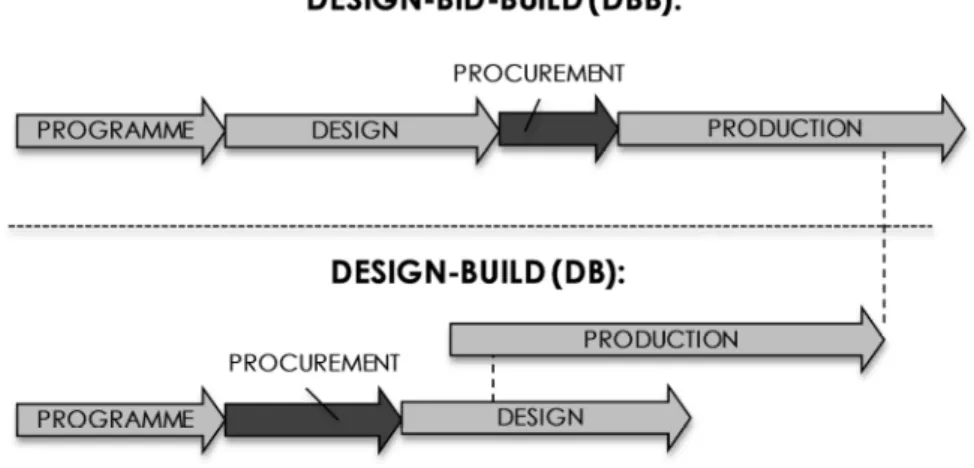
The organisational method illustrates how an organisation is designed. Payment system defines how the client is paid, examples are price based alternatives; lump sum and cost based alternatives; cost reimbursement. Tender procedures can be open or selective. According to Söderberg (2011), contract conditions in Sweden are regulated by two forms of standard agreements. According to Osipova and Eriksson (2011) there are two major types of procurement options in the Swedish construction industry, design-bid-build and design-design-bid-build. The most significant difference is the responsibility of the design, illustrated in Figure 1. According to GNA (2008) each procurement method is in monetary terms used at the same amount in infrastructural projects.
3.1.1
Design-bid-build (DBB) procurement
In DBB contracts, the responsibility for construction design is in the hands of the client. When the design is completed, it becomes a part of the tendering documents. A contractor’s procurement phase therefore only involves construction (Murdoch and Hughes, 2007). The process of a DBB contract can be visualised in Figure 1, which explains the procurement sequence and how the procurement phase relates to the design phase. DBB procurements can be arranged into two categories, where the essential difference is the involvement of a main contractor, called the general contractor (Osipova, 2008). In general contracting there is only one contract between the client and the contractor and it is the general contractor’s responsibility to coordinate work
between the involved subcontractors. General contracting is sometimes referred to as traditional contracting. This has to do with general contracting being the most used form of procurement method over the years (Murdoch and Hughes, 2007).
Potts (2008) argues that DBB contracts generate a distinct view on what the project cost is going to be before the construction starts. Murdoch and Hughes (2007) claim that projects with advanced design are more suitable for DBB contracts. This is determined by what the design team creates, and explains what should be built, and the contractor only focus on construction. Osipova (2008) says that DBB contracts are less risky for a contractor, due to the absence of construction design. However, Potts (2008) argues that a disadvantage with the contract is that they are more time consuming than DB contracts. Osipova and Eriksson (2011) claim that a DBB contract gives the contractor a lower profit margin than a DB contract and it is a less expensive alternative for the client.
3.1.2
Design-build (DB) procurement
In DB procurements the contractor has a wider role than in DBB procurements, due to the responsibility for the project’s design. The design can be performed by an internal division within the contractor’s company or by an external body selected by the contractor. How detailed the design is varies between projects and the client might have predetermined parts of the design in the tendering documents. In those situations, the contractor will design the remaining parts. Another alternative is that the contractor is obligated to perform the entire construction design (Murdoch and Hughes, 2007). One main advantage with DB procurements is that the construction phase can begin before the design phase is completed. However, the time for tendering is usually longer in a DB contract. The DB contractor composes a contract with each subcontractor. It is possible that each subcontractor can be in charge of the design within its actual theme (Murdoch and Hughes, 2007).
According to Osipova and Eriksson (2011), DB contracts have become more frequently used due to the greater range of responsibility for the contractor and less responsibility for the client. An advantage with DB contracts is that the client establishes one agreement with the party responsible for both design and construction (Potts, 2008). This facilitates the communication between the client and the contractor and there is only one party for the client to exchange information with. Ling et al. (2004) argue that DB contracts are more successful when it comes to construction and delivery speed. On the other hand they argue that DB contracts are more expensive to the client, due to less competiveness in the process and a wider range of responsibility for the DB contractor. The DB contractor takes a big risk by being both in charge and responsible for faults in design and construction.
3.2
Contractor’s tendering
The planning for a tender can start before the tendering documents are announced and available for the contractor. The contractor observes potential projects by studying plans or announcements from public bodies, where an example of a client publishing upcoming infrastructural projects is the Swedish Transport Administration (Söderberg, 2011). He discusses that contractor’s must have continuous contact with potential customers. This phase can be seen as stage A in the tendering process, see Figure 2. The tendering documents are presented by the client, which is normally done electronically (Tindsley, 2008). According to Brandt and Franssen (2007) the tendering documents can be divided into two parts; where the first part is technical specification
and the second part is the administrative conditions. Technical specifications can include general drawings, bill of quantities and descriptions. The administrative part contains contractual issues and other construction details concerning the project.
Preparation for tendering can be related to high costs as well as time consumption (Wilson and Kusomo, 2004; Hassel and Långström, 2004). The cost for tendering varies between 5-15% of the contract sum, depending on size and complexity of a project. Results indicate that one of six tenders turns out to be a winning tender. Thus it is important to decide whether to tender or not (Wilson and Kusomo, 2004).
Two studies investigate factors to determine the decision whether to tender.Fayek et al. (1998) lists 15 factors which decide whether to tender or not. The results from the study aligns with Bajaj et al. (1997), who rank the most important factor to what project type it concerns. The type of project answers how well the project is suited to the business plan, number of competitors and time for tender. The second most important factor whether to tender or not, relies on the availability of personnel. Additionally, a contractor can have several intentions to tender on a project. Fayek et al. (1998) identify the most usual intention to win the contract, but also to enhance reputation.
3.2.1
Cost estimation in tendering
Cost estimation is the event where the tender price is calculated. According to Akintoye and Fitzgerald (2000) the most popular methods of estimation techniques is the traditional cost estimating, which is often supported with computer based software. Brandt and Franssen (2007) separate the traditional cost estimating technique into six activities. The first activity includes two phases, investigation of what is going to be constructed by a careful study of the tendering documents and to visit the construction site; it also involves the choice of construction method. The second phase consists of producing bill of quantities, which lists all quantities of the chosen construction method. The third activity is to perform schedule of execution. The fourth activity is to estimate the direct costs for material and labour. The fifth activity is to select overhead costs that include costs of machines and salaries for the production management. The last activity is to combine all documents and transform it to a tender. The six estimation stages are illustrated in Figure 2.
Another cost estimating technique that is frequently used is experienced based techniques (Akintoye and Fitzgerald, 2000). It is mainly a comparison of information or experience from past similar projects. The traditional method and the experienced based method are deterministic methods which only include the most likely value of the estimation (Ali, 2005). Also, he claims that a deterministic technique is inadequate due to the fact that the estimator misses the likelihood of the estimation. Thus, Ali (2005) argues for probabilistic methods which include the probability and a range of the estimation. Akintoye and MacLeod (1997) claim that absence of experience of the technique and that many projects are too small to invest in the time it takes to perform probabilistic simulations, are the two main reasons why probabilities simulations are rare.
Akintoye and Fitzgerald (2000) investigate which people are the most frequently participants in the estimating process. Except from the estimator, other participants are subcontractors and contract managers. Moreover they point out that site managers do not participate in the estimation process. Most of the tendering time is used to perform accurate estimates on material and labour, choice of construction method, setting the design and to assessing risks (Fayek et al., 1998). A vital activity, according to Potts
(2008) is when the contractor turns the estimation to a tender. Additionally to the estimations, risks must be assessed to investigate how it affects the tender price. The last stage involves the senior management making final comprehensive decisions on the estimations before the tender is submitted. This phase can be seen as stage C in the tendering process, see Figure 2.
3.2.2
Calculation of a tendering price
There are usually two options on how to calculate costs in a tendering price. Nemuth (2008) separates the tendering price into three categories, direct costs, indirect costs and the company’s profit and risks. Direct costs include wages, materials and subcontractors. Indirect costs include management etc. Profit is the mark-up decided by the company and risk includes positive and negative risks. Olsson et al. (2006) separate the tendering price into three categories: the estimated cost, profit and risks. The risks can then be divided into two categories, cost for contingencies and risks relating to uncertainties in a project. Fayek et al. (1998) say that approximately 60% of the companies include a risk percentage in the mark-up. All mark-ups in the study were in the range of 4-16% of the tender price.
According to Nemuth (2008): According to Olsson et al. (2006):
+ Direct costs + Estimated costs
+ Indirect costs + Profit
+ Profit including risks + Risk (contingencies) + Risk (uncertainties)
= TENDER PRICE = TENDER PRICE
3.3
Public procurement
According to Eriksson (2008) public bodies are a major part of a country’s construction clients. In Sweden, The Public Procurement Act (LOU) explains how public bodies must act in construction procurements and what regulations the contractor must comply with. A public body can be a municipality or a public authority, but it also includes companies and authorities acting under a public interest. The regulation affects several aspects in the tendering process. For instance, it regulates what the tender documents should contain and when a tender must be disproved. Larger construction projects must be announced to the public (Söderberg, 2011).
LOU is regulated by two principles; equal treatment and transparency. Equal treatment claims that all involved parties in the tender should access information at the same time. Transparency defines that all parties should access exact the same information. The two principles can be exemplified in a tender process where there is ambiguity in the tender documents and an answer from the public client must be available to all competitors at the same time (Söderberg, 2011).
Figure 2. Sequence of a typical tendering process (based on Söderberg, 2011; Brandt and Franssen, 2007; Potts, 2008)
1 2 3 Observing projects Tender docs. published Creating BOQ
Add risks & submit tender
A
1 2 1 2 3 4 5 6 Schedule of execution 2 1 Material & labour costs Overhead costs Combine docs.C
4
Risk management
This chapter will present a comprehensive view of the risk management process, which will be based on the established risk management standard ISO 31000. Initially, the text will illustrate how risk and uncertainty can be defined and why some people rate a specific risk as significant, while others find it less important. Also, this chapter will compare risk management practice within construction with other project based industries and finally explain how a risk management support tool can be developed.
4.1
Definitions
Most people have a good notion about how the terms risk, uncertainty and opportunity are related in their daily life. However, most people would have a problem when it comes to state a definition that clarify its whole content. It becomes clear that it exists a wide range of definitions when studying engineering and finance based publications. In this section some of the most often used definitions will be presented and an explanation why it will become important to know about the existing differences will be given.
4.1.1
Risk
Most available risk management literature explains risk as an event that occurs with a certain probability in combination with a consequence in the case of occurrence. Risk can in a simplistic approach be defined as:
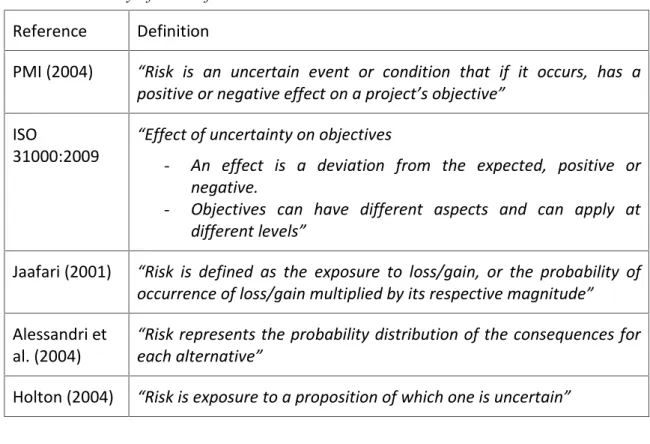
Risk = probability of risk occurring x impact of risk occurring (McNeil et al., 2005). Samson et al. (2008) say that it does not exist any general risk definition. They argue that a new definition will be established every time an organisation faces a new decision problem. Their statement is in accordance with the research of Grimvall et al. (2003) on the same subject. They claim that most people’s risk definition will to a high extent be dependent on the situation in which the risks may occur. Also, they argue that this state of knowledge will have some impractical consequences in projects where risks often occur in a number of different situations and with a lot of different actors involved. Grimvall et al. (2003) discuss that the most important aspect is that the whole organisation agrees with a definition that everyone is comfortable with. Today, most of the big organisations that frequently are exposed to risks have identified this problem and as a result agreed with a common definition. According to Samson et al. (2008), organisations usually adopt some of the already established definitions, but employees would rather come up with their own specific definition. Table 1 illustrates some of existing risk definitions established by well-known institutes and researchers.
Winch (2010) discusses that most risk definitions include the whole range of both positive and negative outcomes, which corresponds to the definitions presented in Table 1. Furthermore, studies have indicated that project managers tend to use the term risk almost solely for the negative consequences of an event. Winch (2010) is criticising this approach and says that this attitude can lead to a lack of determination when it comes to managing the opportunities in a project. Therefore he argues against the use of risk as a term for both positive and negative outcomes and calls it highly inappropriate. Instead he suggests an implementation of a more suitable framework that separates the risk definition into threats and opportunities. When adopting this approach, organisations can design more effective strategies that manage threats and opportunities separately. Finally he claims that the management of threats and the management opportunities will in many aspects be different, and therefore necessary to separate.
Reference Definition
PMI (2004) “Risk is an uncertain event or condition that if it occurs, has a positive or negative effect on a project’s objective”
ISO
31000:2009
“Effect of uncertainty on objectives
- An effect is a deviation from the expected, positive or
negative.
- Objectives can have different aspects and can apply at
different levels”
Jaafari (2001) “Risk is defined as the exposure to loss/gain, or the probability of occurrence of loss/gain multiplied by its respective magnitude”
Alessandri et al. (2004)
“Risk represents the probability distribution of the consequences for each alternative”
Holton (2004) “Risk is exposure to a proposition of which one is uncertain”
In this report we will use the definition which is established by PMI (2004), “risk is an uncertain event or condition that if it occurs, has a positive or negative effect on a project’s objective”.
4.1.2
Uncertainty
Samson et al. (2008) argue that there does not exist any general accepted definition of either risk or uncertainty. Alessandri et al. (2004) say that strategic managers and finance academics for decades have argued about the terminological differences between risk and uncertainty. Today there are in general two different approaches of the question, see Figure 3. The first opinion claims that uncertainty is equivalent with risk and the others argue for a point of view where risk and uncertainty are two different concepts. In the second approach, there are those who consider uncertainty and risk as two independent concepts, while others have the belief that they are dependent on each other. Although the differences in opinion, a majority of the concerned parties do agree that risk and uncertainty are two different concepts that somehow are related. Additionally, most parties do agree that projects are associated with both uncertainty and risk, and therefore need a management system that can handle both simultaneously (Samson et al., 2008).
Uncertainty and risk
Uncertainty
is risk Uncertainty and risk are different concepts
Uncertainty and risk are independent
Uncertainty and risk are dependent
Figure 3. Relationship between risk and uncertainty (based on Samson et al., 2008) Table 1. Summary of risk definitions
Jaafari (2001) defines uncertainty as: “the probability that the objective function will not reach its planned target value”. He claims that an uncertainty creates risk and that the extent of the risk will depend on the level of uncertainty and its consequence for the project. Furthermore, when the probability for an event is 100%, the uncertainty becomes certain.
In this thesis, uncertainty and risk will be used as two different concepts that are related to each other, which correspond with the most accepted view (Alessandri et al., 2004).
4.2
Risk classification
Several studies have been made in order to identify various risk categories to enable a design of an effective risk classification system for construction projects. Today, a number of allocation approaches exist, separating risks into categories. Some literature gives the recommendation to allocate the risks based on its consequences on a project, while others suggest a categorisation based on the risk source (Hastak and Shaked, 2000). Furthermore, a risk allocation approach based on the level of knowledge can be performed by using the following four categories (Winch, 2010):
Known knowns, is the condition of a risk where its source can be identified and a
specific probability and consequence in the case of occurrence can be calculated.
Known unknowns, is the condition of uncertainty where the risk source can be
identified but the probability will remain unknown.
Unknown known, is the condition of an uncertainty where someone has knowledge
of both the risk source and its estimated probability but the information will be unknown for most concerned parties.
Unknown unknowns, is the condition of uncertainty where the risk source cannot be
identified, therefore there is no possibilities to calculate its probability or consequence.
A key for an effective risk management strategy is how an organisation can manage these concepts. When an organisation accepts a project they realise that risks will arise that will require extra spending of resources, this is the known part. If the organisation has the ability to determine the risks probability and its consequences it will be classified as a known known. If the organisation neither can estimate its probability nor its consequences, they will face a known unknown. Furthermore, unknown known are those uncertainties where knowledge about the uncertainty exists, but not among the people who manage it. Finally, unknown unknowns, also called black swans, are unrecognised until they actually materialises. They will always occur without warnings, with a substantial impact, and the possibilities to prepare the organisation for its consequences are small (Winch, 2010).
4.3
Risk perception
Risk perception is according to Grimvall et al. (2003), the joint concept that discusses why some people rate a specific risk as significant, while others find it less important. The concept will be a key for the understanding of how risk should be managed in projects and how effective risk strategies should be designed.
Grimvall et al. (2003) discuss risk management in technical systems and say that there are a large number of factors that will affect in which way humans experience risk. Risk
accessibility is presented as one of the most significant factors, which is risks that one
can easily imagine and have one’s own experience of. This type of risk will be seen as more probable and therefore judged as a bigger threat. Another factor that will affect the way one experience risk is risk voluntariness. Grimvall et al. (2003) explain that
humans are willing to take on up to ten times more risks if the decision to carry out the event is based on their own free will than if someone else would make the decision. The third risk perception factor is based on the moment when the risk was discovered. Recently discovered risks can be seen as a larger threat than risks that have been around for a longer time. Grimvall et al. (2003) discuss that much of our risk perceptions can be explained by the irrational nature of the human being. Alessandri et al. (2004), say that decision makers will often act irrationally when it comes to decisions which include substantial risks. This is an effect of the limitation of the human ability to process various types of information simultaneously.
An additional approach is the one that explain how people experience risk differently as a consequence of human and social factors, such as gender, age, educational level and social belonging. As an example, females rate general risks higher than men. However, when it comes to personal risks, female rate risks in just about the same way as men. Moreover, people’s educational level will affect their risk perception. Research indicates that highly educated people rate risk lower than people with less education. To minimise the effect of the differences in humans risk perception, an organisation should assemble a heterogeneous decision-team (Grimvall et al., 2003).
Grimvall et al. (2003) argue that most studies in the area of risk perception are done by psychologists which are specialised in human behaviour. However, some researchers address criticism against their point of view and claim that it assumes a far too homogeneous picture of a group. The critics agree with the statement that there are differences between groups, but favours a view focusing on individual risk perception. The individual risk perception is a product of the genes that one gets from one’s parents, the environment in which one is raised and one’s collected experiences. The critics claim that the social factors are far more dominant than the human factors. This statement carries the discussion to whether humans are able to make objective evaluations of risks or not. Studies have concluded that humans tend to overestimate risks with small probability and underestimate risks with high probability. This behaviour can cause numerous failures in risk calculations, especially when it is based on a high proportion of small risks (Lidskog et al., 1997).
Another condition that will affect the limitation of an objective risk evaluation is the level of individual risk acceptance. Winch (2010) uses the term risk propensity to
explain that every individual has a specific risk acceptance function. These functions illustrate what people are willing to pay to avoid risks. He presents a frequently used approach which separates the human risk propensity into three different behaviours, see Figure 4. Risk averse, are people who have a negative slope of the risk-reward function,
which illustrate a person who avoid risks when the reward is smaller than the risk exposure. Flanagan et al. (2007), say that the risk averse behaviour can results in a condition where a number of projects are not accepted, even though it would be profitable. The second behaviour is the risk taker (Winch, 2010). Risk takers are willing
to accept a high numbers of risks under uncertain provision of reward. The behaviour can let organisations accept projects with an opportunity to generate a big return but with the possibility of big losses (Flanagan, 2007). The risk taking behaviour can be illustrated by a positive slope of the risk-reward function. Finally, risk neutral are those
are equally big. The risk neutral behaviour can be explained by a linear risk-reward function.
Lyons and Skitmore (2004) investigated how risk acceptance may differ in the Australian construction sector. The result indicated significant differences in risk tolerance among construction actors. The result confirmed that construction contractors were more willing to take risks than the selection of consultants and project clients. They classified project clients as risk averse, contractors as risk takers and consultants as risk neutral. Lyons and Skitmore (2004) claim that research performed within the UK construction industry indicates an overall risk taking behaviour in the construction industry. Paradoxically, a study with respondents from several segments within the construction industry confirms that a majority classifies themselves as risk averse or neutral to risk.
4.4
The risk management process
The risk management process has during the last decades become an important event in most project based organisations (Flanagan et al., 2007). Potts (2008) says that the risk management within the construction industry has historically been either ignored or dealt with in an arbitrary way. Today, risk management techniques are best developed within industries with heavy engineering events or in organisations where there are high levels of technical risk involved (Maylor, 2003). However, Flanagan et al. (2007) claim that it is important for most organisations to implement an effective risk management system that enables minimum loss from occurred risks. By the risk management system, risks can be transferred into opportunities which can generate gain for the company. To be competitive and able to make correct decisions in the project processes it becomes crucial to take advantage of the knowledge and experience within the organisation. The risk management principles describe how knowledge should be managed in a systematic manner. Most organisations adopt an informal risk management approach, without realising its content. The informal approach will often give the outlook of risk management as something subjective and uncontrolled. Subject related literature argues for a more formal attitude to the risk management process. The attitude should include a more systematic approach, with established routines, which should give involved parties guidelines and structure on how to manage risk in their daily business (Flanagan et al., 2007).
In reality, even small incidents can have significant impact associated with big losses. These incidents can start a chain reaction that can threaten the whole project’s existence
Risk Reward Risk Risk taker Risk Reward Reward
Risk neutral Risk averse
and in the long run, even be a threat for the survival of the company. Therefore, it will be essential to provide a risk management system that enables identification of those risks and a comprehensive analysis of its triggers (Flangan et al., 2007).
4.4.1
The risk management model
The risk management model can in a simplistic approach be divided into activities that identify risks, activities that analyse its probability and impact and finally activities where the handling plan is evaluated and established. Maylor (2003) separates these activities into three event categories: identification, quantification and response.
Risk management literature explains this process differently, but as a whole, much of the described principles are the same. A majority of the literature illustrates the process as a circular model in order to emphasise risk management as an on-going and learning process throughout time (Winch, 2010; Baker et al., 1998). In contrast, some literature explains the model as a line of processes where the start and end activities are disconnected from each other (Simu, 2006). Criticism has been addressed against this models and claim that its lack of interrelation is why the construction industry often faces the same incidents in projects time after time (Winch, 2010).
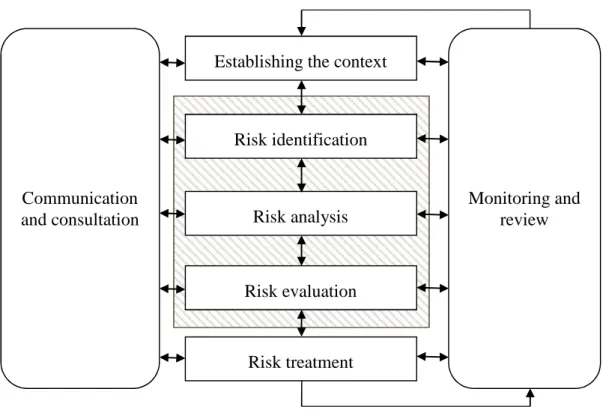
The risk management process consists of three prime phases, which correspond with Pott’s (2003) and Maylor’s (2003) established models. The phases are risk identification, risk analysis and risk evaluation. The model is based on ISO 31000 and can be seen in Figure 5. The risk management strategy has to be tailored for the specific organisation and its processes. It is impossible to design a risk management strategy that is suited for all organisations (Flanagan et al., 2007).
Eskesen (2009) claims that it is of great importance that the risk management processes begin early to enable a successful project outcome. The process should be started during a project’s feasibility study and in the early planning phase. Reilly and Brown (2004)
Communication and consultation
Monitoring and review Establishing the context
Risk treatment Risk analysis Risk identification
Risk evaluation
say that an early implementation will reduce the number of risks that affect the project objectives. Also, it should be done to assure the project team and shareholders that the planned events are rationally evaluated. They claim that an execution of the early risk management process will give the contractor useful information about specific threats, which makes it possible to calculate a budget and a schedule. Finally, the process enables the parties to construct a mitigation plan to effectively manage the identified risks, and subsequently define the project strategy.
4.4.2
Risk identification
The risk identification process should be a set of on-going activities during the whole lifetime of a project. As a construction project makes progress, it will be harder to make changes as these will be associated with high costs. Therefore it will be crucial to identify project risks in an early stage while it still can be governed (Smith et al., 2006). The risk identification activities can be separated into events where the project team identifies risks and events where the identified risks are separated into an appropriate structure (Chapman and Ward, 1997).
Establish the context
According to ISO 31000:2009, the first phase, before risks can be identified, is to establish an organisation’s risk management context, see Figure 5. This is the process where the company’s objectives are expressed and defined in external and internal parameters. When establishing the external parameters, aspects of the company culture, rules, laws, financial condition, stakeholder relationship and key drivers are evaluated. When defining the internal parameters aspects of the organisational structure, policies, strategies, information systems and internal stakeholders have to be evaluated. Eskesen (2009) advises a high involvement by the project team when establishing the context. It will be important that all parties have a good knowledge about the context and have the chance to contribute in the process. The invested time and effort by the project team will result in a more effective process and a reduction of disputes. When the contextual phase has been completed, the risk identification process can start.
The importance of risk identification
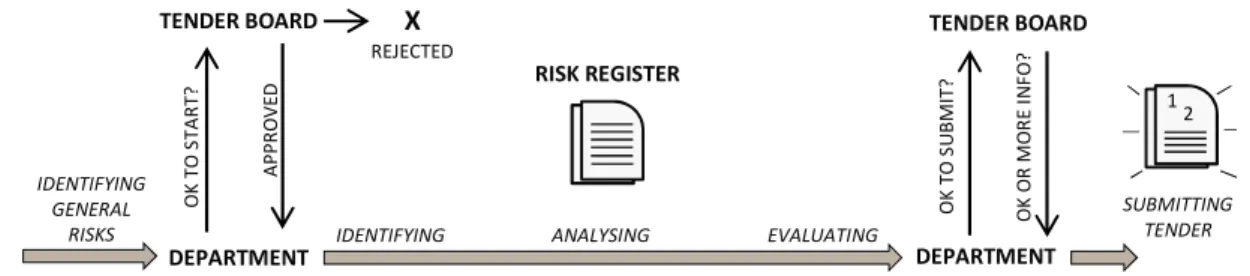
The primary aim with the risk identification process is to generate a list of risks with both negative and positive consequences, which is called risk register (PMI, 2004). The risk register should be as comprehensive as possible and include risks whether or not its consequences are under control of the organisation (ISO 3100:2009). Bajaj et al. (1997) claim that if a risk is not identified it cannot be controlled, transferred or in any other aspects managed. However, Potts (2008) claims that it is impossible to identify all project related risks. He says that it will be counterproductive if a company think that they can, and base the tender price on that assumption. Projects within the construction industry are unique projects, which results in a demand of an individual identification phase for each project. Winch (2010) claims that the risk identification process is an important key to the whole risk management practices. This statement concurs with Bajaj et al. (1997), who claim that the main benefits of risk management arise from the identification phase rather than the risk analysis. Paradoxically they argue that the identification phase is one of the less formalised elements in the risk management process.
Trial and error
Winch (2010) states that risk identification performance is mainly based on experiences from skilled personnel within an organisation. The experiences of a risk are often based on a specific incident that has occurred in a previous project. People tend to remember
risks that have a negative impact on a project, rather than events with a better outcome than expected. This statement corresponds with the information that Bajaj et al. (1997) provide, where they claim that the primary basis for risk identification is internal and external experience and historical data. To increase experience within a project team, ISO 31000 advices organisations to involve people with appropriate knowledge and experience in the identification phase. Flanagan et al. (2007) make an attempt to explain in more detail how risks can be identified and what resources they will demand. Experience, knowledge and advice from a third party seem to be the most important elements in the process. They argue that the best result will be achieved when organisations combine several of these alternatives and not rely on one source alone. Identification techniques
Flanagan et al. (2007) say that much of the resources for risk identification should be spent in an early project phase, during the tendering process. The frequently limitation of time during tendering generates a demand for effective identification methods. The risk identification process can be performed with a number of techniques. Brainstorming, interviews and risk source identification are some of the most used methods within construction projects. Other important activities are contract studies, site visits and further project research. Bajaj et al. (1997) asked 19 contractors how risks were identified in their organisations. The conclusion highlights that the most used risk identification activity is the risk review, which was performed by 70% of the respondents. Although it is important to realise that it is impossible to design a risk identification technique which is suitable for all organisations and projects. The brainstorming technique enables people from different departments and with different knowledge to share their point of view regarding risks. To obtain the best possible outcome, it will be crucial to engage the right mix of people with different background, gender and age (Smith et al., 2006). Another used method to identify risks is to perform a set of interviews with people from relevant areas within the project. The respondents should have experiences from similar projects or other knowledge that will contribute to the risk identification process. The risk interview itself gives the respondents a feeling of both involvement and responsibility in the risk identification process (Smith et al., 2006).
The next phase after the identification period is to assemble a risk register based on the respondent’s answers. This can be done by one single person from the project team or during a meeting where all respondents discuss together the identified risks. In some situations it can be challenging to compare and summarise the identified risks, as it is difficult to determine whether some of them regard the same risks potential (Smith et al., 2006).
The risk register
As previously stated, the primary aim with the risk identification phase is to generate a risk register of project specific risks. Bajaj et al. (1997) claim that it is possible to contain a list of more or less standard risks that will be present in all construction projects. To confirm this statement, Potts (2008) says that Perry and Hayes (1985) constructed a comprehensive list of construction risks, where they identified over 100 potential risky project events. Today, many organisations adopt some of these risk lists, but some prefer to construct their own, which is suited for their organisation’s projects. The risk register should give an extensive focus to the identification of critical risks. Bajaj et al. (1997) say that the risk identification process will be a waste of resources if critical risks are missed in the process. If noncritical risks are identified and some of the most critical risks are missed, a risk analysis will give the decision makers a misleading
result about the total risk exposure. As a consequence, the organisation will be exposed for risks without realising it.
The risk register can be designed in a number of ways (Potts, 2008). The design will depend on the organisational size, project characteristics and the personnel using the risk register in practice. For smaller organisations which mainly manage small projects, the demand of a sophisticated risk register is minor. In contrast, the risk register used by larger organisations with large projects can be a range of complex documents which have been prepared in a software program. ISO 31000:2009 claims that it will be important to design the risk register based on an organisation’s projects. The individual design will be crucial in order to get an effective and useful support tool and not been seen as a burden.
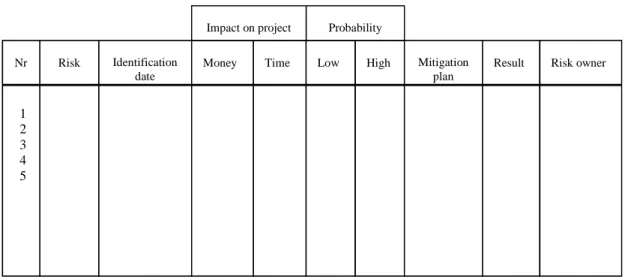
When it comes to the content of a risk register Flanagan et al. (2007) claim that a basic register should include information about the identified risk, and its expected impact on the project. The impact is usually measured in a monetary unit but can also be measured in time or quality. For a more detailed risk register, information about the following should be administrated: risk type, risk status, risk identification date, identification number, mitigation plan, date for mitigation activity, risk owner and probability of occurrence. An example of a quite detailed risk register is presented in Figure 6. If the risk register should be used as a reference for future similar projects it should include information concerning whether each risk occurred, the observed impact and how the mitigation activities succeed (Flanagan et al., 2007).
The need of structure
A construction project consists of a large number of risks, which should be visualised during the identification process. The risks may vary rather widely from one project to another. However, the variety of project related risks, the key risk sources will basically be the same (Smith et al., 2006). In the identification process the project team can use the risk sources as a checklist, to ensure comprehensive risk identification. The below presents list consists of frequently used risk sources in construction related projects (Smith et al., 2006).
Risk Identification date
Money Time Low High Mitigation plan
Result Risk owner Nr Probability Impact on project 1 2 3 4 5

![Figure 12. Simulation of project 2 [risk as ‰ of prime cost]](https://thumb-us.123doks.com/thumbv2/123dok_us/1321259.2676628/55.892.125.720.122.495/figure-simulation-project-risk-prime-cost.webp)
