arXiv:1901.02436v1 [eess.SP] 8 Jan 2019
Analysis of Distributed ADMM Algorithm for
Consensus Optimization in Presence of Node Error
Layla Majzoobi
+, Farshad Lahouti
∗, and Vahid Shah-Mansouri
++School of Electrical and Computer Engineering, University of Tehran
*Electrical Engineering Department, California Institute of Technology
Abstract
Alternating Direction Method of Multipliers (ADMM) is a popular convex optimization algorithm, which can be employed for solving distributed consensus optimization problems. In this setting agents locally estimate the optimal solution of an optimization problem and exchange messages with their neighbors over a connected network. The distributed algorithms are typically exposed to different types of errors in practice, e.g., due to quantization or communication noise or loss. We here focus on analyzing the convergence of distributed ADMM for consensus optimization in presence of additive random node error, in which case, the nodes communicate a noisy version of their latest estimate of the solution to their neighbors in each iteration. We present analytical upper and lower bounds on the mean squared steady state error of the algorithm in case that the local objective functions are strongly convex and have Lipschitz continuous gradients. In addition we show that, when the local objective functions are convex and the additive node error is bounded, the estimation error of the noisy ADMM for consensus optimization is also bounded. Numerical results are provided which demonstrate the effectiveness of the presented analyses and shed light on the role of the system and network parameters on performance.
Index Terms
ADMM algorithm, Consensus optimization, Convergence, Node error, Steady State Error. I. INTRODUCTION
In the advent of big data, the Internet of Things and cyber-physical systems, distributed processing algo-rithms have attracted increasing research attention. Considerable problems in these areas including network flow control, feature extraction and power system state estimation, are formulated as convex optimization problems, and use distributed optimization methods [2]- [9]. These algorithms may be characterized by their range of applicability, convergence behavior, performance, and computational complexity.
Alternating Direction Method of Multipliers (ADMM) is one of the popular convex optimization algorithms which can be implemented in a distributed manner. Wide range of applicability and convergence with an adequate accuracy within a few tens of iterations make ADMM very useful in practice. Different applications and convergence behavior of ADMM algorithm are discussed in [10] - [20]. An upper bound on the global linear convergence rate of ADMM algorithm for strongly convex objective function under smoothness assumptions is provided in [20]. A parameter selection method which optimizes the derived convergence bound is also presented in this work.
Decentralized consensus optimization is an important family of optimization problems which is formu-lated as min ˜ x N X i=1 fi(˜x) (1) where ˜x ∈ Rn and f
i(˜x) : Rn → R are convex functions. N agents aim to optimize the sum of local
objective functions, fi(˜x), i∈ {1, ..., N}, over a global variable x˜. Distributed ADMM-based algorithms
for consensus optimization problems can be classified into two categories. In the first one, there is a central
Preliminary results on this research has been reported in IEEE International Conference on Acoustics, Speech and Signal Processing (ICASSP), China, 2016 [1].
collector or fusion center that all agents communicate with. Indeed the agents and the fusion center form a star network [10]. In the second one, there is not a fusion center, and the underlying network between the agents can have any connected topology [21]- [24]. While the former category has better convergence rate, the flexibility of network topology in the latter one is more appealing. A framework is provided in [25], which improves the convergence property of the latter category by allowing multiple fusion centers in the network.
The distributed optimization algorithms rely on local computations and communication between neigh-bors. They potentially suffer from different types of errors and imperfections such as computation, quantization and communication errors and link failure which could substantially affect the performance of distributed optimization methods. The subgradient-push algorithm which is convergent over time varying networks is proposed in [26]. ADMM-based algorithms which are resilient to link failure are proposed in [27]. Certain local computations are too complex to be carried out exactly and are usually replaced by approximations. Inexact variants of ADMM algorithm are proposed in [21], [28]–[30]. In [21], three distributed ADMM-based algorithms are proposed to solve the Lasso problem offering different computa-tional complexity and convergence rate trade-offs. In [28] each ADMM update step, which includes solving an optimization subproblem, is replaced by an inexact step which reduces the computational cost of the algorithm by an order of magnitude. In [29] and [30], the Lagrangian minimization in each ADMM step is, respectively, replaced by linear and quadratic approximations of the objective function. The quadratic approximation is more complex than the linear approximation, but results in an algorithm with better convergence properties. A distributed subgradient method for consensus optimization which is convergent in presence of quantization error is proposed in [31]. In [32], ADMM-based distributed algorithms are proposed for parameter estimation in ad hoc wireless sensor networks which exhibit resilience in the presence of communication/quantization noise. For the least square objective function, the steady state error of the algorithm is analyzed. A robust ADMM-based distributed algorithm for average consensus problem in presence of noise is presented in [33].
In this work, we focus on analyzing the convergence behavior of distributed ADMM for consensus optimization over a connected network in presence of additive node error. We consider general convex or strongly convex local objective functions. In this setting, the latest estimate of the solution computed at each node is subject to additive random noise prior to transmission to neighboring nodes (this for instance could be due to quantization error [34]). We provide analytical upper and lower bounds on the mean squared steady state error of the noisy ADMM algorithm for consensus, when local objective functions are strongly convex and have Lipschitz continuous gradients. In addition, we show that for convex, proper and closed local objective functions and in presence of bounded node error, the steady state error of noisy ADMM algorithm for consensus is bounded. Extensive numerical results are provided which shows the effectiveness of the presented analyses. We also study the effect of different factors, such as noise variance, network topology and ADMM algorithm parameter on the provided bounds. We also propose a method to tune the algorithm parameter, which results in a faster convergence rate and a smaller steady state error.
The rest of the paper is organized as follows. The system model and prior art is reviewed in good details in Section II. Section III analyzes the convergence behavior of the algorithm in presence of additive node error. Analytical results are numerically assessed in Section IV, and conclusions are drawn in Section V.
II. PRELIMINARIES
Consider a set ofN nodes that intend to solve the consensus optimization problem in (1) in a distributed manner and over a given connected network with E undirected links. The network can be represented by the graph G = (V,A), where V is the set of nodes, |V| = N, and A is the set of arcs, |A| = 2E. Communications of nodes are synchronous and restricted to the neighbors.
Algorithm 1 : Distributed ADMM-based algorithm for consensus optimization problem
Input functions fi; Initialization: for all i∈ V, set x0i =α0i = 0n×1 ∈Rn; Set algorithm parameter c >0;
k = 0:
for all k = 0,1, . . . , every node i do
1. Update xk+1i by solving ∇fi(xk+1i ) +αki + 2c|Ni|xk+1i −c(|Ni|xki +
P
j∈Nixkj) =0 ;
2. Node i sends xk+1i to its neighbors; 3. Update αk+1i =αki +c(|Ni|xk+1i −
P
j∈Nixk+1j );
In this section, we briefly review the ADMM algorithm and the known convergence results from [24] for completeness. To apply the ADMM algorithm to problem in (1), we reformulate the problem as
min xi,zij N X i=1 fi(xi) s.t. xi =zij, xj =zij ∀(i, j)∈ A (2)
where xi ∈ Rn is the copy of the global optimization variable x˜ ∈ Rn at node i and zij ∈ Rn is the
variable, which enforces equality ofxi andxj at the optimal point. Concatenatingxis andzijs respectively
into x∈RnN and z∈R2nE, (2) can be rewritten in the following form
min
x,z f(x) +g(z); s.t. Ax+Bz= 0 (3)
wheref(x) = PN
i=1fi(xi), g(z) = 0. MatrixA can be partitioned asA= [A1;A2], whereA1 = ˆA1⊗In
and A2 = ˆA2 ⊗In, and ⊗ represents the Kronecker product. Elements of Aˆ1 and Aˆ2 are zero or one.
Assuming that (i, j)∈ A is an arc in the network graph, the(m, i)element of Aˆ1 and the(m, j) element of Aˆ2 are one if zij is the mth block of z, ∀m ∈[1,2E]. Also, we have B= [−I2nE;−I2nE]. Forming
augmented Lagrangian and applying ADMM algorithm, we have
∇f(xk+1) +ATλk+cAT(Axk+1+Bzk) =0 (4a)
BTλk+cBT(Axk+1+Bzk+1) =0 (4b)
λk+1−λk−c(Axk+1+Bzk+1) =0 (4c)
where λ and c are Lagrange multiplier and ADMM parameter, respectively; ∇f(xk+1) is gradient or
subgradient of f(x) at xk+1 depending on the differentiability of f. Considering λ= [β;ν] with β,ν ∈
R2nE, M+ =AT
1 +AT2 and M− = A1T −AT2, it can be shown that β = −ν and with some algebraic
manipulations [24], we have ∇f(xk+1) +M−βk+1−cM+(zk−zk+1) =0 (5a) βk+1−βk− c 2M T −xk+1 =0 (5b) 1 2M T +xk+1−zk+1 =0 (5c)
Multiplying (5b) by M− and substituting the result in (5a), and also replacing (5c) in (5a), we have ∇f(xk+1) +M−βk+ 2cWxk+1−
c
2M+M
T
βk+1−βk− c 2M T −xk+1 =0, (6b) where W= 1 4 M+M T ++M−M T − , (7)
is the extended degree matrix of the underlying network. By “extended”, we mean replacing every 1 by
In, and 0 by 0n in the original definition of this matrix [24]. Multiplying two sides of (6b) by M−, and defining α= [α1;α2;. . .;αN] = M−β ∈ RnN, a relatively simple fully decentralized algorithm is obtained in [24] and presented in Algorithm 1. In this Algorithm, Ni is the set of neighbors of node i.
It is shown that with the following assumption, the proposed algorithm converges R-linearly to its optimal point over a fixed connected underlying network [24].
Assumption 1. The local objective functions are strongly convex and have Lipschitz continuous gradients. For each agent i, and given any xa,xb ∈Rn, we have
∇fi(xa)− ∇fi(xb),xa−xb ≥mfikxa−xbk 2 2, k∇fi(xa)− ∇fi(xb)k2 ≤Mfikxa−xbk2, where mfi >0 and Mfi >0.
According to Assumption 1, f(x) is a strongly convex function with module mf = minimfi and its gradient is Lipschitz continuous with constant Mf = maxiMfi.
Theorem 1. Consider the ADMM iterations in (5), that solves the optimization problem in (3). The primal variables x and z, respectively have their optimal values x∗ and z∗, and the optimal value for the dual variable β is β∗. Considering uk , z k βk ! , u∗ , z∗ β∗ , G, cI 2nE 02nE 02nE 1cI2nE , (8)
if the local objective functions satisfy Assumption 1, and the dual variable β is initialized such that β0
lies in the column space of MT−, then for any µ >1, uk is Q-linearly convergent to its optimal point u∗
with respect to the G-norm
kuk+1−u∗k2G ≤ρkuk−u∗k2G (9) where ρ is the convergence rate of the algorithm and
ρ= 1 1 +δ, (10) where δ= min (µ−1)˜σ2 min(M−) µσ2 max(M+) , mf c 4σ 2 max(M+) +µcMf2σ˜− 2 min(M−) (11) where σmax(M+) and σ˜min(M−) are the largest and smallest non-zero singular values of M+ and M−,
respectively. Further xk is R-linearly convergent to x∗, which follows from kxk+1−x∗k2 2≤ 1 mfk uk−u∗k2 G. (12) Proof: See [24].
As shown in [24], µ and c parameters which maximize δ are
µ∗ = 1 + K 2 G 2K2 f − KG 2Kf s K2 G K2 f + 4 −1 , (13)
Algorithm 2 : Distributed ADMM-based algorithm for consensus optimization problem in presence of node error
Input functions fi; Initialization: for all i∈ V, set xˆ0i = ˆα0i = 0n×1 ∈Rn; Set algorithm parameter c >0;
k = 0:
for all k = 0,1, . . . , every node i do
1. Update xk+1i by solving ∇fi(xk+1i ) + ˆα k
i + 2c|Ni|xk+1i −c(|Ni|xˆki +
P
j∈Nixˆkj) =0 ;
2. Node i sends ˆxk+1i =xk+1i +ek+1x,i to its neighbors; 3. Update αˆk+1i = ˆαki +c(|Ni|xˆk+1i − P j∈Nixˆk+1j ); c∗ = 2 √ µ∗M f σmax(M+)˜σmin(M−) , (14) where KG= σmax(M+) ˜ σmin(M−) , Kf = Mf mf ,
and the corresponding δ is
δ∗ = 1 2Kf s 1 K2 f + 4 K2 G − 1 2K2 f . (15)
Note that since ρ = 1+1δ is the upper bound of the convergence rate, c∗ does not neccesserily maximize the algorithm convergence rate, but as it is shown in [24, Figure 3], this can accelerate the algorithm.
As described and according to Algorithm 1, the nodes performing local processing in each iteration send their last estimation of the optimal point to their neighbors. In practical situations, local processing suffer from different sources of errors, such as truncation and quantization, which can potentially change the convergence behavior of the algorithm. In the next section, we analyze the performance of Algorithm 1 in presence of an additive random error at the nodes.
III. DISTRIBUTED ADMMALGORITHM IN PRESENCE OF NODE ERROR
In this section, we consider the scenario where the neighboring nodes only exchange a noisy version of their messages in Step 2 of Algorithm 1. We model the node error ekx,i at nodei in iterationk, as zero mean, additive and independent, identically distributed (i.i.d) error. We have
ˆ
xik =xki +ekx,i, xˆk =xk+ekx, (16) where xˆk
i is the message that nodei∈ N communicates to its neighbors at iteration k; and ˆx∈RnN and
ekx ∈RnN denote the concatenated versions of xˆki and ekx,i for all i.
The noisy ADMM algorithm can be derived by replacing xk+1 with xˆk+1 in (4b) and (4c). We have
∇f(xk+1) +ATλˆk+cAT(Axk+1+Bzˆk) = 0, (17a)
BTλˆk+cBT(Axˆk+1+Bˆzk+1) =0, (17b)
ˆ
λk+1−λˆk−c(Axˆk+1+Bˆzk+1) =0. (17c) Note thatxˆk+1, ˆzk+1 andλˆk+1 represent the variables affected by node noiseekx+1. Consideringλˆ = [ ˆβ; ˆν]
with βˆ,νˆ ∈ R2nE, and letting zk+1 = 1
2M T +xk+1 and βk+1 = ˆβ k + c 2M T
manipulations similar to those done in the derivation of (5), we have ∇f(xk+1) +M−βk+1−cM+(ˆzk−zk+1) = 0, (18a) βk+1 = ˆβk+ c 2M T −xk+1, (18b) zk+1 = 1 2M T +xk+1, (18c) ˆ βk+1 =βk+1+ c 2M T −ekx+1, (18d) ˆ zk+1 =zk+1+1 2M T +e k+1 x , (18e)
which can be considered as the noisy version of iteration in (5). With some algebraic manipulations, this iteration results in the distributed noisy ADMM algorithm outlined in Algorithm 2.
In the following theorem we analyze the convergence behavior of dk where
dk=kuˆk−u∗k2G, (19) and ˆ uk= ˆz k ˆ βk ! , (20)
andu∗ andGare defined in (8). From (18) it can be seen thatdk is a random variable, whose randomness
is caused by error sequence {e1
x, . . . ,ekx}. In Theorem 2, we obtain an upper bound on lim
k→∞E[d
k], which
shows that lim
k→∞d
k is bounded. As we shall demonstrate in proof of this theorem, boundedness of lim
k→∞d
k
dictates that lim
k→∞kx
k−x∗k2
2 is finite. We provide an upper bound on the mean squared steady state error
lim
k→∞E[kx
k+1−x∗k2
2] of the algorithm. The proof of the theorem requires the KKT conditions for (3) to
hold, i.e., ∇f(x∗) +M−β∗ = 0, (21a) MT−x∗ = 0, (21b) 1 2M T +x∗−z∗ = 0. (21c)
Theorem 2. Consider the optimization problem in (3) and the iterative solution in (18) for the optimal points x∗ and z∗. The elements of noise vectorek+1x are zero mean i.i.d random variables whose variance are σ2
n. Assume that local objective functions satisfy Assumption 1, and the initial value β0 lies in the
column space of MT−. We have
lim k→∞EFk[kx k −x∗k22]≤ (4 + 3δ) δ(mf + 2cλmin(W)) 2cnEσn2, (22) where Fk = {e1
x, . . . ,ekx} is the history of observed error vectors up to iteration k, and λmin(W)
represents the minimum eigenvalue of W defined in (7).
Proof: See Appendix A.
Remark 1. In the noiseless scenario, we have σ2
n = 0, and Theorem 2 indicates that the upper bound on
(3).
Remark 2. The upper bound on the mean squared steady state error in (22) depends on the network topology through δ,E and the minimum eigenvalue of matrixW. There is no explicit mathematical rela-tionship between the network topology and these parameters. We investigate this through some numerical experiments in Section IV.
Theorem 2 provides an upper bound on the mean squared steady state error of the estimate produced by Algorithm 2 under Assumption 1. We obtain a lower bound on the mean squared steady state error in Theorem 3.
Theorem 3. Consider the optimization problem (3) and iterative solution (18) for optimal points x∗ and
z∗. The elements of noise vector ek+1x are zero mean i.i.d random variables whose variance areσ2
n. Assume
that the local objective functions satisfy Assumption 1. We have
EFk+1 kxk+1−x∗k22≥ 8nEc 2σ2 n Mf + 2cσmax(W) 2. (23)
Proof: See Appendix B.
Theorem 2 provides an upper bound on the mean squared steady state error of the estimate produced by Algorithm 2 under Assumption 1. In the following theorem, we will show that the steady state error of the algorithm is bounded under a milder condition. To enable the proof we need Proposition 1 derived from the ADMM proof of convergence provided in [10], Proposition 2 and Corollary 1.
Proposition 1. Consider the optimization problem in the form of problem in (3), and iteration in (4) to solve it, for the general f(x) and g(z) functions, and A and B matrices. Assume that f(x) and g(z)
are convex, proper and closed functions, and the corresponding Lagrangian function has a saddle point
(x∗,z∗,λ∗). Let Vk , 1 ckλ k −λ∗k22+ckB(zk−z∗)k2 2. (24) We have Vk+1 ≤Vk −ckAxk+1+Bzk+1k22−ckB(zk+1−zk)k22, (25) and lim k→∞Ax k +Bzk =0, lim k→∞B(z k+1 −zk) =0. (26)
Proof: See Appendix of [10].
Proposition 2. Consider the optimization problem in (3), definition of matrices A and B, and the corresponding iterative solution in (5). If the local objective functions are convex, proper and closed, the iterative solution converges to an optimal point of the problem.
Proof: See Appendix C.
Corollary 1. We have 1 ckβ k+1−β∗ k2 2+ckzk+1−z ∗ k2 2 ≤ 1 1 +δk+1 1 ckβ k −β∗k22+ckzk−z∗k22, (27) where δ0 = 0 and δk+1 >0,∀k≥0.
Proof: See Appendix D.
In the following theorem we show that the steady state error of the noisy ADMM is bounded when local objective functions are closed, proper and convex, and do not necessarily meet more conditions, such as strong convexity.
Theorem 4. Consider the optimization problem in (3) and the iterative solution in (18) for the optimal points x∗ and z∗. The elements of noise vectorek+1
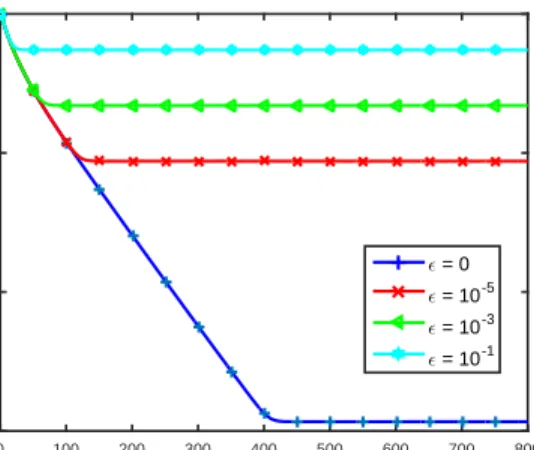
Iteration number 0 100 200 300 400 500 600 700 800 Relative error 10-15 10-10 10-5 100 ǫ = 0 ǫ = 10-5 ǫ = 10-3 ǫ = 10-1
Fig. 1. Performance of Algorithm 2 when local objective functions are not strongly convex: relative error vs. iteration number over randomly
generated networks forN= 20, c= 1,r= 0.5
are σ2
n, and kekxk2 ≤emax <∞. Assume that the local objective functions are convex, closed and proper.
We almost surely have
lim
k→∞kx
k
−x∗k22 <∞, (28)
i.e., the steady state error of the Algorithm 2 is bounded.
Proof: See Appendix E
IV. NUMERICAL EVALUATION
In this section, we use Algorithm 2 to solve the following optimization problem
min ˜ x N X i=1 1 2kyi−Mix˜k 2 2. (29)
N agents estimate variable ˜xusing noisy linear observationsyi =Mix˜+ni, cooperatively. The variables
communicated between neighbors are subject to additive node error as in (16). In these experiments, the elements of error vector are i.i.d and follow uniform distribution U(−ǫ, ǫ). We consider network edge density as r , E
Ec, whereEc is the number of edges in a corresponding complete graph. Considerx
D
k and
xC as respectively the distributed and centralized estimates of x(at iteration k). Our performance metrics are the relative error pE[EDC
k ], where E DC k = kxD k−x Ck2 2 kxCk2 2
, and steady state error lim
k→∞
p E[EDC
k ].
In the first set of experiments, the number of agents N is 20, and x˜ ∈ R20 (i.e., n = 20) and its elements are i.i.d from N(0,1). Measurement matrices Mi ∈ R5×20, which means that local objective
functions are not strongly convex. The observation noise is ni ∼ N(0, σ2I5) and σ2 = 0.1. Figure 1
presents the relative error of the algorithm as a function of iteration index k for different values of ǫ. In this experiment c = 1 and r = 0.5. As evident the algorithm is convergent, which confirms theoretical result form Theorem 4.
In the second set of experiments the local objective functions satisfy Assumption 1, and x˜ ∈ R3 (i.e.,
n = 3) and its elements are i.i.d from N(0,1). We first generate measurement matrices Mi ∈ R3×3,
whose elements are i.i.d from N(0,1). Then, scale their singular values to the range [√mf,
p
Mf] and
rebuildMi. The observation noise isni ∼ N(0, σ2I3)and σ2 = 0.1. In the following experiments, unless
otherwise stated, the parameter c is set to c∗ in (14).
The upper bound in Theorem 2 depends on δ whose theoretical value is presented in (11). In nu-merical experiments, we can compute this parameter by estimating convergence rate of the algorithm
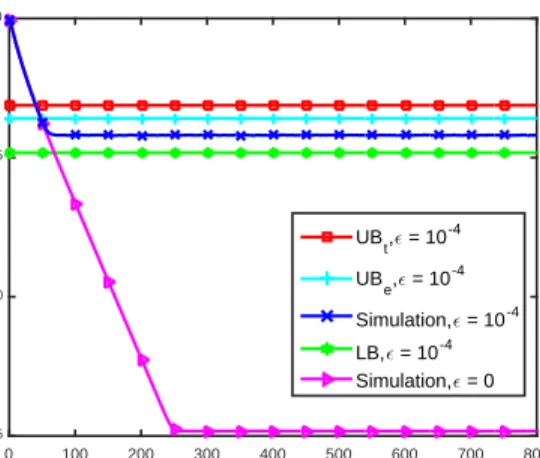
Iteration number 0 100 200 300 400 500 600 700 800 Relative error 10-15 10-10 10-5 100 UB t,ǫ = 10 -4 UB e,ǫ = 10 -4 Simulation,ǫ = 10-4 LB,ǫ = 10-4 Simulation,ǫ = 0
Fig. 2. Performance of Algorithm 2 when local objective functions are strongly convex and their gradients are Lipschitz continuous : relative
error vs. iteration number over randomly generated networks forN = 20,Mf = 10,mf = 1,r= 0.5
experimentally. Define ρk
e as the estimated convergence rate of the algorithm at iteration k
ρke , kuk−u∗k2 G kuk−1−u∗k2 G . (30)
The geometric average rate of convergence of the algorithm is
¯ ρe= K Y k=1 ρk e K1 . (31)
Based on (11) and (31), we have
δe =
1 ¯
ρe −
1. (32)
In the sequel, the upper bounds in Theorem 2 which are computed based on different δ parameters presented in (11) and (32) are referred to as theoretical upper bound, UBt, and experimental upper bound,
UBe, respectively. The lower bound in Theorem 3 is labeled as LB.
Figure 2 depicts the relative error of Algorithm 2 as a function of iteration numberk. In this experiment, the nodes communicate over a randomly generated connected network ofN = 20nodes with edge density
0.5, andǫ= 10−4. The performance of the algorithm in error free scenario is also presented for comparison.
As seen, UBe is a tighter bound than UBt, indicating that experimentally computed convergence rate is
more accurate.
A distributed subgradient method is proposed in [31], which is convergent in presence of quantization error. Figure 3 presents the performance of this algorithm, labeled as DGD and Algorithm 2 (ADMM), for comparison. In this experiment, we have N = 20 and r= 0.5. This figure shows that the ADMM-based algorithm outperforms DGD algorithm.
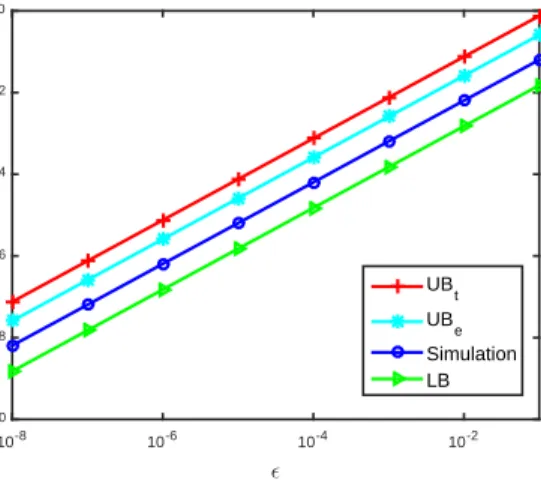
Figure 4 shows the effect of ǫ on steady state error of Algorithm 2. In the current experiment set up with the least squares as the objective function of the optimization problem, one can show that indeed the steady state error of the algorithm is a linear function of the node error. This holds true not only in the performance of the algorithm (as reflected in simulations), but also in the presented lower and upper bounds.
Figure 5 presents the influence of network edge density on the steady state error of the algorithm. In this experiment networks of N = 20 andN = 100 nodes are generated randomly. One sees that increase in network edge density leads to little decrease in steady state error. The trends of simulation results and lower and upper bounds are consistent.
k 0 100 200 300 400 500 600 700 800 Relative error 10-5 10-4 10-3 10-2 10-1 100 ADMM DGD
Fig. 3. Performance of Algorithm 2 (ADMM) and DGD algorithm [31], obtained with randomly generated networks forǫ= 10−4,N= 20,
Mf = 10,mf= 1, andr= 0.5. ǫ 10-8 10-6 10-4 10-2 Relative error 10-10 10-8 10-6 10-4 10-2 100 UB t UBe Simulation LB
Fig. 4. Steady state error vs.ǫ, obtained with randomly generated networks,N = 20,Mf = 10,mf = 1,r= 0.5
r
0.1 0.2 0.3 0.4 0.5 0.6 0.7 0.8 0.9 1
Steady state error
10-6 10-5 10-4 10-3 10-2 10-1 100 UBT, N = 100 UBe, N = 100 Simulation, N = 100 LB, N = 100 UBT, N = 20 UBe, N = 20 Simulation, N = 20 LB, N = 20
Fig. 5. Steady state error vs. edge density as a function of number of nodesN, obtained with randomly generated networks.ǫ= 10−4,
Mf = 10,mf = 1.
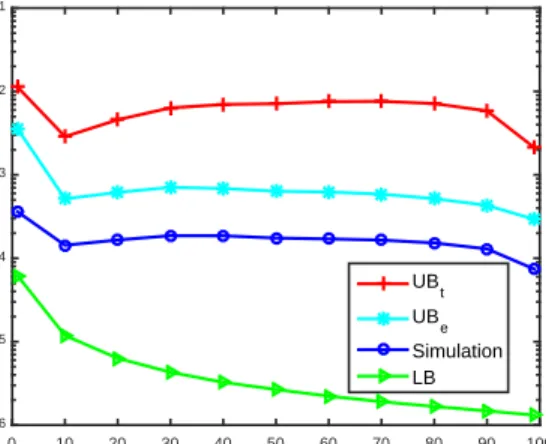
We study the performance of the noisy ADMM algorithm over regular networks as an especial case. Figure 6 depicts the effect of node degree on the steady state error of the algorithm for networks of
Node degree
0 10 20 30 40 50 60 70 80 90 100
Steady state error
10-6 10-5 10-4 10-3 10-2 UB t UBe Simulation LB
Fig. 6. Steady state error vs. node degree of regular network,ǫ= 10−4,Mf = 10,mf = 1, N= 100.
Branch factor
0 10 20 30 40 50 60 70 80 90 100
Steady state error
10-6 10-5 10-4 10-3 10-2 10-1 UB t UB e Simulation LB
Fig. 7. Steady state error vs. branch factor of tree network, ǫ= 10−4,Mf = 10,mf = 1,N= 100
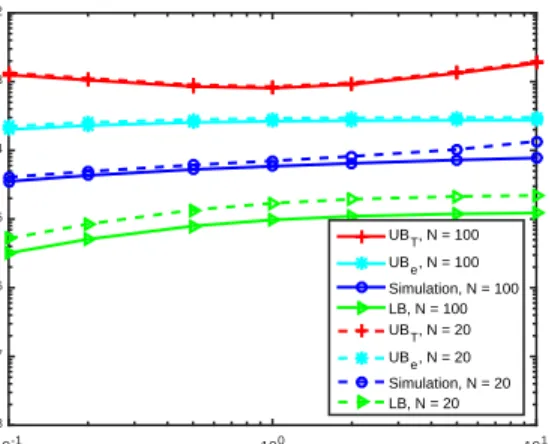
N = 100 nodes. As evident, the slop of the curve is a decreasing function of node degree, and varying node degree in the range of [30 99] does not improve steady state error significantly. The upper bounds which are functions of E and δ, predict this behavior properly. The lower bound is just a function of E, and does not predict the slop of steady state error curve.
We consider tree network as another especial case. Figure 7 demonstrates the influence of branch factor parameter of the tree network on steady state error of the algorithm. It can be seen that experimental upper bound predicts the performance of the algorithm better than the other bounds, and proposed theoretical upper bound is an acceptable indicator of the algorithm behavior. From the last three sets of experiments, we can conclude that the upper bounds can predict effects of network topology on the steady state error more accurately.
Another parameter which affects the performance of the algorithm is c. Figure 8 shows the effect of
c parameter on the steady state error over the randomly generated networks. The connectivity ratio in
N = 20 and N = 100 scenarios are 0.5 and 0.2, respectively. One sees that, a lower c results in a lower steady state error which is also predicted by the proposed lower and experimental upper bounds. The mismatch between theoretical upper bound and simulation shows that the effect of c on the convergence rate of the algorithm is not predicted properly by (10).
As discussed, the convergence rate and steady state error of the algorithm output depends on parameterc. The value of the parametercis to be selected for minimized steady state error and maximized convergence rate. According to our observations, the performance of the noisy ADMM algorithm in early iterations is
c/c*
10-1 100 101
Steady state error
10-8 10-7 10-6 10-5 10-4 10-3 10-2 UB T, N = 100 UBe, N = 100 Simulation, N = 100 LB, N = 100 UBT, N = 20 UB e, N = 20 Simulation, N = 20 LB, N = 20
Fig. 8. Steady state error vs. cparameter as a function of number of nodes N, obtained with randomly generated networks. ǫ= 10−4,
Mf = 10,mf= 1. k 0 500 1000 1500 Relative error 10-5 10-4 10-3 10-2 10-1 100 Tuned c Fixed c
Fig. 9. Comparison of performance of tuned and fixedcalgorithms,ǫ= 10−4,Mf = 10,mf = 1,N= 20,r= 0.5
similar to the noiseless case. A smaller value of c results in a smaller steady state error, but it does not necessarily lead to a high convergence rate. A reasonable tuning policy is to set parameter cto accelerate the convergence in early iterations, and then to reduce the parameter to aim for a small steady state error. Figure 9 depicts the performance of this tuning method. In this experiment, parameter cis set to c∗ provided in (14) in the first 200 iterations, and then it is reduced by a factor of 0.01. The performance of the algorithm with fixed parameter c set to 0.01c∗ is also presented for comparison. The results confirm faster convergence rate and improved steady state error when the proposed tuning policy is in effect.
We also examined the effects ofMf, Lipschitz constant, andmf, strong convexity module, on the steady
state error of the algorithm (not reported here). We observed that the influence of these parameters is accurately predicted by the proposed lower and experimental upper bounds. The theoretical upper bound, however, does not reflect the effects of these parameters properly.
V. CONCLUSIONS
We analyzed the effect of additive node error on the performance of distributed ADMM algorithm for consensus optimization over a connected network. Analytical upper and lower bounds were provided on the mean squared steady state error of the algorithm, in the case that local objective functions are strongly convex and have Lipschitz continuous gradients. The analysis quantifies how the provided bounds depend on different factors such as noise variance and network topology. To accelerate the algorithm and also
reduce the steady state error, a method was proposed to tune the algorithm parameter. In addition, it was shown that if the local objective functions are proper, closed and convex, for a bounded and random node error, the steady state error of the noisy ADMM algorithm for consensus is bounded. Numerical results validated the theoretical analyses and demonstrated the role of different system and network parameters. Analysis of the algorithm convergence behavior over the networks whose links suffer from additive noise can be considered as an important next research steps.
APPENDIX A PROOF OF THEOREM 2 We first derive an upper bound on lim
k→∞E[d k]. We have EFk+1[dk+1] =EFk Eekx+1[d k+1|Fk] , (33) where Eekx+1[d k+1 |Fk] = Eekx+1 1 ckβˆ k+1 −β∗k22 +ckˆzk+1−z∗k22|Fk (a) =Eekx+1 1 ckβ k+1 −β∗+ c 2M T −ekx+1k22|Fk +Eekx+1 ckzk+1−z∗+ 1 2M T +e k+1 x k22|F k (b) = 1 ckβ k+1−β∗ k2 2+ckz k+1−z∗ k2 2+cE[(e k+1 x ) T Wekx+1] = 1 ckβ k+1−β∗ k2 2+ckz k+1−z∗k2 2+ 2cnEσn2 (c) ≤ 1 1 +δ 1 ckβˆ k −β∗k22+ckˆzk−z∗k22 + 2cnEσ2 n = 1 1 +δd k+ 2cnEσ2 n, (34)
where (a) follows from (18d) and (18e), (b) follows from the fact that the elements of noise vector ek+1x
are zero mean i.i.d random variables and (c) follows from (9) and (18a)- (18c). From (33) and (34), we have EFk+1[dk+1]≤ 1 1 +δEFk[d k ] + 2cnEσn2. (35)
Recursively using (35), we have
EFk+1[dk+1]≤ d0 (1 +δ)k+1 + k X ℓ=0 1 (1 +δ)ℓ2cnEσ 2 n, (36) which leads to lim k→∞EF k[dk]≤ 1 +δ δ 2cnEσ 2 n. (37)
To prove (22), we use the update equation for x in (18a), and its corresponding KKT condition (21a). Our goal is to derive a mathematical relationship between xk+1 −x∗, βˆk−β∗ and ˆzk−z∗. To this aim we combine (18a) and (21a) as
Replacing (18b) and (18c) in (38), we have ∇f(xk+1)−∇f(x∗) + c 2M−M T −xk+1+ c 2M+M T +xk+1 =−M−( ˆβ k −β∗) +cM+ˆzk. (39) According to (7), combining (39) with (21b) and (21c) leads to
∇f(xk+1)− ∇f(x∗) + 2cW(xk+1−x∗) =−M−( ˆβ
k
−β∗) +cM+(ˆzk−z∗).
(40) The inner product of xk+1−x∗ and (40) is
hxk+1−x∗,∇f(xk+1)− ∇f(x∗)i + 2chxk+1−x∗,W(xk+1−x∗)i =−hMT−(xk+1−x∗),βˆk−β∗i +chMT+(xk+1−x∗),ˆzk−z∗i (a) =−2 chβˆ k −β∗,(βk+1−β∗)−( ˆβk−β∗)i + 2chˆzk−z∗,zk+1−z∗i, (41) where (a) follows from (18b) and (18c). Since W is a positive definite matrix, and based on strong convexity of f(x), the lower bound on the LHS of (41) is
mf + 2cλmin(W) kxk+1−x∗k22. (42) Replacing (42) in (41) leads to mf + 2cλmin(W) kxk+1−x∗k22 ≤ −2 chβˆ k −β∗,(βk+1−β∗)−( ˆβk−β∗)i + 2chzˆk−z∗,zk+1−z∗i ≤ 1 ckβ k+1−β∗ k2 2+ 3 ckβˆ k −β∗k22+ckˆzk−z∗k22 +ckzk+1−z∗k22 (a) ≤ 3 + 1 1 +δ kuˆk−u∗k2G (b) = 3 + 1 1 +δ dk, (43)
where (a) and (b) follow from (8) and (9), and (19), respectively. Combining (43) and (37), we have
lim k→∞EFk +1[kxk+1−x∗k22]≤ 4 + 3δ δ(mf + 2cλmin(W)) 2cnEσn2, (44)
which completes the proof.
APPENDIX B PROOF OF THEOREM 3 Subtracting (21a) from (18a), we have
Replacing (18b) and (18c) in (45) yields
∇f(xk+1)− ∇f(x∗) + 2cW(xk+1−x∗) =cM+(ˆzk−z∗)−M−( ˆβ
k
−β∗). (46)
Writing ˆzk and βˆk in terms of zk, βk
and ek x in (46) leads to k∇f(xk+1)− ∇f(x∗) + 2cW(xk+1−x∗)k2 2 =kcM+(zk−z∗)−M −(β k −β∗) +c 2(M+M T +−M−M T −)e k xk 2 2. (47)
The upper bound on the square root of the LHS of (47) is
k∇f(xk+1)− ∇f(x∗) + 2cW(xk+1−x∗)k2
≤ k∇f(xk+1)− ∇f(x∗)k2+k2cW(xk+1−x∗)k2
(a)
≤(Mf + 2cσmax(W))kxk+1−x∗k2,
(48)
where (a) follows from Lipschitz continuity property of ∇f(x). The RHS of (47) can be rewritten as follows kcM+(zk−z∗)−M −(β k −β∗) +c 2(M+M T +−M−M T −)e k xk 2 2 = 2hcM+(zk−z∗)−M −(β k −β∗),c 2(M+M T +−M−MT−)e k xi +kcM+(zk−z∗)−M −(β k −β∗)k2 2 +kc 2(M+M T +−M−M T −)e k xk 2 2. (49)
From (47), (48) and (49), we have
(Mf+ 2cσmax(W))2kxk+1−x∗k22 ≥2hcM+(zk−z∗)−M −(β k −β∗),c 2(M+M T +−M−M T −)e k xi +kcM+(zk−z∗)−M −(β k −β∗)k2 2 +k2c(M+MT +−M−M T −)e k xk 2 2. (50)
Taking average from both sides of (50), and considering that the elements of ek
x are zero mean random
variables independent of zk and βk
, we have EFk+1 kxk+1−x∗k22 ≥ c 2 Mf + 2cσmax(W) 2E k(L+−L−)ekxk22 , (51)
where L+= 12M+MT+ and L− = 12M−MT− are, respectively, the extended signless and signed Laplacian matrices of the underlying network. According to the structure of these matrices, the (i, j) block of
P=L+−L− is as follows P(i, j) = 0 n i=j,or(i, j)∈ A/ 2In (i, j)∈ A . (52)
According to (52), following some algebraic manipulations, we have
EFk+1 kxk+1−x∗k22≥ 8nEc 2σ2 n Mf + 2cσmax(W) 2, (53)
which completes the proof.
APPENDIX C
PROOF OF PROPOSITION 2
According to the definition of matrices A and B, the feasible set of problem in (3) is nonempty. This fact and the convexity of local objective functions guarantee that the Lagrangian function corresponding to (3) has a saddle point. If local objective functions are also proper and closed, inequality (25) in Proposition 1 is valid for this problem. From (4c), we have
Axk+1+Bzk+1 = 1
c λ
k+1
−λk
. (54)
Since λk= [βk;−βk], and B= [−I2nE;−I2nE], and based on (54), (25) can be rewritten as follows
1 ckβ k+1 −β∗k22+ckzk+1−z∗k22 ≤ 1 ckβ k −β∗k22+ckzk−z∗k22 − 1 ckβ k+1 −βkk22−ckzk+1−zkk22, (55) and (26) is equivalent to lim k→∞β k+1 −βk =0, lim k→∞z k+1 −zk=0. (56) Replacing (56) in (5), we have lim k→∞∇f(x k) +M −βk=0, (57a) lim k→∞M T −xk =0, (57b) lim k→∞ 1 2M T +x k −zk=0. (57c)
Comparing (57) and (21), it can be seen that ask → ∞, primal and dual variables satisfy KKT conditions, and hence the iteration converges to an optimal point. In the other words, (56) is a sufficient condition for attaining an optimal point, which completes the proof.
APPENDIX D PROOF OFCOROLLARY 1 From (55) in Proposition 2, we have
0≤ 1 ckβ k+1 −βkk22+ckzk+1−zkk22 ≤ 1 ckβ k −β∗k22+ckzk−z∗k22, (58) which is equivalent to 1 ckβ k+1 −βkk22 +ckzk+1−zkk22 =ηk+1 1 ckβ k −β∗k22+ckzk−z∗k22 , (59)
where 0< ηk+1 ≤1,∀k ≥0. Note that, based on Preposition 2, the LHS of (59) being zero, guarantees
that its RHS is also zero, and hence we can consider 0< ηk+1 in all cases. From (55) and (59), we have
1 ckβ k+1 −β∗k22+ckzk+1−z∗k22 ≤ 1 1 +δk+1 1 ckβ k −β∗k22+ckzk−z∗k22 , (60)
where 1/(1 +δk+1) = 1−ηk+1, δ0 = 0 and δk+1 >0,∀k≥0, which completes the proof.
APPENDIX E PROOF OF THEOREM 4 Similar to proof of Theorem 2, we have
EFk+1[dk+1] =EFk Eek+1[dk+1|Fk] (a) ≤ 1 +1δk+1EFk[d k ] + 2cnEσn2, (61)
where (a) follows from (27) in Corollary 1. By recursive use of (61), we have EFk+1[dk+1]≤ d0 Qk+1 ℓ=1(1 +δℓ) + k X ℓ=0 1 Qℓ i=0(1 +δi) 2cnEσn2. (62) Since δk >0,∀k > 0, we have lim k→∞EFk[d k ]<∞, (63)
and hence we almost surely have,
lim k→∞d k< ∞, (64) which implies lim k→∞k ˆ βk+1−β∗k2 <∞, lim k→∞kˆz k+1 −z∗k2 <∞. (65)
From (18d), (18e), (21b) and (21c), we have
ˆ βk+1−β∗ = ˆβk−β∗+ c 2M T −(xk+1−x∗) + c 2M T −ek+1x , ˆ zk+1−z∗ = 1 2M T +(xk+1−x∗) + 1 2M T +ek+1x . (66) Since kek
xk2 ≤emax <∞, and based on the definition of M− and M+, from (65) and (66) we have
lim
k→∞kx
k
−x∗k22 <∞,
which completes the proof.
REFERENCES
[1] L. Majzoobi and F. Lahouti, “Analysis of distributed admm algorithm for consensus optimization in presence of error,” in41st IEEE
International Conference on Acoustics, Speech and Signal Processing (ICASSP), 2016, pp. 4831–4835.
[2] S. H. Low and D. E. Lapsley, “Optimization flow control-I: basic algorithm and convergence,”IEEE/ACM Transactions on Networking,
vol. 7, no. 6, pp. 861–874, 1999.
[3] T. Erseghe, “Distributed optimal power flow using admm,”IEEE transactions on power systems, vol. 29, no. 5, pp. 2370–2380, 2014.
[4] M. Rabbat and R. Nowak, “Distributed optimization in sensor networks,” inACM Proceedings of the 3rd international symposium on
[5] A. Nedi´c and A. Ozdaglar, “Distributed subgradient methods for multi-agent optimization,”IEEE Transactions on Automatic Control, vol. 54, no. 1, pp. 48–61, 2009.
[6] B. Johansson, M. Rabi, and M. Johansson, “A randomized incremental subgradient method for distributed optimization in networked
systems,”SIAM Journal on Optimization, vol. 20, no. 3, pp. 1157–1170, 2009.
[7] E. Ghadimi, I. Shames, and M. Johansson, “Multi-step gradient methods for networked optimization,”IEEE Transactions on Signal
Processing, vol. 61, no. 21, pp. 5417–5429, 2013.
[8] N. Li, “Distributed optimization in power networks and general multi-agent systems,” Ph.D. dissertation, California Institute of Technology, 2013.
[9] T.-H. Chang, A. Nedic, and A. Scaglione, “Distributed constrained optimization by consensus-based primal-dual perturbation method,”
IEEE Transactions on Automatic Control, vol. 59, no. 6, pp. 1524–1538, 2014.
[10] S. Boyd, N. Parikh, E. Chu, B. Peleato, and J. Eckstein, “Distributed optimization and statistical learning via the alternating direction
method of multipliers,”Foundations and Trends in Machine Learning, vol. 3, no. 1, pp. 1–122, 2011.
[11] C. Shen, T.-H. Chang, K.-Y. Wang, Z. Qiu, and C.-Y. Chi, “Distributed robust multicell coordinated beamforming with imperfect csi:
An admm approach,”IEEE Transactions on signal processing, vol. 60, no. 6, pp. 2988–3003, 2012.
[12] F. Lin, M. Fardad, and M. R. Jovanovi´c, “Design of optimal sparse feedback gains via the alternating direction method of multipliers,”
IEEE Transactions on Automatic Control, vol. 58, no. 9, pp. 2426–2431, 2013.
[13] J. Liu, P. Musialski, P. Wonka, and J. Ye, “Tensor completion for estimating missing values in visual data,” IEEE transactions on
pattern analysis and machine intelligence, vol. 35, no. 1, pp. 208–220, 2013.
[14] P. Danaher, P. Wang, and D. M. Witten, “The joint graphical lasso for inverse covariance estimation across multiple classes,”Journal
of the Royal Statistical Society: Series B (Statistical Methodology), vol. 76, no. 2, pp. 373–397, 2014.
[15] X. Qing, G. Hu, and X. Wang, “Robust compressed sensing with bounded and structured uncertainties,”IET Signal Processing, vol. 8,
no. 7, pp. 783–791, 2014.
[16] W. Deng and W. Yin, “On the global and linear convergence of the generalized alternating direction method of multipliers,”Journal
of Scientific Computing, pp. 1–28, 2012.
[17] B. He and X. Yuan, “On the o(1/n) convergence rate of the douglas-rachford alternating direction method,”SIAM Journal on Numerical
Analysis, vol. 50, no. 2, pp. 700–709, 2012.
[18] W. Deng, M.-J. Lai, Z. Peng, and W. Yin, “Parallel multi-block admm with o (1/k) convergence,”Journal of Scientific Computing, pp.
1–25, 2014.
[19] T. Goldstein, B. O’Donoghue, S. Setzer, and R. Baraniuk, “Fast alternating direction optimization methods,”SIAM Journal on Imaging
Sciences, vol. 7, no. 3, pp. 1588–1623, 2014.
[20] P. Giselsson and S. Boyd, “Linear convergence and metric selection for douglas-rachford splitting and admm,”IEEE Transactions on
Automatic Control, vol. 62, no. 2, pp. 532–544, 2017.
[21] G. Mateos, J. A. Bazerque, and G. B. Giannakis, “Distributed sparse linear regression,” IEEE Transactions on Signal Processing,
vol. 58, no. 10, pp. 5262–5276, 2010.
[22] R. H. Etemad and F. Lahouti, “Resilient decentralized consensus-based state estimation for smart grid in presence of false data,” in
41st IEEE International Conference on Acoustics, Speech and Signal Processing (ICASSP), 2016, pp. 3466–3470.
[23] J. F. Mota, J. M. Xavier, P. M. Aguiar, and M. Puschel, “D-admm: A communication-efficient distributed algorithm for separable
optimization,”IEEE Transactions on Signal Processing, vol. 61, no. 10, pp. 2718–2723, 2013.
[24] W. Shi, Q. Ling, K. Yuan, G. Wu, and W. Yin, “On the linear convergence of the admm in decentralized consensus optimization,”
IEEE Transactions on Signal Processing, vol. 62, no. 7, pp. 1750–1761, 2014.
[25] M. Ma, A. N. Nikolakopoulos, and G. B. Giannakis, “Fast decentralized learning via hybrid consensus admm,” inIEEE International
Conference on Acoustics, Speech and Signal Processing (ICASSP), Calgary, Alberta, Canada, 2018.
[26] A. Nedi´c and A. Olshevsky, “Distributed optimization over time-varying directed graphs,”IEEE Transactions on Automatic Control,
vol. 60, no. 3, pp. 601–615, 2015.
[27] L. Majzoobi, V. Shah-Mansouri, and F. Lahouti, “Analysis of distributed admm algorithm for consensus optimisation over lossy
networks,”IET Signal Processing, vol. 12, no. 6, pp. 786–794, 2018.
[28] T.-H. Chang, M. Hong, and X. Wang, “Multi-agent distributed optimization via inexact consensus admm,”IEEE Transactions on Signal
Processing, vol. 63, no. 2, pp. 482–497, 2015.
[29] Q. Ling, W. Shi, G. Wu, and A. Ribeiro, “Dlm: Decentralized linearized alternating direction method of multipliers.”IEEE Transactions
Signal Processing, vol. 63, no. 15, pp. 4051–4064, 2015.
[30] A. Mokhtari, W. Shi, Q. Ling, and A. Ribeiro, “Decentralized quadratically approximated alternating direction method of multipliers,” inIEEE Global Conference on Signal and Information Processing (GlobalSIP), 2015, pp. 795–799.
[31] A. Nedic, A. Olshevsky, A. Ozdaglar, and J. N. Tsitsiklis, “Distributed subgradient methods and quantization effects,” inIEEE 47th
Conference on Decision and Control (CDC), 2008, pp. 4177–4184.
[32] I. D. Schizas, A. Ribeiro, and G. B. Giannakis, “Consensus in ad hoc wsns with noisy links—part i: Distributed estimation of
deterministic signals,”IEEE Transactions on Signal Processing, vol. 56, no. 1, pp. 350–364, 2008.
[33] T. Erseghe, D. Zennaro, E. Dall’Anese, and L. Vangelista, “Fast consensus by the alternating direction multipliers method,” IEEE
Transactions on Signal Processing, vol. 59, no. 11, pp. 5523–5537, 2011.
[34] D. Marco and D. L. Neuhoff, “The validity of the additive noise model for uniform scalar quantizers,”IEEE Transactions on Information