PREFERENCE BASED TERM WEIGHTING FOR ARABIC FIQH DOCUMENT RANKING Khadijah Fahmi Hayati Holle, Agus Zainal Arifin, and Diana Purwitasari
Informatics Engineering Department, Faculty of Information Technology, Institut Teknologi Sepuluh Nopember, Jalan Raya ITS, Surabaya, 60111, Indonesia
E-mail: [email protected], [email protected], [email protected]
Abstract
In document retrieval, besides the suitability of query with search results, there is also a subjective user assessment that is expected to be a deciding factor in document ranking.This preference aspect is referred at the fiqh document searching. People tend to prefer on certain fiqh metho-dology without rejecting other fiqh methodologies. It is necessary to investigate preference factor in addition to the relevance factor in the document ranking. Therefore, this research proposed a method of term weighting based on preference to rank documents according to user preference. The proposed method is also combined with term weighting based on documents index and books index so it sees relevance and preference aspect. The proposed method is Inverse Preference Fre-quency with α value (IPFα). In this method, we calculate preference value by IPF term weighting. Then, the preference values of terms that is equal with the query are multiplied by α. IPFα combin-ed with the existing weighting methods become TF.IDF.IBF.IPFα. Experiment of the proposcombin-ed me-thod uses dataset of several Arabic fiqh documents. Evaluation uses recall, precision, and f-mea-sure calculations. Proposed term weighting method is obtained to rank the document in the right order according to user preference. It is shown from the result with recall value reach 75%, preci-sion 100%, and F-measure 85.7% respectively.
Keywords: document ranking, document retrieval, preference, term weighting, IPFα
Abstrak
Dalam pencarian, selain kesesuaian query dengan hasil pencarian, terdapat penilaian subjektif pengguna yang diharapkan menjadi faktor penentu dalam perangkingan dokumen. Aspek prefe-rensi tersebut tampak pada pencarian dokumen fiqih. Seseorang cenderung mengutamakan meto-dologi fiqih tertentu meskipun tidak mengabaikan pendapat metometo-dologi fiqih lain. Faktor prefe-rensi menjadi hal yang diperlukan selain relevansi dalam perangkingan dokumen. Oleh karena itu, pada penelitian ini diajukan metode pembobotan kata berbasis preferensi untuk merangkingkan dokumen sesuai dengan preferensi pengguna. Metode yang diajukan digabungkan dengan pembo-botan kata berbasis indeks dokumen dan buku sehingga mampu memperhatikan aspek kesesuaian (relevance) dan keutamaan (preference). Metode pembobotan yang diusulkan disebut dengan Invers Preference Frequency with α value (IPFα). Langkah pembobotan yang diusulkan yaitu de-ngan perhitude-ngan nilai preferensi term dengan pembobotan IPF. Kemudian nilai preferensi dari term dokumen yang sama dengan term query dikalikan dengan 𝜶𝜶sebagai penguat. IPFα digabung-kan dengan metode pembobotan yang telah ada menjadi TF.IDF.IBF.IPFα. Pengujian metode yang diusulkan menggunakan dataset dari beberapa dokumen fiqih berbahasa Arab. Evaluasi meng-gunakan perhitungan recall, precision, dan F-measure. Hasil uji coba menunjukkan bahwa dengan pembobotan TF.IDF.IBF.IPFα diperoleh perangkingan dokumen dengan urutan yang tepat dan se-suai dengan preferensi pengguna. Hal ini ditunjukkan dengan nilai maksimal recall mencapai 75%, precision 100%, dan F-measure 85.7%.
Kata Kunci:perangkingan dokumen, temu kembali dokumen, preferensi, pembobotan kata, IPFα
1. Introduction
Document ranking is common discussion in infor-mation retrieval research [1]. Harrag et al. was us-ing vector space model to perform Arabic docu-ment ranking [2]. In the vector space model (VSM), the text content is represented as a vector in the term space. In general, text to vector
repre-sentation can be classified into two tasks: index-ing and term weightindex-ing.
The most popular term weighting method is TF.IDF weighting [3,4]. TF.IDF weighting is co-mbining term frequency (TF) and inverse docu-ment frequency (IDF). TF measures the density of a term in a document and IDF provides the lowest score of those terms that appear in multiple
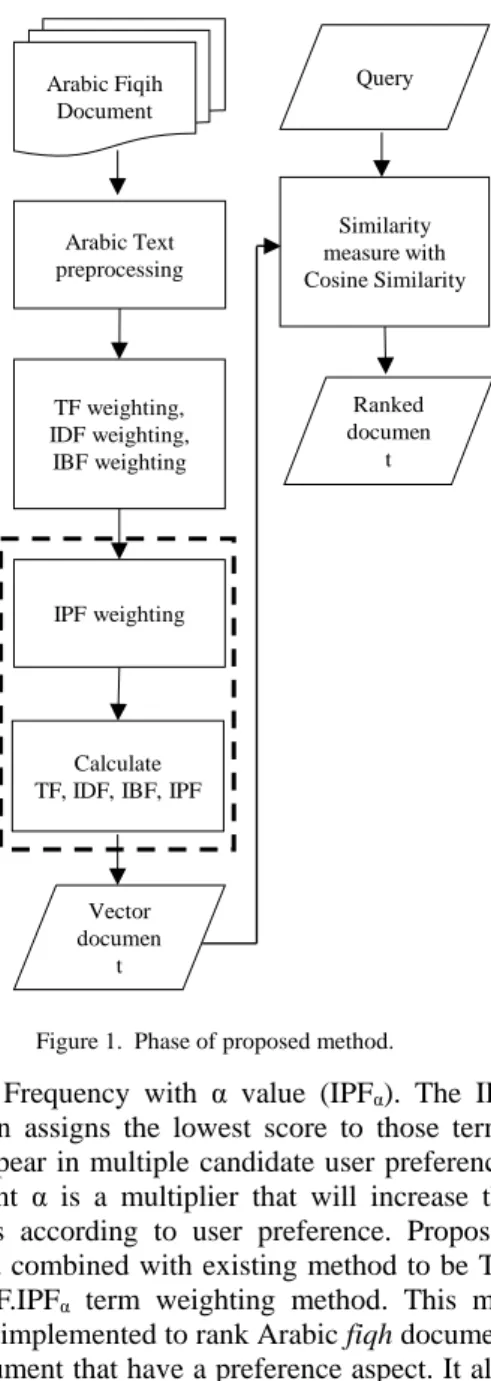
Figure 1. Phase of proposed method. T e r m W e i g h t i n g Arabic Fiqih Document Arabic Text preprocessing TF weighting, IDF weighting, IBF weighting IPF weighting Calculate TF, IDF, IBF, IPF
Vector documen t Ranked documen t Similarity measure with Cosine Similarity Query
ments; because of this, the TF.IDF score gives po-sitive discrimination to rare terms and is biased against frequent terms.
However, by TF.IDF weighting, information about a set of documents in a certain class is not calculated. Therefore, Fuji et al. [5] proposed cla-ss indexing based term weighting. They impleme-nt a class indexing based TF.IDF.ICF weighting method in which inverse class frequency (ICF) is incorporated. They also implement the inverse cl-ass space density frequency (ICSdF). This method was proved to have higher precision and recall th-an those on TF.IDF weighting method.
In addition, Fauzi [6] proposed book index-ing based term weightindex-ing for Arabic document ranking called inverse book frequency (IBF). IBF is used to improve the performance of document ranking that have hierarchy in the form of books that have many pages. IBF calculation is multipli-ed by the previous method and becomes TF.IDF. ICF.IBF weighting method. TF.IDF.ICF.IBF wei-ghting method proven can be applied to Arabic document ranking and has a better performance than the previous method.
Those existing term weighting methods rank the documents based on relevance of documents. Nevertheless, beside relevance factor it is neces-sary to investigate preference factor. Many resear-ches implement preference in the proposed me-thod. User preference is useful in recommender system [7,8], query enrichment [9,10], data rank-ing [11], and others. Chulyadyo et al. [7] introdu-ced approach of constructing a personalized reco-mmendation model from Probabilistic Relational Model with the help of users’ preferences over their search criteria. De Amo et al. [12] focused on preference elicitation and proposed an automa-tic preference elicitation method based on mining techniques by capturing implicit user's choices. Preference elicitation also can be done by using a query interface where users are asked to express their preferences [13].
In the document ranking, besides the releva-ncy of the query with the search results, there is user subjective assessment that expected to be the deciding factor. This preference aspect referred at the fiqh document searching. Fiqh document can be grouped in a particular mazhab. Mazhab is pa-radigm or fiqh methodology that has been a factor in decision-making [14]. Several famous fiqh me-thodologies are Syafi’iyah, Hanabilah, Hanafiyah,
and Malikiyah. People tend to prefer on certain
fiqh methodology without reject other fiqh metho-dologies.
Therefore, this research proposed a method of term weighting based on preference to rank do-cument according to user preference. This prefe-rence-based term weighting is called Inverse
Pref-erence Frequency with α value (IPFα). The IPF function assigns the lowest score to those terms that appear in multiple candidate user preference. Constant α is a multiplier that will increase the weights according to user preference. Proposed method combined with existing method to be TF. IDF.IBF.IPFα term weighting method. This me-thod is implemented to rank Arabic fiqh document as document that have a preference aspect. It also can be implemented to rank other document that have a preference aspect. This method combined relevance and preference that will rank the docu-ment in the correct order, that relevant to query according to user preference.
2. Methods
This paper proposed term weighting method that combine relevance aspect and preference aspect to rank Arabic fiqh document. Phase of proposed method include preprocessing and similarity mea-sure are shown in Figure 1.
Dataset
To implement proposed method, we can use types of documents that have a preference aspect as data
in the experiment. In this reseach the dataset is Arabic fiqh document because it one of the types of documents that have a preference aspect. A do-cument is each page of the book. The fiqh books are books that have been categorized into four
fiqh methodologies that are Hanafiyah, Malikiyah,
Syafi’iyah, and Hanabilah. For each fiqh
metho-dology taken three books and for each book taken 10 documents. So the number of book and docu-ment that we used in this research are 12 fiqh boo-ks and 120 documents. Data taken from the Ara-bic e-book (http://shamela.ws/).
Preprocessing
Whole of collection documents through the pre-processing phase. The prepre-processing consists of several stages, which are tokenizing, filtering, sto-pword removal, and stemming [15]. Token-izing is done to token entire contents of the document into a set of single word. In filtering stage, vowel
(harokat) and punctuation are remo-ved. Words
that frequently appear in the document but did not have significant value in a document are removed in stopword removal stage. Stopword list is taken from the website http://-Arabicstemmer.codeplex. com/. The last stage of preprocessing is stemming. Stemming stage used to obtain the root of each word by finding the base word and removing affix and suffix. To implement this process we used Li-ght Stemmer [16-17] which are in lucene library (http://lucene.apache.-org/).
Term Weighting
In term weighting phase we calculate TF (term frequency), IDF (inverse document frequency), and IBF (inverse book frequency) of each term in the whole documents. Then the calculation of IPF (inverse preference frequency) also calculated for each term in the whole documents. For term do-cument which equal with term query, IPF weight of the term is multiplied by the value of α to obtain the IPFα (inverse preference frequency with α value). Then TF.IDF.IBF.IPFα can be calculated. Here is the formula for each term weighting.
Term frequency is the simplest method in term weighting [3-4]. Each term is assumed have significant level in accordance with the number of occurrences of the term in document. Weight of term t in document d as defined in equation(1).
𝑾𝑾𝑻𝑻𝑻𝑻�𝒕𝒕𝒊𝒊,𝒅𝒅𝒋𝒋�=𝒇𝒇�𝒕𝒕𝒊𝒊,𝒅𝒅𝒋𝒋� (1)
where 𝒇𝒇�𝒕𝒕𝒊𝒊,𝒅𝒅𝒋𝒋� denotes number of term ti in docu-ment dj.
IDF is calculated to determine the significan-ce of each term in differentiating one document to the others [3,4]. Term that is rarely appears in the document is very valuable. Significance of each term is assumed have the opposite proportion with the number of documents that contain the term. The common term weighting as defined in equati-on(2).
𝑊𝑊𝐼𝐼𝐼𝐼𝐼𝐼�𝑡𝑡𝑖𝑖,𝑑𝑑𝑗𝑗�= 1 +𝑙𝑙𝑙𝑙𝑙𝑙 �𝑑𝑑𝐷𝐷
(𝑡𝑡𝑖𝑖)
� (2)
where D denotes the total number of documents in the collection and d(ti) is the number of docume-nts in the collection in which term ti occurs at lea-st once.
IBF calculates occurrence the term on the set of books [6]. Term that rarely appears in the col-lection of books is very valuable. Significance of each term is assumed have the opposite proportion with the number of books that contain the term. IBF calculation can be adopted from the IDF as defined in equation(3).
𝑊𝑊𝐼𝐼𝐼𝐼𝐼𝐼(𝑡𝑡𝑖𝑖,𝑏𝑏𝑘𝑘) = 1 +𝑙𝑙𝑙𝑙𝑙𝑙 �𝑏𝑏𝐵𝐵
(𝑡𝑡𝑖𝑖)
� (3)
where B denotes the total number of books in the collection and b(ti) is the number of books in the collection in which term ti occurs at least once.
IPF calculates occurrence the term in the group of candidate user preference. In this resear-ch, candidate user preference is four fiqh metho-dologies. Term that rarely appears on the fiqh me-thodology is very valuable.
Significance of each term is assumed have the opposite proportion with the number of fiqh
methodologies that contain the term. As with IBF, IPF calculation can be adopted from the IDF as defined in equation(4). While IPFα obtained by multiplying IPF with value of α for term that equal with user query, IPFα as de-fined in equation(5). In Arabic document fiqh, do-cument of each book have been categorized in particular
fiqh methodology. So, we can define particular document categorize as certain user pre-ference according to chosen fiqh methodology.
𝑊𝑊𝐼𝐼𝐼𝐼𝐼𝐼(𝑡𝑡𝑖𝑖,𝑝𝑝𝑙𝑙) = 1 +𝑙𝑙𝑙𝑙𝑙𝑙 �𝑝𝑝𝑃𝑃
(𝑡𝑡𝑖𝑖)
� (4)
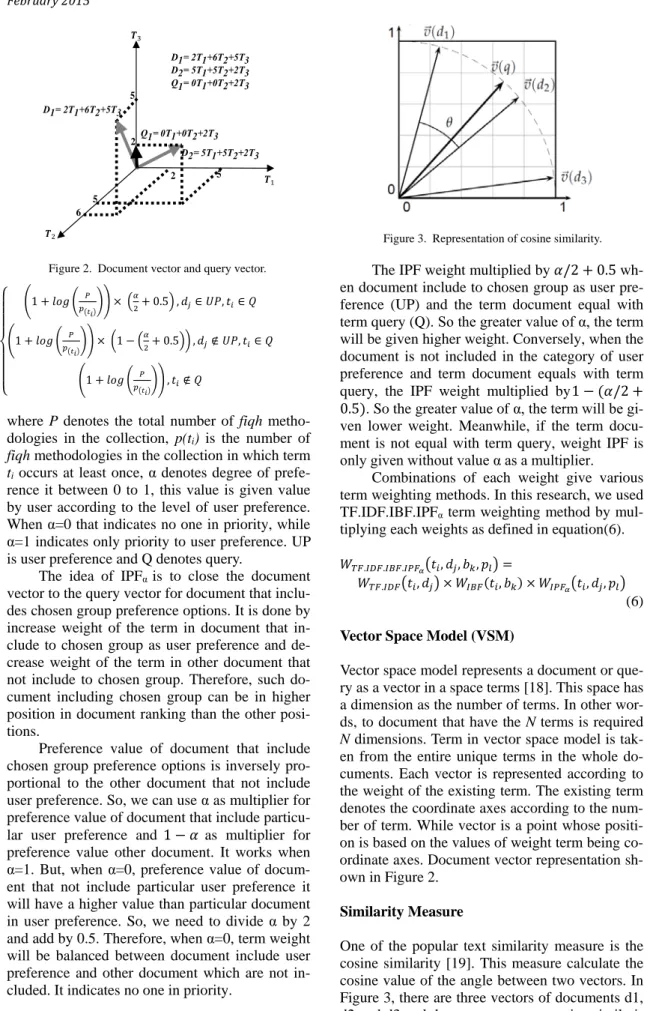
Figure 2. Document vector and query vector. 6 5 2 5 5 2
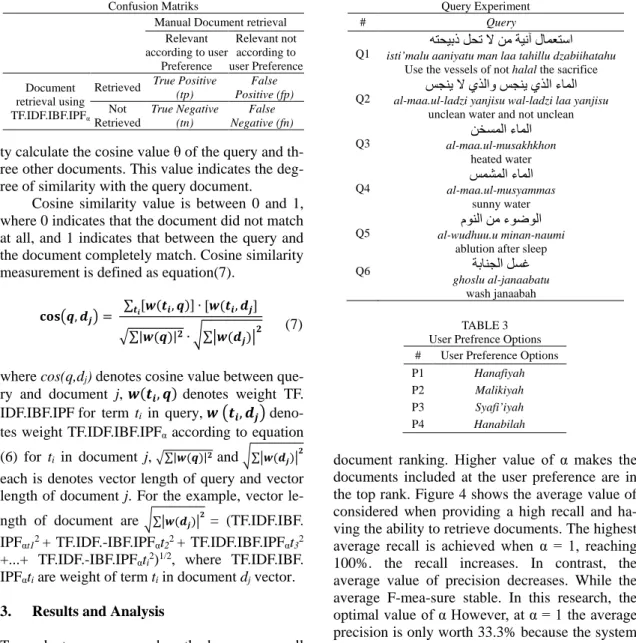
Figure 3. Representation of cosine similarity.
⎩ ⎪ ⎪ ⎪ ⎨ ⎪ ⎪ ⎪ ⎧ �1 +𝑙𝑙𝑙𝑙𝑙𝑙 � 𝐼𝐼 𝑝𝑝�𝑡𝑡𝑖𝑖���× � 𝛼𝛼 2+ 0.5�,𝑑𝑑𝑗𝑗∈ 𝑈𝑈𝑃𝑃,𝑡𝑡𝑖𝑖∈ 𝑄𝑄 �1 +𝑙𝑙𝑙𝑙𝑙𝑙 �𝑝𝑝𝐼𝐼 �𝑡𝑡𝑖𝑖���× �1− � 𝛼𝛼 2+ 0.5��,𝑑𝑑𝑗𝑗∉ 𝑈𝑈𝑃𝑃,𝑡𝑡𝑖𝑖∈ 𝑄𝑄 �1 +𝑙𝑙𝑙𝑙𝑙𝑙 �𝑝𝑝𝐼𝐼 �𝑡𝑡𝑖𝑖���,𝑡𝑡𝑖𝑖∉ 𝑄𝑄
where P denotes the total number of fiqh metho-dologies in the collection, p(ti) is the number of
fiqh methodologies in the collection in which term
ti occurs at least once, α denotes degree of prefe-rence it between 0 to 1, this value is given value by user according to the level of user preference. When α=0 that indicates no one in priority, while α=1 indicates only priority to user preference. UP is user preference and Q denotes query.
The idea of IPFα is to close the document vector to the query vector for document that inclu-des chosen group preference options. It is done by increase weight of the term in document that in-clude to chosen group as user preference and de-crease weight of the term in other document that not include to chosen group. Therefore, such do-cument including chosen group can be in higher position in document ranking than the other posi-tions.
Preference value of document that include chosen group preference options is inversely pro-portional to the other document that not include user preference. So, we can use α as multiplier for preference value of document that include particu-lar user preference and 1− 𝛼𝛼 as multiplier for preference value other document. It works when α=1. But, when α=0, preference value of docum-ent that not include particular user preference it will have a higher value than particular document in user preference. So, we need to divide α by 2 and add by 0.5. Therefore, when α=0, term weight will be balanced between document include user preference and other document which are not in-cluded. It indicates no one in priority.
The IPF weight multiplied by 𝛼𝛼/2 + 0.5 wh-en documwh-ent include to choswh-en group as user pre-ference (UP) and the term document equal with term query (Q). So the greater value of α, the term will be given higher weight. Conversely, when the document is not included in the category of user preference and term document equals with term query, the IPF weight multiplied by1−(𝛼𝛼/2 +
0.5). So the greater value of α, the term will be gi-ven lower weight. Meanwhile, if the term docu-ment is not equal with term query, weight IPF is only given without value α as a multiplier.
Combinations of each weight give various term weighting methods. In this research, we used TF.IDF.IBF.IPFα term weighting method by mul-tiplying each weights as defined in equation(6). 𝑊𝑊𝑇𝑇𝐼𝐼.𝐼𝐼𝐼𝐼𝐼𝐼.𝐼𝐼𝐼𝐼𝐼𝐼.𝐼𝐼𝐼𝐼𝐼𝐼𝛼𝛼�𝑡𝑡𝑖𝑖,𝑑𝑑𝑗𝑗,𝑏𝑏𝑘𝑘,𝑝𝑝𝑙𝑙�=
𝑊𝑊𝑇𝑇𝐼𝐼.𝐼𝐼𝐼𝐼𝐼𝐼�𝑡𝑡𝑖𝑖,𝑑𝑑𝑗𝑗�×𝑊𝑊𝐼𝐼𝐼𝐼𝐼𝐼(𝑡𝑡𝑖𝑖,𝑏𝑏𝑘𝑘) ×𝑊𝑊𝐼𝐼𝐼𝐼𝐼𝐼𝛼𝛼�𝑡𝑡𝑖𝑖,𝑑𝑑𝑗𝑗,𝑝𝑝𝑙𝑙�
(6) Vector Space Model (VSM)
Vector space model represents a document or que-ry as a vector in a space terms [18]. This space has a dimension as the number of terms. In other wor-ds, to document that have the N terms is required
N dimensions. Term in vector space model is tak-en from the tak-entire unique terms in the whole do-cuments. Each vector is represented according to the weight of the existing term. The existing term denotes the coordinate axes according to the num-ber of term. While vector is a point whose positi-on is based positi-on the values of weight term being co-ordinate axes. Document vector representation sh-own in Figure 2.
Similarity Measure
One of the popular text similarity measure is the cosine similarity [19]. This measure calculate the cosine value of the angle between two vectors. In Figure 3, there are three vectors of documents d1, d2 and d3 and the query vector q. cosine
similari-TABLE 2 Query Experiment
# Query
Q1 isti’malu aaniyatu man laa tahillu dzabiihatahu ﮫﺘﺤﯿﺑذ ﻞﺤﺗ ﻻ ﻦﻣ ﺔﯿﻧآ لﺎﻤﻌﺘﺳا
Use the vessels of not halal the sacrifice Q2 al-maa.ul-ladzi yanjisu wal-ladzi laa yanjisu ﺲﺠﻨﯾ ﻻ يﺬﻟاو ﺲﺠﻨﯾ يﺬﻟا ءﺎﻤﻟا
unclean water and not unclean Q3 al-maa.ul-musakhkhon ﻦﺨﺴﻤﻟا ءﺎﻤﻟا
heated water Q4 al-maa.ul-musyammas ﺲﻤﺸﻤﻟا ءﺎﻤﻟا
sunny water Q5 al-wudhuu.u minan-naumiمﻮﻨﻟا ﻦﻣ ءﻮﺿﻮﻟا
ablution after sleep
Q6 ﺔﺑﺎﻨﺠﻟا ﻞﺴﻏ
ghoslu al-janaabatu
wash janaabah TABLE 3 User Prefrence Options # User Preference Options
P1 Hanafiyah P2 Malikiyah P3 Syafi’iyah P4 Hanabilah TABLE 1 Confusion Matriks
Manual Document retrieval Relevant according to user Preference Relevant not according to user Preference Document retrieval using TF.IDF.IBF.IPFα
Retrieved True Positive
(tp) False Positive (fp) Not Retrieved True Negative (tn) False Negative (fn) ty calculate the cosine value θ of the query and th-ree other documents. This value indicates the deg-ree of similarity with the query document.
Cosine similarity value is between 0 and 1, where 0 indicates that the document did not match at all, and 1 indicates that between the query and the document completely match. Cosine similarity measurement is defined as equation(7).
𝐜𝐜𝐜𝐜𝐜𝐜�𝒒𝒒,𝒅𝒅𝒋𝒋�= ∑𝒕𝒕𝒊𝒊[𝒘𝒘(𝒕𝒕𝒊𝒊,𝒒𝒒)]∙[𝒘𝒘(𝒕𝒕𝒊𝒊,𝒅𝒅𝒋𝒋]
�∑|𝒘𝒘(𝒒𝒒)|𝟐𝟐∙ �∑�𝒘𝒘(𝒅𝒅𝒋𝒋)�𝟐𝟐 (7)
where cos(q,dj) denotes cosine value between que-ry and document j, 𝒘𝒘(𝒕𝒕𝒊𝒊,𝒒𝒒) denotes weight TF. IDF.IBF.IPFfor term ti in query, 𝒘𝒘�𝒕𝒕𝒊𝒊,𝒅𝒅𝒋𝒋� deno-tes weight TF.IDF.IBF.IPFαaccording to equation (6) for ti in document j, �∑|𝒘𝒘(𝒒𝒒)|𝟐𝟐 and �∑�𝒘𝒘(𝒅𝒅𝒋𝒋)�𝟐𝟐 each is denotes vector length of query and vector length of document j. For the example, vector le-ngth of document are �∑�𝒘𝒘(𝒅𝒅𝒋𝒋)�𝟐𝟐 = (TF.IDF.IBF. IPFαt12 + TF.IDF.-IBF.IPFαt22 + TF.IDF.IBF.IPFαt32 +...+ TF.IDF.-IBF.IPFαti2)1/2, where TF.IDF.IBF. IPFαti are weight of term ti in document djvector. 3. Results and Analysis
To evaluate our proposed method, we use recall and precision by adjusting variables. So we can determine the ability of proposed method to retrie-ved relevant document according user preference. The adjusted variables in recall and preci-sion are shown in Table 1. Recall is defined as aquation(8) and precision is defined as equation(9).
For experiment, we use several queries that shown in Table 2. Each query is a fragment taken from a document in group preference options. The query has some relevant documents in a variety of group preference options. Each query is combined with user preference options that shown in Table III. So, there are variation input such as Q1_P1, Q1_P2, ...., Q6_P3, Q6_P4.
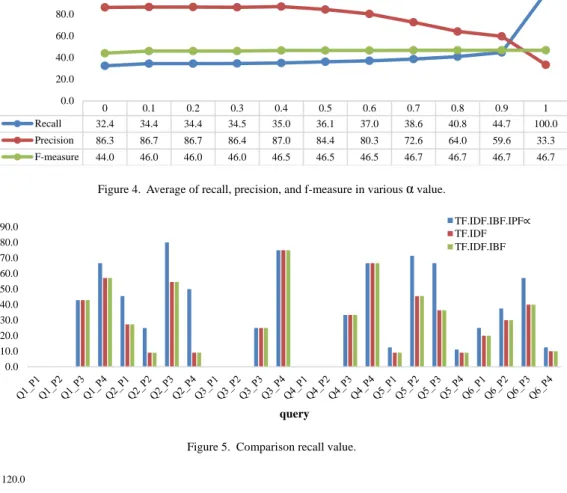
In this experiment we compared proposed method with TF.IDF and TF.IDF.IBF term weight-ing method. For TF.IDF.IBF.IPFα term weighting method, we use α=0.9. Based on experiment, α value is influence the level of user preference in
document ranking. Higher value of α makes the documents included at the user preference are in the top rank. Figure 4 shows the average value of considered when providing a high recall and ha-ving the ability to retrieve documents. The highest average recall is achieved when α = 1, reaching 100%. the recall increases. In contrast, the average value of precision decreases. While the average F-mea-sure stable. In this research, the optimal value of α However, at α = 1 the average precision is only worth 33.3% because the system only retrie-ving documents that include user preference categorize and ignore other. Therefore, α is considered optimal with α is at 0.9 with an average recall of 44.7%, the average precision of 59.6%, and the average F-measure of 46.7%.
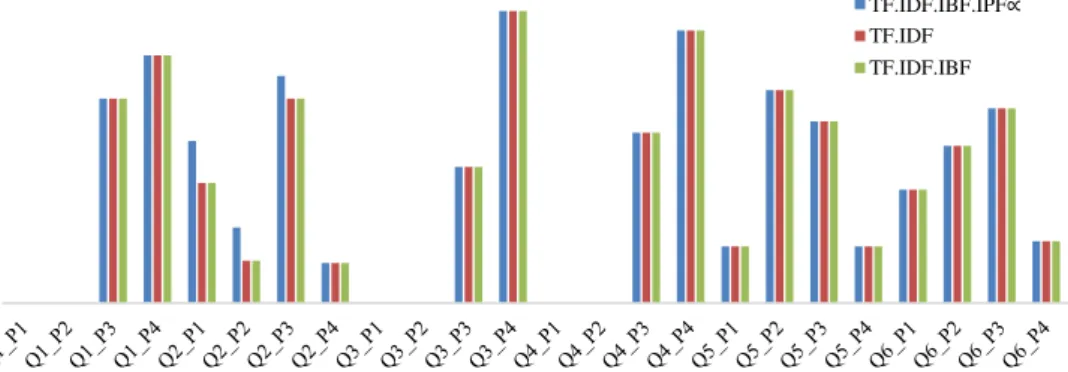
Result of experiment shown in Figure 5, Fi-gure 6, and FiFi-gure 7. FiFi-gure 5 shows a compari-son recall value between proposed method and other methods. From that figure we know, recall values of proposed method are higher than other method in 13 various input. For 5 other various input, recall TF.IDF.IBF.IPFα method is equal wi-th TF.IDF and TF.IDF.IBF mewi-thod. And 6 various input are no result founded. Among the queries th-at generth-ate high recall is Q1_P4 with 9.5% value, Q2_P1 with 18.2% value, Q2_P2 with 15.9% va-lue, Q2_P3 with 22.5% vava-lue, Q2_P4 with 40.9% value higher than others method, and so on. High-est recall TF.IDF.-IBF.IPFα method is 80% for in-put Q2_P3. This prove TF.IDF.IBF.IPFα method
Figure 4. Average of recall, precision, and f-measure in various α value.
Figure 5. Comparison recall value.
Figure 6. Comparison precision value.
0 0.1 0.2 0.3 0.4 0.5 0.6 0.7 0.8 0.9 1 Recall 32.4 34.4 34.4 34.5 35.0 36.1 37.0 38.6 40.8 44.7 100.0 Precision 86.3 86.7 86.7 86.4 87.0 84.4 80.3 72.6 64.0 59.6 33.3 F-measure 44.0 46.0 46.0 46.0 46.5 46.5 46.5 46.7 46.7 46.7 46.7 0.0 20.0 40.0 60.0 80.0 100.0 120.0 0.0 10.0 20.0 30.0 40.0 50.0 60.0 70.0 80.0 90.0 reca ll ( % ) query TF.IDF.IBF.IPF∝ TF.IDF TF.IDF.IBF 0.0 20.0 40.0 60.0 80.0 100.0 120.0 precis io n ( % ) query TF.IDF.IBF.IPF∝ TF.IDF TF.IDF.IBF
is capable to rank the document according to user preference rather than existing term weighting method.
Figure 6 shows a comparison between the precision value TF.IDF.IBF.IPFα method TF.IDF and TF.IDF.IBF method. From these image it is known that the TF.IDF and TF.IDF.IBF method has higher precision value compared with TF.-IDF.IBF.IPFα method, i.e. at 11 queries used, while 7 other queries have the same precision va-lue. This is because TF.IDF.IBF.IPFα method tho-ugh relevant documents, but if it is not in accor-ding to user preference then the document will be placed on the lower order than the relevant
docu-ments according to user preference
Figure 7 shows a comparison between the F-measure value TF.IDF.IBF.IPFα method TF.IDF and TF.IDF.IBF method. Based on these images there are 3 inputs with TF.IDF.IBF.IPFα method which gives the higher value of F-measure than TF.IDF and TF.IDF.IBF method. For 15 other inp-uts, TF.IDF.IBF.IPFα method gives F-measure va-lue equal to two other methods. The three inputs are Q2_P1 with 12.3% higher value, Q2_P2 with 9.7% higher value, and Q2_P3 with 6.7% higher value than the two other methods.
Overall, based on the comparison of the re-call, precision, and F-measure between TF.IDF.
Figure 7. Comparison f-measure. 0.0 10.0 20.0 30.0 40.0 50.0 60.0 70.0 80.0 90.0 f-m ea sure ( % ) query TF.IDF.IBF.IPF∝ TF.IDF TF.IDF.IBF
IBF.IPFα method with TF.IDF and TF.IDF.-IBF method it can be concluded that TF.-IDF.IBF.IPFα method is affords to Arabic fiqh docusment rank-ing accordrank-ing to user preference rather than TF. IDF or TF.IDF.IBF. It is also evident from the ave-rage F-measure. TF.IDF.-IBF.IPFα method has av-erage F-measure of 46.7% while the two other methods worth 45.1%. TF.IDF.IBF.IPFα has max-imum recall value 75%, precision 100%, and F-measure 85.7% for input Q3_P4.
4. Conclusion
From experiment of this research we can conclude that TF.IDF.IBF.IPFα method is capable to Arabic
fiqh document ranking according to user prefernce with value of recall, precision and F-measure rea-ched 75%, 100%, and 85.7% for Q3 query Q3 with chosen user preference options is P4. Propo-sed method may also can be implemented to rank other document that have a preference aspect.
However, preference in this study is based on a single preference. Therefore, further research can be done to fulfill the needs of multi prefe-rences. Suitability of search results is also deter-mined by the user query, further query expa-nsion is needed to improve search capabilities.
References
[1] C.D. Manning, P. Raghavan, & H. Schütze.
Introduction to Information Retrieval, vol. 1.
Cambridge: Cambridge university press, 2008.
[2] F. Harrag, A.H. Cherif, & E.E. Qawasmeh. "Vector Space Model for Arabic Information Retrieval—Application to “Hadith” Index-ing." Applications of Digital Information and Web Technologies, 2008. ICADIWT 2008.
First International Conference on the, IEEE,
2008.
[3] G. Salton & C. Buckley. "Term-Weighting Approaches in Automatic Text Retrieval."
Information Processing & Management
24.5, pp. 513-523, 1988.
[4] S. Gerard. Automatic Text Processing: The
Transformation, Analysis, and Retrieval of.
Addison-Wesley, 1989.
[5] F. Ren & M.G. Sohrab. "Class-indexing-bas-ed term weighting for automatic text classi-fication." Information Sciences 236, pp. 109-125, 2013.
[6] M. A. Fauzi, “Term Weighting based on Book and Class Indices for Arabic Docu-ment Ranking,” B.S Thesis, Depart-Docu-ment of Informatic Engineering, Faculty of Informa-tion Technology, Institut Teknologi Sepuluh Nopember, Indonesia, 2013.
[7] R. Chulyadyo & P. Leray. "A Personalized
Recommender System from Probabilistic Relational Model and Users’ Preferences."
Procedia Computer Science, vol. 35, pp.
1063-1072, 2014.
[8] D. Bogdanov, M. Haro, F. Fuhrmann, A.
Xambo, E. Gommez, & P. Herrera, "Seman-tic audio content-based music recommend-dation and visualization based on user
prefe-rence examples", Information Processing &
Management 49.1, pp. 13-33, 2013.
[9] T. Tegegne and Th P.V.D. Weide. "Enriching
queries with user preferences in healthcare",
Information Processing & Management
50.4, pp. 599-620, 2014.
[10] G.J. Hahm, M.Y. Yi, J.H. Lee, & H.W. Suh,
"A personalized query expansion approach
for engineering document retrieval",
Advan-ced Engineering Informatics 28.4, pp.
344-359, 2014.
[11] A. Miele, E. Quintarelli, E. Rabosio, L.
Tan-ca, "A data-mining approach to preference-based data ranking founded on contextual
information", Information Systems, vol. 38,
[12] S.D. Amo, M.S. Dialo, C.T. Diop, A. Giaco-metti, D. Li, & A. Soulet, "Contextual prefe-rence mining for user profile construction"
Information Systems, vol. 49, pp. 182-199,
2015.
[13] C. Boutilier, R.I. Brafman, C. Domshalk,
H.H. Hoos, & D. Poole, "CP-nets: A Tool for Representing and Reasoning with Conditio-nal Ceteris Paribus Preference Statements."
J. Artif. Intell. Res. (JAIR), vol. 21, pp.
135-191, 2004.
[14] S. Sulaiman, H. Mohamed, M.R.M. Arshad, N.A.A. Rashid, & U.K. Yusof, "Hajj-QAES: A Knowledge-Based Expert System to Supp-ort Hajj Pilgrims in Decision Making" Com-puter Technology and Development, 2009.
ICCTD'09. International Conference on, vol.
1, 2009.
[15] A.M.A. Mesleh, "Chi Square Feature Extrac-tion Based SVMs Arabic Language Text
Ca-tegorization System" Journal of Computer
Science, vol. 3, pp.430, 2007.
[16] L.S. Larkey, L. Ballesteros, & M.E. Connell, "Improving Stemming for Arabic Informa-tion Retrieval: Light Stemming and Co-Occurrence Analysis." Proceedings of the 25th annual international ACM SIGIR confe-rence on Research and development in
infor-mation retrieval. ACM, 2002.
[17] L.S. Larkey, L. Ballesteros, & M.E. Connell, "Light Stemming for Arabic Information Retrieval", Arabic computational morpholo-gy. Springer Netherlands, pp. 221-243, 2007. [18] K.J. Cios, W. Pedrick, R.W. Swiniaraski, and L. Kurgan, "Data Mining: A Knowledge Dis-covery Approach", Springer, US, p.127, 2007.
[19] S. Tata, & J.M. Patel, "Estimating the selec-tivity of tf-idf based cosine similarity predi-cates." ACM SIGMOD Record, vol. 36, pp. 7-12, 2007.