Assessing Test Quality
David Schuler
Dissertation zur Erlangung des Grades des Doktors der Ingenieurwissenschaften
der Naturwissenschaftlich-Technischen Fakult¨aten der Universit¨at des Saarlandes
Dean Prof. Holger Hermanns
Head of the Examination Board Prof. Dr. Reinhard Wilhelm
Members of the Examination Board Prof. Dr. Andreas Zeller, Prof. Dr. Sebastian Hack Dr. Valentin Dallmeier
Abstract
When developing tests, one is interested in creating tests of good quality that thor-oughly test the program. This work shows how to assess test quality through mutation testing with impact metrics, and through checked coverage.
Although there a different aspects that contribute to a test’s quality, the most impor-tant factor is its ability toreveal defects, because software testing is usually carried out with the aim to detect defects. For this purpose, a test has to provide inputs that execute the defective code under such conditions that it causes an infection. This infection has to propagate and result in a failure, which can be detected by acheck of the test. In the past, the aspect of test input quality has been extensively studied while the quality of checks has received less attention.
The traditional way of assessing the quality of a test suite’s checks ismutation test-ing. Mutation testing seeds artificial defects (mutations) into a program, and checks whether the tests detect them. While this technique effectively assesses the quality of checks, it also has two drawbacks. First, it places a huge demand on computing resources. Second,equivalent mutants, which are mutants that are semantically equiv-alent to the original program, dilute the quality of the results. In this work, we address both of these issues. We present the JAVALANCHEframework that applies several op-timizations to enable automated and efficient mutation testing for real-life programs. Furthermore, we address the problem of equivalent mutants by introducingimpact met-ricsto detect non-equivalent mutants. Impact metrics compare properties of tests suite runs on the original program with runs on mutated versions, and are based on abstrac-tions over program runs such as dynamic invariants, covered statements, and return values. The intention of these metrics is that mutations that have a graver influence on the program run are more likely to be non-equivalent.
Moreover, we introducechecked coverage, an alternative approach to measure the quality of a test suite’s checks. Checked coverage determines the parts of the code that were not only executed, but that actually contribute to the results checked by the test suite, by computing dynamic backward slices from all explicit checks of the test suite.
Zusammenfassung
Diese Arbeit stellt dar, wie die Qualit¨at von Software Tests durch mutationsbasiertes Testen in Verbindung mit Auswirkungsmaßen und durch Checked Coverage beurteilt werden kann.
Obwohl unterschiedliche Faktoren die Qualit¨at eines Tests beeinflussen, ist der wichtigste Aspekt die F¨ahigkeit Fehler aufzudecken. Dazu muss ein Test Eingaben bereitstellen, die den fehlerhaften Teil des Programms so ausf¨uhren, dass eine Infek-tion entsteht, d.h. der Programmzustand fehlerhaft wird. Diese InfekInfek-tion muss sich so fortpflanzen, dass sie in einem fehlerhaften Ergebnis resultiert, welches dann von einer Test-Pr¨ufung erkannt werden muss.
Die herk¨ommliche Methode um die Qualit¨at von Test-Pr¨ufungen zu beurteilen ist mutationsbasiertes Testen. Hierbei werden k¨unstliche Fehler (Mutationen) in ein Pro-gramm eingebaut und es wird ¨uberpr¨uft, ob diese von den Tests erkannt werden. Ob-wohl diese Technik die Qualit¨at von Test-Pr¨ufungen beurteilen kann, weist sie zwei Nachteile auf. Erstens hat sie einen großen Bedarf an Rechenkapazit¨aten. Zweitens verw¨assern ¨aquivalente Mutationen, welche zwar die Syntax eines Programms ¨andern, jedoch nicht seine Semantik, die Qualit¨at der Ergebnisse. In dieser Arbeit werden L¨osungen f¨ur beide Probleme aufgezeigt. Wir pr¨asentieren JAVALANCHE, ein Sys-tem, das effizientes und automatisiertes mutationsbasiertes Testen f¨ur realistische Pro-gramme erm¨oglicht. Des Weiteren wird das Problem von ¨aquivalenten Mutationen mit-tels Auswirkungsmaßen angegangen. Auswirkungsmaße vergleichen Eigenschaften zwischen einem normalen Programmlauf und einem Lauf eines mutierten Programms. Hierbei werden verschiedene Abstraktionen ¨uber den Programmlauf benutzt. Die zu-grunde liegende Idee ist, dass eine Mutation, die eine große Auswirkung auf den Pro-grammlauf hat, weniger wahrscheinlich ¨aquivalent ist.
Dar¨uber hinaus stellen wir Checked Coverage vor, ein neuartiges Abdeckungsmaß, welches die Qualit¨at von Test-Pr¨ufungen misst. Checked Coverage bestimmt die Teile im Programmcode, die nicht nur ausgef¨uhrt, sondern deren Resultate auch von den Tests ¨uberpr¨uft werden.
Acknowledgements
First of all, I would like to thank my adviser Andreas Zeller for the guidance and support while working on my PhD. Many thanks also go to Sebastian Hack for being the second examiner of my thesis, and to
During my time at the Software Engineering chair, I have been fortunate to work with great colleagues, of whom many helped me with proofreading parts of this thesis. Thank you Valentin Dallmeier, Gordon Fraser, Florian Groß, Clemens Hammacher, Kim Herzig, Yana Mileva, Jeremias R¨oßler, and Kevin Streit. While working at this chair, I have been lucky to have great office mates. Thank you Christian Lindig, Rahul Premraj and Thomas Zimmermann. The research that I carried out would not have been possible without the work of our system administrators Kim Herzig, Sascha Just, Sebastian Hafner and Christian Holler who did a great job at maintaining the infras-tructure at our chair. For parts of this research, I collaborated with Bernhard Gr¨un and Jaechang Nam, whom I would like to thank. Furthermore, I would like to thank Arnika Marx and Anna Theobald for proofreading.
I am deeply grateful to my friends and family. Especially, I would like to thank Anna, Conny, Heiner, Bastian, Julia, Luzie, Peter and Timo for cooking together and the good time we spent together. Finally, my biggest thanks go to my parents Sigrid and Werner for always supporting me.
Contents
1 Introduction 1 1.1 Thesis Structure . . . 3 1.2 Publications . . . 4 2 Background 7 2.1 Software Testing . . . 7 2.2 Unit Tests . . . 9 2.3 Coverage Metrics . . . 112.3.1 Control Flow Criteria . . . 12
2.3.2 Data Flow Criteria . . . 14
2.3.3 Logic Coverage Criteria . . . 14
2.3.4 Summary Coverage Criteria . . . 15
2.4 Program Analysis . . . 16
2.4.1 Static Program Analysis . . . 16
2.4.2 Dynamic Program Analysis . . . 17
2.4.3 Execution Trace . . . 18
2.4.4 Program Analysis Techniques . . . 19
2.4.5 Coverage Metrics . . . 19 2.4.6 Program Slicing . . . 19 2.4.7 Invariants . . . 22 2.4.8 Related Work . . . 24 2.5 Summary . . . 25 3 Mutation Testing 27 3.1 Underlying Hypotheses . . . 30
3.1.1 Competent Programmer Hypothesis . . . 30
3.1.2 Coupling Effect. . . 31
3.2 Costs of Mutation Testing. . . 31
3.3 Optimizations . . . 32
3.3.1 Mutation Reduction Techniques . . . 32
3.3.2 Mutant Sampling . . . 33 3.3.3 Selective Mutation . . . 33 3.3.4 Weak Mutation . . . 34 3.3.5 Mutation Schemata . . . 34 3.3.6 Coverage Data . . . 35 3.3.7 Parallelization . . . 35 3.4 Related Work . . . 35 3.5 Summary . . . 36
4 The Javalanche Framework 37 4.1 Applying Javalanche . . . 39
4.2 Subject Programs . . . 41
4.3 Mutation Testing Results . . . 43
4.4 Related Work . . . 44
4.4.1 Further Uses of Javalanche . . . 45
4.5 Summary . . . 47
5 Equivalent Mutants 49 5.1 Types of Mutations . . . 50
5.1.1 A Regular Mutation . . . 50
5.1.2 An Equivalent Mutation . . . 50
5.1.3 A Not Executed Mutation . . . 51
5.2 Manual Classification . . . 52
5.2.1 Percentage of Equivalent Mutants . . . 52
5.2.2 Classification Time . . . 53
5.2.3 Mutation Operators . . . 53
5.2.4 Types of Equivalent Mutants . . . 54
5.2.5 Discussion . . . 56
5.3 Related Work . . . 58
5.4 Summary . . . 59
6 Invariant Impact of Mutations 61 6.1 Learning Invariants . . . 62
6.2 Checking Invariants . . . 63
6.3 Classifying Mutations. . . 64
6.4 Evaluation . . . 65
CONTENTS
6.4.1 Evaluation Subjects. . . 65
6.4.2 Manual Classification of Impact Mutants . . . 67
6.4.3 Invariant Impact and Tests . . . 71
6.4.4 Ranking. . . 73
6.4.5 Invariant Impact of the Manually Classified Mutants . . . 76
6.4.6 Discussion . . . 78
6.5 Threats to Validity. . . 79
6.6 Related Work . . . 80
6.6.1 Mutation Testing . . . 80
6.6.2 Equivalent Mutants . . . 80
6.6.3 Invariants and Contracts . . . 81
6.7 Summary . . . 82
7 Coverage and Data Impact of Mutations 83 7.1 Assessing Mutation Impact . . . 84
7.1.1 Impact on Coverage . . . 84
7.1.2 Impact on Return Values . . . 85
7.1.3 Impact Metrics . . . 86
7.1.4 Distance Metrics . . . 87
7.1.5 Equivalence Thresholds . . . 88
7.2 Evaluation . . . 89
7.2.1 Impact of the Manually Classified Mutations . . . 89
7.2.2 Impact and Tests . . . 93
7.2.3 Mutations with High Impact . . . 98
7.3 Threats to Validity. . . 100
7.4 Related Work . . . 100
7.5 Summary . . . 102
8 Calibrated Mutation Testing 105 8.1 Classifying Past Fixes . . . 105
8.1.1 Mining Fix Histories . . . 106
8.1.2 Subject Project . . . 107
8.1.3 Fix Categorization . . . 108
8.2 Calibrated Mutation Testing . . . 108
8.2.1 Mutation Operators . . . 110
8.2.2 Mutation Selection Schemes . . . 110
8.3 Evaluation . . . 111
8.3.1 Evaluation Setting . . . 112
8.3.2 Evaluation Results . . . 112
8.4 Threats to Validity. . . 115
8.5 Related Work . . . 116
8.5.1 Mining Software Repositories . . . 116
8.5.2 Mutation Testing . . . 117
8.6 Summary . . . 118
9 Comparison of Test Quality Metrics 119 9.1 Test Quality Metrics . . . 120
9.2 Experiment Setup . . . 121 9.3 Results. . . 122 9.4 Threats to Validity. . . 127 9.5 Related Work . . . 128 9.6 Summary . . . 130 10 Checked Coverage 133 10.1 Checked Coverage . . . 135
10.1.1 From Slices to Checked Coverage . . . 136
10.1.2 Implementation . . . 138
10.2 Evaluation . . . 139
10.2.1 Evaluation Subjects. . . 139
10.2.2 Qualitative Analysis . . . 140
10.2.3 Disabling Oracles. . . 142
10.2.4 Explicit and Implicit Checks . . . 145
10.2.5 Performance . . . 147 10.3 Limitations . . . 147 10.4 Threats to Validity. . . 149 10.5 Related Work . . . 150 10.5.1 Coverage Metrics . . . 150 10.5.2 Mutation Testing . . . 150 10.5.3 Program Slicing . . . 151 10.5.4 State Coverage . . . 151 10.6 Summary . . . 152
11 Conclusions and Future Work 155
Bibliography 159
List of Figures
2.1 Static data and control dependencies for themax()method. . . 21
2.2 Dynamic data and control dependencies for themax()method. . . . 22
2.3 A method that computes the square of an integer. . . 23
5.1 A non-equivalent mutation from the XSTREAMproject. . . 50
5.2 An equivalent mutation from the XSTREAMproject. . . 51
5.3 A mutation of XSTREAMproject that is not executed by tests. . . 51
5.4 An equivalent mutation in unneeded code. . . 55
5.5 An equivalent mutation that does not affect the program semantics. . . 55
5.6 An equivalent mutation that alters state. . . 56
5.7 An equivalent mutation that could not be triggered. . . 57
5.8 An equivalent mutation because of the context. . . 57
6.1 The process of ranking mutations by invariant impact.. . . 62
6.2 An invariant checker for a method that computes the square root. . . . 64
6.3 A non-detected JAXENmutation that violates most invariants.. . . 69
6.4 A non-detected JAXENmutation that violates the second most invariants. 70 6.5 The undetected mutation that violates most invariants.. . . 71
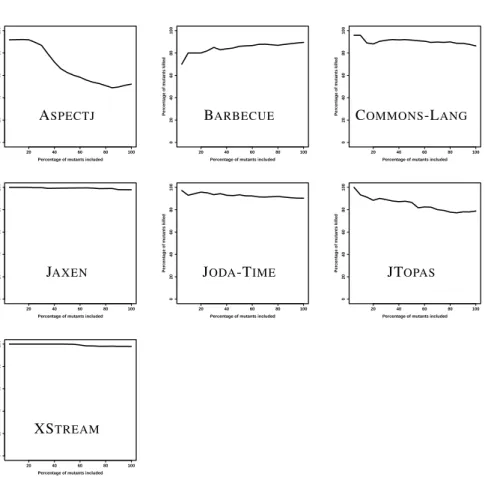
6.6 Detection rates (y) for the topx% mutations with the highest impact. . 75
7.1 Precision and Recall of the impact metrics for different thresholds. . . 92
7.2 Percentage of mutations with impact and detection ratios of mutations with and without impact for varying threshold.. . . 97
8.1 The process of calibrated mutation testing. . . 106
8.2 Collected fixes for the JAXENproject. . . 107
9.1 Correlation between coverage level and defect detection for test suite sizes 1 to 15. . . 123
9.2 Correlation between coverage level and defect detection and corre-sponding P-values for test suite sizes 1 to 100. . . 124
9.3 Correlation between coverage level and defect detection and corre-sponding P-values for test suite sizes 1 to 100. . . 125
9.4 Correlation between coverage level and defect detection for test suite sizes 1 to 500. . . 126
10.1 A test without outcome checks. . . 134
10.2 Dynamic data and control dependencies as used for checked coverage. 135
10.3 Another test with insufficient outcome checks. . . 141
10.4 A method where the return value is not checked.. . . 141
10.5 Coverage values for test suites with removed assertions. . . 142
10.6 Decrease of the coverage values relative to the coverage values of the original test suite. . . 144
10.7 A common JUNITpattern to check for exceptions.. . . 148
10.8 Statements that lead to not taking a branch. . . 149
List of Tables
4.1 JAVALANCHEmutation operators. . . 39
4.2 Description of subject programs. . . 41
4.3 Description of the subject programs’ test suites. . . 42
4.4 Mutation statistics for the subject programs. . . 42
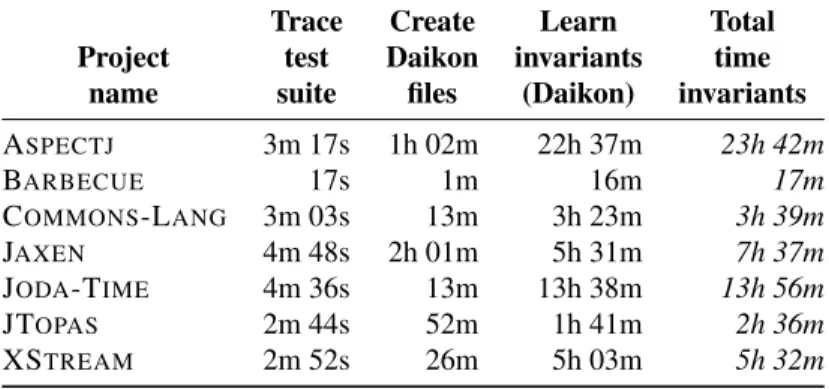
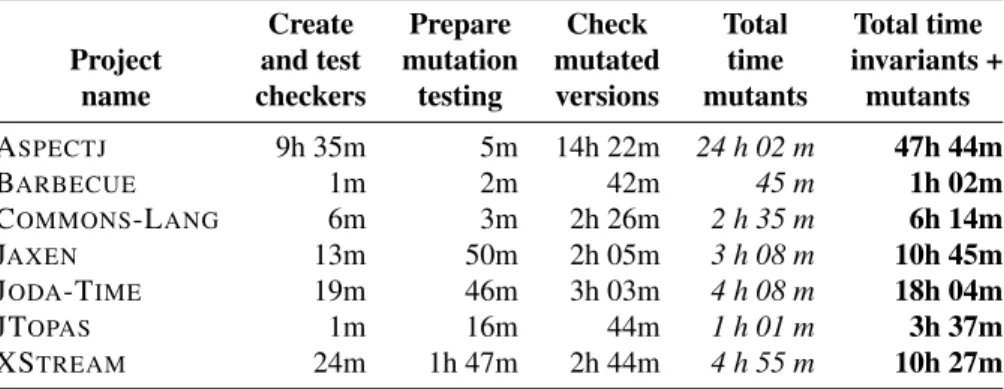
4.5 JAVALANCHEruntime for the individual steps.. . . 43
5.1 Classifying mutations manually. . . 53
5.2 Classification results per mutation operator. . . 54
6.1 Invariants used by JAVALANCHE.. . . 63
6.2 Description of subject programs. . . 66
6.3 Runtime (in CPU time) for obtaining the dynamic invariants. . . 66
6.4 JAVALANCHEruntime (in CPU time) for the individual steps. . . 67
6.5 Results forH2. Invariant-violating mutants (VM) have higher detec-tion rates than non-violating mutants (NVM). . . 73
6.6 Results forH3. Best results are obtained by ranking VMs by the num-ber of invariants violated. . . 76
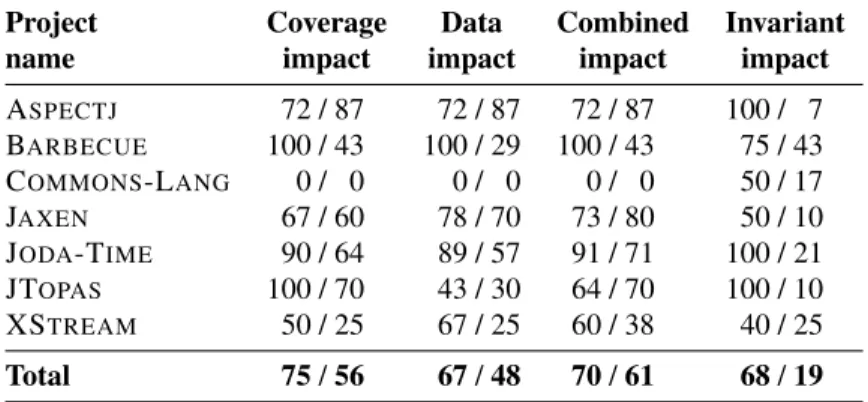
6.7 Results for H4. Precision and recall of the invariant impact for the 140 manually classified mutants. . . 77
7.1 Effectiveness of classifying mutants by impact: precision and recall. . 90
7.2 Effectiveness of classifying mutants by distance based impact. . . 90
7.3 Assessing whether mutants with impact on coverage are detected by tests. . . 93
7.4 Results for ranking the mutations according to their impact on coverage. 94 7.5 Assessing whether mutants with impact on data are detected by tests.. 94
7.6 Results for ranking the mutations by their impact on data. . . 95
7.7 Assessing whether mutants with combined coverage and data impact
are detected by tests. . . 95
7.8 Results for ranking the mutations by their impact on coverage and data. 96 7.9 Detection ratios for different operators . . . 98
7.10 Focusing on mutations with the highest impact: precision of the classi-fication . . . 99
8.1 Fix pattern properties and their values. . . 108
8.2 10 most frequent fix patterns for Jaxen.. . . 109
8.3 Classification of the 10 most frequent fix patterns. . . 109
8.4 Defects detected for pattern and location based schemes (for revision 1229). . . 113
8.5 Defects detected for property based schemes (for revision 1229). . . . 114
8.6 Defects detected for pattern and location based schemes (for revision 931).. . . 115
8.7 Defects detected for property based schemes (for revision 931).. . . . 116
9.1 Description of the Siemens suite. . . 121
10.1 Checked coverage, statement coverage, and mutation score.. . . 140
10.2 Mutations detected by explicit checks of the test suite. . . 146
10.3 Runtime to compute the checked coverage and the mutation score. . . 147
Chapter 1
Introduction
Software fails, and as software is part of our everyday lives, almost everyone has ex-perienced a software failure. Failures are caused by defects in programs, which are accidentally introduced by developers because of the inherent complexity of modern software. It is impossible for a human to account for all possible scenarios that can arise during the execution of a program. Thus, defect free software is an illusion and almost all programs contain defects that lead to more or less severe failures.
Infamous defects include the Ariane 5 explosion in 1996 [20]. A conversion error from a 64-bit floating-point to 16-bit signed integer value caused the Ariane 5 launcher to veer off the planned flight path, which put too much force on the engines so that they were in danger to drop off, and eventually, the self-destruct mechanism was activated. Another severe defect was in the in the control software of the Therac-25 radio therapy machine [51]. Its electron beam has two operation modes, low and high power. A defect in the control software caused the usage of high power beam when the low power beam should have been used. In these cases the high power beam was used without the indispensable safety mechanisms. This caused a massive overdose of radiation for many patients.
A study by the National Institute of Standards and Technology [95] from 2002 quantifies the problem of software defects in terms of costs. It is estimated that software failures cause costs of $59.5 billion annually in the U.S., and that over one third of these costs could be avoided by using a better testing infrastructure.
Software testingtechniques are concerned with detecting as many defects as early as possible. To this end, software is tested at different architectural levels and at dif-ferent stages during the development process. Thereby, one is interested to test the program systematically. Unit testoperate at the most basic level, and provide inputs for the program under test and compare the results to expected values.Coverage met-ricsimpose requirements on the test inputs so that the program is systematically tested. However, they do not consider how well the results of the computations are checked.
Mutation testing, which inserts artificial defects (mutations) into a program and checks whether tests detect them, assesses the quality of checks and test inputs. Besides these benefits mutation testing also has two major drawbacks. First, it is expensive in terms of computing resources. Second,equivalent mutants, which are mutants that do not differ in the program semantics, dilute the quality of its results.
This work makes the following contributions to mutation testing, detecting equiva-lent mutants, and assessing the quality of a test suite’s checks.
JAVALANCHE We introduce the JAVALANCHEmutation testing framework that en-ables automated and efficient mutation testing for JAVAprograms. It is the basis for further research presented in this work and has been developed with the in-tent to apply mutation testing to real-life programs. JAVALANCHEapplies sev-eral optimizations adapted from previous mutation testing tools, and it introduces previously unimplemented optimizations.
Equivalent mutants We study and quantify the problem of equivalent mutants for real-life JAVA programs. Equivalent mutants have a different syntax than the original program but are semantically equivalent. As they cannot be detected by a test, they are presented to the developer among regular undetected mutants, and thereby, dilute the quality of mutation testing’s results. We study their frequency among undetected mutants on real-life programs and test suites, and measure the time needed to identify them.
Impact metrics To address the problem of equivalent mutants, we introduce several impact metrics that measure the difference between a run of the test suite on the original program and a run of the test suite on a mutated version. The idea behind these approaches is that a mutant with a strong impact on the program run is more likely to be non-equivalent. In this work, we investigate several metrics based on different abstractions that characterize program runs. We show how to compute the impact of a specific mutation by comparing the abstractions over a run of the original program to a run of the mutated version.
1.1. THESIS STRUCTURE 3
Checked coverage We introduce checked coverage, a coverage metric that is designed to assess the quality of the inputs and checks of a test suite. Using dynamic slicing, checked coverage determines the statements actually contributing to the results checked by the test suite, in contrast to statements that are only executed. Thereby, checked coverage focuses on the explicit checks of the test suite, which verify the results of one concrete run and can make detailed assumptions. Thus, they have an important influence on the test quality.
1.1
Thesis Structure
The main contributions of this work are to apply mutation testing to real-life programs, introduce methods that help to identify non-equivalent mutants, and to present a new coverage metric that measures the quality of a test suite’s checks. The results of our research are presented further on in the following order:
Chapter2 gives a short introduction into software testing and program analysis. It describes different testing levels, and focuses on testing at the unit level because the techniques presented in this work operate at this level. The second part in-troduces static and dynamic program analysis, and explains dynamic analysis approaches relevant for this work in more detail.
Chapters3to5 introduce and define mutation testing as a technique that assesses the quality of a test suite by inserting artificial defects and checking whether the test suite detects them. Chapter4 presents the JAVALANCHE framework that enables efficient mutation testing for JAVA. With the help of JAVALANCHE, the extend of the equivalent mutant problem for real-life JAVAprograms is studied in Chapter5.
Chapters6and7 present methods to detect non-equivalent mutants via the impact of a mutation. The impact of a mutation is the difference between a run of the test suite on the original version of the program and a run on the mutated version. Chapter6introduces invariant impact which is computed by inferring dynamic invariants from the original run and checking for violations in the mutated run. Chapter7presents impact measures based on the differences in code coverage and return values between a run of the original program and the mutated version.
Chapter8 introduces calibrated mutation testing. A method which adapts mutant generation schemes to the defect history of a project. A mutant generation scheme produces a set of mutations calibrated to past defects by mining past fixes, extracting properties of them, and mapping these properties to mutations.
Chapter9 investigates whether there is a correlation between the coverage level of a test suite and its defect detection capability for mutation testing and several coverage metrics, i.e. whether test suites with a higher coverage level are also more likely to detect defects.
Chapter10 presents checked coverage, an alternative to mutation testing, which as-sesses the quality of a test suite’s checks. This is done by focusing on those code features that actually contribute to the results checked by oracles. For this purpose, the dynamic backward slice from the checks is computed, and only statements that are on the slice are considered as covered.
Chapter11 concludes with a summary of our results and ideas for future work.
1.2
Publications
This dissertation builds on the following papers (in chronological order):
• David Schuler, Valentin Dallmeier, Andreas Zeller. Efficient Mutation Testing by Checking Invariant Violations. InISSTA ’09: Proceedings of the 18th Inter-national Symposium on Software Testing and Analysis, pages 69–80, New York, NY, USA, 2009. ACM.
• Bernhard J. M. Gr¨un,David Schuler, Andreas Zeller. The Impact of Equiva-lent Mutants. InMutation ’09: Proceedings of the 3rd International Workshop on Mutation Analysis, pages 192-199, Los Alamitos, CA, USA, 2010. IEEE Computer Society.
• David Schuler, Andreas Zeller. (Un-)Covering Equivalent Mutants. InICST ’10: Proceedings of the 3rd International Conference on Software Testing, Verifica-tion and ValidaVerifica-tion, pages 45–54, Los Alamitos, CA, USA, 2010. IEEE Com-puter Society.
1.2. PUBLICATIONS 5
• David Schuler, Andreas Zeller. Assessing Oracle Quality with Checked Cov-erage. InICST ’11: Proceedings of the 4th International Conference on Soft-ware Testing, Verification and Validation, pages 90–99, Los Alamitos, CA, USA, 2011. IEEE Computer Society.
• Jaechang Nam, David Schuler, Andreas Zeller. Calibrated Mutation Testing. In Mutation ’11: Proceedings of the 5th International Workshop on Mutation Analysis.
Chapter 2
Background
This work presents approaches that measure the quality of software unit tests, and further extensions to these approaches that use dynamic program analysis techniques. The following chapter gives a short introduction to software testing and more details for testing on the unit level as most techniques presented later in this work operate at this testing level. Further on, there will be a focus on program analysis techniques, especially dynamic ones, which are exerted by various approaches that are presented later.
2.1
Software Testing
The goal of the software development process is to produce a piece of software that meets the requirements and contains no defects. In other words, the software should perform as expected under all circumstances. However, meeting this goal is in most cases impossible because not all requirements might be known beforehand and the re-quirements might be imprecise so that they allow room for interpretation. Furthermore, most software is so complex that one cannot make sure that it contains no defects. In order to gain confidence that the software behaves as expected, it is tested at different stages in the development process. Testing at different stages corresponds to testing at different levels of the program structure.
Acceptance testingaddresses the question whether the complete software meets the users’ requirements, i.e. if it really does what the users want. It is the last testing step before shipping the product, and is usually carried out by domain experts, who are often the customers themselves. Therefore, the software is tested in the environment of its users which can be executed in the following ways: for software that was developed for a specific customer, a test system is set up at the customer’s site that may be tested with real production data. For software that has been developed for the mass market, a beta phase is started in which the software is handed out to selected customers.
System testingis concerned with the question whether the assembled system meets the specifications. The system is tested on the architectural level and the focus is put on the functional part of the software. It is assumed that the subsystems work correctly, and the complete system is tested with the aim of discovering problems that arise from discrepancies between the specification and the implementation, i.e. the specification is not implemented correctly. In contrast to acceptance testing which is carried out by customers, system testing is carried out by the producer of the software, usually by a separate testing team.
Integration testingassesses whether the modules communicate correctly via their interfaces. The aim of this testing phase is to find interaction and compatibility prob-lems. When integrating the modules, different integration techniques are used. First, big-bang integration follows no real strategy because all components are integrated at once. Second, structure-oriented integration combines the modules incrementally by considering the structural dependencies between them. Third, function-oriented inte-gration combines the modules according to specified functional criteria. Inteinte-gration testing is carried out by the development team, and in contrast to system testing, the code structure is also considered.
Module testing(also calledunit testing) checks the implementation of single pro-gram modules in isolation. The part of a propro-gram that is considered as a module can vary. For example, methods and functions can be considered as modules, or classes and files can be considered. In practice, they often cannot be tested in isolation be-cause of the dependencies between modules. Module testing is always concerned with concrete implementations; therefore, it is carried out by the software developer. As the techniques presented in this work are concerned with testing at the unit level, we will present unit tests in more detail.
2.2. UNIT TESTS 9
2.2
Unit Tests
Unit tests are small programs that exercise thesystem under test(SUT) under specified conditions. The execution of the SUT is observed. For example, exceptions that are raised during execution are logged. After the SUT has been exercised the results are checked with the help oftest oraclesand classified aspassingorfailing. When a test meets the expectations imposed by the oracle, it is considered to be passing and failing otherwise. A single unit test is referred to as atest case.
Definition 1 (Test Case) A test case executes the system under test under specified conditions and with specified inputs, observes the execution, and checks the results via test oracles.
Definition 2 (Test Oracle) A test oracle determines whether the test passes or fails.
The result of a test is determined by the test oracle and can be influenced byexplicit checks of the test suite,explicit checks of the program, orimplicit checks of the pro-gram. Explicit checks of the test suite usually come in the form of expectations about the computed results. Values returned by the program and the state of the program are compared against expected values. Explicit checks of the program are pre- and post-conditions of the methods and the assertions inside the program, e.g. many methods check their arguments and raise an exception if an illegal argument was passed. Im-plicit checks are carried out by the runtime system and are not exIm-plicitly stated. For example, the JAVAvirtual machine implicitly checks whether an object isnullbefore calling a method on it and if this is the case aNullPointerExceptionis thrown. If all of the checks succeed, the test is considered aspassing, otherwise, if one of the checks indicates an unexpected behavior, the test is considered asfailing.
Definition 3 (Test Result) A test result r for a test t is the result, as determined by the test oracle, of running the test on a version P of the program . The result can either be pass or fail.
t(P) =r,r∈ {PASS,FAIL}
The aim of a unit test is to test atomic units, which are the smallest possible parts that can be tested in isolation. The benefit of testing small parts comes into play when a test fails. In this case, the location of a bug can easily be pinpointed because only a
small part of the program was covered by the test. However, it is not always possible to test every unit of the program in isolation because of the dependencies between different units.
To test bigger parts of the system (than a single unit), test cases can be combined into test suites. The purpose of those test suites is to group tests for a specific feature or a part of the system. They can be organized in a hierarchical order, i.e. a master test suite might consist of several sub test suites.
Definition 4 (Test Suite) A test suite is a set of several test cases.
During the development process, unit tests are executed very frequently. Therefore, the execution of the tests should be, and in most cases is, automated. To this end, several testing frameworks for different programming languages have been developed. Most prominent is the JUNITframework for JAVA.
These frameworks provide support to automatically run tests, group tests in several test suites. They separate setup code from testing code so that the setup code can be shared between several test cases, and introduce methods to check results, e.g. to check for equality of values or arrays. Furthermore, the frameworks give the developer an overview of the test results, and failing tests are reported together with associated failures and error messages.
The test suite is usually maintained in the same repository as the tested system and is written in the same programming language. It is run by the developer when changes have been made to the system, in order to gain confidence that the changes do not break existing tests. The practice of running tests after a modification to check whether it caused any defects previously experienced and detected by the tests, is called
regression testing. Of course, tests cannot show the absence of defects. They can only show that the system does not behave unexpected on a limited number of inputs.
Continuous integration tools build the system and run the test suites automatically in regular intervals, and make the results accessible to all developers. Thereby, devel-opers get immediate feedback about the current state of the system.
Using unit tests provides a number of benefits:
Find problems earlier Detecting a defect via unit testing saves costs because detect-ing a defect at later stages is much more expensive.
2.3. COVERAGE METRICS 11
Facilitate change By changing the software, there is always the risk of introducing a defect. Therefore, developers might refrain from changing specific parts of the system or making design changes although such changes might be necessary. Thorough unit tests can give the developer confidence that after a change, the system still behaves as expected.
Documentation Tests can provide examples of how to use the program under test. These tests can serve as documentation for developers who are not familiar with the system. Furthermore, the tests are kept up-to-date because they are executed regularly on recent versions of the program. This is often not the case for external code examples.
In order to profit from these benefits, it is important to have a good test suite. However, it is an open question what makes a good test suite. In the following sections, we present methods to assess the quality of unit tests.
2.3
Coverage Metrics
When testing a program, one is interested in thoroughly testing all parts of the pro-gram. However, testing with all possible inputs is practically impossible for nontrivial programs. For example, for a method that takes a date encoded as a string, all possible strings might be used as test inputs because tests can also use invalid inputs. In order to direct the testing process,coverage criteriacan be used. Different coverage criteria impose differenttest requirementsthat the test should satisfy.1
Definition 5 (Coverage Criterion) A coverage criterion is a rule that imposes re-quirements on a test suite.
Definition 6 (Test Requirement) A test requirement is a specific element or property of the system that the test must cover or satisfy.
By using coverage metrics that impose test requirements, rules can be stated on how many tests should be created and when to stop testing. This might be the case when all test requirements are satisfied or when a defined fraction of the test requirements is satisfied, i.e. a specific level of coverage is reached.
1These definitions of coverage criteria in form of test requirements follow the style of Ammann and
Definition 7 (Coverage Level) For a test set T and a set of test requirements TR, the coverage level is the ratio of satisfied requirements relative to all requirements.
The coverage level can also be used to assess the quality of a test suite with respect to a coverage metric. This also allows comparing different test suites regarding their quality.
Sometimes, coverage criteria impose requirements that cannot be met. These in-feasible requirements prevent test sets from satisfying all requirements. Detecting all infeasible requirements can be impossible as this problem can be reduced to the halting problem.
Some coverage criteria are related to each other via subsumption. A coverage cri-terion is said to subsume another coverage cricri-terion when every test set that satisfies the coverage criterion also satisfies the coverage criterion it subsumes.
Definition 8 (Subsumption) A coverage criterion Casubsumes another coverage cri-terion Cbif and only if every test set that satisfies Caalso satisfies Cb.
Inspired by different types of defects, different coverage criteria have been intro-duced. The criteria are designed in such a way that the tests satisfying one criterion do also detect defects of a specific type. Different criteria vary in the effort needed to compute the requirements, to write tests that satisfy them, and in their ability to require tests that reveal defects.
2.3.1
Control Flow Criteria
Criteria that can be defined using thecontrol flow graph(CFG) are also calledcontrol flow criteria. The control flow graph is a directed graph that has a node for every statement or every basic block, i.e. a piece of code that starts with a jump target and ends with a jump and contains no jump or jump target in between. Edges between nodes indicate that there is a direct control flow transition between the nodes. In the following, we will present the most prominent control flow criteria. The intention of these criteria is that defects are revealed by simply exercising the program structures or exercising them in a specific order.
Statement coverage is the most basic coverage metric. It requires that all state-ments in the program are executed, i.e. a single requirement is that a specific statement
2.3. COVERAGE METRICS 13
gets executed by at least one test, and the set of test requirements for statement cov-erage consists of one such requirement for every executable statement in the program. An alternative way of defining statement coverage is to require that every node in the control flow graph is executed by at least one test. Therefore, statement coverage is sometimes also referred to asnode coverage. Statement coverage can be measured with little overhead, and many tools exist for different programming languages that compute statement coverage. Thus, it is the most widely used coverage metric.
Branch coveragerequires that every branch in the program is taken, i.e. every con-ditional statement is evaluated totrueandfalse. A single test requirement demands that a specific branch is exercised by at least one test. The set of test requirements is made up of one requirement for every branch in the program. Alternatively, branch coverage can also be defined via the control flow graph by requiring that every edge in the control flow graph is exercised. Thus, branch coverage is sometimes also called
edge coverage. Branch coverage is a stronger criterion than statement coverage because it implicitly requires that every statement is executed, and in contrast to statement cov-erage it also requires that branches with no statement are executed, e.g. an empty else block of an if statement. Consequently, branch coverage subsumes statement cover-age, which means that every test suite that reaches full branch coverage also reaches full statement coverage.
Path Coveragerequires that every possible execution path in the program is exer-cised. A single test requirement implies that a specific path through the program is followed by at least one test, and the set of test requirements consists of one require-ment for each possible path. For the control flow graph this means that every possible path through the CFG has to be taken in order to fulfill path coverage. Path coverage subsumes branch coverage and transitively statement coverage as well. However, the number of paths can become unbounded in the presence of loops. Even if we do not consider loops and restrict ourselves to acyclic paths, there are so many paths that it becomes almost infeasible to exercise them all in non-trivial programs. For example, Ball and Larus [5] reported approximately 109 to 1011 acyclic paths for the subject programs in the SPEC95 benchmark suite out of which only about 104were exercised by the tests. Therefore, several variants of path coverage exist that limit the number of paths that have to be taken in order to make it feasible to fulfill the criterion. Examples include limiting the length of the paths, only considering loop-free paths, or limiting the number of loop traversals.
2.3.2
Data Flow Criteria
Data flow criteriaare based on the idea that a defect is revealed when an erroneous value is used later in the execution of a program. Thus, they impose requirements between the definition and the use of variables. A definition (def) is a point in the program where a value is assigned to a variable, i.e. the value is written to memory. A use is a point in the program where a value of a variable is accessed, i.e. it is read from memory. A definition and a use of the same variable form adefinition-use pair
(also calleddef-usepair ordu pair) if there exists adefinition-clear pathwith respect to the variable between them. A definition-clear path for a variable is a path with no redefinition of the variable.
All definitions coveragerequires that every definition of a variable is exercised and also used at least once, i.e. there is at least one test that exercises a du pair that includes the definition.
All du pairs coveragerequires that every du pair is exercised by at least one test, i.e. every use for a definition should be covered by a test. Therefore, it is sometimes calledall uses coverage. It subsumes all definitions coverage, due to the fact that the execution of every du pair also implies that every definition is executed.
All du paths coveragerequires that every simple path for every du pair is included by the test suite. A simple path is a path that contains no loops, i.e. no node is con-tained twice. It is considered to be included with respect to a du pair by another path if it exercises every node of the simple path with no redefinition of the variable asso-ciated with the du pair. This definition ensures that all paths between definitions and corresponding uses are exercised, but it excludes all paths that arise from a different execution frequency of loops. A du pair can be exercised by one or more simple paths. Hence, du path coverage subsumes all du pairs coverage.
2.3.3
Logic Coverage Criteria
Logic coverage criteria are based on logicalpredicatesof a program. A predicate is a logical expression that evaluates totrueorfalse. It is composed of subpredicates, boolean variables and literals, function calls, and comparisons between non-boolean variables and literals. The elements of a predicate are connected vialogical operators. Aclauseis an atomic expression that contains no logical operator. This group of cover-age criteria follows the intuition that predicates partition the program’s state space. For
2.3. COVERAGE METRICS 15
this reason, inputs that test different assignments of logical predicates systematically test the state space, which increases the chance to detect defects.
Predicate coveragerequires each predicate to be evaluated totrueandfalse. It is important to note that this criterion is not the same as branch coverage, because it includes boolean expressions used in conditional statements and expressions used in variable assignments. Thus, it subsumes branch coverage.
Basic condition coveragerequires each basic condition to betrueandfalse. That is, every clause is evaluated totrueandfalse. Thus, this criterion is also calledclause coverage. It typically requires more tests than predicate coverage, but it does not subsume it because a predicate might not be evaluated to both boolean values although its clauses do so.
Compound condition coverage, which is also known asmultiple condition cover-age, addresses this problem by requiring that every possible assignment of a predicate to be exercised. Therefore, it subsumes basic condition coverage and predicate cover-age. This requirement, however, leads to an exponential growth of the required assign-ments in the number of clauses. In order to avoid this multitude of assignassign-ments, some restricted versions have been proposed.
The most prominent one ismodified condition/decision coverage(MC/DC) which is also calledactive clause coverage. For each clause, it requires an assignment which independently affects the outcome of the whole predicate. In other words, the predi-cate’s result should change whenever the result of the clause changes.
2.3.4
Summary Coverage Criteria
The different criteria were inspired by different types of defects, with the aim that tests fulfilling a criterion do also detect a specific type of defects. However, writing tests that fulfill the criteria requires significant effort. Therefore, the effort needed to fulfill a criterion has to be weighted against the strength of the criterion. In areas where failures have graver consequences, stronger coverage criteria are used, e.g. the RTCA/DO-178B standard [82] for avionics requires modified condition decision/cov-erage for safety critical applications.
The criteria may also impose infeasible requirements, e.g. when a program has unreachable code it is impossible to cover these statements. These infeasible require-ments can also influence the subsumption relations. The relation between infeasible
requirements and subsumption is discussed in more detail by Ammann and Offutt [2], and a more detailed discussion on software testing and coverage criteria can be found in dedicated books on software testing [2,81].
Satisfying coverage metrics, however, does not guarantee to detect defects, and in general testing cannot show the absence of defects. For example, failures caused by missing code might not be detected by a coverage criterion. Furthermore, the coverage metrics only measure how well the inputs exercise the program. They do not assess how well the results of the program are checked by the oracles. This might result in test cases that trigger a defect but do not detect it, because the input causes a failure which is not checked for.
2.4
Program Analysis
The approaches presented later in this work combine software testing and program analysis. This section gives an introduction to program analysis and presents tech-niques which are used by approaches presented later in this work in more detail.
Program analysis techniques are concerned with investigating and gaining insight into different aspects of program behavior. Different techniques are used to help devel-opers get a better understanding of complex programs, transform programs (compiler optimizations), and to detect bugs. The different analysis techniques fall into two cate-gories:staticanddynamictechniques, which are presented in the following sections.
2.4.1
Static Program Analysis
Static program analysistechniques reason about a program by analyzing its source code or other static representations, e.g. an intermediate representation used by a com-piler. The results of a static analysis technique hold for all possible executions and no specific inputs are needed. Static program analysis emerged from compiler construc-tion where it is needed for optimizaconstruc-tions, but it also has further applicaconstruc-tion areas such as model checking and bug detection.
An analysis technique should besafeandprecise. Safe means that each possible behavior of a program is detected by an analysis, i.e. no possible behavior is missed. Precise means that no impossible behavior of a program is detected by an analysis, e.g.
2.4. PROGRAM ANALYSIS 17
an imprecise analysis might infer that a variable can take values that it never takes in practice. While in most cases one is interested in a safe analysis, there is usually a trade-off between precision and scalability.
For example, compiler optimizations transform a program so that the transformed program meets a performance goal, which is mostly faster execution. For these trans-formations, it is important that they do not change the behavior of the program, i.e. that they aresemantics preserving. Program analysis techniques are used to prove that spe-cific transformations do not alter the behavior of the program. In this case, the analysis must be safe because the transformation should preserve the semantics for all possible executions. On the other hand, the analysis does not have to be fully precise because it is tolerable that not all possible optimizations are detected.
Many problems can be solved efficiently by static analysis techniques. For some problems, however, static analysis suffers fromcombinatorial explosion. This means that the number of possible states which have to be considered becomes too large, so that a solution cannot be computed efficiently.
2.4.2
Dynamic Program Analysis
Dynamic program analysisaims to overcome the problem of combinatorial explosion by observing concrete program runs. Typical application areas are bug detection and localization, profiling for speed and memory consumption, or the detection of memory leaks.
In contrast to static analysis, the results of dynamic analysis are only guaranteed to hold for the observed runs. Therefore, its results also depend on the quality of the inputs, i.e. whether they thoroughly exercise the program and trigger a specific behavior of the program. Furthermore, the results of dynamic program analysis are always precise as they correspond to observed behavior. The results, however, are not safe because for all non-trivial programs, it is impossible to exercise them exhaustively. Therefore, a possible behavior can be missed. As a consequence the results are likely to hold, or they are partial results. Likely results are results which have been obtained from a set of runs and might also hold for all runs. Partial results reflect the parts of the obtainable result that could be inferred from the given runs, while other aspects are missed.
Technically, dynamic analysis can be applied in two ways: the program can be
inserts additional code into the program that allows observing it, and then the instru-mented program is run in its original environment. The interpreter approach runs the program in a different environment that simulates the original environment but also allows observing different parts of the program. The advantages of the instrumentation approach are that it is less intrusive and generally faster than the interpretive approach. Furthermore, for the interpreter approach some effort is needed to make sure that the original environment is simulated correctly. The advantages of the interpretive ap-proach are that more aspects of the execution can be observed, and it provides more control over the execution. For example, it can observe program internals that cannot be accessed with the instrumentation approach.
For the analysis part there are two options as well: the data can be analyzed at runtime, or offline after the execution. The runtime techniques analyze the data right when it is observed and can present the result during or at the end of the execution. The offline techniques are split into atracingandprocessingpart, i.e. first, the observed data is streamed to disk and the analysis, then, takes place in a separate step after the program run is finished.
2.4.3
Execution Trace
Most dynamic analyses capture the program behavior in the form of anexecution trace. This is a sequence of observed events during a program run where a single event rep-resents a step of the execution.
Definition 9 (Execution Trace) An execution trace T is a series of execution events
T=he1, . . . ,eni, where an execution event e is a tuple of attributes.
Depending on the analysis technique, different events and attributes are of interest. The attributes of an execution event may include the time at which an event took place and information about the code and the data that was involved. The time attribute can either be a timestamp of the absolute time or the time passed since the start of the program. The attributes referring to the code might consist of the statements that were executed, and the thread that executed them. This would allow to track the control flow of an execution. The attributes referring to the data can be the results of intermediate calculations, variables and values that are read or written, values and locations that arise from interaction with the main memory or disk, or from communication with the environment, e.g. input devices or network.
2.4. PROGRAM ANALYSIS 19
The tracing of all possible events and attributes is limited by the sheer amount of data which can be traced, e.g. a few seconds of executions can produce several GB of data. Therefore, several techniques can be used to reduce the traced data. For example, only parts of the program or a subset of events and attributes are traced, a statistical sampling method can be applied, e.g. only every 100th event is traced, or an abstraction over the data is used, e.g. for every variable only the observed minimum and maximum value is stored.
2.4.4
Program Analysis Techniques
In order to address different problems, several program analysis techniques have been proposed. Depending on their application area, they are concerned with different as-pects of the data and control flow of a program. In the following sections, we present program analysis techniques. Mainly dynamic techniques are presented in more detail, because they are used in later parts of this work. Further on, we conclude with a sample of related program analysis techniques.
2.4.5
Coverage Metrics
Coverage metrics can also be seen as a form of dynamic analyses that measure the thoroughness of execution by a test suite. To be able to determine whether a set of tests fulfills a coverage criterion or to compute the coverage level, requires to run and trace the program. Depending on the type of coverage metric, different events and attributes have to be traced. For example, one way to determine the statement coverage is to trace the first execution of each statement. For more complex metrics like all du pairs coverage, every read and write of a variable has to be traced.
Static analysis techniques have been successfully used to generate test inputs that satisfy coverage criteria [8,99]. Recent approaches also combine static and dynamic analysis for this purpose [91,96].
2.4.6
Program Slicing
Program slicing was introduced by Weiser [102,103] as a technique that determines the set of statements that potentially influence the variables used in a given location.
Weiser claims that this technique corresponds to the mental abstractions programmers make when they debug a program.
A static backward slice is computed from aslicing criterionwhich consists of a statement and a subset of the variables used in the program. A slice for a given slicing criterion is computed by transitively followingall data and control dependenciesfor the variables from the statement, whereas data and control dependencies are defined as follows:
Definition 10 (Data Dependency) A statement s is data dependent on a statement t if there is a variable v that is defined (written) in t and referred to (read) in s, and there is at least one execution path from t to s without a redefinition of v.
Definition 11 (Control Dependency) A statement s is control dependent on a state-ment t if t is a conditional statestate-ment and the execution of s depends on t.
Definition 12 (Backward Slice) A backward slice for a slicing criterion(s,V)is the transitive closure over all data and control dependencies for a set of variables V at statement s.
Korel and Laski [47] refined this concept and introduceddynamic slicing. In con-trast to the static slice as proposed by Weiser, the dynamic slice only consists of the statements thatactually influencedthe variables used in a specific occurrence of a state-ment in a specific program run. This means that only those data and control dependen-cies are considered which actually emerged during a specific run of the program.
Adynamic slicing criterionspecifies, in addition to the static slicing criterion, the input to the program and distinguishes between different occurrences of a statement. A
dynamic backward sliceis then computed by transitively following all dynamic depen-dencies for a set of variables, which are used in a specific occurrence of a statement in a program run that was obtained by using the specified input.
Definition 13 (Dynamic Data Dependency) A statement s is dynamically data de-pendent on a statement t for a run r, if there is a variable v that is defined (written) in t and referred to (read) in s during the program run without an intermediate redefinition of v.
2.4. PROGRAM ANALYSIS 21
Definition 14 (Dynamic Control Dependency) A statement s is control dependent on a statement t for a run r, if s is executed during the run and t is a conditional statement that controls the execution of s.
Definition 15 (Dynamic Backward Slice) A dynamic backward slice for a dynamic slicing criterion(so,V,I)is the transitive closure over all dynamic data and control dependencies for the variables V , in a run with input I, at the o-th occurrence of state-ment s.
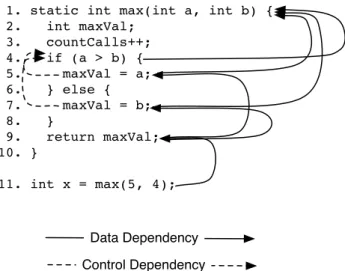
1. static int max(int a, int b) { 2. int maxVal; 3. countCalls++; 4. if (a > b) { 5. maxVal = a; 6. } else { 7. maxVal = b; 8. } 9. return maxVal; 10. } 11. int x = max(5, 4);
1. static int max(int a, int b) { 2. int maxVal; 3. countCalls++; 4. if (a > b) { 5. maxVal = a; 6. } else { 7. maxVal = b; 8. } 9. return maxVal; 10. } Data Dependency Control Dependency
Figure 2.1: Static data and control dependencies for themax()method.
In contrast to dynamic slices, static slices take into account all possible dependen-cies. Therefore, static slices tend to include more statements than dynamic slices.
The code shown in Figure2.1, for example, displays a method that computes the maximum for two integers, and a statement that calls this method and assigns the result to a variable. Solid arrows show the data dependencies whereas dashed arrows display the control dependencies. The static backward slice from the last statement consists of statements{1,4,5,7,9,11}. The increment ofcountCalls (statement 3) , for example, is not included in the trace, as there is neither a transitive static control nor
data dependency from the variables used in the last statement tocountCalls. Note that there are different definitions of which statements should be included in a slice. While we only consider those statements where an actual control or data dependency exists, there are also definitions that require the slice to be executable. Thus, some statements will never be included in a slice because there exist no dependencies. For example, statement 2 in the example, which just declares a variable.
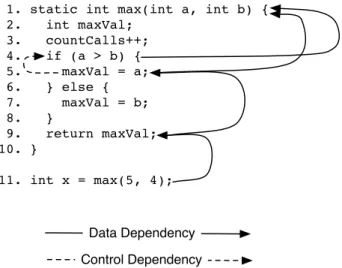
1. static int max(int a, int b) { 2. int maxVal; 3. countCalls++; 4. if (a > b) { 5. maxVal = a; 6. } else { 7. maxVal = b; 8. } 9. return maxVal; 10. } 11. int x = max(5, 4);
1. static int max(int a, int b) { 2. int maxVal; 3. countCalls++; 4. if (a > b) { 5. maxVal = a; 6. } else { 7. maxVal = b; 8. } 9. return maxVal; 10. } Data Dependency Control Dependency
Figure 2.2: Dynamic data and control dependencies for themax()method.
Figure2.2shows the dynamic data and control dependencies, e.g. the dependen-cies that actually emerge during the program run. The dynamic slice consists of the statements{1,4,5,9,11}. In contrast to the static slice, the statement in the else part (statement 7) of themax()method is excluded since this code is not exercised by this run, and consequently, these control and data dependencies are not present in the trace.
2.4.7
Invariants
Most program analysis techniques are concerned with the control flow or the data flow. Techniques that are concerned with the actual values used in a program a rare. One abstraction that considers actual values is the concept of program invariants. They
2.4. PROGRAM ANALYSIS 23
characterize a program by specifying properties, mostly about variables, that always hold at specific program points.
Definition 16 (Invariants) Invariants are properties of the program that are true at specific program points.
For example, an invariant for thesquare()method given in Figure2.3is that the return value is always greater than or equal to zero.
public int square(int x) { return x * x;
}
Figure 2.3: A method that computes the square of an integer.
Invariants help in understanding programs, because they give details that might not be obvious from the source code itself, e.g. that a parameter only takes specific values. Furthermore, invariants can help to avoid introducing bugs if they are explicitly stated. For example, if a parameter is only allowed to take specific values, the use of wrong values can be prevented by an explicitly stated invariant. Although programmers often have invariants in mind when writing programs, they are rarely explicitly stated. Thus, in most cases they have to be inferred from the program.
Static invariants that hold for all possible inputs can be inferred with static analy-sis techniques. Although static analyanaly-sis techniques can deduce useful invariants, they are also limited by the state explosion problem. Thus,dynamic invariantshave been proposed that hold for a specific set of runs, and can be inferred via dynamic analysis by observing one or more program runs. Thereby, the problem of state explosion is avoided. The DAIKONtool by Ernst et al. [23] pioneered the idea of dynamic invariant detection. The dynamic invariants inferred by DAIKONrepresentlikely invariants, i.e. some of them correspond to static invariants while others are artifacts of the input data. For example, if the code in Figure2.3would only be executed with positive values, two dynamic invariants might be inferred: (1) that the parameter is always positive, which is an artifact of the input, and (2) that the returned value is always greater than or equal to zero, which corresponds to the static invariant.
2.4.8
Related Work
Several static and dynamic analysis techniques have been used in different application areas. Among others, they have been successfully applied to assist in program un-derstanding and debugging, to find and locate defects, to automatically generate test inputs, and to detect memory management problems.
Reps et al. [84] presented path spectra, a dynamic technique that characterizes a run of a program, which aims at helping in testing and debugging. A path spectrum for a program run is the distribution of loop-free paths that were exercised. The Year 2000 problem is presented as an example application for path spectra. Differences in spectra between execution with pre-2000 data and post-2000 data were used to identify computations that are date dependent.
The Delta Debugging algorithm as proposed by Zeller et al. [106] is a dynamic analysis technique that narrows down defect causes. It either creates a minimal test case for a single failing test case (ddmin), or it narrows down the difference between a passing and a failing test case (dd). In contrast to other dynamic analysis techniques, Delta Debugging also generates new executions. To this end, the delta debugging al-gorithm starts with a failing test case and systematically applies changes (deltas) to it, either by removing parts or copying parts from a passing test case, until a minimal test case is produced, i.e. removing or replacing a single entity from the test case would make the failure disappear.
Another family of dynamic analysis techniques usesshadow valuesto observe the program behavior. A shadow value for every memory location and every register is introduced to keep track of additional information. This analysis is used to detect boundary values, to detect memory leaks, and for taint analysis, which tracks the flow of information from possibly untrusted sources through the program. For example, the Valgrind tool presented by Nethercote and Seward [62] uses shadow values to detect memory management problems for C and C++ programs. Valgrind is a framework for dynamic binary instrumentation, and the Memcheck tool of Valgrind can detect illegal access to memory, uses of uninitialized values, memory leaks, and bad frees of heap blocks. For this purpose, it uses shadow values to keep track of pointers to the memory and whether the memory is allocated and initialized.
Several approaches use static analysis or combined techniques to generate test in-puts. The Korat framework for automated testing of JAVA programs introduced by Boyapati et al. [8] automatically generates all test inputs within given bounds. To this
2.5. SUMMARY 25
end, Korat translates the preconditions of a method to a JAVApredicate that either re-turnstrueorfalse. Further on, it systematically generates non-isomorphic inputs that exhaustively explore the bounded input space. Visser et al. [99] presented an ap-proach that uses JAVAPath Finder to generate test inputs to achieve structural coverage by using symbolic execution and model checking. In order to generate test inputs that reach full branch coverage, the program is executed symbolically.Symbolic execution
uses symbolic values instead of real data, and a path condition is used to keep track of how to reach a program point. To this end, the program is run with symbolic inputs, and during program execution, these symbolic inputs are used instead of concrete val-ues. Thereby, symbolic formulas over the input are obtained. These formulas are used in the path condition in order to get constraints on the input that need to be satisfied to reach a specific program point. The constraints can then be fed to a constraint solver to generate concrete test inputs. Sometimes the constraints to reach a program point get too complex to be solved within reasonable time. Thus, several approaches extend symbolic execution with dynamic analysis [30,91,96]. In these approaches, also called concolic testing, the program is executed with real inputs, and constraints are collected that need to be satisfied to take a different branch. Solving these constraints gives a new input that is then used to repeat the process. By using this approach, less complex constraints have to be solved. Thus, even more paths can be reached than through via static analysis alone.
2.5
Summary
In this chapter, we described the different levels at which software can be tested, and we focused on testing at the unit level. Unit tests are carried out via automated test cases, which are small programs that exercise the program and check the result via test oracles. A test can either pass or fail. A failing test indicates that the program behaved in an unexpected way. When developing tests for a program, one is interested in the quality of the tests. Coverage criteria are a method to assess and improve the quality of test suites. They are inspired by different types of defects. The idea is that tests satisfying a specific coverage criterion also detect defects of a specific type. Thus, several coverage criteria have been introduced that impose different requirements on the tests. Control flow criteria measure how well the tests exercise control flow structures of the program. Data flow criteriaare concerned with the relation between definitions and uses of variables, andlogic coverage criteriawith the evaluation of logical predicates. These coverage metrics, however, only measure how well the tests
exercise the program. They do not measure how well the results of the execution are checked.
In the second part of this chapter, program analysis techniques were presented. Program analysis is concerned with investigating and gaining insight about different aspects of the program behavior and comes in the form of static and dynamic tech-niques. Static program analysis reasons about the program without executing it while dynamic analysis observes concrete program runs. Some application areas of program analysis techniques include defect detection, minimizing defect causes, memory leaks, or generating test inputs. Two techniques, program slicing and dynamic invariants, were presented in more detail because further techniques presented in this work rely on them. Program slicing is a technique that determines the statements that influenced the variables used at a specific point. Dynamic invariants are properties that hold at a specific program point for a set of executions.
Chapter 3
Mutation Testing
Traditional coverage metrics that are used to assess the quality of tests at the unit level only measure how well the test inputs exercise specific structures of the code. They do not gauge the quality of the checks that are used to detect defects.
Mutation testing is a technique to assess and improve the quality of software tests in terms ofcoverage and checks. A program gets mutated by seeding artificial defects (mutations). Such a mutated program is calledmutant. Then, it is checked whether the test suite detects the mutations. A mutation is considered to bedetectedwhen at least one test that passes on the original (not mutated) version of a program fails on the mutant. In such cases it is also said that the mutant iskilled, and an undetected mutant is called alive mutant. The defects that are introduced are provided by mu-tation operators. These are well-defined rules that describe how to change elements of a program and aim at mimicking typical errors that programmers make. Usually, a mutation operator can be applied to a program at multiple locations, each leading to a new mutant.
More formally, mutation testing can be defined as modifications to a ground string, i.e. the program that gets mutated.
Definition 17 (Ground String) A ground string S is a string that belongs to a lan-guage L, which is specified by a grammar G.
A mutation operator then becomes a function that modifies the ground string, and a mutant is the result of applying a mutation operator. 1 A mutant is detected if a test suite contains a test that has a different test result (as introduced in Definition3) for the mutant than it has for the original version.
Definition 18 (Mutation Operator) A mutation operator is a function MOPthat takes a ground string S from a language L and a location l inside the ground string as input and produces a syntactic variation of the ground string.
S6=MOP(S,l)
Definition 19 (Mutant) A mutant SMis the result of a mutation operator’s application to a ground string at a specified location l.
SM=MOP(S,l)
Definition 20 (Mutant Detection) A mutant SM is detected by a test suite T if it con-tains a test t that has a different result for the original than for the mutant:
∃t∈T t(SM)6=t(S)
A mutation operator, however, cannot be applied to every location in the ground string. Some mutation operators, for example, only modify specific syntactic elements, and consequently, they can only be applied if this element is present. Thus, for each mutation operator, there is a fixed set of locations in a program which it can be applied for.
Definition 21 (Mutation Possibilities) For a mutation operator MOP, and a ground string S that belongs to a language L, the set of mutation possibilitiesL is the set of locations for which the mutation operator can be applied so that the result is a string that belongs to the language.
L ={l|MOP(S,l)∈L}
1Although the term mutation refers to the actual change that is made to the program and the term mutant
29
The results of the mutation testing process can be summarized in the mutation score, which provides a quantitative measure of a test suite’s quality. The mutation score is defined as the number of detected mutants divided by the total number of mutants. To measure the mutation score, a set of mutation operators has to be applied exhaustively which is done by applying all mutation operators to all possible locations.
Definition 22 (Set of all Mutants) For a given ground string S and a set of mutation operatorsO=MOP1 , . . .MOP2 , the set of all possible mutants are all valid applications of the mutation operators to the ground strin