Evaluating immersive and non-immersive
VR for spatial understanding in
undergraduate construction education
Conference or Workshop Item
Accepted Version
Creative Commons: Attribution-Noncommercial-No Derivative Works 4.0
Nikolic, D. and Windess, B. (2019) Evaluating immersive and
non-immersive VR for spatial understanding in undergraduate
construction education. In: Advances in ICT in Design,
Construction and Management in Architecture, Engineering,
Construction and Operations (AECO), CIB W78, 18-20 Sept
2020, Newcastle, UK, pp. 1013-1021. Available at
http://centaur.reading.ac.uk/93677/
It is advisable to refer to the publisher’s version if you intend to cite from the
work. See
Guidance on citing
.
Published version at: https://research.tees.ac.uk/en/publications/advances-in-ict-in-design-construction-and-management-in-architec
copyright holders. Terms and conditions for use of this material are defined in
the
End User Agreement
.
www.reading.ac.uk/centaur
CentAUR
Central Archive at the University of Reading
Evaluating immersive and non-immersive VR for spatial
understanding in undergraduate construction education
Dragana Nikolic1 and Ben Windess1
1 University of Reading, School of the Built Environment, Whiteknights, Reading RG6 6AG,
Abstract. In this paper we explore a pedagogical value of using immersive vir-tual reality to teach construction students how to identify and evaluate the spa-tial characteristics of their design in terms of sizes, layout or structural issues. This study builds on the premise that virtual reality, though generally valuable for design understanding, cannot be treated as a monolithic system when it comes to evaluating its effectiveness for tasks that differ in their objectives. The study extends the work of similar studies that have looked into the claimed ben-efits of immersion, stereoscopy or interactivity on visual perception and spatial cognition. We compared a desktop-based environment with a fully immersive virtual reality in the form of a wearable VR headset to see if there are any no-ticeable differences in how students review and evaluate spaces. Thirty-two par-ticipants from the first year undergraduate construction program were tasked to walk through a small residential house that incorporated up to 12 intentional de-sign mistakes in terms of the size, layout, position or structural oversight. Initial results suggest that the students using the HMD-type of VR slightly better per-form compared to those using the monitor. However, observations of students’ interactions with the model while completing the tasks suggest a greater com-plexity in how the navigation patterns, domain knowledge and technology expe-rience may be affecting the way they perceive the design.
Keywords: virtual reality, immersion, spatial understanding, construction edu-cation.
1
Introduction
The design and construction of the built environment is spatial and three-dimensional in nature, but quite often the information about it is represented in an abstracted form such as two-dimensional and symbolic drawings. Students in the early architectural and construction education are challenged to visualize and understand often complex structures and one of the main goals of built environment education is the help stu-dents develop such skills. For that purpose, different representational mediums are used – from 2D drawings to more recent computer-generated environments that offer new ways of exploration. Given the importance that a representational medium has in the process of visualization, studies have been performed in search of how such visu-alization tools could enhance this process. This study builds upon the premise that the
medium of representation can have a significant impact on the design process and thus, choosing an appropriate medium is of importance. Previous research has indi-cated that virtual reality though generally valuable for design understanding, cannot be treated as a monolithic system when it comes to evaluating its effectiveness for tasks that differ in their objectives.
2
Background
In the domain of design and engineering education, we emphasize the importance for the students to develop spatial cognition skills in order to design and evaluate pro-posed design and construction solutions. Cognition is broadly defined as a complex process that involves interaction of an individual’s sensory-motor and neurological systems [1]. Spatial cognition represents an integral part of general cognition and can be defined in basic terms as how one understands space. Spatial cognition involves the processes of perception, storing, recalling, creating, and communicating spatial images [1]. Spatial cognition in the design context has been variously defined as one’s understanding of the proportions of a given space [2], way finding or ones’ ability to orient in a given space, or the relationship between various spaces [3]. Spatial skills when seen as a component of spatial cognition are generally defined as the ability to understand relationships between three-dimensional objects. In the context of design and construction, spatial skills mainly involve the ability to mentally represent and transform three-dimensional objects, comprehend relationship between objects, and interpret images in the mind. For the students, the ability to visualize space is im-portant for solving spatial tasks. Mental rotation is a commonly used strategy for solv-ing spatial problems in design such as to determine if orthographic views match the isometric view and vice versa. Hence, one of the goals in the education of both archi-tecture and construction students is to enhance spatial cognition and develop the abil-ity to accurately perceive scale and spatial character through design representations.
2.1 The role of representational medium
Studies in psychology provide guidance on visual perception and spatial cognition and their purpose to identify, estimate, or otherwise give meaning to perceived objects and spaces [10]. Being a complex internal information-processing task, the visual perception of representations is greatly affected by the type of those representations [11]. Studies that have explored the role of representations for spatial understanding typically argue that physical scale models or two-dimensional drawings are limiting in accurately representing three dimensional objects. Because of the reduced or abstract-ed scale and object representation, these forms require the user to exert more effort to visualize objects, spaces and the movement through them [4]. One reason for this is the effort to convert the scale of the model to correspond to own scale. Since the scale of the representational medium does not match that of the observer, the designer is more prone to misinterpret objects and spaces resulting in design errors [4].
3
Virtual reality or computer generated three-dimensional environment have become increasingly popular in the fields of design and engineering as it offers the possibility to present both small-scale and large-scale spatial information in more interactive, immersive and intuitive manner. When compared to VR, traditional medium is also limiting in that it is static in its nature and cannot represent movement through space and time. Visualization that includes time and motion conveys spatial information more easily, allowing the designer to make better judgments about space and form [9]. Virtual reality provides the quality of experiential learning which is deemed as very useful in assisting the development of spatial skills [5, 6]. The ability to view the model at full scale, such as in fully immersive systems (e.g. HMDs or room-like VR) is argued to support egocentric experience of the spaces and thus, understand better the relative sizes of spaces to own scale. Earlier studies have also argued that virtual reality is a superior learning environment for enhancing spatial skills because of its nature to maintain visual and spatial characteristics of the simulated world (e.g. [7]) whereas Dwyer [8] also emphasized how virtual reality provides an engaging envi-ronment which is stated to have a positive effect on students’ motivation and learning. As a learning tool, VR allows students to experience their own creations and manipu-late worlds and phenomena that are not always accessible in the real world. This is where VR could enhance the visualization process by augmenting the richness and recall of the information [1].
The main goal of VR systems is to enhance the three dimensional aspect of a de-signed space, providing an instructional medium that can be very useful in aiding perception of the designed object. Since building information modeling has become central to design and construction practices, these fields seem ideal for taking ad-vantage of what VR has to offer, while considering various stages of the design pro-cess and its issues of representation, perception, cognition, and design analysis. As design and construction processes work with visual and spatial data, they are an ideal context for studying the effects of VR technology on spatial cognition.
Still, as we are currently witnessing a proliferation of consumer market VR devices and headsets, the question of their appropriateness and specific benefits for design and construction tasks become even more important. One of the current challenges from the research view is that virtual reality still tends to be largely conceptualized as a singular construct, where the largely proclaimed benefits tend to mask the underlying perceptual complexities of different configurations these technologies carry. The is-sues of representations and mediums are intrinsically coupled, making it particularly challenging to discern the combinations of specific features and attributes that ampli-fy, rather than hinder and distract from an effective experience or task performance.
2.2 Virtual reality
Research focusing on the benefits of virtual reality for general task performance can be broadly classified into two groups [12] of those that investigate the effects of spe-cific system components, such as field of view[13], head tracking and stereosco-py[14], or navigation [15] on spatial understanding and user performance; and those that attempt to compare immersive systems, such as CAVE with non-immersive
sys-tems, such as desktop[16]. The assumption or the assertion that immersive systems are advantageous for spatial understanding [17] stems mostly from the notion that immersive systems provide multiple depth cues that are missing from non-immersive systems. In terms of estimating the size of spaces and objects in VR, studies by Ni-kolic and Zikic [18, 19] compared various conditions using semi-immersive large screen configurations and monitor-based configurations, revealing a more complex interplay between the VR variables such as field of view, stereoscopy, screen size, levels of detail and realism on spatial understanding. Namely, the perception of object and space sizes can be greatly affected when certain variables work in tandem (e.g. screen size and stereoscopy) leading to significant overestimation of height or depth. In the context of undergraduate architecture education, the findings of these studies suggested the usefulness of having large screens and wide field of view for evaluating spaces in terms of scale and size, as long as detail and realism are kept at low levels.
Research in virtual reality and industry adoption has grown in recent times, paral-leling an increase in offer of low cost, scalable solutions and wearable head-mounted displays, such as OculusRift, HTC Vive or even Google cardboard. At the same time, the knowledge of what makes each of these different VR systems and configurations appropriate for a particular use scenario is tied to the specific characteristics of these systems (e.g. single-user vs. multi-user, immersive vs. non-immersive, etc.), and the nature of the tasks and their users [20]. Some of the recent studies exploring the value of such systems for design reviews, constructability or safety training are primarily qualitative in nature, relying on observations, surveys and interviews to understand the applicability of such systems for practical use. Fewer experimental, comparative and user-centered studies reveal a general gap around human factors such as spatial cognition [17] and the value of immersion for data visualization [12].
In the context of engineering and design education, one question we were interest-ed in was whether there was value in introducing immersive VR to support the con-struction students in understanding the design they are asked to develop as part of their first-year course in information visualization. Namely, for the past couple of years we observed a number of students struggling with understanding the spatial and dimensional relationships between the building components, resulting in common issues such as insufficient or excessive floor heights, stairs problems, floor openings, or structural issues, when designing and representing a small residential house in the forms of 2D drawings, SketchUp and Revit models. Each year we were reconsidering the order of using these three forms of representations to see if there would be an improvement in spatial understanding. Hence, while the typical sequence was to start with 2D and then progress through two 3D models, for the last two years we started by asking students to first model a house in SketchUp before developing the plans and subsequently the same model in Revit. We do not have data to support our anecdotal observations, but our general sense was that even towards the end some common issues with the model would surface.
To explore the potential of immersive VR to support the students in evaluating the spatial characteristics of their designs, we developed a 3D visualization of four varia-tions of the residential house that incorporate various mistakes from past students projects. Our approach was to evaluate the immersive VR effectiveness in the ability
5
for the students to identify those issues compared to viewing the same model on the desktop monitor. The steps and the process are detailed in the following section.
3
Method
To explore how immersive VR and specifically the aspects of scale, stereoscopy and navigation may support undergraduate students in understanding of design spaces, we developed a virtual environment using a small residential house that students in their first year undergraduate education in construction develop as part of their core mod-ule. Designed as a between-subjects comparative study, out of 32 participants, 16 students completed the task by navigating the model sitting at a standard lab computer monitor using an x-box controller, while the other half did the same task by wearing Oculus Rift and using the x-box controller. The two systems differed in field of view (immersive vs. non-immersive), stereoscopy (stereo vs. non-stereo) and the general movement (sitting vs. standing and free movement), offering different experience of the environment. We hypothesized that the immersive environment will yield better spatial understanding and student performance compared to the desktop option.
3.1 Models/stimulus
The visualization environment consisted of four variations of a small residential house adapted from the project brief the first year students are given as part of their course work (Figure 1). The choice of this house was made to balance students’ familiarity with it with a potential novelty impact of the immersive technology, and also because the students were still working on the project for their course at the time this study took place. The models were created using Autodesk’s Revit 2019 and subsequently exported through Revizto as a navigable virtual environment that could then be load-ed into a head-mountload-ed display and integratload-ed with the controllers.
Each of the models contained 12 deliberate design errors taken from the past stu-dent submissions as the most commonly found issues. These mistakes have been gen-erally classified into four categories pertaining to scale, layout, dimensional and struc-tural issues, as a way to potentially discern further differences in the ability to identify them (Table 1). During the walkthrough session, the students were asked to identify and indicate out loud whenever they thought there was an issue in the model. Each student was assigned a random house, resulting in four students per house across both conditions.
Table 1. Types of intentional design mistake included in the models Structural Dimensional Scale Layout
Stair floor connection Windows height TV Bathroom elements Roof overhang Riser height Doors (too tall/short) Missing doors Roof angle Stair landing width Showerhead posit. Window location Wall-roof connection Door thickness Kitchen cabinets Furniture location
3.2 Procedure
The two conditions involved a walk through the model on a 27” computer monitor and a fully immersive OculusRift CV1 where in both settings the students used a standard x-box controller to navigate and exploring a 3D model. This is assumed to be a more intuitive method of navigation for the students compared to the mouse and keyboard option available in the Revizto software.
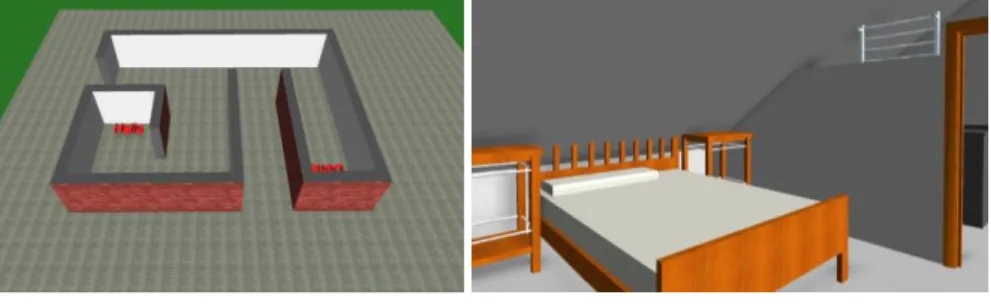
After the participants were greeted and briefed on the nature of the study, they were either seated at the desktop monitor or fitted with the headset and controllers. Before commencing the walkthrough, all the participants were placed first in a small ‘training ground’ to familiarize themselves with the controls and navigation (Figure 2 left). After they felt comfortable navigating around the training area, they were di-rected to one of the four passive houses. Given a relatively small size of the house, they were given up to 10 minutes to explore both inside and outside of the building and during that time identify as many building defects as possible (see example in Figure 2 right). As the students were calling out the mistakes as they thought, these were noted down by the researcher. Any items they identified that were not building defects were ignored, but were commented on if appropriate. In addition to asking the students to identify potential mistakes in the model, following the session we also asked them if they felt that they understood better the design in terms of its dimen-sional and spatial characteristics by completing a seven-item questionnaire. The ques-tionnaire sought to understand any potential differences as a result of their current building technology understanding, familiarity with the technology, and their own perception of their spatial understanding as a result of the experience.
7
4
Findings
Initial results suggest that the students using the HMD-type of VR slightly outper-formed those using the monitor. However, observations of students’ interactions with the model while completing the tasks suggest a greater complexity in how the naviga-tion patterns, domain knowledge and technology experience may be affecting the way they perceive the design.
A total of 32 participants were divided into 16 participants who used immersive VR and 16 participants who used the monitor which still allowed for reliable trends to be identified [21]. In each of these two groups, four students were assigned to one of each of the four houses. All students were the first year students in the School of the Built Environment enrolled in the ‘Information and Communication’ module. This was done to maintain relative consistency in students’ previous knowledge and expe-rience with the taught material. The co-author who was also their teaching assistant on the module, recruited volunteers so they were not pre-selected based on age, sex, or other their past performance on the module. Of the 32 participants, 12.5% were female and 87.5% were male. Most of the participants were between 18 and 21 years old (97%). Of the VR participants, 38% has never used the headset before.
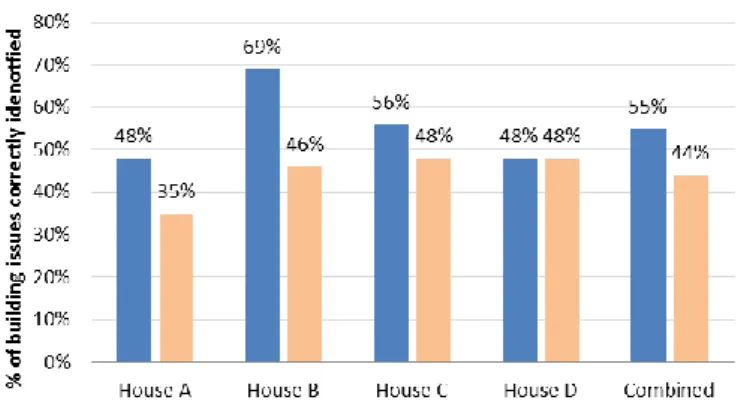
In terms of the spatial performance and the number of issues detected across the conditions, as mentioned earlier, overall the VR participants slightly outperformed the participants who viewed the model on the monitor (Figure 3). The largest difference was observed for the house labeled B where the participants out of 12 mistakes identi-fied 69% in the VR condition compared to 46% in the monitor condition. Further breakdown per type of spatial issues identified in both conditions reveals the largest variation in scale perception illustrated in two of the houses (A and B) where the number of issues correctly identified in VR condition were far greater (88% for both) than those scores in the monitor condition (38% and 13% respectively) (Figure 5).
Interestingly, the lowest average score in the VR condition (48%) was also the highest average score in the monitor condition. The lowest overall scores were rec-orded for House A, which may suggest that the types of issues seemed particularly difficult to identify, especially those of dimensional nature (Figure 5).
Figure 4: Average number of identified issues per type and per house viewed in VR
Figure 5: Average number of identified issues per type and per house viewed on the monitor
From both Figure 4 and Figure 5, it can be seen that the scale related issues scored the highest with an average of 59% across both mediums, but with some notable vari-ations in two of the houses (A and B). This suggests to an extent the broader assump-tion that immersive VR does allow the user to more easily relate the space to own scale compared to non-immersive experience. At the same time, the scores for the structural issues appeared to be lower across both conditions, which could perhaps be in part due to a generally lower level of domain knowledge in construction technolo-gies in the first year. Surprisingly though, the lowest scores were observed for the dimensional types of issues where the average score across both mediums is 42%. Some types of errors may have been more difficult to identify if they were perceived to be open to interpretation (e.g. roof overhang), or were otherwise difficult to easily detect in absence of additional perceptual clues. For example, riser height and the tread depth though obvious to a trained eye, may have been easier for the students to oversee as they could easily jump or fly up the stairs, instead of walk. A perceptual
9
pendant mimicking a physical strain of climbing steep stairs would possibly allow for this design consideration to be more easily spotted.
Though not part of the formal data collection, observations of the participants dur-ing the sessions also revealed some interestdur-ing interaction instances with the technol-ogy, especially with immersive VR. In terms of the movement and exploration, though HMD allows the user to move their head in any direction, a large number of students tended to keep the view at eye level or below. This could have been the fac-tor of the lack of experience with the technology and the reliance on the x-box con-troller to move the view instead of moving the head. In terms of the user experience with the HMD, one student experienced a slight discomfort after completing the ses-sion, which further illustrates the potential of such environments to provoke motion sickness and discomfort, even when the frame rate and the resolution are kept at high levels. Another interesting observation was at times an apparent lack of confidence to call out an issue in the model. There were a number of participants in the VR condi-tion who seemed reluctant to voice their opinion on the design issue, even though they were focusing on it. One of the participants for example, physically crouched down to look through a window that was intentionally positioned too low in one of the rooms on the upper floor, but did not say anything. This again could be attributed to early level domain knowledge, or the lack of confidence in the answer being too obvious.
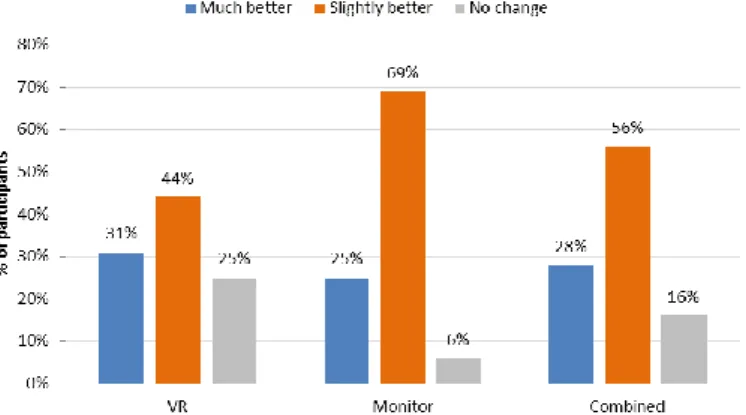
The last segment of the study asked the students to also share their perception of the usefulness of such approaches to understanding the spatial characteristics of the design with the goal of an improved performance on their project. For this study, we did not look into the course grades to further assess the effects of using VR for long-er-term effects on spatial skills. However, the students’ responses indicate that the majority of those who participated perceived that the experience was helpful (Figure 6). Those who viewed the models on the monitor seemed to have particularly re-sponded well to the experience compared to those who wore the headset, which could be the result of the familiarity with the setup and fewer perceptual or navigational distractors found in immersive VR.
Figure 6: Graph showing the students’ responses stating the level of confidence to complete the house project in light of their experience of the technology
5
Conclusions and future work
Overall, the question of how appropriate immersive VR (HMD) is for developing spatial skills in undergraduate education remains sufficiently complex to allow for an easy answer. This study, while indicating some advantages of immersive VR for spa-tial understanding, also reveals further multi-dimensionality of VR and inherent com-plexities in how the domain knowledge, novelty effect, content and perceptual differ-ences may influence the spatial understanding and overall performance. Though both conditions overall yielded fairly positive results, questions such as to what extent the ability to interactively walk through the model regardless of the medium benefits understanding spaces, or what are the types of design mistakes that seem to be more difficult to spot in either of the configurations, open the room for additional scrutiny. Human factors such as perceptual differences, gender, level of confidence, affinity towards such technologies, though observed, were not specifically measured or con-trolled to discern more significant differences in the potential outcomes. Hence, the findings should also be interpreted in light of the study limitations such as the sample size, navigational affordances which allowed teleporting or fly through in addition to walking, and the between-subject study design to claim statistical significance in the findings. Lastly, taking into account the performance on the project after having done the experiment would provide insight into any potential longer term effects of using such technologies for supporting spatial skills.
References
1. Osberg, K.: Spatial Cognition in the Virtual Environment. Seattle: HIT Lab (1997) 2. Pinet, C.: Design evaluation based on virtual representation of spaces. In: Proceedings of
ACADIA’97 Conference. pp. 111–120 (1997)
3. Henry, D., Furness, T.: Spatial perception in virtual environments: Evaluating an architec-tural application. In: Proceedings of IEEE Virtual Reality Annual International Symposi-um. pp. 33–40 (1993)
4. Dorta, T., LaLande, P.: The impact of virtual reality on the design process. In: Digital Design Studios: Do Computers Make a Difference? (1998)
5. Castronovo, F., Oprean, D., Liu, Y., Messner, J.: Application of Immersive Virtual Reality Systems in an Interdisciplinary Design Studio Course. Lean and Computing in Construc-tion Congress - Joint Conference on Computing in ConstrucConstruc-tion. (2017)
6. Whyte, J.: Industrial applications of virtual reality in architecture and construction. ITcon Vol. 8. 43–50 (2003)
7. Regian, J.W.: Virtual Reality for Training: Evaluating Transfer. In: Seidel, R.J. and Chate-lier, P.R. (eds.) Virtual Reality, Training’s Future? Perspectives on Virtual Reality and Related Emerging Technologies. pp. 31–40. Springer US, Boston, MA (1997)
8. Dwyer, D.: Apple Classrooms of Tomorrow: What We’ve Learned. Educational Leader-ship. 51, 4–10 (1994)
9. Kalisperis, L.N., Otto, G., Muramoto, K., Gundrum, J.S., Masters, R., Orland, B.: Virtual reality/space visualization in design education: the VR-desktop initiative. In: Proceedings
11 of eCAADe2002, design e-ducation: Connecting the Real and the Virtual. pp. 64–71. , Warsaw, Poland (2002)
10. Palmer, S.E.: Visual Perception of Objects. In: Handbook of Psychology. pp. 177–211. American Cancer Society (2003)
11. Rice, A.: Exploring the Impact of Emerging Landscape Visualization Tools on Spatial Perception and Design Education. In: Buhmann, E. and Ervin, S. (eds.) Trends in Land-scape Modeling. pp. 173–182. Heidelberg: Wichmann (2003)
12. Schuchardt, P., Bowman, D.A.: The Benefits of Immersion for Spatial Understanding of Complex Underground Cave Systems. In: Proceedings of the 2007 ACM Symposium on Virtual Reality Software and Technology. pp. 121–124. ACM, New York, NY, USA (2007)
13. Arthur, K.W.: Effects of field of view on performance with head-mounted displays, (2000)
14. Ragan, E.D., Kopper, R., Schuchardt, P., Bowman, D.A.: Studying the Effects of Stereo, Head Tracking, and Field of Regard on a Small-Scale Spatial Judgment Task. IEEE Transactions on Visualization and Computer Graphics. 19, 886–896 (2013). doi:10.1109/TVCG.2012.163
15. Balakrishnan, B.: Evaluating Impact of Navigability Affordances and Narrative Transpor-tation on Spatial Presence, (2008)
16. Swindells, C., Po, B.A., Hajshirmohammadi, I., Corrie, B., Dill, J.C., Fisher, B.D., Booth, K.S.: Comparing CAVE, wall, and desktop displays for navigation and wayfinding in complex 3D models. In: Proceedings Computer Graphics International, 2004. pp. 420–427 (2004)
17. Paes, D., Arantes, E., Irizarry, J.: Immersive environment for improving the understanding of architectural 3D models: Comparing user spatial perception between immersive and traditional virtual reality systems. Automation in Construction. 84, 292–303 (2017). doi:10.1016/j.autcon.2017.09.016
18. Nikolic, D.: Evaluating relative impact of virtual reality components detail and realism on spatial comprehension and presence, (2007)
19. Zikic, N.: Evaluating Relative Impact of VR Components Screen size, Stereoscopy and Field of View on Spatial Comprehension and Presence in Architecture, (2007)
20. Whyte, J., Nikolić, D.: Virtual Reality and the Built Environment. Routledge, Milton Park, Abingdon, Oxon ; New York, NY (2018)
21. Calderon, C.P., van Schaik, P., Hobbs, B.: Is VR an effective communication medium for building design. In: Proceedings of the Virtual Reality International Conference, Laval, France. pp. 46–55 (2000)