San Jose State University
SJSU ScholarWorks
Master's Theses Master's Theses and Graduate Research
Summer 2018
Learning Chinese Characters and German Words
Using Multimedia
Cheuk Yue Fung
San Jose State University
Follow this and additional works at:https://scholarworks.sjsu.edu/etd_theses
This Thesis is brought to you for free and open access by the Master's Theses and Graduate Research at SJSU ScholarWorks. It has been accepted for
Recommended Citation
Fung, Cheuk Yue, "Learning Chinese Characters and German Words Using Multimedia" (2018).Master's Theses. 4937. DOI: https://doi.org/10.31979/etd.k89z-t49y
LEARNING CHINESE CHARACTERS AND GERMAN WORDS USING MULTIMEDIA
A Thesis Presented to
The Faculty of the Department of Psychology San José State University
In Partial Fulfillment
of the Requirements for the Degree Master of Arts
by
Cheuk Yue Fung August 2018
© 2018 Cheuk Yue Fung ALL RIGHTS RESERVED
The Designated Thesis Committee Approves the Thesis Titled
LEARNING CHINESE CHARACTERS AND GERMAN WORDS USING MULTIMEDIA
by
Cheuk Yue Fung
APPROVED FOR THE DEPARTMENT OF PSYCHOLOGY
SAN JOSÉ STATE UNIVERSITY
August 2018
Cary Feria, Ph.D. Department of Psychology Mildred Alvarez, Ph.D. Department of Psychology Shinchieh Duh, Ph.D. Department of Psychology
ABSTRACT
LEARNING CHINESE CHARACTERS AND GERMAN WORDS USING MULTIMEDIA
by Cheuk Yue Fung
This study applies cognitive theory of multimedia learning and cognitive load theory to foreign language learning and examines in what conditions English-speakers benefit most from multimedia instruction. Sixty-four English-speaking college students learned either German words or Chinese characters. The reason for comparing these two
languages is to assess the differences between low-knowledge and high-knowledge learners. We assume English-speakers have a better linguistic knowledge for learning German words than Chinese characters, because of the closer relationship between English and German languages than between English and Chinese languages. There were four cue conditions in which participants received either no cue, a verbal cue, a visual cue, or both cues on the screen accompanied with the target foreign word. Consistent with previous studies, the findings show that participants recalled more foreign
vocabulary when they were given both verbal and visual cues other than only having one type of cue. When compared with students who learn German words, students who learn Chinese characters benefit more from this multimedia environment. No significant relationship was found between the words recalled in different cue conditions and verbal and spatial ability test scores in this study. This study supports that multimedia boosts foreign vocabulary learning performance and our findings provide an additional
TABLE OF CONTENTS
List of Tables... vi
List of Figures... vii
List of Abbreviations... viii
Introduction………...………...……… 1
What is Second-Language Acquisition with Multimedia?... 2
Why Second-Language Acquisition with Multimedia?... 4
Theories and Models…………..…….………..………. 6
Cognitive Theory of Multimedia Learning (CTML)………... 6
Cognitive Load Theory (CLT)………. 9
Individual Difference and Prior Linguistic Knowledge………. 11
The Role of Multimedia in German Words and Chinese Characters Learning……. 12
Rationale for the Current Study………….………...………. 15
Hypotheses…………..…….………..……… 19 Method... 20 Participants... 20 Design... 20 Materials... 21 Multimedia Learning... 21
Card Rotation Test... 22
English Vocabulary Test... 23
Procedure... 24
Scoring... 24
Dependent Measures and Data Analysis... 25
Results... 26
Discussion... 33
Application... 38
Limitations and Future Research Directions... 41
References... 45
Appendices... 52
Appendix A…... 52
Appendix B……... 53
Appendix D……... 62
Appendix E……... 63
Appendix F……... 65
LIST OF TABLES
Table 1. Number of Vocabulary Words Recalled in Different Cue Conditions…... 27 Table 2. Number of Vocabulary Words Recalled for the High vs. Low Verbal Ability
in Each Cue Condition... 31 Table 3. Number of Vocabulary Words Recalled for the High vs. Low Spatial
LIST OF FIGURES
LIST OF ABBREVIATIONS SLA – second language acquisition
CALL – computer-assisted language learning IIO – input-interaction-output
ESL – English-as-a second language
CTML – the cognitive (generative) theory of multimedia learning CLT – the cognitive load theory
Introduction
The use of multimedia is a common instructional tool in online and in person
classroom demonstrations because it is believed that it helps students process information faster and more efficiently (Mayer, 1997, 2001; Mayer & Moreno, 1998, 2003; Mayer & Sims, 1994; Plass, Chun, Mayer, & Leutner, 1998, 2003). Multimedia instruction refers to the use of materials presented in both verbal and visual forms. Empirical evidence (Baddeley, 1999; Baddeley & Hitch, 1974) suggests that learners benefit by building mental representations from the two different forms. Learners can better understand the material when pictures and words are presented compared to when words are presented alone (Mayer & Moreno, 1998). Researchers have explored the effectiveness of using multiple modalities instruction to foster second language acquisition (Chapelle, 2001, 2003; Plass et al., 1998, 2003). However, a comparison of the effectiveness of
multimedia in aiding English speakers in acquiring different foreign languages has not been explored extensively.
This study investigates the relative efficacy of the use of four different cue conditions (no cue, verbal cue, visual cue, and both cues) in learning a foreign language. The
targeted foreign languages in this study are Chinese characters and German words. The study’s focal issue is to determine which foreign language learning benefits more from multimedia for English speakers.
This paper first defines second language acquisition with multimedia and reviews the studies that investigate the use of multimedia in second language acquisition. Then, a brief overview of the psychological and cognitive theories related to multimedia learning
in second language acquisition is given. We further describe the theories on individual differences in foreign language learning and explain why English speakers may benefit from multimedia differently in the Chinese and the German language learning
environment. Then, we discuss how this study replicated and extended the Plass et al. (1998, 2003) studies and the issues that have not been explored.
The goal of this study is to answer three questions: a) do people have better recall of foreign words with verbal cues, visual cues, or both? b) in learning which foreign language will multimedia instruction be more effective for English speakers? and c) do individual differences in verbal and spatial ability modulate the potential benefits of multimedia instruction?
What is Second Language Acquisition with Multimedia?
According to Mayer (1997), a multimedia instructional message is a communication delivered to learners. Multimedia instructional message often involves more than one kind of medium and integrates multiple forms of media to promote learning. Multimedia instructional message can be any learning material that contains words and pictures no matter whether it is presented on paper or computers. The verbal message can be
presented in printed or in spoken form. Meanwhile, the visual message can be presented in static form such as illustrations, diagrams, or photos or dynamic form such as
animation or video clips (Collins, Hammond & Wellington, 1997). Multimedia
instruction can be used in different kinds of learning environments. For example, we can include a picture of a neuron and a paragraph describing it in a biology textbook chapter, an animation and spoken narration demonstrating how the neuron transmits information
on an online learning platform, and even an interactive simulation game allowing the learner to stimulate the neuron on a mobile application.
As technology is rapidly developing, educators make use of computer and digital media to implement second language acquisition (SLA) multimedia instructions. Garrett, Hart and Meskill (1989) state that computer technology brings knowledge and
experiences from different fields and they describe it as “new humanism.” They further point out that foreign language learning has exploited technology potential in this “new humanism.” Since the computer has been a common tool to assist SLA, many researchers have investigated the potential of it to boost language learning performance (Levy, 1997; Muyskens, 1997; Pennington, 1996; Warschauer, 1996; Warschauer & Healey, 1998). The use of a computer to assist language learning is referred to as computer-assisted language learning (CALL). Multimedia instruction is not limited to computers or new technologies such as phone and tablet applications. Technologies such as augmented reality and virtual reality use more than one medium to present language learning material to learners.
Language learning usually involves four skills: speaking, listening, writing, and reading. In particular, beginning learners often start with memorizing and understanding the meaning of vocabulary as fundamental learning. Without learning any vocabulary, learners are not ready to acquire the four language skills. According to Gass’s Input-Interaction-Output (IIO) theory (Block, 2003), the process of acquiring a second
language involves six aspects: input, comprehensible input, noticing, intake, integration and output. We use vocabulary acquisition with multimedia as the example to illustrate
the process of this learning. First, input is the selected material provided and presented to the learner. With the help of multimedia, vocabulary can be presented in a way that helps establish a relationship between the meaning and the word. Comprehensible input refers to the input resource that the learner is able to comprehend. This is essentially important to language learning because each learner has different prior knowledge, experience and individual differences to comprehend the same resource input (Krashen, 1985). When multimedia applies to vocabulary learning, written text, spoken words, pictures, photos, animation, and/or video can be presented in an integrated way. Instructors can make use of multiple modalities to allow different learners to comprehend the vocabulary in
different ways. Beebe (1985) further emphasizes that the learner has the decision to select and attend to the kind of input resource they are able to comprehend. After receiving the input resource, the learner will practice linking the vocabulary and the meaning of the word. The learner will notice the error he or she made and further intake the best approach for self-correctness. For example, with the aid of multimedia, the learner may want to choose how the vocabulary is presented in order to facilitate the learning most. Lastly, the learner is able to integrate the similarities and difference of the learned
vocabulary and explicitly produce the output and demonstrate what they learned in a task or a test.
Why Second Language Acquisition with Multimedia?
Since multimedia has been growing in popularity in SLA, researchers have investigated how different media types of aids should be presented and integrated in order to facilitate learning. Particularly, numerous studies have examined the relationship
between the use of multimedia and vocabulary acquisition and retention. Researchers found that different modes and media used to aid vocabulary learning might have different effects on performance (Al-Seghayer, 2001; Chun & Plass, 1996; Plass et al., 1998, 2003; Yoshii & Flaitz, 2002).
Plass et al.’s (1998) study examined the effect of different types of annotation on vocabulary learning and text comprehension. In the study, intermediate level German language students were allowed to choose whether they would prefer an English
translation, and/or an illustration, and/or a video clip to represent the German word. They found that students had better recall of German vocabulary when they were given both verbal and visual annotations in the reading text, compared to when only given one type of annotation. This finding supports that vocabulary learning is enhanced when both verbal (i.e. definitions of words) and visual (i.e. pictures or videos) annotations are presented with multimedia applications. Yoshii and Flaitz’s (2002) study finding is consistent with Plass et al.’s (1998) study. English-as-a-Second-Language (ESL) students were divided into three reading groups. Each group was provided with text only, picture only, and both text and picture for the vocabulary respectively. The results of the study indicated that learners who were provided with both text and picture annotations
performed better in the immediate and delayed vocabulary post-tests than learners of the other two groups. In Chun & Plass’s (1996) study, they investigated which type of visual aid works best for learning vocabulary. Intermediate level German language class
students were given a multimedia application for reading a German text. The text
and video. They found that students scored higher in the recognition test when they were given pictures and text annotations for the words, compared to when they were given text annotation only. The above findings also illustrate that visual aids with word definitions facilitate vocabulary learning more efficiently compared to when word definitions are presented alone.
With research on the benefits and potentials of using multimedia to acquire a second language illustrated in the previous section, the underlying cognitive process involved is discussed in the following section.
Theories and Models
The most prevalent cognitive models of multimedia learning are the cognitive
(generative) theory of multimedia learning (CTML) (Mayer, 2005) and the cognitive load theory (CLT) (Sweller, 1999). This section describes the role of working memory in these two theories of multimedia learning, describes how multimedia can be used to support the cognitive process and reports research studies on how the theories apply to foreign language learning.
Cognitive Theory of Multimedia Learning (CTML). Cognitive (generative) theory of multimedia learning (CTML), proposed by Mayer (1997, 2001, 2005, 2009) is
primarily based on dual-coding theory (Paivio & Desrochers, 1980) and Baddeley's working memory model (Baddeley, 1999; Baddeley & Hitch, 1974). According to Paivio and Desrochers’s (1980) dual-coding theory, there are two mental codes (i.e. visual and verbal codes) to organize, store and retrieve information. Visual and verbal information are processed separately in each channel of the verbal and visual system. According to
Clark and Paivio (1991), verbal information is coded in the form of linguistic symbols, whether it is presented aurally or visually. For visual information, it is coded in the form of pictures, both static and moving. Studies (Paivio & Desrochers, 1980; Paivio & Lambert, 1981) support that words that are coded dually in visual and verbal modes would be learned better compared to those coded only verbally or visually. For example, when applied to SLA, presenting the foreign vocabulary in the form of text and pictures may increase the recall rate of that vocabulary compared to when the foreign vocabulary is only coded in the form of text or pictures.
Similar to the dual-coding theory, Baddeley and Hitch (1974) propose two distinct working memory subsystems to process information. According to Baddeley's model (Baddeley, 1999; Baddeley & Hitch, 1974), working memory is responsible for temporarily maintaining, manipulating and integrating information. Information is processed in two distinct subsystems – a verbal, and a visuo-spatial working memory subsystem. The two subsystems are relatively independent of each other, and each has limited resources for processing information simultaneously. The central executive subsystem is responsible for coordinating the two subsystems (Baddeley, 1999; Baddeley & Hitch, 1974).
With respect to multimedia learning, Mayer’s (2005) cognitive (generative) theory of multimedia learning takes a step beyond dual-coding theory and Baddeley's model of learning in describing the learning process. Schuler, Scheiter and Genügten (2011) pointed out that Mayer’s (2005) CTML is consistent with Baddeley’s (1999) distinction between the verbal and visuo-spatial working memory subsystem.
Mayer (2005) proposed CTML, in which humans possess separate channels for processing multimedia materials, and that the two channels are distinguishable by the material’s representation modality and representation code. For the representation
modality, there are two sensory modalities (i.e. auditory or visual). For the representation code, there are two presentation modes (i.e. verbal and pictorial). When the multimedia message is represented using auditory and visual modalities, spoken words and visual images (i.e. printed words and pictures) are first detected by sensory memory through the ears and eyes. After spoken words and visual images are actively selected from sensory memory, the spoken words and printed words are organized into the verbal mental representation, and the pictures are organized into the visual mental representation. Similar to the responsibility of the central executive subsystem proposed by Baddeley (1999), the two mental representations are merged with prior knowledge from long-term memory (Schuler et al., 2011). Mayer (1997, 2001, 2005, 2009) suggested that learners actively select and process visual and verbal information from what is presented, then organize the information into the verbal and visual mental representations; lastly learners integrate the two representations with each other. When learners are able to integrate the verbal and visual mental representations by creating meaningful connections using their existing knowledge, learning performance is enhanced (Mayer, 2005).
Studies (e.g. Plass et al., 1998, 2003; Marzban, 2011) have applied CTML to second language learning. Two verbal representations (foreign word and native word) and a visual representation (picture, video) can occur in the acquisition of foreign vocabulary words. Learners establish a connection between the foreign word and native word that
links the two verbal representations. A linkage between the verbal representation and visual representation is formed. In this sense, learners establish two types of retrieval cues for the foreign word in memory.
While the CTML proposes a dual code of representation, the cognitive load theory places more emphasis on the limited-capacity assumption, which is discussed in the following section.
Cognitive Load Theory (CLT). According to the cognitive load theory (1994), learners’ cognitive load largely depends on the instructional design. Cognitive load is defined as mental activity or effort imposed on working memory at that moment in time (Cooper, 1998). Sweller (1994) proposes three types of cognitive load: intrinsic load, extraneous load, and germane load. Intrinsic cognitive load is the difficulty of material or topic, and it depends on prior knowledge. For example, reading a Spanish novel imposes less mental activity for readers who took some Spanish classes, compared to readers who have never learned Spanish. Extraneous cognitive load depends on how effectively the learning material is presented and designed for the learners to learn and comprehend. For example, readers have to allocate more mental activity when a biology textbook is only presented with written text but without visual illustrations. Lastly, germane cognitive load is devoted to the efficient cognitive processing and construction of a permanent store of knowledge, or a schema so that learners can retrieve information easily. That is, when illustrations are accompanied with the text in the biology textbook, the illustrations are effective cognitive load even though the illustrations are extra information in the book. Sweller, van Merriëboer and Paas (1998) added that some appropriate instructional
designs could increase germane cognitive load and promote learning at the same time. On the other hand, inappropriate instructional designs can increase extraneous cognitive load and have a negative impact on learning (Sweller et al., 1998). The goal of CLT is to reduce extraneous cognitive load and free resources to germane cognitive load (Sweller, 2007). Like filling a glass with different kinds of liquid, the three types of cognitive load are additive. While intrinsic load may not be altered, instructional designers are suggested to minimize extraneous load and promote germane load (Sweller et al., 1998).
Studies (e.g. Debue, 2014; Plass et al., 1998, 2003) have applied CLT to second language learning. Based on the dual-channel and limited-capacity assumption
(Baddeley, 1999), CLT assumes that multimedia (e.g. text and pictures) produces less extraneous cognitive load because information can be processed separately in the verbal and visual subsystem of working memory at the same time. When the foreign word is annotated with an English meaning only, the foreign word and the English translation have to be processed in the verbal subsystem. If the learner has to process too much text at one time, it may impose a high cognitive load on the verbal subsystem. When the foreign word is annotated with a picture and an English meaning, this allows learners to process information through different modes simultaneously. Limited resources in verbal working memory adversely impact the processing of verbal information, whereas limited resources in visuo-spatial working memory affect the processing of visual information (e.g. Colle & Welsh, 1976; McConnell & Quinn, 2000). For example, excessive verbal information presented at one time may overwhelm learners because verbal working memory has a limited capacity to process such a great amount of information. Recall that
extraneous cognitive load refers to the way information is presented to learners. When applying CLT to foreign language learning, presenting the annotations in multiple
modalities may be an effective way to promote foreign word learning. Overwhelming the learner’s verbal or visual subsystem may increase extraneous cognitive load. Once extraneous cognitive load is minimized, it frees up the resource to process germane cognitive load. One of the examples of germane cognitive load applied to SLA would be connecting the foreign word with a picture and constructing a permanent store of
knowledge in long term memory. Hence, considering the learner’s cognitive load is of great importance when designing how multimedia materials are presented.
Individual Differences and Prior Linguistic Knowledge
Since multimedia learning involves the process of encoding verbal and visual
information, researchers have examined the effect of individual differences in verbal and visuo-spatial abilities and prior linguistic knowledge with respect to multimedia learning.
Verbal and spatial ability were found to have moderating effects on the effectiveness of multimedia learning (Jonassen & Grabowski, 1993; Mayer, 1997; Mayer & Sims, 1994; Pellegrino, Alderton, & Shute, 1984). In Plass et al.’s (2003) study, low-verbal and low-spatial ability students performed worse than high-verbal and high-spatial ability students, when they received visual annotations instead of verbal annotations for the vocabulary words. The authors explained that foreign vocabulary accompanied with pictorial annotations might create high cognitive load because they require learners to translate the visual mental representation into a meaning that links with the unknown vocabulary. However, verbal annotations do not hinder vocabulary learning because
verbal annotations impose less cognitive load than visual annotations. Learners do not need to translate the visual image into a meaning corresponding to the foreign
vocabulary.
In Chung’s (2008) study, the learner’s experience was put into consideration.
Learners were divided into beginner and experienced Chinese learning groups. They were either provided with auditory pronunciation, English translation or both to learn some Chinese characters. The study found that learning was the most effective when both words meaning and pronunciation were presented for more experienced learners. Whereas, learning was more effective when word meaning only instead of both modalities was presented for the beginners. Beginners did not benefit from the
multimedia presentation because it requires more mental load to process both the word meaning and the pronunciation at the same time. The same piece of learning material may be detrimental for novices if it overloads working memory but beneficial for experts if it can be processed (Chung, 2008). These findings support that learners’ characteristics may be an important variable in the investigation of the effect of annotations on SLA. The Role of Multimedia in German Words and Chinese Characters Learning
For English speakers, learning other European languages requires less intrinsic load compared to learning Asian languages because they have existing knowledge associated with European languages. For example, the words ‘flamme’ (French), ‘Flamme’
(German), and ‘vlam’ (Dutch) share the same meaning with the word ‘flame’ in English (Schepens, Dijkstra, Grootjen & van Heuven, 2013). All of these words coincide in form, and they are called cognates because they share a similar meaning, spelling, and
pronunciation. For example, an English speaker can easily remember the German word ‘Apfel’ by recalling its similarity with the English word ‘Apple’. By using the cognate strategy, this facilitates the learning of second language (L2) if its language system is similar to the first language (L1). If the appearance and the meaning of the word in L2 have high similarity with the appearance and the meaning of the word in L1, this greatly facilitates the learning of that foreign word (Ellis & Sagarra, 2011; MacWhinney, 2008; Ringbom, 2007; Schepens et al., 2013). Chen, Ramirez, Luo, Geva and Ku’s (2012) study had three groups of learners from different first language backgrounds (i.e. Spanish, Chinese, and English) learning English vocabulary. While English shares many cognates with a European language like Spanish or German, it shares very few cognates with an Asian language like Chinese. They found that the Spanish-speaking learners were able to utilize the cognate strategy to learn English words, but this was not the case for the Chinese-speaking learners.
Chen et al.’s (2012) study findings show that the similarity in sound, appearance, and meaning between English and Spanish enhances the learning of the second language. Similarly, both English and German languages use letters to represent phonemes of the spoken language. The German written language system utilizes the same 26 letters as the English alphabet, with only an additional four umlauted letters: ä, ö, ü, and the ß. Also, due to similar sound, appearance, and meaning, English speakers can transfer their prior knowledge of English literacy into German literacy. For this reason, English speakers may greatly benefit from having verbal cues (i.e. English translation) when learning German vocabulary, compared to when learning other languages with a different writing
system.
In contrast, the Chinese written language system uses non-Latin alphabets. Each Chinese character represents a word, morpheme, or a semantic unit, but not the phoneme of the spoken language. Many Chinese characters are pictographs which represent
objects, ideograms which indicate abstract concepts or the combination of the two to give a third meaning (Hung & Tseng, 1981; Wieger, 1915). Characters can refer to the
meaning in pictorial form, the pronunciation of the word, or the combination of the two (Ann, 1982). Over 70% of Chinese characters are formed by different components with a semantic indicator and a phonetic indicator (Wieger, 1915). For some compound
characters, they are formed with two pictographs or ideograms to illustrate the meaning of the character. For other compound characters, the pictograph is added together with the phonetic indicator to suggest the pronunciation of the character. Previous studies suggest that novices tend to treat and remember Chinese characters as individual pictures when they learn Chinese characters at an early stage (Chuang, 1975). In light of this, researchers have considered visual and pictorial cues when examining the effects of multimedia on Chinese character learning. Lam’s (1993) study used computer animation to establish connections between the written form of some Chinese characters and their pictorial origins. Learners provided with animation were more motivated and tended to remember better the meaning of the characters and their written form, when compared to learners with no animation given. Chinese character learning is facilitated if the link between the character and the meaning in pictorial form is built. For this reason, English
speakers may benefit more when visual cues are presented if the pictures can help them process and memorize the Chinese.
The Rationale for the Current Study
Following Plass et al.’s (1998, 2003) studies, the current study addresses two of Mayer’s principles for the design of multimedia learning. These principles have been proposed on the basis of CTML (Mayer, 2005). First, the multimedia principle suggests presenting relevant verbal and visual information simultaneously (Mayer, 2009). The individual differences principle is to consider learners’ individual when designing a multimedia environment (Mayer, 2001).
The multimedia principle is derived from CTML, and it states that “people learn more deeply from words and pictures than from words alone” (p.47) (Mayer, 2009). According to CTML, learners process visual and verbal information from what is presented, then organize and integrate the verbal and visual mental representations by creating
connections using their existing knowledge. The multimedia principle suggests that learning is enhanced when the link between the verbal representation and visual
representation is formed. Plass et al. (1998) found that students were more likely to learn German vocabulary when they were presented with both verbal and visual annotations in the reading text. The two verbal representations (i.e. German vocabulary and English translation) are presented and a link is established. Meanwhile, a link is also formed between the German vocabulary and the picture. In this way, learners establish two types of retrieval cues for the German word in memory. In the current study, we hypothesized that learners would recall more foreign vocabulary when they are given both verbal and
visual cues, compared to when they are only given one type of cue.
Another principle Plass et al. (2003) addressed in their study is the individual differences principle. According to the individual differences principle, high-spatial learners can benefit more from effective multimedia presentations than low-spatial learners because they are capable of integrating the words and pictures presented (Mayer, 2001). In a multimedia learning task, spatial ability is of great importance to establish a linkage between a pictorial representation with a verbal representation (Plass et al., 2003; Mayer, 2001). In Plass et al.’s (2003) study, low-verbal and spatial ability learners recalled fewer German vocabulary than high-verbal and spatial ability learners when a picture was accompanied with the vocabulary word. However, recall of word did not differ when an English translation was provided. The authors explained that without the benefit of an English translation, the learners had to process the pictures and interpret their meaning. This caused the low-ability learners to experience high cognitive load when establishing a linkage between the foreign word and the picture in working memory and integrating these verbal and visual representations simultaneously into their mental models. Meanwhile, English translations provide the clear and unambiguous meaning of the vocabulary word. For example, when a German word is presented with a picture, low ability learners may not have sufficient cognitive resources to process words and pictures at the same time. On the other hand, when only a verbal cue is presented in the German learning condition, low-ability learners have sufficient resources to process the German word and English translation. It is because the English translation imposes less cognitive load than visual cue and both the German word and English translation are processed
through the verbal working memory subsystem. This low cognitive resource condition would not hinder the learning performance of low-ability learners. Particularly, providing both the English translation and the picture helped the low-spatial learners recall more German words, compared to when the picture was presented. In other words, when the learners were weak at spatial relationships, the visual cue was not as useful as the verbal cue. They benefited most when both cues were provided.
Plass et al.’s (2003) study only examined the effects of individual differences in visual and spatial abilities but not in prior linguistic knowledge. Learners who have prior knowledge of the learning material or topic will learn better even though the learning materials are not presented in both verbal and visual format (Mayer, 2001). Hence, the current study includes not only the German words learning condition, but also a Chinese characters learning condition. The reason for adding a Chinese character learning
situation is to assess the differences between low-knowledge and high-knowledge
learners. Even though an English-speaker may have no prior knowledge of either German or Chinese languages, we assume English speakers have a better linguistic knowledge base for learning German words than for learning Chinese characters. In comparison to students who learn German words, those who learn Chinese characters may benefit more in their recall of vocabulary words from having both visual and verbal cues compared to when only having one type of cue. For the German learning group, the English translation alone is a useful cue to help English-speaking learners to memorize the German word because learners can relate the word to English. Adding a visual cue with the verbal cue may not greatly boost the recall performance. For one reason, the visual cue becomes
extra information for the learners to process and interpret. For another reason, the picture may not necessarily be able to be processed efficiently and help construct a connection with the foreign word. For example, when learners learn the German word “Sonne,” they can use the cognate strategy to relate the alphabets and the sound to the English
translation “Sun” (Chen et al., 2012; Ringbom, 2007; Schepens et al., 2013). A picture of the sun, however, may not greatly boost the performance when it is presented together with an English translation. This can be explained by CLT (Sweller, 1994), the additional picture to text in the German word learning group becomes extraneous cognitive load for English speakers because the visual cue is an additional cue which is not as useful as the verbal cue. The English meaning presented is a germane cognitive load if the German word is a cognate which shares similar meaning, spelling, and pronunciation with the English word. On the other hand, when learning a Chinese character, English-speaking learners have no existing knowledge of it and are not able to relate it with the alphabetic system. Learners might not be able to memorize the character and establish connections with the English translation. Since Chinese characters are in pictorial form, learners may benefit more when visual cues are presented if the pictures can help to process and memorize the characters. The picture in the Chinese character learning group is treated as germane cognitive load for English speakers because the visual cue may greatly help construct a useful linkage between the pictographic character and the visual cue.
However, the picture alone may fail to provide a clear and unambiguous meaning of the character like the verbal cue does. Therefore, we hypothesize that the Chinese learning group will benefit more from having both visual and verbal cues compared to when only
having verbal or visual cue when compared to the German learning group.
The current study replicates and extends Plass et al.’s (1998, 2003) study. The current study investigates the relative efficacy of three different cue conditions, that is the printed English definition, a still picture and both, in a multimedia environment. Specifically, the focus of the study is to compare the efficacy of each type of cue in aiding the acquisition of German words and Chinese characters respectively. The participants of Plass et al.’s (1998, 2003) study were English-speaking college students who enrolled in a second-year German course, and they were required to read a 762-word German story. The authors tested the hypotheses based on the students’ vocabulary learning and reading
comprehension performance. However, the current study measured participants’
vocabulary learning but not text comprehension because it is assumed that participants of this study would have no prior knowledge of these languages. Therefore, they may not be able to comprehend a full text of German or Chinese reading.
Hypotheses
First, learners will recall more foreign vocabulary when they are given both verbal and visual cues, compared to when only given one type of cue. Second, compared to learners who learn German words, those who learn Chinese characters will benefit more from having both visual and verbal cues compared to when only having one type of cue by recalling more vocabulary items. Third, learners with high verbal and/or spatial ability will benefit more from having both visual and verbal cues compared to when only having one cue by recalling more vocabulary items when compared to low-ability learners.
Method Participants
The study recruited 64 San Jose State University students enrolled in Psychology 1 as participants. They were randomly assigned to the German words learning group or Chinese characters learning group with 32 participants each. Participants were at least 18 years old with mixed genders and ethnicities. A questionnaire was given to determine the participants’ prior language experiences (Appendix A). None of the participants had
learned German or Chinese (or Japanese Kanji), and all of them were native English speakers. They were given course credit for taking part in the experiment.
Design
This study was a mixed design which included both between- and within-subject comparisons. For the between-subject comparison, the independent variable was the foreign language. Participants were randomly assigned to either the German words or the Chinese characters learning group. For the within-subject comparison, there were two independent variables. The first independent variable was verbal cues (present / not present). The second independent variable was visual cues (present / not present). The number of correct answers in the recall tests was the dependent variable. Verbal and spatial ability were the quasi-independent variables. The study contained four blocks: no cue (A), verbal cues (B), visual cues (C), and verbal and visual cues (D). The order of the four blocks was partially counter-balanced (Latin Square) with eight different sequences: ABCD, BCDA, CDAB, DABC, DCBA, ADCB, BADC, CBAD. The sets of foreign words were randomized so that participants received different sets of words (or
characters) for each block. An online list randomizer was used to arrange the words (or characters) in random order.
Materials
Multimedia learning. Participants had to learn either German words or Chinese characters in a multimedia format (Keynote software) on an Apple 13.3” MacBook Pro with an 11.97 x 8.36 x 0.59 (in) monitor. There were 80 German words (or Chinese characters) in total, with each slide containing 1 German word (or Chinese character). For the German word condition, the words were in 150 pt Times New Roman. For the
Chinese character condition, the characters were in 180 pt Times New Roman. The Chinese characters were chosen from My First Chinese Reader which was a textbook for students with no prior exposure to Chinese. From the textbook vocabulary list, we selected 80 Chinese characters that could be easily represented by a picture (Appendix C). All of the characters were nouns. The 80 German words corresponded to the 80 Chinese characters (Appendix C). The pictures were downloaded from Google Images. The size of the pictures was 5 x 5 inch (Appendix B). Slides were presented at a 10 sec/slide rate and automatically changed to the next slide.
For both the German words and Chinese characters learning groups, the task was divided into four blocks. In each block, the screen presented a specific type of cue. There were four conditions: no cue, verbal cues, visual cues, and verbal and visual cues in separated blocks. The order of the four blocks was partially counter-balanced with eight different sequences. Each block contained 20 foreign words. The no cue condition served as a baseline. Each foreign word was presented alone in the middle of the slide. For
verbal cues, only English translations of the foreign words were presented. Each foreign word was presented with English translations side by side, with the foreign word on the left and the English translation on the right. For visual cues, pictures corresponding to the foreign words were presented. Each foreign word was presented with the picture of the word underneath. For the both cues condition, each foreign word was presented with both the English translation side by side and the picture of the word underneath.
This learning task was a multiple choice test which included 20 questions. Each question had an English translation and a picture presented on the screen (Appendix D). Participants could click to go from one question slide to the next. An answer sheet was provided to participants to circle the answer. Six choices of foreign words were given on each question on the answer sheet (Appendix E). Participants had to choose the correct one according to the question on the screen.
Card Rotation Test. The current study followed the test used by Plass et al. (2003) to measure students’spatial ability. The Card Rotation Test was chosen from the Manual forKit of Factor-Referenced Cognitive Tests (Educational Testing Service, 1976).
Previous studies (Mayer, 2001; Mayer & Sims, 1994) have used this test to measure spatial relations ability. Richardson’s (1983, 1994) studies showed the difference between tests that measured spatial relations and imagery abilities. The current study assumed that spatial ability was related to this multimedia vocabulary learning task because learners had to mentally establish a connection between a pictorial representation and a verbal representation (Plass et al., 2003). Therefore, instead of measuring the ability to visualize or analyze the parts of a picture, the current study’s vocabulary learning task required
skills that were more closely related to spatial relations.
The test was in paper-and-pencil format typed on 8.5x11 inch sheets of paper. Each problem in this test consisted of one figure on the left column and eight figures on the right column. The figures were line drawings of two-dimensional shapes varying in symmetry and number of sides. Participants had to answer whether each of the eight figures on the right was a rotated version of the target figure on the left. Participants had to choose S if it was a rotated version or D if it was not a rotated version of the target figure (Appendix F). This test consisted of 10 questions, and participants had 3 minutes to finish the task.
English Vocabulary Test. This study adopted the advanced vocabulary test from the
Manual forKit of Factor-Referenced Cognitive Tests (Educational Testing Service, 1976). The purpose of this English vocabulary test was to measure participants’verbal ability in English and predict their performance on vocabulary learning in a second language. Previous studies found that this kind of vocabulary test was highly correlated with the relationship between the capacity of verbal working memory and second language vocabulary learning (Atkinson & Baddeley, 1998; Papagno & Vallar, 1995). The test was in paper-and-pencil format typed on 8.5x11 inch sheets of paper.
Participants had to choose one of the five words that matched the meaning of the word above it (Appendix G).This test consisted of 18 questions, and participants had 4 minutes to finish the task.
Procedure
Sixty-four participants were randomly assigned to the German words learning group or the Chinese characters learning group. The experiment was run in a study room at the King Library, and the participants experimented individually. The participants sat in front of the computer, and the researcher gave a brief demonstration of the learning task, which was presented on a Keynote software. The researcher told the participants that there would be one foreign word per slide on the screen and there would be 20 slides in total for each block. There were four blocks in total, and the screen presented a specific type of cue in each block. The researcher showed the participants a sample slide from each block and a sample vocabulary test question.
When the participants were ready for the task, the researcher started the slides. Participants looked at the slides which were presented at a 10 sec/slide rate and automatically changed to the next slide. After each block, the researcher asked participants to take a 1-minute recall test.
After completing the learning task, participants took the 3-minute card rotation test and the 4-minute English vocabulary test in order to assess individual differences in working memory capacity.
Scoring
For both the German and Chinese vocabulary test, the scoring for each block was the number of correct answers out of the 20 questions. The spatial ability and verbal ability tests were scored for the number of correct answers given.
Dependent Measures and Data Analysis
Our data analyses examined the participants’ learning performance of two language groups in each cue condition. This analysis was done to determine whether the number of words recalled differed between the German group and the Chinese group. We expected there would be a significant interaction effect between cue conditions and types of language. If the results revealed that the number of words recalled across the four cue conditions was different between the two language groups, we planned to follow up by analyzing how each cue condition exerted a different effect on the two language groups respectively. Furthermore, the interaction between verbal ability and cue conditions, and the interaction between spatial ability and cue conditions were analyzed. We expected there would be a significant interaction effect between verbal ability and cue conditions, and also a significant interaction effect between spatial ability and cue conditions. If the results revealed that the number of words recalled across the four cue conditions was different between the high and low ability groups, we planned to follow up by analyzing how participants’ verbal and spatial ability would predict the number of words recalled in each cue condition respectively.
SPSS was used for the data analyses. The number of words recalled was analyzed in a 2 (language) x 4 (cue conditions) and a 2 (verbal and spatial ability) x 4 (cue conditions) mixed analysis of variance (ANOVA), using the Greenhouse-Geisser correction for violations of the sphericity assumption. The tests were run with an alpha level of .05.
Results
The number of words recalled was analyzed in a 2 (language) x 4 (cue conditions) mixed analysis of variance. A significant main effect of language was found, F(1, 62) = 45.58, p < .001. More words were recalled in the German group (M = 15.52, SD = 2.46) than the Chinese group (M = 12.08, SD = 2.42). A significant main effect of cue was also found, F(2.6, 160.1) = 215.82, p < .001.
LSD post hoc tests were used to test for differences between the cues. Significantly fewer words were recalled when the participants were provided with no cue (M = 7.02,
SD = 3.05) than with any other cues, p < .001. Also significantly more words were recalled when the participants were provided with both cues (M = 17.92, SD = 2.59) than with only a verbal cue (M = 14.84, SD = 3.27) , p < .001 or only a visual cue (M = 15.23,
SD = 3.46) , p < .001. However, the number of words recalled when the participants were provided with a verbal cue did not differ significantly from when they were
provided with a visual cue, p > .05. This result supported the first hypothesis. Participants recalled more foreign vocabulary when they were given both cues, compared to only using one type of cue or no cue.
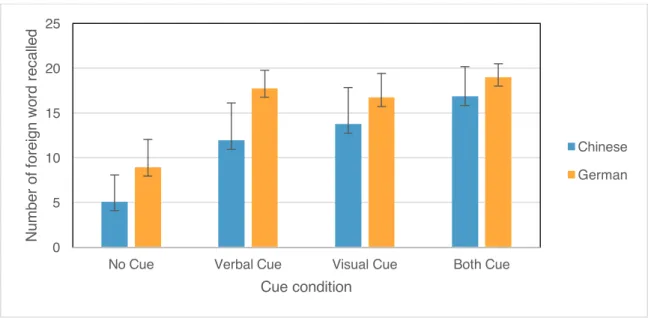
The two-way ANOVA was also used to test our second hypothesis. We hypothesized that participants who learn Chinese characters would benefit more from having both cues than from only having one type of cue or no cue by recalling more vocabulary items when compared to participants who learn German words. There was a significant interaction between language and cue, F(2.6, 160.1) = 6.04, p < .01. The mean and standard deviation of the number of vocabulary words recalled in different cue conditions
for the Chinese and German language learning group were reported in Table 1.This reveals that the number of recalled vocabulary items across the four cue conditions was different between the two language learning groups (Figure 1).
Table 1
Number of Vocabulary Words Recalled in Different Cue Conditions
Language No cue Verbal cue Visual cue Both cues Chinese 5.09 (2.99) 11.94 (4.19) 13.75 (4.10) 16.84 (3.34) German 8.94 (3.11) 17.75 (2.02) 16.72 (2.68) 19.00 (1.50) Standard deviations appear in parentheses next to the mean.
Figure 1. Number of foreign words recalled in each condition
LSD post-hoc tests were done to examine the second hypothesis further. The first goal was to test whether the both cues condition was significantly different from the other cue conditions in each language group.
For the Chinese group, more words were remembered in the both cues condition
0 5 10 15 20 25
No Cue Verbal Cue Visual Cue Both Cue
N u m b e r o f fo re ig n w o rd r e ca lle d Cue condition Chinese German
compared to the no cue condition, p < .001. Also, more words were remembered in the both cues condition compared to the verbal cue condition, p < .001. Lastly, more words were remembered in the both cues conditioncompared to the visual cue condition, p
< .001. For the German group, more words were remembered in the both cues condition compared to the no cue condition, p < .001. Also, more words were remembered in the both cuesconditioncompared to the verbal cue condition, p < .01. Lastly, more words were remembered in the both cues condition compared to the visual cue condition, p
< .001.
The second goal was to test whether the verbal cue condition was significantly different from the visual cue condition in each language group. For the Chinese group, more words were recalled by presenting the participants visual cues compared to verbal cues (M = 1.81, SD = 3.15), t(31) = 3.26, p < .01. However, the number of words recalled was not significantly different between the verbal cue and the visual cue condition in the German group (M = 1.03, SD = 3.00), t(31) = 1.95, p > .05. In other words, when the Chinese group participants were given visual pictures as a retrieval cue, they performed better in the recall test as compared to when they were only given the verbal English translations. In contrast, the German group learners performed similarly no matter whether they received pictures or English translations as retrieval cues.
Based on the above results, we moved forward to examine whether the both cues condition elicited stronger benefit in the Chinese group than the German group. Since we had to compare which language learning group benefited more from the both cues
subtracted the scores in the no cue condition from the both cues condition to examine the benefit gained from having both cues compared to no cue. We subtracted the scores in the verbal cue condition from the both cues condition to examine the benefit gained from having both cues compared to verbal cues. We subtracted the scores in the visual cue condition from the both cues condition to examine the benefit gained from having both cues compared to visual cues. These score differences were compared between the Chinese and German groups. The results showed that the score difference between the both cues condition and the no cue condition was not significantly greater in the Chinese group than the German group, t(62) = 1.84, p > .05. In other words, participants who learned Chinese characters did not benefit more from having both cues than from having no cue, when compared to participants who learned German words.
The results showed that the score difference between the both cues condition and the verbal cue condition was significantly greater in the Chinese group than in the German group, t(62) = 4.55, p < .001. In other words, participants who learn Chinese characters benefited more from having both cues than from only having verbal cues, when
compared to participants who learn German words. The results shows that the score difference between the both cues condition and the visual cue condition was not
significantly greater in the Chinese group than the German group, t(62) = 1.03, p > .05. This reveals that participants who learned Chinese characters did not benefit more from having both cues than from only having visual cues, when compared to participants who learned German words.
characters would benefit more from having both cues compared to when only having one type of cue or no cue by recalling more vocabulary items, when compared to participants who learn German words. Based on the results, participants in the Chinese group and the German group benefited more from having both cues than having one type of cue or no cue. Mainly, when comparing the Chinese group and the German group, participants who learned Chinese characters benefited more when they were given both cues as compared to verbal cues.
Additional independent samples t-tests were done to examine further whether the scores in each cue condition would differ between the Chinese group and the German group. The score difference in the no cue condition between the Chinese group and the German group was significant, t(62) = 5.04, p < .001. The result also shows that the score difference in the verbal cue condition between the Chinese group and the German group was significant, t(62) = 7.07, p < .001. Also, the score difference in the visual cue
condition between the Chinese group and the German group was significant, t(62) = 3.43,
p < .001. Moreover, the score difference in the both cues condition between the Chinese group and the German group was significant, t(62) = 3.33, p < .01. As seen in Table 1, the German group learners recalled more words even without any cue when compared to the Chinese group learners. Compared to the Chinese group learners, the German group learners recalled more words when they solely received verbal cues and when they solely received visual cues. When given both cues for learning German, the German group learners also performed better in the recall test than the Chinese group learners (Figure 1).
Since one of our aims was to investigate how participants of different verbal and spatial abilities were affected differently by different cue conditions, the two factors (i.e. verbal ability and spatial ability) were included as between-subject factors in the two-way ANOVA. After calculating the median score of each test, the participants were split into high and low verbal and spatial ability groups respectively according to their verbal and spatial ability test scores. The means and standard deviations for the high vs. low verbal ability and the high vs. low spatial ability in each cue condition were listed in Table 2 and Table 3 respectively.
The interaction between verbal ability and cue conditions and the interaction between spatial ability and cue conditions were analyzed. There was no significant relationship between verbal ability test scores and the number of words recalled in different cue conditions, F(2.52,141.22)=1.56, p>.05. No significant relationship was found between spatial ability test scores and the number of words recalled in different cue conditions,
F(2.52,141.22)=.50, p>.05. Based on the results found, the third hypothesis was not supported in this study. No relationship was found between the number of words recalled in different cue conditions and participants’ verbal and spatial ability test scores.
Table 2
Number of Words Recalled for the High vs. Low Verbal Ability in Each Cue Condition
Verbal ability No cue Verbal cue Visual cue Both cues High 6.97 (3.42) 15.68 (3.88) 15.19 (3.65) 18.16 (2.71) Low 7.06 (3.79) 14.06 (4.74) 15.27 (3.89) 17.70 (2.89)
Table 3
Number of Words Recalled for the High vs. Low Spatial Ability in Each Cue Condition
Spatial ability No cue Verbal cue Visual cue Both cues High 6.75 (3.58) 14.53 (4.63) 15.53 (3.35) 18.16 (2.30) Low 7.28 (3.64) 15.16 (4.17) 14.94 (4.13) 17.69 (3.23)
Standard deviations appear in parentheses next to the mean. High (n=32), low (n=32) Independent samples t-tests were done to examine further whether participants’ verbal and spatial ability would predict the number of words recalled in the both cues condition. The score difference in the both cues condition between the high and low verbal ability groups was not significant, t(62) = .66, p > .05. Also, the score difference in the both cues condition between the high and low spatial ability groups was not
significant, t(62) = .67, p > .05. Participants’ verbal and spatial ability were not able to predict the number of words recalled in the both cues condition when they were required to process both verbal and visual information at the same time. Therefore, the third hypothesis was not met based on the result found.
Discussion
The goal of the current study was to answer three questions: a) do people have better recall of vocabulary with verbal cues, visual cues, or both? b) in which foreign language learning (Chinese or German) will multimedia instruction be more effective for English speakers? and c) do individual differences in verbal and spatial ability modulate the potential benefits from multimedia instruction?
Do people have better recall of vocabulary with verbal cues, visual cues, or both? In the current study, significantly more words were recalled when participants provided with both cues compared to when provided with only one type of cue or no cue. This result supported our hypothesis. Learners would recall more foreign vocabulary when they are given both verbal and visual cues, compared to when only given one type of cue.Our finding supports Mayer’s (1997, 2001) generative theory of multimedia learning that learners process visual and verbal information from what is presented, and organize and integrate the verbal and visual mental representations by creating connections using their existing knowledge. Previous researchers have found that learners can establish two types of retrieval cues for the foreign word in memory by presenting a verbal representation and a visual representation (Plass et al., 1998, 2003). Replicating the findings of previous studies, learners had better recall of foreign vocabulary when they were given both verbal and visual cues, compared to when only using one type of cue (Paivio & Desrochers, 1980; Paivio & Lambert, 1981; Plass et al.,1998; Yoshii & Flaitz, 2002; Plass et al., 2003).
In learning which foreign language learning will multimedia instruction be more effective for English speakers? We hypothesized that English speakers would benefit more in the multimedia instruction when they learn Chinese characters compared to when they learn German words. The result of our study supports this hypothesis. Participants who learned Chinese characters recalled more words when they were given visual cues in addition to verbal cues, compared to participants who learned German words. Although both language learning groups benefited from the multimedia instruction in our study, we found that the multimedia elicited a larger effect for the Chinese learning group. Each Chinese character represents a word, morpheme, or a semantic unit, but not the phoneme of the spoken language. English-speaking learners have no existing knowledge of it and are not able to relate it with the English alphabetic system. Learners might not be able to memorize the character and establish connections with the English translation. Therefore, our English-speaking participants benefited more when visual cues were given to learn Chinese characters compared to when only verbal cues were given.
The pictures aided the learners in processing and memorizing the Chinese characters. When participants were given only pictures as a retrieval cue, they performed better compared to when only the English translations were given. The reason is that many Chinese characters are in a pictorial form which resembles the picture of the meaning of the word. For example, the Chinese character 日 means sun. Since this character is a pictograph that depicts the sun, it resembles the picture of the sun. Therefore, learners can easily establish a linkage between the written form of the character and the picture. Our findings are consistent with Lam’s (1993) finding. In Lam’s (1993) study, learners were
more motivated and tended to remember the written form and the meaning of the characters when they were presented with the character’s pictorial origins during learning. The character learning is facilitated because the linkage between the character and the meaning in pictorial form is built (Lam, 1993). However, not all Chinese
characters are easily linked with the picture of the meaning of the word. Learners may not be able to process and interpret the meaning of the picture if the character merely
resembles the picture. Presenting the picture alone also fails to provide a clear and unambiguous meaning of the character like the English translation does. Therefore, presenting the English translation in addition to the picture greatly helps learners
remembering Chinese characters efficiently. Therefore, a multimedia Chinese characters learning environment is more effective for English speakers.
We found that the English-speaking participants in our study did not benefit much from the multimedia instruction when they learned German words. Although we found that more words were remembered by showing them the visual cue in addition to the verbal cue, they did not benefit as much as participants who learned Chinese. English speakers have existing knowledge associated with European languages. Also, many participants in our study reported Spanish as their first or second language. English, Spanish, and German use letters to represent phonemes of the spoken language. Also, with a similar sound, appearance, and meaning, English or Spanish speakers can transfer their prior knowledge of English or Spanish into German literacy (Ringbom H, 2007; Schepens, 2013). The English translation helps establish the connection between the two verbal representations (i.e. the German word and the English translation) because learners
can easily relate the German word with the English meaning by utilizing the cognate strategy (Chen et al., 2012; Ringbom H, 2007; Schepens, 2013). This explains why the German group learners recalled more words than the Chinese group overall in this study.
European language speakers greatly benefit from having just a verbal translation when learning German words when compared to other languages with a different writing system. Therefore, the English translation alone is a useful cue to help English-speaking learners to memorize the German word. Most importantly, although we found that participants recalled more words when they were given both visual and verbal cues, participants who learned German did not benefit as much as participants who learned Chinese. The reason is that the visual cue becomes additional information for the learners to process and interpret. Furthermore, the picture may not necessarily help construct a connection with the foreign word.
According to the cognitive load theory (1994), the additional picture to the English translation in the German word learning group may become extraneous cognitive load for the English speakers. The visual cue may become an additional piece of information needed to be processed when a verbal cue is also given. The English translation presented is a more useful retrieval cue if the learner utilizes the cognate strategy to relate the German word. Whereas, the additional picture to the English translation in the Chinese character learning group is treated as germane cognitive load for the English speakers because the visual cue greatly helps construct useful linkages between the pictographic character and the visual cue. This is consistent with Mayer’s (2001) statement that
though the learning material is not presented in both verbal and visual format. In our study, since participants were mostly English speakers and Spanish speakers, they had a better knowledge base for learning German words than for learning Chinese characters, given that they had no prior knowledge of either of these languages. Therefore, adding a visual cue to the verbal cue may not greatly boost the German learning performance for the English speakers. Our findings are consistent with Plass et al.’s (1998) and other studies which support that multimedia boosts learning performance. However, our findings give an additional implication that multimedia may exert a different degree of effectiveness on different kinds of language learners.
Do individual differences in verbal and spatial ability modulate the potential benefits from multimedia instruction? No significant relationship was found between the number of words recalled in different cue conditions and the verbal and spatial ability test scores in our study. According to Plass et al.’s (2003) finding, visual annotations hinder learning for low ability learners because visual annotations impose more cognitive load than verbal annotations. Therefore, our study predicted that low spatial and verbal ability learners would be less likely to learn foreign words compared to high spatial and verbal ability learners when they were required to process both verbal and visual information. It is because multimedia imposes more cognitive load compared to when learners are only required to process information from a single modality. However, contradictory to Plass et al. (2003), our results showed that the participants’ spatial and verbal ability test scores were not significantly related to their recall performance in different cue conditions. There is a reason to explain why the result of our study did not support the hypothesis.
The foreign words the participants had to learn in this study were chosen from a textbook for students with no prior exposure to Chinese. Therefore, the simplicity of the words did not overload the learners. Also, Plass et al.’s (2003) study presented a paragraph of 762-word German reading text with visual or verbal annotations given for each vocabulary. However, the current study only presented a single German word or Chinese character on each slide. Participants in our study did not need to comprehend a full text of the foreign language. Therefore, they had sufficient cognitive resources to process the foreign words and the retrieval cues simultaneously because the foreign words and the cues were not too overwhelming. In this way, low- and high- verbal and spatial ability learners performed similarly no matter which cue condition they received.
Application
More and more people are beginning to use multimedia applications to acquire a new skill nowadays. Recent studies have examined under which condition multimedia
instruction exerts its largest benefit and improves learning outcomes (Mayer, 1997, 2001; Mayer & Moreno, 1998; Mayer & Sims, 1994; Moreno & Mayer, 1999, 2000; Plass, Chun, Mayer, & Leutner, 1998; Plass et al., 2003).Based on the current study’s finding, the following section describes some important factors to consider when designing a foreign language multimedia learning environment.
First, designers should make use of different modalities to facilitate foreign
vocabulary learning. In our study, learners had better recall of foreign vocabulary when they had both verbal and visual cues, compared to only one type of cue. Researchers (Mayer, 1997, 2001; Paivio & Desrochers, 1980; Paivio & Lambert, 1981; Plass, Chun,
Mayer, & Leutner, 1998; Plass et al., 2003) also support that multimedia improves learning outcomes. Therefore, designers can make use of multiple modalities to represent the meaning of the foreign vocabulary. Based on the dual-channel and limited-capacity assumption (Baddeley, 1999), designers should avoid demanding learners to exploit resources in verbal working memory or visuo-spatial working memory alone. For
example, the learner may not have enough cognitive resource to process too much text on the screen because verbal working memory is overwhelmed. On the other hand,
presenting pictures or animation alone may overwhelm the visuospatial channel (Mayer & Moreno, 2003). Instead, designers can combine pictures and words together in the instruction so as not to overwhelm a single type of working memory. Moreover, according to the modality principle suggested by Mayer (2005), using mixed-modality presentations facilitate learning. Therefore, designers can present material in different modalities in the language learning environment.
Second, designers should consider the writing system of the target foreign language and the mother language of the learner. In our study, a multimedia Chinese characters learning environment was more effective for the English-speaking participants. However, the multimedia environment did not greatly boost their German word learning
performance, as compared to Chinese character learning. The main reason is that Chinese has a different writing system from Engli