Labeled Topic Detection of Open Source Software from
Mining Mass Textual Project Profiles
Tao Wang, Gang Yin, Xiang Li, Huaimin Wang
National Laboratory for Parallel and Distributed Processing National University of Defense Technology, Changsha, 410073, China
{taowang.2005, jack.nudt, shockleylee}@gmail.com,[email protected]
ABSTRACT
Nowadays open source software has become an indispensable basis for both individual and industrial software engineer-ing. Various kinds of labeling mechanisms like categories, keywords and tags are used in open source communities to annotate projects and facilitate the discovery of certain soft-ware. However, as large amounts of software are attached with no/few labels or the existing labels are from differ-ent ontology space, it is still hard to retrieve potdiffer-entially topic-relevant software. This paper highlights the valuable semantic information of project descriptions and labels, pro-poses labeled software topic detection (LSTD), a hybrid ap-proach combining topic models and ranking mechanisms to detect and enrich the topics of software by mining the large amount of textual software profiles, which can be employed to do software categorization and tag recommendation. L-STD makes use of labeled LDA to capture the semantic cor-relations between labels and descriptions and then construct the label-based topic-word matrix. Based on the generated matrix and the generality of labels, LSTD designs a simple yet efficient algorithm to detect the latent topics of software that expressed as relevant and popular labels. Comprehen-sive evaluations are conducted on the large-scale datasets of representative open source communities and the results validate the effectiveness of LSTD.
Categories and Subject Descriptors
D.2.9 [Software Engineering]: Management-productivity; H.3.3 [Information Storage and Retrieval]: Retrieval models,Clustering,Query formulation
General Terms
Experimentation, Management, Human Factors
Keywords
Open Source Software, Topic Detection, Topic Model, La-beled LDA, Software Profile
Permission to make digital or hard copies of all or part of this work for personal or classroom use is granted without fee provided that copies are not made or distributed for profit or commercial advantage and that copies bear this notice and the full citation on the first page. To copy otherwise, to republish, to post on servers or to redistribute to lists, requires prior specific permission and/or a fee.
SoftwareMining’12 August 12, Beijing, China
Copyright 2012 ACM 978-1-4503-1560-9/12/08 ...$10.00.
1.
INTRODUCTION
With the evolving and growing of Internet-based open source ecosystems, software developers treat open source software as huge and inexhaustible resources in both indi-vidual and industrial software engineering for high quality development tools and reuse source code. Currently, there are nearly one million open source projects hosted in ten-s of open ten-source communitieten-s ten-such aten-s ten-software forgeten-s and social directories. Some giant forges such as SourceForge1 and Googlecode2 contain tens of thousands of open source projects, while some social open source directories such as ohloh3 contains even more projects collected from differ-ent forges. To facilitate quick discovery and retrieval of desired projects with relevant topics, textual description-s and varioudescription-s kinddescription-s of annotationdescription-s are attached to open source projects, which are key elements of project profile data. The annotations in project profiles are the most im-portant semantic data generated by labeling systems such as the hierarchical categories in SourceForge, the keywords in Freecode4, the tags in ohloh and in this paper we give them a uniform identifier “label”. Labels identify the func-tional or technical features of software and do great help for developers to quickly understand unfamiliar software.
However, current labeling systems in open source commu-nities are insufficient for detecting potentially topic-relevant software for two reasons. The first is simply due to label insufficiency. For example, there are a large proportion of projects in the above communities that not marked with any labels or only tagged with very few labels. As shown in Ta-ble 1 (according to data in mid-2011), among the 298,402 projects in SourceForge, 39.8% of them have no label and 77% of them have no more than one label. That’s worse for ohloh in which 61.68% have no label and 69.89% have less than two labels. The project profiles in Freecode are con-sidered to be carefully supervised, but 8.61% of them have no labels and 20.6% have less than two labels.
Even for the software annotated with multiple labels, de-velopers often find it hard to retrieval them. There comes the second reason which we call topic heterogeneity in open source communities. It is mainly the result of ontological d-ifferences between labeling mechanisms and technical back-ground of labelers in communities.
The software engineering community has conducted plen-ty of efforts on discovering or retrieval of related software by 1http://sourceforge.net 2 http://code.google.com 3http://www.ohloh.net 4 http://freecode.com
Table 1: Labels in open source communities Community total projects unique labels projects (#label=0) ratio (#label=0) projects (#label=0,1) ratio (#label=0,1) SourceForge 298,402 363 118,750 39.80% 229,752 77.00% ohloh 417,344 102,298 257,429 61.68% 291,673 69.89% Freecode 43,864 6,432 3,777 8.61% 9,035 20.60%
mining source code identifiers [8, 11, 20], word frequencies [10], source code comments [19], API calls [14] and hybrid artifacts [1, 3]. These works mainly concentrated on a few project repositories while little attention has been paid to the project profiles in global communities and made no use of software labels. Feature recommendation research [6] us-es machine learning methods to mine correlated featurus-es of software products from online profiles, which concentrate on domain-specific feature models. Knowledge mining re-searchers have paid many efforts to use social tags of Web entities to make tag recommendation [16, 17, 18], ontology construction [12] and topic discovery [7, 21].
We believe that there exists a knowledge core hidden in the massive scale of interconnected project labels and de-scriptions hosted in open source communities, which is fun-damental for detecting topics of software. In this paper, we propose labeled software topic detection (LSTD) approach to discover relevant topics for a given project with descrip-tion by mining the huge amount of software profiles crawled from several large scale open source communities. The main contributions of this paper are as follows:
• The rich semantic information of software description-s and labeldescription-s are explored and probabilidescription-stic description-software word-label matrix is constructed from mining large amount of textual project profiles. This matrix pre-serves the semantic correlations and is leveraged as a base for later software categorization and tag recom-mendation.
• A simple but efficient algorithm is proposed for topic detection based on the word-label matrix. Different from the time-consuming LDA which runs iteratively on all document sets, it directly computes the poten-tial label set based on the matrix for a given project description with high precision.
• Three large open source communities with differen-t labeling mechanisms are crawled and differen-their projecdifferen-t profiles are analyzed. Comprehensive evaluations are conducted and compared with two different previous works. Furthermore, the capabilities of the aggrega-tion of different labeling mechanisms are explored. The reminder of this paper is organized as follows. Sec-tion 2 discusses the related work. SecSec-tion 3 analyzes the labeling mechanisms and statistical data of profiles in typi-cal open source communities. Section 4 formulates the top-ic detection problem, introduces the LSTD approach and topic detection algorithm in detail. Section 5 describes the experiment datasets and evaluation measures and section 6 demonstrates case studies. Section 7 summarizes this paper and discusses the future work.
2.
RELATED WORK
Though project descriptions and tags contain abundant summarized information about software, little attention has been paid to such data for open source software. Neverthe-less, there are many researches closely related or inspiring to our work.
To facilitate discovery or retrieval of related software, Kaw-aguchi et al. [8] proposes MUDABlue to categorize software systems by using LSA on software source code identifiers. Kuhn [10] uses log-likelihood ratio of word frequencies to ex-tract labels from source code and used them to label software components. Differently, Tian [19] employs the probabilistic topic model LDA [4] to analyze software categories. They treat every software system as a document consisted of a collection of words including code identifiers and comments parsed from source code, cluster topics based on topic sim-ilarities and categorize software by software-topic matrices. McMillan et al. [14] use API calls from third-party libraries as attributes for automatic categorization of software appli-cations. They chose decision trees, na¨ıve Bayes and support vector machines (SVM) to categorize applications, and find that SVM is most-effective. Cleary et al. [5] use a language-based approach to locate non source code artifacts to a set of predefined topics. Linstead et al. [11] use LDA to extrac-t concepextrac-ts from source code and compuextrac-te extrac-the similariextrac-ty of source file.
Some recent efforts have been conducted on feature recom-mendation and traceability of software artifacts. Dumitru et al. [6] propose a feature recommendation approach that mines software domain-specific features from publicly avail-able online product profiles, and uses association rules and standard k-nearest neighbor learning strategy to generate domain-specific software feature recommendations. Asun-cion et al. [1] propose an approach to automatically records traceability links during the software development process and uses LDA for semantic categorization of artifacts and the topical visualization of the software system. Codebook [3] provides a hybrid graph model of people and artifacts, which can be used to discovery software artifacts through the potential links across teams.
Other research fields such as knowledge management have done plenty of works on tag-based topic models and their applications. Ramage et al. [16] propose Labeled LDA (L-LDA) to predict topic labels for multi-labeled documents by associating each word in a document with the most ap-propriate tags. Sigurbj¨ornsson et al. [17] design a generic method to extend Flickr photo annotations based on tag co-occurrence statistics. Griffiths et al. [7] design a LDA-based algorithm to discover the topics from a large set of textual abstracts of a scientific journal. Yin et al. [21] com-bine geographical clustering and latent topic modeling into one framework and discovered latent topics by using geo-graphical tags. Liu et al. [12] use a subsumption graph to model the tag space and turn this graph into a concept hi-erarchy, which can be used as domain ontology. Krestel et al. [9] propose a LDA-based tag recommendation technique. It took the tag set attached by users as the document for that project and used LDA to discover every project’s topics which are distributions over tags. Based on these discovered topics, each project can be represented by a set of tags that appear in these topics and additional tags are recommended. These works provide us with valuable inspirations to solve the software topic detection problem by using topic models and mass project profile data.
3.
OPEN SOURCE PROJECT PROFILES
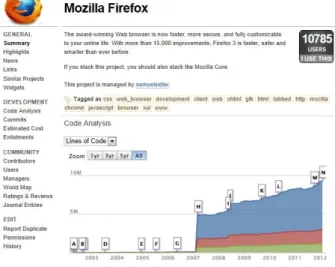
Currently, abundant information is available for open sour-ce software from various kinds of open soursour-ce repositories, such as source code, mailing lists and bug reports. These da-ta mainly depict the inner software development process in detail. Compared to project descriptions and labels, such in-ner repository data has no emphasis on the gein-neral features of the projects which are required by the process of software submission. Figure 1 gives an example taken from ohloh. The web page of Mozilla Firefox contains large amount of information about the project, including description text, code analysis, tags, and so on. Among various kinds of in-formation, this paper mainly focuses on project descriptions and labels, which we defined as the profile of a project.
3.1
Labels in Open Source Communities
Open source communities use labels to mark software, mainly used to identify the software function feature, such as “game” and “video”; some others are used to indicate the technical characteristics, such as “Linux” and “XML”. These labels subdivide projects into more concrete domain, and help clustering and understanding these projects. As men-tioned in section 1, the three communities adopt different labeling mechanisms to annotate projects. In this section, we analyze the three typical open source labeling mecha-nisms in detail: categories, keywords and social tags.
Categories: SourceForge defines a categorization which has 363 unique categories(in mid-2011) and users can only annotate projects by choosing from these predefined ones. These categories are hierarchical and the relations between them are well defined. In addition, SourceForge has a very strict constrains on labeling authorization that only project managers are allowed to decide/change the categories of a project. Such mechanism ensures the quality of the labels and almost all of the categories are recapitulative and ex-plicit, such as “games” and “multimedia”. However, as new software categories may emerge quickly, it is hard for such rigid mechanism to keep pace.
Keywords: Freecode adopts a comparably flexible label creation mechanism that project managers are allowed to add labels(keywords) to a project according to their knowl-edge. The difference between SourceForge and Freecode is that the latter one has no predefined categories and man-agers are allowed to label freely. Such mechanism on the one hand enlarges the labels with open vocabulary, and on the other hand ensures the quality of annotations.
Social tag: In ohloh, any registered users of the communi-ty can delete or add tags to a project with any term based on their experience and understanding. This largely makes it easy to annotate projects and immensely broadens the vocabulary of labels for software. However, as anyone can add tags with any words, the quality of labels is not as good as that in SourceForge and Freecode. Generally speaking, categories in SourceForge mainly reflect the functional fea-ture of projects, and they are well strucfea-tured but rigid to keep pace with the quick emergence of new software. While keywords and social tags, contain much diverse information, not only functional and technical messages, but also quali-ty and sentimental information. They are flexible but often over-fragmented and sparse [10]. Just as shown in Table 1, though with fewer projects than SourceForge, Freecode has much more unique labels.
Figure 1: Mozilla Firefox in ohloh
3.2
Statistical Features of Project Profiles
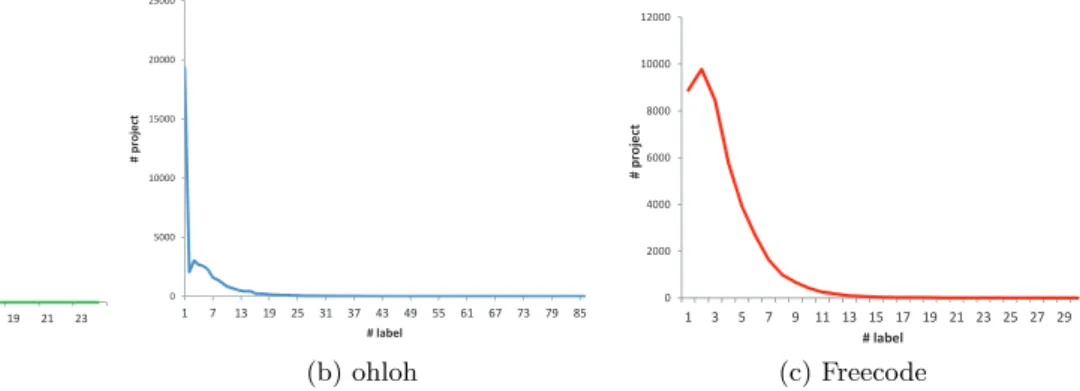
Different from academic papers, project profiles usually have short and freely written descriptions and labels. This section gives a statistical study of project profiles in the three open source communities with the data sets present-ed in Table 1. The number of labels attachpresent-ed usually has significant impact on the chances for the projects of been browsed and discovered by others. Figure 2 presents the distributions of number of labels per project in all three open source communities. Thexaxis stands for the number of labels of one project and y axis represents the number of projects. From this figure we find that, although with different labeling mechanisms, all of the three communities obey a similar distribution on the number of labels of each project. Most of the projects are attached with a few labels and very few projects are annotated with a large number of labels. Different from power-law, there are summits in both Freecode and ohloh distributions at two or three. Another thing worth noting is that there are considerable differences at the tail of the three distributions, where the maximum size of the project label sets in SourceForge and Freecode is around 20 to 30, but ohloh has a long tail of projects at-tached by more than 40 labels, which we believe is primarily the result of the social tagging mechanisms.
Figure 3 shows the distribution of project description length in three communities, wherex axis represents the descrip-tion length and yaxis denotes the percent of projects with the corresponding description length. From this figure we can find that for all three communities, most of the descrip-tion lengths are about 40 words. In SourceForge, most of the description lengths are between 30 and 50 words. Freecode is mainly composed of the projects with description length at about 30 to 100, while for ohloh is 30 to 150. Further-more, for SourceForge and Freecode, the length of about 50 words witnesses a peek in the curve, while for ohloh, project with about 10 words seizes the highest percentage.
From Figure 2 and Figure 3 we can observe that: (1)The number of labels attached to each project for different com-munities are quite different which mainly induced by the different labeling mechanisms; (2)Most of the project de-scriptions are short and the content are not as strict as a-cademic papers. These characteristics bring the difficulties such as how to merge different labeling mechanisms to a
u-0 50000 100000 150000 200000 250000 1 3 5 7 9 11 13 15 17 19 21 23 # p ro je ct #label (a) SourceForge 0 5000 10000 15000 20000 25000 1 7 13 19 25 31 37 43 49 55 61 67 73 79 85 # p ro je ct #label (b) ohloh 0 2000 4000 6000 8000 10000 12000 1 3 5 7 9 1113 15 17 19 21 23 25 27 29 # p ro je ct #label (c) Freecode
Figure 2: Tag distributions in OSS Communities
0 0.005 0.01 0.015 0.02 0.025 0.03 0.035 0 100 200 300 400 500 p e rc e n t o f p ro je ct s descriptionlength SourceForge ohloh Freecode
Figure 3: Distribution of description length
niform one and how to grasp the semantic relations between descriptions and labels.
4.
LABELED TOPIC DETECTION
This section formally defines the software topic detection problem and then proposes a new hybrid approach to solve this problem which mainly contains two steps.
4.1
Approach Overview
SupposeP={p1, p2, ..., pN}is a set of software profiles in whichpi is the profile of theith project. pi= (Wi, Li) is a two-tuple whereWi={wi,1, wi,2, .., wi,h}is the description of the project andwi,j is an appearance of a word in the description,Li ={li,1, li,2, ..., li,t}is the label set attached and each elementli stands for a label. Given a project pro-filepr(pr ∈/ P) that only has description Wr, the software topic detection problem can be formulated as constructing a mapping function:
F:f(P, Wr)→Lr (1) where P and Wr are the inputs of F, and Lr ⊆ L is the detected label set for the given project.
We propose a Labeled Software Topic Detection (LSTD) approach which consists of two steps: the first step is to mapping every word appeared in the project description to a label by which it is generated and construct the word-label matrix; the second step is to detect the topics for the given project based on the word-label matrix.
4.2
Word-Label Matrix Construction
We propose to use L-LDA [16], an extension of LDA, to compute the semantic relations between labels and words. LDA is a probabilistic topic model which views documen-t as a mixdocumen-ture of documen-topics and every documen-topic is presendocumen-ted as a
distribution of words. Similar to LDA, L-LDA views a doc-ument as a bag of words and assumes that every word in the document is generated by a topic. The different is that, L-LDA builds correspondences between latent topics and la-bels by constraining LDA topics to user lala-bels. By this L-LDA captures the hidden word-label correlations and gives every latent topic a name with label.
At this step, we implemented L-LDA based on Gibbs sampling-based LDA in the MALLET toolkit [13]. Then a set of project profiles with descriptions and tags are used as the training dataset and the outcome of this step is the word-label matrix. In this paper we mark this matrix as a|W| × |L|matrix A, where|W|is the total number of is unique words and|L|is the number of unique labels. Item a(i, j) inArepresents the number of times labelljassigned to wordwi. At the second step, we design an effective topic detection algorithm that uses the matrixAto capture latent topics for a given project.
4.3
Labeled Topic Detection Algorithm
For an unlabeled project, two factors should be taken into consideration for detecting its labels: one is the appropriate-ness of labels for the project, and the other is the popularity of labels. This section designs a topic detection algorithm to discover a suitable label set for a given open source project based on the word-label matrix. The detected labels are ranked by their appropriateness and popularity.
We suppose that, for most projects, the descriptions at-tached to them reflect their topics. Based on this assumption we can specify the topics for a given project by synthesis the topics of the words in the description. For a project profile pr with description Wr = {wr,1, wr,2, , wr,x}, we calculate the project labels by synthesizing the labels of all the words inWr. For every appearance of wordwr,i, we calculate its possibility of being associated with labellj by using follow-ing formula: P(lj|wr,i) = ai,j Pn k=1ai,k × ai,j P|W| t=1at,j (2) In Equation 2,ai,jis the number of times that wordwr,ihas been assigned with label lj, P|L|
k=1ai,k is the sum of times that wordwr,i has been assigned with all labels, P|tW=1|at,j is the total number of words assigned with labellj. This e-quation consists of two parts: the first part, from the word’s point of view, reflects the possibility the wordwr,i has been assigned with labellj; and the second part, from the label’s point of view, reflects the possibility label lj has been as-signed to wordwr,i. The combination of the two parts can
reflect the probability the word being assigned with a label based on the large amount of project profiles.
To get the overall possibility for a project of being assigned to a label, we synthesize the possibility of every word for been assigned to that label by using Equation 3:
P(lj|pr)∝ϕ(lj|pr)×
|Wr| X
i=1
P(lj|wr,i) (3)
In Equation 3, the second part is simply the sum of pos-sibility for all words been assigned labellj. The first part ϕ(lj|pr) is a coefficient which reflects the popularity of label lj which we call Popularity Coefficient. In this paper, to simplify the computation, we set this coefficient as:
ϕ(lj|pr) = |Wr| X i=1 f(lj|wr,i) (4) where f(lj|wr,i) = 0 ifp(lj|wr,i)> δ 1 elsewhere (5) As can be seen from Equation 4 and 5, we set the popu-larity coefficient as the number of words in the description of this project that has been assigned with labelljwith pos-sibility higher than the thresholdδ, which reflects the effect caused by topic assignment of other words in the document. That is, the more a label been assigned with different words, the higher the possibility for this label to be assigned to this project. The whole topic detection algorithm is shown in Algorithm 1.
Algorithm 1Labeled Software Topic Detection Algorithm Input: word-label matrixA, project descriptionWr,
num-ber of topics to detectK Output: detected label setLr
1: for(lj:l1→l|L|)do 2: for(wr,i:wr,0→wr,|Wr|)do 3: for(ai,k :ai,1→ai,|L|)do 4: A(it)+ =ai,k 5: end for; 6: for(ax,j :a1,j→a|Wr|,j)do 7: A(jw)+ =ax,j 8: end for 9: P(lj|wr,i) = ai,j A(it) × ai,j A(jw) 10: P(lj|pr)+ =P(lj|wr,i) 11: end for; 12: P(lj|pr) =ϕ(lj)×P(lj|pr) 13: end for;
14: descending sortLr according toP(lj|pr) 15: return topK labels inLr
Some words in project description Wr may not exist in the constructed word-label matrix, which makes it impossi-ble to compute their possibility to be assigned to any label. However, as huge amount of project profiles are used at the word-label matrix construction process, this kind of words is usually of small proportion and have little influence on the accuracy of our topic detection algorithm. So we just ignore these kinds of words while computing.
5.
EXPERIMENT SETUP
The goal of our approach is to detect the latent topics of software by using the labels(i.e. tags, keywords and cate-gories) from open source communities. To accomplish this, we first construct the word-label matrix and then use it to detect the hidden topics of software by the topic detection algorithm proposed in subsection 4.3.
5.1
Data Collection
We carry out the experiments on datasets from three typi-cal open source communities: SourceForge, ohloh and Freec-ode. SourceForge hosts more than 300,000 projects and it is still growing every day. SourceForge predefined a hierarchi-cal category system with 363 categories currently. Ohloh is a large, mature open source community which has collected more than 400,000 projects and Freecode listed about 45,000 projects currently.
To ensure the data quality, we first make use of Porter Stemmer [15] to stem the labels and descriptions, then use p-core [2] algorithm at level 3 for SourceForge, Freecode and level 10 for ohloh to eliminate the projects that have few la-bels and those idiosyncratic or misspelling lala-bels that not reflect the common perspective. Such difference in p-core level is due to the different labeling mechanisms used in these communities. Table 2 presents the three groups of pre-processed datasets. Oh, Sf and Fc denote the dataset from ohloh, SourceForge and Freecode respectively. The columns represent number of projects, labels, unique labels, words and unique words in these profiles respectively.
Table 2: Preprocessed experiment data sets
Dataset #projects #labels #unique
labels #words #unique words Sf 28,963 98,960 363 1,061,154 45,941 oh 10,927 98,319 1,678 772,175 31,436 Fc 15,236 87,587 832 963,302 30790
5.2
Evaluation Metrics
Precision and recall are usually used in Information Re-trieval for evaluation. In our context, precision is the frac-tion of labels correctly detected and recall is the fracfrac-tion of correctly detected labels over all the true ones. However, for topic detection, it is always difficult to calculate the re-call metric as is hard to define the complete ground-truth labels which largely rely on human judgment. So as to com-prehensively evaluate the proposed approach, we adopt two different metrics for different evaluations:
• Objective evaluation: In objective evaluation, we ac-count original user attached labels as the ground-truth and only those exactly the same labels among the de-tected ones are viewed as correct. And the standard precision and recall metrics are adopt.
• Subjective evaluation: We invite two reviewers, who both have more than fifteen years of experiences on open source development, to make judgements on if a tag correct or not for a given project. We used t-wo metrics: Mean Success at rank k(M S@k) which reflects the ability to return a correct label in the top k recommendations and Mean Precision at rank k(M P@k) that means the fraction of labels correctly detected within topkdetected ones.
The main different between objective and subjective evalua-tion is the definievalua-tion of theaˇ,rtruea´,s label for a given project.
In this paper, we adopt one or both of these evaluations for different case studies according to the characteristics of the datasets.
6.
CASE STUDIES
To evaluate the ability of LSTD on data with different labeling mechanisms, we conducted three experiments and compared with previous related works. In subsection 6.1, we compare LSTD with LACT [19] for software categorization on SourceForge; In subsection 6.2, we compare our approach with LDA-TR [9] for tag recommendation on ohloh dataset; And in subsection 6.2.1, we evaluate the ability of LSTD for aggregating different labeling mechanisms.
6.1
Open Source Software Categorization
In SourceForge, the community predefined a hierarchical category and a great of projects are attached with one or more categories. LACT categorizes software systems by an-alyzing the source code with LDA. We compare LSTD with LACT on the same 43 software systems used in the original work.
We construct the word-label matrix based on the 28,963 projects excluding the testing ones, and then run the top-ic detection algorithm on these 43 testing files whose cate-gories are removed. Different from LACT, our method do not need the parameter of number of topics but iteration times for constructing the word-label matrix. We record the results for different iteration. Besides, as the categories in SourceForge are hierarchical and some of the projects may be cross-category, one project may belong to more than one category. In fact, a great many of SourceForge projects are attached with two or three categories. So in this case study we use subjective evaluation which is more rational and fo-cus onM P@K(K= 1,2,3,5). Because of lack of space, we just presents part of the detailed results in Table 3.
Table 3: Evaluation results on SourceForge projects
Iteration time MP@1 MP@2 MP@3 MP@5 500 0.85 0.67 0.60 0.48 800 0.89 0.73 0.61 0.49 1000 0.90 0.75 0.68 0.59
For LSTD the highest precision comes with iteration 1000 for categorizing every project to one category (M P@1) at about 0.9 which means that most of the tested projects are correctly classified to one category. Even classifying every project into two or three categories, the average precision reaches 0.75 and 0.68 respectively. While for LACT, as pre-sented in the original work, the highest precision 0.74 comes from 40 topics with distribution threshold of 0.02. The re-sults indicate that our approach works well for classifying software with descriptions. Different from LACT for which source code are needed to be analyzed, LSTD only relies on software description, which is much more efficient and is eligible to make real-time categorization. On the other hand, LACT may generate new categories that not exist in the predefined hierarchical categories, while LSTD can only detect the existing categories. However, all the generated categories by LACT are presented as a collection of words and manual naming is needed.
6.2
Open Source Software Tag
Recommenda-tion
In this section we conducted a comparison with LDA-TR [9] for tag recommendation. The experiment files are from
0 0.05 0.1 0.15 0.2 0.25 0.3 0.35 0.4 0.45 0.5 0.55 0.6 0.65 1 2 3 4 5 p re ci si o n
numberofretainedtags
LDATR
LSTD
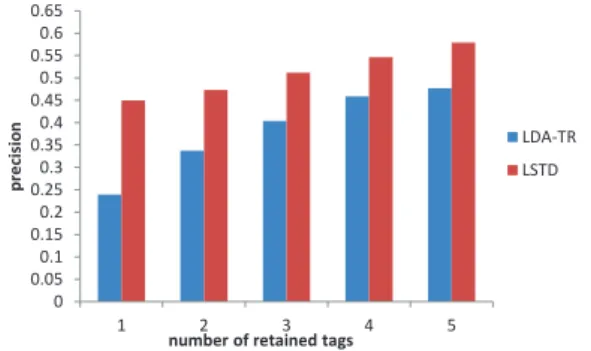
Figure 4: Precision with different number of retained tags
0 0.05 0.1 0.15 0.2 0.25 0.3 0.35 0.4 0.45 0.5 1 2 3 4 5 re ca ll
numberofretainedtags
LDATR
LSTD
Figure 5: Recall with different number of retained tags
ohloh and consist of 9,927 project profiles as the training set and 1,000 profiles as the testing set each of which has more than 10 tags. For each of the 1000 test files 1-5 tags are randomly retained for test. The differences are that: for the training profiles, LSTD uses both descriptions and tags while LDA-TR only uses the tag information; for test pro-files, LSTD uses the descriptions and the retained tags while LDA-TR uses the retained tag information. As mentioned in [9], the best results are reached for recommending 10 tags, so we compare the precision, recall for recommending 10 tags. To comprehensively evaluate the approaches, we first make an objective evaluation as adopted in the original work, and then do a subjective evaluation in addition.
6.2.1
Objective evaluation
For objective evaluation, only these detected tags that appeared in the original test profiles are viewed as correct. Figure 4 and 5 present the objective evaluation results on precision and recall.
As shown in these two figures, our approach shows a clear edge over LDA-TR on precision, recall, with more than 39% and 40% overall improvements respectively, which suggest-s the usuggest-sefulnesuggest-ssuggest-s of thesuggest-se desuggest-scription information for topic detection and tag recommendation.
Another thing need to note is that the number of retained tags has much greater influence for LDA-TR than that for LSTD. This is different from the results reported in [9] which may due to the different characteristics of the data. Taking precision as an example, for LDA-TR when the retained tags changes from 1 to 5 the precision rises from 24% to 48% which increases about two times while for LSTD the precision changes from 45% to 58% which only increases about 1.3 times. Such difference may be mainly due to the fact that LDA-TR greatly depends on tags while our method mainly relies on description.
In addition, from these figures we find that the best result for absolute precision and recall are less than 60%. However,
Table 4: Subjective evaluation for LDA-TR and LSTD
Method MS@1 MS@5 MP@3 MP@5 MP@8 MP@10 MP@15 LDA-TR 0.69 1.0 0.72 0.69 0.66 0.62 0.56
LSTD 0.92 1.0 0.90 0.85 0.82 0.81 0.77
after an in-depth analysis we found that lots of tags detected by our method that not appear in user attached tags are semantically correct. So we conduct a further subjective evaluation on our method.
6.2.2
Subjective evaluation
Although adopted in the original work, objective tion is not so rationale, so we conduct a subjective evalua-tion in addievalua-tion that based on experts judgments to compare LSTD with LDA-TR onM S@kandM P@kwith the result-s generated in objective evaluation. In ohloh, the projectresult-s usually have more tags than that in SourceForge, and for the test projects used in this case study all have more than ten tags. So in this evaluation we calculateM S@K(K= 1,5) andM P@K(K= 3,5,8,10,15). Table 4 shows the subjec-tive evaluation of LDA-TR and LSTD.
Based on the metrics mean success at rank 1 and 5(M S@1 andM S@5), we observe that LSTD achieves higher value at finding good label at rank 1 while both methods can return a good label at rank 5 for almost all projects. While for pre-cision we can see that our approach still works better than LDA-TR on all precision ranks and gets remarkable high precision. From this table we can see that both LDA-TR and LSTD get higher mean precision than that in objective evaluation, which indicates that lots of tags, though not ap-pear in user attaches ones, are considered correct by experts.
6.3
Aggregated Tag Recommendation
Different communities employ different labeling mecha-nisms and each has its own superiorities and drawbacks. How to integrate these different labels into a uniform one and provide a general tag recommendation is a problem. LSTD, by aggregating different communities’ project pro-files to construct a uniform word-label matrix, provides a way out. In this section we construct four word-label ma-trices: the first three are constructed from the three open source communities and the last one is the aggregation of all these communities(i.e. the union of the first three data sets). Then we employ them to detect the latent topics of 200 projects randomly selected from these communities.
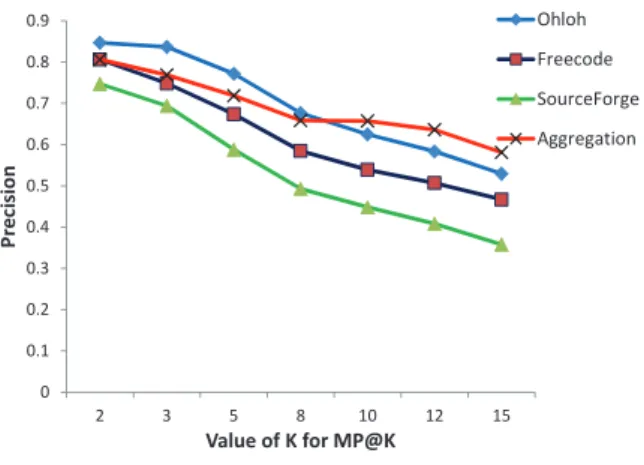
Figure 6 presents the changes of mean precision with d-ifferent precisionk values for all matrices. There are four curves with different colors in this figure, representing the precision trends forMoh,Mf c,Msf and Mag, which repre-sents the matrix constructed from ohloh, Freecode, Source-Forge and aggregated data set respectively.
This figure shows a general trend that the precision de-clines along with the increase of value k. This complies with practical experiences. It also clearly depicts the compari-son of semantic power of the first three word-label matri-ces, which can be ranked descending asMoh,Mf candMsf. While forMohandMag, the result is different: Moh outper-formsMagwhenk≤8, whileMagis better whenk>8. The above results comply with the analysis of the open source labeling mechanisms in section 3. In SourceForge, it prede-fines well-structured categories and lots of them may never appear in any project description, while Freecode and ohloh adopt a kind of folksonomy with much more labels com-ing from free users who hold more knowledge for projects.
0 0.1 0.2 0.3 0.4 0.5 0.6 0.7 0.8 0.9 2 3 5 8 10 12 15 P re c is io n ValueofKforMP@K Ohloh Freecode SourceForge Aggregation
Figure 6: Precision with differentk
Table 5: Test results with different matrices
Matrix MS@1 MS@5 MP@3 MP@5 MP@8 MP@10 MP@15
Moh 0.91 1.0 0.84 0.77 0.67 0.62 0.53
Msf 0.69 0.96 0.69 0.59 0.49 0.45 0.40
Mf c 0.88 0.98 0.75 0.68 0.58 0.54 0.47
Mag 0.87 1.0 0.77 0.71 0.66 0.66 0.58
Therefore the word-label matrix from SourceForge will con-tain less semantic connections among labels and description words. For the difference between Moh and Mag, because Magmerges all the project profile sets from three commu-nities and contains a more unified label vocabulary. There-fore more appropriate labels may be available for a specific project. Furthermore, for the curve of Mag, its downward tendency is slower than other three. This suggests the com-plementarity of different profile sets will make LSTD more stable, and reveals the possibility to construct a unified on-tology of software projects based on the vocabulary from multiple communities.
Table 5 presents the detailed results of this experiment. Based on the metric mean success at rank 1 and 5(M S@1 andM S@5), we observe that all four matrices perform well in detecting a good label for software projects within the top-k labels detected by our method. The M S@5 in the table shows that for almost all projects by all four matrices, the topic detection method can return a good label within top 5. For the columns of mean precisions(M P@k, k = 3,5,8,10,15) in this table, we can see that the precisions at rank 3 and 5 are fairly high which validate our method in detecting latent topics for software projects.
7.
CONCLUSION AND FUTURE WORK
Massive open source software require efficient labeling me-chanism to enrich their topic-based labels. This paper This paper firstly analyzed the differences and characteristics of the three typical labeling systems in open source commu-nities and then proposed LSTD approach to detect latent topics for given software: constructs the word-label matrix from mass open source project profiles and then uses the matrix to directly compute the latent label set. After the matrix been built,it can quickly compute the label set with comparably high precision. The evaluation results verify the effectiveness of LSTD for different community projects and it can be improved by choosing and combining appropriate sets of training profiles from different communities.
system named Influx5, which has crawled OSS data from several influential forges and communities (such as Source-Forge, ohloh, Freecode and OW2). Currently, Influx can provide some interesting mechanisms for mining oss data, such as cross-forge profiles, synergy analysis, and project ranking in some forges (such as OW2). The topic detection algorithm proposed in this paper will be further tested and integrated toInflux.
Future research will be conducted to improve the perfor-mance of LSTD, such as the popularity function in section 4 which can be extended to capture more semantic and social factors of open source projects, like the feature information in software development repositories. Besides, current LST-D simply ignore the words that not appear in word-label matrix, which may reduce the precision of topic detection, and an evolving approach which can add new word-label correspondence incrementally may help.
8.
ACKNOWLEDGEMENT
This research is supported by the National Science Foun-dation of China (Grant No.60903043) and the National High Technology Research and Development Program of China (Grant No. 2012AA010101). Many thanks to Yanxu Zhu, Xue OuYang, Biaocheng Zhao and Yue Yu for discussion and their help on data collecting. We also gratefully thank Jiangning Liu and Sanwei Huang who are CEO and CTO of CVICSE(http://www.cvicse.com), for their hard work and valuable reviews on our test results.
9.
REFERENCES
[1] H. U. Asuncion, A. U. Asuncion, and R. N. Taylor. Software traceability with topic modeling. In Proceedings of the 32nd ACM/IEEE International Conference on Software Engineering, pages 95–104, New York, NY, USA, 2010. ACM.
[2] V. Batagelj and M. Zaver´LAnik. Generalized cores., Arxiv preprint cs/0202039, 2002.
[3] A. Begel, Y. P. Khoo, and T. Zimmermann.
Codebook: discovering and exploiting relationships in software repositories. InProceedings of the 32nd ACM/IEEE International Conference on Software Engineering, pages 125–134, New York, NY, USA, 2010. ACM.
[4] D. Blei, A. Ng, and M. Jordan. Latent dirichlet allocation.The Journal of Machine Learning Research, 3:993–1022, 2003.
[5] B. Cleary, C. Exton, J. Buckley, and M. English. An empirical analysis of information retrieval based concept location techniques in software
comprehension.Empirical Software Engineering, 14(1):93–130, 2009.
[6] H. Dumitru, M. Gibiec, N. Hariri, J. Cleland-Huang, B. Mobasher, C. Castro-Herrera, and M. Mirakhorli. On-demand feature recommendations derived from mining public product descriptions. InSoftware Engineering, 2011 33rd International Conference on, pages 181–190. IEEE, 2011.
[7] T. Griffiths and M. Steyvers. Finding scientific topics. Proceedings of the National Academy of Sciences of the United States of America, 101(Suppl 1):5228, 2004. 5
http://influx.trustie.net
[8] S. Kawaguchi, P. Garg, M. Matsushita, and K. Inoue. Mudablue: An automatic categorization system for open source repositories.Journal of Systems and Software, 79(7):939–953, 2006.
[9] R. Krestel, P. Fankhauser, and W. Nejdl. Latent dirichlet allocation for tag recommendation. In Proceedings of the third ACM conference on
Recommender systems, pages 61–68. ACM, 2009.
[10] A. Kuhn. Automatic labeling of software components and their evolution using log-likelihood ratio of word frequencies in source code. InMining Software Repositories, 2009. 6th IEEE International Working Conference on, pages 175–178. IEEE, 2009.
[11] E. Linstead, P. Rigor, S. Bajracharya, C. Lopes, and P. Baldi. Mining concepts from code with probabilistic topic models. InProceedings of the twenty-second IEEE/ACM international conference on Automated software engineering, pages 461–464. ACM, 2007. [12] K. Liu, B. Fang, and W. Zhang. Ontology emergence
from folksonomies. InProceedings of the 19th ACM international conference on Information and
knowledge management, pages 1109–1118. ACM, 2010.
[13] A. McCallum. Mallet: A machine learning for language toolkit. 2002.
[14] C. McMillan, M. Linares-V´asquez, D. Poshyvanyk, and M. Grechanik. Categorizing software applications for maintenance. InSoftware Maintenance, 2011 27th IEEE International Conference on, pages 343–352. IEEE, 2011.
[15] M. Porter et al. An algorithm for suffix stripping, 1980.
[16] D. Ramage, D. Hall, R. Nallapati, and C. Manning. Labeled lda: A supervised topic model for credit attribution in multi-labeled corpora. InProceedings of the 2009 Conference on Empirical Methods in Natural Language Processing, pages 248–256. Association for Computational Linguistics, 2009.
[17] B. Sigurbj¨ornsson and R. Van Zwol. Flickr tag recommendation based on collective knowledge. In Proceedings of the 17th international conference on
World Wide Web, pages 327–336. ACM, 2008.
[18] Y. Song, L. Zhang, and C. Giles. Automatic tag recommendation algorithms for social recommender systems.ACM Transactions on the Web (TWEB), 5(1):4, 2011.
[19] K. Tian, M. Revelle, and D. Poshyvanyk. Using latent dirichlet allocation for automatic categorization of software. InMining Software Repositories, 2009. 6th IEEE International Working Conference on, pages 163–166. IEEE, 2009.
[20] S. Ugurel, R. Krovetz, and C. Giles. What’s the code?: automatic classification of source code archives. In Proceedings of the eighth ACM SIGKDD international conference on Knowledge discovery and data mining, pages 632–638. ACM, 2002.
[21] Z. Yin, L. Cao, J. Han, C. Zhai, and T. Huang. Geographical topic discovery and comparison. In Proceedings of the 20th international conference on World wide web, pages 247–256. ACM, 2011.