33
C.1 MORE BACKGROUND
INFORMATION ON PSS
This part of the PSS module gives more background knowledge. It discusses:
> State of the art in PSS theory and practise PSS for all, industrialised and emerging contexts Barriers and rebound effects
State of the art in theory
and practise
2Although Product-Service System (PSS) is a concept that is not necessarily connected with the Sustainable Development paradigm, a lot of research carried out (e.g. SusProNet, MEPSS etc.) discussed PSS as one effec-tive strategy to lead towards Sustainable Development. And indeed it has been shown that PSS can lead to much more environmentally and economically efficient production-consumption systems, but this is not a given.
When trying to understand PSS one should be aware that this field has strong connections to product design and its methodologies as well as service design and its methodologies. Nevertheless, PSS Design is more than just a combination of the former two fields.
What does this module
offer to successfully
implement PSS activities?
To keep the methodology simple and straightforward, a pragmatic approach on PSS is introduced in this publica-tion. Nevertheless, reference is made to other sources for more detailed information and tools whenever suit-able. This publication can be the reader’s initial step into the world of PSS and will encourage further testing in the field.This module offers further back-ground knowledge for experts who are more interested in the scientific concept and context of PSS.
Description in further detail of how to run a PSS pilot project and intro-duce helpful methodologies and tools.
How to integrate the PSS thinking and innovation into company practice on a more regular basis is described next.
Finally case studies and best practice examples are introduced to show that the approaches work in practice.
P
Pr
ro
od
du
uc
ct
t--S
Se
er
rv
viic
ce
e
S
Sy
ys
st
te
em
ms
s;; T
To
oo
ol
ls
s
a
an
nd
d c
ca
as
se
es
s
MODULE
C
U
Ur
rs
su
ul
la
a T
Tiis
sc
ch
hn
ne
er
r a
an
nd
d C
Ca
ar
rl
lo
o V
Ve
ez
zz
zo
ol
lii
Chapter C.1 Chapter C.2 Chapter C.3 Chapter C.434
F
Fiir
rs
st
t a
ar
re
ea
a:: P
Pr
ro
od
du
uc
ct
t d
de
es
siig
gn
n
Product design and/or industrial design is a field which has been practiced professionally for more than hun-dred years now. It is not necessary to describe in detail the best practice of product design because it is well-known. What is interesting for the focus of PSS is the state of the art integration of environmental and social aspects (sustainability) into the routines of product development and design. Integrating environmental aspects is also a field of study that has been researched for some decades now. The ISO technical report on “Integrating environmental aspects into product devel-opment and design” as well as national ecodesign guides have disseminated the knowledge about best practices in this field and have made information available on the market. This publication covers D4S Resdesign in Chapter 4.Nevertheless there are still a few gaps:
> Integration of social aspects still is very difficult. Missing are practical indicators and tools covering social and ethical aspects and the strategies for integration into design and development.
> Dissemination to small and medium sized compa-nies is necessary. Most ecodesign tools and methods are for large companies and the majority of the activities are done by large companies. It is necessary to translate the methods and tools and adapt them to the specific needs of medium sized and small enterprises, which comprise almost 90% of business (See information on SMEs).
> Looking at the soft factors of sustainable and ecodesign such as aesthetics, product semantics, cultur-al aspects and consumer behaviour and preferences etc.
S
Se
ec
co
on
nd
d a
ar
re
ea
a:: S
Se
er
rv
viic
ce
e d
de
es
siig
gn
n
The main source of the service design area is the clas-sical service marketing. The two central features of services are intangibility and client intensity. The main obstacles and drivers of service design are related to these features. A service is intangible, which means that a customer cannot see, touch, or feel a service before purchase, making it more difficult for a sales represen-tative to sell the quality aspects of a service. Intangibility means that customers have nothing concrete toevalu-ate; they must trust the provider’s word that the serv-ice was done as well as it could be done for the money the customer paid. In addition, if the customer has little idea of how a service is performed or what cost they would incur if they attempted to do the service them-selves, very often they will undervalue the service. For these reasons, a service’s brand image, reputation and quality are particularly important in selling a service and introducing new services.
A service must be designed to meet the customer’s needs even more than a product. A service varies more in its execution than a product does in its manufactur-ing. It is easier to excuse a product for not performing as previously expected. It is much more difficult to excuse a service provider who is not being responsive. While intangibility makes services more difficult to sell, it makes it easier to introduce new services by sim-ply varying the nature of the service, changing the serv-ice production routine and retraining the servserv-ice provider. New services form a decisive factor of compe-tition. For example, in a study about the consumer choice of computer brands, the bad service of some companies was the reason for the consumers’ purchase of a different brand. As service conformance is particu-larly hard to manage compared to manufacturing con-formance (services are produced by people who are much harder to regulate than machines), it is essential to care for well-trained and skilled staff in service con-cepts.
For the different steps of service development and design, specific methods and approaches exist but often not adapted to the specific needs and co-operative operations in this area. In general the following steps are taken by service design methods: (1) Continuous Idea-Generation; (2) Concretion; (3) Assessment; (4) Decision; (5) Realisation. Tools that indicate the major design steps in service design are: blueprinting for con-ceptualising the wanted service; gap-analyses for detect-ing possible problems and QFD (Quality Function Deployment) for minimising those gaps. Scenario meth-ods are also opening doors for integrating service design.
The main gap in this area is the lack of integration of environmental and social aspects in both practice and research of service design (e.g. lack of sustainable serv-ice case studies).
35
T
Th
hiir
rd
d a
ar
re
ea
a:: P
Pr
ro
od
du
uc
ct
t--S
Se
er
rv
viic
ce
e
S
Sy
ys
st
te
em
m d
de
es
siig
gn
n
Most businesses are connected with tangible products (e.g. a car), and services (e.g. automotive repair). In both cases, services and products are involved in offering value to the customer, e.g. the manufacturer needs serv-ices such as transport to produce the car, the mechan-ic needs products such as a screw driver to repair the car. For some years now the trend in most industrialised economies is that the service content of business is increasing and the material product becomes less important. Then a new perspective on this trend was raised by environmental scientists who expect this shift from products to services to have positive effect on the environmental impacts caused by production and con-sumption. Their thesis is that a demanded material and energy efficiency improvement of Factor 10 or greater is hard to achieve by modifications to existing products only. The idea behind broadening the view from product to service and system design is to integrate and opti-mise product functions or to replace the product with a service. There are many practical cases for reconfigur-ing the product-service mix. For example, some mobile phones are now given to consumers in a contract through which payment is made only for the service that they provide. A growing number of companies have marketed themselves as service providers, including Rank Xerox (photocopiers), Interface (carpets), Electrolux (industrial cleaning), IBM (computers), and Wilkhahn (furniture). The trend to offer product-serv-ice mixes has been most notable so far in business-to-business offers.
There is increasing public interest in the environ-mental product policy and, specifically, the potential for ‘market transformation’. The debate on changing the product-service mix in order to gain environmental benefits has advanced significantly over the past ten years and is now attracting interest from government and industry as well as academics, proved by the amount of literature on this issue. However, that the concept has not been taken seriously enough by the societal actors may be due to the anecdotal nature of the discussion and the difficulty in determining the envi-ronmental or other merits of such an approach. The EU market for ‘products sold as services’ in 1998 was
esti-mated at 758 billion euros, or 10% of GDP (Stahel, 2000). Within this segment, selling the function of prod-ucts ( e.g. through fleet management) accounts for 60% (equal to 6% of GDP); while remanufacturing services account for 40% (4% of GDP) (Stahel, 2000).
Due to the multiple approaches of academic research into PSS, a standard model for classifying the typology of the many possible product-service combi-nations and variations does not exist. The most com-mon typology is presented in this text (see chapter 7). The generalisation of the principle of ‘function vs. prod-uct sale’ for an ecological modernisation of economy and society has to be clearly differentiated. The most important result still is that none of the researched services has a golden path of innovation (method) that decreases material flows and establishes a cyclic econo-my. At the same time there are clear distinctions con-sidering the environmental effects. There is practically no general solution, thus customised concepts for dif-ferent products and companies are always necessary. A progressive, gradual move towards PSS is usually the best course of action for companies, e.g. running through a pilot project and understanding what should be integrated into normal business practice.
Another more radical and promising but also more risky strategy, as shown by case studies, is to start a new business or branch with a new PSS, which gives the opportunity to develop everything from scratch.
It may be concluded from the literature that PSS have a potential for promoting better economic, envi-ronmental and social characteristics than similar prod-ucts. But as PSS are so diverse and their success depends on many frame conditions each PSS must be analysed and evaluated on a case-by-case basis to understand if they really lead towards more Sustainability. Often PSS are able to increase the eco-nomic and environmental efficiency in the system, but there can be pitfalls. Sharing washing machines in a laun-dry, for example, reduces the amount of products that are required to fulfill the need to clean clothes. But case studies show that if consumers washing in the laundry who use the tumbler to dry clothes would dry their clothes at home on the line, it is more eco-efficient to do the washing at home.
Most existing PSS cases were originally implemented for reasons other than environmental benefit. By
con-36
tinuing research in this field, a better understanding can be developed regarding PSS characteristics, success fac-tors, and relation to sustainability.
When a company decides that it is worth going for PSS – the question is how they can manage to do so – there are methodologies and tools available to support the development and implementation of PSS. The tools for PSS Design have different backgrounds (e.g. chemi-cal industry, car sharing) and are differentiated to their type (e.g. assessment, priority setting tools).
It is also very helpful to look at successful examples. The cases listed in this module (section C-4) vary from small to large firms and from country to country. From looking at such cases obstacles, drivers and success fac-tors can be identified, these include (see also chapter barriers and rebound effects below):
> The possibility of PSS with a stronger value in the service, like leasing and sharing, to be able to compete with ‘buying products’ considering the price and/or gen-erate a higher added value respectively usability so that the customer is willing to pay for these services.
> How to shift the consumer’s ideas about owner-ship to “userowner-ship”, i.e. it is not necessary to own a prod-uct in order to use it for satisfying your demands.
> A clever combination and diversification of prod-uct service offers. Providers should identify the need and purpose first and then strive for the most effective, efficient and elegant combination of products and serv-ices to fulfill the need and deliver customer satisfaction.
> How to motivate the service personnel as it is representing the “user interface” in a service concept and how to motivate and train sales personnel to “sell” services instead of products
> How to organise multi-stakeholder participatory design and development processes as PSS concepts often require strategic partnership and co-operation.
> Regional and global dimensions of a PSS combined with the use of modern information communication technologies and their influence on society.
Aside from the uncertainties mentioned above, major gaps in the area of PSS design are:
> The lack of integration of social/ethical aspects in both practice and research of PSS design.
> Quick and efficient tools to estimate the sustain-ability of PSS.
> The missing multi-stakeholder and -actors approach that is necessary to (re-)design whole produc-tion and consumpproduc-tion systems.
> New forms of co-operation and methods to organise these, which take the different stakeholders’ motivations and interest into account and are able to deal with possible conflicts.
The following section suggests an approach and tools to close these gaps.
PSS for all, industrialised
and emerging contexts
Can PSS, as a business approach, be applied to reach more sustainable production and consumption patterns in devel-oping and newly industrialised contexts? In other words, could PSS be a valid business strategy for both industri-alised and emerging contexts?
At a first glance an answer to the former question is: PSS already exist in those contexts. For example, we can identify more shared use of products (in keeping with cultural norms) than in industrialised contexts, e.g. the use of carpoolingcould be a common solution for mobil-ity in several world-wide emerging contexts.
In fact, the PSS we may observe in emerging contexts derive from economic and cultural conditions, such as scarcity of access to products and resources. So we can-not say these kinds of PSS are sustainable, at least can-not in the social and ethical dimension of sustainability.
On the other side, some of the most modern utili-ties have been offered and accessed by a large number of people through service brokers. For example, the dis-semination of Internet cafe sites (a PSS appreciable by both emerging and industrialised contexts, thus offering a globally “sharable” quality standard) in emerging con-texts is even more rapid than in the industrialised ones. We can also observe examples of PSS offered from emerging to industrialised countries like call centres or financing consultancy services (especially form India to US companies).
IIm
mp
pl
le
em
me
en
nt
ta
at
tiio
on
n o
of
f P
PS
SS
S iin
n
e
em
me
er
rg
giin
ng
g c
co
on
nt
te
ex
xt
ts
s
eco-effi-37
cient on a system level because of the stakeholders’convergence of interests. This means, in the case of a system to be implemented from the beginning (as is the case of emerging context), a PSS solution is in principle
“cheaper” on a macroeconomic scale. In fact, a PSS as a whole and for a given social demand requires fewer resources. In other terms, an economic imple-mentation and expansion in poorer contexts of such systems (for the given demand satisfaction), could be easier than other resource-intensive solutions.
Furthermore, PSS often require investments in Information and Communication Technologies, which generally speaking requires lower investment costs, in comparison with industrial technological infrastructures transferred to emerging contexts in recent times.
Normally PSS are more labour-, organisation- and/or intellectual-intensive. Thus the lower labour costsin emerging contexts may be, in a first stage, an advantage compared to industrialised ones. Hence their PSS could be more competitive on a global scale.
A PSS approach typically focuses more on specifying the context of usei, because it is characterised by a stronger and longer relationship with the customer (both end-user and business). That leads to a greater company involvement at the user locations, which means greater involvement of local rather than global (multinational) stakeholders. In emerging contexts this may have the positive implication of fos-tering the growth and the empowerment of local economies.
Furthermore, PSS focuses on “satisfaction” as a value instead of private ownership of physical products (the traditional perceived standard of well being in industri-alised contexts). This may again be an advantage for emerging contexts in which the non-owning of prod-ucts is closer to existing cultural-economical habitsii. We can think to the diffusion of the mentioned internet sites where computers are publicly available. However, the real issueis to put together as aPSS a business concept that developing and emerging contexts may aspire to. This is something that they could see as more interesting than patterns for devel-opment aiming at privately owned and mass distributed (physical) products.
PSS may bring forward business opportuni-ties to facilitate the process of socio-economic development – by jumping over or by passing the stage characterised by individual consumption/ownership of mass produced goods – towards a “satisfaction-based” and “low-resource intensive” service-economy.
Barriers and rebound
effects
B
Ba
ar
rr
riie
er
rs
s
The main barrier to adopting PSS in industrialised con-texts is the cultural shift necessary for the user, to value ‘having a need or want met in a sustainable way’ as opposed to ‘owning a product’. This cultural leap can be made, but is not straightforward for a consumer or intermediary retailer (as client) to understand. In a developing country, the main barrier may be the avail-ability of advanced technological information and knowledge, to produce a socially and economically viable PSS.
Businesses face barriers in the design, development and delivery of PSS, in implementing the changes required in corporate culture and organisation to sup-port a more systemic innovation and service-oriented business. In this regard, it has been observed that some companies in mature industries see it as an opportuni-ty to survive, while others see it as a way of gaining entry to a new sector.
A further obstacle for business is the difficulty of quantifying the savings arising from PSS in economic and environmental terms, in order to market the innovation to stakeholders both inside and outside the company, or to the company’s strategic partners.
Other barriers faced by business include lack of knowledge and experience in terms of:
> service design methods and tools
> new tools, which companies can use to assess and implement PSS
> service management systems
> entrepreneurial personnel who are skilled in serv-ice development and provision and life-cycle costing methods
38
Furthermore, businesses may perceive the risks of: > conflict with their business as usual and offers they have already on the market
> conflict with existing internal procedures and tools, e.g. accounting and reporting methods
> service being easily replicated by a competitor (more easily than a physical product)
> partnerships and entrepreneurial interdependence leading to reduced control of core competencies and reducing the influence of business decisions
Finally, barriers to be overcome may include a lack of external infrastructure and technologies, e.g. for prod-uct collection, re-manufacturing or recycling.
T
Th
he
e r
re
eb
bo
ou
un
nd
d e
ef
ff
fe
ec
ct
ts
s
Not all shifts to PSS result in environmental benefits and/or economic or social advantages. A PSS must be specifically designed, developed and delivered, to be sus-tainable. For example, schemes where products are borrowed and returned incur transportation costs (and the resultant use of fuel, and emissions). In some instances, the total fuel cost and environmental impact may make the system less sustainable than a product sales concept.
Furthermore, even when well-designed, some PSS concepts could generate unwanted side effects, usually referred to as rebound effects,i.e. counterproductive effects that “eat up” the intended positive sustainability effects, maybe by inefficient use or unsustainable changes in consumer behaviour etc. Society as a whole is a set of complex, inter-related systems that are not clearly understood. As a result, something may happen that turns potential environmentally friendly solutions into increases in global consumption of environmental resources at the practical level. One example is the impact of PSS on consumer behaviour. For example, outsourcing, rather than ownership of products, could lead to careless (less environmentally responsible) behaviour, e.g. the benefits of a small and more fuel therefore cost efficient car can lead to more driven kilometres, simply because it is convenient and cheaper even in a car sharing system.
Nevertheless, PSS development certainly presents a potential for generating win-win solutions, which pro-mote economic, environmental and social benefits. They
have the potential to provide the necessary, if not suffi-cient, conditions to enable communities to leap-frog to less resource intensive (more dematerialised) systems of social and economical benefits.
C.2.1 HOW TO RUN A PSS PILOT
PROJECT/ APPROACHES, SKILLS
AND TOOLS
W
Wh
ha
at
t iis
s n
ne
ew
w iin
n t
th
he
e P
PS
SS
S b
bu
us
sii--n
ne
es
ss
s// d
de
es
siig
gn
n a
ap
pp
pr
ro
oa
ac
ch
h?
?
Most of the companies today are either mainly product oriented, e.g. a producer of computers adding service as necessary and only as a by-product to its computers, or service oriented, e.g. a telecommunication company using the products (phones) only as means to provide their services.
Depending on their starting points, companies have the knowledge and optimal organisation for a specific field, e.g. product development, but lack knowledge and organisation in the other field, e.g. service development. For efficient PSS development both sides have to work together, meaning they have to be connected in market research, innovation activities, in the formulation of specifications, in the time frame of the design, in the actual delivery of the PSS on the market etc. to increase efficiency and success. Today it often happens that both sides (products and services) are not co-ordinated and connected enough, leading only to sub-optimal results. For instance some service providers, e.g. mobile com-munication service, have difficulties because the product producers, e.g. mobile phone producer, do not listen to their demands, do not deliver the products in time, do not take care for repairs well enough, which then demolishes the image of the mobile communication providers, because they are responsible for the com-plete service, including the material product, in the view of their customers.
We describe an approach below, describing how both sides, products and services, can be developed together more strategically and efficiently taking into account environmental, social and economic aspects and therefore leading to more sustainable business and consumption strategies. Because of this it is often
nec-39
essary to get additional partners in the design process,because the competencies, e.g. of the former product oriented company, have to be increased in the service side, or the other way round. This means co-operation with new stakeholders, e.g. other companies or organi-sations, and also that the customer is highly recom-mended for PSS development.
The ultimate goal of this approach is to fulfill the cus-tomer’s/consumer’s demands in a sustainable way (deliver satisfaction) – while increasing profits and cre-ating more value simultaneously. This means that the demands of the customers are in the focus of the busi-ness activities and then busibusi-ness searches for the most efficient and effective combination of products and services to fulfill the customer’s needs. This approach offers a great chance to move the whole production and consumption system towards greater sustainability.
H
Ho
ow
w t
to
o s
st
ta
ar
rt
t?
?
Before trying to restructure a whole organisation or found a new company or organisation with a new busi-ness idea, it makes a lot of sense to run through a pilot project. The aim of such a project is to analyse the PSS business opportunities, to find out how the new PSS design and development process could work, to exper-iment with new PSS tools, and finally to develop new PSS solutions and test them, e.g. in a niche market, before the company or consortium of companies decide to go for the real market launch.
An approach for such a pilot project is described in this chapter. The pilot project will take the reader through the following five phases:
1> Exploring opportunities, identification and analy-sis of the existing reference system.
2> PSS idea generation and selecting the most prom-ising concepts.
3> Detailing selected PSS concepts.
4> Evaluation of detailed PSS concept(s) and testing. 5> Planning implementation.
The actual implementation, management and control of success will be done after the pilot project if the companies decide to materialise the new solution. This is very company consortium- and solution-specific, thus only the generic aspects will be mentioned here.
In Chapter C we will expand more on the question of how strategic PSS development can be done in com-panies as a more regular, daily activity.
T
Th
he
e P
PS
SS
S p
piil
lo
ot
t p
pr
ro
ojje
ec
ct
t
The challenge in the pilot project is to develop and explore business strategies to fulfill customer’s/ con-sumer’s demands in a sustainable way – and create more value/ profit at the same time. This is done by exploring and assessing the PSS opportunities for a company in a specific market, that have a potential for sustainability improvement.
40
approach: A company should start with qualitative tools and analyses, and go to (semi-)quantitative tools when-ever possible, i.e. when there is enough time, when the necessary knowledge can be generated easily in the given time frame and capacity.
The following table describes the steps of the pilot project and the tools that are suggested to be used. In the following description of the pilot project we only describe simple and time efficient (‘quick and dirty’) tools. In section 2.2 we add additional tools that are helpful and are recommended to use for a more in depth approach.
The stepwise approach in the PSS pilot project can be carried out by organising workshops for each or some of the different steps involving a multidisciplinary team. Recommended internal experts to involve are
> strategic management > marketing and public relations
> research and development, e.g. designers, engi-neers and product managers
> purchasing / procurement > retail
> customer service
Furthermore it might be sensible to invite external stakeholders, e.g.
> PSS experts
> trend and scenario analysts > environmental analysts
> customers and other stakeholders, e.g. NGOs, Media
> potential or actual co-operating partners, e.g. sup-pliers
Between the workshops the participating experts can complete some “homework” and do research to answer open questions and develop and detail con-cepts.
S
ST
TE
EP
P 11:: E
Ex
xp
pl
lo
or
riin
ng
g o
op
pp
po
or
rt
tu
un
nii--t
tiie
es
s::
iid
de
en
nt
tiif
fiic
ca
at
tiio
on
n
a
an
nd
d
a
an
na
al
ly
ys
siis
s o
of
f t
th
he
e e
ex
xiis
st
tiin
ng
g r
re
ef
f--e
er
re
en
nc
ce
e s
sy
ys
st
te
em
m
Tools:> Drawing a system map > Blueprinting
> Sustainability SWOT
> Identification and analysis of an existing
system
All companies already offer products or semi-finished products or services in existing production-consump-tion systems. But usually these systems are not in the scope of the company’s development activities. They normally focus on what happens in their own company, in relation to their suppliers and in relation to their cus-tomers. For a PSS project it is necessary that the pro-duction-consumption system is taken into account as often and as broadly as possible. Thus a very sensible first activity is to identify existing production-consump-tion reference systems in which the company is active or expects to be active in the future. To do this, it is essential to define a functional or satisfaction unit, e.g. for a washing machine producer this might be “cleaning clothes” for a furniture producer it might be “having nice interiors in private homes” or even “living in healthy interiors that create well-being”. Given this sat-isfaction unit, the boundaries of the existing references system to consider can be defined, e.g. for the washing machine this might be: producing and purchasing mate-rials/pre-products, manufacturing the machine in the company, selling it, using it, repairing it, recycling it and final disposal, but also providing the water, the energy and the cleaning agents for the washing in the private household. Part of this process is to write down cus-tomer’s/consumer’s demands that are fulfilled in the existing system but also, which demands are not yet covered by the existing system but are existing and therefore an excellent starting point for a new offer.
Result: identified satisfaction unit, list of ele-ments of the reference system, description of the boundaries of the reference system.
Then the most relevant actors in the reference sys-tem have to be identified, e.g. product manufacturers, suppliers, customers, retailers, etc. with their own inter-est in the system.
Result: list of actors with one line about their interest in the system
Furthermore the necessary products and services that are needed so far to make the system work have
41
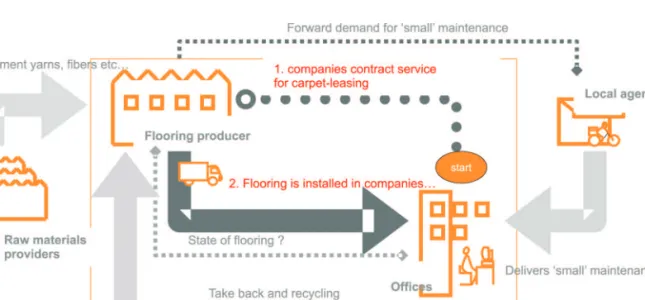
to be listed.Result: list of (material) products and (imma-terial) services that are necessary in the system With all this information it is finally possible to pro-duce a rough sketch of the reference system that describes its interactions. This can be done either by using a system organisation map technique (illustrated in Figure C-1) or the blueprinting method (described below in C.2.2). This system map should summarise and visualise the reference system, its actors and the inter-actions that are necessary to deliver the required func-tion/ satisfaction from the viewpoint of the customer/ consumer.
T
TO
OO
OL
L:: D
DR
RA
AW
WIIN
NG
G A
A S
SY
YS
ST
TE
EM
M M
MA
AP
P
5This tool is used here for the existing reference system and it is recommended for describing the new PSS con-cept below (Step 2).
The application of a system map brings many bene-fits: It provides a complete and clear overview of the (product-service) system, which is useful for everyone working with it, it helps to identify potential failure points, it helps to identify the role and level of
partici-pation of customers and to clarify what customers should see or come in touch with, it stresses the areas of interactions between different actors and how the money flows through the system. Thus it is very helpful to support system re-design processes.
It can be very enlightening if a company switches roles and takes the customer/ consumer perspective (for business to business and/ or business to consumer offers), e.g. in a workshop to complete the system map-ping exercise. Figure C-1 gives one example for a sys-tem drawing methodology of a carpet leasing syssys-tem.
In this system map for a carpet leasing system the system starts with the customer, here offices, in the cen-tre. Then the material/product flows in the system are represented by the large grey arrows and the informa-tion/service flows are indicated by the dotted lines. The icons show actors and locations. The orange square shows the closer system of primary service provider(s) and customers. Additional secondary actors that are important for the system are positioned outside the square.
Result: Overview about the existing reference system through written text and system map
After getting an overview about the existing system the task is to understand where problems in the
42
ing situation occur, how the system will develop in the future and where future opportunities and threats lie. The goal of this activity is to identify and explore (future) business opportunities that lead to more sus-tainability. To do so, we recommend completing a SWOT (Strengths-Weaknesses-Opportunities-Threats) analysis that includes all three dimensions of Sustainability (environmental, socio-cultural and eco-nomic).
T
TO
OO
OL
L:: S
SU
US
ST
TA
AIIN
NA
AB
BIIL
LIIT
TY
Y S
SW
WO
OT
T
Sustainability
Strength-Weakness-Opportunities-Threats Analysis
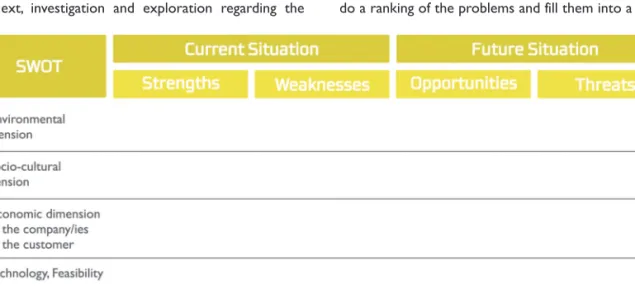
The following matrix (Table C-1) should be completed for the existing reference system and the future situa-tion that is likely to occur, e.g. the washing machine pro-ducer looks at the reference system that was described and mapped in the system map and tries to identify cur-rent strengths and weaknesses elaborating all the dimensions in the SWOT and filling in the boxes of the first two columns. Maybe he finds out that from an envi-ronmental point the biggest problem is that the users always wash with half empty machines and therefore a lot of energy, water and detergent is misspent etc.
Next, investigation and exploration regarding the
future developments are necessary in order to identify future opportunities and threats for the company (or a consortium of companies). This means that all the data that are available about current developments in terms of user demands, technology, legislation etc. are gath-ered and filled into the SWOT matrix.
In addition to the SWOT, a future or scenario work-shop can be used to explore possible future
trends more in depth (e.g. Jungk/ Müllert 1987; Kensing 1987)
The SWOT matrix requires looking at the situation from different perspectives, e.g.
> related to the natural environment
> related to society, the social and cultural environ-ment, including media
> related to the economical situation for the compa-ny and the value chain on the one hand
> but also the customers/consumers on the other > related to technology and feasibility
> related to legislation, regulation and public infra-structure
Now try to identify the importance of the weakness-es and threats, e.g. the possibility that it is a real threat for your business within the next year or the next five years. Are you expecting the public awareness to increase regarding this problem? Do you expect any new legislation/regulation regarding the problem? Try to do a ranking of the problems and fill them into a
43
sheet similar to Table C-2 below.Do the same for opportunities: Try to identify the potential of the opportunities, e.g. is it powerful and has a significant impact? Can it really change the existing system? Can you make business out of the opportunity? Do you think it will be interesting for some customers/target groups?
Try to do a ranking and fill the most important opportunities in the table below.
If you like to expand the SWOT analysis and analyse the system more in depth, please see Chapter B+, where a PSS sustainability evaluation tool is introduced. With the help of this tool you can expand your analysis of an existing system in the dimensions: A – environ-ment, B – socio-cultural and C – economic. This tool will also help you to set the priorities for your project (designing a new sustainable PSS) with more
back-ground information.
Results of this step 1:
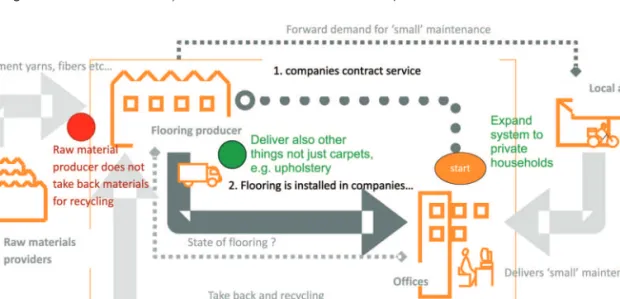
After completing step 1 you familiar with the satisfac-tion unit and the reference system that you are dealing with. Furthermore, you have identified the strengths and weaknesses, problems and opportunities of this existing system and of the future of the system according to the expected developments. You finished a ranking of prob-lems and opportunities and selected the most impor-tant ones. You have drawn a map of the existing system and its actors. You might even be able to mark the points of problems (red) and of opportunities (green) in the System Map of the existing system.
S
ST
TE
EP
P 2
2:: P
PS
SS
S IId
de
ea
a G
Ge
en
ne
er
ra
at
tiio
on
n
Tools:> PSS Idea generation
> > Tool: Sustainability Guidelines Level 1 > Representation of new PSS concepts > > Tool: Format of PSS concept description > Selecting the most promising PSS concepts > > Tool: Sustainability Screen
> > Portfolio Diagram Sustainability and Feasibility
Table 2 ___ (see also Worksheet 1) List of Problems and Opportunities
44
Based on the analysis of the existing system, now the challenge is develop concrete ideas for new PSS that are aiming at improving the existing system taking into account that you might expand the system or even end up with a completely new system. The goal of the idea generation should be to solve the identified problems, take the opportunities and satisfy the identified con-sumer/customer demands and – of course – the new solutions should be as sustainable as possible.
To do so, it is necessary to identify exactly which consumer or customer demands the new PSS should fulfill. This decision should be taken based on the analy-sis of step 1: Consumer demands that are fulfilled in the current system but also demands that are not yet com-pletely satisfied have been identified. So take a look at this list and decide which items are promising demands to deal with in the new PSS. Here it is very sensible (or essential) to choose demands that are not yet fulfilled and or demands that you expect to still be there in the future or even might increase in the future.
Then consult the following sustainability guidelines sorted according to the three sustainability dimensions (environment, socio-cultural, economic) to help you formulating new sustainable PSS solutions.
T
TO
OO
OL
L:: S
SU
US
ST
TA
AIIN
NA
AB
BIIL
LIIT
TY
Y G
GU
UIID
DE
E--L
LIIN
NE
ES
S ((L
LE
EV
VE
EL
L 11))
These guidelines help to develop solutions and ideas that are moving the system towards greater Sustainability. They are formulated on two levels:
1> Level one is introduced below because Level one guidelines ask inspiring questions that are suited for idea development.
2 > Level two Guidelines are more detailed
recommendations and therefore introduced in the PSS Design phase (Step 3).
The guidelines are organised in 6 criteria per each of the three dimensions of sustainability.
The criteria are relevant for the Sustainability of PSS and given in the table below. In the PSS Sustainability guidelines each criterion is expanded by questions (level1) and recommendations (level2). Please see PSS worksheets 3 to 5 for level 1 and worksheets 9 to 11 for level 2.
45
How to work with the PSS Sustainability
guidelines:
This can be done in a brainstorming workshop with a group of experts or alone and requires minimum 2 hours time:
Generally it is interesting to work through all the 6 criteria of the 3 sustainability dimensions, i.e. 18 criteria. However, not all of them are of the same importance for every PSS project. Thus a first step can be to set pri-orities and do a weighing of the criteria. For this use Worksheet 2, the checklist for analysis of the existing reference system and setting priorities. With the help of this checklist you can identify for each criterion if it is of High (H), medium, (M), Low (L) or no (N) priority for
your specific system. Mark the specific priority on the worksheets for each criterion.
In parallel to the Sustainability guidelines we suggest to use the Sustainability Radars to visualise the priori-ties and evaluate and compare different new solutions with the existing reference system.
Here you can start using the Radars by identifying the given priorities, i.e. transfer these priorities to the three sustainability radars.
(30 minutes)
Next follow the given questions and suggestions in the guidelines especially for the criteria with high and medium priorities, when developing new PSS ideas to fulfill the function/satisfaction that you have defined as the goal of the new PSS. Do this, for instance, in an idea brainstorming. Brainstorm 10 to 15 minutes per each of
46
the selected criteria (also possible in workgroups). Take notes (words or sketches) of the developed ideas, e.g. using memo slips, so that after completing the exercise the cards can be used to cluster and rank the collected PSS ideas.
(90 minutes)
The guidelines:Below we only show the first block of each sustainability dimension. The complete guide-lines can be found in the annex (worksheets 3 to 5).
A. Environmental guidelines: System eco-effi-ciency, Level 1
These guidelines should lead to eco-efficient solutions (win-win: environmental + economic) by new stake-holders partnership/relations.
See worksheet 3.
B. Socio-cultural guidelines, Level 1
These guidelines should lead to socially and culturally beneficial solutions.
47
C. Economic guidelines, Level 1
These guidelines should lead to long term economical-ly beneficial solutions.
See worksheet 5
Results: new PSS ideas collected while working through the guidelines
The outcome of working through the sustainability guidelines is many new PSS ideas that are likely to improve the current system in the direction of
sustain-ability. These ideas first of all have to be sorted, duplica-tions have to be eliminated and the ideas shall be clus-tered so that the amount can be reduced and they can combine to a more complete PSS concept. Then they have to be described in a way that they can be discussed and evaluated. Please use the approach described below to do so.
48
T
TO
OO
OL
L:: R
RE
EP
PR
RE
ES
SE
EN
NT
TA
AT
TIIO
ON
N O
OF
F N
NE
EW
W P
PS
SS
S
C
CO
ON
NC
CE
EP
PT
TS
S
The new PSS concepts (a more elaborated idea) must be described in a nice and clear way, so that they can be discussed, communicated and evaluated. For that we suggest to use a short descriptive text, a system map like the example given in step 1 (but now for the new product service system) and some tables as suggested in the following:
The important elements that have to be generated to get an overview about the new concepts are:
> Short description of the new PSS concept. > System map that describes the PSS from the cus-tomer’s/consumer’s point of view.
> Network of key actors and how it is organised. > Revenue model: how is the cash flow through the system, who pays whom for what.
> Key material parts of the system, the material infrastructure, technology used.
> Key immaterial (service) parts of the system, organisation, information etc.
An example can be found in worksheet 6.
Results of these activities:
A number of new PSS concepts are generated that are able to improve the problems/weaknesses and use the opportunities as identified in step 1 and follow as much as possible the sustainability guidelines. The PSS concepts are described in detail as much as possible for the stage of idea generation and a first estimation about their sustainability has been completed.
Selecting the most promising PSS
con-cepts
After generating a number of new PSS concepts, the task is now to select the most promising ones. For that it is necessary to look at two dimensions:
(a) > which of the new solutions are the most sus-tainableones (in all three dimensions).
(b) > which of the new solutions have the most promising market potential and are not too problematic for implementation, i.e. meeting clients’ demands, feasible in terms of technology,
organ-isational aspects and related to the starting point of your company/ organisation and the network of actors involved.
For these two areas we introduce two helpful tools below.
(a) TOOL: PSS SUSTAINABILITY SCREEN
Please use the following qualitative assessment tool to evaluate your ideas according to their sustainability. PSS Sustainability screen
The starting point of this simple screening tool for the Sustainability of PSS is the description of a PSS concept that has the same (or better) functionality/ user satisfac-tion as a competing or reference system. The tool works as follows:
> The three sustainability dimensions are evaluated. > For each aspect, 6 key criteria are defined and questions referring to that criterion are asked.
> Each criterion can be scored. + means ‘better than the reference system’, ++ means ‘radically better’, = means equal, or – means worse than the reference sys-tem.
> Scores are summed up per sustainability dimen-sion.
(Use worksheet 7)
Please use these results to confirm or change your preliminary estimation of the Sustainability of the PSS solutions that you have generated in the concept description and fill it into the description form (work-sheet 6).
(b)
TOOL:
PORTFOLIO
DIAGRAM
SUSTAINABILITY AND FEASIBILITY
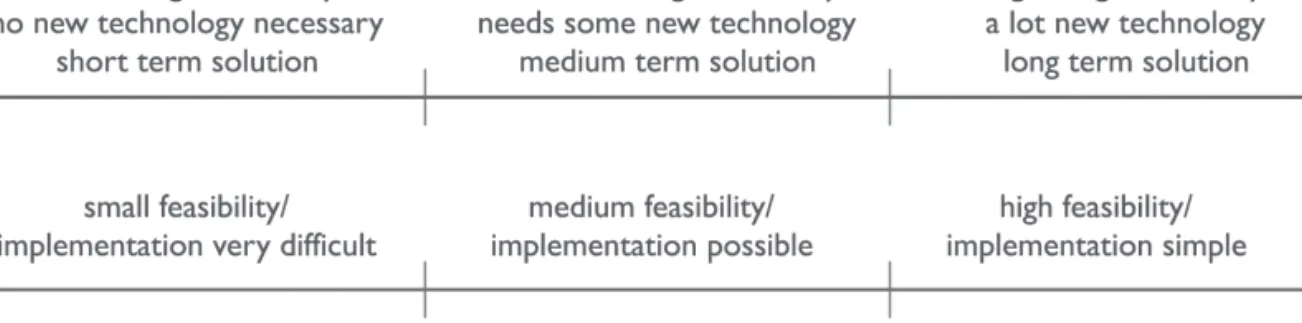
In addition to the economic aspects considered in the Sustainability Checklists, another important perspective for evaluation and selection of the best PSS concepts is feasibility and market potential. It is important to esti-mate how difficult it would be to implement the new PSS idea. Is the technology already there or would it need new technology development? Is there a big change necessary in the frame conditions of the system, e.g. public infrastructure, legislation etc.?
fol-49
lowing matrix:Then try to discuss implementation and feasibility issues. Do you think customer acceptance for the new PSS will be high? Is there a big demand for the solution? Consult your marketing experts. Do research if possi-ble. Will it be difficult to implement the solution for your company/the consortium of companies? Do you have the right knowledge; can you get the right partners to increase your capacity if necessary?
Now summarise all the results of the evaluation into the following PSS portfolio diagram. It offers two axes for the dimensions:
> Sustainability (all three dimensions as evaluated before).
> Feasibility/ Implementation (as evaluated in the two matrices above).
Evaluate the PSS concepts compared to each other and by consulting all the previous evaluations you have completed. Then position the solutions in the diagram according to the high or low potential regarding
sustain-ability and feasibility/ implementation. It is recommend-ed to complete this step in an expert workshop to reduce the subjectivity of the evaluation results and to hear more than one opinion about it.
Now it becomes clear that the solutions in the upper right field are very good, while the solutions in the lower right field are more short term and the solu-tions in the upper left field are more long term. The ones that end up in the lower left field are not interest-ing because they are neither sustainable nor very feasi-ble. In the next step you should only take solutions fur-ther that are positioned in the upper right field, because these are solutions that are best in all dimensions. But maybe you can shift solutions from the upper left field to the right or from the lower right field up, by modify-ing them. Maybe you are able to combine ideas or take important elements from one idea into another. Maybe you can expand one concept that has not yet been eval-uated as successful, into a new direction e.g. with a few amendments you might be able to turn excellent tions that are more long term into short term solu-tions, or make concepts that are very promising in terms of feasibility more sustainable etc.
Results of this step 2
The final results of the idea generation and prioriti-sation phase is a number of new PSS concepts that are evaluated and compared according to their sustainabili-ty and feasibilisustainabili-ty.
This is a good basis to make the decision, which of the concepts should be taken further to the next step 3, where the selected concepts are detailed and elabo-rated further.
Figure 3 ___ Sustainability/ Feasibility Portfolio Diagram (cf. worksheet 8)
50
S
ST
TE
EP
P 3
3:: P
PS
SS
S d
de
es
siig
gn
n
Tools> Sustainability Guidelines level 2
In this step, the chosen PSS concept(s) from step 2 are elaborated and detailed further.
One way to do so is to detail the system map of the selected new PSS system really in depth and to com-plete the system drawing (for an example compare step 1 and chapter internal communication).
To detail the new PSS concept, include the following important considerations for the design of PSS:
R
Re
el
la
at
tiio
on
n o
of
f m
ma
at
te
er
riia
al
l p
pr
ro
od
du
uc
ct
t a
an
nd
d
iim
mm
ma
at
te
er
riia
al
l s
se
er
rv
viic
ce
e
Identify the importance of material products including infrastructure in the system versus the importance of immaterial service. Check for options to increase the importance of immaterial service and decrease the importance of products. Can you imagine a solution using almost no material input? Will this have positive effects on environmental aspects of the offer? Can the value creation in the whole system for all actors be de-linked from the consumption of raw materials and ener-gy?
If you need products in the system then make clear: Is your design based on already existing products (that you/ a partner in the system produce/s)? Can you use existing products available on the market or do you have to design a new product/ get a new product designed? What makes the system most efficient, what is the most elegant combination of product and service? Does the product have to be designed to meet the service aspects or does the service have to be designed to meet the product characteristics? According to this decision the specifications for product design respective service design have to be formulated.
To do so, please expand the description of the technolog-ical architecture/ material infrastructure in the system and the description of the organisational architecture/ the imma-terial processes in the system as started in step 2 (work-sheet 6).
C
Co
o--o
op
pe
er
ra
at
tiio
on
n a
an
nd
d p
pa
ar
rt
tn
ne
er
rs
sh
hiip
p
Identify which actors are needed to offer the product-service-system in a professional way taking into account which core competencies you and your partners have, which expertise you lack, which additional competen-cies you need, how this can best be organised so that all partners profit in the system and that it is as cost effi-cient as possible. Understand how co-operation will work in practice, what information exchange is neces-sary, which cost occur for the partners and how the revenues have to be distributed, which contracts have to be made etc.
To clarify these points please expand the description of the value network/ actors and roles table that you started in step 2 (worksheet 6).
O
Or
rg
ga
an
niis
sa
at
tiio
on
n
Identify the product life cycle and the service ‘life cycle’ and how they come together. Connect this with actors responsible for product development and design and service development and design, and the timing of the production of product and production of service. How can the system be organised in a highly professional way offering the PSS as close and convenient as possible to the customer/ consumer? How can you avoid transport of material products or people in the system?
To clarify this, please expand the description of the PSS concept (the storyboard) that you have started in step 2 including all the organisational aspects (worksheet 6).
C
Cu
us
st
to
om
me
er
r// C
Co
on
ns
su
um
me
er
r r
re
el
la
at
tiio
on
n
Identify exactly which consumer/ customer needs you want to fulfill and how you can create as much value as possible for the customer for as little cost as possible. Identify exactly which target group you are aiming at. For example:> How open is your customer for using services instead of or accompanying products? How will you communicate the PSS to your customers?
> What are the benefits for the customers compared with other existing offers and how can you increase them? Is there a possibility to change your customer’s behaviour towards less material and energy consump-tion?
51
with waste disposal) and risks (e.g. handling hazardoussubstances) for your customer by offering a new P-S-System?
> Can you offer opportunities for your customers to be involved in the design of the system, or possibilities to learn, get interesting information, and get more skills through the new PSS? How can you reach a high cus-tomer/ consumer satisfaction and therefore establish a close customer relationship through the new system?
To expand this point it is beneficial to create an adver-tisement that would convince the customers about his/ her benefits connected with the new PSS concept. Try to make it as real as possible and list good arguments that would con-vince the customer to choose your PSS (instead of buying a product or going to the competitor).
U
Us
se
er
r iin
nt
te
er
rf
fa
ac
ce
e
In a PSS with a high value in service the user interface is normally dominated by personnel rather than by the material product. Thus it is very important how this user interface is designed, how the staff that is in con-tact with the customer is trained and motivated. As services themselves are mainly immaterial the question is how the brand image and the value is communicated, how the point of sale can be designed in a way that expresses the idea and character of the product-serv-ice-system, increases confidence of the customers, and attracts customers to use the system. Check if you have the right expertise on board and the right information about your target group to formulate the design speci-fications for the user interface. If not, get the missing expertise and knowledge, e.g. by involving external experts, by training your designers and marketing staff, by learning from experiences of other comparable cases etc.
Check if there are any obstacles, e.g. if your sales people are paid by the number of product sales, then they will not like a service concept, unless you offer them other (financial) incentives to sell the PSS instead of products. Are your employees and retail people capa-ble of explaining the new PSS offer or do they need training?
Add a detailed description of the user interface in the PSS concept description and identify needs for training and
incentives for personnel.
F
Fiin
na
an
nc
ciia
al
l S
St
tr
ru
uc
ct
tu
ur
re
e
Please be aware that in a PSS quite often the pay back period (return on investment) for a produced product is longer than in a pure product-selling concept, e.g. car sharing, leasing, or contracting. Do you have the financial resources or the right financing partners on board to bridge this period? Furthermore in a co-operation of different companies the revenue distribution in the sys-tem has to be clarified and fixed in contracts. The same is true for the tasks and duties that the co-operating partners have, e.g. guarantees, who is responsible in case of an accident etc.
Please expand the description of the revenue model/ money flows through the system as started in step 2 (work-sheet 6).
In addition to these important generic issues the fol-lowing sustainability guidelines level two are recom-mended to detail and improve the sustainability of the new PSS concept.
TOOL: SUSTAINABILITY GUIDELINES
LEVEL 2
These guidelines are the continuation of the guidelines level one, which were introduced in the idea generation phase (step 2). The level 2 guidelines can be used in the same way as guidelines level 1, but this time for the detailed design of the chosen PSS concept. Please check and identify first the priorities of the criteria for your new PSS concept (High, Medium, Low or No) and then detail your PSS concept with the help of the guidelines as given below. Especially the guidelines for the criteria with high and medium priority should be considered.
Here we introduce only the first block of the 6 cri-teria for the 3 sustainability dimensions. The full guide-lines can be found in the annex (worksheet 9 to 11).
A. Environmental guidelines, Level 2:
See worksheet 9
B. Socio-cultural guidelines, Level 2:
53
C. Economic guidelines, Level 2:
See worksheet 11
Results of this step 3:
Now the new PSS concept has been elaborated and is described in detail using a system map, the description form as given in step 2, which was elaborated in this step 3, an advertisement for the new PSS system with all the arguments that are able to convince the cus-tomers.
Next a final sustainability evaluation can take place to understand if your new PSS concept is really going in the right direction and is so promising that it should be materialised. We suggest using the following tool:
S
ST
TE
EP
P
4
4::
E
Ev
va
al
lu
ua
at
tiio
on
n
o
of
f
D
De
et
ta
aiil
le
ed
d P
PS
SS
S
Tool> Sustainability evaluation of detailed PSS
T
TO
OO
OL
L:: S
SU
US
ST
TA
AIIN
NA
AB
BIIL
LIIT
TY
Y E
EV
VA
AL
LU
UA
AT
TIIO
ON
N O
OF
F
D
DE
ET
TA
AIIL
LE
ED
D P
PS
SS
S
Once the new PSS solution has been detailed and the implications are much clearer than in the previous phas-es it is time to do a final sustainability check, before it is decided to realise the solution and launch it on the mar-ket.
For this, the three radar diagrams as introduced in step 2 can be used to check the improvement (or wors-ening) of the new solution compared to the existing ref-erence situation that has been analysed in step 1.
Please use the three radar diagrams, one for each sustainability dimension (environment, socio-cultural, economy) with the six sustainability criteria and assess the new PSS solution in comparison with the existing reference situation. You have to decide if the new solu-tion is improving radically (++), improving incremental-ly (+), is on the same level (=), or even worse than the existing/ reference situation (-). To go more in detail here, you can use again the PSS Sustainability screen (see worksheet 7), this time to compare the two sys-tems: the existing reference system that you analysed in step 1 and the newly developed PSS. Mark your decision for every criterion in the radar diagram and finally
con-nect the marks to create the Sustainability Profile of the new solution compared to the existing system. Please use worksheet 12.
If the evaluation has been done for all three sustain-ability dimensions it shows whether the new solution is really going into the right direction. The further to the outside of the radar the profile expands, the better the solution. It shows also if there are any weak points left that should be improved and eliminated before market launch. The Radars can also be used to compare differ-ent new PSS solutions, which deliver the same function-al or satisfaction unit, with each other.
Important aspects out of the evaluation should be integrated into the specifications for implementation. For example, if it is discovered that transportation is a critical issue, the specifications for implementation could ask for short transportation distances and effi-cient transportation means etc.
Results of steps 3 and 4:
Now the new PSS concept has been elaborated as much as possible to satisfy the customer’s/ consumer’s demands in order to be sustainable and profitable for the companies or consortium of companies offering it. It has been evaluated and compared with the existing reference system. According to the outcome of the evaluation the solution has been amended further.
Next the company has to decide how to implement the new PSS solution. To do so the critical implementa-tion issues must be identified for the new PSS. That is what we describe in the next step and that leads to suc-cessful implementation.
S
ST
TE
EP
P 5
5:: P
Pl
la
an
nn
niin
ng
g P
PS
SS
S iim
mp
pl
le
e--m
me
en
nt
ta
at
tiio
on
n
Tools> List of specifications for PSS implementation > Business plan for new PSS
After the final evaluation has been carried out and the new PSS concept has been evaluated as good enough to implement it in the market a lot of activities have to fol-low:
54
and the partners have to agree on contracts and a form of organisation,
> the material parts of the system have to be designed or purchased,
> the immaterial/ organisational parts of the system have to be organised and designed,
> the user interface has to be designed
> and the brand identity, communication, advertise-ment must be designed and planned
> a business plan for the PSS has to be developed These processes are very company/ consortium and PSS type specific. Therefore we suggest in this chapter
only the following format to identify and decide the most important aspects and specifications for imple-mentation. The participating companies in the pilot project have to make sure that they have the right capacities to complete the implementation and market launch of the chosen PSS concept successfully.
T
TO
OO
OL
L:: L
LIIS
ST
T O
OF
F S
SP
PE
EC
CIIF
FIIC
CA
AT
TIIO
ON
NS
S F
FO
OR
R P
PS
SS
S
IIM
MP
PL
LE
EM
ME
EN
NT
TA
AT
TIIO
ON
N
Source: SusProNet, U.Tischner./A.Tucker See work-sheet 13.