Large-Scale
Pattern-Based Information
Extraction from the
World Wide Web
Sebastian Blohm
Sebastian Blohm
Large-Scale Pattern-Based Information Extraction from the World Wide Web
Large-Scale Pattern-Based Information
Extraction from the World Wide Web
by
Impressum
Karlsruher Institut für Technologie (KIT) KIT Scientific Publishing
Straße am Forum 2 D-76131 Karlsruhe www.ksp.kit.edu
KIT – Universität des Landes Baden-Württemberg und nationales Forschungszentrum in der Helmholtz-Gemeinschaft
Diese Veröffentlichung ist im Internet unter folgender Creative Commons-Lizenz publiziert: http://creativecommons.org/licenses/by-nc-nd/3.0/de/
KIT Scientific Publishing 2011 Print on Demand
ISBN 978-3-86644-479-9
Dissertation, Karlsruher Institut für Technologie Fakultät für Wirtschaftswissenschaften, Tag der mündlichen Prüfung: 22.01.2010 Referenten: Prof. Dr. Rudi Studer
Abstract
Extracting information from text is the task of obtaining structured, machine-processable facts from information that is mentioned in an unstructured manner. It thus allows systems to automatically aggregate information for further analysis, efficient retrieval, automatic validation, or appropriate visualization. Information Extraction systems require a model that describes how to identify relevant target information in texts. These models need to be adapted to the exact nature of the target information and to the nature of the textual input, which is typically ac-complished by means of Machine Learning techniques that generate such models based on examples. One particular type of Information Extraction models are textual patterns. Textual patterns are underspecified explicit descriptions of text fragments. The automatic induction of such patterns from example text fragments which are known to contain target information is a common way to learn this type of extraction models.
This thesis explores the potential of using textual patterns for Information Ex-traction from the World Wide Web. We review and discuss a large body of related work by describing it within a common framework. Then, we empirically an-alyze the effects of a multitude of design choices in pattern-based Information Extraction systems. In particular, we investigate how patterns can be filtered ap-propriately. We show how corpora of different nature can be exploited benefi-cially and how the nature of the patterns influences extraction quality. Finally, we present new ways of mining textual patterns by modelling pattern induction as a well-understood type of Data Mining problems.
Acknowledgements
I am indebted to many people who guided and supported me during working to-wards my Ph.D. and writing this thesis. Most prominently, these are my advisors Rudi Studer and Philipp Cimiano. Rudi Studer gave me the chance to do this re-search and the guidance, trust and freedom I needed to complete it and learn a lot. Philipp Cimiano made this work possible through invaluable discussions, ideas and optimism.
Furthermore, I would like to thank my colleagues at the AIFB institute and in the X-Media project. The friendly, focused environment and the chance to build on a large body of previous experience was a great asset to me. Most of all, I would like to thank Johanna V¨olker, Krisztian Buza and Frank Dengler for their commitment, trust and patience during our collaborations and Sebastian Rudolph for comments and discussions during the production of this thesis.
Additionally, I am grateful to Yunyao Li, Thomas Hampp and Shiv Vaithyanathan and their colleagues at IBM for an intense collaboration during my stay at the Unstructured Information Mining group in Almaden which taught me entirely different perspectives on my research.
Most of the text in this thesis was written during my stay at TU Delft. I would like to thank Ursula and Philipp Cimiano and the Web Information Systems group of Geert-Jan Houben for their hospitality.
I owe a lot to Kathrin Heuser, Olesya Isaenko, Maria Maleshkova, Tobias Hauth, Stefan Kittler, Pascal Kretschmann, Egon Stemle, J¨urgen Umbrich and Andreas Wagner who contributed their ideas and a lot of labor to my research and project work as thesis students or assistants in our lab.
Finally, I thank my parents and my sisters for supporting and motivating me not only but more intensely during my work towards this thesis.
My Ph.D. studies were financially supported by two generous Ph.D. Fellow-ship Awards from IBM and a travel grant from the Karlsruhe House of Young Scientists. During my Ph.D. studies I worked in the X-Media project sponsored by the European Commission as part of the Information Society Technologies (IST) program under EC grant number IST-FP6-026978.
Contents
1 Introduction 1
1.1 Motivation . . . 1
1.2 Problem Statement . . . 2
1.3 What is Special about Operating at Web Scale? . . . 4
1.4 Trends in the Field of Information Extraction . . . 5
1.5 Contribution . . . 6
1.6 Reader’s Guide . . . 7
1.7 Published Results . . . 7
I
Preliminaries
9
2 Methodological and Technical Foundations 11 2.1 Terminology. . . 112.2 Natural Language Processing . . . 15
2.3 Machine Learning and Data Mining . . . 21
2.4 Information Retrieval . . . 30
3 Information Extraction Tasks 35 3.1 Terminology. . . 36
3.2 Dimensions of Information Extraction Tasks . . . 36
3.3 Prominent extraction tasks . . . 40
3.4 Challenges in IE. . . 41
3.5 Focus of this Thesis . . . 42
4 Approaches to Information Extraction 45 4.1 Applications and Evaluation . . . 46
4.2 Machine Learning for Information Extraction . . . 51
vi CONTENTS
II
Large-Scale Extraction Methods
67
5 The Iterative Pattern Induction Framework 69
5.1 Framework Overview . . . 70
5.2 Patterns for Relation Extraction . . . 72
5.3 The Algorithmic Framework . . . 74
5.4 Assumptions and Challenges . . . 76
5.5 The Pronto System . . . 79
5.6 Related Extraction Systems . . . 82
5.7 Evaluation Paradigms . . . 100
5.8 Performance of Systems in the Literature . . . 103
6 Controlling Quality of Induced Patterns 105 6.1 Filtering Functions . . . 106
6.2 Experimental Setup . . . 111
6.3 Analysis of Results . . . 115
6.4 Summary . . . 124
7 Text Corpus and Extraction Dynamics 127 7.1 Related Work . . . 128
7.2 The Problem of Low Redundancy . . . 128
7.3 Approach . . . 131
7.4 Experimental Evaluation . . . 136
7.5 Conclusion . . . 141
8 Efficient Pattern Induction with DM 143 8.1 Pattern Induction as Frequent Itemset Mining . . . 146
8.2 Experimental Evaluation . . . 153
8.3 Conclusion . . . 158
9 Pattern Expressivity 159 9.1 The Role of Pattern Expressivity . . . 161
9.2 Related Work . . . 163
9.3 Taxonomic Sequential Patterns . . . 164
9.4 Pattern Mining . . . 167
9.5 Experiments . . . 169
CONTENTS vii
III
Applications
183
10 Web-wide IE for Market Analysis 185
10.1 The Competitor Scenario Forecast Task . . . 185
10.2 Information Extraction for CSF . . . 186
10.3 Practical Experience . . . 189
10.4 Summary . . . 192
11 Communities And Structured Knowledge 195 11.1 Combining Human and Machine Intelligence . . . 197
11.2 System Design and Implementation . . . 200
11.3 Practical Experiences . . . 202
11.4 Related Work . . . 203
11.5 Summary . . . 204
IV
Conclusion
205
12 Synopsis of Results 207 12.1 Controlling Quality of Iterative Pattern Induction . . . 20712.2 Supervision and Redundancy . . . 208
12.3 Rich Patterns and Scalable Induction . . . 208
12.4 Applications . . . 209 13 Outlook 211 13.1 Application Scenarios . . . 211 13.2 Advancing IE Methods . . . 213 Appendix 217 References 221
List of Figures
2.1 Parse tree example. . . 20
2.2 A linear-chain CRF with Markov assumption . . . 25
2.3 Concept Learning Example . . . 26
5.1 Induction cycle . . . 71
5.2 NFA example . . . 73
5.3 Example pattern (1) as NFA. . . 74
5.4 Iterative pattern induction algorithm . . . 76
5.5 Key components of the Pronto System . . . 79
6.1 Pattern learning procedure . . . 113
6.2 Precision over scoring strategies . . . 118
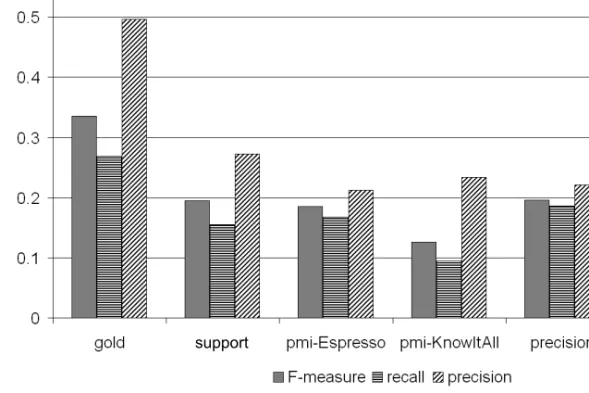
6.3 Precision, recall and F-measure for strategies . . . 120
6.4 Precision over recall for experiments . . . 121
6.5 Impact of filtering on precision and recall . . . 122
6.6 Development of precision over iterations . . . 123
6.7 Number of correctly extracted instances . . . 124
7.1 Page co-occurrences on Wikipedia . . . 129
7.2 Combined Web and wiki pattern induction algorithm . . . 132
7.3 Wikipedia data model example . . . 134
7.4 Performance comparison over seed set size . . . 137
7.5 Performance comparison over seed set size for individual relations 139 7.6 Performance over iterations for varying seed set sizes . . . 140
8.1 The Apriori algorithm. . . 148
8.2 Apriori example . . . 149
8.3 Extraction quality of the itemset-based approach . . . 155
8.4 Relative differences in F-measure of extraction results with FIM . 156 8.5 Running time comparison . . . 157
x LIST OF FIGURES
9.2 Possible choice of features for a pattern from the example sentence.160
9.3 Possible effects of pattern class variation . . . 162
9.4 The pattern classes considered . . . 166
9.5 The extended Eclat algorithm. . . 170
9.6 Taxonomy mining example . . . 171
9.7 Excerpt from the taxonomy . . . 172
9.8 F-measure by relation . . . 178
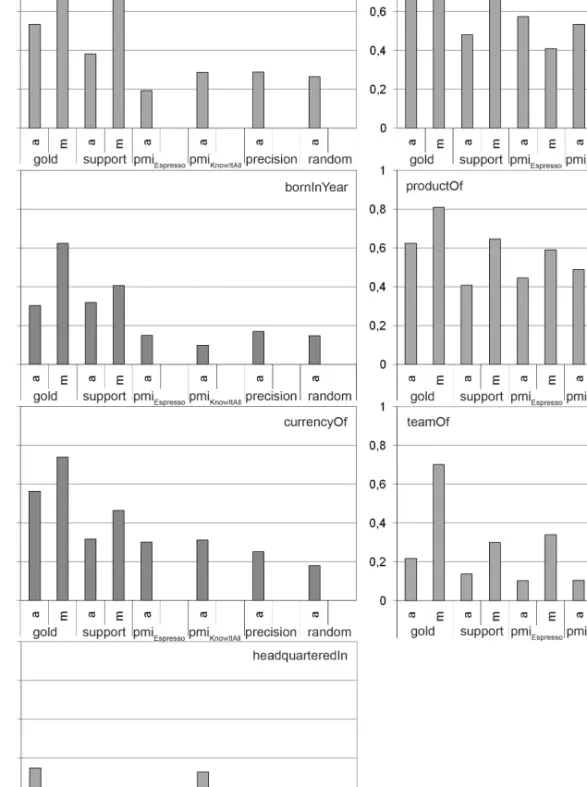
9.9 Extraction quality for the different pattern languages . . . 179
9.10 Extraction quality for the different relations . . . 179
11.1 Integrating wikis with IE tools – basic architecture . . . 197
11.2 Annotated wiki source text. . . 199
11.3 Query result in Semantic MediaWiki . . . 200
List of Tables
2.1 Parts of speech in the WSJ tagset . . . 18
5.1 Performance results reported in the literature . . . 104
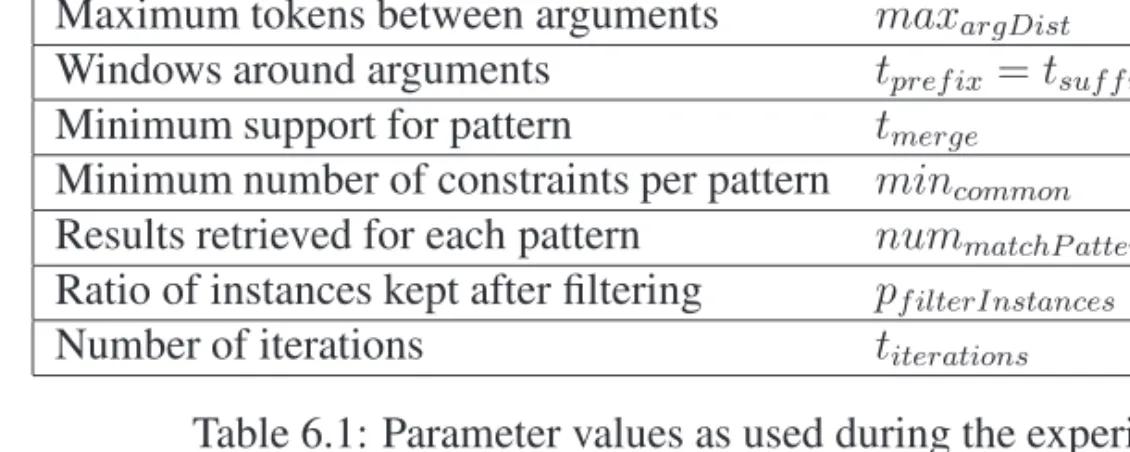
6.1 Parameter settings for experiments . . . 116
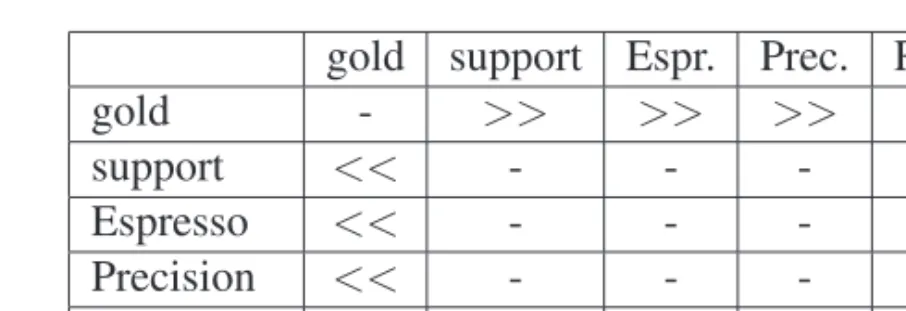
6.2 Significance test on extraction precision . . . 117
6.3 Properties of the evaluation relations . . . 125
7.1 Parameter values for Web and Wikipedia extraction . . . 136
8.1 Parameter values for standard, FIM and FIM tuned . . . 154
9.1 Mining time, counts, precision and recall for the 3 taxonomies . . 176
10.1 The feature set for CRF-based annotation . . . 190
10.2 Precision of extraction for the different relations . . . 191
Chapter 1
Introduction
1.1
Motivation
Technical and economic trends have increased the need for automatic extraction of information from large bodies of text such as the World Wide Web. The amount of content available on the Web is not only rapidly increasing but is also being produced in an ever more individualized manner because a growing number of private users create and share Web content [O’Reilly, 2009]. Grasping important aspects of this content automatically has become a key requirement for many ap-plications. Web search increasingly relies on extracted information to establish a better correspondence between the user’s query and the document’s content by going beyond the mere presence or absence of words. In the face of a large amount of ever-growing Web content, market analysts rely on automatically extracted in-formation to generate an overview of trends, rumors and customer opinions (cf. Chapter10). As a further example, scientific research faces millions of potentially relevant documents (e.g. 18 million in the Medline medical literature database) the automatic analysis of which has the potential of supporting and accelerating sci-entific progress. A detailed description of applications of Information Extraction is given in Section4.1.
The task of automatically extracting information from text can be thought of as compiling a list or some other structured representation of the facts that are needed for the task at hand. As an example, market analysts may compile a list of all products in the market they are surveying along with their vendors. From reading a sentence like
2 CHAPTER 1. INTRODUCTION
they conclude among other things that Audi is the maker of the A4 TDI and may add a corresponding assertion to their list.
Structured information has several advantages over text. In particular it ismore concise, that is, looking at an appropriate table may save us reading hundreds of pages of text. Furthermore, it is machine interpretable. If the structure of the information is formalized in a way that a computer can process, the computer can carry out tasks with this information. If for example, a further list exists that specifies that “TDI” models feature a diesel engine, a computer would be able to answer the question “Does Audi produce vehicles with diesel engines?”
Concluding that Audi produces the A4 TDI when reading “Audi’s new A4 TDI” is an almost trivial inference for a human reader and is yet hard for a ma-chine because mama-chines are limited to executing previously encoded instructions. Human readers would recognize Audi as a vehicle maker and if not would know that an unfamiliar capitalized word is likely to denote a company if the context suggests this. They further know that car makers tend to release new models which have names that frequently consist of combinations of letters and numbers. Several phenomena make it difficult if not impossible to produce a computer sys-tem that approaches such a phrase with the same inferences and the same ease as human readers. The large variability of language requires to account for an infinite amount of possible expressions that imply the same information. The am-biguity of terms and phrases further makes interpretation difficult. For instance, “A4” may also refer to an ISO standard paper size or a fashion magazine. Finally, the extraction has to perform faster than human interpretation of the content in order to keep up with the scale of the text bodies to be processed. Information Extraction therefore relies on strongly simplifying models that encode how rele-vant information may be mentioned in text. For the example phrase, such a model could contain the following instructions: If the sequence “’s new” is present in a text that is about the automotive domain and is preceded by a capitalized word
xand followed by a combination of letters and numbers y, assume thatxstands for the maker ofy. This thesis is about ways to create and apply such models for extracting information from large amounts of Web documents.
1.2
Problem Statement
This thesis investigates a paradigm of Information Extraction that can be char-acterized as global relation extractionbased on seed examples. This means that processing starts with a pre-defined relation and a small set of examples that stand in this relation (the “seeds”). Throughout this thesis, we will use the locatedIn
relation as an example target relation. The following is an example seed set that can define a target relation:
1.2. PROBLEM STATEMENT 3
Amsterdam The Netherlands Angers France Camptown Lesotho Hollywood California Karpacz Poland Mannheim Germany Plymouth Massachusetts Salinas Brazil
Note that this is the only information on the relation the system has. Human readers can see from this list that on the left hand side, all items are cities and on the right hand side are countries. They know that a single city can be in only one country, that there are cities that carry the same name in different countries but that country names are relatively few and in the general case unique. How-ever, this additional information relies on human background knowledge and is therefore not available for an automated system. It thus helps to imagine the seed examples as sequences of characters in an unfamiliar alphabet. All one would be able to do is to spot mentions of the seeds and observe commonalities and differ-ences among them. The goal is to generate many more records for this table i.e., extracting further instances of this relation. To come up with these instances, ob-servations are made about how known instances are mentioned in the text. These observations are generalized to a model that is characteristic of the relation. The model describes those properties (features) of text fragments that are good indi-cators that the fragments mention a target relation instance. In sum, theinputis a small list of relation instances that (by example) define a relation and the intended
output is a larger list of instances of the same relation. The focus of this work is global relation extraction, that is to find and formalize knowledge that holds generally true as opposed tolocalextraction that aims at deriving the information provided by a given sentence regardless of the question if it holds generally true. Furthermore we focus onpattern-basedInformation Extraction which is the most appropriate approach for Web-based extraction. Patterns are descriptions of text fragments that can be read as a rule: If a given pattern is present in a text fragment (i.e. the patternmatchesthat fragment) relevant information is present. We aim at automatically deriving such patterns from seed examples.
More formally, the task can be characterized as follows: Given a specific bi-nary relation R, find instances (x1, x2) ∈ DomainR × RangeR that stand in
the relation R. Thereby, DomainR and RangeR need not be known. The
ap-proach, i.e. learning an extraction model means finding a relation-specific map-ping matchR : T → {0,1} that decides for each fragment of text t ∈ T,
4 CHAPTER 1. INTRODUCTION
extractR : T → NDomainR×RangeR1 that determines the relation instance that is
present.
extractR(t) = {(x1, x2)|(x1, x2) is expressed at some position int}
The decision thatmatchR andextractRstand for may or may not happen in the
same processing step. Clearly, with the help of statistical methods and with lim-ited knowledge, matchR can only be approximated. The goal is to produce an
approximation that is precise in the sense that it does not produce many incorrect matches and has a large coverage thus identifying many of the possible extrac-tions.
Given that we want to learnmatchR using observations on known outcomes
on a subset ofmatchR’s domain we need countablefeaturesto actually formalize
these observations. In its most general sense, each feature is a partial function
f : T ⇁ Df which decides if a given feature is present in a given text fragment t ∈ T and if so, to which degree d ∈ Df. We can assume Df = [0,1]and for
most features even{0,1}.
1.3
What is Special about Operating at Web Scale?
The special focus of this thesis is on extracting information from very large doc-ument collections. There are several reasons why the large scale of the extraction task requires a set of approaches distinct from classical Information Extraction. Most prominently, both the computational costs for the induction of the extrac-tion models (“learning”) and their application (“matching”) heavily depend on the amount of text that is processed. Most matching mechanisms evaluate all text fragments one by one making the amount of processing time grow linear with the amount of text. When operating with the entire Web, this is no longer accept-able. It is hence required to make use of indexing techniques to access relevant text sections directly. The focus of this thesis is thus on textual patterns which can be applied to search indicators for efficient matching. In very abstract terms, learning for Information Extraction is the process of observing relevant properties that allow the system to automatically identify in the data relevant information. This process requires to compare different relevant text fragments. The amount of possible comparisons grows more than linear with the amount of training input to be mined. Due to the diverse and uncontrolled nature of Web corpora techniques for mining large amount of text become necessary.
1We use2Ato denote the powerset ofAandNAto denote the set of all possible multisets of zero or more elements fromA.
1.4. TRENDS IN THE FIELD OF INFORMATION EXTRACTION 5
On the upside, large corpora like the Web are an attractive source as they are rich in up-to-date information. At the same time, most relevant information is likely to appear in several positions redundantly so that errors that occur at one position may be corrected by extractions in other positions.
1.4
Trends in the Field of Information Extraction
While the extraction of information has been studied for a long time (cf. Sec-tion4), recent developments in various areas of Computer Science, some of which we mention below, have shifted both the goals and the methods of Information Extraction research. Research in the area ofSemantic Web Technologieshas pro-vided standard representations for formalized knowledge. These formalisms allow systems to express information about document content in a structure with a for-mally defined meaning that in turn enables automatic integration and interpreta-tion of content. Semantic Web technologies allow for presentainterpreta-tion (e.g. browsing or searching) of documents in a way that does justice to the formalized content or to infer information that is not explicitly specified but can be inferred by means of logical reasoning. At the same time, Machine Learningand Data Mining meth-ods have experienced trends towards processing larger amounts of data as well as modeling and exploiting structure that is present in the data (cf. Section2.3). These developments have enabled the uptake of Machine Learning and Data Min-ing methods in the field of Computational Linguistics. Today, many linguistic analysis steps such as parsing and part-of-speech tagging are routinely done with the help of learned models. In recent years, Information Extraction also started benefiting from such models. Finally, the sheer processing power that is available for extraction tasks has increased. Apart from the development of faster proces-sors and data transfer mechanisms as well as larger main memory and storage solutions, this increase is due to the development of methods for distributed com-puting. As an example, the MapReduce framework [Dean and Ghemawat, 2008], one of the key technologies in Cloud Computing has been designed particularly with document analysis tasks in mind.
In addition to the technical novelties, the nature of the available content has triggered research in Information Extraction. The most prominent example is Wikipedia, which provides millions of articles of relatively high quality organized in categories and portals and partially enriched with semi-structured information. Examples of other attractive sources that have become available and processable for Information Extraction are the above-mentioned Medline texts and online fo-rums.
6 CHAPTER 1. INTRODUCTION
1.5
Contribution
The contribution of this thesis consists of three major aspects.
• An overview is given of pattern-based Information Extraction systems with a strong focus on methods for the automatic induction of such patterns which have evolved approximately over the last 10 years. Furthermore, the focus is put on the extraction of binary relations the meaning of which is specified by example. A variety of pattern induction systems is summa-rized in an abstract framework and many design and configuration options are introduced. Such a framework is necessary as there is no agreed-upon view of the problem in this field of research, let a lone an accepted evalua-tion standard specialized on large-scale extracevalua-tion. We use the framework to illustrate key design alternatives abstracting over different target relations and output structures, input sources and supervision models as well as im-plementation aspects. The framework is introduced in Chapter5along with a plugable implementation which is used in the experiments that constitute the technical contribution of this thesis.
• This thesis presents a series of experiments that aim at deepening the un-derstanding of important design choices within the pattern induction frame-work. Most contributions that have been published in the field so far discuss their work on the system level. That is, almost every new study introduces a new extraction system which typically makes assumptions with regards to many dimensions of the extraction task and alters many design choices at once. However, to understand which key variables govern the setup of a good extraction system, the impact of alternative choices of each of them has to be understood. In particular with the aim of minimal supervision and automatic adaptation to new extraction tasks in mind, understanding the impact of design choices is important. In Chapter6, alternative choices of how to filter for appropriate patterns is analyzed. Chapter 7shows how corpus structure and size have impact on the bootstrapping behavior and in Chapter9, the choice of pattern language is analyzed.
• Finally, an important focus of this work is on large scale extraction. While the application of patterns to the Web is quite common, scala-bility problems during mining have not been addressed in the literature. Most mining algorithms explore a huge space of possible patterns ei-ther by pairwise abstraction or top-down exploration of the search space (cf. Section 5.6.2 for details). Some other approaches are scalable, but do not allow for rich feature integration [Ravichandran and Hovy, 2001;
1.6. READER’S GUIDE 7
Talukdar et al., 2006]. In Chapter8, pattern induction is modelled as a stan-dard Data Mining problem (frequent itemset mining) which can be tackled with highly optimized data structures. In Chapter9, this approach is taken further to allow for more flexible modeling of pattern languages. This way, we analyze, what elements patterns should be able to contain to improve extraction results.
The techniques presented in this thesis are discussed in the context of two application scenarios. One of them is based on a use case from a marketing de-partment in the automotive industry (Chapter10), the other builds on the idea of supporting communities in the compilation of knowledge resources that are useful for human and machine processing (Chapter11).
1.6
Reader’s Guide
This thesis consists of four parts. Part I: Preliminaries, introduces the context of this work. In Chapter 2, methodological and technical foundations from the neighboring fields are presented before the major Information Extraction tasks are introduced in Chapter 3. Chapter 4 presents related work from the field of Information Extraction along with applications and an overview of the relevant tools.Part II: Large Scale Extraction Methodsbegins by presenting a framework of iterative pattern-induction for Information Extraction (Chapter5). Related sys-tems are described by means of this framework. Further an implementation, the
Prontosystem, is introduced. Chapter6 presents experimental results on the ap-plication of the Pronto system to Information Extraction from the Web using a standard search engine. In Chapter 7, further experiments show results about the extraction on a smaller corpus and the added benefit of Web extraction results to reduce the required input seeds. Chapter8presents an efficient mining algorithm for pattern induction applied in the Pronto system before Chapter9investigates al-ternatives in the choice of pattern structures. Part III: Applicationsdescribes two applications of the methods presented in this thesis. One of them supports market analysts in the automotive industry (Chapter10) and one supports online commu-nities in collaborative generation of semi-structured documents (Chapter11). Part IV: Conclusionsummarizes the findings and indicates potential for future work.
1.7
Published Results
We published the analysis of pattern filtering approaches as discussed in Chap-ter6to a large extend at the AAAI conference 2007 together with Philipp Cimi-ano and Egon Stemle [Blohm et al., 2007]. Some further results were presented
8 CHAPTER 1. INTRODUCTION
at the 3rd Web as Corpus Workshop 2007 [Blohm and Cimiano, 2007]. Fur-thermore, we published results on the interaction of extraction from the Web and from Wikipedia at the ECML PKDD 2007 together with Philipp Cimiano [Blohm and Cimiano, 2007]. We presented the mining algorithm for pattern in-duction (Chapter 8) at the Ontology-Based Information Extraction Workshop at KI 2008 [Blohm and Cimiano, 2008]. The work on pattern expressivity (Chap-ter 9) is joint work with Krisztian Buza, Philipp Cimiano, and Lars Schmidt-Thieme and has been submitted to Taylor and Francis as a chapter of the book “Ap-plied Semantic Technologies: Using Semantics in Intelligent Information Process-ing.” Concerning the applications, the system for market analysis (Chapter10) is deployed at an industrial partner’s site as part of the software from the X-Media project. A paper about the on online community support (Chapter 11) has been published at the workshop on Wikipedia and Artificial Intelligence at AAAI 2008 with Markus Kr¨otzsch and Philipp Cimiano [Blohm et al., 2008].
Exploratory studies on Machine Learning and Information Ex-traction have been conducted and published with Stephan Bloehdorn [Bloehdorn and Blohm, 2006] and J¨urgen Umbrich [Umbrich and Blohm, 2008].
Part I
Chapter 2
Methodological and Technical
Foundations
The work in this thesis makes use of concepts and methods from various fields of research. In this chapter, we give an overview of these fields in order to put the work in this thesis in a context and to facilitate understanding for readers from various disciplines. Our goal is to convey an idea of the general concepts of the fields and then give details relevant to the work presented in this thesis. Hence, the overview is not intended to be exhaustive nor to balance the depth in which different aspects of the fields are covered. Books and seminal works that cover the respective fields in more depth are referenced in the respective sections. Af-ter introducing some basic concepts and Af-terminology in the following sections, we present foundations of the field ofNatural Language Processingbefore intro-ducing methods fromMachine Learning and Data Miningand explaining some basics ofInformation Retrieval.
2.1
Terminology
Various fields of research are concerned with the question of how information about facts in the world can be best represented for further processing. Research areas such as Logics, Databases, Semantic Web, Computational Linguistics and Artificial Intelligence have investigated this question from various points of view and with various goals in mind. Like most works in the field of Information Ex-traction, we approach the question how to represent information in a task-oriented way. In the following, we introduce the corresponding notation and terminology. Most of the terms should be intuitively clear to the reader; for some of them we point out the context from which they have been adopted. To ensure a general understandability of the thesis, we give preference to terms from widely adopted
12 CHAPTER 2. METHODOLOGICAL AND TECHNICAL FOUNDATIONS
Computer Science and mathematical terminology. They are enriched and com-plemented by terms from Computational Linguistics as well as Semantic Web research and Description Logics as its formal foundation. An overview of the his-tory of formal modeling in general and Semantic Web formalisms can be found in a book by Pascal Hitzler et al. [2009].
2.1.1
Concepts and Relations
Almost all knowledge representation formalisms have in common that they allow statements about objects. Objects, also called individuals, are elementary units of processing and can stand in relations to each other. In the context of NLP, objects are sometimes referred to as (named) entities. In addition to objects there are values (e.g. numbers, specific strings etc.) which are used to describe objects and referred to asliterals.
Objects are grouped in classes. Many statements are made on the level of classes of objects rather than on individual objects. In
“Tomatoes are red,”
the class of objects that qualify as tomato and the class of objects that qualify as red are under discussion. An object (such as a given tomato) can belong to one or more classes and is then called itsinstance. A class can be thought of as a mathematical set (e.g. X) of objects; its instances are the elements in the set. The number of instances that belong to a given class is called itscardinality. In particular in the tradition of formal semantics, the termconceptis used for classes of objects. The view behind the term concept is that a distinction can be made between an extensional description of the concept which enumerates all instances and an intensional description which specifies criteria for determining whether an object belongs to a given concept.
When it comes to identifying objects and concepts, words seem to be a natural choice. For reasons described in Section 2.2, this leads to ambiguity. Semantic Web formalisms hence put forwardunique identifiersand proposename spacesto ensure uniqueness.
Both, objects and classes can stand inrelations. A relation is defined among several classes (e.gXandY). A relation associates object. The associated objects are said to “stand in” that particular relation. The most common type of relation is binary (i.e. is defined between instances of two classes). In binary relations, the two classes involved are called domain and range. If the domain is X and the range isY the relation can be formalized as a subset of the cross-product of
2.1. TERMINOLOGY 13
domain and rangeR ⊆ X×Y. All pairs(x, y) ∈ R stand in the given relation. They are also calledinstances of the relation. In(x, y), we speak ofxas the first
argumentandyas the second argument. All instances together form theextension
of the relation.
Relations can have several general properties that provide additional knowl-edge about the instances standing in such a relation.
• Symmetry: A relation is symmetric if for every instance(x, y)the instance
(y, x)exists as well. Symmetry requires that domain and range are the same. An example for a symmetric relation that specifies thatxis married toy. • Functionality:Functional relations are those for which at most one instance
exists for each element of the domain. i.e. if(x, y)∈Rwe know that there is no(x, z) ∈ R with y 6= z. An example of a functional relation is that between persons and their birth dates. A functional relation is also called (partial) function.
• Injection:Injections are relations where no two values from the domain are related to the same element of the range. i.e. if (x, y) ∈ R we know that there is no (w, y) ∈ R withw 6= x. Injectivity is thus a dual property to functionality and also referred to asinverse functionality. An example of an injective relation is the relation between a home and its address.
• Transitivity: A relation is called transitive if relatedness is “passed on” in the sense that if(x, y)stand in a given relation and so do (y, z)also(x, z)
stand in this relation. An example of a transitive relation is that of a person being older than another person.
• Reflexivity: A relation is reflexive if for every elementxin the domain the instance(x, x)is in the extension of the relation. An example is the relation of two objects having the same color.
Classes can be related as well. The relations between classes correspond es-sentially to classical set algebraic operations. We only consider here the sub-class relationship which corresponds to the subset operator.
2.1.2
Ontologies
If a formal framework with a formally defined meaning is used to specify a shared conceptualization of a domain of interest, this specification is called an ontol-ogy[Studer et al., 1998]. Ontologies are widely used to formalize knowledge in particular in topic domains where an unambiguous definition of a complex ter-minology is needed such as in Genomics [Ashburner et al., 2000] and Medicine
14 CHAPTER 2. METHODOLOGICAL AND TECHNICAL FOUNDATIONS
[Smith et al., 2007]. The benefit of a formally defined ontology is that inferences on the information provided can be made. If the information that Peter is older than Holger and that Holger is older than Markus is given and the ontology spec-ifies that the relation “is older than” is transitive, a system can automatically infer that Peter is older than Markus.
A special simple type of ontologies are taxonomies in which classes are arranged in a hierarchical structure by means of a single relation. The hierarchical nature of the relation requires that the relation is transitive and anti-symmetric (i.e. does not have any cycles). The most common relation for taxonomies is the subclass relation. If a class X is a subclass of Y, all instances of X are also instances of Y. We show here a naive and incomplete biological subclass hierarchy: Living being Plant Tree Flower Animal Mammal Lion Mouse Rodent Squirrel Capybara
An example of an instance of the subclass relation is the class “Lion” which is a subclass of the class “Mammal.” Taxonomies allow primarily one type of inference namely that of inferring relation instances by means of transitivity, thus one can infer that lions are also animals and living beings. Taxonomies are com-monly described by means of atreestructure in which all classes are connected to their immediately related classes. Using the tree metaphor, the topmost elements are referred to asroots, the elements that stand in the relation to a givenX and lie above X are called the root path ofX because they constitute exactly those classes which connectX with the root. An example biological taxonomy could have “Living being” as root and the root path of “Lion” could be “Lion, Mammal, Animal, Living being.” As in our example there are no further specifications of types of lions, “Lion” lion is aleaf. Some taxonomies are not trees but arbitrary partial orders. This would allow a class to be subclass of several classes.
2.2. NATURAL LANGUAGE PROCESSING 15
2.2
Natural Language Processing
Natural Language Processing (NLP) is a subfield of Computational Linguistics that is concerned with the application of linguistic methods to the analysis and generation of natural language statements. Natural language is our primary means of communication and can be characterized as a set of symbols, which we arrange in a structure form to statements that convey a certain meaning. The structure of a language statement is referred to as itssyntaxand the meaning as itssemantics. The field of Computational Linguistics and NLP has proposed a great variety of conceptualizations and formalisms to describe language. They differ with regard to the aspects of language they capture and the goals they have been designed for. In fact, the question of how to conceptualize language interacts heavily with research on human cognition, mathematical logic and philosophy.
When aiming at NLP, more specifically the extraction of information, the con-ceptualization becomes driven by what helps to computationally process language as far as that is needed to extract the target information. The methods from the field of NLP presented here are those which have been widely applied. Therefore they can typically be handled well both by human designers and administrators of NLP systems and computationally by machines. In the remainder of this section, we first discuss some NLP terms and methods to describe and model language at a word level before going into the representation and interpretation of structure.
2.2.1
Words and their Semantics
Words can be characterized in many ways which typically formalize some aspect of the meaning they convey or the syntactic role they play in the structural com-position of language. A common and rather coarse conceptualization of a word is the so-called “semiotic triangle” by Ogden and Richard [1923] who distinguish the “symbol” of a word, its “referent” and the “thought of reference”. The symbol is the realization of the word for the purpose of communication, i.e. in written language the surface string by which it is written. The referent constitutes the real world objects that are denoted by the symbol and the “thought of reference” (alsoconcept[Sowa, 2000] or analogous in Section2.3.1) is the abstract intended meaning which is denoted.
Before text can be processed automatically on a word-level basis, the individ-ual units in a sentence have to be identified. In NLP, the notion of atokenis used for the minimal textual elements. Most tokenizers which are used for this task separate tokens by white space and take into account punctuation. The notion of a token is distinct from that of a word as special characters may be considered tokens, too. Furthermore, there may be multi-word expressions which are the
16 CHAPTER 2. METHODOLOGICAL AND TECHNICAL FOUNDATIONS
actual meaning-bearing units. As an example, the sentence
“I called her on the cell phone.”
contains seven words, eight tokens, and one multi-word expression (“cell phone”).
Lexical Semantics
One way to formalize the meaning of words is to characterize relations between word senses. As it turns out, one and the same symbol can denote various con-cepts, and concepts can share (part of) the objects they denote. The following are the most common lexical relations which capture limited aspects of the meaning of the involved words.
Synonymyis the relation between two words that have the same meaning in some context. They can be exchanged in that context without altering its meaning (which is why one synonym of “synonymous” is “interchangeable”).
Homonymymeans that the same symbol denotes distinct concepts. For ex-ample, “bow” as the front of a ship or “bow” as the weapon. A special form of homonymy is polysemy where the two polysemous concepts are different but related (e.g. “foot” as in football and “foot” as in “foot of the mountain.”
Hyponymyis a relation that holds between terms and generalizations of them. A hypernym of a word x is a word that denotes the same objects asx but also denotes further ones. xis then called the hyponym of that word. An example is “car” being a hyponym of “vehicle.”
Meronymyis a relation that holds between objects and their parts. For exam-ple, “wheel” is a meronym of “car.” There are various types of meronymy. For example, it can be distinguished, if something is a necessary or an optional part. Also different types of objects and entities have different types of parthood. As an example, “Frankfurt” only in a very general sense stands in the same relation to “Germany” as “Queen Elizabeth II” to “The Royal Family.”
Antonymy is a relation between words that have opposite meanings. Antonymy is most clear in adjectives which clearly focus on one aspect (“hot” vs. “cold”) but they exist among some verbs (e.g. “accelerate” vs. “break”) as well as among nouns (“student” vs. “teacher”).
The freely available lexical databaseWordNet[Miller, 1995] captures the rela-tions synonymy, hyponymy and meronymy for nouns and several others for verbs and for adjectives. Synonymy is captured in form of “synsets” which list all words that (at least in one of their meanings) share a given meaning. All other relations
2.2. NATURAL LANGUAGE PROCESSING 17
are defined between such synsets. Apart from that, WordNet explicitly lists co-ordinate terms (words with a common hypernym) and indicators of frequency of usage.
Part-of-speech
A common way to capture the roles of words in the syntactic structure or specific aspects of their meaning is to assign them to word classes. The most common type of word class is called part of speech or grammatical category. The most prominent parts of speech are noun, verb and adjective. Nouns typically refer to real world things, like “espresso”, “love” or “garbage” which can be further described by means of adjectives (“hot”, “desperate”, “worthless”). Verbs express actions e.g. “drink”, “make” or “write.” To test if two words belong to the same part of speech, we can make thesubstitution testand replace one for the other in a sentence and check if it remainssyntacticallycorrect. The process of assigning parts of speech to words in a text is called part-of-speechtagging. While a part of speech is a property of an individual word, one should note that tagging them requires to look at the context in which a word is used because homonymous words may belong to different parts of speech but cannot be distinguished by their surface string. For instance, “shower” may be an verb or a noun.
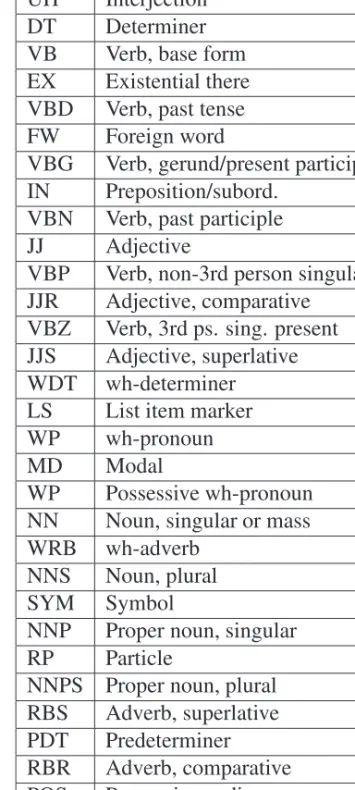
Table2.1lists the parts of speech used in the WSJ tagset [Marcus et al., 1993], a standard tagset originally used to annotate named entities in the Wall Street Journal corpus. We use the WSJ tagset in the experiments in Chapter 9. The tagset has special classes for non-word token types like numbers, symbols and special characters. Furthermore it addsdeterminers(e.g. “the”),prepositions(e.g. “before”), pronouns (e.g. “she”) and adverbs(e.g. “violently”) as well as some smaller classes. The major parts of speech are separated according to variants that are mainly due toinflection. Inflections are modifications of the words to express which role a given word plays in a given sentence. Verbs can have different forms for singular (one referent) or plural (several referents) and encode temporal as-pects of the statement (past tense,present,gerund: “loaded”, “loads”, “loading”). Nouns are separated in singular and plural as well and adjectives allow forpositive
(e.g. “big”),comparative(e.g. “bigger”), andsuperlative(“biggest”).
The part-of-speech tagging performed for the experiments presented in Chapter 9 was performed with a probabilistic tagger using an HMM model [Ciaramita and Altun, 2006] which was trained on the Penn Treebank [Marcus et al., 1993].
18 CHAPTER 2. METHODOLOGICAL AND TECHNICAL FOUNDATIONS CC Coordinating conjunction TO to CD Cardinal number UH Interjection DT Determiner VB Verb, base form EX Existential there VBD Verb, past tense FW Foreign word
VBG Verb, gerund/present participle IN Preposition/subord.
VBN Verb, past participle JJ Adjective
VBP Verb, non-3rd person singular present JJR Adjective, comparative
VBZ Verb, 3rd ps. sing. present JJS Adjective, superlative WDT wh-determiner LS List item marker WP wh-pronoun MD Modal
WP Possessive wh-pronoun NN Noun, singular or mass WRB wh-adverb
NNS Noun, plural SYM Symbol
NNP Proper noun, singular RP Particle
NNPS Proper noun, plural RBS Adverb, superlative PDT Predeterminer RBR Adverb, comparative POS Possessive ending RB Adverb
PRP Personal pronoun PP Possessive pronoun
Table 2.1: Parts of speech in the WSJ tagset as used in our experiments. Classes for individual special characters omitted.
2.2. NATURAL LANGUAGE PROCESSING 19
Other Classes of Words
Another way to classify words is grouping them intolexemes. A lexeme represents a group of words that can be derived from each other by means ofmorphological
operations. One type of morphological modification is inflection as described above. Another one is the addition of pre- and postfixes that modify the meaning of the word (“reload”). For processing in NLP on a lexeme-basis (i.e. to ignore morphological modifications), words are assigned alemma, which is a canonical form of a word (e.g. the infinitive of a verb).
A special class of words in NLP is that of stopwords. This application-dependant class contains all tokens that can be excluded from further processing because they can be safely assumed not to bear any meaning important to the application. As an example, search engines filter out words that are likely to be present on all pages so that their presence in a document does not contribute to de-termining the relevance of a page with regard to a query. Common stopwords are articles (“the”, “a”), pronouns (“he”, “who”, “this”), prepositions (“on”, “over”) and conjuncts (“and”, “or”). In several experiments we exclude patterns that con-sist only of stopwords. We use a stopword list that concon-sists of the (alleged) stop-words excluded by Google as presented by the Wikimedia Foundation.1
2.2.2
Syntactic Analysis
Whether or not a natural language sentence is intelligible and what its exact meaning is, depends on the order in which words are arranged. The following example contains a sentence which appears wrong (3) and hence potentially unintelligible to English speakers and two sentences which share the same set of words but express different meanings (1,2).
“Mary drove from Saarbr¨ucken to Stuttgart.” (1)
“Mary drove from Stuttgart to Saarbr¨ucken.” (2)
“Stuttgart Mary drove to Saarbr¨ucken from.” (3)
A set of rules defining how correct utterances of a given language are built is called grammar. Various kinds of grammars exist. Almost all of them have in common that they break apart sentences into phrases of different types. They are
20 CHAPTER 2. METHODOLOGICAL AND TECHNICAL FOUNDATIONS S NP Mary VP drove PP from Saarbr¨ucken PP to Stuttgart Figure 2.1: Parse tree example.
hence called phrase structure grammars. Sentence (1) from the above example contains the phrase “drove from Saarbr¨ucken to Stuttgart” which has the role of describing the action that was taken (verb phrase). It can be further subdivided into the phrases “drove”, “from Stuttgart” and “to Saarbr¨ucken” (the latter two are examples ofprepositional phrases). The difference in meaning between sen-tence (1) and sensen-tence (2) can be explained by the different city names sharing a prepositional phrase with “to” and –likewise – sharing a prepositional phrase with “from.” Another essential type of phrases arenoun phraseswhich name and fur-ther describe the nouns in a sentence. Phrases of different kinds can play different
syntactic roles. For example, “Mary” plays the role of the subject performing the action which is an argument of the verb phrase which consists of the predicate “drove” naming the action and prepositional phrases further specifying it.
Given a sentence in a language and its grammar, one can determine its phrase structure. Figure2.1visualizes the phrase structure of sentence (1). Such a struc-ture allows IE systems to derive an assignment of syntactic roles which in turn may facilitate the extraction of information from the sentence.
The process of determining the phrase structure of a sentence is called syn-tactic parsing. Two challenges exist in parsing: ambiguity and a large hypothesis space. Consider the following example sentence:
“Mary drove Peter from Stuttgart to Saarbr¨ucken.”
The prepositional phrase “from Stuttgart” may be a part of the noun phrase “Peter from Stuttgart” or directly of “drove Peter from Stuttgart to Saarbr¨ucken.” In the former case, the phrase “from Stuttgart” names the origin of Peter in the latter the start of the journey. The parser would have to derive and output both
2.3. MACHINE LEARNING AND DATA MINING 21
alternative parses. The large hypothesis space is due to the fact that grammars are built up of many local rules the application of which may allow for the application of further rules. In many cases, rule applications are possible at some time during the process but do not lead to an ultimate result because at some later point, no further rule applications are possible. This can be thought of as rejecting a hypothesis of a partial parse. Due to these challenges, parsing takes a significant amount of time for each sentence processed (cf. the work of Ravichandran [2005] for a comparison of running times of different NLP techniques for Information Extraction). Full parsing is hence rarely used in Information Extraction which is why no particular natural language grammars and parsing systems are discussed here. An introduction to the currently very common probabilistic approaches to parsing is given by Manning and Sch¨utze [1999] a detailed overview of many aspects of the syntactic structure of natural language is given in a book by Akmajian et al. [1995]. An alternative to parsing ischunking, a heuristic process to determine some phrases within a sentence without completely analyzing the phrase structure. Chunkers usually rely on part-of-speech tags in combination with a set of rules or with a trained statistical classifier and are able to operate much faster.
2.2.3
Summary
Information Extraction commonly makes use of many linguistic methods for text processing. The key concepts were introduced in this section. Techniques consist of classifying and labelling words along various linguistically motivated dimen-sions such as part-of-speech and lemmas. Further, some semantic aspects of words are established by describing relations that hold between words. Finally, the syn-tactic structure of text can be captured by parsing or chunking. An overview of the use of such techniques in the IE literature is given when individual extraction sys-tems are introduced in Chapter4and Section5.6. Some frameworks that integrate linguistic processing tools are presented in Section4.1.2.
2.3
Machine Learning and Data Mining
Machine Learning is a rather interdisciplinary sub-field of computer science which is concerned with approaches to make computer programs improve by ex-perience. The behavior of the programs thus not only depends on explicitly coded instructions but on a predefined model along with observations in the input data. Thereby, machines become able to adapt to aspects of the data they process which are not known or fully understood at the time when the machines are set up. Ma-chine Learning can hence be considered part of the field of Artificial Intelligence
22 CHAPTER 2. METHODOLOGICAL AND TECHNICAL FOUNDATIONS
and make use of concepts and methods from formal disciplines like logics, statis-tics and information theory but also from biology, cognitive science and other natural sciences as approaches are inspired by learning in living beings. Data Mining is a field of research that is concerned with deriving relevant information from large amounts of data. Thereby, both the model by which the obtained in-formation is structured and the inin-formation itself can be derived during mining. Machine Learning and Data Mining have a large overlap in methods and models.2 Formally, Mitchell [1997] defines a Machine Learning problem as given by a
task, aperformance measureandtraining experience. As an example, a learning problem may be to create a named-entity tagger the task of which is to decide for a given word if it is of a specific entity type. The training experience con-sists of texts in which the entities of that type are labelled and the performance measure would be the number of choices correctly made by the tagger. Generally, the task is captured in form of a target function f : X → Y which constitutes the decisions that are to be learned. The decisions are just captured by mapping values from someinput spaceX to values from theoutput spaceY. The mapping is not known in advance (otherwise learning would not be necessary) and can only be approximated. The individual dimensions of the input space are referred to as features. Training experience provides the learning system with training examplesthat can be used to learn to approximate the target function. The perfor-mance measure indicates the appropriateness of the approximation to some task frequently by means of verifying if the decisions the learned system makes on sometest examplesare appropriate to the task.
This overview covers methods that can be divided into supervised and un-supervised Machine Learning methods. This distinction is commonly made in the literature and affects task definition, performance measure and the nature of training experience. In supervised learning, training examples are of the form
(x, y) ∈ X × Y and explicitly state values the target function should return for the training inputs. The goal is then to approximate an underlying target function
f :X → Y which generalizes over the mapping presented during training. Unsu-pervisedlearning means that explicit target class values are not available. Training examples here are only values fromX. The target function learns to assign values fromY, which in the unsupervised case is usually a set of cluster labels that is not specified in advance. The goal is to yield a target function that accounts for in-teresting properties of the data. Other unsupervised Data Mining methods derive some other abstract descriptions (e.g. Association Rules) of the data that do not map to individual data points.
2In many cases, the distinction of Machine Learning and Data Mining lies in the application.
Other application-oriented bordering and overlapping fields are knowledge discovery in databases (KDD) and intelligent data analysis (IDA).
2.3. MACHINE LEARNING AND DATA MINING 23
The supervised and unsupervised methods discussed here are selected to allow for an understanding of Machine Learning for Information Extraction in general and the methods applied in this thesis in particular. We leave out many alternative learning methods as well as paradigms not prominently employed for Information Extraction (e.g. reinforcement learning, most regression methods and most clus-tering techniques). Broader overviews and in-depth coverage of a large variety of methods can be found in the classical textbook by Mitchell on Machine Learning [1997] or in a more recent work by Kononenko and Kukar [2007] who cover both Machine Learning and Data Mining. An overview with focus on learning and Data Mining for Web-oriented applications is given by Liu [2007].
2.3.1
Supervised Methods
Supervised Machine Learning, as formalized above, aims at predicting outputs of the target function based on known training input-output pairs from the function. One distinguishes the prediction of continuous values,regression, and the predic-tion of a finite set of target values (referred to as classes or labels),classification. In both cases, the goal is to achieve a good generalization over the training ex-amples that captures the important laws governing the data. Two possible types of errors should thereby be avoided: When overfitting, the model replicates the training data too closely and thereby includes into its decision aspects that do not belong to the interesting properties of the data (noise). On the other hand, if the approximation is too loose, overfitting is avoided, yet the error on the data may increase.
We present here several recent approaches for supervised learning. They were chosen to be those used most prominently in IE literature.
Support Vector Machines
Support vector machines (SVMs) [Boser et al., 1992;Vapnik, 1995] are a widely used method for binary classification (i.e.|Y| = 2). They constitute an instance of the class of linear function models which aim at separating data in a vector space by means of a hyperplane. More specifically, SVMs compute the maximum margin hyperplane by iteratively selecting from the training examples so-called support vectors which along with some parameters define the separating hyper-plane. In a trained SVM, the support vectors represent the training examples which are closest to the separating hyperplane. Classification consists of mapping an element from X to the side of the hyperplane it lies on and returning a label that corresponds to the label of the support vectors on this side of the hyperplane. A method based on a separating hyperplane requires that most of the data points are linearly separatable, i.e. that there exists a hyperplane which correctly
24 CHAPTER 2. METHODOLOGICAL AND TECHNICAL FOUNDATIONS
divides at least most of the data points into the desired classes. The so-called
Kernel trick is employed to increase linear separatability by mapping the data from the input spaceX to a different, possibly higher-dimensionalfeature space
X∗ in which the desired separatability exists. The kernel trick is based on the
observation that the only operator needed to compute a separating hyperplane in the feature space is the inner product. Conceptually, the kernel is a functionκ : X × X 7→Rthat given two elementsx, y ∈ X from the input space, computes the
inner product of the corresponding elements in the target spaceφ(x), φ(y)∈ X∗. κ(x, y) = < φ(x), φ(y)>
The benefit of the kernel trick is that showing a limited set of properties for κ ensures that κ is appropriate for the use of the kernel without specify-ing φ explicitly. For example, the definitions of kernels for text processing in [Giuliano et al., 2007] are defined directly as a comparison operation on text frag-ments not separating the steps of embedding into the feature space and computa-tion of an inner product. A detailed discussion of kernel-based Machine Learn-ing methods with applications from the field of natural language processLearn-ing and with the help of structured knowledge has been presented by Stephan Bloehdorn [2008].
Conditional Random Fields
Conditional Random Fields (CRF) [Sutton and Mccallum, 2006;
Lafferty et al., 2001] are a class of very general discriminative probabilistic models. Probabilistic models introduce random variablesxandyfor the domain
X and range Y of the target function. Discriminative probabilistic models are concerned with deriving the probability distribution p(y|x) which specifies the probability of a classification from Y given an input observation from X. Types of models constitute a function ofxand ywith a set of parameters. Training is usually done by means of a maximum-likelihood estimation of parameters, that is the parameters are set in a way that maximizes the likelihood of the observed combinations of values fromX andY.
CRF are very powerful because they model conditional dependance between observations ofXandY. These dependencies can be arranged in graphs of arbi-trary structure. Connections in the graph can encode linear order of observations or co-occurrence. Frequently, they are used to assign a sequence of labels to a sequence of observations a task which is common in computational linguistics (e.g. part-of-speech tagging), bioinformatics and speech recognition. In their most general version, they are an undirected graphical model. The graph Grepresents observations fromX andYas verticesV and dependencies in the model as edges
2.3. MACHINE LEARNING AND DATA MINING 25
Figure 2.2: A linear-chain SVM with Markov assumption. Image due to [Sutton and Mccallum, 2006].
E. In the following, we describe the linear-chain CRF in which the structure of the graph is limited to a structure as indicated in Figure2.2.
The model of the linear-chain CRF which additionally makes the assumptions that output labels at positiont only depend on the input att and the output label at positiont−1can be formalized as follows:
p(y|x) = 1 Z(x)exp K X k=1 λkfk(yt, yt−1,xt) !
Thereby Z(x) is a normalization factor, fk(yt, yt−1,xt) stands for one of the K feature functions that determine if a given feature is expressed. The choice of fk also binds the positiont at which the feature is present. It indicates the
probability with which a given yt is output following a givenyt−1 based on the
distribution of inputsxt att. Note that the presence of the same feature at
differ-ent positions is reflected by differdiffer-ent feature functions. λk stands for the model
parameter associated with the respective feature.
Practical linear-chain CRFs are likely to lift the Markov assumption by al-lowing for further dependencies among labels in the output sequence but at the same time tie parameters to each other assuming for example that a label that depends on a particular feature in the previous element of the sequence has the same dependency regardless of the position within the sequence. To account for more complex structures, the set of feature functions needs to be altered includ-ing their domain and range which in principle allows for the full distribution of observations.
Conditional Random Fields constitute in fact a framework that covers several other supervised probabilistic learning methods used in the literature including Naive Bayes classification and Logistic Regression.
26 CHAPTER 2. METHODOLOGICAL AND TECHNICAL FOUNDATIONS
Figure 2.3: Concepts as sets of text fragments (left) and arranged in a lattice structure (right).
Concept Learning
In the following, we introduce Concept Learning, an early, non-statistical type of Machine Learning tasks [Winston, 1975;Mitchell, 1997]. While the methods from Concept Learning are not in the scope of this thesis, we use its basic no-tions to later give a generalized formal basis for the task of text pattern induction. Concept learning is concerned with deriving aconceptas a Boolean function that decides for each object from a domain based on a set of attributesif it is an in-stance of a concept. As an example, in the domain of sportspersons, the concept of a “swimmer” may be detected based on the attribute “clothing” to have the value “swim suit” and the attribute “competition type” to be “race.” Or, by the exam-ple of pattern-based Information Extraction which we will introduce later: In the domain of textual mentions, a concept may be the sentences that express the rela-tion of a person being born at a particular date. The decision, whether a sentence belongs to this concept is based on the words of the mentions and their positions as attributes. Formally, a concept is a subset of the domain X. c is the target function, the values of which are only known for the training examples. Concept learning is thus a supervised binary classification task (Y = {0,1}). Learning is performed by generating and testinghypothesis functions which are of the same type as cwith the goal of deriving or approximatingc. More specifically, learn-ing is performed as a search process in the space of allowed hypothesesX ⊆ X, which is also called thehypothesis spaceorsearch space. This space is defined by the formalization of the attributesAtt. In the classical notion of concept learning, each attribute or featurea ∈ Attcorresponds to a function a : X → Da with a
domainDa. Each hypothesis and concept consists of a conjunction ofconstraints.
In this simple formalization, each constraintγa on an attribute acan have three
types of values∗,z ∈ Da or∅. A∗constraint is always true, a∅is always false
2.3. MACHINE LEARNING AND DATA MINING 27
a hypothesis for a hypothesis space defined by the attributesa1, . . . ancan thus be
written as a vector of constraintsha1, . . . , ani.
We identify two properties of concept learning that are key to the understand-ing of text pattern induction:
• Property 1:There are several interesting properties of the hypothesis space. In particular, there exists a partial ordering ≤ with a single supremum ⊤
(“top”) and single infimum ⊥ (“bottom”). If for two concepts, c1 ≤ c2
holds, then all instances of c1 are also instances of c2 . For each concept
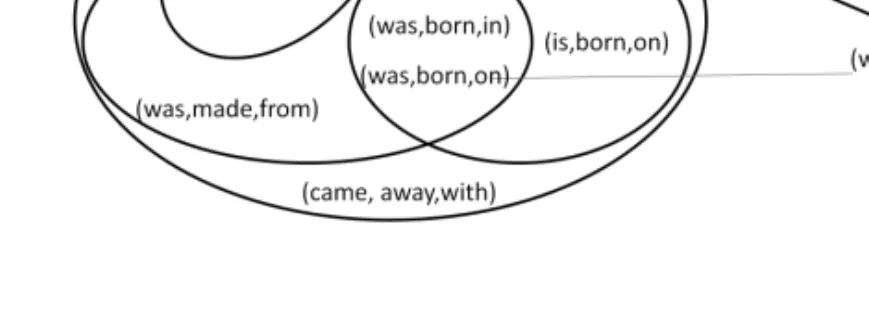
c holds⊥ ≤ c ≤ ⊤. ⊤ and ⊥ are abbreviations for “top” and “bottom” denoting the concepts that contain all or respectively no objects. The search for good hypothesis can start at the top, at the bottom, or proceed from both sides at a time. The corresponding traversal strategies are called “top-down” and “bottom-up” depending if they explore concepts in the space based by adding or by removing constraints. Figure 2.3 shows some concepts as sets of text fragments (left) and arranged in a lattice structure (right). The right-hand side shows all concepts that have at least two instances. The best concept in this space may be(was, born,∗)which could be found by start-ing with(∗,∗,∗)and becoming more restrictive (top-down) or by starting by concrete phrases and becoming less specific (bottom-up).
• Property 2: The size of the search space depends combinatorially on the number of attributes and the number of values each attribute can take. Specifically, the size of the search space corresponding to ha1, . . . , ani is 1 +Q
1...n(|Dan|+ 1). The constant 1 stands for ⊥, the added 1 for each
constraint stands for the option of setting it to ∗ (note that all options in-volving at least one constraint set to∅are equal to⊥).
Partial Supervision
The provision of training examples for supervised learning is one main cost fac-tor. Approaches have been developed to reduce the number of labelled examples from X needed by making use of unlabelled examples. These techniques are referred to as “semi-supervised.” One general approach, which plays a major role in the framework presented in Chapter 5 is bootstrappingwhich iteratively evolves a classifier by taking parts of its output as input in the next iteration. Bootstrapping is introduced in more detail and illustrated by applications from NLP in Section 4.2.2. Bootstrapping can be performed with any classifier. A special variant calledpositive-only learningrequires the classifier to output some confidence score with the classification. The classifier is trained initially on pos-itive examples only and iteratively re-trained always taking the examples which are classified negative with the highest confidence as artificial negative examples.
![Figure 2.2: A linear-chain SVM with Markov assumption. Image due to [Sutton and Mccallum, 2006].](https://thumb-us.123doks.com/thumbv2/123dok_us/1707266.2737655/43.892.156.589.180.302/figure-linear-chain-markov-assumption-image-sutton-mccallum.webp)