RIT Scholar Works
RIT Scholar Works
Theses4-2020
Machine Learning-Enabled Resource Allocation for Underlay
Machine Learning-Enabled Resource Allocation for Underlay
Cognitive Radio Networks
Cognitive Radio Networks
Fatemeh Shah MohammadiFollow this and additional works at: https://scholarworks.rit.edu/theses
Recommended Citation Recommended Citation
Shah Mohammadi, Fatemeh, "Machine Learning-Enabled Resource Allocation for Underlay Cognitive Radio Networks" (2020). Thesis. Rochester Institute of Technology. Accessed from
This Dissertation is brought to you for free and open access by RIT Scholar Works. It has been accepted for inclusion in Theses by an authorized administrator of RIT Scholar Works. For more information, please contact
Machine Learning-Enabled
Resource Allocation for
Underlay Cognitive Radio
Networks
by
Fatemeh Shah Mohammadi
Supervisor: Prof. Andres Kwasinski
A dissertation submitted in partial fulfillment for the
degree of Doctor of Philosophy in Engineering
Engineering (PhD Program)
Kate Gleason College of Engineering
Computer Engineering Department
Thesis Signature Form
Approvals
Dr. Andres Kwasinski
Dissertation Advisor Signature/Date
Dr. Raymond Ptucha
Committee Member Signature/Date
Dr. Drew Maywar
Committee Member Signature/Date
Dr. Panos Markopoulos
Committee Member Signature/Date
Dr. Nathan Cahill
Outside Representative Signature/Date
Dr. Edward Hensel
PhD Program Director Signature/Date
way. And if you can recognize that in yourself and accept and appreciate that in others, you can make magic.”
Abstract
Due to the rapid growth of new wireless communication services and appli-cations, much attention has been directed to frequency spectrum resources and the way they are regulated. Considering that the radio spectrum is a natural limited resource, supporting the ever increasing demands for higher capacity and higher data rates for diverse sets of users, services and appli-cations is a challenging task which requires innovative technologies capable of providing new ways of efficiently exploiting the available radio spectrum. Consequently, dynamic spectrum access (DSA) has been proposed as a re-placement for static spectrum allocation policies. The DSA is implemented in three modes including interweave, overlay and underlay mode [1]. The key enabling technology for DSA is cognitive radio (CR), which is among the core prominent technologies for the next generation of wireless communication systems. Unlike conventional radio which is restricted to only operate in designated spectrum bands, a CR has the capability to oper-ate in different spectrum bands owing to its ability in sensing, understand-ing its wireless environment, learnunderstand-ing from past experiences and proactively changing the transmission parameters as needed. These features for CR are provided by an intelligent software package called the cognitive engine (CE). In general, the CE manages radio resources to accomplish cognitive functionalities and allocates and adapts the radio resources to optimize the performance of the network. Cognitive functionality of the CE can be achieved by leveraging machine learning techniques. Therefore, this thesis explores the application of two machine learning techniques in en-abling the cognition capability of CE. The two considered machine learning techniques are neural network-based supervised learning and reinforcement learning. Specifically, this thesis develops resource allocation algorithms that leverage the use of machine learning techniques to find the solution to the resource allocation problem for heterogeneous underlay cognitive radio networks (CRNs). The proposed algorithms are evaluated under extensive simulation runs.
ing paradigm to present a fully autonomous and distributed underlay DSA scheme where each CR operates based on predicting its transmission effect on a primary network (PN). The scheme is based on a CE with an artificial neural network that predicts the adaptive modulation and coding configura-tion for the primary link nearest to a transmitting CR, without exchanging information between primary and secondary networks. By managing the effect of the secondary network (SN) on the primary network, the presented technique maintains the relative average throughput change in the primary network within a prescribed maximum value, while also finding transmit settings for the CRs that result in throughput as large as allowed by the primary network interference limit.
The second resource allocation algorithm uses reinforcement learning and aims at distributively maximizing the average quality of experience (QoE) across transmission of CRs with different types of traffic while satisfying a primary network interference constraint. To best satisfy the QoE require-ments of the delay-sensitive type of traffics, a cross-layer resource allocation algorithm is derived and its performance is compared against a physical-layer algorithm in terms of meeting end-to-end traffic delay constraints. Moreover, to accelerate the learning performance of the presented algo-rithms, the idea of transfer learning is integrated. The philosophy behind transfer learning is to allow well-established and expert cognitive agents (i.e. base stations or mobile stations in the context of wireless communi-cations) to teach newly activated and naive agents. Exchange of learned information is used to improve the learning performance of a distributed CR network. This thesis further identifies the best practices to transfer knowledge between CRs so as to reduce the communication overhead. The investigations in this thesis propose a novel technique which is able to accurately predict the modulation scheme and channel coding rate used in a primary link without the need to exchange information between the two networks (e.g. access to feedback channels), while succeeding in the main goal of determining the transmit power of the CRs such that the interference they create remains below the maximum threshold that the primary network can sustain with minimal effect on the average through-put. The investigations in this thesis also provide a physical-layer as well as
resource allocation in underlay cognitive radio networks, resulting in better learning performance and reduced communication overhead.
Acknowledgements
I would like to sincerely express my gratitude to my advisor Dr. Andres Kwasinski for guiding me during my Ph.D. program. His constant support and timely advice have provided me with a great opportunity to earn my
Ph.D. degree. Dr. Kwasinski’s insightful thoughts, excellent academic
expertise and inspiring guidance have significantly helped me to achieve academic excellence. His diligent working attitude and pursuit of perfection have motivated me to pay attention to the details and achieve the best. His encouragement and support will continue to motivate me in the future. I am very grateful to him for being my Ph.D. advisor.
I want to thank Dr. Drew Meywar, Dr. Raymond Ptucha and Dr. Panos Markopoulos for their time and efforts in serving as my committee members. Their constructive and genuine advice has greatly helped me to improve this dissertation work.
I owe a lot to my parents. I am very grateful to them for their constant support and faithful love.
Contents
Thesis Signature Form i
Abstract iii
Acknowledgements vi
List of Figures xii
List of Tables xv
Abbreviations xvii
1 Introduction 2
1.1 DSA Models . . . 3
1.2 Centralized and Distributed CR networks . . . 5
1.3 Cooperative and Non-cooperative CR Networks . . . 5
1.4 Motivation . . . 6
1.5 Why ML is needed? . . . 8
1.6 ML as an Enabler of CR . . . 10
1.6.1 ML Algorithms . . . 10 1.6.1.1 Supervised Learning . . . 10 Neural Network . . . 11 1.6.1.2 Unsupervised Learning . . . 12 1.6.1.3 Reinforcement Learning . . . 13 Q-Learning . . . 16 Deep Q-Learning . . . 17 1.6.2 Learning Applications in CRNs . . . 18 Traffic Classification . . . 19 Routing Optimization . . . 19 QoS/QoE Prediction . . . 20 Resource Management . . . 21 Security . . . 22 1.7 Thesis Outline . . . 23
2 Fully Autonomous Supervised Learning-Based Resource Al-location Framework for Underlay Cognitive Radio Networks 25 2.1 Literature Review . . . 26
2.2 System Model . . . 30
2.2.1 SU Transmission Effect Assessment on the PU: An-alytical Framework . . . 31
2.3 Leveraging Adaptive Modulation and Coding in Underlay DSA . . . 36
2.4 Autonomous and Distributed Underlay DSA for Cognitive
Radio Networks . . . 39
2.5 Results . . . 48
2.6 Summary . . . 58
3 Reinforcement Learning-Based Resource Allocation Frame-work for Heterogeneous Underlay Cognitive Radio Net-works 61 3.1 Literature Review . . . 63
3.2 MOS models . . . 67
3.3 Traffic Models . . . 70
3.3.1 Best Effort Traffic Model . . . 70
3.3.2 Video Streaming Traffic Model . . . 70
3.4 Single Layer Resource Allocation Leveraging Reinforcement Learning . . . 71
3.4.1 System Model . . . 72
3.4.2 Q Learning-Based Cognitive Engine . . . 75
3.4.2.1 State Space . . . 76
3.4.2.2 Reward . . . 76
3.4.3 DQL Learning-Based Cognitive Engine . . . 77
3.5 Cross Layer Resource Allocation Leveraging DQL . . . 79
3.5.1 System Model . . . 80
3.5.2 DQL-Based Learning Framework . . . 82
3.5.2.2 Reward . . . 83
3.6 Integration of Transfer Learning into Reinforcement Learning 84
3.7 Results . . . 88
3.8 Summary . . . 104
4 Conclusion 108
List of Figures
1.1 The cognitive radio’s cognition cycle. . . 7
1.2 A Basic Neural Network. . . 12
1.3 The reinforcement learning cycle. . . 13
2.1 Considered network model composed ofNpprimary transceivers and Ns cognitive radio users. . . 29
2.2 Throughput of one resource block as a function of SNR for the AMC scheme of an LTE system . . . 37
2.3 Throughput vs. noise power in the primary network. . . 38
2.4 NARX neural network with two delayed inputs and one de-layed output. . . 43
2.5 Block diagram of an SU with a cognitive engine based on the NARX neural network. . . 44
2.6 Throughput prediction performance of the NARX neural network. Best validation performance is 0.10825 at epoch 2. . . 46
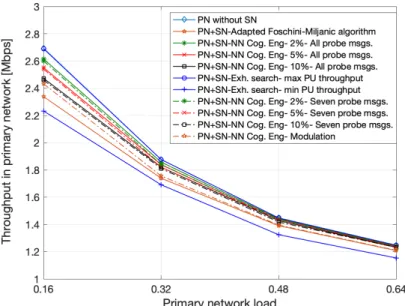
2.7 Average throughput in primary network. . . 53
2.8 Relative throughput change in primary network. . . 55
2.9 Average throughput in secondary network. . . 56
2.10 Cumulative distribution function (CDF) of the throughput in the secondary network. . . 57
2.11 CQI estimation performance of the NARX neural network. . 59
3.1 MOS versus PSNR. . . 68
3.2 System model overview. . . 81
3.3 Reward function for video frame delay. . . 84
3.4 Distribution of the MSE of the action-value function param-eters (θ) between a first SU and other SUs in a secondary network of 4 users. . . 86
3.5 Distribution of the cross correlation between the action-value function parameters of the video reference SU and its nearest neighboring SU. . . 88
3.6 Average MOS. . . 91
3.7 Average number of iteration for convergence. . . 92
3.8 Experienced SINR at the PN after adding SN. . . 94
3.9 Frame delay for 10 fps video source. . . 95 xiii
3.10 Frame delay for 20 FPS video source. . . 96
3.11 Mean frame delay for 10 fps video source. . . 97
3.12 Mean frame delay for 20 fps video source. . . 98
3.13 Average MOS and number of time slots at the convergence
point in secondary network. . . 98
3.14 Average MOS in the secondary network. . . 100 3.15 Average number of iterations needed for algorithm
conver-gence. . . 101 3.16 Average MOS and average number of iterations needed for
algorithm convergence. . . 102 3.17 Average MOS and average number of iterations needed for
List of Tables
3.1 Possible PSNR to MOS Conversion [2] . . . 69
3.2 Parameters of FTP traffic model [3] . . . 71
3.3 Parameters of video streaming traffic model [4] . . . 72
3.4 Simulation parameters . . . 90
Abbreviations
ANN Artificial Neural Network
AMC Adaptive Modulation and Coding
ARQ Authomatic Repeat re-Quest
BER BitError Rate
CDMA CodeDivision Multiple Access
CE Cognitive Engine
CNN Convolutional NeuralNetworks
CR Cognitive Radio
CRN Cognitive Radio Network
CQI ChannelQuality Indicator
DARPA Defense Advance Research Project Agency
DSA Dynamic Spectrum Access
DP Dynamic Programming
DQL Deep Q-Learning
FDMA Frequency Division Multiple Access
FTP FileTransfer Protocol
HARQ Hybrid AuthomaticRepeat Request
IDS Intrusion Detection System
ITU International Communication Union
MCM Monte Carlo Method
MDP Markov Decision Process
MSE Mean Square Error
MIMO Multiple Input MultipleOutput
MOS Mean OpinionScore
ML Machine Learning
NARX-NN Non-linear Auto-Regressive exogenous Neural Network
RL Reinforctment Learning
SDMA Space Division Multiple Access
PBS Primary BaseStation
PU Primary User
PSNR Peak Signal toNoise Ratio
SBS Srimary BaseStation
SINR Signal to Interference plus Noise Ratio
SRN Simple Recurrent Networks
SU Secondary User
SVM Support Vector Machine
QoE Quality of Experience
QoS Quality of Service
RL Resource Allocation
TD Temporal Difference
TDMA Time Divsion Multiple Access
TDNN Time Delay Neural Networ
encouragement and love
Chapter 1
Introduction
Radio spectrum is a limited natural source which is regulated around the world by international and national regulators. The International Commu-nication Union (ITU) and in particular, its Radio commuCommu-nication Sector (ITU-R) have the core responsibility of the governance of the radio spec-trum. At the international level of allocation which is done by ITU, the use of radio spectrum is regulated for different type of services on a regional basis. At the national level, in most countries the use of radio spectrum is managed by the government. For example, the Federal Communications Commissions (FCC) is responsible for radio spectrum regulation in the United States, while in the United Kingdom it is regulated by the Office of Communications (Ofcom). Radio spectrum allocation and management, traditionally, can be divided into two categories: licensed and unlicensed [5]. Over unlicensed bands, users can freely transmit without any licensing requirements, while in licensed bands, the right of the use of a frequency band is assigned through the sale of a license. This approach assigns fixed spectrum allocation, operating frequencies and bandwidths with constrains on power emission which limits their range. Hence, most communication systems are designed so that to increase spectrum efficiency within the assigned bandwidth using different modulation, coding, multiple antenna configuration and other techniques [6].
Since demands on wireless applications are explosively increasing, the radio spectrum is becoming more occupied. Because of this, the static spectrum
allocation policy will result in spectrum scarcity. Conflict between the
spectrum scarcity due to the traditional static spectrum allocation policy, 2
and ever increasing service demands has motivated research groups to in-vestigate innovative schemes, that can solve the problem of the spectrum allocation. However, radio spectrum usage pattern shows that large por-tion of the licensed bands are under-utilized. For instance, in [7] authors reported a study, conducted by the US Defense Advance Research Project Agency (DARPA), showing that only 2% of the licensed spectrum is utilized in USA. Authors in [8] also showed that only 22% of allocated spectrum is in use in urban areas, while this figure is less than 3% in rural areas. These findings led researches toward the definition of spectrum hole which is a band of frequencies already assigned to primary users (who are licensed to transmit on assigned frequency band), but at a particular time and/or specific geographical location, the band is not being utilized by the primary user [5]. Based on the evidences, which briefly mentioned here, the current fixed spectrum allocation policy is highly inefficient and results in under-utilized frequency bands. Consequently, a new communication paradigm is needed which leads to more efficient usage of the radio spectrum by ex-ploiting the spectrum holes. In this new paradigm, unlicensed users or secondary users (SUs) will ”opportunistically” operate in the unused li-censed spectrum bands without interfering with lili-censed users or primary users (PUs), hence it enhances the efficiency of spectrum utilization. This model of spectrum sharing is called interweave dynamic spectrum access (DSA). There are two more models naming overlay DSA and underlay DSA which were later merged into the DSA spectrum sharing models.
1.1
DSA Models
As stated, there are three DSA models, including interweave, underlay, and overlay [1]. In interweave DSA model the SUs can have access to the spectrum only if the frequency band of interest is idle and PU is not active on the band. In this model PU has the absolute priority on the spectrum band and SU must vacant the band if PU wants to access the band. Since the SUs opportunistically utilize the spectrum holes in time, space and/or frequency domain, this model is also called opportunistic spectrum access. With the interweave DSA model, SU uses the cognitive radio to sense the surrounding spectrum environment, then selects one or
more idle spectrum band(s), and switches to the selected band(s) to keep a seamless transmission. Hence, for this model SUs need to be equipped with a reliable spectrum sensing mechanism. In contrast to the interweave model, underlay model allows coexistence of primary and secondary users at the same time and over the same frequency band, provided that the accumulated interference from all SUs is less than the tolerable interference level of the PU. In this DSA model, power allocation for SUs is the first task needs to be taken into account.
The overlay DSA model, as more recent development of DSA, is similar to underlay DSA and allows concurrent coexistence of both users on the same frequency band but with a different constraint. The overlay DSA aims at maintaining the PU performance, as contrast to underlay DSA which constraints the interference from SUs to PU via limiting the SU’s transmit power. Specifically, SUs are allowed to continue their transmission simultaneously with PUs over the same band as long as no performance degradation is guaranteed for PUs. There are two approaches to overlay DSA. The first approach is to use channel coding [1]. In this approach the packet which is being transmitted by the PU is known to SU, thus the SU transmitter can split its transmit power into two parts to transmit its own (SU) packet along with the PU packet to enhance the total power received at the PU receiver, such that the PU received signal to interference plus noise ratio (SINR) does not degrade. To cancel the the interference to the SU caused by transmitting the PU packet, SU transmitter can use the dirty paper coding to precode the SU packet. Another approach for the overlay DSA model is to use network coding [9]. In this approach, an SU serves as a relay node between PU nodes. While relaying a PU packet, the SU may encode its packet onto the PU packet through network coding. Therefore, transmission of the SU packet does not need separate spectrum access, while the PU performance does not degrade as well.
Regarding the network spectrum sharing control architectures, there are two of them in CR networks which are networks with centralized control and networks with distributed control. They can be further categorized according to the spectrum allocation behavior as Cooperative and Non-cooperative. In the following we briefly explain each paradigm.
1.2
Centralized and Distributed CR networks
In the centralized network setting, resource allocation decisions are taken by a secondary base station or a central spectrum server. In this architec-ture, the base station gathers the information from the SUs or a dedicated sensor network. Using this information it runs an assignment algorithm and informs the SUs of the resources to be utilized. In this version of net-work setting an assignment of predefined control channel is needed. Having information on the global setting, the base station can provide a globally optimal resource assignment. However, there are several problems regard-ing to this architecture: requirement of a common control channel and high processing complexity at the base station. In this type of networks common control channel should be pre-assigned and all SUs should have interference free access to it. Distributed networks are preferred to centralized when there is no preexisting infrastructure available or when the centralized net-works are not scalable. CRs use distributed algorithms while performing resource assignment in the decentralized setting. Each user does its own sensing equipments and coordinates with the nearby cognitive radios and determines who gets which resource. These algorithms are iterative so the neighborhood to which the CR sends data and from which it receives data should be limited. Otherwise it can incur large delays and the network will become unscalable. The distributed networks are also not completely im-mune to the problem of common control channel because to communicate with one another, transmitter and receiver should perform a handshake and it should happen on a channel both transmitter and the receiver know about.1.3
Cooperative and Non-cooperative CR
Net-works
All the centralized CR networks are cooperative networks in principal and some distributed networks can be cooperative as well. The choice of a utility function plays a key part in defining a network as cooperative and non-cooperative. Each user tries to maximize the individual gain it can achieve without considering about the utility of others in non-cooperative networks.
In contrast to that a user in a cooperative network tries to maximize its own utility while satisfying the minimum utility required by other users in the network. One advantage of non-cooperative networks over the cooperative ones stems from the advantage of being able to function with minimum communication with other CR users. Cooperative networks can improve the overall network utilization with the burden of higher communication overhead. In situations where the benefits of cooperation surpasses the cost of communication one should choose a cooperative solution.
1.4
Motivation
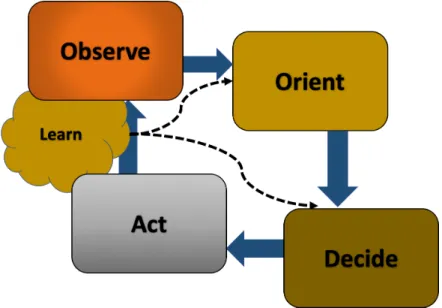
Cognitive radio (CR) is the enabling technology for DSA, [10]. Unlike a conventional radio which can only operate on a predefined spectrum band based on regulatory restrictions, a cognitive radio is capable of operating in different spectrum bands. In order to be able to operate in different bands, CR must have the ability to sense and understand its wireless environment and proactively change its mode of operation as needed in order not to interfere with PU transmission. These set of fundamental activities, which is called cognition cycle [11], is performed by a CR in order to satisfy
the end-user needs. The set of activities are as follows: observing the
environment and acquisition of information such as spectrum occupancy or interference temperature, orienting itself, learning from past experiences, decision making and finally performing actions.
A cognition cycle by which cognitive radio interacts with the environment is illustrated in Fig. 1.1. According to this interpretation, the action phase consists of (re)configuring the CR to provide enhanced communication qual-ity with respect to end-user goals. Such configuration can be for example the choice of the wireless radio interface to be used for communication, or the tuning of the communication system’s parameters; the observation phase collects statistics from the device which characterize the external en-vironment, such as traffic load patterns, SNR measurements, packet error rate, round trip time, etc.; the orientation phase consists of understanding the impact on communication performance of the external environment and of possible system configurations. This is achieved by identifying a func-tional relation between measurements and configuration parameters and
Figure 1.1: The cognitive radio’s cognition cycle.
different aspects of communication performance (e.g, throughput, delay, reliability); the decision phase is the solution of the performance optimiza-tion problem, i.e., it is a search in the space of possible configuraoptimiza-tions which aims at finding the one that best satisfies user-defined goals, which are ex-pressed in terms of high-level performance metrics such as application-layer throughput, delay and reliability, as well as cost, power consumption, etc; and finally, the learning phase consist of evaluating the outcome of the deci-sions which have been made, thereby gathering knowledge to be exploited in future orientation phases with the aim of being more effective in the decision phase.
The brain of a CR where the set of activities associated with the cognitive cycle is implemented is called Cognitive Engine (CE). Machine learning (ML) can be widely used in implementing the learning, orientation and decision phases of CRs (and specifically CEs). We explore in this thesis the application of two machine learning techniques including neural-network based supervised learning and reinforcement learning in this context. There are various reinforcement learning techniques among which we consider the most common form, widely considered to be Q-learning, in both standard table-based and deep Q-learning, and deep Q-learning. We focus on under-lay cognitive radio networks where we need to devise resource allocation algorithm for the SUs such that it ensures the non-interfering co-existence of primary and secondary networks. In particular, we use machine learning
technique to allocate for the SUs radio resources (transmit power and rate in this work) such that not only the PU interference constraint is met, but also the network performance metric in SN is maximized.
1.5
Why ML is needed?
Recent advances in technology, the ever increasing computing power of ma-chines and the instant connectivity provided by the Internet anywhere and at anytime in the world, has enabled companies to capture trillions of bytes of information everyday, in what is known as Big Data. Such information comes from the billions of sensors connected to computers, automobiles, mobile phones, home appliances and in general everyday objects with abil-ity to sense, create and communicate data. As such, this massive amount of data generated and collected every second motivated companies to explore that data using data analytic methods, in order to create better solutions that would benefit them while also please their customers [12].
Regarding the wireless communications, rapid development of intelligent devices (such as smart phones, cars and home) and development of cloud computing and network virtualization has led to exponential increase in data traffic. On the other hand, the networks have become more com-plex as they involve a multitude of devices, drive different protocols and support diverse applications. In wireless networks, for instance, different types of cells (each associated with a specific coverage such as macro-cells, pico-cells and femto-cells) with different transmission power range, work-ing mechanism and communication technologies (such as ZigBee, WiMAX, Bluetooth and LTE) have been applied and have led to more challenges in effectively managing and optimizing the network resources. Inserting more intelligence into networks is one possible solution to these challenges. This intelligence can be brought by deployment of ML and cognitive techniques which always favor from the collected massive amount of data. In fact, ML algorithms rely on collecting and analysing data in order to find patterns and relationships between them and produce a model that can relate the input to the output, instead of trying to develop a complex and complete model of the system. As a result, these algorithms are able to learn, reason and make decisions without human intervention [13].
In addition, another clear advantage of ML is that these algorithms are able to generalise. For example, considering the task of mobile network optimization, if a model had to be developed for every possible situation of the network, with users in all possible positions and all base stations with different power, interference and load levels, it would be impossible. As such, solutions that analyse data and are able to create a model based on their observations are much more feasible. This occurs because ML solu-tions are able to learn from data and make predicsolu-tions if new unseen data is fed into the model, being much more general than analytical approaches, as they do not require the entire model to be trained again or rebuilt from zero [13, 14].
Furthermore, another key advantage of ML algorithms is when dealing with complex tasks. Similar to the case above, in which for some applications it is impossible to create an analytical model for every possible solution, in very complex domains, traditional approaches would also not work. For example, considering the task of teaching a self-driving car how to drive. The car has a large number of sensors, inputs, images from different cam-eras and also lots of possible actions, such as accelerating, braking, turning the wheel, changing gears, etc.. As it can be seen from this example, when tasks are extremely complicated and have many variables and parameters, traditional analytical approaches or controller design solutions are not very suitable, as the solutions required to solve these problems would be too complex and costly. As such, in those cases ML solutions also excel at, as they are able to learn from the great amount of data gathered and gener-ated from these complex applications and determine the best action [13, 15]. ML algorithms, and more recently deep learning, have shown comparable human performance in certain tasks, such as image classification or playing certain games like chess, Go, backgammon, and video games [16, 17]. As such, with the constant development of more robust and powerful comput-ers and algorithms, the possibilities of what these intelligent algorithms can do are practically unimaginable.
1.6
ML as an Enabler of CR
ML algorithms allow the system to learn the structural patterns and models from training data. A ML approach usually includes two main phases: a training phase and a decision making phase. During the training phase, the system model is learnt using the training data set. Whereas, during the decision making phase the trained model is used for each new input to estimate the output of the system. As stated earlier, ML techniques bring intelligence to cognitive radio networks by performing data analysis and network optimization. Such intelligence derived from learning capability of ML enables CRs to autonomously learn to make optimal decisions to adapt to the network environment. Before addressing the existing learning effort to address issues in CRNs, we briefly explore the main ML algorithms.
1.6.1
ML Algorithms
ML algorithms are basically divided into three categories, as follow:
• Supervised Learning
• Unsupervised Learning
• Reinforcement Learning
Below a brief description of each category is presented. For more insightful discussion on ML theory and its concepts, the works [18, 19] can be referred.
1.6.1.1 Supervised Learning
Supervised learning, as the name implies, requires a supervisor (teacher) to supervise (train) the system. For training, it requires a data set which has information about both input and output data. For every input data, the teacher knows the answers (output) by which the teacher can correct the predictions as the algorithm iteratively makes them. More formally, supervised learning is an algorithm that learns the underlying model in data (the relation between input and output data) that best represents
the data, and is able to make predictions for newly, unseen data points. In addition, supervised learning algorithms are further split into two main cat-egories, depending on type of their output variable. If the output variable is discrete value, such as spectrum band being busy or idle, the supervised learning problem is referred to as a classification problem. While, if the output variable is a real or a continuous value, such as the throughput in primary network, the supervised problem is considered as a regression prob-lem. Supervised learning algorithms range from simple ones, such as linear regression, logistic regression, k-Nearest Neighbors and decision trees, to more complex ones, such as, support vector machines (SVM), neural net-works, and its variant (such as convolutional neural networks (CNN) and deep neural networks)[14].
Neural Network
Artificial neural network (ANN or simply NN) is a ML technique and in-spired by the human brain functionality. In fact, artificial neural networks are made up of artificial neurons (as emulation of biological neurons) in-terconnected with each other to form a programming structure to mimic organisation and learning procedure of biological neurons. Due to the spe-cial ability of human brain in parallel data processing (in massive vol-ume), it performs many tasks much faster than fastest computers. NNs are meant to mimic such substantial performance, specially for the problems with cognitive or associative tinge. To this end, NNs have been applied to time-series prediction, pattern (image/speech) recognition, regression and function approximation, classification and adaptive control.
NNs, as stated, consists of pools of simple processing units called neurons. The neurons are categorized into three groups: input neurons (which orga-nize the input layer) receive input from the outside; output neurons send the data out of NN and form the output layer; and hidden neurons (which comprise the hidden layer) receive data from within the NN and output the data to another layer inside the NN. Fig. 1.2 illustrates the typical struc-ture of NN. Each neurons sends its signal over large number of weighted
connections. Each connection is defined by a wjk associated with which
shows the effect that signal from neuron j has on neuron k. The output
of neuron k is first the summation over the weighted version of all neurons
Figure 1.2: A Basic Neural Network.
summation using a activation function Fk, as follow [20]:
Fk(
X
j=1
Bwjkyj+bk), (1.1)
where B denotes the number of neurons in the previous layer. The
activa-tion funcactiva-tion is usually sort of threshold funcactiva-tion, such as rectified linear unit function, sigmoid function and hyperbolic tangent sigmoid.
NN is itself divided into two categories of feed-forward NN and recurrent NN. In feed-forward NNs, the data enters at the inputs and is forwarded through the network layer by layer, until it arrives at the outputs. While recurrent NNs also contain feedback connections, which are connections extending from outputs of neurons to inputs of neurons within the same or previous layers. Examples of recurrent networks have been presented in [21].
1.6.1.2 Unsupervised Learning
On the other hand, unsupervised learning algorithms are useful when the data set only contains the input data and does not have any ground truth labels [13, 22]. As such, these algorithms do not have a supervisor (i.e. output data) to lead the training procedure. However, they search for sim-ilarity in the data and form groups of similar examples (known as clusters
Figure 1.3: The reinforcement learning cycle.
too). Since unsupervised learning tries to estimate a model without having access to labeled output data, unsupervised learning algorithms are mainly grouping algorithms (clustering), such as K-Means and mixture models [13, 22].
1.6.1.3 Reinforcement Learning
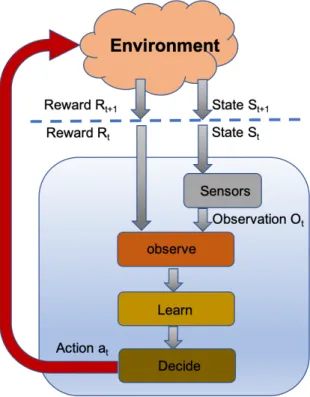
As mentioned, in supervised learning the relational model between input and output is developed using an external supervisor. But reinforcement learning (RL) is quite different than supervised learning, as it deals with interactive problem in which generating examples of desired behaviour are quite hard or even impractical to achieve [23]. In fact, RL is adequate for learning dynamic models, and specifically in interactive or unknown situations where an agent has to learn from its own experience of interaction with the environment, RL is the most appropriate solution [23]. RL is a ML technique with an assigned goal meant to be achieve. In RL the agent interacts with the surrounding environment by taking actions and receiving rewards that show the effect of the action on the environment. After taking an action the entire environment (system) transitions into a new situation
(known as state) (as shown in Fig 1.3) [23, 24]. At the beginning of each learning cycle, the agent receives a full or partial observation of the current state, as well as the accrued reward. By using the state observation and the reward value, the agent updates its policy (e.g. updating the Q-values) during the learning stage. Finally, during the decision stage, the agent selects a certain action according to the updated policy. The agent receives a reward only if the taken action results in transition toward the optimal state, otherwise it is penalized (meaning it receives a negative or small reward). Basically, the agent and environment interact continuously at
certain time-steps. At each time-step,t, the agent receives a representation
of the environment’s state and selects an action according to a policy (π).
On the next time-step, t + 1, as a consequence of its action, the agent
receives a reward (rt+1) and transitions in a new state. The goal of an agent
is to maximize its total cumulative reward. Based on this, RL algorithm is divided into four main components [23]:
• Policy: dictates the behaviour of the agent at each state s, basically
it determines which action a is chosen at state s.
• Reward (rt): a numerical value given by the environment to the agent
as the immediate return of taking an action, and that the agent tries to maximize over time.
• Value function (Q function or action-value function): indicates the
expected value of visiting a state, Q(s, a), or the value of taking an
action in a specific state.
• Environment: includes everything outside the agent.
Regarding the RL algorithm, there is term know as exploration-exploitation which determines how new action is selected. If the new action at state
s is selected based on the developed policy at that state, the agent
ex-ploit the best action. While if the new action is selected randomly, the agent performs exploration, meaning that the agent explores new actions, in order to determine if there are possible actions that lead to a better cumulative reward. Furthermore, RL algorithms can be divided into three main categories, as follow:
• Dynamic programming (DP): in which the agent has a perfect model of the environment, given by a Markov decision process (MDP), and the goal is to learn the optimal policy (in order to choose the best actions).
• Monte Carlo methods (MCM): in this case, it is not assumed that
there is complete knowledge about the environment. Thus, the agent must learn either online, by experiencing the environment, or through simulated experiences, in which the environment is represented by a very simple model.
• Temporal-difference learning (TD learning): which can be defined as a
combination of MCM and DP. Just like MCM, TD learning agents can learn directly from their experience with the environment, without the need of the complete environment dynamics. Furthermore, similar to DP, TD algorithms update their estimates (either a policy or a value function) based on other learned estimates.
These algorithms can be further divided into On-Policy or Off-Policy, de-pending on how learning is performed [23]:
• On-policy learning: the agent updates its value function and
esti-mates the return (the total discounted future reward) assuming that the current policy continues to be followed. The performance of these algorithms is evaluated via on-policy interactions with the environ-ment. Specifically, it is an algorithm that, during training, chooses actions using a policy that is derived from the current estimate of the optimal policy, while the updates are also based on the current estimate of the optimal policy.
• Off-policy learning: the agent updates its value function and
esti-mates the return assuming a different policy than the one that is being followed. off-policy learning is good at predicting movement in robotics. Off-policy learning can be very cost-effective when it comes to deployment in real-world reinforcement learning scenarios. The characteristic of the agent to explore and find new ways and cater for the future rewards task makes it a suitable candidate for flexi-ble operations. Imagine a robotic arm that has been tasked to paint
something other than what it is trained on. Physical systems need such flexibility to be smart and reliable.
With regard to RL there are also two famous terms, denoted as exploration and exploitation. Given that the agent still does not know the optimal policy, it often behaves sub-optimally. During training, the agent faces a dilemma: the exploration or exploitation dilemma. Exploration is the selection and execution (in the environment) of an action that is likely not optimal (according to the knowledge of the agent) and exploitation is the selection and execution of an action that is optimal according to the agent’s knowledge (that is, according to the agent’s current best estimate of the optimal policy). During the training phase, the agent needs to explore and exploit: the exploration is required to discover more about the optimal strategy, but the exploitation is also required to know even more about the already visited and partially known states of the environment. During the learning phase, the agent thus can’t just exploit the already visited states, but it also needs to explore possibly unvisited states. To explore possibly unvisited states, the agent often needs to perform a sub-optimal action. With that being said we can discuss one of the most commonly
used methods in RL is the -greedy, which states that with a probability
p = (1−) the action that results in the maximum value known by the
agent is chosen, whereas with probability p = an action is chosen at
random. Furthermore, when a decaying is chosen, this policy exhibits
a nice trade-off in terms of exploration and exploitation, in which in the
beginning, because the is quite larger, the agent will favour exploring
new actions, while later, due to the decaying rate, the agent favours the
exploitation of the best actions [23].
Q-Learning
One of the most popular algorithms in RL is Q-Learning. First proposed by Watkins, in [25], Q-Learning is a TD Learning method that learns an
action-value function, Q(s;a), which represents the expected value of an
agent being in a certain state and taking a specific action. Q-Learning is a
method that, at each step at a state st, chooses an action that maximizes
action at a specific state according to an immediate reward r. The agent repeatedly makes decisions and finally obtains its optimal policy which maximizes the expected sum of discounted reward:
Q(s, π) = P∞
t=0γ
t.E(r
t|π, s0=s), (1.2)
where π is the local strategy and s0=s is the initial state. According to
Bellman’s principle of optimality [26], the solution to (1.2) can be obtained by taking the optimal action if all the strategies thereafter are optimal:
Q∗(s, π∗) = max
a [r(s, a) +γ
X
s0
p(s0|s, a)Q(s0, π∗)]. (1.3)
Further, Q∗(s, π∗) in (1.3) can be approached by the Q-function, which is
updated as follows [23, 25]:
Qt+1(st, at) = (1−αt)Qt(st, at)+αt[rt(st, at)+γ.max
a Qt(a, st+1)], (1.4)
where Q(st;at) is the current action-value function, α is the learning rate,
rt is the immediate reward, γ is the discount factor and maxaQt(a, st+1)
is an estimate of the optimal future action-value function at the next time
step, over all possible actions, a. In (1.4), the back-up, which is defined as
what the algorithm stores in memory, is represented by the right side of the equation.
Deep Q-Learning
Equation (1.2) is a value iteration algorithm that converges to the optimal
action-value function if t → ∞. This approach is impractical.
Conse-quently, a function estimator is used to estimate the optimal action-value function. In a Deep Q-Learning (DQL), a neural network has been pro-posed as an efficient nonlinear approximator to estimate action-value
func-tion Qi(s, a;θ) ≈ Q∗(s, a), [16]. Deep Q-learning is suitable for the
prob-lems where the dimension of state-action space (possibly continuous) is
high. In this thesis we used a fully connected feed-forward Multilayer
DQL takes advantage of neural network as a powerful non-linear func-tion approximator to estimate the acfunc-tion-value funcfunc-tion. To improve the learning performance, we include a technique known as ”experience
re-play” to the DQL algorithm. In experience replay, at each time step,
the experience of each agent with the environment is stored as a tuple ei(t) = (ai(t), si(t), ri(t), si(t+ 1)) into a replay memory. The replay
mem-ory of the agent, denoted as D(t) = e(1), . . . , e(t), and its entries is used
to update the parameters of the action-value function. Basically, at each time step random mini-batch of entries in memory is selected to train the
parametersθof the action-value function. This approach has several
advan-tages over standard Q-learning. First, each step of experience is potentially used in many weight updates, which allows for greater data efficiency. Sec-ond, learning directly from consecutive samples is inefficient, due to the strong correlations between the samples; randomizing the samples breaks these correlations and therefore reduces the variance of the updates. Third, when learning on-policy the current parameters determine the next data sample which later are used to train the next parameters. This will lead to see how unwanted feedback loops may arise and the parameters could get stuck in a poor local minimum, or even diverge [23]. By using experi-ence replay the behavior distribution is averaged over many of its previous states, smoothing out learning and avoiding oscillations or divergence in the parameters.
1.6.2
Learning Applications in CRNs
In the following, we review the existing learning applications to address issues in CRNs. These efforts can be generally divided into five categories of:
• Traffic Classification
• Routing Optimization
• Quality of Service (QoS)/ Quality of Experience (QoE) Prediction
• Resource Management
Below a brief description of each category is presented.
Traffic Classification
Traffic classification is identification of different traffic flow types in the net-work. Such information provides a network operator with a way to perform a fine-grained network management. In fact, the network operators with the help of traffic classification can more efficiently handle the various ser-vices and allocate different resources. ML-based traffic classification can be itself grouped into two approaches: application-aware traffic classification and QoS-aware traffic classification. In application-aware traffic classifica-tion the applicaclassifica-tions of traffic flow are identified [27–30]. Such classificaclassifica-tion usually involves three major tasks. First, collecting flows of different type of traffic, sorting them and extracting flow statistics and ground-truth train-ing data from end devices and access devices; second decidtrain-ing about which classifier to use to identify the name of the application such as Facebook, YouTube and etc., finally the flow type (such as video content, audio file, file sharing and Instant Messaging (IM)) can be even classified in case if a finer-grained traffic classifier is needed. However, due to the dramatic growth of applications on the Internet, it is difficult and also impractical to identify all applications. Since many different applications may belong to a QoS class, the applications can be classified according to their QoS require-ments into different QoS classes. The QoS requirerequire-ments can be delay, jitter or loss rate. This is what QoS-aware traffic classification approaches aim to do: categorizing (putting) traffic flows into different QoS classes [31]. The performance of learning algorithms used to implement traffic classifi-cation (which is mainly supervised learning algorithms) tightly depends on training data set, its dimension and volume.
Routing Optimization
Routing is a fundamental network function as it controls the traffic flows of the transmission links. Inefficient routing decisions may lead to over-loading of network links and consequently end-to-end transmission delay increase. Thus, traffic flows routing optimization is an significant research problem.
The two widely used algorithms in this field include short path first (SPF) algorithm and heuristic algorithms [32]. However, shortcomings associated with these algorithms (such as high computational complexity and resultant inefficient use of network resources) paved the way for development of ML-based routing policies. Ml-ML-based routing algorithms can quickly give near-optimal solutions, of course after they were trained. Since the routing optimization problem can be seen as a decision-making task, RL-based algorithms have been applied significantly in this context. In particular, the network has seen as the environment, composed of the traffic states and the network have been usually considered as the state space and the reward has been defined based on the metrics targeted to be optimized [33– 35]. Note that traffic prediction can enhance the performance of routing optimization as it reduces the transmission delay by modifying the switches’ flow tables in advance [36]
QoS/QoE Prediction
ML-based QoS prediction approaches aim at discovering the quantitative correlation between the network key performance indicators (KPI) (such as packet size, transmission rate and the length of the queue) and QoS parameters to improve the QoS management. For example, [37] studies the problem of estimation of the network delay given the traffic load and the overlay routing policy. Authors in [38] limited their study to the specific application and performed application-aware QoS prediction for video on demand (VoD) application. As the QoS parameters (e.g. delay, through-put, jitter and loss rate) are often continuous variables (data), the QoS prediction problem can be seen as a regression task; as a consequence the supervised learning is an efficient learning paradigm to apply in this regard. To have an end-user centric assessment of the quality of a received service, QoE subjective metrics are often used. Mean opinion score (MOS) is the most widely used QoE metric [39] which gives QoE values in five levels be-ing as excellent, good, fair, poor and bad. Such values are obtained usbe-ing subjective methods which necessitate availability of number of users to rate the quality of a specific service. Since the subjective methods are time con-suming and expensive in cost, the QoS parameters are used to objectively
model the QoE values. ML is an effective method which is used to learn the relationship between QoS parameters and the QoE values. Since the QoE values (MOS values) are discrete data, QoE prediction lie under the realm of classification, and accordingly supervised learning algorithms are the best fit for this task [40].
Resource Management
To improve the network performance an efficient network resource manage-ment is the primary requiremanage-ment needed to be met by network operators. There are mainly three type of resources need to be managed efficiently including catching, networking and computing resources. Networking re-sources are used to deliver the data through the network and includes spec-trum and transmit power, to name a few. Dynamic specspec-trum access (DSA) has accounted large body of research under this resource management cate-gory.Maximising (satisfying) the network QoS/QoE (requirements) is usu-ally the background motivation for optimizing the management of these type of resources. On the other hand, catching resources are used to store the frequently requested data at devices to reduce the data transmission delay, resulting in improvement of the network performance [41]. Develop-ment of applications requiring more computational capability such as face recognition and augmented reality as well as limited computing resources and battery capacity motivated the researchers to consider more efficient usage of computing resources. For example, to offload the computing tasks, edge computing technologies are used to deploy the computing resources closer to the end-users [42, 43]. The work in [44] focused on jointly allo-cating the networking, caching and computing resources. In particular, it formulated the resource allocation problem as a joint optimization prob-lem by considering the gains of networking, caching and computing and deployed deep Q-learning algorithm to obtain the best resource allocation policy for the smart cities. [45] explores ML-based spectrum sharing so-lution for a system where LTE and WiFi coexist together and share the same unlicensed spectrum resources while each has its own separate con-trollers. We explore more studies in next chapters that focused on resource allocation management for the specific case of spectrum sharing problem.
Security
Since the secure networks can be only accepted and used by users, security has been always the vital aspect in development of any network which needs to be considered by the network operators. Intrusion detection system (IDS), as an important network security element, is responsible to monitor the events in the network and identify the possible attacks. According to how IDSs identify the network attacks, they are categorized into two types; signature-based and anomaly-based IDS [46]. When traffic flows arrive, signature-based IDS compare these traffics with known signature and if they are not matched, the traffic flows are classified as malicious activities. However, there are some shortcomings associated with signature-based IDS. As in such IDSs humans are responsible for creating the signature of un-known attacks, they can only identify attacks whose signature is available, while the development of new attacks makes the signature update difficult. The long time associated with comparing all signature is the next main disadvantages of signature-based IDS.
Compared to the signature-based IDS, anomaly-based IDS performs sta-tistical analysis on the collected data related to the behavior of legitimate users to be later used to develop a model. The way it works is that each ar-riving flow is compared with the model and if its behavior has a significant deviation from the model, it is marked as anomaly. Thus, anomaly-based are able to detect new type of attacks. ML methods have been widely used in anomaly-based IDS. As stated anomaly-based IDS need training data set to develop the model, thus, such intrusion detection can be considered as a classification task (performed by supervised learning algorithms). As a consequence, the high dimensional of input data set has impact on the ML-based intrusion detection. to speed up the detection process while maintain the accuracy, feature reduction is used to reduce the input data dimensionality. Two well-known and effective methods in this regards are feature extraction and feature selection. In feature extraction a set of exist-ing features are used to extract one new feature, which results in reduction in dimensionality. In feature selection a subset of appropriate features are selected (instead of using all features). The works [47, 48] studied the ML-based anomaly detection problem.
1.7
Thesis Outline
This thesis consists of two core chapters where we present our machine learning based resource allocation algorithms for underlay cognitive radio networks. Chapter two discusses the supervised learning-based algorithm where a recurrent neural network is used at each SU to predict the effect of its transmission on the nearest primary link. Specifically, we present an underlay DSA technique to infer, without tapping into feedback or control channels from another network, the modulation order and the channel cod-ing rate (and accordcod-ingly the effective bit rate) used in the transmission of the primary network, and to leverage this inference in the realization of a fully autonomous and distributed underlay DSA scheme. This ability to estimate the effective throughput enables a finer control knob for a more accurate power allocation with less harmful effect on PN transmissions. In the third chapter, we explore the application of reinforcement learning and its two main variant in allocating the resources for underlay DSA. As opposed to the second chapter, where we consider a system with more than one primary link, considered system in this chapter consisting of a single primary link. This chapter itself consists of three sub-sections; in first section we develop a physical-layer resource allocation algorithm while in the second section a cross-layer algorithm is developed to incorporate into our design the parameters from higher layers of protocol stack. This is because in measuring the QoE for real-time video streaming SUs, not only the PSNR of the received video traffic but also its experienced end-to-end delivery delay play a key role. To guarantee the end-to-end delivery delay for the video traffic we monitor the state of the queue at the data link layer (where the video packets are buffered to be later transmitted) and incorporate the result of this monitor into our machine learning model. In the third section we explore the solution of transfer learning to address the problem of long learning time associated with reinforcement learning. This is because reinforcement learning devises the best resource allocation decision (policy) only after performing a numerous trials and by rewarding the successful decisions and penalising the failed ones. The philosophy be-hind the transfer learning is to allow well-established and expert cognitive agents (i.e. base stations or mobile stations in wireless communication con-text) to teach newly activated and naive agents. This exchange of learning
information is used to improve the performance of a distributed cognitive radio network. With regard to transfer learning there are three main chal-lenges: who to obtain the knowledge, the level of information exchange and when to stop the information exchange. We, specifically, explore the first two challenges regarding the transfer learning and their effect on the learning performance of the RL algorithm. In the last chapter we conclude the thesis.
Chapter 2
Fully Autonomous Supervised
Learning-Based Resource
Allocation Framework for
Underlay Cognitive Radio
Networks
In this chapter we develop a supervised learning-based CE for the SUs operating under the underlay DSA scenario. The neural network is used as the machine learning model to implement the supervised learning. As stated in the first chapter, the data set is used as a teacher to supervise the learning agent (and specifically the neural network) to detect the relation between the inputs (coming from the environment) and output. The de-ployed neural network in the work being presented in this chapter will be trained using a data set collected from a network simulation with a set up which will be described afterwards.
The motivation for developing this work is to answer the two key chal-lenges in underlay DSA, which are how to establish an interference limit from the primary network (PN) and how cognitive radios (CRs) in the secondary network (SN) become aware of the interference they create on the PN, especially when there is no exchange of information between the two networks. These challenges are addressed in this chapter by present-ing a fully autonomous and distributed underlay DSA scheme where each
CR operates based on predicting its transmission effect on the PN. The scheme is based on a cognitive engine with an artificial neural network that predicts, without exchanging information between the networks, the adap-tive modulation and coding configuration for the primary link nearest to a transmitting CR. By managing the effect of the SN on the PN, the pre-sented technique maintains the relative average throughput change in the PN within a prescribed maximum value, while also finding transmit set-tings for the CRs that result in throughput as large as allowed by the PN interference limit. It is shown through simulation results that the ability of the cognitive engine to estimate the effect of a CR transmission on the full adaptive modulation and coding (AMC) mode that is used at a PN link translates into a much more fine underlay transmit power control and increase of the CR transmission opportunities, compared to a scheme that can only estimate the modulation scheme used at the PN link.
2.1
Literature Review
Despite having been studied for almost two decades, the main challenges in underlay DSA remain on how to establish the interference threshold for the PN links and how the SUs autonomously become aware of the interference they create on the PN, specially when following an ideal operating setup where there is no exchange of information between primary and secondary networks. In order for the SN to assess its effect on the PN and protect the PN transmissions, researchers have proposed different techniques that usu-ally assume that the secondary transmitter (SU-TX) knows the gain of the primary channel (that between the primary transmitter, PU-TX, and the primary receiver, PU-RX) and/or the cross-channel gain from the SU-TX to the PU-RX, [49–56]. The common theme between these works is that they make use of the information that is sent over a feedback channel from the PU-RX. Since feedback channels are part of most wireless communica-tion standards [57, 58], they have often been used, under the assumpcommunica-tion that SUs can access them, to not only estimate the primary channel gain, but also assess the effect of the SN on PN transmissions. Examples of a CR obtaining information about the primary link from a PN feedback channel are found in [49–52, 56] for the case of the rate/power control feedback
channel, in [53] and [54] for the ARQ feedback channel, and in [55] for the feedback of the channel state information (CSI). In general, by relying on listening to feedback channels from the PN all works mentioned above share a setup where primary and secondary networks are not completely separated and exchange information with each other. In fact, the access of a control channel from another network calls into question as to whether there are really two separate network or, as we would argue, a single net-work with two different types of nodes.
With a different approach, the works in [59] and [60] proposed solutions to obtain the cross-channel gain without listening to the PN feedback chan-nels. The typical process in these works consists of the SU observing a change in the primary’s waveform power and/or modulation order that re-sults from the transmission of a probe message from the SU, [59], or the SU acting as a relay by sending the amplified version of the signal received from the PU, [60]. However, in these works a CR transmitter is not able to estimate the cross-channel gain and later assess the effect of SN on PN, unless it observes a change in primary signal power and/or modulation order. Moreover, these work did not considered the combined effect from scenarios with multiple links in the PN and the SN, as they focused on a setup with one link in each network. In contrast to these works, the tech-nique to be presented here is not limited by the need to observe a change in transmit power or modulation order and is able to directly estimate the effect of an SN transmission on the PN much more accurately by also es-timating the channel coding rate in a PN link. Moreover, the work herein is on scenarios consisting on multiple links in the PN and SN. In addition, our presented technique meets a key requirement by not relying on any in-formation exchange between the networks but, instead, takes advantage of the use at the PN of adaptive modulation and coding (AMC), a technique where the modulation scheme and channel coding rate, a pair of param-eters known as the AMC mode, are adapted based on the quality of the transmission link. The use of AMC has been part of all high performance wireless communications standards developed over the past two decades and, thus, expected to be used by a typical PN [61–63]. By estimating the AMC mode used in a primary link, it becomes possible for a CR to learn the signal-to-interference-plus-noise ratio (SINR) experienced at that link because the AMC mode in use depends on the link’s SINR.
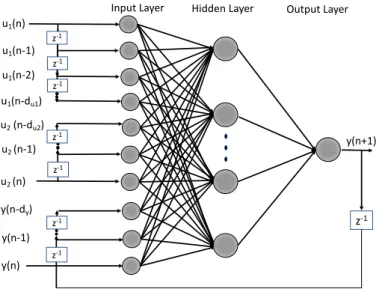
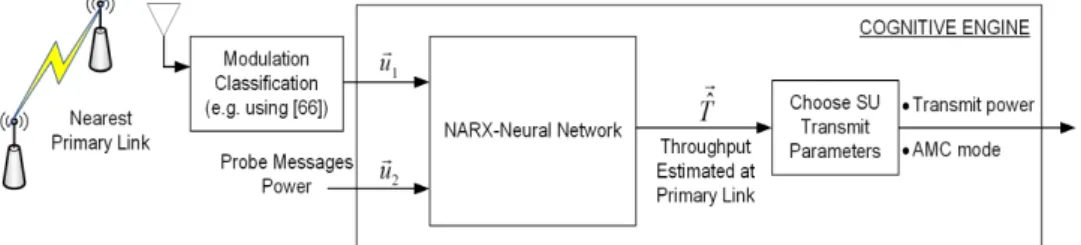
Therefore, in this work we propose an underlay DSA technique that config-ures the transmit power for a SU based on estimating the throughput at its nearest PN link that corresponds to the AMC mode that would be chosen based on the interference created by the SU’s transmission. The proposed technique works in a distributed way and is not limited by the number of links in the PN or the SN. The core of our technique is a non-linear au-toregressive exogenous neural network (NARX-NN)-based cognitive engine that estimates the throughput on a PN link (equivalently, the full AMC mode), an indicator of the interference induced by the SU on the PN link, using as input an estimate of the modulation scheme being used at the PN link. As such, to the best of our knowledge, our presented cognitive engine is the first to be capable of estimating the channel coding rate setting for an AMC mode, a capability well beyond the estimation of the modulation scheme that has been realized through multiple signal processing or ma-chine learning techniques. While modulation classification, the technique to estimate the modulation scheme used in a radio waveform, is applied in our DSA technique to derive an input for the cognitive engine, it is not the subject of this work. Instead, we leverage the already large volume of existing research. In this regard, the work in [64] studied modulation clas-sification based on second and higher order time variant periodic cumulant function of the sensed signal for which it is required a prior knowledge of the signal parameters. Authors in [65] used the same framework to perform signal pre-processing, along with utilizing artificial neural networks to ad-dress the issues associated with classification when the signal parameters are unknown. The work in [66] proposed a fully automated modulation classification scheme which employs two stages of signal processing to clas-sify the modulation of an incoming signal. In this chapter we assume that each SU applies the technique proposed in [66] on the nearest primary link to infer its used modulation scheme.
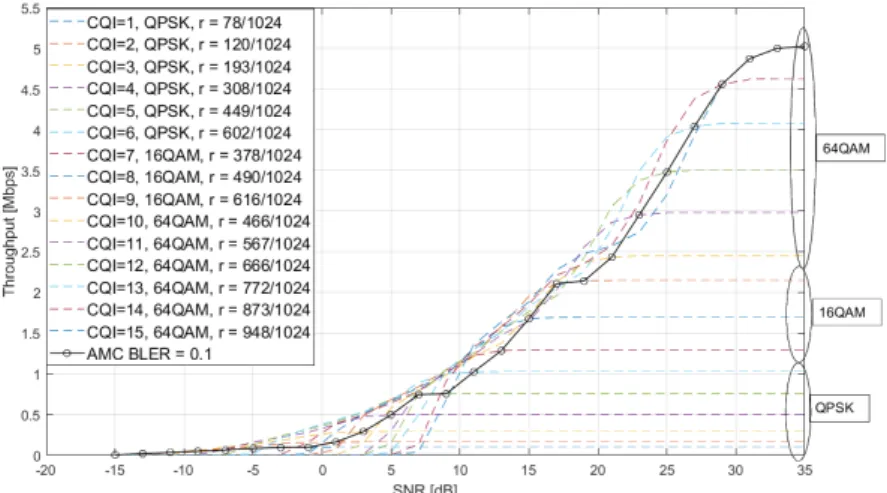
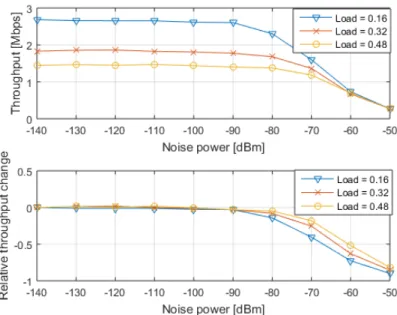
Leveraging the use of adaptive modulation in the PN will allow us not only to assess the effects of the SN on the PN, but will also allow us to establish the PN interference threshold. As shown in [67], the use of adaptive modu-lation allows for the background noise to increase up to a certain level before the average throughput in a network starts to decrease. In the context of underlay DSA where the PN does not exchange any information with the SN, the interference imposed on the PN by an underlay-transmitting CR
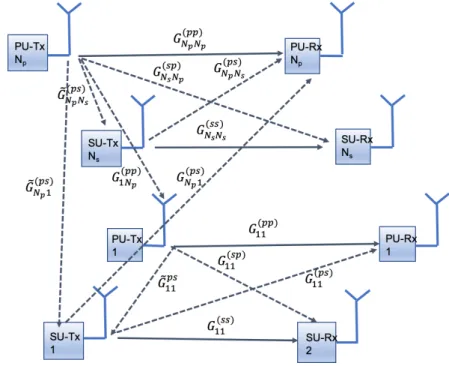
Figure 2.1: Considered network model composed of Np primary
transceivers andNs cognitive radio users.
can be seen as a background noise for the PN, that can be increased up to a level which does not affect the average throughput in the primary net-work. Therefore, a CR can become aware about the interference that is creating on the primary link and decide on its transmit power by inferring the experienced throughput of the primary link (which is equivalent to the full AMC mode used) and detecting any change in it.
The main contribution of this chapter resides in presenting an underlay DSA technique to infer, without tapping into feedback or control channels from another network, the modulation order and the channel coding rate (and accordingly the effective bit rate) used in the transmission of the other network (here primary network), and to leverage this inference in the realization of a fully autonomous and distributed underlay DSA scheme. This ability to estimate the effective throughput enables a finer control knob for a more accurate power allocation with less harmful effect on PN transmissions as compared to techniques that rely only on the estimation of modulation order (from applying signal processing on the transmission waveform).
2.2
System Model
We consider a primary network with NP active primary links coexisting
with NS active secondary links, with both networks transmitting over the
same frequency band. The system model is shown in Fig.2.1, whereG(ijps) is
the path gain fromjth. transmitting SU to the receiver inith. primary link
(denoted as cross-channel gain),G(ijss)is the path gain from the transmitter
in the jth. secondary link to the receiver in the ith. secondary link, G(ijsp)
is the path gain from the transmitter injth. primary link to the receiver in
ith. SU link,G(iipp) is the path gain from theith. primary transmitter to its
corresponding receiver, and G(iiss) is the path gain from theith. secondary
transmitter to its corresponding receiver. While, ˜G(ijps)is the path gain from
the transmitter in jth. secondary link to the transmitter in ith. primary
link.
In this section we focus on describing the operation of the PN, which is incumbent to the considered radio spectrum band. Section 2.4 will present the underlay DSA scheme implemented in the SN. We assume that the PUs
receive service fromNP BS transmitting base stations (BSs), and we call the
ratio NP/NP BS as the primary network load. Each PU is assigned to the
base station that presents the best channel gain. In addition, AMC is used in all transmissions (primary and secondary networks). This means that a transmitter has information about its link quality, in terms of SINR, and based on this assessment chooses, from a set of options, the modulation scheme and channel coding rate that results in highest throughput while at the same time meeting a maximum bit error rate (BER) limit.
Let Pi(p) denotes the transmit power in the ith. active primary link (i =
1,2, . . . , NP). Then, in the absence of the SN, the SINR in theith. primary
link (which is used to decide on the AMC mode) can be written as,
γi(p) = G (pp) ii P (p) i X j6=i G(ijpp)Pj(p)+σ2p , i= 1,2, ..., NP, (2.1) where σ2
p is the background noise power.
network the variable transmit power allocation algorithm proposed in [67]. This is an iterative power control algorithm that converges to a global optimum solution that maximizes the product of SINRs across all active
links. In the algorithm