A Dissertation Entitled
The Roles of Information Systems Integration in the Supply Chain Integration Context - Firm Perspective
by
Thawatchai Jitpaiboon
Submitted as partial fulfillment of the requirements for the Doctor of Philosophy Degree in
Manufacturing Management
~
.~.
Advisor: Dr. T.S. Ragu-Nathan
7rf~
U~
Advisor: Dr. Mark Vonderembse
The University of Toledo June 2005
UMI Number: 3188242
____________________________________________________________ UMI Microform 3188242
Copyright 2006 by ProQuest Information and Learning Company. All rights reserved. This microform edition is protected against
unauthorized copying under Title 17, United States Code.
_______________________________________________________________ ProQuest Information and Learning Company
789 East Eisenhower Parkway P.O. Box 1346
Committee Members, Signature
Dr. Christine Fox
Associate Professor of Educational Research and Measurement College of Education
The University of Toledo
Dr~anet L. Hartley Professor of Management
College of Business Administration Bowling Green State University
~r
Dr. Bhanu Ragu-bhthan Professor of Accbunting
College of Business Administration The University of Toledo
An Abstract of
The Roles of Information Systems Integration (ISI) in the Supply Chain Integration Context – Firm Perspective
Thawatchai Jitpaiboon
Submitted as partial fulfillment of the requirement for The Doctor of Philosophy degree in
Manufacturing Management
The University of Toledo June 2005
With advances in information technology (IT), information systems integration (ISI) and its role in an integrated supply chain have become important to executives and researchers. ISI represents the degree of cooperation in information system practices between business functions within a firm and between a firm and its trading partners. It has been documented that the introduction and utilization of ISI for supply chain management enhance the firms’ competitiveness and growth. While many firms focus on achieving high levels of IT utilization, without high levels of ISI, supply chain members may not attain the full benefits of working within a supply chain.
The concept of ISI can be captured using two main sub-constructs (e.g., internal ISI and external ISI) and can be conceptualized at three levels – (1) Strategic, (2) Operational, and (3) Infrastructural. Studying the effects of ISI in these levels can help researchers and executives understand how ISI practices at different levels contribute to
overall supply chain effectiveness. The implications of such an understanding may bring significant benefits to both operations researchers and practitioners. Such benefits may include making better decisions about which IT to utilize, which information systems (IS) practices to emphasize, and what level of ISI to attain. From a practitioner’s perspective, this research provides important guidelines so firms may better understand ISI issues and effectively implement IT.
This study proposes three significant contributions to supply chain management research. First, this study applies an information system perspective to study both causes and effects of supply chain integration. It proposes a theoretical framework that considers the role of ISI as a mediator between IT utilization and supply chain integration. Second, this study provides the inferences made from an instrument that is valid and reliable for the current study’s context, which are beneficial for both practitioners and academicians. Third, it examines the effects of supply chain integration on a firm’s operational performance; the effects of supply chain integration on a suppliers’ operational performance, the effects of a suppliers’ operational performance on a firm’s operational performance, the effects of a suppliers’ operational performance on a firm’s overall performance, and the effects of a firm’s operational performance on the firm’s overall performance.
ACKNOWLEDGEMENTS
The completion of this dissertation would be impossible without generous help and unstoppable advice from the following remarkable people.
First, I would like to express my whole hearted gratitude to Dr. T.S. Ragu-Nathan and Dr. Mark Vonderembse, co-chairs of my dissertation, for their advice and wisdom given with positive synergy and attitude. They made every effort to make my work significant and worthwhile. They encouraged me to do better when I was down and congratulated me when I reached their expectations. They showed concern for my academic success and well-being as a person. It is my hope to continue our long-term relationship. To Dr. Ragu and Dr. Vonderembse, thank you very much for being in my life.
Second, equal thanks also go to Dr. Bhanu Ragu-Nathan, Dr. Janet Hartley, and Dr. Christine Fox. Your suggestions were exceptional and undeniably brought significant improvements to my dissertation. They were especially important for improving the theory development.
Third, I would like to thank the Society of Manufacturing Engineers (SME) for the letter of endorsement and the provision of the valuable mailing list. Special thank goes to Mark Stratton (Community Relations Manager, Manufacturing Education & Research Community), Mary Venianakis (List Manager), and Vincent Harrington (Publication Manager).
Fourth, I would like to thank many professors: Dr. William Doll, Dr. Jeen S. Lim, Dr. Ram Rachamadugu, Dr. Udayan Nandkeolyar, and other faculty members who were valuable sources of knowledge and experience.
Fifth, I am grateful for the financial support for this research provided by the Miller College of Business, Ball State University. My humble gratitude goes to Dr. Tom Harris (Chair of Information Systems and Operations Management), Dr. Lynn Richardson (Dean of the Miller College of Business), Dr. Ray Montagno (Associate Dean), and Dr. Rodney Davis (Associate Dean).
Lastly, I would like to thank my mother, my father, and my family for continually supporting me.
TABLE OF CONTENTS
ABSTRACT...iv
ACKNOWLEDGEMENTS ...vi
LIST OF TABLES ...xii
LIST OF FIGURES ...xiv
LIST OF APPENDICES ...xv
CHAPTER 1: INTRODUCTION...1
CHAPTER 2: LITERATURE REVIEW ...8
2.1 ISI IN THEORY ...9
2.2 CONSTRUCTS OF ISI...11
2.3 ISI FRAMEWORK AND ITS RELATED CONSTRUCTS...15
2.3.1 Information Technology Utilization ...15
2.3.2 Supply Chain Integration ...20
2.4 PERFORMANCE INDICATORS...23
2.4.1 Firm’s Operational Performance...23
2.4.2 Supplier Performance...24
2.4.3 Firm Performance ...25
CHAPTER 3: THEORETICAL FRAMEWORK AND HYPOTHESES DEVELOPMENT ...27
3.1 THEORETICAL FRAMEWORK ...27
3.2 IMPACTS OF IT UTILIZATION OF ISI (H1a and H1b) ...30
3.3 IMPACTS OF IISI ON EISI (H2) ...31
3.4 IMPACTS OF ISI ON SUPPLY CHAIN INTEGRATION (H3 and H4)...32
3.5 IMPACTS OF SUPPLY CHAIN INTEGRATION ON OPERATIONAL PERFORMANCE (H5 and H6)...33
3.6 IMPACTS OF SUPPLIERS’ OPERATIONAL PERFORMANCE ON FIRM’S
OPERATIONAL PERFORMANCE (H7) ...35
3.7 IMPACTS OF OPERATIONAL PERFORMANCE ON FIRM PERFORMANCE (H8 and H9) ...36
CHAPTER 4: INSTRUMENT DEVELOPMENT ITEM GENERATION AND PILOT TEST ...38
4.1 ITEM GENERATION ...39
4.2 PILOT TEST...41
4.3 SCALE DEVELOPMENT: THE Q-SORT METHOD ...42
4.3.1 Sorting procedures ...43
4.3.2 Inter-rater reliabilities………... 46
CHAPTER 5: INSTRUMENT DEVELOPMENT – LARGE SCALE ADMINISTRATION AND INSTRUMENT VALIDATION ...52
5.1 SAMPLING PLAN...52
5.1.1 Sampling plan and sampling design ...52
5.1.2 Sampling frame options ...53
5.1.3 Random sampling generation ...54
5.2 LARGE-SCALED DATA COLLECTION METHODOLOGY ...55
5.3 SAMPLING CHARACTERISTICS OF THE RESPONDENTS...57
5.3.1 Sampling characteristics of the respondents ...58
5.3.2 Sampling characteristics of the surveyed organizations ...59
5.3.3 Sampling characteristics of the supply chains ...61
5.3.4 Sampling characteristics of technology applications...63
5.4 TEST OF NON-RESPONSES BIAS ...64
5.5 TEST OF RESPONSES BIAS...65
5.7 LARGE-SCALE MEASURE RESULTS...72
5.7.1 Information Technology Utilization (ITU)...74
5.7.2 Internal Information System Integration (IISI)...81
5.7.3 External Information System Integration (EISI)...90
5.7.4 Supply Chain Integration (SCI) ...98
5.7.5 Suppliers’ Operational Performance (SOP)...104
5.7.6 Firm’s Operational Performance (FOP)...111
5.7.7 Firm Performance (FP) ...118
5.8 DISCRIMINANT VALIDITY (SECOND-ORDER CONSTRUCT) ...120
5.9 PREDICTIVE VALIDITY ...122
CHAPTER 6: STRUCTURAL EQUATION MODELING, HYPOTHESES TESTING, AND SUMMARY OF RESULTS ...123
6.1 THE PROPOSED STRUCTURAL MODEL...124
6.2 STRUCTURAL EQUATION MODELING METHODOLOGY ...126
6.3 STRUCTURAL MODEL TESTING RESULTS ...130
6.3.1 Initial structural modeling results ...131
6.3.2 Revised structural model...136
6.4 DISCUSSIONS OF STRUCTURAL MODELING AND HYPOTHESES TESTING RESULTS ...137
6.5 STRUCTURAL EQUATION MODEL RESULTS – INDIRECT EFFECTS...143
6.6 MODIFIED STRUCTURAL EQUATION MODEL RESULTS...145
6.7 DISCUSSIONS OF THE NEW PATHS ...148
6.8 SUMMARY OF RESULTS ...149
CHAPTER 7: SUMMARY, LIMITATIONS, IMPLICATIONS, AND RECOMMENDATIONS FOR FUTURE RESEARCH...151
7.1 SUMMARY...151
7.2 IMPLICATIONS FOR PRACTITIONERS ...154
7.4 LIMITATIONS OF THE RESEARCH ...159 7.5 RECOMMENDATIONS FOR FUTURE RESEARCH...160
LIST OF TABLES
Table 1 IISI Construct, its sub-constructs, and construct definitions ...13
Table 2 EISI Construct, its sub-constructs, and construct definitions ...14
Table 3 IT utilization constructs, its sub-constructs, and construct definitions...19
Table 4 Supply chain integration construct, its sub-constructs, and construct definitions ...22
Table 5 Operational performance construct and its definition...24
Table 6 Supplier performance, construct definition, and related literature ...25
Table 7 Firm performance construct and its definition...26
Table 8 Construct definition summary...29
Table 4.1 Inputs for Cohen’s Kappa coefficient ...189
Table 4.2 Inter-judge raw agreement scores: first sorting round ...190
Table 4.3 Items placement ratios: first sorting round ...191
Table 4.4 Inter-judge agreements...192
Table 4.5 IT utilization constructs ...193
Table 4.6 Internal information system integration...194
Table 4.7 External information system integration...195
Table 4.8 Relationship with customers and suppliers...196
Table 4.9 Inter-judge raw agreement scores: first sorting round ...197
Table 4.10 Items placement ratios: second sorting round...198
Table 4.11 Inter-judge agreements...200
Table 4.12 IT utilization constructs ...201
Table 4.13 Internal information system integration...202
Table 4.14 External information system integration...203
Table 4.15 Relationship with customers and suppliers...204
Table 4.16 Inter-judge raw agreement scores: third sorting round ...205
Table 4.17 Items placement ratios: third sorting round ...206
Table 4.18 Inter-judge agreements...208
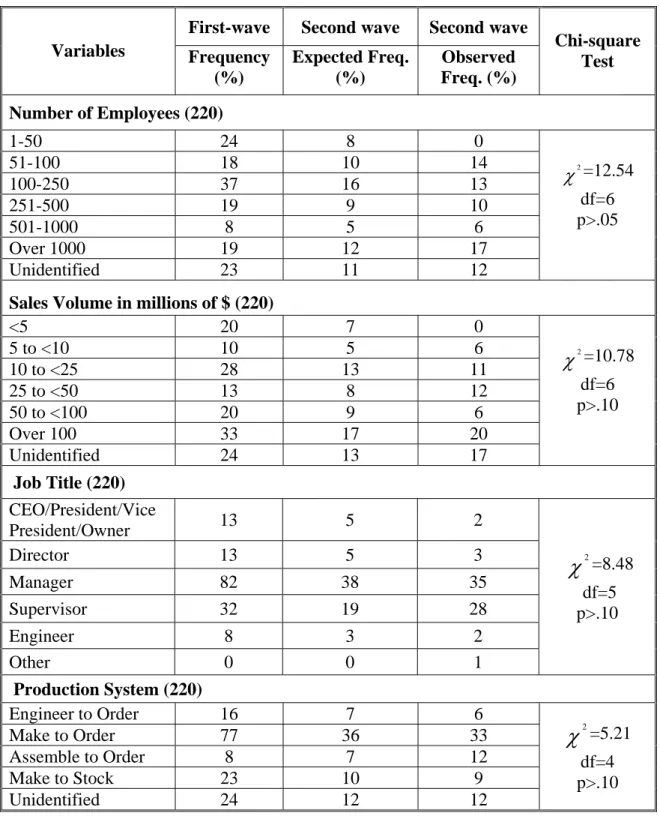
Table 5.1 Number of employees ...55
Table 5.2 Number of respondents and telephone calls by state ...56
Table 5.3 Characteristics of the respondents ...242
Table 5.4 Characteristics of the surveyed organizations...246
Table 5.5 Characteristics of the surveyed organizations – relationship with customers and suppliers ...251
Table 5.6 Test of non-response bias...65
Table 5.7 Test of response bias between an online survey and a regular mail ...66
Table 5.7.1.1 Purification for information technology utilization ...75
Table 5.7.1.2 Exploratory factor analysis for information technology utilization...78
Table 5.7.1.3 Model fit indexes for information technology utilization...80
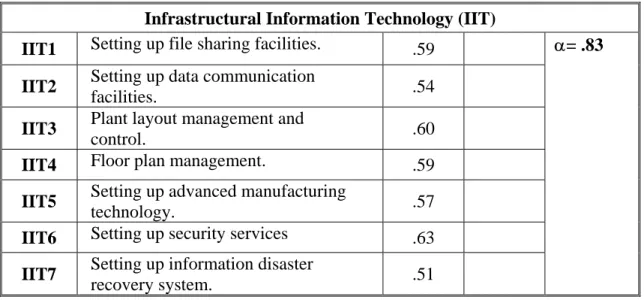
Table 5.7.1.4 Information technology utilization – final construct measurement items .80 Table 5.7.2.1 Purification for internal information system integration ...82
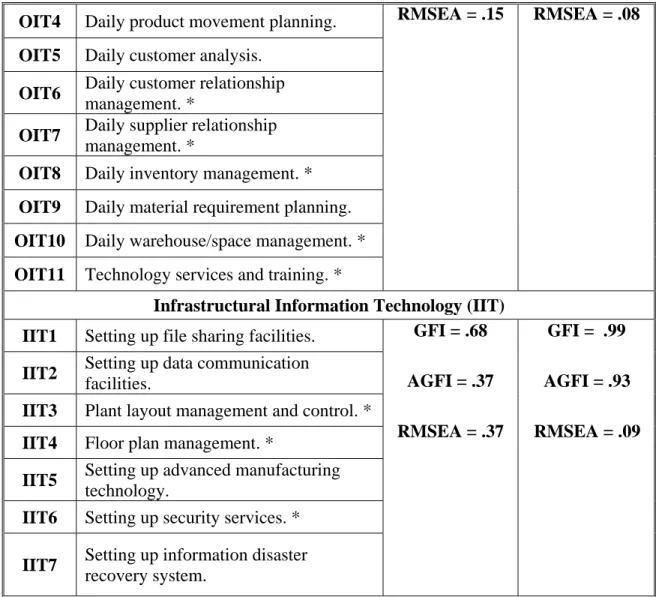
Table 5.7.2.2 Model fit indexes for internal information system integration ...86
Table 5.7.2.4 Internal information system integration – final construct measurement
items...89
Table 5.7.3.1 Purification for external information system integration...91
Table 5.7.3.2 Model fit indexes for external information system integration ...94
Table 5.7.3.3 Pairwise comparison for EISI ...96
Table 5.7.3.4 External information system integration – final construct measurement items...97
Table 5.7.4.1 Purification for supply chain integration ...99
Table 5.7.4.2 Model fit indexes for supply chain integration ...101
Table 5.7.4.3 Pairwise comparison for supply chain integration...102
Table 5.7.4.4 Supply chain integration – final construct measurement items ...103
Table 5.7.5.1 Purification for suppliers’ operational performance ...104
Table 5.7.5.2 Model fit indexes for suppliers’ operational performance...107
Table 5.7.5.3 Pairwise comparison for suppliers’ operational performance ...109
Table 5.7.5.4 Suppliers’ operational performance – final construct measurement items110 Table 5.7.6.1 Purification for firm’s operational performance ...111
Table 5.7.6.2 Model fit indexes for firm’s operational performance...114
Table 5.7.6.3 Pairwise comparison for firm’s operational performance ...116
Table 5.7.6.4 Firm’s operational performance – final construct measurement items....117
Table 5.7.7.1 Purification for firm performance ...118
Table 5.7.7.2 Model fit indexes for firm performance...119
Table 5.7.7.3 Firm performance – final construct measurement items...119
Table 5.8.1 Goodness of fit indexes for first and second order model ...121
Table 5.9.1 Construct-level correlation analysis results ...122
Table 6.2.1 The relationship between r and r2 ...130
Table 6.3.1 Initial AMOS structural modeling results...134
Table 6.3.2 Revised structural modeling results ...136
Table 6.5.1 Structural modeling result – indirect effects...145
LIST OF FIGURES
Figure 2.1 Theoretical framework for information system integration ...18
Figure 3.1 Theoretical framework for information system integration ...28
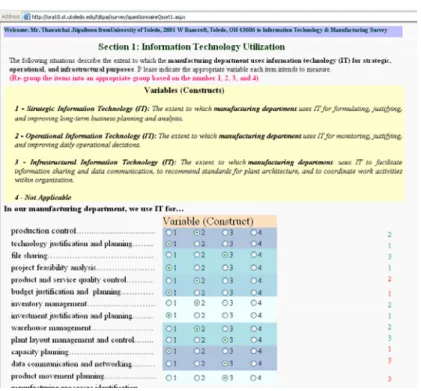
Figure 4.1 Q-sort login page...44
Figure 4.2 Q-sort page...45
Figure 4.3 Web-site to calculate Cohen’s Kappa Coefficient ...209
Figure 4.4 The result of computing Cohen’s Kappa ...210
Figure 5.3.1.1 Respondents by job title...243
Figure 5.3.1.2 Respondents by job function...243
Figure 5.3.1.3 Level of education...244
Figure 5.3.1.4 Respondents by years worked at the organization...244
Figure 5.3.1.5 Respondents by years of work ...245
Figure 5.3.2.1 Major business ...248
Figure 5.3.2.2 Organizations by SIC code ...248
Figure 5.3.2.3 Organizations by primary production system ...249
Figure 5.3.2.4 Organizations by primary manufacturing system ...249
Figure 5.3.2.5 Organizations by # of employees...250
Figure 5.3.2.6 Organizations by annual sales...250
Figure 5.3.3.1 Electronic transactions with customers and suppliers ...252
Figure 5.3.3.2 Organizations by supply chain horizontal structure...252
Figure 5.3.3.3 Organizations by supply chain position...253
Figure 5.6.1 Model A ...71
Figure 5.6.2 Model B ...71
Figure 6.1 Theoretical framework for information system integration...125
Figure 6.2 Structural model for information system integration framework ...132
Figure 6.3 Path analysis for information system integration framework ...133
Figure 6.4 Revised path analysis for information system integration framework ....135
LIST OF APPENDICES
APPENDIX A: MEASUREMENT ITMES ...174
APPENDIX B: COHEN’S KAPPA AND MORRE AND BENBASAT COEFFICIENT ...180
APPENDIX C: THE FINAL VERSION OF QUESTIONNAIRE ...208
APPENDIX D: LARGE-SCALE MAIL SURVEY QUESTIONNAIRE...211
APPENDIX E: FACTS AND CHECKLIST ...212
APPENDIX F: MANUFACTURING & IT SURVEY ...213
APPENDIX G: SURVEY ONLINE VERSION ...225
APPENDIX H: MAILING ENVELOP DESIGN ...234
APPENDIX I: RETURN MAIL ENVELOP DESIGN ...235
APPENDIX J: FOLLOW UP LETTER ...236
APPENDIX K: LETTER OF ENDORSEMENT FROM SME ...237
APPENDIX L: CALLING SCRIPTS...238
APPENDIX M: SAMPLE CHARACTERISTICS...239
APPENDIX N: THE QUESTIONNAIRE RECOMMENDED FOR FUTURE RESEARCH ...251
APPENDIX O: IRB FROM UNIVERSITY OF TOLEDO ...263
CHAPTER 1: INTRODUCTION
A supply chain is a network of companies connected via a set of serial and parallel supplier-customer relationships from the first supplier to the final customer. A supply chain involves an interwoven coordination of logistics planning activities among supply chain members, which include all of the capabilities and functions required to design, fabricate, distribute, sell, support, use, and recycle or dispose of a product, as well as the associated information that flows up and down the chain (National research council, 2000). Supply chains are typically comprised of geographically dispersed facilities and capabilities, including sources of raw materials, product design and engineering organizations, manufacturing plants, distribution centers, retail outlets, and customers, as well as the transportation and communications links between them. As firms are continually participating in the global market to stay competitive, they are facing many challenges that include expanding global competition, advancing technology and innovation, increasing customer expectations, and growing supply chain complexity. These challenges are expected to continuously increase in intensity and complexity. To cope with these challenges, firms are applying advanced information technology (IT) to move toward ever-increasing supply chain integration in both inter- and intra-organizations.
An integrated supply chain is an association of customers and suppliers who work together to optimize their collective performance in the creation, distribution, and support of an end product. All supply chains are integrated to some extent by focusing and
coordinating the relevant resources of each participant to optimize the overall performance of the chain. Therefore, supply chain integration is a continuous process that can be optimized when supply chain members work together to improve their relationships and when all participants are aware of key activities at all levels in the chain.
Information Technology (IT) is playing an increasingly critical role in the success or failure of the supply chain. IT ranks highly as the essential ingredient and backbone for the success of supply chain integration (Barut et al., 2002). IT has become one of the keys to operating success. It is impossible to achieve an effective supply chain without IT. Since suppliers are located all over the world, it is essential to integrate the activities both inside and outside of an organization. This requires an integrated information system (IS) for sharing information on various value-adding activities along the supply chain (Gunasekaran and Ngai, 2004; Gangopadhyay and Huang, 2004). As the concept of competing between supply chains grows more intense and widespread because of inevitable global competition, IT utilization has changed its role from back office and operational support to strategic imperative. Firms have started to utilize IT to directly influence the processes of comprising the value chain (Rushton and Oxley 1994; Williams et al., 1997). Increasingly, IT is used to facilitate internal coordination within a firm and enhance external integration with external constituencies (e.g., customers and suppliers) and also to enhance decision making among supply chain members. This phenomenon is evident by the increased usage of information systems for integration purposes; for instance, information systems infrastructure (e.g., data communication tools, network connection, standard data structure, and unified coding standards),
information systems software (e.g., enterprise-wide information system such as SAP), and information systems applications (e.g., centralized database management systems, electronic data interchange (EDI), web-based or internet-base information systems). Although the advances in formation technologies are considered a key driver of supply chain integration; what is the best way to deploy these technologies and to coordinate supply chain-wide activities is still under research (Gangopadhyay and Haung, 2004).
This research is an attempt to study and understand the phenomenon by which IT has been used for integration purposes in the supply chain context and to examine how Information Systems Integration (ISI) relates to other factors (direct and indirect) at the organizational level. ISI is the degree of cooperation in information system practices between business functions within a firm and between the firm and its trading partners. ISI represents how top management perceives the extent of coordination on each IS activity, which the firm chooses to perform internally or to interact with its trading partners. At the functional level, ISI helps firms to use data from existing, heterogeneous, distributed sources by providing integration capabilities that support the illusion that a single integrated IS is being used in the supply chain. At the operational level, ISI offers supply chain members the possibility of increased productivity and customer responsiveness. ISI enhances the firm’s operational performance by integrating similar functions over different areas and by curtailing unnecessary activities, thus enhancing the firm’s capability to cope with sophisticated customer needs and to meet product quality standards, improve product quality, enhance productivity, increase equipment utilization, reduce space requirements, and expand logistics efficiency and flexibility (Bardi, Raghunathan, and Bagchi, 1994; Gross, 1984; Kaltwasser, 1990). At the strategic level,
ISI helps businesses not only to automate their activities, but also to reshape and improve their business processes (Venkatraman, 1991).
In spite of a general understanding of the useful roles of ISI in enhancing firms’ competitive position, the empirical investigation explaining both causes and impacts of ISI has been scarce in literature. The previous studies related to ISI have three major shortcomings. First, though there have been some studies discussing the issues of ISI, most of these studies are functionally focused and not in the supply chain context (Wyse and Higgins, 1993; Webber and Pliskin, 1996; Bhatt, 2000). The empirical investigation of the roles of ISI in the supply chain context and the establishment of an instrument to measure the concept of ISI are still lacking.
Second, although benefits of IT utilization in enhancing organizational performance are well documented in literature (Kim and Narasimhan, 2002; Rushton and Oxley, 1994; William et al., 1997; Bardi et al., 1994; Carter and Narasimhan, 1995; Gross 1984; Kaltwasser, 1990), the mechanism by which IT utilization enhances supply chain integration through ISI is not fully developed. Although some studies have pointed out that IT utilization can lead to productivity, performance, and differential and sustainable competitive advantages because it can strengthen linkages between functions within a firm and between firms (Hammer, 1990; Hammer & Champy, 1993; Davenport & Short, 1990; Venkatraman, 1994; Kim and Narasimhan, 2002; Narasimhan and Kim, 2001), empirical studies have not shown consistent results. In fact, several studies have shown that, in some instances, IT investment has had negative, dysfunctional effects on organizational productivity and performance (Hitt & Brynjolfsson, 1994; Roach, 1989; Weill, 1988).
Third, the study of both the causes and effects of ISI in the supply chain context at the organizational level is not fully developed and needs more attention from both practitioners and academicians.
Because the current literature still lacks a clear explanation of the role of ISI in enhancing the relationship between IT utilization and supply chain integration, this study seeks to provide three main contributions. First, a measurement of ISI is developed. Through an extensive literature review, the study identifies three levels of ISI (1) strategic integration, (2) operational integration, and (3) infrastructural integration, and two sub-constructs of ISI (1) Internal ISI (IISI) and (2) External ISI (EISI). This instrument is useful for both practitioners and academicians because it provides an appropriate set of ISI practices that firm can adopt to gain optimal benefits from integration of supply chain activities. Three dimensions of ISI guarantees that the implemented IS can be used to link all activities within and between firms.
Second, this study investigates the mediating role of ISI on the relationship between IT utilization and supply chain integration. According to the productivity paradox theory, the mediating role of ISI in ISI framework combined with the results from this study might be useful to explain the negative relationship between IT utilization and organizational performance found in previous studies (Hitt & Brynjolfsson, 1994; Roach, 1989; Weill, 1988; Dos Santos and Sussman, 2000). Small part-manufacturers, for instance, were forced by larger firms such as Ford and GM to implement IT projects such as EDI. However, the full benefits of technology utilization are hardly recognized due to the lack of systematic, hand-on practices which can help firms realize the potential benefits of IT. Without a higher level of ISI, benefits of supply chain integration may not
be fully attained (Bhatt & Stump, 2001). ISI enhances the organizational capability to make decisions on which IT is to be utilized, which IS practices is to be emphasized, and on what levels of ISI to focus. From a practitioner’s point of view, this research provides important guidelines for a firm to better understand ISI issues and to more effectively implement IT.
Third, this study proposes a theoretical framework to study causes and effects of ISI. This framework is tested using a large-scale survey methodology. The unit of analysis is at the organizational level and the targeted respondents are high level managers of manufacturing firms. The important relationships tested include: (1) direct impact of IT utilization on internal ISI; (2) direct impact of IT utilization on external ISI; (3) direct impact of internal ISI on external ISI; (4) direct impact of internal ISI on supply chain integration; (5) direct impact of external ISI on supply chain integration; (6) direct impact of supply chain integration on firm’s operational performance; (7) direct impact of supply chain integration on suppliers’ operational performance; (8) direct impact of suppliers’ operational performance on firm’s operational performance; (9) direct impact of suppliers’ operational performance on firm’s overall performance; and (10) direct impact of firm’s operational performance on firm’s overall performance.
Chapter 2 reviews the literature on theoretical foundation and constructs development. The overall framework that depicts the relationships between the constructs and the development of hypotheses are presented in Chapter 3. The research methodology for generating items for measurement instruments appears in Chapter 4. The large scale administration and instrument validation are coved in Chapter 5. Chapter 6 covers the structural equation modeling methodology for hypotheses testing and
summary of results. Lastly, summary of the study, limitations, implications, and recommendations for future research are covered in Chapter 7.
CHAPTER 2: LITERATURE REVIEW
The globalization of markets and manufacturing has forced the management of supply chains to consider not only business processes in the traditional value chain, but also processes that penetrate networks of organizations. Thus, ISI research has turned from an intra-enterprise focus towards an inter-enterprise focus. Noori and Mavaddat (1998) discussed ISI as “enterprise-wide systems” which enable a much greater degree of integration through greater speed and flexibility in the way firms integrate their internal and external activities. A higher degree of ISI creates information visibility and captures the moments of information which enable collaborative members of the supply chain to manage their business processes better (Lummus and Vokkurka, 1999).
Despite the widely held belief that information technology (IT) is fundamental to a firm’s survival and growth, scholars are still struggling to specify the underlying mechanisms linking IT to organizational performance (Bharadwaj, 2000). Anecdotal evidence and case studies have found that effective and efficient use of IT is a key factor differentiating successful firms from their less successful counterparts (Byrd and Marshall, 1997; Hammer, 1990; Hammer & Champy, 1993; Davenport & Short, 1990; Venkatraman, 1994). Although evidence from many case studies suggests that IT increases productivity and performance (Hammer, 1993; Hammer & Champy, 1993; Davenport & Short, 1990; Venkatraman, 1994), empirical evidence from large sample studies has not been as readily forthcoming. In fact, several studies have shown that, in some instances, IT investment has had negative, dysfunctional effects on organizational
productivity and performance (Hitt & Brynjolfsson, 1994; Roach, 1989; Weill, 1988). There is evidence that many firms, concerned about falling behind on the technology curve, engage in high IT investments without deriving any benefits from IT (Nolan 1994). Despite the substantial investment in IT by corporations, direct linkage between technology utilization and increases in productivity and performance has been extremely elusive. Therefore, this study attempts to explain this missing link using the ISI concept.
2.1. ISI IN THEORY
The study of ISI started as early as 1985. Mudie and Schafer (1985) analyzed ISI in process terms, as they believed ISI should not only facilitate the process of development and use of data, applications, and other processing technology, but also should provide the flexibility to meet the future business demands in workstations, processing types, and applications. Wyse and Higgins (1993) defined ISI as the extent to which data and applications through different communication networks can be shared and accessed for organizational use. They defined ISI into two components: data integration and technical integration. Data integration refers to the relevancy of the information that is collected, processed, and disseminated throughout the firm. Technical integration concerns the physical or formal linkage of information systems and subsystems that are used by the firm.
Webber and Pliskin (1996) defined ISI in the merger or acquisition context as the extent of the integration of IS and data processing functions with financial systems, which are usually a critical component of the IS. The findings point to a positive relationship between ISI and effectiveness only when controlling IT intensity and
organizational culture differences between the joining firms. Stylianou et al. (1996) also studied ISI framework in the merger and acquisition context conducted by the American Management Association (AMA). The framework examines the relationships between the measure of ISI success and the components that affect it. ISI success was measured using a multidimensional attribute as: 1) IS-assessment of the success of the integration process and integrated systems; 2) the ability to exploit to avoid opportunities arising from a merger; 3) the ability to avoid problems stemming from the merger; and 4) the end-user satisfaction with the integration process and integrated systems. Following this study, Robbies and Stylianou (1999) modified the ISI success measure to fit with the post-merger system integration context. The improved IS capability construct was added. They argued that the measure relating to improved IS capabilities that helped support the underlying motives for the merger is important and should be included.
Bhatt (2000) studied the relationship between ISI and business process improvement. He argued that, at a conceptual level, ISI can be viewed as data architectures, communication networks, and support firms. He used two aspects to measure the degree of ISI: Data integration and communication networks integration. The data integration was defined as the extent to which different firms can share a number of databases for coordinating their activities. Communication networks integration was defined as the extent to which different information systems can communicate with other wide information systems to coordinate present and future activities depending on network connectivity and network flexibility.
2.2. CONSTRUCTS OF ISI
Previous studies have discussed the role of ISI in tactical and operational perspectives suitable for the context of studies such as process development, financial research or merger and acquisition. Researchers mostly looked at only functional aspects of ISI, for instance, data integration and communication networks integration (Madnick, 1991; 1995; Wyse and Higgins, 1993; Bhatt, 2000; Wainwright and Waring, 2004; Themistocleous et al., 2004), the extent of IS and data processing functions and the extent of integration of financial systems (Webber and Pliskin, 1996), integration of heterogeneous information systems, databases, or application software, integration of different physical stages in business processes, and integration of subsystems into a well-coordinated network system (Sikora and Shaw, 1998; Cohen and Lee, 1988). None of the previous studies focused on ISI research at the strategic level. In addition, previous studies considered ISI as a success measure, not as a practice (Stylianou et al., 1996; Robbies and Stylianou, 1999).
In the inter-and intra-organizational supply chain context where integration of corporate entities can produce dynamic and synergistic opportunities, ISI should not only be viewed as traditional back office and processing support, but also as strategic support. Porter and Millar (1985) asserted that management of information systems can no longer be the only provision of functional activities such as accounting and record keeping. The use of advanced information systems in value chain activities allows companies to enhance competitive differentiation as well as attain cost leadership and sustainable competitive advantage (Kim and Narasimhan, 2002). McFarlan and McKenny (1984)
showed in their information systems strategic grid that the role of IS should change from operational supporter to strategic enabler in order to form competitive success.
In this study, from a firm’s perspective, ISI is the degree of cooperation between business functions within the firm (IISI) and between a firm and its trading partners (EISI) on an internally consistent set of strategic, operational, and infrastructural information systems practices using information systems (IS). ISI can be defined using two sub-constructs – IISI and EISI. Table 1 displays the IISI construct, its sub-constructs, and the construct definitions and Table 2 shows the EISI construct, its sub-constructs, and the construct definitions.
Constructs Definitions Literature
Internal Information Systems Integration (IISI)
The degree of cooperation between business functions within the firm on an internally consistent set of strategic, operational, and infrastructural information systems practices using information systems (IS).
Wainwright and Waring, 2004; Themistocleous et al., 2004; Koufteros,
Vonderembse, and Jayaram, 2005; Fiderrio, 1989; McFarlan and McKenny, 1984; Gross, 1984; Porter and Millar, 1985; Madui and Schafer, 1985; Cohen and Lee, 1988; Earl, 1989; Kaltwasser, 1990; Madnick, 1991; Buck-lew et al., 1992; Wyse and Higgins, 1993; Stylianou et al., 1996; Webber and Pliskin, 1996; Sikora and Shaw, 1998; Robbies and Stylianou, 1999; Bhatt, 2000;
Narasimhan and Kim, 2001; Numilaakso et al, 2002; Kim and Narasimhan, 2002; Strategic information
system integration
A set of strategic information system practices, which promote cooperation of various business functions within the firm.
McFarlan and McKenny, 1984; Earl, 1987; Earl, 1989; Chan et al., 1997; King and Teo, 1997
Operational
information system integration
A set of operational
information system practices, which promote cooperation of various business functions within the firm.
Buck-Lew et al., 1992; Narasimhan and Kim, 2001; Numilaakso et al, 2002; Kim and Narasimhan, 2002; Infrastructural
information system integration
A set of information system practices to facilitate
information sharing and to coordinate work activities, which promote integration within firm.
Fiderrio, 1989; Madnick, 1991; 1995; Wyse and Higgins, 1993; Bhatt, 2000; Mudie and Schafer, 1985; Goodhue et al., 1992; Yates and Benjamin, 1991; Bhatt, 2002; Bhatt and Stump, 2001; Nurmilaakso et al.,2002;
Constructs Definitions Literature
External Information Systems Integration (EISI)
The degree of cooperation between a firm and its trading partners on an internally consistent set of strategic, operational, and infrastructural information systems practices using information systems (IS).
Wainwright and Waring, 2004; Themistocleous et al., 2004; Fiderrio, 1989; McFarlan and McKenny, 1984; Gross, 1984; Porter and Millar, 1985; Madui and Schafer, 1985; Cohen and Lee, 1988; Earl, 1989; Kaltwasser, 1990; Madnick, 1991; Buck-lew et al., 1992; Wyse and Higgins, 1993; Stylianou et al., 1996; Webber and Pliskin, 1996; Sikora and Shaw, 1998; Robbies and Stylianou, 1999; Bhatt, 2000; Narasimhan and Kim, 2001; Numilaakso et al, 2002; Kim and Narasimhan, 2002; Strategic information
system integration
A set of strategic information system practices, which promote cooperation between a firm and its external constituencies such as customers and suppliers.
McFarlan and McKenny, 1984; Earl, 1987; Earl, 1989; Chan et al., 1997; King and Teo, 1997
Operational
information system integration
A set of operational
information system practices, which promote cooperation between a firm and its external constituencies such as customers and suppliers.
Buck-Lew et al., 1992; Narasimhan and Kim, 2001; Numilaakso et al, 2002; Kim and Narasimhan, 2002;
Infrastructural information system integration
A set of information system practices to facilitate
information sharing and to coordinate work activities, which promote integration between a firm and its external constituencies such as customers and suppliers.
Fiderrio, 1989; Madnick, 1991; 1995; Wyse and Higgins, 1993; Bhatt, 2000; Mudie and Schafer, 1985; Goodhue et al., 1992; Yates and Benjamin, 1991; Bhatt, 2002; Bhatt and Stump, 2001; Nurmilaakso et al.,2002;
2.3. ISI FRAMEWORK AND ITS RELATED CONSTRUCTS 2.3.1. Information Technology Utilization
Previously, the introduction of IT was viewed as a back office support limited to the automation of clerical functions (Kim and Narasimhan, 2002). With the realization of global competition and advances in information technology, the utilization of IT can have a direct effect on value creation by integrating firm’s supply chain activities resulting in higher quality products, enhanced productivity, efficient machine utilization, reduced space and increased logistics efficiency and flexibility (Gross, 1984; Kaltwasser, 1990; Kim and Narasimhan, 2002). Porter and Millar (1985) asserted that the utilization of IT has a significant influence on the relationships between value chain activities as well as on the physical aspects of individual value chain activities. IT provides competitiveness to firms such as: (a) creating value for customers; (b) creating value for companies; (c) optimizing or integrating value chains through IT to improve competitiveness; and (d) accommodating the creation of a new value chain. Earl (1989) asserted that IS must be considered as a strategic weapon. This view focuses the utilization of IS more in strategic and managerial activities than in operational areas. He classified the scope of IT into four categories: (1) IT used to automate or improve the physical aspects of every activity; (2) IT used to physically connect each value activity or to control the activities at the connecting point; (3) IS used to facilitate the implementation, support, and management of value activities, and (4) IS used to optimize or to adjust the connection of each value activity. Kyobe (2004) purported that strategic IT utilization plays a significant role in supporting the development and building of core and distinctive competencies which enable a firm to create a competitive advantage. Jane et al. (2004) argued that advances in
information technology have been a primary enabler for firms’ focus on Interorganizational business processes. Gangopaddyay and Hauang (2004), using simulation, claimed that the advances in formation technologies make information sharing possible, and these advances actually become a key driver of supply chain integration. However, what is the best way to deploy these technologies and to coordinate supply chain-wide activities is still under research.
This study adopts IT utilization from previous studies (Narasimhan and Kim, 2001; Kim and Narasimhan, 2002; Narasimhan and Kim, 2002). Narasimhan and Kim (2001) proposed measuring IT utilization using three sub-constructs. The three constructs include: (1) IS for infrastructural support (e.g., network plan and design system, accounting information system, and office information system); (2) IS for value creation management (e.g., production plan and process control system, sales and price management system, customer service and customer management system, and inventory and warehouse management system), and (3) IS for logistical operations (e.g., transportation management system, forecasting system, automatic ordering system, resource management system, and plant warehouse location selection system). They argued that the strategic utilization of IT has two major points in common. First, the role of IS must be raised from information processing to utilization of technology to change an existing value chain or create a new value chain. Second, IT should not only automate and improve the physical aspect of value activities, but also create and optimize the structural connection among supply chain activities. The IT utilization proposed by Narasimhan and Kim (2001) focuses only on physical and operational aspects of IS. Although these two points have significant implications for supply chain activities, these
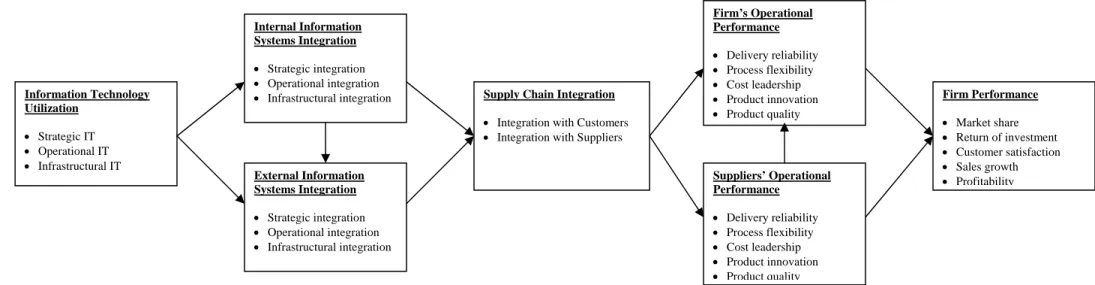
two points might not fully cover the concept of IT utilization in a supply chain integration context where strategic impacts of IT are far more important than operational and physical impacts. This study proposes to measure IT utilization using three sub-constructs: Strategic IT, Operational IT, and Infrastructural IT. Figure 2.1 shows the constructs and sub-constructs of IT utilization.
Figure 2.1: Theoretical framework for information systems integration External Information Systems Integration • Strategic integration • Operational integration • Infrastructural integration Firm’s Operational Performance • Delivery reliability • Process flexibility • Cost leadership • Product innovation • Product quality Firm Performance • Market share • Return of investment • Customer satisfaction • Sales growth • Profitability Information Technology Utilization • Strategic IT • Operational IT • Infrastructural IT Internal Information Systems Integration • Strategic integration • Operational integration • Infrastructural integration Suppliers’ Operational Performance • Delivery reliability • Process flexibility • Cost leadership • Product innovation • Product quality
Supply Chain Integration
• Integration with Customers
From a firm’s perspective, IT utilization refers to ways that firms apply computer and information technology to support infrastructural and operational decision making and to assist in strategic decision planning. Table 3 shows the construct and sub-constructs of IT utilization.
Constructs Definition Literature
Information Technology (IT) Utilization
The way that firms apply computer and information technology to support infrastructural and operational decision making, and to assist in strategic decision planning.
Jane et al., 2004; Gangopadhyay and Huang, 2004; Gross, 1984; Porter and Millar,1985;
Kaltwasser, 1990; Rushton and Oxley, 1994; Bardi, Raghunathan, and Bagchi, 1994; Raghunathan and Raghunathan, 1994; Carter and Narasimhan, 1995; Williams et al., 1997; Narasimhan and Kim, 2001; Kim and Narasimhan, 2002; Narasimhan & Kim,2002; Strategic IT The extent to which your
firm uses IT for formulating, justifying, and improving long-term business planning processes.
Kyobe, 2004; Chan et al, 1997; King and Teo, 1997;
Operational IT The extent to which your firm uses IT for monitoring, justifying, and improving daily operational decision processes.
Narasimhan and Kim, 2001; Kim and Narasimhan, 2002;
Infrastructural IT The extent to which your firm uses IT to facilitate information sharing and data communication, to
recommend standards for IT architecture, to implement security, and to coordinate work activities within firm.
Narasimhan and Kim, 2001; Kim and Narasimhan, 2002;
Table 3: The IT utilization construct, its sub-constructs, and the construct definitions
2.3.2. Supply Chain Integration
Supply chain integration is defined as the extent to which a firm coordinates activities with suppliers and customers (Stock et al., 2000; Narasimhan and Jayaram, 1998; Wood, 1997; Li, 2002; Marquez et al., 2004). Supply chain integration links a firm with its customers, suppliers, and other channel members by integrating their relationships, activities, functions, processes and locations (Kim and Narasimhan, 2002). Having an integrated supply chain provides significant competitive advantage including the ability to outperform rivals on both price and delivery (Lee and Billington, 1995). The concept of supply chain integration was studied as early as 1989 by Bowersox. He argued that the process of supply chain integration should progress from the internal logistics integration to external integration with suppliers and customers. Both can be accomplished by the continuous automation and standardization of each internal logistics function and by efficient information sharing and strategic linkage with suppliers and customers. Stevens (1989), Byrne and Markham (1991), and Hewitt (1994) suggested that the development of internal supply chain integration should precede the external integration with suppliers and customers. Narasimhan and Kim (2002) examined the effect of chain integration on the relationship between diversification and performance. The supply chain integration instrument is comprised of three dimensions: (1) internal integration across the supply chain, (2) a company’s integration with customers, and (3) a company’s integration with suppliers. Frohlich and Westbrook (2002) and Frohlich (2002) studied the effect of web-based integration on demand chain management’s operational performance. In their study, web-based supply chain integration was measured by two constructs: (1) e-integration with suppliers and (2) e-integration with
customers. This study adopts the concept of supply chain integration from previous research by using two sub-constructs to measure supply chain integration; Integration with suppliers and Integration with customers (Frohlich and Westbrook, 2002; Frohlich, 2002). Integration with customers involves determining customer requirements and tailoring internal activities to meet these requirements (Koufteros, Vonderembse, and Jayaram, 2005). As a firm gets to know its customers better and becomes committed to understanding and meeting their needs, a strong linkage is forged between the firm and its customers. Integration with customers ensures that the voice of the customer plays a vital role in the innovative process with in the organization. Integration with suppliers is characterized by a long-term commitment between the collaborators, and openness of communication, and mutual trust. Supplier partnering seeks to bring participants early in the product life cycle; thus entailing early supplier involvement in product design or the acquisition of access to superior supplier technological capabilities (Narasimhan and Das, 1999; Peterson et al., 2005). The internal supply chain integration is not included in the model because the concept is already captured in the ISI construct. Table 4 shows related literature on supply chain integration, its sub-constructs, and their definitions. Figure 2.1 shows the constructs and sub-constructs of supply chain integration.
Constructs Definition Literature Supply Chain Integration The extent to which a firm coordinates activities with suppliers and customers.
Peterson et al., 2005; Gunasekaran and Ngai, 2004; Bowersox, 1989; Stevens, 1989; Byrne and Markham, 1991; Lee and Billington, 1995; Hewitt, 1994; Clark and Hammond, 1997; Wood, 1997; Lummus et al., 1998; Stock et al., 2002; Narasimhan and Jayaram, 1998; Johnson, 1999; Frohlich and Westbrook, 2001; Ahmad and Schroeder, 2001;Kim and Narasimhan, 2002; Narasimhan and Kim, 2002; Frohlich and Westbrook, 2002; Frohlich, 2002; External integration with suppliers The degree of coordination between manufacturing firm and its
upstream partners.
Peterson et al., 2005; Koufteros, Vonderembse, and Jayaram, 2005; Bowersox, 1989; Stevens, 1989; Byrne and Markham, 1991; Lee and Billington, 1995; Hewitt, 1994; Clark and Hammond, 1997; Wood, 1997; Lummus et al., 1998; Stock et al., 2002; Narasimhan and Jayaram, 1998; Johnson, 1999; Frohlich and Westbrook, 2001; Ahmad and Schroeder, 2001;Kim and Narasimhan, 2002; Narasimhan and Kim, 2002; Frohlich and Westbrook, 2002; Frohlich, 2002; External integration with customers The degree of coordination between manufacturing firm and its downstream customers.
Koufteros, Vonderembse, and Jayaram, 2005; Bowersox, 1989; Stevens, 1989; Byrne and Markham, 1991; Lee and Billington, 1995; Hewitt, 1994; Clark and Hammond, 1997; Wood, 1997; Lummus et al., 1998; Stock et al., 2002; Narasimhan and Jayaram, 1998; Johnson, 1999; Frohlich and Westbrook, 2001; Ahmad and Schroeder, 2001;Kim and Narasimhan, 2002; Narasimhan and Kim, 2002; Frohlich and Westbrook, 2002; Frohlich, 2002;
Table 4: The supply chain integration construct, its sub-constructs, and the constructs definitions
2.4. PERFORMANCE INDICATORS 2.4.1. Firm’s Operational Performance
Operational performance indicators are commonly used in the supply chain integration context to measure the effects of supply chain integration activities on the functional/operational outcomes. Considerable agreement exists among academics that the performance of manufacturing companies can be evaluated by one or more key competitive priorities (Wheelwright, 1984; Hayes and Wheelwright, 1984: Krajewski and Ritzman, 1996; Christiansen et al., 2003). Competitive priorities can be described in four major categories: (1) quality, (2) delivery, (3) cost, and (4) flexibility.
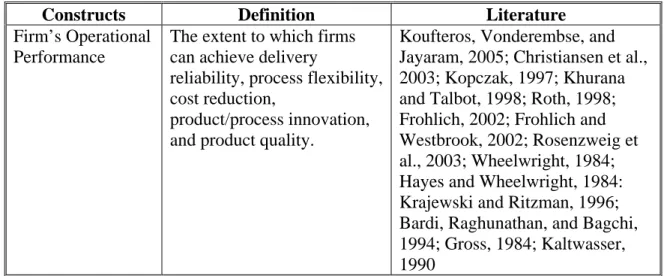
Many studies have reported the use of operational performance as one of the performance outcomes. For example, Frohlich and Westbrook (2002) studied the effects of the type of web-based demands and supply integration. They used operational performance as a dependent variable. The operational benefits of supply chain integration include faster delivery time, reduced transaction costs, greater profitability, and enhanced inventory turnover. The use of operational performance in supply chain integration context can also be found in terms of competitive capabilities. A significant body of prior empirical research indicates that capabilities such as quality, delivery, flexibility, and/or cost are positively related to supply chain integration (Khurana and Talbot, 1998; Kopczak, 1997; Roth, 1998). Rosenzweig et al. (2003) studies the effects of supply chain integration intensity using competitive capabilities: product quality, delivery reliability, process flexibility, and cost leadership. Table 4 shows the firm’s operational performance construct, its literature review, and the construct definition. Figure 2.1 shows the constructs and sub-constructs of firm’s operational performance.
Constructs Definition Literature
Firm’s Operational Performance
The extent to which firms can achieve delivery
reliability, process flexibility, cost reduction,
product/process innovation, and product quality.
Koufteros, Vonderembse, and Jayaram, 2005; Christiansen et al., 2003; Kopczak, 1997; Khurana and Talbot, 1998; Roth, 1998; Frohlich, 2002; Frohlich and Westbrook, 2002; Rosenzweig et al., 2003; Wheelwright, 1984; Hayes and Wheelwright, 1984: Krajewski and Ritzman, 1996; Bardi, Raghunathan, and Bagchi, 1994; Gross, 1984; Kaltwasser,
1990
Table 5: The firm’s operational performance construct and its definition
2.4.2. Suppliers’ Operational Performance
Supplier performance is defined as the extent to which suppliers meet standards of product quality, delivery reliability, process flexibility, product innovation, and cost reduction. In the literature, supplier performance is considered one of the powerful determinants for the firm’s operational success (Davis, 1993; Levy, 1997; Shin et al., 2000; Tan et al., 1998; Vonderembse and Tracey, 1999; Carr and Pearson, 1999). Beamon (1998) defined supplier performance as suppliers’ consistency in delivering materials, components and products to manufacturing firms on time and in good condition. Poor vendor quality and delivery performance can result in higher inventory and backlog (Shin et al., 2000). Stevens (1990), Beamon (1998), and Gunasekaran et al. (2001) asserted that supplier performance is considered a very important dimension of supply chain performance because supplier involvement helps firms improve overall quality, reduce costs, and compete with competitors. Table 5 shows the supplier
performance construct, its literature review, and the construct definition. Figure 2.1 shows the constructs and sub-constructs of suppliers’ operational performance.
Constructs Definition Literature
Suppliers’ Operational Performance
The extent of suppliers’ consistency in delivering materials, components or products to manufacturing firm on time and in good condition Koufteros, Vonderembse, and Jayaram, 2005; Christiansen et al., 2003; Beamon, 1998; Davis, 1993: Levy, 1997; Li, 2002; Shin et al., 2000; Tan et al., 1998; Vonderembse and Tracey, 1999; Carr and Person, 1999; Stevens, 1990; Gunasekaran et al., 2001.
Table 6: The suppliers’ operational performance construct and its definition
Based on the extensive literature review, the concept of supplier performance can be measured using five sub-constructs: delivery reliability, delivery flexibility, cost leadership, innovation, and product quality.
2.4.3. Firm Performance
Firm performance refers to the ability of a firm to fulfill its market and financial goals (Yamin et al., 1999). There are many studies examining firm performance in the literature; however, this study focuses on the firm performance in the supply chain integration context. Wisner (2003) studies the effects of supply chain management strategy on firm performance. The firm performance can be measured by market share, return on assets, overall product quality, overall competitive position, and overall
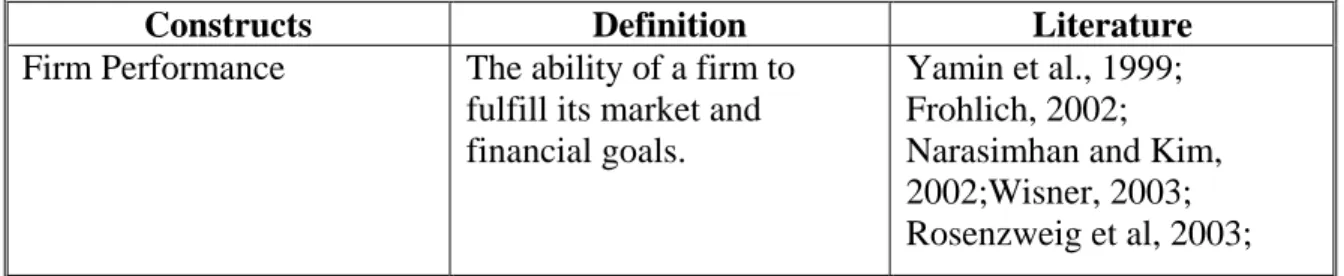
customer service level. Rosenzweig et al. (2003) used four items to measure business performance including pre-tax return on assets (ROA), percentage of revenues from new products, overall customer satisfaction ratings, and business unit’s sales growth. Frohlich (2002) used two items to measure e-business performance: Annual percent of procurement using the Internet and annual percent of sales/turnover using the Internet. Narasimhan and Kim (2002) used sales growth and market share growth (ratio of the current level to three years ago), profitability, return on investment, return on assets, revenue growth, financial liquidity, and net profit to measure firm performance. Table 6 shows related literature on a firm performance construct and the construct definition. Figure 2.1 shows the constructs and sub-constructs of firm performance.
Constructs Definition Literature
Firm Performance The ability of a firm to fulfill its market and financial goals.
Yamin et al., 1999; Frohlich, 2002; Narasimhan and Kim, 2002;Wisner, 2003; Rosenzweig et al, 2003;
CHAPTER 3: THEORETICAL FRAMEWORK AND HYPOTHESES DEVELOPMENT
When understanding the phenomenon of ISI, it is helpful to have a framework from which testable hypotheses can be drawn. A theoretical framework enables predictions to be made about the role of ISI in supply chain integration context. It enables observed business to be evaluated and therefore provides better explanations of the implications of ISI and their consequences.
3.1. THEORETICAL FRAMEWORK
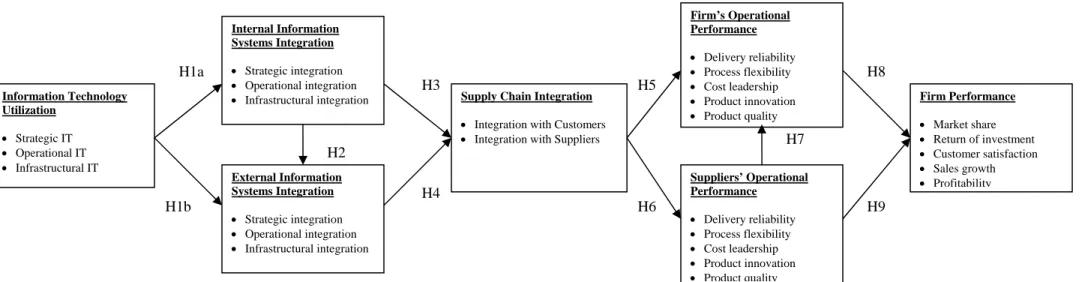
To better understand the mediating role of ISI on the relationship between IT utilization and organizational performances, a framework is established that describes the causal relationships among IT utilization, internal ISI, external ISI, supply chain integration, suppliers’ operational performance, firm’s operational performance, and firm performance. The rationale underlying this research framework is straightforward. By considering the relationship of each pair of constructs carefully, Figure 3.1 depicts the proposed relationships among seven constructs discussed in Chapter 2. The numbers next to each arrow correspond to the 12 hypotheses to be developed later in this chapter. Table 7 shows the main constructs and their definitions in ISI framework. The following section will provide theoretical support for each hypothesis.
Figure 3.1: Theoretical framework for information systems integration External Information Systems Integration • Strategic integration • Operational integration • Infrastructural integration Firm’s Operational Performance • Delivery reliability • Process flexibility • Cost leadership • Product innovation • Product quality Firm Performance • Market share • Return of investment • Customer satisfaction • Sales growth • Profitability Information Technology Utilization • Strategic IT • Operational IT • Infrastructural IT Internal Information Systems Integration • Strategic integration • Operational integration • Infrastructural integration Suppliers’ Operational Performance • Delivery reliability • Process flexibility • Cost leadership • Product innovation • Product quality H2 H4 H3 H6 H7 H8 H9 H1a H5 H1b
Supply Chain Integration
• Integration with Customers
Table 8: Construct definitions summary
Constructs Definition Literature
Information Technology Utilization (ITU)
The way that firms apply computer and information technology to support infrastructural and operational decision making, and to assist in strategic decision planning.
Jane et al., 2004; Gangopadhyay and Huang, 2004; Gross, 1984; Porter and Millar,1985; Kaltwasser, 1990; Rushton and Oxley, 1994; Bardi, Raghunathan, and Bagchi, 1994; Raghunathan and Raghunathan, 1994; Carter and
Narasimhan, 1995; Williams et al., 1997; Narasimhan and Kim, 2001; Kim and Narasimhan, 2002; Narasimhan & Kim,2002;
Internal Information Systems
Integration (IISI)
The degree of cooperation between business functions within the firm on an internally consistent set of strategic, operational, and infrastructural information systems practices using information systems (IS).
Wainwright and Waring, 2004; Themistocleous et al., 2004;
Koufteros, Vonderembse, and Jayaram, 2005;Fiderrio, 1989;
McFarlan and McKenny, 1984; Gross, 1984; Porter and Millar, 1985; Madui and Schafer, 1985; Cohen and Lee, 1988; Earl, 1989; Kaltwasser, 1990; Madnick, 1991; Buck-lew et al., 1992; Wyse and Higgins, 1993; Stylianou et al., 1996; Webber and Pliskin, 1996; Sikora and Shaw, 1998; Robbins and Stylianou, 1999; Bhatt, 2000; Narasimhan and Kim, 2001; Numilaakso et al, 2002; Kim and Narasimhan, 2002; External
Information Systems
Integration (EISI)
The degree of cooperation between a firm and its trading partners on an internally consistent set of strategic, operational, and infrastructural information systems practices using information systems (IS).
Wainwright and Waring, 2004; Themistocleous et al., 2004; Koufteros, Vonderembse, and Jayaram, 2005; Fiderrio, 1989; McFarlan and McKenny, 1984; Gross, 1984; Porter and Millar, 1985; Madui and Schafer, 1985; Cohen and Lee, 1988; Earl, 1989; Kaltwasser, 1990; Madnick, 1991; Buck-lew et al., 1992; Wyse and Higgins, 1993; Stylianou et al., 1996; Webber and Pliskin, 1996; Sikora and Shaw, 1998; Robbins and Stylianou, 1999; Bhatt, 2000; Narasimhan and Kim, 2001; Numilaakso et al, 2002; Kim and Narasimhan, 2002; Supply Chain
Integration (SCI)
The extent to which all activities with suppliers and all activities with customers are coordinated.
Peterson et al., 2005; Koufteros, Vonderembse, and Jayaram,
2005;Bowersox, 1989; Stevens, 1989; Byrne and Markham,
1991; Lee and Billington, 1992; Hewitt, 1994; Clark and Hammond, 1997; Wood, 1997; Lummus et al., 1998; Stock et al., 1998; Narasimhan and Jayaram, 1998; Johnson, 1999; Frohlich and Westbrook, 2001; Ahmad and Schroeder, 2001;Kim and Narasimhan, 2002; Narasimhan and Kim, 2002; Frohlich and Westbrook, 2002; Frohlich, 2002; Suppliers’
Operational Performance (SOP)
The extent to which suppliers meet delivery reliability, process flexibility, cost reduction, product/process innovation, and product quality.
Koufteros, Vonderembse, and Jayaram, 2005; Christiansen et
al., 2003;Stevens, 1990; Alverez, 1994; Owen and
Richmond, 1995; Beamon, 1998; Spekman et al., 1998; Beaman, 1999; Gunasekaran et al., 2001; Narasimhan and Kim, 2001; Li, 2002; Kim and Narasimhan, 2002;
Firm’s Operational Performance (FOP)
The extent to which firms can achieve delivery reliability, process flexibility, cost reduction, product/process innovation, and product quality.
Koufteros, Vonderembse, and Jayaram, 2005; Christiansen et al., 2003; Kopczak, 1997; Khurana and Talbot, 1998; Roth, 1998; Frohlich, 2002; Frohlich and Westbrook, 2002; Rosenzweig et al., 2003;
Firm Performance (FP)
The ability of a firm to fulfill its market and financial goals.
Yamin et al., 1991; Frohlich, 2002; Narasimhan and Kim, 2002;Wisner, 2003; Rosenzweig et al, 2003;
3.2. IMPACTS OF IT UTILIZATION ON ISI (H1a and H1b)
In the inter-organizational supply chain context, not only does IT provide firms with the automation of clerical functions, but IT is also viewed as providing infrastructural and strategic support to the value chain. As firms move toward a highly integrated supply chain, the strategic usage of IT is much clearer and more compatible. As the trend moves toward globally competing between supply chains, supply chain members are much inclined to use IT to integrate similar functions spread over different areas, to communicate with each other, and to coordinate supply chain activities. The electronic inter-connectivity between two or more firms has become a competitive necessity to reduce cost and improve services (Bhatt, 2000).
The evidence explaining this phenomenon can be found in both conceptual and empirical research. Madnick (1991) and Boar (1993) stated that the level of extensive communication networks and inter-connectivity is raised because of the adoption of standards and integrated services digital networks (ISDN). Through the utilization of IT, companies have been able to integrate their internal functions as well as external activities, thus enhancing capability to cope with the sophisticated needs of customers and meeting the quality standards of products (Bardi et al., 1994, Carter and Narasimhan, 1995). Because the use of networks, shared databases, and other related information systems has been considered important for eliminating duplicate activities, preventing errors, reducing cycle time in product development, and improving inter-organizational communication, firms have not realized the benefits of ISI. Therefore,
H1a: The higher the extent of IT utilization, the higher the extent of IISI H1b: The higher the extent of IT utilization, the higher the extent of EISI
3.3. IMPACTS OF IISI ON EISI (H2)
The development and evolvement of ISI can be explained using the supply chain integration theory. For example, Bowersox (1989) argued that the process integration should progress from the internal logistics integration to external integration with suppliers and customers. Both can be accomplished by the continuous automation and standardization of each internal logistics function and by efficient information sharing and strategic linkage with suppliers and customers. Stevens (1989), Byrne and Markham (1991), and Hewitt (1994) suggested that the development of internal supply chain integration should precede the external integration with suppliers and customers. This notion implies that, in order for IS to be integrated, ISI should happen in a sequential manner from internal integration to external integration. Firms with higher degree of internal ISI (i.e., firms with centralized databases, firms with enterprise-wide information systems) are more likely to integrate with their external partners because ISI processes take time, effort and capital investment. However, firms which have already set up internal systems have more chance to integrate with other firms that have compatibles systems.
In this study, IISI is characterized by internal cooperation between business functions. ISIS focuses on full system-visibility of internal supply chain activities including strategic, operational, and infrastructural IS practices. At this stage, all internal functions from raw material management through production, shipping, and sales are connected and integrated real-time. EISI, on the other hand, is characterized by an external cooperation between a firm and its trading partners. At this stage, full supply
chain integration extending the scope of integration outside the company is accomplished. Therefore,
H2: The higher the extent of IISI, the higher the extent of EISI
3.4. IMPACTS OF ISI ON SUPPLY CHAIN INTEGRATION (H3 AND H4)
The sole purpose of ISI is to integrate diverse information system practices exercised by individual supply chain members and prioritize them into three levels of integration – strategic, operational, and infrastructural. ISI helps firms save costs by eliminating redundant logistic activities, unimportant information system practices, and unnecessary information system investments, which do not contribute to overall performance. With ISI, the proper architecture of hardware, software, networks, applications, and management practices must be integrated with the fabric of the firm, its business processes, and its organizational life (Bourdreau and Couillard, 1999).
Mudie and Schafer (1985) asserted that ISI should not only facilitate the process of developing and using data, applications, and other processing technology, but also should provide flexibility to meet the future business demands in workstations, processing types, and applications. In a merging and acquisition context, ISI is considered an important success factor when corporations seek to create synergistic effects by integrating two separate business entities in efforts to increase competitive advantages (Robbins and Stylianou, 1999; Stylianou et al., 1996). In the inter-organizational supply chain context, information technologies allow “multiple organizations to coordinate their activities in an effort to truly manage a supply chain” (Handfield and Nichols, 1999). ISI represents a set of consistent IS practices that supply
chain members adopt and exercise to interact with each other. In this context, ISI can be both an internal focus and an external focus (IISI and EISI). A higher level of alignment in IS practices (internal and external) allows firms to stay competitive in a rapidly changing environment. Firms have to manage different components of technologies by integrating and coordinating them into a highly efficient, effective, and responsive system (Sikora and Shaw, 1998). With intensification of competition, firms begin to utilize information systems to directly influence the processes comprising the value chain (Rushton and Oxley, 1994; Williams et al., 1997). This study hypothesized that highly integrated information system practices (internal and external) help enhance cooperation and coordination between a firm and its external partners (e.g., suppliers and customers); therefore,
H3: The higher the extent of IISI, the higher the extent of supply chain integration H4: The higher the extent of EISI, the higher the extent of supply chain integration
3.5. IMPACTS OF SUPPLY CHAIN INTEGRATION ON OPERATIONAL PERFORMANCE (H5 AND H6)
When sharing common objectives across the supply chain, firms become more cost effective, more efficient, more agile, more responsive to market and supply chain changes, and more innovative. Highly frequent information exchanges within and between firms in the production processes make the delivery process more stable and reliable. The supply chain management literature reports a number of studies on the operational performance benefits that firms derive from supply chain integration.