An Econometric Analysis of
Inventory Turnover Performance in Retail Services
Vishal Gaur
*, Marshall L. Fisher
†, and Ananth Raman
‡May 2004
Abstract
Inventory turnover varies widely across retailers and over time. This variation undermines the usefulness
of inventory turnover in performance analysis, benchmarking and working capital management. We
develop an empirical model using financial data for 311 public-listed retail firms for the years 1987-2000
to investigate the correlation of inventory turnover with gross margin, capital intensity and sales surprise
(the ratio of actual sales to expected sales for the year). The model explains 66.7% of the within-firm
variation and 97.2% of the total variation (across and within firms) in inventory turnover. It yields an
alternative metric of inventory productivity, Adjusted Inventory Turnover, which empirically adjusts
inventory turnover for changes in gross margin, capital intensity and sales surprise, and can be applied in
performance analysis and managerial decision-making. We also compute time-trends in inventory
turnover and Adjusted Inventory Turnover, and find that both have declined in retailing during
1987-2000.
*
Leonard N. Stern School of Business, New York University, 8-72, 44 West 4th St., New York, NY 10012, Ph: 212 998-0297, Fax: 212 995-4227, E-mail: [email protected].
†
The Wharton School, University of Pennsylvania, Jon M. Huntsman Hall, 3730 Walnut St., Philadelphia, PA 19104-6366, Ph: 215 898-7721, Fax: 215 898-3664, E-mail: [email protected].
‡
Harvard Business School, T-11, Morgan Hall, Soldiers Field, Boston, MA 02163, Ph: 617 495-6937, Fax: 617 496-4059, E-mail: [email protected].
1. Introduction
The total inventory investment of all U.S. retailers averaged $449 billion during the year 2003.1 On
average, inventory represents 36% of total assets and 53% of current assets for retailers2. Since such a
significant fraction of the retailers’ assets are invested in inventory, retailers and stock market analysts
focusing on retailers pay close attention to inventory productivity. Retailers continuously seek to improve
their inventory management processes and systems to reduce inventory levels. Stock market analysts
track such practices and reward retailers on gains in their inventory productivity (see, for example,
Standard & Poor’s surveys on the retailing industry (Sack 2000)).
Inventory turnover, the ratio of a firm’s cost of goods sold to its average inventory level, is
commonly used to measure performance of inventory managers, compare inventory productivity across
retailers, and assess performance improvements over time. However, we find that the annual inventory
turnover of U.S. retailers varies widely not only across firms but also within firms from one year to
another. For example, during 1987-2000, the annual inventory turnover at Best Buy Stores, Inc. (Best
Buy), a consumer electronics retailer, ranged from 2.85 to 8.53. The annual inventory turnover at three
peer retailers of Best Buy during the same period shows similar variation: at Circuit City Stores, Inc. from
3.97 to 5.60, at Radio Shack Corporation from 1.45 to 3.05, and at CompUSA, Inc. from 6.20 to 8.65.
The factors influencing these variations have not been studied systematically to our knowledge. Thus, the
extent to which they indicate better or worse performance in inventory productivity is not known.
In addition, inventory turnover can be correlated with other performance measures in a firm.
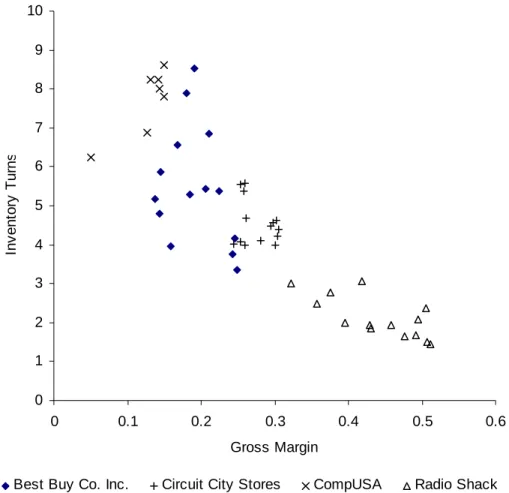
Figure 1 plots the annual inventory turnover of the above four consumer electronics retailers against their
gross margins (the ratio of gross profit net of markdowns to net sales) for the period 1987-2000. The
figure shows a strong correlation between inventory turnover and gross margin. Such correlation could
1
According to the 2003 Monthly Retail Trade Surveys of the U.S. Census Bureau.
2
These values are computed from our dataset, which contains quarterly values of inventory, total assets, current assets and other variables for all public retailers across 10 product-market segments for the period 1985-2000. The dataset includes 311 firms. It is constructed using Standard and Poor’s Compustat database and is summarized in
possibly be caused by many factors studied in the operations literature, such as differences in variety and
price. It raises the question whether inventory turnover should be used per se in performance analysis.
This paper uses public financial data to conduct a descriptive investigation of inventory turnover
performance in retail services. We identify the following variables that should be correlated with
inventory turnover and can be measured from public financial data: gross margin, capital intensity (the
ratio of average fixed assets to average total assets), and sales surprise (the ratio of actual sales to
expected sales for the year). Using results from the existing literature, we formulate hypotheses to relate
these variables to inventory turnover. We then propose an empirical model to represent these relationships
and apply it to a panel of retailing data.
Our paper reports three main findings. First, we find that the explanatory variables explain a
significant 66.7% of the within-firm variation and 97.2% of the total variation (i.e., within and across
firms) in inventory turnover. Annual inventory turnover is found to be negatively correlated with gross
margin and positively correlated with capital intensity and sales surprise.
Second, we estimate time-trends in inventory turnover in retailing both with and without taking
account of the correlations with the explanatory variables. We find that, on average, inventory turnover in
retailing has declined during 1987-2000, even though it is positively correlated with capital intensity and
capital intensity has increased during this period. However, there are marked differences in the
time-trends in inventory turnover across firms: 43% of the firms have increased their inventory turnover with
time, and on average, firms that have invested more in capital assets have achieved higher inventory
turnover.
Third, using the estimates from our model, we construct an alternative metric of inventory
productivity, Adjusted Inventory Turns, which empirically models the tradeoff between inventory
turnover and the explanatory variables. This metric can be applied in performance analysis, benchmarking
and managerial decision-making, since it enables comparison of inventory productivity across firms and
There is considerable interest in the operations management community in evaluating time-trends
in inventory turnover, and assessing the impact of operational improvements on operational and financial
performance. However, there are few empirical studies on these topics. Balakrishnan et al. (1996)
compare the performance of a sample of 46 firms that adopted just-in-time processes (JIT) during
1985-89 with a matched sample of 46 control firms, and find that JIT firms achieved larger improvements in
their inventory turns. Billesbach and Hayen (1994), Chang and Lee (1995) and Huson and Nanda (1995)
also study the impact of JIT on inventory turns for different samples of firms. Hopp and Spearman (1996:
chapter 5) summarize the findings of several survey-based studies on whether U.S. manufacturing firms
that implemented MRP systems achieved better inventory turns as a result. Hendricks and Singhal (1997,
2001) examine the impact of implementation of total quality management programs on the operating
incomes and shareholder values of firms.
In contrast to the above research, Rajagopalan and Malhotra (2001) use aggregate industry-level
data from the U.S. Census Bureau for 20 industrial sectors for the period 1961-1994 to determine whether
the inventory turns for U.S. manufacturers have decreased with time for each of raw material inventory,
work-in-process inventory and finished goods inventory. They find that six sectors show increasing trends
in inventory turns for finished goods, and four sectors show larger trends in the years 1980-1994 when
JIT became popular compared to the previous period (1961-1979). The results for raw material and
work-in-process inventories are marginally better.
Our paper contributes to the operations literature as it studies inventory productivity in retail
services, and utilizes firm-level panel data for all public-listed firms in this sector. Panel data are
advantageous because they enable us to control for the effects of unobserved firm-specific or
time-specific factors in measuring the tradeoffs between the variables of interest. We exploit the flexibility of
panel data to compare alternative model specifications and assess their suitability for modeling inventory
turnover empirically. We also introduce the variable sales surprise to control for the effect of
The model can also be applied in future research to assess the impact of improvements in operations on
the inventory productivity of firms.
The rest of this paper is organized as follows. Section 2 summarizes the data and defines the
performance variables used. Section 3 develops hypotheses to relate inventory turnover with gross
margin, capital intensity and sales surprise using results from the existing literature. In section 4, we
discuss the empirical model used in estimation. We present our empirical results in section 5, discuss their
managerial implications in section 6, and conclude in section 7 with a discussion of the limitations of our
study and directions for future research.
2. Data Description and Definition of Variables
We use financial data for all public-listed U.S. retailers for the 16-year period 1985-2000 drawn from
their annual income statements and quarterly and annual balance sheets. These data are obtained from
Standard & Poor’s Compustat database using the Wharton Research Data Services (WRDS).
The selection of firms is based on a four-digit Standard Industry Classification (SIC) code
assigned to each firm by the U.S. Department of Commerce according to its primary industry segment.
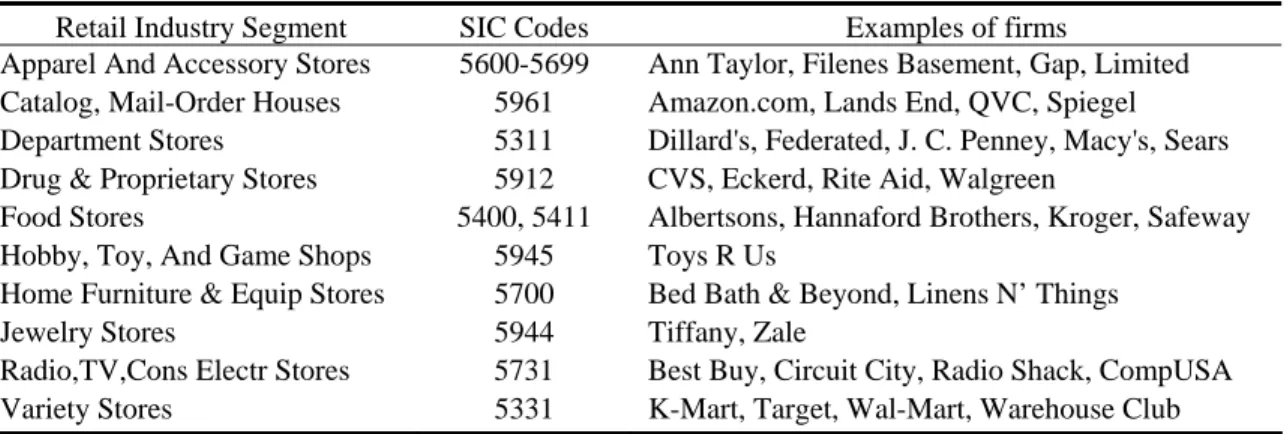
Our dataset includes ten segments in the retailing industry. Table 1 lists the segments, the corresponding
SIC codes, and examples of firms in each segment. All segments except apparel and accessories and food
stores correspond to unique 4-digit SIC codes. In apparel and accessories, we group together all firms that
have SIC codes between 5600 and 5699 because there is substantial overlap between their products. This
grouping enables us to increase the number of degrees of freedom by estimating one set of coefficients for
all apparel firms instead of estimating separate coefficients for each SIC code. Likewise, in food stores,
we group together supermarket chains (SIC code 5400) and convenience stores (SIC code 5411) because
of the overlap between their products.
Let Ssit denote the sales, net of markdowns, of firm i in segment s in year t, and CGSsit denote the
corresponding cost of goods sold. Both sales and cost of goods sold are obtained from the annual income
equipment, of firm i in segment s at the end of quarter q in year t, NFAsitq denote the net fixed assets,
comprised of gross fixed assets less accumulated depreciation, Invsitq denote the inventory, valued at cost,
and TAsitq denote the total assets. These four data items are obtained from the quarterly closing balance
sheets of the firms. From these data, we compute the following performance variables for our study:
Inventory turnover (also called inventory turns), 4
1 1 4 sit sit sitq q CGS IT Inv = =
∑
,Gross margin, sit sit sit
sit S CGS GM S − = , Capital intensity, 4 1 4 4 1 1 sitq q sit sitq sitq q q GFA CI Inv GFA = = = = +
∑
∑
∑
, and Sales surprise, Sales Forecast sit sit sit S SS = .Here, average inventory and average gross fixed assets are computed using quarterly closing values in
order to control for systematic seasonal changes in these variables during the year. The method for
obtaining the sales forecast will be described in section 3.3.
We also note that there are alternative measures of capital intensity that could be considered
instead of that defined above. In particular, NFAsitq, could be used in place of GFAsitq, to measure capital
investment, or TAsit could be used in the denominator as the scaling variable instead of the sum of the
average inventory and the average gross fixed assets. We tested our hypotheses with these alternative
measures and found that the results are consistent with those reported in this paper. The reader is referred
to Stickney and Weil (1999) for detailed descriptions of the income statement and balance-sheet
variables.
Our original dataset contains 5088 observations across 576 firms. After computing all the
because the computation of sales forecast required two years of sales data at the beginning of each
time-series. We also omit from our dataset those firms that have less than five consecutive years of data
available for any sub-period during 1985-2000; there are too few observations for these firms to conduct
time-series analysis. These missing data are caused by new firms entering the industry during the period
of the dataset, and by existing firms getting de-listed due to mergers, acquisitions, liquidations, etc.
Further, we omit firms that had missing data or accounting changes other than at the beginning or the end
of the measurement period. These missing data are caused by bankruptcy filings and subsequent
emergence from bankruptcy, leading to fresh-start accounting. There were also accounting changes
related to the inventory valuation method. Out of ten inventory valuation methods identified by the
Compustat database, four are commonly used by retailers: FIFO (first in first out), LIFO (last in first out),
average cost method and retail method (see the Compustat data manual for the definitions of these
methods). Most retailers in our dataset use a combination of these methods. After removing the firms with
missing observations, there were only three firms that switched between exclusively FIFO and
exclusively LIFO inventory valuations during the subject time period.
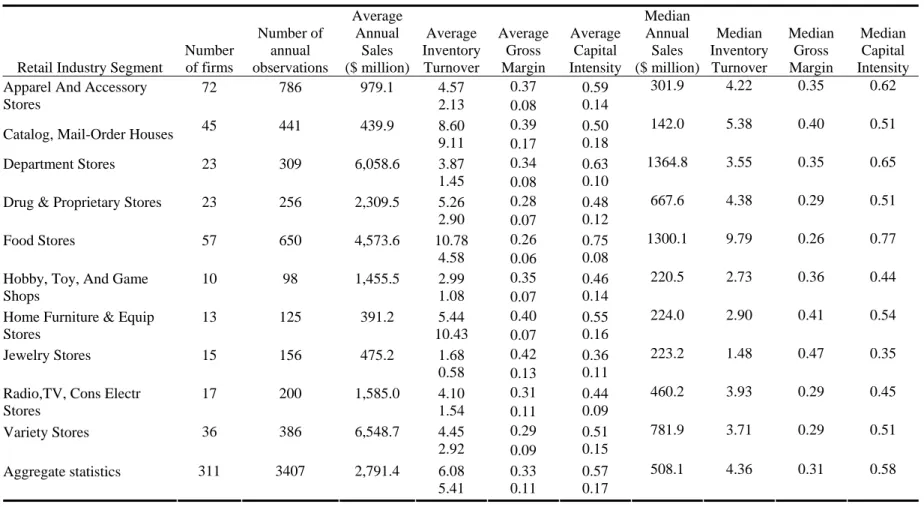
Our final dataset contains 3407 observations across 311 firms, an average of 10.95 years of data
per firm. Table 2 presents summary statistics by retailing segment for the performance variables used in
our study. It lists the mean and standard deviation for each variable within each segment. For example,
the mean of inventory turnover for apparel and accessory stores is 4.57 and the standard deviation is 2.13.
The coefficient of variation of inventory turnover ranges from 0.36 for hobby, toy and game shops to 1.92
for home furniture & equipment stores. Thus, the variability of inventory turnover is not limited to a few
firms but is widely prevalent. Hereafter, we use IT, GM, CI and SS without the subscripts s, i, t as
abbreviations for the respective variable names. We collectively call GM, CI and SS as ‘explanatory
3. Hypothesis Development
In this section, we set up the hypotheses to relate inventory turnover with gross margin, capital intensity
and sales surprise. An important aspect of our model is that we focus attention on year-to-year variations
within a firm, rather than differences across firms. This is done because differences in IT across firms
may be associated not only with their GM, CI and SS, but also with factors such as accounting policies,
location strategy, management, etc. These factors are exogenous to our dataset. Focusing on variations
within a firm enables us to limit their influence. In the empirical analysis in subsequent sections, we
control for variation across firms by using firm-specific fixed effects.
We also note that firm-level aggregated variables have several shortcomings that limit their
usefulness. We identify these shortcomings at appropriate points in the analysis.
3.1 Gross Margin
We test the following hypothesis:
HYPOTHESIS 1: Inventory turnover is negatively correlated with gross margin.
We motivate this hypothesis in two ways: by observations of managerial practice, and based on results in
the academic literature. In surveys of retailing firms conducted by us, we find that managers trade off
inventory turns and gross margin in their decision-making. They set their business targets partly in terms
of the product of gross margin and inventory turnover (this measure is called gross margin return on
inventory, abbreviated as GMROI). Items with higher margins are given lower turns targets than items
with lower margins. This tradeoff is commonly referred to by retailing managers as the “earns versus
turns” tradeoff. It is consistent with the Du Pont model in accounting, and is prescribed in retailing
textbooks, see for example, the strategic profit model in Levy and Weitz (2001: chapter 7). However, no
theoretical or empirical justification for this tradeoff is provided in retailing textbooks. Thus, it is not clear
whether the practice of trading off earns versus turns is based on observed tradeoffs between inventory
turns and gross margin, or whether it is simply a heuristic to allocate a targeted return on investment to
We explain below that the existing literature, even though it is largely based on item-level
models, supports a negative correlation between inventory turnover and gross margin, and more
importantly, identifies several factors that could explain this correlation. In particular, gross margin can
be related to inventory turnover directly because it determines the optimal service level. Further, gross
margin can be related to inventory turnover indirectly through price, product variety and length of product
lifecycle because they affect both inventory turnover and gross margin. The following discussion explains
these relationships.
Service Level: According to the classical newsboy model, an increase in gross margin implies an increase
in the average inventory level. It can further be shown that in the newsboy model, an increase in inventory
level implies a decrease in expected inventory turnover regardless of the form of the demand distribution.
Therefore, an increase in gross margin implies a decrease in expected inventory turnover.
Price: For a given set of items with given costs, an increase in price increases the gross margin of the
firm. Further, since demand is negatively correlated with price, an increase in price decreases the demand
for the item and increases the coefficient of variation of demand, thus decreasing inventory turnover.
Product Variety: Multiple papers in marketing and economics consider the effect of product variety on
price. According to Lancaster (1990), Chamberlin (1950) and Dixit and Stiglitz (1977), higher variety
leads to an increase in the consumers’ utility, either by reducing the distances of consumers from their
perceived ‘ideal product’ profiles (the Lancaster demand model), or because consumers have an in-built
preference for variety (the Chamberlin demand model). Further, from consumer utility theory, higher
consumer utility implies higher prices for a given cost (Kotler 1986, Nagle 1987). According to Lazear’s
model of retail pricing and clearance sales (Lazear 1986), higher variety increases the retailer’s
uncertainty about price, which further increases the average price.
In empirical research, Pashigian (1988) shows that price is positively correlated with variety in a
study of time-series price and sales data for department stores, and Kekre and Srinivasan (1990) show that
firms with higher variety have higher relative prices in a cross-sectional study of over 1,400 business
has a positive effect on gross margin through price. We note that these papers do not address the cost of
variety.
Numerous papers and case studies using risk pooling as the basis of their argument have
examined the impact of product variety on inventory turnover. Lower variety through delayed
differentiation is used to increase inventory turnover in the Benetton case study (Heskett and Signorelli
1989), at Hewlett-Packard (Feitzinger and Lee 1997), and in research articles that explore these
relationships (Lee and Tang 1997, Swaminathan and Tayur 1998). Zipkin (2000: chapter 5) constructs an
index of product variety, and observes from experience with a large firm that an increase in variety is
associated with a decrease in inventory turnover. van Ryzin and Mahajan (1999) also analyze the effects
of variety on price and inventory using a model of assortment choice. While they do not explicitly
consider inventory turnover, they show that total inventory increases with variety, and that variety under
market equilibrium is increasing in price given fixed procurement costs.
Length of the product lifecycle: The length of product lifecycle has a similar effect on gross margin and
inventory turnover as product variety. A shorter product lifecycle implies rapid changes to products to
better match consumer requirements, and thus, increased consumer utility (Pashigian 1988). As discussed
above, higher consumer utility implies higher prices and higher gross margin. A shorter product lifecycle
also implies less availability of historical data for forecasting. Since the accuracy of demand forecasts
increases with the availability of historical data, products with longer lifecycle and greater availability of
historical data should have lower demand uncertainty, less safety stock requirement, and higher inventory
turnover than products with shorter product lifecycle and less availability of historical data.
Since service level, price, variety and lifecycle length are not measured in our model, separate
tests of the linkages of these factors with inventory turns and gross margin are beyond the scope of our
study. Instead, Hypothesis 1 is limited to estimating the correlation of inventory turnover with gross
3.2 Capital Intensity
Investments in warehouses, information technology, and inventory and logistics management systems
involve capital investment by a firm, which is accounted as fixed assets, and is therefore measured by an
increase in CI. Thus, we formulate the following hypothesis:
HYPOTHESIS 2: Higher capital intensity increases inventory turnover.
We expect that the addition of a new warehouse should result in a decrease in total inventory at
the retailer, and thus, an increase in its inventory turnover because of two reasons. First, the warehouse
enables the retailer to reduce safety stock over the supplier lead-time by postponing the decision to
allocate inventory across stores (‘the joint ordering effect’, see Eppen and Schrage 1981). Second, the
warehouse enables the retailer to centralize safety stock and re-balance store inventories between
shipments from the supplier (‘the depot effect’, see Jackson 1988).
We also expect inventory turns to increase with investment in information technology. According
to Cachon and Fisher (2000), the benefits of implementing information systems for the management of
inventory include better allocation of the inventory to the stores, shorter ordering lead times, smaller
batch sizes, and a lower cost of processing orders. Clark and Hammond (1997), in a cross-sectional study,
show that food retailers who adopt a continuous replenishment process (CRP) enabled by the adoption of
electronic data interchange (EDI) achieve 50-100% higher inventory turns than traditional ordering
processes. For further documentation of the benefits of information technology, see Kurt Salmon
Associates (1993), Campbell Soup Company (Cachon and Fisher 1997), Barilla SpA (Hammond 1994),
H. E. Butt Grocery Co. (McFarlan 1997), and Wal-Mart Stores, Inc. (Bradley, et al. 1996).
Since capital intensity is measured from gross fixed assets, it does not isolate the effects of
different kinds of capital investments made by a firm. Further, it includes other capital investments of a
retailer as well, for example, investments in stores. These could dilute the effect of capital intensity on
3.3 Sales Surprise
Inventory turnover can be affected by unexpectedly high sales. If the sales realized by a retailer in a given
period are higher than its forecast, then the average inventory level for the period will be lower than
expected, and realized inventory turnover, which is a ratio of realized unit sales to the average inventory
for the period, will be higher than expected. The outcome will be reversed if realized sales are lower than
expected sales.
Therefore, we use sales surprise as defined in §2 to measure unexpectedly high sales, and
formulate the following hypothesis.
HYPOTHESIS 3: Inventory turnover is positively correlated with sales surprise.
Sales surprise should, ideally, be measured with respect to the management’s forecast of sales
since inventory decisions taken by the management are based on these forecasts. Since managements’
sales forecasts are not publicly reported, we estimate sales forecasts from historical data using Holt’s
linear exponential smoothing method3. The sales forecast for period t is as
Sales Forecastsit =Lsi t, −1+Tsi t,−1, where Lsi,t-1 and Tsi,t-1 are smoothed series defined as
, 1 , 1 , 1 , 1 (1 )( ), ( ) (1 ) , sit sit si t si t sit sit si t si t L S L T T L L T − − − − =α + − α + =γ − + − γ
and α (0 < α < 1) and γ (0 < γ < 1) are weighting constants. We compared the forecast errors for several values of α and γ. The best forecasts were obtained for α = γ = 0.75. Thus, these values are used to compute all the results reported in this paper. We also computed sales forecasts using simple exponential
smoothing and double exponential smoothing. These forecasts had higher forecast errors and were biased
compared to Holt’s linear exponential smoothing.
3
Alternatively, one could use the I/B/E/S dataset to obtain sales forecasts. This dataset provides analysts’ forecasts of sales for a subset of the public-listed firms for the period 1997 onwards. For the time-period used in this paper,
4. Model Specification and Analysis
We propose the following log-linear model to test the hypotheses:
1 2 3
log
IT
sit=
F
i+
c
t+
b
slog
GM
sit+
b
slog
CI
sit+
b
slog
SS
sit+
ε
sit.
(1) Here, Fi is the time-invariant firm-specific fixed effect for firm i, ct is the year-specific fixed effect foryear t, b1s, b 2
s, b 3
s are the coefficients of log GMsit, log CIsit, and log SSsit, respectively, for segment s, and εsit denotes the error term for the observation for year t for firm i in segment s. Hypotheses 1, 2 and 3 imply that, for each segment s, b1s must be less than zero, and b2s and b3s must be greater than zero.
We use a log-linear specification for three reasons: (1) A log-linear relationship between the
variables is suggested by plotting IT against GM, CI and SS. (2) Retail industry reports (see, for example,
Sack 2000) and surveys of retailers that we have conducted show that multiplicative measures such as
GMROI and return on assets are widely used to measure and reward the performance of inventory
planners and merchants. (3) We simulated a periodic review inventory model with stationary demand for
different values of gross margin, lead-time and variance of demand, and collected data on the variables of
interest to compare log-linear and linear model specifications. We found that the log-linear specification
had significantly lower prediction errors than the linear specification.
The following aspects of the model need elaboration:
Firm-specific fixed effects, Fi: Inventory turnover can be correlated with factors that are omitted in our
dataset, such as managerial efficiency, marketing, location strategy, accounting policy, etc. These factors
can result in biased and inconsistent estimates of the parameters (see Hausman and Taylor 1981).
Therefore, we minimize their effect by using firm-specific control variables, Fi. These control variables
can be modeled either as fixed effects or as random effects. We model them as fixed effects because they
can be used to compare average inventory turnover performance across firms over the period of analysis.
I/B/E/S provides forecasts only for a few firms, giving a total of less than 300 observations. However, this dataset could be useful in future research.
Omitted variables also imply that cross-sectional data for a single year or longitudinal data for a
single firm are unsuitable for estimating the model because they cannot distinguish the effects of the
explanatory variables from differences in Fi (see Hoch 1962).
Time-specific fixed effects, ct: These variables control for changes in secular characteristics over time,
such as in economic conditions, in the interest rates, in price level, etc., and thus, enable us to compare
inventory turnover across years. They also enable us to measure trends in average inventory turnover in
the retailing industry over time after controlling for the effects of the other explanatory variables.
Segment-specific coefficient estimates, b1s, b
2 s, b
3
s: The coefficients of the explanatory variables might differ across retailing segments. Thus, we estimate segment-specific coefficients to test for heterogeneity
across segments.
It is useful to estimate other model specifications with different combinations of the control
variables to ascertain the correctness of the model and draw further insights. First, to test whether the
coefficients of the explanatory variables differ across segments, we compare (1) with the following
specification (with pooled coefficients of explanatory variables instead of segment-wise coefficients):
1 2 3
log
IT
sit=
F
i+
c
t+
b
log
GM
sit+
b
log
CI
sit+
b
log
SS
sit+
ε
sit.
(2) Second, to test whether the firm-wise fixed effects Fi are statistically significant, we compare (1)with the following specification (with segment-wise fixed effects instead of firm-wise fixed effects):
1 2 3
log
IT
sit=
F
s+
c
t+
b
slog
GM
sit+
b
slog
CI
sit+
b
slog
SS
sit+
ε
sit.
(3) Here, Fs is the segment-wise fixed effect, and the other terms have their usual meaning. Both (2) and (3)are useful because they have fewer parameters, and hence can allow more precise estimation. However,
(3) should not be used if firm-wise fixed effects are statistically significant.
Third, since IT and GM are both functions of cost of goods sold, it is possible that we observe a
negative correlation between IT and GM even if inventory levels are independent of the gross margin
realized by a firm. A similar argument could be applied to IT and CI since they are both functions of
inventory level, Invsit 1
4 qInvsitq
⎛= ⎞
⎜ ⎟
⎝
∑
⎠, as the dependent variable instead of ITsit. We add CGSsit to the listof explanatory variables in this model to control for scale.
1 2 3 4
log
Inv
sit=
F
s+
c
t+
b
slog
GM
sit+
b
slog
CI
sit+
b
slog
SS
sit+
b
log
CGS
sit+
ε
sit.
(4) For this model, we measure capital intensity as the ratio of GFA to TA rather than as defined in §2 toavoid having a term in the explanatory variables that is a function of Invsit. Further, we also test for this
problem using models (1) and (2). We estimate these models with values of gross margin and capital
intensity lagged by one year, log GMsi,t-1 and log CIsi,t-1, as the explanatory variables instead of log GMsit
and log CIsit.
Other model specification can be constructed to test if b1s, b 2
s and b 3
s change with time or if the time-specific fixed effect ct differs across segments. We compare the results of different specifications in
section 5. The main results of the paper are based on (1) and (2). We estimate all models assuming that
the error term, εsit, has first-order autocorrelation, and is segment-wise heteroscedastic, i.e., the variance of εsit varies by segment. The estimation process and statistical tests of assumptions are presented in the Appendix. The reader is referred to Greene (1997: chapter 14), Hsiao (1986) and Judge, et al. (1985:
chapter 13) for further discussion of the specification and estimation of panel data models such as ours.
5. Results 5.1 Basic Results
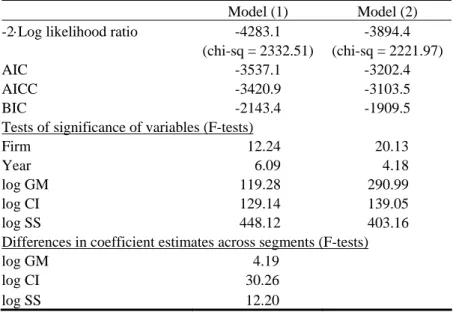
Table 3 shows the fit statistics for models (1) and (2) estimated using MLE. The overall fit of model (1) is
statistically significant (p<0.0001). The coefficients of all the explanatory variables, log GMsit, log CIsit
and log SSsit, are also significantly different from zero (p<0.0001). Comparing the results for models (1)
and (2), we find that the likelihood ratio test that model (1) is preferred to model (2) is statistically
also significant (p<0.0001 for each of log GMsit, log CIsit and log SSsit). Therefore, the coefficients’
estimates differ significantly across segments.
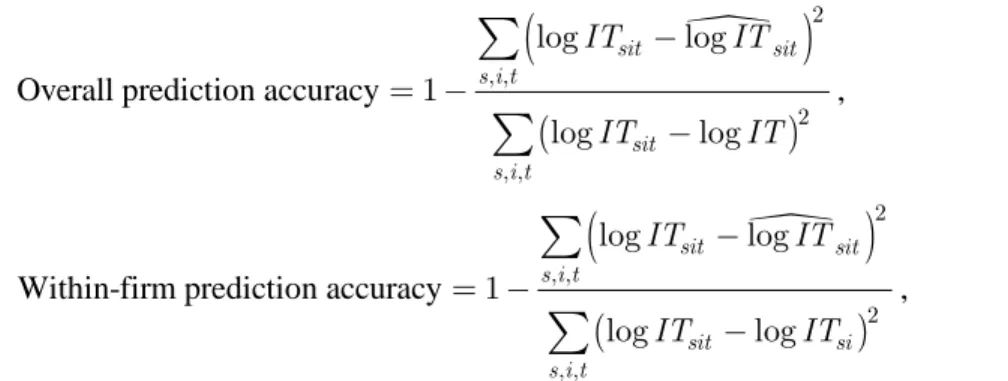
We determine the fraction of variation in log ITsit explained by each model by computing the
overall prediction accuracy and the within-firm prediction accuracy of each model using the usual
formula for R2:
n
(
)
(
)
Overall prediction accuracy
2 , , 2 , , log log 1 log log sit sit s i t sit s i t IT IT IT IT − = − −
∑
∑
, n(
)
(
)
Within-firm prediction accuracy
2 , , 2 , , log log 1 log log sit sit s i t sit si s i t IT IT IT IT − = − −
∑
∑
,where lognITsit is the predicted value of logITsit obtained from (1) or (2), logIT is the overall mean of logITsit, and logITsi is the within-firm mean of logITsit4. The overall prediction accuracy for model (1) is 97.16% and for model (2) is 96.83%. The within-firm prediction accuracy for model (1) is 66.7%
and for model (2) is 62.8%. The within-firm accuracy is remarkable because it shows that year-to-year
changes in the IT of a firm are highly correlated with simultaneous changes in GM, CI and SS. The
overall prediction accuracy is higher than the within-firm accuracy because the between-firm variation in
inventory turnover is larger than the within-firm variation, and is fully explained by the firm-specific
fixed effects.
Table 4 shows the coefficients’ estimates for models (1) and (2). The pooled coefficient for
log GMsit is –0.285 (p<0.0001), and strongly supports hypothesis 1. The segment-wise coefficients also
support hypothesis 1 for nine of the ten segments. Thus, inventory turns are negatively correlated with
gross margin. Since we have a log-linear model, the coefficient of log GMsit gives the elasticity of
4
There are several measures of R-square for the generalized regression model. One alternative would be to apply the formula for R-square to the transformed model obtained in FGLS estimation. Since the R-square thus determined
inventory turns with respect to gross margin. Thus, a 1% increase in gross margin (for example, from 0.5
to 0.505) is associated with an estimated –0.285% change in inventory turns.
Across segments, the coefficient estimate for log GMsit varies from –0.153 for apparel and
accessories retailers to –0.571 for hobby, toy and game shops. From the discussion in §3, there can be
several reasons for this variation. For example, for the same value of GM, product variety, lifecycle
length and demand uncertainty may vary across segments, resulting in different coefficients. Since price,
variety and lifecycle length are not included in our dataset, we cannot ascertain the causes of the
differences in coefficients’ estimates across segments. These could be investigated in a further study.
The pooled coefficient for log CIsit is 0.252 (p<0.0001), and strongly supports hypothesis 2.
Segment-wise estimates of the coefficient of log CIsit also strongly support hypothesis 2 for seven of the
ten segments. The value of the coefficient ranges from 0.106 to 1.085 across segments where it is
statistically significant (p<0.02). Thus, investment in capital assets is positively correlated with inventory
turnover.
The pooled and segment-wise estimates of the coefficient of log SSsit are all positive and
statistically significant at p<0.001. They strongly support hypothesis 3. The value of the pooled
coefficient is 0.143 and the segment-wise coefficients range between 0.053 and 0.279. These estimates
are useful since they enable us to control for the effect of surprisingly high sales on inventory turnover.
5.2 Time-trends in inventory productivity
The year-specific fixed effects, ct, in our model can be used to estimate the time-trend in inventory
productivity after adjusting for the correlation with gross margin, capital intensity and sales surprise.
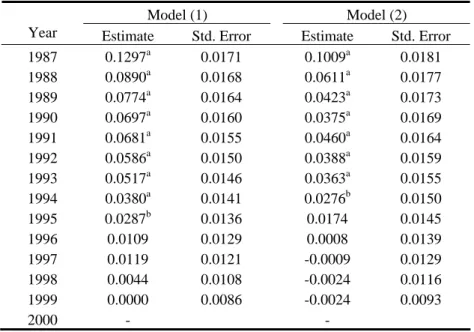
Table 5 shows the estimates of ct obtained from models (1) and (2), and figure 2 shows a time-series plot
of ct for model (2). Note that these estimates are decreasing with time. Taking the standard errors of the
estimates into account, we find that the estimates of ct for the initial years, t = 1987,…,1993, are
significantly larger than the estimates of ct for the latter years, t = 1996,…,2000 (p<0.01). This shows that
controlling for sales surprise and changes in capital intensity and gross margin, inventory turns have
The trend in ct can be compared with the ‘unadjusted’ time trend in inventory turns (i.e., ignoring
the correlation with GM, CI and SS) by fitting the following model:
sit i sit
y
=
g
+
ht
+
ν
. (5)Here, ysit equals ITsit to estimate a linear time-trend and log ITsit to estimate an exponential time-trend, gi is
the intercept for firm i, and h is the common slope with respect to time across all firms. We also apply this
model to CIsit, GMsit, log CIsit and log GMsit to estimate the trends in their values. Table 6 gives the results
obtained. We find that inventory turns have decreased significantly with time (p<0.0001), capital intensity
has increased significantly with time (p<0.0001), and gross margin has no significant time-trend.
Now consider the trends in inventory turns for individual firms. These trends can be estimated
with the following models, after slight changes to (1) and (5):
sit i i sit
y
=
g
+
h t
+
ν
. (6)1 2 3
log
IT
sit=
F
i+
h t
i′
+
b
slog
GM
sit+
b
slog
CI
sit+
b
slog
SS
sit+
ε
sit.
(7) Here, (6) measures the ‘unadjusted’ time-trend, hi, in the inventory turns for each firm i, and (7) measuresthe ‘adjusted’ time-trend, h′i, after controlling for the correlation with the explanatory variables. We find that the estimate of hi is negative for 176 firms (of these, 76 are statistically significant (p<0.05)), and
positive for 135 firms (59 statistically significant (p<0.05)). The estimate of h′i is negative for 193 firms (83 statistically significant (p<0.05)), and positive for 118 firms (49 statistically significant (p<0.05)).
In summary, the overall trend in inventory turns in the retailing industry is downward sloping
during 1987-2000. This result is consistent with the result obtained by Rajagopalan and Malhotra (2001)
for several sectors in the manufacturing industry. However, we additionally find that capital intensity has
increased significantly during this period, and is positively correlated with inventory turnover. Thus, even
though the overall trend in inventory turns is negative, firms with a greater increase in capital intensity
have shown a larger increase in inventory turns over time compared to their peers. Further, as shown
period, 43% of the firms have shown an increase in inventory turns, and 38% of the firms have shown an
increase in inventory turns controlling for the changes in capital intensity, gross margin and sales surprise.
Rajagopalan and Malhotra offer several conjectures to explain the observed downward trends in
inventory turns, for example, product variety may have increased with time, product lifecycles may have
become shorter with time due to faster introduction of new products, average lead times may have
increased due to greater global sourcing. While these conjectures apply to retailing as well, like
Rajagopalan and Malhotra, we currently cannot offer conclusive evidence.
5.3 Econometric Issues
We find that models (1) and (2) are more suitable for our analysis than model (3) because the firm-wise
fixed effects Fi are statistically significant as shown in Table 3. We also find that the estimates from
model (4) and from models (1) and (2) with lagged explanatory variables, log GMsi,t-1 and log CIsi,t-1,
support hypotheses 1, 2 and 3 at p<0.0001. Therefore, the estimated correlations between inventory turns
and gross margin, and between inventory turns and capital intensity are not artifacts of the way the
variables are defined.
Please see the Appendix for the results regarding heteroscedasticity and autocorrelation in the
dataset.
6. Managerial Implications
Our results show that inventory turnover should not be used per se in performance analysis. For example,
if a firm realizes an increase in inventory turnover with a concurrent decrease in gross margin, it does not
necessarily indicate an improvement in its capability to manage inventory. Likewise, if two firms have
similar inventory turnover and gross margin values but different capital intensities, then the firm with the
lower capital intensity could possibly have a better capability to manage inventory than the other firm.
Finally, if a firm realizes an increase in inventory turnover with an unexpected increase in sales, then the
changes in gross margin, capital intensity and sales surprise should be incorporated in the evaluation of
inventory productivity of a firm.
Our results give a tradeoff curve that computes the expected inventory turnover of a firm for
given values of sales surprise, gross margin and capital intensity. We term the distance of the firm from
its tradeoff curve as its Adjusted Inventory Turnover, denoted AIT. The value of AIT for firm i in
segment s in year t is computed as
1 2 3
logAITsit =logITsit −b logGMsit −b logCIsit −b logSSsit, or, equivalently, as
(
) (
b1) (
b2)
b3sit sit sit sit sit
AIT =IT GM − CI − SS − . (8)
Adjusted Inventory Turnover is an empirical measure to compare inventory productivity across firms and
across years by controlling for differences in gross margin, capital intensity and sales surprise.
According to our results, managers of firms with low AIT should investigate whether their firms
are less efficient than their peers, and identify steps they might take in order to improve their inventory
productivity. Firms with higher inventory turnover may differ systematically from firms with lower
inventory turnover. On the one hand, such differences may be attributed to differences in accounting
policies and may not have operational implications. On the other hand, they may indicate differences in
efficiency that cannot be rectified simply by increased spending. This possibility is supported in our
discussions with managers. Fisher, Raman and McClelland (2000) discuss differences between retailers
and identify best practices in retail operations through on-site interviews, surveys and workshops in a
four-year study of 32 retailers.
We present two examples to illustrate the interpretation of Adjusted Inventory Turns. The first
example shows that inventory turns may overstate differences in inventory productivity across firms. The
second example shows that time-trends in inventory turns can be misleading.
Example 1: Consider again the example of four consumer electronics retailers in Figure 1. We apply (8)
Buy), 4.1 (Circuit City), 8.2 (CompUSA) and 3.0 (Radio Shack). The corresponding values of gross
margin are 0.15, 0.26, 0.14 and 0.32, respectively, and the corresponding values of capital intensity are
31%, 47%, 33% and 42%, respectively. After applying these values and sales surprise, we find that the
Adjusted Inventory Turns of the four firms are 3.1, 2.6, 4.1 and 2.2, respectively. Thus, we observe that
the differences between the Adjusted Inventory Turns of Best Buy, Circuit City, CompUSA and Radio
Shack are smaller than the differences between their inventory turns because the differences in inventory
turns are partly compensated by the differences in gross margin. For example, the inventory turns of
CompUSA are 2.8 times those of Radio Shack, but the Adjusted Inventory Turns of CompUSA are 1.9
times those of Radio Shack.
The gross margins of these firms might differ due to any one or more of the factors listed in §3.
Indeed, the annual reports to shareholders of these firms show that their product mixes differ from each
other. CompUSA has a higher proportion of personal computers in its sales (high turns, low margins),
Best Buy and Circuit City have higher proportions of home electronics and appliances (mid-range turns
and margins), and Radio Shack has a higher proportion of spare parts and accessories in its sales (low
turns, high margins). Since the Adjusted Inventory Turns of these firms are less disparate than their
inventory turns, it suggests that the differences in inventory turns between these firms may not indicate
better or worse inventory productivity. Figure 3 shows the tradeoff between inventory turns and gross
margin for the four firms obtained using (8) (assuming constant capital intensity and no sales surprise to
avoid year-to-year variations in these variables).
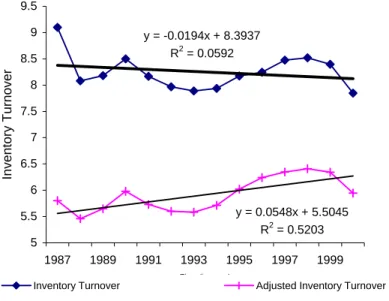
Example 2: Ruddick Corp. is a holding company that owns Harris Teeter, a regional supermarket chain
in the southeastern United States with 137 stores and sales of $2.7 billion in the year 2000. Figure 4
shows time-series plots and linear trends of IT and AIT for Harris Teeter for the years 1987-2000. The
inventory turns of Harris Teeter do not show any significant time-trend. During the same period, the gross
margin of Harris Teeter has increased steadily from 23.4% to 30.9%, and its capital intensity has
increased marginally. After applying (8), we find that the Adjusted Inventory Turns of Harris Teeter have
the lack of time-trend in inventory turnover may not imply that the inventory productivity of the firm has
not improved with time. Indeed, we discovered from retailing managers that Harris Teeter switched to
private label brands during this period. Since private label brands have higher gross margins, Harris
Teeter increased the service level for private label merchandise in its stores, affecting its inventory turns.
7. Limitations and Directions for Future Research
We have shown that inventory turns in retail services have a high correlation with gross margin, capital
intensity and sales surprise. Therefore, inventory turns should not be used per se in performance analysis.
Instead, we have proposed an empirical metric derived from our model, Adjusted Inventory Turns, which
controls for the correlation between these variables and enables comparison of inventory productivity
across firms and across years. We have also computed time-trends in inventory turns in the retailing
industry for the period 1987-2000. We find that inventory turns in the industry, on average, have declined
during this period even though they are positively correlated with capital intensity, and capital intensity
has increased during this period. Further, there are marked differences between the time-trends in
inventory turnover across firms. Inventory turns of 43% of the firms in our dataset have improved with
time while the rest have declined.
Since our paper is based on aggregate financial data, it has many limitations that can be addressed
in future research using more detailed datasets. The first is the issue of omitted variables. Operational
characteristics such as product variety, length of product life cycle and price are omitted in our model.
Thus, our results are limited to estimating the structural relationship between inventory turns and gross
margin; they do not explain the causes of this relationship. Our model can be enriched by including the
omitted variables and directly measuring their effects on inventory turns and gross margin.
A second limitation of our study is that the variables are measured at an aggregate level. The
variable for capital intensity does not distinguish between the relative merits of different kinds of
investments made by a firm. Further, some firms have more than one retail chain under one corporate
ownership (for example, Gap, Inc.), or own stores in many countries. Data at the level of retail chain and
country of location for such firms would be useful to analyze the tradeoffs between the performance
variables more accurately.
A third limitation of our study is related to the measurement of accounting data. We have sought
to minimize the effects of accounting policies by focusing only on intra-firm variation in inventory turns.
Further, we have controlled for firms that report changes in accounting policies, mergers, acquisitions and
filing of bankruptcy during the period of the study. However, the constitution of the variables measured in
our study may change even when accounting policies remain unchanged. Therefore, our results need to be
interpreted with caution.
Our paper identifies opportunities for future research on inventory productivity. One valuable
area of research is to investigate why some firms realize higher inventory productivity than others even
after controlling for differences in capital investment, gross margin and sales surprise. This question could
be of relevance to both the operations and the business strategy literature. In the latter, it would contribute
to research on the role of industry, corporate-level strategy and firm-level strategy on the operating
performance of firms (see, for example, Beard and Dess 1981, McGahan and Porter 1997, Rumelt 1991
and Schmalensee 1985). A related research question is to understand why the elasticities of inventory
turns with respect to the explanatory variables differ across segments. We have hypothesized some
plausible reasons for these differences, which could be tested in future research. Finally, we have tested
our model for many alternative specifications, datasets, and time periods. We have found the estimates to
be very robust with respect to these variations. This model could be applied to control for correlations
between performance variables in future research as to how operational improvements affect operating
performance and financial performance of firms.
Acknowledgements
The authors thank the referees and the editors for their valuable feedback on the previous versions of this
References
Balakrishnan, R., T. J. Linsmeier, M. Venkatachalam. 1996. Financial Benefits from JIT Adoption:
Effects of Consumer Concentration and Cost Structure. Accounting Review, 71, 183-205.
Beard, D. W., G. G. Dess. 1981. Corporate-Level Strategy, Business-Level Strategy, and Firm
Performance. Academy of Management Journal, 24, 663-688.
Billesbach, T. J., R. Hayen. 1994. Long-term Impact of JIT on Inventory Performance Measures.
Production and Inventory Management J., First Quarter, 62-67.
Bradley, S. P., P. Ghemawat and S. Foley. 1996. Wal-Mart Stores, Inc. Harvard Business School Case #
9-794-024.
Cachon, G. P., M. L. Fisher. 1997. Campbell Soup’s Continuous Replenishment Program: Evaluation and
Enhanced Decision Rules. Production and Operations Management,6, 266-276.
Cachon, G. P., M. L. Fisher. 2000. Supply chain inventory management and the value of shared
information. Management Science, 46, 1032-1048.
Chamberlin, E. 1950. Product Heterogeneity and Public Policy. American Economic Review, 40, 85-92.
Chang, D., S. M. Lee. 1995. Impact of JIT on Organizational Performance of U.S. Firms. International J.
Production Research, 33, 3053-3068.
Clark, T., J. Hammond. 1997. Reengineering channel reordering processes to improve total supply chain
performance. Production and Operations Management,6, 248-265.
Dixit, A., J. Stiglitz. 1977. Monopolistic Competition and Optimum Product Variety. American Economic
Review.67, 297-308.
Eppen, G., L. Schrage. 1981. Centralized Ordering Policies in a Multi-Warehouse System with Lead
Times and Random Demand, in Multi-Level Production/Inventory Control Systems: theory and
Practice, L. Schwarz (ed.), TIMS Studies in the Management Sciences, Vol. 16, North Holland,
Feitzinger, E., H. L. Lee. 1997. Mass-Customization at Hewlett-Packard: The Power of Postponement.
Harvard Business Review, 75, 116-121.
Fisher, M. L., A. Raman, and A. McClelland. 2000. Rocket Science Retailing is Almost Here – Are You
Ready? Harvard Business Review, July/August.
Greene, W. H. 1997. Econometric Analysis, 3rd ed., Prentice-Hall, Inc., New Jersey.
Hammond, Janice. 1994. Barilla SpA. Harvard Business School Case # 9-694-046.
Hausman, J., W. Taylor. 1981. Panel Data and Unobservable Individual Effects. Econometrica, 49,
1377-1398.
Hendricks, K. B., V. R. Singhal. 1997. Does Implementing an Effective TQM Program Actually Improve
Operating Performance: Empirical Evidence From Firms That Have Won Quality Awards.
Management Science, 43, 1258-1274.
Hendricks, K. B., V. R. Singhal. 2001. The Long-run Stock Price Performance of Firms with Effective
TQM Programs as Proxied by Quality Award Winners. Management Science, 47, 359-368.
Heskett, J. L., S. Signorelli. 1989. Benetton (A). Harvard Business School Case # 9-685-014.
Hoch, I. 1962. Estimation of Production Frontier Parameters Combining Time-Series and Cross-Section
Data. Econometrica, 30, 34-53.
Hopp, W., M. Spearman. 1996. Factory Physics. McGraw-Hill/Irwin Publishers, New York.
Hsiao, C. 1986. Analysis of Panel Data. Cambridge University Press, New York.
Huson, M., D. Nanda. 1995. The Impact of Just-in-time Manufacturing on Firm Performance. J.
Operations Management, 12, 297-310.
Jackson, P. 1988. Stock Allocation in a Two-Echelon Distribution System or ‘What to do until your ship
comes in. Management Science, 34, 880-895.
Judge, G., C. Hill, W. Griffiths, and T. Lee. 1985. The Theory and Practice of Econometrics, John Wiley
and Sons, New York.
Kekre, S., K. Srinivasan. 1990. Broader Product Line: A Necessity to Achieve Success. Management
Kmenta, J. 1997. Elements of Econometrics, 2nd ed., University of Michigan Press, Ann Arbor.
Kotler, P. 1986. Principles of Marketing, Prentice-Hall, Englewood Cliffs, NJ, 1986.
Kurt Salmon Associates Inc. 1993. Efficient Consumer Response: Enhancing Consumer Value in the
Grocery Industry, Food Marketing Institute, Washington, DC.
Lancaster, K. 1990. The Economics of Product Variety: A Survey. Marketing Science. 9, 189-206.
Lazear, E. P. 1986. Retail Pricing and Clearance Sales. American Economic Review, 76, 14-32.
Lee, H., C. Tang. 1997. Modelling the Costs and Benefits of Delayed Production Differentiation.
Management Science, 43, 40-53.
Levy, M., B. Weitz. 2001. Retailing Management, 4th ed., McGraw-Hill/Irwin Publishers, New York.
McFarlan, F. W. 1997. H.E. Butt Grocery Co.: A Leader in ECR Implementation (A). Harvard Business
School Case # 9-196-061.
McGahan, A. M., M. E. Porter. 1997. How much does industry matter, really? Strategic Management
Journal, 18, 15-30.
Nagle, T. T. 1987. Strategy and Tactics of Pricing, Prentice-Hall, New Jersey.
Pashigian, B. P. 1988. Demand Uncertainty and Sales: A Study of Fashion and Markdown Pricing.
American Economic Review, 78, 936-953.
Rajagopalan, S., A. Malhotra. 2001. Have U.S. Manufacturing Inventories Really Decreased? An
Empirical Study. Manufacturing & Service Operations Management, 3, 14-24.
Rumelt, R. P. 1991. How much does industry matter? Strategic Management Journal, 12, 167-185.
Sack, K. 2000. Retailing: General Industry Survey, Standard & Poor’s, New York.
Schmalensee, R. 1985. Do markets differ much? American Economic Review, 75, 341-351.
Stickney, C. P., R. L. Weil. 1999. Financial Accounting: An Introduction to Concepts, Methods, and
Uses, 9th ed., Dryden Press.
Swaminathan, J., S. Tayur. 1998. Managing broader product lines through delayed differentiation using
Van Ryzin, G., S. Mahajan. 1999. On the relationship between inventory costs and variety benefits in
retail assortments. Management Science. 45, 1496-1509.
Zipkin, P. H. 2000. Foundations of Inventory Management, McGraw-Hill/Irwin Publishers, New York.
Appendix: Estimation and Econometric Issues
Since our data contain observations across firms and years, it is likely that the variance of εsit varies across firms, and that εsit is correlated across years. Further, we find that the standard deviations of all the variables differ substantially across segments. For example, as shown in table 2, the standard deviation of
inventory turnover ranges from a low of 0.58 for jewelry stores to a high of 10.42 for home furniture and
equipment stores. Likewise, the standard deviation of gross margin ranges from a low of 0.12 for food
stores to a high of 1.02 for catalog and mail-order houses. Therefore, we consider a flexible structure of
the variance-covariance matrix of εsit with segment-wise heteroscedasticity and first-order autocorrelation. Segment-wise heteroscedasticity implies that the variance of εsit is identical across firms within a retailing segment but differs across segments. Autocorrelation is also a common characteristic of financial
time-series data. Since our data are annual time-time-series, we use a first-order autoregressive process; higher order
autoregressive processes would be suitable for monthly or quarterly data.
For this variance structure, ordinary least squares (OLS) estimators are not efficient and the tests
of significance performed on OLS estimators are not valid. Therefore, we use maximum likelihood
estimation (MLE) to estimate the parameters of our model5. See Greene (1997: chapter 13) for a
description of the estimation methodology, and Judge, et al. (1985) for a survey of the research on the
asymptotic properties of various estimation methods.
5
Other estimation techniques that may be used include feasible generalized least squares (FGLS) estimation omitting the first observation for each firm (the Cochrane-Orcutt procedure or the Hildreth-Liu procedure) or full FGLS estimation using the Prais-Winsten transform. We do not omit the first observation in the time-series of each firm because our data have relatively short time-series and it has been shown that discarding the first observation can adversely affect the efficiency of the estimates when the length of the time-series is short. Instead, we apply the transformation εsi1 =u / 1si1 − ρ2s to the first observation.
We obtain the following results regarding the specification of the error term. We find that
segment-wise heteroscedasticity and first order autocorrelation are also statistically significant in our
dataset6. The standard error ranges from 0.011 for department stores to 0.145 for home furnishings and
equipment stores. The autocorrelation coefficient ranges from 0.29 for hobby toys and games stores to
0.92 for home furnishings and equipment stores. Thus, the use of MLE with segment-wise heteroscedastic
and AR(1) autocorrelated errors is suitable for our analysis.
Further, we find that the coefficients’ estimates for the explanatory variables are robust with
respect to changes in model specification if the assumptions of heteroscedastic and AR(1) autocorrelated
errors are applied. For example, even though firm-wise fixed effects Fi are statistically significant, model
3 with segment-wise fixed effects gives similar coefficients’ estimates as models (1) and (2). (The
autocorrelation coefficient becomes very large and captures some of the differences across firms.)
However, model 3 does not give the same results when errors are assumed to be homoscedastic and
independent. We think that this indicates the presence of a correlation between the firm-wise fixed effects
and the explanatory variables as discussed in §4. Other changes, such as segment-specific year effects or
linear time-trends also do not have any significant effect on the coefficients of the explanatory variables.
6
Upon estimating models 1-3 with and without the assumptions of segment-wise heteroscedasticity and AR(1) autocorrelation, we find that the value of the log likelihood function improves significantly (likelihood ratio test p<0.0001) after these assumptions. White’s General Test for heteroscedasticity and Durbin-Watson test for AR(1)
Table 1: Classification of data using SIC codes into retailing segments
Retail Industry Segment SIC Codes Examples of firms
Apparel And Accessory Stores 5600-5699 Ann Taylor, Filenes Basement, Gap, Limited Catalog, Mail-Order Houses 5961 Amazon.com, Lands End, QVC, Spiegel Department Stores 5311 Dillard's, Federated, J. C. Penney, Macy's, Sears Drug & Proprietary Stores 5912 CVS, Eckerd, Rite Aid, Walgreen
Food Stores 5400, 5411 Albertsons, Hannaford Brothers, Kroger, Safeway Hobby, Toy, And Game Shops 5945 Toys R Us
Home Furniture & Equip Stores 5700 Bed Bath & Beyond, Linens N’ Things Jewelry Stores 5944 Tiffany, Zale
Radio,TV,Cons Electr Stores 5731 Best Buy, Circuit City, Radio Shack, CompUSA Variety Stores 5331 K-Mart, Target, Wal-Mart, Warehouse Club
Table 2: Summary Statistics of the Variables for each Retail Segment: 1985-2000
(The values for each variable are its mean and standard deviation across all observations in the respective segment.)
Retail Industry Segment
Number of firms Number of annual observations Average Annual Sales ($ million) Average Inventory Turnover Average Gross Margin Average Capital Intensity Median Annual Sales ($ million) Median Inventory Turnover Median Gross Margin Median Capital Intensity 72 786 979.1 4.57 0.37 0.59 301.9 4.22 0.35 0.62 Apparel And Accessory
Stores 2.13 0.08 0.14 45 441 439.9 8.60 0.39 0.50 142.0 5.38 0.40 0.51 Catalog, Mail-Order Houses
9.11 0.17 0.18 23 309 6,058.6 3.87 0.34 0.63 1364.8 3.55 0.35 0.65 Department Stores
1.45 0.08 0.10 23 256 2,309.5 5.26 0.28 0.48 667.6 4.38 0.29 0.51 Drug & Proprietary Stores
2.90 0.07 0.12 57 650 4,573.6 10.78 0.26 0.75 1300.1 9.79 0.26 0.77 Food Stores
4.58 0.06 0.08 10 98 1,455.5 2.99 0.35 0.46 220.5 2.73 0.36 0.44 Hobby, Toy, And Game
Shops 1.08 0.07 0.14 13 125 391.2 5.44 0.40 0.55 224.0 2.90 0.41 0.54 Home Furniture & Equip
Stores 10.43 0.07 0.16 15 156 475.2 1.68 0.42 0.36 223.2 1.48 0.47 0.35 Jewelry Stores
0.58 0.13 0.11 17 200 1,585.0 4.10 0.31 0.44 460.2 3.93 0.29 0.45 Radio,TV, Cons Electr
Stores 1.54 0.11 0.09 36 386 6,548.7 4.45 0.29 0.51 781.9 3.71 0.29 0.51 Variety Stores 2.92 0.09 0.15 311 3407 2,791.4 6.08 0.33 0.57 508.1 4.36 0.31 0.58 Aggregate statistics 5.41 0.11 0.17
Table 3: Fit statistics for the maximum likelihood estimates of models (1) and (2)
Model (1) Model (2)
-2⋅Log likelihood ratio -4283.1 -3894.4 (chi-sq = 2332.51) (chi-sq = 2221.97)
AIC -3537.1 -3202.4
AICC -3420.9 -3103.5
BIC -2143.4 -1909.5
Tests of significance of variables (F-tests)
Firm 12.24 20.13
Year 6.09 4.18
log GM 119.28 290.99
log CI 129.14 139.05
log SS 448.12 403.16
Differences in coefficient estimates across segments (F-tests)
log GM 4.19
log CI 30.26
log SS 12.20
Note: All the statistics are significant with p<0.0001.
Table 4: Coefficients’ estimates for models (1) and (2) obtained from MLE
(Pooled coefficients are for model (2) and segment-wise coefficients are for model (1).)
log GM log CI log SS
Estimate Std Err Estimate Std Err Estimate Std Err Coefficients from model (1)
Apparel And Accessory Stores -0.153a 0.034 0.977a 0.069 0.053a 0.011 Catalog, Mail-Order Houses -0.226a 0.048 -0.039 0.102 0.225a 0.021 Department Stores -0.310a 0.029 0.861a 0.103 0.189a 0.020 Drug & Proprietary Stores -0.186a 0.061 0.361a 0.093 0.143a 0.024 Food Stores -0.351a 0.042 1.085a 0.097 0.179a 0.016 Hobby, Toy, And Game Shops -0.571a 0.145 -0.015 0.151 0.215a 0.033 Home Furniture & Equip Stores -0.017 0.174 0.562b 0.241 0.174a 0.030 Jewelry Stores -0.438a 0.085 0.038 0.065 0.279a 0.035 Radio,TV,Cons Electr Stores -0.500a 0.089 0.268a 0.059 0.140a 0.034 Variety Stores -0.313a 0.047 0.106a 0.028 0.176a 0.027 Pooled coefficients from model (2) -0.285a 0.017 0.252a 0.021 0.143a 0.007
a, b
Table 5: Estimates of time-specific fixed effects ct for models (1) and (2)
Model (1) Model (2)
Year Estimate Std. Error Estimate Std. Error
1987 0.1297a 0.0171 0.1009a 0.0181 1988 0.0890a 0.0168 0.0611a 0.0177 1989 0.0774a 0.0164 0.0423a 0.0173 1990 0.0697a 0.0160 0.0375a 0.0169 1991 0.0681a 0.0155 0.0460a 0.0164 1992 0.0586a 0.0150 0.0388a 0.0159 1993 0.0517a 0.0146 0.0363a 0.0155 1994 0.0380a 0.0141 0.0276b 0.0150 1995 0.0287b 0.0136 0.0174 0.0145 1996 0.0109 0.0129 0.0008 0.0139 1997 0.0119 0.0121 -0.0009 0.0129 1998 0.0044 0.0108 -0.0024 0.0116 1999 0.0000 0.0086 -0.0024 0.0093 2000 - - a, b
Statistically significant at p<0.01 and p<0.10, respectively, for two-tailed tests.
Table 6: Time trends in IT, CI and GM estimated using equation (5)
Variable Coefficient Std Error t-statistic p-value IT -0.05460 0.01354 -4.03 <0.0001 log IT -0.00454 0.00110 -4.11 <0.0001 CI 0.00568 0.00030 19.00 <0.0001 log CI 0.01250 0.00077 16.23 <0.0001 GM -0.00018 0.00031 -0.59 0.5568 log GM 0.00093 0.00130 0.72 0.4736