Sentence-Position Effects on Children
’
s
Perception and Production of English
Third Person Singular
–s
Purpose:Two-year-olds produce third person singular–smore accurately on verbs in sentence-final position as compared with verbs in sentence-medial position. This study was designed to determine whether these sentence-position effects can be explained by perceptual factors.
Method:For this purpose, the authors compared 22- and 27-month-olds’perception and elicited production of third person singular–sin sentence-medial versus-final position. The authors assessed perception by measuring looking/listening times to a 1-screen display of a cartoon paired with a grammatical versus an ungrammatical sentence (e.g.,She eats nowvs.She eat now).
Results:Children at both ages demonstrated sensitivity to the presence/absence of this inflectional morpheme in sentence-final, but not sentence-medial, position. Children were also more accurate at producing third person singular–ssentence finally, and production accuracy was predicted by vocabulary measures as well as by performance on the perception task.
Conclusions:These results indicate that children’s more accurate production of third person singular–sin sentence-final position cannot be explained by articulatory factors alone but that perceptual factors play an important role in accounting for early patterns of production. The findings also indicate that perception and production of inflectional morphemes may be more closely related than previously thought. KEY WORDS: development, inflection, perception, production, morpheme
C
hildren’s production of closed-class grammatical items (e.g., func-tion words such asthe, and, of,and inflectional morphemes such as–ing,–ed,–ly,–s) emerges later than their production of open-class, content words and continues to be variable during early acquisition (Bloom, 1970; Brown, 1973). This variability in the acquisition of closed-class items is systematic. For example, longitudinal data from 1- to 3-year-olds and cross-sectional data from 2-year-olds show that children produce third person singular–smore accurately sentence-finally com-pared with sentence-medially even when mean length of utterance, utter-ance length, and final syllable structure complexity of the inflected verb were controlled (Song, Sundara, & Demuth, 2009). Other studies have also found sentence-position effects on the production of grammatical mor-phemes by children with language impairment (cf. Dalal & Loeb, 2005; Leonard, Miller, & Owen, 2000; Norbury, Bishop, & Briscoe, 2001).One possible explanation for these findings concerns the greater articulatory/planning complexity of producing verbs in sentence-medial compared with sentence-final position. It has been shown that children’s productions begin to exhibit longer duration at phrase boundaries around Megha Sundara
University of California, Los Angeles
Katherine Demuth
Macquarie University, Sydney, Australia
Patricia K. Kuhl
the time that they begin to produce word combinations (Snow, 1994, 1998). This is likely to give children more time to produce coda consonants and morphemes sentence-finally as compared with sentence-medially (cf. Kirk & Demuth, 2006). Inflectional morphemes such as the third person singular–smight also be more challenging in utterance-medial position due to the fact that another word follows, necessitating the planning of additional ar-ticulatory gestures. In contrast, at the end of an utter-ance, no additional gestural planning is immediately required (Song et al., 2009). Such an articulatory/planning complexity account of sentence-position effects predicts that children’s production, but not their perception of third person singular–s,should be sensitive to sentence-position effects.
However, an alternate explanation of these results emerges when prosodic factors involving distributional/ durational issues are considered. In an examination of con-versation with and stories for children, Hsieh, Leonard, and Swanson (1999) found that 52% of nouns with plural–s
occurred in sentence-final position, whereas only 16% of verbs with third person singular–soccurred sentence-finally. Given the fact that utterance-final syllables are lengthened in English, the average duration of the third person singular–sis about 25% shorter than that of the plural–s. Thus, it is also possible that the shorter du-ration of medial third person singular–sitself leads to less than perfect perception and production of this mor-pheme. Therefore, the goal of this study was to further investigate why English-learning children produce third person singular–s more accurately sentence-finally— and the extent to which this might be influenced by per-ceptual versus articulatory/planning factors. The results could help shed light on factors affecting the acquisi-tion of grammatical morphemes more generally. In the following sections, we first review the literature on the perception of closed-class functional elements during ac-quisition, and then we discuss issues relating to the use of preference as an index of perception.
Perception of Functional Elements
Cross-linguistic findings from English- (Gerken, Wilson, & Lewis, 2005; Santelmann & Jusczyk, 1998; Shady, 1996; Soderstrom, Wexler, & Jusczyk, 2002; Soderstrom, White, Conwell, & Morgan, 2007), French-(Hallé, Durand, & Boysson-Bardies, 2008; Shi, Marquis, & Gauthier, 2006), and German-learning infants (Höhle, Schmitz, Santelmann, & Weissenborn, 2006; Höhle & Weissenborn, 2003) indicate that children begin to form perceptual, surface representations of function words and inflectional morphemes within the first 2 years of life, before they begin to reliably produce these closed-class items. Infants’ surface representations of these gram-matical morphemes are initially underspecified, with phonetically detailed representations emerging in the
second half of the first year (Hallé et al., 2008; Shady, 1996; Shafer, Shucard, Shucard, & Gerken, 1998; Shi, Cutler, Werker, & Cruickshank, 2006; Shi, Marquis, & Gauthier, 2006; Shi, Werker, & Cutler, 2006).
This early sensitivity to function elements is likely to facilitate children’s language development in at least two ways. First, it may allow them to segment and learn new lexical items (Hallé et al., 2008; Shi, Cutler, et al., 2006; Shi & Lepage, 2008). Second, it may help them to determine the grammatical class (e.g., nouns, verbs, or adjectives) or category (e.g., gender categories of nouns) to which a novel item belongs (Bernal, Lidz, Milotte, & Christophe, 2007; Chemla, Mintz, Bernal, & Christophe, 2009; Gerken et al., 2005; Höhle, Weissenborn, Keifer, Schulz, & Schmitz, 2004; Johnson, 2005; Mintz, 2003; Onnis & Christiansen, 2008; Van Heugten & Johnson, in press; Van Heugten & Shi, 2009).
Infants’early sensitivity to functional items by no means implies that their learning is complete. Although 6- to 12-month-olds demonstrate sensitivity to the pho-netic detail of function words in nonreferential tasks cross-linguistically, in a more demanding, referential
task with pictures or videos, the performance of even 18-to 25-month-olds is far from perfect (Gerken & McIn18-tosh, 1993; Golinkoff, Hirsh-Pasek, Cauley, & Gordon, 1987; Hirsh-Pasek & Golinkoff, 1996; Kedar, Casasola, & Lust, 2006; Shipley, Smith, & Gleitman, 1969; Zangl & Fernald, 2007). Instead, these studies suggest that 2-year-olds’ rep-resentation of function elements in referential contexts is evident only under optimal processing conditions (i.e., with familiar words).
Thus, although it is not clear whether the pictures and videos provide a context for lexical (e.g., verb identity, subject) or grammatical information, adding a referential context to auditory stimuli renders the sentence-processing task much more challenging for young children. This finding is similar to results found in the domain of word learning, where children demonstrate poorer segmental discrimination at early stages of word learning when mapping the auditory signal onto a visual stimulus, es-pecially in the context of novel words (Naigles, 2002; Stager & Werker, 1997, 1998). This suggests that some of the re-search on children’s sensitivity to inflectional morphol-ogy may be underestimating children’s comprehension abilities due to task effects.
Consider two recent studies in which children’s sensi-tivity to inflectional morphemes was investigated. Legendre, Barrière, Goyet, and Nazzi (2010) examined French-learning children’s sensitivity to subject–verb– number agreement in third person contexts. Although French has lost much of its inflectional morphology, traces of it still exist in certain prosodic environments. Specifi-cally, the third person singular and third person plural subject pronouns/agreement differ phonetically when the verb begins with a vowel (the context forliason) (il arrive
[ilariv]“he arrived”vs.ils arrivent[ilzariv]“they arrived”) but not when the verb begins with a consonant (il dance
[ildãs]“he dances”vs.ils dancent[ildãs]“they dance”). Legandre and colleagues found that 30-month-olds looked longer at the matching picture in an intermodal pref-erential looking procedure ( IPLP; Golinkoff et al., 1987; Golinkoff, Hirsh-Pasek, & Schweisguth, 2001) in the liason /vowel-initial verb condition. This is particularly interesting, given that the phonetic cues to the French third person plural are quite subtle (/z/ embedded in the middle of an utterance). Furthermore, an analysis of the 35,480 utterances produced by five monolingual French-speaking mothers from the Child Language Data Ex-change System (CHILDES) database (MacWhinney, 2000) showed that, of the 4%–18% that contained a third person singular verb, only 0%–12% third person verbs occurred in a vowel-initial context (total = only 23 tokens). Thus, 30-month-old French-speaking children exhibit sensi-tivity to the subtle acoustic marking of number agreement on pronominal clitics, despite the fact that the contexts for this plural marking are not frequent in the input that they hear.
Compare this with a recent study in which English-learning 20-, 24-, and 36-month-olds’comprehension of plural–swas tested using the IPLP procedure (Kouider et al., 2006). In contrast to the third person singular and plural in French and English, the English nominal plural –s is a highly frequent inflection (Hsieh et al., 1999). Kouider et al. presented children with pictures of two novel objects: a single object A, and several objects B, accompanied by a grammatical sentence (e.g.,Look at the blicketsvs.Look at the blicket). A correct response was a longer look at the novel object that matched the noun in number. When number was simultaneously marked on the noun, verb, and quantifier (e.g.,Look, there are some blicketsvs.Look, there is a blicket), 24- but not 20-month-olds correctly looked at the appropriate novel display. However, when number was marked only on the noun (e.g.,Look at the blicketsvs.Look at the blicket), only 36- but not 24-month-olds succeeded.
Because children were equally unfamiliar with the labels for the two different novel objects in Kouider et al.’s (2006) design, they had to rely on number marking on the noun alone to get the correct answer. However, Kouider et al.’s findings are inconsistent with the French findings by Legendre and colleagues (2010). French-learning chil-dren demonstrated sensitivity to the low-frequency verbal plural agreement earlier than the age at which English-learning children showed sensitivity to high-frequency nominal plural inflection. Kouider et al.’s finding is also inconsistent with English production data, where chil-dren begin to produce plural–sin about 90% of obliga-tory contexts between the ages of 24 and 34 months (Brown, 1973; Cazden, 1968). However, in the Kouider et al. study, only 36-month-olds ( but not 24-month-olds)
demonstrated their knowledge of the plural marking on the noun alone. It seems unlikely that children are pro-ducing plural –searlier than they are able to compre-hend it (although see Johnson, de Villiers, & Seymour, 2005). What seems more likely is that the IPLP pro-cedure, with its two visual images—coupled with two novel noun labels—resulted in an underestimation of children’s plural comprehension abilities.
Preference as an Index of Perception
In this study, we used a measure of preference to test children’s perception of sentences with third person singular–s. The measurement and manipulation of pre-ference is ubiquitous in the developmental literature and is used to index perceptual salience, measure discrim-ination, and investigate aspects of cross-modal learn-ing. Across domains, a number of studies have reported on infants’preference for shapes, faces, voices, stories, lan-guages, grammatical or ungrammatical sentences, and the like (e.g., DeCasper & Fifer, 1980; Hayashi, Tamekawa, & Kiritani, 2001; Moon, Cooper, & Fifer, 1993; Vouloumanos & Werker, 2004). Typically, these studies measure an in-fant’s behavioral response (e.g., looking, listening, or suck-ing) while presenting them with two kinds of stimuli that differ in familiarity.This difference in familiarity between the two kinds of stimuli is established in one of two ways. An a priori difference in familiarity between two kinds of stimuli can be established on the basis of infants’real-life experience before the experiment. For example, an infant’s native lan-guage isfamiliar,whereas a language not previously heard isunfamiliar,ornovel. A difference in familiarity can also be established by experimental manipulation during test-ing. For example, given two unfamiliar languages, an infant may be presented with one language repeatedly to make it familiar, whereas the other language remains novel.
A differential behavioral response to the two kinds of stimuli indicates a preference. This also means that the infant can distinguish between the two kinds of stim-uli. An absence of a preference, however, is harder to inter-pret. Infants may fail to show a preference because they are unable to distinguish between two kinds of stimuli. Alternately, although able to distinguish between the two kinds of stimuli, infants still may not show a consis-tent preference as a group because some children prefer one stimulus, and some prefer the other. This latter sce-nario is likely to happen, given that infants’preferences tend to change with increasing experience with the stimuli. With increasing experience, infants show a tendency to shift from a preference for familiar stimuli to a pre-ference for novel stimuli (Houston-Price & Nakai, 2004; Hunter & Ames, 1988). Specifically, familiarity prefer-ences emerge as infants begin to encode a stimulus to con-struct an initial representation. When representations
become more robust, a shift in preference toward novel stimuli is observed (Roder, Bushnell, & Sasseville, 2000; Solokov, 1963). The rate and timing of this shift from a familiarity to a novelty preference is a function of task complexity, age, and individual differences in encoding (Bornstein, 1985; Cohen, 1969; Houston-Price & Nakai, 2004; Hunter & Ames, 1988).
The Present Study
In this study, we tested whether 22- and 27-month-olds can detect the presence or absence of third person sin-gular–s. We selected these two ages because we wanted to compare children’s perception at two ages where their production of this morpheme is variable. Findings from longitudinal, spontaneous production data indicate that by 22 months, children have typically started producing third person singular–s,but their production abilities are not yet at ceiling at 27 months (Song et al., 2009). In this study, as well, we collected elicited production data from children in both age groups to confirm the results from Song et al. (2009). Specifically, we wanted to know whether children’s ability to detect the presence or ab-sence of the third person singular–swith familiar verbs would differ when embedded sentence-medially versus sentence-finally. In particular, we wanted to test this in a simple, referential task, using a one-video display of a cartoon performing an action accompanied by a gram-matical or an ungramgram-matical sentence (e.g.,He cries now
vs.He cry now).
Given the findings reviewed here, we expected that both the younger and older children would show a look-ing time difference between the grammatical and ungram-matical conditions when the verb was sentence-final, demonstrating that they were sensitive to subject–verb agreement. Because the grammatical form is also famil-iar to the younger children, we expected to see a familfamil-iarity preference for the 22-month-olds. In contrast, we expected to see a novelty preference for the older 27-month-olds, whose representations of third person singular mor-phemes are likely to be more robust given previous reports of higher production rates. Critically, we wanted to know whether children in either age group would show a looking time difference in the medial condition, in which percep-tual cues to third person singular–sare not as salient. If perception of third person singular–sis worse in medial position, then perhaps perceptual factors could also play a role in explaining the production results.
Method
Participants
Data from thirty-four 22-month-olds (20 girls, 14 boys; range = 647–693 days) and thirty-four 27-month-olds
(16 girls, 18 boys; range = 811–850 days) were included in the final analysis. All were full-term, monolingual English-learning children from middle-class homes rep-resentative of the racial and ethnic diversity of the major metropolitan cities of Seattle and Los Angeles. Accord-ing to parental report, the children had normal hearAccord-ing and vision and had good health; none of the children had a cold or an ear infection on the day of testing. Of these 68 children, only 20 of the younger children (13 girls, 7 boys) and 25 of the older children (12 girls, 13 boys) produced sentences in the elicited production experi-ment. The high attrition rate in the production task is consistent with previous literature, often ranging be-tween 25% and 50% (e.g., Gerken, 1996).
Two other children completed the production task but not the perception task. Data from those two chil-dren are not reported here. Results from an additional 11 children (four 22-month-olds, seven 27-month-olds) were also excluded from analysis because they did not com-plete perception and production testing (five participants), never looked away from the screen (four participants), equipment problems (one participant) or experimenter error (one participant). See Song et al. (2009) for more details on production results from a subset of the children included in this study (i.e., not including the additional data from fourteen 22-month-olds and ten 24-month-olds reported here).
Stimuli
The stimulus sentences used for the perception ex-periment were a subset of the stimulus sentences used for the production experiment; thus, the production stim-uli are described first. The 16 stimulus sentences used for the production task in this study were selected to be highly frequent, familiar, pictureable action verbs con-taining either a single final coda consonant (cries, throws) or a final coda consonant cluster (eats, sleeps). To control for utterance length, the target verbs were embedded in either medial or final position in syllable, three-word sentences with a third person singular subject (e.g.,
He cries now;There he cries).
We determined verb familiarity by examining child MacArthur Communicative Development Inventories (CDI; Fenson et al., 2000) comprehension scores for each target verb at 16 months and production scores at 16 and 24 months (Dale & Fenson, 1996) as well as information from the CHILDES database regarding inflected and noninflected verb frequency in child-directed speech (Li & Shirai, 2000; MacWhinney, 2000). We selected picture-able activity verbs with comparpicture-able inflected frequency in the input that the children were likely to comprehend and produce. This information is presented in Table 1. Perception testing was done with four verbs—cry, throw,
eat,andsleep. Production testing included these four verbs plus four additional verbs—fly, blow, drive,andrun.
Each verb was then paired with an animated car-toon depicting the action (see Figure 1). The animated cartoons were selected after pilot testing with adults and children. Ten adults were presented with several differ-ent animated cartoons represdiffer-enting each action and were asked to describe the cartoon with one verb. They were then asked to rate how well each cartoon repre-sented that verb on a 5-point scale ranging from 1 (poor) to 5 (excellent). Only animated cartoons with a rating of 5 were selected. The final set of cartoons was presented to five 2-year-olds. Children were asked,“What is X doing?” If they failed to respond with a verb in the–ingform, then
they were asked, “Is X verb-ing?” All 2-year-olds con-firmed the representativeness of the cartoons.
In pilot testing, five 27-month-olds were presented with the grammatical and ungrammatical test sentences in two blocks and then were presented with one incon-gruent posttest trial. As expected, across the two blocks, 27-month-olds’listening time to the test sentences de-creased. In the posttest trial, the picture of“boy crying” was presented with the grammatical sentence“He sleeps now.”Critically, in the posttest trial, all five 27-month-olds demonstrated recovery in looking times back to the levels observed in Block 1. Similarly, in a follow-up, five 22-month-olds were also presented with a posttest trial in which the sentence and picture were incongruent. The
Table 1.Characteristics of the target verbs.
Target verb
Proportion of children from CDI database
Frequency from CHILDES database Comprehending
at 16 months
Producing at 16 months
Producing
at 24 months Inflected Noninflected
Cry 63.9 19.4 67.3 38 296
Throw 77.8 9.7 48.6 24 858
Eats 84.7 19.4 79.4 135 3,960
Sleeps 61.1 15.3 61.7 56 822
Fly Missing entry from CDI 39 305
Blow 58.3 9.7 54.2 24 545
Drive 36.1 4.2 54.2 39 292
Run 50.0 5.6 56.1 59 618
Note. The first four verbs—cries, throws, eats,andsleeps—were used for the perception experiment. CDI = MacArthur Communicative Development Inventories.
22-month-olds, as well, showed a sudden increase in look-ing time to the posttest trial. Thus, pilot testlook-ing revealed that children were attending to the cartoon and the sen-tence as well as its congruence. In other words, the car-toons successfully provided a referential context for the auditory sentences.
Acoustic Characteristics of the Stimuli
A 36-year-old female native speaker of American English, who is also a trained musician, read the 16 target (eight grammatical, eight ungrammatical) sentences where the verb was in sentence-final position, 16 target sentences where the verb was in sentence-medial posi-tion, and four filler sentences, in an animated voice. Sen-tences were recorded in a soundproof booth using a Shure SM81 tabletop microphone. The eight grammatical sen-tences, with the verb in medial and final position, are listed in Table 2. The ungrammatical sentences were the same, with third person singular–smissing (e.g.,He sleeps nowvs.He sleep now). All sentences were digitized at a sam-pling frequency of 44.1 kHz and 16-bit quantization and were excised using PRAAT (Boersma & Weenink, 2005). For target sentences with verbs in medial position, the mean duration was 1.84 s (SD= 0.39; range = 1.46– 2.56), and the average pitch (fundamental frequency [f0]) was 229 Hz (SD = 14.5; range = 203–249). For target sentences with verbs in final position, the mean durationwas 1.97 s (SD= 0.22; range = 1.58–2.32), and the av-erage f0 was 228 Hz (SD= 18; range = 191–247). Paired
ttests were used to compare the average duration and f 0 of the target sentences with verbs in medial and final position. The duration of target sentences with verbs in medial versus final position was not significantly differ-ent,t(14) =–1.02,p= .34. The average f 0 was also not different for target sentences with verbs in medial ver-sus final position,t(14) = 0.16,p= .88.
To further validate the stimuli, we asked five native English-speaking adults (mean age = 19.4; range = 19–20) to decide whether the sentence stimuli were grammatical or ungrammatical. Sentence stimuli were presented in (a) unaltered and (b) low-pass filtered versions. Low-pass filtering eliminates most segmental information, particu-larly the presence or absence of the third person singular–s,
while retaining the prosody (the rhythm, intonation, phras-ing) of the sentence. Adults were expected to be at ceiling when tested with unaltered test sentences and to be at chance when presented with low-pass filtered sentences. To minimize recall bias, we tested adults on the low-pass filtered condition before testing them on the unaltered test stimuli. As expected, native English-speaking adults were at chance in the low-pass filtered condition (mean percentage correct = 52.5%; SD = 1.9) and identified grammatical and ungrammatical sentences almost per-fectly when presented with unaltered test sentences (mean percentage correct = 98.2%;SD= 1.3). Thus, the gram-matical and ungramgram-matical sentences differed in the presence/absence of the third person singular–sbut did not differ systematically on extraneous prosody.
The duration of the third person singular–sand the preceding vowel duration are presented in Table 2. Recall that, due to final lengthening, both duration measures are expected to be longer sentence-finally compared with sentence-medially. For target sentences with verbs in medial position, the average duration of the third person singular–swas 125 ms (SD= 24), and the average dura-tion of the preceding vowel was 290 ms (SD= 115). For target sentences with verbs in final position, the average duration of the third person singular–swas 202 ms (SD= 23), and the average duration of the preceding vowel was 471 ms (SD= 221). Pairedttests were used to compare the duration of third person singular–sand the preceding vowel duration of target sentences with verbs in medial versus final position. As expected, third person singular–s
was significantly longer in final position than in medial position,t(14) =–5.99,p= .001. Similarly, the preceding vowel duration was significantly longer in final position than in medial position,t(14) =–4.44,p= .003.
Procedure
Design.Children participated in two tasks—the per-ception task (10 min) followed by the production task
Table 2.Duration of third person singular–sand the preceding vowel in each target sentences (in ms).
Position Sentence Durations (ms) Third person singular–s Preceding vowel
Medial “He cries now.” 97 368
“He throws fast.” 134 249
“She eats now.” 117 179
“He sleeps now.” 146 144
“He flies fast.” 121 426
“He blows now.” 99 445
“She drives fast.” 169 312
“He runs fast.” 118 197 Final “There he cries.” 200 570
“There he throws.” 228 459
“Here she eats.” 234 250
“There he sleeps.” 215 238
“Here he flies.” 170 831
“Here he blows.” 205 706
“Here she drives.” 175 446
“There he runs.” 192 264
Note. The first four verbs—cries, throws, eats, andsleeps—were used for the perception experiment.
(20 min). For the perception task, half the children were tested on the sentence-final condition, and half were tested on the sentence-medial condition. All children participated in the production task. To obtain an estimate of each child’s language abilities and vocabulary size, parents were asked to fill out the short form of the MacArthur CDI—Vocabulary Checklist: Level II, Form A (Fenson et al., 2000). MacArthur CDI scores (raw and percentiles) for each of the four groups of children are reported in Table 3. Each of the two groups of 22- and 27-month-olds tested on the sentence-medial and sentence-final posi-tion were comparable in age as well as raw and per-centile CDI scores (ps > .4).
Perception task.During testing, children sat on their parent’s lap in a dark room facing a TV monitor. Audio stimuli were played at a comfortable 77-dB SPL over Bose loudspeakers that were placed next to the TV mon-itor but behind a dark curtain. A Sony SuperExWave camera lens was placed below the monitor. A tester out-side the room was able to record the infant’s gaze by watching the infant over a second TV monitor connected to the camera. During testing, the parent and tester lis-tened to music over sound-attenuating JTC Clearwater headphones so as not to influence the child’s behavior.
Children were tested using a modified version of the central fixation auditory preference procedure (Pinto, Fernald, McRoberts, & Cole, 1999). Two modifications were made. First, in the original version, children were given one visual display to fixate on throughout testing; in our version, children saw a cartoon providing the ref-erential context for each grammatical–ungrammatical sentence pair. Second, a familiarization phase was in-troduced before the test phase.
A fully infant-controlled version implemented using the software Habit 2000 (Cohen, Atkinson, & Chaput, 2000) was used to test children. At the beginning of each trial, a red flashing light accompanied by a baby giggle was presented to draw the child’s attention to the screen. Once the child’s gaze was on the screen, an animated
cartoon was presented for as long as the child looked at the screen. The cartoon disappeared at the end of a trial or if the child looked away from the TV screen for more than 2 s.
Testing was done in two phases. In the familiarization phase, children were presented with the four animated cartoons, each representing one verb, one by one but with no audio signal (maximum trial duration = 10 s). The order of presentation of the four cartoons was randomized across children. Pilot testing revealed that a familiariza-tion phase with video-only presentafamiliariza-tion was necessary because children found the cartoons very interesting and would otherwise never look away from the screen during the test phase. In the test phase, children were presented with two blocks of eight trials each (16 trials). On each trial, children saw one cartoon accompanied by either a grammatical or an ungrammatical sentence presented repeatedly (maximum trial duration = 18.5 s). The order of the four grammatical and four ungrammatical sen-tences was randomized in each block. Using the Habit 2000 software, the experimenter, who was blind to the condition, coded how long the child looked at the monitor to obtain a measure of listening time to grammatical and ungrammatical sentences. Ten percent of the looking time data was coded offline; the correlation between looking times in the online and offline coding was .92. Upon completion of the perception task (10 min), chil-dren were then invited to come to an adjacent room for the production task.
Production task.For the production task, children were invited into a soundproof test room with the ex-perimenter and were asked to put on a child-sized back-pack with an Azden 31LT FM wireless microphone clipped to it. This was done to ensure good acoustic quality of the recording. In the few cases in which the child refused to wear the backpack, it was placed on the table, and the microphone was clipped to the child’s collar. The chil-dren were then invited to sit in the child-sized chair at the table and watch animated cartoons of all eight verbs on the computer monitor. The parent sat next to the child, and the experimenter sat across the table from the child, advancing the cartoons one at a time from a laptop computer.
In the production task, children were presented with only grammatical sentences. The 16 grammatical target sentences (eight verbs, each in sentence-medial and sentence-final position) and four fillers were ran-domized and presented at a comfortable listening level. The children were then asked to listen and repeat what they heard. Each grammatical sentence accompanied the cartoon depicting the action. This was done to engage the children’s attention as well as to keep the perception and production tasks as similar as possible. The first two sen-tences were“warm-up”sentences (repeated if necessary)
Table 3.MacArthur CDI raw scores and percentiles for each of the four groups. Vocabulary measure 22-month-olds 27-month-olds Medial (n= 17) Final (n= 17) Medial (n= 17) Final (n= 17) Raw score Average 47 49 70 75 Minimum:Maximum 5:100 11:100 36:100 39:100 Percentile Average 43 44 46 55 Minimum:Maximum 1:99 1:99 6:99 8:99
to ensure that they understood the task. Each child was then given a maximum of four chances to repeat a given target sentence. If the child failed to attempt a target sentence, then the experimenter moved on to the next sentence. The experimenter encouraged the child’s per-formance with praise and stickers for both correct and incorrect productions.
As described in Song et al. (2009), children’s pro-ductions were coded as either–s missingor–s produced. A trained coder listened to the children’s utterances over headphones and transcribed them phonetically. A sec-ond coder retranscribed data from 10 of the children, resulting in 90% agreement (Cohen’sk= .84, 95% CI = .76, .92) regarding the presence or absence of third person singular –s. Differences in voicing were not counted because young children’s voicing is not stable enough to accurately transcribe (Stoel-Gammon & Buder, 1999).
Items containing an epenthetic vowel (five tokens; e.g.,He flies fast[hi flaIzəfæst]) or inserted vowel-initial
word following the verb (four tokens; e.g.,He throws fast
[hi qaoOz It fæst]) were excluded from the analysis to
avoid issues of possible resyllabification. This was pri-marily an issue for one participant, where all eight medial verbs were produced with an epenthetic vowel or inserted vowel-initial word. Some children occasionally deleted the final word in a medial target sentence, producing a two-word utterance with the verb in final position (e.g.,
He sleeps now[hi slips]). These were also excluded from the analysis (33 tokens). For three utterances, one child inserted an extra word after the final target sentence (e.g.,There he sleeps[deɚhi slips tIgɚ]); these three
ut-terances were also excluded from analysis. The resulting data set included 254 tokens with verbs in medial position and 295 tokens with verbs in sentence-final position. Thus, the children attempted to produce verbs with third person singular–sin sentence-medial position (254 + 33 = 287) and sentence-final position (295 + 3 = 298) about equally often.
For words ending with a singleton–s(simple C con-text),–s missingindicated that the target morpheme was either missing or substituted with another consonant (e.g.,cries[ kaI], [ kaId]). However, substitution of /s, z /
with /S/, /q/ or /Z/ was counted as–s producedbecause studies have shown that these fricatives are often inter-changeable with /s/ and /z/ in early speech (Bernhardt & Stemberger, 1998). Verbs ending with consonant clusters (complex CC context) were coded as–s producedif final /s, z / was present, regardless of whether the consonant of the verb stem was present, reduced, or substituted (e.g.,drives[daaIvz], [daIz], or [daIts]). In contrast, a verb
was coded as –s missing if a cluster was entirely de-leted (e.g., runs [aÃ]) or if–swas missing (e.g.,run[aÃn] or [wÃn]).
Results
Results from the production task are reported first. This task was carried out for three purposes. First, we wanted to confirm that although 22- and 27-month-olds were producing third person singular–s,neither group was at ceiling. Second, the production data were used to replicate sentence-position effects demonstrated in Song et al. (2009) with a larger sample. Specifically, we wanted to know whether children produced third person singular –s correctly more often sentence-finally than sentence-medially. Finally, we wanted to investigate the relationship (if any) between individual children’s per-formance on the perception and production task.
Production Task
All eight verbs were used in the elicited production task, with every participant asked to produce each verb in both sentence-medial and sentence-final position. All children in both age groups had previously participated in the perception experiment, where half had heard the third person singular –s embedded sentence-medially, and the other half had heard the third person singular–s
embedded sentence-finally.
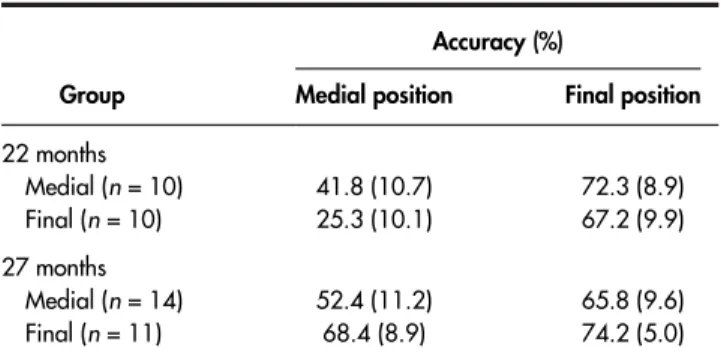
The percent-produced scores for children in each of the four perception groups are presented in Table 4 (n= the number of participants who cooperated in the production task). Overall, 22-month-olds correctly produced third per-son singular–sin 34% (SE= 7) of sentence-medial con-texts versus 70% (SE= 6) of sentence-final contexts; 27-month-olds correctly produced third person singular–s
in 59% (SE= 7) of sentence-medial contexts versus 70% (SE= 6) sentence-finally.
We analyzed the elicited production data (using the percent-produced score) using a general linear model repeated measures analysis of variance (ANOVA). In this analysis, sentence position in the production task
Table 4.Average correctly produced sentences for each of the four groups in the two sentence positions.
Group
Accuracy (%)
Medial position Final position
22 months Medial (n= 10) 41.8 (10.7) 72.3 (8.9) Final (n= 10) 25.3 (10.1) 67.2 (9.9) 27 months Medial (n= 14) 52.4 (11.2) 65.8 (9.6) Final (n= 11) 68.4 (8.9) 74.2 (5.0)
(medial, final) was a within-subjects variable; age (22 months, 27 months) and sentence position in the perception task (medial, final) were between-subjects variables. We included sentence position in the percep-tion task as a variable in the ANOVA because the pro-duction task always followed the perception task; thus, whether children were tested on the sentence-final or sentence-medial position in the perception task has the potential to affect their production task performance. We also ran a repeated measures ANOVA with word familiarity—that is, if the verb had been heard in the perception task (familiarized, not familiarized) as another within-subjects variable. The results of both ANOVAs were identical, so we do not report them separately.
In the production task, only the main effect of sen-tence position,F(1, 41) = 17.2,p< .001,hp2= .30, and the
interaction between age and sentence position were sig-nificant,F(1, 41) = 5.7,p= .02,hp2= .12. All other effects
were nonsignificant (ps > .1). To probe the interaction, the sentence-position effects were investigated separately for each age using pairedttests. As there were two paired comparisons, using Bonferroni’s correction, onlypvalues of (.05/2) .025 and lower are indicated as significant. Sentence-position effects in the production task were significant only at 22 months,t(19) = 4.9,p= .008. Spe-cifically, 22-month-olds produced significantly more instances of third person singular–sin sentence-final compared with sentence-medial position. By 27 months, children’s improvement in the production of third person singular–sin sentence-medial position brought their production statistically on par with their production in sentence-final position, although the overall percentage of medial morpheme productions was lower (59% vs. 70%). The production results replicated and extended Song et al.’s (2009) findings. Specifically, children were more accurate at producing third person singular–sfor verbs that were embedded finally than sentence-medially. Furthermore, differences in accuracy with sentence position are more evident at earlier stages of acquisition.
Perception Task
The average listening times to grammatical and un-grammatical sentences in each of the two blocks for each age and sentence position are presented in Table 5. Over the course of any experiment, children’s listening times to stimuli typically decrease. Here, as well, listening times in Block 2 were shorter than in Block 1. In fact, children were at ceiling in Block 1 (see Table 5). Thus, the differ-ences between listening time to grammatical and un-grammatical sentences become evident only in Block 2. As shown in Block 2 of Table 5, in sentence-final position, 22-month-olds listened longer to grammatical sentences, whereas 27-month-olds listened longer to ungrammatical sentences. In sentence-medial position, the listening
times to grammatical and ungrammatical sentences were comparable for both age groups. Statistical anal-yses (reported in the paragraphs that follow) confirmed the overall finding.
Listening times to grammatical and ungrammatical sentences in Block 2 were compared using a general linear model repeated measures ANOVA.1Trial type (grammatical, ungrammatical) was a within-subjects var-iable; age (22 months, 27 months) and sentence position (medial, final) were between-subjects variables. Only the three-way Trial Type × Age × Position interaction was significant,F(1, 64) = 14.05,p< .001,hp2= .18. All other
effects were nonsignificant (ps > .1, except for the Age × Position interaction, wherep> .05).
To probe the three-way interaction, we investigated the effect of trial type and age separately for the medial and the final condition. In sentence-final position, only the Trial Type × Age interaction was significant,F(1, 32) = 10.8,p= .002,hp2= .25. All other effects were
nonsig-nificant (ps > .2).
We carried out subsequent pairedttests to determine whether the difference in listening time to grammatical and ungrammatical sentences in sentence-medial and sentence-final position was significantly different for each age group. As there were four paired comparisons, and we had directional predictions, using Bonferroni’s correc-tion, onlypvalues of (.1/2) .025 and lower are indicated as significant. In sentence-final position, 22-month-olds listened significantly longer to grammatical sentences,
t(16) = 2.53,p= .02, whereas 27-month-olds listened sig-nificantly longer to ungrammatical sentences,t(16) =–2.43,
p= .025. For sentence-medial position, there was no sig-nificant difference between listening time to grammatical and ungrammatical sentences at either age (ps > .1).
In summary, in sentence-final position, both the 22-month-olds and the 27-month-olds demonstrated a significant preference in a referential task, showing the ability to detect the presence or absence of third person singular–s. However, the two age groups differed in how they demonstrated this ability: The 22-month-olds lis-tened significantly longer to grammatical sentences, whereas the 27-month-olds listened significantly longer to ungrammatical sentences. In contrast, neither group presented a significant preference when third person singular–swas embedded sentence-medially. Thus, de-tecting the presence or absence of third person singular–s
appears to be more challenging sentence-medially. 1We also ran an ANOVA with Block 1 listening times included in the
analysis, where block was an additional within-subjects variable. The pattern of results was the same as the one reported here. In addition, there was a main effect of block and an interaction of block with the variables of interest. Finally, the Shapiro-Wilks’s test confirmed that the listening time difference,W(68) = 0.98,p= .45, as well as the proportion of listening time,W(68) = 0.97,p= .21, used later for correlations and linear regression were normally distributed.
Correlations Between MacArthur CDI
and Perception and Production Results
To investigate the relationship between CDI scores and the production data, we calculated the Pearson’s product–moment correlation coefficient between CDI raw scores and the percent-production scores (r= .52,
p< .001). About 27% of the variance in the production data was accounted for by the variability in the CDI. This correlation was unchanged even when the effect of age (in days) was partialed out (r= .52,p< .001). Thus, perhaps unsurprisingly, children with larger vocabu-laries showed higher production scores for third person singular–s.
To investigate the correlation between CDI scores and performance on the perception task, we calculated pref-erence scores for each child (cf. Arterberry & Bornstein, 2002; Sundara, Polka, & Molnar, 2008). Thepreference scorewas defined as the proportion of time spent listen-ing to the grammatical sentences durlisten-ing the test phase ( listening time to grammatical sentences/sum of listen-ing time to grammatical and ungrammatical sentences). Thus, calculating preference scores corrects for differ-ences in absolute listening times across individual chil-dren. These scores range from 0 to 1. A preference score of 0.5 indicates that the child listened equally to gram-matical and ungramgram-matical sentences. A score greater than 0.5 indicates that the child listened longer to gram-matical sentences—that is, showed a familiarity prefer-ence; a score less than 0.5 indicates that the child listened longer to ungrammatical sentences—that is, showed a novelty preference. Preference scores for children in each of the four groups—22- and 27-month-olds tested on sentence-medial and sentence-final position—are pre-sented in Figure 2.
Interestingly, there was no significant correlation between CDI raw scores and preference scores obtained from the perception task (r=–.24,p= .1); again, this cor-relation was unchanged when age was partialed out
(r = –.23, p = .1).2 Given previous reports that word recognition is significantly correlated with CDI scores (Fernald, Perfors, & Marchman, 2006), we suggest that the lack of such a correlation here is due to the fact that the perception task in this study taps into higher levels of grammatical processing than word recognition tasks.
Relationship Between Perception
and Production
Before we investigate the relationship between per-ception and production, a caveat regarding the interpre-tation of a lack of preference is in order. Recall that the lack of preference demonstrated in this study by 22- and 27-month-olds tested on sentence-medial verbs may have several different explanations. First, a lack of preference could arise if children are unable to detect the presence/ absence of the third person singular–swhen the verb is sentence-medial. In this case, by random chance, some children listen longer to grammatical sentences and others to ungrammatical sentences. Second, a lack of prefer-ence could also arise if children were able to detect the third person singular–s,with some children systematic-ally demonstrating a familiarity preference and others a novelty preference. In both cases, children as a group would fail to demonstrate a preference for grammatical or ungrammatical sentences.
Critically, children who do not detect the presence or absence of the third person singular –sshould show a unimodal distribution of preference scores centered at 0.5; in contrast, children demonstrating a lack of pref-erence because they are in transition from a familiarity to a novelty preference should show a bimodal distribution of preference score. From Figure 2, it is evident that the
Table 5.Average listening time(s) for grammatical and ungrammatical sentences for each of the four groups in the two blocks.
Group
Block 1 Block 2
Grammatical Ungrammatical Grammatical Ungrammatical
22 months Medial (n= 17) 15.5 (0.83) 16.2 (0. 48) 12.3 (0.81) 13.9 (0.85) Final (n= 17) 16.1 (0.66) 16.4 (0.53) 15.0 (0.52) 13.9 (0.68) 27 months Medial (n= 17) 16.8 (0.49) 16.6 (0.49) 14.8 (0.73) 14.1 (0.79) Final (n= 17) 15.3 (0.74) 16.3 (0.82) 12.2 (0.90) 14.4 (0.82)
Note. Values in parentheses represent standard errors.
2We also calculated the preference score separately for each sentence pair
and then averaged the four preference scores; the Pearson’s product– moment correlation coefficient for the preference scores calculated using the two methods is .98. So, we only report analysis with the first method.
preference scores of 22-month-olds tested on sentence-medial position are centered at 0.5 and are unimodally distributed. Preference scores of 27-month-olds tested on sentence-medial position, however, are bimodally dis-tributed, with seven showing a novelty preference and nine showing a familiarity preference.
If 22-month-olds tested on sentence-medial verbs are unable to distinguish the presence or absence of the third person singular–s,the direction of preference can-not predict production accuracy because the direction of preference is truly random. As expected, on the basis of the unimodal distribution of preference scores, the 22-month-olds tested on sentence-medial position did not show any correlation between preference scores and production accuracy (r= .03). In contrast, for the other three groups—22-month-olds tested in sentence-final position and 27-month-olds tested in sentence-medial and -final position—there was a significant negative cor-relation between preference scores and production ac-curacy (rs =–.27,–.19, and–.45, respectively). Thus, 22-month-olds tested on the perception task in sentence-medial position were behaving randomly, and their data are excluded from the analysis of the perception– production relationship.
We used linear regression to determine the relation-ship between perception and production of third person
singular–sfor three groups of children—22-month-olds tested on the sentence-final perception task and 27-month-olds tested on sentence-medial and -final perception tasks. We used age (days), MacArthur CDI raw scores, and the preference scores on the perception task to predict overall production scores (in percent) using a stepwise regres-sion. In stepwise linear regression, at each step, the most significant term is added to the model until none of the factors left out of the model would have a statistically significant contribution if they were added to the model (Step 2 in our model).
Unsurprisingly, the first predictor to be entered into the model was the MacArthur CDI raw score (B= 0.008,
SE B = 0.002,b= .57), accounting for 33% (R2) of the variance. The positive sign on the coefficientB(andb) indicates that children with bigger vocabularies (i.e., greater MacArthur CDI scores) have higher production accuracy. At the second and final step, the preference score from the perception experiment (B=–1.36,SE B= 0.55,b=–.33) significantly added 10.6% to the explained variance. The negative sign on the coefficientB(andb) indicates that children with a preference score greater than 0.5 (i.e., the children who demonstrated a familiarity preference by listening longer to grammatical sentences) have lower production accuracy. This confirms that the lexical and morphosyntactic representations of these
Figure 2.Individual preference scores (looking time to grammatical sentences/looking time to grammatical + ungrammatical sentences) for children in each of the four groups. A preference score greater than 0.5 indicates longer looking time to grammatical sentences (a familiarity preference). A preference score less than 0.5 indicates longer looking time to ungrammatical sentences (a novelty preference).
children are not as robust as those of the children demonstrating a novelty preference for ungrammatical sentences. Furthermore, results from the stepwise re-gression analysis show that the perception scores ac-count for a unique proportion of the variance in predicting production scores; this is in addition to the variance ex-plained by a vocabulary measure (i.e., the MacArthur CDI score).
Discussion
In this study, we tested 22- and 27-month-olds’ ception and production of sentences with the third per-son singular –s. In the perception task, children were presented a one-screen video display of a cartoon per-forming an action. Half the time, animated cartoons were paired with grammatical sentences where the third person singular –s was present, and half the time they were paired with ungrammatical sentences where the third person singular–swas absent. In the presence of a referential context provided by the video display, chil-dren’s preference for listening to grammatical and un-grammatical sentences was compared.
Children at both ages were tested on one of two per-ception conditions: (a) when the verb was in sentence-final position or ( b) when the verb was in sentence-medial position. If less accurate production of this morpheme sentence-medially is due to its articulatory complexity, we expected children to be equally good at detecting the presence or absence of the third person singular–s
sentence-medially and sentence-finally. In contrast, if children exhibited worse performance on detecting the presence or absence of the third person singular–s
sentence-medially as compared with sentence-finally, this would suggest that highly variable production of this morpheme is influenced by a lack of perceptual salience. The results showed that when the verbs were in sentence-final position, children at both ages demon-strated the ability to distinguish grammatical and ungram-matical sentences. The 22-month-olds listened significantly longer to the grammatical sentences, demonstrating a familiarity preference, whereas the 27-month-olds lis-tened significantly longer to ungrammatical sentences, demonstrating a novelty preference. In contrast, chil-dren at both ages listened equally to grammatical and un-grammatical sentences when the verbs were embedded sentence-medially and, thus, did not demonstrate that they were able to detect the presence/absence of the third person singular–ssentence-medially. This indicates that articulatory complexity alone cannot account for why chil-dren are better at producing the third person singular–s
sentence-finally. Rather, perceptual factors contribute to poorer production of third person singular–sin certain prosodic contexts (cf. Leonard et al., 2000).
Note that children’s differential response to the grammatical and ungrammatical sentences used in this study cannot be explained simply by their never having heard the ungrammatical forms. Children routinely hear sequences such as“he run,”but only in the context of ques-tions such as“Where did he run?”(Theakston, Lieven, & Tomasello, 2003); however, they do not hear sequences such as“he run”in declarative sentences with third per-son singular–s.
Furthermore, the results cannot be explained as a preference for superficial surface characteristics of sentences (e.g., simply the presence of /s/). Recall that 22- and 27-month-olds show opposite preferences: The former prefer to listen to sentences with the third person singular–s,and the latter prefer to listen to sentences without the third person singular–s. Thus, it is unlikely that a preference for sentences with certain segments such as–sdrives younger children’s preference for gram-matical sentences and older children’s preference for un-grammatical sentences.
Previous research has shown that younger infants, specifically, 18-month-olds, tested using only listening time paradigms, are also sensitive to agreement (Santelmann & Jusczyk, 1998; Soderstrom et al., 2007). Perhaps the 22-month-olds tested in this study also treated the one-screen central fixation task as a listening task and ignored the visual stimuli altogether. We think this is unlikely. Note that a preference for either grammatical or ungrammatical sentences does not, in and of itself, establish that the children attended to the visual stim-uli. To confirm that the children in a one-screen task considered both the audio and video stimuli, we included additional controls. In the pilot experiment, 10 children (five 22-month-olds and five 27-month-olds) were pre-sented with a posttest trial in which the video of“boy crying” was presented with the grammatical sentence
“He sleeps now.”On the posttest trials, all children lis-tened for almost the entire duration of the trials—that is, about 18 s. In addition, in the elicited imitation task, children at both ages spontaneously labeled the video stimuli using verb+ing. It seems quite unlikely that chil-dren would attend to the video stimuli in the elicited imita-tion task but not in the percepimita-tion task. Taken together, these findings indicate that the animated cartoons suc-cessfully provided a referential context for the auditory stimuli. Thus, unlike the pattern recognition demonstrated by the 18-month-olds tested by Santelmann and Jusczyk (1998) or Soderstrom et al. (2007), the 22-month-olds tested in the present study were engaged in a referential task. Recall also that children hear the third person sin-gular–s five times more often sentence-medially com-pared with sentence-finally (Hsieh et al., 1999). Thus, children’s more accurate production of third person sin-gular –s sentence-finally cannot be explained on the
basis of differences in positional distribution in the input. Our results point to a crucial difference between language input and language uptake (Harris, 1992). Chil-dren hear third person singular–soverwhelmingly in sentence-medial position; however, children selectively attend to the third person singular–sin sentence-final position. This is demonstrated by 22-month-olds’ prefer-ence for grammatical sentprefer-ences when the verb is sentprefer-ence- sentence-final but not when it is sentence-medial. Thus, children’s perceptual representation of sentence-final third person singular–sdevelops earlier. Once children begin to no-tice the third person singular morpheme sentence-finally, their production begins to reflect this knowledge, as well. With increasing experience, measured here by age, children’s production of the third person singular–sin sentence-final position improves with a concomitant shift in preference for ungrammatical sentences in the percep-tion task.
In contrast, the perception and production of the third person singular–sin sentence-medial position lags behind. What explains the lack of preference demon-strated by 22- and 27-month-olds in sentence-medial position? Recall that the lack of preference may have several different explanations. First, a lack of preference could arise if children are unable to detect the presence/ absence of the third person singular–swhen the verb is sentence-medial. Second, a lack of preference could also arise if children were able to detect the third person singular–s,with some children systematically demon-strating a familiarity preference and others a novelty preference. In both cases, children as a group would fail to demonstrate a preference for grammatical or ungram-matical sentences. At present, we are unable to deter-mine which of these accounts for the present data.
However, it is likely that 22- and 27-month-olds fail to demonstrate a preference in the sentence-medial per-ception task for different reasons. We argue that the 22-month-olds are not able to detect the presence or ab-sence of third person singular–ssentence-medially and, thus, fail to show a preference. Subsequently, either be-cause of their improved perception of third person sin-gular–s sentence-finally or because of their improved production of this morpheme, children’s perception also improves sentence-medially. Again, although as a group, the 27-month-olds are not able to detect the presence or absence of third person singular–ssentence-medially, this may be due to the fact that children in this group are in transition. This is consistent with (a) the unimodal distribution of preference scores and ( b) the lack of cor-relation between perception and production scores for the 22- but not the 27-month-olds tested in the sentence-medial condition. In keeping with this possibility, we would predict that 25-month-olds should demonstrate a familiarity preference for sentence-medial third person
singular–ssentences, whereas older children—perhaps 30-month-olds—are likely to demonstrate a clear nov-elty preference for sentence-medial third person singu-lar–ssentences.
There could be several reasons for why children first attend to the presence or absence of the third person sin-gular morpheme sentence-finally. There is evidence that edges—beginnings and ends—are salient, whether we consider language-general, sensory, or recall-based ex-planations, or more linguistic ones (Slobin, 1973, 1985). We discuss the salience of ends here, as this edge is most relevant to this article. First, the audibility of audi-tory stimuli can be reduced by audiaudi-tory signals that follow it (Moore, 1997). These effects of backward masking are much more detrimental to the performance of children than of adults (Saffran, Werker, & Werner, 2006), although it is not clear whether this is due to the immaturity of the sensory or neural systems or due to nonsensory factors such as attention and memory. Psychoacoustic experi-ments measuring the threshold for detecting a tone that is followed by a noise indicate that 6-year-olds have, on average, a 34-dB higher threshold than adults; even 10-year-olds have thresholds that are about 20 dB higher than those of adults (Hartley, Wright, Hogan, & Moore, 2000). Because the ends of utterances are not followed by other speech material, the audibility of segments at the ends of utterances is less likely to be affected by backward masking. Second, across studies of recall, the first and last items are routinely remembered more accurately and more often (Deese & Kaufman, 1957).
Third, although languages may differ in their exact acoustic instantiation, the edges of utterances tend to be marked prosodically. In speech directed to adults as well as to infants, the edges of utterances are typically marked with intonational contours (Beckman & Pierrehumbert, 1986; Fernald & Mazzie, 1991; Fisher & Tokura, 1996), pause duration, and segmental modifications such as initial strengthening or final lengthening (Bernstein Ratner, 1986; Fisher & Tokura, 1996; Fougeron & Keating, 1997; Horne, Strangert, & Heldner, 1995; Keating, Cho, Fougeron, & Hsu, 2003; Wightman, Shattuck-Hufnagel, Osterdorf, & Price, 1992). Given the acoustic and per-ceptual salience of the edges of utterances, linguistic units that are adjacent to these edges may have a processing advantage.
Across languages, in child-directed speech, mothers typically place novel words at the ends of multiword ut-terances, even when the resulting sentences are un-grammatical (Aslin, Woodward, LaMendola, & Bever, 1996). The processing advantage for units occurring near the edges of utterances is evident very early in de-velopment. Utterance-initial and utterance-final words, but not utterance-medial words beginning with conso-nants, are segmented by 7.5-month-olds (Seidl & Johnson,
2006). Similarly, there is evidence that the segmentation of vowel-initial words by infants is also facilitated by placement at utterance edges (Seidl & Johnson, 2008). This processing advantage for words at the edges of ut-terances continues into adulthood; it is easier for adults to learn novel words in a nonnative language when the words are final than when they are utterance-medial (Golinkoff & Alioto, 1995). Thus, the acoustic and positional prominence of utterance-final linguistic in-formation may facilitate its perception and production ( but see also Montgomery & Leonard, 2006). In fact, any account of language learning that appeals to the salience of edges would be consistent with the earlier acquisition of inflections such as the plural–sand would predict that for other morphemes, as well, perceptual representa-tions and production will emerge first at the edges of utterances.
In this study, we have demonstrated that 22- and 27-month-olds are able to detect the presence or absence of the third person singular–s. Although we have not investigated the phonetic detail in which the third per-son singular–s is encoded by these children, research with adults indicates that discrimination of phonetic con-trasts is affected by position within the syllable (Redford & Diehl, 1999). Specifically, adults are less sensitive to pho-netic differences in syllable codas than in syllable onsets. The roots for these syllable-position effects are in place within the first year and a half of life (Juscyzk, Goodman, & Baumann, 1999; Kajikawa, Fais, Mugitani, Werker, & Amano, 2006; Mugitani, Fais, Kajikawa, Werker, & Amano, 2007; Zamuner, 2006). Thus, given that inflections such as the plural or third person singular–sare in coda position, some consequences for the detail in which chil-dren encode these morphemes may be expected. For ex-ample, Song et al. (2009) reported that children produce the third person singular morpheme more accurately in phonologically simple coda contexts (e.g.,sees) as com-pared with complex coda contexts (e.g.,needs). Future re-search is needed to determine whether these phonological complexity effects are motoric or relate to the perceptual salience of different positions within the syllable.
In summary, 22- and 27-month-old English-learning children’s perception and production of the third person singular–sis affected by sentence position and cannot be explained by motoric/articulatory complexity limitations alone. Rather, we demonstrate that children show earlier sensitivity to inflections at edges of utterances. Thus, any account of morphosyntactic development needs to incor-porate some measure of the relative perceptual salience of morphemes in different prosodic contexts as well as how these are distributed in the input that learners hear. These results also point to a closer connection between perception and production than is often assumed and suggest that, together, the two may play a critical role in
the development of more robust lexical and morphosyn-tactic representations.
Acknowledgments
This work was supported, in part, by National Institutes of Health Grants R01MH60922 (principal investigator, Katherine Demuth; co-principal investigator, Mark Johnson) and R01HD057606 (principal investigator, Katherine Demuth; principal investigator, Stefanie Shattuck-Hufnagel); National Science Foundation Grant 0354453 (principal investigator, John Bransford; co-principal investigator, Patricia Kuhl); and University of California, Los Angeles ( UCLA) start-up funds awarded to Megha Sundara.
Part of the present article was presented at the 33rd Boston University Conference on Language Development in November 2008. We thank that audience and Jae Yung Song for helpful comments and suggestions. Many thanks also to Karen Evans, Mathew Masapollo, and Rachel Theodore of the Child Language Lab at Brown University; Hillary Fix, Denise Padden, Kathryn Schoolcraft, and Robert Shields at the Institute for Learning and Brain Sciences (I-LABS), University of Washington; and Kristi Hendrickson and Adrienne Scutellaro at the Language Acquisition Lab at UCLA. Finally, we thank the parents and children who participated in the research.
References
Arterberry, M. E., & Bornstein, M. H.(2002). Variability and its sources in infant categorization.Infant Behavior and Development, 25,515–528.
Aslin, R. N., Woodward, J. Z., LaMendola, P., & Bever, T. G.(1996). Models of word segmentation in fluent maternal speech to infants. In J. L. Morgan & K. Demuth ( Eds.), Signal to syntax: Bootstrapping from speech to grammar in early acquisition( pp. 117–134). Mahwah, NJ: Erlbaum. Beckman, M. E., & Pierrehumbert, J. B.(1986).
Intona-tional structure in Japanese and English.Phonology Yearbook, 3,255–309.
Bernal, S., Lidz, J., Milotte, S., & Christophe, A.(2007). Syntax constrains the acquisition of verb meaning.Language Learning and Development, 3,325–341.
Bernhardt, B. H., & Stemberger, J. P.(1998).Handbook of phonological development: From the perspective of constraint based nonlinear phonology. San Diego, CA: Academic Press. Bernstein Ratner, N.(1986). Durational cues which mark
clause boundaries in mother–child speech.Journal of Phonetics, 14,303–309.
Bloom, P.(1970). Subjectless sentences in child language. Linguistic Inquiry, 21,491–504.
Boersma, P., & Weenink, D.(2005). PRAAT: Doing phonetics by computer ( Version 4.4.07) [Computer program]. Available at http://www.praat.org.
Bornstein, M. H.(1985). Habituation of attention as a mea-sure of visual information processing in human infants: Summary, systematization and synthesis. In G. Gottlieb & N. A. Krasnegor ( Eds.),Measurement of audition and vision in the first year of life: A methodological overview( pp. 253–300). Norwood, NJ: Ablex.
Brown, R.(1973).A first language: The early stages. Cambridge, MA: Harvard University Press.
Cazden, C.(1968). The acquisition of noun and verb inflec-tions.Child Development, 39,433–448.
Chemla, E., Mintz, T. H., Bernal, S., & Christophe, A. (2009). Categorizing words using“frequent frames”: What cross-linguistic analyses reveal about distributional acqui-sition strategies.Developmental Science, 12,396–406. Cohen, L. B.(1969). Observing responses, visual preferences,
and habituation to visual stimulation in infants.Journal of Experimental Child Psychology, 7,419–433.
Cohen, L. B., Atkinson, D. J., & Chaput, H. H.(2000).Habit 2000: A new program for testing infant perception and cognition. Austin, TX: The University of Texas.
Dalal, R., & Loeb, D.(2005). Imitative production of regular past tense-edby English-speaking children with specific language impairment.The International Journal of Com-munication Disorders, 40,67–82.
Dale, P. S., & Fenson, L.(1996). Lexical development norms for young children.Behavior Research Methods, Instruments & Computers, 28,125–127.
DeCasper, A., & Fifer, W. P.(1980, June 6). Of human bonding: Newborns prefer their mothers’voices.Science, 208,1174–1176.
Deese, J., & Kaufman, R. A.(1957). Serial effects in recall of unorganized and sequentially organized verbal material. Journal of Experimental Psychology, 54,180–187.
Fenson, L., Pethick, S., Renda, C., Cox, J. L., Dale, P. S., & Reznick, J. S.(2000). Short form versions of the MacArthur Communicative Development Inventories. Applied Psycholinguistics, 21,95–115.
Fernald, A., & Mazzie, C.(1991). Prosody and focus in speech to infants and adults.Developmental Psychology, 27,209–221. Fernald, A., Perfors, A., & Marchman, V. A.(2006). Picking
up speed in understanding: Speech processing efficiency and vocabulary growth across the 2nd year.Developmental Psychology, 42,98–116.
Fisher, C., & Tokura, H.(1996). Acoustic cues to grammat-ical structure in infant-directed speech: Cross-linguistic evidence.Child Development, 67,3192–3218.
Fougeron, C., & Keating, P.(1997). Articulatory strength-ening at edges of prosodic domains.The Journal of the Acoustical Society of America, 101,3728–3740.
Gerken, L. A.(1996). Prosodic structure in young children’s language production.Language, 72,683–712.
Gerken, L., & McIntosh, B.(1993). Interplay of function morphemes and prosody in early language.Developmental Psychology, 29,448–457.
Gerken, L., Wilson, R., & Lewis, W.(2005). Infants can use distributional cues to form syntactic categories.Journal of Child Language, 32,249–268.
Golinkoff, R. M., & Alioto, A.(1995). Infant-directed speech facilitates lexical learning in adults hearing Chinese: Impli-cations for language acquisition.Journal of Child Language, 22,703–726.
Golinkoff, R. M., Hirsh-Pasek, K., Cauley, K., & Gordon, L.(1987). The eyes have it: Lexical and syntactic compre-hension in a new paradigm.Journal of Child Language, 14, 23–46.
Golinkoff, R. M., Hirsh-Pasek, K., & Schweisguth, M. A. (2001). A reappraisal of young children’s knowledge of grammatical morphemes. In J. Weissenborn & B. Höhle ( Eds.),Approaches to bootstrapping: Phonological, syntactic, and neurophysiological aspects of early language acquisition ( pp. 167–188). Amsterdam, the Netherlands: John Benjamins. Hallé, P., Durand, C., & Boysson-Bardies, B. D.(2008).
Do 11-month-old French infants process articles?Language and Speech, 51(1–2), 23–44.
Harris, M.(1992).Language experience and early language development: From input to uptake. Mahwah, NJ: Erlbaum. Hartley, D. E. H., Wright, B. A., Hogan, S. C., & Moore,
D. R.(2000). Age-related improvements in auditory back-ward and simultaneous masking in 6- to 10-year-old children. Journal of Speech, Language, and Hearing Research, 43, 1402–1415.
Hayashi, A., Tamekawa, Y., & Kiritani, S.(2001). Devel-opmental change in auditory preferences for speech stimuli in Japanese infants.Journal of Speech, Language, and Hearing Research, 44,1189–1200.
Hirsh-Pasek, K., & Golinkoff, R. M.(1996). The intermodal preferential looking paradigm reveals emergent language comprehension. In D. McDaniel & C. McKee ( Eds.),Methods for assessing children’s syntax( pp. 53–72). Cambridge, MA: MIT Press.
Höhle, B., Schmitz, M., Santelmann, L. M., & Weissenborn, J.(2006). The recognition of discontinuous verbal depen-dencies by German 19-month-olds: Evidence for lexical and structural influences on children’s early processing capaci-ties.Language Learning and Development, 2,277–300. Höhle, B., & Weissenborn, J.(2003). German-learning
infants’ability to detect unstressed closed-class elements in continuous speech.Developmental Science, 6,122–127. Höhle, B., Weissenborn, J., Keifer, D., Schulz, A., &
Schmitz, M.(2004). Functional elements in infants’speech processing: The role of determiners in the syntactic catego-rization of lexical elements.Infancy, 5,341–353.
Horne, M., Strangert, E., & Heldner, M.(1995). Prosodic boundary strength in Swedish: Final lengthening and silent interval duration.Proceedings of the 13th International Congress of Phonetic Sciences, 1,170–173.
Houston-Price, C., & Nakai, S.(2004). Distinguishing novelty and familiarity effects in infant preference proce-dures.Infant and Child Development, 13,341–348. Hsieh, L., Leonard, L. B., & Swanson, L. A.(1999). Some
differences between English plural noun inflections and third singular verb inflections in the input: The contribu-tions of frequency, sentence position, and duration.Journal of Child Language, 26,531–543.
Hunter, M. A., & Ames, E. W.(1988). A multifactor model of infant preferences for novel and familiar stimuli. In C. Rovee-Collier & L. P. Lipsitt ( Eds.),Advances in infancy research(Vol. 5, pp. 69–95). Stamford, CT: Ablex.
Johnson, E. K.(2005). Grammatical gender and early word recognition in Dutch. In A. Brugos, M. R. Clark-Cotton, & S. Ha ( Eds.),Proceedings of the 29th Annual Boston University Conference on Language Development(Vol. 1, pp. 320–330). Sommerville, MA: Cascadilla.
Johnson, V. E., de Villiers, J. G., & Seymour, H. N.(2005). Agreement without understanding? The case of third person singular /s/.First Language, 25,317–330.