NASA/TM–2016-219361
Big Data Analytics and Machine Intelligence
Capability Development at NASA Langley Research
Center: Strategy, Roadmap, and Progress
Manjula Y. Ambur and Jeremy J. Yagle
Langley Research Center, Hampton, Virginia
William Reith
Booz Allen Hamilton, Hampton, Virginia
Edward McLarney
Langley Research Center, Hampton, Virginia
NASA STI Program . . . in Profile
Since its founding, NASA has been dedicated to theadvancement of aeronautics and space science. The NASA scientific and technical information (STI) program plays a key part in helping NASA maintain this important role.
The NASA STI program operates under the auspices of the Agency Chief Information Officer. It collects, organizes, provides for archiving, and disseminates NASA’s STI. The NASA STI program provides access to the NTRS Registered and its public interface, the NASA Technical Reports Server, thus providing one of the largest collections of aeronautical and space science STI in the world. Results are published in both non-NASA channels and by NASA in the NASA STI Report Series, which includes the following report types:
• TECHNICAL PUBLICATION. Reports of completed research or a major significant phase of research that present the results of NASA
Programs and include extensive data or theoretical analysis. Includes compilations of significant scientific and technical data and information deemed to be of continuing reference value. NASA counter-part of peer-reviewed formal professional papers but has less stringent limitations on manuscript length and extent of graphic presentations.
• TECHNICAL MEMORANDUM.
Scientific and technical findings that are preliminary or of specialized interest, e.g., quick release reports, working
papers, and bibliographies that contain minimal annotation. Does not contain extensive analysis.
• CONTRACTOR REPORT. Scientific and technical findings by NASA-sponsored contractors and grantees.
• CONFERENCE PUBLICATION.
Collected papers from scientific and technical conferences, symposia, seminars, or other meetings sponsored or co-sponsored by NASA.
• SPECIAL PUBLICATION. Scientific,
technical, or historical information from NASA programs, projects, and missions, often
concerned with subjects having substantial public interest.
• TECHNICAL TRANSLATION. English-language translations of foreign scientific and technical material pertinent to NASA’s mission.
Specialized services also include organizing and publishing research results, distributing specialized research announcements and feeds, providing information desk and personal search support, and enabling data exchange services. For more information about the NASA STI program, see the following:
• Access the NASA STI program home page at http://www.sti.nasa.gov
• E-mail your question to [email protected]
• Phone the NASA STI Information Desk at 757-864-9658
• Write to:
NASA STI Information Desk Mail Stop 148
NASA Langley Research Center Hampton, VA 23681-2199
NASA/TM–2016-219361
Big Data Analytics and Machine Intelligence
Capability Development at NASA Langley Research
Center: Strategy, Roadmap, and Progress
Manjula Y. Ambur and Jeremy J. Yagle
Langley Research Center, Hampton, Virginia
William Reith
Booz Allen Hamilton, Hampton, Virginia
Edward McLarney
Available from:
NASA STI Program / Mail Stop 148 NASA Langley Research Center
Hampton, VA 23681-2199 Fax: 757-864-6500
Acknowledgments
The authors gratefully acknowledge the following individuals for their invaluable contributions to the
Comprehensive Digital Transformation (CDT) Big Data Analytics and Machine Intelligence Capability Team at NASA Langley Research Center, and for their continued support and collaboration on capability development for data analytics and machine learning. Those who contributed to the development of the initial vision, strategy, and roadmap in 2014 include Sakeba Abedin, Steve Dry, Cory Gilbert, Dana Hammond, Dave Hinton, Michael Little, Ed McLarney, Peter Mount, Brandi Quam, William Reith, Steve Scotti, Ted Sidehamer, Mia Siochi, Jim Thomas, Sharon Welch, and Bill Winfree. Big Data Analytics and Machine Intelligence (BDAMI) Team members including Lin Chen, James Ecker, Christina Heinich, Charles Liles, Raymond McCollum, Graeme Melrose, Robert Milletich, William Reith, Daniel Sammons, Travis Smith, Ted Sidehamer, and Jeremy Yagle have diligently and skillfully worked on use case development, outreach, and collaboration over the past three years. Their efforts have been supplemented by interns including Karleigh Cameron, Zachary Ernst, Moshea Fink, Evana Gizzi, Wade Hunter, Colin Lockard, Travis Moore, Macarena Ortiz, Jefferson Ridgeway, Alexander Sarris, Nicholas Sarris, Jake Spracher, and Troy Thomas. Leaders of the CDT and BDAMI activities including Damodar Ambur, Manjula Ambur, J.F. Barthelemy, Dennis Bushnell, Jill Marlowe, Ed McLarney, Joe Morrison, and Jeff Seaton have provided guidance and direction for all aspects of the initiative, collaborations, and outreach efforts. Finally, we extend our sincere thanks to the subject matter experts from our mission organizations, without whose strong collaboration and continued support this work would not otherwise be possible; Danette Allen, Dale Arney, Trey Arthur, Erik Axdahl, Randy Bailey, Kristopher Bedka, Douglas Brown, Eric Burke, Jeff Cerro, Kyle Ellis, Christie Funk, Dana Hammond, Angela Harrivel, Jeff Herath, Jon Holbrook, Patty Howell, Lisa Le Vie, Constantine Lukashin, Louis Nguyen, Jeremy Pinier, Alan Pope, Brandi Quam, Laura Rogers, Cheryl Rose, Jamshid Samareh, Mark Sanetrik, Rob Scott, Lisa Scott-Carnell, Steve Scotti, Patrick Shea, Walt Silva, Mia Sicohi, Chad Stephens, Scott Striepe, Patrick Taylor, Marty Waszak, Bill Winfree, and Kristopher Wise.
The use of trademarks or names of manufacturers in this report is for accurate reporting and does not constitute an official endorsement, either expressed or implied, of such products or manufacturers by the National Aeronautics and Space Administration.
Table of Contents
Executive Summary ... 4
A: Big Data Analytics & Machine Intelligence Strategy and Roadmap ... 8
A1 Overview ... 8
A1.1 Background ... 8
A1.2 Current State and Approach ... 10
A1.3 Vision ... 11
A1.4 Scope ... 13
A2 Strategic Goals, Objectives, and Initiatives ... 14
A3 Use Cases ... 23
A4 Knowledgeability ... 26
A5 Research and Partnerships ... 27
A5.1 Federal Research Initiatives ... 28
A5.2 Partnerships ... 28
A6 Technology and Architecture ... 29
A6.1 Deep Analytics and Data Visualization ... 29
A6.2 Data Mining and Data Discovery ... 29
A6.3 Machine Learning and Machine Intelligence ... 29
A6.4 Architecture and Infrastructure ... 30
A7 Workforce Skills ... 32
A8 Findings, Key Recommendations, and Actions ... 33
A8.1 Findings ... 33
A8.2 Key Recommendations ... 34
A8.3 Actions ... 36
A9 The Way Ahead ... 37
A9.1 Organizational and Cultural Changes ... 38
A9.2 Funding Considerations ... 38
B: Progress Made to Date (2014-2017) ... 39
2
B3.6 Entry, Descent, and Landing ... 56
B3.7 Climate Science: Cloud Fraction Simulation ... 56
B3.8 Space Launch System (SLS) Booster Separation Aerodynamics ... 57
B3.9 Hypersonic Inlet Performance Analysis ... 58
B3.10 Space Launch System (SLS) Additive Manufacturing Certification ... 58
B3.11 Flight Deck Analytics from Trajectory-Based Optimization ... 58
B4 Progress on Deep Content Analytics (DCA) Projects ... 58
B4.1 Carbon Nanotubes ... 60
B4.2 Autonomous Flight ... 60
B4.3 Space Radiation ... 60
B4.4 Aerospace Vehicle Design ... 60
B4.5 Uncertainty Quantification ... 61
B4.6 Space Mission Analysis ... 61
B4.7 Model Based Engineering ... 61
B4.8 Human-Machine Teaming ... 61
B4.9 NASA Technical Reports ... 62
B4.10 NASA Lessons Learned ... 62
B5 Progress on Deep Q&A Projects ... 62
B5.1 Cognitive Computing and the “NASA Watson” Vision ... 62
B5.1 Current Application: Pilot Advisor Proof of Concept ... 64
B5.2 Current Application: Aerospace Innovation Advisor Proof of Concept ... 66
B5.3 Next Steps ... 67
B6 Collaboration ... 67
B6.1 Collaboration with other NASA Centers ... 67
B6.2 Collaboration with Universities ... 68
B6.3 Collaboration with Expertise in Industry and Other Federal Agencies ... 68
B7 Outreach and Education ... 69
B7.1 Seminars and Focus Groups ... 70
B7.2 Agency Events ... 70
B7.3 Conferences ... 71
B7.4 Center-wide Workshops ... 71
B8 Research Machine Intelligence ... 72
B9 Hire or Obtain Expertise ... 73
C: Moving Forward (2018 – 2020) ... 74
C1 Vision, Roadmap, Recommendations, and Actions ... 74
Phase II Actions (2018-2020) ... 77
C3 Focus on Mission Support Functions ... 78
C4 Enhancing Data Intensive Scientific Discovery (DISD) ... 78
C5 Enhancing Deep Content Analytics (DCA) ... 78
C6 Enhancing Deep Q&A and “NASA Watson” ... 79
C7 Enhancing Collaboration ... 79
C8 Artificial Intelligence ... 80
C9 Enhancing Outreach and Education ... 80
C10 Integration with High Performance Computing and Modeling & Simulation ... 80
Concluding Remarks ... 81
Appendix A: References for Section A ... 83
Appendix B: References for Section B ... 84
Appendix C: Key Presentations ... 86
Big Data Analytics and Machine Intelligence Capability Algorithms and Software: AIAA SciTech Conference (January 2016) ... 86
Comprehensive Digital Transformation: An Overview (February 2016) ... 94
Knowledge Analytics and Data Analytics (August 2016) ... 107
4
Executive Summary
The term Big Data refers to datasets whose volume, speed, and complexity is beyond the ability of typical tools to capture, store, manage and analyze. Big data is often described by the four V’s -- volume of data, velocity of data, variety or types of data, and veracity or accuracy of the data. Analysis of the data can be enhanced by Machine Learning and Machine Intelligence. Machine Learning relies on algorithms that are capable of learning from both data and human interaction to enable insights and predictions, while machine intelligence involves an autonomous entity that can observe and act upon its environment, making decisions like a human. Each of these three terms refers to rapidly emerging capabilities that are revolutionizing how industry and government analyze data.
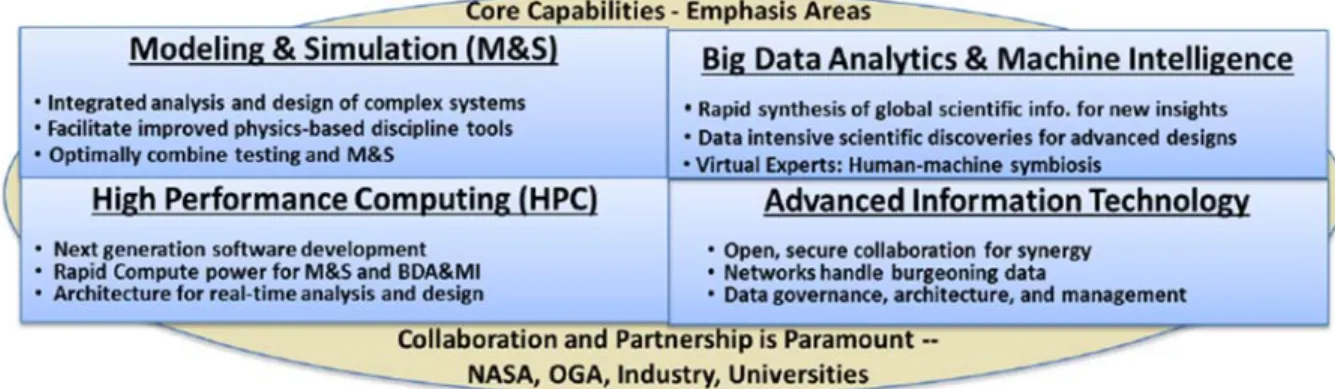
The fields of machine learning and big data analytics have made significant advances over the past several years and have been demonstrating the potential to transform how the traditional disciplines of science and engineering are conducted. These new, advanced methods, paired with rapidly evolving computational capabilities, have created an environment where cross-fertilization of methods and unique collaborations can achieve previously unattainable outcomes. NASA Langley Research Center (LaRC) has recognized these changes in the technical and scientific communities and created the Comprehensive Digital Transformation (CDT) initiative that focuses on four main pillars: advanced modeling and simulation, machine learning and big data analytics, high performance computing, and advanced IT infrastructure. The primary goal of CDT is to serve as a catalyst to apply these capabilities both individually and through convergence of these compute- and data- intensive capabilities to enable innovative concepts, reduced design cycle time, improved affordability, and increased confidence in the designs.
A team of researchers, engineers and information technology (IT) specialists developed the Big Data Analytics & Machine Intelligence Strategy and Roadmap in 2014. The vision is to have a “Virtual Expert” or “Virtual Research and Design Partner” enabling NASA employees to achieve greater scientific discoveries and system design optimization. Drawing from this document, Section A presents the BDAMI goals, objectives, initiatives, key recommendations, and phased actions designed to equip LaRC to develop near-, mid- and long-term big data capabilities.
Section B provides an overview of the significant progress that has been made over the last two and a half years in developing pilots and projects in several research, engineering, and science domains, and
implementing them using both institutional and aeronautics and exploration project funds. These accomplishments were possible with significant collaboration between the multi-skilled BDAMI team, mission organizations, and external partners from universities and industry. Two of the major capability focus areas that are being worked are Data Intensive Scientific Discovery (DISD) and Deep Content Analytics (DCA). Both areas are equally important, and will eventually need to come together in the “Virtual Expert”
vision, with data fusion and analyses of scientific and engineering data, scholarly literature, web, and multimedia.
In Section C, a strategy for moving forward is presented, with a focus on achieving next steps for the near future (2018 – 2020.) Since there are few readily available solutions for applying machine learning and big data techniques to the information and physics-based data sets in our aerospace domains, our challenges must be researched and developed into solutions by enhancing current work, continuing collaboration, and
providing regular outreach and education. The six main goals of the strategy are:
•
Goal #1 – Keep up with big data, deep analytics and machine intelligence technologies and capabilities, and advance LaRC knowledge and utilization of them.•
Goal #2 - Build a robust data intensive scientific discovery analytics capability and cognitive computing analytics to enable better science and engineering.•
Goal #3 - Build a modular, robust and flexible big data and machine intelligence architecture and infrastructure to enable use by multiple disciplines/groups for heterogeneous data.•
Goal #4 – Ensure understanding and use of machine intelligence remains a long-term focus.•
Goal #5 – Proactively pursue, utilize, and leverage partnerships and collaborations withuniversities, federal research organizations, Department of Energy (DoE) labs and industry.
•
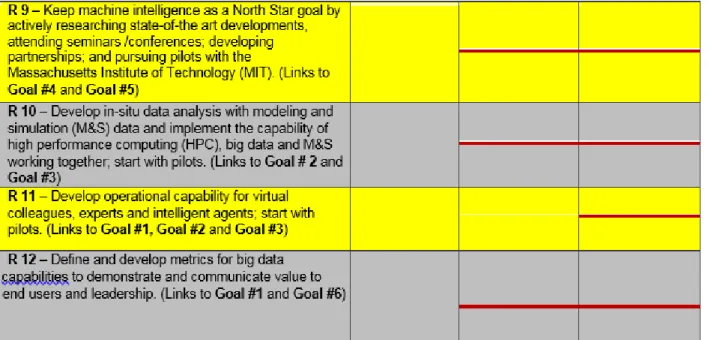
Goal #6 – Ensure buy-in at the grassroots level, resource availability and investment prioritizationfor building and enhancing a big data, deep analytics and machine intelligence capability. Twelve key recommendations to meet these strategic goals are outlined in Table 1, below.
Table 1 Overall Roll-Up of 12 Key Recommendations and Projected Timeline
With constraints on NASA funding and in view of the significant ongoing external efforts to develop Big Data and Machine Intelligence technologies, LaRC must utilize a collaboration model to leverage these technologies and adapt them for our science and technology applications. The twelve recommendations reflect an emphasis on pilots, research and partnerships over capital-intensive technology acquisition. Investment in in-house personnel with specific big data and machine intelligence skills will be critical to ensure that right technologies are identified and nurtured to more efficiently and effectively address our challenges. The strategy should be to build a small team of civil servants augmented by contractors and students with the flexibility to bring in skills on an as-needed basis and manage LaRC’s analytic resources (data, talent, technologies, and time). This team will work closely with researchers and engineers from our mission organizations and external partners to implement big data and machine learning solutions for specific LaRC challenges.
8
A: Big Data Analytics & Machine Intelligence Strategy and
Roadmap, 2014-2035
A1 Overview
Big data is a rapidly emerging, and in some cases, even mainstream capability across a range of industries that is revolutionizing how companies and government agencies analyze data. Big data enables users to perform faster analysis and achieve unprecedented and, often, counterintuitive insights from data.
The Big Data Analytics & Machine Intelligence Strategy and Roadmap, 2014-2035, provides goals, objectives and initiatives and lists 12 key recommendations to enable Langley Research Center (LaRC) to develop near-, mid- and long-term big data capabilities. Big data, deep analytics and machine intelligence are critical capabilities in LaRC’s Comprehensive Digital Transformation (CDT), which is designed to strategically position LaRC to maximize relevant, innovative and persistent contributions to NASA and the Nation in the 21st century. In reading this document, it is important to keep in mind the recommendations outlined represent the forward thinking of the LaRC Big Data, Deep Analytics and Machine Intelligence Team and LaRC scientists and information technology (IT) specialists. They have looked beyond their own disciplines to consider best practices and lessons learned from industry, academia and other government agencies to determine where LaRC research and development efforts should be focused. Given the fact short-term recommendations are generally based on more concrete information than long-range ones, there is greater fidelity for the near- and mid-term than the long-term (e.g., 10-20 years) recommendations. This does not diminish the importance of the long-term recommendations, but merely
acknowledges that they are likely to be more malleable as technologies evolve and mission focus areas change. The Big Data Analytics and Machine Intelligence Strategy and Roadmap, 2014-2035, will be updated periodically to reflect those changes.
A1.1 Background
The significance of big data is recognized at the highest levels of the Federal government. As described by Jeffrey Mervis in his article “Agencies Rally to Tackle Big Data,” Science, 6 April 2012, a Federal effort is under way to improve the nation's ability to manage, understand and act upon the 1.2 zeta bytes (1021) of electronic data generated annually. In March 2012, President Barack Obama’s administration unveiled a “Big Data Research and
Development Initiative,” which allocated more than $200 million (M) to improve the tools and techniques needed to access, organize and glean discoveries from huge volumes of data.
The inherent potential of big data, deep analytics and machine intelligence is predicated on 1) recognition of how these capabilities should be applied for best effect, and 2) recognizing that they do not exist in a vacuum. They are cross-cutting capabilities that can benefit all scientific disciplines. To ensure a clear understanding of big data, deep analytics and machine intelligence and what they entail, the terms, as used throughout this document, are defined below.
“Big Data” refers to datasets whose volume, speed and complexity is beyond the ability of typical tools to capture, store, manage and analyze. “Big” will be a different number for each organization that may be trying but unable to extract business advantage from its data. Big data is often described as having four challenges. Known as the four Vs, they include volume, velocity, variety and veracity.
•
Volume refers to the scale of big data. About 2.5 quintillion bytes (2.3 trillion gigabytes) of data are created daily. By 2020, there are expected to be 40 zeta bytes (43 trillion gigabytes) of information, or 300 times the amount of data in existence in 2005.•
Velocity involves the analysis of streaming data. The sheer velocity at which data is being created today is exceptional. The New York Stock Exchange (NYSE) alone captures one terabyte of trade information each session. At another level, a modern car has nearly 100 sensors to monitor data such as fuel level and tire pressure.•
Variety involves the numerous forms of data. In 2011, the global size of healthcare data was about 150 exabytes (161 billion gigabytes). As hospitals increasingly adopt systems for electronic medical records, this number will rise. There are an estimated 420 million personal wearable wireless health monitors in use, storing constant data never monitored so extensively before. At the same time, people watch 4 billion hours of video on YouTube and share 30 billion pieces of content on Facebook each month.•
Veracity involves the effort to mitigate the uncertainty of data. The fourth big data challenge is keeping it organized in order to distinguish between accurate and inaccurate information. Today, one in three business leaders do not trust the information they use to make decisions. Poor data quality costs the U.S. economy around $3.1 trillion each year, according to estimates.“Deep Analytics” involves getting value from big data using various analysis techniques, often involving natural language processing. The major outcomes from deep analytics are knowledge, discovery and prediction. Deep analytics depends on:
•
Technologies to collect, store, analyze and share huge quantities of data•
Harnessing and using massive data for sensing, perception and decision support to make autonomous systems possible•
Creating human-computer interaction tools for customizable visual reasoning•
Scalable data management analysis and visualization for simulation data“Machine Learning,” and the related field of artificial intelligence, is about the construction and study of systems that can learn from data. Machine learning focuses on prediction, based on known properties learned from training data. It differs from data mining, which focuses on the discovery of (previously) unknown properties of the data. “Machine Intelligence” involves the study and design of intelligent agents, where an intelligent agent is a system that perceives its environment and takes actions that maximize its chances of success. The goal of machine
10
intelligence is to sufficiently replicate human intelligence to create virtual experts to support researchers and scientists in their work.
Each of these areas has been used to determine everything from potential target markets for products based on social media data to identifying the correlation between retailer food/beverage sales and pre-hurricane weather conditions. The biomedical field, most notably through the use of IBM Watson, and the financial industry have also benefitted in recent years from big data and deep analytics. Nevertheless, it is important to keep in mind applying big data and deep analytics is not a one-size-fits-all panacea for every problem.
LaRC has been involved with big data for several years, even before the term “big data” became popular. Research projects at LaRC generate large amounts of raw data, of which only a fraction is analyzed. While the Office of the Chief Information Officer (OCIO) has analytics tools to process large amounts of data, it needs to expand this capability to optimize its ability to manage knowledge, provide greater opportunities for discovery and, ultimately, use data as a predictive mechanism.
A basic application of big data, deep analytics and machine intelligence involves automating human decision making with automated algorithmic functions, freeing staff from performing repetitive tasks to address more creative and productive tasks. A larger opportunity is to create discoveries and draw conclusions that might not be reached with existing processes and technologies. Sophisticated analytics can substantially improve decision making, minimize risks and unearth valuable insights that would otherwise remain hidden.
A1.2 Current State and Approach
Overall, LaRC is not currently positioned to reap the benefits of digital age advances and risks being left behind. LaRC does not have data scientists or cloud experts on staff and little expertise in over-the-horizon technologies like machine intelligence.
Externally, big data has proven to be a significant force multiplier in the retail, financial, social media and medical fields. However, its application in the scientific and engineering fields is relatively nascent, outside of large entities such as Conseil Européenne pour la Recherche Nucléaire (CERN). This provides an opportunity for LaRC to fill a void.
LaRC, while having massive amounts of data, faces several unique scientific and technological challenges. Some of these will involve analyzing data compiled by a small number of experts in a very specific area of interest. Drawing correlations and determining causation in these situations is likely to require different approaches and algorithms than those used by marketing professionals, social media experts, investment firms and medical professionals with access to data involving populations in the millions.
The OCIO and LaRC leadership has recognized the importance and potential of big data as a core capability and made this a key component of the CDT effort. This is an opportunity for LaRC to build a big data capability and position the organization to realize the benefits of these advanced technologies for mission enablement and success. In February 2013, a kickoff meeting was held to formally begin the CDT strategy development process. The Big Data Team was formed April 2013. The CDT team outlined several principles to guide the strategy. One of those
principles called for a specific focus on applying and utilizing big data, deep analytics and machine intelligence as force multipliers for simulation-based engineering and science (SBES), systems innovation and scientific discovery. The intent was to provide LaRC competitive advantage, while leveraging external research and innovations. In pursuing that intent, the Big Data Team took several specific steps. These included:
•
Forming a team with IT experts and end users/subject matter experts (SME) (e.g., researchers and engineers)•
Recognizing and understanding the possible value of big data, deep analytics and machine intelligence to other LaRC disciplines/missions by collaborating with discipline sub-team leads (aerosciences, structures, multiphysics, materials, high performance computing [HPC])•
Developing detailed use cases with many disciplines. The team also identified potential partnerships it could leverage to establish a scientifically-focused big data capability.•
Extensive knowledgeability collection via seminars, research, etc.•
Identifying and learning about significant research initiatives in order to shape a long-term vision and develop/establish potential partnershipsA1.3 Vision
LaRC faces a future where data intensive scientific discovery presents heretofore unforeseen opportunities to exploit tools and technologies for data mining, analysis, visualization, collaboration and dissemination. The data available from instruments, sensors and simulations and the ability to utilize that data to achieve entirely new levels of knowledge is unprecedented.
In the same way experimental science, exemplified by Galileo’s descriptions of natural phenomena, led to
theoretical science (i.e., Newton’s laws and Maxwell’s equations), the computational science of recent decades has evolved into data intensive science. This represents a fourth research paradigm, as outlined in The Fourth
Paradigm: Data-Intensive Scientific Discovery, Microsoft Research, 2009.
In the future, researchers, engineers and project teams will have” virtual experts/colleagues” capable of answering specific questions, providing a level of human/intuitive cognition and machine cognition that will facilitate:
•
Synthesizing and making sense of huge volumes of big data/ information and processes•
Providing discipline modeling and simulations (M&S) in real time•
The generation of predictions for new technologies and design configurationsA massive cloud-based data repository or data lake for LaRC could include all data collected by simulations and sensors. This collection of data would facilitate analysis not possible now since current approaches focus on a single dataset. In the future, such data collections could allow System-of-Systems (SoS) analysis, since the interaction of various model data sets could be looked at collectively.
12
Likewise cloud computing will need to be considered by LaRC in the future. Rising equipment costs, massive storage needs associated with big data and the need for adequate data security must be addressed as part of the discussion and, ultimately, decision process.
Parallel processing will also be a critical driver as LaRC tackles the future’s hardest problems. Artificial
intelligence and Strong AI will further propel LaRC on its journey to gaining new knowledge and enable scientific discovery.
The vision for big data, deep analytics and machine intelligence is to enable LaRC to discover “unknowns” and deliver previously unimaginable capabilities by applying these transformational technologies as force multipliers for scientific and engineering discoveries and systems innovation and optimization. Achieving this vision will provide a number of tangible benefits. These include cost savings resulting from the use of more SBES and less physical testing to enable LaRC to be more competitive and innovate in providing transformational aerospace technologies. Another major benefit will be helping SMEs analyze more data, doing it faster and recognizing new patterns in data not feasible before. This will improve scientific discovery and engineering designs and allow scientists to spend significantly more time performing analysis rather than waiting on algorithms.
A1.4 Scope
The Big Data Analytics and Machine Intelligence Strategy and Roadmap, 2014-2035 covers a 20-year period. Assumptions and challenges that bound the recommendations outlined in this document are listed below. Specific assumptions include:
•
Missions and disciplines – While mission focus areas may change, the disciplines that currently reside at LaRC will remain largely intact through 2035.•
M&S – The use of M&S at LaRC will expand in the future since it offers the potential for lower cost than physical experimentation.•
Partnerships – LaRC will increasingly rely on partnerships with other research centers, agencies and laboratories to build knowledge and mitigate funding constraints.•
Agility and flexibility – While technologies and tools available 3-5 years from now may be predicted with some degree of certainty, longer-range technologies and tools that will be developed may be unknown at this time. LaRC needs to maintain a high degree of agility and flexibility to quickly leverage new technologies and tools that directly impact its missions. Specific challenges include:•
Science is different - Applying big data technologies for scientific applications is a more complex task and not as mature as other fields such as medicine and finance.•
Data management and data policy – Implementing big data will require the creation of data repositories that do not exist and development of architecture and meta data guidelines to support those repositories. There will also be a need to develop sufficient access/restriction controls.•
Technology and techniques – LaRC will need to deploy new technologies (e.g., storage,computing and analytical software) and techniques (i.e., types of analysis). A further challenge is that these new tools will need to be integrated with existing systems.
•
Staffing and talent – Leveraging big data will require acquiring talent and skills not resident at LaRC today.•
Cost – LaRC has a limited investment budget. This necessitates making tradeoffs that facilitate access to state-of-the-art technology and research tools at a reasonable cost.•
Cultural change – The application of big data, deep analytics and machine intelligence will involve new ways of performing, researching and analyzing data that may not be easily embraced.14
A2 Strategic Goals, Objectives, and Initiatives
To determine the pathway for developing a big data, deep analytics and machine intelligence capability, the Big Data Team focused on applying and utilizing force multipliers for SBES, systems innovation and scientific discovery; seeking out partnerships to build knowledge and offset constraints imposed by funding limitations; and leveraging the expertise and collaborating with of discipline SMEs, data scientists, IT specialists and leadership to ensure success.
The team also wanted to ensure integration was a priority. This included identifying potential
implementation obstacles early in the process and ensuring resources for problem resolution were available. It also necessitated making recommendations that would allow enough flexibility during implementation to accommodate technological breakthroughs that propel big data, deep analytics and machine intelligence development forward more quickly than initially projected. The Big Data Team felt it was imperative to pursue pilots that are technologically mature, have measurable value and are consistent with available resources. The team also considered specific virtual capabilities being addressed by the CDT team in its strategy development process. Detailed descriptions of the virtual capabilities are in the Comprehensive Digital Transformation Strategy & Roadmap.
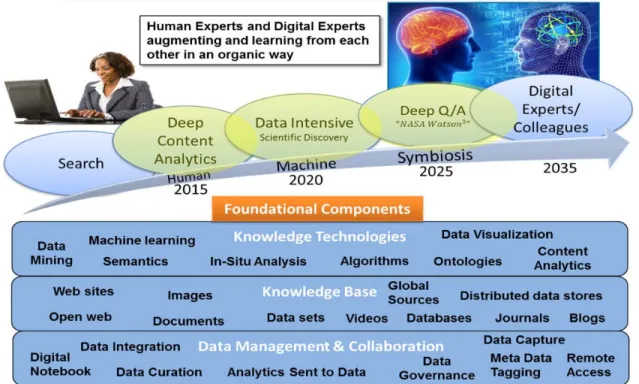
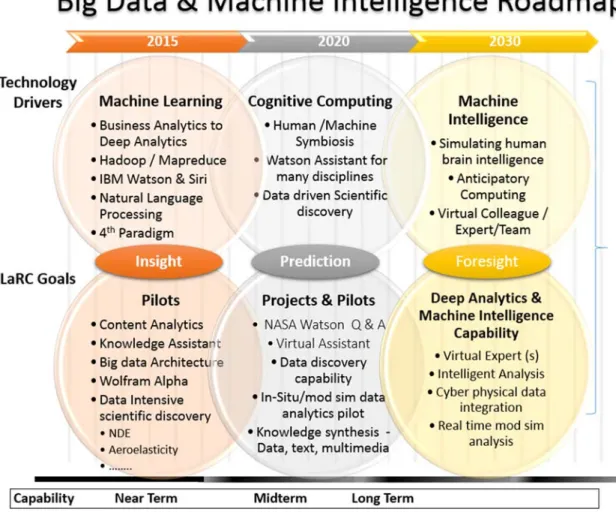
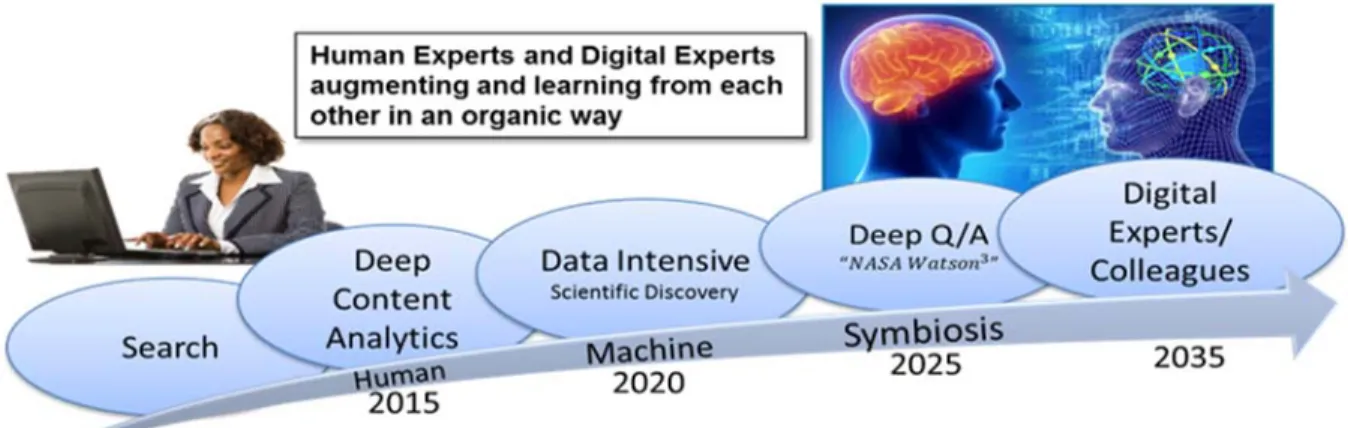
Figure 2 provides a high-level overview of the roadmap and associated timeline for development of the big data, deep analytics and machine intelligence capability at LaRC. The overview was generated based on the team’s development of specific goals, objectives and initiatives, listed in Table 1. These were then distilled into a list of twelve key recommendations to showcase the most critical needs for developing the capability.
Figure 2 Overarching Big Data, Deep Analytics & Machine Intelligence Roadmap
•
Goal #1—Keep up with big data, deep analytics and machine intelligence technologies and capabilities, and advance LaRC knowledge and utilization of them.•
Goal #2—Build a robust data intensive scientific discovery analytics capability and cognitive computing analytics to enable better science and engineering.•
Goal #3—Build a modular, robust and flexible big data and machine intelligence architecture and infrastructure to enable use by multiple disciplines/groups for heterogeneous data.16
•
Goal #5—Proactively pursue, utilize and leverage partnerships and collaborations with universities, federal research organizations, Department of Energy (DoE) labs and industry.•
Goal #6—Ensure buy-in at the grassroots level, resource availability and investment prioritization for building and enhancing a big data, deep analytics and machine intelligence capability.Objectives are more narrowly scoped statements outlining general actions that, when achieved, contribute to accomplishing a goal. In effect, objectives can be thought of as sub-goals. Table 2 lists 17 objectives for big data, deep analytics and machine intelligence. Initiatives are specific action items that must be accomplished to achieve an objective. Table 2 also lists 54 initiatives for big data, deep analytics and machine intelligence.
Goal Objective Initiative
1 - Keep up with big data, deep analytics and machine intelligence technologies and
capabilities, and advance LaRC
knowledge and utilization of them
1.1 - Make big data part of existing LaRC technology considerations and research
Impact: Chances of successfully leveraging big data increase as staff becomes aware of the capability being developed locally.
1.1.1 – Make big data a topic of consideration by the Chief Technologies and Chief Scientist offices
1.1.2 – Make field part of strategic goal of either
OCIO or LaRC
1.2 - Educate LaRC staff on big data
and capabilities and build a collaborative community
Impact: Allows scientists to better understand how big data can assist them with their work and allow the capability to grow as staff
becomes aware of latest improvements/technologies
1.2.1– Bring big data training and class on site or make it available through Satern online
1.2.2 – Make big data a topic of monthly center briefings
at LaRC and Virginia Air and Space Center (VASC), bringing in field experts as required
1.2.3 – Identify internal users, SMEs to participate as
initial core cadre and continuously seek to expand membership to other LaRC stakeholders
1.2.4 - Build understanding and momentum of possibilities among scientists and engineers – Big Data Working Group; seminars; workshops
2 – Build a robust data intensive scientific discovery analytics capability and cognitive computing analytics to enable better science and engineering
2.1 – Identify existing problems and opportunities that can be
addressed
Impact: Most effective way to show the potential impact big data will have at LaRC
2.1.1 – Use existing use-case examples as a starting point for assessing new opportunities for pilots
2.1.2 – Develop proposals for review, analysis and
funding considerations, detailing the opportunities
2.1.3 – Develop requirements documentation for each use
case
2.2 – Assess big data tools and
concepts and integrate them into future project analysis
Impact: Development of more efficient algorithms and enables performance of better scientific research
2.2.1 - Review and research applicable analysis tools and statistical and computational algorithms
2.2.2 – Research how big data techniques can be part of
the normal research and proposal process already being utilized
2.2.3 – Work to modify the existing process to include big
data techniques as part of the standard operating procedure (SOP).
2.3 – Begin pilot examples to assess
results, demonstrate value and develop deeper understanding of needed techniques and
architectures
Impact: Shows the potential impact big data will have at LaRC
2.3.1 – Develop Knowledge Assistant Pilot with IBM on the path to NASA Watson
18
2.3.2 – Develop data mining pilots with nondestructive
evaluation (NDE), Aeroelasticity and IT Security
2.3.3 – Develop a data visualization and discovery pilot
with strategic business opportunities
2.4 - Establish an in-house big data,
deep analytics and machine intelligence capability
Impact: Enables the successful execution of big data pilots using a ccore team solely devoted to working the pilots
2.4.1 – Hire an initial big data scientist and big data programmer
2.4.2 - Start building the expertise capability by hiring
additional staff ~ one overall lead; additional data scientists; big data architects; machine learning /intelligence experts; advanced algorithm developer; students; establish points of contact (POC) in major mission organizations and disciplines
2.4.3 – Develop new staff into a fully functional area of
expertise 3 - Build a modular,
robust and flexible big data and machine intelligence architecture and infrastructure to enable use by multiple disciplines/groups for heterogeneous data
3.1 – Develop big data architecture and design blueprint to modularly scale to a data lake
Impact: Facilitates successful, efficient achievement of a robust big data capability
3.1.1 – Have a Multi-Discipline Big Data Architecture Workshop facilitated by an architecture expert to determine the needs at LaRC
3.1.2 - Investigate architecture platforms needed to make
short-term goals a reality (Hadoop and other technologies, Amazon Web Services, etc.)
3.1.3 –Develop design documentation to detail “how”
each component will be implemented, what data sources will be supported, what methodologies will be used for transforming data to an acceptable format, how the components will be glued together, and performance and scalability of the application.
3.1.4 – Consider each functionality as a milestone, and develop a timeline for each
3.1.5 – Describe the basic functionalities the big data
application will support, which at a minimum include: o Intelligent question answering capability o Predictive analysis o Categorization o Anomaly detection o Optimized parallel algorithm
o Data mining, text analysis and data visualization o Features that support machine learning algorithms such as neural network, Bayesian network, regression analysis, K-means and Dirichlet algorithms
3.1.6 – Define the following parameters for each
functionality listed in 3.2.5: o Nature of user input o Function performed on user input o Desired output
3.2 - Begin implementing new
architectures and tools where possible
Impact: Targets high impact areas first to show the value/impact of big data
3.2.1 – Begin purchases and integration of tools into the LaRC infrastructure
3.2.2 – Convert existing systems and techniques
20
3.3 - Implement the big data
knowledge base, access layer and user interface
Impact: Operationalizes the capability
3.3.1 - Define knowledge base with a wide variety of data, including numeric, text, images, video, audio, structured, unstructured, semi-structured, human or machine generated
3.3.2 – Begin work on implementing and integrating
software components
3.3.3 - Assess if the application is producing desired
output stated in project specification documentation and make corrections/adjustments, as required
3.3.4 – Develop and test a big data prototype and deploy
it to a small group of beta testers to enhance software features
3.4 – Begin developing an integrated cross-discipline data repository (data lake/knowledge base) that can be utilized for various analytics by different groups and for varied purposes
Impact: Significantly improves cross-discipline collaboration and the ability to centrally store data and process algorithms without having to “move the data”
3.4.1 - Develop a long-term plan for a permanent data lake at LaRC
3.4.2 - Understand various data sets and assorted formats and context – where, how much, value, etc.
3.4.3 - Investigate architecture models available – demonstrations, discussions, consultants, etc. 3.4.4 – Pursue agreements with scholarly information vendors to obtain meta data
3.4.5 – Begin large-scale implementation of a big data platform
3.5 – Develop integrated environment to leverage/utilize data mining, HPC and M&S for
better and faster science
Impact: Aligns big data with major CDT focus areas/capabilities
3.5.1 - Engage and sustain relationships with HPC and M&S groups to understand the possibilities
3.5.2 - Choose a pilot to model the required integration 4 - Ensure understanding
and use of machine intelligence remains a long-term focus
4.1 - Keep up with long-term vision of machine learning and
intelligence, with simulation of the human brain to identify possibilities for LaRC experimentation
Impact: Facilitates continuous application of the best technology available to LaRC big data projects
4.1.1 – “Shape” the long-term vision by active
participation and leadership of seminars and conferences (internal and external) focused on machine learning and intelligence
5 – Proactively pursue, utilize and leverage partnerships and collaborations with universities, federal research organizations, Department of Energy (DoE) labs and industry
5.1 - Identify, establish and leverage partnerships with universities, industry and
government agencies
Impact: Increases awareness of top of the latest technology/ research; enhances awareness of where to outsource work too difficult or expensive for LaRC to perform
5.1.1 - Establish partnership with Ames’ Data Sciences and Intelligent Systems Group. Build a formal relationship with identified areas/initiatives.
22
5.1.2 – Utilize graduate students (Georgia Institute of Technology, Old Dominion University [ODU], William and Mary) to help with translational research and solutions to specific data mining use cases
5.1.3 – Pursue partnerships with Defense Advanced Research Projects Agency (DARPA), National
Science Foundation (NSF) and and Intelligence Advanced Research Projects Activity (IARPA). Actively participate to understand and leverage technologies being developed. 6 - Ensure buy-in at the
grassroots level, resource availability and
investment
prioritization for building and enhancing a big data, deep analytics and machine intelligence capability
6.1. - Develop a flexible and
innovative funding strategy with inputs from stakeholders, users and Office of the Chief Financial
Officer (OCFO)
Impact: Provides leadership with a clear and detailed understanding of what steps are necessary to stand up a big data capability
6.1.1 – Develop implementation plan, to include a funding approach for the first three years for big data, deep analytics and machine intelligence at LaRC
6.1.2 - Demonstrate and communicate cost benefits/value to stakeholders on a regular basis via briefings and progress updates
6.1.3 – Identify potential resource/infrastructure
investments that can be made due to savings/value gained from leveraged partnerships
6.2 - Ensure tie-ins to programs are accounted for to gain long-term commitment
Impact: Ensures scientists fully maximize the use of big data in their work
6.2.1 - Engage with program managers to gain a full understanding of their needs and constraints
6.2.2 - From early pilots , demonstrate return on investment (ROI) to programs
6.2.3 - Investigate and follow up on potential funding sources at headquarters level
6.3 – Develop metrics to ensure performance standards for big data tools, techniques and systems are defined
Impact: Allows leadership at LaRC to fully understand and gauge success
6.3.1 – Develop metrics that specify expected baseline performance for specific system components
6.3.2 – Develop metrics that capture: oStatic historical measurements
oQuantitative return measurements (e.g., cost savings) oQualitative return measurements (e.g., value of
science/discovery outcomes)
oQuantitative performance measurements o Qualitative performance measurements
6.4 – Collect and disseminate performance data to users and leadership
Impact: Allows leadership at LaRC to fully understand and gauge success
6.4.1 – Develop capability to collect data for each metric standard in near-real time
6.4.2 – Ensure system can self-identify performance gaps/shortfalls in near-real time
6.4.3 – Develop dashboard to keep LaRC leadership informed on big data/project status/performance on weekly/monthly basis
6.4.4 – Produce annual white paper that provides a comprehensive overview of big data performance 6.4.5 – Develop capability to produce tailored reports for projects/users of big data
Table 2 Goals, Objectives, and Initiatives
A3 Use Cases
To determine the value of a big data, deep analytics and machine intelligence capability, the Big Data Team
24
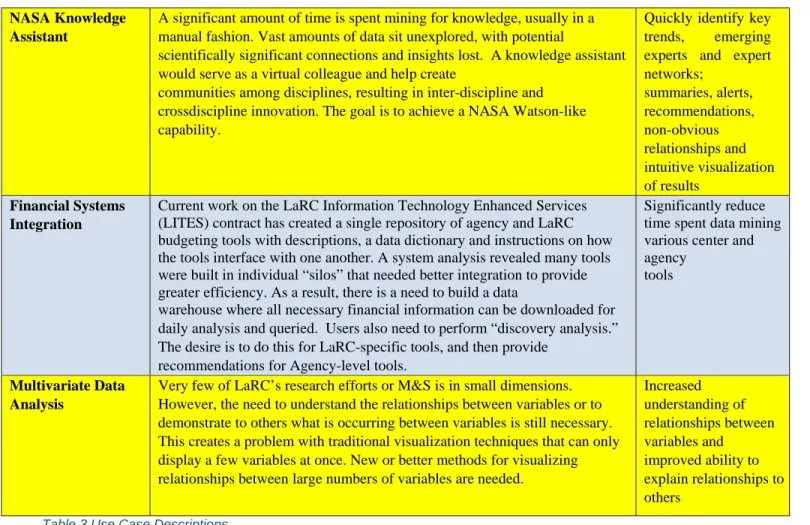
Team is continuing to develop more in areas like Atmospheric Sciences Data/Climate Change, Air Traffic Control Lab (ATOL), Flight Simulators and Multimedia. The team interviewed scientists and engineers in areas such as NDE; Entry, Descent and Landing (EDL); Aeroelasticity; Airframe Noise Reduction; Scientific and Technical Information (STI); and IT Security to determine how big data and machine learning technologies can be applied to LaRC technical challenges to improve mission success and research.. Table 3 provides a brief description of each use case.
Use Case Description Impact
Aeroelasticity: Predicting Flutter Conditions
Flutter occurs when an airplane wing begins to vibrate more and more rapidly until structural damage or catastrophic failure occurs. The Aeroelasticity department uses wind tunnels to test wing designs and determine the conditions under which flutter is most likely to occur of wing designs. The department, which has decades of wind tunnel data containing a wide variety of observational variables, is interested in collectively data mining all these data sets to discover new datagenerated predictors of aircraft flutter.
Potential new insights from analyzing multiple wind tunnel data sets simultaneously NDE: Reconstruction of Material Computed Tomography (CT) Scans
NDE analyzes materials to identify flaws or anomalies. For more complex materials, only a fraction of the data available can be evaluated--roughly 10 percent in some cases. This severely limits the analysis. A single highly effective algorithm that could find anomalies for any material type would give researchers the ability to create a more complete picture and increase their understanding.
New forms of analysis and the potential for insights that are currently impossible from completely manual analysis techniques Turbulence Modeling
Currently, physics models of turbulence contain significant discrepancies between predicted behavior and observed behavior from real-world testing. Dr. Karthik Duraisamy is working with other professors at the University of Michigan and private businesses to create neural networks that can predict turbulence. LaRC could undertake two initiatives relative to Dr. Duraisamy’s work. The first would involve LaRC providing turbulence SMEs to assist with analysis of the neural network approach. The second would entail LaRC investigating a regression approach to add the capabilities of error estimation, confidence and power that neural networks lack.
Achieve a better understanding of the parameters that predict turbulence and decrease the gap between current physics based models and observed data
Airframe Noise ReductionPhysics-Based
Simulation and Design
Physics-based equations are used to model airframe noise. The current process is extremely time intensive and requires significant resources. The current algorithm does not store any of the 1.2 terabytes of data produced, which prevents any kind of regression-like predictive techniques. Additionally, the algorithm takes months to run and the impact of predictors on the response variable has not been fully assessed. Goals for the project include the ability to store data generated by the algorithm every time it is run, without an increase in runtime or processing requirements. The team would also like to determine which variables could be removed from the algorithm to speed up
performance.
Be able to store all data generated from the algorithm in order to perform better analysis using data from multiple tests and run the algorithm more frequently and at a reduced cost Entry, Descent and
Landing
Monte Carlo analyses are run and data is passed to each of the different disciplines for further evaluation. Changes are then made by each discipline, which can affect the analysis results for other disciplines. EDL would like to have a more interconnected set of disciplines and shared data capabilities to create improved Monte Carlo simulations and better system-wide
understanding of the impacts of changes made by each discipline. EDL would also like to improve analysis efficiency, connect different disciplines,
facilitate sharing among the disciplines and enable disciplines to participate in the entire process, if desired.
Create better designs, improve analysis efficiency, connect disciplines,
and facilitate sharing among the disciplines
IT Security-Real-Time Cyber-Threat Detection
IT Security would like to provide as robust a system as possible to protect NASA’s network from intrusion attempts, maintain networks at peak
operating performance, and maintain high levels of user access to the network. IT Security would like to:
• Build a capability to use real-time streaming network traffic to search for anomalous behavior on the network and have increased protection from advanced persistent threat (APT) type attacks
• Undertake a correlation analysis between vulnerable equipment and anomalous traffic to identify the most likely targets for infiltration into the network
• Increase its data warehouse capabilities to store network traffic for 365 days rather than 180 days to be fully compliant with Federal mandates
Significantly reduce the threat of state sponsored APT attacks on LaRC and significantly
reduce the amount of data that is
compromised from APT type attacks
Connecting Researchers and Fostering Innovation
Researchers find information by searching STI data. The current process lacks automation, machine intelligence and the ability to connect researchers. The desire is to build a knowledge base with machine intelligence that enables seamless, automated discovery and dissemination of STI data. This would facilitate sharing, enable delivery of content and create communities of researchers through alerts, recommendations and questions and answers to improve efficiency and foster innovation.
Improve researcher efficiency freeing up time to perform other tasks and connect researchers via communities
26 NASA Knowledge
Assistant
A significant amount of time is spent mining for knowledge, usually in a manual fashion. Vast amounts of data sit unexplored, with potential
scientifically significant connections and insights lost. A knowledge assistant would serve as a virtual colleague and help create
communities among disciplines, resulting in inter-discipline and crossdiscipline innovation. The goal is to achieve a NASA Watson-like capability.
Quickly identify key trends, emerging experts and expert networks; summaries, alerts, recommendations, non-obvious relationships and intuitive visualization of results Financial Systems Integration
Current work on the LaRC Information Technology Enhanced Services (LITES) contract has created a single repository of agency and LaRC budgeting tools with descriptions, a data dictionary and instructions on how the tools interface with one another. A system analysis revealed many tools were built in individual “silos” that needed better integration to provide greater efficiency. As a result, there is a need to build a data
warehouse where all necessary financial information can be downloaded for daily analysis and queried. Users also need to perform “discovery analysis.” The desire is to do this for LaRC-specific tools, and then provide
recommendations for Agency-level tools.
Significantly reduce time spent data mining various center and agency
tools
Multivariate Data Analysis
Very few of LaRC’s research efforts or M&S is in small dimensions. However, the need to understand the relationships between variables or to demonstrate to others what is occurring between variables is still necessary. This creates a problem with traditional visualization techniques that can only display a few variables at once. New or better methods for visualizing relationships between large numbers of variables are needed.
Increased understanding of relationships between variables and improved ability to explain relationships to others
Table 3 Use Case Descriptions
A4 Knowledgeability
The Big Data Team gathered a large amount of research information during the development of the strategy and roadmap. This included whitepaper reports from Microsoft and and Gartner as well as journal articles to shorter articles on the use of big data in social media, finance, medicine and science. The research revealed social media and finance are already heavily leveraging big data on a daily basis to predict consumer marketing potential or the impact of current events on the stock market. Likewise, the field of medicine is applying big data analytical techniques to a wealth of sensor and patient data. Many of these medical research efforts show significant potential to better predict patient complications resulting from surgery and adverse reactions to medications as well as proper treatment recommendations than doctors are currently able to do. Overall, this shows significant potential for LaRC to leverage similar capabilities for scientific discovery.
Additionally, the team brought in distinguished speakers from universities and colleges, including the University of Michigan, Georgia Institute of Technology, Iowa State University, William and Mary and ODU. Iowa State, in particular, is actively pursuing the use of the fourth paradigm to identify new types of materials, instead of simply seeking to improve upon the manufacturing process of known materials. Georgia Institute of Technology is working on advancing the visualization capabilities for M&S efforts. As a result, the Big Data Team is working with both of these universities, along with the likes of NASA Ames and Goddard Space Center to build some of its first
partnerships in big data.
The team held discussions with corporations like Booz Allen Hamilton, in the area of data science and the notion of the data lake; IBM in the area of text analytics and content analytics; and AMA in more general areas of big data analytics. Team members also participated in the 2013 American Society of Engineering (ASE)/Institute of Electrical and Electronics Engineers (IEEE) International Conference on Big Data in Washington D.C. with speakers from Carnegie Mellon and Johns Hopkins University. Insights derived from this research include:
•
Big data challenges are not the same across all domains; i.e., challenges in finance, social media andscience are all different.
•
Big data capabilities in the sciences are not as advanced as other fields like finance, medicine and social media; medicine is the area where several applications are evolving.•
The volume of big data is not what is most important. It is the analytics of big data that provides the most value to organizations.•
Big data is capable of providing new insights and understanding into the world of physics, the notion of the Fourth Paradigm.•
For science it is not just about the three Vs of big data, but also the fourth V (veracity); the complexity of science is the challenge for LaRC. In particular, engineering and physics often require solving verycomplicated mathematical equations, which means programmers need a deep understanding of how to solve such equations and do so efficiently.
•
To show a value proposition, start with clear value-based goals, use cases and pilots.•
Do not throw away data; keep it in raw form to avoid losing potentially critical information.•
Big data analytics technologies and tools are increasing with many open-source options.•
Data capture and management are key pieces that cannot be ignored.A5 Research and Partnerships
Big data, deep analytics, and machine intelligence technologies can be force multipliers on par with M&S to ensure and enhance LaRC mission success. LaRC seeks competitive advantage by being aggressive, innovative and early adopters of these transformational capabilities. To do that effectively, LaRC must leverage ongoing research initiatives and partnerships to be a smart adopter and implementer of these emerging technologies to best meet specific scientific and engineering data and knowledge mining challenges.
28
Research initiatives and potential partnerships LaRC should investigate are described below.
A5.1 Federal Research Initiatives
The Federal government, including the White House, is currently conducting research in data mining techniques, algorithms, image and video processing, architectures and large-scale dataset analytics. A comprehensive listing is in Appendix E. Following is a description of several key research initiatives with potential partnership value that LaRC will investigate in the next 1-2 years.
XDATA by DARPA: DARPA’s XDATA program is designed to develop computational techniques and software tools for processing and analyzing the vast amount of mission-oriented information for defense activities. Funded for $25M annually for four years beginning in 2012, the program seeks to develop computational techniques and software tools for analyzing large volumes of semi-structured and unstructured data.
BIGDATA by NSF: Big Data: Core Techniques and Technologies for Advancing Big Data Science & Engineering (BIGDATA) is a joint solicitation between the NSF and National Institutes of Health (NIH) that aims to advance the core scientific and technological means of managing, analyzing, visualizing and extracting useful information from large, diverse, distributed and heterogeneous data sets. The effort began in 2012 with funding for small projects ($750,000 for three years) and mid-scale projects ($1.25M to $5M for five years). The main objectives are to promote research into data management, collection and storage and support new approaches to data analytics to gain knowledge from largescale databases.
SDAV Institute by DoE: Scalable Data Management, Analysis and Visualization (SDAV) Institute is a Department of Energy (DoE) effort to deliver end-to-end solutions that range from managing large datasets as they are being generated to creating new algorithms for analyzing the data on emerging architectures. The $25M five-year initiative aims to develop a way to interact with data as it is being created in a simulation. This technique would allow researchers to monitor and steer the simulation, adjusting or even stopping it if there is a problem.
Artificial/Machine Intelligence by NSF: NSF awarded a $25M, five-year grant to Harvard and MIT to study how the brain creates intelligence and how that process can be replicated in machines. The grant will be used to create a Center for Brains, Mind and Machines. The quest for the basis of intelligence is an ancient one, bolstered in recent years by the ability to create machines that have domain-specific abilities, such as Google's self-driving car, IBM’s Watson or Apple’s Siri. “But we are still some way from understanding the broad basis for human intelligence,” notes Dr. L. Mahadevan, Professor of Mathematics, Evolutionary Biology and Physics at Harvard. “This new center will refocus our collective efforts at trying to solve this question from multiple perspectives.”
A5.2 Partnerships
Innovation in industry and ongoing research within academia are major factors pushing technology forward. LaRC recognizes this and is working to position itself as a technology “adopter.” This necessitates leveraging efforts underway in the universities, commercial sector and at other government agencies. LaRC has the opportunity to more rapidly develop future capabilities. In exchange, LaRC can provide partners unique intellectual capital,
including unique use cases and, world-class expertise in specific scientific disciplines. In an era when Federal budgets are increasingly vulnerable, developing partnerships is essential for LaRC to continue to remain relevant in a fiscally realistic manner. LaRC is currently pursuing partnerships the FUSE and XDATA programs as well as the IBM Watson group.
A6 Technology and Architecture
To get a clear picture of how LaRC can leverage big data, deep analytics and machine intelligence in the future, an understanding of tools, infrastructure and technological considerations shaping the future is necessary.
A6.1 Deep Analytics and Data Visualization
Deep analytics is an application of sophisticated natural language processing and machine learning algorithms to large corpus of knowledge to obtain insights, trends and answers to specific questions. Specific examples deep analytics include IBM Watson and the Wolfram Alpha computational knowledge engine. An outcome of the growth of big data is the need to represent data visually to ensure clear communication. Visualization can help explain analysis results, model the evaluation or assist in assessing data quality and selecting options. Data visualization displays can include modeling results of algorithms and techniques, volume of information, multi-resolution methods and interaction techniques and architectures. The growing need for visualization has led to the emergence on a new field--visualization analytics, which is the science of analytical reasoning facilitated by visual, interactive interfaces.
A6.2 Data Mining and Data Discovery
In the world of big data, data mining and data discovery are rapidly becoming a synonymous concept often referred to as theFourth Paradigm, which is the progression from developing a hypothesis and then testing that hypothesis to letting the patterns and correlations in data suggest what the hypothesis should be.
A6.3 Machine Learning and Machine Intelligence
Machine learning is an artificial intelligence discipline geared toward the technological development of human knowledge. Machine learning allows computers to handle new situations via analysis, self-training, observation and experience. Machine learning facilitates the continuous advancement of computing through exposure to new scenarios, testing and adaptation, while employing pattern and trend detection for improved decisions in subsequent, though not identical, situations. Historically, machine learning is the development and advancement of systems that can learn from data. The goal is to build an artificially intelligent computer system capable of rivaling human capabilities, i.e., an intelligent machine. The most well-known example is IBM’s Watson system. Watson is a complex analytics system that can process natural language input using parallel processing servers. The system has not yet reached the level of machine intelligence, but it is the closest any research effort has come to date. In the future, such a computer system would perform most of the work done by humans during the analysis process.
30
A6.4 Architecture and Infrastructure
Big data analysis requires a robust infrastructure and architecture (cloud computing). This necessitates having adequate resources, in terms of funding and personnel skill sets, to build the foundation for a big data capability. Organizations that lack those resources often look externally. This has allowed companies like Amazon to develop and grow a substantial capability to meet that need. Today, Amazon has a market share of nearly 80 percent. Cloud computing is a method of addressing the physical storage requirements of big data. The cloud is typically a remote computer system available through the Internet that provides a resource or capability for a fee. Cloud computing is a way to offload functions or needs to a remote system versus covering the cost and overhead locally.
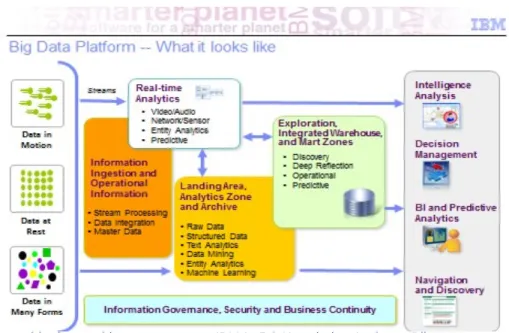
Cloud services are expected to continue to become more affordable, and the use of the cloud will become a mainstay of business. Companies that use cloud resources are expected to grow from 27 percent today to 43 percent in five years. Cloud computing will help spur the implementation of increased security to address general public concerns; relational model data warehouses will become obsolete. A major idea for big data in the near future is the “data lake.” The idea is to store all data into a single collection, instead of silos of relational databases. In this model, data is tagged as it is ingested, instead of being deconstructed into a fixed relational model. When data is accessed, is is transformed into the format needed. This approach lends itself to analysis defined by need rather than collection requirements. Today, a data lake requires that data be in a single location; large data sets do not work well in a distributed configuration. However, this limitation could be mitigated in the future with faster data transfer rates. Figures 3 and 4 shows conceptual big data architectures. Key layers are described below:
•
The lowest level, Infrastructure, harnesses the cloud to receive and store raw data in the various “Not Only Special Query Language” (NoSQL) and Hadoop architectures.•
As part of Data Management, each part of the data is tagged for identification as it is included in the data lake.•
Data is processed and analyzed in the Analytics & Services layer where various tools access, mine and analyze data using machine learning techniques and analytics tools.•
The layer seen by the end user is Human Insights & Action, where tools used to visualize present the data to the analyst and interfaces allow data manipulation.Figure 3 Big Data Architecture; courtesy Booz Allen Hamilton