Lehigh University
Lehigh Preserve
Theses and Dissertations
8-1-2018
Fine-grained Visual Representation Learning with
Deep Neural Networks
Tao Xu
Lehigh University, [email protected]
Follow this and additional works at:
https://preserve.lehigh.edu/etd
Part of the
Materials Science and Engineering Commons
This Dissertation is brought to you for free and open access by Lehigh Preserve. It has been accepted for inclusion in Theses and Dissertations by an
Recommended Citation
Xu, Tao, "Fine-grained Visual Representation Learning with Deep Neural Networks" (2018).Theses and Dissertations. 4331. https://preserve.lehigh.edu/etd/4331
Fine-grained Visual Representation Learning
with Deep Neural Networks
by
Tao Xu
Presented to the Graduate and Research Committee of Lehigh University
in Candidacy for the Degree of Doctor of Philosophy
in
Computer Science
Lehigh University August 2018
c
Copyright by Tao Xu 2018 All Rights Reserved
Approved and recommended for acceptance as a dissertation in partial fulfillment of the requirements for the degree of Doctor of Philosophy.
Date
Dr. Xiaolei Huang, Dissertation Director
Accepted Date
Committee Members:
Dr. Xiaolei Huang, Committee Chair
Dr. Brian Y. Chen
Dr. Ting Wang
To my parents Youjin Xu and Huiqiong Xie, my sister Yi Xu, my husband Han Zhang.
Acknowledgements
I would like to thank my advisor, Dr. Xiaolei Huang, for her guidance, encourage-ment and continuous support over my Ph.D. years at Lehigh. Dr. Huang has been an excellent professor. Not only has she taught me how to do good research, but also she has shown me how to be a better person. For research, I have learned how to organize and present my work nicely, how to think independently and critically, how to motivate new problems and propose novel ideas, and many other skills. For being a better person, I have learned to be more patient and always have a kind mind. Consequently, It is my great fortune and honor to achieve my degree under the supervision of Dr. Huang.
I am very grateful to Dr. Brian Y. Chen, Dr. Ting Wang and Dr. Shaoting Zhang for serving as my committee members. I would like to thank them for their constructive feedback for my dissertation, and their insightful comments and valuable questions regarding my presentations. Their time and energy is gratefully acknowl-edged. In particular, I would like to thank Dr. Shaoting Zhang for his continuous suggestions on technical and non-technical topics in the last several years of my PhD study.
I greatly appreciate Dr. Victor Fang from Awake Networks, Dr. Xiaodong He from MSR, and Dr. Sam Tsai from Facebook for working as my mentors during my
internships. My work at MSR has been continued after I returned to Lehigh and has become part of my dissertation. I would also like to thank my collaborators who I worked with during my internships. They are Dr. Pengchuan Zhang, Dr. Qiuyuan Huang, Dr. Zhe Gan, Dr. Priyam Chatterjee and Dr. Mohammad Elhoseiny.
Special thanks to my labmates from Image Data Emulation and Analysis Labo-ratory: Ting Xu, Sunhua Wan, Yuan Xue and Qian Zhang for their friendship and support. Especially, I would like to thank two former students of our Lab, Hongsheng Li and Edward Kim, for their stimulating discussions and valuable suggestions on my doctoral research.
Contents
Acknowledgements iv
List of Tables x
List of Figures xii
Abstract 1
1 Introduction 3
1.1 Part-based Fine-grained Representation Learning . . . 5 1.2 Multimodal Fine-grained Representation Learning . . . 7 1.3 Adversarial Fine-grained Representation Learning . . . 9 1.3.1 Learning Fine-grained Conditions for Image Generation . . . . 10 1.3.2 Learning Coarse-to-fine-grained Representations for Semantic
Segmentation . . . 12 1.4 Thesis Outline . . . 14
2 Semantic Part Detection and Abstraction CNN Architecture for
Fine-grained Object Categorization 16
2.1.1 Part Detection Sub-network . . . 18
2.1.2 Part Abstraction and Classification. . . 21
2.1.3 Unifying Two Sub-networks . . . 24
2.2 Experiments. . . 25
2.2.1 Part Detection Results on CUB-2011. . . 27
2.2.2 Classification Results on CUB-2011. . . 30
2.2.3 Classification Results of Our Unified Network . . . 32
2.2.4 Discussion. . . 34
3 Multimodal Deep Neural Network for Fine-grained Medical Image Classification 37 3.1 Preliminaries: Cervical Cancer Diagnosis. . . 38
3.1.1 Data and Materials. . . 39
3.1.2 Hand-crafted Image Features for Cervical Cancer Diagnosis . . 41
3.2 Multimodal Deep Neural Network . . . 46
3.2.1 Learning Deep Representation for Cervigram . . . 48
3.2.2 Learning Multimodal Information Jointly . . . 49
3.3 Experiments. . . 52
3.3.1 Hyper-parameters of the Proposed Method . . . 52
3.3.2 Comparison with Previous Works. . . 55
4 Fine-Grained Text to Image Generation with Attentional Generative Adversarial Networks 58 4.1 Preliminaries . . . 59
4.2.1 Attentional Generative Network . . . 60
4.2.2 Deep Attentional Multimodal Similarity Model . . . 64
4.3 Experiments. . . 69
4.3.1 Component Analysis . . . 72
4.3.2 Comparison with Previous Methods . . . 75
5 Adversarial Learning with Multi-scale Loss for Medical Image Seg-mentation 82 5.1 Methodology . . . 83
5.1.1 The Proposed Multi-scaleL1 Loss . . . 84
5.1.2 SegAN Architecture . . . 85
5.1.3 Training SegAN . . . 86
5.2 Experiments. . . 87
5.2.1 Choice of Components in SegAN Architecture. . . 89
5.2.2 Comparison to State-of-the-art . . . 91
5.3 Discussion . . . 93
6 Conclusions and Future Work 96 6.1 Conclusions . . . 96
6.2 Future Work . . . 98
References 101
List of Tables
2.1 Comparison of our k-NN proposal method with different k values by the mean average precision (mAP) of all seven parts. . . 27 2.2 Comparison of our k-NN proposal and bottom-up proposal methods
for small semantic parts detection by average precision. . . 28 2.3 Comparison with previous works by Percentage of Correctly Localized
Parts (PCP) on CUB-2011. (To fairly compare, we use exactly the same 2-part annotations for all methods.) . . . 30 2.4 Comparison of different settings of our CLS-NET on CUB-2011 with
oracle part annotations. Ensemble, VGGNet indicates the ensemble of 7-part with 1pfc and 7-part with 2pfc. . . 31 2.5 Comparison with state-of-the-art methods on CUB-2011. +ft means
fine-tuning the model using the part detections of training images;Our ensemble models for CaffeNet and VGGNet are same models shown in Table 2.4. . . 32 2.6 Comparison with state-of-the-art on CUB-2010. . . 33 2.7 Area Under the Curve (AUC) for head attribute prediction using
dif-ferent part features in the pfc layer. Object means the whole object and other parts means all the other 6 parts except head. . . 34
3.1 Results of the proposed models with different hyper-parameters. (“noBN” indicates that batch normalization is not used in joint fully connected (jfc) layers.) . . . 53 4.1 Statistics of datasets.. . . 70 4.2 The best inception score and the corresponding R-precision rate of each
AttnGAN model on CUB (top six rows) and COCO (the last row) test sets. More results in Figure 4.3. . . 71 4.3 Inception scores by state-of-the-art GAN models [86,84,126,127,77]
and our AttnGAN on CUB and COCO test sets. . . 75 5.1 Comparison to previous methods and a baseline implementation of
U-net with softmax loss for segmenting three classes of brain tumor regions: whole, core and Gd-enhanced (Enha.) . . . 91
List of Figures
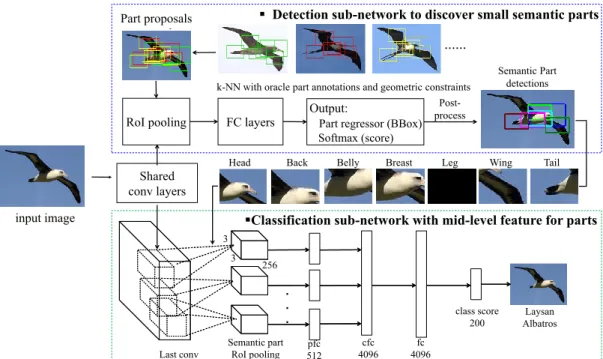
2.1 SPDA-CNN: Semantic Part Detection and Abstraction CNN architec-ture for fine-grained classification. In the detection sub-network, we propose a novel top-down k nearest neighbor (k-NN) method to gener-ate proposals for small semantic parts. Given k-NN proposals, our part detection network applies Fast RCNN [29] to regress and obtain much more accurate part bounding boxes compared with the directly transfer method [35]. The final part detections are then sent to the part-based classification sub-network. The invisible/occluded parts (such as leg here) are represented by zeros. . . 18 2.2 Parts illustration. Left: bird in the W ×H bounding box with part
centers marked by circles; Right: 14W×14Hregion for each part. Black
regions represent invisible parts. . . 26 2.3 Detections failed by selective search (green boxes) but succeeded by
our k-NN proposal method (blue). Red are ground truth. . . 29 2.4 PCP of part detection network at different overlaps . . . 35 2.5 Detections (blue) that have less than 0.5 overlaps with the ground truth
3.1 Hierarchical representation of data in an example patient visit. . . 40 3.2 Representative Cervigrams with different visual features. . . 41 3.3 Pyramid image features extraction . . . 43 3.4 The proposed multimodal deep neural network: (1) a convolutional
neural networks (CNN) is applied to learn high-level image features from raw data in Cervigram ROIs; (2) the compressed CNN feature and the high-level non-image feature are concatenated; (3) joint fully connected (jfc) layers are utilized to model the non-linear correlations across all modalities. Each unit in our jfc layers computes the weighted sum of the outputs of all units in the layer below and then perform ReLU and batch normalization. Here we show an example unit in jfc1 and its connections (edges) with all units in the previous layer. . . 47 3.5 Baseline methods. ((a)(b) are Late Fusion (LF) models based on the
assumption presented in [116, 99]; (c)(d) are models only using one group of modalities.) . . . 49 3.6 Our models with different hyper-parameters (please view in color) . . 54 3.7 Comparison with baseline methods (please view in color). . . 55 4.1 The architecture of the proposed AttnGAN. Each attention model
au-tomatically retrieves the conditions (i.e., the most relevant word vec-tors) for generating different sub-regions of the image; the DAMSM provides the fine-grained image-text matching loss for the generative network. . . 60 4.2 The module of Conditioning Augmentation. . . 61
4.3 Inception scores and R-precision rates by our AttnGAN and its variants at different epochs on CUB (top) and COCO (bottom) test sets. For the text-to-image synthesis task, R= 1. . . 77 4.4 Intermediate results of our AttnGAN on CUB (top) and COCO
(bot-tom) test sets. In each block, the first row gives 64×64 images by G0, 128×128 images by G1 and 256×256 images by G2 of the AttnGAN; the second and third row shows the top-5 most attended words byF1attn
and F2attn of the AttnGAN, respectively. . . 78
4.5 Example results of our AttnGAN model trained on CUB while changing some most attended words in the text descriptions. . . 79 4.6 256×256 images generated from descriptions of novel scenarios using
the AttnGAN model trained on COCO. . . 79 4.7 Intermediate results of Figure 4.6. . . 80 4.8 Novel images by our AttnGAN on the CUB test set. . . 81 5.1 The architecture of the proposed SegAN with segmentor and critic
networks. 4×4 convolutional layers with stride 2 (S2) and the corre-sponding number of feature maps (e.g., N64) are used for downsam-pling. Image resize layers with a factor of 2 (R2) and 3×3 convolutional layers with stride 1 are used for upsampling. . . 84 5.2 Average dice scores of different architectures on BRATS validation set 89 5.3 Example results of our SegGAN (right) with corresponding T2 slices
Abstract
Representation learning is about learning representative features of the data that make it easier to extract useful information for the subsequent learning task. Due to the great success of deep learning, representations learned by deep neural networks have shown significant improvement than handcrafted features on most learning tasks. However, it is still very challenging to learn fine-grained visual representations, which refer to highly localized features extracted from images that are useful for image un-derstanding tasks, such as fine-grained recognition, image generation and semantic segmentation. Fine-grained recognition identifies subtle visual differences to distin-guish among subordinate categories; image generation learns fine-grained visual fea-tures to generate realistic details; and semantic segmentation depends on coarse-to-fine representations to segment objects with pixel-wise precision and global coherence. In this thesis, I focus on improving or extending deep neural networks to learn bet-ter fine-grained visual representations for solving those image understanding tasks. (i) Part-based fine-grained representation learning: A new Semantic Part Detection and Abstraction (SPDA) CNN architecture is proposed for fine-grained recognition. It has a detection sub-network for small semantic parts detection and a recognition sub-network to learn discriminative part-based features for fine-grained object cate-gorization. (ii) Multimodal fine-grained representation learning: A multimodal deep
learning framework is developed for fine-grained medical image classification by lever-aging image and non-image clinical data collected during a patient’s visit. The pro-posed multimodal framework learns better complementary fine-grained features from the image and non-image modalities for disease grading. (iii) Adversarial fine-grained representation learning: An Attentional Generative Adversarial Network (AttnGAN) is presented for text-to-image synthesis, while an end-to-end adversarial neural net-work (called SegAN) is proposed for semantic segmentation. The AttnGAN learns coarse-to-fine-grained conditions (sentence level information and word level informa-tion) to generate images with photo-realistic details. The SegAN adopts a novel adversarial critic network with a multi-scale L1 loss function to capture long- and
short-range spatial relationships between pixels. Both qualitative and quantitative validation experiments are conducted for all proposed methods.
Chapter 1
Introduction
The representation (or features) of input data is critically important in many ma-chine learning tasks [33]. Representation learning is about learning representations of the data that make it easier to extract useful information for subsequent learning task [5]. For example, the typical pipeline for image classification has two key steps: extracting discriminative features from input images (i.e., representation learning), and training a classifier (e.g., softmax) using those feature representations. Manually designed features,i.e., handcrafted features, used to be standard practice in extract-ing discriminative representations from raw data. Different learnextract-ing tasks usually require different types of handcrafted features,e.g., Histogram of Oriented Gradients (HOG) [16] was popular for human detection while Local Binary Pattern (LBP) [80] was proposed for texture classification. Due to the great success of deep learning, representations learned by deep neural networks have shown significant improvement than handcrafted features on most learning tasks. In a deep neural network, the criterion (for solving the final task such as image classification) naturally leads to representations at hidden layers taking on properties that make the final task
eas-ier [33]. Compared with handcrafting, deep neural networks have several advantages: i) they are data driven and requires no effort or expertise for representation extrac-tion;ii)they automatically learn different representations for different tasks; iii)they have shown significant improvement on many learning tasks [60,83].
Despite the success of deep learning, it is still very challenging to learn fine-grained visual representations, which refer to highly localized features extracted from images that are essential for solving fundamental image understanding problems, such as fine-grained recognition [133, 128,65, 130, 131, 26,134, 96, 64, 132], image genera-tion [82, 18, 79, 9, 48, 62, 86, 127] and semantic segmentation [70, 78, 66, 89, 40]. While fine-grained recognition extracts latent features from images to distinguish among subordinate categories, generative image modeling explores the opposite di-rection, i.e., decoding latent variables such as class labels to generate images with fine-grained details. Both fine-grained image recognition and image generation can be extremely challenging because they require modeling subtle details in images. In addi-tion, semantic segmentation performs pixel-wise classification and has the challenge of simultaneously capturing long- and short-range spatial relationships between pixels. It usually requires dense, pixel-level labeling for learning coarse-to-fine visual repre-sentations. To learn better fine-grained visual representations for above-mentioned tasks (i.e., fine-grained recognition, image generation and semantic segmentation), we propose several deep learning frameworks [125,118,120,119] in this thesis. Our pro-posed methods fall into three groups: part-based fine-grained representation learning, multimodal fine-grained representation learning and adversarial fine-grained represen-tation learning. In the rest of this chapter, I will introduce the motivations of our proposed methods and review their related work.
1.1
Part-based Fine-grained Representation Learning
Fine-grained recognition aims to distinguish among subordinate categories, such as identifying product models [72,57,69] and discriminating animal and plant species [110, 54]. Compared to generic object recognition, this task is more challenging since the subtle visual differences can be easily overwhelmed by the other factors such as poses and viewpoints. Humans typically refer to the difference in some semantic parts to distinguish subordinate categories. Thus, capturing fine-grained details from object parts is extremely important in fine-grained object recognition. The frameworks of fine-grained recognition are typically composed of Convolutional Neural Networks (CNNs), which learns fine-grained features with supervised [6, 35, 11, 128, 65, 59] or unsupervised [98, 68, 49, 26, 134, 96] part models for category prediction. One group of fine-grained categorization methods have incorporated semantic part lo-calization [128, 65], which relies on human-annotated bounding box/part locations. However, they do not model or utilize small semantic parts. For example, on the CUB-2011 bird dataset [110], both methods [128, 65] only localized the head and body, i.e., large parts, and they did not utilize other smaller parts such as the tail and wings although these parts can be very useful for recognition [17]. The head and body detection results by these two methods also show that the results for the head are consistently worse than that of the body because of the head’s smaller size. To the best of our knowledge, prior to our proposed work [125], existing CNN-based fine-grained classification methods have not focused on the detection and utilization of small semantic parts. In the work [125], we presents a Semantic Part Detection and Abstraction (SPDA) CNN architecture with built-in mid-level part abstraction layers. The proposed architecture has two sub-networks: a detection sub-network and
a part-based recognition sub-network. A novel top-down proposal method is designed to generate small semantic part candidates for multiple semantic parts detection. A new type of part-based layers is proposed in the recognition sub-network, which pro-vides an abstraction of small semantic parts and combines those part-based features for fine-grained classification.
Related work. Subordinate classes within a category generally share
com-mon appearances with subtle differences at certain parts. Therefore, localizing object parts and extracting discriminative part features play crucial roles in fine-grained image recognition. Some of the pioneering works in this research direction use low-level image features for part localization and part feature abstraction. Among them, DPM [25, 129, 11] and Poselet [7, 24] have been extensively utilized to localize ob-ject parts from different poses and viewpoints. Other works [35, 28] transferred part locations to a test image from training samples with the most similar global shapes. G¨oring et al. [35] extracted hand-crafted features from each part for the final classification; this method achieved promising classification results on the Caltech-UCSD birds datasets [110,112], because all 15 small semantic parts of the bird were used. Since they directly transferred part regions from training samples to a test image, however, the transferred regions suffer from low overlapping with the ground truth; by running their source code, we found the average overlap between the trans-ferred part regions and the ground truth is only 0.45. Currently, methods based on CNNs [128, 59, 65, 8, 31, 39] significantly outperform previous works that rely on hand-crafted features for part detection, part abstraction and fine-grained clas-sification. For example, Zhang et al. [128] applied the bottom-up selective search method [107] to generate part and object proposals and use RCNN [30] to perform
detection. It was difficulty for their selective search method to propose small semantic part regions. So they only utilized two big parts (i.e., head and torso). Also because there are no geometric constraints among selective search proposals, they had to pro-vide extra hand-crafted geometric constraints to further filter the detection results. Lin et al. [65] directly regressed part bounding box coordinates from CNN features and proposed to use valve linkage function to join part localization, alignment and class prediction in one network for each part. However, this method also only used the head and torso. Other unsupervised methods [58,59,114,98] could generate mul-tiple object parts, but they are not guaranteed to produce small parts with semantic meanings. On the other hand, many of those part-based CNN methods [128,65,8] fol-lowed the multi-stage CNN-SVM scheme for fine-grained classification, which makes the training process expensive and also restricts the usage of more semantic parts. Although [123] has shown some neurons in CNN might implicitly capture part or attribute information, there is no evidence that part-level features are well modeled in the current architecture.
1.2
Multimodal Fine-grained Representation Learning
Deep learning has shown its ability to discover intricate structures in multimodal (e.g., video and audio) datasets and improve the performance of corresponding tasks using learned joint representation of different modalities [76,100]. Thus, besides part-based representation, multimodal representation can also be learned for fine-grained recognition.
Advances in a wide range of medical imaging technologies have revolutionized how we view functional and pathological events in the body and define
anatomi-cal structures in which these events take place. Computerized Axial Tomography (CAT), Magnetic Resonance Imaging (MRI), Ultrasound, X-ray, among other med-ical imaging technologies enable images to capture in-vivo structural and functional information inside the body for diagnosis, prognosis, treatment planning and other purposes. Handcrafted multimodal representations have shown great potential in the medical domain (e.g., improving the diagnostic accuracy [19,12,99,116]), however multimodal deep learning has not been well investigated in this domain. In this the-sis, we propose a multimodal deep learning framework [118] for fine-grained medical image classification (i.e., disease grading) by leveraging image and non-image clinical data collected during a patient’s visit. A CNN sub-network is first applied to convert the low-level image data into a fusible level of non-image modalities. And then, the non-linear correlations among all modalities are jointly learned in a fully connected sub-network. The proposed multimodal framework is trained end-to-end to learn better complementary fine-grained features from the image and non-image modalities for disease grading. The cervical dysplasia diagnosis is utilized as an application to evaluate the proposed method.
Related work. Previous works [19,12,99,116] have shown multimodal
infor-mation can provide complementary inforinfor-mation to improve the diagnostic accuracy of cervical dysplasia. DeSantis et al. [19] combined spectroscopic image information measured from the cervix with other patient data, such as Pap results or patient de-mographic data for diagnosis. Chang et al. [12] investigated the diagnostic potential of different combinations of reflectance and fluorescence spectral features. In [99,116], the authors hand-crafted pyramid histograms of color and oriented gradient features to represent Cervigram and directly utilized the clinical results to represent non-image
modalities. Then either Support Vector Machine (SVM) [116] or k-nearest neighbor (K-NN) [99] was used to calculate the decision score for each group of modalities sep-arately. The final decision was simply made by combining decision scores in all the modalities. Since those previous methods integrated multimodal information at the final stage, their methods did not fully exploit the inherent correlations across image and non-image modalities. Another limitation is that their hand-crafted features may require strong domain knowledge and it is difficult to manually design proper features that are fusible across different modalities. Recently, deep learning that learns rep-resentations of data with multiple levels of abstraction has been successfully used in general visual object recognition [83, 60]. Relevant ideas have also been exploited in medical image analysis to achieve state-of-the-art results [14, 102, 97, 44, 90]. Instead of learning data representations just from a single modality, deep learning is also able to discover the intricate structure in multiple modalities to improve the performance of corresponding tasks [76,100]. However, this attractive feature is less well investigated in the medical domain. As one pioneer work in this direction, Suk et al. [101] applied multimodal Deep Boltzmann Machine (DBM) to learn a unified representation from the paired patches of PET and MRI for AD/MCI diagnosis.
1.3
Adversarial Fine-grained Representation Learning
Generative Adversarial Network (GAN) is a generative model proposed by Goodfellow et al. [34]. In the original setting, GAN is composed of a generator and a discriminator that are trained with competing goals. The generator is trained to generate samples towards the true data distribution to fool the discriminator, while the discriminator is optimized to distinguish between real samples from the true data distribution and fake
samples produced by the generator. Currently, GAN is one of the most popular topics in deep learning and has been applied to many tasks including image generation [82], semantic segmentation [71] as well as semi-supervised classification [92].
1.3.1 Learning Fine-grained Conditions for Image Generation Image generation is the most important application of GANs. Basically, GAN models learn to decode latent variables (e.g., a random noise vector drawn from Gaussian distribution) to generate realistic images by adversarial training. Despite the suc-cess, GAN models are known to be difficult to train. Using conditions (e.g., class-conditional GANs [18]) is found to result in a dramatic improvement in the subjective quality of the GAN-generated samples, because the condition information gives the training process useful clues that help with optimization [32]. Conditional image generation has been widely studied, and most methods utilized simple conditioning variables such as attributes or class labels [121, 108, 13, 79]. There is also work conditioned on images to generate images, including photo editing [9, 135], domain transfer [105,48] and super-resolution [104,62]. Recently, several methods have been developed to generate images from unstructured text. A commonly used approach is to encode the whole text description into a global sentence vector as the condi-tion for GAN-based image generacondi-tion [86,84, 126,127]. Although those conditional GAN models have achieved impressive results, they lack fine-grained conditions. For example, current text-to-image GAN models condition only on the global sentence vector which lacks important fine-grained information at the word level, and prevents the generation of high quality images. This problem becomes even more severe when generating complex scenes such as those in the COCO dataset [67]. In this thesis,
we propose an Attentional Generative Adversarial Network (AttnGAN) [119], which consists of two novel components. The first component is an attentional generative network, in which an attention mechanism is developed for the generator to draw different sub-regions of the image by focusing on words that are most relevant to the sub-region being drawn. The other component is a Deep Attentional Multimodal Similarity Model (DAMSM). With an attention mechanism, the DAMSM is able to compute the similarity between the generated image and the sentence using both the global sentence level information and the fine-grained word level information. Thus, the DAMSM provides an additional fine-grained image-text matching loss for training the generator.
Related work. Generating high resolution images from text descriptions,
though very challenging, is important for many practical applications such as art generation and computer-aided design. Recently, great progress has been achieved in this direction with the emergence of deep generative models [56, 108, 34]. Mansi-movet al. [73] built the alignDRAW model, extending the Deep Recurrent Attention Writer (DRAW) [37] to iteratively draw image patches while attending to the relevant words in the caption. Nguyenet al. [77] proposed an approximate Langevin approach to generate images from captions. Reedet al. [87] used conditional PixelCNN [108] to synthesize images from text with a multi-scale model structure. Compared with other deep generative models, Generative Adversarial Networks (GANs) [34] have shown great performance for generating sharper samples [82,18,92,62,48]. Reedet al. [86] first showed that the conditional GAN was capable of synthesizing plausible images from text descriptions. Their follow-up work [84] also demonstrated that GAN was able to generate better samples by incorporating additional conditions (e.g., object
locations). Zhang et al. [126, 127] stacked several GANs for text-to-image synthesis and used different GANs to generate images of different sizes. However, all of their GANs are conditioned on the global sentence vector, missing fine-grained word level information for image generation. The attention mechanism has recently become an integral part of sequence transduction models. It has been successfully used in modeling multi-level dependencies in image captioning [115], image question answer-ing [122] and machine translation [4]. Vaswani et al. [109] also demonstrated that machine translation models could achieve state-of-the-art results by solely using an attention model. In spite of these progress, the attention mechanism has not been explored in GANs for text-to-image synthesis yet. It is worth mentioning that the alignDRAW [73] also used LAPGAN [18] to scale the image to a higher resolution. However, the GAN in their framework was only utilized as a post-processing step without attention. To our knowledge, the proposed AttnGAN for the first time de-velops an attention mechanism that enables GANs to generate high quality images via coarse-to-fine grained (e.g., word level and sentence level) conditioning.
1.3.2 Learning Coarse-to-fine-grained Representations for Semantic Segmentation
Convolutional Neural Networks (CNNs) are most popular approaches for seman-tic segmentation [70, 78, 66, 89, 40, 81, 53]. However, those existing approaches (e.g., CNN models) have the limitation of utilizing a pixel-wise loss, such as soft-max, which is insufficient to directly learn both local and global contextual rela-tions between pixels. Although GANs have been widely applied to image genera-tion [82,18,92,62,48,86, 84,126,127], there are very few works that apply GANs
to semantic segmentation. One such work that we found by Lucet al. [71] used both the conventional adversarial loss of GAN and pixel-wise softmax loss against ground truth. The authors showed small but consistent gains on both the Stanford Back-ground [36] and the PASCAL VOC 2012 [22] datasets; meanwhile they observed that pre-training only the adversarial network was unstable. We believe that the main reason contributing to the unstable training of their framework is: the conventional adversarial loss is based on a single scalar output by the discriminator that clas-sifies a whole input image into real or fake category. To overcome the limitation of CNN-based models and also avoid the unstable training behaviour observed by Lucet al. [71], we propose a novel end-to-end adversarial neural network, called SegAN, for semantic segmentation [120]. A fully convolutional neural network is utilized as the segmentor to generate segmentation label maps, and a novel adversarial critic network with a multi-scale L1 loss function is proposed to force the critic and segmentor to
learn coarse-to-fine features that capture long- and short-range spatial relationships between pixels. We use the brain tumor segmentation application as an example to demonstrate the proposed SegAN framework and its training process.
Related works. Convolutional Neural Networks (CNNs) have achieved
re-markable success for semantic segmentation, In [70], Longet al.first proposed a fully convolutional network (FCNs) for semantic segmentation. The authors replaced fully connected layers in CNNs with convolutional layers to obtain a coarse label map, and then upsampled the label map with deconvolutional layers to get per pixel classifica-tion results. Nohet al. [78] used an encoder-decoder structure to get more fine details about segmented objects. With multiple unpooling and deconvolutional layers in their architecture, they avoided the coarse-to-fine stage in [70]. However, they still needed
to ensemble with FCNs in their method to capture local dependencies between labels. Linet al. [66] combined Conditional Random Fields (CRFs) and CNNs to better ex-plore spatial correlations between pixels. In the domain of segmenting medical images, deep CNNs have also been applied with promising results. Ronneberger et al. [89] presented a FCN, namely U-net, for segmenting neuronal structures in electron mi-croscopic stacks. With the idea of skip-connection from [70], the U-net achieved very good performance and has since been applied to many different tasks such as image translation [48]. In addition, Havaeiet al. [40] obtained good performance for medical image segmentation with their InputCascadeCNN. The InputCascadeCNN has image patches as inputs and uses a cascade of CNNs in which the output probabilities of a first-stage CNN are taken as additional inputs to a second-stage CNN. Pereira et al. [81] applied deep CNNs with small kernels for brain tumor segmentation. They proposed different architectures for segmenting high grade and low grade tumors, re-spectively. Kamnitsaset al. [53] proposed a 3D CNN using two pathways with inputs of different resolutions, and used 3D CRFs to refine their results. Although these previous approaches using CNNs for segmentation have achieved promising results, they still have the limitation of utilizing a pixel-wise loss, which lacks the ability to en-force the learning of multi-scale spatial constraints directly in an end-to-end training process.
1.4
Thesis Outline
The remainder of this thesis is organized as follows. Chapter 2 introduces our pro-posed Semantic Part Detection and Abstraction CNN architecture for fine-grained object categorization. Chapter 3 presents the proposed multimodal deep learning
framework for fine-grained medical image classification. In Chapter 4, the Atten-tional Generative Adversarial Network is proposed to learn fine-grained conditions for text to image synthesis. In Chapter 5, a novel adversarial neural network with multi-scaleL1 loss is introduced for the task of medical image segmentation. Finally,
Chapter 2
Semantic Part Detection and
Abstraction CNN Architecture
for Fine-grained Object
Categorization
Learning discriminative features from object parts is extremely important in fine-grained object recognition. However, previous part-based methods [6,35,11,128,65, 59] did not model or utilize small semantic parts, which can be very useful for recog-nition [17]. On the other hand, traditional CNNs lack mid-level layers that model semantic parts of objects. Thus, prior part-based CNN methods [128, 8, 65, 114] trained a separate CNN network for each part. Features extracted from each part are then concatenated into a long vector and used to train a separate classifier (e.g., SVM) for the final classification. This CNN-SVM framework has several limitations,
however. It makes training and testing a multi-stage process, and makes the sharing of convolutional filters among separate part networks difficult. Moreover, it limits the ability of the overall architecture to learn correlations among different parts, which can be essential to recognition. To tackle these challenges, in this chapter, a Semantic Part Detection and Abstraction (SPDA) CNN architecture [125] with built-in mid-level part abstraction layers is proposed for fine-grained object categorization. The proposed SPDA-CNN architecture has two sub-networks: a detection sub-network and a part-abstraction and recognition sub-network. More specifically, a novel top-down proposal method is designed to generate small semantic part candidates for multiple semantic parts detection. As a result, our detection sub-network outper-forms state-of-the-art methods for small parts. Meanwhile, a new type of part-based layers is proposed in the recognition sub-network, which provides an abstraction of small semantic parts, extracts fine-grained part-based features and combines them for recognition. Our recognition sub-network also achieves state-of-the-art perfor-mance. Furthermore, the part detection and part-based recognition sub-networks are integrated into a unified architecture to form an end-to-end system for fine-grained object categorization; in this way, the two sub-networks can easily share the compu-tation of convolutional filters.
2.1
Semantic Part Detection and Abstraction CNN
As illustrated in Figure 2.1, the proposed SPDA-CNN architecture integrates a de-tection sub-network and a part-abstraction and recognition sub-network. The two sub-networks share a common set of convolutional layers. In the rest of this section, I will explain the details of these two sub-networks.
FC layers
input image
Detection sub-network to discover small semantic parts
RoI pooling
Shared conv layers Part proposals
Output:
Part regressor (BBox) Softmax (score)
Post- process k-NN with oracle part annotations and geometric constraints
...
Head Back Belly Breast Leg Wing Tail Semantic Part detections . . . 256 3 3 Semantic part RoI pooling 512 pfc cfc 4096 fc 4096 Last conv class score 200 Albatros Laysan
Classification sub-network with mid-level feature for parts
Figure 2.1: SPDA-CNN: Semantic Part Detection and Abstraction CNN architecture for fine-grained classification. In the detection sub-network, we propose a novel top-down k nearest neighbor (k-NN) method to generate proposals for small semantic parts. Given k-NN proposals, our part detection network applies Fast RCNN [29] to regress and obtain much more accurate part bounding boxes compared with the directly transfer method [35]. The final part detections are then sent to the part-based classification sub-network. The invisible/occluded parts (such as leg here) are represented by zeros.
2.1.1 Part Detection Sub-network
Geometrically-constrained Top-down Region Proposals for Small Semantic
Parts. Small semantic object parts are hard to detect since they may not have
distinct visual features compared to the rest of the object. On the other hand, their rough locations can easily be estimated if we know the global shape of the object and geometric constraints among parts are utilized. However, traditional region proposal methods [107, 10, 2, 137] often focus on bottom-up image cues ignoring geometric
constraints, thus fail to generate region candidates for small semantic parts. In this thesis, inspired by the recent success of nonparametric part transfer methods [35,28] for fine-grained recognition, we propose a geometrically-constrained part proposal method similar to the k Nearest Neighbors (k-NN) approach to generate candidate part regions for detection.
The proposed method is a top-down scheme. First, histograms of oriented gra-dients (HOG) in the bounding box of the object are computed to represent its rough global shape. Then based on HOG features, the k nearest neighbors of the given image are retrieved from the training dataset. All part regions of each neigh-bor are scaled proportionally according to the size of the given test image. Let B = [b11, ..., b1m, b21, ..., b2m, ..., bk1, ..., bkm] denote all the transferred part bounding boxes, wheremis the number of parts in each object. These transferred parts inherit the prior information from nearest neighbors, which have oracle part annotations and geometric constraints among parts. To generate part region proposals from those transferred regions, we investigate two types of priors.
1. Strong prior is the prior information that inherits both part class label and part geometric constraints from the nearest neighbors. With this type of prior, we generate proposals for the i-th part of the given image using transferred part locations [b1i, b2i, ..., bki]. Thus, the number of proposals for each part is kand
the total number for all parts isN =km.
2. Weak prior is the prior that is not restricted to the prior part class label com-pared to the strong prior. That is, [b11, ..., b1m, b21, ..., b2m, ..., bk1, ..., bkm] are equally shared as proposals for every part of the given image. In this case, the number of proposals for each part is the same as the total number of proposals
(i.e., N =km).
Considering the possibility of invisible or occluded parts, the total number of proposals might be less thanN. Compared with our top-down part region proposal method, the bottom-up methods, (e.g., selective search [107]), use no prior information. They can propose regions everywhere in a given image without any part geometric constraints. Moreover, our approach does not generate part regions through low-level texture or color image features, since those features may not be reliable for small semantic parts or part regions without distinct boundaries. In addition, since the values for m and k are usually very small (e.g., m≤10, k≤20), the number of our part proposals is about one order of magnitude less than that of the traditional region proposals (e.g., 200 vs 2000).
Fast RCNN based Part Detection. Given the k-NN part proposals, our
detection network (DET-NET) applies Fast RCNN [29] to regress each proposed part region and assigns a part label. As each object has m parts, the DET-NET has (m+ 1) way output, including m part labels and one background label as 0. Each way of the output contains one regressed bounding box, b, and a confidence score, s∈[0,1]. As in Fast RCNN [29], we train the part classifier and part regressor jointly by optimizing the multi-task lossL.
L s, b, c, bgt=Lcls(s, c) +λ[c >0]Lloc bc, bgt, (2.1)
in whichc∈[0, m] is the ground truth class for the input part bounding box;Lcls(s, c) is the log loss for the true class;Llocis the loss for part bounding box regression, where bcis the regressed bounding box for the true class andbgtis the ground truth box for the input part. More details about Lcls and Lloc can be referred to [29]. We classify
all the part region proposals in parallel, and use a simple post-processing strategy to filter the results. We first assume that each object part could have at most one detection in the test image. Thus for each part, only the part bounding box with the highest confident score is chosen, indicated by{b∗, s∗}. We then remove the detections with confidence scores lower than a threshold, which indicates the corresponding parts are actually invisible (e.g., the leg detection in Figure 2.1). In this thesis, we set the threshold on the confidence score to be the probability of random guess, 1/(m+ 1). Since our k-NN proposals can automatically inherit the part geometric constraints from the nearest neighbors, we do not need to provide extra geometric constrains which are crucial for the method by Zhanget al. [128].
2.1.2 Part Abstraction and Classification
Our part abstraction and classification sub-network (CLS-NET) introduces a semantic part RoI pooling layer, a part-based fully connected layer (pfc) and a concatenation fully connected layer (cfc) to the traditional CNN architecture to adjust it to be an end-to-end framework for fine-grained classification. The semantic part RoI pooling layer is devoted to extracting features only from the semantic object parts detected by the detection sub-network, and re-organizing them in a pre-defined order. The pfc layer only allows connections inside the same part in order to abstract mid-level part-specific features. A cfc layer is used to combine the pfc layers for all parts to enable an end-to-end training for all parts together in one network. The other convolutional (conv) and fully connected (fc) layers are the same as those in [60]. Figure 2.1shows the details of our part abstraction and classification network. We also explain the details of these above-mentioned layers next.
Semantic Part RoI Pooling Layer. In the traditional CNN architecture, the pooling layer is used to increase the translation invariance and reduce the spatial size of the network. So the same pooling operation (e.g., max pooling) is applied everywhere in the feature map. However, this “blind-mind” pooling strategy ignores the fact that not all the features in the feature map are useful for classification. Given that features from semantic parts of an object are more valuable for classification, we propose a part RoI pooling layer which is “clever” enough to conduct pooling just from the semantic parts of the object.
The proposed layer has two operations, pooling and re-organizing. First, based on the results from detection (during testing) or ground truth (during training), the part RoI pooling layer does semantic pooling. 1) Each part region is divided intoH×W (e.g., 3×3) sub-windows and then max-pooling is applied to each sub-window. A similar strategy was used in methods [29, 41]. 2) Features that do not lie within the semantic parts of the object are just discarded. Then the pooled features from different parts are re-organized in a pre-defined order (e.g., head, belly, back, ...). This process can also be viewed as part alignment, which is useful for fine-grained classification. Note that this is different from the RoI pooling in [29], because region proposals in the RoI pooling do not have an order and are evaluated separately in later steps. Their RoI pooling is just a way to reduce computational cost by sharing the convolutional filters. In contrast, our semantic part RoI pooling layer conducts feature selection and re-ordering, which are useful for the final classification.
Part-based Fully Connected Layer. Considering that the performance of
fine-grained recognition heavily relies on the features in object parts, we propose to directly add a part-based fully connected layer (pfc) in CNN to model mid-level part
information for fine-grained classification. Each node in the pfc layer is only allowed to connect nodes which are from the same part of the object.
yi =f(Wixi), i= 1,2, ...m, (2.2)
where xi are the input features in part i, yi are the output features of parti in the pfc layer,Wi are the weight parameters set for parti. Note thatWi are unique for each part to enforce the network to learn part specific features.
Compared to the fully connected layer, the main advantage of this pfc layer is that it cuts the redundant interactions of nodes in different parts and focuses on modeling the part features in the mid-level. It bridges the gap between low-level image features and high-level holistic information. Moreover, the number of parameters in this layer is much smaller than that of the fully connected layer given the same size input, which is also a desirable property in a large neural network. Note that our pfc layer is different from other works [38, 45, 106], where the local convolutional filters are utilized to specified local regions. First, the convolutional filters in their works are applied to the same spatial location rather than the same parts, thus they are less applicable to objects with different poses since parts are not necessarily at the same location in different images. Second, for each part, we still use the same convolutional filters to capture the low-level image features. In our case, only the mid-level pfc layer discriminates the variation among different parts. To the best of our knowledge, we are the first to propose adding a pfc layer in CNN for mid-level part abstraction.
Concatenation Fully Connected Layer. Note that most previous
part-based CNN approaches [128, 8,65] train a separate CNN network for each part and concatenate the CNN features extracted for each part and then train a SVM on this
concatenated feature vector. Here we propose to use a concatenation fully connected (cfc) layer to build an integrated network dealing with different parts for fine-grained classification. This allows the propagation of classification error to all the parts and, hence, adjusting the part weights during training. The nodes in this layer connect to all the nodes in pfc layers. Thus this layer models the interactions among the nodes in different parts. y=f m X i=1 Wixi ! , (2.3)
wherexi are the input features from parti,Wi are the weight parameters connecting with parti,yare the output features in this layer. During the training procedure, the connection weightsWi are adjusted to assign relative importance to different parts.
Compared with previous works’ CNN-SVM scheme, our network can be trained and tested end-to-end for different parts in one stage. No extra storage is needed for feature caching in our network. Further, while the CNN-SVM scheme ignores the fact that different parts contribute differently in the classification, in our network, the cfc layer learns the relative importance of different parts for the recognition task.
2.1.3 Unifying Two Sub-networks
So far we have discussed the structure in our detection sub-network and classification sub-network. These two sub-networks can be trained and tested independently for the corresponding tasks. However, we want to build a unified network instead of having two separate networks. One additional motivation is that in one unified network, the convolution computation can be shared thus reduce significantly the computational cost. Some other recent works [15, 88, 95] have explored the same idea in object detection and semantic segmentation.
To unify the two sub-networks, we follow a similar idea from [88], using alternating optimization. Our 3-step training algorithm is as follows: First, the detection sub-network (DET-NET) and classification sub-sub-network (CLS-NET) are trained for the corresponding task, respectively. Initialized with the ImageNet pre-trained model, these two sub-networks are fine-tuned end-to-end independently. For training the CLS-NET, the oracle part annotations instead of part detection results are used. At this point, these two sub-networks still have different conv layers. Second, we use the firstnconv layers of CLS-NET to replace the corresponding layers in DET-NET, and then fine-tune all the other unique layers in DET-NET. Herenis a hyper-parameter, which plays a trade-off between accuracy and efficiency for the unified network. In the last step, using the part detections from DET-NET, we fine-tune all the other layers in CLS-NET except the shared conv layers. Therefore, these two sub-networks will have the same conv layers and thus form a unified network.
2.2
Experiments
Datasets. We evaluate our method on the well-known fine-grained benchmark
birds dataset, CUB-2011 [110]. It has 200 bird species, with high degrees of similarity among some categories. Each category contains about 60 images with oracle object bounding boxes. Just as several previous works [35, 65], we will use these bounding boxes for both training and testing. Each image also provides the oracle annotations for 15 part centers. Similar to [35], we set each part region to be the size of 14W ×
1
4H where W and H indicates the width and height of the object bounding box,
respectively. As Figure2.2shows, regions of beak, forehead, crown, nape, throat, left and right eyes are highly overlapping. Thus, to avoid the duplicate usage of those
beak forehead crown nape throat
left eye right eye back belly breast
left leg right leg left wing right wing tail
Figure 2.2: Parts illustration. Left: bird in theW×Hbounding box with part centers marked by circles; Right: 14W × 1
4H region for each part. Black regions represent
invisible parts.
regions, we define the union of all these seven part regions to be a grouped part, called head. Also the pair of legs and the pair of wings are symmetrical, so we assign an identical label to each pair. Consequently, we have seven parts for the bird in the order of head, back, belly, breast, leg, wing and tail.
Evaluation metrics. Same as the PASCAL VOC challenge [21] and the
ILSVRC [91], the average precision (AP) is used as the principle quantitative mea-sure for the detection task. A detection is considered true or false based on the area of overlap with ground truth. We use the suggested 0.5 overlap as the de-fault threshold. Our detection network is also compared with state-of-the-art previ-ous works [65, 128, 3] by their reported results of Percentage of Correctly Localized Parts (PCP). For the classification task, we evaluate the accuracy, as most previous works [6,35,11,129, 8,128,65,59,98].
Implementation details. Our network is built on the open-source package
k 1 5 10 15 20
mAP 52.83% 70.96% 71.45% 72.70% 72.72%
Table 2.1: Comparison of our k-NN proposal method with different k values by the mean average precision (mAP) of all seven parts.
of both detection and classification sub-networks. The aspect ratio of the input image is kept unchanged and then either the shortest length is scaled to 600 or the longest length is scaled to 800. In the classification network, for each part, the part RoI pooling size is 3×3 and the number of nodes in the pfc layer is 512 for each part. The number of nodes in the cfc layer is kept as 4096. Out of the 5 conv layers, the two sub-networks share the first 3 conv layers in order to achieve the best trade-off between accuracy and efficiency. Random flip, crop and rotation are added as data augmentation for training the network.
2.2.1 Part Detection Results on CUB-2011
To evaluate our part detection sub-network for small semantic object part detection, we first investigate the hyper-parameters of our k-NN proposal method and then compare our detection results with the state-of-the-art works [65, 128, 3]. For all experiments, part detection is considered correct if it has at least 0.5 overlap with ground truth.
Hyper-parameter k. Table 2.1 lists detection results of our k-NN proposal
method with different k values. It indicates that we can improve the overall perfor-mance for all parts by increasing the k value up to 20. From k= 15 to k = 20, the incremental value becomes very small. So we set 20 as the default k value of our k-NN proposal method for all other experiments.
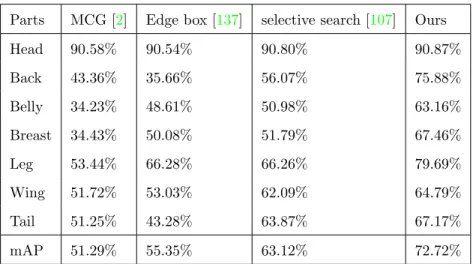
Parts MCG [2] Edge box [137] selective search [107] Ours Head 90.58% 90.54% 90.80% 90.87% Back 43.36% 35.66% 56.07% 75.88% Belly 34.23% 48.61% 50.98% 63.16% Breast 34.43% 50.08% 51.79% 67.46% Leg 53.44% 66.28% 66.26% 79.69% Wing 51.72% 53.03% 62.09% 64.79% Tail 51.25% 43.28% 63.87% 67.17% mAP 51.29% 55.35% 63.12% 72.72%
Table 2.2: Comparison of our k-NN proposal and bottom-up proposal methods for small semantic parts detection by average precision.
Strong prior or weak prior. Compared to the strong prior, our k-NN
pro-posal method with weak prior gives slightly higher recall, because it is not restricted to the prior part class label inherited from the nearest neighbors, and more candidate regions are proposed for each part. The mean average precision (mAP) of the weak prior improves that of the strong prior from 71.79% to 72.72%, see Table2.1. So we will use the weak prior in all our other experiments by default.
Comparison with bottom-up proposal methods. To evaluate the
ef-fectiveness of our top-down proposal method for small semantic parts detection, we compare it with several well known bottom-up methods [107, 137,2] with the same metric. As shown in Table 2.2, our k-NN proposal method achieves 72.72% mAP that significantly outperforms all baseline methods. For example, our method gives a 9.6% higher mAP than our best baseline, the selective search method [107]. Results for each part further indicate that our method is much more accurate for proposing small semantic part regions (such as “back” and “leg”), compared with all
base-Head Back Belly Breast Leg Wing Tail
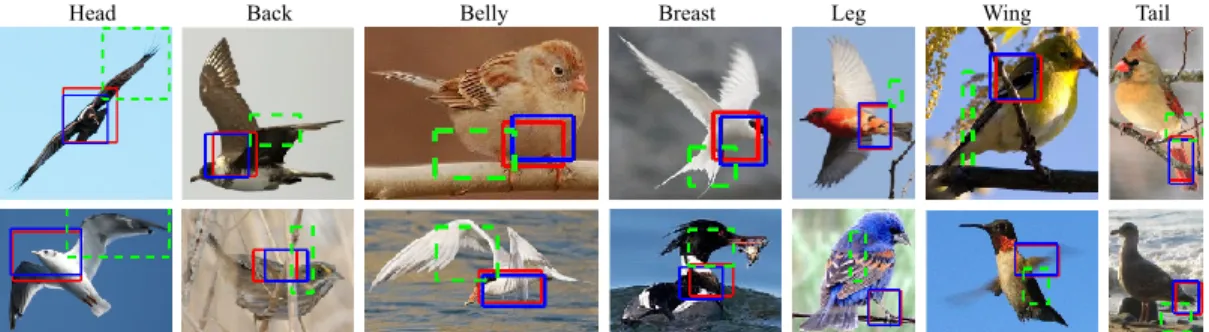
Figure 2.3: Detections failed by selective search (green boxes) but succeeded by our k-NN proposal method (blue). Red are ground truth.
line methods, e.g., we achieves a 19.48% higher average precision than the selective search method for the part “back”. Figure2.3shows example detection results of our method and the best baseline (selective search [107]). It indicates that part detections from our k-NN proposals have more accurate locations and more precise shapes than the detections from the selective search method. It qualitatively demonstrates that our k-NN proposal method plays a crucial role for small semantic parts detection. With respect to efficiency, the selective search method proposes an average number of 1270 regions for each image while our 20-NN proposal method only generates fewer than 180 proposals. Note that, to have faster speed and fewer false positives it is extremely important to have fewer proposals. In conclusion, our top-down k-NN pro-posal method is more efficient and more effective than bottom-up methods for small semantic parts detection.
Comparison with other state-of-the-art methods. Table 2.3 shows
the comparison result of our part detection network (DET-NET) and the previous works [65, 128, 3] by Percentage of Correctly Localized Parts (PCP). By using the exactly same 2-part annotations as all the baseline methods, our part detection net-work achieves the best overall performance. Especially, for the relatively smaller part,
Methods Head Body
Strong DPM [128,3] 43.49% 75.15%
Selective search [128,107] 68.19% 79.82%
LAC [65] 74.00% 96.00%
Ours 93.40% 94.93%
Table 2.3: Comparison with previous works by Percentage of Correctly Localized Parts (PCP) on CUB-2011. (To fairly compare, we use exactly the same 2-part annotations for all methods.)
head, our DET-NET outperforms the previous best method (LAC) by 19.4% PCP. We believe that our DET-NET achieves the significant improvement on small semantic part detection for two reasons. One is that our k-NN proposals inherit priors from the nearest neighbors in the training data, so that many promising small semantic part candidates are proposed. The other reason is that the fast RCNN integrated in our DET-NET performs the region regression to calculate more accurate part locations. In conclusion, our final part detection result outperforms all the previous works with a large margin on the CUB-2011 dataset [110].
2.2.2 Classification Results on CUB-2011
In this section, we evaluate the effectiveness of our part-abstraction and classification sub-network (CLS-NET), especially the proposed part-based fully connected (pfc) layer. A set of experiments are conducted to decide how many pfc layers and how many parts are the best to use in our CLS-NET. Here we use the oracle part anno-tations to avoid any influence from the part detection sub-network.
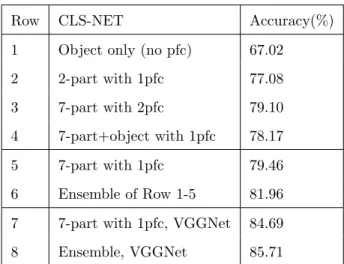
The experimental results are shown in Table2.4. Compared with other alternative settings (Row 1-4) under exactly the same condition, the 7-part CLS-NET with 1pfc
Row CLS-NET Accuracy(%)
1 Object only (no pfc) 67.02
2 2-part with 1pfc 77.08
3 7-part with 2pfc 79.10
4 7-part+object with 1pfc 78.17
5 7-part with 1pfc 79.46
6 Ensemble of Row 1-5 81.96
7 7-part with 1pfc, VGGNet 84.69
8 Ensemble, VGGNet 85.71
Table 2.4: Comparison of different settings of our CLS-NET on CUB-2011 with oracle part annotations. Ensemble, VGGNet indicates the ensemble of 7-part with 1pfc and 7-part with 2pfc.
(Row 5) performs the best. We can draw several insights from the comparison results. First, it is very important to build part layers (e.g., pfc layer) in the CNN framework to abstract and concatenate multiple parts; and it is important to use more semantic parts (67.02% vs 77.08% vs 79.46%). Second, one pfc layer is sufficient for part feature abstraction on this dataset (79.10 vs 79.46%). Last but not the least, although the whole object has been shown useful in previous fine-grained classification [35,65,128], it is not needed anymore when more small semantic parts of the object are integrated in our framework (78.17% vs 79.46%). Here, we treat the whole object same as other parts and build pfc layer for it. We can further improve our best accuracy on CaffeNet to 81.96% using the ensemble of all five models with different settings. To test the generalization of our method, the results of models initialized by VGGNet are listed in Table 2.4. The final accuracy is boosted to 85.71%. In conclusion, our 7-part CLS-NET with 1pfc layer is the best setting on the CUB-2011. We will use it as the
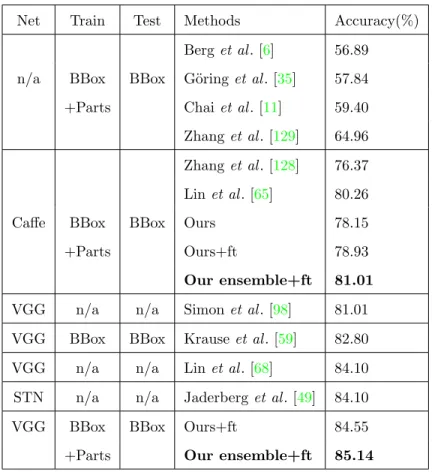
Net Train Test Methods Accuracy(%) Berget al. [6] 56.89
n/a BBox BBox G¨oringet al. [35] 57.84
+Parts Chaiet al. [11] 59.40
Zhanget al. [129] 64.96
Zhanget al. [128] 76.37
Linet al. [65] 80.26
Caffe BBox BBox Ours 78.15
+Parts Ours+ft 78.93
Our ensemble+ft 81.01
VGG n/a n/a Simonet al. [98] 81.01
VGG BBox BBox Krauseet al. [59] 82.80
VGG n/a n/a Linet al. [68] 84.10
STN n/a n/a Jaderberget al. [49] 84.10
VGG BBox BBox Ours+ft 84.55
+Parts Our ensemble+ft 85.14
Table 2.5: Comparison with state-of-the-art methods on CUB-2011. +ft means fine-tuning the model using the part detections of training images; Our ensemble models for CaffeNet and VGGNet are same models shown in Table2.4.
default setting in all other experiments.
2.2.3 Classification Results of Our Unified Network
This section gives the overall performance of our SPDA-CNN by feeding the seven semantic parts detected by the detection sub-network to the part-abstraction and classification sub-network. We compare the proposed SPDA-CNN with state-of-the-art previous works on CUB-2011 and CUB-2010, respectively.
Methods Accuracy(%)
G¨oringet al. [35] 35.94
Chaiet al. [11] 47.30 Linet al. [65] 65.25
Ours 66.14
Table 2.6: Comparison with state-of-the-art on CUB-2010.
CUB-2011. By directly using the model trained with oracle part annotations
to classify test images using parts detected by the DET-NET, we achieves 78.15% accuracy (Table 2.5) which is only 1.31% lower than the accuracy of classifying test images using oracle part annotations (Row 5 in Table2.4). After fine-tuning the model by training with part detections, as shown in Table2.5, the gap becomes even smaller. This shows that our SPDA-CNN is robust to the part detection results. Moreover, our DET-NET is able to provide very good part detection results, as demonstrated in the section2.2.1. The comparison results in Table2.5show that our method performs much better than previous part-based methods, including fully supervised methods [6, 35, 11, 129, 128, 65] and methods without part annotations [98, 59]. Compared with state-of-the-arts [68, 49], our method also achieves slightly better performance. Moreover, with more supervision our method can explicitly detect small semantic parts and learn part-specific features.
CUB2010. We also evaluate the generalization of our method on
CUB-2010 [112], which does not provide oracle part annotations. We use the same part detection sub-network (DET-NET) trained on CUB-2011, but re-train the classifica-tion sub-network (CLS-NET) by only using data from CUB-2010. Part detecclassifica-tions from DET-NET are used in both training and testing procedures of CLS-NET. The
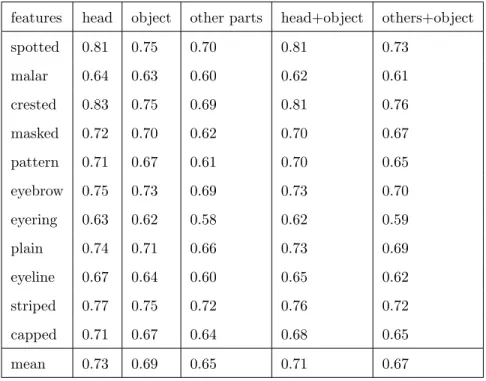
features head object other parts head+object others+object spotted 0.81 0.75 0.70 0.81 0.73 malar 0.64 0.63 0.60 0.62 0.61 crested 0.83 0.75 0.69 0.81 0.76 masked 0.72 0.70 0.62 0.70 0.67 pattern 0.71 0.67 0.61 0.70 0.65 eyebrow 0.75 0.73 0.69 0.73 0.70 eyering 0.63 0.62 0.58 0.62 0.59 plain 0.74 0.71 0.66 0.73 0.69 eyeline 0.67 0.64 0.60 0.65 0.62 striped 0.77 0.75 0.72 0.76 0.72 capped 0.71 0.67 0.64 0.68 0.65 mean 0.73 0.69 0.65 0.71 0.67
Table 2.7: Area Under the Curve (AUC) for head attribute prediction using different part features in the pfc layer. Object means the whole object and other parts means all the other 6 parts except head.
comparison results of our method with the previous works [35, 11, 65] in Table 2.6 illustrate that we achieve the state-of-the-art accuracy on CUB-2010, indicating the proposed method can be well generalized to other datasets.
2.2.4 Discussion
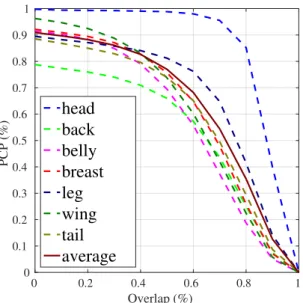
By analyzing our part detection and part-based classification results, we have an interesting observation. That is, our classification performance based on the 7-part detections is nearly as good as the performance based on the ground truth part annotations, however, the mAP of our 7-part detections is only 72.72% at the default 0.5 overlap threshold. As shown in Figure 2.4, decreasing the overlap threshold will
0 0.2 0.4 0.6 0.8 1 Overlap (%) 0 0.1 0.2 0.3 0.4 0.5 0.6 0.7 0.8 0.9 1 PCP (%) head back belly breast leg wing tail average
Figure 2.4: PCP of part detection network at different overlaps
increase the PCP for every part. For example, by decreasing the threshold to 0.2, we can achieve a 88.24% overall precision (i.e., object PCP) at 94.07% recall. The mAP for all parts is increased from 72.72% to 88.75%. In particular, we can achieve much higher PCPs for the parts whose exact regions are ambiguous. Thus we conjecture that it might be safer to have a smaller overlap threshold for the part detection task, compared with general object detection tasks. As shown in Figure 2.5, although some detections have less than 0.5 overlaps with the ground truth, they are visually correct. To be consistent with previous works [65, 128, 3], we use 0.5 as the default overlap threshold for all our experiments. However, this observation indicates that our detection results are actually more accurate than what is shown by its mAP at the 0.5 overlap threshold. This might be the reason why our classification performance based on the part detections is nearly as good as the performance based on the ground truth annotations.
Breast Leg Back
Wing Wing Wing
Leg
Back
Back
Figure 2.5: Detections (blue) that have less than 0.5 overlaps with the ground truth annotations (red), but are visually correct.
To investigate whether the added part-based fully connected (pfc) layer actually learns part-specific features, we have done another experiment. We directly use fea-tures in the pfc layer to predict attributes in the parts. As shown in Table 2.7, the features from head are consistently better in predicting head attributes compared to features from the whole object or from the other parts. Also, adding features of the whole body does not improve the result, which proves the features in the pfc layer are part-specific and perform better for part-related tasks. This experiment also shows attribute prediction can be one potential application of the proposed network and we will investigate it in the future.
Chapter 3
Multimodal Deep Neural
Network for Fine-grained
Medical Image Classification
In this chapter, we propose a multimodal deep learning framework [118] to lever-age heterogeneous imlever-age and non-imlever-age medical data for disease grading (i.e., fine-grained medical image classification). We use the task of cervical dysplasia diagnosis as an example to evaluate the proposed method. Some background information about cervical dysplasia diagnosis is first introduced in Section3.1. And then, the proposed multimodal deep learning framework is presented in Section3.2. Finally, experimental results are discussed in Section 3.3.
3.1
Preliminaries: Cervical Cancer Diagnosis
Cervical cancer ranks as the second most common type of cancer in women aged 15 to 44 years worldwide [113]. Screening can help prevent cervical cancer by detecting cervical intraepithelial neoplasia (CIN), which is the potentially precancerous change and abnormal growth of squamous cells on the surface of the cervix. According to the World Health Organization (WHO) [113], CIN has three grades: CIN1 (mild), CIN2 (moderate), and CIN3 (severe). Mild dysplasia in CIN1 only needs conservative observation and will typically be cleared by an immune response in one year, however lesions in CIN2/3 or cancer (denoted as CIN2+ in this thesis) require treatment. In clinical practice one important goal of screening is to differentiate normal/CIN1 from CIN2+ for early detection of cervical cancer.
Widely used cervical cancer screening methods today include Pap tests, HPV tests, and visual examination. Pap tests involve collecting a small sample of cells from the cervix and need a laboratory and trained personnel to examine these samples under a microscope for squamous and glandular intraepithelial lesions (SIL). Also Pap tests suffer from low sensitivity in detecting CIN2+ [93, 99]. HPV tests are DNA tests which detect human papillomavirus (HPV) strains associated with cervical cancer. The sensitivity of HPV tests in detecting CIN2+ lesions varies greatly [93]. HPV tests are often used in conjunction with Pap tests, because nearly all cases of cervical cancer are caused by Human papillomavirus (HPV) infection [111], especially by persistent infection with a high type (e.g., HPV16 and HPV18). Digital cervicography is a non-invasive and low-cost visual examination method that takes a photograph of the cervix (called a CervigramR) after the application of 5% acetic acid to the