DigitalCommons@University of Nebraska - Lincoln
DigitalCommons@University of Nebraska - Lincoln
Theses, Dissertations, and Student Researchfrom Electrical & Computer Engineering Electrical & Computer Engineering, Department of
5-2020
Deep Learning and Polar Transformation to Achieve a Novel
Deep Learning and Polar Transformation to Achieve a Novel
Adaptive Automatic Modulation Classification Framework
Adaptive Automatic Modulation Classification Framework
Pejman Ghasemzadeh
University of Nebraska - Lincoln, [email protected]
Follow this and additional works at: https://digitalcommons.unl.edu/elecengtheses
Part of the Computer Engineering Commons, and the Other Electrical and Computer Engineering Commons
Ghasemzadeh, Pejman, "Deep Learning and Polar Transformation to Achieve a Novel Adaptive Automatic Modulation Classification Framework" (2020). Theses, Dissertations, and Student Research from
Electrical & Computer Engineering. 114.
https://digitalcommons.unl.edu/elecengtheses/114
This Article is brought to you for free and open access by the Electrical & Computer Engineering, Department of at DigitalCommons@University of Nebraska - Lincoln. It has been accepted for inclusion in Theses, Dissertations, and Student Research from Electrical & Computer Engineering by an authorized administrator of
ADAPTIVE AUTOMATIC MODULATION CLASSIFICATION FRAMEWORK
by
Pejman Ghasemzadeh
A THESIS
Presented to the Faculty of
The Graduate College at the University of Nebraska In Partial Fulfillment of Requirements
For the Degree of Master of Science
Major: Telecommunications Engineering
Under the Supervision of Professor Hamid R. Sharif-Kashani
Lincoln, Nebraska
ADAPTIVE AUTOMATIC MODULATION CLASSIFICATION FRAMEWORK Pejman Ghasemzadeh, M.S.
University of Nebraska, 2020 Advisor: Hamid R. Sharif-Kashani
Automatic modulation classification (AMC) is an approach that can be leveraged to identify an observed signal’s most likely employed modulation scheme without anya priori knowledge of the intercepted signal. Of the three primary approaches proposed in literature, which are likelihood-based, distribution test-based, and feature-based (FB), the latter is considered to be the most promising approach for real-world implementations due to its favorable computational complexity and classification accuracy. FB AMC is comprised of two stages: feature extraction and labeling. In this thesis, we enhance the FB approach in both stages. In the feature extraction stage, we propose a new architecture in which it first removes the bias issue for the estimator of fourth-order cumulants, then extracts polar-transformed information of the receivedIQwaveform’s samples, and finally forms a unique dataset to be used in the labeling stage. The labeling stage utilizes a deep learning architecture. Furthermore, we propose a new approach to increasing the classification accuracy in low signal-to-noise ratio conditions by employing a deep belief network platform in addition to the spiking neural network platform to overcome computational complexity concerns associated with deep learning architecture. In the process of evaluating the contributions, we first study each individual FB AMC classifier to derive the respective upper and lower performance bounds. We then propose an adaptive framework that is built upon and developed around these findings. This framework aims to efficiently classify the received signal’s modulation scheme by intelligently switching between these different FB classifiers to achieve an optimal balance between classification accuracy and computational complexity for any observed channel conditions derived from the main receiver’s equalizer. This
We conduct a performance analysis using this framework in which we employ the standard RadioML dataset to achieve a realistic evaluation. Numerical results indicate a notably higher classification accuracy by 16.02% on average when the deep belief network is employed, whereas the spiking neural network requires significantly less computational complexity by 34.31% to label the modulation scheme compared to the other platforms. Moreover, the analysis of employing framework exhibits higher efficiency versus employing an individual FB AMC classifier.
Acknowledgments
First and foremost, I would like to wholeheartedly thank my precious mother and dear father for their unwavering support and belief in my dreams, although no amount of gratitude can ever be enough for them. I would not have accomplished any of my successes in life without their constant support, inspiration and encouragement.
I would specially like to thank my advisor, Prof. Hamid Sharif, for his invaluable and indispensable experience, guidance, support and inspiration during the course of my research work. I am also grateful to Dr. Hempel for his insights and directions in my graduate research.
Contents
List of Tables xi
List of Figures xi
List of Algorithms xiii
List of Acronyms xv
List of Symbols xix
1 Introduction 1
1.1 AMC Applications . . . 2
1.1.1 Civilian AMC Applications . . . 2
1.1.2 Military AMC Applications . . . 3
1.2 AMC Approaches . . . 4
1.2.1 Likelihood-based AMC . . . 4
1.2.2 Distribution Test-based AMC . . . 7
1.2.3 Feature-based AMC . . . 9
1.3 AMC Implementation . . . 11
1.4 Summary of AMC Approaches . . . 13
1.5 Thesis Organization . . . 14
2 Problem Statement 15 2.1 Feature Extraction Stage . . . 16
2.2 Classification Stage . . . 21 2.2.1 Classification Accuracy . . . 21 2.2.2 Computational complexity . . . 22 3 Literature Review 24 4 Proposed Solution 31 4.1 Solutions Structure . . . 31
4.1.1 Feature Extraction Stage . . . 31
4.1.2 Labeling Stage . . . 32
4.1.2.1 Classification Accuracy . . . 32
4.1.2.2 Computational Complexity . . . 33
4.1.3 The Proposed Novel Framework Structure . . . 35
4.2 New Feature Extraction Stage Architecture . . . 35
4.2.1 High-Order Statistical Feature Extraction Component . . . 36
4.2.1.1 One-Pass Algorithm . . . 38
4.2.1.2 Two-Pass Algorithm . . . 38
4.2.2 Polar Coordinate Transformation . . . 42
4.3 Proposed Deep Learning Structure for Labeling Stage . . . 42
4.4 Deep Belief Network as Fully-Connected Network in Deep Learning Structure 46 4.4.1 Adaptive Moment Estimation . . . 51
4.5 Spiking Neural Network as a Fully-Connected Network in a Deep Learning Structure . . . 55
4.5.1 Threshold Unit Networks . . . 55
4.5.2 Continuous Neural Networks . . . 57
4.5.3 Spiking Neural Networks . . . 58
4.5.4 Unsupervised Learning-Hebbian Learning . . . 61
5 Results, Analysis and Discussion 65
5.1 RadioML2018.01A Dataset . . . 65
5.2 DBN-based FB AMC Classifier Analysis . . . 70
5.2.1 DBN Architecture and Employment . . . 70
5.2.2 AMC Results and Discussion . . . 72
5.2.2.1 Lower-bound Discussion . . . 73
5.2.2.2 Upper-bound Discussion . . . 74
5.2.2.3 Number of Training Samples Discussion . . . 75
5.2.3 Computational Complexity Analysis . . . 76
5.2.4 Model Conclusion . . . 77
5.3 SNN-based FB AMC Classifier Analysis . . . 77
5.3.1 Results and Discussion . . . 80
5.3.1.1 Lower-bound performance . . . 80
5.3.1.2 Upper-bound Performance . . . 81
5.3.2 Computational Complexity Analysis . . . 82
5.3.3 Model Conclusion . . . 82
5.4 Proposed Novel Framework Analysis . . . 83
6 Conclusion and Future Work 84 Bibliography 86 A Deep Learning Models Participating in Comparing Results 90 A.1 Deep CNN-based Model . . . 90
A.2 RNN-based Model . . . 91
B Spiking Neural Network-Based Platform Utilized in This Research 93 B.1 Initialization and Refactored Conversion Module . . . 93
B.3 Network . . . 104 B.4 Pipeline . . . 163 B.5 Encoding . . . 177 B.6 Conversion . . . 185 B.7 Model . . . 198 B.8 Learning . . . 210 B.9 Evaluation . . . 232 B.10 Analysis . . . 237
List of Tables
4.1 Values to be collected . . . 63
5.1 Input data dimensions. . . 66
5.2 3D high-order statistical polar-baseddataset dimensions. . . 70
5.3 Optimized hyperparameters and configurations of DBN. . . 70
5.4 Computational complexity of the proposed DBN-based model. . . 76
5.5 SNN hyperparameters’ architecture. . . 78
5.6 Proposed SNN-based model computational complexity measurement. . . . 82
5.7 Tradeoff-driven model selection for classification at each SNR. . . 83
List of Figures
1.1 Overview of an AMC operation in a communication system. . . 1
1.2 LB approach operation structure. . . 5
1.3 DT approach operation structure. . . 8
1.4 FB AMC overview structure. . . 11
1.5 Required components in transmitter to necessitate inclusion of AMC in the receiver. . . 12
2.1 Spectral-based features tree classification procedure. . . 17
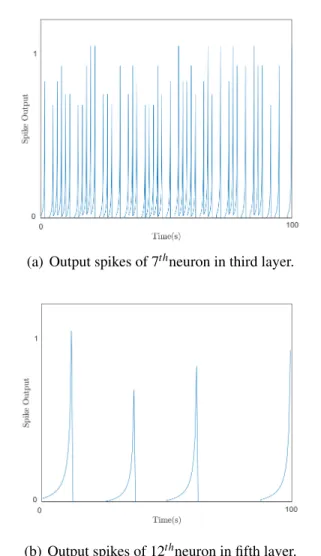
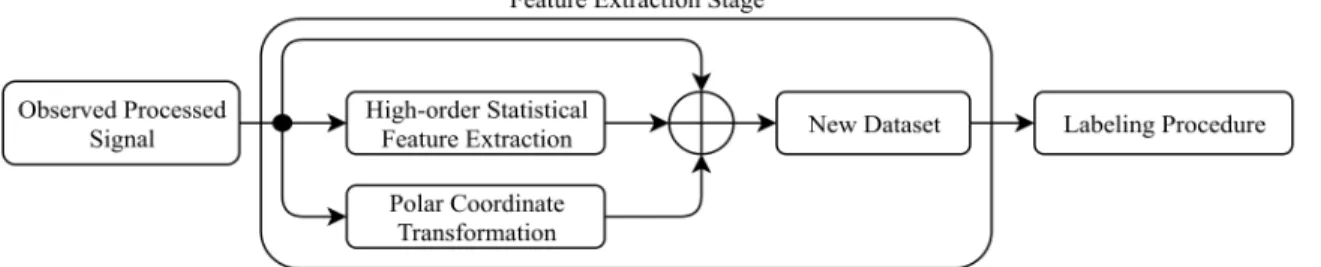
4.1 Output spikes of neurons in third and fifth for the proposed SNN-based model. 34 4.2 Architecture of the new feature extraction stage. . . 35
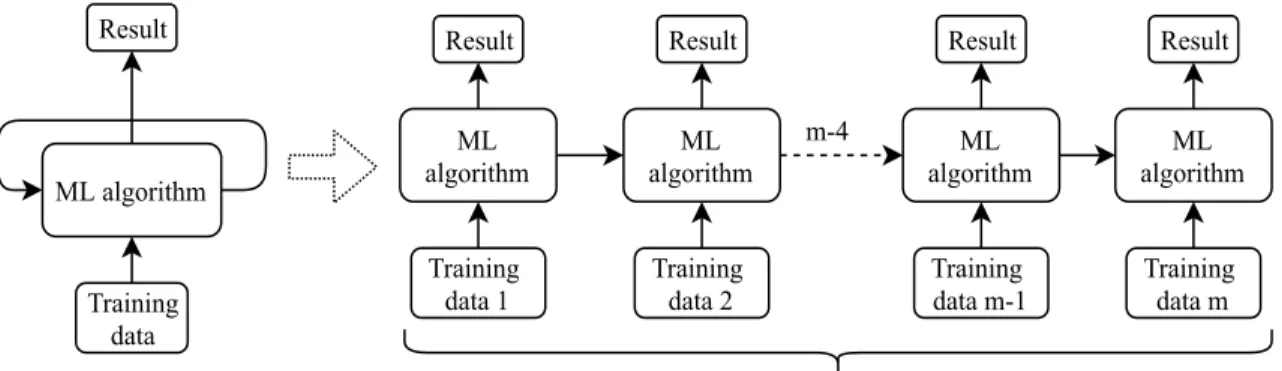
4.3 RNN training process overmportion of cross-validated training set. . . 43
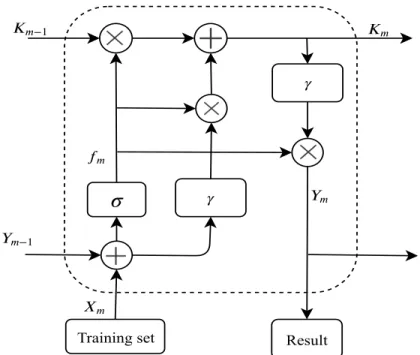
4.4 LSTM module in each RNN architecture training iteration. . . 44
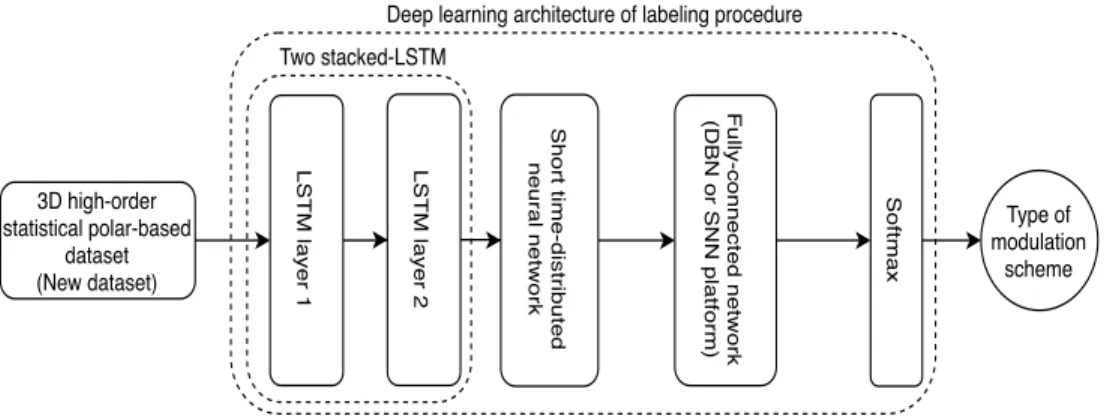
4.5 Deep Learning architecture of the labeling stage. . . 46
4.6 An example RBM structure with 4 visible and 2 hidden units in their corresponding layers in which the effect of biases on visible and hidden layers units can be observed. . . 47
4.7 The proposed novel framework’s principal working. . . 64
5.1 Process of applying channel effects to the transmitted signal . . . 67
5.2 The destructive effect of the selective fading model over the constellation of 128QAM and 256QAM from RadioML dataset at SNR=5 dB. . . 68
5.3 Polar-based constellation of 128QAM and 256QAM from RadioML dataset at SNR=5 dB with and without destructive effect of the selective fading model. . . 69 5.4 Validation accuracy of DBN-based model in training stage. . . 71 5.5 Training loss of DBN-based model in training stage. . . 72 5.6 Proposed DBN-based lower-bound performance compared to RNN and CNN 73 5.7 Proposed DBN-based upper-bound performance compared to RNN and CNN 74 5.8 Number of training sample impact on classification accuracy. . . 75 5.9 Proposed SNN-based model performance of number of training epochs
versus validation accuracy. . . 79 5.10 Proposed SNN-based model performance of number of training epochs
versus training loss. . . 79 5.11 Proposed SNN-based model lower-bound performance compared to
proposed DBN-, RNN- and CNN-based models. . . 80 5.12 Proposed SNN-based model upper-bound performance compared to
proposed DBN-, RNN- and CNN-based models. . . 81 A.1 The deep CNN-based classifier’s structure. . . 91 A.2 The deep RNN-based classifier’s structure. . . 92
List of Algorithms
List of Acronyms
AMC Automatic modulation classification
IMD Intelligent modem design
DSA Dynamic spectrum access
SC Spectrum congestion EW Electronic warfare ES Electronic support EA Electronic attack EP Electronic protect LB Likelihood-based
PDF Probability density function
ML Maximum likelihood
ALRT Average likelihood ratio test
GLRT Generalized likelihood ratio test
SNR Signal-to-noise ratio
DLRT Discrete likelihood ratio test
MDLF Minimum distance likelihood function
NPLF Non-parametric likelihood function
DT Distribution test-based
GoF Goodness of fit
KS Kolmogorov–Smirnov
CDF Cumulative distribution function
OKS One-sample Kolmogorov–Smirnov
TKS Two-sample Kolmogorov–Smirnov CVM Cramer–Von Mises AD Anderson–Darling FB Feature-based ML Machine learning SS Signal spectral-based
PSD Power spectral density
WT Wavelet transform-based
HoS High-order statistics-based
CA Cyclostationary analysis-based
KNN K-Nearest Neighbour
DL Dictionary learning
ANN/NN Artificial neural network
DNN Deep neural network
CNN Convolutional neural network
RNN Recurrent neural network
ResNN Residual neural network
CR Cognitive radio
SDR Software defined radio
CSI Channel state information
QoS Quality of service
QoE Quality of experience
PCC Probability of correct classification
M-ASK M-amplitude shift keying
M-PSK M-phase shift keying
M-FSK M-frequency shift keying
M-QAM M-quadrature amplitude modulation
CWT Continuous wavelet transform
AWGN Additive white Gaussian noise
LSTM Long short-term memory
RBM Restricted boltzmann machine
SNN Spiking neural network
FCN Fully-connected network
ADAM Adaptive moment estimation algorithm
SGD Stochastic gradient descent
EPSP Excitatory postsynaptic potential
IPSP Inhibitory postsynaptic potential
MLP Multilayer perceptrons
ReLU rectified linear units
ODE Ordinary differential equation
IF Integrate-and-fire
LIF Leaky-integrateand-fire
STDP Spike-timing-dependent-plasticity
List of Symbols
γmax Normalized and centred maximum instantaneous amplitude value of the intercepted signal’s spectral power density
σiap Non-linear component absolute value’s standard deviation of the instantaneous phase
σip Non-linear component direct value’s standard deviation of the instantaneous phase
λ Evaluation of the spectrum symmetry around the carrier frequency
σias Normalized and centered of absolute value of instantaneous amplitude of signal’s symbols’ standard deviation
σi f Normalized and centered of absolute value of instantaneous frequency’s standard deviation
σia Normalized and centered instantaneous amplitude’s standard deviation
K42a Normalized and centered instantaneous amplitude’s Kurtosis
K42f Normalized and centered instantaneous frequency’s Kurtosis
I Real part of the received symbol
r Radius of the polar transformed symbol
θ Angle of the polar transformed symbol
X Random variable
E{X} Expected value of random variableX
xi ith sample of random variableX
X Mean of random variableX
mi ith partition’s mean ofX
L Number of a random variable’s samples
Mni nth order of central moment ofith partition ofX
∆B A Mean difference of portionsA andB ofX
li Length ofithpartition ofX
σ(.) Sigmoid function
T Time steps in LSTM layer
Wα Shared time-distributed NN weight matrix
ζα Shared time-distributed NN bias matrix
αt tth attention weight
yt tth output of LSTM layers
τ Timing unit
Vi ith neuron/node in visible layer
E Energy function
V Vectors of units in visible layers
h Vectors of units in hidden layers
Z(.) Partition function ai Visible layers’ biases
bi Hidden layers’ biases
V Moving average
g Gradient on current mini-batch
βi New introduced hyperparameter to ADAM algorithm
η Step size
ρi Binary inputs to neurons
λ Predefined learning rate
C Membrane capacitance
R Membrane resistance
I(t) Total input current to the neuron at timet
v(t) Membrane potential
Iext(t) External current
Si Spike train
CHAPTER
1
Introduction
Automatic modulation classification (AMC) refers to a signal processing mechanism through which the intercepted signal’s modulation scheme can be classified with minimal information on the signal’s configurations. This process is exclusively operated at the receiver side of a communication, as illustrated in Fig 1.1 [1].
Communication Channel Pre-processing Transmitter Automatic Modulation Classifier Equalizer Demodulator Receiver
Figure 1.1:Overview of an AMC operation in a communication system.
The modulation scheme’s information will then be used in the demodulator for further processing. The term “automatic” is used to oppose the initial implementations of fixed modulation classification procedures, where signals are modulated by electronic processors capable of operating one fixed modulation scheme. AMC essentially gained importance when link adjustment methods that use adaptive modulation and coding were introduced. These methods created an adaptive selection of modulation schemes in which a pool of multi-ple modulation schemes are employed by the system [2]. In this manner, the communication system further enabled an optimization process through which the transmission reliability
and data rate are investigated to lead to the adaptive selection of the modulation scheme according to communication channel conditions. While the transmitter has the freedom to choose the most reliable modulation scheme, the receiver must know the modulation scheme in order to demodulate the received signal so that the transmission can be successful. An easy way to inform the receiver about changes in the modulation scheme at the transmitter is to include the modulation scheme’s information in each transmitted signal frame [3]. However, this solution affects the spectrum efficiency due to the extra information that is included in each signal frame. In the current era of wireless communication, where the wireless spectrum is extremely limited and valuable, this solution is not considered to be efficiently sufficient. For this reason, AMC is an attractive solution to the problem of notifying the receiver of the transmitted signal’s modulation scheme.
Additionally, AMC also has other applications, which are briefly discussed below.
1.1
AMC Applications
AMC applications can be generally categorized into two groups: civilian applications and military applications.
1.1.1
Civilian AMC Applications
In this category, AMC mainly targets applications for intelligent modem designs (IMDs), spectrum sensing, safety monitoring in open or working areas, interference cancellation, dynamic spectrum access (DSA), link-adjustment to data rate and channel capacity, and signal protection [4]. In general, AMC’s primary contribution to these applications can be summarized into three aspects. Below, we highlight these three aspects and describe them in more detail.
• Signal Cancellation:
of spectrum congestion (SC). At any given moment, a receiver faces the challenge of observing multiple radio signals, and has to filter out all but the intended transmitter’s signal. The intended transmitter’s signal may not be of favorable strength or quality, which results in the receiver cancelling out competing signals. One option to determine unfavorable signals is to deploy AMC at the receiver to find the signal’s modulation scheme. After the modulation scheme is determined, the receiver then can filter out any signals that do not match the modulation schemes of the targeted transmitter [5].
• Spectrum Surveillance:
By deploying AMC at the receiver and then conducting a sweep of all supported frequencies, the receiver can then easily conduct a survey of mapping modulation schemes used at each particular frequency. This knowledge provides the primary tool to either eavesdrop or jam a signal in the area.
• Removing Overhead in the receiver:
In many communication systems, the transmitter changes the modulation scheme during the connection. This can be caused by any number of reasons, such as adjusting transmission parameters with channel rates. When the transmitter changes the modulation scheme, it typically notifies the receiver by sending information to the receiver. This overhead can be removed by deploying AMC in the receiver.
1.1.2
Military AMC Applications
AMC can assist with three tasks in electronic warfare (EW). These tasks are electronic support (ES), electronic attack (EA), and electronic protect (EP) [6]. The main duty in ES is to collect communication information on the battlefield, especially concerning hostile units. Frequency bands used by hostile units are examples of essential information. These frequency bands can be determined by utilizing AMC in friendly units to monitor modulation schemes and their corresponding frequency bands which are being employed
on the battlefield. This assists friendly units in differentiating among known (friendly) and unknown (hostile) modulation schemes and their frequency bands. As a result, friendly units can obtain two pieces of information from battlefield communications: frequency bands and modulation schemes used by hostile units. In EA, after capturing hostile communication information, jamming these hostile transmissions is a relatively easy task that can be accomplished by transmitting a signal with a higher power in the same frequency band to override the hostile transmission. In EP, if friendly communications are cut off by the same EA mechanism done by hostile units, the friendly frequency bands can be changed to those that are free and safe. The primary means by which these tasks can be accomplished is to gain information on the hostile communications’ modulation schemes. Moreover, all the information gathered through this process can be leveraged to eavesdrop on hostile communications.
We will next briefly introduce proposed AMC approaches in literature.
1.2
AMC Approaches
AMC can fundamentally be organized into three primary widely discussed approaches in the literature: likelihood-based, distribution test-based, and feature-based. In the follow-ing subsections, we not only introduce these approaches, but also discuss their workfollow-ing principles.
1.2.1
Likelihood-based AMC
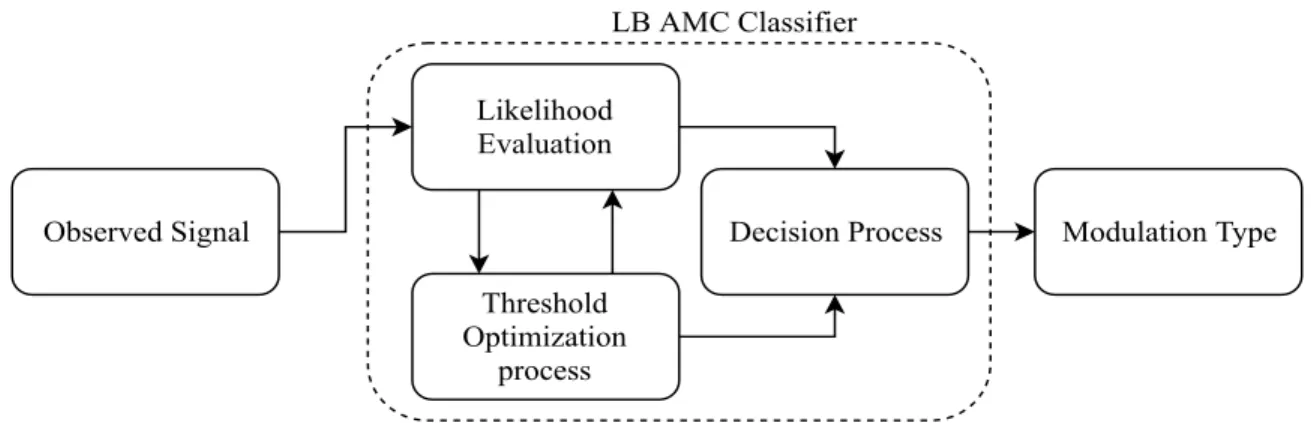
In the likelihood-based (LB) approach, it is believed that the probability density function (PDF) of the intercepted signal conditioned over an observed embedded modulated waveform consists of all required information for the modulation classification process. The LB classification process is generally accomplished in three following steps at the receiver:
threshold determination.
2. Performing likelihood evaluation between the calculated pool of modulation schemes’ PDF and the observed signal’s PDF for each observed received frame while updating the threshold through a predefined optimization process.
3. Determining which likelihood evaluation reaches the optimized threshold to make the final decision.
This operation can be seen in Fig 1.2.
Observed Signal Likelihood Evaluation Threshold Optimization process
Decision Process Modulation Type
LB AMC Classifier
Figure 1.2:LB approach operation structure.
It is evident that all three steps are highly expensive computational processes for the receiver to simultaneously execute along with other processes at receiver such as equalizing. Furthermore, this procedure is also dependent on the channel’s parameters since likelihood evaluation is conditioned over them. There is no way to exclude the effects of channel parameters since likelihood evaluation cannot handle any missing parameter. This also creates more computational complexity and requires the receiver to have some knowledge of the channel’s parameters as conditional variables of PDF. Having perfect knowledge of channel parameters does not occur in real-world scenarios. Therefore, there is a theoretical classifier that uses a known channel’s parameters, in addition to executing all aforementioned steps in a precise manner, calledMaximum likelihood (ML) classifier. This classifier reaches the highest classification accuracy in comparison with all other classifiers. LB AMC was
then developed to make this approach more practical in real-world scenarios where there is no available information on channel parameters at the receiver, which resulted in proposing three other classifiers in this approach [7]. These classifiers attempt to estimate the channel’s parameters along with executing AMC likelihood evaluation. They also ease the above three likelihood evaluation steps by calculating an approximation of likelihood evaluation, and performing a comparison scenario rather than optimizing the decision threshold to determine the intercepted signal’s modulation scheme. Hence, the channel parameters’ calculation mechanism, in addition to the degree of likelihood evaluation approximation and the comparison process, determines the classification accuracy and computational complexity of these three classifiers. The first of these classifiers is calledaverage likelihood ratio test (ALRT) classifier. This classifier handles the channel’s parameters that are unknown to it as random variables with certain PDFs that very well fit with the mathematical definition of the properties of the channel’s parameters. Essentially, the most likely value of the channel parameters is computed by considering the integration of all possible values in the likelihood evaluation. The classifier consequently calculates the likelihood evaluation for each observed signal’s PDF conditioned on channel parameters, while forming and updating a likelihood ratio test as part of the decision making process. This procedure, which forms the ALRT classifier, produces the highest computational complexity of all other non-theoretical classifiers. It attempts to precisely obtain the channel parameters in addition to the typical procedure of LB AMC, which is to calculate the likelihood evaluation for each observed waveform, and makes decisions based on an updated ratio. Despite this disadvantage, the classifier reaches the highest classification accuracy of all other non-theoretical classifiers. Consequently, ALRT can be called the optimal AMC classifier [8]. In order to ease computational complexity of this classifier, another alternative classifier was proposed called generalized likelihood ratio test (GLRT) classifier. This classifier handles a channel’s parameters as unknown deterministics. Hence, in order to estimate the values of the channel’s parameters, likelihood evaluation can be done over a specific
range of values, not over all possible values such as in ALRT. This approximation reduces the computational complexity of this classifier in addition to its classification accuracy, especially in lower signal-to-noise ratio (SNR) conditions where it is extremely difficult to determine the aforementioned range for nested modulation schemes. To solve this problem, the hybrid likelihood ratio test (HLRT) classifier was proposed, which is fundamentally built upon the signal carrier phase. Then this classifier acquires the values of the channel’s parameters by performing discrete likelihood evaluation. In other words, this classifier finds the most likely values within a few number of candidates. This mechanism of approximation notably reduces computational complexity while slightly overcoming the lower SNR issue with GLRT. On the other hand, it makes the average classification accuracy of HLRT to be lower than both the ALRT and GLRT classifiers. In the sequence of reducing this approach’s computational complexity, we can point to a few other classifiers such asdiscrete likelihood ratio test (DLRT) and look-up table classifier,minimum distance likelihood function (MDLF) classifierandnon-parametric likelihood function (NPLF) classifier. These classifiers reduce the LB approach’s computational complexity by applying various channel parameters’ estimation methods as well as approximation of likelihood evaluation. These classifiers still have high enough computational complexity, which hinders their real-world implementation due to creating delays in further processes at the receiver. It can be concluded that this approach’s classifiers obtain the highest classification accuracy on average, and have the highest computational complexity of all other approaches’ classifiers due to the mathematical perspective of this approach. Therefore, another mathematical perspective is needed to overcome the computational complexity and cost issues.
1.2.2
Distribution Test-based AMC
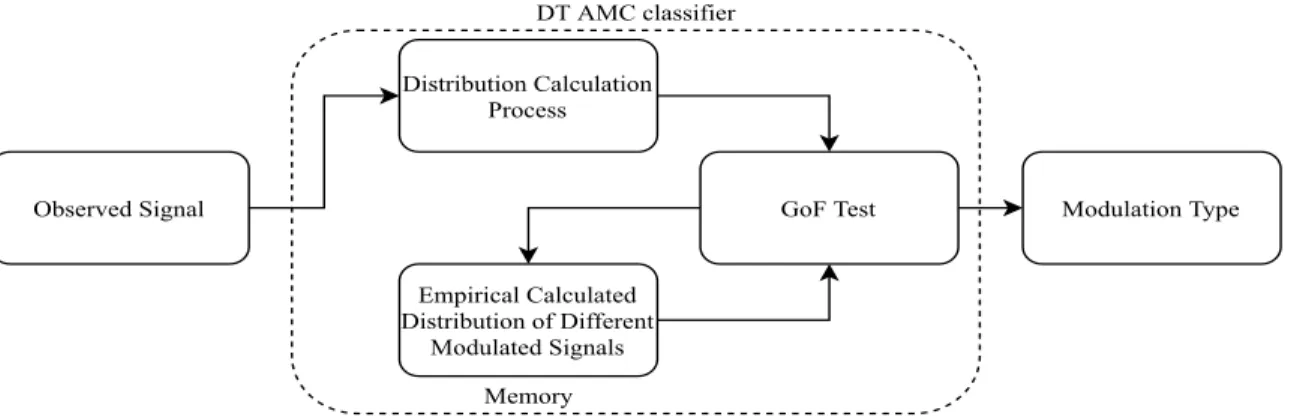
The distribution test-based (DT) approach is built upon a mathematical definition called goodness of fit(GoF), which in this domain represents the difference of two signals’ distribu-tions [9]. Thus, in order to build a classifier upon this definition, the calculated distribution
of the intercepted signal of adequate length, compared with the empirical one of different modulated signals, should be used in the GoF test. The modulation scheme that has the clos-est empirical distribution to the calculated one from the intercepted signal will be selected as the signal’s modulation scheme. This process can be seen in Fig 1.3.
GoF Test Observed Signal Empirical Calculated Distribution of Different Modulated Signals Distribution Calculation Process Modulation Type Memory DT AMC classifier
Figure 1.3:DT approach operation structure.
There are many proposed different distribution tests for GoF, but only a few are appro-priate for our modulation classification purposes. The first one is theKolmogorov–Smirnov (KS) test. In this test, the cumulative distribution function (CDF) is used for distribution calculations. This test was originally selected for AMC because of its notable lower compu-tational complexity compared to the LB approach. Comparing these two approaches in this test creates two classifiers: theOne-sample KS (OKS) test classifierand theTwo-sample KS (TKS) test classifier[10]. These two classifiers have different implementable applications. TKS should be used when the channel is in a harsh condition, which results in the need for precisely reconstructing the CDF of an actual transmitted signal’s CDF. In other words, TKS performs higher in lower SNR scenarios, and also has a higher computational complexity than OKS. Two alternatives to the KS test, which have their own comparison mechanisms between empirical CDF and a reconstructed CDF, are called theCramer–Von Mises (CVM) test and theAnderson–Darling (AD) test. The difference between these two tests lies in their sensitivity to the changes in the tail of the signal’s distributions. The AD test shows less sensitivity than CVM to sudden changes in the tail of the distribution. This makes AD
less computationally complex than both KS and CVM. Moreover, this also results in lower performance than both KS and CVM classifiers on average [11]. There are other tests that have attempted to do various models of approximation to ease the computational complexity issue to make this approach operational in real-time. In summary, the DT approach performs less accurately than the LB approach on average, especially in lower SNRs, while having less computational complexity as well. But this approach’s performance highly depends on the surroundings where transceivers are deployed, because that determines the SNR condition. Additionally, the computational complexity of the DT approach can vary based on the selected test for the mechanism of GoF. Therefore, this approach cannot provide a global solution for AMC.
1.2.3
Feature-based AMC
The feature-based (FB) approach gained importance when machine learning (ML) algorithms became popular in classification applications. Machine learning algorithms are important in real-world applications when there are no patterns of changes in the data structures. This perspective can well connect with the disorderly changes caused by channel parameters over transmitted signals [12]. Thus, machine learning algorithms can assist with assessing and analyzing these negative effects and eventually lead to modulation classification. This approach involves two stages. In the first stage, an instantaneous signal’s feature is extracted and then used in the second stage, which is also called labeling stage. The features that are utilized in the first stage relate mostly to a signal’s characteristics. They can be categorized as follows:
• Signal spectral-based (SS) features, which also include:
– The normalized and centered maximum instantaneous amplitude values of the intercepted signal’s power spectral density (PSD) (γmax)
instanta-neous phase (σiap)
– The non-linear component direct value’s standard deviation of the instantaneous phase (σip)
– Evaluation of the spectrum symmetry around the carrier frequency (λ)
– The normalized and centered absolute values of the instantaneous amplitude of the standard deviations of a signal’s symbols.(σias)
– The normalized and centered absolute values of instantaneous frequency’s stan-dard deviations (σi f)
– The normalized and centered instantaneous amplitude’s standard deviations (σia)
– The normalized and centered instantaneous amplitude’s Kurtosis (K42a )
– The normalized and centered instantaneous frequency’s Kurtosis (K42f )
• Wavelet transform-based (WT) features
• High-order statistics-based (HoS) features, which include:
– Moment-based features
– Cumulant-based features
• Cyclostationary analysis-based (CA) features
In the second stage, machine learning algorithms execute the labeling procedure [13]. Machine learning algorithms that have been utilized in literature are:
• K-nearest neighbor (KNN)
• Genetic programming (GP)
• Support vector machine (SVM)
• Artificial neural network (ANN/NN), which also includes:
– Deep neural network (DNN)
– Convolutional neural network (CNN)
– Recurrent neural network (RNN)
– Residual neural network (ResNN) An overview of this approach can be seen in Fig 1.4.
Observed Signal Feature ExtractionStage (ML algorithm)Lableing Stage Modulation Type FB AMC
Input Output
Figure 1.4:FB AMC overview structure.
As it can easily be observed, a combination of various feature extraction techniques and labeling procedures can create different AMC classification mechanisms with different levels of computational complexity and classification accuracy. One important factor in the computational complexity and cost of ML algorithms is the environment where the AMC classifier is intended to be deployed. The impact of this parameter and other elements will be further investigated in detail in Chapter 3 and 4. It can be concluded that this approach can be targeted for more real-world applications of AMC while its computational complexity and classification accuracy are related to the environment, feature extraction techniques and the labeling stage (ML algorithm) that form the FB AMC classifier; which are mostly under control of the AMC classifier designer.
1.3
AMC Implementation
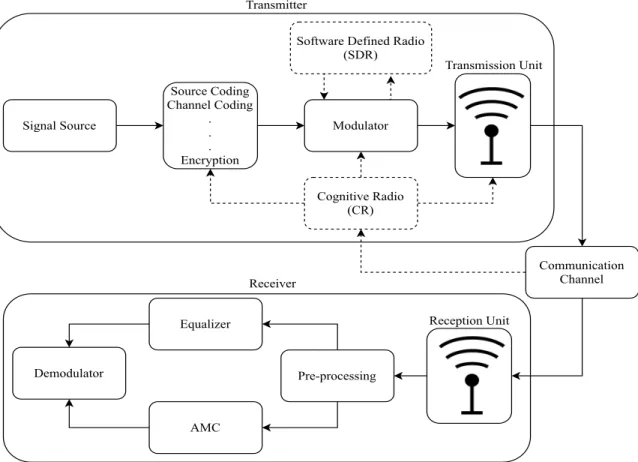
The implementation of AMC was widely regarded as an impossible task before the introduc-tion of cognitive radio (CR) and software-defined radio (SDR) technologies. Historically,
transceiver designs were very limited in the number of modulation schemes they could implement for transmission and reception for a variety of reasons, including hardware component and size limits, computation limitations, energy considerations, band limits, and more. Even today, with all the developments in modern technologies, it is still not possible to have a transmitter modulate a signal with all available types of modulation schemes. It only became feasible with the advent of CR and SDR [14]. CR transmitters are capable of sensing their environments and changing transmission parameters based on the obtained results from the environment. One of these parameters could be the employed signal’s modulation scheme. SDR technology, on the other hand, enables transceivers to avoid being locked into fixed functionality sets. On the other hand, it makes the transmitter capable of employing virtually any type of modulation schemes simply through software upgrades. This entire process can be seen in Fig 1.5.
Signal Source Source Coding Channel Coding . . . Encryption
Software Defined Radio (SDR) Modulator Cognitive Radio (CR) Transmission Unit Transmitter Communication Channel Reception Unit Pre-processing Equalizer AMC Demodulator Receiver
But CR and SDR only help in providing the necessary functionality for AMC. It does not mandate inclusion of AMC, as AMC inherently suffers from high computational complexity. This problem stems from the need for multi-dimensional computations to extract features and estimate a channel’s unknown parameters, such as the signal and carrier frequency offset, signal and carrier phase offset, channel state information (CSI), and so on. And yet, the expectation is that AMC needs to operate in real-time with minimal latency. Once the signal is received and sampled, it is expected to immediately go through demodulating and decoding processes. Hence, AMC information is also needed virtually immediately in order to control the demodulation process. Latency stemming from computational complexity can cause delays in this process. Therefore, the continued presence of the excessive com-putational complexity prevents AMC from being employed in current transceiver systems [15]. However, the reduction in computational complexity through the use of low complex algorithms results in a significant degradation in classification accuracy. As a result, there is a trade-off between computational complexity and classification accuracy. Depending on which application AMC is being deployed, this trade-off needs to be resolved either in favor of lower latency or higher classification accuracy. It should be noted that for most military applications that consider AMC, real-time low-latency operation is vital. On the other hand, for civilian applications, a somewhat higher latency may still be acceptable, as long as it does not negatively impact either quality of service (QoS) or Quality of Experience (QoE). In order to further investigate AMC implementation, related works will be discussed and analyzed in this thesis.
1.4
Summary of AMC Approaches
After providing an introduction and background of different AMC approaches and reviewing various aspects of AMC, we can conclude that the theoretical aspects of AMC have reached a point that it can classify the intercepted signal’s modulation scheme with the highest
potential probability of correct classification (PCC) at a given SNR condition with the LB AMC approach. Even though the DT approach reduces the computational complexity of the LB approach, its performance is notably degraded in lower SNR conditions. The proportional degradation in classification accuracy over reduction of computational complexity is not considered efficient compared to what the FB approach can offer. On the other hand, in feature-based AMC, there is still research that needs to be done to improve its classification accuracy performance as well as decreasing its corresponding computational complexity to make it an efficient and flexible real-world implementable approach.
1.5
Thesis Organization
The rest of the thesis is organized as follows. Chapter 2 presents the problem statement of this thesis specially concerning FB AMC appraoch. Chapter 3 provides a literature review of prominent works in this domain. Chapter 4 presents the proposed solutions to the problem statement, which their corresponding findings finally form the novel framework. Chapter 5 presents the numerical results, analysis and discussion of the proposed solutions and the novel framework. And finally, Chapter 6 concludes the thesis.
CHAPTER
2
Problem Statement
In this thesis, we deeply focus on addressing the problem of increasing the classifica-tion accuracy for high-order modulaclassifica-tion schemes in harsh channel condiclassifica-tions (low SNR values). Moreover, the computational complexity of the AMC architecture is also taken into consideration in order to make the AMC classifier operate simultaneously alongside other components in the receiver. Reducing computational complexity should be accom-plished while not sacrificing classification accuracy as much as computational complexity is decreased. We focus on featuring the AMC classifier with flexibility, where it can freely switch between various architectures to obtain an efficient balance between computational complexity and classification accuracy in different environments.
To accomplish the above objectives, we select feature-based automatic modulation classification as the potential real-world implementable approach with advancements in computational power of next communication systems, especially the receiver. The proposed next generation of communication systems that involve machine learning algorithms for different tasks make this approach even more promising. In addition to these advantages, the feature-based approach also provides the following properties when designing the AMC classifier:
1. A combination of various methods in both stages of the FB AMC classifier that can create myriad methods with different levels of computational complexity and
classification accuracy can help the designer easily deal with particular applications, which require certain computational complexity and classification accuracy.
2. The designer has control over the FB AMC classifier’s computational complexity and classification accuracy by deigning a complex or non-complex architecture.
3. The FB AMC approach provides flexibility for various applications in different environments since computational complexity and classification accuracy of this approach can be designed by application’s requirements and environment’s condition. As mentioned in the previous chapter, this approach consists of two stages. Each stage suffers from a number of problems that can eventually affect the performance of the FB AMC classifier. We investigate each stage’s issues below.
2.1
Feature Extraction Stage
There are several methods that can be utilized to extract the intercepted signal’s features. All of these methods have their own advantages and disadvantages, although they represent some information about a signal’s modulation scheme. Our goal is to investigate which one is capable of providing more correlative in-depth information to finally help address our problem statement of increasing classification accuracy of high-order modulation schemes with low SNR values.
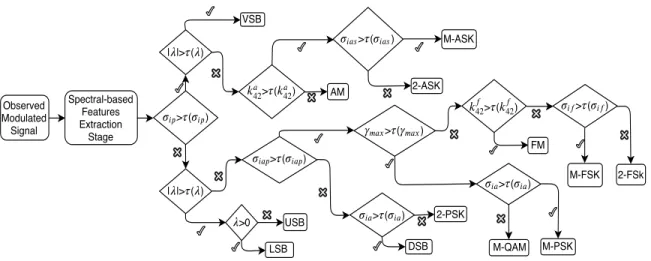
• Signal Spectral-based Features: Spectral-based features provide frequency-domain metrics on the intercepted signal. These metrics can target various aspects of the frequency domain of the intercepted signal. These aspects can include functions that use the zeroth and first power of the intercepted signal’s samples, i.e., spectral power, absolute or direct instantaneous phase, absolute or normalized or centered instantaneous amplitude, normalized or centered instantaneous carrier frequency. The functions that use the second order of the intercepted signal’s samples can include
features such as the normalized or centered amplitude’s and frequency’s Kurtosis. These features provide generic information about changes in density of the modulation parameters such as amplitude and phase density.
– Advantages: These features can be used to generally group the intercepted signal’s modulation scheme into one of the M-amplitude shift keying (M-ASK), phase shift keying (PSK), frequency shift keying (FSK), or M-quadrature amplitude modulation (M-QAM) groups without specifying the order of modulation scheme (M). These features are also resilient against destructive environmental effects over transmitted signals. When this feature extraction technique is used, a simple tree classification can be sufficient for executing the labeling procedure. Hence, if no detailed information of the intercepted signal’s modulation scheme is of interest, then this technique is considered to possess efficient computational complexity as well. The simplicity of this method, in addition to its labeling stage, can be seen in Fig 2.1.
Observed Modulated Signal Spectral-based Features Extraction Stage > ( ) | |> ( ) | |> ( ) VSB >0 USB > ( ) 42 42 AM > ( ) 2-ASK M-ASK > ( ) > ( ) 2-PSK > ( ) > ( ) > ( ) 42 42 FM > ( ) M-FSK 2-FSk LSB DSB M-QAM M-PSK
Figure 2.1:Spectral-based features tree classification procedure.
– Disadvantages:These features do not provide any in-depth information about determining the order of the intercepted signal’s modulation scheme. Hence, they cannot be used to extract features from the intercepted signal when the environment is characterized with a high SNR value since in such environments,
high-order modulation schemes are deployed to transmit and receive more data. This problem is intensified nowadays when the communication protocols tend to increase the bandwidth of transmitted and received data.
• Wavelet Transform-based Features: These features form series that represent a square-integrable (real- or complex-valued) function by a certain orthonormal series generated by a wavelet. In other words, functions that use the third power of the intercepted signal’s samples can form such features. In literature, three mother wavelet functions, namely Morlet, Haar and Shannon, are involved in calculating the continuous wavelet transform (CWT) to extract the intercepted signal’s features.
– Advantages: Each mother wavelet function is capable of providing a different level of correlation between received signal’s symbols. This provides more in-depth information regarding symbols’ patterns that can finally enable the labeling stage to also classify low-order modulation schemes in addition to the aforementioned general groups.
– Disadvantages:Deploying the mother wavelet function, which provides more correlative information about received signal’s symbols, can increase the com-putational complexity. This is because it requires comcom-putationally expensive procedures to extract the features and longer waveforms to enable feature extrac-tion stage to form these relaextrac-tions. On the other hand, the classificaextrac-tion accuracy of higher-order modulation schemes does not satisfactorily increase compared to the increase in computational complexity.
• Cyclostationary Analysis-based Features: These features represent statistical prop-erties of the received signal that vary cyclically with time. In literature, there are two ways to treat these features: probabilistic approaches and deterministic approaches. A deterministic approach views the measurements of the intercepted signal as a single time series, from which a probability distribution for a sample associated with the
time series can be defined as the fraction of time. This entire process occurs over the samples’ lifetime of the time series. In both approaches, the process or time series is considered to be cyclostationary if and only if its associated probability distributions vary periodically with time.
– Advantages:As this method measures the intercepted signal samples over time, it can provide precise information about amplitude and phase changes happening in signal over time if the sampling rate adheres to the Nyquist rate. Hence, enough in-depth information can be obtained from this method to enable the FB AMC classifier to also classify higher modulation schemes as well as lower-order ones.
– Disadvantages: This method’s principal working element is time, and it also needs multiple waveforms to extract enough in-depth features of the intercepted signal. Hence, this method cannot operate in real time alongside other compo-nents in the receiver because the extracted features are also used in the labeling stage for training and classifying. Moreover, literature shows that as environ-mental conditions become harsh, this method significantly loses its precision in extracting features.
• Higher-order Statistics-based Features:Higher-order statistics-based features, which are also known as statistics moments, refer to utilizing functions with a third or higher power of the intercepted signal’s sample. Whereas, conventional methods utilize low powers such as constant, linear and quadratic terms in their calculations. These calculations involve with zeroth, first and second powers, respectively. HoS features are used in estimation of shape parameters, which indicate the changing behavior of a sample.
– Advantages: Estimating the properties of shape parameters can not only reveal the disorderly changes in a signal’s symbols, but also provide enough in-depth
information on the correlation between the received signal’s symbols. This can easily enable the labeling stage to achieve higher classification accuracy on higher-order modulation schemes. Moreover, these features follow a simple recursive mathematical procedure that does not impose any expensive computa-tional complexity on the entire operation of the FB AMC classifier. Addicomputa-tionally, these features have a special property. That is, if the received signal is degraded by noise, which follows the additive white Gaussian noise (AWGN) distribu-tion, calculating these features with any order greater than 2 will automatically result in cancelling out the effects of the AWGN noise in output. Hence, no matter how harsh the environment becomes, this method can compensate for AWGN degradation. This is one the reasons why they are widely used for AMC purposes.
– Disadvantage)The estimator function of a signal’s moments is proven to be biased. In other words, the extracted features by a signal’s moment estimator is not accurate. That’s because the true value of the features being estimated is dif-ferent than the estimator’s expected value. Further, this provides an inaccurate or mirage correlation among received symbols. As the order of modulation scheme increases, this inaccuracy intensifies due to a decrease in spatial distance among symbols in the signal’s constellation. We also should take into consideration the environmental effect on the received signal’s constellation. It is clear that as the environmental conditions become harsh, the received signal’s constellation’s shape becomes even more disorderly, which makes the AMC task more difficult. Among feature extraction methods, HoS features exhibit higher effectiveness in providing more in-depth correlative information about the received signal’s constellation. Hence, HoS features are considered effective enough for implementation in the feature extraction stage. Although, HoS features hold many advantages, they provide inaccurate quantitative features in the labelling stage as the environmental conditions become more harsh, or the order of
the modulation scheme increases. To improve the performance of the FB AMC classifier in lower SNR conditions when high-order modulation schemes are classified, we should address the bias issue of the HoS method’s estimator function in the feature extraction stage. We next explore the classification stage problem statement.
2.2
Classification Stage
As mentioned in the introduction, machine learning algorithms execute classification proce-dures in the labeling stage of FB AMC classifiers. Each machine learning algorithm has various factors measuring its performance. Two of these factors that are critical in the AMC domain are classification accuracy and computational complexity. These two factors affect a FB AMC classifier’s performance based on the provided features of the received signal. We next investigate the problem statement for each of these factors.
2.2.1
Classification Accuracy
Classification accuracy measures the precision of a machine learning algorithm in the classification of an intercepted signal’s modulation scheme. In other words, to specifically explain this factor in the AMC domain, it corresponds to a fraction whose numerator is the number of waveforms with correctly classified modulation schemes, and its denominator represents all analyzed waveforms.
The environment in which the FB AMC classifier is deployed is one of the major ele-ments that can affect the FB AMC classifier’s classification accuracy. As environmental conditions degrade in terms of scattering elements, e.g., densely developed urban environ-ments representing a multipath propagation case, it is more difficult for an AMC classifier to classify the intercepted signal’s modulation scheme with a high degree of accuracy. This mostly happens to nested modulation schemes with higher orders such as 128-QAM and 256-QAM. Therefore, there should be a mechanism that can resolve this issue in lower SNR
values. This finds its application in situations where classification accuracy is of crucial importance, such as military applications.
2.2.2
Computational complexity
A machine learning algorithm’s computational complexity refers to the required time for executing training, validation, and classification steps. Among these steps, training requires the longest time, since it needs to find hidden patterns in data changes. A classification step, on the other hand, can be done in a short amount of time. There are two methods to measure computational complexity of a machine learning algorithm.
1. Theoretically, where it involves the process of Big O notation to describe the limiting behavior of a machine learning algorithm when its running time tends towards a particular value or infinity in the defined space of an experiment.
2. Experimentally, where the specifications of a platform in which the machine learning algorithm runs are given, and then the required time to do training, validation, and classification are normalized based on the platform’s timing unit.
These methods are of importance in the AMC domain because we need to simulate the theoretical performance of the FB AMC classifier while considering its real-world imple-mentation. Implementing a real-time FB AMC classifier in receivers has been historically considered to be an impossible task, since it inherently suffers from high computational complexity. This problem stems from the need for multi-dimensional computations to estimate unknown pattern changes in the intercepted signal to finally extract information of sufficient fidelity regarding the signal’s modulation scheme. However, FB AMC must operate in real time while imposing minimal latency on other receiver components. Hence, FB AMC information is needed virtually immediately in order to control the demodulation process. Latency stemming from computational complexity can cause delays in this process.
Therefore, the continued presence of this excessive computational complexity prevents AMC from being implemented in most current receivers.
In a very concise comparison between the computational complexity of these steps and the feature extraction stage, we can easily observe that the computational complexity of the labeling stage is much higher than the feature extraction stage. Hence, we mainly focus on reducing the labelling stage’s computational complexity to provide for the possibility that the FB AMC classifier can operate real time. However, when employing low computational complexity algorithms to achieve a reduction in computational complexity, the achievable results show a significant degradation in classification accuracy. As a result, there is a trade-off between computational complexity and classification accuracy. Depending on which application FB AMC is being utilized for, this trade-off needs to be resolved either in favor of lower latency or higher classification accuracy. For most military applications that consider AMC deployment, real-time operation is vital. On the other hand, for civilian applications, a somewhat higher latency may still be acceptable as long as it does not negatively impact quality of service and experience.
CHAPTER
3
Literature Review
In this chapter, we briefly investigate some of the prominent works in the FB AMC domain to see how they have attempted to address the aforementioned problems.
Yu and Miao in [16] proposed a deep learning-based method combining two CNNs with different structures trained on different datasets with their samples composed of in-phase and quadrature component signals, otherwise known as in-in-phase and quadrature samples, to distinguish modulation modes. They also adopted a dropout instead of a pooling operation. Their entire system design is based on constellation diagrams for 16QAM and 64QAM modulation schemes. Combining two machine learning platforms with different learning structures creates a powerful FB AMC classifier capable of learning more hidden patterns of the received signal’s constellation shape when, in particular, the focus is on classifying M-QAM modulation schemes. This easily increases the classification accuracy for all environmental conditions. Even though this work has increased classification accuracy for constellation-based modulation schemes, their FB AMC classifier is not capable of classifying M-FSK and M-PSK modulation groups as well as M-QAM. Moreover, combining two NN platforms notably increases computational complexity. This makes their FB AMC classifier difficult to implement in the real world.
FanandPengin [17] proposed a CNN-based deep learning structure where the labeling stage is trained in two steps. After the first training step is done, the learned characteristics
are transferred to the second step of training. Through this two-step training structure, not only are features from the long symbol-rate observation sequence extracted, but the environmental condition is also estimated. Their classifier can also dimensionally accom-modate varying inputs. Two-step training can increase the robustness of the labeling stage in the presence of carrier phase offset under most environmental conditions. This can also provide independence for the FB AMC classifier form receiver’s main equalizer in providing the SNR value. Moreover, their deep learning structure is flexible over the input data’s dimension, which makes the FB AMC classifier capable of operating on different waveform lengths. Two-step training significantly increase the computational complexity of the labeling stage, which makes the FB AMC classifier incapable of operating the AMC task real-time. Additionally, having a CNN-based platform does not create a robust FB AMC classifier for the M-FSK and M-PSK groups of modulation schemes.
Chieh-FangandChing-chunin [18] proposed a CNN-based deep learning platform in which a mechanism to estimate channel state information is created. In such a mechanism, the FB AMC classifier is enabled to compensate for the destructive channel’s effect on the received signal. CNN-based platform dimensions were increased to a two-dimensional platform, which is capable of being trained not only overI−Q, but also overr−θ samples. It is obvious that equalizing the channel’s effect over signal, and reconstructing the estimated transmitted signal, will significantly increase classification accuracy. Additionally, providing extra information (r−θ samples) to the labeling stage will lead to a more accurate training process of the CNN-based platform, which can eventually increase the classification accuracy. Having the mechanism to estimate channel state information is inherently a computationally expensive task since it requires multiple iterations to obtain channel parameters. Hence, adding such mechanism to a deep learning platform will result in a significant increase in computational complexity of a proposed FB AMC classifier. Moreover, providing another dataset to the deep learning structure in order to increase classification accuracy will result in increasing the computational complexity of the training stage.
ZheandYongin [19] proposed a novel pre-processing stage that eliminates the effect of a multipath channel coefficient over the intercepted signal. They utilized an estimation mechanism to achieve channel state information parameters. They furthermore utilized a logarithmic functional fitting method to classify received modulated signals. Their pro-posed FB AMC classifier increases the classification accuracy of low-order modulation schemes under harsh environmental conditions. Utilizing the logarithmic functional fitting method can decrease the computational complexity of the labeling stage due to its simple classification mechanism. The authors attempted to compensate for the increase in compu-tational complexity of their proposed FB AMC classifier due to utilizing the channel state information estimation method by selecting a simple labeling mechanism. Adding another stage such as pre-processing to a typical FB AMC classifier’s components will increase its total computational complexity, which hinders its practical implementation. Moreover, estimating channel state information when receiving a high-order modulated signal is a very computationally expensive task, since it requires several iterations of the modulated signal’s waveforms. Deploying a simple mechanism in the labeling stage can decrease the accuracy of detecting hidden patterns in data, which can finally result in lower classification accuracy for high-order modulation schemes.
ShengliangandHanyuin [20] mainly focused on decreasing the labeling stage’s com-putational complexity. To accomplish this, they employed two CNN platforms built by Google called AlexNet and GoogLeNet, which are capable of parallel computation over various partitioned data. It is obvious that parallel computation, especially in the training stage, will significantly decrease the required time to execute each step of the labeling stage. This idea can be leveraged for real-world implementation where faster classification of an intercepted signal’s modulation scheme is of importance. Partitioning the data, received samples of an intercepted signal, can result in losing the correlation between partitioned data considering the fact that each partitioned data will separately be processed by the ML platforms. This can finally lead to a less accurate training process of the ML algorithm
that can negatively impact classification accuracy, especially with high-order modulation schemes. Additionally, since AlexNet and GoogLeNet are CNN-based, they are not capable of exhibiting high performance when M-FSK and M-PSK modulation schemes groups participate in classification.
Sudhan and Rahul in [21] proposed a new architecture of a feature extraction stage that combines two feature extraction methods, namely elementary cumulants and cyclic cumulants. This method can easily detect if the intercepted signal’s modulation scheme is within a real, circular or rectangular class (group of the modulation scheme). Moreover, they used cyclic cumulants that describe positions of non-zero cyclic frequencies to classify the order of the modulation scheme. Utilizing two feature extraction methods in the feature extraction stage can not only provide more in-depth information to the labeling stage, leading to a more accurate training process, but also can enable the FB AMC classifier to blindly make a final decision without knowing the channel state information. Utilizing non-zero cyclic frequency features can be beneficial in increasing the classification accuracy of M-FSK modulation schemes. Having two feature extraction methods increases the computational complexity of the FB AMC classifier. Although more in-depth information is provided to the labeling stage by extracting two different features from the intercepted signal, their proposed classifier can robustly classify the general group of modulation schemes in addition to low-order ones. In order for high-order modulation schemes to be robustly classified, more correlative information that cannot be provided by elementary cumulants and cyclic cumulants is needed.
SreerajandWannesin [22] attempted to enhance the training process of the labeling stage by adding a long short-term memory (LSTM) layer to conventional deep learning structures. In the training process, LSTM layers are characterized by executing several iterations over the data to lead the LSTM layer to memorize the features of the intercepted signal. This property will become useful later to balance the links weights of NNs. Memorizing extracted features of intercepted signal and helping to balance the links weights of NN
will result in increasing classification accuracy regardless of the group of an intercepted signal’s modulation scheme. Utilizing the LSTM layer also provides more robustness to the classification process in various environments. All these advantages together can make this FB AMC classifier more suitable for those applications where classification accuracy is of crucial importance. LSTM layers are considered computationally expensive due to several iterations performed to memorize features. Therefore, the FB AMC classifier in which LSTM layers are utilized is not recommended for selection for real-time practical applications.
Yahia and Octavia in [23] conducted an experiment to classify phase shift-keying modulated signals based on the graph representation of the Fourier transform of the second and fourth powers of these signals. This experiment shows the capability of classifying low-order of phase shift-keying signals with high accuracy. For high-low-order of phase shift-keying signals, the experiment is not as successful as for low-order signal classification. Graph representation of the Fourier transform of the second and fourth powers of the intercepted signal does not provide in-depth enough information for high-order modulation schemes to be robustly classified.
Muhammad and Zhechenin [24] proposed a FB AMC classifier where this classifier combines genetic programming and K-nearest neighbor in labeling stage. In this work, K-nearest neighbor has been used to evaluate the fitness of GP individuals during the training step. Additionally, in the testing step, K-nearest neighbor has been used for deducing the classification performance of the best individual produced by GP. The classification step has been divided into two phases for improving the classification accuracy. In feature extraction stage, cumulants have been user as input feature for GP. They tested their classifier’s performance with four modulation schemes: BPSK, QPSK, 16QAM and 64QAM. Utilizing two machine learning algorithms in labeling stage can increase the classification accuracy. This increase in classification accuracy is built upon the fact that K-nearest neighbor oversees the performance of GP to deduce the classification performance of the best individual
produced by GP. This feedback operation helps classifier to more deeply find hidden patterns in symbol changes. On the other hand, this entire procedure is highly computationally expensive because the feedback operation in this classifier is built on top of K-nearest neighbor algorithm, which itself is based on several nested loops. Hence, although the classification accuracy is increased, computational complexity of this classifier is considered to be much higher than other ones on this domain.
Lei and Hongin [25] proposed a classifier where it uses a distributed AMC scheme based on compressive sensing by taking advantage of the sparse property of cyclic feature mapping. Thus, they introduced a novel method based on compressive sensing principle for capturing the prominent peaks of the feature mapping. This method is capable to acceptably perform AMC task at sub-Nyquit rate of sampling. Additionally, they proposed a novel neural network fusion strategy for better cooperation with compressive sensing principle. Using a classifier that can operate at sub-Nyquit rate can be extremely helpful for situations where there is no knowledge of transmitted signal such as in battlefields. Moreover, since a compressive sensing method is used, the training step of neural network in labeling stage is considered to be accomplished in shorter time, which implies the decrease in computational complexity. This work has shown that their classifier strongly performs with low-order modulation schemes. On the other hand, using a compressive sensing method in addition to operating at sub-Nyquist sampling rate can decrease the probability of correct classification for higher-order modulation schemes.
Octavia and Ali in [26] proposed a classifier where it employs higher-order cyclic cumulants to discriminate linear or low-order digital modulation schemes under various channel conditions. In order to more deeply investigate the performance of this classifier, they not only test its performance in single-antenna mode, but they also consider a multiple-antenna case to assess the effect of spatial diversity. Additionally, they derived analytical closed-form expressions for the cyclic cumulant polyspectra of linearly digitally modulated signals affected by fading, carrier frequency and timing offsets, and additive Gaussian noise.
Their proposed classifier significantly increase the classification accuracy for low-order modulation schemes especially in multiple-antenna scenario due to taking the advantage of spatial diversity to eliminate the fading effect over received signal. On the other hand, their classifier is also capable to address the problem of increasing the classification accuracy for high-order modulation schemes in low SNR conditions while its computational complexity is notably increases. This increase is due to the fact that higher-order cyclic cumulants requires several waveforms to be able to establish the relationships between received signal’s moment and cumulants. It also should be noted that the increase in computational complexity is much more than the increase in average classification accuracy for higher-order modulation schemes.
After reviewing the literature, we can conclude:
1. No study, to the best of our knowledge, has considered the impact of the estimator’s bias in the feature extraction stage when a signal’s moment is to be extracted. 2. Literature contributions that aim to increase classification accuracy have thus far not
achieved acceptable performance at lower SNR values for high-order modulation schemes.
3. Computational complexity of deep learning architecture in the labeling stage has not been effectively reduced up to a point of operating real-time.
4. Thus, to date, no efficient and adaptive framework has been presented in literature to provide flexibility in controlling computational complexity and classification accuracy. The problems statement and our findings from reviewing the scientific literature on the topic of AMC have led us to conduct research that aims to address these challenges. Our contributions and the resulting novel framework structure are presented in the next chapter.
CHAPTER
4
Proposed Solution
This thesis aims to address the aforementioned prominent problem statements in both stages of the FB AMC classifier. Providing an overview of contributions in below can strongly help the reader understand our procedure to address these problems.
4.1
Solutions Structure
The following subsections will provide an overview of proposed solutions to solve the stated problems of both forming stages of the FB AMC classifier.
4.1.1
Feature Extraction Stage
Feature extraction stage procedures in literature have not been promising in providing in-depth enough correlative information of received signal to labeling stage, specially for high-order modulation schemes. Therefore, we propose a new architecture for the feature extraction stage. This architecture is comprised of two components. The first component extracts the fourth-order cumulants from the received signal’s I−Q symbols. For this process, we also address the problem of biased estimators for fourth-order cumulants for two different cases: when the received signal’s symbols are 1) real values, and 2) complex values. The second component extracts polar coordinatesr−θ from the receivedI−Qsymbols