HR Strategy Planning and Implementation Process:
A case-study of the banking sector in Pakistan
Nousheen Zakaria
Submitted in accordance with the requirements for the degree of Doctor of Philosophy
The University of Leeds Leeds University Business School
The candidate confirms that the work submitted is her own and that appropriate credit has been given where reference has been made to the work of others.
The work in Chapter 4 of the thesis has appeared in publication as follows:
Zakaria, N. (2013). Human Resource Strategic Planning Process: A Qualitative Study of Financial Institutions, SAGE Research Methods Cases. London, United Kingdom: SAGE Publications, Ltd.
This copy has been supplied on the understanding that it is copyright material and that no quotation from the thesis may be published without proper acknowledgement.
The right of Nousheen Zakaria to be identified as Author of this work has been asserted by her in accordance with the Copyright, Designs and Patents Act 1988.
Acknowledgements
In the name of Allah, the Most Gracious, the Ever Merciful
First and foremost - All the praises and thanks be to Allah, the Lord of all the worlds (Al-Quran 1:1) for the countless blessings and for providing me in ways, I could have never imagined.
I would like to express my thanks and gratitude to my supervisors Professor Christopher Forde and Professor Andrew Robinson for their unrelenting enthusiasm, encouragement, and critical and insightful feedback. I am indebted in no small measure to Professor Christopher Forde, for extended feedback, patience, timely advice and for providing me countless opportunities. I am also very grateful to Professor Andrew Robinson for his critical and ingenious comments that continually challenged my thinking. They have greatly helped me develop as a researcher. I owe this and much more to them.
I wish to express my appreciation and thanks to my wonderful family for their support and much needed encouragement throughout these years. Dad, for being an inspiration, a source of strength and a great influence in my life, Mom for her ever-lasting support and advices on maintaining a work-life balance, my parents-in-law; Baba, for all the motivation, enthusiasm and appreciation towards my work and Mama for all the love, support and for bearing with our absence through the years. Ambreen, Mariyam and Uzma for being there as sisters and friends & for the much needed laughter and joy over the years and to my late grandfather for the inspiration and love that continues to be with me.
I would also like to thank all my PhD friends and colleagues. In particular, I would like to mention Dr Hugh Cook, Dr Jyoti Mishra and Dr Azlinzuraini Ahmad for their helpful comments and support. Dr. Nick Jephson, for being a wonderful friend and for sharing much of the PhD journey with me, Cheryl Roberts, for sharing the write-up miseries, Aditi Rana, Abdulrahman Basahal, Shaheera Amin, Muroud Aliyev, Danat Valizade, Chris Mclachlan, Hsu Jen-Hsien and to all others in F20 and the study centre with whom I share many wonderful memories.
I also wish to thank all the members of the Work and Employment Relations Division at the University of Leeds. To Prof. Rob McKenzie for his efforts as a PGR tutor. To the Research office: Su Bain, David Courtney, Natasha Muir and Tracy Wilman for being ever so helpful and dealing with my queries.
I am also very grateful to all the participants and organisations for taking part in the research and for their most valuable comments and time and to those who assisted with the access in the organisations.
This thesis wouldn’t be possible without the encouragement & support of my husband – Omar
Thank you –
For making me follow my dreams…. For always being there for me…
For the unconditional love, support & sacrifices…
Abstract
This thesis provides a multi-level investigation of human resource management (HRM) strategy planning and implementation processes, through an intensive case study of the banking sector in Pakistan. Few studies in the strategic HRM field have explored the realities and complexities of the processes through which HR policies are planned and implemented in workplaces and the role played by individual actors in the process. The novelty of the thesis lies in the consideration at a conceptual and empirical level of the role of the three main actors – leaders, HR managers and line managers - in the integration, formulation and implementation of HR strategies. Employee experiences are presented to instigate detailed accounts and tap into the top to bottom chain of HR strategy planning and implementation.
The empirical findings from qualitative interviews with leaders, HR mangers, line managers and non-managers across five case study banks reveal that these processes of integration, formulation and implementation are dependent on the enactment and actualisation by the three main actors: leaders, HR managers and line managers. Data analysis reveal that if line managers are involved in the HR policy formulation process and are connected to the HR department and top management, this may result in better HR policy implementation. At a conceptual level, the thesis proposes a new ‘Actor-Process Model’ to understand the way these actors are involved in the process, shaped by various organisational, institutional and cultural conditions. The thesis demonstrates different scenarios and possible combinations of the links either being strong or weak and their likely impact on these three processes. It is argued that organisations must strive for a strong link between these three actors: leaders, HR managers and line managers for successful HR policy integration, formulation and implementation.
Table of Contents
Acknowledgements ... iii Abstract ... v Table of Contents ... vi List of Figures ... ix Chapter 1: Introduction 1.1 Introduction to the Thesis ... 1Chapter 2: Literature Review 2.1 Introduction ... 12
2.2 Foundations of Strategic HRM ... 14
2.3 Concept and Perspectives on Strategic HRM ... 18
2.4 HR Strategy Process ... 22
2.5 Corporate and Business Strategy Integration ... 25
2.6 HR Strategy Formulation ... 30
2.7 The Implementation of HR Policies: The Key Role of Line Manager . 37 2.8 Conclusion ... 41
Chapter 3: Context of Pakistan 3.1 Introduction ... 45
3.2 Pakistan’s Context ... 47
3.2.1 Economic History and Business Environment ... 47
3.2.2 World Rankings ... 48
3.2.3 Socio-Cultural Variables ... 48
3.2.4 Organisational Characteristics ... 48
3.2.5 Core HRM Characteristics... 50
3.3 MNC’s Impact and Practices... 51
3.4 Banking Sector Context ... 53
3.5 Conclusion ... 54
Chapter 4: Methodology 4.1 Introduction ... 56
4.2 Aim and Nature of the Thesis ... 57
4.4 Research Design ... 61
4.5 Case Study Approach ... 62
4.6 Research Location ... 66
4.7 Case-Study Organisations ... 67
4.8 Data Collection Strategy ... 73
4.9 The Use of Semi-Structured Interviews ... 76
4.9.1 Top Managers Interviews ... 78
4.9.2 HR management Interviews ... 79
4.9.3 Line Management Interviews ... 80
4.9.4 Non-Managers Interviews ... 81
4.10 Research Ethics ... 82
4.11 Data Analysis ... 82
4.12 Data Quality Issues ... 85
4.13 Conclusion ... 89
Chapter 5: Integration of HR Policies with Corporate and Business Strategy 5.1 Introduction ... 91
5.2 Integration with Mission and Vision ... 92
5.2.1 Restructuring and HR Policy Development ... 104
5.3 Integration with the Value System ... 115
5.4 HR Representation on the Board ... 118
5.5 HR Autonomy and Interaction with the Top Management ... 121
5.6 Conclusion ... 127
Chapter 6: Formulation of HR Policies with HR Managers 6.1 Introduction ... 130
6.2 Market Competition ... 131
6.3 Market Scanning ... 135
6.4 Intended Policies ... 140
6.4.1 Recruitment and Selection ... 140
6.4.2 Training and Support ... 144
6.4.3 Performance Evaluation ... 148
6.4.4 Rewards and Retention Packages ... 152
Chapter 7: Implementation of HR Policies and Employee Experiences
7.1 Introduction ... 159
7.2 HR Department Support System for Line ... 160
7.3 Implementation of HR Policies with Line Managers ... 163
7.3.1 Recruitment and Selection ... 163
7.3.2 Training and Support ... 169
7.3.3 Performance Evaluation ... 173
7.3.4 Rewards and Retention Packages ... 179
7.4 Line Managers on HR Department’s Support ... 183
7.5 Employee Experience ... 188
7.5.1 Recruitment and Selection ... 189
7.5.2 Training and Support ... 193
7.5.3 Performance Evaluation ... 197
7.5.4 Rewards and Retention Packages ... 203
7.6 Conclusion ... 206
Chapter 8: Conclusions 8.1 Introduction ... 208
8.2 How are HR Policies Integrated with the Business and Corporate Strategy? ... 212
8.3 Formulation of HR Policies with the HR Department ... 216
8.4 Implementation of HR Policies ... 219
8.5 The Actor-Process Model ... 225
8.6 Methodological Contributions and Implications for Future Research 240 8.7 Implications for Practice ... 245
References ... 246
List of Abbreviations ... 264
Appendix A: Interview Themes for Top Managers ... 265
A.1 CEO/Top Management ... 265
Appendix B: Interview Themes for HR Managers ... 267
Appendix C: Interview Themes for Line Managers ... 269
Appendix D: Interview Themes for Non-managers ... 270
Appendix E: Interview Schedule ... 271
List of Figures
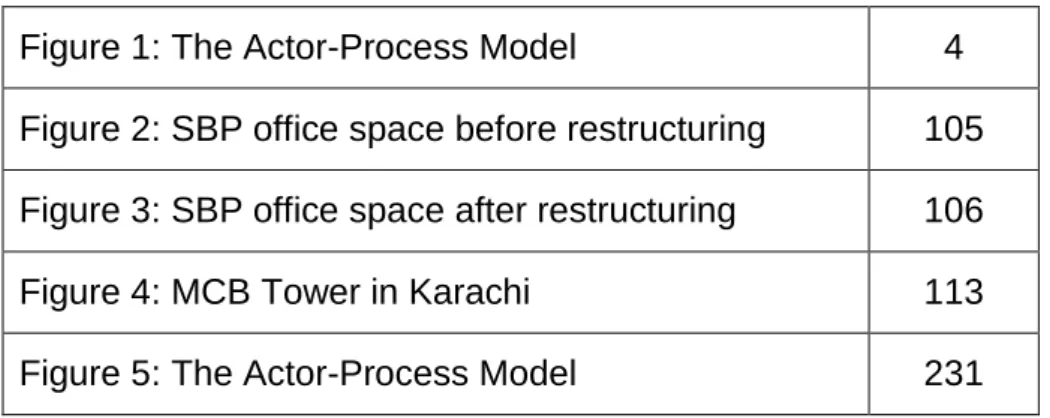
Figure 1: The Actor-Process Model 4
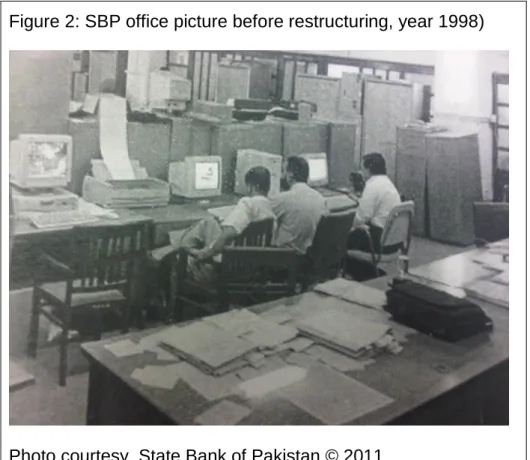
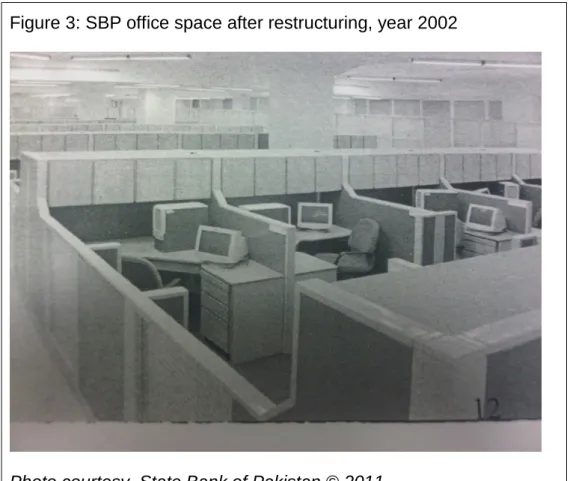
Figure 2: SBP office space before restructuring 105 Figure 3: SBP office space after restructuring 106
Figure 4: MCB Tower in Karachi 113
Chapter 1: Introduction
1.1 Introduction to the ThesisStrategic human resource management (SHRM) is of interest to both academics and practitioners. Strategic integration, detailed formulation and effective implementation of HR policies are all known to play an important role in contributing to effective organisational performance (Brewster and Larsen, 1992; Budhwar, 2000; Boxall and Purcell, 2008). Yet, there are very few studies which look in detail at the role of organisational actors in the strategic HR planning process. Thus, the thesis presents an in-depth investigation of the strategic planning and implementation processes of HR policies. The thesis looks at three particular aspects of the process: integration of HR policies with the corporate and business strategies; HR strategy formulation; and the process through which the HR policies are implemented. The main novelty of the thesis lies in its detailed consideration of leaders, human resource managers and line managers in strategic HR planning. Through an in-depth analysis of the tensions, contradictions and complementarities between these three actors in the HR planning process, the study is able to highlight specific circumstances under which leadership, HR management and line management can contribute positively to organisational outcomes. The thesis puts forward a new model for understanding the role of these three actors in the strategic planning process. The ‘Actor-Process model’ suggests that the process of integration, formulation and implementation of HR strategies is dependent on the way these links are contextualised by the three actors; leaders, HR managers and line managers working within particular workplaces, shaped by institutional, organisational and other cultural conditions.
Much of the literature suggests that effective management and successful policies are created through vertical and horizontal integration (i.e. integration of HR policies with the corporate plans and consistency between HR policies) and implementation of HR policies. However, the literature lacks detailed exploration of these processes and the role that the main actors - leaders, HR managers and line managers - play in the HR strategy and implementation process. There are arguments over the use of best fit
and best practice models but less is known about how HR policies are actually planned (Kim and Wright, 2011) and implemented in the workplaces and who is responsible for these. The existing literature limits the role of top managers to integration, HR managers to formulation and line managers to implementation. There is little acknowledgement that these actors work in a social process and their contextualisation of this may play an important role in shaping these processes. Scholars have called for research to focus on the macro and micro aspects such as; the formulation and implementation of these processes with an explicit focus on how specific HR policies such as recruitment and selection, training, performance appraisals are designed and employee responses to these (Paauwe, 2009; Huselid and Becker, 2011; Truss et al., 2012). Much of the research has also relied on interviews with senior managers or HR managers (Paauwe, 2009; Purcell and Hutchinson, 2007), with little attention given to the views of line managers and non-managers on the realities and contradictions of the processes. Also, HR based research has mainly been conducted in the west hence there is a need to do contextual, HR based research in the developing side of the world (Budhwar, 2012).
Thus, the thesis addresses these gaps through a qualitative study of the three core aspects of HR policy planning; corporate integration, formulation of HR policies and the implementation process with line managers. The aim of the thesis is to explore the following questions:
1) How are HR policies integrated with the corporate strategy and business strategy (i.e. organisation’s mission and goals)
2) How are HR policies formulated, and what is the role of HR managers in the formulation process?
3) How are HR policies implemented by HR and Line Managers
Scholars have called for research to unpack and explore the complexities, tensions and complementarities of the HR processes (Gratton et al., 1999; Paauwe, 2009). Intending to bridge this gap, the thesis adopts a qualitative approach to inquiry. It is suggested that intensive inquiry will lead to the exploration of complex scenarios (Hesketh and Fleetwood, 2006). HR based research has mainly focused on interviews from single-respondents (Becker
and Gerhart, 2006). It is acknowledged that relying on single-respondents such as top managers or HR managers may fail to capture the entire account of the processes (Guest, 2011) hence, the thesis uses multiple sources of evidence to add richness to the data (Winterton and Winterton 1997). In-depth semi-structured interviews are conducted with top managers, HR managers, line managers and non-managers to tap into the realities and complexities of the processes and gain a richer, deeper understanding of these.
The thesis also adds new levels of understanding in the international human resource management literature. Whilst, India and China have gained much popularity in the past few years on research conducted by leading scholars, Pakistan remains under-explored (Chaudhary, 2013). The thesis draws comparisons between five; public, private and foreign banks in Pakistan. Guest (2011) considers the banking sector to be of importance as it is able to reflect accounts from numerous branches. Pakistan’s banking sector has also gone through several reforms. Thus, through this the thesis is able to shed light on the role of various internal and external factors such as culture, context and institutional settings on the HR planning and implementation process in workplaces.
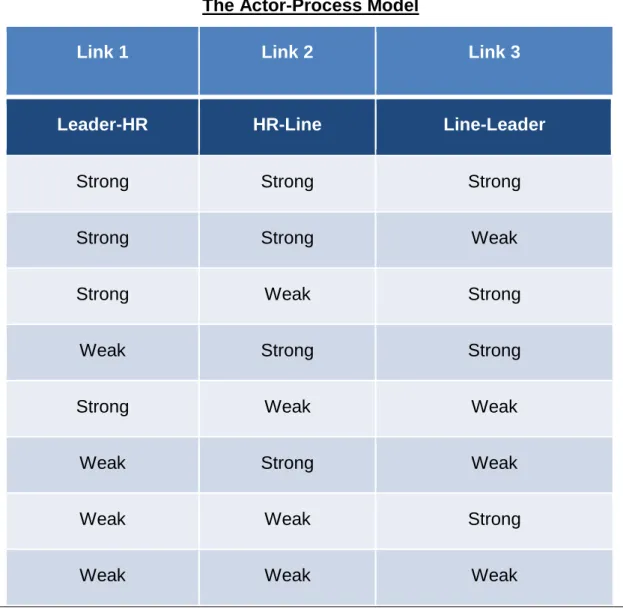
The main conceptual contribution of the thesis is in the elaboration of a new Actor-Process model of HR strategy planning and implementation. Whilst, much of the literature suggests that integration, detailed formulation and implementation are vital for the success of the strategic HR processes, the ‘Actor-Process model’ suggests that the contextualisation of these is dependent on the enactment by the three main actors; leaders, HR managers and line managers. The model presents three links between these actors. The first link: ‘link 1’ is between the leader and HR managers, the second link: ‘link 2’ is between HR managers and line managers and the third link: ‘link 3’ is between line managers and the leaders.
Figure 1: The Actor-Process Model
The main argument is that the combination of these links either being strong or weak, may lead to a possible scenario of the HR strategy planning and implementation process. The thesis presents a matrix of 8 possible scenarios with a combination of these links. For instance, a strong link 1; between the leader and HR managers may lead to corporate and business strategy integration, consideration of HR policies in the overall business plans and providing HR department with a direction to formulate HR policies. A weak link on the other hand, may signify HR feeling lost and lack of integration with HR policies. In similar fashion, a strong link 2; between HR
The Actor-Process Model
Link 1 Link 2 Link 3
Leader-HR HR-Line Line-Leader
Strong Strong Strong
Strong Strong Weak
Strong Weak Strong
Weak Strong Strong
Strong Weak Weak
Weak Strong Weak
Weak Weak Strong
managers and line managers may lead to an integrative policy formulation process. This can be seen as HR managers including line manager’s feedback in the HR strategy formulation process as well as providing support to line managers to implement HR policies. A weak link on the other hand may suggest lack of interaction and communication between the HR and line managers and lack of support from the HR. This may lead to frustrations and tensions on the line, which then may effect HR policy implementation. Lastly, a strong link 3; between the line and the leader may help bind managers with the organisation and its values. A strong link may imply that line managers feel connected with the leader and/or the organisational values. Literature suggests that poorly designed HR policies can be concealed by good management behaviour (Purcell and Hutchinson, 2007). This in effect, is shaped by the top management’s behaviour and organisational culture. Line managers are also seen as pivotal for HR policy implementation. Thus, if this link is strong, it may lead to better implementation of HR policies and employee experiences. If this link is weak, however and line managers do not feel connected to the organisational values or the leadership, then it is likely to result in poor implementation of HR policies and negative employee experiences.
Thus, through a combination of these three links, detailed exploration and insights are presented into these scenarios of HR strategy planning and implementation processes. Through multiple-cases, the thesis is able to explore different scenarios, presenting realities, commonalities and contradictions, between the actors, their relationships and interactions with the process.
The following Chapter, two, reviews the literature surrounding Strategic HRM planning and the implementation process. The chapter first presents with the earlier developments in the field of strategic HRM. It is argued that a fit between HR strategies and business strategies can lead to competitive advantage of the firm. Little attention is, however, given to the way these policies are actually formulated or implemented. Consideration is then given to the applicability of resource-based view as the main theoretical framework in the SHRM literature. Criticisms and concerns are presented by various scholars that question the explanatory power and exploration of the strategic
HRM processes within this. Thus, the chapter examines the concept and definitions of strategic HRM and its core dimensions. There is little consensus amongst researchers over the concept and definition of strategic HRM. However, detailed analysis of the definitions suggest that this mainly consists of two core dimensions; corporate and business strategy integration of HR policies and devolution of these to the line. Furthermore, the chapter considers the HR strategy process. It is argued that coherence between vertical and horizontal integration and implementation, may lead to sustained competitive advantage for the firm. However, more emphasis is given to the processes of integration and devolution, with little attention given to the role of the actors; leaders, HR managers and line managers in these processes. Thus, the chapter explores these three processes; integration, formulation and implementation and the role of actors in this.
The literature concerning these processes contains some notable gaps and lacks detailed explorations. The literature surrounding integration of HR policies present a number of benefits associated of corporate integration with HR policies, but lacks empirical evidence of the vertical integration in practice (Farnham, 2010). Little consideration is given to the absence of vertical integration, and its consequences. The literature also focuses on this to be a top management activity, with no consideration given to the role of line managers. The literature surrounding formulation of HR policies is then considered. This mainly presents text book accounts of the tools available for strategy formulation. Much of the literature focuses on the use of best practice, contingency and configurational approaches however, less is known about how HR policies are actually formulated within firms. There is also little consideration given to understand how HR strategists might be engaged in the formulation process (Truss et al. 2012). Finally, the literature uncovers the implementation of HR policies with line managers. Although a lot of research has centred on the devolution of HR policies however, there is ambiguity over the role of line managers, challenges, benefits and processes that may lead to HR policy implementation. In sum, the literature review identifies some prominent gaps on these processes and the involvement of the three main actors in these. It downplays the idea that HR strategy planning is a social process and that it is likely to be complex with
interactions, contradictions and tensions between the actors that may play a vital role in these processes.
Following the literature review, Chapter three provides a contextual background on the research location – Pakistan. Scholars have suggested conducting research in different parts of the world. Specific attention has been given to the emerging and developing economies. Where, countries such as India and China have garnered most attention; Pakistan – as a ‘Next-11’ country, remains under researched (Chaudhary, 2013). Literature is presented on the unique cultural, economic and business environment of Pakistan. The chapter presents the socio-cultural and organisational context of Pakistan, which suggests that it is likely to have rigid HR policies; influenced by patriarchal approach, high power distance and high levels of bureaucracy. The banking sector context is then presented. It makes an interesting sector to study as it has gone through multiple reforms introduced by the government. Thus, this is expected to reflect and take into account institutional changes in the country and incorporate influences external factors; such as government policy changes, cultural impacts, and competition, may have on organisations. The chapter discusses the emergence of MNCs in Pakistan. Although, there is a scarcity of literature on MNC firms in Pakistan, evidence is drawn from other emerging economies to suggest that the introduction of these, have resulted in increased competition and formalisation of HR policies. Overall, then the chapter suggests that the literature on HRM in Pakistan is generally weak and hence more research is needed to fully understand the context and the impact of these on the planning and implementation processes of HR policies.
Chapter four discusses the methodological approach adopted for the thesis. The aims of the thesis are set out, followed by a methodological framework of intensive research. Philosophical paradigms explaining the ontological and epistemological assumptions are presented. Both quantitative and qualitative methods of inquiry are reviewed. The adoption of qualitative intensive research is considered necessary as the research aims to illuminate controversies, tensions, contradictions and understand the dynamic social processes. Through this discussion and the gaps identified in the HRM literature, the research design is presented based on a
single-industry and multiple case study approach. The adoption of case-study is presented, along with the introduction of the five case-study banks used in the thesis. The narrative justifies the location of the research, both in terms of the banking industry and the geographical location of Pakistan. Data collection strategy is based on semi-structured interviews consideration is given to ethnography and collection of documentary evidence. The thesis adopts a multi-level approach to conduct semi-structured interviews with top managers, HR managers, line managers and non-managers. This is novel, as the current literature lacks detailed consideration of the interaction between different levels of employees. The inclusion of multiple levels of employees also adds to the richness of data and presents the realities of the process under investigation. A detailed account is presented on the data analysis; familiarisation, transcription, and coding. Finally, the chapter discusses the data quality issues, concerning reliability, validity and generalizability.
Chapter five is the first of three empirical chapters and examines in detail the integration of HR policies with the corporate and business strategies. It firstly considers the integration of HR policies with the mission and vision of the organisations. It does this through understanding leaders’ involvement in the process. It suggests how the leaders of the organisations can play an important role in setting the direction for the HR department by aligning HR policies with the mission and vision. This chapter also considers the HR policy changes due to the integration process. It then shows how the integration process may be crucially dependent on the involvement of the leadership and its relationship with HR managers. This contributes to the argument of the first link; link 1 of the actor-process model. Where much of the literature lacks explorations and explanation of the absence of the integration process and the role; other actors may play. This chapter further elaborates on the cases where such integration is missing. The lack of integration was found to be due to the lack of initiatives by the leader of the organisations. Hence, contrary to much of the literature, which suggests that integration is due to the incorporation of business plans with HR policies, the findings suggest that this process is crucially dependent on the recognition of initiatives taken by the leader. Furthermore, the chapter also elaborates
that in case of such an absence, line managers, may play an important role in providing the HR department with a direction to form HR policies.
Chapter, six, addresses the second research question which aims to understand the HR formulation process with HR managers. Huselid and Becker (2011) stress on the need to explore the designing and development of the core HR policies. Thus, the aim of the chapter is to explore the factors, realities and the role played by the actors in the policy formulation process. Much of the literature surrounding HR policy formulation presents prescriptive text-book models; there is little empirical evidence to suggest how HR policies are formulated. The chapter first presents the main factors that led to the creation of some of the policies. The chapter considers the external influences such as market competition, which led to the formalisation and development of HR policies. Furthermore, the chapter considers the development of the four core HR policies; training and development, recruitment and selection, performance evaluation, reward and retention. Through this, the chapter presents the factors considered and the development of these policies in different firms. Evidence from case-studies suggests that HR policy formulation is a complex process and present much variety in the way the policies are formulated. For instance, the local banks were found adopting an opportunistic ‘follow the leader’ approach. Elsewhere, dominant coalition also played an important role in the formulation of HR policies. Policies were also developed over time and considerations were given to the cultural and organisational contexts. Moreover, in some cases the policies were formed through a top-down approach, with the main link between the leader and HR managers. Elsewhere, bottom-up approach was adopted with the involvement of line managers and HR managers. This leads to the argument of link 2; and how it can contribute positively to organisational outcomes. However, in the MNC’s the HR policies were sent by the group heads, with little room for the HR to manoeuvre. Overall, then the chapter suggests this to be a complex process, based on various organisational, institutional and cultural factors. The last empirical chapter, seven, considers the implementation of HR policies: the role of line managers, and non-managers experiences. Literature surrounding the implementation of HR policies mainly relies on
interviews with the HR and line managers. However, this chapter builds on interviews with HR, line and non-managers to unravel some of the tensions and complexities of the implementation process. The chapter first considers the support provided by the HR department to line managers to implement HR policies. The chapter then explores the four core HR policies and their implementation with line managers. Through a detailed analysis of these four core HR policies, the discussion sheds light on the tensions, contradictions and the frustrations of line managers due to the lack of support by the HR department. Contrary to statements of HR managers, line managers suggested little support by the HR. This further leads to work intensification and problems on the line. This may suggest a weak link, between the HR and the line. However, analysis from the other case suggests keenness in the attitudes of line managers for HR policy implementation. Overall, line managers in this case are found more supportive of the HR function than in other banks. Detailed analysis suggests that line managers’ support for the HR department may be dependant on line managers’ involvement in the HR strategy formulation process and the connection between line managers and their leader and organisational values. Overall evidence from this particular case study points to a strong link between the leader/top managers and line managers as well as a link between the line and the HR. Hence, it is argued that these links: link 2; between line and HR and Link 3; between line managers’ and leaders, may lead to better implementation of HR policies. The chapter also explores the employee experiences of the four core HR policies. These were generally found positive in the case where line managers were involved in the strategy formulation process and were connected with the leader. However, in the other cases, non-managers complained of line manager’s bias, favouritism and work intensification. Through this, the chapter draws on the inner realities, contradictions, and tensions between these relationships and their impact on the HR policy implementation.
The last chapter presents the conclusion of the thesis. This draws together the previous chapters. The contribution to the HR strategy planning and implementation process is set out and the role of the actors in the process is made explicit. The sections in the chapter present detailed conclusions on
the three research questions posed and their contribution to the literature is set out. Taken together, the thesis suggests that the processes of HR strategy planning and implementation are dependent on the contextualisation of these by the three main actors; leaders, HR managers and line managers. Synthesising this argument, the chapter presents the ‘Actor-Process’ model with 8 different scenarios based on a combination of three links: link 1; between leaders and HR managers, link 2; between HR and line managers and link 3; between line managers and leaders and/or organisational values. The elaboration of these three links is presented as the main conceptual contribution of the thesis. Different scenarios are presented with the help of the case-studies adopted to argue that the processes of integration, formulation and implementation are dependent on the actualisation of these processes by the three main actors; leaders, HR managers and line managers involved in the process.
Chapter 2: Literature Review
2.1 Introduction
This chapter presents the literature review on Strategic HRM and its processes. The chapter is divided into two main sections. The first section considers the introduction of some of the earlier models in Strategic HRM. At the outset a number of definitions concerning strategic HRM are presented with key concepts introduced. The literature review starts with some of the early assumptions and developments. The chapter first examines the use of some of these models such as hard and soft models, and the resource-based view and their applicability. This is done in order to gain an understanding of the earlier developments in the field and their limitations. The second section is concerned with examining the HR strategy process. Various definitions of SHRM are examined to suggest that that corporate and business strategy integration and devolution of HR activities to the line are considered core aspects. Explicit focus is then given to the three processes; integration, formulation and implementation Consideration is given to the role of top managers in integration, HR managers in formulation and the role of line managers in implementation, the limitations of these are discussed and gaps are highlighted.
Various scholars present a number of benefits of corporate integration, suggesting that corporate strategy integration with HR policies can lead to sustained competitive advantage to the firm. Much of the literature relies on the ‘fit’ or hard approach to HR policy integration with corporate plans. The literature surrounding integration, presents a linear approach to this. It is suggested that HR policies need to be perfectly aligned with the corporate goals and objectives as these will lead to better organisational performance (Truss et al., 2012). There is a scarcity of empirical evidence on the process of integration, how this takes place, and the changes due to this. There is also a lack of literature surrounding evidence based work on how corporate and business strategy integration lead to HR policy changes and who is responsible for this activity. This is followed by the literature surrounding the second research question on the formulation of HR policies with HR managers. As with integration, the literature surrounding formulation
considers this to be a logical, rational process, whilst some authors assume that there is no one best policy a firm can adopt. The Hard HRM model presents a narrow, classical approach for strategy formulation, which assumes formulation and implementation to be separate activities (Truss et al., 1997). It fails to acknowledge that HR strategy formulation is a complex process. There is little empirical evidence on the formulation of HR policies in the organisations. The HR models on formulation mainly present text-book accounts with little consideration given to the actual formulation process within firms, the factors considered and the main actors involved in this. The literature lacks detailed consideration of the formulation and development of specific HR policies. There are arguments over the use of ‘best fit’ and best practice’, but what do organisations do, in order to formulate these HR policies? How are HR managers and top managers actually involved in the process? The literature suggests this to be a HR and top management activity, limits the role of line managers. Hence, within the HR based literature, more consideration is given to the ‘top-down’ approach, than the ‘bottom-up’ approach and empirical evidence of this.
The literature concerning the third research question; implementation of HR policies is then presented. Research presents ambiguity over the role of line managers and how line managers are engaged in the implementation of HR policies. The literature also lacks detailed analysis of core HR policies such as; recruitment, training, performance appraisals their formulation,, implementation and employee experiences. The literature misses out the tensions, contradictions and detailed analysis of the social dynamic of the process and the relationship shared between the line and the HR and the line and non-managers within this process.
Overall, the literature reflects some key gaps within these ‘three research questions’, Moreover, the literature surrounding these three processes of integration, formulation and implementation have categorised the role of top managers in integration, HR managers for formulation and line managers in implementation. There is little mention of these three actors working together in this complex social process. The literature surrounding strategic HRM also ignores some of the complexities, internal and external links, factors of
dominant coalition, and the relationship between the three core actors; leaders, HR managers and line managers.
2.2 Foundations of Strategic HRM
The aim of the thesis is to understand the HR strategic planning and implementation process. The thesis does so by assessing the corporate and business strategy integration with HR policies, HR strategy formulation and the processes through which these policies are implemented.
Firstly, in order to assess these three processes, it is important to understand the early developments and prevalent models in the Strategic HRM literature. Early developments in the field of HRM evolved from the United States in the 1960s when HRM was interchangeably used with the term ‘personnel management’ (Truss et al., 2012). The transition from personnel management to HRM from the 1980s onwards reflected the growing trend of HRM and performance studies that present with various ways and policies to effectively manage the human resources of an organisation. The last two decades centre on the role that people play in the success of businesses, with a growing view that organisational capability is dependent of successful management of people (Gratton et al., 1999). Earlier debates on both sides of the Atlantic centred on several areas addressing debates drawing distinctions between personnel management and HRM (Legge, 1989; Lundy, 1994), incorporation of industrial relations to HRM, examining relationships between business strategies and HRM, and examining the extend of HRM’s contribution towards the competitive advantage of organisations (e.g. Barney, 1991; Tayeb, 1995). More attention was given to the integration and fit between corporate strategies and HR policies with less emphasis on the actual HR policy formulation processes and how these were implemented (Truss et al., 2012).
The first developmental phase in the field is from Fombrun et al (1984). They presented the Michigan Matching Model which highlighted the ‘resource’ aspect of HRM, emphasising that ‘human resource’ like any other resource should be utilised effectively to meet organisational objectives. This means that the human resource just like any other resource has to be sourced as
cheaply as possible, developed and exploited to their full extent (Sparrow and Hiltrop, 1994). This model is also referred to as the ‘Hard model’ stressing on ‘the quantitative, calculative and business-strategic aspects of managing the “headcount resource” in as “rational” a way as for any other factor of production’ (Storey 1992, p.29). Fombrun and colleagues explained a HRM cycle consisting of selection, development, appraisal, and reward to be a correct match between HRM and business strategy.
This hard HRM model presents a narrow, classical approach for strategy formulation, which assumes formulation and implementation as separate activities (Truss et al., 1997). It fails to acknowledge that the HR strategy formulation is a complex process. It presents a linear approach to strategic integration of HR policies and considers that these should be perfectly aligned with the corporate goals and objectives and should be aimed at improving performance (Truss et al., 2012). Where, the HR policies and practices are aligned to the strategic objectives of the organisation referred to as ‘external fit’ and consistent with each other ‘internal fit’ (Hendry and Pettigrew, 1986). This paved way for the ‘strategic-fit’ or ‘contingency models’ in SHRM. It was argued that a ‘fit’ between the corporate and business plans and HR policies, is most important for organisational effectiveness (Boxall and Purcell, 2008). The matching model is also criticised for being prescriptive, with emphasis on ‘tight fit’ between organisational strategy and HR strategy and for missing the human aspect of human resources (Guest, 1987; Legge, 1995). But it provides an initial framework for theoretical development in the SHRM field.
The second influential study is the Harvard Framework (Beer et al., 1984). The Harvard model works as a strategic map to provide a guide to managers in their relations with employees. Compared to the Michigan model, this is a ‘soft variant’ (Legge, 1995; Truss et al., 1997). It focuses on the ‘human side’, focusing on employee commitment rather than control (Wall and Wood, 2005). It is also concerned with the employer-employee relationship. The Michigan model takes into account the interest of different stakeholders for instance, trade unions, shareholders, management, employee groups, government, community and union and how their interests are linked to the management objectives (Budhwar and Debrah, 2001; Truss et al., 2012).
Where the earlier model emphasised control and a ‘fit’ between corporate and business plans, this model was based on the commitment side emphasising that policies can be implemented with a better ‘employer-employee’ relationship. The model also takes into consideration the societal context, so in effect, it does not advocate ‘one-best way’ of managing people but instead a map of the HRM terrain (Truss et al., 2012). Hence, it suggested that policies can be formulated keeping in mind the ‘employee’ perspective as well as matching or fitting with the corporate or business strategy.
The second developmental phase is from the ‘resource based view’ (RBV). Academics are of the view that ‘the resource based view’ has become a dominant theoretical framework in the field of SHRM (Boxall and Purcell, 2008; Marchington and Wilkinson, 2005; Paauwe and Boselie, 2003; Truss et al., 2012) ‘on how human resources and related HR practices can have an effect of firm performance’ (Paauwe and Boselie, 2003 p. 56). The resource-based view of the firm provides a paradigm shift in SHRM, by having a focus on the internal resources of the firm, rather than analysing the performance in terms of the external context, i.e. an inside-out rather than an ‘outside-in’ approach (Golding, 2004). Hence, the focus is on given on gaining sustainable competitive advantage by utilising firm’s unique internal resources effectively and efficiently (Barney, 1991). Although there can be multiple and varied resources available to the firm, researchers emphasise that a resource must meet four requirements in order to generate sustained competitive advantage for the firm (e.g. Barney, 1991; Boxall, 1998; Snell, Youndt & Wright, 1996). Weight et al., (1994) argues that the resource must meet the criteria of inimitability (not easily replicable by competitors), value (i.e. they contribute to the efficiency or effectiveness of a firm), non-substitutability (unique and substitutable resource) and rarity (not widely available).
Scholars argue that the ‘human resource’, constitutes a strong source of sustained competitive advantage, provided the firm is organised to exploit it (Youndt, Snell, Dean and Lepak, 1996; Becker and Gerhart, 1996). Further to this, Delery and Shaw (2001) argue that RBV places emphasis on the role of HR in securing firm competitive advantage and acknowledges the
complexity of the HR system. As organisations evolve, they pick up skills, competencies, abilities and resources that are unique to them; this reflects their particular path through history (Barney, 1995). Hence, a firm’s human resources i.e. employees are specifically trained, specific to its organisation’s culture and network (Paauwe and Boselie, 2003). The formation of human resources and their competencies thus can be subject to numerous decisions and events that lead to the formulation of specific capability that leads to competitive advantage.
The resource based view is criticised for lack of theoretical modelling and lack of predicting the performance of firms over time (Truss et al., 2012). It is also criticised for ignoring the role of the external environment which is vital for a firm’s functioning (Oliver, 1997). It is stated that the RBV ignores the social pressures in which the firms are embedded for example, firm traditions, network ties and regulatory pressures. The inside-out model neglects the ‘importance of the contextual and a Porter-based factor such as market competition, i.e. threats to market entry or new suppliers (Priem and Butler, 2001). There also appears to be an underlying problem with the use of value of ‘rarity’ of resources which lead to competitive advantage. Preim and Butler (2001) argue that both these independent and dependent variables, i.e. the valuable and rare organisational resources and competitive advantage lack clarity, and are referred to as the ‘black box’ dilemma. One important question is related to whether competitive advantage created by successful organisations would be successful in all circumstances (Paauwe and Boselie, 2003) rare ‘resources’ such as human resources can be acquired by competitor firms by offering attractive compensation packages. Furthermore, competitor firms can also create, modify or replicate training structures of the already successful firm. Therefore, formulation of HR policies must not only depend on external competition but also on creating a link between the process of integration and formulation and feedback from the operations. It must also depend on feedback received from multiple levels of employees, working in different departments. Furthermore, links must also be established between the strategic and operational tiers.
Overall, the field of SHRM has seen a growing body of theoretical and methodological sophistication. Earlier models of strategic HRM were mostly based on a strong integration and elements of fit. Little attention was paid to how these policies were formulated (Kim and Wright, 2011) considering various internal and external factors and how these were implemented. The rise of the resource-based view presents that firm’s competitive advantage remains with its human resources and the resource based view provides an important framework to understand how and why SHRM may lead to organisational performance. Yet, there is little insight into how a firm’s employees or the actors working in these processes can lead to competitive advantage for the firm. It is this recognition that is missing in much of the literature. The next section considers the concept and perspectives on Strategic HRM to understand the core dimensions and the strategic HR processes in organisations.
2.3 Concept and Perspectives on Strategic HRM
The previous section considered early developments and theories of HRM. It is understood that earlier notions were based on ‘fit’ with little attention to the implementation of the HR policies. This section now considers the notion of strategy, as it is important to understand the strategy planning and implementation process. It also provides discussion of the main actors involved in the strategy making process. The section then considers the concept of SHRM.
The notion of strategy is subject to a lot of interpretations (Boxall and Purcell, 2008). Early literature on strategic HRM provides little recognition that the notion of strategy requires careful handling. Boxall and Purcell (2008) argue that the definition of ‘strategy’ is of immense importance in the field of strategic HRM. The word ‘strategy’ can be traced back to the Greek word ‘strategos’ which described a commanding role of an ‘army’ (Bracker, 1980 cited in Whitthington, 1993) ‘and the successful deployment and governance of troops (Cunningham and Harney, 2012, pp. 26). Bratton (2003) suggests that strategy can be formed at the three levels corporate, business and specific functional level such as HR or marketing. This, points
to the notion of a ‘senior management’ activity, directing the organisation towards some goals (Legge, 1995) Mintzberg (1994) however, suggests that strategies can be deliberate or emergent. Deliberate strategies are formed keeping in mind the specific intentions of the senior management. Counter perspective from Mintzberg et al (1998) suggests that strategy is not limited to the concerns of senior management. Hence, they can also be emergent, ‘meaning that a convergent pattern has formed among different actions taken by the organisation at that time’ (pp. 111).
According to Mintzberg (1987) strategies are both plans for the future and patterns from the past. Contrary to the traditional planning models, Mintzberg believes that the all strategies are a mixture of deliberate and emergent strategies. However, Tyson (1997) considers all strategies to be emergent in practice. Strategies are strongly influenced by the organisations past history and culture and constantly evolve through new ideas (Quinn, 1980; Tyson, 1997).
It is important to understand whether strategic HRM is the same as ‘human resource management’? Truss and Gratton (1994:666) present the following distinction: ‘we should, perhaps, regard SHRM as the over-arching concept that links the management and deployment of individuals within the organisation to the business as a whole and its environment, while HRM would be viewed as an organising activity that takes place under this umbrella’. Truss and Gratton (1994) regard SHRM as the ‘over-arching’ concept that provides linkage between the management and how individuals are placed in an organisation, leading to the management of people in an organisation in a broad sense (Truss et al., 2012) . This definition, however, deals with the overall perspective on strategic HRM and it is also important to consider what SHRM actually entails. Thus there is no consensus amongst academics on a single definition for SHRM. Therefore, it is important to consider a range of definitions to understand the concept of SHRM and its processes.
Schuler and Walker (1990) define SHRM as a shared activity of human resources and line managers with a set of processes and activities to solve people-related business problems. This definition considers SHRM to be a
shared activity between HR and the line. It also suggest SHRM as a combination of both activities and processes, however, they are mainly directed at solving ‘people-related’ business issues rather than the business issues (Truss et al., 2012). According to Guest (1989) Strategic HRM is concerned with the integration of HR policies into the strategic plans to be accepted by line managers as a part of their everyday work. Guest’s definition is two folds. Firstly, it considers the ‘integration of policies with the strategic plan of the firm, secondly, it places emphasis on line manager’s acceptance of this plan as a part of their everyday work. Where this definition gives importance to the line manager’s acceptance to these, it also limits their level of input ‘in the plan itself’ and secondly it limits the line manager’s role to their everyday work and not overall objectives of the firm or their input in the overall policies.
Boxall and Purcell (2003: 34) define SHRM ‘as the strategies of firms as their particular attempts to deal with the strategic problems they face’. Strategy is thus related to a firm’s choices it makes for its critical success with a specific market context (Boxall and Purcell, 2008). There are characteristic ways in which the managers of firms understand their goals and develop resources both human and non-human to reach them. Some strategies are better than others in the context concerned. Some address the problems of viability extremely well and others are simply disastrous with every shade of effectiveness in between. This definition provides a ‘reactive’ approach to strategic HRM. It considers SHRM as a response to current problems, versus the longer-term goals of the organisation. It also places emphasis on the development and effective deployment of resources in order to reach goals. This definition also considers the organisations to work in an ‘open-dynamic’ system, and consider the organisation to have unique characteristics, whereby, what may work for one organisation might not be true for the other (ibid).
It is, however, important to understand the linking mechanisms through which the organisation, group and individuals interact to be linked to human resource management practices that are in turn linked to organisational performance (Bartram et al., 2007). Brewster and Larsen (1992, pp 411-412) define integration as the degree to which HRM issues are considered as part
of the formulation of business strategy. It presents with two core aspects of SHRM, the first is the integration of HRM into the business and corporate strategy and second is the devolvement of HRM to line managers. On the other hand, Guest (1989) defines strategic integration as an organisation’s ability to integrate HRM issues into its strategic plans in order to ensure coherence within various aspects of HRM and for line managers to incorporate HRM perspective into their decisions. It is argued that both the vertical and horizontal integration are equally important to ensure that HR exists as a coherent system within a particular system strategy (Arthur, 1992; Wright and McMahan, 1992). It also ensures that the HR policies are not created in isolation and is mutually shared with other departmental heads and senior executives. Corporate strategy is defined as integration of corporate’s mission statement and vision with human resource management policies, i.e. involvement of senior management in HR policy creation (Wright and McMahan, 1992). Business or business-level strategy is referred to each business unit with the organisation and their integration with HRM policies. It is asserted that strategic HRM is essentially about integrating HR practices with the business strategy of the organisation.
Hence, to deduce a key goal of Strategic HRM is to ensure that HRM policies cohere both across policy areas and across hierarchies (Guest, 1990). The integration of HRM policies with both corporate and business strategy would ensure that HRM is given a much more central position in any decisions that are made at the strategic and operational level, and reminds policy makers that an investment in people is vital to the organisation (Sheehan, 2005). The second important aspect of SHRM is the ‘devolvement of HRM’ to line managers. Devolvement is defined as the ‘degree to which HRM practices involve and give responsibility to line managers’ (Brewster and Larsen 1992:412).
The chapter presents definitions of the SHRM perspective. This is important in order to understand the core dimensions of Strategic HRM. Although, there is no consensus amongst researchers on the definition and dimensions of Strategic HRM however, it is suggested in the light of the definitions considered that there are two core aspects of SHRM. The first is its vertical and horizontal integration and the second is the implementation of
these with line managers. It is vital that in order to achieve its goals strategic HRM should plan and deploy its policies across these the vertical and horizontal. Further to this definition, it is imperative to consider how the strategic HRM system enacts or is expected to enact within organisations. For this consideration in the next section is drawn to the HR strategy process and how it is developed in the literature.
2.4 HR Strategy Process
So far, the chapter has discussed the theoretical underpinnings of HRM, the foundations, perspectives and concept of Strategic HRM. It was deduced that Strategic HRM comprises two important activities; corporate and business strategy integration and devolution of these to the line. This section will now discuss the strategic HR process and devolution of HR policies to the line.
HR strategies are essentially plans and programmes that are engaged in solving basic strategic issues related to the management of human resources in organisation (Schuler, 1992). Grattan and Truss (2003) present a ‘three dimensional model’ to understand the fundamental purpose of an HR strategy. The main function of an HR strategy is to effectively manage people in order to achieve organisational outcomes. They define this to be a ‘strategy with its underpinning policies and processes, that an organisation develops and implements for managing its people to optimal effect’ (p.74). According to them there appears to be no one single ‘ideal type’ of people strategy that can have a set of HR practices and policies that can be adopted by the firm to manage their employees more strategically. In other words, there does not appear to be universal or best HR practices that the firms can adopt for effective results from employees. This is a critique for the ‘universalist approach’ which is based on the assumption that there is ‘one best way’ of managing employees to improve organisational performance (Boxall and Purcell, 2008).
Gratton and Truss (2003) suggest that HR strategies must vary according to organisational circumstances. In their three dimensional model, they present ‘vertical alignment’ between people strategy and business goals; ‘horizontal
alignment’ between individual HR policy areas and finally an ‘action’ or ‘implementation stage’ (p.75). The word ‘align’ is of significance here, as it is being differentiated from ‘fit’ (Wall and Wood, 1999). ‘Fit’ is referred to as the relation between two ‘discrete entities’ whereas, alignments refers to a more ‘fluid dynamic’ that can allow variation and flexibility (Gratton and Truss, 2003). Their argument is that in order for HR policies and practices to work, they should reflect, reinforce and support the overall business aims and objectives.
Further to this, Farnham (2010) suggest that vertical and horizontal integration are key concepts in the ‘development and implementation of HR strategy’ (p. 194). Furthermore, where vertical integration is dependent on alignment of business and corporate strategy, horizontal integration uses elements of political, social, economic and legal forces (Farnham, 2010). Horizontal alignment is concerned with the internal consistency and coherence of the firm’s HR policies (Gratton and Truss, 2003). Furthermore, it is argued that the personality of the CEO can have an influence on the strategy process. Top managers should be able to motivate and align behaviour with the desired culture of the organisation (Cunningham and Harnery, 2012), which can lead to vertical and horizontal integration. The main aim is to achieve a coherent and consistent approach to manage people that influence all the other activities of the HR function along with the other organisational functional areas at policy level.
The third dimension is ‘action’ stage, which is also considered the most important stage. According to Gratton and Truss (2003), the translation of HR policies into practice is absolutely fundamental as it ensures whether the organisation is delivering the policies it has documented. The action dimension has two aspects. The first is concerned with employee experience of the HR policies and the second is concerned with the behaviour and values of the managers while they implement the policies. Where the first one deals with the policy being turned into action, the second, deals with the body language and attitudes of managers towards these policies.
In an ideal situation, these three dimensions; vertical, horizontal and action would be perfectly aligned together, however, if even one or two of these are
misaligned, then it will disturb the whole process. This model covers different aspects of SHRM, together these three stages; horizontal, vertical and action, create a synergistic effect. Considering theoretical analysis and the definitions it can, however, be suggested that these mainly rely on the integration and implementation aspects, neglecting formulation stage of HR policies. Furthermore, the three dimensional model, offers useful insight to understand the strategies organisations make in order to manage their employees.
In summary, it is deduced that the concepts of vertical and horizontal integration, strategic formulation of HR policies and implementation or action stage of HR policies are extremely important. As argued in the Gratton and Truss (2003) three-dimensional model, that a successful HR strategic process is dependent on the perfect alignment of vertical, horizontal and implementation phases. The role ‘actors’ play is not, however, in the binding of the process emphasised. The three dimensional model sheds light on the process and the importance of having strong vertical and horizontal integration and implementation. The three dimensional model also builds to provide a realistic roadmap for organisations to understand where additional work is needed. But, what happens if there is weak vertical integration, and weak implementation? What are the main factors behind this? How can an organisation act to resolve this? What is the role of the actors in the process? How can the relationships between the actors influence the process?
Organisations are multi-level systems and each organisation will have their own criteria for vertical and horizontal integration and implementation. To create competitive advantage, however, each organisation must capitalise on the capabilities that are customised according to that organisations scenario. Although there is some mention of top managers, HR managers and line manager’s involvement in the process of vertical and horizontal integration and in the action stages. It is vital, however, to understand that the process of vertical, horizontal integration and action may be dependent on the role these actors play in the process and their relationships and interaction with each other. It is this acknowledgement of these core ‘actors’ that seems to be missing in much of the literature surrounding Strategic
HRM. Additional work is needed to understand the role these actors play in the success of HR policy planning and implementation process. For instance, the three dimensional model suggests different scenarios based on the combination of the processes of vertical, horizontal and action stages. The processes, however, may be dependent on the actors and their relationships with each other in the process.
The next sections considers literature surrounding these three processes of and debates surrounding integration, formulation and implementation and the actors involved in the processes.
2.5 Corporate and Business Strategy Integration
Following on from the earlier developments, the core aspects and the processes of strategic HRM, this section addresses the first research question; corporate and business strategy integration with HR policies. Corporate and business strategy integration is also referred to as vertical integration. Some of the earlier developments on this were discussed in the previous sections 2.2 and 2.3. This section will provide a detailed focus on the literature surrounding the concept of corporate integration, empirical evidence surrounding this, and the involvement of top management in the process as well as the prominent gaps.
Integration is an important aspect of SHRM. Farnham (2010) suggests that corporate and business strategy integration is vital for the implementation of HR policies. The integration of HRM policies with both corporate and business strategy would ensure that HRM is given a much more central position in any decisions that are made at the strategic and operational level and reminds policy makers that an investment in people is vital for the success of the organisation (Sheehan, 2005). Lawler and Mohrman (2003) advocate HR’s presence at top strategic level by making explicit the human capital resources required to support various strategies and strategic initiatives by playing a leadership role in helping organisation develop the essential capabilities to enact the strategy and play a vital role in the implementation and change management process. Senior executives are also taking more interest in the utilization of human resource due to the
changing organisational context, which has reflected the rise of globalisation, complexity, market competitiveness and the use of information technology (Inyang, 2010).
Scholars have emphasized the need for HRM to become a strategic business partner and have highlighted a number of benefits associated with the integration of HRM with corporate and business strategy (e.g. Lengnick-Hall and Lengnick-Lengnick-Hall, 1988; Purcell, 1989; Storey, 1992; Truss et al., 1997). It is asserted that the integration of HRM into corporate strategy can provide a number of benefits such as problem solving for organisational performance, equal consideration to employees working at different levels and achieving sustained competitive advantage (Purcell, 1989; Truss et al., 1997; Budhwar and Sparrow, 1997). Top managers along with HR specialists can integrate HR policies with the external and internal environment, overall mission and goals of the organisation. The involvement of HR managers during this stage can be a key aspect. It can open avenues to become members of senior or top management in the organisation (Budhwar, 2000) and also prove to be beneficial at the formulation and implementation stages of HRM (Inyang, 2010).
HRM integration requires broad support from areas elsewhere in the organisation. With respect to HRM integration with organisations decision making processes, it has been argued that HR personnel’s representation on the board of directors or at the senior committee level is critical for appropriate input (Poole and Jenkins, 1997; Shipton and McAuley, 1993). Such representation is also considered to be important in the development of internally consistent and strategically focused HRM policies and practices (Budhwar, 2000). It is asserted that HR managers need to be a part of the strategic planning mechanism in order to match the internal fit between HRM policy areas and the strategic business initiatives developed at the senior committee level (Sheehan, 2005). Senior HR directors contribution to the strategic decision making process can lead to a more effective HRM policy design (Poole and Jenkins, 1997).
An important issue for senior management is to evaluate the extent that corporate strategy is integrated with HR policies. This can be evaluated by a