Deposit Insurance Coverage
Discussion Paper
Prepared by the Research and Guidance Committee
International Association of Deposit Insurers
C/O BANK FOR INTERNATIONAL SETTLEMENTS CENTRALBAHNPLANTZ 2, CH-4002 BASEL, SWITZERLAND
TEL: +41 0 61 280 9933 FAX: +41 61 280 9554
WWW.IADI.ORG
Table of Contents
I. Executive summary ………..………2
II. Introduction……….……….….6
III. Types of coverage ……….………..………..6
IV. Setting the coverage level/limit……….……….8
V. Scope of coverage……….………15
VI. Adjustment of coverage limit……….………..…..18
VII. Cross-border issues ……….………..……….…23
VIII. Communicating coverage level/scope……….………...26
IX. Concluding remarks ………..……….……....28
References ……….……..……….…….………….29
Annex i ……….……..…31
I. Executive
Summary
The International Association of Deposit Insurers (IADI) was established in 2002 to “contribute to the enhancement of deposit insurance effectiveness by promoting guidance and international cooperation.” As part of its work, IADI undertakes research to suggest guidance on deposit insurance issues.
This paper reviews issues in the determination of the level and scope of deposit insurance coverage and suggests guidance in the form of Core Principles and Supporting Guidance Points. Key areas addressed include the setting of coverage level, scope of coverage, setting of coverage level, scope of coverage, adjustment of coverage limits, cross-border issues, coverage of retirement and pension funds, and the emergence of new financial instruments. The importance of effective communication of deposit insurance coverage is also stressed.
The guidance is designed for deposit insurance practitioners and other interested parties, and is based on the judgment of IADI members, associates, and observers. The paper also draws on relevant literature on the subject.
A.
Definition of Key Concepts
The following are the key terms and their definitions as used in the paper: Bank Run is a rapid loss of deposits precipitated by fear on the part of the public that a bank may fail and depositors may suffer losses.
Blanket Coverage/Guarantee is a declaration by the government that all deposits and perhaps other instruments will be protected.
Co-insurance is an arrangement whereby depositors are insured for a pre-specified portion, less than 100% of their insured deposits, thereby requiring depositors to bear part of the loss in the event of bank failure.
Criminal Deposits are deposits arising out of transactions in connection with which there has been a criminal conviction for money laundering.
Cross-Border issues are those related to banks operating branches in other jurisdictions or providing services to customers in other locations abroad. Deposit is the unpaid balance of money received or held by bank and/or any authorized intermediary from or on behalf of a person in the usual course of deposit-taking business for which the bank or the institution is obliged to repay on a fixed day or on demand by that person or within a specified
period of time following demand by that person, including any interest that has accrued or which is payable to that person.
Foreign Deposits are deposits in foreign currencies in a domestic bank. Full Coverage is a guarantee that all depositors or deposits are protected 100%.
Government Deposits are deposits belonging to all tiers and arms of government.
Indexation: This is the adjustment of long-term contracts, such as, insurance contracts, to take account of inflation. Indexation removes some of the distortions caused by continuing inflation.
Indexed Coverage: This is the limited coverage level determined by the inflation rate (or some other relevant measure of price inflation) of a country. Insurable/Eligible Deposits are the types of deposits that are covered by deposit insurance scheme.
Insured/Guaranteed Deposit refers to the exact amount of deposit that a depositor is obliged to receive from the deposit insurance agency in the event of bank failure.
Inter-bank Deposits refer to deposits that banks lodge in other banks in the same system.
Insiders’ Deposits are deposits of significant owners1, officers, directors,
auditors and closely connected parties of the member institutions.
Joint Account is an account opened in the names of two or more persons or over which two or more persons have rights that may operate against the signature of one or more of those persons.
Limited Coverage is a guarantee that the principal and/or the interest accrued on insured (protected) deposit accounts will be paid up to a specified limit.
Market Discipline The act of depositors and creditors monitoring and influencing bank risk-taking activities.
Moral Hazard is the incentive for excessive risk-taking that is often present in insurance contracts and it arises from the fact that parties to the contract are protected against loss.
1 Significant owners are defined as those with at least 5% shareholding with a member
Systemic Crisis is a risk where a bank(s) failure has implications for the general health of the financial system and can have serious adverse implications for financial stability and overall economic conditions.
B.
Suggested IADI Guidance
The following IADI Core Principles and Supporting Guidance Points are intended to promote the sound determination of deposit insurance coverage for countries that are establishing or enhancing a deposit insurance system. The guidance is reflective of and can be adapted to a broad range of settings, circumstances, and structures.
Core Principle: Coverage
Policymakers should define clearly in law or by private contract what is an insurable deposit. The level of coverage can be set through an examination of relevant data. Whatever coverage level is selected, it must be credible and internally consistent with other deposit insurance system design features, and cover adequately the large majority of depositors in order to meet the public-policy objectives of the system. Coverage limits may need
to be adjusted periodically because of inflation and other factors.2
Supporting Guidance Points
1. The level of coverage should be limited. Coverage limits should be consistent with the public policy objectives of the deposit insurance system and should be based on the following principles: maintain depositors’ confidence and enhance macroeconomic and financial stability of the banking system; do not unduly tax or overburden the banking system; and protect the majority of depositors.
2. The deposit insurance system should conduct a detailed study of the deposit profile of member banks in the country to determine the appropriate coverage limit.
3. In setting the coverage level/scope in a particular country, the stage of development of the financial system should be considered. If the flow of funds among neighboring countries is significant, it is advisable to consider the coverage levels in those countries and the competitive implications. 4. To avoid policy-induced competitive distortions, depositors in all member banks should be subject to the same coverage limit.
2See IADI Core Principles for Effective Deposit Insurance Systems, Principle #9, International
5. In adjusting the coverage limit, it is an effective practice for the deposit insurer to take into account inflation, changes in real income, the composition and size of deposits, stakeholder expectations, the development of new financial instruments, additional funding requirements, and other factors that could affect the public policy objectives of the deposit insurance system.
6. In implementing an indexing system for coverage limits, the deposit insurer should consider the timing and frequency of adjustments. The timing can be set to reflect factors such as changes in the size of the financial market, the growth of real income, and inflation. Adjustments should not be made so often that they confuse depositors or undermine the credibility of the deposit insurance system.
7. To qualify for deposit insurance coverage, the ownership, nature, and purpose of a financial instrument (either existing or new) must be easily determined. If this information cannot be easily established, extending coverage to an instrument might be incompatible with the broad public policy objectives of the deposit insurance system.
8. If foreign currency deposits are widely used in a country, it is an effective practice to insure them. To avoid foreign exchange risk in the event of bank failure, holders of foreign currency deposits may be compensated in the local currency.
9. If the host country deposit insurance system provides supplementary coverage for foreign bank branches, multiple reimbursements of insured depositors should be avoided. The deposit insurance provided by the home country system should be part of the calculation of levies and premiums. 10. If a foreign bank participates only in the host country’s deposit insurance system, it is generally an effective practice to determine coverage according to the host country system’s regulations.
II. Introduction
Coverage is a fundamental issue in designing a deposit insurance system. Coverage can be classified into two broad aspects: scope and level. Scope is concerned with the eligibility for coverage of deposit instruments, institutions, and depositors, while level addresses the amount of deposits to cover; that is, the coverage limit.
This paper provides practical advice on setting and adjusting scope and coverage limits. It was prepared by the IADI Subcommittee on
Developing Guidance for Deposit Insurance Coverage.3 The subcommittee
drew on country experiences for practical insights into how coverage issues are being handled. Information was obtained from a survey designed for the study, the experience of subcommittee members and from other secondary
sources.4 The paper offers guidance on appropriate coverage limits, insurable
deposits, and depositors to be covered, and on challenges posed by cross-border transactions and new developments in the financial market.
III. Types of Coverage
The literature identifies three levels of coverage: blanket, full, and limited/partial.5
A. Blanket
Coverage
Blanket coverage offers full protection to both depositors and creditors. It is usually applied during a systemic banking crisis that threatens the payment system. The objectives of blanket coverage are to strengthen the confidence of depositors and the general public in the banking system, prevent bank runs and capital flight, and give authorities time to implement
resolution strategies.6The funding requirement to finance blanket coverage is
likely to be beyond the ability of a deposit insurer—government often
intervenes to provide standby funding through the treasury. T
o minimize
the ill effects of blanket coverage (particularly those associated with
moral hazard), implementation requires broad and credible
restructuring plans.
3 The Subcommittee on Deposit Insurance Coverage was composed of representatives from
Nigeria (chair), Jordan, Kazakhstan, Malaysia, Mexico, Taiwan, Turkey, and Uruguay.
4 Nine countries (Brazil, Canada, France, Jordan, Kazakhstan, Malaysia, Taiwan, Turkey, and
the United States) responded to the survey conducted for this study. The survey instrument is attached as annex I. Additional data were obtained from Demirguc-Kunt, Karacaovali, & Laeven (2005) and Hoelscher, Taylor, & Klueh (2006), which provide the most current and comprehensive global information on deposit insurance systems.
5 Afolabi, 2004. 6 Sandararajan, 2000.
B. Full Coverage
A full coverage system protects all depositors 100 percent and largely protects the system against bank runs. Full coverage lowers depositors’ incentive to withdraw funds from financially insolvent banks; it allows a bank to weather a storm more successfully and enables authorities to intervene with greater ease. From the point of view of stability, full protection is preferred. It is especially effective in preventing overreaction to rumors by small or naïve depositors.
However, full protection can erode market discipline and heighten the problem of moral hazard. And even with full coverage, depositors might withdraw their money from a failing bank because of the inconvenience and
temporary liquidity problems associated with having deposits blocked.7 Thus,
full protection reduces but does not eliminate the motivation for a run on a bank, and it can interfere with the workings of the financial market. In addition, the ready availability and greater efficiency of two other components of the safety net (the lender of last resort, and regulation and supervision) make full coverage less relevant.
C. Limited/Partial
Coverage
Limited/partial coverage protects deposits only up to a certain amount or a proportion of the account balance. This is the favored practice when the public policy objective is to protect small deposits (sometimes referred to as “household deposits (or retail deposits). Limited coverage provides a meaningful amount of protection against contagious bank runs and preserves market discipline by exposing large depositors to potential losses.
But although the literature identifies three levels of coverage, in practice, no deposit insurance system (DIS) adopts blanket or full coverage,
so there is only one choice: limited/partial coverage.8 This coverage can be
set high or low, depending on the public policy objectives. If the objective is to ensure banking stability, high or relatively generous coverage limits are an attractive option (without compromising the need for incentives for wealthy and sophisticated depositors to exert market discipline). If the objective is to protect small depositors and reduce the moral hazard associated with insurance, low or less generous coverage limits are preferred. Thus, coverage
limits should be set at levels consistent with the objectives of the DIS.9 In a
7 Financial Stability Forum (FSF), 2001; Afolabi, 2004.
8 Garcia (2000) says the DIS should not interfere with the workings of the financial market by
providing unlimited protection of depositors, especially large depositors. She suggests a cap on the amount that can be insured. The cap will avoid giving large depositors the impression that they can ignore the soundness of their banks.
period of financial crisis that threatens a nation’s payment system, the government may consider intervening to provide blanket coverage.
IV. Setting the Coverage Level/Limit
A. Basic
Considerations
The ultimate purpose of the deposit insurance system determines the coverage limits—the limits should synchronize with the public policy objectives of the DIS, which are typically to protect small and unsophisticated depositors and to contribute to financial stability. Coverage limits should be set to have the least possible negative impact on the normal operation of the financial system; they should be credible and internally consistent with other design features of the DIS.
Three basic principles can be used to set coverage limits:10
1. The coverage level should maintain depositor confidence and enhance the macroeconomic and financial stability of the banking system. Insuring depositors’ funds is a way to sustain their confidence in the banking system, and the level of confidence is related to the amount of coverage. Enhanced depositor confidence often leads to increased savings, which means a steady inflow of funds to the bank. This inflow, in turn, maintains the stability of the banking system and enhances its capacity to perform its role of intermediary. Thus, an adequate DIS coverage level is critical to a country’s financial and macroeconomic stability, which is a prerequisite for sustainable economic development.
2. The level of coverage and cost of premiums should not unduly burden the banking system, nor should deposit insurance be subsidized by public funding. All other things being equal, there is a direct relationship between coverage level and the premiums paid by participating institutions: the higher the coverage level, the higher the premiums. But the cost of deposit insurance should not be so high that it endangers the profitability or solvency of the banking system. Unduly high premiums could threaten the soundness of individual banks and the stability
of the banking system.11 Relying on the government to support a higher
coverage level creates a fiscal burden for the government. In addition, funds might not always be available or budgeted, which will impair the effectiveness of the DIS and have a negative effect on the system’s credibility. Thus, in setting coverage limits, policymakers must consider the funding requirement of the system as well as sustainable sources for these funds.
10 Sabourin, 2005. 11 Sabourin, 2005.
3. Coverage should protect the majority of depositors. Striking the right balance between coverage limits that are too low and those that are too high is critical. A limit that is too low cannot fulfill the main objectives of the DIS; a limit that is too high will encourage participating banks to take more risks, which may lead to moral hazard. The limit should be low enough to encourage large depositors and sophisticated creditors to discipline banks, either by demanding a higher risk premium from weaker banks or by
refusing to patronize them.12 Coverage limits must be sufficient to cover
most depositors and prevent destabilizing bank runs, but not so high that they eliminate market discipline.
B.
Setting the Initial Coverage Limit
To determine the level of coverage, policymakers must first gather data on the financial instruments held by the population; that is, the number of accounts and their size distribution. These data will allow policymakers to determine what proportion of accounts and total deposits would be covered at various levels, so they can set a limit that will protect most depositors. A representative sample of deposit accounts across the participating institutions can produce the necessary information at a relatively low cost. However, depositors often hold multiple accounts at a given depository institution. Gathering data for depositors, which would, in effect, aggregate multiple accounts for individual depositors would require additional effort. The necessary information, in principle, could be obtained from the banks or through a survey of the population, although in some countries, this might either not be feasible or produce accurate data. To track trends, information on holdings of financial instruments could be repeated every few years.
Policymakers can use these data to arrive at a coverage limit that will be consistent with the objectives of the DIS—to promote depositor confidence and contribute to financial stability. The optimum coverage limit is one that covers a proportion of depositors and deposits beyond which the
benefits accruable to small depositors are negligible.13 A limit that covers at
least 80 percent of depositors and 20–40 percent of total deposits is
considered adequate.14 Hoelscher and colleagues (2006) say that in a
jurisdiction where the objective is to protect small-scale depositors, and where deposits are distributed between a large number of relatively small deposits and a small number of very large deposits, a limit that fully covers 80 percent of the depositors and 20 percent of total value is adequate. A DIS that emphasizes financial stability might aim to cover more depositors and,
especially, a higher proportion of total deposits.15 Some empirical studies
12 Garcia, 1997.
13Monetary Authority of Singapore, 2002.
14 Rule of thumb accepted at the First Annual Conference of the International Association of
have found that for most jurisdictions, deposits are distributed between a large number of relatively small deposits and a small number of very large deposits. Beyond 85 percent, the marginal increase in the proportion of fully
covered depositors is negligible.16 Additionally, because of the substantially
higher balances of the top 20 percent of depositors, the marginal benefits of
extending DI coverage to them will not accrue to small depositors.17
Another guide for determining optimal coverage is how closely it conforms to a uniform measure across countries. One suggestion is to use a percentage of per capita gross domestic product (GDP), although Hoelscher and colleagues (2006) describe this factor as a mere statistical ratio that “is
not…a desired design feature.”18 In fact, this ratio can be misleading and its
use as a yardstick should be discouraged. First, the number is based on averaging data results from the May 2001 International Monetary Fund (IMF)
survey.19 Second, countries do not share the same characteristics with
respect to their financial systems or the same objectives for their deposit insurance systems—the per capita distribution of GDP in one country cannot easily be compared with that of another country to set one level of insurance coverage.20
Setting coverage limits is a country-specific process. For example, a coverage level of twice per capita GDP might be adequate for Country A; Country B may have a similar per capita GDP but a different income distribution, so the same coverage levels would produce different results. Moreover, the definition of “small depositor” varies by country and may not be captured by a single parameter such as GDP level. And countries that are very similar might have very different objectives for their systems.
Figure 1 shows deposit coverage as a proportion of per capita GDP in
each of the continents.21 It illustrates the great variation among countries in
different continents that had adopted formal deposit insurance systems as of 2000.
15 Hoelscher et al., 2006.
16 Survey results regarding deposits and depositor profiles for all banks and finance companies
in Singapore in May 2001 show that the proportion of fully insured depositors in participating institutions increases with higher coverage limits, but the marginal increase is negligible after about 86 percent of depositors have been fully covered (Monetary Authority of Singapore, 2002). The Nigeria Deposit Insurance Corporation (NDIC) survey of 2004 had similar results (NDIC, 2004).
17 Monetary Authority of Singapore, 2002. 18 Hoelscher et al., 2006, p. 14.
19 Sabourin, 2005. 20 Afolabi, 2004.
Figure 1
Deposit Coverage Per Continent
1 1.5 2 2.5 3 3.5 4 Un-weighted average deposit coverage/per capita GDP
Source: Sandrarajan (2000)
According to figure 1, only in Europe was the maximum insurance coverage level below twice per capita GDP. This is largely a reflection of the public policy objectives of European systems, which are primarily to protect small depositors and limit moral hazard. It may also reflect the fairly even income distribution in most European countries.
For all other continents, the un-weighted maximum deposit insurance coverage level went over the benchmark, reflecting the circumstances of individual countries and the policy objectives of their systems. In 2000, maximum coverage as a percentage of per capita GDP was in the following ranges:
- Europe 0.41 in Luxembourg to 6.11 in Norway
- Americas 1.17 in Venezuela to 9.50 in Peru
- Asia 2.28 in the Philippines to 5.53 in Bangladesh
- Africa 1.48 in Nigeria to 7.48 in Uganda
- Middle East 6.31 in Oman to 8.14 in Jordan
These ranges further illustrate the country-specific nature of determining coverage limits. For example, it cannot be concluded that the
Europe World Asia Africa Americas Middle East
coverage level of about twice per capita GDP in the Philippines was more adequate or appropriate than the coverage level of about eight times per capita GDP in Jordan. Similarly, the 2003 coverage level of 489 times per
capita GDP in Mexico22 could not be judged inferior or less adequate than
that of Portugal (twice per capita GDP).23 The levels merely reflect each
country’s circumstances and policy objectives.
These circumstances may be due to factors such as the macroeconomic and financial system conditions in a country, inflation, exchange rate regime, GDP growth rate, income distribution, deposit structure in member institutions, or the need to minimize opportunities for arbitrage among different deposit insurance systems, especially in neighboring countries. Other factors are the political environment, the state of the banking system, the age of the DIS, and the awareness level of the populace. Laeven (2004) shows that deposit insurance coverage is significantly higher in countries where poorly capitalized banks dominate the market and where depositors are poorly educated. He does not find that coverage is significantly related to proxies for the general level of
institutional development, such as per capita income.24 Any or all of these
factors might have affected the insurance coverage reported in figure 1 and in the discussion.
C.
Other Factors to Consider in Setting the Initial Limit
Policymakers should also consider institutional and cultural factors such as a country’s financial environment, development, and legal framework, and the cultural behavior and beliefs of depositors. These variables differ from one jurisdiction to another and are likely to affect small depositors. Institutional and cultural factors influence tolerance for risk as well as depositor reactions to adverse financial news and economic shocks. For example, in some Asian countries, the public can readily tolerate losses from personal investments but not from deposits. Before a lower coverage limit could be implemented in these jurisdictions, financial education and enhancement of the system of financial supervision and information
disclosure would be needed.25
It is helpful to consider coverage limits in countries that are in a similar phase of development of the financial industry or culture. Coverage
22 The relatively high coverage level in Mexico in 2003 reflected the desire to stabilize
depositor confidence in the banking system as the country began a transition from blanket coverage to limited coverage. From 2003 onward, guaranteed obligations, including coverage levels, have been narrowed; in March 2007, the ratio of the coverage limit to per capita GDP was 17.57.
23 See table 3 of annex II for coverage ratios of selected countries in 2003. 24 Laeven, 2004.
limits in neigboring countries also are important, especially if the cross-border flow of funds is easy. Neighboring nations’ coverage should be similar
to minimize deposit flights to countries with higher limits.26
D. Co-insurance
Some countries have adopted co-insurance mechanisms that require
insured depositors to bear part of the loss in a bank failure.27 This approach
can encourage people to make more prudent deposit decisions28 and to
monitor bank risk taking. But co-insurance can also trigger a run on a bank— because transferring funds among banks is virtually free and even the
prospect of a small loss can be enough to encourage a run.29 The failure of
Northern Rock PLC in September of 2007 illustrates some of the serious problems with using co-insurance. Setting the coverage level at a sufficiently high fixed amount rather than a proportion of deposits as used in co-insurance systems ensures that depositors know the coverage limit with certainty and reduces incentives to run. Even in advanced economies, this approach can enhance the stability of a DIS without compromising market discipline.
E.
Extent of Coverage
Limits can be applied on accounts or depositors. Account limits may not help reduce moral hazard, as a depositor could easily circumvent the limit by opening numerous accounts in a single bank for an amount equal to or below the insured limit. Also, the funding requirement to implement coverage limits on an account basis might be prohibitive for the DIS and, by extension, for the participating institutions. Coverage limits can be applied to a depositor (natural or legal person) on a per bank basis or across all banks that are members of the DIS. Applying the limit across all banks would enhance market discipline, but aggregating deposits for each depositor across all banks makes the system costly and administratively cumbersome, and reduces opportunities for depositors to diversify their risk among member banks. Thus, in most jurisdictions, coverage limits are applicable on a per depositor, per institution basis.30
26 For example, Mexico and Canada considered U.S. coverage limits when they
established/reviewed their own limits.
27 In 2004, co-insurance existed in 24 countries out of 88 that practiced explicit DIS (see table
1 in annex II for a list of these countries).
28 Demirguc-Kunt et al., 2005; Hoelscher et al., 2006. The Northern Rock crisis of September
2007 in the United Kingdom showed the ineffectiveness of co-insurance in preventing bank runs.
F.
Level of Coverage for Different Institutions
In jurisdictions where different categories of institutions/deposits are covered, different coverage limits may be in effect. Unfortunately, this arrangement does not provide a level playing field. To avoid policy-induced competitive advantage for some depository institutions over others, many jurisdictions apply the same limit to all depositors in each category of institution.31
G. Extension of Coverage Limit
Although the coverage limit set by a DIS is usually a fixed amount or a given proportion of deposits up to a certain limit, it can be extended by providing separate coverage under certain circumstances without compromising policy objectives. For example, in some countries, holders of joint accounts and deposits held in trust are individually considered for the
purpose of calculating their insured claims in the event of bank failure32. The
objective is to increase public confidence in the banking system and enhance the credibility of the DIS.
H.
Coverage Limit and Systemic Crisis
In a systemic banking crisis, the insurer is under intense pressure because typically multiple institutions and many depositors are affected and the deposit insurance fund may be inadequate. Stakeholders, especially depositors, expect the government to step in to restore confidence in the banking system. In this situation, strictly adhering to the maximum insurance limit might not instill confidence. To keep deposits in the banking system and protect the nation’s payment system, many countries have
instituted temporary blanket guarantees during periods of economic crisis.33
Where blanket coverage has been instituted, the transition back to limited/partial coverage should commence as soon as the macroeconomy
30 Of 88 countries practicing explicit DIS in 2003 and 2004, 66 used payment per depositor
per institution (Demirguc-Kunt et al., 2005; Hoelscher et al., 2006). The practice is acknowledged and stipulated in EU Directive 94/19/EC of May 1994.
31 Jurisdictions such as Brazil, Canada, France, Jordan, Kazakhstan, Malaysia, Taiwan, Turkey,
and the United States, among others, offer same level of deposit insurance coverage for different categories of participating institutions. In Nigeria, mainstream banks offer higher coverage limits than do other deposit-taking institutions.
32 Malaysia, Nigeria, Taiwan, and the United States are some of the jurisdictions where
separate coverage up to the permitted limit is provided for joint accounts and deposits held in trust.
33 Blanket coverage had been adopted by some countries (e.g., Ecuador, Honduras, Japan,
Korea, and Turkey) during periods of financial crisis. After the crisis, each of these countries transitioned back to limited coverage.
stabilizes. A sound legal regime and an effective disclosure regime are also necessary. A smooth transition back to limited coverage requires the following: a well-structured mechanism to reduce the blanket guarantee; a time frame for the transition that takes into account possible effects on public confidence and the ability to achieve policy objectives; an appropriate
funding mechanism; and new coverage limits that are well understood.34 The
process from blanket guarantee to limited coverage (sequence of events, timing, coverage level, eligible deposits, and public awareness) should be well articulated, widely publicized and effectively implemented to ensure that
the transition and the DIS itself have the confidence of the public.35
V. Scope
of
Coverage
A. Basic
Considerations
The scope of coverage must align with the policy objectives of the DIS. For all deposit insurance systems, the primary objectives are to protect small/unsophisticated depositors while requiring larger depositors to monitor their banks, help contain moral hazard, and contribute to the overall stability
of the financial system.36 It is important to identify institutions and deposits
that will further the policy objectives of the DIS. Generally, the scope of coverage depends on the policy objectives of the DIS; effective supervision; similarity of depository products offered by participating institutions; competitiveness among the institutions; and the viability of the deposit insurance fund. The type of deposits for DIS coverage is guided by policy
objectives, funding requirements, and the need to minimize moral hazard.37
Because the DIS exists to protect small depositors and contribute to the stability of the financial system, it must cover all deposit-taking financial institutions in the jurisdiction, as well as a substantial portion of domestic deposits. In practice, virtually all DISs cover all the deposit-taking financial institutions in their jurisdiction, while excluding foreign currency deposits and non-deposit liabilities from coverage. But there is no one-size-fits-all scope of coverage—it differs for different jurisdictions, depending on their primary and secondary policy objectives.
34 Ogunleye, 2006.
35 The transition from blanket to limited coverage in Mexico (May 1999–December 2004) was
a well-articulated process that involved the gradual exclusion of coverage for certain types of banking obligations and the reduction of coverage levels.
36 Garcia, 2000.
37 In a 2007 paper presented at the Deposit Insurance Corporation of Japan (DICJ), Kanai
identified effectiveness of the supervisory system, similarity of institutions and their services, and DIS policy objectives as the determining factors for the scope of coverage of institutions. Funding and the need to minimize moral hazard were also factors in determining the scope of deposits for DIS coverage in Japan.
B.
Determination of Insurable Deposits
Policymakers should clearly define—in law or by private contract—what is meant by an “insurable deposit.” In some jurisdictions, insurable deposits can be identified by the following characteristics: ease of determining their ownership, wide recognition of the instrument/product, relative importance of different types of deposits in the banking system, and nature and purpose of the deposits. But even with these criteria, a deposit may not be covered, for example, because it does not meet the objective of protecting small and
unsophisticated depositors. Foreign deposits, 38 interbank deposits, 39
government deposits, certificates of deposit,40 and criminal deposits41 are
examples of such exempted deposits. In the case of interbank deposits, it is thought that extending coverage to interbank deposits could reduce the
incentive to supervise other banks and thus undermine market discipline.42
C.
Foreign Deposits
In some countries, coverage for foreign deposits is not an issue.43 The
choice to cover this kind of deposit depends on a country’s circumstances.44
In countries where most transactions are conducted in domestic currency and the total value of retail foreign currency deposits is small, they could easily be exempted from coverage. In countries where foreign currency deposits are considerable, the DIS might insure them to promote financial stability. Noncoverage of foreign currency deposits in a less developed economy that enjoys large capital inflow from citizens working abroad may be detrimental to the country’s economy. This consideration has informed DIS coverage in
some countries.45 A country that covers foreign deposits can plan to
38 Foreign currency deposits were covered by about 75 percent of deposit insurance systems
in 2003 and 2004 (Demirguc-Kunt et al., 2005; Hoelscher et al., 2006).
39 Interbank deposits are deposits that banks lodge in other banks in the same system. 40 Large-denomination certificates of deposit issued by a commercial bank as interest-bearing
time deposits paying the holder a fixed amount of interest at maturity may not be cashed in before maturity.
41 Criminal deposits are excluded in virtually all jurisdictions, including all EU members (EU
Directive 94/19/EC).
42 Demirguc-Kunt et al., 2005.
43 Coverage is not an issue because it is believed that these deposits do not significantly affect
the domestic money supply (NDIC, 2000).
compensate holders of these deposits in local currency in the event of a bank failure, to avoid the trouble and expense of acquiring foreign currencies.
D.
Insider Deposits
Insider deposits—deposits of significant owners,46 officers, directors,
auditors, and closely connected parties of the member institutions—are usually excluded from DIS coverage. This practice is used to compel the insiders to embrace sound risk management systems for their institutions. In some countries, insiders are defined to include connected parties, such as affiliated companies of the participating institutions.
E
Other Coverage Issues
Changes in the financial world influence a country’s financial safety net. As a significant component of the safety net, deposit insurance faces issues such as the eligibility of new financial instruments for DIS coverage and large deposits by vulnerable groups (for example, retirees).
In many countries, the banking institutions continue to offer depositors alternative instruments that can be considered deposit substitutes. These new financial instruments include derivative-type deposits, collective deposits, index-linked deposits, and principal-protected notes.
Another new financial instrument is value-stored cards. The use of these cards is extensive in many economies; it affects every part of daily life and is almost same as providing settlement services. If such a business is run by a non-deposit-taking institution, it is not a problem; however, if a bank runs it—either directly or through a subsidiary—a problem arises, because a value-stored card is similar to a deposit, so its insurable status becomes an issue.
For a new financial instrument to qualify for deposit insurance coverage, the ownership must be easily determinable, the nature and
purpose must be identifiable without any difficulty,47 and holdings using the
instrument should be a relatively high proportion of total deposits. If these criteria are not met, extending DI coverage to such instruments might be incompatible with the broad public policy objectives of a DIS.
45 Nigeria, for example, extends coverage to foreign currency deposits mainly to attract
foreign resources for development from its citizens living outside the country.
46 Significant owners are those with at least a 5 percent share of a member institution. 47 Holdings should be for savings and transactional purposes rather than for investment
purposes. Placements for investment purposes are excluded by EU Directive 94/19/EEC; EU Directive 97/9/EC provides for the establishment of an investor compensation system separate from the deposit guarantee system.
The recent worldwide growth of defined contribution pension plans has been phenomenal. Should the huge sums in retirement plans—managed by professional pension administrators—be subject to the same coverage as ordinary deposits, or should they be treated differently? If they are subject to the subsisting level of coverage, these groups of contributors may not have confidence in the custodian bank. The safety net should include some arrangement to complement the coverage level available from the DIS
agency.48 This is in line with the use of deposit insurance to protect
vulnerable depositors.49 Increasing coverage on retirement accounts tends to
have less of an impact on moral hazard or market discipline, because the holders of these accounts either do not withdraw retirement funds from troubled banks in the same proportion as other depositors do or are denied direct access to such funds.50
All eligible and non-eligible deposits for DIS coverage should be codified in the system’s enabling statute, so depositors can be clear about the two categories of deposits. Such clarity removes ambiguity and facilitates
transparency and market discipline.51
VI. Adjustment of Coverage Limits
Experience has shown that inflation, changes in the composition and size of deposits, and the development of new financial instruments can all diminish the real value of the coverage limit and make it less compatible with policy objectives. Periodic adjustments to the level of coverage may
therefore, be necessary.52 The frequency of these adjustments depends on
many factors, including developments in the macroeconomy and in the financial system. In a stable and advanced economy with low inflation and a well-developed financial system, adjustments are likely to be less frequent and more predictable than in an economy with severe challenges and a financial system that is evolving or passing through a crisis.53
48 In the United States, retirement savings accounts are covered up to $250,000, while other
accounts are covered up to $100,000. CDIC (Taiwan) provides additional coverage up to NT$1,000,000 for pension accounts, and Canada provides additional coverage up to Can$60,000. Pension and retirement funds are excluded from coverage by EU Directive 94/19/EC.
49 Laeven, 2004.
50 The FDIC analysis, which Congress considered before increasing coverage to $250,000 in
2006, corroborated this statement.
51 Virtually all deposit insurance systems established between 2000 and 2004 explicitly define
eligible and noneligible deposits (Hoelscher et al., 2006).
52 See table 4 in annex II for a list of countries that have adjusted their coverage limits and
when they made the adjustments.
There is a trade-off between preserving the real value of deposit insurance coverage and maintaining a constant level of coverage for a long
period so depositors can easily keep track of it.54 This problem is especially
acute for high-inflation countries, where adjustments could have negative consequences on the deposit insurer’s costs and risks as well as unintended
impacts on the competitiveness of member institutions.55
A.
Basic Considerations
In adjusting the coverage limit, certain factors must be considered:56
• The need to choose the right coverage limit.
• The need to maintain confidence among depositors.
• The need to minimize moral hazard.
Any adjustment in coverage should aim to maintain depositor
confidence and enhance macroeconomic and financial stability.57 As noted
earlier, a higher coverage limit may be justified as a means to encourage the public to increase savings, which will result in an inflow of funds to member institutions to finance new businesses and economic activities.
The following are some reasons a jurisdiction might review and adjust its coverage limit:
a. The need to protect the majority of depositors if developments in the
macroeconomy or the banking system have adversely altered the proportion of depositors or the volume of deposits covered. A review will keep the limit (and, by extension, the DIS) relevant. Examples of such developments are changes in income levels, in the Consumer
Price Index (CPI), or in the composition or size of deposits.58
b. The need to meet minimum coverage levels mandated by central
authorities; for example, in EU member countries.59
c. The need to respond to stakeholders’ expectations, especially when
deposit insurance statutes are amended. In adjusting the coverage
54FSF, 2001. 55 Vice, 2007. 56 Keen, L. W, 2007.
57“Malaysia Deposit Insurance Corporation (MDIC), 2007. 58 As in Taiwan in 1985 and 1987.
59 The EU has prescribed a minimum coverage limit of 20,000EUR for existing members and
limit, the DIS must seek the views and opinions of depositors and policymakers to ascertain their expectations.60
d. The need to transition from blanket to limited coverage.61
e. The need to encourage more financial institutions to join the deposit
insurance system, especially if membership is voluntary.62
B. Methods of Adjusting Coverage Levels
Coverage can be adjusted upward over time to reflect a number of factors such as higher gross domestic product (GDP)—especially
redistribution of per capita income—and faster rates of inflation.63 If the
coverage was initially set very low to give the system time to build its resources, the level can be raised as the fund matures. Adjustments can take place either on an ad hoc basis or systematically; for example, through indexing or a mandatory periodic review. When adjustments are made on an ad hoc basis, policymakers are in control of the process. This may or may not be desirable, depending on the circumstances in the country. Indexing coverage levels is one way to depoliticize the process.
C. Indexation of Coverage Levels
To implement an indexing system, a jurisdiction should answer two questions: What index should be used, and when should the level be adjusted? Among the possibilities are price, wealth, and income indices. For pragmatic reasons, the Consumer Price Index (CPI) is a good choice. It is widely understood and accepted, is readily available, and captures inflation reasonably well.
Indexed adjustments can be implemented automatically, but care is required in choosing the frequency and amount of adjustment. If the limit changes often or for odd amounts, the public will be confused. Frequent adjustments are expensive, because they involve informing the public. On the other hand, if the limit is adjusted too infrequently, the result could be a large increase in uninsured deposits and a significant decline in the number of depositors and amount of deposits insured.
Some countries with histories of high inflation (such as Turkey and Ireland) use indexing units to maintain the real value of the deposit
insurance coverage level.64 In this system, adjustment of the coverage level
60 This is done, for example, in Chile, Korea, the Philippines, and the United States. 61 As in Korea in 2001 and Japan in 2005.
62 As in Taiwan when membership in the Central Deposit Insurance Corporation (CDIC-Taiwan)
was voluntary.
is automatic, and there is no need to inform the public each time, because coverage in terms of indexing units is constant.
In any indexing system, the limit in real terms should be reviewed periodically to confirm that the insurer’s objectives are being met. Changes in the size of the financial market, expansion of household access to financial markets, and the growth of real income are likely to necessitate changes in the real value of deposit insurance coverage level.
Indexation has advantages and disadvantages. An indexing system
lessens the potential for large, sudden increases65 and allows bankers and
depositors to predict the timing and magnitude of coverage changes. This predictability helps depositors with their financial planning and facilitates bankers’ planning, thereby lowering costs. The disadvantage is that it is hard for the public to keep abreast of repeated changes. Also, indexing coverage typically results in unrounded numbers, whereas round figures are easier to remember and use.
Some countries (e.g., Mexico, Turkey, and the United States) index
the coverage limit for inflation.66 Although countries with high inflation may
have no other options, this practice can be confusing to the public—if depositors have difficulty remembering the current coverage limit, they are less able to protect their interests. The ideal situation is one in which a country has low inflation and can keep the limit constant for a relatively long
period, until the increasing value of real GDP warrants an increase.67 When
adjustments are necessary, it may be better to delay the change until it will result in an easy-to-remember number.
Indexation of coverage levels may be an objective way to adjust the coverage limit, but a simple comparison of real coverage across time may not yield a relevant measure of the adequacy of the current limit, because it might not capture changes in the structure of deposits arising from factors such as changes in the size of financial markets, changes in household access to financial markets, and the growth of real income, any of which could alter
the structure of bank deposits.68 Scholars have proposed another approach:
assessing the adequacy of coverage by calculating the potential need of an
64 Mexico’s coverage limit is also expressed in real terms and is unaffected by changes in the
price level.
65 Garcia, 2000.
66 Turkey’s coverage level is not currently indexed to inflation, but when the country
experienced high inflation in the past, the coverage level was adjusted accordingly. Although the F DIC in the United States has the authority to index, it has kept the limits the same since 1980 for all other accounts except for the adjustment to Pension Fund Accounts made in 2006.
67 For example, the FDIC Act provides that FDIC may index coverage every five years
beginning in 2011.
average depositor (proxied by the average deposit in accounts in depository institutions) over two different periods. However, using only the need of an average depositor to determine the adequacy of coverage might result in a low limit, especially where income distribution is highly skewed. Setting the coverage limit very low increases the number of depositors who are at risk, which jeopardizes the stability objective, among others. Most systems use a combination of the two approaches to adjust the coverage limit.
Generally, the timing/frequency of adjustment should reflect and be dictated by changes in the size of the financial market, changes in household access to financial markets, the growth of real income, inflationary pressure,
and other developments in the economy and the financial system.69 In
economies characterized by high inflation and severe macroeconomic
imbalances, adjustments will be more frequent.70 However, they should not
be so frequent that they confuse depositors, or the credibility of the DIS and public confidence in the banking system could be undermined.
In adjusting the coverage limit, the deposit insurer must consider funding requirements; otherwise, it may find itself incapable of meeting its obligations. Attempts to set an adequate coverage limit must include estimates of the funds that will be needed and identification of sources of those funds. The additional funding requirement should not constitute an unduly high burden on the participating institutions.
D.
Legal Framework for Adjustment of Coverage Limit
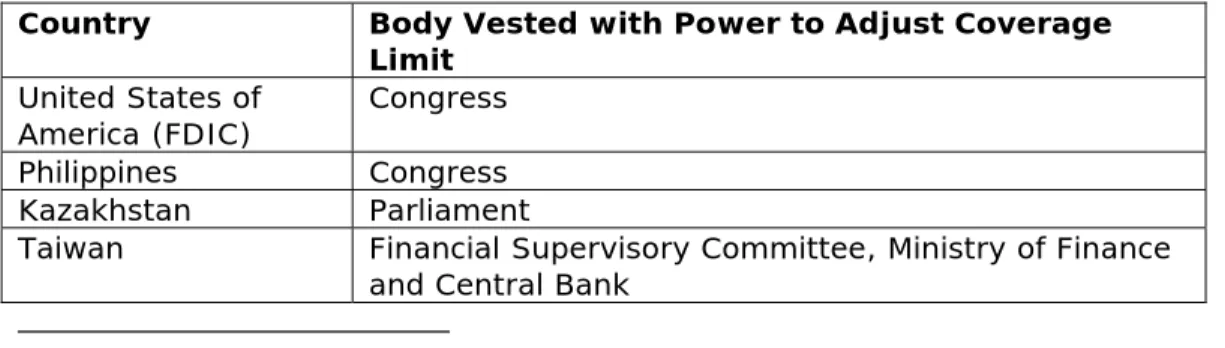
Depending on the legal framework for a country’s deposit insurance system, the responsibility for adjusting the coverage limit might reside with the board of directors of the implementing agency or with the legislature. The arrangements for some jurisdictions are shown in Figure 2.
Figure 2. Responsibility for the Adjustment of Coverage Limits in Selected Countries
Country Body Vested with Power to Adjust Coverage
Limit United States of
America (FDIC) Congress
Philippines Congress Kazakhstan Parliament
Taiwan Financial Supervisory Committee, Ministry of Finance and Central Bank
69 Bradley, 2000.
70 For example, in Zimbabwe, the coverage level has been adjusted two or three times a year
Canada Minister of Finance
Malaysia Board of directors of the fund, subject to approval by parliament
France Minister of finance
Jordan Council of Ministers
Mexico Congress
Brazil Monetary authority
Turkey Central Bank, Banking Regulation and Supervision Board, and treasury undersecretary
Nigeria Board of directors of the system
Source: Responses from Survey Questionnaire
It is obvious in Figure 2 that government bodies (either the legislature or the minister of finance) are most commonly responsible for adjusting the coverage limit. In only a few cases do deposit insurance agencies have this
power.71 Experience has shown that when the governing body of the deposit
insurance agency (e.g. the board of directors) has the power to make adjustments, they are usually made much more expeditiously than when an
enabling act has to go through the legislative process.72 However, when the
board is vested with this power, it is imperative that the DIS have strong corporate governance to ensure the integrity of the review process and guarantee the credibility of the outcome. Effective corporate governance requires transparency, accountability, independence, integrity, and stewardship—principles that ensure a high-quality decision-making process.
VII. Cross-Border Issues
In general, the laws, regulations, and other provisions applicable to a bank, its customers, and its deposit insurers are those of the country of charter or incorporation. Circumstances may change if a bank operates branches in other jurisdictions or provides cross-border services. The implementation of appropriately adapted policies by home and host country deposit protection systems can be crucial for the effective operation of deposit protection arrangements and the achievement of public policy goals.
In most countries, deposit taking is primarily a domestic business; however, cross-border business is increasing in many jurisdictions as a result of developments such as e-finance and globalization. In some jurisdictions, these developments play a considerable role in the design of deposit insurance arrangements; for example, if a banking system is characterized by numerous foreign bank branches. In weak banking systems, especially
71 Among the countries surveyed for this research, only in Nigeria and Malaysia are the DIS
boards responsible for adjusting the coverage limit.
72 For example, it took the Nigerian National Assembly about seven years to conclude
amendments to the NDIC Act, which included an adjustment to the coverage limit from 50,000 naira to 200,000 Naira.
after a crisis, the outflow of deposits to foreign countries may have to be taken into consideration in establishing or reforming deposit insurance arrangements. And special arrangements may be required in regions where economies are closely related (e.g., North America) or closely integrated (e.g., the European Union, West Africa, and Southeast Asia).
Deposit insurers as national entities are typically charged with the responsibility of protecting domestic but not foreign deposits. However, while most deposit insurance systems regulate only domestic banks, some countries require subsidiaries and branches of foreign banks to participate. Several arguments have been made for their participation, including ensuring the stability of the domestic financial system, providing a minimum level of deposit insurance to all depositors, and the notion that foreign banks benefit from a stable financial system and should therefore participate in the DIS as part of doing business in a country. Other reasons to include them are to minimize competitive issues by placing foreign banks on the same footing as domestic banks and to encourage the diversification that arises from wider
membership and expansion of the funding base.73 In Canada, for example,
foreign banks that want to accept retail deposits can do so through a subsidiary, and deposits at such banks are insured. However, foreign banks that operate through a branch structure may accept only wholesale deposits, which are not insured by the Canada Deposit Insurance Corporation
(CDIC).74 The reasoning is that it is easier for deposit insurers to deal with a
separate legal entity (a subsidiary) than with a branch of a foreign bank. In some situations, deposits are collected by a bank directly from depositors in other countries (e.g., via the Internet). Such deposits may not be covered by the bank’s deposit protection systems. However, if a bank has established a branch in a foreign country, a wide spectrum of coverage arrangements may apply.
Generally, coverage for deposits in foreign bank branches that participate in the host country’s DIS is determined according to the host system’s regulations, although the coverage provided in other countries may
be taken into account. 75 Providing coverage comparable to that in
competitor/neighboring countries might be part of a strategy to strengthen the financial system and stop the outflow of deposits, especially in weak banking systems and those that have recently experienced a crisis. However, it is important to avoid a competitive process in which a national deposit insurance system adopts the most all-encompassing features and the lowest premiums or levies without considering the domestic situation in its own
73 FSF, 2001. 74 Davies, 2007.
75 Taking account of coverage provided in other countries reflects the practice applicable to the
country. Doing so can have negative implications for the viability of the system and can jeopardize financial stability.
In some jurisdictions—such as Taiwan—branches of foreign banks that are covered by their home country deposit insurance systems may choose not to join the host country’s DIS.
The determination of an appropriate coverage policy is more complex if the bank’s home country system also covers deposits taken by branches in foreign jurisdictions. Coverage of deposits in foreign branches may be appropriate, because the branches are a legal part of the bank and its solvency, and their liquidity cannot be separated from that of the bank
itself.76 Furthermore, domestic customers of the bank who are doing business
with its foreign branches are likely to expect to be protected in the same manner as they are when they deal with the bank’s main facility. If the coverage of the home country system is lower or less encompassing than that of the host country system, the host country DIS could provide supplemental coverage. On the other hand, if the coverage of the branch’s home country system is higher or broader, the branch’s customers would not benefit from the protection provided by the host country.
If a branch that already benefits from coverage by its home country system is permitted or obliged to join the host country system, care should be taken to ensure that deposits are not covered twice. This might require appropriate provisions in contracts, statutes, and laws, and mutual
agreements between the two systems.77
Using the European Union as an example, the home country deposit insurance system covers deposits in a bank’s branches in all other EU
jurisdictions according to the EU directive.78 The directive specifies minimum
features for deposit protection systems in member countries and contributes to the harmonization of banking supervisory regulations throughout the Union. Because the minimum coverage is already provided by the branch’s home country system, the branch cannot be obliged to join the host country’s DIS. However, if the coverage offered by the host country is higher or of broader scope, the branch may choose supplementary coverage by this
system, provided that it accepts the membership conditions of the system.79
76 CDIC-Taiwan will cover a deposit in an overseas branch of a domestic bank only if the
deposit is in NT dollars; in that case, the deposit receives the same coverage as domestic deposits.
77Table 6 in annex II lists the countries that allow branches of foreign banks to participate in
their deposit insurance system and the countries that provide cover for their domestic banks’ branches abroad.
78 EU Directive 94/19/EC. 79 EU Directive 94/19/EC.
For candidate countries preparing for accession to the EU, transitional arrangements with lower initial coverage are permitted. However, if an accession country were allowed to export its lower coverage to an EU member state with higher coverage, depositors could be insufficiently protected. To address this problem, branches of banks in accession countries are required by host EU countries to top-up to the minimum EU level to ensure that an adequate minimum guarantee is offered in all member states.
On the other hand, an accession country might require that EU branches operating in its territory not to exceed the lower initial coverage during the transitional period. Implementation of this approach could be difficult if it required amendments to the law in the branch’s home country.
The following are some possible consequences of intensified cross-border banking:
• Large deposit insurance risk burdens might be transferred from one
country to another by shifting them to a branch office.
• The difference between the coverage level and the scope of coverage
in the same market might become a competitive factor among members, especially during a crisis.
• Becoming the agent for foreign DISs could become an important new
function for the national deposit insurer in the future.
VIII.
Communicating Coverage Level/Scope
Because the main objectives of a DIS are to protect deposits and maintain financial stability, it is crucial that coverage limits and scope as well as other benefits and limitations be effectively communicated to all stakeholders, especially small depositors. A successful public awareness program conveys accurate messages and builds trust; for example, small depositors are less likely to create a run on a bank if they know their deposits are protected. The primary communication objectives should be to build initial acceptance, educate stakeholders, and build public confidence in the deposit insurance and banking systems.
In a rapidly changing financial market in which new products are frequently introduced, the DIS should conduct information campaigns
regarding which products are covered and the extent of coverage. 80
Information should flow continuously from the DIS agency to the public, especially in jurisdictions where coverage is reviewed and decisions are made without direct public involvement.
Effective, ongoing public awareness campaigns create a well-informed public that is less susceptible to rumors and panic. Public awareness about all
the features of the DIS—especially coverage—can prevent bank runs.81
Clarity about the extent of protection and the limits of coverage will reduce ambiguity, minimize confusion, and prevent loss of confidence in the system. The importance of public awareness has motivated many jurisdictions to focus on providing effective disclosure of the scope and level of DIS coverage. For example, in Taiwan’s recently amended Deposit Insurance Act (January 2007), participating institutions are required to disclose the limit and scope of coverage for each financial product. Deposit insurance systems in Canada, the Philippines, the United States, and many other countries have extensive public education programs to explain coverage.
Public awareness is especially crucial in jurisdictions that are transitioning from blanket to limited coverage. A public awareness campaign at this stage should focus on dissemination of accurate information to member institutions, depositors, and creditors, including maximum coverage and the schedule of the transition (i.e., either a fast-track or gradual
approach).82 The campaign should begin as early as possible to allow
sufficient time for financial institutions and depositors to understand and accept the changes. Good communications can help establish a positive corporate image for the deposit insurance agency.
Public awareness is also crucial in the event of bank failure, to assure depositors that their deposits are covered and their claims will be settled promptly.83
In a country that is establishing a new deposit insurance system, public awareness programs should emphasize the benefits and limitations of the new system, and stress that deposit insurance systems in other countries have proved successful. The public awareness campaigns should start when the DIS is at the inception stage.
Another area to consider in communicating coverage limits is cross-border transactions. These issues can be difficult to communicate, because they involve different jurisdictions with different systems, coverage limits, and scope, which can be confusing to the public. It is probably wise to avoid publicizing information about higher or lower coverage limits that might lead
to unfair market competition84 or motivate depositors to put their money in
81 Lack of public awareness about the depositor protection system in the United Kingdom was
a factor in the Northern Rock banking crisis of September 2007.
82 FSF, 2001. 83 IADI, 2007.
84 EU Directive 94/19/EC restricts the use of differing coverage levels in advertising to protect
financial institutions that offer higher coverage than competitors in the same
country.85 In a crisis, depositors’ inability to receive information about the
condition of their savings in their native language or assurances from deposit insurers in the home countries of failed foreign banks might touch off panic.
However, despite the difficulties, public awareness campaigns must address cross-border issues. Insured financial institutions that establish branches in a foreign country usually sign an agreement with a deposit insurer in the host country. Such bilateral or multilateral agreements enhance cross-border cooperation and are an effective way to deal with cross-border financial activities. However, these agreements usually do not cover communication or public awareness issues, and it is too late to start a campaign during a bank failure. Deposit insurers should include communication and public awareness issues in cross-border agreements.
IX. Concluding Remarks
This paper has explored a number of coverage issues and offered guidance for the design or reform of a deposit insurance system. Because these systems operate under different environmental factors in different countries, practitioners should consider the guidance points as suggestions and choose those that may be applicable to their own jurisdictions and the unique factors of their environments.
REFERENCES
Afolabi, J. A. (2004, June). “Determining maximum deposit insurance coverage,” paper presented at the International Conference on Deposit Insurance in Africa, organized by the Africa Regional Committee of IADI, Abuja, Nigeria.
Bradley, C. M. (2000). “A historical perspective on deposit insurance coverage,” FDIC Banking Review Vol 13, No. 2
Davies, B. P. (2007. “Setting out the issues: Cross-border information sharing and the need for formalized arrangements,” presentation at the Symposium on Cross-Border Issues, Basel, Switzerland.
Demirguc-Kunt, A., Karacaovali, B., & Laeven, L. (2005). Deposit insurance around the world: A comprehensive database. Policy Working Paper Series No. 3628, (Washington D.C.: World Bank).
European Parliament and Council of the European Union. (1994). Directive 94/19/EC on deposit-protection schemes,
www.dif.bg/en/files/eu_law/Directive9419EU
European Parliament and Council of the European Union. (1997). Directive 97/9/EC on investor-compensation schemes.
www.efdi.net/scarica.asp?id=22&Types=DOCUMENTS
Fan Y. Y. (2007, March). “Coverage of deposit insurance protection:
Rationale and Taiwan experience,” paper presented at the Deposit Insurance Corporation of Japan (DICJ), Roundtable on Coverage of Deposit Insurance, Tokyo.
Financial Stability Forum (FSF). (2001, September). Guidance for developing
effective deposit insurance systems (Basel: Bank for International
Settlements).
Garcia, G. G. H. (1997). Protecting bank deposits, Economic Issues No.9 (Washington, DC: International Monetary Fund).
Garcia, G. G. H. (2000). Deposit insurance: Actual and good practices, Occasional Paper No. 197 (Washington, DC: IMF).
Hoelscher, D. S., Taylor, M., & Klueh, U. H. (2006). The design and
implementation of deposit insurance systems, Occasional Paper No. 251
(Washington, DC: IMF).
IADI Research and Guidance Committee, Subcommittee on Public Awareness. (2007). General guidance for public awareness of deposit