. .
1999 Particle Accelerator Conference, New York, NY, March 29-April 2, 1999
BNL-66018
4
INTERACTION REGION LOCAL CORRECTION FOR THE
LARGE HADRON COLLIDER*
J.Weit, W. Fischer,V. Ptitsin, BNL, USA; R. Ostojic, CERN, Switzerland; J. Strait, FNAL, USA Abstract
l%e performance of the Large Hadron Collider (LHC) at collision energy is limited by the field quality of the inter-action tegion (R) quadruples and dipoles. In this paper we study the impact of the expected field errors of these magnets on the dynamic aperture (DA). Since the betatron phase advance is well defined for magnets that are bated in regions of large beta funetiona, local co~ons ean be very effeetive and robust. We compare possible compen-sation schemes ~d propose a uxrector layout to meet the required DA performance.
1
INTRODUCTION
‘k LHC interaction region consists of a low-r quadruple tripiet (Q1-Q3) and a sepamtion dipole (D1) on either side of the interaction point (IP), Fig. 1. The su-pemondueting triplet quadrupolea are built by FNAL and KEIL and assembled in eryoatats at FNAL. The sepamtion diples in the high luminosity interactions points IPl (AT-LAS) and IP5 (cMS) are room-temperatme magnets sup-plied by IPN-Novosibti. In IP2 (ALICE) and E% (LHC-B), where the beams are also injected into the two rings, the DI is a superconducting magnet buiIt by BNL. ‘Ms mag-M# has the same coil design as the RHIC arc dipoles, and its field quality is well established. The field quality of the warm D1 is expected to be satisfactory.
— smvard$!beIP
Q1 Q2A Q2S Q3 D1
tl-- 181 Ial
I
.-11 ml III
Tkble 1: LHC parameters for protons at collision (7 TeV). tunes H/v/L
fY IP1,5,2,8 H/V [m] @j2 IP1,5,2,8 WV ~rad] tnaxrms beamsize [mm] 1.5 max orbit offset H/V [mm] A7.3/+7~
‘~n~ ;&the net coil radius. Similarly, during ion colh
beam size is squeezed at IF2, the impact fro qeld D1 is also noticeable. Compensation of field errors of these cold Ill magnets is of primary importance in improving the per-formance of the LHC at collision [2].
‘lhe leading source of DA reduction are the field errors of the FNAL and KEK triplet quadruples. The expected er-rors of the FNAL quadruple (ver. 2.0) am given in Tab. 2. WM the experience of model conatruetion and measure-ment and design iterations that occurted through close interaction between the magnet and accelerator physics grouw knowledge and eoniidence in the expeeted body and end-field etrors has substantially improved. The KEK quadruple errors are ahown in Tab. 3; the coil eross-seetion of this quadruple has been recently redesigned in order to substantially reduce the geometric blo error.
In Section Z we evaluate the DA under nominal collision conditions and explore the optimum quadruple arrange-ment to minimbe the error impact. In Sections 3 and 4, we review the local IR correeo“on principle and propose a corrector layout.
Table 2 Expected field errors of FNAL low-fl quadruple at collision (version 2.0, ~~f = 17 mm). (.), d(.) and u(.) denote the m- mean uncertainty and tms of the harmon-ics resueetively.
MM bid MCSXblhlMC@ mZ MCBX ●lk.1 MCIO b10
IKOM Mcoss83 MCS b3
Mcob3 Meosak McoDb6
n Normal Skew
(bn) d(bn) u(bn) (an) ti(an) a(an)
body [unit]
MmDs@6 McDsd
Figure 1: Schematic layout of the LHC inner triplet region. lhe target DA for magnet field quahty is set at 12 times thetransveraerms beam size (12u=V)for both injection and collision. During injection and ramping, the impact of Ill magnet is small compared with that of the arc magnets. On the other hand during p-p collision (Tab. 1) the reduc-tionofbeam sizeat IPland5restdtsina large beamsiz.e (u.g = 1.5 mm) at the corresponding triplets. Further-more, beam-beam interaction requires a erossing angle of *150 pr corresponding to a closed otilt up to *7.3 mm. ‘Rte target 12uZYthus corresponds to about 71% of
mag-“Work performed under the auspices of the US Depamnent of Eneqgy. t Ed wei 1Wnl.gov 3 4 5 6 7 8 9 10 LIZ 2 6 10 RE 6 10 0.3 0.2 0.2 0.6 0.05 0.03 0.02 0.02 [tmi;m] 0.82 0.82 -0.08 0.08 [unit-m] 0.41 -0.08 0.08 0.8 - 0.3 0.8 - 0.2 0.3 - 0.2 0.6 - 0.05 0.06 - 0.04 0.05 - 0.03 0.03 - 0.02 0.03 - 0.02 (length=O.41 m) - 16.4 – 0.31 - 0.21 0.04 - 0.04 (length=O.33 m) 0.31 - -0.04 - -0.8 0.8 0.3 0.1 0.06 0.04 0.02 0.03 0.06 0.04
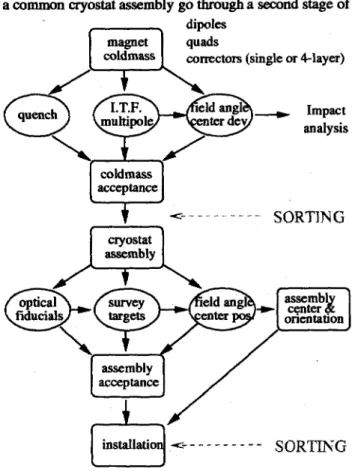
review, acceptance and sordrtg. At this stage, the assembly is surveyed with either colloidal-cell optical or 3tationary-coil pick-up (antenna) techniques to locate the magnetic centers of the components relative to the cold mass fidu-cials and the externally accessible cryostat fidufidu-cials. This survey data is transferred into the Mabase and analyzed using the computer program SURVSTAT [3]. Based on a second-round review and balance of both cdlmaas and as-sembly da@ the assemblies are sorted for final installation.
3
ARC REGION
MAGNETSORTING
RHIC arc dipola quadrupolesand sextupoks are industry-built magnets. Despite close communication and detailed quality assurance proced~ unexpected changes in the manufacturing process Still occurred. Magnet Uceptance review and the subsequent sorting played an essential role in optimizing the final performance.
3.1 Ax Dipoles
Duringtheaccep_adropin theintegral tranaferfunc-tion(ITF)ofaboutO.l% wasnoticedand traced tothenar-rower width of the phenolic insulator used between the coil and the iron. Althoughtheproblem was comect@ about 20 magnets were aiTected. ‘lEme magnets were sorted along with all subsequent dipole magnets. The sorting procedure waabased onthestreagth “ “ “ tionofdipole cOrrec-tor3requiredtoc0mpemate forthevariationin theintegra3 transfer function. With sorting the maximum CmIent R-quired for such compenmtion was decmaedfrom12 Ato about 3A.
The dominant mukipoles of the dipole magneta are lq (normal Sextupole) and b~ (normal decapcde) resulting tlom the dipole symmetry of the magn~ and al (skew
quadruple) resulting from the asymmetric vertical place-ment of the magnet cold mass in the cryostat. Due to the relatively high injection energy and the small diameter of the coil mamenm the persistent current effects are small. Magnet design has minimkd tq and~4 for both injection
and storage currents by opdmkingthe cmss-sectiorts of the coil and the yoke taking into account the przsistent current and satmation effects. The - . . wion of al is achieved by sorting the yoke weight during the assembly process so that the lower half yoke is heavier than the upper half.
Among the eight dipoles allocated as spare rnagne@ five of them have off-normal skew quadruple component (al up to –5.9 units [4]), some caused by a known coil size mismatch one has an excessive twist (2.5 mr standard de-viation in body field angle) along the magnet body, and one has low transfer function at high fields.
3.2 Ax Qudrupoles
At the early stage of industM mad- midplane shims Wele incormd y changed on 5 quadrupolq result-inginab30f about -6 units. llwsemagnets wereaorted and distributed among the two rings to minimize their ef-fects.
The dominant multiples of the quadruples are IJ5and
a5 resultingfrom the quadruple symmetry of the coil and
A
the end configuration and IJ3resulting from the asymmetry ‘, between the horizontal and vertical planes. bs was
com-pensated in the ddgn by making the coil to rnidplarte gap appropriately asymmetric, while bs was reduced by com-pensating the body with the ends of the magnet.
Among the eight quadruples allocated as span mag-nm four of them are of concern with off-normal coil size or low collaring pressure, some resulting in large az; two have excessivebz(–5 units); one has an engineering repair.
3.3
Am &xtupoksIngeneraL the performance of the aextupole magnets ex-ceeded the design goal. However, the epoxy contained in about 42 magnet coils is significantly weaker than normal. Consequently, the average quench currents (about 170 A) of these magnes although exceeding the design operating current (100 A), are lower than the average of the regular magnets (above 200 A). To minimize possible long-tarn eff~ these magnets have been sorted and allocated to the focusing locations around the two rings where the m+ quired strength of the sextuples for chromaticity correc-tion is about5(IYo of that at the defocusing locations.
3.4 Ax Trim Qwdrupoles
Trimquadrupoles all have minimum quench currents above 200 A well exceeding the design operating current of 100 A. One trim quadruple coldmaas was designated as a spare due to rust on !theyoke caused by rain damage.
3.5 Am Correctavs
Allof the cmecto~ either single-layer or four-layer, were built in-house and cold tested. After initial training, all the magnets quench above the design opemting current of 50A. Since the dipole cmector layers are all powered indi-vidually, the variation in the integral transfer function (typ-ically 170rms) is of Mle concern. Correctors with layers of excessive field angle deviation (up to z20 mr) or erratic quench training were !selectedas spare magnets.
3.6 AK CQS Assembly
Arccorrector, quadrupde, and sextupole magnets were welded into a single “CQS” assembly. The CQS assembly also includes a beam position monitor and (for some) a re-tooler. The CQS components need to be aligned with each other so that their magnetic centers are on a stmight line. It was found in the early stage of installation that “Springs” (made of G-10 plastic) needed to be installed or refitted in the support posa confining the c&lmass transversely while allowing free longitudinal motion. Special welding stripes were applied to the CQS shell to align the magnetic centers of the individual coldmasses for assemblies that ex-ceeded a tolerance of 0.25 mm. Subsequently, the welding sequence is carefully choreographed to balance “curling” distortions against each other.
Correctors with large misalignments can generate seri-ous feeddown
harmamics.
‘ho
early CQSS with corrector offsets larger than 2 mm have been removed from the tun-nel. and were later comected.:
D
4 IR
MAGNET SORTING
?
The IR
triplet cryostat contains two dipol~ sixquadruples, and six four-layer corrector packages of the two rings, Field imperfection of the Ill magnets limits the machine performance at collision when @ is squeezed. Among the 6 interaction points, 2 of them are planned to run at a low /Y of 1 m. Most sorting efforts have btzn to select the best IR magnets for these 2 “goklen” IPs.
4.1 IR Dipoles
Ingeneral, two IR dipole% one on each side of the E? are powered by the same shunt power supply. Sorting has been performed to pair dipoles of similar transfer fimction to the same II? ‘Nvodipoles with off-normal transfer function are assigned to special locations where individual shunt supplies exist. Early magnets with imperfect field quality (large bz) were assigned to non-golden region. Since the outstanding random error is al, magnets of similar aI are
sorted to the opposite side of the same IP to mhdmize their
action kicks [5]. One dipde is designated as a spare due to elIatiC quench pt?ifOIlllSl103.
4.2 IR Qua&upoles
Themanufwtmingsequenceof IR quadrupolesfollows the level of required performan~ starting with the Iess-criticd Q1. Several iterations weremadeonthemagnet cross sec-tion to optimize the field quality. Applicasec-tion of tuning shims is also pmcticd at this stage.
In one Q2 quadrupol% an excessive amount of axial vari-ation in muhipole exrors was found (change of 15 units of a2) and suapectd to be due to cracked insulators. The quench perf~ though adequate, was lower than av-erage. Efforts were made at the last stage of installation to replace this “golden candidate” with a “spare candidate”.
Due to lack of time for cryogenic testing, 11 OUtof 72 II? quadruples were measured only at room ternpemture. Because of imperfect correlation between the warm and uremenq the field quality of these magnets is cold rneas
less well known than tbe field quality of magnets which have been cold tested. Since this information is the critical base for IR correcdom these magnets were sorted to “non-golden” IRs. Spare magnets were mostly selected baaed on off-nom@ muhipole errors. One quadruple with a par-tiallyinsert dshimwa sfirstallocatedasa spare butlater installed to meet schedule requirements for the tirst aextant test.
4.3 IR Correctors
Sorting on LR correctors was performed along with the quadruples before their attachment to minimize the rel-ative magnetic cenkx offset and field angle. After sorting, for CQ combiions with excessive relative offset and rcdi, shimming adjustment were made before welding of the as-sembly.
4.4 IR CQ Assembly
Et correctorswere welded to IR quadruples to form CQ assemblies. At a later stage of IR CQ assembly, electric
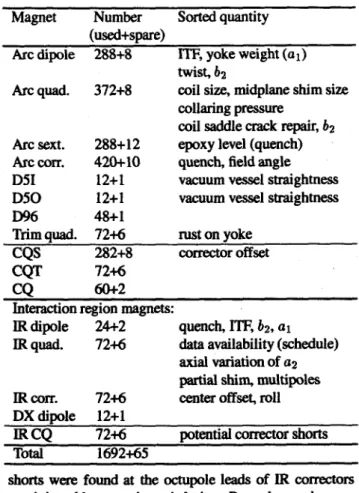
Table 1: Summary of RHIC magnet sorting (n = 1 is quadruple).
Magnet Number Sorted quantity (Used+spare)
Arc dipole 288+8 ITF, yoke weight (al) tWiSk bz
Arcquad. 372+8 coil size, midplane shim size collaring pressure
cd saddle crack repair, b2
Arc Sext. 288+12 epoxy level (quench)
Arc mm 420+10 quench field angle D51 12+1 vacuum vessel straightness D50 12+1 vacuum vessel straightness D96 48+1
Trim quad. 72+6 rust on yoke CQS 282+8 corrector offset
CQT
72+6CQ 60+2
Interaction region magnets
JR dipole 24+2 quenck ~, bz, al R quad. 72+6 data availability (schedule)
axial variation of uz partial shim muhipoles IR car. 72+6 center offse~ roll DX dipole 12+1
IR CQ 72+6 potentiaI corrector shorts Total 1692+65
shorts wem found at the octupole leads of Ill comectors precipiti by a routing misdesign. Rework was done on all the comectors which were still in cdhnass state. For correctors designated as “golden” and yet with their end plates already welded ou their end plates were removed to allow a complete rework. About 8% of the CQ assemblies fully installed in the machine were not reworke4 and their chance of octupole layer malfunction is less than 10Yo.
4.5
Separating Dipoles DXAftera design iteration based on the prototype magne~ the field errors (bz, biJ of these large-bore (18 cm coil diam-eter) dipoles were greatly reduced and are weU within the xty of II? correction [6].
We thank members of the Magnet Acceptance Commit-tee for their contribution.
5
REFERENCES
[1] P.Wanderer,C!ERN98-05(1998)p. 273.
[2] J. Wei, G. Ganetia,R. Gup@ M. Hanison, M. Hemmer,A.
Jain, F. Karl, S. Peggs, S. Tepikian,P.A.Thompson, D. Trbo-jevic, and P. Waadenx, EPAC96 (1996) p. 2222.
[3]
[4]
[5]
[6]
J. Wei, R. C. Gup@ A. Jaia, S. G. Peggs, C. G. Trahem, D. Trbojevic, and P. Wanderer, PAC95 (1995) p. 461.
MultiPole emxs are nonnaliied to 10-4 of their integrsI strength at a reference radks of about 2/3 coil radius. n = 1 is quadmpole.
J. Wei, W. F~her, V.Ptitsin, R. Ostojic, J.StraiL PAC99 (1999).
DISCLAIMER
This repo~ was prepared as an account of work sponsored by an agency of the United States Government. Neither the United States Government nor any agency thereof, nor any of their employees, make any warranty, express or implied, or assumes any legal liability or responsibility for the accuracy, completeness, or usefulness of any information, apparatus, product, or process disclosed, or represents that its use would not infringe privately owned rights. Reference herein to any specific commercial product, process, or service by trade name, trademark, manufacturer, or otherwise does not necessarily constitute or imply its endorsement, recommendation, or favoring by the United States Government or any agency thereof. The views and opinions of authors expressed herein do not necessarily state or reflect those of the United States Government or any agency thereof.