Univerza v Ljubljani
Fakulteta za raˇ
cunalniˇ
stvo in informatiko
Gaˇsper Kojek
Primerjava uˇ
cinkovitosti prenosa
podatkov v standardih Bluetooth
MAGISTRSKO DELOMAGISTRSKI PROGRAM DRUGE STOPNJE RA ˇCUNALNIˇSTVO IN INFORMATIKA
Mentor
: izr. prof. dr. Patricio Buli´
c
Somentor
: doc. dr. Anton Biasizzo
University of Ljubljana
Faculty of Computer and Information Science
Gaˇsper Kojek
Comparing data transmission
efficiency in Bluetooth Standards
MASTER’S THESIS
THE 2nd CYCLE MASTER’S STUDY PROGRAMME COMPUTER AND INFORMATION SCIENCE
Supervisor
: izr. prof. dr. Patricio Buli´
c
Co-supervisor
: doc. dr. Anton Biasizzo
Povzetek
Naslov: Primerjava uˇcinkovitosti prenosa podatkov v standardih Bluetooth
Ta magistrska naloga predstavlja opravljeno delo, potrebno za meritve in primerjavo energetske uˇcinkovitosti tehnologije Bluetooth Low Energy (BLE). Predstavljene so primerjave porabe elektriˇcne energije glede na preto-ˇcnost med razliˇcnimi verzijami standarda BLE.
Predstavljena je kratka zgodovina tehnologije Bluetooth Low Energy, kot tudi glavne izboljˇsave in razlike med verzijami specifikacij tehnologije. Meri-tve smo opravili z enim parom naprav, kateri sta imeli parametre nastavljene glede na razliˇcico BLE, na kateri je test temeljil. Porabo energije smo merili z razliˇcnimi parametri, pri branju, pisanju, obveˇsˇcanju in pisanju brez odziva.
Po priˇcakovanjih so rezultati pokazali, da novejˇse verzije BLE ponujajo veˇcjo pretoˇcnost, pa tudi dejstvo, da je povpreˇcna poraba energije neodvisna od koliˇcine poslanih podatkov. Zanimivo je, da se z vsako novo razliˇcico BLE poraba energije na preneseno koliˇcino podatkov zmanjˇsa, tudi ˇce se poveˇca pretoˇcnost. Ugotovili smo tudi, da je energija, potrebna za pre-nos doloˇcene koliˇcine podatkov, konstantna pri spreminjanju pretoˇcnosti pri doloˇceni razliˇcici specifikacije. Ugotovitve v tej diplomski nalogi dokazujejo da ni razloga, da ne bi preˇsli na razvoj in uporabo naprav, ki uporabljajo tehnologijo Bluetooth Low Energy 5, saj prinaˇsa veˇcjo pretoˇcnost, veˇcji do-seg in boljˇse soˇzitje z drugimi brezˇziˇcnimi tehnologijami, hkrati pa porabi isto ali manjˇso koliˇcino energije za prenos podatkov.
POVZETEK
Kljuˇ
cne besede
Bluetooth, zmogljivost, pretoˇcnost, energetska uˇcinkovitost, meritve, nizka poraba
Abstract
Title: Comparing data transmission efficiency in Bluetooth Standards
This master thesis presents the work done to measure and compare power efficiency of Bluetooth Low Energy technology versions. More specifically, comparisons between different BLE core specification versions are made with regards to power consumption in relation to throughput.
A brief history of Bluetooth Low Energy is presented, as well as the main improvements and differences between core specification versions. Measure-ments were performed with a single pair of devices, which had their connec-tion parameters tuned in line with BLE version they were targeting. Power consumption was measured with different parameters, with read, write, no-tify and write without response BLE operations.
As expected, results revealed that newer BLE versions offer higher through-put, as well as the fact that average power consumption is independent from the amount of data transmitted. Interestingly enough, with each BLE ver-sion, power consumption per transmitted amount of data is decreasing, even when the throughput is increased. It was also discovered that total en-ergy needed to transmit some amount of data is constant when changing the throughput in a single core specification version. The findings in this thesis prove that there is no reason not to switch to developing and using de-vices that use Bluetooth Low Energy 5, as BLE 5 brings higher throughput, extended range and better coexistence while consuming the same or lower amount of energy for transmissions.
ABSTRACT
Keywords
Bluetooth, performance, throughput, power efficiency, measurements, low en-ergy
Copyright. The results of this master’s thesis are the intellectual property of the author and the Faculty of Computer and Information Science, University of Ljubljana. For the publication or exploitation of the master’s thesis results, a written consent of the author, the Faculty of Computer and Information Science, and the supervisor is necessary.
Acknowledgments
First and foremost I would like to thank my fiancee Eva for all the love and support she gave me during the writing of this thesis and through the course of my studies.
Furthermore, I would like to thank my family and friends for providing me with unfailing support and continuous encouragement throughout my years of study and through the process of researching and writing this thesis.
I would like to thank my mentor izr. prof. dr. Patricio Buli´c for his help with my thesis. I would also like to thank my co-mentor doc. dr. Antoin Biasizzo from Joˇzef Stefan Institute for his counselling and guidance with the technical challenges I encountered during my research.
A special thanks goes to Foolography GmbH and its CEO Oliver Perialis for providing me with the hardware needed to conduct the measurements and kind-hearted support.
Contents
Povzetek Abstract
Razˇsirjeni povzetek i
I Uvod . . . i
II Kratka zgodovina standarda Bluetooth . . . ii
III Bluetooth Low Energy . . . iii
IV Metodologija testiranja . . . vi
V Implementacija vgradne programske opreme . . . viii
VI Rezultati in analiza . . . ix
VII Sklep . . . xi
1 Introduction 1 1.1 Related Work . . . 1
1.2 Thesis content . . . 4
2 A brief history of Bluetooth 7 2.1 Version 1.0 . . . 7 2.2 Version 2.0 + EDR . . . 8 2.3 Version 2.1 + EDR . . . 8 2.4 WiBree acquisition . . . 9 2.5 Version 3.0 + HS . . . 9 2.6 Version 4.0 + LE . . . 9
CONTENTS
2.7 Version 4.1 LE . . . 10
2.8 Version 4.2 . . . 11
2.9 Version 5 . . . 11
3 Bluetooth Low Energy 13 3.1 BLE Stack . . . 13
3.2 Physical Layer (PHY) . . . 15
3.3 Link Layer (LL) . . . 15
3.4 Generic Access Profile (GAP) . . . 18
3.5 Generic Attribute Profile (GATT) . . . 20
4 Testing methodology 29 4.1 Hardware . . . 29 4.2 Measuring system . . . 30 4.3 Hardware configuration . . . 31 4.4 Test scenarios . . . 33 4.5 Measurement strategy . . . 38 5 Firmware implementation 41 5.1 Peripheral Core . . . 42 5.2 Peripheral BLE . . . 44 5.3 BLE Abstraction . . . 44 5.4 Central Core . . . 44 5.5 Test params . . . 47 5.6 Central BLE . . . 48 5.7 Nordic SoftDevice . . . 48
5.8 Bluetooth Low Energy API . . . 49
6 Results and analysis 51 6.1 Measurement examples . . . 51
6.2 BLE 4.0/4.1 energy consumption . . . 55
6.3 Throughput . . . 57
CONTENTS
6.5 BLE version comparison: notify and write without response . 62
List of used acronyms
acronym meaning
IoT Internet of Things
SIG Special Interest Group
BR/EDR Basic Rate/Enhanced Data Rate
BLE Bluetooth Low Energy
HS High Speed
LR Long Range
PHY physical layer
L2CAP Logical Link Control and Adaptation Protocol
GAP Generic Access Profile
ATT Attribute Protocol
GATT Generic Attribute Profile
MTU Maximum Transmission Unit
DLE Data Length Extension
SoC System on Chip
FEC Forward Error Correction
UUID Universally Unique Identifier
CE Connection Event
CI Connection Interval
SoC System-on-Chip
MCU Microcontroller Unit
DK Development Kit
ACRONYMS
kB kilobyte (1024 bytes)
kbps kilobits per second (1024 bits per second)
Mbps mega bits per second (1024 * 1024 bits per second)
GFSK Gaussian Frequency Shift Keying
Razˇ
sirjeni povzetek
V zadnjih letih smo lahko opazili velik napredek v digitalnih tehnologijah, ka-tere prispevajo k vedno veˇcjemu pojmu ”internet stvari”(Internet of Things -IoT). Velika veˇcina IoT izdelkov uporablja za komunikacijo Bluetooth, tako da je le-ta ˇse vedno v razvoju in se nenehno izboljˇsuje. Kljub temu ni-smo zasledili nobene ˇstudije, ki bi primerjala porabo energije v primerjavi s pretokom pri razliˇcnih parametrih povezave in z razliˇcnimi razliˇcicami stan-darda Bluetooth Low Energy. To je ˇse posebej zanimivo v povezavi z novim standardom Bluetooth 5, ki obljublja dvakratno hitrost, ˇstirikraten doseg in osemkrat boljˇso zmogljivost oddajanja, ki naj ne bi vplival na porabo moˇci. Predstavili smo primerjave porabe elektriˇcne energije glede na pretoˇcnost med razliˇcnimi verzijami specifikacije BLE.
I
Uvod
Primerjava porabe energije za prenos podatkov z uporabo razliˇcnih tehnolo-gij ni niˇc novega, je pa izjemno zanimivo, da nismo naˇsli nobene take raz-iskave, ki bi primerjala razliˇcne verzije tehnologije Bluetooth. Naˇsli smo nekaj raziskav, ki primerjajo Bluetooth Low Energy v4.0 ali v4.1 z ostalimi brezˇziˇcnimi tehnologijami. V ˇclanku ”How Low Energy is Bluetooth Low Energy? Comparative Measurements with ZigBee/802.15.4”[1], kjer so pri-merjali BLE v4.0 z ZigBee tehnologijo, so ugotovili da BLE resniˇcno porabi majhno koliˇcino energije glede na poslane podatke. V ˇclanku ”Performance Analysis and Comparison of Bluetooth Low Energy with IEEE 802.15.4 and
ii
SimpliciTI”[2] so prav tako uporabljali BLE v4.0, katerega so primerjali z IEEE 802.15.4 in SimpliciTI tehnologijami. Tudi avtorji tega ˇclanka so priˇsli do podobnih zakljuˇckov: Bluetooth Low Energy ponuja poceni reˇsitev za prenos majhnih koliˇcin podatkov, hkrati pa je tehnologija zelo energetsko varˇcna. Prav tako smo naˇsli nekaj razliˇcnih raziskav ali ˇclankov o meritvah porabe energije z uporabo padca napetosti preko referenˇcnega upora napa-jalnega kroga [3, 4, 5].
II
Kratka zgodovina standarda Bluetooth
Standard Bluetooth je zasnoval dr. Jaap Haartsen leta 1994. Poimenovan je bil po danskem kralju, katerega so klicali Bluetooth. Leta 1998 je bila ustanovljena posebna skupina interesentov za standard Bluetooth ( Blueto-oth Special Interest Group (SIG)) in leta 1999 je bila izdana prva verzija standarda Bluetooth, imenovana Bluetooth 1.0. ˇCeprav uporablja isto fre-kvenˇcno obmoˇcje kot Wi-Fi, je bil Bluetooth ˇze od vsega zaˇcetka zasnovan kot tehnologija z veliko niˇzjo porabo energije in manjˇsim dosegom.
Leta 2002 je bila izdana razliˇcica 2.0, ki je prinesla nekaj zelo pomembnih izboljˇsav. Najpomembnejˇse izmed izboljˇsav so bile poveˇcana prepustnost zaradi dodatka EDR (Enchanced Data Rate), poveˇcan doseg na okoli 30 m ter za polovico manjˇsa poraba energije. Verzija 2.1 je bila izdana leta 2007 in je prinesla poenostavljen proces vzpostavljanja povezave, kateri je bil hkrati tudi varnejˇsi. Izboljˇsali so porabo energije za naprave, katere so veˇcji del ˇcasa neaktivne. Leta 2009 je izˇsla verzija 3.0, ki je izjemno poveˇcala prepustnost, saj je v kombinaciji z Wi-Fi povezavo omogoˇcala hitrosti prenosa podatkov do 24 Mbps.
Bluetooth SIG je leta 2010 uradno izdal specifikacije verzije 4.0, ki prviˇc doda Bluetooth Low Energy tehnologijo. Le-ta je prinesla nove naˇcine po-vezovanja, prav tako pa je prviˇc omogoˇcila nekaj let delovanja naprav, ki uporabljajo gumbno baterijo. Leta 2013 je bila izdana verzijo 4.1, ki je pri-nesla veliko izboljˇsav v programskem delu, saj je omogoˇcila razvijalcem veˇc
iii
kontrole nad parametri naprave, prav tako pa je omogoˇcila direktno povezo-vanje naprav Bluetooth med seboj, brez posrednika.
Verzija standarda 4.2 je bila izdana leta 2014 in je prinesla veˇc novosti, ka-tere se s pridom uporabljajo ˇse danes. Najveˇcja sprememba je bila poveˇcanje maksimalne dolˇzine paketa, ki je prinesla pribliˇzno desetkratno pospeˇsitev hitrosti prenosa podatkov. Dodali so tudi moˇznost direktne povezave na internet ter izboljˇsali varnost povezave.
Standard Bluetooth 5 je bil uradno izdan leta 2016, vendar smo prve naprave dobili v letih 2017 in 2018. Verzija 5 je prinesla dvakratno hitrost prenosa podatkov, ˇstirikrat daljˇsi doseg (do 120 metrov) in osem krat veˇcjo zmogljivost oddajanja. Hkrati se je izboljˇsalo sobivanje z drugimi brezˇziˇcnimi tehnologijami, ter poenostavilo poimenovanje, saj je sedaj uradno ime Blue-tooth 5, brez decimalk.
III
Bluetooth Low Energy
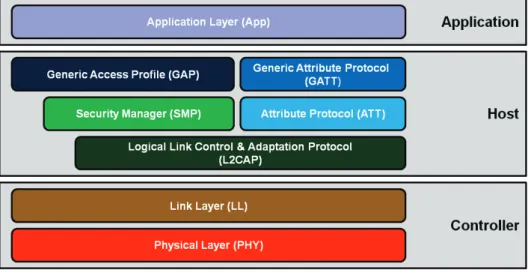
Standard Bluetooth Low Energy (BLE), poznan tudi kotBluetooth Smart je bil prviˇc predstavljen v verziji 4.0 standarda Bluetooth kot lahek del stan-darda Bluetooth, ki porabi izjemno malo energije. Ceprav si s klasiˇˇ cnim Bluetooth-om deli nekaj funkcionalnosti in ime, imata ta dva dela standarda povsem drugaˇcne lastnosti in funkcionalnosti. Glavne razlike med razliˇcnimi verzijami specifikacij tehnologije BLE so predstavljene v Tabeli 3.1. Bluetooth Low Energy je razdeljen na tri glavne nivoje: krmilnik, gostitelj in aplika-cija. Ti so naprej razdeljeni na dele, kot je razvidno s Slike 3.1. Veˇcinoma so vsi trije nivoji implementirani na enem integriranem vezju, za nas pa so najpomembnejˇsi deli fiziˇcni nivo (Physical Layer - PHY), generiˇcni profil do-stopa (Generic Access Profile - GAP) in profil sploˇsnih atributov (Generic Attribute Profile - GATT).
Fiziˇcni nivo je najniˇzji nivo sklada BLE in vsebuje analogno vezje za ko-diranje, poˇsiljanje in prejemanje digitalnih simbolov preko elektromagnetnih valov. BLE oddajnik deluje v 2.4 GHz ISM frekvenˇcnem pasu. Standardi
iv
BLE verzij v4.0, v4.1 in v4.2 poˇsiljajo podatke s hitrostjo 1 Mbps, stan-dard BLE 5 pa doda ˇse tri naˇcine delovanja: visoko-hitrostni 2 Mbps ter dva naˇcina za veˇcji doseg s hitrostmi 125 kbps in 500 kbps. Zadnja dva naˇcina prav tako uporabljata modulacijo s hitrostjo 1 Mbps, vendar je vsak bit zakodiran z veˇcimi simboli, kar zniˇza prepustnost. To omogoˇca odpra-vljanje napak pri prenosu, kar pomeni, da se biti pravilno razpoznajo na veˇcji razdalji. To hkrati pomeni, da za standard BLE 5 oglaˇsevana dvakratna pre-pustnost in ˇstirikraten doseg v resnici predstavljata dvakratno prepre-pustnost ALI ˇstirikraten doseg.
Povezovalni nivo (Link Layer - LL) je nivo, ki povezuje fiziˇcni nivo in gostiteljski del. Ker je zadolˇzen za upravljanje vseh ˇcasovnih omejitev je navadno loˇcen od viˇsjih nivojev sklada. Ta nivo je zadolˇzen za oglaˇsevanje, iskanje ter vzpostavitev in vzdrˇzevanje povezav. Povezava v standardu BLE pomeni zaporedje prenosa paketkov ob vnaprej doloˇcenih ˇcasovnih intervalih.
ˇ
Cas med paketki je eden od parametrov povezave, ki se imenuje povezovalni interval (connection interval), skupek paketkov poslan ob tem ˇcasu pa pove-zovalni dogodek (connection event). Ko je povezava vzpostavljena nivo LL skrbi za zanesljiv prenos podatkov na viˇsjih nivojih. Povezovalni interval je kljuˇcen pri zagotavljanju nizke porabe energije, saj je oddajnik vkljuˇcen le ob povezovalnih dogodkih, sicer pa je izkljuˇcen, kar prihrani izjemno veliko energije.
Generiˇcni profil dostopa (Generic Access Profile - GAP) uporablja niˇzje nivoje za definiranje viˇsjenivojskih vlog, procedur in naˇcinov delovanja, ki omogoˇcajo napravam prenos podatkov, odkrivanje servisov, upravljanje po-vezav in varnosti. To je temeljni profil naprav BLE, ki je obvezen za vse naprave. Nivo GAP v standardu BLE doloˇca ˇstiri vloge naprav, naprave pa lahko uporabljajo eno ali veˇc vlog hkrati. Vlogi opazovanca in opazovalca se uporabljata za poˇsiljanje podatkov veˇcim opazovalcem hkrati, ki niso po-vezani z opazovancem. Vlogi centralne in periferne naprave se uporabljata za prenos podatkov preko vzpostavljene povezave med dvema napravama. Centralna naprava podpira veˇc hkratnih povezav na veˇc perifernih napravah
v
in je tista naprava, katera vzpostavi in kontrolira povezavo.
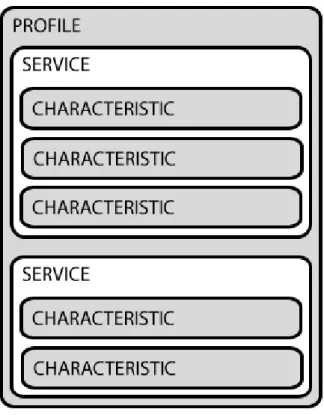
Profil sploˇsnih atributov (Generic Attribute Profile - GATT) definira naˇcine, kako naprave BLE prenaˇsajo podatke z uporabo konceptov imeno-vanih servisi in karakteristike. GATT definira kako se uporablja niˇzje nivoje za odkrivanje, branje, pisanje, oddajanje in sprejemanje podatkov. Podatki so organizirani hierarhiˇcno, v skupine imenovane servisi, kateri zdruˇzujejo konceptualno povezane skupine podatkov imenovane karakteristike. Karak-teristike si lahko predstavljamo kot zabojnike podatkov, vsaka karakteristika pa ima veˇc atributov, kot so lastnosti karakteristike, vrednosti podatkov ter dodatni opisi karakteristike. Hierarhijo podatkov lahko vidimo na Sliki 3.3. GATT prav tako doloˇca referenˇcno ogrodje profilov definiranih s strani Blue-tooth SIG. Ti osnovni profili zagotavljajo skupno delovanje naprav razliˇcnih proizvajalcev. GATT definira dve vlogi naprav, GATT server, ki hrani po-datke in GATT klient, ki se poveˇze na GATT server ter bere, piˇse in sprejema podatke. Najbolj pogosta konfiguracija naprav je GAP periferna naprava v vlogi GATT serverja in GAP centralna naprava v vlogi GATT klienta, vendar so moˇzne tudi druge konfiguracije. Vsi GATT atributi, karakteristike in ser-visi se naslavljajo z uporabo edinstvenih identifikatorjev (UUID). GATT de-finira postopke za upravljanje s podatki in konfiguracijami naprav. Postopka branja in pisanja podatkov nadzoruje GATT klient. Za ta dva postopka je potrebna potrditev GATT serverja, kar se zgodi v naslednjem povezovalnem dogodku, ki sledi poslanemu zahtevku. Postopek pisanja podatkov brez po-trdila zaˇcne GATT klient, vendar mu ni potrebno ˇcakati na potrdilo GATT serverja, da lahko poˇslje naslednji paketek. Postopka obveˇsˇcanja in indikacije podatkov zaˇcne GATT server ob vnaprejˇsnji konfiguraciji s strani GATT kli-enta. Indikacija podatkov zahteva potrditev s strani GATT klienta, medtem ko obveˇsˇcanje tega ne potrebuje, zaradi ˇcesar je prenos podatkov na ta naˇcin veliko hitrejˇsi.
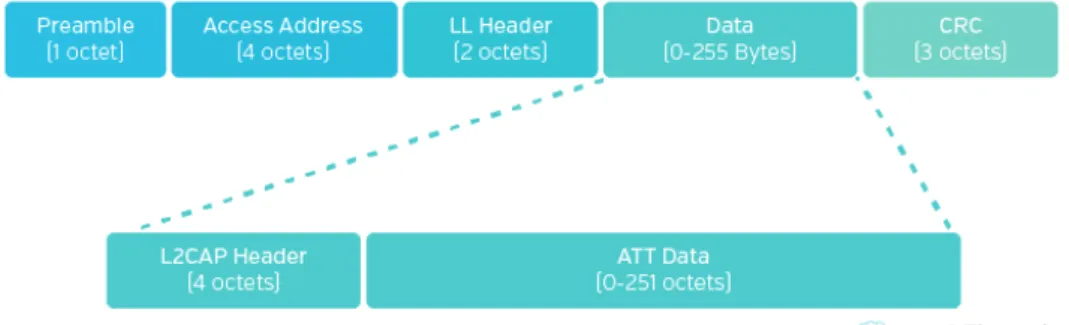
Strukturo komunikacijskega paketa standarda BLE lahko vidimo na Sli-kah 3.4 in 3.5. Velikost podatkov je odvisna od razliˇcice standarda BLE. V verzijah v4.0 in v4.1 je bila ta maksimalno 27 bajtov, od razliˇcice v4.2
na-vi
prej pa je 251 bajtov. Od tega je potrebno odˇsteti 4 bajte za glavo L2CAP nivoja, s ˇcimer pridemo do 23 bajtov, oziroma 247 bajtov, kar je definirano v parametru povezave imenovanem AT T M T U. Paketek nivoja ATT vsebuje ˇse nadaljnje 3 bajte glave, s ˇcimer pridemo do najveˇcjega ˇstevila podatkov za prenos na nivoju GATT, ki je 20 oziroma 244 za razliˇcico v4.2 in kasnejˇse razliˇcice.
IV
Metodologija testiranja
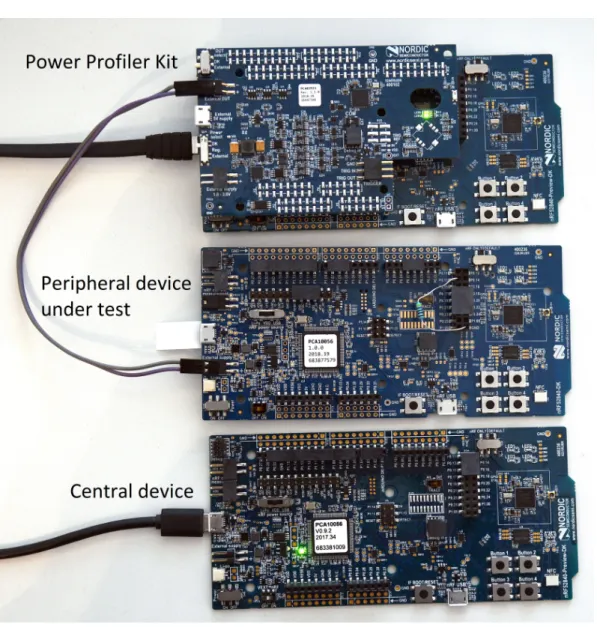
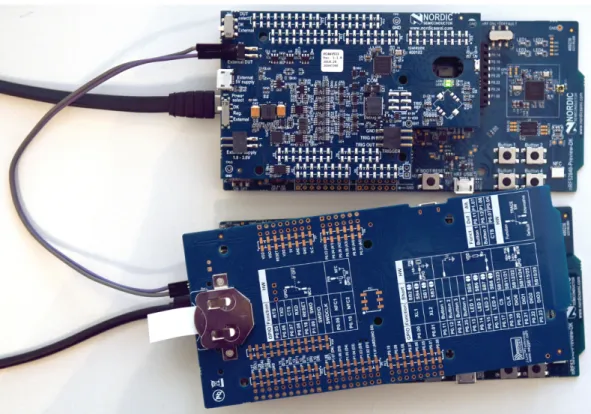
Testirali smo s pomoˇcjo dveh Nordic Semiconductor nRF52840 DK [6] ra-zvojnih ploˇsˇc, od katerih je bila ena konfigurirana kot periferna naprava na kateri se je merila poraba energije, druga pa kot centralna naprava, katera je upravljala s testi.
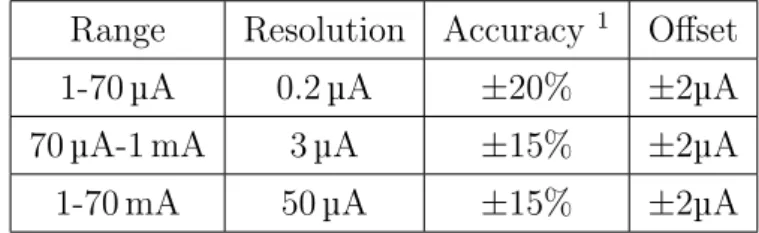
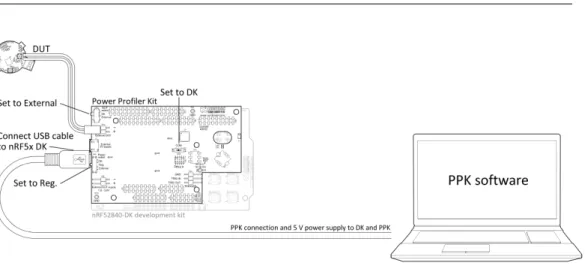
Za meritve smo uporabili Power Profiler Kit [7] proizvajalca Nordic Se-miconductor. To je sistem, ki se priklopi na razvojno ploˇsˇco nRF52840-DK [6], katero uporablja za napajanje in komunikacijo z raˇcunalnikom. Ta sistem je razvit posebej za meritve porabe energije vgrajenih sistemov kakrˇsne so naprave Bluetooth. Sistem ima analogno meritveno vezje, katero za zagota-vljanje veˇcje natanˇcnosti razdeli obmoˇcje merjenja od 1µA do 70 mA na tri razpone, kar lahko vidimo na Tabeli 4.1. Meritveni sistem prikazuje meritve na raˇcunalniku, od koder meritveni sistem tudi krmilimo. Meritve so ˇcasovno omejene na maksimalno dolˇzino 120 s. Primer meritve z izbranimi podatki enega testa lahko vidimo na Sliki 4.1.
Porabo smo merili na GATT periferni napravi. Vezje smo nastavili tako, da smo vse dele vezja, ki niso nujno potrebni za delovanje povezave Bluetooth izklopili, saj bi drugaˇce vplivali na rezultate meritev. Za laˇzjo sinhronizacijo testov in rezultatov smo na periferno napravo dodali 470 Ω upor, skozi kate-rega je v ˇcasu med dvema testoma tekel elektriˇcni tok, v samem trajanju testa pa je bil le-ta odklopljen. Na ta naˇcin je bilo v rezultatih meritev zelo eno-stavno opaziti kdaj se je test zaˇcel in konˇcal, saj smo dosegli vidne preskoke porabe energije med testnim naˇcinom delovanja in stanjem pripravljenosti.
vii
Odloˇcili smo se, da naˇcinov delovanja standarda BLE 5 za zagotavlja-nje veˇcjega dosega ne bomo testirali, saj ti naˇcini niso namenjeni visoki pretoˇcnosti podatkov. Pri razdaljah, ki jih ti naˇcini omogoˇcijo, navadni naˇcini ne delujejo, tako da bi bila primerjava brezpredmetna, saj gre za pov-sem drugo namembnost. Zaradi ˇcasovne omejitve 120 s merilnega sistema smo pred testi izraˇcunali teoretiˇcen ˇcas trajanja prenosa podatkov razliˇcnih testov, kar lahko vidimo v Tabelah 4.2 in 4.3. Zaradi (pre)dolgega trajanja prenosa podatkov pri nekaterih testnih parametrih, smo zasnovali dva sklopa testov. Pri prvem testu smo testirali neodvisnost povpreˇcne porabe energije od koliˇcine prenesenih podatkov nad neko mejo, pri drugem pa porabo ener-gije v odvisnosti od pretoˇcnosti. Parametre testov lahko vidimo v Tabeli 4.2 za prvi in Tabeli 4.4 za drugi sklop testov.
Vsi testi so bili izvedeni petkrat in nato povpreˇceni z Enaˇcbo 4.7. Vse meritve so bile izvedene preko celotne transakcije. Konec transakcije je bil definiran kot trenutek, ko lahko priˇcnemo naslednjo operacijo istega tipa na isti karakteristiki. Pri operacijah GATT branja in GATT pisanja to pomeni da so bile meritve izvedene preko dveh povezovalnih intervalov pomnoˇzeno s ˇstevilom paketkov. Za to smo se odloˇcili, ker vsak zahtevek za GATT pisanje in branje potrebuje svoj GATT odgovor, katerega se poˇslje v naslednjem povezovalnem intervalu, kar pomeni, da lahko naslednji zahtevek poˇsljemo ˇsele v naslednjem povezovalnem intervalu po GATT odgovoru. Operaciji obveˇsˇcanja in pisanja brez odgovora lahko izvajamo brez ˇcakanja na GATT odgovor, zato smo pri teh operacijah kot konec transakcije definirali trenutek ko so vsi podatki uspeˇsno preneˇseni, ˇcetudi to ni na koncu povezovalnega intervala, saj lahko isto z isto operacijo nadaljujemo takoj za tem (v istem povezovalnem dogodku). Merjeni intervali in merjene koliˇcine za vse merjene Bluetooth operacije so povzete v Tabeli 4.5.
viii
V
Implementacija vgradne programske
opreme
Vgradno programsko opremo (firmware) smo pripravili posebej za potrebe teh testov. Projekti za centralno in periferno napravo so bili loˇceni, vendar so uporabljali iste module za povezovanje. Arhitektura firmware-a je vidna na Sliki 5.1. Zaradi izvajanja testov smo na centralni in periferni napravi morali uporabiti ˇcasovnik.
Centralno in periferno jedro sta modula na centralni in periferni napravi, ki vsebujeta vso potrebno logiko za izvajanje testov. To smo implementi-rali z uporabo avtomata stanj. V periferni napravi se avtomat stanj odziva na prejete ukaze s centralne naprave, v centralni napravi pa avtomat stanj poskrbi za povezovanje na periferno napravo, nakar ˇcaka na pritisk gumba, kateri zaˇzene teste. Testi so definirani v modulu testnih parametrov, ka-teri poskrbi tudi za gradnjo in preverjanje podatkov, kaka-teri se poˇsiljajo med testi. Centralna in periferna BLE modula ter modul BLE abstrakcije skr-bijo za visoko abstrakcijo funkcij potrebnih za izvajanje testov. Delujejo kot lepilo med komponentami sklada BLE, implementiranimi s strani Nordic Semiconductor, ter viˇsjih modulov. Ti moduli poenostavijo operacije pove-zovanja, nastavlanja povezovalnih parametrov, branja, pisanja, obveˇsˇcanja, in podobno, prav tako pa zdruˇzijo dogodke proˇzene na niˇzjih nivojih v enoten format, katerega predstavijo modulu jedra. Komponente Nordic BLE Sklada so deli BLE sklada, kateri skrbijo za abstrakcijo nivojev kot so GATT, GAP, L2CAP in ostali. Nordic S140 SoftDevice je vnaprej pripravljena (pri Nordic Semiconductor) ”ˇcrna ˇskatla”, katera se sklada s specifikacijami brezˇziˇcnega protokola BLE.
Periferna naprava vsebuje lasten servis z dvema karakteristikama, kot je vidno na Sliki 5.2. Karakteristika kontrole testov se uporablja za poˇsiljanje ukazov periferni napravi, kot so nastavljanje parametrov testa ter zaˇcetek in konec testa. Karakteristika testnih podatkov se uporablja za dejanski prenos podatkov med testom.
ix
VI
Rezultati in analiza
Slike 6.1, 6.2 in 6.3 prikazujejo primere meritev porabe za tri razliˇcne primere testov. Na sliki 6.1 lahko identificiramo posamezne pakete operacije pisanja, poslane v posameznih povezovalnih dogodkih. Programska oprema privzeto prikazuje skalo toka od −100µA naprej, zaradi ˇcesar lahko izgleda da smo izmerili negativen tok, ˇceprav je bil dejanski izmerjen tok vedno nad 0µA. Kot predvideno v teoretiˇcnih izraˇcunih, predstavljenih v Tabeli 4.2 je bilo za prenos 100 bajtov podatkov potrebnih 5 podatkovnih paketov, ki so zasedli 10 povezovalnih dogodkov in potrebovali 75 ms. Slika 6.2 prikazuje meritev porabe pri branju podatkov z razliˇcico v4.2 standarda BLE. Tudi operacija branja zahteva potrditev s strani GATT serverja, zato vsako branje podat-kovnega paketa porabi dva povezovalna dogodka. Slika 6.3 prikazuje meritev porabe pri prenosu podatkov z razliˇcico BLE 5 z uporabo operacij obveˇsˇcanja, za kar potrditve na nivoju GATT niso potrebne, temveˇc se opirajo le na po-trjevanje niˇzjega povezovalnega nivoja. Zaradi tega je lahko poslanih veˇc paketov v vsakem povezovalnem dogodku, kar izjemno poveˇca pretoˇcnost podatkov. Vidimo lahko tudi, kdaj se zaˇcne vsak povezovalni dogodek, saj se pred tem oddajnik za kratek ˇcas izklopi, da prepusti morebitnim ostalim povezavam prostor za komunikacijo. Meritvi porabe periferne naprave v pri-meru, kadar Bluetooth ni aktiven, sta prikazana na slikah 6.4 in 6.5. Slika 6.4 prikazuje meritev porabe z uporabljenim ˇcasovnik, slika 6.5 pa meritev porabe brez uporabe ˇcasovnika. Razlika porabe v obeh primerih je poraba ˇcasovnika in znaˇsa pribliˇzno 580µA.
Prikaz odvisnosti porabe energije od koliˇcine podatkov lahko za opera-cijo pisanja vidimo na sliki 6.6 in za operaopera-cijo branja na sliki 6.7. Tu vi-dimo potrditev priˇcakovanj, da je porabljena energija sorazmerna s koliˇcino preneˇsenih podatkov in ˇcasom prenosa. Prenos vsakega podatkovnega paketa potrebuje dva povezovalna dogodka, kar pomeni da veˇcje ˇstevilo podatkov enostavno potrebuje veˇcje ˇstevilo podatkovnih paketov, ki v povpreˇcju pora-bijo enako koliˇcino energije. Skupna energija za prenos neke koliˇcine podat-kov poveˇcuje v linearni odvisnosti od koliˇcine preneˇsenih podatkov. Zaradi
x
uporabe ˇcasovnika, kateri doda konstantno porabo prb. 580µA pri veˇcjih po-vezovalnih intervalih le-ta prevlada nad porabo Bluetooth oddajnika/spreje-mnika. Na Slikah 6.8 in 6.9 lahko vidimo kakˇsna bi bila poraba brez uporabe ˇcasovnika. Razlike med porabo energije pri razliˇcnih ˇcasovnih intervalih so manjˇse, vendar zaradi neniˇcelne porabe energije ko je BLE oddajnik/spre-jemni ugasnjen poraba energije ni neodvisna od ˇcasovnega intervala, kot bi v teoriji morala biti (ˇce bi bila poraba niˇcelna kadar naprava ugasne BLE oddajnik/sprejemnik).
Primarni naˇcini spreminjanja pretoˇcnosti v standardu Bluetooth Low Energy so spreminjanje parametrov AT T M T U, povezovalnega intervala in hitrosti modulacije PHY nivoja. Ker je smiselno nastaviti najveˇcje parametre
AT T M T U ter PHY modulacije, ki jih naprave podpirajo, nam za spremi-njanje pretoˇcnosti ostane le ˇse povezovalni interval. Slika 6.10 prikazuje spre-minjanje pretoˇcnosti ob razliˇcnih povezovalnih intervalih. Pretoˇcnost prenosa se spreminja v skladu s priˇcakovanji - manjˇsi kot je povezovalni interval, veˇc paketkov lahko poˇsljemo v eni sekundi, zato bo pretoˇcnost viˇsja. Vidimo lahko tudi, da viˇsji AT T M T U obˇcutno poveˇca pretoˇcnost v razliˇcicah v4.2 in 5. Operacija obveˇsˇcanja po drugi strani ni omejena z GATT odgovori, tako da bi priˇcakovali, da bo imela dolˇzina povezovalnega intervala manjˇsi vpliv in da bo z daljˇsimi povezovalnimi dogodki tudi veˇcja pretoˇcnost, saj bo oddajnik lahko priˇzgan v celotnem povezovalnem intervalu. Slika 6.11 prikazuje rezultate pri operaciji obveˇsˇcanja, kjer vidimo da nad neko dolˇzino intervala pretoˇcnost priˇcne padati. Do tega pride zaradi dejstva, da se v primeru neuspeˇsnega prenosa paketa, povezovalni dogodek zapre. Takrat se lahko poˇsiljanje nadaljuje ˇsele ob naslednjem intervalu. To pomeni, da bo ob veˇcjem intervalu tudi povpreˇcen ˇcas, ko je dogodek zaprt, daljˇsi, zaradi ˇcesar pretoˇcnost pade. Ob primerjavi s Tabelo 6.1 lahko vidimo, da so doseˇzene hitrosti pretoˇcnosti zelo blizu teoretiˇcni meji za vsako razliˇcico standarda BLE.
Ker sta operaciji branja in pisanja omejeni z odgovori GATT serverja so rezultati obeh operacij praktiˇcno isti. Ob pogledu na Sliko 6.12 vidimo, da
xi
je uspelo razvijalcem standarda Bluetooth z vsako novo razliˇcico zmanjˇsati porabo moˇci za prenos podatkov glede na pretoˇcnost. To jim je uspelo kljub temu, da razliˇcica BLE 5 deluje pri viˇsji hitrosti. To omogoˇca dejstvo, da se pri viˇsjih hitrosti podatki hitreje prenesejo, kar pomeni, da se lahko oddaj-nik prej izklopi. To je lepo razvidno na Sliki 6.13, ki kaˇze skupno energijo potrebno za prenos doloˇcene koliˇcine podatkov v odvisnosti od pretoˇcnosti. Vidimo da je najbolj energijsko uˇcinkovit prenos pri najviˇsjih pretoˇcnostih, pri ˇcemer je potrebno poudariti, da je pri merjenju razliˇcice v4.1 koliˇcina prenesenih podatkov manjˇsa, prikazana pa je ekstrapolacija za isto koliˇcino podatkov.
Zaradi istih lastnosti je analiza operacij obveˇsˇcanja in pisanja brez potr-dila zdruˇzena. Ker ni potrebno ˇcakati na odgovor druge naprave, je moˇzno opraviti veˇc operacij v enem povezovalnem dogodku. Na Sliki 6.14 je razvi-dno da razliˇcici v4.1 in v4.2 uporabljata isti fiziˇcni nivo, saj sta najveˇcja in najmanjˇsa moˇc praktiˇcno enaki, vendar pri razliˇcnih pretoˇcnostih. Vidimo, da hitrejˇsa modulacija standarda BLE 5 potrebuje veˇc energije, vendar je zato tudi dosti veˇcja pretoˇcnost podatkov. Bolj zanimiva je Slika 6.15, kjer vidimo velik preskok skupne porabe energije za prenos iste koliˇcine podatkov z vsako razliˇcico standarda. Za oba preskoka zmanjˇsanja porabe energije je odgovorno dejstvo, da se lahko oddajnik hitreje izklopi, pri ˇcemer je ra-zlog pri razliˇcici v4.2 poveˇcanje koliˇcine podatkov v posameznem paketku, pri razliˇcici 5 pa viˇsja hitrost modulacije. Zanimivo je, da je koliˇcina energije po-trebne za prenos neke koliˇcine podatkov praktiˇcno neodvisna od pretoˇcnosti. Ta informacija je zelo pomembna, saj nam omogoˇci, da parametre povezave nastavimo glede na potrebe, brez posebne skrbi za porabo energije pri veˇcjih koliˇcinah preneˇsenih podatkov.
VII
Sklep
Nedavno predstavljena razliˇcica 5 standarda Bluetooth obljublja dvakratno hitrost, ˇstirikraten doseg in osemkrat boljˇso zmogljivost oddajanja, ki naj ne
xii
bi vplivala na porabo moˇci. V magistrski nalogi je predstavljeno opravljeno delo potrebno za meritve in primerjavo energetske uˇcinkovitosti tehnologije Bluetooth Low Energy (BLE). Predstavljene so primerjave porabe elektriˇcne energije glede na pretoˇcnost med razliˇcnimi verzijami specifikacije BLE.
Da smo premostili omejitve merilnega sistema, smo morali najprej po-trditi, da je povpreˇcna poraba neodvisna od koliˇcine preneˇsenih podatkov. Nato smo testirali vpliv povezovalnega intervala na pretoˇcnost, kjer smo ugo-tovili da je pretoˇcnost najviˇsja ob najniˇzjem intervalu za operacije branja in pisanja. Za operacije obveˇsˇcanja in pisanja brez potrdila je za najviˇsjo pretoˇcnost potrebno najti ravnovesje med velikostjo intervala ter zasedeno-stjo radijskih valov v danem okolju. Z meritvami potrebne moˇci in porabe energije za prenos podatkov smo ugotovili, da se energetska uˇcinkovitost stan-darda Bluetooth izboljˇsuje z vsako razliˇcico. Ugotovili smo, da je za najniˇzjo porabo energije v vseh primerih potrebno najti najviˇsjo pretoˇcnost, saj se v tem primeru lahko oddajnik najhitreje izklopi, s tem pa se tudi zmanjˇsa poraba energije. Hitrejˇsi prenos podatkov hkrati pomeni tudi manjˇso obre-menitev brezˇziˇcnega okolja, kar zmanjˇsa ˇstevilo trˇcenj paketov in s tem tudi koliˇcino veˇckrat poslanih paketov, kar ˇse dodatno zmanjˇsa porabo energije.
Rezultati in ugotovitve predstavljene v tej magistrski nalogi dokazujejo, da ni razloga da nadaljnji razvoj naprav Bluetooth ne bi uporabljal razliˇcice Bluetooth 5, saj le-ta prinese viˇsjo pretoˇcnost, daljˇsi doseg in boljˇse sobivanje z ostalimi brezˇziˇcnimi tehnologijami, saj vse to zagotavlja pri niˇzji porabi energije za prenos podatkov.
Chapter 1
Introduction
In recent years, we have seen significant progress in digital technologies, that contribute to the ever-present concept of ”Internet of Things” (IoT). Since the vast majority of IoT products use Bluetooth for communication, it is still evolving and is continuously improved. In our company, we are working on the development of a new product that uses Bluetooth Low Energy for communication. During development we have encountered a problem, where we needed a study, that would compare energy consumption in relation to throughput with different connection parameters applied and across different Bluetooth Low Energy versions. This is especially interesting for the new Bluetooth 5, which promises twice the throughput, four times the range and eight times increased broadcast capacity, all of which is supposed not to affect power consumption [8].
1.1
Related Work
Comparing energy consumption when transferring data using different tech-nologies is nothing new. To the best of our knowledge, there is no such study, that compares different versions of Bluetooth technology. Such comparison would be even more interesting with the arrival of Bluetooth 5 [8], which introduces many innovations that are incompatible with previous versions
2 CHAPTER 1. INTRODUCTION
without modifying the physical level of the device.
A comparison of the power consumption between Bluetooth 4.0 Low En-ergy and ZigBee / 802.15.4 can be found in the article ”How Low EnEn-ergy is Bluetooth Low Energy? Comparative Measurements with ZigBee/802.15.4” [1], that supersedes older articles that compare Bluetooth Classic (2.0) with other technologies. The authors also test the effect of interference on Blue-tooth and ZigBee technology. For BlueBlue-tooth Low Energy measurements, they were using a BlueGiga BLE112 module (based on TI CC2540 SoC), which was configured as a slave peripheral device, as the device under test for which power consumption was measured. The module was running Texas Instru-ments’s BLE Stack v1.0 in single chip mode. This represented a realistic example of a sensor where the amount of hardware and power consumption is to be kept at a minimum. Since they were using BLE version 4.0, the maximum application layer packet payload size is 20 bytes, which has a mea-surable effect on power consumption. They were using the Monsoon Power Monitor [9] for power measurements, which uses the technique of measuring the voltage drop through the shunt resistor. The authors concluded that BLE (version 4.0) indeed consumes a comparatively small amount of energy and has a very attractive ratio of energy per bit transmitted.
Another study comparing BLE with other wireless technologies in regards to power consumption was made for the article ”Performance Analysis and Comparison of Bluetooth Low Energy with IEEE 802.15.4 and SimpliciTI” [2]. The authors used Texas Instrument CC2540 System-on-Chip as their BLE device under test and used TI BLE Stack v1.2.1, which implements Bluetooth Low Energy specification version 4.0. They performed their tests in the laboratory environment with the peripheral and central devices placed one meter apart. They used the current-shunt resistor method for measuring the power consumption of the device under test. The results presented in that paper revealed that BLE v4.0 already provided an inexpensive and power-efficient solution for wireless communication, even if it had several downsides, which were resolved in later BLE versions, when compared to other wireless
1.1. RELATED WORK 3
technologies.
Although the article ”An Experimental Performance Evaluation and Com-patibility Study of the Bluetooth Low Energy Based Platform for ECG Mon-itoring in WBANs” [10] was released when Bluetooth Low Energy v4.2 was already released, the authors still used v4.0/v4.1 for their experiments. Their test datasets were specific to healthcare applications, such as transmitting ECG data wirelessly. They performed their measurements using the BLE112 wireless module, running a BGScript application, supported by BlueGiga.
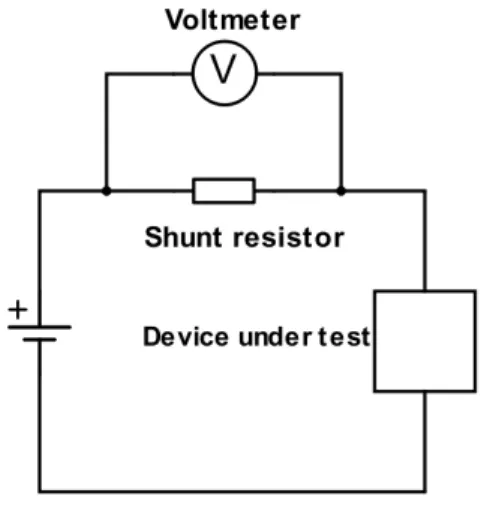
The technique of measuring the voltage drop through the shunt resistor was used for power consumption measurements in related articles. Power consumption measurements using the shunt resistor technique are described in multiple articles, such as ”Measuring Bluetooth® Low Energy Power Consumption” [3], ”Power Measurements Techniques For Embedded Sys-tems” [4] and ”Embedded Systems Power Consumption Measurement Meth-ods Overview” [5]. The current-shunt resistor technique is commonly used for power consumption measurements. It uses a high precision (better than 1%), low impedance (usually less than 1 Ω, but can be more) resistor, placed in series with current flow to, or from the device under test. The scheme of this technique is presented in Figure 1.1. The voltage drop over the resis-tor is measured, from which we can calculate the current using the Ohm’s law equation. It is important to select a high precision resistor, as this will make our measurements and calculations more precise. Selection of resistor value is usually below 1 Ω, as this will have a small voltage drop, which has a small impact on the measured circuit. A higher value may be selected as well if the power supply voltage and minimum voltage needed by the measured circuit allow it. Selecting a larger value will result in a larger voltage drop, which is easier to measure and is thus more appropriate for measurements of small currents. All three mentioned articles describe other current measure-ment methods, such as the Charge transfer method, which uses a capacitor, where charging or discharging time is measured to measure the current, the Current mirror method, which uses four bipolar transistors and the Current
4 CHAPTER 1. INTRODUCTION
probe method, which exploits magnetic coupling of currents running through wires.
Figure 1.1: Current shunt resistor measurement scheme.
1.2
Thesis content
In Chapter 2, we describe the history of Bluetooth and Bluetooth Low En-ergy, as well as general differences between the Bluetooth standard versions and when those improvements were introduced.
In Chapter 3, we describe the Bluetooth Low Energy stack, what are the responsibilities of each layer and how layers interact with each other. The properties and mechanisms of the layers that have major impact on throughput and power consumption are given in detail.
In Chapter 4, we describe the hardware and software tools used for power consumption measurements. Measuring system and hardware configuration are explained and the test scenarios that were used as the basis for power consumption measurements are presented.
In Chapter 5, we describe the tested device firmware implementation development. Developed layers are presented and the testing firmware
mech-1.2. THESIS CONTENT 5
anisms are explained for both the peripheral and central devices.
In Chapter 6, we describe measurement examples and results for differ-ent tests. We analyzed the relationship between energy consumption and amount of data transmitted, the data throughput and power consumption of BLE standards for different connection parameter settings and diferent BLE standards.
Finally, we conclude the thesis in Chapter 7, recapping the work done and present the most important findings.
Chapter 2
A brief history of Bluetooth
2.1
Version 1.0
The Bluetooth standard was initially conceived by Dr Jaap Haartsen at Er-icsson back in 1994. It was named after the Danish king Harald Blatand, nicknamed Bluetooth, who united Denmark, Norway and Sweden in the 10th century. At the time Ericsson wanted to replace the wired standard RS-232 with a wireless alternative, while other companies including Intel and Nokia also had the idea of wirelessly linking cell phones and computers around the same time.
In 1998 the Bluetooth Special Interest Group (SIG) was formed with five companies: Ericsson, Nokia, Intel, Toshiba and IBM. The Bluetooth SIG still to this day publishes and promotes the Bluetooth standard and its subsequent revisions, and although it started as a group of five companies, it reached 4,000 members by the end of its first year. The group now contains over 33,000 member companies at various levels of influence.
Although Bluetooth uses a very similar frequency bandwidth (2.4 - 2.485 GHz) as Wi-Fi, it has been designed as a much shorter range and lower power alternative from the start. Version 1.0, released in 1999, proposed as a replacement for the RS-232 standard, was designed as a flexible packet-based protocol with a wide selection of profiles. The standard came with profiles
8 CHAPTER 2. A BRIEF HISTORY OF BLUETOOTH
for wireless voice and headsets, dial-up networking, fax and file transfers, which were the primary use cases for RS-232, but the set of profiles has increased substantially since then. The first version had some problems, such as anonymity issue due to compulsory address broadcasting, connection problems, slow (theoretical) data speeds of just 721 kbps and short range of about 10 meters.
2.2
Version 2.0 + EDR
In 2002 IEEE approved 802.15.1 specification to conform with Bluetooth wireless technology and two years later Version 2.0 [11] with Enhanced Data Rate (EDR) was released. The same year Bluetooth technology reaches an installed base of 250 million devices and product-shipment rate surpasses 3 million per week. Version 2.0 brings some much-needed improvements, such as increased range of around 30 meters, an increased theoretical core connection speed of 1 Mbps and 3 Mbps with EDR. Power consumption was also reduced by 50% in comparison to the previous version.
2.3
Version 2.1 + EDR
In 2007 Bluetooth 2.1 [12] standard was released. Secure Simple Pairing (SSP) was the most important feature of this version, which made the pairing process more secure and simpler. SSP made encryption mandatory for all connection, which made man-in-the-middle attacks more difficult. Another important improvement brought in version 2.1 was sniff subrating, which improved battery life in devices that are inactive most of the time, such as keyboards and headsets, by reducing the active duty cycle of Bluetooth devices.
2.4. WIBREE ACQUISITION 9
2.4
WiBree acquisition
In June 2007 the Bluetooth SIG acquired the Wibree Alliance, an initiative led by Nokia (together with Nordic Semiconductor, Broadcom Corporation, CSR and Epson) to develop an ultra-low power form of wireless connectivity, which uses much less power than existing Bluetooth technology. Nordic and other brought their knowledge of ultra-low power wireless connectivity to the Bluetooth SIG, enabling it to develop what will become Bluetooth Low Energy (BLE).
2.5
Version 3.0 + HS
Version 3.0 High Speed (HS) [13] specification was released in 2009, with the key feature being high-speed data transfer. In conjunction with 802.11 Wi-Fi radio, it could reach data speeds of up to 24 Mbps. It used the 802.11 link for transferring large amounts of data while still using Bluetooth radio for discovery, connection and configuration, which made it less power hungry than classic 802.11 Wi-Fi link. This version also permitted near-field communication (NFC) for pairing.
2.6
Version 4.0 + LE
The Bluetooth SIG announces the formal adoption of Bluetooth Core Spec-ification Version 4.0 with Low Energy [14] technology in 2010. This version defines two chips, one for Classic Bluetooth v4.0 (BR/EDR) and one for Bluetooth Low Energy (also called Smart Bluetooth). The Bluetooth Low Energy technology was heavily based on WiBree. Adoption of BLE in Blue-tooth Core Specification v4.0 by BlueBlue-tooth SIG made it possible for BLE to complement the existing Classic Bluetooth, while still making it possible to run it off a single coin cell battery. Bluetooth LE was mainly designed to frequently transmit small chunks of data to and from small devices while
10 CHAPTER 2. A BRIEF HISTORY OF BLUETOOTH
saving power. That empowered a new way to gather data from various sen-sors, which enabled the development of heart rate monitors, thermometers, health and fitness trackers, etc., which all took advantage of the new low power feature.
Aside from Bluetooth LE feature, this version also introduced the Secu-rity Manager (SM) services with AES encryption and the Generic Attribute Profile (explained in Chapter 3.5), which is the backbone of a Bluetooth LE device, as it provides the profile of the device.
2.7
Version 4.1 LE
Version 4.1 [15], introduced in 2013 brought very few changes in hardware, speed and range, but many improvements on the software side. Bluetooth 4.1 focused on implementing the groundwork to drive IoT devices. It could indirectly connect devices to the cloud that would have otherwise been out of range. Another improvement was coexistence with 3G/LTE radios, as pre-vious versions had problems such as poor performance and battery draining when used simultaneously. Even though Bluetooth and 3G/4G radios use different frequency bands, the frequencies used are adjacent to each other, which meant that radios in mobile devices, which are physically placed close to each other or even implemented on the same chip, brought increased in-terference when Bluetooth and 3G/4G radios were used at the same time. Bluetooth 4.1 eliminates this problem by coordinating its radio with 3G/4G radios automatically so there is no overlap in the time domain, which means that both Bluetooth and mobile network radios can perform at their max-imum potential. This version also allowed developers to have more control over connections, making it easier to manage devices power consumption. Additionally, Version 4.1 made it possible to treat any device as both a pe-ripheral and a hub at the same time, enabling the direct connection between peripheral devices without an intermediary.
2.8. VERSION 4.2 11
2.8
Version 4.2
Version 4.2 [16] was released in 2014, and it brought multiple improvements and is still the most widely used standard today. The most notable im-provement was the LE Data Length Extension (DLE), which increased the capacity of each packet from 20 bytes to 244 bytes. It also enabled devices to use Internet Protocol version 6 (IPv6) for direct internet access, which al-lowed sensor and smart devices transmitting data directly over the internet. Another improvement was LE Secure Connections, which made it harder to track devices without permission.
2.9
Version 5
Bluetooth version 5 [17] was officially adopted by Bluetooth SIG in 2016, with most of the major smartphone manufacturers adopting it in 2017 and 2018. Its purpose is to optimise wireless technology by increasing the functionality of Bluetooth. Aside from improvements involving IoT, Bluetooth 5 promises two times faster transfer speed, four times longer range (up to 120 meters) and eight times the data broadcasting capacity. The improvements made to support these claims are explained in Chapter 3. A new and improved Channel Selection Algorithm #2 (CSA #2) is added, which improves the interference tolerance and multi-path fading effects of the Bluetooth radio, as well as allows the radio to limit the minimum number of channels used for channel hopping in high interference environments. When compared with CSA #1, which was used only for channel selection for connection events, CSA #2 supports channel selection for periodic advertising packets as well. This improves coexistence between different Bluetooth connections as well as with other wireless technologies, which is becoming more and more critical as we enter a complex world of IoT smart devices. Bluetooth SIG dropped the point number of the name, so it is now just called Bluetooth 5 (instead of Bluetooth 5.0 or 5.0 LE), which is supposed to ”simplify marketing and communicate user benefits more effectively” [18].
Chapter 3
Bluetooth Low Energy
Bluetooth Low Energy (BLE), also known as Bluetooth Smart, was intro-duced in Bluetooth Core Specification Version 4.0 [14] as a light-weight, ultra-low power subset of classic Bluetooth. While there is some functionality overlap with classic Bluetooth and they share the name ”Bluetooth”, BLE has an entirely different property and functionality set. BLE started its life in 2001, in Nokia labs as an in-house project named WiBree, before it was adopted by Bluetooth SIG and renamed to Bluetooth Low Energy.
This chapter will give a quick overview of BLE, specifically how data is organised in BLE and how devices advertise their presence so that other devices can find and connect to them.
The biggest differences between versions of the Bluetooth Low Energy core specifications can be observed in Table 3.1.
3.1
BLE Stack
The Bluetooth Low Energy stack is split into three main layers, Controller, Host and Application, which in turn consist of multiple parts, as seen in Figure 3.1. In most cases those three layers are implemented on a single SoC, but they can also be distributed onto multiple physical SoCs, with most commonly split between the Host and the Controller [19]. For us, the
14 CHAPTER 3. BLUETOOTH LOW ENERGY
BLE
AT T M T U Data Rate Other Version
4.0 23 1 Mbps First release
4.1 23 1 Mbps Improved 3G/LTE coexistence,
Direct connections between devices 4.2 247 1 Mbps IPv6, LE Secure Connections
5 247
125 kbps (Coded), 8x broadacting capacity, 500 kbps (Coded), Range up to 120m (Coded),
1 Mbps, 2 Mbps Improved channel selection algorithm
Table 3.1: Biggest differences between BLE versions.
key elements of the BLE stack are the Physical Layer (PHY), the Generic Access Profile (GAP) and the Generic Attribute Profile (GATT).
Figure 3.1: Bluetooth Low Energy stack1.
1Image via Microchip: http://microchipdeveloper.com/wireless: ble-introduction
3.2. PHYSICAL LAYER (PHY) 15
3.2
Physical Layer (PHY)
The BLE physical layer is the lowest layer of the BLE stack and contains the analogue circuitry responsible for translation, transmission and receiving of digital symbols over the air. BLE radio operates in the 2.4GHz ISM (Industrial Scientific Medical) band. A frequency hopping transceiver is used to combat interference and fading. The BLE system uses 40 RF channels between 2400 MHz and 2483.5 MHz with 2MHz spacing. The 40 channels are divided into 3 Advertising Channels and 37 Data Channels [20].
BLE v4.0, v4.1 and v4.2 used a radio, transmitting at 1 Mbps with one symbol per bit, using the 1 Msym/s GFSK (Gaussian minimum shift keying) modulation scheme with FHSS (Frequency-hopping spread spectrum) spread-ing, implemented as Adaptive frequency-hopping spread spectrum (AFH). With the BLE 5 Core Specification [17], Bluetooth SIG added two new modes: High Speed (HS) and Long Range (LR). The basic 1 Msym/s GFSK modulation scheme is still supported, as that is the only modulation scheme that is mandatory in a BLE device and is therefore used for backwards com-patibility. The BLE 5 HS standard brings the possibility of using the 2 Msym/s GFSK modulation scheme, which doubles the transmission speed to 2 Mbps. BLE 5 LR (also known as coded) uses the same 1 Msym/s physical GFSK modulation scheme as older versions, but each bit is encoded at either 125 kbps (S=8) or 500 kbps (S=2).
It means that the ”2x speed and 4x range” advertised by Bluetooth SIG for Bluetooth 5 actually means 2x speed OR 4x range, as those two options are on opposite sides of the spectrum, meaning we cannot have both at the same time.
3.3
Link Layer (LL)
The Link Layer is the part that ties together the PHY and the Host stack. It is usually implemented as a combination of custom hardware and soft-ware. Because it is responsible for managing all timing requirements, it is
16 CHAPTER 3. BLUETOOTH LOW ENERGY
Input (from FEC encoder) Output with S=2 Output with S=8
0 0 0011
1 1 1100
Table 3.2: FEC Pattern Mapper behaviour
usually kept isolated from the higher layers of the stack, as it is the only hard real-time constrained layer of the whole protocol stack. It is responsi-ble for advertising, scanning, and creating/maintaining connections, as well as coding the data before transmission, controlling the frequency hopping and acting as a reliable data barrier. Coding in Bluetooth 5 LR consists of two steps: Forward Error Correction (FEC) and pattern mapping. The convolutional FEC encoder uses a non-systematic, non-recursive rate 12 code with constraint length K = 4. This means that it replaces a single bit with two encoded bits, before sending it to the pattern mapper. The pattern map-per converts each bit from the FEC into one (S=2) or four (S=8) symbols, as shown in Table 3.2, before sending.
At the link layer, the following role pairs are defined:
Advertiser / Scanner (Initiator)
Slave / Master
Broadcaster / Observer
Once the Scanner has acquired enough information about the Advertisers in its range to decide to which to connect it, it becomes an Initiator, initiating a BLE Link Layer connection process. A connection is simply a sequence of packet transmissions between two BLE devices at predefined times. Once connected, the Link Layer acts as a reliable data barrier, meaning any data presented to the upper layers have been reliably transmitted. All packets are checked against a 24-bit CRC. If the check fails, re-transmissions are requested by the Link Layer until the packet is transmitted successfully, with the retries being done in the next connection event and channel.
3.3. LINK LAYER (LL) 17
3.3.1
Connection Events (CE) and Connection
Inter-val (CI)
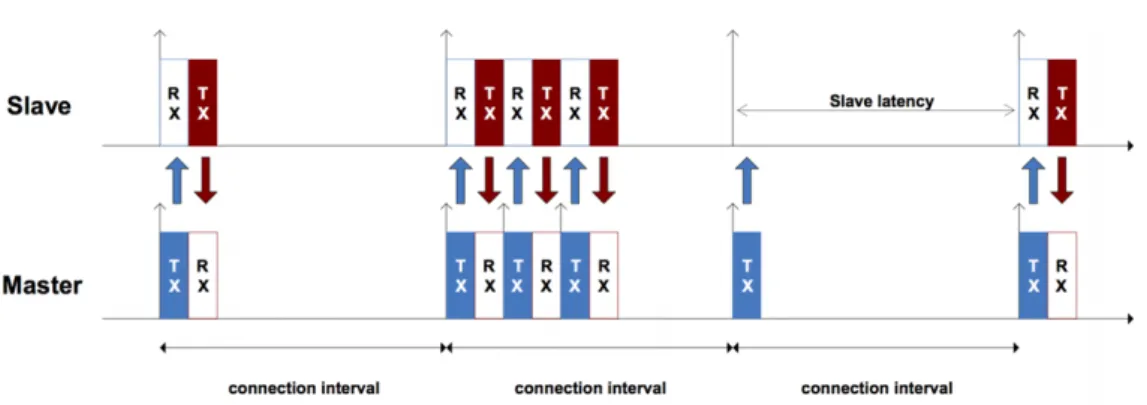
Once connected, the Master/Slave exchange data packets at regular intervals, calledconnection events, as seen in Figure 3.2. TheConnection Interval can be set between 7.5 ms and 4000 ms with a step size of 1.25 ms. When in a connection, the master has to transmit a packet to the slave once every connection event. If there is no actual data to send, a 0-byte packet is sent to keep the connection alive. A connection event is the start of a group of data packets that are sent from the master to the slave and back again. The connection event continues until a packet either fails to be received correctly, the sender is satisfied with ending the connection event, or, in an improbable scenario, the end of the interval has been reached. If a packet fails to be received correctly, the connection event is ended, and the failed packet will be retried at the next connection event.
Connection Events and Connection Intervals are the concepts that enable the Bluetooth Low Energy to actually be Low Energy. That is because between CIs, the radios can be turned off, which saves tremendous amounts of energy. The most power-hungry part of a BLE chip is undoubtedly the 2.4GHz oscillator needed for the radio, and if we can keep the radio turned off as much as we can, the energy consumption will be lowered substantially. The CEs/CIs are thus used to turn on the radio only at predetermined intervals for short amounts of time, keeping the average power consumption low.
3.3.2
Connection parameters
Other than the connection interval, explained in Chapter 3.3.1, there are two more connection parameters managed by LL: Slave latency, which de-clares the number of connection events that a slave can choose to skip without risking disconnection, andConnection supervision timeout, which is the
max-2Image via Microchip:
https://microchip.wdfiles.com/local--files/wireless: ble-link-layer-connections/connected-phase.png
18 CHAPTER 3. BLUETOOTH LOW ENERGY
Figure 3.2: Connection events and connection intervals2.
imum time between two received valid data packets before a connection is considered lost.
The connection parameters are negotiated at the initial connection pro-cedure, but they can also be changed during the active connection. This can be used to dynamically increase throughput for transfer of larger chunks of data, while still maintaining low power consumption on average. This can be achieved by decreasing the connection interval for the data transfer and increasing it back up after the data was sent. That way, each connection can be fine-tuned to provide the best balance between throughput and power consumption.
3.4
Generic Access Profile (GAP)
Generic Access Profile (GAP) covers the usage mode of the lower-level radio protocols to define roles, procedures and modes that allow devices to broad-cast data, discover devices, manage connections and negotiate security levels. This is a Bluetooth base profile which is mandatory for all Bluetooth devices.
3.4. GENERIC ACCESS PROFILE (GAP) 19
3.4.1
Roles
In BLE, GAP defines four specific roles: Broadcaster, Observer, Peripheral, and Central. A device can operate in one or more BLE GAP roles at a time.
Broadcaster role is optimised for transmit-only applications that dis-tribute data regularly. Broadcasters send data in advertising packets instead of in data packets, so that data is immediately accessible to any device lis-tening, without the need for a specific connection to the Broadcaster.
The Observer is optimised for receive-only applications that want to collect data from broadcasting devices, without the need to form a connection with them. An Observer listens to data embedded in the advertising packets.
Centralrole corresponds to the Link Layer master and supports multiple connections. It is the initiator and controller of connections to peripheral de-vices. The device supporting the central role needs access to more processing and memory resources to be able to manage multiple connections and gener-ally supports more complex functions compared to other BLE GAP devices. The central starts by scanning for other devices advertising packets and then initiates a connection with the selected device.
Peripheralrole corresponds to the Link Layer slave. It is optimised for devices that support a single connection and are less complex than central devices. The peripheral device starts with advertisements to allow the central devices to find and establish a connection with it.
It is common for developers to associate BLE GATT client and server roles (explained in Chapter 3.5) with GAPcentral andperipheral roles, even though there is no connection between them, as any combination is allowed and used in different devices and use cases.
3.4.2
Modes and procedures
GAP layer is responsible for the following procedures, which are applicable to specific roles [17]: broadcasting, observing, advertising, discovery, connec-tion establishment, connecconnec-tion parameter update, connecconnec-tion terminaconnec-tion
20 CHAPTER 3. BLUETOOTH LOW ENERGY
and many more.
Advertising packets are blindly sent at fixed intervals unidirectionally, and they make up the basis for broadcasting (and observing), as well as discovery. An observing or scanning device may receive the advertising packet if it happens to scan while the advertising packet is transmitted, after which it can initiate the connection. A connection requires two devices that synchronously perform data exchanges at set regular intervals and provide guarantees on data transmission.
3.5
Generic Attribute Profile (GATT)
Generic Attribute Profile (GATT) defines the way BLE devices transfer data between themselves, using concepts called services and characteristics. GATT defines how to use Attribute Protocol (ATT) as its transport protocol to discover, read, write, broadcast and obtain indications of data. It is used by the application for data communication between two connected devices. The data is organised hierarchically in groups called services, which group conceptually related pieces of data called characteristics.
Attributes are the smallest data item defined by GATT (and ATT). They are addressable pieces of information that can contain user data or meta-data. Metadata houses information about the structure and grouping of the different attributes contained within the server.
GATT also provides the reference framework for all GATT-based profiles, which are defined by Bluetooth SIG. These profiles cover precise use cases and ensure interoperability between devices from different manufacturers and range from mandatory ones, such asDevice Name, to more use case specific such as Heart Rate Measurement.
3.5.1
Roles
As with any other profile or protocol in Bluetooth specification, GATT starts with defining the roles that devices can implement:
3.5. GENERIC ATTRIBUTE PROFILE (GATT) 21
The GATT Server contains the data to be monitored or changed, or-ganised in attributes. It receives requests from a client and sends back re-sponses. It can also send server-initiated updates when configured to do so.
The GATT Client sends requests to a server and receives responses (and server-initiated updates) from it. Because the GATT client inherently has no information about the server’s attributes, it must first inquire about those attributes by performing service and characteristic discovery. After completing service and characteristic discovery, it can then start reading and writing attributes (organised in services and characteristics) supported by the server.
While the most common configuration is a smaller device configured as GAP Peripheral and GATT Server, and a second device (most often a smart-phone) configured as GAP Central and GATT Client, it is by no means mandatory, as already mentioned in Chapter 3.4.1.
3.5.2
UUIDs
A universally unique identifier (UUID) is a globally unique 128-bit (16-byte) number that is used to identify Profiles, Services and Data Types in a Generic Attribute (GATT) Profile. BLE specification adds support for shortened 16-bit and 32-16-bit UUIDs. These shortened formats can only be used with UUIDs that are defined by the BLE specification (i.e., that are listed as standard Bluetooth UUIDs by the Bluetooth SIG), while vendor-specific UUIDs always use 128-bit.
3.5.3
Attribute and Data Hierarchy
The data in a GATT server is grouped intoservices, each of which can contain zero or morecharacteristics, as seen in Figure 3.3. Each service distinguishes itself from other services by a UUID. Any device claiming GATT compati-bility (essentially, all BLE devices sold) has to strictly follow this hierarchy
22 CHAPTER 3. BLUETOOTH LOW ENERGY
pattern.
Characteristics can be thought of as user data containers. They always include at least two attributes: the characteristic declaration (metadata) and the characteristic value (user data). They can also contain additional attributes called descriptors, which expand the metadata contained in the characteristic declaration. The most common descriptor used is the Client Characteristic Configuration Descriptor (CCCD), which provides a mecha-nism for Server-Initiated updates (explained in Chapter 3.5.4).
Attributes are the smallest addressable data entity defined by GATT (and ATT). The most common attributes are:
The attributehandleis a unique 16-bit identifier for each attribute on a particular GATT server.
The attribute type is simply the UUID (see Chapter 3.5.2) of the characteristic.
Permissions are metadata that specify which operations can be exe-cuted on each particular attribute. ATT and GATT define the following permissions:
– Access Permissions: None, Readable, Writeable, Readable and Writeable.
– Encryption: No encryption, Unauthenticated encryption, Authen-ticated encryption.
– Authorization: No authorization required, Authorization required.
Value holds the actual data content.
3.5.4
Features
GATT features are strictly defined procedures that allow data exchanges to take place using the GATT layer. There are 11 features defined in the GATT
3.5. GENERIC ATTRIBUTE PROFILE (GATT) 23
Figure 3.3: GATT data hierarchy3.
Profile: Server Configuration, Primary Service Discovery, Relationship Dis-covery,Characteristic Discovery, Characteristic Descriptor Discovery, Read-ing a Characteristic Value, Writing a Characteristic Value, Notification of a Characteristic Value, Indication of a Characteristic Value, Reading a Char-acteristic Descriptor and Writing a Characteristic Descriptor. Here, the features relevant for this work, will be explained in more details.
Server Configuration: Exchange MTU
This (sub-)procedure is used by the client to set the AT T M T U parameter (see Chapter 3.5.5) to the maximum value that is supported by both devices. The client will send anExchange MTU request, to which the server will reply with either Exchange MTU Response or Error Response. The AT T M T U
24 CHAPTER 3. BLUETOOTH LOW ENERGY
means that the maximum data payload for GATT operations isAT T M T U−
3 bytes, as 3 bytes are used for the header.
Service and Characteristic Discovery
Because the client by itself has no knowledge about the server attributes, services and characteristics themselves and their handles it usually issues a series of sub-procedures to gather that information when it first connects to the server. These sub-procedures return the list of primary services and their handles, which can then be used to issue characteristic discovery for each returned service.
Characteristic Value Read
This procedure is used by the client to read a Characteristic Value from a server. Four sub-procedures can be used to read a Characteristic Value: Read Characteristic Value, Read Using Characteristic UUID, Read Long Charac-teristic Values, and Read Multiple Characteristic Values.
The Read Response to the Read Characteristic Value contains the com-plete Characteristic Value if that is less thanAT T M T U−3 bytes in length. Otherwise, it only contains the first part, and the Read Long Characteristic Value can be used to obtain the rest of the value.
The Read Long Characteristic Values sub-procedure request is issued with increasing offset as a request parameter until the reply is shorter than
AT T M T U −3 bytes.
Characteristic Value Write
This procedure is used by the client to write a Characteristic Value to a server. Five sub-procedures can be used to write a Characteristic Value: Write Without Response, Signed Write Without Response, Write Character-istic Value,Write Long Characteristic Values and Reliable Writes.
Write Characteristic Value can be used by the client to write a Charac-teristic Value if it is smaller than AT T M T U −3 bytes and the server will
3.5. GENERIC ATTRIBUTE PROFILE (GATT) 25
acknowledge the operation with a response.
When the value to be written is larger than AT T M T U −3 bytes, the client can use Write Long Characteristic Values. Here the data (up to 512 bytes long) is split into multiple Prepare Write Requests, each of which can have at most AT T M T U −5 bytes in its payload, as two bytes are needed to transfer the offset. Each Prepare Write Request will get a Prepare Write Response from the server, which sends the offset, as well as data for the client to confirm. After all the data is transferred, anExecute Write Request is used to write the complete value.
Reliable Writes sub-procedure is used when the client wants to write multiple characteristic values, so the operations are queued and at the end, a final packet to commit the pending write operations and execute them is sent.
Write Without Response is the equivalent to notifications, except that here the data stream is from client to server. This uses Write Command packets, which are not acknowledged at the application layer, only by the link layer, which means that the client will get the acknowledgement that the packet was successfully transferred to the server, but not if the server accepted the packet. The data payload limit ofAT T M T U−3 bytes applies toWrite Without Response as well.
The Signed Write Without Response uses the same mechanism as Write Without Response, with the difference being it is only used if the authenti-cated bit is enabled and the client and server share a bond and that the data payload is AT T M T U −15 bytes.
Characteristic Value Notification
This procedure is used when a server is configured to notify a Characteristic Value to a client without expecting any acknowledgement that the notifi-cation was successfully received. Notifinotifi-cations can be configured using the Client Characteristic Configuration descriptor.
26 CHAPTER 3. BLUETOOTH LOW ENERGY
Characteristic Value Indication
This procedure is used when a server is configured to indicate a Character-istic Value to a client and expects an acknowledgement that the indication was successfully received. Indications can be configured using the Client Characteristic Configuration descriptor.
3.5.5
BLE Packet
A BLE packet containing application data and transferred over the air has the structure seen in Figure 3.4. The size of the Data field is dependent on the Bluetooth specification version. In Bluetooth 4.0 and 4.1, the maximum size of the Data field was 27 bytes (+4 bytes for the message integrity check). Bluetooth 4.2 brought the new feature calledData Length Extension (DLE), which enabled the Data field size to be up to 251 bytes (+4 bytes for the message integrity check).
Figure 3.4: BLE packet structure4.
That Data field is an L2CAP packet, which includes 4 bytes for the L2CAP header, yielding 23 (BLE v4.0, v4.1) or 247 (BLE v4.2, v5) bytes of ATT Data, which is also known asAT T M T U. The ATT packet includes 1 byte for the ATT operation code and another 2 bytes for the attribute
4Image via PunchThrough: https://punchthrough.com/blog/posts/ maximizing-ble-throughput-part-2-use-larger-att-mtu
3.5. GENERIC ATTRIBUTE PROFILE (GATT) 27
Figure 3.5: ATT packet structure5.
handle, as seen in Figure 3.5, from which we get the maximum data payload for the application layer of 20 (27−4−1−2) bytes in BLE v4.0 and v4.1, and 244 (251−4−1−2) bytes for BLE v4.2 onwards.
5Image via PunchThrough: https://punchthrough.com/blog/posts/ maximizing-ble-throughput-part-2-use-larger-att-mtu
Chapter 4
Testing methodology
4.1
Hardware
Testing was done using two NordicnRF52840 DK [6] development kit boards, one as the central device and the other as the peripheral. ThenRF52840 DK is a single board development k