Ministry of Education National Implementation Framework III………..2011 - 2015
i
Education Sector
National Implementation Framework III
2011 - 2015
Education for All:
Accelerating Poverty Reduction Through Rural Investment,
Human Capital and Infrastructure Development
June 2010
Lusaka
COVER PICTURES
1. A teacher and her pupils at Jacaranda Basic School in Lusaka District.
2. An outdoor lesson at a Community School in Senama Township, Mansa District. 3. Pupils in class at a Basic School in Chiengi District.
4. A pupil at Mukunkiki Basic School in Kaoma District.
5. Students in the main library at Nkrumah University College, Kabwe District. 6. Graduation time at Northrise University, Ndola District.
Ministry of Education National Implementation Framework III………..2011 - 2015 iii
Republic of Zambia
MINISTRY OF EDUCATIONEducation Sector
National Implementation
Framework III
2011 - 2015
Implementing the Sixth National Development Plan
Vision
Innovative and productive life-long education and training accessible to all by 2030.
Mission
Providing equitably accessible education and skills training opportunities for sustainable livelihood and development.
Goals
1. To ensure universal basic education provision to children.
2. To ensure that opportunities exist for all citizens to have equitable access to ECCDE, basic and high school, tertiary education and / or technical and vocational training.
3. To improve the quality and relevance of education and skills training. 4. To promote efficiency and cost effectiveness.
5. To enhance institutional coordination in both public and private education and training institutions.
6. To ensure that library services are improved to contribute to high standards and quality of education in Zambia
Corporate Objectives
1. To improve access, quality and equity of education at all levels. 2. To improve efficiency of the education system.
3. To ensure that school curricula and materials are relevant to the needs of Zambia and are consonant with the appropriate standards.
4. To ensure that non-formal education programmes respond to the needs of the industry and the communities in general.
5. To develop and implement a common system of regular collection and reporting of
information on the current status and future demand and supply, and on priority educational areas of the country.
6. To effectively participate in regional and international educational sector development initiatives (MoUs, Agreements, Conventions, Protocols, etc)
Ministry of Education National Implementation Framework III………..2011 - 2015 v
Table of Contents
Acronyms ... viii Acknowledgements ... x Foreword ... xiMacro and Sector-level Context ... 1
1.1 Macro-level Context ... 1
1.2 Education Sector Context ... 2
1.2.1 Overview ... 2
1.2.2 Educational Financing ... 2
1.2.2 Cooperating Partners and the Education Sector ... 4
Strategic Focus ... 5
2.1 Background ... 5
2.2 Goals ... 9
2.3 Broad Objectives ... 9
Early Childhood Care, Development and Education ... 11
3.1 Overview ... 11
3.2 Situational Analysis ... 11
3.3 Strategic Objectives ... 12
3.4 Strategies ... 12
3.5 ECCDE Performance Indicators ... 13
Basic Education ... 14
4.1 Overview ... 14
4.2 Situational Analysis ... 14
4.3 Strategic Objectives ... 16
4.4 Strategies ... 16
4. 5 Basic Education Performance Indicators ... 18
High School Education ... 22
5.1 Overview ... 22
5.2 Situational Analysis ... 22
5.3 Strategic Objectives ... 23
5.4 Strategies ... 23
5.5 High School Performance Indicators ... 24
Skills Training ... 28
6.1 Overview ... 28
6.2 Situational Analysis ... 28
6.3 Strategic Objectives ... 29
6.4 Strategies ... 29
6.5 Skills Training Performance Indicators ... 30
Adult Literacy ... 32
7.1 Overview ... 32
7.2 Strategic Objectives ... 34
7.4 Strategies ... 34
Teacher Education, Supply and Management ... 36
8.1 Overview ... 36
8.2 Situational Analysis ... 36
8.3 Strategic Objectives ... 38
8.4 Strategies ... 38
8.5 Teacher Education, Supply and Management Performance Indicators ... 40
University Education ... 42 9.1 Overview ... 42 9.2 Situational Analysis ... 42 9.3 Strategic Objectives ... 43 9.4 Strategies ... 43 EQUITY ... 48 10.1 Overview ... 48 10.2 Situational Analysis ... 48 10.3 Objectives ... 50 10.4 Strategies ... 50
10. 5 Equity Performance Indicators ... 52
Information and Communication Technology ... 55
11.1 Overview ... 55
11.2 Situational Analysis ... 55
11.3 Strategic Objectives ... 56
11.4 Strategies ... 56
11.6 ICT Performance Indicators ... 58
Infrastructure Development ... 61
12.1 Overview ... 61
12.2 Situational Analysis ... 61
12.3 Strategic Objective ... 61
12.4 Strategies ... 62
12.5 Infrastructure Development Performance Indicators ... 63
Organisational and Institutional Framework ... 64
13.1 Overview ... 64
13.3 Information Management ... 65
13.4 Budgeting and Financial Management ... 65
13.5 Procurement ... 66
13.6 Management and Human Resource Capacity ... 66
13.7 Indicative Activities ... 68
Monitoring and Evaluation ... 72
14.1 Overview ... 72
14.3 Implementation Priorities ... 73
14.4 Sharing of Tasks and Responsibilities ... 74
14.5 Monitoring and Reporting Mechanisms ... 76
14.6 Key Performance Indicators ... 82
14.7 Key Infrastructure Development Milestones ... 83
Financing of the NIF ... 84
15.1 Introduction ... 84
Ministry of Education National Implementation Framework III………..2011 - 2015
vii
15.3 Resource Requirement Projections ... 85
Total Required Resources ... 85
15.2.1 Required Recurrent Resources ... 85
15.3.2 Capital Resource Requirements ... 86
15.4 Sector Development and Financing Projections ... 86
15.4.1 Enrolment at Lower to Middle Basic Level (Grade 1-7) ... 89
15.4.2 Enrolment at Upper Basic Level (Grade 8-9) ... 91
15.4.3 Enrolment at High School Level (grade 10-12) ... 92
15.4.4 Teacher Supply Management ... 94
15.4.5 Teacher Training ... 96
Acronyms
AIDS Acquired Immune Deficiency Syndrome AEP Alternative Education Programmes AWPB Annual Work Plans and Budgets
BESSIP Basic Education Sub-Sector Investment Programme CBOs Community-based Organisations
CBU Copperbelt University
CPD Continuing Professional Development CSEN Children with Special Educational Needs CSO Central Statistical Office
DEBS District Education Board Secretaries
DECC District Education Coordinating Committee DEMC District Education Management committee DODE Directorate of Distance Education
EBS Education Broadcasting Services
ECCDE Early Childhood Care, Development and Education EFA Education for All
FNDP Fifth National Development Plan FTI Fast Track Initiative
GBS General Budget Support GDP Gross National Product
GRZ Government of the Republic of Zambia
HIV Human Immuno-deficiency Virus
ICT Information and Communication Technology INSET In-service Training
JASZ Joint Assistance Strategy for Zambia LFFTE Limited Financial Flow Tracking Exercise LSEN Learners with Special Educational Needs
MCDSS Ministry of Community Development and Social Services MoESP Ministry of Education Strategic Plan
MDGs Millennium Development Goals MoE Ministry of Education
M&E Monitoring and Evaluation
MTEF Medium-Term Expenditure Framework
NAC National AIDS Council
NGOs Non-Governmental Organisation NIF National Implementation Framework NSC National Science Centre
ODL Open and Distance learning OVC orphans and vulnerable children PEO Provincial Education Offices PER Public Expenditure Review PPP Public-Private-Partnership
Ministry of Education National Implementation Framework III………..2011 - 2015
ix PTR
SACMEQ
Pupil Teacher Ratio
Southern and Eastern African Consortium for Monitoring Quality Education SADC Southern Africa Development Community
SHN School Health and Nutrition SNDP Sixth National Development Plan
SPRINT School Programme of In-service for the Term SWAp
TBS
Sector Wide Approach Target Budget Support
TEVET Technical Education and Vocational Training
UNESCO United Nations Education, Scientific and Cultural Organization UNZA University of Zambia
ZACODE Zambian College of Distance Education ZAMREN Zambia Education Research Network ZLS Zambia Library Service
Acknowledgements
During the preparation of the National Implementation Framework III, the Ministry of Education received invaluable support and guidance from numerous stakeholders in the Education Sector. In this regard I wish to thank especially Dr. Cornelius Chipoma from USAID, Dr. John Chileshe from JICA and Mrs. Given M. Daka from the Embassy of the Kingdom of the Netherlands.
In addition I wish to thank also Mr. Joe Kanyika from the Examination Council of Zambia, Mr. Saul Banda and Mr. Stanley Banda from EQUIP 2, Mrs. Madrine B. Mbuta, Mrs. Esvah Chizambe, Mr. James Chilufya, Mr. Valentine Chitambala, Mrs. Ireen Chirwa, Mr. Fanwell Besa and Mr. Oscar Shitima from the Ministry of Education, who skilfully and with experience coordinated the development of this important document. Lastly, gratitude goes to Zambia National Education Coalition (ZANEC) and Campaign for Female Education (CAMFED) for their enormous contribution to the shaping up of ideas contained in this document.
Felix V. Phiri (Dr.) Director – Planning and Information
Ministry of Education National Implementation Framework III………..2011 - 2015
xi
Foreword
The National Implementation Framework III (NIF III) will guide the implementation of the Sixth National Development Plan (SNDP) 2011 to 2015. The purpose of this document is meant for steering the Ministry of Education’s contribution towards the realisation of Zambia’s long term development vision of becoming a prosperous middle income country by the year 2030 as articulated in the National Vision 2030 and to also drive the nation to achieve both Millennium Development and Education For All goals. Like the NIF II before it, the purpose of the NIF III is twofold. Firstly, it will guide the articulation of broader objectives of the Sixth National Development Plan (SNDP) into identified activities and that it will be operationalised through Annual Work Plan and Budgets over the period. In this regard, NIF III will be the SNDP operational tool at all levels of the education system from the Ministry Headquarters to the Provincial Education Offices (PEO), District Education Board Secretaries (DEBS) and schools. Secondly, NIF III intends to serve as an important instrument for monitoring implementation performance (targeting mainly the outcome and impact levels). In this respect, it will also provide the framework for tracking resource utilisation.
I wish to encourage all Ministry of Education officials, stakeholders and collaborating partners to make the best use of this document in the implementation and monitoring of the SNDP.
Andrew Phiri Permanent Secretary Ministry of Education
1
Macro and Sector-level Context
1.1 Macro-level Context
Zambia has registered positive economic growth with significant improvements in per capita income since 1999. Real annual GDP growth averaged about 5 percent over the past five years, mainly on account of improved agricultural production and significant new investments across the main sectors, particularly in the mining sector.
The global economic crisis of 2008 however reduced the gains the country had recorded. In 2008, global economic growth slowed down to 2.5 percent, compared to 3.7 percent in 2007. This was mainly because of the onset of the global recession in industrialised economies, a consequence of the turbulence in the international financial markets. One of the major consequences of the global financial crisis was the spectacular collapse of commodity prices in 2008. Copper prices reached a record high of US$ 8,985 per ton in July 2008, before tumbling by 67.7 percent to US$2,902 by the close of the year. Global inflation also worsened, thus, affecting Zambia’s growth, inflation, the exchange rate and the terms of trade. The country’s macroeconomic performance in 2008 was weaker and growth was lower than projected, at 5.8 percent (as opposed to the 6.3 percent GDP growth achieved in 2007).
The Government policy of lowering inflation to single digit has remained a challenge in the light of the impeding difficulties. Although this was achieved during 2006 and 2007,1 the high international oil and food prices in 2008 resulted in the inflation growth of 16.6 percent in that year. Food inflation, in particular, grew by as much as 20.5 percent in 2008 (compared with 5.9 percent in 2007). Similarly, the exchange rate was not spared from the global financial crisis, with the Zambian Kwacha recording a depreciation of 27.3 percent against the US dollar (at K4, 882 for a US dollar) in December 2008. This worsened further to K5, 200 by June, 2010. This volatility in the exchange rate makes it difficult to plan.
Worsening poverty levels have negated Zambia’s economic growth, a factor that greatly challenges the attainment of both the Education for All (EFA) Goals and the Millennium Development Goals (MDGs). According to the Living Conditions Monitoring Survey (2008), 64 per cent of Zambia’s population lives below the poverty line, with rural poverty levels at 81 percent. Income distribution has remained highly unequal, resulting in worsening human deprivation as demonstrated by the decline in the country’s Human Development Index, mainly on account of the very low record of life expectancy at birth.
Ministry of Education National Implementation Framework III………..2011 - 2015
2
The country’s high HIV and AIDS prevalence rate, along with malaria and other infectious diseases, has contributed to the high mortality rate.
1.2 Education Sector Context 1.2.1 Overview
The development of National Implementation Framework (NIF) III builds upon the successes and lessons of NIF II. From 2006 to 2010, funding to the sector steadily increased from 2.9 of GDP to 3.5 percent which resulted in a marked expansion of infrastructure which led to increased access to education at all levels especially basic Since the introduction of the free basic education policy in 2002 the number of children accessing basic education has increased by over one million. Consequently, the attainment of universal primary education is on track in Zambia. Notwithstanding this positive development, a number of challenges still remain. Critical among them are the following:
1. Insufficient infrastructure and desks
2. Inadequate teaching and learning materials.
3. Low learning achievements especially in Science and Mathematics. 4. Low teacher motivation.
5. Low Capacities to utilize available data for effective planning and decision making
6. Coordination of key stakeholder mobilization and participation 7. Delayed disbursement of funds
8. Ineffective teacher supervision and management 9. Delays in updating and reviewing the curriculum 10.Inadequate transport at lower levels
1.2.2 Educational Financing
For many years, educational financing has been quite poor and hardly responded to the rising demands for educational services in the light of the growing population. In 2002, the Government spent only 2.1 percent of the GDP on education. Expenditure on basic education from the Government’s own resources was only 1.8% of GDP, a low level in comparative terms. In per capita terms, Government expenditure per basic school pupil in 2004 was 8.6% of the country’s per capita GDP, as compared with 12.4% of per capita GDP among developing countries. Furthermore, about 90% of the Government’s own expenditures on basic education have been devoted to personal emoluments, leaving little for other educational requisites.
However, in recent years, the Government has increased the funding to education. The education sector’s share of GDP increased substantially to 4.2 percent in 2008, compared to only 2 percent in 2000. Although this increase is substantial, it is insufficient to finance the achievements of the MDG related to universal basic education covering grades 1-9. In terms of per capita GDP, Zambia spent about 8.6 percent on basic education, while the average in Low Income Countries (LICs) is about 12.4 percent. Funding levels in Zambia were much lower than the government expenditure on education in three comparison
countries (Kenya, Uganda, and Malawi) where the average GDP allocation was 5.3% of GDP. The comparator countries devoted at least 25% of their domestic discretionary budgets to education, compared to Zambia’s 20%. In the Sixth National Development Plan for the 2011-2015 period, the Government has prioritised education as a key social sector.
In the light of the policy commitment above, total annual budget allocations to the Ministry of Education over the 2006-2008 period increased substantially, amounting to a total nominal increase of almost 30 percent during this period. Table 1 reveals this clearly.
Table 1: Annual Budget for Ministry of Education 2006-08 (In K billion –current prices)
2006 2007 2008
Total National Budget 10,236.60 12,034.40 13,761.40 Total Education Budget 1,647.40 1,807.00 2,118.50 o/w sector pool 178.19 279.71 267.69
GDP 39,223.00 45,482.23 51,559.00
In percent
4.2 4.0 4.1
16.1 15.0 15.4
10.8 15.5 12.6
Source: Derived from Ministry of Education, Fiduciary Risk Assessment, Lusaka, November 2008 (based on Annual Budget Speeches).
In spite of the significant increases in educational financing, the education ministry’s share of total government expenditure was approximately 15-16 percent of total government expenditure during the three years, which is significantly lower than in comparable countries such as Kenya, Uganda, and Malawi that allocate, on average, around 25 percent of total government expenditures to the education sector. Consequently, the quality dimension of educational service provision has continued to be compromised by persistently high pupil-teacher ratios, insufficient infrastructure, and insufficient learning materials.
In terms of sub-sectoral allocations within the education sector, basic education receives more than 60 percent of total education sector share. The share of high schools in total education expenditure has also progressively increased, rising from 8 percent in 2006 to 17 percent in 2008. A significant expenditure increase has also been recorded for the tertiary sector. Table 2 shows the annual allocations for the strategic education sub-sectors over the 2006-2008 periods, based on the Annual Work Plans and Budgets (AWPB).
Ministry of Education National Implementation Framework III………..2011 - 2015
4
Table 2: Annual Work Plan and Budget for the Ministry of Education 2006-08
(K million) 2006 2007 2008 GRZ Sector Pool GRZ Sector Pool GRZ Sector Pool ECCDE 3,727 3,640 1,023 1,726 899 196 Basic Education 97,205 86,497 1,017,066 143,755 1,181,200 158,309 Literacy Education 0 0 300 0 575 387
High School Education 59,283 50,132 184,946 112,878 301,104 63,654 Tertiary Education 157,826 11,324 291,208 9,250 340,906 31,722 Administration and Support 959,035 26,594 121,601 12,106 58,892 13,421
Total 1,277,076 178,186 1,616,145 279,716 1,883,576 267,689
Source: Ministry of Education AWPB 2006, 2007 and 2008
1.2.2 Cooperating Partners and the Education Sector
A number of Cooperating Partners support the education sector using a variety of funding modalities. Cooperating Partner support through the sector pool contributed about 13 percent to the total budget of the Ministry of Education in 2008, which was lower than in 2007. Since there is a general recognition that the sector pool support has introduced a parallel system to that of Government,2 efforts are being made to harmonise external support especially now when the Aid Policy and Strategy clearly defines the government preferences, including its clear objection to parallel financing systems that generally tend to be capacity draining rather than capacity building. A number of Cooperating Partners have actually taken a decision to move from the sector pool funding modality into General Budget Support. In the context of the FNDP and the Aid Policy and Strategy, a new Memorandum of Understanding for the education sector was entered into in May 2008. The Education Sector Management and Coordination Guidelines continues to guide the relationship between the Ministry of Education and other stakeholders that include Cooperating Partners and NGOs.
2
The Sector Pool Support is where funds are channelled directly to the MoE and deposited in a common bank account, under the control and management of the MoE. The funds are then used towards activities defined in the AWPB as guided by the strategic priorities of the NIF. The sector pool uses parallel budget and financial management systems and procedures, and separate audits of the sector pool account are carried out.
2
Strategic Focus
2.1 Background
The Ministry of Education’s Strategic focus combines the policy aspirations outlined in Educating Our Future, Vision 2030 and the Sixth National Development Plan (SNDP) to run from 2011-2015. The strategic approach also embraces social factors impacting the education system including HIV/AIDS, gender, disability, OVC and illiteracy. With these considerations, the NIF III aims to improve the general quality of education provision specifically raising learning achievement levels as well as overturning inefficiencies. Zambia has participated in a number of regional and international forums that focused on how best to improve education service provision and some of these have made an important impression on the manner in which the country has redefined its goals, objectives and priorities for the education sector. The regional initiatives in which Zambia has participated include the Southern Africa Development Community (SADC) Protocol on Education and training and the regional education programme that targets the girl-child, namely, the African Girls’ Education Initiative.
At the international level, Zambia’s education policies incorporate the Education for All (EFA) initiative/process and the Millennium Development Goals (MDGs). EFA is a global strategy devised to ensure that all children have access to quality education. The following EFA goals and targets agreed upon at the World Education Conference in Jomtien provided hope for the development of basic education in Zambia and shall, thus, continue to guide policy actions in the fields of education and training through:
(a) Expanding early childhood care and developmental activities, including family and community interventions, especially for poor, disadvantaged and disabled children.
(b) Universal access to, and completion of Basic Education (Grades 1-9) (c) Raising the learning achievement levels
(d) Reducing the adult illiteracy rates
(e) Expanding the provision of basic skills education and training for youths and adults
(f) Increasing the acquisition of knowledge, skills and values by individuals and families of for better living and sustainable development.
Ministry of Education National Implementation Framework III………..2011 - 2015
6
outstanding, particularly in Sub-Saharan African countries, including in Zambia. This realisation sets the stage for the 2000 World Education Forum in Dakar, Senegal, where the EFA initiatives were re-affirmed against the backdrop of the devastating effects of the HIV and AIDS pandemic, the impact of structural adjustment programmes and natural disasters. Zambia subscribed to the collective Dakar Framework of Action that was formulated with the following targets:
a) Expanding and improving comprehensive early childhood care and education, especially for the most vulnerable and disadvantaged children.
b) Ensuring that, by 2015, all children have access to, and complete free, compulsory, and quality basic education.
c) Ensuring that learning needs of young people and adults are met through equitable access to appropriate learning and life-skills programmes.
d) Achieving a 50 percent improvement in levels of adult literacy in 2015. e) Eliminating gender disparities in primary and secondary education and
achieving gender equality in education by 2015. f) Improving all aspects of quality of education.
In order to achieve these goals, it was agreed that EFA forums shall be strengthened at the national, regional and international levels. For Sub-Saharan African countries, the EFA goals are expected to be realized through strategizing at the national level, complemented by concerted action at the African regional level.
For Zambia, the Jomtien EFA Conference and the Dakar Framework of Action are understood as being rooted in fundamental values of basic human rights of every individual, which include:
a) justice, equity and fairness to all individuals;
b) obligation of the society to the educational needs of all its people; c) the right of all people everywhere to basic education as a fundamental
human right;
d) fair and equitable treatment of all learners - infants, children, youth and adults;
e) establishment of better learning environments;
f) promotion of learning achievement as a significant measure of real education opportunities; and
g) education as a basis for better living of individuals and communities.
Summary EFA Regional Framework for Action Strategic Objectives, Targets and Strategies.
Box 1: EFA REGIONAL FRAMEWORK FOR ACTION
1. Priority areas of focus
a) Improving access and equity
b) Improving quality and relevance of education c) Institutional and professional capacity building d) Improving partnerships
2. Strategic Objectives
a) Transforming education for national and regional development goals with specific reference to social, cultural and economic and technological development
b) Transforming curriculum content and improving relevance, quality and teaching methodologies with the need of learners in focus
c) Transforming the role of the state and education system structures and functions for facilitating active participation of stakeholders in the lifelong learning processes d) Building capacity in educational leadership, management, research and information
systems
e) Strengthening partnerships with NGOs, civil society and development partners at community, and national, regional and international levels.
3. Basic strategies
a) Review and harmonisation of existing policies and legislation, focussed at rights of disadvantaged groups and the creation of a culture of lifelong learning
b) Increase in financing and rationalisation of investment in education c) Development of national, sub-regional and regional institutional capacities
d) Review of curricula and validation of African indigenous knowledge systems, values and skills
e) Improvement of capacities for educational change
f) Improvement of the teaching and learning environment, through development of materials, methodologies and social learning environments that are feasible, sustainable and relevant to the African learner
g) Adoption of appropriate and cost-effective technologies, including reducing the dependence on imported materials and increasing the use of the oral tradition
h) Promotion and support of Africa based educational research i) Development of genuine and sustainable partnerships
4. Targets a) ECCDE Programmes - double by 2006 offering safe and stimulating environments. 100% access for 3-6 age group by 2015
b) Primary education - By 2015: 100% access; 80% completion rate, of which 90% start at secondary level
c) Learning achievement - By 2015: all teachers have received initial training; operational in-service training programmes which are child-centred and gender-based.
d) Enhancement of education of girls and women – Increase admission, completion and transition rates of girls and remove legislative barriers; create safe learning environments for girls; institutionalisation of action in relation to access; implement awareness raising campaigns and training.
e) Reduction of adult literacy – Reduce illiteracy by 50%
f) Expansion of basic education and skill training for out-of-school learners – Conduct studies in next 2 years to assess situation of out-of-school children; based on these studies design of NFE programmes; bridging gap between formal education and NFE. g) Development of HIV/AIDS programmes and mechanisms – life skills and HIV/AIDS
education become part of education programmes; partnerships with civil society, media, communities; AIDS campaigning
h) Improving management and governance – Use of ICT; decentralisation and participation through capacity building at a lower level; produce strategic plan on management.
i) Increase budgetary allocation to education – By 2005: 7% of GDP spent on education; By 2010: 9%; international agencies should double their financial support
j) Institutionalise the assessment and monitoring functions of the EFA team – Establishment of Regional EFA Consultative Council; By 2000: work plan on regular assessment and monitoring
Four major targets/principles capture the underlining spirit of Jomtien EFA objectives in Zambia. The first is access, which continues to emphasize commitment to universal provision of opportunities for a defined minimum level of education. Although this principle is often taken to be principally concerned with opportunities for the school-age population, the Government of Zambia maintains that it shall also embrace the provision for the adult population, which in the earlier years did not have access to such opportunities.
Ministry of Education National Implementation Framework III………..2011 - 2015
8
The second target is equity, which stresses the need to ensure that the distribution and utilization of opportunities in education would be fairly targeted in order to reach the disadvantaged groups in society. This target calls for specific measures and explicit strategies in favour of groups that had not been able to fully participate in the education process. Women, disadvantaged children, particularly orphans and vulnerable children (OVC), the extremely poor people found mainly in rural areas, people with physical and learning disabilities, etc., are all specifically targeted to allow then to equitably enjoy the rights and opportunities that are offered by education.
The third target namely learning achievement, fundamentally underpins the focus of this investment plan gauged against past gains in access and participation, there has not been much improvement in learning achievement levels over time. In this NIF, significant efforts will be made to ensure that learning achievement levels are improved to acceptable levels across all grades.
Finally, the issue of partnerships remains a central strategy in education provision. Partnerships and alliances in service provision are also founded on the principles of democracy and inclusiveness that call for the direct involvement of both providers of, and beneficiaries from, the education system not only in meeting the cost of provision but also in directly participating in decision-making processes. For the Ministry of Education, the main partners include Faith Based Organisations (FBOs), the private sector, NGOs, CBOs, traditional leadership, communities, parents, and the different categories and levels of learners themselves. Included among stakeholders are Cooperating Partners that are being called upon not only to provide complementary financial resources but also technical assistance so that most, if not all, goals under this NIF are achieved over the 2011 to 2015 period.
Government has taken a number of important initiatives at the national level. In 1992
Focus on Learning policy document was adopted as a follow up to the Jomtien
declaration. The emphasis was on learning opportunities and the national education policy entitled Educating Our Future was launched in May 1996, this time focusing on decentralization, equity and equality, partnership, efficiency, quality, democratization and effectiveness. Under Educating Our Future, Government aspires to have every child access nine years of quality basic education by 2015. Through the Basic Education Sub-Sector Investment Programme (BESSIP) launched in 1998, the Government used the sub-sector-wide approach to realising its objectives. The Ministry of Education Strategic Plan (MoESP) covering the period 2003 to 2007 was developed to operationalise the policy. As a complement to this and to enhance access, the Free Basic Education policy (Grades 1-7) was announced in February 2002 by the President of Zambia, which subsequently abolished all user fees at this level.
2.2 Goals
The Goals of the education sector during the 2011-2015 NIF shall remain similar to those stated in the FNDP period, namely,
1. To ensure universal basic education provision to children;
2. To ensure that opportunities exist for all citizens to have equitable access to ECCDE, basic and high school, tertiary education and/or technical and vocational training and further education and training opportunities
3. To improve the quality and relevance of education and skills training; 4. To promote efficiency and cost-effectiveness; and
5. To enhance institutional coordination in both public and private education and training institutions;
2.3 Broad Objectives
The following are the broad objectives of the Ministry of Education (the more sub-sector ones are stated in the respective chapter):
1. To improve access, quality and equity of educational provision for all citizens of Zambia.
2. To improve efficiency and effectiveness in the delivery of education services. 3. To ensure that school curricula and materials are relevant to the needs of Zambia
and are of appropriate standard.
4. To ensure that non-formal education programmes respond to the needs of industry and the communities in general.
5. To develop and implement a common system of regular collection and reporting of information on the current status and future demand and supply, and on priority educational areas of the country.
6. To effectively participate in regional and international educational sector development initiatives (Agreements, Conventions, Protocols, etc.).
In the light of the above, a number of strategies developed shall guide the implementation of the NIF over the period 2011-2015. Firstly, quantitative aspects of educational service provision shall be addressed through increased enrolments. Secondly, the quality aspects shall be addressed by equipping schools with the requisite skills and facilities. Adequate school infrastructure, complemented by sufficient suitably qualified teachers, curriculum reforms and improved teacher supervision and support, shall be part of the Government’s quality improvement strategies. The enhancement of learning achievement will continue to be linked to the Government’s target of attaining relevance, effectiveness and efficiency which collectively promote the prospects for quality educational services provision. Particularly targeted shall be curriculum development; use of ICTs as a
Ministry of Education National Implementation Framework III………..2011 - 2015
10
teaching and learning tool; improved educational materials production and procurement; and expanded and improved teacher training and deployment;
Equitable access to education shall be enhanced through formal and alternative modes of delivery in partnership with key stakeholders. This shall be supported by an effective
infrastructure development programme that facilitates, in an equitable manner, the construction, rehabilitation and maintenance of the educational sector’s physical assets. Infrastructure development, particularly the construction of classrooms, shall constitute an important priority towards the achievement of both qualitative and quantitative objectives of the Government as it strives to meet the MDG targets by 2015.
Systemic restructuring and management capacity enhancement shall be an integral part of Government efforts towards efficient and effective educational service delivery. This will take the form of systemic improvements at both the Headquarters and lower levels. In this regard, decentralisation shall be one instrument that shall be depended upon to realise efficiency gains in educational management and service delivery during the Strategic Plan period. More decentralised systems of delivery shall call for improvements in school management that, in turn, entails the development and application of effective teacher assessment and inspection systems; enhancement of inspections of basic schools; design and application of an effective standards assurance system that monitors teacher performance; and securing qualitative and quantitative stability in the supply of well-motivated, satisfied and healthy teachers. Improvement of the quality of teacher management that in turn entail the establishment of an effective oversight body on quality control and quantitative improvements in teacher supply, which will be complemented by an effective Performance Management System that would monitor the performance of teachers at different levels, both in schools and teacher training institutions. E-governance in teacher management will be explored so as to minimise the occurrence of such vices as, inter alia, teacher absenteeism. Teacher motivation shall complement these efforts through, for example, clear career structure and a well coordinated Continuing Professional Development (CPD) structure.
Equity considerations in the provision of universal education at all levels shall be the cornerstone of the Ministry of Education approach at this level, paying special attention to the peculiar needs and requirements of the girl-child, OVC, Learners with Special Education Needs (LSEN) and those that are affected by, and infected with, HIV and AIDS. An effective targeting mechanism to identify those to be supported shall be developed.
3
Early Childhood Care, Development and Education
3.1 Overview
The provision of ECCDE has largely been in the hands of the Private Sector with very little Government direction. Government gazette of 2004, number 547 formally transferred the mandate of regulating ECCDE provision was transferred from the Ministry of Local Government and Housing to Ministry of Education. Since then, the government has started the process of formulating a policy framework which is waiting for Cabinet approval (as of June 2010).
During the period 2011-2015, the government policies will aim at increasing access from the current 17 percent to 30 percent. The government during the same period will address the issues of equity and quality in ECCDE provision.
3.2 Situational Analysis
Although the Ministry of Education assumed responsibility of providing ECCDE in 2004, the provision of the service has remained largely underdeveloped and uncoordinated. Only about 17 percent of children entering basic education in Zambia had some form of pre-school experience in 2008. By 2009, this was still about to 17 percent, thus, revealing that access to ECCDE in Zambia is still very low particularly among vulnerable groups. Even with this small percentage in the provision of early childhood education, the quality of and access to the service is still quite low. Access and quality issues in ECCDE have been compromised by a number of factors that include the following:
(a) Absence of a policy framework.
(b) Lack of appropriately trained human resources. Early Childhood Teacher training is conducted only in 3 out of 14 colleges of education
(c) Inappropriate and uncoordinated curriculum. (d) Inadequate and inappropriate infrastructure.
(e) There is absence of monitoring and evaluation systems for ECCDE.
(f) There is low community involvement and parental participation in ECCDE
programmes. (g) There has been insufficient resource allocation to the ECCDE sub-sector.
The provision of organized Early Childhood Care and Development Education has remained mainly in the hands of the private sector and civil society organisations.
The age range that defines the critical period of early childhood is 0 to 6 years. This is a critical period for child survival, growth and development. This is the period when the
Ministry of Education National Implementation Framework III………..2011 - 2015
12
brain develops rapidly; when walking, talking, self-esteem, vision of the world and moral foundation are developed. From the perspective of the Ministry of Education, the ECCDE benefits include the following:
a) Impact on school achievement: Children that are exposed to an
effective ECCDE are better equipped for the demands of the school system, including proven record of improved academic achievement. Thus, ECCDE programmes enhance children’s readiness for schooling.
b) Reduction of educational wastage: ECCDE activities reduce the
number of repeat cases and failure rates, thus, allowing the system to optimally apply its limited resources to more school children.
c) ECCDE has strong gender implications as its enables women to work and participate in development activities while the children are being cared for. Moreover, to the extent that gender disparities and marginalization of girls start during early years, ECCDE programmes can reduce gender inequalities by providing a fair and equitable start to both girls and boys.
The 2008 Ministry of Education draft ECCDE Policy recognizes the realities stated above and a clear framework of strategies has been developed. The overarching principle is that the Ministry of Education will build on existing initiatives that address survival, health, nutrition, development and education for the very young. It will also encourage on-going initiatives by the private sector and civil society in ECCDE provision.
3.3 Strategic Objectives
The Draft ECCDE policy framework is linked to the country’s overall national development. The Government further recognises that such a framework would facilitate the advancement of the rights of the child. In this regard, the following are the policy objectives of ECCDE in Zambia during the 2011-2015 Strategic Plan period:
a) Improve the quality of ECCDE provision
b) Increase access to quality ECCDE from 17 percent to 30 percent by 2015
c) Provide qualified human resources
3.4 Strategies
The Ministry of Education is committed to the provision of quality ECCDE services. This will be done through the following strategies:
a) Provide a policy and regulatory framework for the delivery of ECCDE services b) Provision of relevant ECCDE Curriculum and instruction materials.
c) Provision of Early Learning Development Standards. d) Construction of model ECCDE centres.
Strategic Objective
Strategies Key Activities Performance Indicators Critical
Assumptions Core implementor s Indicators Baseline (2009) Target (2015) To improve the quality of ECCDE provision
• Provide a policy and regulatory framework for the delivery of ECCDE services
• Provision of relevant ECCDE Curriculum and instruction materials.
• Provision of Early Learning Development Standards.
• Finalise ECCDE policy
• Develop ECCDE curriculum and other relevant materials • Increase the intake
of students to be trained in ECCDE service provision in
colleges of education
ECCDE Policy Draft ECCDE Policy Approved ECCDE Policy by 2011 • Political will Cabinet Office MoE Standardized curriculum Nil Standardized curriculum in place by 2012 • Political will MoE To increase access to quality ECCDE
• Provision of ECCDE through alternative modes
• Construction of model ECCDE centres.
• Enhancing PPPs in the provision of ECCDE
• Construct ECCDE model centres in the 9 Provincial centres. • Provision of ODeL
materials in both print and electronic formats
• Strengthen
participation of NGOs and private sector in the provision of ECCDE services including rural areas Percentage of Grade 1 entrants with ECCDE experience
17 percent 30 percent • Political will • Willingnes s of civil society and private sector to participate MoE Civil Society Private Sector
4
Basic Education
4.1 Overview
The Basic Education Sub-sector offers schooling in Grades 1 to 9 and provides for children aged six (7) to fifteen (15) years. The provision of basic education to children provides an environment that promotes desirable attitudes, values and behavioural change. In this respect the Ministry has for the past decades put emphasis on basic education to enable eligible children to access education at this level and ensured that those who entered the school system were retained in school. This is also on the premise that basic education lays firm ground upon which all other levels are built. There are four management agencies of basic schools in Zambia: Government, Private, Grant-Aided and Community Schools.
4.2 Situational Analysis
In 2009, there were 8,111 Basic Schools of which 4,687 were Government, 381 Private, 296 Grant-Aided and 2,747 Community Schools. In terms of location, 84.7 percent of the schools are in rural areas. Basic education is currently divided into three levels, namely, Lower Basic (Grade 1-4), Middle Basic (Grade 5-7) and Upper Basic (Grade 8-9). The sector in 2009 had 935 schools offering lower Basic education only; 4,259 schools offering lower and Middle Basic education and 2,915 schools offering lower to Upper basic education were reported, while 2 schools only provided upper basic education. The Ministry of Education has recorded a remarkable increase in enrolment of over 1 million pupils from 2.5 million in 2005 to 3.3 million in 2009, representing a 15.1 percent increase. The increase in girls’ participation has equally been remarkable, increasing from 1, 391, 988 in 2005 to 1,647,035 in 2009, representing 18 percent increase. The increase is attributed to the expansion of physical space through infrastructure development, free basic education and the implementation of the every child to school policy in 2007.
Basic School Enrolment 2005-2009
Access to Grade 8 still remains a challenge. Despite the remarkable increase in pupil enrolment of 15.1 percent from 2005 to 2009, progression from Grade 7 to 8 has remained almost static at 54 percent during the same period. This implies that grade 8 places are still inadequate to meet the existing demand as a number of schools still remain as middle basic schools thereby making the transition to grade 8 difficult.
There are two predominant considerations in the dimensions of education quality. One dimension is the framework that focuses on inputs and process and the other dimension focuses on education outputs and outcomes with an elevated level of relevance. In respect of inputs and processes, although there has been an increase in the general provision of inputs, the quality gains have been marginal in terms of quality indicators such as pupil/teacher ratio and pupil classroom ratio improving from 53.41 to 49.8 and from 40.66 to 38.8 between 2005 and 2009 respectively. During the same period, the pupil to book ratio also decreased from 7.48 to 1.32.
According to the 2006 National Assessment Survey Report, the majority of the pupils (59.9% in English and 58.4% in Mathematics) shared a textbook between 3 and 4 pupils. The targeted book-pupil ratio of two pupils per textbook has not yet been achieved.
The overall system performance in terms of enhancing quality has also been compromised by the following realities:
(a) Inadequately qualified and motivated teachers and head teachers (b) Inadequate management capacity at the school and district levels.
Ministry of Education National Implementation Framework III………..2011 - 2015
16
(c) Mismatch between increased enrolments and quality considerations that include teacher supply, teaching materials and classroom space.
In addition, internal efficiency still remains a major concern in the basic education sub-sector. The sub-sector is still experiencing high repetition, dropout rates and low completion rates. In the period 2005 – 2009 repetition rates, for Grade 1-9 fluctuated from 6.4 percent in 2005 to 7.2 percent in 2006 and down to 6.4 percent in 2009. Similarly, there has been only a marginal reduction in dropout rates over the same period from 2.5 percent in 2005 to 2.4 percent in 2009. There are many factors leading to this scenario such as early marriages, pregnancies, high poverty and management issues that also have a negative effect on the quality of education in schools. Though, there is the policy of free basic education, there are reports that some schools are imposing fees and forcing the poor children to drop out of school. The prevalence of HIV/AIDS is also a major contributing factor as it affects teacher absenteeism leading to reductions in what is already inadequate teacher/pupil contact time.
System inefficiencies also exist in the deployment and utilisation of resources for example there is a mismatch between the supply of teachers and the demand for teachers especially in mathematics and science teachers at upper basic level as well as rural/urban mismatch in teacher deployment and utilisation.
4.3 Strategic Objectives
During the period 2011-2015, Government will focus on securing quantitative and qualitative improvements in Basic Education service delivery. This shall be achieved through consolidating the gains in access by focusing on programs aimed at improving
quality and efficiency of the basic education system. In this regard, the Government has will pursue the following policy objectives:
a) Ensure that by 2015 every child has access to and complete quality basic education
b) To improve the quality of education at basic school level
c) To improve the efficiency of the school system at basic education level d) To improve equity at Basic School Level
4.4 Strategies
In order to consolidate the gains in access at Basic School level the Ministry of Education will implement the following strategies:
a) Construction and expansion of infrastructure in existing schools and on new sites
b) Determine the demand patterns for education provision through an elaborate school mapping framework
c) To achieve expanded partnership among service providers and other relevant stakeholders
d) Train, recruit and deploy adequate numbers of teachers
e) Improve teacher qualifications through Continuous Professional Development (CPD)
f) Undertake a complete review of the basic education curriculum to enhance human, practical and vocational relevance of basic education
g) Increase the availability of teaching and learning materials & the integration of ICTs in the provision of basic education
h) Provide special education services for Learners with Special Educational Needs (LSEN)
i) Accelerate the implementation of the Education Leadership and Management course
4. 5 Basic Education Performance Indicators Strategic
Objective
Strategies Key Activites Performance Indicators Critical
Assumptions
Core
Implementors
Indicators Baseline (2009) Target (2015)
2.1 To achieve universal access to Basic School Education by 2015
• Ensure that all children of school going age are in school • Determine the demand patterns for education provision through an elaborate school mapping framework • Sensitization of communities on the need to send their children to school • Achieve expanded partnership among service providers and other relevant stakeholders • Expansion of infrastructure • Provision of ODeL materials in both print and electronic formats Net Enrolment Ratio 97 % 100 % • Political will • Availability of financial resources MoE Civil Society 2.2 To improve the quality of education at basic school level • Improve the learning environment through the provision of • Review of Basic Education Curriculum • Recruit and deploy of 16,000 Pupil Teacher Ratio 49.8 42 • Political will • Availability of resources MoE Pupil Book Ratio 1.32 1
appropriate infrastructure • Train, recruit and
deploy adequate numbers of teachers • Improve teacher qualifications through Continuous Professional Development (CPD) • Motivation of teachers through, among others, provision of decent staff housing & affordable power supply • Review of basic education curriculum to enhance human, practical and vocational relevance of basic education • Increase the availability of teaching and learning
materials & the integration of teachers by 2015 with particular attention to districts with high pupil teacher ratios • Intensify monitoring systems. • Scale up national assessment surveys beyond grade 5 to include grade 9 • Provision of mobile science kits and labs
Teacher Qualification Grade 1-7: 82.6 % 90 % Grade 8-9: 91 % 95 % Pupil Classroom Ratio 43.5 40 Scores in National Assessment tests Literacy : 34.6 Numeracy: 39.4 Literacy: 68 Numeracy: 75
Ministry of Education National Implementation Framework III………..2011 - 2015 20 ICTs in the provision of basic education • Provide specialised services for Learners with Special Educational Needs (LSEN) • Provision of guidance and counselling services 2.3 To improve the efficiency of the school system at basic education level • Make the education system more accountable to society • Accelerate the implementation of the Education Leadership and Management course • Improve the effectiveness of teaching through increased supervision • Provide capacity building in guidance and counselling • Establishment of effective school management systems • Provide continuous professional development Transition Rates • Grade 7-8 : 56 % • Grade 9-10 : 41 % • Grade 7 : 62 % • Grade 9-10: 50% • Political will • Availability of resources • Willingness of communities to participate in education MOE PTAs Education Boards Dropout Rates • Grade 7: 2.14 % • Grade 9: 2.4 % • Grade 7: 1.6% • Grade 9: 1.74 % 2.5. To improve equity at Basic School Level • Expand the bursary support to OVCs • Construction and expansion of special educations schools for the LSEN particularly those • Provision of Bursaries to OVC • Strengthening of psycho-social support systems in schools • Expansion of school feeding to needy areas • Gender Parity Index 0.97 1 • Political will • Availability of resources • Willingness of communities to participate in education MoE
with severe impairments
• Make the school environment
more child friendly
Ministry of Education National Implementation Framework III………..2011 - 2015
22
5
High School Education
5.1 Overview
High School Education in Zambia consists of learning at Grades 10 to 12 and caters for children aged between 16 and 18 years. Admission to high school is based on obtaining of a full certificate at Upper Basic School Leaving Examination at the end of Grade 9.
The High School Education Sector in Zambia is a critical level in the education delivery system because it churns out the cadre that go into the tertiary level and wage-sector employment.
5.2 Situational Analysis
The MoE recognises the role of basic education as a tool for poverty alleviation and has in the past decades devoted a lot of its investment on the expansion of basic education at the expense of the High School Subsector. This resulted in the limited infrastructure expansion at the high school education level with very low progression rates. In terms of provision the total number of schools that offered education at High School level in 2009 was 672 comprising of 180 run by GRZ and 492 run by other agencies. The total enrolment at this level was 264,795 out of which 82% are in GRZ schools with high pupil classroom ratio of 58.8 in 2009.
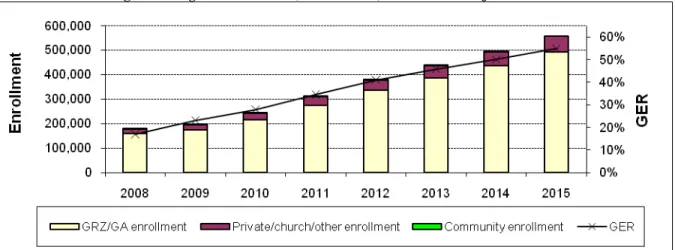
The Ministry successfully constructed fifty (50) high schools in the period of the FNDP and forty seven are currently in progress and are expected to be completed by 2012. Other efforts the Ministry is putting in place include the exploration of the community based mode of construction for high schools, a strategy that has hitherto only been used for the construction of basic schools. With these efforts, the Ministry hopes to substantially improve the provision of high school education from 264,795 learners in 2009 to 578,654 learners in 2015. In relative terms the Ministry plans to increase the participation rates (Net Enrolment Rates) from 21.1 percent in 2009 to 55 percent in 2015 while at the same time improving transition rates to high schools from 41 percent in 2009 to 61.10 percent in 2015. The Ministry also plans to double high school completion rates by 2015.
Completion rates at High Schools have improved from 17.7 percent in 2005 to 19.8 percent in 2009 while dropout rates have reduced from 2.0 percent in 2005 to 1.1 percent in 2009. In spite of these gains gender disparities in all key indicators have persisted at High School level. Gender Parity Indices have only marginally improved from 0.81 in 2005 to 0.87 in 2009
The subsector still faces challenges including shortage of qualified teachers that are trained to teach specific subjects such as mathematics, sciences and practical subjects, limited classroom space and ill equipped specialised rooms.
5.3 Strategic Objectives
The overall objective of the Ministry of Education under high school sub-sector during the 2009-2015 period is to secure quantitative and qualitative improvements in High School education service delivery. In the context of this, the Government’s overall policy objectives for High School Education during the Strategic Plan period shall focus on the following:
a) To improve access to High School Education.
b) To improve the quality of education at High School level c) To improve the efficiency in high School Education.
d) To make the education system more relevant to the needs and aspiration of the nation e) To improve equity at High School Level
5.4 Strategies
In striving to achieve the objectives above, the Ministry of Education shall initially focus more on:
a) Construction of infrastructure
b) Improve teacher qualifications through fast track initiative and Continuous Professional Development (CPD)
c) Increase the availability of teaching and learning materials & the integration of ICTs in the provision of high school education
d) Improve teacher retention through capacity building and targeted training incentives particularly in special education, mathematics and science
e) Provision of guidance and counselling services
f) Development of a two tier education system at high school level : one focusing on academics and another on skills development
g) Expansion of the bursary support to OVCs
Ministry of Education National Implementation Framework III………..2011 - 2015
24 5.5 High School Performance Indicators
Strategic Objective
Strategies Key Activities Performance Indicators Critical
Assumptions
Core Implementors Indicators Baseline (2009) Target (2015)
2.1 To Improve access to High School Education • Construction of new schools • Construction of appropriate infrastructure in schools that were upgraded to High school status • Determine the demand patterns for education provision through an elaborate school mapping framework • Achieve expanded partnership among service providers and other relevant stakeholders •Construction of additional high schools •Expansion and improvement of facilities in existing schools to cater for more pupils, particularly with special education needs. •Increasing targeted funding to rural boarding schools. •Provision of ODeL materials in both print and electronic formats Net Enrolment Ratio 21.1 % 55 % • Political will • Availability of resources MoE 2.2 To improve the quality of education at High School level • Improve the learning environment through the provision of appropriate infrastructure • Improving staffing levels of qualified teachers
• Train, recruit and deploy adequate numbers of teachers particularly in mathematics and science
• Setup up and equip libraries in high schools. Pupil Teacher Ratio Math 66 Science 58 English 27 35 35 35 • Political will • Availability of resources MoE Civil Society Private Sector Pupil Book Ratio 3:1 1:1
Teacher Qualification
at high schools. • Improve teacher
qualifications through fast track initiative and Continuous Professional Development (CPD) • Motivation of teachers through, among others, provision of incentives • Review of high school curriculum in order to enhance human, practical and vocational relevance • Increase the availability of teaching and learning
materials & the integration of ICTs in the provision of high school education • Improve teacher retention through capacity building and targeted training incentives particularly in special education, mathematics and science • Provide special • Upgrade teachers’ qualification through relevant in-service and pre-service training. • Provide opportunities for remedial lessons for slow learners. • Conduct monitoring
and supervision of teachers
• Roll out Lesson Study approach to all provinces. • Introduction of internship programme for graduate teachers Provinces using lesson study methodology 3 9
Ministry of Education National Implementation Framework III………..2011 - 2015 26 services for Learners with Special Education Needs (LSEN) • Provision of guidance and counseling services 2.3 To improve the efficiency in high School Education • Make the education system more accountable to society • Accelerate the implementation of the Education Leadership and Management course • Improve the effectiveness of teaching through increased supervision • Strengthen school supervision and support services. • Scale up the implementation of ICTs management systems
Completion Rate 19.8 % 39.8% • Political will • Availability of resources • Economic growth MoE Civil Society Private Sector Dropout Rate 1.1% 0.4% Repetition rate 7% 3% 2.4 To make the education system more relevant to the needs and aspiration of the nation • Development of a two tier education system at high school level : one focusing on academics and another on skills development • Develop curriculum that will cater for the two tier system • Introduce TEVET programmes in High schools. Proportion of Enrolment at High School level disaggregated by type of tier 90% Academic 10 % Vocation 60 % Academic : 40 % Vocational • Political will • Availability of resources • Economic growth MoE Civil Society Private Sector 2.5. To improve equity at High • Expansion of the bursary support to • Provision of
bursaries for the vulnerable and rural
Gender Parity Index 0.87 1 • Political will MoE Civil Society Private Sector
School Level OVCs • Construction
and expansion of special education
schools for the LSEN particularly those with severe impairments • Make the school environment more child friendly children • Construction of user friendly rooms in high schools for all learners including LSENs. . • Availability of resources • Economic growth
Ministry of Education National Implementation Framework III………..2011 - 2015
28
6
Skills Training
6.1 Overview
The establishment of skills training courses at Schools for Continuing Education centres is aimed at offering training to recent school-leavers and adults, men and women. Skills training institutions were initially meant for school leavers at Grade 7 and 9 and adults. However, school leavers at Grade 12 level are now participating in training at these centres. This is partially because of inadequate college places since for instance out of the 236, 000 pupils that left the school system at grade 12 level in 2008, only 30,000 accessed technical, vocational and entrepreneurship training. In the last two years, there has been closer collaboration in development of the curricula between MoE and MSTVT. Currently, all Centres for Continuing Education are registered with TEVETA, which is a requirement for all institutions conducting skills training in the country.
6.2 Situational Analysis
The Skills Training Centres are inadequately equipped and staffed. Consequently, these centres engage part-time instructors from the community including instructors trained as industrial arts teachers. The infrastructure and equipment does not meet the expected standards. The situation is worse for students with special education needs. Although the country’s laws cater for people with disabilities, there is no specific legislation that reserves a certain percentage of school places for the disabled. With regard to urban and rural amenities, there is a distinct disparity in favour of the urban communities. Training at skills centres tend to be stereotyped in that it is predominantly male-dominated. Access has been negatively affected by locating Centres at provincial headquarters instead of district level where they are needed.
This situation is compounded by a lack of boarding facilities. Furthermore, the current structure does not promote effective and efficient delivery of services as the staff establishment of most of the centres is not adequate to allow effective provision of education and training.
Currently, there are thirteen Schools for Continuing Education throughout the country and in every province except Lusaka. The main courses offered are secretarial and office management; design, cutting and tailoring; automotive mechanics; carpentry and joinery; bricklaying and plastering; accounts; electrical and electronics; leather and tannery; metal fabrication; plumbing; and computer appreciation. Each school has a small nucleus of full-time staff supported by part-time workers. Training in these schools is at sub-artisan level, that is, below the level of those trained by the Department for Technical Education and Vocational Training (TEVET). In Schools for Continuing Education, students are given a certificate of attendance and a
Testimonial as opposed to TEVET institutions where graduates obtain certificates after passing a trades test.
6.3 Strategic Objectives
a) To increase access to skills training especially to out-of-school youths and adults
b) To improve the quality of skills training programs that are responsive to market demands. c) To promote equity in the provision of skills training
6.4 Strategies
a) Rehabilitation and expansion of infrastructure b) Establishment of new skills training centres
c) Implementation of targeted programmes for the marginalised groups d) Promote ODeL in skills training
e) Expand provision of skills training for inmates in prisons f) Design market-responsive skills training programmes