This article is based on the presentation at The 4th International Tropical Renewable Energy Conference (i-TREC 2019) in Bali, Indonesia, 14 - 16
Article
Optimizing Extraction and Enrichment of
Lanthanide from Indonesian Low Grade Bauxite
Using Sequential Magnetic Separation, Acid
Leaching, and Precipitation Processes
Eny Kusrini
1,*, Nici Trisko
1, Sri Harjanto
2, Arif Rahman
3, and Anwar Usman
41 Department of Chemical Engineering, Faculty of Engineering, Universitas Indonesia, Kampus Baru
UI-Depok, 16424, Indonesia
2 Department of Metallurgy and Material Engineering, Faculty of Engineering, Universitas Indonesia,
Kampus Baru UI-Depok, 16424, Indonesia
3 Department of Chemistry, Faculty of Mathematics & Natural Sciences, Universitas Negeri Jakarta,
Indonesia
4 Department of Chemistry, Faculty of Mathematics & Natural Sciences, Universiti Brunei Darussalam,
Brunei Darussalam
*E-mail: [email protected] (Corresponding author)
Abstract. In this work, investigation on the extraction of lanthanide from Indonesian low grade bauxite using
three processes, namely magnetic separation, acid leaching and precipitation methods. The magnetic separation produced three fractions, namely magnetic (3.37%), low magnetic (12.97%) and non-magnetic (81.54%) with recovery value of 97.9%. The non-magnetic fraction containing lanthanides with size of 200 mesh was used for leaching process using sulfuric acid (3 M) with a solid and liquid (S/L) ratio of 1: 5. The final treatment using precipitation reaction consisted of two stages using sodium sulfate and sodium hydroxide. The first stage using sodium sulfate produced lanthanide metal of ~ 13.00035% consisting of 11.84% (La), 1.16% (Ce), and 0.00035% (Y). The second stage using sodium hydroxide resulted lanthanide of ~0.00392% with consisting composition of La (0.00108%), Ce (0.00262%), and Y (0.00022%). After the series treatments, the concentration of lanthanides increased from 0.00396 % (39.6 ppm) to 13.00427 % (130,042.7 ppm). The total of lighter lanthanides La (54.66%) and Ce (4.80%) and heavy lanthanide of Y (0.013%) were obtained. These resulted showed that the application of acid leaching using sulfuric acid and precipitation reaction were recommended for enrichment of lanthanide from Indonesian low grade bauxite.
Keywords: Enrichment, Indonesian low grade bauxite, lanthanides, leaching, precipitation, sulfuric acid.
ENGINEERING JOURNAL Volume 24 Issue 4
Received 5 December 2019 Accepted 21 April 2020 Published 31 July 2020 Online at https://engj.org/ DOI:10.4186/ej.2020.24.4.327
1.
Introduction
Low grade bauxite which are sorted out upon washing bauxite ore was are abundant in exploration sites, and are considered as non-valuable mineral ores. One of exploration sites of bauxite in Indonesia is located in Bintan Island with bauxite reserve estimated up to 1,282,487,720 tons. Consequently, the availability of Indonesian low grade bauxite is also abundant. These low-grade bauxite have not been utilized yet, thus they could become a potential problem to inhabitant in the surrounding area, because the bauxite mining is on open land without any reclamation, and the low grade bauxite are left over without proper tailing disposal. Thus, the low grade bauxite can potentially cause hazardous lands. Our previous research indicated that low grade bauxite from Wacopek bauxite mining in Bintan island, Indonesia, contained lanthanides (Ln) such as lanthanum oxide (La2O3) of 0.0052 wt% and yttrium oxide (Y2O3) of 0.0041
wt% [1, 2]. Considering that lanthanides (rare earth element, REE) are currently utilized in a wide range high- technology application, it is believed that by using the low grade bauxite as raw materials to produce lanthanides with a proper isolation technique, they might have a high economic value for industries and further advanced applications. The data of the lanthanides content in the low grade bauxite also provide prospective information to gain substantial added value through extraction of the valuable metals. Separation of lanthanides from the low grade bauxite would be useful for both the environmental remediation around the bauxite exploration sites and economic value of the low grade bauxite, because it can reduce the wastes of mining products and process them into materials that contains high economic value. Therefore, the attempt to extract lanthanides through the enrichment method is the most appropriate and efficient. Lanthanide elements are very useful metals for many applications such as biomedical, advanced materials, adsorbent, catalyst, antiamoebic agent, and fluorescence probe [3-17]. Lanthanides have high excellent spectroscopic characters such as spectroscopic with large Stokes and anti-Stokes shifts, narrow emission bands and long luminescence lifetimes, in addition to their structural flexibility and adjustable ability with large coordination number from 3 – 12 [14-18].
Various studies focusing on separation of lanthanides using solid-liquid extraction methods using acid, precipitation, crystallization, or ion exchange [19, 20], adsorption using activated carbon from banana peels [3], pectin from durian peels [7], and durian rind biosorbent [8] have been reported. On the other hand, separation of lanthanides showed some disadvantages such as the complex processes and the requirement to use chemicals and solvents [21], and the selectivity of lanthanides is still low due to similar physical and chemical properties of lanthanide [22].
The solubility of the impurity metals in the sulfate solution can be first minimized by separating process using a magnetic separator. Magnetic separation is a
powerful method utilized from long time in the treatment of strongly magnetic mineral ores and for the removal of ferromagnetic impurities from mixtures. In this case, magnetic separation is used in order to remove the ferromagnetic irons from the Indonesian low grade bauxite to decrease an obstacle of data caused by iron contain in the low grade bauxite. Ferromagnetic metals can be separated using a magnetic separator at an intensity of 1,400 gauss by passing the material on a rotating magnet. Magnetic separation process is a physical separation process by utilizing the magnetic properties contained in the materials [23]. According to the previously method reported by Kusrini and coworkers [1, 2] the magnetic separator will separate three fractions, namely magnetic, low magnetic and non-magnetic. In the magnetic container having the ferromagnetic properties, low magnetic container have high iron metals, and the rest for non-magnetic container contained a relatively small iron metal. The main purpose for this separation process is to separate the ferromagnetic iron metals.
Impurities such as iron also can dissolve in sulfuric acid to form iron(III) sulfate [24]. It became impurities when the next precipitation process occurred. Thus, the physical treatment process is necessary to increase the solubility of the lanthanides and reduce the solubility of the impurities in sulfuric acid [25-28]. In additon, decreasing and sizing of Indonesian low grade bauxite can expand the surface contact of the particles, thereby it will increase the surface contact area between sulfuric acid and low grade bauxite particles. In this study, we used solid-liquid extraction or leaching using sulfuric acid. The use of sulfuric acid as solvent has several advantages compared to other acid solvents, such as low reaction temperature [25-28]. Sulfuric acid leaching is one of the most major
process for mineral decomposition step in
hydrometallurgical manufacturing of lanthanide [29, 30]. In industry, this acid is also currently used in the processing of the concentrates from deposits of lanthanide, namely Bayan Obo in China and Mt. Weld in Australia [29, 30].
Precipitation method is one way to separate the mixture into two phases, namely solid phase and liquid phase. The precipitation process of lanthanide can be carried out by two stages of precipitation reaction by performing and adjusting the pH at a certain temperature. Thus, the lanthanide metals can be precipitated when the concentration value of these ions were exceeds the value of the solubility product (Ksp). The precipitation process cannot be conducted by only one step because as we know that each lanthanide metal has a certain precipitation condition. Therefore, the leachate precipitation resulting from the first leaching will be precipitated with sodium sulfate reagent at pH 1.5 and at temperature of 80°C, then it forms a sodium disulfate lanthanide, thus by dissolution in sodium hydroxide (NaOH) the sodium disulfate lanthanide is converted to lanthanide hydroxide. At the second-stage of precipitation reaction, the suspension was added with sodium phosphate reagent to reach the pH 3.5 and at temperature of 80°C. It is an ideal condition for the
precipitation process of lanthanide phosphate [31]. Leaching kinetics of lanthanides from Indonesian Madong’s low grade bauxite using sulfuric acid as a leaching agent has also been reported by Kusrini and coworkers [32]. Recently, there are no bulk applications of red mud (bauxite residue) except for minor use such as in cements and ceramics [33]. As literature review, some types of bauxite residues are rich in rare-earth elements (REEs), and the extraction of Sc [33]. On the other hand, the recovery of lanthanide elements from apatite ore using sulfuric acid, solvent extraction and precipitation process have also been reported by Battsengel and co-workers [34].
In this study, investigation on the extraction and enrichment of lanthanide elements (La and Y) from Indonesian Madong’s low grade bauxite using sequential treatments comprised of magnetic separation process, acid leaching with sulfuric acid, and precipitation reaction were studied in details.
2.
Experimental
2.1. Materials
Low grade bauxite was provided from bauxite mining in Madong area, Bintan Island. Chemicals and materials in this study; 25% ammonia (NH3), 96% sulfuric acid
(H2SO4), aquadest, 99% sodium hydroxide (NaOH),
tri-sodium phosphate dodecahydrate (Na3PO4.12H2O) and
sodium sulfate (Na2SO4) were used as received without
further purification.
2.2. Mechanical Treatment
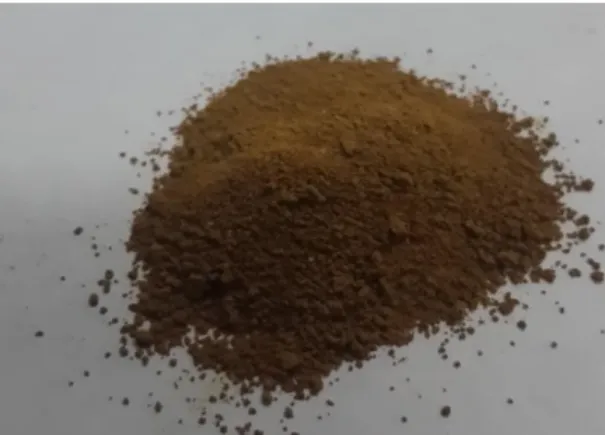
This pre-treatment is needed in order to make the process of the reaction occurring effectively. First, the low grade bauxite was dried for 24 hours at 105°C to reduce the water content. Water content of the sample after the sieving process was 2.8%. Then, the dried samples were crushed until it reaches 200 mesh particle size in order to make easier to be applied in the next process with another instrumentation. 2 kg of low grade bauxite and 15 kg of iron balls were put into the milling and following the milling process during for 2 hours. Low grade bauxite was filtered using a rough sieve to remove impurities such as small rocks and garbage. Sample from milling process was sieved using a mesh size of 200 mesh (Fig. 1).
Fig. 1. Low grade bauxite with size of 200 mesh.
2.3. Magnetic Separator Treatment
The magnetic separation consists of 3 outputs. The magnetic which presents the ferromagnetic samples, low magnetic which presents the low grade bauxite sample which still has high iron contents, and non-magnetic samples which is has relatively small iron contents.
Magnetic treatment prior to the leaching process was conducted. Low grade bauxite (200 mesh) was separated using a magnetic separator tool with an intensity of 1,400 gauss. Three fractions of low grade bauxite were dried in an oven at temperature of 105°C to remove water content. Then, the non-magnetic fraction was refined and sieved with size of 200 mesh.
2.4. Extraction of Lanthanide Using Sulfuric Acid
and Precipitation Methods
The dried non-magnetic fraction was dissolved in 3 M sulfuric acid with a solid and liquid (S/L) ratio of 1: 5. The suspension was stirred with a magnetic stirrer at 250 rpm for 2 hours. The suspension was filtered and used for the next step with precipitation reaction. The leachate solution is adjusted with the pH 1.5 and it was maintained at temperature of 80°C. A total of 5 mole/mole of sodium sulfate (Na2SO4) was added slowly into the leachate
solution. The precipitation in the respective order with Na3PO4.12H2O and NaOH were filtered using Whatman
paper number 40 and the filter funnel.
The precipitate was washed three times using 250 mL of aquadest to remove the impurities and until the solution reached at the pH 7. The obtained precipitate of lanthanide sulfate was added 12.5 M NaOH solution with a molarity ratio of 15 mole/mole lanthanides. The pH of filtrate solution was adjusted to pH 3.5 with the addition of ammonium hydroxide (NH4OH) under stirring at 250
rpm. The precipitated lanthanide hydroxide was filtered using Whatman filter paper no. 40. Then, this precipitate was washed three times using distilled water to remove impurities contained in the precipitate. The filtrate of the precipitate was kept for the second stage of precipitation reaction. The lanthanide hydroxide precipitated was heated in an oven at 105°C for 12 hours. Finally, all of the samples from treatments of magnetic separation, acid leaching and precipitation processes were kept and used for further characterizations.
2.5. Characterizations
The lanthanide concentrations in all samples were determined using inductively coupled plasma optical emission spectrometry (ICP-OES, Agilent technology 7000). Samples were dissolved in aqua regia (HCl: HNO3 = 3:1) solution. The morphology and elemental composition were measured using SEM-EDX. The structure of low grade bauxite before and after the series treatments were determined by XRD.
3.
Results and Discussion
3.1. Magnetic Separation
Magnetic separation is a powerful method that has been used for quite a long time in the treatment of strongly magnetic mineral ores and for the removal of ferromagnetic impurities from mixtures. In this case, magnetic separation was used to remove the ferromagnetic iron impurities from Indonesian low grade bauxite. The sample was diluted with distilled water with 1:4 of solid to liquid ratio in order to make the material bonding effectively and could easily attracted to the surface of the drum magnet. The sample which has high viscosity will have a shorter interaction time between the material and the magnetic drum. The intensity of the magnetic separator was set to be 1,400 gauss. Higher intensity will result in more lanthanides attracted to the drum magnet, and lower intensity will give an optimum condition to iron removal.
Low grade bauxite was drained into magnetic drums, then it is accommodated into three containers comprising (i) magnetic, (ii) low-magnetic (middle), and (iii) non-magnetic samples. The non-magnetic sample was attached to the magnetic drum and when the magnetic intensity was removed, the samples flew down into magnetic container. The low magnetic sample is a weak bound sample in the magnetic drum, thus it go down with a slight reduction in the magnetic intensity of the magnetic drum. The non-magnetic sample was not completely attached to the magnetic drum. Table 1 shows the distribution of magnetic, low-magnetic and non-magnetic samples. It is shown that the total recovery of magnetic separation process reaches ~98% with ~2% loss. The loss percentage resulted from the magnetic sample which are trapped in the drum magnet may be due to its small particle size that could be easily dropped.
Non-magnetic sample has contained of lanthanide metals. There are no significant decreased of iron content in the non- and magnetic samples, indicating low efficiency of this equipment. The efficiency of magnetic separation process in this work is below 5%. This may be occurred because the magnetic separator that are used is a wet low intensity magnetic separator resulting unfinished products that must be treated with another final cleaning separator in order to separate two or more paramagnetic minerals into separate finished products. Iron content (%) in Indonesian low-grade bauxite before treatment (11.74%) and after the magnetic separator process in the respective order are 12.34, 11.44 and 11.50% for magnetic, low magnetic and magnetic contents [1]. The non-magnetic sample was then used for further experiment.
Table 1. Major material composition in non- magnetic sample.
Fraction Mass (g) Percentage (%)
Magnetic 65.50 3.37
Low-magnetic 252.39 12.97
Non-Magnetic 1586.80 81.54
Loss 41.31 2.12
Table 2. Comparison of low grade bauxite composition before and after treatment using magnetic separator.
Sample Clay Mineral (%) Other Minerals (%)
Ect ite Il lit e K aol ini te C al ci te Q uar tz C ris tob al ite G ibb si te Hem at ite Mu scov ite A na ta se Low grade bauxite * * 42 * 2 8 30 7 4 7 Magnetic * * 42 * 3 7 30 6 7 5 Low magnetic * * 40 * 3 8 32 7 4 6 Non-Magnetic * * 47 * 2 7 29 6 3 6
3.2. Chemical Component Analysis
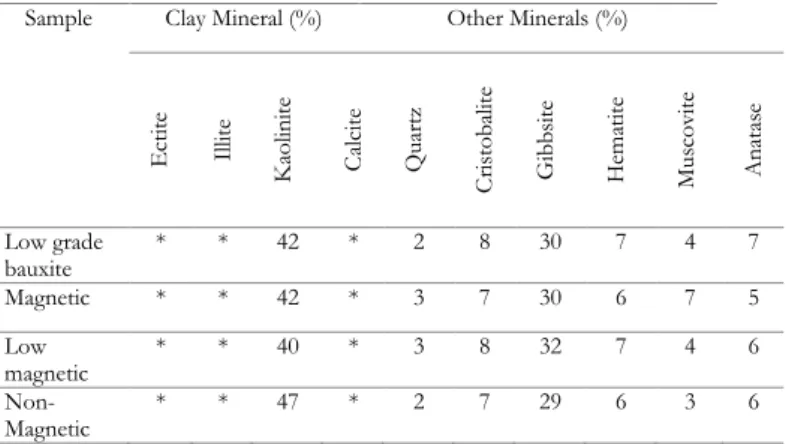
The sample was analyzed using X-ray diffractometer (XRD) and ICP-OES in order to find out the minerals and chemical composition of the raw materials. This step is important to know how the sample should be treated and how much lanthanides present in the sample. Figure 2 shows comparison between the low-grade bauxite before treatment and after magnetic process. Figure 2a shows the XRD pattern of the low-grade bauxite, and from the calculation it suggests the presences of gibbsite, hematite, quartz low, muscovite, high cristobalite, and anatase. The major minerals found in the sample are gibbsite and kaolinite with total quantity of 30 and 42%, respectively.
Table 2 showed the comparison of XRD analysis of low grade bauxite before and after treatment using magnetic separator. The different in XRD analysis after magnetic separation process is known to be the muscovite
mineral (see Fig. 2(b)). Muscovite mineral
(KFe2(Si3AlO10)(OH)2) is the paramagnetic mineral that
can be attracted with a magnetic separator with low intensity, as it was set to be 1,400 gauss in this study.
Fig. 2. XRD patterns for (a) low grade bauxite and (b) low grade after magnetic treatment.
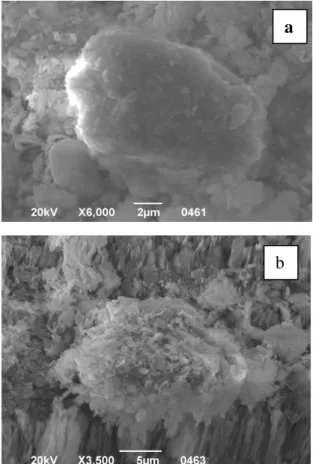
Fig. 3. SEM images of low grade bauxite before leaching and low grade bauxite after leaching at 80oC for one hour.
Fig. 4. EDX of low grade bauxite before treatment and after leaching treatment for 60 minutes at 80C.
3.3. Morphology Studies
Scanning electron microscopy (SEM) images of low grade bauxite before and after leaching treatment at 80°C for one hour are shown in Fig. 3a and b. Before leaching treatment, the morphology of low grade bauxite is compacted and no porous. After leaching treatment, the morphology of low grade bauxite such as hive, striped, fragile, crumble and dependent parallel. Figure 4 showed the EDX images of low grade bauxite before treatment and after leaching treatment for 60 minutes at 80C.
EDX elemental analysis of low grade bauxite before and after leaching is shown in Table 3. After leaching, the compounds of Al2O3 and FeO are reduced to be 52.31 and
13.67%, respectively, however SiO2 was increased to
34.02%.
Table 3. EDX elemental analysis of low grade bauxite before and after leaching.
Compounds Mass fraction %
before leaching Mass fraction % after leaching
Al2O3 64.27 52.31 SiO2 25.43 34.02 FeO 10.30 13.67 Position [°2Theta] 10 20 30 40 50 60 Counts 0 5000 10000 15000 Magnetic-01
b
Position [°2Theta] 10 20 30 40 50 60 Counts 0 5000 10000 Tailling Bauksita
b
a
0.00 1.00 2.00 3.00 4.00 5.00 6.00 7.00 8.00 9.00 10.00 keVedx 002 Tailling Bauksit x6000
0 150 300 450 600 750 900 1050 1200 1350 Coun ts O Al Si Fe Fe Fe Fe
b
a
3.4. Extraction and Enrichment of Lanthanide Studies
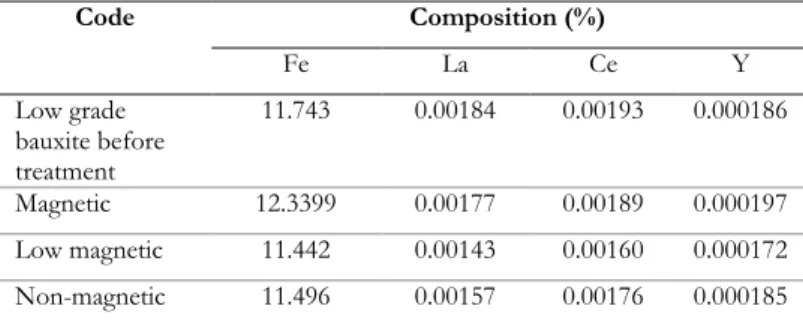
The ICP-OES analysis results showed no significant differences in the composition of low grade bauxite after the magnetic separation process (see Table 4). The iron element (Fe) which is separated from the low grade bauxite cannot be separated by a magnetic separator. This is because the main mineral of iron was found in low grade bauxite in the form of hematite forms. Hematite is a weak ferromagnetic mineral that is difficult to be drawn by low intensity magnetic fields (1,400 gauss). The lanthanides content also has no significant differences for low grade bauxite before and after treatment using magnetic separator. This can be caused by low equipment efficiency, thus separation process of magnetic and non-magnetic minerals was not optimal.
The minor elements of lanthanides were characterized by ICP-OES. Concentration of lanthanides in Indonesian low grade bauxite before treatment is low (0.00396 % or 39.6 ppm) with lanthanum (18.39 ppm), cerium (19.32 ppm), and yttrium (1.86 ppm) [32]. This finding shows that the low-grade bauxite is richer in lighter lanthanides than in heavier lanthanides. The major impurities exist in the sample are silica (49%), aluminum (34%), iron (11%) and titania (1%) [32]. In this study, alumina content in the raw material is approximately 34%. This is higher than found in bauxite residue (23.6%) reported by Borra et al. [8]. On the other hand, the Fe2O3 content in Indonesian
low grade bauxite is only 9.8%, which is lower than reported by Borra et al. [8] with Fe2O3 content of 44.6%.
The non-magnetic fraction was used and dissolved in 3 M sulfuric acid with a solid and liquid (S/L) ratio of 1: 5. The use of sulfuric acid as solvent with a concentration lower than 3 M leads to the dissociation of mineralized structures that are not optimal, which can caused the dissolution process to be less than optimum, following Eq. (1). On the other hand, the use of sulfuric acid with higher concentrations more than 3 M can increase the solubility of impurities such as Fe, Al, Mn metals and other elements. It is noteworthy that in the study reported by Battsengel and co-workers [34], the most effective dissolution of lighter lanthanides (>85%) and heavier lanthanides (>89%) from apatite ore when use the acid of 1 M H2SO4 at
temperature of 20C in an hour. However, the heavier lanthanides were loaded into the organic phase in the solvent extraction process using 3 M H2SO4 solution.
3H2SO4(aq) + Ln2O3(s) Ln2(SO4)3(aq) +
3H2O(l)
(1) where Ln = lanthanide.
Table 4. Results of ICP-OES analysis of Indonesian low grade bauxite after magnetic separator process.
Code Composition (%) Fe La Ce Y Low grade bauxite before treatment 11.743 0.00184 0.00193 0.000186 Magnetic 12.3399 0.00177 0.00189 0.000197 Low magnetic 11.442 0.00143 0.00160 0.000172 Non-magnetic 11.496 0.00157 0.00176 0.000185
Ammonium hydroxide was used to adjust the pH of leachate because NH4OH is a highly soluble base in sulfate
solution and the resulting NH4+ ions will not contaminate
the precipitate that formed. The leachate solution of lanthanide sulfate having the pH 1.5 was maintained at temperature of 80°C. It is found that the optimum temperature for precipitation of lanthanides at 80oC [31].
A total of 5 mole/mole of sodium sulfate (Na2SO4) was
added slowly into the leachate solution, following Eq. (2.) Ln2(SO4)3 + NaSO4 +2H2O
Na2SO4.Ln2(SO4)3.2H2O (2)
The amount of sodium sulfate was added for the result of a stoichiometric comparison between sodium sulfate and the amount of lanthanides are present in the leachate solution. The total amount of molarity of lanthanide is presented in the leachate solution that considered being equal to the amount of lanthanide molarity in the initial sample. In this study, the excess concentration of sodium sulfate was added in leachate solution to produce more precipitated and it leads to the formation of impurities precipitates, especially iron sulfate in below (Eq. (3)).
3Fe2+ + 2SO43- + xH2O Fe(SO4).xH2O (3)
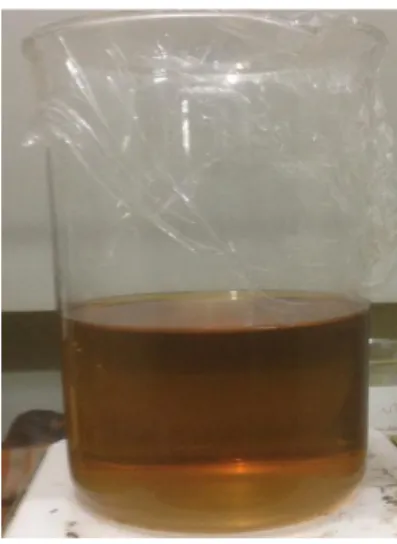
When the concentration of sodium sulfate is smaller than the ratio of 5 mole/mole would result in poor precipitation or not all lanthanides contained in the leachate solution can be precipitated. Herein, precipitates and filtrates were separated using Whatman filter paper No. 40 with a filter funnel. The use of Whatman filter paper No. 40 is due to several factors, such as has a uniform pore size, able to filter quickly and not easily clogged, not hygroscopic, a low dust content, so it does not contaminate the sample and does not absorb samples. Filtering step was used twice to ensure there are no impurities in the leachate solution. The total sample extracted was 1.5 kg because the concentration of lanthanides was quite low in the sample, thus the final result of the final process was obtained to be more than 1% lanthanide precipitates. Leachate solution of Indonesian low grade bauxite from solid-liquid extraction is shown in Fig. 5.
Fig. 5. Leachate solution of Indonesian low grade bauxite from solid-liquid extraction.
In this study, the mixture of lanthanide sulfate solution was stirred at 250 rpm for 60 minutes. In the precipitation process was done under stirring to help the formation of precipitate compound. The faster stirring would lead to the formation of precipitate which gradually diminished in size, thus the surface area of contact is greater. There are two things that influenced in the formation of the precipitate, namely (i) the rate of formation of the sediment core, and (ii) the growth of the precipitate. The formation rate of this nucleus is presented by the number of cores formed in the units of time. The rate of growth of the precipitate is another factor affecting the size of the precipitate formed during the precipitation.
The precipitate formed was filtered using Whatman paper No. 40 and filter funnel. The precipitate is washed three times using 250 mL of distilled water to remove impurities that are still present. The produced precipitate was added into 12.5 M NaOH solution with a molarity ratio of 15 mole/mole lanthanides (see Eq. (4)). The purpose of adding lanthanides into sodium hydroxide solution is to change the structure of the sodium lanthanide sulfate salt to the lanthanide hydroxide, thus it can facilitate the process of enrichment and separating the lanthanide elements into single elements that have high purity, while the solvent can dissolve impurities that are still present in the lanthanide sulfate precipitate. The lanthanide hydroxide was formed and filtered using a Whatman filter paper No. 40. The precipitate was washed for three times using distilled water to remove impurities present in the precipitate. The precipitate of filtrate was kept for the second stage of deposition process. The lanthanide hydroxide precipitate was heated in an oven at 105C for 12 hours. The reaction occurred between sodium lanthanide sulfate dihydrate and NaOH is shown in Eq. (4).
Na2Ln(SO4)3.xH2O(s) + 3NaOH(aq)
Ln(OH)3(s) + 2NaSO4(aq) + xH2O(l) (4)
Figure 6 showed lanthanide hydroxide (Ln(OH)3)
produced from sodium sulfate precipitation reaction. A
total of 0.1087 g of Ln(OH)3 was obtained at the first
precipitation reaction. The composition of lanthanide hydroxide precipitated was 11.84% (La), 1.16% (Ce), 0.00035% (Y), 16.64% (Fe), and 70.35% of other impurities. Based on the ICP-OES analysis, the total amount of 54.66% lanthanum, 4.80% cerium and 0.013% yttrium are present in the first precipitation reaction. There are several factors that could give rise the impurity contained in the precipitate to be high, one of which is that the soluble metals which are also soluble in sulfuric acid have the same precipitation rate as lanthanide metal. Increased impurity content such as iron (Fe) is lower than that of lanthanides.
Fig. 6. Lanthanide hydroxide (Ln(OH)3) produced from
sodium sulfate precipitation process.
Filtrate in the first precipitation process still contains lanthanides, thus the second stage of precipitation process is needed. The pH of filtrate solution in the second stage was adjusted to 3.5 because the occurrence of lanthanide phosphate precipitated with the addition of sodium phosphate salt. The amount of sodium phosphate was added is the result of a stoichiometric comparison between sodium phosphate and the amount of lanthanides present in the leachate solution of 15 mole/mole. The reaction between sodium phosphate salt and lanthanide sulfate is given by Eq. (5).
Ln(SO4)n3-2n(aq) + PO43-(s)LnPO4(s) +nSO 42-(aq)
(5) The total molarity of the lanthanides present in the leachate solution was considered to be the same as the total molarity of the lanthanides in the initial sample. The addition of an excess of sodium phosphate (15 mole/mole ratio) will cause the formation of impurities, especially aluminum phosphate and iron phosphate. The precipitate obtained was added into a 12.5 M NaOH solution with a molarity ratio with lanthanides of 15 mole/mole. The precipitate was separated from the solution using a Whatman paper no 40. The precipitate result was washed with 250 mL of distilled water for three times and then it was dried in oven at 105C for 12 hours to remove the water content. The reaction occurred between sodium
lanthanide sulfate dihydrate and sodium hydroxide follows Eq. (6).
LnPO4.xH2O(s) + 3NaOH(aq)
Ln(OH)3(s) +Na3PO4(aq) + xH2O(l) (6)
Figure 7 shows lanthanide hydroxide that was resulted from precipitation reaction with sodium phosphate salt. A total of 56.5 g of lanthanide hydroxide were obtained in the second precipitation reaction. From the result of ICP-OES characterization for the precipitation in the second stage with the chemical composition consisted of La (0.00108%), Ce (0.00262%), Y (0.00022%), Fe (19.06%) and other impurities of 80.93%. Two types of lighter lanthanide metals, namely La (2.59%), Ce (5.50%) and heavy lanthanide of Y (4.39%) have been successfully precipitated on the second stage precipitation reaction using NaOH. The concentration of lanthanides was obtained in the second precipitation reaction was smaller than those found in the first stage precipitation reaction. The total of lighter lanthanides La (54.66%) and Ce (4.80%) and heavy lanthanide of Y (0.013%) were obtained from the series of treatments. This is because the concentration of lanthanides in the solution is too small compared with impurities such as iron sulfate and aluminum sulfate. Thus, it would react more easily with the sodium phosphate salt.
The total recovery value of the precipitation process was 57.25% lanthanum, 10.39% cerium and 4.40% yttrium. The small recovery is caused by the leaching process of Indonesian low grade bauxite which has not yet reached 100% dissolution rate of lanthanide minerals and the presence of lanthanides in solution. In this study, recovery of lanthanide from Indonesian low grade bauxite is smaller (72.04%) than those found for the extraction of the lanthanide was around 80% [33]. On the other hand, extraction of selected lanthanide from bauxite residue using dry digestion method followed by water leaching has been reported [35]. Rivera and coworkers reported that dissolution of silica increases with increasing HCl or H2SO4 concentration by two steps process, namely dry
digestion using acid and followed by water leaching only showed result is less than 5 wt%. Here, silica dissolution tends to form a silica gel. However, the extraction of aluminum was low because the low solubility of aluminosilicate materials [35]. Dissolution of Al, Si, Ti are ranged from 30 to 50% [33]. Bora and coworkers reported that extraction of lanthanide from Greek bauxite residue was high using acid leaching with hydrochloric acid (HCl) compared with other organic acids (methanesulfonic acid, acetic acid, citric acid, nitric acid, and sulfuric acid), but the iron dissolution was also high (60%) [33]. This extraction of lanthanides was conducted at low acid concentration (< 1 N) [33]. On the other hand, extraction of lanthanum from Belitung silica sand using the series processes of heap leaching with sulfuric acid, precipitation reaction stage using trisodium phosphate and complexation with phytic acid has been also reported by Kusrini et al. [36].
Fig. 7. Lanthanide hydroxide from precipitation reaction with sodium phosphate salt.
4.
Conclusion
In this paper, the sequential treatments for extraction and enrichment of lanthanide from Indonesian low grade bauxite using magnetic treatment, acid leaching, and precipitation processes. Concentration of lanthanides in low grade bauxite before treatment is low (0.00396% or 39.6 ppm). After the series treatments, the concentration of lanthanides is increased to be 13.00427% or 130,042.7 ppm. The first stage using sodium sulfate as a reagent produced ~ 13.00035% consisting of 11.84% (La), 1.16% (Ce), and 0.00035% (Y). The second stage using sodium hydroxide as a reagent resulted ~0.00392% with consisting composition of La (0.00108%), Ce (0.00262%), and Y (0.00022%). The total of lighter lanthanides La (54.66%) and Ce (4.80%) and heavy lanthanide of Y (0.013%) were obtained from these series treatments. These resulted showed that the application of acid leaching using sulfuric acid and precipitation processes are recommended for enrichment of lanthanide from Indonesian low grade bauxite.
Acknowlegment
The authors greatly acknowledge the Ministry of Research, Technology and Higher Education of the Republic of Indonesia for research grant award through PTUPT grant No. 492/UN2.R3.1/HKP05.00/2018.
References
[1] E. Kusrini, Y. Nurani, and Z. J. Bahari, “Extraction of rare earth elements from low-grade Bauxite via precipitation reaction,” IOP Conf. Series: Materials
Science and Engineering, vol. 4334, p. 012052, 2018.
[2] E. Kusrini, Z. J. Bahari, A. Usman, A. Rahman, and E. A. Prasetyanto, “Recovery of lanthanides from Indonesian low grade bauxite using oxalic acid,”
Materials Science Forum, vol. 929, pp. 171-176, 2018.
[3] E. Kusrini, D. D. Kinastiti, L. D. Wilson, A. Usman, and A. Rahman, “Adsorption of lanthanide ions from an aqueous solution in multicomponent
systems using activated carbon from banana peels (Musa Paradisiaca L.),” International Journal of
Technology, vol. 9, no. 6, pp. 1132-1139, 2018.
[4] E. Kusrini, C. S. Utami, A. Usman, N. Nasruddin, K. A. Tito, “CO2 capture using graphite waste
composites and ceria,” International Journal of
Technology, vol. 9, no. 2, pp. 287-296, 2018.
[5] A. Usman, E. Kusrini, A. B. Widiantoro, E. Hardiya, N. A. Abdullah, and Y. Yulizar, “Fabrication of chitosan nanoparticles containing samarium ion potentially applicable for fluorescence detection and energy transfer,” International Journal of Technology, vol. 9, no. 6, pp. 1112-1120, 2018.
[6] E. Kusrini, S. N. Paramesti, A. Zulys, N. Z. A. Daud, A. Usman, L. D. Wilson, and N. Sofyan, “Kinetics, isotherm, thermodynamic and bioperformance of defluoridation of water using praseodymium-modified chitosan,” Journal of Environmental Chemical
Engineering, vol. 7, p. 103498, 2019.
[7] E. Kusrini, W. Wicaksono, C. Gunawan, N. Z. A. Daud, and A. Usman, “Kinetics, mechanism, and thermodynamics of lanthanum adsorption on pectin extracted from durian rind,” Journal of Environmental
Chemical Engineering, vol. 6, pp. 6580–6588, 2018.
[8] E. Kusrini, A. Usman, F. A. Sani, L. D. Wilson, and M. A. A. Abdullah, “Simultaneous adsorption of lanthanum and yttrium from aqueous solution by durian rind biosorbent,” Environ. Monit. Assess., vol. 191, no. 488, pp. 1-8, 2019.
[9] E. Kusrini, F. Hashim, W. N. N. W. N. Azmi, N. M. Amin, and A. Estuningtyas, “A novel antiamoebic agent against Acanthamoeba sp.—A causative agent for eye keratitis infection,” Spectrochimica Acta Part A:
Molecular and Biomolecular Spectroscopy, vol. 153, pp.
714–721, 2016.
[10] E. Kusrini, N. Sofyan, N. Suwartha, G. Yesya, C. R. Priadi, “Chitosan-praseodymium complex for adsorption of fluoride ions from water,” Journal of
Rare Earths, vol. 33, no. 10, pp. 1104-1113, 2015.
[11] E. Kusrini, D. Tristantini, Slamet, and V. M. Setianingrum, and Y. Yulizar, “Fluorescence properties of microcomposites europium triethylene
glycol picrate complex doped in
polymer,” International Journal of Technology, vol. 5, no. 1, pp. 70-78, 2014.
[12] E. Kusrini, R. Arbianti, N. Sofyan, M. A. A. Abdullah, and F. Andriani, “Modification of chitosan by using samarium for potential use in drug delivery system,”
Spectrochimica Acta Part A: Molecular and Biomolecular Spectroscopy, vol. 120, pp. 77–83, 2014.
[13] E. Kusrini, Y. M. Togar, V. Hasyim, and A. Usman, “The role of Praseodymium oxide-Impregnated clinoptilolite zeolite catalyst to increase octane number in gasoline,” E3S Web of Conferences, vol. 67, p. 03051, 2018.
[14] P. Lv, Yu. Xu, Z. Liu, G. Li, and B. Ye, “Carbon dots doped lanthanide coordination polymers as dual-function fluorescent probe for ratio sensing Fe2+/3+
and ascorbic acid,” Microchemical Journal, vol. 152, p. 104255, 2020.
[15] E. Kusrini, M. I. Saleh, Y. Yulizar, N. K. Za’aba, and W.H. Abd. Majid, “Samarium(III) picrate tetraethylene glycol complex: Photoluminescence study and active material in monolayer electroluminescent,” Journal of Luminescence, vol. 131, pp. 1959–1965, 2011.
[16] M. I. Saleh, E. Kusrini, M. A. Mohd Sarjidan, and W. H. Abd. Majid, “Study and fabrication of europium picrate triethylene glycol complex,” Spectrochimica
Acta Part A, vol. 78, pp. 52–58, 2011.
[17] E. Kusrini, M. I. Saleh, R. Adnan, Y. Yulizar, N. S. Shiong, H. K. Fun, M. A. Adhha Abdullah, M. Mamat, N. K. Za’aba, and W. H. Abd. Majid, “Structural, optical and electrical properties of europium picrate tetraethylene glycol complex as emissive material for OLED,” Journal of Luminescence, vol. 132, pp. 91–99, 2012.
[18] M. I. Saleh, E. Kusrini, H. K. Fun, and B. M. Yamin, “Structural and selectivity of 18-crown-6 ligand in
lanthanide–picrate complexes,” Journal of
Organometallic Chemistry, vol. 693, pp. 2561–2571,
2008.
[19] K. Binnemans, P. T. Jones, B. Blanpain, T. V. Gerven, and Y. Pontikes, “Towards zero-waste valorisation of rare-earth-containing industrial process residues: a critical review,” Journal of Cleaner
Production, vol. 99, pp. 17-38, 2015.
[20] F. Sadri, A. M. Nazari, and A. Ghahreman, “A review on the cracking, baking and leaching processes of rare earth element concentrates,” Journal of Rare
Earths, vol. 35, no. 8, pp. 739-752, 2017.
[21] Y. Liu and R. Naidu, “Hidden values in bauxite residue (red mud),” Recovery of Metals, Waste
Management, vol. 34, no. 12, pp. 2662-2673, 2014.
[22] D. Beltrami, G. J. P. Deplonde, S. Belair, and V. Weigel, “Recovery of yttrium and lantanides from sulfate solutions with high concentration of iron and low rare earth content,” Hydrometallurgy, vol. 157, pp. 356-362, 2015.
[23] L. Gao and Y. Chen, “A study on rare earth ore containing scandium by high gradient magnetic separation,” Journal of Rare Earths, vol. 28, no. 4, pp. 622-626, 2010.
[24] R. C. Borra, J. Mermans, B. Blanpain, Y. Pontikes, K. Binnemans, and T. V. Gerven, “Selective recovery of rare earth from bauxite residu by combination of sullfation, roasting and leaching” Minerals Engineering, vol. 92, pp. 151-159, 2016.
[25] R. D. Abreu and C. A. Morais, “Purification of rare earth elements from monazite sulphuric acid leach liquor and the production of high-purity ceric oxide,”
Minerals Engineering, vol. 23, pp. 536-540, 2010.
[26] J. K. Chul, S. Y. Ho, W. C. Kyung, Y. L. Jin, D. K. Sung, M. Y. Shun, J. L. Su, J. Ram, I. L. Se, J. L. Seung, and H. K. Seung, ”Leaching kinetics of lanthanum in sulfuric acid from rare earth element (REE) slag,”
[27] A. Yorukoglu, A. Obut, and I. Girgin, “Effect of thiourea on sulphuric acid leaching of bastnasite,”
Hydrometallurgy, vol. 68, pp. 195-202, 2003.
[28] S. S. Baral, K. R. Shekar, M. Sharma, and P. V. Rao, “Optimization of leaching parameters for the extraction of rare earth metal using decision making method,” Hydrometallurgy, vol. 143, pp. 60-67, 2014. [29] J. Demol, E. Ho, E. Soldenhoff, and G. Senanayake,
“The sulfuric acid bake and leach route for processing of rare earth ores and concentrates: A review,” Hydrometallurgy, vol. 188, pp. 123–139, 2019. [30] C. F. Croft, M. I. G. S. Almeida, R. W. Cattrall, and S. D. Kolev, “Separation of lanthanum(III), gadolinium(III) and ytterbium(III) from sulfuric acid solutions by using a polymer inclusion membrane,”
Journal of Membrane Science, vol. 545, pp. 259–265,
2018.
[31] M. Vincec, “Method for selectively recovering the rare earths from an aqueous acid sulphate solution
rich in aluminium and phosphates,”
WO2014140492A1, September 9, 2014. [Online]. Available:
https://patents.google.com/patent/WO201414049 2A1/en
[32] E. Kusrini, A. Usman, N. Trisko, S. Harjanto, and A. Rahman, “Leaching kinetics of lanthanide in sulfuric acid from low grade bauxite,” Materials Today:
Proceedings, vol. 18, pp. 462–467, 2019.
[33] C. R. Borra, Y. Pontikes, K. Binnemans, and T. V. Gerven, “Leaching of rare earths from bauxite residue (red mud),” Minerals Engineering, vol. 76, pp. 20-27, 2015.
[34] A. Battsengel, A. Batnasan, A. Narankhuu, K. Haga, Y. Watanabe, and A. Shibayama, “Recovery of light and heavy rare earth elements from apatite ore using sulphuric acid leaching, solvent extraction and precipitation,” Hydrometallurgy, vol. 179, pp. 100–109, 2018.
[35] R. M. Rivera, B. Ulenaers, G. Ounoughene, K. Binnemans, and T. V. Gerven, “Extraction of rare earths from bauxite residue (red mud) by dry digestion followed by water leaching,” Minerals
Engineering, vol. 119, pp. 82-92, 2018.
[36] E. Kusrini, A. Zulys, A. Rachmana, D. A. Wulandari, Y. Muharam, A. Usman, and A. Rahman, “Enrichment and extraction of lanthanum from Belitung silica sand using sulfuric acid heap leaching, precipitation and complexation with phytic acid,”
Materials Today: Proceedings, to be published. [Online].
Available:
https://doi.org/10.1016/j.matpr.2020.02.815
Eny Kusrini was born in Sragen, Central Java, Indonesia in 1976. She received the B.S.c degree
in chemistry from Gadjah Mada University, Indonesia in 2002, and the Ph.D. degree in chemistry from Universiti Sains Malaysia, Malaysia in 2007. Since 2009, she has been a lecturer in the Department of Chemical Engineering, Universitas Indonesia. Her research interests include extraction and separation of lanthanide and versatile application of lanthanides and their derivative compounds. She also studied nanotechnology, synthesis of graphene oxide, reduced graphene oxide and their derivative compounds, adsorption and utilization of agro-wastes as adsorbents, utilization of natural kaolin for preparing of zeolite and quantum dot.
Nici Trisko was born in West Sumatra, Indonesia in 1990. He received the bachelor’s. degree in
Chemistry from the Universitas Padjadjaran, Indonesia in 2013 and master degree from Chemical Engineering, Universitas Indonesia in 2017. His research interest include in chemistry, anorganic materials and engineering.
Sri Harjanto was born in Jakarta, Indonesia in 1969. He received the bachelor’s. degree in
Metallurgy and material from the Universitas Indonesia, Indonesia in 1993. He received master degree from School of Science and Engineering, Waseda University, Japan in 1996 and Ph.D degree from Tohoku University, Japan in 2002. Since 1994, he has been a researcher and lecturer in the Metallurgy and Material Engineering, Faculty of Engineering, Universitas Indonesia. His research interests include metallurgy and material engineering.
Arif Rahman was born in Cilacap,Indonesia in 1979. He received the bachelor’s. and master degrees in Chemistry from the Gadjah Mada University, Indonesia in 2003 and 2008, respectively. His research interest include in anorganic materials, natural product and adsorption.
Anwar Usman was born in Medan, Indonesia in 1964. He received the B.S.c degree in Chemistry
Department of Physics, Gadjah Mada University Yogyakarta, Indonesia in 1989, the M.S. degree in chemistry from Department of Chemistry, Grad