THE LIVED EXPERIENCE OF GRADUATES WHO STUDIED NURSING IN THE CONTEXT OF A NURSING ACADEMIC-PRATICE PARTNERSHIP
A DISSERTATION SUBMITTED TO THE GRADUATE DIVISION OF THE UNIVERSITY OF HAWAI‘I AT MĀNOA IN PARTIAL FULFILLMENT OF THE REQUIREMENTS FOR
THE DEGREE OF DOCTOR OF PHILOSOPHY IN NURSING DECEMBER 2017 By Troy J. Larkin Dissertation Committee:
Alice Tse, Chairperson Allen Hanberg Renee Hoeksel Sandra LeVasseur
Chris Lucas
Keywords: Academic Clinical Partnership, Nursing Education, Lived Experience, Nursing Student
I dedicate this work to my friends, family, and colleagues who stood beside me and supported me while authoring this study. Sincere thanks to my partner, Steven V. Faulkner, who provided encouragement and a keen eye for detail during his reviews of this manuscript. You are one heck of a proof reader and an awesome lemur buddy. To my mother, Debra R. Larkin, whose inspiration, support, and guidance I would be lost without. To Josh, you helped me get started and taught me to ride the bus - mahalo. And to my dear friend, Robert J. Zeiser, your help in statistics will not soon be forgotten. My love and gratitude to you all.
ii
Acknowledgments
No dissertation is completed without the mentorship, guidance, and assistance of others. I would like to express my most sincere gratitude to Dr. Sandra A. LeVasseur and Dr. Alice M. Tse for their help and guidance as my committee chairs. I would also like to thank my
committee members, Dr. Renee C. Hoeksel, Dr. Chris M. Lucas, Dr. Allen D. Hanberg, and Dr. Debra D. Mark. Your guidance, instruction, and mentorship have been invaluable. I would also like to recognize Aeza Hafalia - mahalo nui loa. Your steadfast assistance was more valuable than you know. Finally, I would like to thank Providence Health & Service and the graduates who participated in this research. Many thanks to you for your time, energy, and support. Without research volunteers and health systems that support nursing research, this work could not be accomplished.
Aim
The purpose of this study was to interpret the lived experiences of graduates who studied nursing within the context of a Nursing Academic-Practice Partnership (NAPP).
Background
Nursing literature is awash in descriptive case studies and even empirical research on the results of NAPPs. However, there are few studies that have examined student outcomes and fewer still that have rigorously examined the experience of learners.
Method
A Heideggerian hermeneutic phenomenology approach was chosen to interpret the lived experience of 10 recent graduates of two different NAPPs.
Results
Six themes emerged from the data and were confirmed by the study participants. These were: Obligations and Responsibilities, Alliance, Disclosure, Advantage, Emotional Response and Regulation, and Meaning of Clinicals.
Conclusion
Graduates of the two NAPPs examined in this study confirmed a number of findings from other research. In addition, the themes uncover a variety of concepts that are new or novel to the current body of nursing literature. The findings of this study inform those designing NAPPs on creating partnerships which support and enrich the learning experience.
iv
Table of Contents
Acknowledgments ... ii
Abstract ... iii
List of Tables ... vii
List of Figure ... viii
List of Abbreviations ... ix
Chapter One: Introduction ... 1
Background ... 2
Significance of the Problem ... 5
Conceptual Analysis of NAPP ... 6
Defining attributes. ... 7 Example cases. ... 9 Antecedents. ... 12 Consequences. ... 12 Empirical referents. ... 12 Definition of NAPP. ... 14 Summary ... 14
Chapter Two: Literature Review ... 16
Literature Review Method ... 16
Search strategies. ... 18
Exclusions and filters. ... 19
Methods summary. ... 22
Study methods. ... 24
Instruments. ... 24
Types of partnerships. ... 27
Findings related to partnership. ... 37
Analysis ... 39
Limitations. ... 40
Gaps in the Literature ... 41
Purpose Statement ... 43
Summary ... 43
Chapter Three: Methodology ... 44
Purpose and Rationale ... 44
Heideggerian Hermeneutic Phenomenology ... 44
Author's Personal Statement ... 48
Approach to Rigor ... 51
Balanced integration. ... 51
Actualization. ... 53
Partnership Eligibility ... 53
Providence Scholars. ... 54
Great Nurses - Great Falls. ... 54
Approach to Human Participants ... 55
Protection of human subjects. ... 55
Recruitment. ... 56
Eligibility of participants. ... 56
Sample size. ... 56
Approach to Data Collection ... 57
Setting. ... 57
Interview process. ... 57
Interview questions. ... 58
Field notes. ... 59
Transcripts. ... 59
Data management and security. ... 59
Approach to Analysis ... 60
Early focus and lines of inquiry. ... 61
Exemplars and paradigm cases. ... 61
Shared meanings. ... 62
Final interpretations. ... 62
Dissemination of the interpretation. ... 62
Summary ... 63
Chapter Four: Results ... 65
Sample ... 65
The Interviews ... 67
Participant one: James. ... 69
Participant two: Mary. ... 74
Participant three: Patricia. ... 77
Participant four: Jennifer. ... 79
Participant five: Robert. ... 83
Participant six: Elizabeth. ... 86
Participant seven: Linda. ... 89
Participant eight: Barbara. ... 93
Participant nine: Susan. ... 96
Participant 10: Jessica. ... 100
vi
Theme six: The meaning of clinicals. ... 112
Summary ... 114
Chapter Five: Discussion ... 116
Findings in Context of the Literature Review ... 116
Obligations and responsibilities ... 117
Alliance. ... 118
Disclosure. ... 119
Advantage. ... 120
Emotional response and regulation. ... 122
The meaning of clinicals. ... 124
Implications for Nursing Practice ... 126
Obligations and responsibilities. ... 126
Alliance. ... 127
Disclosure. ... 128
Advantage. ... 128
Emotional response and regulation. ... 129
The meaning of clinicals. ... 130
Limitations ... 130
Future Research ... 132
Conclusion ... 134
Appendix A ... 137
Informed Consent Form ... 137
Appendix B ... 140
Recruitment Tool ... 140
Appendix C ... 141
Interview Guide ... 141
Table 2.1: Standardized Definitions of Search Terms ... 18
Table 2.2: Source and Number of Articles Identified ... 21
Table 2.3: Screening of Identified Articles ... 21
Table 2.4: Reasons for Eliminating Publications from Further Review ... 22
Table 2.5: Research Methods within Literature Review ... 25
Table 2.6: Partnership Purposes and Membership ... 28
Table 2.7: Evaluation Criteria and Student Experiences of NAPPs ... 31
Table 4.1: Participant Demographics ... 66
Table 4.2: Practice History ... 67
viii List of Figure
1. IOM: Institute of Medicine
2. AACN: American Association of Colleges of Nursing 3. AONE : American Organization of Nurse Executives 4. NAPP: Nursing Academic-Practice Partnership 5. DEU: Dedicated Education Unit
6. SON: School of Nursing
7. CINHAL: Cumulative Index to Nursing and Allied Health Literature 8. ERIC: Educational Resource Information Center
9. MeSH: Medical Subject Headings 10. CLE: Clinical Learning Environment
11. NCLEX-RN: National Council Licensure Examination for Registered Nurses 12. SECEE: Student Evaluation of Clinical Education Environment
13. LTC: Long Term Care
14. PH&S: Providence Health & Services 15. UP: University of Portland
16. UGF: University of Great Falls 17. PSP: Providence Scholars Program 18. RN: Registered Nurse
Chapter One: Introduction
I think a lot about how people learn. Your study in itself is very interesting because a lot of what happens in schools is we say, "well, we taught." But we never ask, "did they learn?" By asking what's the student experience, it’s not, "we have this program and here are all the elements to it," but, "what did they take from it? What did they learn?" That’s the sign of a good program, right? Is that people experienced it, not that we offered it.
"Jessica" study participant, April, 2017 The Institute of Medicine's report on the future of nursing calls for increased partnership between service and education (IOM (Institute of Medicine), 2011). This call is echoed by the American Association of Colleges of Nursing (AACN) and the American Organization of Nurse Executives (AONE) taskforces (later elevated to a steering committee) on academic-practice partnerships (AACN & AONE, 2010; Beal et al., 2012). Numerous other references call for increases of, and innovation in, nursing partnerships (Bleich, Hewlett, Miller, & Bender, 2004; Harvath, Flaherty-Robb, White, Talerico, & Hayden, 2007; Herbert & Best, 2011; Kinnaman & Bleich, 2004; Malloch & Porter-O'grady, 2011; Stanley, Hoiting, Burton, Harris, & Norman, 2007; Warner & Burton, 2009). As competition for resources increases, nursing academic-practice partnerships (NAPP) have gained popularity as effective means of addressing learning and service gaps while advancing important agendas (Beal et al., 2012).
Given such attention and enthusiastic endorsement, it is important for nursing to
understand all facets of the NAPP. This starts by understanding the significance of NAPPs and building a foundation of conceptual clarity on what is meant by the term. Further, it is
fundamental that nursing understands how being in a NAPP impacts the members engaged in the partnership. Literature exists that explores the relationships between academic and service
student learning in the context of a partnership. Through deep understanding of the student experience of being in a NAPP, nursing education and practice leaders are aided in designing partnerships that optimize the goals of the partnership. Typically, these goals include optimizing learning outcomes, expanding the nursing workforce (both in service and academia), and
improving clinical performance. Still other partnerships exist to extend clinical service or advance research. To uncover both conceptual and operational understanding of partnerships - how they function, and their impact - the body of research that addresses various aspects of NAPPs continues to grow. This dissertation seeks to contribute to the body of knowledge on nursing academic-practice partnerships by understanding the lived experience of students learning within the context of a nursing academic-practice partnership.
This chapter provides an introduction to the current study of NAPPs. It includes a
discussion on the background of partnerships within the nursing literature and the significance of the problems uncovered. A Wilsonian concept analysis is provided in an effort to clearly
articulate how this study conceptualizes a NAPP. Finally, a definition of NAPP is advanced. Background
A general review of current nursing literature on NAPPs reveals that many publications focus on specific aspects of partnerships such as model development, identification of best practices, and reporting of outcomes (AACN, 2012; Beal et al., 2011; Boland, Kamikawa, Inouye, Latimer, & Marshall, 2010; Dobalian et al., 2014; Guttman, Parietti, Reineke, &
to guide selection, development, implementation, management or dissolution of NAPPs. Despite this, there is some agreement as to common drivers of partnership (Beal et al., 2011; Erickson & Raines, 2011; Warner & Burton, 2009).
On the topic of partnerships between nursing academia and practice, many papers report on a specific project or goal accomplished through the use of partnership and can be categorized based upon the purpose of the partnership. Numerous manuscripts focus on seeking clinical placement opportunities for nursing students or other general workforce development and growth strategies (Allen, Schumann, Collins, & Selz, 2007; Beal et al., 2011; Burns et al., 2011;
Gregory, Bolling, & Langston, 2014; Louie, Campbell, Donaghy, Rice, & Sabatini, 2011). Some report on the use of partnerships to expand research capacity of both academic and practice settings (Balakas, Bryant, & Jamerson, 2011; Boland et al., 2010; Frank, 2008; Missal, Schafer, Halm, & Schaffer, 2010). Another common partnership goal prevalent in the literature is the expansion of nursing services to new clients or providing new nursing services to established clients (Aponte & Egues, 2010; Helm, Koyanagi, Else, Horton, & Fukuda, 2010; Petroro, Marola, Ferreira, Raboin, & Lewis, 2011).
The Dedicated Education Unit (DEU), a specific type of clinical partnership frequently reported in the current literature, is a specific type of NAPP where a school of nursing (SON) partners with a service provider (typically a hospital) to provide clinical learning experiences. These differ from traditional clinical learning experiences in that the hospital-based nurses are specially prepared to teach and precept a specific SON's students. Often, the clinical nurses are made adjunct faculty of the SON. SON-based faculty members focus on coaching and
precepting the hospital-based nurses who, in-turn, precept and coach the student. Operational details of DEUs vary from one partnership to the other. Nonetheless, several studies explore
faculty shortage (Campbell & Dudley, 2005; Hardy, Koharchik, & Dixon, 2015; Jeffries et al., 2013; Lovecchio, Dimattio, & Hudacek, 2012; Maguire, Zambroski, & Cadena, 2012; Moscato, Miller, Logsdon, Weinberg, & Chorpenning, 2007; Moscato, Nishioka, & Coe, 2013; Mulready-Shick, Flanagan, Banister, Mylott, & Curtin, 2013; Murray, & James, 2012; Nishioka, Coe, Hanita, & Moscato, 2014; Rhodes, Mattie L., Meyers, Claire, & Underhill, 2012).
In addition to exploring NAPPs in terms of purpose of the partnership (e.g., workforce
development and capacity, research collaborations, and service expansion), several articles seek to describe or evaluate a particular program. These publications typically follow a common
structure:
1) They provide a summary of the issue(s) and the goal(s) that brought the parties into partnership.
2) They offer a general description of the individual partners and the structure of the partnerships.
3) These articles then theorize rationale for why the partnership is successful, summarize challenges, and provide basic outcome data, or achievements of the partnership (Allen et al., 2007; Casey, 2011; Chatman, Buford, & Plant, 2003; Debourgh, 2012; Heron & Hammond, 2001; Huckabay, 2009; Missal et al., 2010; Newton, Cross, White, Ockerby, & Billett, 2011; Petroro et al., 2011; Wurmser & Bliss-Holtz, 2011). These articles provide insight into elements that promote successful NAPPs, help the reader better understand threats facing NAPPS, and
Significance of the Problem
Despite a number of articles that explore NAPP outcomes as measured or experienced by practice and academe (Dobalian et al., 2014; Hendricks, Wallace, Narwold, Guy, & Wallace, 2013; Newton et al., 2011; Wurmser & Bliss-Holtz, 2011), few explicitly explore the experience of students navigating their education within the context of an academic or clinical partnership. This gap was called out by Malloch and Porter-O'grady (2011),
...the specified impact or outcomes of the relationship needs to be of such clarity that real substance can be obtained and definitive value specifically enumerated. Most
importantly, evaluation of the outcomes and values of these types of relationships needs to be further documented (Malloch & Porter-O'grady, 2011, p. 304).
The voice of the student as learner, consumer, or participant of a partnership is faint; yet, the student has a critical story to share with those who develop, operate, and evaluate NAPPs. The student is too often silent and is rarely acknowledged, or called upon to act, as a third partner in the relationship. Understanding the experience of those who are most frequently the focus of the partnership promises to provide deep insight. Critical analysis of the student experience may provide NAPPs with information that guides partnership development, improves partnership outcomes, enhances satisfaction, deepens learning, promotes clinical competency, and informs new ways of examining partnership evaluation. The use of a strong, philosophically-driven and methodologically-grounded approach to evaluating the existing literature on NAPPs, and how they are experienced by nursing students, holds promise to provide guidance in structuring and operating NAPPs to achieve optimal outcomes.
The term, partnership, has long been part of the English language. The first known use of the term appeared between 1570 and 1580 (Partnership, 2005, 2011c). Merriam Webster defined partnership as "the state of being a partner; a legal relation existing between two or more persons contractually associated as joint principals in a business; a relationship resembling a legal
partnership and usually involving close cooperation between parties having specified and joint rights and responsibilities (Partnership, 2011c). The New American Heritage On-Line
Dictionary defined the term as "the state or condition of being a partner; the relation subsisting between partners; the contract creating this relation; an association of persons joined as partners in business" (Partnership, 2005). The United States' Internal Revenue Service provided an operational and legal definition of partnership as "a partnership is the relationship existing between two or more persons who join to carry on a trade or business. Each person contributes money, property, labor or skill, and expects to share in the profits and losses of the business" (Partnership, 2011b). The above definitions emphasize the business and legal aspects of the term partnership. When describing partnerships between nursing academic and practice settings, the legality and business aspects do not fully explain the phenomenon of interest.
A search of Google images was performed to consider what types of graphics or pictures might best represent the concept of partnership. The search term "partnership" was entered into Google images in October of 2011. The search engine reported about 243,000,000 images which matched the term. The first 250 images were reviewed and revealed that 41 of the 250 images
Common synonyms for the topic of partnership include: affiliation, assistance, association, brotherhood, business, cahoots, cartel, chumminess, clique, club, collaboration, combination, combine, companionship, cooperation, gang, fraternity, friendship, liaison, marriage, relationship, togetherness, and union (Partnership, 2011c).
One of the simpler definitions may also be the most elegant. "A partnership is an arrangement where parties agree to cooperate to advance their mutual interests" (Partnership, 2011d). This definition has the advantage of not being so legalistic to explain only the business-related characteristics of partnership and allows for fluidity among who the partners are and what kinds of specific activities they undertake. This definition indicates that a partnership is
intentional behavior, is collaborative and reciprocal in nature, and is aimed toward meeting mutual needs.
Two other uses of the term partnership appear often and are not consistent with the concept as used within this paper. These include: use of the term partnership to refer to a quasi-marriage and use of the term in the game of cricket.
Defining attributes. There are several defining attributes when one considers the
concept of nursing academic-practice partnerships. These defining attributes must be present for one to suggest that a true partnership exists. Without these attributes, one is likely examining another similar concept such as collaboration or affiliation.
Mutuality. Mutuality refers to the cross directional risk and benefit that a true
partnership shares. Partnerships are created for any number of reasons. However, partnerships exist to distribute risk and share resources to the mutual benefit of the parties involved. Without mutuality, the partnership would be unidirectional or cross-directional. Mutuality is what allows
mutuality to be definitional of the concept (Carnwell & Carson, 2008; Horns et al., 2007). Common goals. Common goals refer to one of the key reasons that partnerships are formed. Both parties must have a reason to come together in the first place. Regardless of the reason, common goals are an attribute that drives the work forward or cause it to come together in the first place. The drive to advance similar ideologies and/or cultures is frequently
foundational to partnership formation. It is also reported that the goals should be mutually beneficial. While parties can work together to achieve a goal that is of benefit to only one party, it would not be considered a partnership (Beal et al., 2012; Carnwell & Carson, 2008; Ferguson-Pare, Mallette, Zarins, Mcleod, & Reuben, 2010; Horns et al., 2007).
Relational factors. The parties engaged in partnerships are in relation with one another. The characteristics of the individuals involved in a partnership matter. It is important that they have similar interests and clear communication. Relational also refers to the way power is shared within a partnership. Not all partnerships are equal and the negotiation of power must be addressed. In partnerships, workloads are divided and individuals perform the tasks required of the partnership. Trust is an essential component of being relational and is noted as being necessary for healthy partnerships (Beal et al., 2012; Carnwell & Carson, 2008; Kinnaman & Bleich, 2004; Logan, Davis, & Parker, 2010; Warner & Burton, 2009).
Organizational agreement. Organizational agreement refers to the understanding that quality NAPPs must have some type of formal structures and agreements to exist. At the most
those involved in the partnership, and other issues specific to the academic and service setting. While it may not be necessary for each of these items to be present in all partnerships, there must be some agreement on the basics. There is a certain level of formality of mutual understanding and roles inherent in partnerships that is missing from other types of collaborative work (Beal et al., 2012; Carnwell & Carson, 2008; Harvath et al., 2007; Kinnaman & Bleich, 2004; Logan et al., 2010; Macphee, Espezel, Clauson, & Gustavson, 2009; Warner & Burton, 2009).
Endurance. Endurance refers to a temporal quality of partnerships. True partnerships last over time. This is not to say that partnerships are permanent. Rather, endurance highlights the quality of partnerships to last beyond a single project. Two or more organizations can 'partner together' to accomplish a task. This is more of an example of collaboration than
partnership. Partnerships can be established to address a particular goal, but they can also evolve over time and circumstance to become rich and deep (Moscato et al., 2007; Warner & Burton, 2009). Partnerships take effort and maintenance. They can follow a serendipitous course once the relationships and boundaries are established. True and deep partnerships carryon (Logan et al., 2010; Moscato et al., 2007; Murray, Schappe, Kreienkamp, Loyd, & Buck, 2010).
Example cases. Developing model cases is an important step in Walker and Avant's (2011) method of concept analysis. There are several potential types of model cases that one can explore. This paper presents three case types: a Model Case, which serves as an example of a
pure academic-practice partnership, a Related Case, which exemplifies several of the defining
attributes but not enough to consider it a true partnership, and a Contrary Case,which provides a
clear example of what the phenomenon of study is not (Carnwell & Carson, 2008; Walker & Avant, 2011).
defining attributes: mutuality, common goals, relational factors, organizational agreement, and endurance. An academic-practice partnership in nursing could occur when a school of nursing and a hospital join forces to enhance patient safety through a partnership to develop and
implement a program to address a given National Patient Safety Goal (NPSG). Meeting this goal would be a benefit to the hospital for reasons of accreditation and quality. Assuring that their graduates are aware of their role in patient safety and marketable to the hospital would benefit the school of nursing. This arrangement would satisfy the requirement of mutuality. Perhaps the hospital also supports some students at the university through a tuition assistance program that requires a term of work upon graduation. In this instance, the NPSG program would weave several common goals between the two organizations furthering the characteristic of mutuality.
Both organizations are private, not-for-profit entities with some individuals who know one another through the local area's professional organizations. Many of the stakeholders within the partnership know one another and have worked together on the tuition assistance program. These relationships would satisfy the defining attribute of relational factors. Organizational agreement would come when the Dean of the school of nursing and the Chief Nursing Officer of the hospital meet to organize the plan for partnership to support the NPSG work and set common agreements of how they will work together.
Finally, the program endures over time and draws the organizations closer. The school eventually starts using the annual NPSG joint development program as part of their leadership
Related Case. For an example of a Related Case, one can consider the same scenario above. However, in this example the two organizations are brought together to host a speaking event. Both organizations desire the prestige of having their names associated with the speaker, topic, and event. The defining attribute of mutuality is established. However, their goals are quite different. The school wants to expose their senior faculty to the speaker and desires a more intimate venue. The hospital desires a large event for their staff nurses. Relational factors may also be an issue. The hospital is affiliated with a large health system and the school is a small private liberal arts school. They do not share common missions or cultures. They eventually decide the event will be held on the college campus, but the school requires a prayer or invocation which is not in keeping with the hospital's tradition further illuminating the
differences of the attribute of relational factors. Organizational agreement is reached, the event is held and both groups continue to invite one another to important events, but both are leery of planning large conferences in the future. Their shared work was always collegial, but the groups seemed to have operated in tandem. They do not put together structures to encourage and drive further partnership experiences. This example, while close to being a partnership, is more one of collaboration, cooperation, or participation.
Contrary Case. A case that is contrary to partnership would be one where a school of nursing and a hospital are brought together by an outside force and coerced into working together where neither, or only one, of the organizations benefit. This could happen due to purely political reasons between a state hospital and a state school. Perhaps a politician is seeking accolades for bringing the two organizations together. The example could be
constructed where all appears as if a partnership is occurring, but the individuals involved are only interested in meeting their own organization or personal needs without consideration for the
services for potential examples of a contrary case of partnership. Multiple organizations, professional groups, and individuals may be trying to help a vulnerable child but cannot be effective for personal, institutional, or legal reasons.
Antecedents. Antecedents are those items which must be present in order to initiate the concept of analysis (Walker & Avant, 2011). Antecedents of an academic-practice partnership include those characteristics that make partnerships possible such as willingness to be in
partnership, identification of common needs, financial (and other) incentives to be in partnership, timing, and sharing the value of cooperation (Carnwell & Carson, 2008; Gallant, Beaulieu, & Carnevale, 2002).
Consequences. Consequences of partnership may include additional funding opportunities, less redundancy, publication of the experience and outcomes, new
knowledge/research, shared workload, culture change and cross-pollination of ideas. There are also potential negative consequences of partnership such as loss of organizational identity, endurance due solely to personalities or individuals (but not due to organizational alignment or culture), repetition of services, breeches of confidentiality, lack of clarity regarding decision making, and boundary conflicts (Carnwell & Carson, 2008; Kinnaman & Bleich, 2004; Secker & Hill, 2001).
Empirical referents. Walker and Avant (2011) shared the final step of a concept
observable and measurable projects and goals that emerge from the partnership. The discussion of empirical referents causes one to consider the measurement of partnership.
Analysis of nursing academic-practice partnerships measurement is scant in the current
nursing literature. There are examples in different contexts and disciplines than nursing such as public health (Granner & Sharpe, 2004; Halliday, Asthana, & Richardson, 2004; Kemshall & Ross, 2000). There are, however, examples of specific program evaluation of NAPPs
(Lovecchio et al., 2012; Moscato et al., 2007; Nishioka et al., 2014).
In a review of the literature to explain community coalition effectiveness, Zakocs and Edwards (2006) found overlap in the evaluation literature regarding the effectiveness indicators of formalizing rules and procedures, leadership styles, member participation, membership diversity, agency collaboration, and group cohesion. The authors also pointed out that there is significant variation in the factors that lead to successful community coalitions.
Context appears to be a significant factor when evaluating partnership. In their
examination of formal assessment tools to evaluate partnerships, Halliday et al. (2004) identified three rationale for why participants in a partnership may wish to evaluate not only the outcomes of the partnership, but also the health of the partnership itself. These rationales included: "To reflect on the effectiveness of their partnership, to describe or 'benchmark' its current status; and… to provide a developmental framework" (p. 286). The authors continued to surmise that partners obtain value from undergoing the process of evaluation and not just from the evaluation findings. They commented that benchmarking is difficult because of differing contexts within which partnerships exist (Halliday et al., 2004).
In an article that reviewed partnership between probation services and voluntary agencies in England, Kemshall and Ross (2000) examined the specific characteristics of partnership.
domains: appropriateness, effectiveness, acceptability, equity, and efficiency.
There are a large number of tools designed to evaluate partnership. Granner and Sharpe (2004) provided a guiding framework in a summary of measurement tools designed to evaluate community coalitions. They pointed out that there is a wide variety of measurement tools, but there is a lack of conceptual consensus of community coalitions and partnerships. The lack of clarity about partnerships makes benchmarking and challenging. It also challenges researchers when they desire a tool with which to evaluate partnership health.
Definition of NAPP. Based on the concept analysis above, this paper advocates that NAPP be defined as:
An intentional and enduring interaction between institutions that is cooperative and reciprocal in nature, where two or more parties agree to engage in work to meet mutual needs. Moreover, a NAPP is a particular kind of partnership that exists, at the minimum, between an academic nursing education institution and an institution that provides clinical nursing services. While a NAPP is neither defined by the number of partners involved nor the reason(s) that the partnership formed, they do share the following common attributes: mutuality, common goals, relational factors, organizational agreements, and endurance.
Summary
perspectives. Generally missing in the nursing literature is the voice of the student who, in this analysis, is conceptualized as a third member of the partnership. This is an unfortunate omission considering that a common and important goal of NAPPs is to beneficially impact nursing students' formation. Formalizing a nursing academic-practice collaboration to a full-fledged partnership that is designed to ultimately better serve the student is a worthwhile endeavor. However, to optimize the outcome of such a partnership, it is important to take into consideration their experience.
Chapter Two presents a comprehensive literature review aimed at uncovering what is known about the impacts and experiences of students and graduates who studied nursing within the context of a NAPP. After describing the review method selected for this research project, an overview of the search strategies utilized will be described. The relevant studies will then be summarized and synthesized.
Literature Review Method
There are many types of academic review methods that attempt to catalogue, categorize, synthesize, and report the findings of research (Grant & Booth, 2009). Nursing has utilized the integrative review as a method of synthesizing new knowledge from existing research reports for decades (Ganong, 1987). Integrative reviews are often well-suited for nursing research questions because they allow for inclusion of experimental and non-experimental research to fully
understand a phenomenon of interest (Whittemore & Knafl, 2005). However, there are other methods that are better designed to summarize effects of similar interventions and inform
evidence-based practices. These include the meta-analyses, systematic review, and systematized review (Whittemore & Knafl, 2005).
The meta-analyses is often heralded as the highest standard of human understanding (Evans, 2003). However, the research question, study design, and the data reported must be exceptionally similar across studies to perform statistical tests on the findings; typical of the meta-analysis approach. This method is often utilized in medical research and interventional
The systematic review is a well-known and thorough type of examination which provides a rigorous method for synthesizing research findings based on a literature review. The
systematic review acknowledges that the process of review is iterative and appropriate for a wide-range of healthcare concerns (Moher, Liberati, Tetzlaff, & Altman, 2009). The systematic review is the chosen method for developing evidence-based practice guidelines. The Preferred Reporting Items for Systematic reviews and Meta Analyses (PRISMA) statement (Moher et al., 2009) and the accompanying elaboration (Liberati et al., 2009), provides a standardized
guideline for reporting a systematic review. It is important to note that the PRISMA statements do not require strict adherence to every standard within the guideline. In fact, "...some
modifications of the checklist items or flow diagram will be necessary in particular
circumstances" (Moher et al., 2009, p. 268). Strengths of the systematic review include that it allows a wide range of study designs to be evaluated and that it is well known and understood by medical and nursing researchers (Grant & Booth, 2009).
Systematic review calls for procedures that establish inter-rater reliability between two or more researchers to determine if a given article meets specified inclusion criteria. This makes systematic review a difficult procedure to reliably invoke for individual graduate students. A more appropriate review type for student work, dissertations, and other single author endeavors, is the systematized review. The systematized review features the same steps and processes
associated with the systematic review, but it does not call for procedures to establish inter-rater reliability within the literature review since it is performed by one person. This makes the analysis less reliable and potentially less comprehensive than with a systematic review as there is a higher risk of study selection and/or study exclusion bias (Grant & Booth, 2009).
was undertaken and preliminary findings were assembled. Identical search strategies were utilized again in the summer of 2016 to uncover any new publications. A final review was performed on July 18, 2016. All reviews followed the identical search strategies as described below. Databases searched included PubMed (using the MEDLINE interface), the Cumulative Index to Nursing and Allied Health Literature database (CINHAL), and the Educational
Resource Information Center (ERIC) (both using the EBSCOhost interface).
Standardized search terms were utilized when possible. Medical Subject Headings (MeSH) are a controlled vocabulary used for indexing research articles in the PubMed database. Table 2.1 shows MeSH terms searched, the definition of each term, and the year each term was first searchable.
Table 2.1
Standardized Definitions of Search Terms
Term Definition
Cooperative Behavior a
The interaction of two or more persons or organizations directed toward a common goal, which is mutually beneficial. An act or instance of working or acting together for a common purpose or benefit, i.e., joint action.
Education Acquisition of knowledge because of instruction in a formal course of study. Education,
Nursing Use for general articles concerning nursing education. Fellowships &
Scholarships b Stipends or grants-in-aid granted by foundations or institutions to individuals for study. Learning Relatively permanent change in behavior that is the result of experience or practice. The concept includes the acquisition of knowledge.
Search strings were constructed using search terms expected to uncover all relevant publications. Adjustments were made to the terms to address the idiosyncrasies of each database. Some terms were truncated to gather as many relevant articles as possible. Specific search strings include:
• (("Cooperative Behavior"[Mesh]) AND "Education, Nursing"[Mesh]) AND (Student* OR Graduate*)
• ("Fellowships and Scholarships"[MeSH Terms]) AND Nurs*
• ((Cooperative Behavior) AND (Education, Nursing)) AND (Student* OR Graduate*)
• ((Clinical Academic Partnership) AND (Education, Nursing)) AND (Student* OR Graduate*)
Exclusions and filters. The PRISMA model calls for a four-step literature review process: 1) identification, 2) screening, 3) eligibility, and 4) inclusion (Liberati et al., 2009). Following these steps, specific standardized search strings were entered into the three databases and the results (1,538 publications) were screened using search filters inherent to each database. It should be noted that not all filters are available on each search engine interface. The filters utilized with PubMed via Medline reduced studies to those that involved only human beings, those published in English, and those published after January 1, 2005 (past 10 years at the time of the first literature review). The filters utilized with CINAHL and ERIC via EBSCOhost reduced studies to those published in English, those published since January 1, 2005, and those which took place in the United States of America (USA). Manual screening was required to identify USA-based studies among those pulled from PubMed via Medline due to lack of geographic filtering capability within Medline. This filtering brought the total number of discovered articles down to 1,433.
thoughtfully considered. Partnership is a phenomenon that is influenced by and understood through culture. Some cultures are more community-oriented (collectivist) where others focus more on the individual (individualist), such as the USA. When one attempts to compare constructs across cultures that involve proclivity toward collectivism or individualism (as does partnership) conceptual confusion can arise (Matsumoto & Van De Vijver, 2011; Vargas & Kemmelmeier, 2013). This confusion is magnified when comparing research findings across studies as is the purpose of a systematized review. Culturally influenced methodological research issues are documented to include translation, measurement, sampling, analytic technique, and data reporting (Matsumoto & Van De Vijver, 2011).
The last step in screening the articles, after removing duplicates, involved carefully examining each of the study titles and reading the abstracts. Manuscripts were removed from consideration if they did not report student outcomes, did not involve partnerships between academic and clinical service providing institutions, or if they focused solely on the working clinical nurse or on staff development. Partnerships that were focused only on advanced practice nurses were also excluded. There were a sizable number of entries focused on interprofessional or intraprofessional education. Unless these included outcomes of a NAPP, these were also excluded. This careful reading of titles and abstracts excluded 1,342 articles.
Table 2.2 presents the source and number of articles identified using the search criteria and Table 2.3 presents the screening filters described above.
Table 2.2
Source and Number of Articles Identified
Database Engine Search
Date Search String
Result (n) PubMed Medline 07/08/2016 ("cooperative behavior"(student* OR graduate*) 1 AND "education, nursing"1) AND 818 PubMed Medline 08/01/2015 "fellowships and scholarships"1 AND nurs* 636 CINAHL EBSCO 08/01/2015 (cooperative behavior AND education, nursing) AND (student* OR graduate*) 59 CINAHL EBSCO 08/01/2015 ((clinical academic partnership) AND (education, nursing)) AND (student* OR graduate*) 22 ERIC EBSCO 08/01/2015 ((clinical academic partnership) AND (education, nursing)) AND (student* OR graduate*) 2 CINAHL EBSCO 08/01/2015 (cooperative behavior AND education, nursing) AND (student* OR graduate*) 1 Notes: *indicates wildcard within search expression. 1MeSH term.
Table 2.3
Screening of Identified Articles
Database Engine
Number initially identified
Number remaining after screening for... Human study USA-based / English Within past 10 yrs. Title / abstract relevance PubMed Medline 818 789 746 595 80 PubMed Medline 636 608 605 269 7 CINAHL EBSCO 59 55 40 23 8 CINAHL EBSCO 22 21 16 12 10 ERIC EBSCO 2 2 2 2 0 CINAHL EBSCO 1 1 1 1 0
Once all studies were screened, the entire text of the remaining 105 entries was reviewed to determine eligibility. Four additional studies were identified by reviewing the references for these 105 articles, bringing the total to 109. The same filtering and screening criteria were
article was read resulting in an enhanced ability to discriminate based upon the selection criteria. This resulted in the removal of 68 articles from further review. During the eligibility screening, 38 reports were removed from further consideration for not reporting student outcomes. The next most common reason for exclusion, which removed 13 articles, was the lack of a clear description of the partnership. Six articles reported a partnership between an academic
institution and a medical organization that was not a clinical service provider. Five articles were
opinion pieces or other types of editorial publications. Finally, six were removed because the partnership of study did not occur between USA-based institutions. Table 2.4 summarizes how articles initially identified for closer review were eliminated or deemed irrelevant for purposes of this study.
Table 2.4
Reasons for Eliminating Publications from Further Review
Missing Eligibility Criteria n Notes
No outcome reported 38 One included numbers of students enrolled in a particular program but no other outcomes
No partnership with a clinical
service provider 6 Partnerships included industry and other academic institutions Not a USA-based partnership 6 Canada = 2; Australia = 2; Hong Kong = 1; UK (Wales) = 1 Not research 5 Opinion pieces or editorials
No description of partnership 13
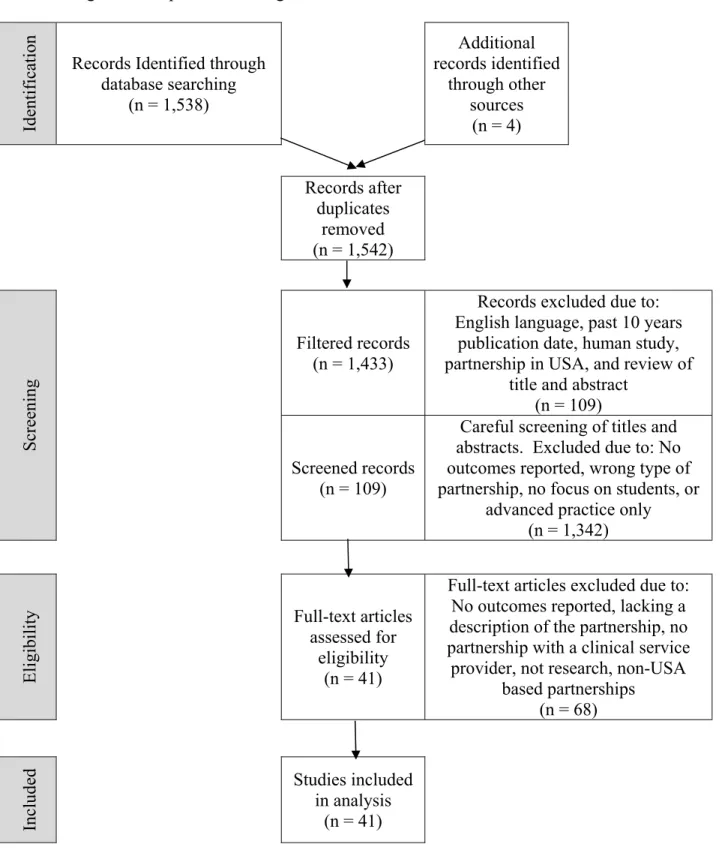
minimum standard for inclusion in this review. A summary of these findings, using the PRISMA algorithm, is presented in Figure 2.1.
Identificatio
n
Records Identified through database searching (n = 1,538) Additional records identified through other sources (n = 4) Records after duplicates removed (n = 1,542) Screening Filtered records (n = 1,433)
Records excluded due to: English language, past 10 years
publication date, human study, partnership in USA, and review of
title and abstract (n = 109) Screened records
(n = 109)
Careful screening of titles and abstracts. Excluded due to: No outcomes reported, wrong type of partnership, no focus on students, or
advanced practice only (n = 1,342)
Eligib
ility Full-text articles assessed for eligibility
(n = 41)
Full-text articles excluded due to: No outcomes reported, lacking a description of the partnership, no partnership with a clinical service
provider, not research, non-USA based partnerships (n = 68) Included Studies included in analysis (n = 41)
Study methods. In total, 41 studies were included in the final analysis. Four of the 41 studies reported an experimental design (Lenchanko, 2013; Moscato et al., 2007; Mulready-Shick et al., 2013; Nishioka et al., 2014); of these, three reported a quasi-experimental pre/post or post-test design while one went further by reporting a randomized multi-site post-test design (Mulready-Shick et al., 2013). All four of the studies which reported an experimental design chose the DEU as their partnership of interest.
The remaining 37 papers were evaluation studies, case studies, or exploratory works. Of these, 12 included some type of qualitative methodology such as individual interviews and focus groups (Austin, Hannafin, & Nelson, 2013; Coakley & Ghiloni, 2009; Gray, 2010; Jeffries et al., 2013; Nishioka et al., 2014; Peck, Lester, Hinshaw, Stiles, & Dingman, 2009; Rhodes, Mattie L. et al., 2012; Stuenkel, Nelson, Malloy, & Cohen, 2011; Teel, Macintyre, Murray, & Rock, 2011; Valde, 2006). A review of student journals was reported as a data source by two of the studies (Hamner, Wilder, & Byrd, 2007; Krumwiede, Van Gelderen, & Krumwiede, 2015).
Instruments. The use of surveys was evident in the selected literature, and four
employed a previously published survey instrument; two of these utilized the Clinical Learning Environment Inventory (CLEI) instrument (Hardy et al., 2015; Lenchanko, 2013), one used the Student Evaluation of Clinical Education Environment (SECEE) instrument (Mulready-Shick et al., 2013) and the final used the Clinical Learning Environment, Supervision and Nurse Teacher (CLES+T) instrument (Nishioka et al., 2014). In total, 18 manuscripts reported using a survey
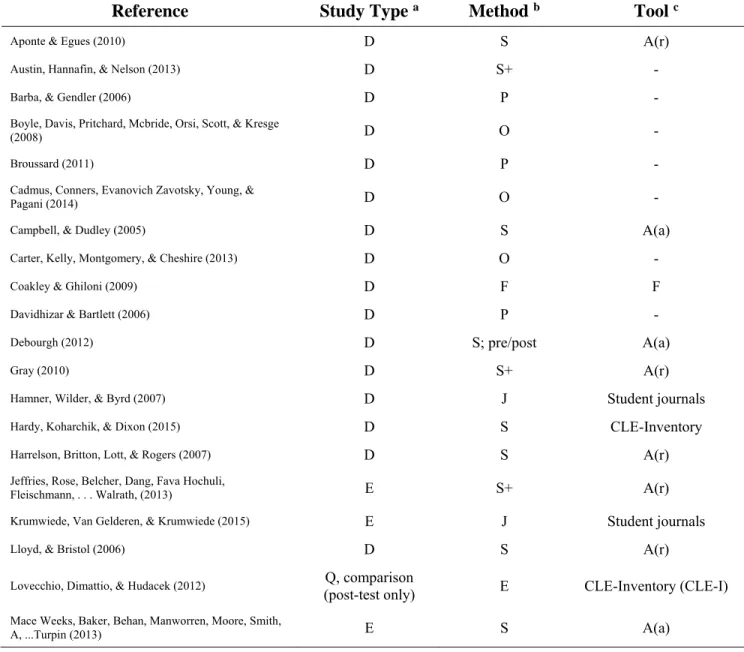
Murray et al., 2010; Nishioka et al., 2014; Peck et al., 2009; Phillips, 2007; Pullen, Mueller, & Ashcraft, 2009; Raines, 2009; Rhodes et al., 2012). Six of these used a survey and a qualitative method, typically focus groups, to arrive at a mixed methodology study (Austin et al., 2013; Gray, 2010; Jeffries et al., 2013; Nishioka et al., 2014; Peck et al., 2009; Rhodes et al., 2012). Table 2.5 summarizes the different research methods used within the literature review.
Table 2.5
Research Methods within Literature Review
Reference Study Type a Method b Tool c
Aponte & Egues (2010) D S A(r)
Austin, Hannafin, & Nelson (2013) D S+ -
Barba, & Gendler (2006) D P -
Boyle, Davis, Pritchard, Mcbride, Orsi, Scott, & Kresge
(2008) D O -
Broussard (2011) D P -
Cadmus, Conners, Evanovich Zavotsky, Young, &
Pagani (2014) D O -
Campbell, & Dudley (2005) D S A(a)
Carter, Kelly, Montgomery, & Cheshire (2013) D O -
Coakley & Ghiloni (2009) D F F
Davidhizar & Bartlett (2006) D P -
Debourgh (2012) D S; pre/post A(a)
Gray (2010) D S+ A(r)
Hamner, Wilder, & Byrd (2007) D J Student journals
Hardy, Koharchik, & Dixon (2015) D S CLE-Inventory
Harrelson, Britton, Lott, & Rogers (2007) D S A(r)
Jeffries, Rose, Belcher, Dang, Fava Hochuli,
Fleischmann, . . . Walrath, (2013) E S+ A(r)
Krumwiede, Van Gelderen, & Krumwiede (2015) E J Student journals
Lloyd, & Bristol (2006) D S A(r)
Lovecchio, Dimattio, & Hudacek (2012) Q, comparison
(post-test only) E CLE-Inventory (CLE-I)
Mace Weeks, Baker, Behan, Manworren, Moore, Smith,
Research Methods within Literature Review
Reference Study Type a Method b Tool c
Maguire, Zambroski, & Cadena (2012) E S A(a)
Moscato, Miller, Logsdon, Weinberg, & Chorpenning (2007)
Q
(pre/posttest design) E A(a), F
Moscato, Nishioka, & Coe (2013) E Case study / exemplar NCLEX-RN d pass rates
Mulready-Shick, Flanagan, Banister, Mylott, & Curtin (2013) Q (randomized multi-site posttest design) E A (x 2) e SECE f
Murray, Havener, Davis, Jastremski, & Twichell (2011) E P -
Murray & James (2012) E P -
Murray, Schappe, Kreienkamp, Loyd, & Buck (2010) E S A(a)
Niederhauser, Schoessler, Gubrud-Howe, Magnussen, &
Codier (2012) D P Various (at least one used HESI)
Nishioka, Coe, Hanita, & Moscato (2014) E S+ F, CLE - Supervision, and Nurse Teacher (CLES+T)
Peck, Lester, Hinshaw Stiles, & Dingman (2009) D S+ A(r)
Phillips (2007) D S A(r)
Pullen, Mueller, & Ashcraft (2009) E S A(a)
Raines (2009) D S; repeated measures A(r)
Rhodes, Meyers, & Underhill. (2012) D S+ A(stated), F,
CLE-Scale
Schoon, Champlin, & Hunt (2012) E P -
Stuenkel, Nelson, Malloy, & Cohen (2011) F F -
Teel, Macintyre, Murray, & Rock (2011) D Individual or focus groups -
Valde (2006) D F -
only. c For Tool, A(r) = Author developed survey instrument (reported); A (a) =Author developed survey instrument
(assumed); F=Focus group; CLE=Clinical Learning Environment. d National Council Licensure Examination for
Registered Nurses e Growth in clinical learning scale and the quality and safety competency development scale. f
Student Evaluation of Clinical Education Environment.
Types of partnerships. Each of these studies met the minimum inclusion criteria in that they reported on a NAPP between at least one nursing academic program, termed a school of nursing (SON), and a nursing clinical service partner. The focus of study in six of the papers was multiple partnerships (Moscato et al., 2013; Murray, Havener, Davis, Jastremski, &
Twichell, 2011; Niederhauser, Schoessler, Gubrud-Howe, Magnussen, & Codier, 2012; Nishioka et al., 2014; Teel et al., 2011; Wurmser & Bliss-Holtz, 2011) and three of those reported on the DEU as their focus of interest (Moscato et al., 2013; Murray et al., 2011; Nishioka et al., 2014).
Of papers with only one partnership studied, nine reported a DEU (or a DEU-type) partnership as their focus (Campbell & Dudley, 2005; Hardy et al., 2015; Jeffries et al., 2013; Lovecchio et al., 2012; Maguire et al., 2012; Moscato et al., 2007; Mulready-Shick et al., 2013). In the remaining studies, the nursing clinical service partner was most often a hospital, however, the SON partnered with a non-hospital or health service entity in 13 of the studies (Aponte & Egues, 2010; Austin et al., 2013; Barba & Gendler, 2006; Boyle et al., 2008; Broussard, 2011; Carter, Kelly, Montgomery, & Cheshire, 2013; Hamner et al., 2007; Lloyd & Bristol, 2006; Murray et al., 2010; Niederhauser et al., 2012; Phillips, 2007; Schoon, Champlin, & Hunt, 2012; Teel et al., 2011). Non-hospital partners in these 13 studies were other service providers such as university health services, community agencies, or homeless shelters.
In addition to membership of the partnership, purpose of the partnership was examined.
Examples of purpose were widely varied and included expansion of clinical opportunities (Mulready-Shick et al., 2013), improvement of the quality of clinical opportunities (Williams-Barnard, Bockenhauer, O'keefe Domaleski, & Eaton, 2006), expansion of clinical services
2007), and addressing faculty shortages (Pullen et al., 2009). Table 2.6 provides an overview of partnership membership and the primary and secondary partnership purposes found in the selected literature.
Table 2.6
Partnership Purposes and Membership
Reference Partnership Primary P
Additional
Purpose Partnership Members Aponte & Egues (2010) E C SON plus university health service
Austin, Hannafin, & Nelson (2013) Q S SON plus community agencies
Barba, & Gendler (2006) Q S 2 SONs plus variety of community agencies
Boyle, Davis, Pritchard, Mcbride, Orsi,
Scott, & Kresge (2008) W 2 colleges, 1 hospital, and a healthcare district
Broussard (2011) E Students and the community
Cadmus, Conners, Evanovich Zavotsky,
Young, & Pagani (2014) T SH/S
Campbell, & Dudley (2005) F Address Staff RN Turnover SH/S
Carter, Kelly, Montgomery, & Cheshire
(2013) E C SON plus University wellness program
Coakley & Ghiloni (2009) W SON plus hospital's oncology unit
Davidhizar & Bartlett (2006) W SH/S
Debourgh (2012) Q S SH/S
Gray (2010) Q S SH
Reference Partnership Primary P
Additional
Purpose Partnership Members Jeffries, Rose, Belcher, Dang, Fava
Hochuli, Fleischmann, . . . Walrath, (2013) E F SON plus 4 clinical institutions (all Johns Hopkins facilities) Krumwiede, Van Gelderen, & Krumwiede
(2015) Q S SH (critical access)
Lloyd, & Bristol (2006) T SON, students (BSN and MSN), and
clinic staff.
Lovecchio, Dimattio, & Hudacek (2012) Q SH
Mace Weeks, Baker, Behan, Manworren,
Moore, Smith, A, ...Turpin (2013) Q S SH8 (and 2 universities) Maguire, Zambroski, & Cadena (2012) Q SHy
Moscato, Miller, Logsdon, Weinberg, &
Chorpenning (2007) E F SHy
Moscato, Nishioka, & Coe (2013) M SHy Mulready-Shick, Flanagan, Banister,
Mylott, & Curtin (2013) E SON and three partners Murray, Havener, Davis, Jastremski, &
Twichell (2011) M W Health system and multiple academic partners
Murray & James (2012) E SH
Murray, Schappe, Kreienkamp, Loyd, &
Buck (2010) E F State hospital association a
Niederhauser, Schoessler, Gubrud-Howe,
Magnussen, & Codier (2012) M Multiple - Hawai‘i
Nishioka, Coe, Hanita, & Moscato (2014) M Multiple - U of P, Tennessee, and South Carolina.
Peck, Lester, Hinshaw Stiles, & Dingman
(2009) F University plus hospital
Phillips (2007) T North Carolina Area Health Education Consortium plus regional workforce planning committee
Pullen, Mueller, & Ashcraft (2009) F Two universities plus 2 systems b
Raines (2009)
Improve Student / Graduate
Clinical Competence SH
Rhodes, Meyers, & Underhill. (2012) E F SH2
2 units per hospital
P
Stuenkel, Nelson, Malloy, & Cohen (2011) W SH7
Teel, Macintyre, Murray, & Rock (2011) M multiple
Valde (2006) T SxHy
(in Iowa)
Wagner, & Seymour (2007) Decrease Student
Attrition S2H
Williams-Barnard, Bockenhauer, O'keefe
Domaleski, & Eaton (2006) Q SH c
Wurmser, & Bliss-Holtz (2011) M W Health System plus multiple colleges
and universities.
Note: * indicates study was DEU or DEU-type of partnership. For Primary partnership purpose and Additional purposes: E= Expansion of quality clinical placement opportunities Q=Improve quality of clinical experience; W= Clinical workforce development strategy; T= Improve transition to practice; M= Multiple programs evaluated; F=Faculty shortage; S= Specific and limited area of focus identified; C= Develop or expand a clinical service to the community; dashes indicate no explicit or implied secondary purpose. For Partnership members, S(x) H(y) =SON (x=number of SONs) and Hospital (y=number of hospitals); SH/S=SON and Hospital or System. a State hospital association hosted meetings between faculty leaders and service leaders. b Systems (large employers of RNs)
provided substantial financial support to the students. c partners were students and clinical partners (e.g., preceptor). While all 41 articles reported on outcomes of a given NAPP (or selection of NAPPs), a few specifically addressed the students’ experience in more depth or supplemented general
statements of approval and satisfaction with empiric data. In total, 14 articles contributed to a more profound and specific understanding of how students experienced NAPPs. Findings from these articles, summarized in table 2.7, addressed the evaluation criteria of the partnership and students' perspective of the experience.
Table 2.7
Evaluation Criteria and Student Experiences of NAPPs
Reference Partnership Summary
Evaluation
Criterion Student Findings
Campbell & Dudley (2005).
SON and hospital set up a DEU like program with SON faculty supervising staff nurse adjuncts.
Satisfaction with
clinical placement N = 78 students (over 3 years) have evaluated the model. Results:
• 3.8 on a 4-pt. scale for skill-based items.
• "Overall, how would you rate this clinical rotation?" rating was 3.9/4.
• Staff nurses rated 3.8/4 "how would you rate your performance in the role"
Coakley & Ghiloni (2009).
Students between their Jr. and Sr. year may join a 400-hour fellowship to learn about oncology nursing.
"what was the experience of the fellowship like for you"
"How do you feel it prepared you differently from nurses who did not participate in an educational program like the fellowship?" - (p. 49)
Outcome measures:
10 of 14 fellows were hired to work at the hospital 9 of these 10 went on to work in oncology
Focus Group
(n=3; 2 via voice recorder 1 via written answers). Results showed:
• Program helps to make informed career choices
• Provides confidence building experience
• Provides preceptor role modeling
• Provides opportunity to build relationship with staff/patients/families
Gray (2010). SON and hospital partnership introduced a clinical experience to Jr. students in a research course focused on evidence based practice. Partnership attempts to ground EBP into daily clinical.
"Please describe in what ways this research project partnership were helpful to your learning or nursing goals" "Please offer suggestions for improvement to this research project partnership" (p. 379) First year:
N = 13 (7 in psych unit; 6 in cardiac unit). Focus group findings:
• Themes: The value of research; communication is critical for success; time commitment; and collaboration.
• All students stated that better directions and more time with the staff RN would have facilitated better outcomes.
Second year (N=34); Third year (N=30). These groups had a different evaluation process. Question:
• Response to open ended question "please describe in what ways this research project partnership was helpful to your learning or nursing goals.
Findings:
• "...the research partnership project facilitated student learning and an appreciation of the rigor of the research process underlying evidence-based practice" (p. 381)
Hamner, Wilder, & Byrd (2007).
In a partnership between a SON and a housing authority, students held a 1 day/week clinical with low income housing authority clients and focused on health promotion, teaching, screening, and referral. Students kept a journal of the experience. Evaluation of
journal entries Journal entries showed a benefit of interacting with different cultures and with those in poverty. Students felt empowered by helping to make a difference.
"…a major impact on students of a community-based partnership was that students felt empowered by seeing first-hand the effect of primary and secondary prevention" (p. 108)
Note: No description provided of how the journals were reviewed or the number of student journals reviewed. Hardy, Koharchik, & Dixon (2015). Partnership involved creating a DEU between two SONs and a hospital. Unit-based RN's were prepared as clinical instructors. The study was developed after two years of being in partnership.
Satisfaction with
clinical placement 40 item, 4-point Likert scale instrument (CLEI) given to students (also included open ended questions for faculty only and focus groups for staff nurses only).
N=17 of 60 (28%) students. The CLEI instrument has 6 factors. Factor 1 - student centeredness 2.43 Factor 2 - affordances and engagement 2.43 Factor 3 - individualization 2.74
Factor 4 - Fostering workplace learning 2.5 Factor 5 - valuing nurses work 2.93 Factor 6 - Innovative and adaptive 2.63 Note: No comparison/control group Lloyd & Bristol (2006). Partnership between graduate (MSN) and undergraduate (BSN) students that occurred in a clinical facility. Perceived effectiveness of the collaboration efforts between students N=10.
5 BSN and 5 MSN students were provided a 6-item survey with answers given on a 5-point Likert scale.
• BSN students answered all survey items between 4.4 and 5.0.
• Collaboration items rated 4.0 to 4.8.
• MSN students rated mentoring 4.6 to 5.0
Reference Partnership Summary
Evaluation
Criterion Student Findings
Lovecchio, Dimattio, & Hudacek (2012).
Partnership between a SON and Hospital where a modified DEU, called the Clinical Liaison Nurse Model, was created. In this model the clinical faculty maintains responsibility for evaluation and work with staff nurses who did the clinical teaching. School faculty kept the same 8:1 ratio as in traditional clinicals.
Satisfaction with
clinical placement N=40 experimental group (40 completed tests) and N=35 control group (14 completed tests) Clinical Learning Environment Inventory (CLEI) administered to students in the experimental and control group.
Experimental group gave higher scores to subscales measuring:
Individualization Satisfaction Task orientation
Experimental group reported the experience was:
• better organized
• had clear assignments
• enjoy the experience
• find it an interesting clinical Mulready-Shick, Flanagan, Banister, Mylott, & Curtin (2013).
A SON with three clinical partners created a DEU and tracked students for two years using a randomized control group procedure. Used three instruments designed to measure growth in clinical learning: • QSEN • competency achievement • student evaluation of clinical education
Random assignment of 1st semester junior nursing students on acute care med/surg units to DEU or traditional group. Students received an online survey at week 12 of the semester. They examined four semesters over 2 years for four separate cohorts. Used the Student Evaluation of Clinical Education Environment (SECEE) - the growth in clinical learning scale and the quality and safety competency development scale.
Findings:
• DEU groups responded higher than control.
• DEU were higher in positive learning experience on all measures.
• DEU also perceived greater growth in clinical learning and knowledge development.
• More opportunities in 4 of the 6 Quality and Safety Education for Nurses (QSEN) competencies.
• Reported receiving more instructional coaching.
• There were no between group differences found that these outcomes impacted overall academic success in school. Nishioka, Coe, Hanita, M, & Moscato (2014). Reports on findings of the DEU programs in Oregon,
Tennessee, and South Carolina. Student survey and focus group data was collected to
Satisfaction Factor modeling
Focus Group Findings:
N=209 participants of which 32 were students. Conducted 6 student focus groups.
All students also had non-DEU experiences. Students reported:
• Clinical learning experiences were high on DEUs
determine if DEU experiences were different than traditional clinical experiences.
they perceived better nursing care on DEUs
• Students verbalized concerns about the traditional clinical model - "the students attributed these problems to the structure of the traditional clinical education model rather than the quality of their faculty instructor" (p. 303). Survey Findings:
473 students turned in 2 of 4 surveys. The 34-item Clinical Learning Environment, Supervision, and nurse teacher survey was used. Hierarchical linear modeling (HLM) was used to determine which variation in perception was associated with the clinical education model or the individual students.
Positive findings associated with DEU placement included:
• Positive unit atmosphere
• Leadership style of manager
• Nursing care on the unit
• The nature of the clinical supervisory relationship was more positive
• Faculty was more helpful in connecting theory with practice and more active in cooperating with their nurse teacher on traditional units. Pullen,
Mueller, & Ashcraft (2009).
Partnership between two SONs and two hospitals/systems to provide financial support to staff/students returning to school. 20 students received funding for their graduate education in return for working three years as a nurse educator and the schools developed an accelerated RN-MSN curriculum. General satisfaction Graduation outcomes
20 ADN RNs, attending an RN-MSN program with funding to become nurse educators.
Findings:
• 19 graduated
• Overall GPA was 3.95
• 15 of 19 completed exit surveys
• Satisfaction was 4.67/5 Likert scale (5 pt.).
• 15 became nurse educators and 4 are in the labor pool for nurse educator positions.
Reference Partnership Summary
Evaluation
Criterion Student Findings
Rhodes, Meyers, & Underhill (2012).
Partnership between one SON and two hospitals engaged in a DEU. Investigation of students' perceived outcomes of the DEU model on quality of learning environment.
Focus Group Findings
The student focus group consisted of 8 students answering the questions "how has your experience in working with your DEU preceptor compare with your other experiences working with faculty in clinical settings," "what were your greatest
challenges as a student on a DEU," and "was the goal of a collaborative working relationship between university faculty, students, and DEU preceptors achieved on this DEU."
• Most students reported learning occurred more from their DEU nurses than fellow students.
• The DEU environment encouraged critical thinking and evidence appraisal within the clinical units.
Survey Findings
Students completed a 21-item investigator generated 4 point Likert survey tool. 36 students in the spring course completed the Clinical Learning Environment Scale - Revised which is a 23-item instrument with 5 subscales.
• Students demonstrated satisfaction with the clinical learning environment on the DEUs.
• 100% said "they were made to feel a part of the team and not just another student"
• All perceived that asking questions was welcomed.
Schoon, Champlin, & Hunt (2012).
SON opened a student run foot clinic in a homeless shelter. Staffed by faculty and students. Also, has specialists like podiatrist and diabetic nurse educator to whom they can refer.
General
satisfaction The researchers evaluated student learning by linking learner objectives to evidence of learning outcomes. This evidence was in the form of statements made by students such as expressions they became more comfortable with listening and sitting quietly with clients but the authors did not indicate how these were measured. While they did work on the "systems" level of public health nursing - there was not mention of how they evaluated the partnership or how they experienced it. The authors claim that the "qualitative course evaluation data consistently demonstrate that this clinical activity is highly valued" (p. 717).