Chapter
7
Earthquake
Hazards
Introduction
Any given earthquake produced by slip along a fault can produce a number of hazards including ground shaking, liquefaction, ground displacement, fires, and tsunamis. Ground shaking is simply the vibration of the land surface while liquefaction transforms what was a solid to a liquid‐like state. In contrast, ground displacement is a direct result of the slippage along the fault. These three processes, in combination or acting alone, can produce tremendous damage to buildings and other structures. In some instances, they can rupture dams and gas lines and thus produce flooding and fires. Though such processes are dangerous their ability to affect large numbers of people are limited by the size of the community that the earthquake occurs in or near. In contrast, tsunami produced by earthquakes on distant lands can devastate large regions hundreds of kilometers or miles away. Hence, though all earthquake hazards are important to understand, in this chapter, after briefly discussing ground shaking, liquefaction, ground displacement (i.e., surface rupturing), and fires, I will focus primarily on tsunami.
Ground Shaking
During an earthquake, both body and surface waves cause the land surface to shake and vibrate. The intensity of an episode of shaking and vibration is dependent upon the magnitude of the earthquake, the distance from the epicenter, and local geological conditions. Typically the intensity of ground shaking is given as the percentage of g, i.e., the acceleration due to gravity (9.8 m/sec/sec).
In soft materials, as for example soils and sediments, shaking and vibration during an earthquake are amplified. As might be expected, if the intensity of ground shaking is sufficiently high, then it can damage buildings if they have not been properly engineered. An excellent example of this effect occurred during the 1985 Mexico City earthquake (Figure 1).
Figure 1. Earth Explorer 5.0 DEM map showing location of 1985 earthquake that devastated Mexico City located ~400 km to the NE.
The epicenter of the Mexico City earthquake was located along the coast of the Pacific Ocean about 400 kilometers (220 miles) distance from Mexico City (Figure 1). The main rupture occurred on September 19 within the Cocos subduction zone at a depth of about 10 – 14 km, i.e., along the approximate interface between the subducting Cocos microplate and the overriding North American plate. The earthquake had a magnitude of 8.0, and was directly or indirectly the cause of about 9,500 deaths. The seismic waves from the earthquake hit Mexico City over two minutes after the main rupture event at 7:19 am PST.
Mexico City is built, in part, on an ancient lake bed composed of soft clay with high water content. Though many areas within the central parts of the city were damaged, the historic downtown area was the most severely shaken. In this historic portion of the city, 258 buildings crumbled, 143 partially collapsed, and 181 were seriously damaged. Overall, throughout the entire city 2,831 buildings were damaged, with 880 being completely ruined (Figure 2). On the Modified Mercalli Intensity scale, the earthquake
Figure 2. Collapsed general hospital, Mexico City, Mexico. Photo by M. Celebi, United States Geological Survey
was classified at an IX level. Much, if not all, of the damage to buildings during the earthquake was produced by amplification of ground shaking through the soft ancient lake bed sediments and soils, and by liquefaction.
Liquefaction and Fires
Water‐saturated granular materials can lose their strength and transform from a solid to a liquid‐like state during ground shaking. For this to happen three factors have to be in place. First, there must be loose, granular sediment such as the weak lake beds and soils on which Mexico City is built. Second the sediment must be saturated with ground water, and third, ground shaking during an earthquake must be sufficiently intense that grains within the granular material lose contact with each other, resulting in a loss of strength and a liquid‐like behavior.
When liquefaction occurs large rigid structures can be affected as they tilt or sink into the liquefied deposits (Figure 3). As noted above, this was one of the contributing causes of
building damage in the 1985 Mexico City earthquake, and it also contributed significantly to the damage during the great 1906 7.8 Mw magnitude San Francisco earthquake.
Figure 3. Tilted Victorian in the Mission District following 1906 San Francisco earthquake. Photograph from United States Geological Survey.
During the April 18, 1906 San Francisco earthquake, the northern one third of the San Andreas fault ruptured for a total length of 477 kilometers (296 miles) (Figure 4). The maximum displacement along the fault was between about 6 meters (20 feet) and 8.5 meters (28 feet). Shaking was felt as far away as Oregon, central Nevada, and Los Angeles. In San Francisco and adjacent regions, the Modified Mercalli Intensity level was estimated to be between VIII and IX. Over
Figure 4. Generalized map showing the location of the 1906 rupture along the northern trace of the San Andreas fault.
3000 deaths are attributed to the earthquake and the subsequent fire, making the 1906 earthquake the worst natural disaster in the history of California. Of the 410,000 populating San Francisco at the time of the earthquake an estimated 225,000 to 300,000 were left homeless.
The fires that nearly destroyed San Francisco were initially started by ruptured gas mains (Figure 5). The likely culprit was ground shaking. It is estimated that over 30 fires destroyed approximately 25,000 buildings on 490 city blocks. Unfortunately, many of the
Figure 5. Panoramic view of earthquake and fire damage from Stanford Mansion site, April 18 ‐ 21, 1906. Photograph by Lester C. Guernsey.
destroyed buildings were the result of firefighters using dynamite to create firebreaks. Of the buildings destroyed during the earthquake, more than 50% were destroyed in this fashion. Sadly, many of the buildings destroyed to create firebreaks, also caught fire. Following the earthquake fires burned for four days and nights, and in the end up to 90% of the total destruction was due to fires.
Examples of areas affected by liquefaction during the great San Francisco earthquake include the Mission District and the Market Street area (Figure 6). In these and other areas, water lines were damaged by liquefaction, and thus inhibited the city’s ability to fight the large fires that burned out of control following the earthquake.
Liquefaction during the 1906 earthquake occurred only in reclaimed areas that had once been bays or marshlands (Figure 6). These old bays and marshlands had been filled in and
Figure 6. Locations of liquefaction during the 1906 San Francisco earthquake. Simplified from map by United States Geological Survey.
reclaimed by pumping or dredging sediment from the floor of San Francisco Bay. According to the United States Geological Survey, the fills were deposited behind a levee or dike and allowed to dry and settle prior to building structures on them. With hindsight such constructions were highly susceptible to liquefaction.
Ground Displacement – Surface Ruptures
If a building, or for that matter any kind of man made or natural structure, lies across a fault, then displacement, that is surface rupture, along the fault can produce damage. Some of the best recent examples of this kind of damage that I am aware of occurred during the 1999 earthquake in Izmit, Turkey. This Mw 7.4 earthquake occurred along the North Anatolian fault (Figure 7), one of the longest and best studied strike‐slip faults in the world.
The Anatolian block or microplate, consisting primarily of Turkey, lies between the Eurasian plate to the north, and the African plate and Arabian microplate to the southeast (Figure 7). It is being shoved westward about 2 to 2.5 cm (0.8 to 1.0 inches) a year as it is squeezed between the surrounding three larger plates.
The Izmit earthquake struck on August 17, 1999 as the North Anatolian fault ruptured along about 110 kilometers (63.4 miles) of its western mapped trace. The amount of displacement across the fault was about 5.7 meters (18.7 feet). The earthquake left between 17,000 and 40,000 dead, and about 500,000 homeless.
Figure 7. Map showing the key tectonic elements and their relationship to the North Anatolian fault. The red curve extending from Izmit to the east is the trace of the segment of the North
Anatolian fault that ruptured during the 1999 earthquake.
Shown in Figures 8 through 11 are photographs taken of various man‐made and natural objects that were displaced by the surface rupture of the North Anatolian fault or a related subsidiary rupture. For example, the photograph in Figure 8 shows a tree that was actually split in part along a surface rupture while in Figure 9 a line of trees is offset in a right lateral sense.
Figure 8. Photograph of a tree trunk split into by a surface rupture associated with the Izmit, Turkey 1999 earthquake. Photograph from United State Geological Survey.
Figure 9. A line of tress and a stream channel are offset in a dextral sense by a surface rupture associated with the Izit, Turkey 1999 earthquake. Photograph from United State Geological
Survey.
In Figure 10, the surface rupture offsets a road, and then crosses adjacent to a building that completely collapsed during the rupture. In Figure 11, a metal fence and road are offset in a right lateral sense.
Figure 10. A road is offset in a dextral sense by a surface rupture during the Izit, Turkey 1999 earthquake. The building adjacent to the surface rupture was completely destroyed.
Photograph from United State Geological Survey.
Figure 11. A road and metal fence are offset in a dextral sense by a surface rupture during the Izit, Turkey, 1999 earthquake. Photograph from United States Geological Survey.
Tsunami
On 26 December 2004, a large magnitude earthquake struck the west coast of northern Sumatra (Figure 12). Though the moment magnitude of the earthquake was first thought to
have been around 9.0‐9.15, later work resulted in the magnitude being upgraded to 9.3. The earthquake generated a tsunami that devastated the shores of Indonesia, Sri Lanka, South India, Thailand, and other countries. Waves up to ~30 meters (~100 feet) high were observed and more than ~225,000 people lost their lives. Though many believe that California has not been hit nor will be by a tsunami, that simple is not true. Hence, it is important that we gain some basic understanding of the causes and characteristics of tsunamis.
Figure 12. Map showing the convergent margin setting and epicenter of the Sumatra December 2004 9.3 Mw earthquake.
General Characteristics
According to NOAA, "a tsunami is a set of ocean waves caused by any large, abrupt disturbance of the sea‐surface". Most are generated by earthquakes, but others are caused by volcanic eruptions, landslides, undersea slumps, or meteor impacts. The term tsunami comes from the Japanese and literally means "harbor wave". The plural is tsunamis.
In the past, tsunamis have sometime been referred to as tidal waves. However, though they can resemble a tidal bore, they have nothing to do with the 4 tides produced by the interaction of the gravitational fields of the Earth, Moon, and Sun with the inertial force produced by the spinning Earth‐Moon pair.
Most major tsunamis are produced by large (>7 magnitude), shallow focus (< 30 km) earthquakes along convergent margins. Can you think of a reason why this might be the case?
At convergent margins one plate slides beneath (i.e., subducts) another. However, subduction may not be a continuous smooth process. Where the interface between the two converging plates is locked (i.e., stuck) stresses build up. Eventually, the stress will exceed the resistance to shearing along the interface between the two converging plates, and sudden large scale slip along this interface will occur (Figure 13).
Figure 13. Common mechanism for generation of tsunami along convergent margins. In the upper image subduction is arrested as the interface between the two plates becomes stuck. In
the lower image, the buildup of stress has reached a critical value, and the subducting plate suddenly slides downward driving a large wedge of the subduction complex upward.
Recall from our earlier study of faults, that reverse or thrust faults are common along convergent margins, and that they displace material upward as the hanging wall moves up toward the surface of the Earth. Because of this characteristic along a convergent margin sudden slip on the thrust interface between the two converging plates, and/or on related reverse or thrust faults within the adjacent subduction complex, would move the sea floor rapidly upward (Figure 13). Because water is incompressible, the upward motion of the sea floor would in turn carry the overlying water column upward resulting in a momentary displacement of the sea surface. However, water has no strength, and, as a result, under the influence of gravity, the upwardly displaced column of water flows outward away from the central area of disturbance as sea level tries to regain its original flat undisturbed form (Figure 13). This whole process is analogous to throwing a stone into a pond. However, along a
convergent margin, the mass causing the disturbance is introduced from below rather than above (Figure 13).
Wave Characteristics
Once formed tsunamis radiate outward from the central area of disturbance as a series of waves called a wave train (Figure 13). They have wavelengths ranging from ~100 meters (~328 feet) to over ~500 kilometers (~311 miles) in the deep oceans, and long periods, ranging from 10 minutes to 2 hours. In addition, wave height is commonly less than ~ 1 meter (~3 feet). In contrast, common everyday wind‐generated waves have wavelengths of about 100 to 200 meters (300 to 600 feet), periods between about 5 and 20 seconds, and wave heights around 2 meters (7 feet).
The speed of typical wind‐generated waves is about 40 kilometers per hour but ranges up to about 90 kilometers per hour. In contrast, the speed of a tsunami depends on ocean depth. It can exceed ~966 kilometers per hour (~600 miles per hour) in the deep ocean but typically tsunamis slow to ~32 to ~48 kilometers per hour (~20 to ~30 miles per hour) in shallow water near land. A tsunami can cross the entire Pacific Ocean in less than 24 hours.
The speed of a tsunami is given by the following formula.
(1) speed = (g * d)1/2.
In equation (1), g is the acceleration due to gravity (9.81 meters per second per second or more simply 9.81 m/sec2) and d is water depth in meters. The average depth in the world’s oceans is ~3.5 kilometers (3500 meters). Hence, the speed of a tsunami traveling in the open ocean would be the square root of (9.81 m/sec2 * 3500 meters) or 185 meters per second or 667 kilometers per hour (414 miles per hour).
The following equation can be used to explore the relationship between wave height and speed as tsunamis propagate from deep into shallow water adjacent to the landmasses lying in their paths:
(2) Hs/Hd = (Sd/Ss)1/2.
In equation (2), Hs is the height of the tsunami in shallow water, Hd is the tsunami height in deep water, Sd is the speed of the tsunami in deep water, and Ss is its speed in shallow water.
Rearranging equation (2) and isolating the Hs term results in
(3) Hs = (Sd/Ss)1/2 * Hd.
Now note that from equation (1) we known that the speed of a tsunami in shallow water (Ss) always will be less than its speed in deep water (Sd), and, as a result, the ratio ((Sd/Ss) will be greater than 1. This result translates into the generalization that the wave height of the tsunami in shallow water will always be larger than its height in deep water. For example, using equation (1), we can calculate that the speed of a tsunami in water depths of 3500 meters is ~185 meters per second. In contrast, in water depths of 5 meters the speed will decrease to ~7
meters per second. If we plug these numbers into equation (3), and assume a wave height of 1 meter for the tsunami in deep water we arrive at Hs = (185 / 7)1/2 * 1 = 5.14 meters (16.86 feet). In short, tsunami wave speed decreases with decreasing water depth while wave height increases.
The speed of a tsunami also can be expressed as its wavelength divided by its period or in the language of mathematics as
(4) Speed = /P
where is wavelength and P is period. The period of a wave is the time it takes two successive crests to pass a stationary point while wavelength is the distance between two successive crests. The period does not change as a tsunami moves from deep to shallow water, and, as a result, in equation (4), P remains constant. This point is significant because it means that as the tsunami slows down in shallow water, the wavelength relative to its value in deep water must decrease.
Just prior to a tsunami coming ashore sea level appears to drop, a phenomenon referred to as drawdown. Because of their long wavelengths, following drawdown tsunamis commonly come ashore more like a flood or a tidal surge than a wind‐generated wave. Runup, that is the maximum vertical height above normal high tide reached by the tsunami as it travels over the land surface, can be extreme sometimes extending up to ~30 meters (~100 feet) above sea level.
An example of such large runup occurred during the 9.3 M earthquake in Sumatra where according to Borrero et al. (2006) maximum runup exceeded 30 meters along the northern coast of Sumatra (Figure 14). In contrast, at Banda Aceh, located about 12 kilometers to the NE (Figure 14), runup exceeded ~9 meters. Nevertheless, because Banda Aceh is a low lying area such runup nearly destroyed the entire community.
Figure 14. Map showing location of Banda Aceh and the destruction produced by 9+ m of runup. Upper images from DigitalGlobe.
Tsunamis in the Pacific Ocean
Though California is well known for its many earthquakes, to my knowledge none in recent history have generated a tsunami. However, Alaska and the Aleutian Islands are probably more earthquake prone than is California, and on March 27, 1964, at 5:36 pm, local time, a 9.2 Mw (moment magnitude) earthquake struck the southcentral part of this state (Figure 15). This earthquake is sometimes referred to as the Good Friday earthquake. It is the largest ever recorded in North America, and for our planet it represents the 3rd largest ever recorded by man. The 1960 Chile earthquake is the largest with a moment magnitude of 9.5, and the 9.3 Mw December 2004 earthquake off the coast of Sumatra is the 2nd largest.
Figure 15. Location and tectonic setting of the 1964 Good Friday earthquake. Modified from United States Geological Survey map.
The epicenter for the Good Friday earthquake was located in northern Prince William Sound ~121 kilometers (~75 miles) east of Anchorage, and ~88.5 kilometers (~55 miles) west of Valdez (Figure 15). The focus was at a depth of ~33 kilometers (~20.5 miles). There was up to 15 meters of uplift associated with the earthquake. The uplift occurred as the Pacific plate suddenly slide ~9 meters (~30 feet) beneath the North American plate. During this event the encircled region shown in Figure 15 moved seaward up to 20 meters (66 feet).
Tsunamis generated by the earthquake killed 106 people in Alaska. The largest tsunami with a wave height of 67 meters (~220 feet) came ashore at Shoup Bay, ~10.5 kilometers (~6.5 miles) west of Valdez (Figure 15). In addition, the tsunami generated by the earthquake traveled across the Pacific Ocean at speeds of ~666 kilometers per hour (~600 miles per hour), and struck Crescent City, California, a coastal town with a population of 3000, as well as other areas rimming the Pacific Ocean (Figure 16). At Crescent City, 4 waves up to ~6 meters (~20‐21 feet) high came ashore.
Crescent City is located approximately 25 kilometers (15 miles) south of the border with Oregon (Figure 16). The first wave to arrive came ashore at mid‐night, ~4.1 hours following the
Good Friday earthquake (Figure 16). It produced some flooding of Crescent City but no significant damage. The smallest of the four waves were the second and the third. When the fourth wave finally can ashore about two hours had lapsed since the first wave had arrived. It was preceded by significant drawdown which left the inner harbor at Crescent City nearly dry. The fourth wave had a height of ~6 meters (~20‐21 feet). It capsized or sunk up to 26 boats and flooded about 30 blocks of the city. In terms of today's dollar over $350 million dollars of damage was inflicted, and 11 people lost their lives. Four additional deaths were reported from Oregon.
Figure 16. Track of Good Friday tsunami. Note location of Crescent City, California. Numerical values are hours after initial earthquake. Data from United States Geological Survey.
Though the 1964 tsunami was devastating to Crescent City, it was not the first nor will it be the last to affect this community. For example, since about 1855 Crescent City has experienced tsunami conditions at least 22 times. The two most recent events occurred on June 14, 2005 and November 15, 2006. Significantly, the vast majority of tsunamis arriving at Crescent City were produced by earthquakes located in various subduction zones surrounding the Pacific Ocean, and thus they serve to remind us that the coastal communities along the west coast of the United States can be affected by distant geological events. However, there is an even greater potential danger lurking along the western shores of the United States than many realize.
The Cascadia Subduction Zone and the 1700 9.0 M Earthquake
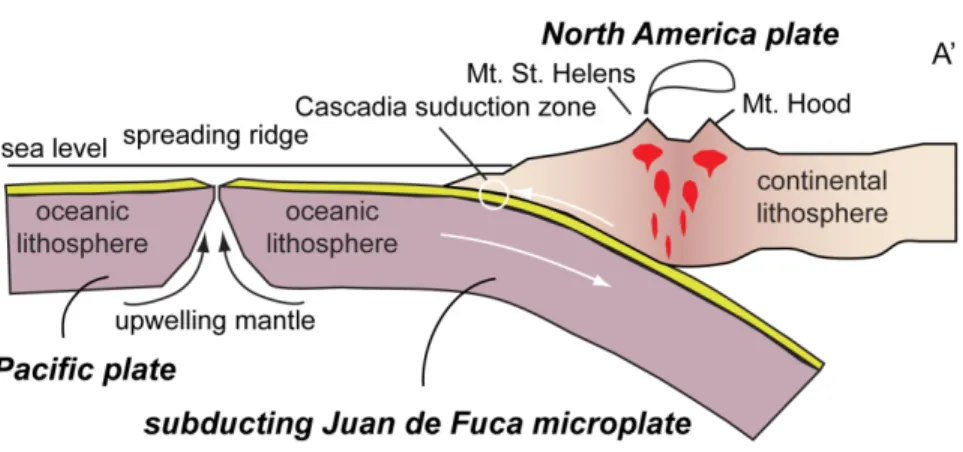
The Cascadia Subduction Zone is the interface between the subducting Juan de Fuca plate and the overriding North American plate (Figures 17 and 18). The rate of convergence between these two plates is 40 millimeters per year. At about 9:00 pm on January 26, 1700, along about 1000 kilometers of the Cascadia Subduction Zone, the descending Juan de Fuca plate suddenly slipped ~20 meters beneath the North American plate. This sudden dramatic
event produced an earthquake with a magnitude estimated to have been somewhere between 8.7 and 9.2.
The 1700 earthquake represents the largest to ever have affected the continental United States. It produced a tsunami that damaged coastal regions of the NW United States and traveled across the Pacific Ocean where ancient documents indicate that it drove Japanese "villagers to high ground, damaged salt kilns and fishing huts, drowned paddies and crops, ascended a castle moat, entered a government storehouse, washed away more than a dozen buildings, and spread flames that consumed twenty more" (Atwater et al., 2005). Geological evidence indicates that the 1700 earthquake was not the only one to have affected the NW United States. In fact, over the last 3500 years great earthquakes (i.e., those of magnitude 8.0 or larger) may have occurred at least seven times. If this is correct, then the recurrence interval
Figure 17. Map showing major tectonic features of the NW United States. See Figure 18 for cross‐section A‐A’
Figure 18. Schematic cross section showing key tectonic features of NW United States. See Figure 17 for location.
for great earthquakes along the Cascadia subduction zone is 300‐600 years. Hence, the likely hood of a future earthquake of this magnitude is very real as is the reoccurrence of a significant tsunami. Will the citizens of the NW United States be ready for such an event?
References Used in the Development of this Chapter
Books and PapersAtwater, B.F., Satoko, M., Kenji, S., Yoshinobu, T., Kazue, U., and Yamaguchi, D.K., 2005, The orphan tsunami of 1700, US Geological Survey Professional Paper 1707, University of Washington Press, P.O. Box 50096, Seattle, Washington 98145, 133 p.
Borrero, J.C., Synolakis, C.E., and Fritz, H., 2006, Northern Sumatra field survey after the December 2004 great Sumatra earthquake and Indian Ocean tsunami, Earthquake Spectra, v. 22,S93‐S104.
Combellick, R. A., 1997, Evidence of Prehistoric Great Earthquakes in the Cook Inlet Region, Alaska. In Guide to the Geology of the Kenai Peninsula, Alaska, Karl, Susan M. N. R. Vaughn and T. J. Ryherd ed(s). Alaska Geological Society, Anchorage, AK, 128 p.
Glass, C.E., 1989, Seismic wave attenuation during the 19 September 1985 Michoacan, Mexico earthquake; International Journal of Mining and Geological Engineering, v. 7, p. 9‐15.
Holzner, T.L., ed., 2000, Implications for earthquake risk reduction in the United States from the Kocaeli, Turkey, earthquake of August 17, 1999; US Geological Survey Circular 1193, 64 p.
Lander, J.F., 1996, Tsunamis affecting Alaska. 1737–1996: National Geophysical Data Center (NGDC): Key to Geophysical Research Documentation no. 31.
Powers, D.M., 2005, The raging sea, Citadel Press, Kensington Publishing Corp., New York, NY, 288 p. Web sites http://en.wikipedia.org/wiki/1985_Mexico_City_earthquake http://en.wikipedia.org/wiki/Earthquake#Shaking_and_ground_rupture http://nctr.pmel.noaa.gov/education/ITTI/seismic/III.4_Effects.pdf http://seismo.berkeley.edu/blogs/seismoblog.php/2008/09/19/title http://walrus.wr.usgs.gov/tsunami/basics.html http://en.wikipedia.org/wiki/2004_Indian_Ocean_earthquake http://www.earth.northwestern.edu/people/seth/research/sumatra2.html http://www.ess.washington.edu/tsunami/index.html http://www.sciam.com/article.cfm?id=reanalysis‐reveals‐tsunam http://www.tsunami.noaa.gov/tsunami_story.html http://www.tsunami.noaa.gov/terminology.html http://www.ngdc.noaa.gov/hazard/hazards.shtml http://earthquake.usgs.gov/regional/states/events/1964_03_28.php http://wcatwc.arh.noaa.gov/64quake.htm http://www.aeic.alaska.edu/tsunami/tsun64/index.htm http://www.drgeorgepc.com/Tsunami1964Calif.html http://www.npr.org/templates/story/story.php?storyId=5007869 http://www.sfgate.com/cgi‐bin/article.cgi?f=/c/a/2006/11/16/TSUNAMI.TMP http://en.wikipedia.org/wiki/Crescent_City,_California
http://www.pbs.org/wgbh/nova/teachers/activities/3208_tsunami.html http://www.pnsn.org/HAZARDS/CASCADIA/simple_cascadia_zone.html http://geomaps.wr.usgs.gov/sfgeo/liquefaction/effects.html http://geomaps.wr.usgs.gov/sfgeo/liquefaction/aboutliq.html http://en.wikipedia.org/wiki/1906_San_Francisco_earthquake http://en.wikipedia.org/wiki/1999_%C4%B0zmit_earthquake http://earthquake.usgs.gov/research/geology/turkey/index.php http://neic.usgs.gov/neis/eq_depot/2003/eq_030501/neic_tgac_anaflt.gif http://www.scec.org/earthquakes/turkey.html