Atomic: an open-source software platform for multi-level corpus
annotation
Stephan Druskat∗†, Lennart Bierkandt∗%, Volker Gast∗†, Christoph Rzymski∗†, Florian Zipser∗∗‡ ∗Friedrich Schiller University Jena, Dept. of English and American Studies, Jena/Germany ∗∗Humboldt University of Berlin, Dept. of German Studies and Linguistics, Berlin/Germany
†{firstname.lastname}@uni-jena.de %
Abstract
This paper1 presents Atomic, an
open-source2 platform-independent desktop
ap-plication for multi-level corpus annotation. Atomic aims at providing the linguistic community with a user-friendly annotation tool and sustainable platform through its focus on extensibility, a generic data model, and compatibility with existing linguistic formats. It is implemented on top of the Eclipse Rich Client Platform, a pluggable Java-based framework for creating client applications. Atomic - as a set of plug-ins for this framework - integrates with the platform and allows other researchers to de-velop and integrate further extensions to the software as needed. The generic graph-based meta model Salt serves as Atomic’s domain model and allows for unlimited annotation levels and types. Salt is also used as an intermediate model in the Pep-per framework for conversion of linguistic data, which is fully integrated into Atomic, making the latter compatible with a wide range of linguistic formats. Atomic pro-vides tools for both less experienced and expert annotators: graphical, mouse-driven editors and a command-line data manipula-tion language for rapid annotamanipula-tion.
1This work is licensed under a Creative Commons
Attri-bution 4.0 International License (CC BY 4.0). Page numbers and proceedings footer are added by the organizers. License details: http://creativecommons.org/licenses/by/4.0/.
2
Atomic is open source under the Apache License 2.0.
1 Introduction
Over the last years, a number of tools for the an-notation and analysis of corpora have been de-veloped in linguistics. Many of these tools have been created in the context of research projects and designed according to the specific require-ments of their research questions. Some tools have not been further developed after the end of the project, which often precludes their installa-tion and use today.
Some of the available annotation tools, such as MMAX2 (M¨uller and Strube, 2006), @nno-tate (Plaehn, 1998) and EXMARaLDA (Schmidt, 2004), have been designed to work on specific an-notation types and/or levels (e.g., token-based or span-based; coreference annotations, constituent structures, grid annotations). However, the anal-ysis of some linguistic phenomena greatly prof-its from having access to data with annotations on more than one or a restricted set of levels. For instance, an empirical, corpus-based analy-sis of scope relations and polarity sensitivity can-not be conducted without richly ancan-notated cor-pora, with token-based annotation levels such as part-of-speech and lemma, and additionally syn-tactic and sentence-semantic annotations. And analyses of learner corpora, for example, benefit from an annotation level with target hypotheses, and a level that records discrepancies between target hypothesis and learner production.3
Simi-larly, in order to analyze the information structure of utterances, annotations on the levels of syn-tax, phonology and morphology are essential, as
3
For an overview see L¨udeling and Hirschmann (forth-coming).
information structure is “interweaved with vari-ous [. . . ] linguistic levels” (Dipper et al., 2007).4 And finally, typological questions such as those that have been the topic of the research project “Towards a corpus-based typology of clause
link-age”5 – in the context of which Atomic has
been developed – require corpora that have fine-grained annotations, at various levels.6 Conse-quentially, any software designed for unrestricted multi-level corpus annotation should meet the fol-lowing requirements.
(1) The data model has to be generic and able to accommodate various types of annotation based on the requirements of different annotation schemes. (2) The architecture needs to exhibit a high level of compatibility, as the corpora avail-able for a specific research question may come in different formats. (3) The software must be ex-tensible, since new types of annotation will have to be accommodated, and some may require new functionalities. (4) As the software should be us-able by a wide variety of annotators – e.g., experi-enced researchers as well as students and special-ists of various languages including field workers – it needs to provide support and accessibility for users with different levels of experience in corpus annotation.
There has been a trend in corpus linguistics to-wards the creation of multi-level corpora for a number of years now, which has of course had an effect on tool development as well. There-fore, there already exist some annotation tools which can handle annotations on more than one
level, e.g., TrED (Pajas and ˇStˇep´anek, 2004)
and MATE (Dybkjær et al., 1999). TrED has been developed mainly for the annotation of tree-like structures and therefore handles only limited types of annotations. These do not fully cover some of the required levels for, e.g., typologi-cal research questions. MATE, a web-based tools platform, is specifically aimed at multi-level an-notation of spoken dialogue corpora in XML for-mats. Atomic’s architecture avoids these
limita-4
See also L¨udeling et al. (forthcoming).
5Cf. http://linktype.iaa.uni-jena.de.
6Annotation levels should minimally include
morphol-ogy, syntax and information structure, ideally also semantics (sentence semantics and reference) and phonology (includ-ing prosody).
tions by using a generic graph-based model ca-pable of handling potentially unlimited annota-tion types in corpora of spoken and written texts
(cf. 2.2). WebAnno (Yimam et al., 2013) is
another multi-level annotation tool currently un-der development, designed with a focus on dis-tributed annotations. It has a web-based archi-tecture partly based on brat.7 In contrast to this, Atomic is built as a rich client for the desktop based on the Eclipse Rich Client Platform (RCP, McAffer et al. (2010)), which offers a number of advantages over the implementation as a web ap-plication, most importantly ease of extensibility, platform-independence, data security and stabil-ity, and network-independence.
The Eclipse RCP comes with a mature,
stan-dardised plug-in framework,8 something which
very few web frameworks are able to provide. And while it is a non-trivial task in itself to develop a truly browser-independent web ap-plication, the Eclipse RCP provides platform-independence out-of-the-box, as software devel-oped against it run on the Java Virtual Ma-chine.9 Desktop applications also inherently
of-fer a higher grade of data security than web-based tools, as sensitive data – such as personal data present in the corpus or its metadata – does not have to leave the user’s computer. Additionally, access to the corpus data itself will be more sta-ble when it is stored locally rather than remotely, as desktop applications are immune to server fail-ures and the unavailability of server administra-tors. And finally, a desktop tool such as Atomic, which is self-contained in terms of business logic and data sources, can be used without an internet connection, which is important not only to field workers but also to anyone who wants to work in a place with low or no connectivity, e.g. on public transport.10
In terms of interoperability and sustainabil-ity, Atomic has been specifically designed to complement the existing interoperable software
ecosystem of ANNIS (Zeldes et al., 2009),
the search and visualisation tool for multilayer
7 Cf. http://brat.nlplab.org/. 8 Eclipse Equinox, cf. 2.1. 9Ibid. 10
Nevertheless it is of course possible to extend Atomic to use remote logic and/or data sources, such as databases.
corpora, Pepper (Zipser et al., 2011), the converter framework for corpus formats, and LAUDATIO (Krause et al., 2014), the long-term archive for linguistic data. Thus, it seamlessly integrates the compilation and annotation of re-sources with their analysis and long-term accessi-bility.
2 Architecture
In order to fulfill the above-mentioned require-ments, Atomic’s architecture is particularly con-cerned with extensibility, a generic data model, and a feature set which focuses on accessibility.
2.1 Extensibility
It should be possible for other research groups to build extensions for Atomic for their specific needs (e.g., new editors, access to remote data sources) and integrate them into the platform. This would increase the sustainability of both the platform and the extensions.
We have therefore decided to develop Atomic on top of the Eclipse RCP, an open-source Java application platform which operates on sets of plugins. The RCP itself is also a set of plug-ins running on a module runtime for the widely distributed Java Virtual Machine (JVM).11Hence applications developed on top of it run on any
sys-tem for which a JVM is available.12 It enables
the implementation of Atomic as a set of plug-ins and their integration into the application plat-form, which in turn makes it possible for Atomic to interact with, and benefit from, the vast num-ber of plugins available in the Eclipse ecosys-tem. These include version control system inter-faces (for, e.g., git and Subversion), plugins for distributed real-time collaboration, an R develop-ment environdevelop-ment, a TEX editor, and many more. By adding one of the version control system in-terfaces to Atomic, for example, the corpus data itself, the annotations and all metadata can be ver-sioned in atomic detail, which can be utilised for collaborative corpus annotation.13
11
Eclipse Equinox is an implementation of the OSGi spec-ification for a dynamic component model for the JVM.
12
This includes all major operating systems including Windows, Mac OS X, and Linux.
13
In Atomic’s current iteration, this would be achieved by versioning a corpus document’s SaltXML files, cf. 2.2.
Eclipse is tried and tested technology which has originally been developed by IBM in 2001 and is now under the aegis of the Eclipse Foun-dation. Due to its long existence and high im-pact it is supported by a very large community.14 Eclipse is used by a wide spectrum of disciplines, mostly from IT and the sciences.15 These param-eters make Eclipse a highly sustainable technol-ogy, more so than any single research project can hope to achieve.
Atomic’s extensibility is further enhanced through its use of the Salt data model, whose fea-ture set (cf. 2.2) in combination with the capabil-ities of the Eclipse RCP allow for the creation of very diverse extensions for Atomic, such as for the annotation of historic text, or of speech data. Salt has successfully been used, for example, as an intermediate model for the data used in the
RIDGES16 project, which was possible because
the model allows for different text segmentations over the same tokens in the context of the repre-sentation of different transcription and annotation levels. And as Salt supports audio and video data sources in addition to textual sources, it has also been used as an intermediate model for the dia-logue data of the BeMaTaC17project.
2.2 Data model
Atomic’s domain model is Salt (Zipser and Ro-mary, 2010), a graph-based metamodel for lin-guistic data. Salt’s generic nature and general lack of semantics makes it independent of specific lin-guistic analyses, tagsets, annotation schemes and theories, and its graph-based nature allows for the modeling of nearly all conceivable kinds of lin-guistic structures as nodes and edges. Tokens, spans, hierarchies, and primary texts are all repre-sented as nodes. There can be an unlimited num-ber of edges between nodes, which permits the creation of very diverse types of structures, such as co-reference chains, dependencies, constituent trees, and simpler morphological token
annota-14Eclipse has over 200 open-source projects and “millions
of users” under its umbrella (Eclipse Foundation, 2011).
15
The Eclipse science community is organized in the Science Working Group at the Eclipse Foundation, cf. http://science.eclipse.org.
16Register in Diachronic German Science,
cf. http://hdl.handle.net/11022/0000-0000-24EC-E.
17
tions. An annotation in Salt is represented as an attribute-value pair with an additional optional namespace tag, and is therefore not restricted to specific tagsets. Salt has originally been de-signed as a main memory model, but could also be mapped to graph-based persistence
technolo-gies such as Neo4j.18 Salt provides a Java API
which is open source under the Apache License 2.0. It was designed using the Eclipse Modeling Framework (EMF, Steinberg et al. (2009)). Mod-els can be persisted via an XMI serialisation of the EMF model as SaltXML, a stand-off format which bundles annotations in one file per docu-ment. SaltXML is used as Atomic’s default per-sistence format.
A graph-based domain model such as Salt can be mapped to a graphical representation model of annotation graphs for Atomic relatively easily, as this is supported by the underlying technology: Solutions for the creation of editors and visual-izations of EMF-based domain models are avail-able in the Eclipse ecosystem. Projects like the Eclipse Graphical Modeling Framework (GMF) and the Eclipse Graphical Editing Framework (GEF (Rubel et al., 2011), used for Atomic’s an-notation graph editor, cf. 2.3) have been specifi-cally designed for this purpose.
2.3 Usability and features
User-friendliness starts at the acquisition and in-stallation of software: Atomic is provided as a single zip archive file on the Atomic
web-site,19 and is available for Linux, Mac OS X,
and Windows. No installation as such is neces-sary, simply extracting the archive to a directory of choice suffices. Unlike other tools – includ-ing locally installed web applications –, Atomic is self-contained inasmuch as no further depen-dencies such as databases, server backends, etc. have to be installed, and the Eclipse RCP plugins are included in the distributed zip file.
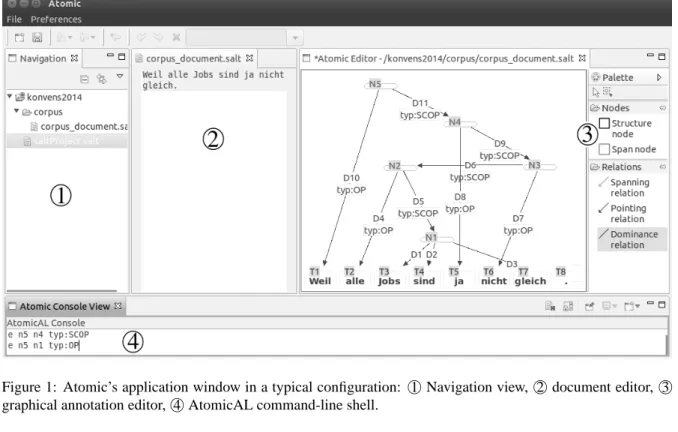
At its heart, Atomic consists of a workspace-driven navigator; a document editor for overview, basic annotation and segmentation of corpus documents; a graphical editor for mouse-and-keyboard-based annotation; a command-line shell for rapid annotation with the native annotation
18
Cf. http://www.neo4j.org/.
19
http://linktype.iaa.uni-jena.de/atomic.
language AtomicAL (Figure 1). Additionally, the current version of Atomic includes a dedicated editor for co-reference annotations.
The navigation view provides an interface to the user’s workspaces as well as the usual project management features.
The document editor is a simple, text-based overview of a corpus document’s primary text. It can be used for token-based annotation, seg-mentation of a corpus document into processable units, and navigation of a document. The editor is the initial entry point for annotation work. Sub-sequently, the user is forwarded to the annotation graph editor for further, more granular annotation of the selected corpus segment, span, or sentence. The annotation graph editor – which offers the user editing facilities based on a graphical rep-resentation of the complete, if relatively abstract, annotation graph – is implemented on top of the Eclipse Graphical Editing Framework, and pro-vides intuitive, mouse-based annotation with sup-port for a set of hotkeys for advanced users. The use of well-established graphical user interface metaphors in the editor, such as the tools palette, make it easy for less experienced users to build
sophisticated annotation graphs quickly. More
experienced annotators can resort to a command-line shell driven by the Atomic Annotation Lan-guage (AtomicAL), a data manipulation lanLan-guage for annotation graphs originally developed for use
in the GraphAnno annotation tool.20 AtomicAL
enables rapid annotation, as it works with one-char commands (e.g., a for “annotate this ele-ment”, or p for “group these elements under a new parent”), followed by optional flags (e.g., for changing the annotation level), a list of target el-ements, and a list of annotations.21 Additionally, annotation options can be restricted by annotating against freely configurable tagsets, defined by the user via project-specific preferences.
While the annotation graph editor is an all-purpose editor which allows for annotation on ar-bitrary levels, it may be imperfectly suited for specific annotation tasks. It is therefore
desir-20URL: http://linktype.iaa.uni-jena.de/?nav=graph-anno. 21E.g., commands like “On the syntax level, create a new
syntactical structure, assign it the category VP, and create dominance relations from it to tokens T1, T2, T3, T4, and T5” can be expressed asp -ls t1..t5 cat:VP.
Figure 1: Atomic’s application window in a typical configuration: 1Navigation view, 2document editor, 3
graphical annotation editor, 4AtomicAL command-line shell.
able to include further editors in Atomic which specialise in such tasks, e.g., annotating on only one specific annotation layer or a set of layers. Some tools for example, which are not actively developed anymore, have fulfilled these tasks to the user’s satisfaction, who in turn will be well-accustomed to them.22 It therefore suggests it-self to re-create the functionality of these tools in an extension to Atomic, and the above-mentioned co-reference editor is such an attempt.
2.4 Compatibility
For a newly developed multi-level annotation tool, compatibility with existing tools will have a major impact on its half-life and sustainability, and is therefore an indispensible requirement, as corpora should be easily transferrable between the existing tools and the new one. A corpus origi-nally created with, e.g., EXMARaLDA should be importable into Atomic for further annotation, as should be a corpus which has been pre-annotated in an NLP pipeline such as WebLicht (Hinrichs et al., 2010), in order to correct or enhance the an-notations. Furthermore, if the annotators are
com-22
Examples include the MMAX2 (M¨uller and Strube, 2006) co-reference editor, and @nnotate (Plaehn, 1998) for syntax annotations.
fortable with using a certain tool for certain anno-tations, they should still be able to use Atomic for those annotation levels that their favourite
tool does not support. As mentioned above,
Atomic includes the Pepper framework to tackle this problem area. It is a universal format con-version framework which follows an intermediate model approach, with the Salt meta-model as the intermediate model. To convert data from format X to format Y, X is mapped to Salt and subse-quently mapped to Y. The detour via Salt reduces the number of mappings that need to be
imple-mented from n2 −n mappings (for direct
map-ping) to2n.
Pepper, like Atomic, is plugin-based and comes with a lot of modules realizing such mappings, for instance for EXMARaLDA, TigerXML, tiger2, PAULA, MMAX, Penn Treebank, TreeTagger’s XML format, CoNLL, RST, the ANNIS format,
and many more.23Since Pepper and Atomic share
the same data model – Salt –, it has been easy to
23
This also includes modules for processing TCF (cf. http://korpling.github.io/pepperModules-TCFModules/), an XML format developed within the WebLicht architecture and used by WebAnno as interchange format. The Pepper TCF modules, therefore, provide Atomic with compatibility to WebAnno, as data processed in the latter can be imported into Atomic.
integrate it into Atomic, which in turn provides import and export wizards for all the existing for-mats. Thus, Atomic is equipped with support for all of the formats for which a mapping exists in Pepper, making it compatible with a wide variety of existing linguistic annotation and search tools. Support for further data formats can be achieved by developing Pepper import and/or export mod-ules for the desired format.
3 Outlook
Following the initial release of Atomic, and some feedback and optimization iterations, we plan to enhance Atomic with additional editors for specific annotation types. Additionally, Atomic should integrate NLP pipelines like UIMA (Fer-rucci and Lally, 2004), WebLicht, etc., to provide semi-automatic workflows from within the tool. We also plan to embed support for distributed col-laboration via one of the above-mentioned exist-ing plugins.
4 Conclusion
Software for multi-level corpus annotation is sub-ject to a number of requirements. It should op-erate on a generic data model to allow for poten-tially unlimited types of annotations, be easily ex-tensible so that new types of annotations and the tooling required for them can be added to it by third parties, and be compatible to other software and data formats in order to make it usable for en-riching pre-annotated corpora with additional an-notation levels. Additionally, it should be acces-sible to users with different levels of experience in corpus annotation, as some annotations may be provided not only by corpus linguists, but also by less experienced annotators.
In this paper we have introduced Atomic, an open-source desktop application based on the Eclipse Rich Client Platform which aims at
ful-filling the above-mentioned requirements. It
does so by operating on the generic graph-based data model Salt, whose lack of semantics al-lows for potentially unlimited types of annota-tions, which in Salt are modeled as nodes and edges. Atomic’s architecture allows for ease of extensibility through its use of the Eclipse RCP plugin framework, and by incorporating the con-verter framework Pepper provides compatibility
with a wide range of corpus and annotation for-mats. The tooling making up the core of Atomic is capable of accommodating a user base with po-tentially diverse levels of experience in corpus notation: Easily accessible tools such as the an-notation graph editor with its tools palette and point-click-and-type workflow are made available for less experienced annotators, while expert an-notators can resort to a command-line interface powered by the native data manipulation language AtomicAL.
Atomic complements an ecosystem of software for corpus linguistics, affiliated through a shared data model and a conversion framework based on it respectively. This, together with its high degree of extensibility, makes Atomic a potentially very sustainable tool.
Despite its ready-for-use set of features for multi-level corpus annotation, Atomic is not com-plete, finalised software. It rather intends to be a platform for corpus annotation tooling upon which the community can build customized so-lutions for specific research questions as well as feature-complete tools for more general annota-tion tasks.
References
Dipper, Stefanie, G¨otze, Michael, and Skopeteas, Stavros (eds.). 2007. Information Structure in Cross-Linguistic Corpora: Annotation Guidelines for Phonology, Morphology, Syntax, Semantics, and Information Structure. Interdisciplinary
Stud-ies on Information Structure 7, special issue. Dybkjær, Laila; Møller, Morten Baun; Bernsen, Niels
Ole; Carletta, Jean; Isard, Amy; Klein, Marion; McKelvie, David and Mengel, Andreas. 1999. The
MATE Workbench. In: Proceedings of ACL-1999,
demo session, University of Maryland, June 1999, 12-13.
Eclipse Foundation. 2011. The open-source De-veloper Report. 2011 Eclipse Community Survey.
URL: http://www.eclipse.org/org/community_ survey/Eclipse_Survey_2011_Report.pdf
Ferrucci, David and Lally, Adam. 2004. UIMA: An
Architectural Approach to Unstructured Informa-tion Processing in the Corporate Research Environ-ment. Cambridge University Press, Cambridge.
Hinrichs, Marie; Zastrow, Thomas and Hinrichs, Er-hard W. 2010. WebLicht: Web-based LRT Services
in a Distributed eScience Infrastructure. LREC, European Language Resources Association.
Krause, Thomas; L¨udeling, Anke; Odebrecht, Carolin; Romary, Laurent; Schirmbacher, Peter; Zielke, Dennis. 2014. LAUDATIO-Repository: Accessing
a heterogeneous field of linguistic corpora with the help of an open access repository. Digital
Human-ities 2014 Conference. Poster Session. July 2014, Lausanne.
L¨udeling, Anke and Hirschmann, Hagen. forthcom-ing. Error Annotation. In: Granger, Sylviane; Gilquin, Gaetanelle and Meunier, Fanny (eds.). The Cambridge Handbook of Learner Corpus Research. Cambridge University Press, Cambridge.
L¨udeling, Anke; Ritz, Julia; Stede, Manfred and Zeldes, Amir. forthcoming. Corpus Linguistics. In: Fery, Caroline and Ishihara, Shinishiro (eds.), OUP Handbook of Information Structure, Oxford University Press, Oxford.
McAffer, Jeff; Lemieux, Jean-Michel and Aniszczyk, Chris. 2010. Eclipse Rich Client Platform. 2nd ed. Addison-Wesley, Boston.
M¨uller, Christoph and Strube, Michael. 2006.
Multi-level annotation of linguistic data with MMAX2. In:
Braun, Sabine; Kohn, Kurt and Mukherjee, Joy-brato (eds.). Corpus Technology and Language Ped-agogy: New Resources, New Tools, New Methods. Peter Lang, Frankfurt/Main, Germany.
Pajas, Petr and ˇStˇep´anek, Jan. 2004. Recent Advances
in a Feature-Rich Framework for Treebank Anno-tation. In: Proceedings of the 22nd International
Conference on Computational Linguistics. Manch-ester, 673-680.
Plaehn, Oliver. 1998. Annotate Programm-Dokumentation (NEGRA Project Report).
Univer-sit¨at des Saarlandes, Saarbr¨ucken, Germany. Rubel, Dan; Wren, Jaime and Clayberg, Eric. 2011.
The Eclipse Graphical Editing Framework (GEF).
Addison-Wesley, Boston.
Schmidt, Thomas. 2004. Transcribing and annotating
spoken language with EXMARaLDA. In:
Proceed-ings of the LREC-Workshop on XML-based richly annotated corpora, Lisbon 2004, ELRA, Paris. Steinberg, David; Budinsky, Frank; Paternostro,
Marcelo and Merks, Ed. 2009. EMF: Eclipse
Mod-eling Framework 2.0. Addison-Wesley, Boston.
Yimam, Seid Muhie; Gurevych, Iryna; Eckart de Castilho, Richard; and Biemann Chris. 2013.
WebAnno: A Flexible, Web-based and Visually Sup-ported System for Distributed Annotations. In:
Pro-ceedings of ACL-2013, demo session, Sofia, Bul-garia.
Zeldes, Amir; Ritz, Julia; L¨udeling, Anke and Chiar-cos, Christian. 2009. ANNIS: A Search Tool for
Multi-Layer Annotated Corpora. In: Proceedings
of Corpus Linguistics 2009, July 20-23, Liverpool, UK.
Zipser, Florian and Romary, Laurent. 2010. A model
oriented approach to the mapping of annotation for-mats using standards. In: Proceedings of the
Work-shop on Language Resource and Language Tech-nology Standards, LREC 2010, Malta.
Zipser, Florian; Zeldes, Amir; Ritz, Julia; Romary, Laurent; Leser, Ulf. 2011. Pepper: Handling a multiverse of formats. In: 33. Jahrestagung der Deutschen Gesellschaft f¨ur Sprachwissenschaft, G¨ottingen, February 2011.