2013 Eleventh Annual Conference on Privacy, Security and Trust (PST)
A Multi-Tenant RBAC Model
for Collaborative Cloud Services
Bo Tang
∗†, Qi Li
∗and Ravi Sandhu
∗†∗Institute for Cyber Security
†Department of Computer Science
University of Texas at San Antonio One UTSA Circle, San Antonio, Texas 78249
Email: [email protected], {qi.li2, ravi.sandhu}@utsa.edu
Abstract—Most cloud services are built with multi-tenancy which enables data and configuration segregation upon shared infrastructures. In this setting, a tenant temporarily uses a piece of virtually dedicated software, platform, or infrastructure. To fully benefit from the cloud, tenants are seeking to build controlled and secure collaboration with each other. In this paper, we propose a Multi-Tenant Role-Based Access Control (MT-RBAC) model family which aims to provide fine-grained authorization in collaborative cloud environments by building trust relations among tenants. With an established trust relation in MT-RBAC, the trustee can precisely authorize cross-tenant accesses to the truster’s resources consistent with constraints over the trust relation and other components designated by the truster. The users in the trustee may restrictively inherit permissions from the truster so that multi-tenant collaboration is securely enabled. Using SUN’s XACML library, we prototype MT-RBAC models on a novel Authorization as a Service (AaaS) platform with the Joyent commercial cloud system. The performance and scalability metrics are evaluated with respect to an open source cloud storage system. The results show that our prototype incurs only 0.016 second authorization delay for end users on average and is scalable in cloud environments.
Keywords—cloud computing; multi-tenancy; trust; collabora-tion; fine-grained authorization
I. INTRODUCTION
The growing predominance of cloud computing impacts every aspect of the information technology (IT) industry [1]. It brings business agility and lower costs for information systems by using virtualization and shared infrastructures. Most cloud providers isolate tenants from each other using multi-tenancy [2] to secure user data and configurations. How-ever, the isolation strategy hampers multi-tenant collaborations which are also essential in the cloud [3]. In particular, fine-grained secure resource sharing among tenants is not fostered in today’s commercial clouds [4], [5].
Utilizing existing access control models, cloud providers are capable to control user activities within a single tenant. For example, NASA integrates Role-Based Access Control (RBAC) in the cloud to enforce fine-grained access control in their existing directories [6]. Nevertheless, the traditional RBAC model [7] is not designed to enforce collaborative ac-cess control in decentralized environments. Currently, database schema is widely utilized to enable multi-tenant data sharing for Software as a Service (SaaS) [8], [9]. However, this approach is confined to address multi-tenant access control in databases and cannot be directly extended to protect other vital types of resources such as files and virtual machines. Conse-quently, in order to enable secure multi-tenant collaborations
in the cloud, we need a general fine-grained access control model for this purpose.
Intra-Tenant Access Cross-Tenant Access
Auditor
Developer Owner
ENTERPRISE (E) AUDITING FIRM (AF)
OUT-SOURCING COMPANY (OS) Dev.E Acc.E HR.E Charlie Alice Bob Cloud Storage Service Dev.OS Acc.AF Web Portal Web Portal
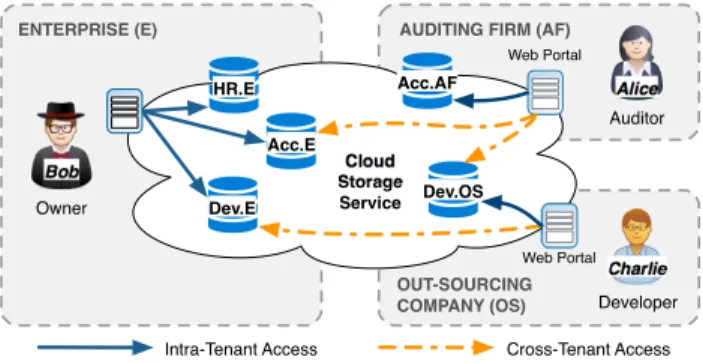
Fig. 1: Multi-tenant accesses in an out-sourcing case To motivate the problem, we use an out-sourcing example
illustrated in Figure 1, in which the Enterprise(E), the
Out-Sourcing company(OS), and theAuditing Firm(AF) are three collaborating parties sharing a common cloud storage service.
E out-sources part of its application development work toOS
and external auditing tasks to AF. The cloud storage service
provides storage services for the development department of
OS, the accounting department of AF, and three of E’s
departments, development, accounting, and HR, as segregated tenants. Let “.” denote the affiliation relation between the tenant and its organization (also called issuer) so that, for
example, Dev.E represents the tenant corresponding to E’s
development department. The example cross-tenant accesses for collaborations are as follows.
C1. Charlie as a developer in OS has to access the source
code stored inDev.E to perform his out-sourcing job;
C2. Alice as an auditor in AF requires read-only access to
financial reports stored inAcc.E; and
C3. Aliceneeds read-only accesses toDev.EandDev.OSin order to audit the out-sourcing project.
For simplicity, in our examples we assume all the tenants are created on a single cloud service, bringing homogeneous architecture which is often the case in cloud environments [10]. However, we do not exclude the potential of heterogeneous collaborations among multiple cloud services or even among multiple service models: SaaS, Platform as a Service (PaaS), and Infrastructure as a Service (IaaS) [2]. As a common collab-oration need suggests, a user may test and deploy the source
code stored in Dev.E directly on another tenant of a PaaS
between the two services. In fact, SaaS services are often hosted on PaaS clouds in which the SaaS services are regarded as tenants. The similar situation holds between PaaS and IaaS. Thus, we treat accesses among multiple tenants, clouds, or even service models equivalently in the abstraction level as multi-tenant accesses upon which access control mechanisms should be enforced.
In order to achieve multi-tenant access control, Calero et al [11] propose a multi-tenancy authorization system (MTAS) by extending RBAC with a coarse-grained trust relation. Multi-tenant collaborations are enabled in MTAS by bridging two tenants with a cross-tenant trust relation. The tenant estab-lishing the trust is called the truster and the tenant being trusted is called the trustee. The essence of collaboration is resource sharing wherein a resource requester requests to share resources from a resource owner. The resources here represent the objects, such as virtual machine instances or stored files, in a tenant leased from the cloud service provider (CSP). For instance, in order to enable cross-tenant access C1 in the out-sourcing example above, an MTAS trust
re-lation is established with Dev.OS as truster and Dev.E as
trustee, allowing Dev.E as resource owner to issue suitable
cross-tenant assignments to allow Dev.OS’s users to access
Dev.E’s resources. By definition, the MTAS trust relation is always established by the resource requester. The granularity of MTAS trust is refined in [12] to reduce undue exposure of the truster’s sensitive authorization information to the trustees. While Calero et al provide use cases for this resource-requester initiated cross-tenant trust relation, there are obviously other practically useful approaches that can be developed.
In this paper we develop a family of models for a cross-tenant trust relation that is established by the resource owner. We demonstrate the utility of this approach by means of use cases. Later in the paper we formally compare the role-based trust models of MTAS, the current paper and RT [13]. There may be possibility of additional cross-tenant trust models, based on roles and perhaps on attributes. Eventually we believe there will be consolidation and unification of cross-tenant trust models but we are currently at early stages of developing and investigating alternate cross-tenant trust models.
Our central contribution is a novel family of Multi-Tenant RBAC (MT-RBAC) models where the cross-tenant trust rela-tion is established by the resource owner rather than by the resource requester. MT-RBAC extends the traditional RBAC model [7] with two new built-in entity components: issuers and
tenants.1 Each issuer can have multiple tenants in the cloud,
whereas each tenant belongs to a single issuer. A cross-tenant trust relation is established and maintained by the issuer of the resource owner tenant (i.e., truster), as opposed to the resource requester tenant (i.e., trustee).
Three MT-RBAC models integrate three different trust relations with increasingly finer-grained constraints,
respec-tively tenant trust (MT-RBAC0), trustee independent public
roles (MT-RBAC1), and trustee dependent public roles
(MT-RBAC2). To allow the trustee to access the truster’s resources,
the base model MT-RBAC0 requires the truster to expose its
1MTAS [11] does not distinguish issuers and tenants, which are regarded as
equivalent notions in that model. This distinction is important for our purpose in this paper, particularly for elaboration of the administrative model.
entire role set and corresponding authorization assignments to the trustee. For example, to achieve the cross-tenant access C1
in the out-sourcing example,Ewill assign a trust relation from
Dev.EtoDev.OSso thatOScan useE’s authorization infor-mation to issue appropriate cross-tenant assignments enabling
Dev.OS’s users to access Dev.E’s resources. To limit un-necessary exposure of the truster’s authorization information,
MT-RBAC1requires only exposing the truster’s public roles to
all the trustees, these being the same for all trustees. Further,
MT-RBAC2enforces finer-grained constraints by exposing the
truster’s public roles on a trustee by trustee basis. With these trust relations, a truster’s issuer can flexibly and efficiently constrain accesses from the corresponding trustees in a suitably fine-grained manner.
We demonstrate the feasibility of MT-RBAC by proto-typing it with SUN’s XACML library [14]. We develop and deploy a novel Authorization as a Service (AaaS) platform applying MT-RBAC models in a Joyent cloud [15]. We system-atically evaluate the performance of MT-RBAC with an open source cloud storage service [16]. The experimental results show the MT-RBAC policies with different expressive power in the AaaS service incur various policy evaluation delays. Evaluation of MT-RBAC policies takes on average no more than 0.016 second overhead in downloading files. Therefore, we believe that the performance of the prototype system is acceptable for cloud services. Further, we observe that the prototype system is also scalable in cloud settings.
The rest of the paper is organized as follows. Section II formally presents the MT-RBAC model family along with the introduction of its administrative model AMT-RBAC and constraints to be considered. Section III describes the prototype implementation and evaluation results. Section IV presents related work and compares our work with others in terms of role-based trust models. Section V concludes the paper.
II. A FAMILY OFMT-RBAC MODELS
To achieve fine-grained access control for multi-tenant collaborations in the cloud, we develop a family of three MT-RBAC models with increasingly finer-grained trust relations.
A. Overview
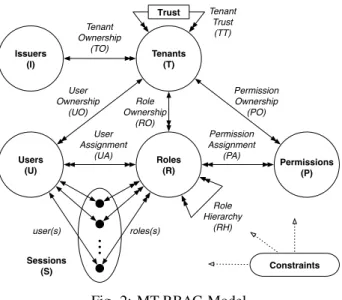
MT-RBAC models, as shown in Figure 2, have six entity
components: issuers (I), tenants (T), users (U), permissions
(P), roles (R) and sessions (S). The traditional RBAC [7] entities of users, permissions and roles now have a tenant attribute so that they can be uniquely identified as depicted
by the user-ownership (U O), permission-ownership (P O) and
role-ownership (RO) relations respectively in Figure 2. All
three relations are many-to-one relations from users, permis-sions and roles respectively to their owner tenants. Further, another many-to-one relation representing tenant-ownership
(T O) exists between tenants and issuers.
ISSUERS. An issuer is a client of a single or multiple cloud services. Typically, it is either an organization or an individual who is able to administer its own tenants in the cloud services. For simplicity, we consider a single cloud scenario in this paper, so the name of the cloud service is not explicitly specified. For instance, in the out-sourcing example,
Users (U) Tenants (T) Roles (R) User Assignment (UA) Permission Assignment (PA) Role Hierarchy (RH) Permission Ownership (PO) Tenant Trust (TT) Role Ownership (RO) User Ownership (UO) Sessions (S) Permissions (P) Constraints Trust user(s) roles(s) Issuers (I) Tenant Ownership (TO)
Fig. 2: MT-RBAC Model
E,OSandAF represent three issuers respectively in a single
cloud storage service.
TENANTS. A tenant is an exclusive virtual partition of a cloud service leased from a cloud service provider. An issuer may own multiple tenants while a tenant belongs to a single issuer. Let “.” denote the tenant-issuer relation. For example,
Dev.OS represents the tenantDev of the issuerOS.2
USERS. A user is an identifier for an individual person associated with a single tenant. An individual can act as dif-ferent users in difdif-ferent tenants. Let “@” denote the user-tenant
relation. For example,[email protected] [email protected]
two different users in tenantsAcc.AF andAcc.Erespectively,
even if they belong to a single person, Alice.3
ROLES. A role is a job function (role name) associated with a tenant. A role belongs to a single tenant while a tenant may own multiple roles. Let “#” denote the role-tenant relation
roleN ame#tenant. For example, dev#Dev.E represents a
developer role in tenant Dev.E.
PERMISSIONS. A permission is a specification of a privilege to an object in a tenant. A permission is as-sociated with a single tenant while a tenant may have multiple permissions. Let “%” denote the
permission-tenant relation (privilege, object)%tenant. For example,
(read, /root/)%Dev.E represents a permission to read the
“/root/” path onDev.E.
SESSIONS. A session is an instance of activity established by a user. A subset of roles that the user is assigned to can be activated in a session. Note that in multi-tenant cloud environments the user and the active roles of a session are not necessarily from a single tenant.
Crucially, in order to address collaborations among tenants,
2In a more general treatment we would identify the cloud service explicitly
in a three part name such asDev.OS.CloudService.
3Other user models are possible. For instance, the users of a same person
can be combined into one universal ID using federated identity [17]–[19]. However, since this mechanism is not fully supported in contemporary clouds, MT-RBAC models do not require a universal ID for an individual. The particular user model chosen does not materially impact the essentials of MT-RBAC. For completeness we do need a concrete user model.
⊴
Tenant: Dev.E Tenant: Acc.AF
Tenant: Dev.OS
⊴
⊴
Alice @ACC.AF Charlie @DEV.OS dev#Dev.OS acc#Acc.AF (read, /root/) %Dev.E dev#Dev.E mgr#Dev.E) MT-RBAC0 exposed roles to all trustees MT-RBAC1 public roles to all trustees MT-RBAC2 public roles to Dev.OS MT-RBAC2 public roles to Acc.AF Permission Assignment (PA)User Assignment (UA) Role Hierarchy (RH)
acc#Dev.E
emp#Dev.E
Fig. 3: Example multi-tenant assignments in the out-sourcing case. The differences among the MT-RBAC models are also
illustrated in terms ofE’s exposed roles.
MT-RBAC introduces a role-based trust relation, Tenant Trust
(T T), as illustrated in Figure 2.
T T is reflexive but not transitive, symmetric or
anti-symmetric. In MT-RBAC, a trust relation is always established by the truster’s issuer. It enables the trustee’s issuer to add trustee’s users to truster’s roles. This can be done directly on
a per user basis by assigning one of B’s (trustee’s) users to
one ofA’s (truster’s) roles viaU A. Alternately it can be done
indirectly by assigning one ofB’s roles, sayr1, to be senior to
one of A’s roles, sayr2, viaRH. Thereby all members ofr1
become members of r2 and A’s permissions associated with
r2 are granted to theB’s users inr1. We emphasize that trust
is established at the granularity of tenants. For example, ifAF
asserts Acc.AF EAcc.E, there is no trust from Acc.AF to
HR.E orDev.E. The formalization ofT T and its effects are described in Definition 1 as follows.
Definition 1: The tenant trust relation T T ⊆ T×T is a
many-to-many reflexive relation onT, also written as “E”. By
asserting AEB, A’s issuer exposes A’s roles to B’s issuer
so that B’s issuer can and can only make the following two
kinds of assignments:
• assigning B’s users toA’s roles; and
• assigning A’s roles as junior roles to B’s roles.
Different MT-RBAC models vary in the granularity of the trust relations, specifically in the truster’s role exposure. The
left part of Figure 3 shows the role hierarchy of Dev.E in
the out-sourcing example. Since MT-RBAC0 does not enforce
any constraint on the trust relation, the entire Dev.E role
structure is exposed to all Dev.E’s trustees (more precisely
to their issuers). In MT-RBAC1, suppose the employee role
emp#Dev.Eis a private role while the others are public. The private role is never exposed to other tenants. Conversely, the public roles are exposed to all the trustees’ issuers. Crucially, during cross-tenant accesses, the permissions associated with the private role cannot be inherited directly or even indirectly
through the public roles. In MT-RBAC2, public role sets are
customized for different trustees. Suppose the accountant role
acc#Dev.E and the manager role mgr#Dev.E have to be
exposed in the collaboration withAcc.AF whilemgr#Dev.E
and the developer role dev#Dev.E need to be exposed to
Dev.OS for the out-sourcing project. Accordingly, as illus-trated in Figure 3, there are two different public role sets to
these two trustees respectively. Note that even ifmgr#Dev.E
is public in both collaborations, for either one, it only inherits permissions from the junior roles in the corresponding public
role set. For example, since acc#Dev.E is a private role to
Dev.OSand a public role toAcc.AF, its permissions are only
inherited to Acc.AF but not toDev.OS.
B. Base Model—MT-RBAC0
In order to enable secure cross-tenant collaborations, the base model is formally defined as follows.
Definition 2: The Base Model MT-RBAC0has the
follow-ing components.
• I,T,U,R,P,SandT Tare finite sets of issuers, tenants,
users, roles, permissions, sessions and tenant trust relation respectively;
• T O⊆T×I, a many-to-one relation mapping each tenant
to its owner issuer, also written as “.”; correspondingly,
tenantOwner(t:T)→I, a function mapping a tenant to
its owner issuer whereuserOwner(t) =iiff(t, i)∈T O;
• U O⊆U×T, a many-to-one relation mapping each user
to its owner tenant, also written as “@”; correspondingly,
userOwner(u:U)→T, a function mapping a user to its
owner tenant where userOwner(u) =tiff(u, t)∈U O;
• RO⊆R×T, a many-to-one relation mapping each role
to its owner tenant, also written as “#”; correspondingly,
roleOwner(r:R)→T, a function mapping a role to its
owner tenant where roleOwner(r) =tiff(r, t)∈RO;
• P O⊆P×T, a many-to-one relation mapping each
perm-ission to its owner tenant, also written as “%”;
correspond-ingly, permOwner(p : P) → T, a function mapping a
permission to its owner tenant wherepermOwner(p) =t
iff(p, t)∈P O;
• canU se(r:R)→2T, a function mapping a role to a set
of tenants who can use the role; formally, canU se(r) =
{t∈T|roleOwner(r)Et};
• U A ⊆ U ×R, a many-to-many user-to-role assignment
relation requiring (u, r)∈U A only if userOwner(u)∈
canU se(r);
• P A ⊆ P × R, a many-to-many permission-to-role
assignment relation requiring (p, r) ∈ P A only if
permOwner(p) =roleOwner(r);
• RH ⊆R×Ris a partial order onRcalled role hierarchy
or role dominance relation, also written as “≥”, requiring
r2≥r1 only if roleOwner(r2)∈canU se(r1);
• user(s:S)→U, a function mapping each session to a
single user which is constant within the life-time of the session; and
• roles(s:S)→2R, a function mapping each session to a
subset of roles, roles(s) ⊆ {r|∃r2 ≥ r[(user(s), r2) ∈
U A ∧ userOwner(user(s)) ∈ canU se(r)]}, which
can change with time, and s has the permissions
S
r∈roles(s){p|(p, r)∈P A}.
Note that the introduction of the derived canU se function
provides convenient means forT T to take effect uponU Aand
RH. For a given roler∈R, the statement roleOwner(r)∈
canU se(r)is always true sinceT T is reflexive. Hence, intra-tenant assignments are always under the authority of the tenant’s owner issuer.
A trustee (more precisely its issuer) can assign a truster’s permissions to the trustee’s users only at the granularity of the truster’s roles. In the spirit of RBAC, MT-RBAC does not allow individual permissions of the truster to be assigned to the trustee’s users or roles.
Role activation mechanisms determine the executable per-missions in a session. Because a role may inherit perper-missions from its junior roles in the role hierarchy, when a role is activated in a session, its inherited roles may be either automatically activated (implicit activation) or require explicit activation. The choice between the two approaches is left as an implementation issue in the NIST RBAC model [7]. In the RBAC96 model implicit activation is specified [20]. In
MT-RBAC, we choose to specify explicit activation in theroles(s)
component. In a session, only the permissions of the explicitly activated roles are available. An alternate forumulation of MT-RBAC with implicit activation can also be developed.
The revocation of a T T relation tr E te can be asserted
by tr’s issuer. This operation will automatically eliminate the
trusteetefromcanU se(r)for each of{r∈R|(r, tr)∈RO}.
Moreover, as the formal description of U A and RH in
Definition 2 suggests, all the relevant cross-tenant assignments
(i.e., U A and RH) issued by te’s issuer will be revoked
automatically, as well as the active roles in the sessions of
te’s users. In this way the permissions in tr are not able
to be inherited to te after revocation.4 If the removed trust
relation is subsequently restored, the trustee’s issuer would have to redefine and reissue all the cross-tenant assignments from scratch.
MT-RBAC0 enables multi-tenant collaborations by means
of T T. However the coarse-grained trust relation may lead to
breaches in protection of sensitive information. For example, in the base model, a truster needs to expose all the organization role structure to its trustees. A more important issue is that trustees can obtain more sensitive information by assigning their users to the sensitive roles they can use. Therefore,
MT-RBAC0may only be suitable for collaborations among closely
related tenants such as departments of a single organization.
C. Trustee Independent Public Role—MT-RBAC1
A natural enhancement to address the granularity limita-tions of the base model is to classify the components for collaborations into public ones and private ones. In this setting, collaborations only take place on the public components of the resource owner. The truster’s roles can be simply classified
into two disjoint sets: public roles and private roles. Since
the truster’s public roles are public equally to all the trustees, we name this mechanism as trustee independent public role
4For simplicity and security in model level, the corresponding cross-tenant
assignments issued by trustee’s issuer are automatically cleared as soon as the trust relation is revoked. Depending upon implementation, trustee’s issuer may also choose to manually clear or even keep the nonfunctional hanging cross-tenant assignments for future use although it is not recommended.
(T IP R) which provides more expressiveness and granularity
thanT T in MT-RBAC0.
Definition 3: MT-RBAC1inherits all the components from
MT-RBAC0 as described in Definition 2, while the following
modifications are applied.
• PT I(t:T)→2R, a new function mapping a tenant to a
set of roles which is the trustee independent public role (T IP R) set of the tenant; and
• canU se(r:R)→2T is modified to canU se(r) ={t} ∪
{te∈T|tEte∧r∈ PT I(t)}, where (r, t)∈RO.
Note that the truster’s permissions associated with the public roles can be inherited externally to the trustees, but those associated with the private roles can only be inherited internally within the truster. For example, in Figure 3, since the
employee role emp#Dev.E is a private role, its permissions
should never be used in cross-tenant accesses. Further, if
PT I(t) consists of the entire role set of t, then MT-RBAC1
is identical to MT-RBAC0. Therefore, MT-RBAC1 is a more
general model than the base model.
MT-RBAC1 provides enhanced security by introducing
T IP Rso that only public roles are exposed to the trustees. Be-sides, it enables finer-grained control for the resource owner’s
issuer, say ir, who can revoke a specific cross-tenant access
from a trustee, say te by removing the relevant roles from
PT I(tr) while not disrupting the other cross-tenant accesses
from te. A public role should be automatically removed from
PT I(tr) as soon as the corresponding trust relation with tr
comes to an end. However, in practice a trustee independent public role may be used in multiple trust relations so that the bindings of the public role and its corresponding trust relations should be carefully managed; otherwise the public role may be unnecessarily maintained or unwillingly removed. Therefore,
MT-RBAC1 is only suitable for a single type or very similar
types of collaborations.
In MT-RBAC1, thePT I(t) function lacks the
expressive-ness to describe various public role sets for different trustees. To achieve the least privilege principle in multi-tenant
collabo-rations, we propose MT-RBAC2which is the most fine-grained
model in the MT-RBAC family.
D. Trustee Dependent Public Role—MT-RBAC2
Unlike MT-RBAC1 treating all the trustees equally,
MT-RBAC2 supports different public role sets specifically for
dif-ferent trustees. With respect to every established trust relation, the truster’s issuer can designate disjoint sets of public roles and private roles with respect to the trustee. This mechanism is
called trustee dependent public role (T DP R) which provides
more expressiveness and flexibility for the truster’s issuer to maintain cross-tenant accesses for different trustees. The
formal definition of MT-RBAC2 follows.
Definition 4: MT-RBAC2inherits all the components from
MT-RBAC0 as described in Definition 2, while the following
modifications are applied.
• PT D(tr, te:T)→2R, a new function mapping a pair of
truster and trustee tenants to a set of roles which is the
trustee dependent public role (T DP R) set of the truster
to the trustee; and
• canU se(r:R)→2T is modified to canU se(r) ={t} ∪
{te∈T|tEte∧r∈ PT D(t, te)}, where (r, t)∈RO.
Note that if for every trustee te the PT D(tr, te) function
returns the same set of public roles, then MT-RBAC2 is
equivalent to MT-RBAC1. Thus, MT-RBAC2 is more general
than MT-RBAC1and the most general model in the MT-RBAC
model family.
Comparing to MT-RBAC1, the revocation process in
MT-RBAC2 is much simpler. The revocation of a cross-tenant
access can be easily achieved by removing the relevant roles
from the specificT DP Rset. This operation is executed by the
truster’s issuer and will not affect other accesses from other trustees.
MT-RBAC2supports various types of collaborations since
T DP R sets are maintained per truster-trustee pair. The
truster’s issuer has to maintain aT DP Rset for each trustee.
E. Administrative MT-RBAC (AMT-RBAC) model
The administration of tenant trust relations and
autho-rization assignments is critical in MT-RBAC. Since T T is
embedded in the cross-tenant assignments (i.e.,U AandRH)
as described in Definition 2, the management of tenant trust relations also controls cross-tenant accesses.
The core idea of the administrative model for MT-RBAC is dual control, meaning both of the truster’s and the trustee’s issuers have complementary power of authority to control cross-tenant accesses. The cross-tenant assignments are created and maintained by the trustee’s issuer. The effectiveness of cross-tenant assignments depends on the corresponding trust relations which are under the control of the truster’s issuer. In this way, the security and efficiency of the administration process are convenient for both parties. The truster’s issuer deals with the overall trust and constraints for a trustee. The trustee’s issuer deals with the finer details of the trustee’s users.
Definition 5: The Administrative MT-RBAC (AMT-RBAC) model requires both issuers of the collaborating
tenants,iA the resource ownerA’s issuer andiB the requester
B’s issuer, to manage the tenant trust relations and the
cross-tenant authorization assignments separately as follows.
• iAis responsible for managing the tenant trust relation of
AEB; and
• iB is responsible for managing the cross-tenant
assign-ments (i.e., U A and RH) to A’s roles, according to
Definition 2.
Note that the resource owner’s issuer delegates the man-agement of the cross-tenant authorization assignments to the resource requester’s issuer. With the carefully defined coop-erative mechanisms, in AMT-RBAC the resource owner’s is-suer retains the critical management authority (managing trust relations) while the maintenance of cross-tenant assignments is given away to the resource requester’s issuer who is more knowledgable of the requesting users and roles.
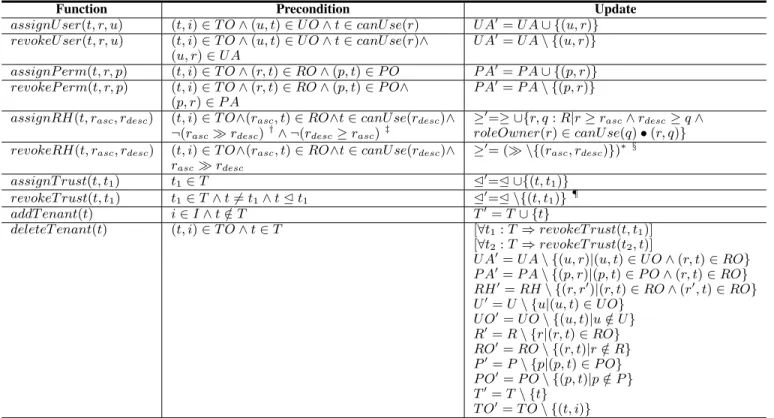
In Table I, we give the formal specification of the exact
administration functions of AMT-RBAC for a single issuer i
along with the corresponding preconditions and updates to MT-RBAC policies.
TABLE I: Administration functions available to issueriin AMT-RBAC
Function Precondition Update
assignU ser(t, r, u) (t, i)∈T O∧(u, t)∈U O∧t∈canU se(r) U A0=U A∪ {(u, r)} revokeU ser(t, r, u) (t, i)∈T O∧(u, t)∈U O∧t∈canU se(r)∧
(u, r)∈U A
U A0=U A\ {(u, r)}
assignP erm(t, r, p) (t, i)∈T O∧(r, t)∈RO∧(p, t)∈P O P A0=P A∪ {(p, r)}
revokeP erm(t, r, p) (t, i)∈T O∧(r, t)∈RO∧(p, t)∈P O∧
(p, r)∈P A
P A0=P A\ {(p, r)} assignRH(t, rasc, rdesc) (t, i)∈T O∧(rasc, t)∈RO∧t∈canU se(rdesc)∧
¬(rascrdesc)†∧ ¬(rdesc≥rasc)‡
≥0=≥ ∪{r, q:R|r≥rasc∧rdesc≥q∧
roleOwner(r)∈canU se(q)•(r, q)} revokeRH(t, rasc, rdesc) (t, i)∈T O∧(rasc, t)∈RO∧t∈canU se(rdesc)∧
rascrdesc ≥0 = ( \{(rasc, rdesc)})∗ § assignT rust(t, t1) t1∈T E0=E∪{(t, t1)} revokeT rust(t, t1) t1∈T∧t6=t1∧tEt1 E0=E\{(t, t1)}¶ addT enant(t) i∈I∧t /∈T T0=T∪ {t}
deleteT enant(t) (t, i)∈T O∧t∈T [∀t1:T ⇒revokeT rust(t, t1)]
[∀t2:T ⇒revokeT rust(t2, t)] U A0=U A\ {(u, r)|(u, t)∈U O∧(r, t)∈RO} P A0=P A\ {(p, r)|(p, t)∈P O∧(r, t)∈RO} RH0=RH\ {(r, r0)|(r, t)∈RO∧(r0, t)∈RO} U0=U\ {u|(u, t)∈U O} U O0=U O\ {(u, t)|u /∈U} R0=R\ {r|(r, t)∈RO} RO0=RO\ {(r, t)|r /∈R} P0=P\ {p|(p, t)∈P O} P O0=P O\ {(p, t)|p /∈P} T0=T\ {t} T O0=T O\ {(t, i)} †
The notation “” represents an immediate inheritance relation. For example,rascrdescmeans thatrascis a parent ofrdesc.
‡
This condition avoids the creation of role cycles which is discussed in Section II-F. §
The notation “∗” represents recursive updates for the entireRHassignments. ImpliedRH relations are preserved after revocation. ¶
The revocation of a trust relation automatically triggers updates in thecanU se()function of allt’s roles and then correspondingU A andRH accordingly.
Note that both of theassignT rustandrevokeT rust
func-tions result in automatic updates of the canU se function for
each of the truster’s roles. Moreover, since the public role sets
in MT-RBAC1 and MT-RBAC2 also can be modified by the
truster’s issuer, the return sets of canU se(r)for the truster’s
roles are updated accordingly. Because canU se function is
updated, the trustee’s cross-tenant assignments, U AandRH,
and their authorized cross-tenant accesses are also updated accordingly. In this way, the cross-tenant assignments are not only controlled by the trustee’s issuer, but also manageable by the truster’s issuer.
F. Constraints
The constraints identified in RBAC96 [20] are directly applicable to MT-RBAC for intra-tenant accesses. While the trust relations in MT-RBAC enable cross-tenant accesses, constraints should also be extended into a multi-tenant envi-ronment. Some constraints we feel reasonable to implement in the new environment are described below.
Role Cycles.A “role cycle” may be formed across tenants in MT-RBAC systems without proper constraints. This is a well known problem in inter-domain access control [21]. The issue may lead to implicit role upgrades in the role hierarchy.
A role r1a in tenant A may be assigned as a senior role
to r2b in tenant B while r2b dominates r1b in B. If r1b is
then assigned as a senior role to r2a which dominatesr1a in
A, then a role cycle forms. As a result, a user in r1a can
inherit permissions from a senior role r2a through the
cross-tenant RH assignments contrary to the role hierarchy in A.
In order to prevent the formation of role cycles, constraints should be enforced over assignments or sessions. Constraints with respect to assignments can be enforced by checking for
role cycles whenever a cross-tenantRH assignment is issued.
Constraints with respect to sessions would allow role-cycles in assignments, but prohibit a cycle of roles from being activated in a single session. The algorithms for checking role cycles are well-known and straightforward.
Separation of Duties. There are two levels of separation
of duty (SoD) problem that we need to be concerned during
collaboration in MT-RBAC systems. These are at the tenant
level and role level. For tenant level SoD, one collaborating
tenant cannot execute two conflicting responsibilities. For in-stance, SOX [22] compliant companies are not suppose to hire one third-party as both consultant and auditing organization. This constraint could be enforced at tenant level against trust
relations. The role level SoD is straightforward. Two roles
attached to conflict duties are not supposed to be activated for one user in a session. In the out-sourcing example, a quality assurance (QA) role and a developer role should not
be obtained by one user in either tenant,EorOS, at the same
time.
Other Considerations. Some other constraints in RBAC [20], such as cardinality and prerequisite roles, are also applicable to tenants. Even if multi-tenancy brings some
complexity to implementation, it is also straightforward to apply these constraints. Moreover, the conflict of interests among tenants can be addressed by Chinese Wall model [23]. For example, two competing tenants cannot be trusted or accessed by tenants of a single issuer.
III. PROTOTYPEIMPLEMENTATION ANDEVALUATION
To demonstrate the feasibility of our approach, we im-plement a prototype to achieve multi-tenant authorization for collaborative cloud services. We also evaluate the performance and scalability of our prototype with CloudStorage [16], an open source cloud storage system, deployed as a cloud service.
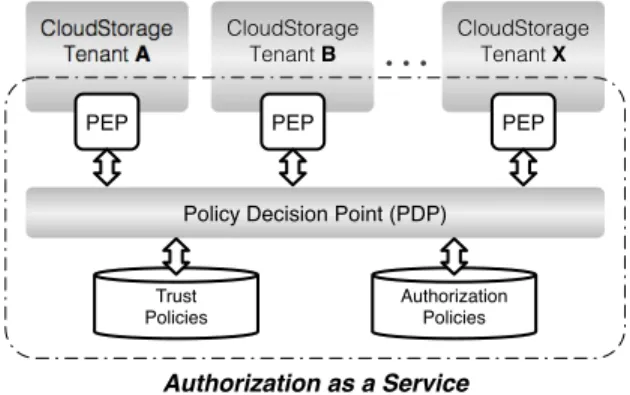
1) Implementation Overview: In order to foster fine-grained access control in collaborative cloud environments, we propose Authorization as a Service (AaaS) as a novel service model providing an independent authorization infrastructure in a multi-tenancy manner. This service can be integrated with the existing cloud services to manage and process authoriza-tions for them. AaaS supports multi-tenant access control by applying suitable access control models, such as MT-RBAC.
CloudStorage
Tenant A
Policy Decision Point (PDP)
PEP PEP CloudStorage Tenant B CloudStorage Tenant X PEP Authorization Policies Authorization as a Service Trust Policies
Fig. 4: The prototype architecture
Figure 4 shows the prototype architecture in which the ten-ants of the cloud storage service use a common authorization service (i.e., AaaS) by associating each with a policy enforce-ment point (PEP) module. The PEPs parse the requests from end users and generate normalized (XACML format) requests to the centralized policy decision point (PDP) module which refers to MT-RBAC policies stored in the centralized policy repository. The MT-RBAC policy specification is presented in Appendix A. After the decision is made, an XACML format response will be sent back to the requesting PEP to take effect with respect to the requested access. The integrity and authenticity of communication messages should be guaranteed, say via long-lived TLS connections between PEPs and the central PDP. For simplicity, they are not included in the prototype implementation. The prototype can be extended to a cloud authorization service with distributed PDPs.
The MT-RBAC policy engine is developed using SUN’s XACML library [14]. The prototype is compiled and deployed on a Joyent cloud system. In the performance evaluation, the PDP module runs on a SmartMachine [15] image with Smar-tOS Version 1.6.3 and 1 GB RAM. The PEP modules and the cloud storage service are deployed on another SmartMachine image with SmartOS Plus 64 Version 3.2.0 with 256 MB RAM. The CPU caps of both images are set to 350 meaning
each can use at most 3.5 CPUs. The PDP and PEP modules are created on different physical machines, so that they don’t affect each other in the performance evaluation results. All the machines in the prototype are connected through data center networks. End users connect to the cloud storage service through wireless local area network (WLAN) which is a common connection type for cloud service users. Note that, in the following experiments, the policy files are stored on the PDP server and an experiment request set consists of 10 independent sample multi-tenant access requests.
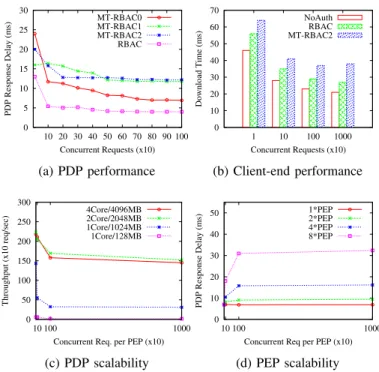
2) Authorization Delay: An MT-RBAC decision making process includes verifying subjects, resources and actions in the request, searching attributes and linking referred policy files. All these operations increase the overhead of access as authorization is involved. Authorization overhead is inevitable in MT-RBAC as well as other authorization models. Figure 5a compares the policy evaluation delay in RBAC and the three MT-RBAC models. Note that in RBAC cross-tenant access requests are not supported. Due to the caching mechanisms of the operating system, as the number of concurrent re-quests increases, the average policy decision delay decreases dramatically until it reaches a stable state. RBAC has the
least delay of 4.01 ms, while MT-RBAC0 has 6.92 ms delay.
The evaluation of T P policies contributes to the extra delay
of MT-RBAC0, compared to RBAC. Since IP S and DP S
evaluations incur the similar I/O operations toT P evaluations,
the authorization delay for MT-RBAC1 and MT-RBAC2 are
similar. MT-RBAC1 and MT-RBAC2 have the most delay
of 11.75 ms and 12.18 ms, respectively. MT-RBAC models introduce acceptable evaluation overheads compared to RBAC. Figure 5b shows a comparison of delays at the client-end of the CloudStorage service. The delays are observed upon a 1KB file downloading task with or without authorization through
RBAC or MT-RBAC2. According to the experiment result,
we observe that MT-RBAC2 introduces 15.50 ms (≈ 0.016
second) authorization delay on average which we believe is acceptable for file downloading tasks in cloud storage services.
3) Scalability: Scalability is also a critical criterion to judge the feasibility of a cloud application. Thus, we evaluate our prototype with various cloud images for the PDP module and numbers of engaged PEPs to see whether the system performance improvement is proportional to the increase of the hardware capacity which is represented by image size in the cloud.
We compare the throughput of PDPs with various capabil-ities in terms of image size. The result is shown in Figure 5c. The speedup of the system is in positive correlation with the increase of CPU cores and memory size. The throughput decreases when the number of concurrent requests increase, until it reaches a stable position. Compare the authorization
throughput of the PDP with 1Core/128MB and the one with
1Core/1024MB. The approximately ten-time increase in mem-ory size results in constantly ten-time enhancement in the throughput. When the physical resource assigned to the PDP
increases to 2Core/2048MB, the throughput increases around
five times. But the throughput has no obvious increase when
the hardware becomes4Core/4096MB because the amount of
requests does not fulfill the utilization of the system with increased capacity. According to the results, we conclude that
0 5 10 15 20 25 30 10 20 30 40 50 60 70 80 90 100 PDP Response Delay (ms) Concurrent Requests (x10) MT-RBAC0 MT-RBAC1 MT-RBAC2 RBAC (a) PDP performance 0 10 20 30 40 50 60 70 1 10 100 1000 Download Time (ms) Concurrent Requests (x10) NoAuth RBAC MT-RBAC2 (b) Client-end performance 0 50 100 150 200 250 300 10 100 1000 Throughput (x10 req/sec)
Concurrent Req. per PEP (x10)
4Core/4096MB 2Core/2048MB 1Core/1024MB 1Core/128MB (c) PDP scalability 0 10 20 30 40 50 10 100 1000 PDP Response Delay (ms)
Concurrent Req per PEP (x10) 1*PEP 2*PEP 4*PEP 8*PEP
(d) PEP scalability
Fig. 5: Performance and scalability evaluation results the system throughput is proportional to the hardware capacity of the PDP module.
Figure 5d illustrates the authorization delay in a
1Core/1024MB PDP with different amounts of engaged PEPs. More PEPs means more concurrent requests generated and more connections which consume the capacity of the PDP. When the number of PEPs increase exponentially, the average evaluation delay also increases exponentially. Hence, if all the engaged PEPs send equal amount of requests, the load of PDP can be roughly determined by the number of PEPs. As a PEP is assigned per tenant, the required capacity of the system is proportional to the amount of tenants. The results show that AaaS with MT-RBAC is scalable in the cloud environment.
IV. RELATEDWORK
The access control problems in collaboration have been extensively addressed in traditional environments. RBAC [7], [20] enabling fine-grained access control does not encompass the overall context associated with any collaborative activ-ity [24]. Many extensions of RBAC have been proposed to en-able multi-domain access control [25]–[28]. These approaches require a centralized authority to define collaborating policies for different domains. However, in clouds, users usually come from different organizations with independent administrating authorities. Therefore, a centralized authority is not only improper but also inefficient.
Another approach is to integrate delegation in RBAC to achieve decentralized authority for collaborations [29]–[32]. Users may delegate their entire or partial permissions to others, which is completely under the control of the users. The delegation approach enables full control for resource providers while introducing additional administration workloads. The administrators of resource providers need to track all of the delegations associated with collaborations. In particular,
collaboration relations may dynamically change. The delega-tion rules may not instantly reflect the current collaboradelega-tion relations so that delegation rules may violate the authorization goals of the resource providers.
To support collaboration, federated identity and authoriza-tion services were proposed in distributed systems. Feder-ated identity [18] enables authenticating strangers by sharing identity information among federated parties who trust each other equally. The equivalent trust relation limits the variety of collaborations. Moreover, maintaining the federation relation becomes costly when it has to cope with the agility feature in clouds. Some tenants are created temporarily and deleted upon completion of their jobs, while the federation relation has to be updated accordingly. Authorization services [33]–[37] were developed to control resource sharing between different
Virtual Organizations (V Os) in grids leveraging credentials. However, cloud is designed with less heterogeneity than grid for better flexibility and scalability [10] so that the maintenance of credentials becomes a critical problem in cloud settings. Moreover, the centralized facility of clouds provide oppor-tunities for policy-driven authorization services. Therefore, to build collaborations among tenants, such credential-driven approaches are neither appropriate nor necessary.
As a critical part of the evolving cloud technology, autho-rization mechanisms for multi-tenant collaborations are emerg-ing in both academia and the industry. Multi-tenancy in the cloud features in homogeneity, centralized facility, and agility which the former approaches cannot handle. Similar to AaaS, these approaches [11], [38]–[40] utilize centralized facilities in clouds to develop authorization services with scalable policy management modules and PDPs in a central location. This setting is consistent with MT-RBAC.
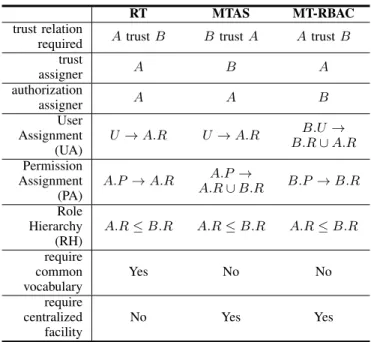
Role-Based Trust Models are effective in terms of access control for collaboration in distributed environments. Trust relations, in certain forms, are established among adminis-trative domains for sharing. The effects of different trust models vary in different aspects. We hereby identify some crucial differences among three role base trust models: Role-based Trust-management (RT) framework [13], Multi-Tenancy Authorization System (MTAS) [11], [12], and our approach MT-RBAC in this paper, as shown in Table II.
RT is a family of Role-based Trust-management language using credentials to express trust relations and policies in distributed authorization. In this paper, we only discuss the
key features of RT0 which is the base model in the family.
RT0 provides four types of multi-domain assignments
(cre-dentials): simple member, simple inclusion, linking inclusion, and intersection inclusion. The former two are compatible with MTAS and MT-RBAC which do not support the latter two.
First, we compare the models in terms of the trust and authorization assignment authorities as well as the required trust relations for collaborations. In RT the trust assignment and the authorization assignment are coupled in a credential so that both of them are assigned by the resource owner who trusts the requester. Conversely, in MTAS and MT-RBAC the two assignments are decoupled and issued by different parties. The unique feature of MT-RBAC is that the resource owner trusts the requester not only to access the resources but also for its issuer to authorize the access that is to make authorization
TABLE II: Trust Model Comparison. A andB represent two entities, issuers and tenants respectively in RT, MTAS and
MT-RBAC. Arepresents the resource owner and B the requester.
RT MTAS MT-RBAC
trust relation
required AtrustB B trustA AtrustB
trust assigner A B A authorization assigner A A B User Assignment (UA)
U →A.R U →A.R B.U→
B.R∪A.R
Permission Assignment (PA)
A.P →A.R A.P →
A.R∪B.R B.P→B.R
Role Hierarchy (RH)
A.R≤B.R A.R≤B.R A.R≤B.R
require common vocabulary Yes No No require centralized facility No Yes Yes
assignments for the owner’s permissions. Further, the direction of a trust relation is special in MTAS where the resource owner has to be trusted by the resource requester before making appropriate authorization assignments.
Then, the models are examined respectively with the three
kinds of authorization assignments: U A, P A, andRH. With
UA, properly authenticated users are allowed to be assigned by resource owners to their own roles in RT and MTAS, while in MT-RBAC the resource requester (trustee) can only assign its own users to the roles of itself or the resource owner (truster) who trusts the requester. Cross-domain permission assignments are not allowed in RT or in MT-RBAC, but possible in MTAS. The inheritance of permissions through RH is always from the resource owner to the requester in all three models.
Last but not least, we discuss the necessity of a prerequisite to enable collaborations with role based trust models. Common vocabulary is a term introduced in RT [13] requiring both collaborators of a trust relation to use a mutually understand-able definitions of roles. Thus the semantic mismatch issue in decentralized collaboration is mitigated. However, there is no such requirement in MTAS and MT-RBAC since their trust relations allow exposure of the truster’s roles to the trustee so that the definition of roles is perceivable to the administrator within a common centralized facility such as an AaaS platform. Although these role-based trust models foster collabora-tions in the cloud, a unified and consolidated trust framework is not currently available. We anticipate research in this field will establish foundations for the evolution of cloud computing.
V. CONCLUSION
In this paper, we propose a family of MT-RBAC models by extending the well-known and widely used RBAC model with
the components oftenantsandissuersto address multi-tenant
authorization for collaborative cloud services. MT-RBAC aims
to enable fine-grained cross-tenant resource access by building
tenant-level granularity of trust relations. We prototype
MT-RBAC using SUN’s XACML library to implement an Au-thorization as a Service (AaaS) in cloud. To demonstrate the viability of the prototype system, we evaluate its performance and scalability in a Joyent cloud. The results show that the AaaS platform with MT-RBAC incur acceptable overhead and is scalable for the cloud storage service.
ACKNOWLEDGEMENT
This work is partially supported by grants from the Na-tional Science Foundation and AFOSR MURI program.
REFERENCES
[1] “Gartner outlines five cloud computing trends that will affect cloud strategy through 2015,” Gartner Press Release, 2012.
[2] P. Mell and T. Grance, “The NIST definition of cloud computing,” Special Publication 800-145, 2011.
[3] J. Judkowitz, “Taking advantage of multi-tenancy to build collaborative clouds,” http://communities.intel.com/community/datastack/cloud builder/blog/2011/04/29/taking-advantage-of-multi-tenancy-to-build-collaborative-clouds, 2011.
[4] D. Jermyn, “Health care not yet ready to share,” https://secure.globeadvisor.com/servlet/ArticleNews/story/gam/201106 10/SRCLOUDHEALTH0610ATL, 2011.
[5] A. Kurmus, M. Gupta, R. Pletka, C. Cachin, and R. Haas, “A compari-son of secure multi-tenancy architectures for filesystem storage clouds,” inMiddleware, 2011, pp. 471–490.
[6] J. McKenty, “Nebula’s implementation of role based access control (RBAC),” http://nebula.nasa.gov/blog/2010/06/03/nebulas-implementation-role-based-access-control-rbac/, 2010.
[7] D. F. Ferraiolo, R. Sandhu, S. Gavrila, D. R. Kuhn, and R. Chan-dramouli, “Proposed NIST standard for role-based access control,”ACM Trans. Inf. Syst. Secur., vol. 4, no. 3, pp. 224–274, Aug. 2001. [8] F. Chong, G. Carraro, and R. Wolter, “Multi-tenant data architecture,”
http://msdn.microsoft.com/en-us/library/aa479086.aspx, 2006. [9] R. F. Chong, “Designing a database for multi-tenancy on the
cloud,” http://www.ibm.com/developerworks/data/library/techarticle/m-1201dbdesigncloud/index.html, 2012.
[10] I. Foster, Y. Zhao, I. Raicu, and S. Lu, “Cloud computing and grid computing 360-degree compared,” inGCE, 2008, pp. 1–10.
[11] J. M. A. Calero, N. Edwards, J. Kirschnick, L. Wilcock, and M. Wray, “Toward a multi-tenancy authorization system for cloud services,”IEEE Security and Privacy, vol. 8, no. 6, pp. 48–55, Nov/Dec 2010. [12] B. Tang, R. Sandhu, and Q. Li, “Multi-tenancy authorization models
for collaborative cloud services,” inIEEE International Conference on Collaboration Technologies and Systems, 2013.
[13] N. Li, J. C. Mitchell, and W. H. Winsborough, “Design of a role-based trust-management framework,” inIEEE Symp. on Sec. and Priv., 2002, pp. 114–130.
[14] “Sun’s XACML implementation,” http://sunxacml.sourceforge.net/. [15] “Joyent SmartOS,” http://smartos.org/.
[16] “Cloud storage system,” http://sourceforge.net/projects/cloudstorage/. [17] R. Bhatti, E. Bertino, and A. Ghafoor, “X-FEDERATE: A policy
engineering framework for federated access management,”IEEE TSE, vol. 32, pp. 330–346, 2006.
[18] ——, “An integrated approach to federated identity and privilege management in open systems,”CACM, vol. 50, no. 2, pp. 81–87, 2007. [19] M. T. Goodrich, R. Tamassia, and D. D. Yao, “Notarized federated ID management and authentication,”J. Comput. Secur., vol. 16, no. 4, pp. 399–418, 2008.
[20] R. S. Sandhu, E. J. Coyne, H. L. Feinstein, and C. E. Youman, “Role-based access control models,”IEEE Computer, vol. 29, no. 2, pp. 38–47, 1996.
[21] M. Shehab, E. Bertino, and A. Ghafoor, “SERAT: SEcure role mApping technique for decentralized secure interoperability,” inSACMAT, 2005, pp. 159–167.
[22] “Sarbanes-Oxley Act (SOX),” Public Law 107-204, 2002.
[23] D. Brewer and M. Nash, “The chinese wall security policy,” inIEEE Symp. on Sec. and Priv., 1989, pp. 206–214.
[24] W. Tolone, G.-J. Ahn, T. Pai, and S.-P. Hong, “Access control in collaborative systems,”ACM Comput. Surv., vol. 37, no. 1, pp. 29–41, 2005.
[25] E. Cohen, R. K. Thomas, W. Winsborough, and D. Shands, “Models for coalition-based access control (CBAC),” inSACMAT, 2002, pp. 97–106. [26] Q. Li, X. Zhang, M. Xu, and J. Wu, “Towards secure dynamic collaborations with Group-Based RBAC model,”Computers & Security, vol. 28, no. 5, pp. 260–275, 2009.
[27] D. Lin, P. Rao, E. Bertino, N. Li, and J. Lobo, “Policy decomposition for collaborative access control,” inSACMAT, 2008, pp. 103–112. [28] Z. Zhang, X. Zhang, and R. Sandhu, “ROBAC: Scalable role and
organization based access control models,” inCollaborateCom, 2006, pp. 1–9.
[29] M. Alam, X. Zhang, K. Khan, and G. Ali, “xDAuth: A scalable and lightweight framework for cross domain access control and delegation,” inSACMAT, 2011, pp. 31–40.
[30] L. Bauer, L. Jia, M. K. Reiter, and D. Swasey, “xDomain: cross-border proofs of access,” inSACMAT, 2009, pp. 43–52.
[31] E. Freudenthal, T. Pesin, L. Port, E. Keenan, and V. Karamcheti, “dRBAC: distributed role-based access control for dynamic coalition environments,” inICDCS, 2002, pp. 411–420.
[32] X. Zhang, S. Oh, and R. S. Sandhu, “PBDM: a flexible delegation model in RBAC,” inSACMAT, 2003, pp. 149–157.
[33] R. Alfieri, R. Cecchini, V. Ciaschini, L. dell’Agnello, A. Frohner, K. L˝orentey, and F. Spataro, “From gridmap-file to VOMS: managing authorization in a grid environment,” Future Gener. Comput. Syst., vol. 21, no. 4, pp. 549–558, 2005.
[34] E. Bertino, P. Mazzoleni, B. Crispo, S. Sivasubramanian, and E. Ferrari, “Towards supporting fine-grained access control for grid resources,” in FTDCS, 2004, pp. 59–65.
[35] D. W. Chadwick and A. Otenko, “The PERMIS X.509 role based privilege management infrastructure,” inSACMAT, 2002, pp. 135–140. [36] P. Mazzoleni, B. Crispo, S. Sivasubramanian, and E. Bertino, “Efficient integration of fine-grained access control and resource brokering in grid,” The Journal of Supercomputing, vol. 49, no. 1, pp. 108–126, 2009.
[37] L. Pearlman, V. Welch, I. Foster, C. Kesselman, and S. Tuecke, “A community authorization service for group collaboration,” inPOLICY, 2002, pp. 50–59.
[38] H. Takabi and J. B. D. Joshi, “Semantic-based policy management for cloud computing environments,” International Journal of Cloud Computing, vol. 1, no. 2, pp. 119–144, 01 2012.
[39] A. Almutairi, M. Sarfraz, S. Basalamah, W. Aref, and A. Ghafoor, “A distributed access control architecture for cloud computing,”IEEE Software, vol. 29, no. 2, pp. 36–44, 2012.
[40] S. Gerges, S. Khattab, H. Hassan, and F. Omara, “Scalable multi-tenant authorization in highly collaborative cloud applications,”International Journal of Cloud Computing and Services Science (IJ-CLOSER), vol. 2, no. 2, pp. 106–115, 2013.
[41] “Core and hierarchical role based access control (RBAC) profile of XACML v2.0,” OASIS Standard, 2005.
APPENDIX
We specify MT-RBAC policies in extensible access con-trol markup language (XACML). According to the normative specification of RBAC policies [41], we keep using the Role
PolicySet (RP S) and the Permission PolicySet (P P S),
repre-sentingU AandP Arespectively in MT-RBAC. Additionally, a
novel Trust PolicySet (T P S) is added. In order to express
MT-RBAC1 and MT-RBAC2 policies, we also introduce T IP R
PolicySet (IP S) andT DP RPolicySet (DP S). In this section,
we present an MT-RBAC2policy example and the
correspond-ing authorization process.
Role <PolicySet> <Target> subject-role = tr:… subject-tenant = te <PolicySetIdReference> Trust <PolicySet> tr <PolicySetIdReference> <Target> subject-tenant = tr Trust <PolicySet> <PolicySetIdReference> <Target> subject-tenant = te
Trust <PolicySet> <PolicySetIdReference>
<Target> resource-id = tr:… Permission <PolicySet> Role <PolicySet> <Target> subject-role = te:… <PolicySetIdReference> Trust <PolicySet> te <PolicySetIdReference> <Target> subject-tenant = te Trust <PolicySet> <PolicySetIdReference> <Target> resource-id = te:… Permission <PolicySet> TDPR <PolicySet> tr <PolicySetIdReference> <Target> subject-tenant = tr TDPR <PolicySet> TDPR <PolicySet> te Cross-Tenant RH RH PA RH PA Cross-Tenant UA UA <PolicySetIdReference> <Target> subject-tenant = te object-role = tr:… TDPR <PolicySet> <PolicySetIdReference> <Target> subject-tenant = te TDPR <PolicySet>
Fig. 6: The MT-RBAC2policy enables two independent
autho-rization paths: cross-tenant user assignment (UA) and
cross-tenant role hierarchy (RH), where trtrusts te.
Cross-Tenant UA:starting from the upperRP Sin Figure 6,
a user intesends a request to accesstr’s resource. If the user is
already assigned to a role intr,RP S will forward the request
totr’sT P S who checks if trEte. If the trust relation does
not exist, the request will be denied; otherwise,tr’sDP Swill
check if the user’s role in tr is in PT D(tr, te). If the role is
public tote,tr’sP P Sassociated with the role will check the
resources and actions in the request. If these do not match the
policy rules, the request will be forwarded to theDP Sagain to
verify the visibility of the junior roles tote. This process will
execute recursively until a match inP P Srules is found or the
lowest role visible to teintr’s role hierarchy is reached. If a
match is found, the PDP will respond with a permit, otherwise the PDP will check other authorization paths in the policy tree for a match. If finally no match is found, a deny response will be returned to the PEP.
Cross-Tenant RH:starting from the lowerRP Sin Figure 6,
the request from a user of a te’s role will first be sent tote’s
T P S. The te’s T P S and the subsequentDP S will forward the user’s request because it is an intra-tenant request. Then,
the request will arrive to the P P S of the user’s role in te.
The recursive process of retrieving a proper junior role will
take place. Since a cross-tenant RH assignment to a junior
role in tr exists, the request will be forwarded to tr’s DP S
during the recursive process. The steps afterwards is similar as described in the other authorization path.
The authorization paths in the other MT-RBAC models are
similar. TheIP Sin MT-RBAC1specification enforcesT IP R
similarly as theDP S in MT-RBAC2 enforcingT DP Rin the
example above.