WJES I4
ILO
POLICY RESEARCH WORKING
PAPER
1647
The Baltics-Banking Crises
Lessons learned from bankingcrises in three Baltic republics
Observed
- crises that all developed inthe context of simultaneous
Alex Fleming transition and adjustment.
Lily Chu putting tremendous strain on
Marie-Ren6e Bakker banks and their enterprise
borrowers
The World Bank
Europe and Central Asia Country Department IV
Enterprise and Financial Sector Development Division September 1996
Public Disclosure Authorized
Public Disclosure Authorized
Public Disclosure Authorized
POLICY RESEARCH WORKING PAPER 1647
Summary findings
Fleming, Chu, and Bakker compare the banking crises In the early stages the three private banking systems
experienced in Estonia, Latvia, and Lithuania, examining were similar and grew rapidly. All three have had liberal
the causes, effects, and policy responses. policies toward licensing new commercial banks,
The starting point for the three 'banking systems was believing that more banks would generate the
the same: They inherited the monobank system of the competition needed to drive down deposit and lending
former Soviet Union, wvith specialized state banks serving rates, and provide the capital needed to support the
specific branches of the econonmy. They quickly emerging private sector. Many new private banks were
established a central bank at the core of their banking established by enterprises that wanted access to cheaper
system. They were weak in bank management and lacked funding than was available from other banks. Little
staffs with modern banking skills, and no system had an thought was given at first to the implications of this
appropriate legal, regulatory, or supervisory framework policy for banking safety and supervision.
governing the banks. In some Oistances fraud and The conclusions drawn by Fleming, Chu, and Bakker
corruption prevailed, encouraged by the relatively (in brief, below) may have implications for banking
permissive regulatory andl sup rvisory environment for reform in the other former Soviet republics, especially
banks that existed in the Baltics. All had to decide what to the smaller ones:
do with the remnants of the Soviet banking s:stem at the * Some banking distress is inevitable.
same time that they encouragecd the growth of the new * Banking distress may be desirable.
private banking sector. eBanking crises die down relatively quickly.
Estonia and Lithuania reconstituted the specialized * When crises arise, authorities should respond firmly
Soviet banks as national state banks and began to and promptly.
privatize them. In some instances the state retains an * Corruption and weakness should never be
ownership stake. In Lithuanii the state may increase its rewarded.
ownership share as part of a rescue effort for some * Banking crises should be prepared for.
former state banks. Larvia, by contrasit, econstituited the * Supervisors should send strong signals to bankers
savings bank, then privatized branc:hes of tlie remaining abotut appropriate banking behavior.
banks. The residual branchcs wvefrez merged into one bank, rehabilitated, and theln subject to formal
privatization. The savings bank Is n(ow being privatized.
This paper - a product of the Enterprise and Financial Sector Development Division, Europe and Central Asia, Country
Department IV - is part of a larger effort in thc region to distill the lessons of the first five years of transition. Copies of the paper are available free fi)mn the World Bank, 1818 H Street NW, Washington, DC 20433. Please contact Suzanne
Coffey, room H6-30S, teelepinn 2()- 473-2635, fax 202-522 0005, Internet address scoffey(@aworldbank.org. September
1996. (35 pages)
The Policy Researc h Work:r4 Praer Series disseminates the findings ot uork in progress to encourage the exchange of ideas about I development issues. An ')i,, r1' ol the series is to get the findings out quickly, eren if the presentations are less than fully polished. The
papers carry the na"ies ./ tkh auithors and should be used and cited accoidinigly. The ftindinigs, interpretations, and conclusions are the authors' own and sJou!d i, .2't ?irib)ted to] the World Bank, its Executive Board of Dirfc tors. or lany of its member countries.
THE BALTICS--BANKING CRISES OBSERVED
by Alex Fleming, Lily Chu and Marie-Renee Bakker'
The World Bank
I The views expressed in this paper are those of the authors and should not be considered the official view of
THE BALTICS--BANKING CRISES OBSERVED
I Introduction
II The starting points MI How the crises arose IV The policy response V The impact
VI Underlying Causes VII Conclusions
Tables and Charts:
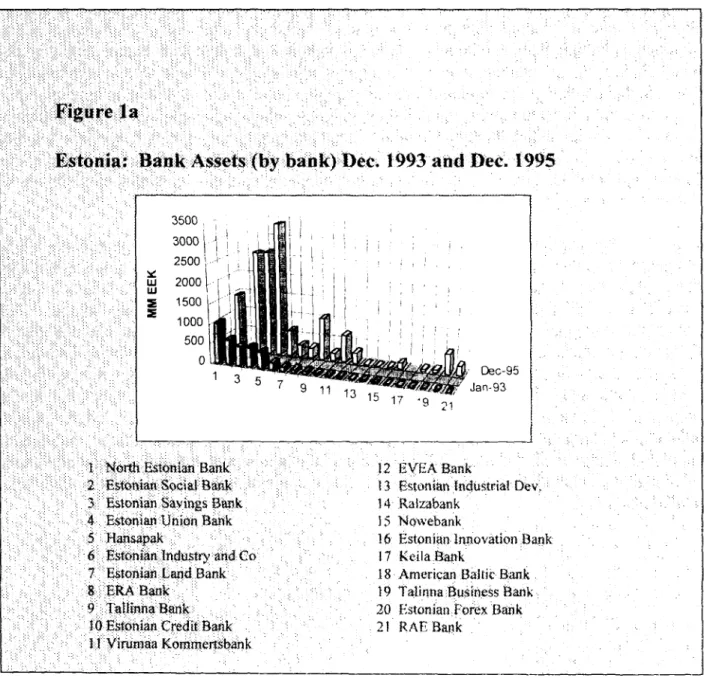
Table 1: Evolving Structure of Baltic Financial System Figure IA Estonia - Bank assets by bank
Figure 1B Latvia - Bank assets by bank Figure IC Lithuania - Banks assets by bank
Boxes:
Box 1: Banking Distress in the Social Bank and the North Estonian Bank Box 2: The Bank Baltija Collapse
Box 3: The Innovation Bank's Failure Box 4: Bank Consolidation in the Baltics
Box 5: The legal, supervisory, and accounting framework for banking in the Baltics
The Authors would like to express their appreciation to Brigita Usakova (Latvian Technical Unit and Peter Modeen (World Bank Lithuania Field Office) for providing banking data, and to Suzanne Coffey for providing assistance in the production of the paper. The paper also benefited from comments by Paul Siegelbaum, Samuel Talley and Richard Roulier at the World Bank.
THE BALTICS--BANKING CRISES OBSERVED
1. INTRODUCTION
1.1 The Baltic Republics of Estonia, Latvia and Lithuania are in the vanguard of transition in the Former Soviet Union (FSU) and have made significant steps towards a market-based economy over the past five years. The first fruits of their reform programs are now being felt in the form of a revival in positive real economic growth. But there are a number of factors that have threatened to derail the fledgling recovery. The most surprising of these, perhaps, is that all three of these republics have experienced serious crises banking which have set in train significant structural changes in their banking systems, and, in some instances adverse political and economic repercussions. The purpose of this paper is to compare and contrast the banking crises experiences of the three Baltic Republics by examining their causes, their effects and the policy response of the three sets of Authorities. By drawing out the lessons of experience, it is hoped to show how the worst manifestations of banking crises can be avoided in other transitional economies.
-I. THE STARTING POINTS2
2.1 The starting point for the evolution of the banking systems in all three of the Baltic Republics was the same. Specifically, all three Republics inherited the monobank system of the FSU with specialized state banks servicing specific branches of the economy. All three quickly established a Central Bank at the core of their banking system. None of the three possessed a human resource base skilled in modern banking practices and none had an appropriate legal, regulatory, and supervisory framework governing the banks. The three republics had, at the outset, to decide what to do with their remnant of the FSU banking system. At the same time, they had the twin challenges of encouraging the growth of the new private banking sector while ensuring that such growth took place within the bounds of prudential norms.
2.2 In their initial responses to the problems of the remnant of the inherited banking systems the similarities among the three republics, to some extent, end. The Estonian and Lithuanian approaches were similar in that both republics reconstituted the specialized Soviet banks as national state banks and gradually/partially privatized them by selling shares to the local private sector. The Latvian approach, in contrast, was to reconstitute the Savings Bank, but then privatize the branches of the remaining banks. The residual banks were merged and rehabilitated, then subject to a formal privatization process.
Text in bold typeface provides a comparative perspective on the developnmenlt of the cr ises in the three counilties.
2.3 All three of the Baltic Republics have had extremely liberal policies toward the licensing of new commercial banks. A large number of banks, it was thought, would quickly generate the competition needed to drive down deposit and lending rates and provide the lending needed to support the emerging private sector. Many new private banks were established by enterprises to gain access to a preferential and much cheaper source of funding than was available from existing banking institutions. Little thought was given initially to the implications of this policy for banking safety and supervision. There were similarities
therefore in the three Baltic Republics in the development of the private banking systems, each of which grew rapidly.
2.4 Estonia: In 1987, as in the other FSU republics, the Gosbank in Estonia spun off five specialized state banks: (i) Savings Bank; (ii) Agriculture Bank; (iii) Social Bank; (iv) Industry and Construction; Bank and (v) Foreign Trade Bank--Vnesheconombank, later renamed the North Estonian Share Bank (NESB). Estonia later moved to a two-tier banking system. The Bank of Estonia (BOE) was established in 1990, and its position as the central bank was affirmed when, after Estonian Independence was declared in 1991, the BOE took over the Estonian branch of Gosbank.
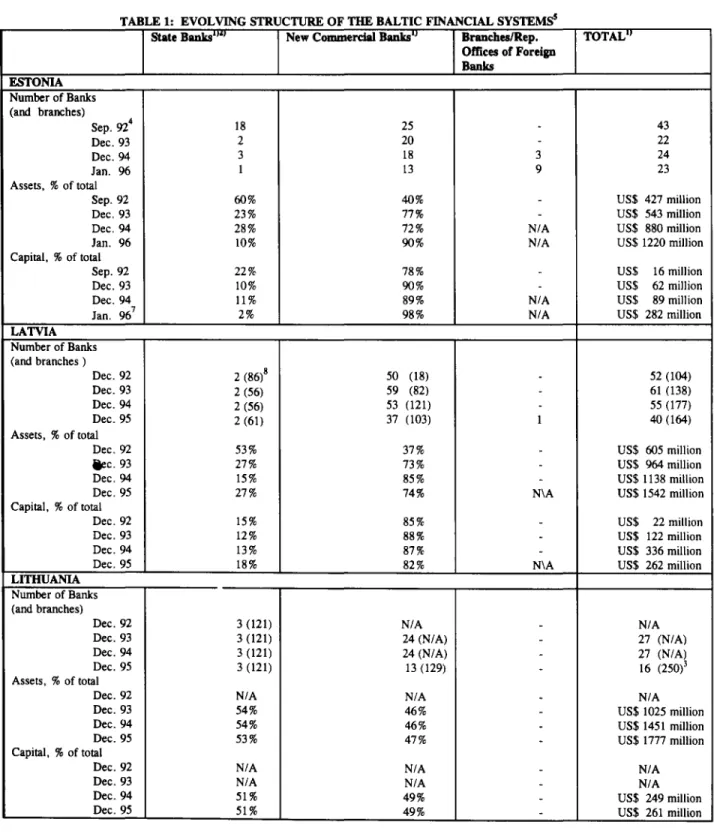
2.5 The state banks were augmented by the creation of new banks; by 1992, 25 new banks had been licensed. In addition, the Agriculture Bank (Maapank), had split up into 14 entities, which were operating separately. Hence, the total number of banks was 43 (25 new banks, 14 Agriculture Bank spin-offs, and the 4 other state banks). Licensing requirements were rather lax; minimum capital was set at only 5 million rubles, which, in 1992 was equivalent to less than $40,000. The evolving structure of the Estonian banking system can be gleaned from Table 1.
2.6 LatYia: In Latvia, meanwhile, the Bank of Latvia (BOLAT) was also established in July 1990. The Government decided that, with the exception of the Savings Bank, the 45 branches of the former Soviet banks would be combined and placed under the auspices of BOLAT. This approach allowed the Latvian Government to proceed on a bank restructuring strategy which had a very flexible departure point. It permitted the Government to consider a range of options: selling off all the branches to the emerging private sector; privatizing the branches individually or in groups; creating one or more state banks; or a combination of these approaches. The disadvantage was that the BOLAT did not play any type of governance role in the branches under its wing. Branch managers, therefore, felt no accountability towards the President of the BOLAT or its directors. As a result. from the time the 45 branches were combined under BOLAT until the creation of Unibank, a significant amount of imprudent lending--in the order of US$50 million equivalent--took place.
2.7 It was decided to keep the Savings Bank initially in the public sector, submit it to considerable institutional cievelopment support, and then privatize it in due course. The lack of strong management meant that the financial condition of this bank has gradually deteriorated. The remnant of the state banks held under BOLAT was dealt with in three ways. Nine branches were sold to private commercial banks. Then, fifteen of the branches were consolidated into
eight private banks and sold through offerings of shares. Finally, on September 28, 1993 the rump of 21 branches was structured into one state bank--the Universal Bank of Latvia, or Unibank--and subjected to intense institutional development support.
2.8 By 1993, over sixty new commercial banks had been licensed in Latvia. Some of them were 'pocket' banks owned by state enterprises, some were purely private but were dedicated mainly to raising deposits to on-lend to the owners, and some were set up with specific functions in mind (Olympia bank was set up to help finance the Latvian Olympic team). All of these private or quasi-private banks were allowed to develop with little supervision from the BOLAT initially.
2.9 The new commercial banking sector grew very rapidly in relation to the remainder of the state banking sector over the period 1992-94. Between December 1992 and December 1994, the new commercial banking sector share of total assets grew from 47% to 85%. Credits granted by the banking system also grew sharply over this period, with the new commercial banks accounting for 89% of the total by the end of 1994, up from only 23% two years earlier
(see Table 1).
2.10 Among the private banks that developed very quickly in 1993 and 1994 was Bank Baltija. Its assets grew from about US$25 million in January 1993 to US$242 million in January 1994, and then to almost US$500 million by early 1995. Bank Baltija became the largest Latvian commercial bank in terms of assets, capital and deposit funding by 1994. The bank's reported capital grew from about US$1 million in early 1993 to US$20 million in January 1994 and to US$44 million in January 1995. The bank had 37 branches and 49 offices throughout Latvia with 1,300 employees in total. In April 1995, when the banking crisis began, the bank had total deposits of US$392 million. Bank Baltija was at the heart of the Latvian banking crisis. 2.11 Lithuania: In contrast, the Lithuanian Government decided early on to corporatize and partially privatize the three specialized state-owned banks which were split off from Gosbank: the State Savings Bank, the State Agriculture Bank and the State Commercial Bank. Up to 49% private ownership was permitted through the infusion of new capital. The Government maintained a 51 % ownership share. However, this privatization was done without appropriate disclosure of the banks' financial condition (International Accounting Standards [IAS] audits showing that the banks were insolvent were not made available to potential purchasers) and without any improvements in corporate governance or changes in management. Early attempts at restructuring the State Savings Bank were unsuccessful as they were partial in nature3 and again were not accompanied by any improvements in corporate governance or changes in management. Nevertheless, among others as a result of the explicit deposit protection provided to its depositors, the State Savings Bank has managed to grow significantly in the years since independence. Due also to the reluctance of the newly-created
3 The restructuring only addressed the claim of the bank on the former all-USSR Savings Bank head office in Moscow but
not the rapidly growing portfolio of new bad loans. Artificial limits on its lending to private enterprises encouraged the
bank to move more aggressively into interbanik lending and lending to state cnterprises of equally doubtful quality.
4
Central Bank--the Bank of Lithuania (BOLIT)--to use its regulatory and supervisory powers the financial condition of the three state banks steadily deteriorated during the period 1992-1996, with an increasing number of incidents of fraud occurring.
2.12 Many new commercial banks emerged in Lithuania: some as the treasury arm of their state-owned enterprise founders. However, rapid progress in enterprise privatization, through Lithuania's mass privatization program, and successful attempts to raise new capital rapidly enhanced the true private influence in these banks. Twenty-five new commercial banks were in operation by March 1995; approximately eight of these could be characterized as active banks, both in terms of asset size and activity. The remainder were foreign exchange offices or true 'pocket' banks that lent primarily to their owners.
2.13 The share of the new private banks (by assets) in Lithuania's total banking system increased rapidly to reach 46% by December 1993 (see Table 1). Since then it has been relatively stable, although within the group of private banks, a clear trend towards consolidation has been discernible since late 1993, with a small number of banks growing
rapidly and an increasing number of 'pocket' banks going out of existence.
2.14 The funding of the fast-growing banks came mainly from new private sector enterprises, and was to a large extent foreign currency denominated. Lending activities were mostly focused on newly-private and privatized enterprises engaged in trade, services, and manufacturing, with the notable exception of Innovation Bank, which lent mainly, and often at the Government's explicit urging, to the energy sector which to date is still plagued by many structural problems.
4 For example, while BOLIT undertook on-site examinations in nearly all private banks during the last two years. BOLIT,
until very recently, refused to undertake such examinations in any of the state-owned banks, claiming that the problems
of these banks were the Government's responsibility, and not those of the regulator.
TABLE 1: EVOLVING STRUCTURE OF THE BALTIC FINANCIAL SYSTEMS5
State Banks""'2 New Commercial Banks" Branches/Rep.
TOTALw-Offices of Foreign Banks ESTONIA Number of Banks (and branches) Sep. 924 18 25 43 Dec. 93 2 20 22 Dec. 94 3 18 3 24 Jan. 96 1 13 9 23 Assets, % of total
Sep. 92 60% 40% - US$ 427 million
Dec. 93 23% 77% US$ 543 million
Dec. 94 28% 72% N/A US$ 880 million
Jan. 96 10% 90% N/A US$ 1220 million
Capital, % of total
Sep. 92 22% 78% US$ 16 million
Dec. 93 10% 90% US$ 62 million
Dec. 94 11% 89% N/A US$ 89 million
Jan. 967 2% 98% N/A US$ 282 million
LATVIA Number of Banks (and branches ) Dec. 92 2 (86)' 50 (18) 52 (104) Dec. 93 2 (56) 59 (82) 61 (138) Dec. 94 2 (56) 53 (121) - 55 (177) Dec. 95 2 (61) 37 (103) 1 40 (164) Assets, % of total
Dec. 92 53% 37% - US$ 605 million
iec. 93 27% 73% US$ 964 million
Dec. 94 15% 85% US$ 1138 million
Dec. 95 27% 74% N\A US$ 1542 million
Capital, % of total
Dec. 92 15% 85% US$ 22 million
Dec. 93 12% 88% US$ 122 million
Dec. 94 13% 87% US$ 336 million
Dec. 95 18% 82% N\A US$ 262 million
LITHUANIA
Number of Banks (and branches)
Dec. 92 3 (121) N/A N/A
Dec. 93 3 (121) 24 (N/A) 27 (N/A)
Dec. 94 3 (121) 24 (N/A) 27 (N/A)
Dec. 95 3 (121) 13 (129) 16 (250)3
Assets, % of total
Dec. 92 N/A N/A N/A
Dec. 93 54% 46% US$ 1025 million
Dec. 94 54% 46% US$ 1451 million
Dec. 95 53% 47% US$ 1777 million
Capital, % of total
Dec. 92 N/A N/A N/A
Dec. 93 N/A N/A N/A
Dec. 94 51% 49% US$ 249 million
Dec. 95 51% 49% US$ 261 million
1 Number of branches are in brackets.
2 State banks that were a remnant of the Soviet System only. 3 Excluding banks in liquidation or bankruptcy.
4 Pre-crises: data. December 1992 was omitted, as the Bank of Estonia was undergoing a bank relicensing process at the time. January 1996 data is shown in lieu of December 1995
5 Asset and capital data must be read with caution. Banks gradually converted to IAS standards over the period studied; hence,
not all the reported figures are comparable. Many banks reported numbers that did not include proper provision for loan losses, with the result of inflating both assets and capital figures.
6 Data for new commercial bank includes the Latvian Mortgage and Land Bank (relatively new state bank) and the Latvian Investment Bank (35% state owned)
7 Estonian Investment Bank data was not available for inclusion in 1996 figures.
8 Figures for December 1992 represent former branches of BOLAT that were overseen by the Bank Privatization
III. HOW THE CRISES AROSE
3.1 Banking crises surfaced in Estonia in 1992, in Latvia in early 1995 and in
Lithuania in late 1995. In all three countries there was a multiplicity of causes of the banking crises; some of these--systemic in nature--had been working on the fabric of the banking system for many months or even years. These underlying causes are described in Chapter IV. Private banks were primarily involved in the crises in all three countries. But in each of the Republics, there were differing events leading up to the crises and different triggers that brought them to a head. A number of specific factors were also at play in each. In Estonia, the proximate cause was the freezing of assets in Moscow of two important banks, coupled with the drying up of cheap credits from BOE, which had previously endowed Estonian banks with significant profits and liquidity. The crisis was ultimately triggered by liquidity difficulties. In Latvia the proximate cause was the drying up of highly profitable trade-financing opportunities and general mismanagement and corruption in the operations of banks (particularly evident in Bank Baltija). The trigger of the crisis was BOLAT's requirement that banks be properly audited using IAS principles. A liquidity squeeze ensued as doubts about the solvency of several banks grew. Banks in Lithuania, as in Latvia, suffered a compression in their profits due to the contraction of lucrative trade financing opportunities. An additional factor in the Lithuanian case, however, was the Government's role in pressing some banks (both state-owned and private) to lend to finance quasi-fiscal expenditures. The trigger in this case was leaks of the results of on-site examinations of two banks which led to runs on each bank and liquidity shortages.
3.2 Estonia: Prior to independence, most of the financial resources collected by local
branches of the state banks were sent back to the main headquarters of each bank in Moscow. In early 1992, the Moscow offices of the Vnesheconombank and the Savings Bank froze all assets belonging to non-Russian banks. This caused financial problems in banks throughout the former Soviet republics. In Estonia, this primarily affected three banks: the NESB and the Union Baltic Bank, which had both placed considerable assets with the Vnesheconombank in Moscow, and the Savings Bank. The frozen amounts were considerable: approximately $40 million of NESB assets, approximately $36 million of UBB assets and approximately $25 million in Savings Bank assets.
3.3 Since the Savings Bank held over 85 % of the household savings at the time, the BOE decided to take action to make sure that these savings were protected. In April, 1992, the BOE took over the ownership of the Savings Bank, swapping some of its own assets for the Savings Bank's claim on the Moscow Saving's Bank. The BOE's decision to assist the Savings Bank was in part motivated by the desire to minimize disruptions to public confidence during the introduction of Estonia's new currency (the kroon) planned for June, 1992.
3.4 The NESB and UBB continued to operate on the assumption that the asset freeze was temporary, and therefore did not properly husband their scarce liquid funds. The liquidity problems were exacerbated by Estonia's new, tight monetary policy, which came into force with the introduction of the kroon. The kroon was pegged to the Deutsche Mark, and was fully backed by gold and convertible foreign currency reserves. A currency board system was established, meaning that the central bank could not issue new base money unless there was a corresponding increase in convertible foreign currency, or in the case of a sharply defined banking crisis. As a result of these reforms, commercial banks could no longer rely on the central bank as a source of cheap credit. Up to that point, some banks had bolstered their
earnings by charging high spreads on loans financed from these cheap credits. In addition, the new unified exchange rate reduced arbitrage opportunities and buy-sell spreads, reducing
foreign exchange revenues.
3.5 Another large private commercial bank, the Tartu Commercial Bank (TCB), also began having liquidity problems, as the new tight money policy made it impossible to use new credits to disguise problems in its loan portfolio. In November of 1992, a serious liquidity crisis developed in the three largest commercial banks: TCB, UBB. and NESB. Payments began slowing down; for example, the average transfer time for a UBB payment slowed from four days to almost a month. UBB finally froze all accounts of state-owned enterprises, in the hopes that this act would force the Government to assist UBB, particularly with regard to some of UBB's assets that were frozen in Moscow. Instead, the BOE placed a moratorium on all three banks. Assets in these distressed banks accounted for about 40% of total banking assets. 3.6 Subsequently, further banking problems have arisen in Estonia, involving banking distress in the Social Bank and the North Estonian Bank (see Box 1). These problems have not been so well publicized as the crisis of 1992 because a less significant volume of banking assets has been involved and no systemic threat existed.
3.7 Latvia: The banking crisis in Latvia came to a head towards the end of March 19955, precipitated in part by the insistence of the BOLAT that all banks should prepare and present to its Banking Supervision Department financial statements that had been audited on the basis of IAS. It was the failure of Bank Baltija to present such accounts, or indeed to give its auditors full access to needed documentation for the audit of its 1994 financials that set off a chain of events leading to the bank's declaration of insolvency. But Bank Baltija was not the only bank involved in the crisis at this stage. Other banks included the Latvian Deposit Bank, Centra Bank and Olimpija Bank, all middle-sized banks that were eventually declared insolvent. A number of
6
smaller banks also experienced difficulty. In all, about 40% of banking system assets were conmpromised, totaling almost US$900 million.
3.8 The growing public perception that Bank Baltija was in difficulty led to a withdrawal of deposits from the bank, mostly by enterprises initially. Households were slower to grasp the gravity of the problem and so their withdrawals were more of a trickle than a classical run. The other banks that were involved in the crisis also experienced similar effects vis-a-vis their deposits. Large numbers of small deposit holders were caught when the banks' doors were closed.
3.9 There were a number of specific factors underlying the Baltija Bank problem, with some also applicable to other banks (see Box 2). The first related to Latvia's special position between East and West which made it especially attractive as conduit for trade between the two areas. Special financing opportunities arose during 1993/4 on account of the fact that prices of metals and other commodities in Russia remained well below world market prices. Latvian banks
Although seven smaller banks had been declared insolvent in 1994: LUitta, Latvian Bank for Reconstruction and
Development, Baltic Bank for Reconstruction and Development. Kurzeme, Sigulda, Tautas and Top-banka.
6 Other banks declared insolvent in 1995 were Latintrade. Latgale Commercial Bank. Liepajas Commercial Bank,
Polarzviagzne Bank and Alejas Commercial Bank. Kredo Bank, Olti-Bank and Bauskas Bank.
Box 1: Banking Distress in the Social Bank and the North Estonian Bank
The Social Bank
The resolution of the 1992 crisis did not mean the end of all banking problems in Estonia. In 1994, the Social Bank, one of the former spin-offs from Gosbank, developed serious liquidity problems. The precipitating cause was the Government's decision in the spring of 1994 to withdraw much of the state's budget deposits (the equivalent of about $15 million) from the Social Bank, and reallocate the deposits among several banks in the system. By August, 1994, about US26 million of other deposits had been withdrawn, the bank ran into serious liquidity problems, and was placed into moratorium. However, the root cause of the bank's problems was a combination of mismanagement and fraud. Lending procedures were not followed, and in some cases openly overruled by shareholders. Loans were made to nonexistent companies, or were made to companies clearly not financially capable of repaying loans of the size they were given.
The Authorities were not as strict in the handling of this bank failure. The Bank of Estonia, which several
weeks before the Social Bank went into moratorium had declared the Social Bank was financially sound, felt that it had some responsibility to the depositors, who had relied on the BOE's statements. The BOE had also, for several weeks, encouraged other commercial banks to provide interbank loans to the Social Bank. The BOE attempted to restore confidence in the bank by providing liquidity support. It also sought for several months a potential partner or buyer for the Social Bank. One small bank, the Estonian Arengupank merged with the Social Bank, but it was unable to provide sufficient resources to help the Social Bank. The BOE also began selling off
assets of the Social Bank to try to raise funds. Ultimately, however, all these efforts failed to keep the bank
afloat. In March, 1995, about US$12 million of the "better" assets were transferred to the North Estonian Bank, along with accompanying liabilities, including EEK 38.5 million (US$3 million ) of BOE claims that were transformned into equity. The remaining assets and liabilities were left with the Social Bank, which essentially was simply transformed into a loan recovery agency. The result of all this was that the Social Bank depositors
were generally made whole, but the shareholders were wiped out. Other creditors were left with claims on
recovered assets.
The overall message from this bank failure was not as clear as in the 1992 crisis. Although the Social Bank clearly had been mismanaged, the BOE provided liquidity support and sought other means of saving the bank. The eventual liquidation of the bank did leave a residual "tough" message -- but the interim maneuvers diluted this message.
The North Estonian Batik
The NEB also is still not out of the woods. The initial recapitalization proved to be inadequate, as many of the
loans inherited by the new bank turned out to be uncollectible. Unfortunately, after the merger and
recapitalization, the new management did not seem capable of running the bank well. For more than two years afterward, the new NEB management continued their poor lending policies. In addition, the NEB was further weakened by mismanagement in other areas, such as poor treasury operations, and also by continuing to provide interbank loans to the Social Bank, when all the other banks had ceased to provide such support. The transfer of Social Bank assets and liabilities to the NEB has also proved to be only a transfer of problems from one weak bank to another. Although the 1995 audit is not yet complete, it appears that the accumulated bad loans from the NEB and Social Bank operations will be considerable. The NEB may yet still survive. One of the stronger banks in Estonia, Uhispank, has purchased 16.7% of NEB for 10 million EEK (less than US$1 million), and also has the option to purchase the remaining shares. Uhispank has replaced the management of the NEB, and has stopped its most egregious lose-making practices (it has tightened up lending and has limited treasury operations to matched transactions only). However, it is not yet clear what the ultimate outcome of this situation will be --the NED is unlikely to be able to "earn its way out" without some outside injection of funds. The Authorities also have been surprisingly supportive, although there was clear evidence of mismanagement of this bank. The BOE has plans to provide a guarantee which would cover any shortfall in the loan portfolio. It appears that the distinction is that the BOE and Government feel a greater level of responsibility toward this bank, as they were instrumental in its creation and also have compounded the problems with the Social Bank asset transfer. It is not yet clear that this guarantee will be sufficient to save this bank.
were instrumental in financing East/West trade of this type. It was very profitable for both the traders and the banks, and the latter were able to charge high rates of interest on the financing. The existence of this type of high return opportunity encouraged several Latvian banks to become involved. The main difficulty came when Russian prices rose to near world levels and the financing opportunities began to dry up. This led to considerable pressure on banks to find other lending outlets. This put downward pressure on banks' profit margins as the banks scrambled to find equally profitable but riskier lending outlets.
Box 2. The Bank Baliija Collapse
Bank Baltija's collapse is an example of classic banking distress brought about by mismanagement on a massive scale. Apart from elements of fraud and corruption, there was poor management of currency risk, and interest rate risk. There is evidence that Bank Baltija--and possibly other banks as well--followed a very high risk strategy in bidding for Lat deposits at very high interest rates. Convinced that the Lat would depreciate vis-a-vis the US dollar, Baltija repeatedly converted large volumes of Lats into US dollars and on-lent these dollars, thereby creating a large open forex position. As it turned out, the Lat appreciated considerably against the US dollar over the 1994/5 period. It is possible that Bank Baltija believed that by putting itself in a position where it dominated the banking system, any doubts about its own solvency would precipitate a fall in the Lat and, thereby, improve the
bank's financial condition.7 A third related explanation for Bank Baltija's strategy is associated with its
ambition to become a major retail bank. Given that it was able to charge very high rates on its trade related lending, Baltija was in a position to offer very high deposit rates. This it did with a view to siphoning off depositors from other banks, particularly the Savings Bank. Queues formed as potential depositors, oblivious to the risks involved, opened accounts with Bank Baltija at a rate of 90 percent for one year deposits. Baltija management furthered this aggressive strategy by opening a significant number of branches around the country. But this strategy back-fired as market interest rates fell, exposing Baltija to significant net interest margin pressures.
As it expanded aggressively, Bank Baltija also undertook many profligate expenditures, including throwing lavish parties for clients and government officials. This activity was apparently undertaken as a means of insuring itself politically against any future difficulties it might encounter. In general, systems were not put in place to properly manage the bank, particularly, as noted above, in the area of risk management. The bankruptcy of Bank Baltija was first petitioned at the end of 1995 by the Bank of Latvia but the owners successfully appealed against this order of the economic court. The bank was again declared bankrupt on April 3, 1996 by Riga District Court on the grounds that no feasible plan for rehabilitating and recapitalizing the bank had been presented. At the time of writing a second appeal against the declaration of bankruptcy had reportedly been successful.
3.10 A factor which may have pushed some banks into ill-advised lending was the ease of availability of certain foreign credit linesg that were guaranteed by the Government. The banks approved for channeling these credit lines often did not have adequate mechanisms in place for screening borrowers.
3.11 Lithuania: The banking crisis started in Lithuania in early 1995 and gradually picked up steam until events brought it to a head in December 1995, with the imposition of a moratorium on Innovation Bank (the largest private, and second largest bank9 overall in terms
This explanation for Bank Baltija's demise is contained in a paper by Hallagan. Big Bang Banking Reform: the Latvian
erperience. July 1995.
8 This funding was intended originally for balance of payments financing.
9 All references to the ranking of Lithuanian banks are based on end-June 1995 data.
of total assets), Vakaru Bank (the sixth largest), and Litimpex Bank (the seventh largest), which together were holding approximately 29% of total bank deposits. All these were private banks. 3.12 Among the specific factors at play in Lithuania, were downward pressures on bank income that occurred as a result of the introduction of a currency board in April 1994 and the drying up of the initially very lucrative metal trade in which Lithuanian banks also actively participated. A further specific factor was the tendency on the part of the Government to put pressure on a number of banks--in particular the State Agriculture Bank and Innovation Bank--to finance quasi-fiscal expenditures. Faced with tightening fiscal expenditure and direct lending ceilings under its successive IMF stabilization programs, the Government increasingly (and in a less concealed manner) resorted to using the banking system as a source of financing of the agricultural and energy sectors where structural imbalances persisted. The result, as loan losses mounted, was a deepening of the already existing insolvencies. In addition as in Latvia, a large part of foreign balance of payments support was used to finance bank loans of dubious quality. Finally, the total absence of foreign banks in Lithuania and, until recently, reputable foreign bank shareholders, may also have played a role. While the licensing and regulatory regime was the same for foreign and local banks, the BOLIT in fact discouraged foreign banks from coming in, thereby depriving the Lithuanian banking system of the positive competitive pressures and higher quality services normally brought by their presence.
3.13 In the Spring of 1995, five pocket banks had their minimum reserve balances with BOLIT frozen due to reported liquidity problems and violation of their minimum reserve requirements; these have since officially been declared bankrupt either by the general prosecutor's office or by their shareholders/creditors. By the end of June 1995, ten smaller banks were officially under administration."' Seven of the administrators were appointed by BOLIT and three by failing banks' shareholders or creditors.
3.14 To cope with shrinking profit margins, among other reasons, Innovation Bank and Litimpex Bank had been pursuing a merger since the summer of 1995 and their operations became increasingly entangled during the latter half of 1995, notwithstanding the fact that the BOLIT had not yet given permission for either the merger or the "defacto" integration of the two banks' operations. The first BOLIT on-site examinations in the two banks were undertaken during late autumn, revealing major irregularities in financial and prudential reporting by both banks. The examination reports were leaked to the press, triggering a run on both banks and causing a liquidity squeeze which also affected Vakaru Bank, which was vulnerable due to liquidity problems it had experienced earlier. This led BOLIT to impose a temporary moratorium on the activities of Innovation Bank and Litimpex Bank on December 19, 1995. On December 21, 1995 the powers of the shareholders' council of Vakaru Bankllwere also suspended, its management board was removed, and an administrator was appointed. The specific circumstances of the Innovation Bank failure are described in Box 3.
Among these banks was Aura Bank (with total assets of US$37 million), which experienced serious liquidity problems during May 1995.
But already in August 1995, after the discovery during the first on-site examination of deposit-taking in foreign currency from shareholders at above-market interest rates and onlending at below-market rates. BOLIT suspended the right of Vakaru Bank to make loans and issue guarantees (but not the right to take deposits) indefintely.
Box 3. The Innovation Bank's Failure
Rapid growth-- Innovation Bank's assets grew from the equivalent of US$16 million at the end of
1993, to US$77 million and US$169 million at year end 1994, and 1995. By June 1995 assets had grown to the equivalent of US$216 million. To achieve this growth, the bank paid above market interest rates on deposits. In addition, the bank rapidly expanded its branch network by building expensive facilities. Fixed Assets were in excess of 15% of total assets at the end of 1995, when over 30% of the bank's branches were unprofitable, but were kept open due to "competitive factors".
Industry concentration-- The bank focused lending activities in the energy sector. The energy sector
in Lithuania is highly risky, characterized by high costs, heavy expenditures, severe payment arrears, and politically influenced decision making processes.
Insider and Political Influences-- The bank's largest shareholders (together owning 15.2% of the
bank) were companies involved in oil trading. The bank also extended large credits to suppliers and customers of the Ignalina Nuclear Power Station and other large, state-owned energy companies. At the end of 1994, US$30 million equivalent of loans to connected parties were classified as non-performing under lAS accounting principles. At the end of 1995, the largest credit in the bank was to LSPS, the state energy company.
Intentional disregard of Prudential Rules and financial warning signals-- IAS audits for 1993 and
1994 revealed the bank's insolvency. The 1993 audit uncovered violations of loan covenants by the bank. The 1993 audit also reflected the bank's non-compliance with prudential rules and contained statements such as "management believes the banking regulator will not take any action with respect to this apparent violation". Innovation Bank took little, if any, steps to resolve violations of the prudential rules. The bank ignored the shrinking margins resulting from the general economic situation, high rates of interest paid on deposits, and lack of repayment on loans. By the end of 1995, the bank approached a negative net interest margin, yet it continued to extend funds to non-perforning borrowers and rolled over interest on credits. During 1995, operating expenses exceeded net operating revenue by 20%. Management's solution was to continue to increase the size of the bank, including the proposed merger with Litimpex Bank.
Insufrncient supervision-- While the BOLIT cannot be blamed for weak, ineffective management in
commercial banks, the lack of timely enforcement in this case, given all the clear warning signals, permitted the size of the problem to grow. Timely action on the part of the BOLIT--intended to assess the
magnitude of the bank's insolvency--could perhaps have limited the cost.
IV. THE POLICY RESPONSE
4.1 All three republics were, for the most part, ill-prepared for the banking crises that erupted. The immediate crisis response differed among the three. The Estonians were the most decisive, promptly closing the main banks concerned and requiring shareholders as well as depositors to absorb losses. The Latvian and Lithuanian Authorities meanwhile became initially involved in protracted negotiations with bank owners and managers. Banking crises are events that can have a profound effect on the longer-term evolution of banking systems, through changing the behavior of banks and strengthening the resolve of the supervision Authorities. While it is too early to gauge the longer-term response by the Authorities in the case of the Lithuanian banking crisis, the response in both Estonia and Latvia has been significant. As a result, there has been a major change in the structure of the banking sector, supervision and regulation has been tightened, and a more robust banking system is emerging.
4.2 Estonia: When the crisis occurred in Estonia the Authorities decided--and announced very quickly--that a harsh solution was needed. The Prime Minister warned that the 1993 budget had no funds for a bailout. Although the currency board arrangement did allow for the BOE to provide credit in a banking crisis, the BOE and the IMF took the stance that the large scale of the proposed bailout would be inflationary and would undermine the fixed exchange rate.
4.3 The management of Tartu Commercial Bank attempted to put together a rescue plan, but the BOE considered the plan unrealistic, and criticized the bank for poor credit analysis, bad records, and failure to follow standard prudential banking practices. The BOE therefore decided that since the bank's problems stemmed primarily from its own mismanagement, that any rescue would just lead to moral hazard problems in the future; thus, the BOE moved to liquidate the bank. TCB's assets were sold, and the depositors received about 60% of their deposits; shareholders received nothing.
4.4 The BOE took a different approach to the other two banks. Since the primary cause of UBB and NESB's problems was the freezing of their assets by the Moscow Vnesheconombank--which was an event that the banks' managers could neither control nor anticipate--the Authorities decided not to liquidate the banks. However, since the banks could not be held entirely blameless for their financial positioii, the shareholders did bear appreciable costs.
4.5 The Authorities decided to merge the UBB and the NESB, into a new entity, the North Estonian Bank (NEB). The BOE and the Government then created a Vnesheconombank-fund (VEB-Vnesheconombank-fund), which issued certificates backed by the frozen assets held in Moscow. The shareholders were given VEB certificates in lieu of their shares; hence they received virtually nothing for their shares. The Government also exchanged VEB bonds from the new bank, NEB, for Government bonds. Hence, the valueless frozen assets on the NEB's balance sheet were transformed into (also valueless) VEB certificates, which were then exchanged for Government bonds, which did have value. The Government also added additional bonds to strengthen the NEB's balance sheet, and in return took 100% ownership of the bank. As a result of this financial engineering: (i) the shareholders received almost nothing; (ii) the
depositors were protected since the Government replaced the banks' bad assets with Government bonds and (iii), the Government took ownership of the bank.
4.6 After the immediate crisis was resolved, the Bank of Estonia instituted a licensing review. A number of banks were delicensed and a number were merged. By mid-1993, the number of banks in Estonia had decreased from 43 to 23. The Bank of Estonia also began to strengthen supervision. A new Law on Credit Institutions was passed in December of 1994, increasing the BOE's supervision and enforcement capabilities. In addition, the new law required that all banks develop internal auditing departments, and that all banks be audited annually be external auditors. Starting in 1995, all banks were required to use International Accounting Standards for their financial statements
4.7 Latvia: The BOLAT initially provided a modest amount of liquidity support for Bank Baltija that was at the center of the banking crisis. Large corporate names such as the Latvian Shipping Company'2 also provided direct liquidity support. Initially it was believed that Baltija's insolvency problem was of moderate size--on the order of US$50 million--but as the accountants dug deeper into Baltija's financial operations, it became clear that the bank's negative net worth
was much larger, about US$320 million or 7% of the expected 1995 GDP. The BOLAT at this time refused to provide further liquidity support. Instead, the BOLAT and Government officials began protracted negotiations with the owners and management of Baltija. Such negotiations were necessary because BOLAT lacked powers under the banking law to formally intervene a bank. The owners and managers sought to stall for time by, among other things, suggesting a merger with the Latvian Deposit Bank and Centra Bank (these banks were also declared insolvent at a later stage) so that they could try to come up with a recapitalization plan. In retrospect, this provided a window of opportunity for managers and owners to undertake an asset stripping of the bank.
4.8 Of the roughly US$500 million in assets on Baltija's books when the crisis began, some US$260 million had disappeared by the time it was declared insolvent in July 1995. In addition, funds were blocked at Baltija's correspondent accounts with banks in Russia, Belarus and Ukraine.
4.9 Subsequently, the BOLAT took over the management of the bank in the context of an Agreement drafted between the owners and management on the one side and the BOLAT and Ministry of Finance on the other. Initially, this Agreement was used by the owners and managers to try to obtain concessions from the Government, on the principle that Baltija was too big to fail and that its fall would have significant political ramifications. Ultimately, as the depth of the problem became known, and following advice from the World Bank and the IMF, the Agreement was redrafted to give full control of the bank to the BOLAT (Baltija's owners could regain control of the bank if they fully recapitalized it--an unlikely event given the degree of insolvency of the bank). So the Agreement served to provide the BOLAT with the powers to run and dispose of Baltija.
4.10 The Latvian Authorities had to deal not only with the immediate management of the crisis but also with the crisis of confidence in the banking sector at large. Urgent changes in
12 The Latvian Shipping Company and connected companies abroad have lent funds to Bank Baltija in an amount of Ls 23
million (US$46 million). These loans were secured by a mortgage on Baltija's loan portfolio, real estate and vehicles.
the legal, regulatory, supervisory and institutional framework have been made in recent months. In order to rekindle confidence in the banking sector, the Government initially decided to compensate household depositors who lost funds in the failed banks. The Government set a compensation ceiling of Lat 500 (US$1,000) per depositor. In the subsequent three years depositors would receive under the plan Lat 100 (US$200) additional per year. With a new Government now in place, and severe tightness in the state budget, there are doubts about the future of the compensation scheme, which will most likely depend on recoveries from assets in banks under liquidation.
4.11 In response to the banking crisis, the Bank of Latvia developed three banking laws--a
new commercial banking law, a law that would set up a bank rehabilitation/liquidation agency, and a law that would create a deposit insurance system. These actions were taken in an effort to rebuild shattered public confidence in the banking system and to strengthen the legal and institutional framework for banking. The new Commercial Banking Law was much more detailed and inclusive than the 1992 statute (see Box 4), and was enacted in October, 1995. Budgetary pressures meant that the other two laws were not ultimately enacted. 13
4.12 BOLAT subsequently hired additional supervisory staff, moved to tighten prudential regulations, and required banks to establish internal control departments. BOLAT also arranged for external accounting firms to supplement the work of the Bank of Latvia's on-site examiners. This more intense supervision focuses on the "core" banks that are permitted to take household deposits. A number of additional banks have been forced to close with the result that at present there are only 39 banks permitted to operate. And of these, only 14 have full banking licenses permitting them to accept household deposits. The remaining 25 banks have restricted licenses. Enforcement has been improved through an amendment to the Administrative code that has permitted the Bank of Latvia to impose fines on bank management for violations of prudential regulations.
4.13 Lithuania: The Lithuanian Authorities' reactions to the early signs of the pending crisis which unfolded during the summer of 1995--especially in Aura Bank and Vakaru Bank--was to provide unconditional support, without removal of management or suspension of shareholders' rights. In the case of Aura Bank, the BOLIT provided the bank with temporary liquidity support, exhausting all the room it had for this purpose under the currency board. In addition, the Government moved some of its deposit in other banks to Aura. Subsequently, the Government negotiated a takeover of all of the bank's outstanding shares with the shareholders for a token amount, de facto wiping out their ownership rights. In the case of Vakaru Bank, the Government channeled the proceeds of a special Treasury bill issue sold exclusively to the stronger banks outside the regular auction mechanism to the bank. This sent a signal to the banking community that there would be few if any penalties for imprudent behavior.
4.14 The policy response to the December 1995 crisis initially appeared more forthright. This time, however, the Authorities' hands were partially tied by the passage by Parliament of a number of emergency pieces of legislation, as well as a new deposit insurance
3 Relying predominantly on enterprise bankruptcy laws which do not allow the bank regulator to play an active role in
resolving bank failings, do not recognize the special status of bank depositors among other creditors and do not allow the decisive regulatory action needed to safeguard depositor confidence in the banking system.
law'4 which had been pending in Parliament since the summer of 1995. The emergency legislation required the Government to lift the moratorium on Innovation Bank and Litimpex Bank by February 1, 1996 and to ensure none of the depositors in the two banks lost any money. In addition, legislation was passed allowing the Government to extend up to Litai 300 million (US$ 75 million) in guarantees for interbank borrowing as a means to address liquidity problems experienced by other banks suffering from a loss of depositor confidence in the banking system. This scheme was conceived as substituting for the lender-of-last-resort function of BOLIT, which was very limited under the currency board arrangement and already exhausted by Aura Bank. The scheme did not specify, however, which banks would be eligible for this implicit Government support, again sending a signal to the banking community that Government support would not distinguish between prudent and imprudent banks. Parliament also adopted a law requiring the Government to retroactively provide compensation to individual depositors in all smaller banks under bankruptcy up to Litai 2000 per person (US$ 500).
4.15 Notwithstanding these constraints, the Authorities, with the assistance of the World Bank and the IMF (during January 1995), drew up a detailed bank restructuring plan that encompassed both the three insolvent state-owned banks and the four failed private banks. This plan envisaged full recapitalization and renationalization of the three majority state-owned banks, merger and nationalization of Innovation Bank, Litimpex Bank, and Vakaru Bank, and liquidation of Aura Bank. Under growing public pressure, however, and charges of incompetence and insider information abuse, shortly after the passage of the package of emergency legislation, the Prime Minister and several other ministers--as well as the BOLIT Governor and the Head of Bank Supervision--were forced to resign. In anticipation of the October 1996 Parliamentary elections, a new care-taker government was installed in mid-March. The change in government created room for the managers and owners of the three banks which were to be merged to open negotiations with the Authorities on alternative solutions, including restructuring plans envisaging a combination of existing shareholder and Government support. These negotiations are still ongoing. Longer-term measures to further strengthen banking legislation, regulation and supervision as well as to improve corporate governance in the banks are also envisaged in the bank restructuring plan. In addition, the Government would, as part of the plan, start addressing some of the underlying structural problems in the agricultural and energy sectors which contributed to the banking crisis. At this moment, it is not clear how much of this plan the caretaker government will be able to implement.
4 This law envisages the creation of a deposit insurance fund initially capitalized by the Government and subsequently to be financed by bank premia, covering individual Litai deposits in qualified banks (meeting BOLIT prudential requirements) up to Litai 5000 with a 20 percent co-insurance provision. In February 1996, the law was amended to extend cover to individuals' foreign currency deposits as well.
V. THE IMPACT
5.1 The impact of banking crises can be gauged with reference to several broad
areas: the economic and political impact and the impact on the banking sector at large. Banking crises can typically affect a wide swathe of the population and, therefore, can in principle have major political repercussions. In Estonia, the main perceived impact has been the largely positive effect on the development of the banking sector. There were few discernible real economy or political implications. In Latvia, there has been an impact in all three areas, while in Lithuania the situation is still unfolding and the full impact is as yet unclear.
The Economic and Political Impact
5.2 Estonia: It is difficult to gauge the impact of the crisis on the real sector of the economy in Estonia. At the time of the crisis, banking intermediation was very small in relation to the size of the real sector. Industrial output and GDP were still declining. In all likelihood, the banking crisis delayed the rebound in output and limited its magnitude. There was no related budget crisis as occurred in Latvia and, to some extent, Lithuania. Similarly, there was little discernible political impact of the banking crisis as comparatively few small depositors were involved (it came at an early phase of transition, when deposits were still concentrated in the Savings Bank) and there were no associated scandals/corruption associated
with government politicians.
5.3 Latvia: The banking crisis meant that the positive real growth expected for 1995--projected to be 5%--was not attainable. The increasing tightness in liquidity, brought about by the loss of deposits, clearly had an effect in 1995 as the economy registered virtually no growth. It is likely that the adverse wealth effects, coupled with the general effect on economic confidence, will have subsequent negative effects on the economy. In real terms, the money supply declined by 17% during the first five months of 1995. Inflation abated on account of the liquidity tightness while nominal interest rates began to increase after the middle of 1995, leading to an upturn in real interest rates. The net international reserves of the BOLAT declined from a peak of $466 million at the end of 1994 to $369 million at the end of June 1995 as the BOLAT intervened to maintain the Lat's parity vis-a-vis the Special Drawing Right. 5.4 A severe budgetary crisis emerged in Latvia in 1995 and has been exacerbated by the banking crisis in two ways. First, the lost liquidity of enterprises has reduced their ability to pay taxes. The budget deficit that had been expected to be US$80 million for the whole of 1995 has ballooned to about US$140 million, or about 3% of GDP. Second, the fall in liquidity of the banking sector at large, reflecting the subsequent reduction in deposits as a result of the banking crisis, led to a fall in the demand for short-term Treasury paper on the part of banks. The outstanding stock of Treasury bills fell from a peak of about US$115 million in early March to US$50 million at the end of June 1995. Hence, the financing side of the budget also became more problematic.
5.5 The political implications of the crises were severe. The elections at the end of September 1995 led to a rejection of the ruling centrist parties. It was the centrist parties that held the prime economic portfolios in recent coalition governments. Furthermore, it was these
parties that were mostly associated with the banking collapse. The parties at the extremes of the political spectrum gained seats in the election, some of which had strongly criticized the Government's performance in handling the banking crisis. While the banking crisis may not have been the primary cause of a shift in voter sentiment, it was certainly a contributing factor and an element in political campaigns.
5.6 Lithuania: As in Latvia, the banking crisis and the concomitant economic fallout have created budget difficulties in Lithuania. While GDP and real income growth were both projected to be around 4 percent and inflation was projected to fall to 20 percent from 37 percent in 1995, it now appears that these targets are unattainable as production and sales are suffering as a result of shortages of working capital experienced by affected enterprise depositors.'5 Before the crisis, the fiscal deficit was planned to be Litai 700 million (US$175 million) or 1.8 percent of GDP, but these estimates will likely have to be revised upwards. 5.7 As a result of the disappearance of Innovation Bank as a source of financing for energy, the energy system's imbalances came into the open. Unpaid debts to Russia's Gazprom have increased sharply (reportedly to reach US$36 million by mid-March 1996) leading Gazprom to reduce the quantity of gas it supplied to Lithuania, with threats to halt supplies completely. Faced with a shrinking resource envelope, the Government was forced to take action against Lithuanian consumers--primarily companies and budgetary organizations--which had long-standing payment arrears to Lithuania's energy system (reportedly US$80 million equivalent as of March 1996) but its efforts in this area have been modest and as a result energy arrears continued to build. As in Latvia, a sharp--but temporary--increase in interest rates took place in the Treasury bill market. The demand for Treasury bills fell abruptly but later quickly recovered.
5.8 The political impact was quite dramatic in Lithuania. The crisis led to the fall of the Government. The subsequent void that emerged--with the resignation of the Prime Minister and the Governor of BOLIT--slowed the attempt to find a solution to the problem.
Impact on the Banking Sector
5.9 The banking crises have had both a short- and long-run impact on the three banking systems under consideration. In the short-run typically there has been a bleeding of deposits from the banking system as a whole with some reallocation to the banks that are either perceived to be the strongest or which have explicit insurance attached to the deposits (especially some state banks). In the longer-run--and here the Latvian and Estonian experiences are only relevant-- the crises have helped to stiffen the resolve of the banking supervisors and encourage a healthy consolidation in the banking sectors.
5.10 Estonia: The banking crisis initially led to some withdrawal of funds from the banking system but this did not last, and confidence gradually returned. In the longer-run, the crisis has had a positive effect on the development of the sector. The Authorities' tough stance during this crisis led many banks to realize that they could not count on Government or central
15 Most of the depositors in the failed banks were corporate entities or budgetary organizations. The bulk of retail deposits is with the state banks and with the better private banks.
bank assistance, and that any assistance would be at a large cost to management and shareholders.
5.11 Another factor that was important was that a "hard-budget constraint" also began to he applied to other parts of the economy. By midi-1993, the Ministry of Economy had begun placing somile of its state owned enterprises into bankruptcy, rather than bailing them out. To their shock, many of the banks, who had assumed that credits to state owned enterprises would be honored by the Government if the enterprises could not pay, discovered that they had to wait with other creditors for their share of recovered assets. The hard-budget constraint in the enterprise sector, combined with the knowledge that bank bailouts would not be forthcoming,
led to much more cautiou leInding by m!ost of the banks.
5.12 The Governnment llow owIns the North Estonian Bank (which included the remnants
of the former Vneshieconomhbaik); and the Bank of Estonia owns the Savings Bank. The state held only a minority stake in the other state banks. The Government had not developed a clear privatization program for the banks, instead. the Government allowed its share in other banks (Industry andi Construction, Social Bank. and Agriculture banks) to be diluted through the issuance of new sihares. I'he Agriculture banks, which prior to the crisis, had operated as 15 separate units, recombined, primarily into 2 banks. Lesti Maapank (the Estonian Land Bank) and Uhispank (Union Bank). Oiie agriculture baiank, Rahva Bank retained its independence until
1995. when it mer-ged with several other small banks.
5.13 The t'orimer starte banks hiave followed very different paths. The Bank of Estonia sold one-third of the Savings Bank to a private Estonian Bank, Hansapank. Subsequently, a new president of the bank was appoinited who instituted sweeping changes, firing over 90% of top management and more than 60% of middle management. He aggressively wrote off the bank's loan losses and restr-uctured the bank's operations. In 1995, the EBRD purchased about 27% of' the stock. In addition, emnployee shar-e purclhase and domestic and foreign (private placeinieniti slhare issues havIe ftUrthel dilute(d the B3O1E's share of the bank to about 30%/6. The
Savings Banik is now ai stable, profitable banlk, and i: one of the largest banks in Estonia.
5.14 lthispaiik, one of the spin-offs from the Agriculture Bank, has also successfully moved from its original structure. It has diversified away from agriculture, has also raised money in both domestic and international markets, and has become the second largest bank in Estonia.
5.15 The other Gosbank spin-off's have not been as successful. The Social Bank was eventually liquidated. Eesti Maapank; and Rahvapank (the other Agriculture Bank spin-offs) had difficulties restructuring and growing thehi client bases. Since they could not meet the new 1996 minimuml capital r ecquiremiienits, tihey were mer-ged with two other small banks. The Industry and Construction Bank is still independent, but is still seeking a profitable niche. The North Estonian Bank is still in difficulty.
5. 16 Of the 25 private banks licensed before the crisis, 16 have been closed or merged. However, several of the rcnaining banks have become quiLe important. The largest bank in Estonia is Hlansapank, which, at thie time of the crisis was only the 8th largest bank. Tallinna