Durham E-Theses
Mapping the Risks and Risk Management Practices in
Islamic Banking
EID, WAEL,KAMAL,AMIN
How to cite:
EID, WAEL,KAMAL,AMIN (2012) Mapping the Risks and Risk Management Practices in Islamic Banking, Durham theses, Durham University. Available at Durham E-Theses Online: http://etheses.dur.ac.uk/3582/
Use policy
The full-text may be used and/or reproduced, and given to third parties in any format or medium, without prior permission or charge, for personal research or study, educational, or not-for-prot purposes provided that:
• a full bibliographic reference is made to the original source • alinkis made to the metadata record in Durham E-Theses • the full-text is not changed in any way
The full-text must not be sold in any format or medium without the formal permission of the copyright holders. Please consult thefull Durham E-Theses policyfor further details.
Academic Support Oce, Durham University, University Oce, Old Elvet, Durham DH1 3HP e-mail: [email protected] Tel: +44 0191 334 6107
Mapping the Risks and Risk Management Practices in Islamic
Banking
By
Wael Kamal Eid
This thesis is submitted to fulfil the requirements for the award of the Degree of PhD at Durham University
School of Government and International Affairs Durham University
September 2011 © Wael Kamal Eid 2011
Abstract
Mapping the Risks and Risk Management Practices in Islamic Banking Wael Kamal Eid
Although risk management in Islamic banking is one of the major as well as controversial issues of the sector, it is still an under-researched area of study. A lot of uncertainties still exist in risk management in Islamic banking, for which the answers are not yet necessarily clear, but which will play a part in shaping the industry’s future. Effective risk management in Islamic banking, thus, deserves priority attention: unless the industry develops its own genuine risk management architecture, it cannot achieve the dynamism that provides the viability needed for a more resilient financial system than the failing Wall Street model. Therefore, the study of risk management issues of the Islamic banking industry is an important but complex area.
This study, hence, explores and analyses risk management practices in the Islamic banking industry through the perceptions of participants who were drawn from the banking and finance industry. The research maps out the opinions and attitudes towards risk and locates the practices of the industry related to risk management. This study provides an up-to-date overview of current market practices, issues, and trends in risk management for Islamic banks. It focuses on practical applications and discusses a wide range of unique risks facing Islamic banks from the perspective of different range of practitioners.
To fulfil the aims of the research study, first, the present thesis analyses a number of issues concerning the subject using secondary data. Second, the unique risks facing Islamic banks and the perceptions of banking professionals regarding these risks are surveyed through a questionnaire. The final survey sample comprised 72 surveys from 18 countries. The data were analysed using various statistical analysis techniques ranging from simple frequency distribution analysis to the more advanced analyses such as non-parametric statistical analysis, factor analysis, and MANOVA multivariate analysis of variance. Third, semi-structured interviews were subsequently conducted with 33 leading Islamic banking professionals from 9 countries in order to develop an in-depth understanding of the underlying issues. Focused coding technique is used to analyse and sort the findings.
In general, the findings from this study identified weaknesses and vulnerabilities among Islamic banks in the area of risk management and governance. Risk management, monitoring, reporting, and mitigation need to be enhanced across the entire industry. The study has also shown that the majority of respondents consider liquidity, asset-liability management, and concentration risks as the top risks facing Islamic banks. In addition, regional risk perceptions were crystallized by conducting inferential statistical analysis. The findings also show that, although Islamic banks have shown resilience, they are not immune to financial shocks. The study asserts that the root drivers of the prevailing financial system have to be challenged and replaced by a more transparent and ethical alternative, for which Islamic finance is a serious yet underdeveloped option. The real issue in Islamic banking is the excessive reliance on form at the expense of substance.
It should also be noted that the findings of the study have policy-making implications which could benefit regulators, policy makers, Shari’ah scholars, practitioners, academia, and institutional stakeholders. Furthermore, this study has filled a gap in the literature by empirically exploring risk management issues from an Islamic banking perspective.
DECLARATION
I hereby declare that no portion of the work that appears in this study has been used in support of an application for another degree or qualification of this or any other University or institution of learning.
STATEMENT OF COPYRIGHT
The copyright of thesis rests with the author. No quotation from it should be published without his prior written consent and information derived from it should be acknowledged.
TABLE OF CONTENTS Chapter 1: INTRODUCTION
1.1 RESEARCH BACKGROUND AND MOTIVATION ... 1
1.2 SYSTEMIC IMPORTANCE OF ISLAMIC BANKING AND FINANCE ... 3
1.3 RESEARCH AIMS, OBJECTIVES, AND QUESTIONS... 6
1.4 RESEARCH HYPOTHESES ... 8
1.5 SIGNIFICANCE OF THE STUDY ... 9
1.6 OVERVIEW OF THE RESEARCH METHODOLOGY ... 12
1.7 OVERVIEW OF THE RESEARCH ... 12
CHAPTER 2: PRINCIPLES OF ISLAMIC BANKING AND FINANCE 2.1 INTRODUCTION ... 17
2.2 HISTORICAL BACKGROUND OF ISLAMIC BANKING AND FINANCE 18 2.3 SIZE OF THE INDUSTRY ... 22
2.4 PRINCIPLES OF ISLAMIC BANKING AND FINANCE ... 25
2.5 BASIC ISLAMIC FINANCING CONTRACTS ... 26
2.5.1 Murabahah ... 26
2.5.2 Mudarabah (profit-sharing agreement) ... 28
2.5.3 Musharakah (equity participation) ... 28
2.5.4 Ijarah and Ijarah wa-Iqtinah ... 29
2.5.5 Istisna’a... 29
2.5.6 Wakala ... 30
2.5.7 Bai’ Salam ... 30
(i)Hibah ... 31
(ii) Musawama ... 31
(iii) Qard Hassan ... 32
(iv) Wadiah ... 32
2.6. SUKUK: A STEP TOWARDS SECURITIZATION... 32
2.6.1. What is Sukuk? ... 32
2.6.2. Types of Sukuk ... 33
2.6.3. Developments in the Sukuk market ... 33
2.7. ISLAMIC BANKING vs. CONVENTIONAL BANKING ... 39
2.8. INSTITUTIONAL DEVELOPMENTS IN THE ISLAMIC BANKING AND FINANCE INDUSTRY ... 42
2.9. CONCLUSION... 49
CHAPTER 3: RISK MANAGEMENT IN ISLAMIC BANKS: A THEORETICAL PERSPECTIVE 3.1 NTRODUCTION……….51
3.2 RISK MANAGEMENT – BASIC CONCEPTS ANDTECHNIQUES………...54
3.2.3 Systemic Importance of Risk Management ... 58
3.2.4 Risk Management vs Risk Measurement ... 60
3.2.5 Risk Management Framework... 60
3.2.5.1. Risk Culture and Governance...61
3.2.5.2. Risk Management... 62
3.2.5.3. Risk Measurement...63
3.2.5.4. Infrastructure and Information Systems...64
3.3 RISK MANAGEMENT AND THE CREDIT CRUNCH……….…64
3.4 CLASSIFIYING OF RISKS………..65
3.5 COMMON RISKS AMONG ISLAMIC AND CONVENTIONAL BANKS...69
3.5.1 Credit Risk ... 69
3.5.1.1. Credit risk in Islamic banks ... 70
3.5.2 Concentration Risk ... 74
3.5.3 Market Risk ... 76
3.5.3.1. Market risk management... 77
3.5.3.2. Market risk in Islamic banks...78
3.5.3.2.1. Rate of return risk (profit rate risk) ... 79
3.5.3.2.2. Equity investment risk ... 82
3.5.3.2.3. Mark-up risk... 83
3.5.3.2.4. Benchmark risk ... 84
3.5.3.2.5. Currency risk ... 85
3.5.3.2.6. Commodity and price risks ... 86
3.5.3.3. Managing market risk for IFIs……...……..…………...………87
3.5.4 Liquidity Risk ... 88
3.5.4.1. Liquidity risk in Islamic banks ... 90
3.5.4.2. Attempts to reduce liquidity risk for Islamic banks ... 95
3.5.5 Asset-Liability Management ... 100
3.5.5.1. Funding sources for IFIs ... 100
3.5.5.2. ALM in Islamic banking: theory vs. practice ... 104
3.5.5.3. Displaced commercial risk ... 107
3.5.5.4. Managing displaced commercial risk efficiently is a dynamic exercise . 109 3.5.6 Operational Risk ... 112
3.5.6.1. Operational risk in Islamic banks ... 113
3.6 FURTHER RISK AREAS SPECIFIC TO ISLAMIC BANKS………...116
3.6.1 Displaced Commercial Risk ... 117
3.6.2.1. Lack of standardization risk ... 117
3.6.2.2. Shari’ah arbitrage risk ... 119
3.6.2.3. Non-compliance risk ... 120
3.6.2.4. Shortfall of scholars ... 120
3.6.3. Reputational Risk ... 122
3.6.4. Accounting Standards ... 125
3.6.5. Fiduciary Risk... 127
3.6.6. Corporate Governance Risk... 129
3.6.7. Regulatory and Tax Issues ... 132
3.6.8. Legal Risk ... 133
3.6.9. Short Track Record ... 134
3.7 RISK CATEGORIES ARE ENTANGLED………135
3.8 RISK MANAGEMENT ISSUES IN SUKUK………136
3.9 RISK MITIGATION IN ISLAMIC BANKING……….139
3.9.1 Credit Derivatives ... 141
3.9.2 Shari’ah and Islamic Derivatives ... 142
3.9.3 Islamic Hedging Tools... 145
3.9.3.1 Bai’ salam ... 145
3.9.3.2 Arbun ... 147
3.9.3.3 Khiyar al-shart ... 147
3.9.3.4. Wa’ad ... 148
3.9.3.5. Dual murabahah ... 148
3.9.4 Further Risk Mitigation Provisions Inherent in Islamic Banking ... 150
3.10 SURVEYING RISK MANAGEMENT PRACTICES IN ISLAMIC BANKS: A REVIEW OF EMPIRICAL RESEARCH………...…………..152
CHAPTER 4: CAPITAL ADEQUACY FOR ISLAMIC BANKS: A SURVEY
4.1 INTRODUCTION ... 160
4.2 SIGNIFICANCE OF CAPITAL IN BANKING ... 162
4.3 CLASSIFICATION OF CAPITAL ... 163
4.4 STEPS IN THE BASEL ACCORD ... 163
4.4.1 The Basel I Accord ... 164
4.4.2 The 1996 Amendment... 164
4.4.3 Issues with the Basel I Accord ... 165
4.4.4 The Basel II Accord ... 165
4.4.5 The Three Pillars of Basel II ... 166
4.4.5.1 Credit risk capital charge ... 168
4.4.5.2 Market risk capital charge ... 168
4.4.5.3 Operational risk capital charge ... 169
4.4.6 Criticism and Amendments to the Basel II Accord ... 171
4.5 BASEL II AND ISLAMIC BANKS ... 174
4.5.1. Pillar 1 ... 174
4.5.2. Determination of Risk Weights ... 176
4.5.3. Pillar 2 ... 177
4.6 BASEL III ... 179
4.7 IFSB PRINCIPLES ON CAPITAL ADEQUACY ... 181
4.8 CAPITAL ADEQUACY AS A TOOL FOR RISK MITIGATION ... 190
4.9 CONCLUSION ... 191
CHAPTER 5: ISLAMIC BANKING AND THE FINANCIAL CRISIS 5.1 INTRODUCTION…… ………...194
5.2 UNDERSTANDING THE CREDIT CRISIS ... 196
5.2.1 The Debt Bubble... ... ....196
5.2.2 Derivatives and the Crisis: A Source of the Financial Crisis ... 202
5.2.3 Searching for the Causes of the Crisis ... 203
5.3 THE FINANCIAL CRISIS AND THE NEED FOR AN ALTERNATIVE SYSTEM………..………..206
5.4 THE FINANCIAL CRISIS AND ISLAMIC FINANCE AND BANKING AS AN ALTERNATIVE OPTION ………....207
5.4.1 Islamic Finance: No Sub-Prime Exposures but not Fully Immune ... 207
5.4.2 Islamic Banks Affected by the Financial Crisis: No Man is an Island ... 209
5.4.3 Failures in Islamic Finance: Sukuk Defaults ... 214
5.4.4 Islamic Banking Emerging Stronger from the Crisis ... 217
5.5 DEVIATIONS FROM THE FOUNDATIONAL SHARI’AH PRINCIPLES: EVALUATING THE OPERATIONS OF ISLAMIC FINANCE……...……..220
5.5.1 Tawarruq: A Contentious Islamic Finance Instrument ... 221
5.5.2 Lack of Appetite for Risk-Sharing Assets ... 223
5.5.3 Sukuk ... 224
5.6 HOW TO ACHIEVE THE FULL POTENTIAL OF ISLAMIC FINANCE?. 226 5.7 CONCLUSION………...….231
CHAPTER 6: RESEARCHFRAMEWORKANDMETHODOLOGY 6.1 INTRODUCTION ... 233
6.2 RESEARCH QUESTIONS AND OBJECTIVES... 233
6.3 RESEARCH HYPOTHESES ... 235
6.4 RESEARCH METHODOLOGY ... 242
6.5 RESEARCH DESIGN ... 243
6.6 RESEARCH STRATEGY ... 245
6.7 RESEARCH METHOD ... 246
6.7.1 Research Method: Data Collection ... 247
6.7.1.1 The survey questionnaire ... 247
6.7.1.1.1. Open-ended vs. closed questions ... 249
6.7.1.1.2. Level and characteristics of measurements ... 250
6.7.1.1.3. Sampling in the questionnaire ... 251
6.7.1.1.4. Operationalising the questionnaire ... 253
(i) Questionnaire Design and Structure... 253
(ii) Administration and Sampling ... 255
6.7.1.1.5. Pilot study ... 256
6.7.1.2 Interviews ... 257
(i) Interview Structure ... 259
(ii) Administration of the Interview and Sampling ... 259
6.7.1.3 Validity and reliability of the data ... 261
6.7.2 Research Method: Data Analysis ... 263
6.7.2.1 Quantitative data analysis ... 263
6.7.2.2 Qualitative data analysis ... 267
6.8 DIFFICULTIES AND LIMITATIONS ... 268
6.9 CONCLUSION ... 269
CHAPTER 7: PROFILING PERSPECTIVES ON RISK DIMENSIONS IN ISLAMIC FINANCE: DESCRIPTIVE QUESTIONNAIRE DATA ANALYSIS 7.1 INTRODUCTION ... 271
7.2.1 Characteristics of the Respondents ... 272
7.2.2 Locating Risk Perception ... 275
7.2.2.1.1. Overall risks faced by Islamic banks ... 275
7.2.2.1.2. Perceived risk levels of Islamic finance contracts ... 281
7.2.2.1.3. Additional risk issues facing IFIs ... 285
7.2.2.2 Gauging perceptions on capital adequacy for Islamic banks ... 288
7.2.2.3 Credit crisis and Islamic banks ... 293
7.2.3 Perceptions on Risk Management and Mitigation ... 297
7.2.3.1 Risk management and reporting ... 297
7.2.3.2 Risk measurement ... 299
7.2.3.3 Risk mitigation ... 301
7.2.4 Evaluating the Practice of Islamic Banking ... 304
7.2.5 The Future of Islamic Banking... 306
7.3 CONCLUSION………307
CHAPTER 8: ANALYSING PERCEPTIONS ON RISK AND RISK MANAGEMENT DIMENSIONS AND ISSUES: INFERENTIAL STATISTICAL ANALYSIS 8.1 INTRODUCTION ... 310
8.2 RISK PERCEPTION ... 311
8.2.1 Risk Issues in Islamic Banks ... 311
8.2.1.1 Overall risks faced by Islamic banks ... 311
8.2.1.2 Islamic finance contracts... 321
8.2.1.2.1 Intensity of use of different Islamic finance contracts ... 321
8.2.1.2.2 Risk perception for different Islamic finance contracts ... 323
8.2.1.3 Additional Risk Issues Facing IFIs ... 327
8.2.2 Capital Adequacy for Islamic Banks ... 342
8.2.3 Credit Crisis and Islamic Banks ... 345
8.3 RISK MANAGEMENT AND REPORTING ... 358
8.4 RISK MEASUREMENT ... 364
8.5 RISK MITIGATION ... 366
8.6 ISLAMIC BANKING IN PRACTICE ... 367
8.7 THE NEXT CHAPTER IN ISLAMIC BANKING ... 369
8.8 CONCLUSION……… 371
CHAPTER 9: EXPLORING THE PERCEPTIONS ON RISK AND RISK MANAGEMENT PRACTICES IN ISLAMIC BANKING: INTERVIEW DATA ANALYSIS 9.1 INTRODUCTION………372
9.2 INTERVIEW ANALYSIS ... 372
9.3 FORMING THE MAIN INTERVIEW THEMES ... 373
9.4 INTERVIEW QUESTIONS ... 374
9.5 RESULTS AND DATA ANALYSIS ... 375
9.5.1 Risk Perception in Islamic Banking ... 375
9.5.2 Capital Adequacy for Islamic Banks ... 384
9.5.4 Risk Mitigation in Islamic Banking ... 396
9.5.5 The Dichotomy Between the Theory and Practice of Islamic Banking ... 399
9.5.6 The Next Chapter in Islamic Banking ... 400
9.6 CONCLUSION AND SUMMARY ... 402
CHAPTER 10: CONTEXTUALISING THE FINDINGS: AN INTERPRETATIVE DISCUSSION 10.1 INTRODUCTION ... 405
10.2 RISK PERCEPTION IN ISLAMIC BANKING ... 406
10.3 ISLAMIC FINANCE CONTRACTS ... 416
10.3.1 Intensity of Use of Different Islamic Finance Contracts ... 416
10.3.2 Risk Perception in Different Islamic Finance Contracts ... 419
10.4 ADDITIONAL RISK ISSUES FACING IFIS ... 423
10.5 CAPITAL ADEQUACY FOR ISLAMIC BANKS ... 426
10.6 ISLAMIC BANKING AND THE GLOBAL CREDIT CRISIS ... 431
10.7 RISK MANAGEMENT AND REPORTING ... 440
10.8 RISK MEASUREMENT ... 442
10.9 RISK MITIGATION ... 444
10.10 ISLAMIC BANKING IN PRACTICE ... 449
10.11 THE FUTURE OF ISLAMIC BANKING... 451
10.12 SUMMARY AND CONCLUSION ... 459
CHAPTER 11: CONCLUSION AND RESEARCH RECOMMENDATIONS 11.1 INTRODUCTION ... 462
11.2 SUMMARY OF THE RESEARCH ... 462
11.3 REFLECTING ON THE RESEARCH FINDINGS ... 464
11.4 RESEARCH IMPLICATIONS AND RECOMMENDATIONS ... 469
11.4.1 Policy Implications ... 469
11.4.2 Theoretical and Empirical Implications: Significance of the Research ... 472
11.5 LIMITATIONS OF THE STUDY ... 473
11.6 SUGGESTIONS FOR FUTURE RESEARCH ... 474
11.7 EPILOGUE ... 475
BIBLIOGRAPHY…….……….... 477
LIST OF TABLES
2.1 Modern History of Developments in Islamic Finance 2.2 Potential Size of the Islamic Finance Industry
2.3 Differences between Islamic Finance and Conventional Finance 2.4 Key Institutions in the Islamic Financial Industry
2.5 IFSB Standards
3.1 Banking Risk Exposures
3.2 Simplified Balance Sheet of an IFI
3.3 Sources of Funds: Islamic vs. Traditional Banks 3.4 Risk Perception in Different Modes of Financing
4.1 Classification of Capital in the Basel Accords 4.2 Capital Adequacy Standards: Basel II vs. IFSB
5.1 The Impact of the Crisis on Islamic Banking 5.2 Asset Composition of Selected Islamic Banks
6.1 Questionnaire Response Rate 6.2 Breakdown of Interview Sample
6.3 Reliability Statistics (Cronbach’s alpha coefficient) 7.1 Geographic Distribution of the Study Sample 7.2 Breakdown of the Positions of the Participants 7.3 Nature of Financial Institution
7.4 Activities of Financial Institutions
7.5 Descriptive Statistics for Each Type of Risk (Aggregate Results) 7.6 Risk Perception Among Different Groups
7.7 Frequency Distribution of Risk Perceptions 7.8 Intensity of Use of Islamic Finance Contracts
7.9 Correlation Between Islamic and Conventional Banks in Using Islamic Finance Contracts
7.10 Risk Perception in Islamic Finance Contracts
7.11 Correlation Between Islamic and Conventional Banks in Risk Perception About Islamic Finance Contracts
7.12 Frequency Results of Responses to Statements Under Question 11
7.13 Descriptive Statistics for Question 13: capital Requirement Methodologies Used 7.14 Evaluating Capital Requirements for Islamic Banks vs. Conventional Banks 7.15 Breakdown of Perceptions About Capital Adequacy Standards
7.16 Perceptions on Islamic Banking and the Financial Crisis 7.17 Risk Management Reports – Market Practice
7.18 Risk Management Reports – Islamic vs. Conventional Banks 7.19 Risk Measurement Techniques
7.20 Risk Mitigation in Islamic Banking 7.21 Risk Mitigation Techniques
20 24 40 43 47 67 101 102 154 163 187 208 223 256 261 263 272 273 274 274 276 279 280 282 283 284 284 286 290 291 292 295 298 299 301 302 303
7.22 Breakdown of Perceptions About Current Practices in Islamic Banking 7.23 Growth Strategies for IFIs
7.24 Correlation Between Perceptions of Islamic and Conventional Banks About Growth Strategies for IFIs
8.1 K-W Test Results by Region for Question 7 (Entire Research Sample) 8.2 K-W Test Results by Region for Question 7 for Selected Sample Data
8.3 K-W Test Mean Rankings for Corporate Governance Risk for Different Sample Data
8.4 K-W Test Mean Rankings for Concentration Risk for Different Sample Data 8.5 K-W Test Mean Rankings for Credit Risk for Different Sample Data
8.6 K-W Test Mean Rankings for Liquidity Risk for Different Sample Data 8.7 K-W Test Results by Respondent’s Position and Accounting Standards for Question 7 (Entire Research Sample)
8.8 K-W Test Results by Nature of FI for Question 7 (Entire Research Sample) 8.9 K-W Test Results by Risk Categories in Relation to Nature of FI for Question 7 (Entire Research Sample)
8.10 K-W Test Results for Question 9 for Selected Sample Data 8.11 K-W Test Mean Rankings for Mudarabah According to Region
8.12 K-W Test Mean rankings for Wakala and Salaam According to Nature of FI 8.13 K-W Test Results for Question 10 (Risk Seriousness) by Region for Entire Sample
8.14 K-W Test Mean Rankings for Murabahah According to Region (Entire Research Sample)
8.15 K-W Test Results by Region for Question 10 for Selected Institutional Data 8.16 K-W Test Mean Rankings for Murabahah According to Region for Selected Institutional Data
8.17 K-W Test Results for Q10 (Perceived Risk Seriousness) for Entire Sample Data 8.18 K-W Test Results for Question 11 for the Full Research Sample According to Nature of FI
8.19 K-W Test Results for Q11 for the Full Research Sample According to Various Control Variables
8.20 KMO and Bartlett’s Test Results for the 11 Items Combined 8.21 Total Variance Explained for Q11
8.22 Rotated Component Matrix for Q11
8.23 Box’s Test of Equality of Covariance Matrices 8.24 Levene’s Test of Equality of Error Variances 8.25 Multivariate Tests
8.26 Tests of Between-Subjects Effects
8.27 Box’s Test of Equality of Covariance Matrices 8.28 Levene’s Test of Equality of Error Variances 8.29 Multivariate Tests
8.30 Tests of Between-Subjects Effects
8.31 K-W Test Results by Region for Q15 (Capital Adequacy) for Entire Research Sample 305 306 307 311 314 315 316 317 317 318 319 320 321 322 322 323 325 326 326 327 328 329 330 332 334 335 336 336 338 339 339 340 341 342
8.32 K-W Test Results by nature of FI for Q15 (Capital Adequacy) for Entire Research Sample
8.33 K-W Test Results by nature of Activities for Question1 5 (Entire Research Sample)
8.34 K-W Test Results by Position of Respondent for Question 15 (Entire Research Sample)
8.35 K-W Test Results by Region for Question 16 (Entire Research Sample) 8.36 K-W Test Results by Nature of FI for Question 16 (Entire Research Sample) 8.37 K-W Test Results by nature of Activities for Question 16 (Entire Research Sample)
8.38 K-W Test Results by Accounting Standards for Question 16 (Entire Research Sample)
8.39 K-W Test Results by Respondent’s Position for Question 16 (Entire Research Sample)
8.40 KMO and Bartlett’s Test Results for the 9 Items Combined 8.41 Total Variance Explained for Q16
8.42 Rotated Component Matrix for Q16
8.43 Box’s Test of Equality of Covariance Matrices 8.44 Levene’s Test of Equality of Error Variance 8.45 Multivariate Tests
8.46 Tests of Between-Subjects Effects
8.47 K-W Test Results for Q17 (Risk Reporting) by Region for Selected Sample Data
8.48 Frequency of Producing Capital Requirement Report 8.49 Frequency of Producing Operational Risk Report 8.50 Frequency of Producing Profit Rate Risk Report 8.51 Frequency of Producing FX Risk Report
8.52 Frequency of Producing Liquidity Risk Report 8.53 Frequency of Producing Country Report
8.54 Frequency of Producing Equity Mark-to-Market Report 8.55 Frequency of Producing Classified Accounts Report
8.56 K-W Test Results for Q18 (Risk Measurement) for Selected Sample Data According to Various Control Variables
8.57 K-W Test Mean Rankings for Risk Measurement by Region for Selected Sample Data
8.58 K-W Test Mean Rankings for Risk Measurement by Nature of FI for Selected Sample Data
8.59 K-W Test Results for Q20 (Risk Mitigation) for Selected Sample Data According to Various Control Variables
8.60 K-W Test Mean Rankings by Nature of FI for Selected Sample Data
8.61 K-W Test Results by Nature of FI for Question 21 (Entire Research Sample) 8.62 K-W Test Results by Region for Question 21 (Entire Research Sample)
8.63 K-W Test Results for Q22 for the Entire Sample According to Various Control Variables
8.64 K-W Test Mean Rankings by Nature of FI for Entire Sample
9.1 Results for Question 1
343 344 345 346 347 347 348 350 351 352 354 355 356 356 357 358 360 360 361 361 362 362 363 363 364 365 365 366 367 368 369 370 370 376
9.2 Focused Coding Number 1 for Question 1 9.3 Focused Coding Number 2 for Question 1 9.4 Focused Coding Number 3 for Question 1 9.5 Focused Coding Number 4 for Question 1 9.6 Focused Coding Number 5 for Question 1 9.7 Results for Question 2
9.8 Focused Coding Number 1 for Question 2 9.9 Focused Coding Number 2 for Question 2 9.10 Results for Question 3
9.11 Focused Coding Number 1 for Question 3 9.12 Focused Coding Number 2 for Question 3 9.13 Results for Question 4
9.14 Focused Coding Number 1 for Question 4 9.15 Focused Coding Number 2 for Question 4 9.16 Results for Question 5
9.17 Focused Coding Number 1 for Question 5 9.18 Focused Coding Number 2 for Question 5 9.19 Results for Question 6
9.20 Focused Coding Number 1 for Question 6 9.21 Focused Coding Number 2 for Question 6 9.22 Results for Question 7
9.23 Focused Coding Number 1 for Question 7 9.24 Focused Coding Number 2 for Question 7 9.25 Focused Coding Number 3 for Question 7 9.26 Results for Question 8
9.27 Focused Coding Number 1 for Question 8 9.28 Focused Coding Number 2 for Question 8 9.29 Results for Question 9
9.30 Focused Coding Number 1 for Question 9 9.31 Focused Coding Number 2 for Question 9 9.32 Results for Question 10
9.33 Focused Coding Number 1 for Question 10 9.34 Focused Coding Number 2 for Question 10 9.35 Focused Coding Number 3 for Question 10 9.36 Results for Question 11
9.37 Focused Coding Number 1 for Question 11 9.38 Focused Coding Number 2 for Question 11 9.39 Results for Question 12
9.40 Focused Coding Number 1 for Question1 2 9.41 Focused Coding Number 2 for Question 12 9.42 Results for Question 13
9.43 Focused Coding Number 1 for Question 13 9.44 Focused Coding Number 2 for Question 13 9.45 Focused Coding Number 3 for Question 13 9.46 Focused Coding Number 4 for Question 13
376 377 377 378 379 380 380 381 381 382 382 383 383 383 384 385 385 386 386 386 387 388 388 389 389 390 390 392 392 392 393 393 393 394 397 397 398 399 399 399 400 401 401 401 401
LIST OF FIGURES
1.1 Contents and Structure of the Thesis
2.1 Muslim Population, Islamic Finance Assets, Revenues, and Profit Pool Breakdown by Region
2.2 Overview of Islamic Financial Instruments 2.3 Global Sukuk Issuance 1996-2010
2.4 Global Sukuk Issuance by Currency 1996-2010 2.5 Risks in Conventional Banks vs. Islamic Banks 2.6 Development Stages of Islamic Banking 2.7 Institutional Developments in Islamic Finance
3.1 Risk Management Framework 3.2 Ways to Conduct Risk Management
3.3 Breakdown Analysis of Leading Islamic Banks’ Balance Sheets 3.4 Example of Imbalanced Funding Continuum at an Islamic Bank 3.5 Breakdown Analysis of IFI’s Funding Base
3.6 Managing Displaced Commercial Risk in IFIs
3.7 Shari’ah Scholars’ Involvement in Boards and Beyond 3.8 Dual Currency Murabahah Structure
4.1 Structure of the Basel II Accord
4.2 Main Components of the Basel III Accord 4.3 IFSB Standard Formula for Calculating CAR
4.4 IFSB Supervisory Discretion Formula for Calculating CAR 4.5 Computation of CAR for an Islamic Bank
5.1 World Recession in 2009
5.2 Decline in Market Value of Leading Banks in 2009 5.3 Global Economic Conditions
5.4 Asset Breakdown for a Sample of Leading Islamic Banks (Excluding Fixed Assets and Cash)
7.1 Accounting Standards Used by Financial Institution
7.2 Islamic Finance Contracts: Intensity of Use vs. Risk Perception 7.3 Additional Risk Management Issues Facing IFIs
7.4 Frequency Distribution of Capital Adequacy Standards used by Respondents 7.5 Evaluating Capital Requirements for Islamic Banks vs. Conventional Banks 7.6 Perceptions About Capital Adequacy Standards
7.7 Perceptions on Islamic Banking and the Global Financial Crisis 7.8 Risk Mitigation in Islamic Banking vs. Conventional Banking
7.9 Frequency Distribution for Question 21 – Current Practices in Islamic Banking
8.1 Screen Plot for Q11 8.2 Screen Plot for Q16
16 24 26 35 38 39 41 44 61 63 92 94 95 111 122 149 171 180 185 186 189 198 200 206 222 275 285 287 289 290 292 294 302 305 333 353
LIST OF BOXES
3.1 IFSB Principles of Credit Risk Management 3.2 IFSB Principle of Market Risk Management
3.3 IFSB Principles of Rate of Return Risk Management
3.4 IFSB Principles of Rate of Equity Investment Risk Management 3.5 IFSB Principles of Liquidity Risk Management
3.6 IFSB Principles of Operational Risk Management 3.7 Practical Default Case of Asset-Based Sukuk
70 78 79 82 90 113 138
LIST OF ABBREVIATIONS
AAOIFI Accounting and Auditing Organisation for Islamic Financial Institutions ALM Asset Liability Management
AMA Advanced Measurement Approach CAR Capital Adequacy Ratio
CDOs Collateralised Debt Obligations CDS Credit Default Swaps
CEO Chief executive Officer
CIBAFI (General) Council for Islamic Banks and Financial Institutions DB Deutsche Bank
DIB Dubai Islamic Bank EAD Exposure at Default
FSA Financial Services Authority GCC Gulf Co-operation Council IAH Investment Account Holders IBB Islamic Bank of Britain Plc. IBF Islamic Banking and Finance ICCS Islamic Cross Currency Swap
ICMA International Capital Market Association IDB Islamic Development Bank
IFIs Islamic Financial Institutions
IFRS International Financial Reporting Standards IFS Islamic Financial Services
IFSB Islamic Financial Services Board IIFM International Islamic Financial Markets
IILM International Islamic Liquidity Management Corporation IIMM Islamic Interbank Money Market
IINCEIF International Centre for Education in Islamic Finance IIRA Islamic International Rating Agency
IMA Internal Model Approach IMF International Monetary Fund IPRS Islamic Profit Rate Swap
IRB Internal Rating Based Approach
IRTI Islamic Research and Training Institute
ISDA International Swaps and Derivatives Association LGD Loss Given Default
LMC Liquidity Management Centre PCA Principle Component Analysis PD Probability of Default
PER Profit Equalisation Reserve PLS Profit and Loss Sharing PPFs Principal Protected Funds
PSIA Profit-Sharing Investment Accounts RAROC Risk-adjusted Return on Capital REITs Real Estate Investment Trusts RWAs Risk Weighted Assets
GLOSSARY OF ARABIC TERMS USED IN ISLAMIC FINANCE
adl: a trusted and honourable person, selected by both parties to a transaction. Somewhat analogous to a trustee.
amana/amanah: literally means reliability, trustworthiness, loyalty and honesty, and is an important value of Islamic society in mutual dealings. It also refers to deposits in trust, sometimes on a contractual basis.
bai/bay: contract of sale, sale and purchase.
bai al-salam: advance payment for goods. While normally the goods need to exist before a sale can be completed, in this case the goods are defined (such as quantity, quality, workmanship) and the date of delivery fixed. Usually applied in the agricultural sector where money is advanced for inputs to receive a share in the crop.
fatwa (pl. fatawa): an authoritative legal opinion based on the Shari’ah.
fiqh: practical Islamic jurisprudence. Can be regarded as the jurists’ understanding of the Shari’ah.
gharar: uncertainty in a contract or sale in which the goods may or may not be available or exist (e.g. the bird in the air or the fish in the water). Also, ambiguity in the consideration or terms of a contract – as such, the contract would not be valid.
hadith: the narrative record of the sayings, doings and implicit approval or disapproval of the Prophet (Peace be upon him).
halal: permissible, allowed, lawful. In Islam, there are activities, professions, contracts and transactions that are explicitly prohibited (haram) by the Qur’an or the Sunnah. Barring these, all others are halal. An activity may be economically sound but may not be allowed in Islamic society if it is not permitted by the Shari’ah.
Hanifite laws: an Islamic school of law founded by Iman Abu Hanifa. Followers of this school are known as Hanafis.
haram: unlawful, forbidden (see halal). Describes activities, professions, contracts, and transactions that are explicitly prohibited by the Qur’an or the Sunnah.
hawala: bill of exchange, promissory note, cheque or draft. A debtor passes on the responsibility of payment of his debt to a third party who owes the former a debt. Thus, the responsibility of payment is ultimately shifted to a third party. Hawala is used in
developing countries as a mechanism for settling international transactions by book transfers.
ijarah/ijara: lease, hire or transfer of ownership of a service for a specified period for an agreed lawful consideration. This is an arrangement under which an Islamic bank leases equipment, a building or other facility to a client for an agreed rental fee.
ijarah wa iqtina/ijarah muntahla bittamleek: a leasing contract used by Islamic financial institutions that includes a promise by the lessor to transfer the ownership of the leased property to the lessee, either at the end of the lease or by stages during the term of the contract.
ijtihad: literally effort, exertion, industry, diligence. As a legal term, it means the effort of a qualified Islamic jurist to interpret or reinterpret sources of Islamic law in cases where no clear directives exist.
istisna’a/istisna: a contract of sale of specified goods to be manufactured with an obligation on the manufacturer to deliver them on completion. It is a condition in istisna that the seller provides either the raw material or the cost of manufacturing the goods.
maisir/maysir: the forbidden act of gambling or playing games of chance with the intention of making an easy or unearned profit.
mudaraba/mudarabah: a form of contract in which one party (the rab-al-maal) brings capital and the other (the mudarib) personal effort. The proportionate share in profit is determined by mutual consent, but the loss, if any, is borne by the owner of the capital, unless the loss has been caused by negligence or violation of the terms of the contract by the mudarib. A mudaraba is typically conducted between an Islamic financial institution or fund as mudarib and investment account holders as providers of funds.
mudarib: the managing partner or entrepreneur in a mudaraba contract (see above).
murabaha: a contract of sale with an agreed profit mark-up on the cost. There are two types of murabaha sale: in the first type, the Islamic bank purchases the goods and makes them available for sale without any prior promise from a customer to purchase them, and this is termed a normal or spot murabaha; the second type involves a promise from a customer to purchase the item from the bank, and this is called murabaha to the purchase order. In this latter case, there is a pre-agreed selling price that includes the pre-agreed
profit mark-up. Normally, it involves the bank granting the customer a murabaha credit facility with deferred payment terms, but this is not an essential element.
musharaka/musharakah: an agreement under which the Islamic bank provides funds that are mingled with the funds of the business enterprise and possibly others. All providers of capital are entitled to participate in management, but are not necessarily obliged to do so. The profit is distributed among the partners in a pre-determined manner, but the losses, if any, are borne by the partners in proportion to their capital contribution. It is not permitted to stipulate otherwise.
qard al hasana/qard hassan: a virtuous loan in which there is no interest or mark-up. The borrower must return the principal sum in the future without any increase.
rab-al-maal: the investor or owner of capital in a mudaraba contract (see above).
rahn: a mortgage or pledge.
riba: interest. Sometimes equated with usury, but its meaning is broader. The literal meaning is an excess or increase, and its prohibition is meant to distinguish between an unlawful exchange in which there is a clear advantage to one party in contrast to a mutually beneficial and lawful exchange.
riba al-fadi riba al-buyu: a sale transaction in which a commodity is exchanged for the same commodity but unequal in amount or quality, or the excess over what is justified by the counter-value in an exchange/business transaction.
Salam/Salaam: a contract for the purchase of a commodity for deferred delivery in exchange for immediate payment.
Shari’a/Shariah/Shari’ah: in legal terms, the law as extracted from the sources of law (the Qur’an and the Sunnah). However, Shari’ah rules do not always function as rules of law as they incorporate obligations, duties and moral considerations that serve to foster obedience to the Almighty.
Sukuk: participation securities, coupons, investment certificates.
Sunnah: the way of the Prophet Mohammed including his sayings, deeds, approvals and disapprovals as preserved in the hadith literature. It is the second source of revelation after the Qur’an.
takaful: a Shari’ah-compliant system of insurance based on the principle of mutual support. The company’s role is limited to managing the operations and investing the contributions.
tawarruq: literally monetisation. The term is used to describe a mode of financing, similar to a murabaha transaction, where the commodity sold is not required by the borrower but is bought on deferred terms and then sold to a third party for a lower amount of cash, so becoming “monetised”.
ummah: the community or nation. Used to refer to the worldwide community of Muslims.
wakala: agency, an agency contract that generally includes in its terms a fee for the agent.
zakah/zakat: a tax that is prescribed by Islam on all persons having wealth above an exemption limit at a rate fixed by the Shari’ah. Its objective is to collect a portion of the wealth of the well-to-do and distribute it to the needy. The way it is distributed is set out in the Qur’an. It may be collected by the state, but otherwise it is down to each individual to distribute the zakat.
ACKNOWLEDGEMENTS
This work would not have been possible without the support of many people. First and foremost, I would like to express my sincere and deep gratitude to my supervisor, Dr Mehmet Asutay, who was abundantly helpful and offered invaluable assistance, support and guidance.
I also wish to express my love and gratitude to my beloved parents for their understanding and endless love through the duration of this study. I am sure without their constant support and encouragement, completing this work would have been an impossible task.
Finally, I would like thank all the participants in the survey questionnaire and interviews for their participation and contributions.
CHAPTER 1
INTRODUCTION
1.1 RESEARCH BACKGROUND AND MOTIVATION
“Risk knows no religion”
Michael Ainley Head of Wholesale Banking, FSA (2007)
Was Michael Ainley right when he assumed that risk management is similar across different cultures and religions, in this case Islamic and conventional banks? Are Islamic banks just like any other bank that provides financial services, and hence have similar risk management requirements?
The subject of risk management in Islamic banking has many facets. On the surface, the frequently repeated story that Islamic banks are more resilient than conventional ones is attractive in a world torn by a financial tsunami. Unfortunately, at least in the current form in which Islamic banking is practiced, this is not entirely true. The assumption at one point early in the crisis was that the Islamic market would be entirely unaffected and would sail through the crunch, and people thought that the financial crisis would be the lift-off platform for Islamic banks. On the contrary, the crisis exposed a number of areas in Islamic banking that needed to be dealt with.
This study examines different aspects of risk management issues in Islamic banking. At the heart of this paper is the question of whether Islamic banks are more or less risky than their conventional peers. A review of the existing literature does not provide a clear-cut answer to this question. The majority of the relevant literature provides conflicting views using theoretical arguments rather than a formal empirical analysis. This is clearly an empirical question, the answer to which requires feedback from the market place. The study, thus, attempts to fill this gap in the empirical literature on risk management in
The difficulties afflicting conventional financial markets since mid-2007 have led to more attention being paid to Islamic alternatives. While the modern Islamic finance industry is still young, it has been growing rapidly for several years, largely on the back of an oil-fuelled economic boom in the Middle East. Much demand came from non-Islamic investors who were simply attracted by good investment opportunities. With awareness of the industry rising, Islamic banks have expanded their operations, especially in the core markets of the Middle East and South Asia, but also in newer markets with substantial Muslim populations, including Sub-Saharan Africa and parts of Europe.
At the same time, risk management is receiving increased attention everywhere due to the financial crisis, and risk management products and methods for Islamic banking and finance are certainly a hot issue. The market turmoil of the past few years has triggered a wide-ranging reassessment of the global financial system and a need to understand the causes that led to a financial crisis of a severity not seen since the Great Depression. One of the main areas of attention has been the failure of many financial institutions to manage their risks adequately. In most cases, the industry debate has focused on pure risk management failures, particularly the shortcomings of risk models in measuring risks accurately, without addressing the broader issue of how risk is managed at the highest macro-economic levels and how the whole financial system is based on greed and lack of morality. Since then the credit crunch has afforded advocates of Islamic finance an opportunity to emphasize Shari’ah principles relating to debt and risk, while finding a receptive audience beyond the Muslim world. For Islamic financers, highly complex structured products such as subprime and toxic assets were seen as unacceptable because they were so far removed from their underlying assets.
There appears to be great potential for further growth in Islamic banking, which is still at a relatively early stage. However, there are also a number of challenges associated with developing a new industry with a different approach to risk management. It is notable that although Islamic banks were unscathed by the subprime crisis, many have since suffered from the negative effects of the broader recession, including a collapse in property prices
in Dubai, where many Gulf Islamic banks had substantial exposure. The first sukuk defaults occurred in 2009 from two Gulf-based corporate institutions: Kuwait‟s Investment Dar and Saudi Arabia‟s Saad Group; others followed shortly after.
This research provides an up-to-date overview of current market practices, issues, and trends in risk management for Islamic banks. It focuses on practical applications and discusses a wide range of unique risks faced by Islamic banks from the perspective of different range of practitioners. The paper asserts that the weaknesses of many financial firms in managing their risks have to be looked at in a comprehensive fashion. The root drivers of the prevailing financial system have to be challenged and replaced by a more transparent and ethical alternative.
This research combines conceptual frameworks with „hands-on‟ practical perceptions about risk management in Islamic banking in a pioneer research that Shari’ah scholars, policy makers, practitioners, academia and researchers may find relevant and motivating to conduct more research in this vital but under researched area. Although a few Shari’ah opinions are included in the paper, religious and Shari’ah discussions are beyond the scope of this research.
1.2 SYSTEMIC IMPORTANCE OF ISLAMIC BANKING AND FINANCE
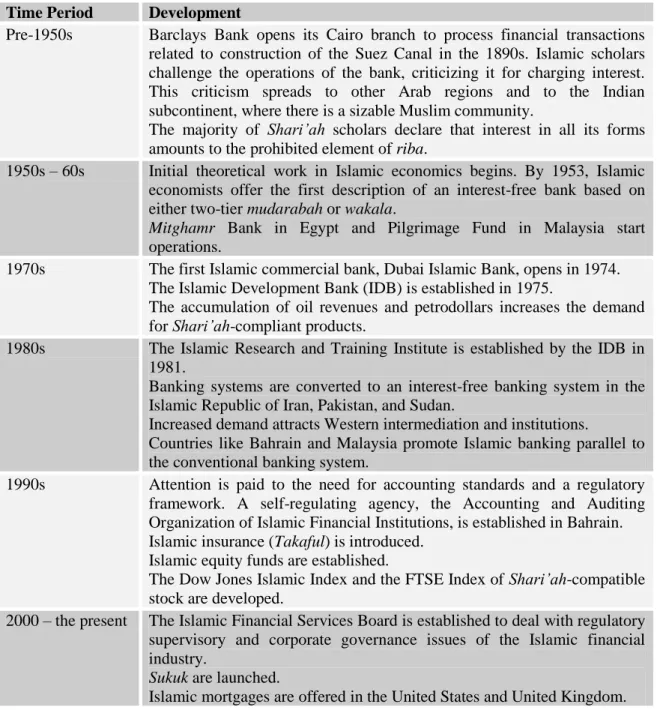
Islamic finance is the fastest growing sector in the financial industry at present. Launched to reconcile the financial with the theological needs of a global community of 1.5 billion Muslims, Islamic finance today offers a broad and sophisticated range of products and services. Double-digit growth rates for Shari’ah-compliant assets over the past decade have naturally driven Islamic financiers to look beyond historical boundaries to explore new territories, both within and outside the Muslim world.
The increasing international interest in Islamic finance is a reflection of the success that this industry has achieved during its short history. Moreover, Shari’ah principles which place emphasis on providing economic added-value to stakeholders and aim to create equivalence in benefits and costs, free from harmful speculation, are gaining more attention and better understanding globally. Several Western supervisory bodies are
incorporating amendments to their supervisory and regulatory legislation to allow for Islamic institutions and Shari’ah-compliant products, which will reinforce the role of Islamic finance globally. Nowadays, in European, American, and most Western markets, financial institutions are offering more products and services to cater for Islamic finance. Moreover, a great number of financial institutions in GCC countries and Asia are managing funds of over USD 300 billion and are encouraged by their markets to provide Islamic financial services (Moody‟s, 2011a).
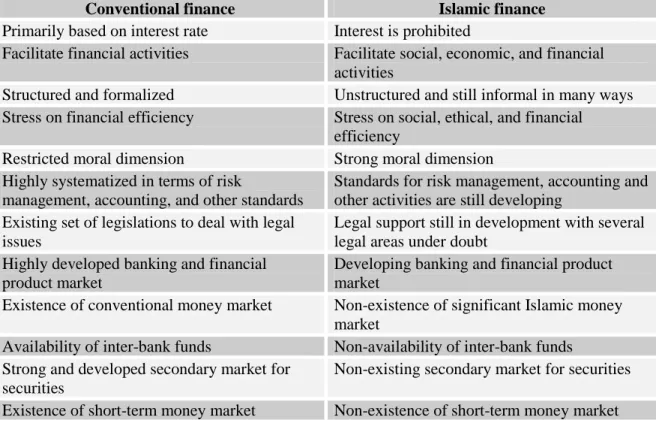
Islamic banking, being the main sub-sector within Islamic finance industry, has been pioneering this exponential growth. According to Moody‟s (2011a), the total assets held by Islamic banks globally amounted to more than USD 1 trillion by the end of 2010. While Islamic banks have been hit by the economic downturn, they have been considerably less affected than most conventional banks. This is mainly because, unlike conventional banks, the Islamic banks have not been exposed to losses from investment in toxic assets, nor have they been highly dependent on wholesale funds. Furthermore, Islamic instruments are highly useful alternative investments for the diversification of portfolios, as they have low correlation to other market segments, allow the selective underweighting of particular sectors, and seem to be relatively independent even from market turbulences like the subprime crisis. As a consequence, the increasing standardisation for derivatives and sukuk, as well as the growing liquidity and organisation of the Islamic capital market, offer many opportunities to innovative investors.
With such a background, it is obvious that Islamic banks have come a long way. The future of these institutions, however, will depend on how they cope with the rapidly changing financial world. With globalization and the information technology revolution, scopes of different financial institutions have expanded beyond national jurisdictions, particularly for investment and wholesale banks. As a result, the financial sector in particular has become more dynamic, competitive, and complex. There has been an unprecedented development in computing, mathematical finance, and innovation of risk management techniques. Moreover, the financial crisis is likely to challenge the global risk management foundations. All these developments are expected to magnify the
challenges that Islamic financial institutions face, particularly as more well-established conventional institutions have begun to provide Islamic financial products. Islamic financial institutions need to equip themselves with the up-to-date management skills and operational systems to cope with this environment. One major factor that will determine the survival and growth of the industry is how well these institutions manage the risks generated in providing Islamic financial services.
The last three decades have witnessed a shift of focus on the development of Islamic banking. The original issue in the sixties and seventies of developing an interest-free financial system is no more the primary objective for Islamic bankers. The current core issue is to develop an Islamic financial industry which does not suffer from the weaknesses of the conventional banking system, particularly after the current credit crisis. Thus, the focus has shifted to risk management and mitigation, financial engineering, innovation, and providing common standards in Islamic finance.
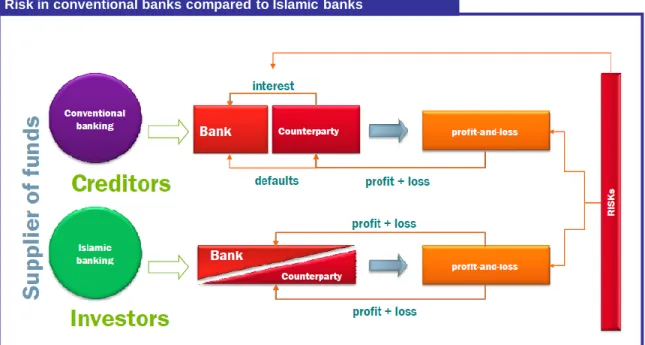
Banking, in all its forms, contains risks that pose a challenge to all stakeholders. Islamic banks, like their conventional counterparts, are financial institutions which provide services to depositors and investors on the one hand and offer financing to companies, the public sector, and individuals on the other. They are, therefore, subject to many risks that are similar to those confronted by conventional banks. There is a growing concern that the risk management practices of Islamic banking are not keeping pace with the global financial market. The rapid growth of Islamic banking on all fronts calls for proactive responses to risk management issues. In addition, Shari’ah-compliant banks have their own unique set of risks that differ from those borne by conventional banks. In principle, there is a range of activities through which Islamic banks can work in different ways that enable them to provide funds. These activities are adapted to meet the Shari’ah principles that govern Islamic banking, the most important of which is the principle of risk sharing.
Managing risk especially in the current perilous times is nothing but an easy task. The events of mid-September 2008 challenged financial institutions‟ preconceived ideas of how to view risk. Until 15 September 2008, few bankers would have thought a systematically important and highly rated financial institution such as Lehman Brothers
could have failed, let alone failed as quickly as it did. However, risk management in Islamic banking is a hot issue as little is yet understood in many aspects, where IFIS are facing significant challenges when measuring and managing risks. Effective risk management in Islamic banking, therefore, deserves priority attention because the future of Islamic banks will highly depend on how they will manage their unique set of risks. So far, Islamic banking has been free-riding on financial theories and instruments developed within the context of the conventional debt- and interest-based system. Unless the Islamic banking industry develops its own genuine risk management architecture, it cannot achieve the dynamism of the Islamic finance system that provides the security and viability needed for a more resilient financial system than the debunked Wall Street model.
1.3 RESEARCH AIMS, OBJECTIVES, AND QUESTIONS
This research attempts to fill the gap in the empirical literature on risk management in Islamic banking. It recognises upfront that Islamic banking offers its own unique approach to risk management. Following a structured approach, first the research aim and objectives were identified and then research questions were developed within the context of the broader objectives.
The aim of this research is to explore and analyse the risk and risk management practices in the Islamic banking industry through the perceptions and opinions of participants drawn from the banking and finance industry. In doing so, this research maps out the attitudes towards risk in the Islamic banking and finance industry and locates perceptions of the various stakeholders on risk management related practices in the industry.
In fulfilling the identified research aim, the following specific objectives are developed:
(i) to ascertain the fundamental principles underlying risk management in Islamic banking and the unique risks facing the IFIs;
(ii) to investigate the effect of different control variables like region, country, respondent‟s position, nature of FI, nature of operations, and accounting standards on the participants‟ perception of the nature of risks, risk measurement, and risk
management and mitigation approaches of IFIs in comparison to those of conventional banks and with reference to the market conditions in which IFIs operate;
(iii) to evaluate the applicability of IFSB Standards and Guidelines with respect to risk management and capital adequacy, and how they could operate in a Basel II (and potentially Basel III) era;
(iv) to investigate the real roots of the recent crisis with a view to draw some lessons for IFIs;
(v) to examine the dichotomy between the theory and practice of Islamic banking; and
(vi) to explore the next chapter for risk management in Islamic banking.
The following specific research questions are developed to address and investigate the broader research objectives:
(i) What are the top risks facing IFIs?
(ii) What is the risk appetite associated with each Islamic finance contract?
(iii) Does risk management in Islamic banking differ from conventional banking?
(iv) Are Islamic banks more or less risky than their conventional peers?
(v) Are Basel II (& potentially Basel III) standards suitable for Islamic banking?
(vi) What are the appropriate capital requirement levels for IFIs?
(vii) Is Islamic banking actually more resilient than conventional banking?
(viii) Could the recent crisis have occurred under an Islamic banking system?
(x) Is there divergence between the current practice and moral principles of Islamic banking?
(xi) How does the future look for Islamic banking? What strategies should IFIs follow?
In answering the research questions, the impact of various categories of respondents and their profile indicators on risk perception are also investigated.
1.4 RESEARCH HYPOTHESES
Based on the dichotomy that exists between the theory and practice in analyzing risk management in Islamic banking, this research aims to explore and study the opinions and risk perceptions of various groups of Islamic banking professionals with the aim of answering the identified research questions.
The following research hypotheses were formulated to determine the parameters of the research questions:
(i) The main risks facing Islamic banks are reputational risk, Shari’ah non-compliance risk, asset-liability management risk, liquidity risk, and concentration risk.
(ii) Islamic bankers prefer mark-up based contracts and shy away from profit sharing contracts.
(iii) Profit-sharing contracts are perceived as more risky than mark-up based contracts.
(iv) There is no substantial difference between risk management in Islamic banking and conventional banking.
(v) Capital requirements levels should be lower in IFIs than in conventional banks.
(vi) Basel II was drafted with conventional banking very much in mind. IFIs should follow their own standards, e.g. IFSB Principles on capital adequacy.
(vii) Islamic banking is more resilient to economic shocks than conventional banking but not recession proof.
(viii) Not many Islamic banks use the more technically advanced risk measurement and reporting techniques.
(ix) The use of risk measurement techniques is less advanced among Islamic banks than among their conventional peers.
(x) Islamic banks use a number of risk mitigation tools that are intended to be Shari’ah -compliant and that are less advanced from those utilised by conventional banks.
(xi) Most IFIs abandoned conservative risk management Shari’ah principles in favour of copying conventional structures.
(xii) There is strong potential for Islamic banking provided that it goes back to its roots.
(xiii) Perceptions of Islamic and conventional bankers differ significantly, as Islamic bankers are more biased towards their business model, and vice versa.
The above hypotheses are further broken down into more refined sub-hypotheses for testing purposes later in this research; these are presented in the research methodology chapter (Chapter 6).
1.5 SIGNIFICANCE OF THE STUDY
This paper has a particular significance as it attempts to provide a complete overview of risk management in Islamic banking. This makes it a valuable source for both conventional and Islamic investors, as well as for IFI, researchers, consultants, and policy-makers who are faced with an increasing complexity of Islamic instruments. Risk management is getting more attention all over the world due to the subprime crisis, and for most IFIs, risk management presents specific challenges.
The existing body of knowledge demonstrates that research on risk management in Islamic banking is still scarce. Globally there has been a significant increase in the literature on risk management over the past decade, especially during the past two years.
This has emerged largely because of a combination of developments: first, there has been greater refection on risk mitigation and management in the wake of frequent episodes of financial crises; second, financial diversification and product innovation have brought new dimensions and types of risks to the forefront; third, the endeavours of the financial community to develop and innovate financial architecture have resulted in different types of risk facing financial institutions. Cross-segment mergers, acquisitions, and financial consolidation have blurred the risk of various segments in the industry. However, these developments have revolved around the conventional banking system, benefiting incrementally from the financial engineering and innovation of esoteric products and structures. While Islamic banking has grown substantively in the last few years, appreciation of its risk architecture and profile is still evolving (Greuning and Iqbal, 2008).
Reflecting the increased role of Islamic finance, the literature on Islamic banking has also grown in the last decade. There is now a considerable amount of research on the topic of Islamic banking and finance; nevertheless there are still large gaps in the coverage of topics related to risk management. A large part of the literature focuses on Islamic finance contracts, structures, roots of Islamic finance, comparisons of the instruments used in Islamic and conventional banking, and the regulatory and supervisory challenges related to Islamic banking. This is expected because the initial focus of the whole Islamic finance industry was to create awareness of perception of Islamic finance and its basic concepts among a riba-dominated financial world. Nevertheless, the last few years have witnessed a shift of focus in the literature on Islamic banking towards more specialised areas like capital markets, mergers and acquisitions, asset management, sukuk, structuring and product development, innovation, and standardisation. There is, however, relatively little research conducted on the risk management and capital requirements for Islamic banking; this includes studies by Haron and Hin Hock (2007), Iqbal and Mirarkor (2007), Akkizidis and Khandelwal (2007), Grais and Kulathunga (2007), Greuning and Iqbal (2007), Mahlknecht, M. (2009), and Sundararajan (2007), and others as explored in Chapter 3.
Given the lack of sufficient research about risk management in Islamic banking, there is even less empirical research available in this vital area. A limited number of papers discuss risks in Islamic financial institutions, but they do so in academic terms instead of pragmatic analysis of data. On the other hand, empirical papers on Islamic banks focus on issues related to efficiency and financial stability, such as Yudistira (2004), Moktar et al., (2006), Heiko and Cihak (2008). But risk management in Islamic banking has not been thoroughly analysed in an empirical fashion, with the exception of only a handful of sources like the profound work done by Khan and Ahmed (2001), Noraini et al. (2009), and Mahlknecht (2009).
In addition, the previous studies on risk management in Islamic banking only highlight the issues without offering any feasible solutions. Therefore this paper is considered as distinct and departs from previous studies by offering practical and feasible recommendations to improve risk management architectures within Islamic banking. Moreover, this study provides a larger sample size within the wider populations in the Islamic banking industry, and includes a very well diversified sample of respondents (geographically, by background, nature of activities of their organisations, as well as other control variables) in order to enable the researcher to obtain better findings by conducting significance tests on the differences between various groups. The survey findings are further enhanced by in-depth interviews with senior Islamic banking professionals, which allow more room for interviewees to express their views in a less formal and more open way than in the structured questionnaire. The interview sample is also well diversified.
Finally, while a few scholars have researched the practical implementation of risk management in Islamic banking, this paper is the first of its kind to do so after the recent credit crisis. The dissertation extracts empirical evidence from the perceptions of Islamic banking professionals and from the current crisis to substantiate the research process and the findings of the research.
1.6 OVERVIEW OF THE RESEARCH METHODOLOGY
In responding to the research questions outlined above, this paper undertakes a combination of two research methods: firstly, a comprehensive review of the existing literature and theory, and secondly an empirical study to elicit the opinions and perceptions in responding to the theory which is discussed in the literature. Both quantitative and qualitative data analyses are used for this part.
In the first part of the research, the theoretical framework of this study was constructed through the literature review, which is presented in a series of chapters. The main literature sources were journals, conference proceedings, books, reports, theses, and bank regulators‟ papers. Due to the fact that literature on risk management in Islamic banking is scant, information and quotations from interviews are used in the literature review to substantiate the argument. This may not be according to convention; however, this strategy helped to provide a better understanding by combining primary and secondary material on the subject matter together.
The second part of the thesis is concerned with an empirical study, which investigates the respondents‟ perceptions towards risk management issues in Islamic banking. A survey technique using questionnaires is used in this context to obtain primary data from the target sample of bankers, financiers, and Shari’ah scholars. The data was analysed using SPSS statistical software. In addition, semi-structured interviews are used to substantiate and compare the questionnaire findings. The detailed description of the research process is presented in Chapter 6.
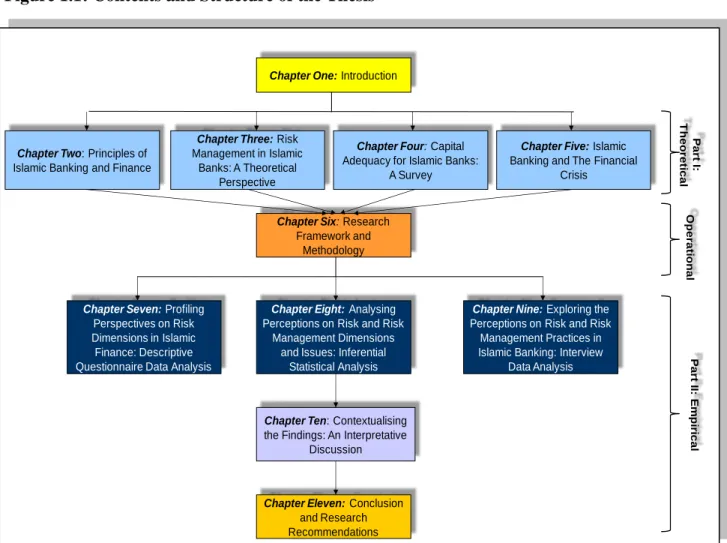
1.7 OVERVIEW OF THE RESEARCH
This study consists of two major sections, namely background and empirical work. The first five chapters are the foundational chapters for the next five chapters, which form the empirical part of the thesis.
Following this brief introduction, the thesis continues with the remaining ten chapters, which are closely interrelated. There is unavoidably some overlapping of discussion and cross-referencing. The overview of Chapters 2 to 11 is as follows:
Chapter 2 (Principles of Islamic Banking and Finance) is the first chapter that reviews the existing literature, text and other relevant reference materials. In order to understand the risks that Islamic financial institutions face, this chapter first briefly discusses the nature of these institutions with the objective of providing an introduction to Islamic banking and its instruments, which it is not intended to provide a detailed description of how Islamic financial products are structured. This chapter is divided into three sections: the first explains the basic tenets of Islamic finance and the most commonly used terms and contracts, the second discusses the important financial instruments available and the market size, and the third looks at the international standardisation bodies.
Chapter 3 (Risk Management in Islamic Banks: A Theoretical Perspective) commences with an overview of risk management in general. After defining and identifying different risks, specific issues related to risk management and mitigation in Islamic banking are discussed. Risks are classified into two main categories: risks which Islamic banks have in common with traditional banks as financial intermediaries, and risks which are unique to Islamic banks due to their compliance with the Shari’ah principles. The risk characteristics of Islamic products and the complexities of some of these are rigorously examined. This chapter is based on both academic desk research and practical views form the open interviews conducted.
As for Chapter 4 (Capital Adequacy for Islamic Banks: A Survey), realizing the significance of capital in today‟s Basel-dominated era, a designated chapter is allocated to analysing capital adequacy for Islamic banks. This chapter examines the need for capital and provides the rational and historical background of the Basel I, II and III frameworks. It then highlights the detailed analysis of credit, market, and operational risks that has been given by the Basel II Accord. Proposed amendments to the Accord after the current crisis and the proposed Basel III standards are discussed. The chapter then examines the applicability of the three Pillars of Basel II to Islamic banking. The chapter also signifies the link between the role of social responsibility of Islamic finance and market disclosure. This chapter further identifies the key role the Islamic Financial Services Board (IFSB)