Direction des études 2002-2003
COURSE OUTLINE
/
Competency based approach
SUPPLY & INVENTORY MANAGEMENT Course title
ACCOUNTING & MANAGEMENT
Program title(s) or component of General Education
BUSINESS ADMINISTRATION Discipline
410-353-MV 2-1-3 1,66
Course code Weighting Credits
Michel Beauregard [email protected]
www.michelbeauregard.com Teacher Office number Telephone number and e-mail
Multicultural Education Centre Marie-Eve Morin
2
GENERAL COURSE DESCRIPTION
How and where the course fits into the student’s program
Targeted competency or competencies in the course Links with other courses, i.e. courses contributing to developing the same competencies
Prerequisites for this course, if any Relevance of this course for the student
General course description:
The course Supply & Inventory Management will provide students with an ability to apply the regulations, purchasing and managerial techniques in acquisition and disbursement of equipment, materials and items in merchandise and service business environment.
The course does not require any prerequisites.
Inventories constitute a significant portion of most firms’ assets. Hence, effective and efficient management of inventories is one of the most vital functions for successful businesses. This course will cover the following topics:
- definition of inventory and purchasing and their place within other functions of a business - identification of inventory management policies and objectives
- overview of the contemporary procedures for purchasing - identification of types of inventories
- learning and practicing the most widely spread and effective techniques for inventory management
- overview of contemporary software solutions for effective inventory and purchasing management
- review financial analysis of inventory management.
The course is targeted to give the students necessary theoretical and practical competences to successfully manage inventory and purchasing in a merchandise or service providing business.
LEARNING TARGET
Task to be completed by the student at the end of the course, as it is related to the competency or competencies
LEARNING TARGET:
By the time the course is successfully completed, a student will be able to:
• Develop a business perspective of inventory management and control
• Enhance his/her professional portfolio of technical skills by mastering the major concepts,
terms, definitions, tools and techniques that make up an inventory system.
• Understand how inventory management is applied in various environments such as
4
STAGES OF LEARNING
Progressive stages showing the logical learning sequence for the student, in order to reach the course learning target
For each stage of learning, specify the learning objectives
essential course contents teaching and learning strategies relative length of the stage
STAGES OF LEARNING:
Module I: Introduction to the course. Definition of inventory and purchasing. Role and objectives of inventory management in a business. The content of
this phase will include:
- definition of inventory and purchasing - role of inventory and purchases in a business
- objectives of the management for inventory and purchases - handling conflicting objectives
- inventory categories - types of inventory
Module II: Independent demand inventory systems: The choice of the appropriate model must be consistent with the overall business plan and objectives, and with the strategies for marketing, finance. The content of these phase will include:
- inventory information systems - independent demand models
- environments and their effects on inventory management - order cycles and lead times.
Module III: Inventory management tools and techniques: Forecasting is critical to estimating future demand. This estimate may be developed by using mathematical formulas, data from informal sources or a combination of both. Forecasting is key to all aspects of a successful business-planning system. As customers place more demands and require faster deliveries, the ability to forecast as accurately as possible is essential. The content of this phase will include:
- Forecasting and determining inventory levels - Essential calculations (EOQ)
- The 80/20 rule (ABC analysis) - Determining other costs - Lot size and safety stock
Module IV: Inventory management and financial analysis: One of the area frequently overlooked in the preparation of inventory management professionals is their financial
knowledge. At a minimum it is necessary to understand the financial ramifications of the inventory policy. The content of this phase will include:
- Financial control of inventory - Balance sheet basics
- Income statement basics
- Identifying suppliers with potential cash-flow problems - Costed bill of materials
- Allocation of factory overhead and activity-based costing.
Module V: Physical controls: the warehouse environment: Warehousing is intended to maximize customer service by positioning the inventory as close to the customer as possible while still impacting cost reduction, especially in the transportation area. The content of this phase will include:
- Objectives of warehousing - Picking, packing and shipping - Costs of warehousing
- Setting up a warehouse system
Module VI: Distribution inventory planning and control(logistics): The physical distribution of products flows through a variety of geographically placed distribution points” Inventory is carried at each location based on criteria such as cost, desired customer-satisfaction level, and efficiency of the distribution operation. The content of this phase will include:
6
EVALUATION OF ACQUIRED SKILLS AND KNOWLEDGE
Evaluations during the course of the session to prepare the student for the final examination
A. Formative evaluations B. Final evaluations
nature and description of the evaluations date
marks awarded evaluation criteria
time required by the student
Showing how the final examination relates to the learning target
EVALUATION OF ACQUIRED SKILLS AND KNOWLEDGE:
During the semester there will be a series of assignment covering the different topics (30%) Students will be required to demonstrate an understanding of certain basic concepts for inventory and purchasing management
Week 8: Midterm Examination, (30%)
Students will be required to demonstrate the understanding of inventory management cycles and procedures.
Week 15: Final Examination, (40%)
Students will be required to prepare an analysis of a case study and provide insights for optimizing inventory management.
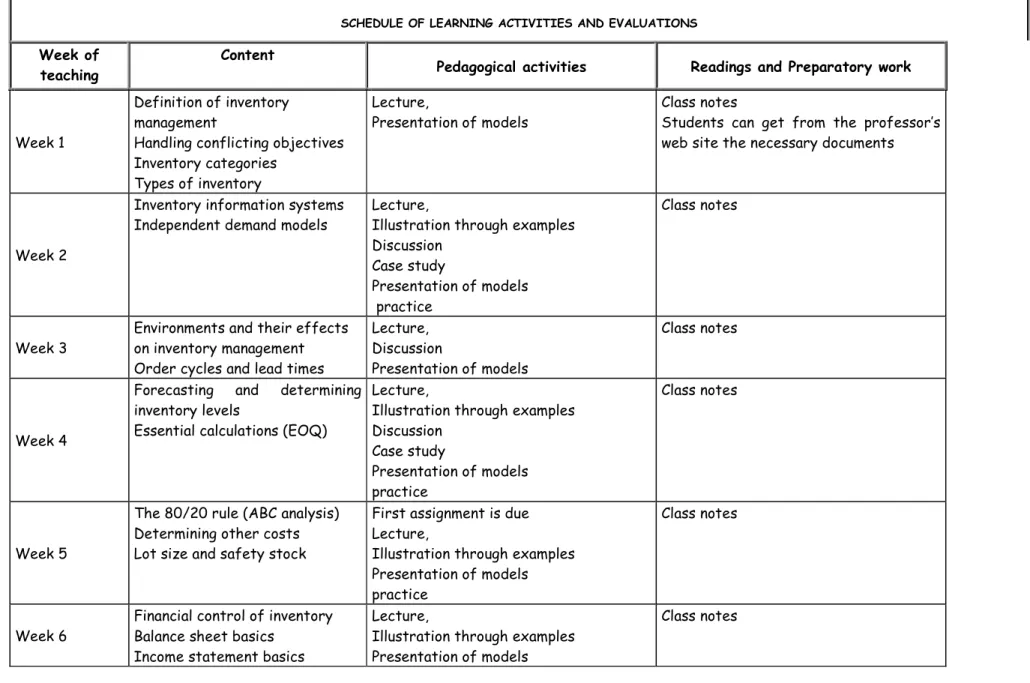
SCHEDULE OF LEARNING ACTIVITIES AND EVALUATIONS
Week of teaching
Content
Pedagogical activities Readings and Preparatory work
Week 1
Definition of inventory management
Handling conflicting objectives Inventory categories
Types of inventory
Lecture,
Presentation of models
Class notes
Students can get from the professor’s web site the necessary documents
Week 2
Inventory information systems Independent demand models
Lecture,
Illustration through examples Discussion Case study Presentation of models practice Class notes Week 3
Environments and their effects on inventory management Order cycles and lead times
Lecture, Discussion
Presentation of models
Class notes
Week 4
Forecasting and determining inventory levels
Essential calculations (EOQ)
Lecture,
Illustration through examples Discussion
Case study
Presentation of models practice
Class notes
8
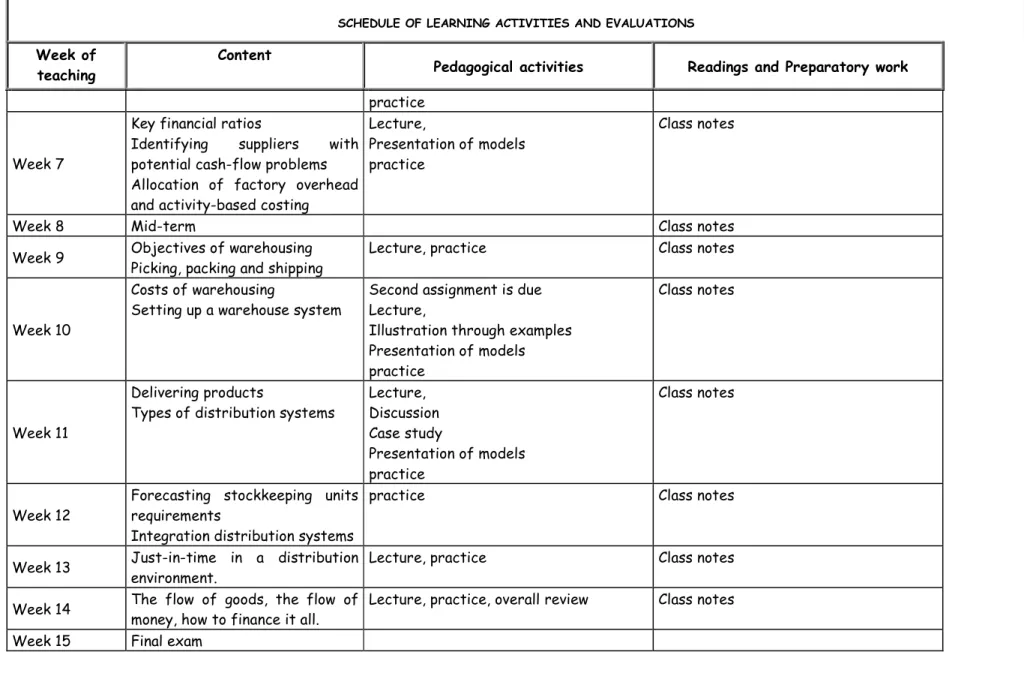
SCHEDULE OF LEARNING ACTIVITIES AND EVALUATIONS
Week of teaching
Content
Pedagogical activities Readings and Preparatory work
practice
Week 7
Key financial ratios
Identifying suppliers with
potential cash-flow problems Allocation of factory overhead and activity-based costing
Lecture,
Presentation of models practice
Class notes
Week 8 Mid-term Class notes
Week 9 Objectives of warehousing
Picking, packing and shipping
Lecture, practice Class notes
Week 10
Costs of warehousing
Setting up a warehouse system
Second assignment is due Lecture,
Illustration through examples Presentation of models practice
Class notes
Week 11
Delivering products
Types of distribution systems
Lecture, Discussion Case study Presentation of models practice Class notes Week 12
Forecasting stockkeeping units requirements
Integration distribution systems
practice Class notes
Week 13 Just-in-time in a distribution
environment.
Lecture, practice Class notes
Week 14 The flow of goods, the flow of money, how to finance it all.
Lecture, practice, overall review Class notes
SPECIFIC COURSE REQUIREMENTS
Application requirements of the PIEA; the following components must be included in the course outline
Class attendance (4.7.3)
Submission of assignments (4.4.2) Evaluation of the English language (4.6.2) Presentation of assignments (4.4.4)
Specific evaluation requirements approved by the Commission des études, if any
article 4.2.5, article 4.2.6, article 4.3.2 and article 4.6.2
SPECIFIC COURSE REQUIREMENTS:
Please read PIEA attentively – it is a good idea to know your rights and responsibilities as students! Missing the final examination without an ABSOLUTELY serious reason will ABSOLUTELY lead you to the failing final grade, which is “0”.
Therefore, you have to seriously take into account that no credits whatsoever will be given to those students who miss classes voluntarily.
Late submission of the assignments will be penalized up to 10%. However, no assignments will be taken by the teacher after the revision of that assignment has been done in class.
Poor language or grammar skills will be treated in accordance with PIEA.
courseoutlineCISE9 10
BIBLIOGRAPHY Required readings
Recommended readings
BIBLIOGRAPHY:
Recommended text:
1. Viale David J., Basics of inventory management, 1996, CrispLearning. ISBN 1-56052-361-1
2. Wild, Tony, Best practice in inventory management, 1997, Woodhead Publishing Limited. ISBN 0-471-25341-3